INTRODUCTION
The replacement of natural shores by hard coastal defence structures (such as seawalls, breakwaters, revetments, and groynes) is increasing as a response to the growing need to defend the coast from sea-level rise and stormier seas (see Airoldi et al. Reference Airoldi, Abbiati, Beck, Hawkins, Jonsson, Martin, Moschella, Sundelöf, Thompson and Åberg2005; Moschella et al. Reference Moschella, Abbiati, Åberg, Airoldi, Anderson, Bacchiocchi, Bulleri, Dinesen, Frost and Gacia2005; Chapman Reference Chapman2006). Realization that these structures generally support lower biodiversity than natural habitats (see for example Chapman Reference Chapman2003, Reference Chapman2006; Chapman & Bulleri Reference Chapman and Bulleri2003; Moschella et al. Reference Moschella, Abbiati, Åberg, Airoldi, Anderson, Bacchiocchi, Bulleri, Dinesen, Frost and Gacia2005; Vaselli et al. Reference Vaselli, Bulleri and Benedetti-Cecchi2008; Firth et al. Reference Firth, Mieszkowska, Thompson and Hawkins2013a; Browne & Chapman Reference Browne and Chapman2014) has focused attention on designing structures that help facilitate specific ecological outcomes (Firth et al. Reference Firth, Thompson, Abbiati, Airoldi, Bouma, Bozzeda, Ceccherelli, Colangelo, Evans and Ferrario2014).
In cases where natural shores are completely replaced by artificial habitats there will be an obvious loss of habitat and the species therein. However, even when species colonize such artificial structures, they can hardly be considered as surrogates for the natural shores they replace (see review by Chapman & Underwood Reference Chapman and Underwood2011). For instance, there is now documented evidence that on such hard coastal defence structures (such as seawalls) there can be changes in the composition of species assemblages (Bulleri et al. Reference Bulleri, Chapman and Underwood2005; Moschella et al. Reference Moschella, Abbiati, Åberg, Airoldi, Anderson, Bacchiocchi, Bulleri, Dinesen, Frost and Gacia2005), abundances (Chapman Reference Chapman2003), size-structure and reproductive output of populations (Moreira et al. Reference Moreira, Chapman and Underwood2006) and competitive interactions (Jackson et al. Reference Jackson, Chapman and Underwood2008; Iveša et al. Reference Iveša, Chapman, Underwood and Murphy2010). Moreover, less obvious changes in community structure can also be found on natural shores surrounded by (Goodsell et al. Reference Goodsell, Chapman and Underwood2007) or in the vicinity of (see Martins et al. Reference Martins, Amaral, Wallenstein and Neto2009) such artificial habitats.
Lack of habitat heterogeneity has been put forward as the main cause of the lower level of biodiversity generally observed on sea defence structures (Chapman & Underwood Reference Chapman and Underwood2011). There is now mounting evidence that experimentally increasing the complexity and heterogeneity of otherwise topographically simple surfaces, for example by including water-retaining features, pits and crevices, can substantially increase the biodiversity of the structure (Chapman & Blockley Reference Chapman and Blockley2009; Firth et al. Reference Firth, Thompson, White, Schofield, Skov, Hoggart, Jackson, Knights and Hawkins2013b; Browne & Chapman Reference Browne and Chapman2014; Firth et al. Reference Firth, Thompson, Abbiati, Airoldi, Bouma, Bozzeda, Ceccherelli, Colangelo, Evans and Ferrario2014). Modifications can also be tailored to increase the abundances of species of economic interest (Martins et al. Reference Martins, Thompson, Neto, Hawkins and Jenkins2010). These studies generally support the idea that hard coastal defence structures can be modified to support an increasing level of diversity and thus contribute toward the conservation and management of urbanized coastlines whilst providing effective protection from sea-level rise and stormier seas.
A common feature of these studies, however, is that their duration is typically < 1 year (see Martins et al. Reference Martins, Thompson, Neto, Hawkins and Jenkins2010; Browne & Chapman Reference Browne and Chapman2014) and little is known about how modifications made to coastal defence structures continue to influence community structure in the longer term, yet results from short-term experiments may not mirror those in the longer-term (for example O'Connor & Crowe Reference O'Connor and Crowe2005) and this may influence feasible management actions (Callahan Reference Callahan1984; Magnuson Reference Magnuson1990).
Patella candei d'Orbigny is endemic to Macaronesia, where it is extensively exploited for human consumption. In the Canary Islands, for instance, P. candei is virtually extinct, presumably due to over-exploitation (Côrte-Real et al. Reference Côrte-Real, Hawkins and Thorpe1996; Navarro et al. Reference Navarro, Ramírez, Tuya, Fernandez-Gil, Sanchez-Jerez and Haroun2005). In the Azores, P. candei stocks collapsed in the mid-1980s (Hawkins et al. Reference Hawkins, Côrte-Real, Pannacciulli, Weber and Bishop2000) and may constitute the largest anthropogenic impact on Azorean coastal ecosystems, being correlated with archipelago-wide changes in the balance between consumers and producers (Martins et al. Reference Martins, Jenkins, Hawkins, Neto and Thompson2008). In 1993, legislation established fishing protected zones (where the collection of limpets is fully prohibited), seasonal fishing closures and minimum catch sizes, but these have proved largely unsuccessful due to lack of enforcement and the limpets still show signs of over-exploitation (Martins et al. Reference Martins, Jenkins, Hawkins, Neto, Medeiros and Thompson2011).
In 2006, experimental habitat enhancements, consisting of the addition of pits differing in size drilled into seawalls at different densities, showed that, over the short-term (four months), the abundance of limpets increased in such enhanced areas of the seawall (in comparison to unmanipulated controls) as a result of both animal immigration and new recruitment (Martins et al. Reference Martins, Thompson, Neto, Hawkins and Jenkins2010). Overall effects of pit density and size varied with limpet size class, with the numbers of large limpets being limited by the availability of pits of the larger size, whereas small limpets were limited by the density of pits of whatever size. Here, we re-survey the experiment to evaluate effects of experimental habitat enhancement on the abundances of the limpet P. candei after seven years. We also examine the wider community-level impacts of changes in patellid limpet populations, because patellid limpets play a key community structuring role on European shores (see Hawkins & Hartnoll Reference Hawkins and Hartnoll1983; Jenkins et al. Reference Jenkins, Coleman, Della Santina, Hawkins, Burrows and Hartnoll2005; Coleman et al. Reference Coleman, Underwood, Benedetti-Cecchi, Åberg, Arenas, Arrontes, Castro, Hartnoll, Jenkins, Paula, Della Santina and Hawkins2006), suggesting that variation in the distribution of limpets as a response to different habitat enhancements may have led to community-wide effects. Moreover, different species of grazing gastropods have distinct influences on the community (for example Hawkins et al. Reference Hawkins, Watson, Hill, Harding, Kyriakides, Hutchinson and Norton1989; O'Connor & Crowe Reference O'Connor and Crowe2005; Griffin et al. Reference Griffin, Noel, Crowe, Burrows, Hawkins, Thompson and Jenkins2010).
METHODS
Study sites and community
The study area was São Roque (São Miguel Island, Azores), which has a gentle sloping basaltic rocky shore with many rock pools, that has been largely replaced by the construction of a 4–5 km long seawall for shoreline protection. Our experimental habitat enhancement was applied to a seawall made of 2 m wide natural basaltic blocks; these had smooth surfaces and lacked the micro-topographic rugosity characteristic of adjacent natural shores (Martins et al. Reference Martins, Thompson, Neto, Hawkins and Jenkins2010). The experimental treatments were applied at mid-shore level just above the algal-dominated lower shore in areas where the barnacle Chthamalus stellatus is the dominant space occupier and the limpet Patella candei reaches its largest abundance. Other patellid limpets (P. aspera) present on Azorean shores are not common at this tidal height. At this height, macroalgae are generally restricted to ephemeral species (such as Ulva spp. and Chaetomorpha spp.) and a few perennial turf-forming algae (for example Caulacanthus ustulatus). Other grazing gastropods, including the littorinids Tectarius striatus and Melarhaphe neritoides, can also be locally abundant.
At each of two sites, 200 m apart, 25 areas of 25 × 25 cm were marked and randomly assigned to five treatments. Five replicate areas were assigned to unmanipulated controls. The remaining 20 areas were randomly assigned to a two-way orthogonal design including the factors pit size (small and large) and pit density (high and low) with five replicates per treatment. Small and large pits were 12 and 24 mm in diameter (both with a depth of 10 mm). Lesser and greater density treatments corresponded to 8 and 16 pits drilled within each area. Pits were drilled using an electrical power drill and were evenly spaced within the experimental areas. The sizes and densities of pits used are within the range of sizes and densities of pits observed on natural shores (for further details see Martins et al. Reference Martins, Thompson, Neto, Hawkins and Jenkins2010). The experimental habitat enhancement was established between November and December 2006.
Sampling design
Experimental areas were resurveyed in November 2013 (84 months after establishment) and March 2014 (87 months after establishment). During the period of time between the start of the experiment and the initial sampling to determine short-term effects of habitat enhancements (see Martins et al. Reference Martins, Thompson, Neto, Hawkins and Jenkins2010) and the resurveys in 2013 and 2014, the experimental areas were left untouched and no sampling occurred. In November 2013, experimentally enhanced plots were re-located and assessed to ensure that pits within experimental treatments were still evident and not masked by natural erosion. At this time, the abundance of mobile gastropods (Patella candei, Tectarius striatus and Melarhaphe neritoides) within each area (25 × 25 cm) was counted. Control areas were not evaluated and sampled at this time. In March 2014, we resurveyed the experiment and recounted all gastropods including those in control areas. In addition, we estimated the percentage cover of sessile species (macroalgae and barnacles). For this purpose, we used a 25 × 25 cm sampling quadrat divided in 25 sub-quadrats. Within each sub-quadrat, a score between 0 (absent) and 4 (full cover) was attributed to all species present. Total percentage cover was obtained by summing the scores of the 25 subquadrats (see Dethier et al. Reference Dethier, Graham, Cohen and Tear1993 for further details). Mobile animals (limpets and littorinids) were counted as described above, and limpets were measured (shell maximum length) using a Vernier calliper. We were able to find all areas except three control locations (marks were gone). We replaced these missing controls with three randomly selected areas scattered among experimental areas. No attempt was made to sample communities surrounding the experimental areas (25 × 25 cm) since the strongest interacting species in this system, P. candei, exhibits a homing behaviour (E. Cacabelos, unpublished data 2014) and was thus unlikely to influence assemblage structures a few centimetres away from the experimental areas.
Data analysis
A mixed model asymmetrical analysis of variance (ANOVA) was used to test for differences in the abundance of taxa among experimental treatments using the factors ‘site’ (random) and ‘among all’ (fixed and orthogonal to site). The latter was partitioned into ‘control versus treatments’, to compare the abundance of taxa in control areas to the average of the enhanced areas, and ‘among treatments’. In addition, the factor ‘among treatments’ was further decomposed and restructured to allow testing the effects of pit ‘size’ (fixed) and ‘density’ (fixed and orthogonal to ‘size’). These are effectively two separate analyses, which can subsequently be built together into a single ANOVA table. Residuals were also decomposed to match changes in the numbers of replicates for both analyses.
Prior to analysis, data were checked for heterogeneity of variances and transformations were applied where necessary (Underwood Reference Underwood1997). Student-Newman-Keuls (SNK) tests were used a posteriori to examine for differences within significant terms.
The variables analysed were the abundance of the gastropods (Patella candei, Tectarius striatus and Melarhaphe neritoides) and the percentage cover of the barnacle Chthamalus stellatus and macroalgae. Prior to analysis, macroalgae were grouped into two morpho-functional groups (Steneck & Dethier Reference Steneck and Dethier1994): uncorticated ephemeral algae, including both filamentous (Chladophora spp.) and foliose (Ulva spp.) species (hereafter referred to as ephemerals alone), and corticated perennial turfs, such as Caulacanthus ustulatus (hereafter referred to as corticated turfs alone). Encrusting algae were also present in some areas, but their overall abundance was very low (< 1%) and was not analysed. This analysis was applied to data sampled during March 2014, as no controls were sampled during November 2013. A simple three-way ANOVA with ‘site’ ‘pit density’ and ‘pit size’ was used to analyse November 2013. Results were similar between these two dates and thus we only present data from March 2014 for simplicity (see Supplementary material, Fig. S1, Table S1 for the analysis of November 2013).
The chi-squared test of independence (or association) was used to test the null hypothesis of no association between the frequency of the three species of grazing gastropods and the experimental treatments. The mean number of each species in each of the four treatments was used as observed frequencies, respectively.
We used Pearson's product-moment correlation to highlight potential relationships emerging from changes in the abundance of grazers as a consequence of treatments on the abundance of sessile taxa.
RESULTS
Enhanced versus control areas
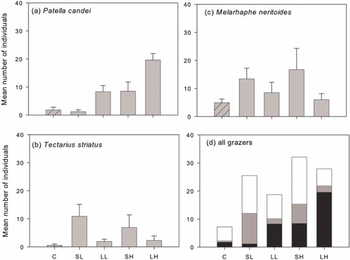
Analysis of the gastropod assemblages showed that all the three species (Patella candei, Tectarius striatus and Melarhaphe neritoides) were on average, more abundant in enhanced areas of the seawall compared to unmanipulated controls (Fig. 1 a–c). This result was significant in the cases of P. candei and T. striatus (Table S2, see Supplementary material), which were c. 5 and 11 times more abundant in enhanced areas of the seawall, respectively. Although the abundance of M. neritoides more than doubled in enhanced areas of the seawall (Fig. 1 c), no significant effect of seawall modification was found (Table S2, see Supplementary material). The mean limpet biomass per plot (dry body weight estimated for each individual from an established length-mass relationship; see Martins et al. Reference Martins, Jenkins, Hawkins, Neto and Thompson2008) of P. candei was also approximately five times greater (mean limpet biomass in mg ± SE, control: 38.2 ± 17.2, enhanced areas: 182.9 ± 30.4) in enhanced areas of the seawall. When considering the entire grazing assemblage (all species together), there was, on average, a significantly greater number of grazers in enhanced areas of the seawall than in unmanipulated controls (Fig. 1 d, Table S2, see Supplementary material).
Mean (+SE) abundance each of the prosobranch gastropod species (a) P. candei, (b) T. striatus, (c) M. neritoides and (d) their combined abundance, in unmanipulated controls and habitat-enhanced areas of the seawall in November 2014. C = control, SL = small and low pit density, LL = large and low pit density, SH = small and high pit density, LH = large and high pit density. In (d), bar length corresponds to the mean abundance of Patella candei (black), Tectarius striatus (grey) and Melarhaphe neritoides (white). Data from the two sites was pooled together for clarity as there was no significant variation between sites (see also Table S2, Supplementary material).

Using SNK tests to examine for differences within the factor ‘among all’ (and not only the control to the average of enhanced areas) showed that, in comparison to controls, the numbers of limpets were effectively and significantly greater in all of the enhanced treatments but one (small and low pit density; Table S3, see Supplementary material). In the case of T. striatus, and despite the significant effect detected between controls and the average of enhanced areas, SNK tests failed to find significant differences between control and all the four enhanced treatments but one (small and low pit density) (Table S3, see Supplementary material).
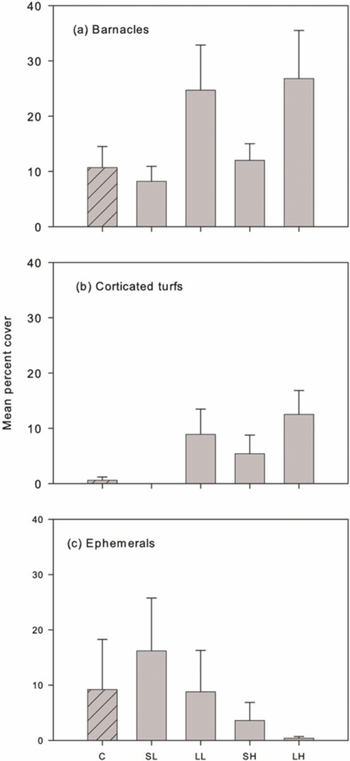
Among the remainder of the assemblage, a significant difference was also found between controls and the average of enhanced areas in the abundance of barnacles and corticated turfs (Table S2, see Supplementary material). These were nearly twice as much and 11 times more abundant in enhanced areas than in controls, respectively (Fig. 2 a, b). In contrast, the abundance of ephemerals was highly variable and did not respond consistently to treatments (Fig. 2 c, Table S2, see Supplementary material).
Mean (+SE) percentage cover of (a) barnacles, (b) corticated turfs and (c) ephemerals in November 2014. For an explanation of other terms, see caption of Fig. 1.

Using SNK tests to examine for differences within the factor ‘among all’ (and not only the control to the average of enhanced areas) showed that, in comparison to controls, the abundance of barnacles was significantly greater in treatments with large pits, independently of their density (Table S2, see Supplementary material). For corticated turfs, results were spatially variable; at one site no difference was found, whilst on the other site there were significant differences only between controls and areas with large and high density of pits (Table S2, see Supplementary material).
Effects of pit size and density
Species making up the gastropod assemblage had variable responses to the different treatments. The limpet P. candei responded positively to both the density and size of pits (Fig. 1 a), being significantly more abundant in enhanced areas with a higher density of pits and in areas with larger pits (Table S2, see Supplementary material). In contrast, the littorinids T. striatus and M. neritoides did not respond to pit density, but were significantly more abundant in areas of the seawall enhanced with small pits (Fig. 1 b–c, Table S2, see Supplementary material). For M. neritoides this result was only detected at one of the sites examined.
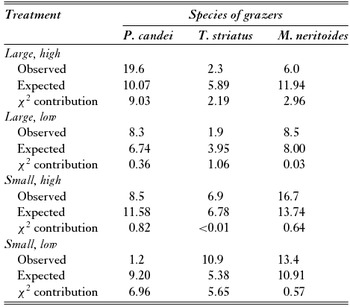
Overall, the null hypothesis of no association between the gastropod assemblage and the experimental treatments was rejected (Table 1). This result suggests that each enhancement treatment supports a structurally divergent assemblage of grazers (Fig. 1 d). This was especially evident in those treatments that differed the most (small pit size and low density versus large pit size and high density), as indicated by the relative chi-squared contribution of each treatment (Table 1). All the above patterns were also present and similar four months earlier in November 2013 (Table S2, see Supplementary material) suggesting that this pattern was temporally consistent.
Results of χ 2 tests of independence comparing the mean abundance of grazers among treatments (χ 2 global = 30.26, df = 4, p < 0.001)

When considering the remainder of the assemblage, the abundance of barnacles was significantly greater in areas with large pits (Fig. 2 a, Table S2, see Supplementary material). A significant interaction between site, pit density and pit size was detected in the case of corticated turfs (Table S2, see Supplementary material). These apparently tended to increase in abundance with increasing pit area (Fig. 2 b), although results were spatially variable (SNK tests in Table S3, see Supplementary material).
The abundance of ephemerals also varied among enhancement treatments (Fig. 2 c). A significant interaction was found between site and pit density, and to lesser extent (α = 0.10) between site and pit size (Table S2, see Supplementary material). SNK tests showed that the abundance of ephemerals was greater in areas with lower pit density (Fig. 2 c), although this was only significant at site 1 (Table S3, see Supplementary material).
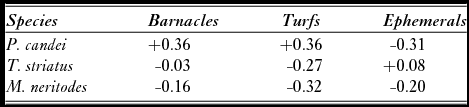
Strong correlations were found between the abundance of barnacles, turfs and ephemerals and P. candei (Table 2). The correlation was positive for barnacles and turfs, but negative between ephemerals and limpets. The abundance of barnacles and ephemerals was also weakly positively correlated with T. striatus, but there was a strong and negative correlation between T. striatus and the abundance of turfs (Table 2). All the sessile taxa (barnacles, turfs and ephemerals) showed a negative correlation with the abundance of M. neritoides (Table 2).
Pearson's product-moment correlation coefficients between the abundance of grazers and the sessile taxa in experimental enhanced areas of the seawall.

DISCUSSION
Long-term effects on the target species
Our results suggest that those areas of the seawall that were experimentally modified to enhance the abundance of the highly exploited limpet Patella candei have had a long-term impact. Although no sampling was done in between the two periods, our resurvey has shown that the short-term enhancement of P. candei, observed by Martins et al. (Reference Martins, Thompson, Neto, Hawkins and Jenkins2010) has been maintained over a seven-year period. Thus, the simple approach of drilling pits in the rock is highly effective in promoting the abundance and biomass of this exploited species over many years; the abundance and biomass of P. candei seven years on was at least five times greater in enhanced compared to control areas of the seawall.
As with results from the short-term experiment (Martins et al. Reference Martins, Thompson, Neto, Hawkins and Jenkins2010), limpets responded differently to the different habitat enhancement treatments. Observations after seven years indicate that limpet abundance as a whole (not differentiating among different size classes; see Martins et al. Reference Martins, Thompson, Neto, Hawkins and Jenkins2010) was positively influenced by the abundance and size of pits, suggesting in particular that the availability of large pits is potentially a limiting factor. This information can be used when designing new infrastructure; in order to enhance limpet stocks, emphasis should be placed on designing structures that offer a high density of pits of the larger size. It should be noted that the larger individuals in this study were all able to fit within the larger pits. It is unclear what happened to animals larger than those that fitted these pits. Such larger animals may eventually seek other areas of the seawall, as reliance on pits decreases with increasing animal size (Martins et al. Reference Martins, Thompson, Neto, Hawkins and Jenkins2010). Such larger individuals are, however, uncommon on Azorean shores due to over-exploitation (Martins et al. Reference Martins, Jenkins, Hawkins, Neto and Thompson2008).
Community-wide effects
Even though the modifications made to the seawall were initially designed considering one specific species (P. candei), a longer-time perspective allows examination of the influence on the structure of the entire assemblage, including littorinids, barnacles and macroalgae (see Fig. 2). When considering littorinids, it is interesting to note that their response to the distinct treatments differed from that observed for limpets. While limpets appeared to be limited by the availability of large pits, littorinids were more abundant in the smaller pits. Their abundance also did not appear to be limited by the density of pits in contrast to that found for limpets. This might reflect the gregarious nature of littorinids as several individuals of both T. striatus and M. neritoides were often found sharing a single pit, as was also noted by Skov et al. (Reference Skov, Hawkins, Volkelt-Igoe, Pike, Thompson and Doncaster2011). This was uncommon among limpets that were generally found inhabiting pits alone. This differing behaviour between limpets and littornids likely reflects differences in the relative strength of intraspecific competition among these gastropods (Underwood Reference Underwood1978).
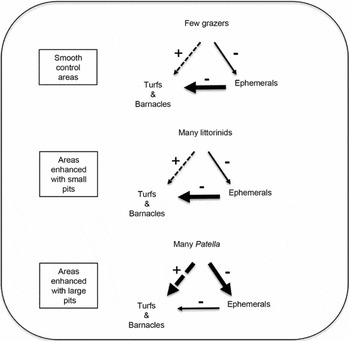
Substantial variation in the abundance of the other taxa (barnacles and macroalgae) was also observed among experimental treatments, especially in relation to pit size. This suggests that the modifications made to the seawall may have also influenced species other than prosobranch gastropods. This is not surprising, as surface topography is known to affect the settlement by many organisms (see Crisp Reference Crisp1955; Harlin & Lindbergh Reference Harlin and Lindbergh1977; Raimondi Reference Raimondi1988). There is, however, an alternative explanation: that changes in the abundance of barnacles and macroalgae are an indirect effect of treatments through changes in the structure of the grazer assemblage (Lubchenco Reference Lubchenco1983; Hartnoll & Hawkins Reference Hartnoll and Hawkins1985; Farrell Reference Farrell1988; Johnson et al. Reference Johnson, Hughes, Burrows and Hawkins1998; Jenkins et al. Reference Jenkins, Coleman, Della Santina, Hawkins, Burrows and Hartnoll2005). For instance, the abundance of ephemeral algae, in contrast with that of limpets, tended to decrease with increasing pit area. Although in such areas there were also increased densities of littorinids, there was little difference in the community structure between these areas and the smooth unmanipulated control areas of the seawall. This result suggests that littorinids have little influence on the overall structure of the community, as noted also by Reference O'Connor and CroweO'Connor & Crowe (Reference O'Connor and Crowe2005) and Griffin et al. (Reference Griffin, Noel, Crowe, Burrows, Hawkins, Thompson and Jenkins2010), even though their abundance was enhanced by the addition of small pits. In contrast, areas of the seawall enhanced by the addition of large pits supported the most distinct community structure with a comparatively higher abundance of limpets, corticated turfs and barnacles, and a lower abundance of ephemeral algae (Fig. 3). Unlike ephemeral algae, a positive correlation was found between barnacles and corticated turfs, and the abundance of limpets, suggesting that the latter may facilitate their establishment. As is widely known, intertidal limpets generally have a large negative effect on the abundance of ephemeral algae (Hawkins Reference Hawkins1983; Van Tamelen Reference Van Tamelen1987). Ephemeral algae, in turn, can have an inhibitory effect of the establishment of perennial algae (see Sousa Reference Sousa1979; Hawkins Reference Hawkins1981; Viejo et al. Reference Viejo, Arenas, Fernández and Gómez2008, Jenkins & Martins Reference Jenkins, Martins, Dürr S. and Thomason2010). Selective removal of ephemerals by high density of limpets in areas of the seawall enhanced with large pits may have thus indirectly facilitated the establishment of barnacles and corticated perennial turfs (Hawkins & Hartnoll Reference Hawkins and Hartnoll1983; Van Tamelen Reference Van Tamelen1987; Benedetti-Cecchi Reference Benedetti-Cecchi2000) (Fig. 3). Overall, these results appear to suggest that the changes seen in the community structure in areas of the seawall enhanced with the addition of large pits may be a result of modifications to the network of interactions among intertidal species (as schematically represented in Fig. 3).
Conceptual representation of the possible network of interactions as result of habitat enhancement treatments. Continuous arrow = direct effect, dashed arrow = indirect effect. Arrow thickness indicates the relative strength of effect; ± indicates whether effects are negative or positive.

CONCLUSION
The experimental modifications made to coastal engineering can have long-lasting effects. This result is important from a conservation perspective and reinforces the concept that simple modifications made to coastal defence structures, that are unlikely to affect structural integrity of the building blocks, can be used as a lasting and effective tool for the conservation of species, provided there is solid understanding of the ecology of the focal species. While the enhancement of unprotected coastal infrastructures may be pointless, many infrastructures actually have regulated access. In these cases, coastal infrastructures may not only positively influence stocks of important species, but also impact nearby areas via spill-over effects. However, our results also suggest that seawall modification can influence non-targeted species both directly, by affecting the spatial distribution of the organisms, and indirectly, by affecting the spatial distribution of competitors and predators. Understanding the interactions between species can lead to a rule-based approach to interventions to enhance biodiversity.
ACKNOWLEDGEMENTS
The initial experiment was supported by Fundação para a Ciência e Tecnologia (FCT) through a PhD grant awarded to Gustavo Martins (SFRH/BD/22009/2005). During this experiment, Gustavo Martins was supported by a post-doctoral grant awarded by the FCT (SFRH/BDP/63040/2009). This research was partially supported by the European Regional Development Fund (ERDF) through the COMPETE and Operational Competitiveness Programme and national funds through FCT, under the project ‘PEst-C/MAR/LA0015/2011’. We thank Eva Cacabelos and João Faria for help during fieldwork.
Supplementary material
To view supplementary material for this article, please visit http://dx.doi.org/10.1017/S0376892915000284