Introduction
The DSM-IV-TR (APA, 2000) conceptualization of personality disorders (PDs) as a group of categorical entities has led to an appreciable research base on several of these constructs (e.g. Blashfield & Intoccia, Reference Blashfield and Intoccia2000), pointing to their clinical utility and predictive validity. Nonetheless, there is broad dissatisfaction with this representation of PDs (Krueger et al. Reference Krueger, Skodol, Livesley, Shrout and Huang2007; Widiger et al. Reference Widiger, Livesley and Clark2009) and various studies have indicated that dimensional alternatives may be more reliable (Heumann & Morey, Reference Heumann and Morey1990; Widiger & Coker, Reference Widiger, Coker and Butcher2002) and valid (Morey et al. Reference Morey, Hopwood, Gunderson, Shea, Skodol, Grilo, Yen and McGlashan2007; Markon et al. Reference Markon, Chmielewski and Miller2011) than DSM-IV categories. However, agreement on the selection of a particular dimensional model to replace the DSM-IV concepts remains limited. Among the alternative proposals are (a) modifying categorical DSM-IV constructs with dimensional representations (Skodol et al. Reference Skodol, Oldham, Bender, Dyck, Stout, Morey, Shea, Zanarini, Sanislow, Grilo, McGlashan and Gunderson2005); (b) replacing PD diagnoses with an assessment of normative traits thought to underlie PD symptomatic expression (Widiger & Trull, Reference Widiger and Trull2007), such as those of the Five-Factor Model (FFM); and (c) assessing traits that are thought to span normal and abnormal personality processes, such as those represented on the Schedule for Nonadaptive and Adaptive Personality (SNAP; Clark, Reference Clark1993) or the Dimensional Assessment of Personality Pathology (DAPP; Livesley et al. Reference Livesley, Jang and Vernon1998) systems.
In an earlier article (Morey et al. Reference Morey, Hopwood, Gunderson, Shea, Skodol, Grilo, Yen and McGlashan2007), we examined the criterion validity of five different models for representing PD in the Collaborative Longitudinal Personality Disorders Study (CLPS; Gunderson et al. Reference Gunderson, Shea, Skodol, McGlashan, Morey, Stout, Zanarini, Grilo, Oldham and Keller2000), examining validating variables that included antecedent variables of potential relevance to etiology and pathogenesis, variables assessing baseline functioning and also 2- and 4-year outcomes. The results of that investigation yielded two broad conclusions. First, there was consistent evidence that dimensional characterizations of PD demonstrated greater concurrent and predictive validity relative to DSM-IV categorical diagnoses. Second, it seemed that models of personality pathology could be distinguished between those that more heavily represent normative trait dispositions (such as the FFM) and those that focus on more maladaptive behavioral manifestations of personality pathology (such as the DSM-IV concepts), and that the latter tended to demonstrate greater concurrent validity whereas the former demonstrated superior predictive validity. Such findings have led to a proposal for PDs in DSM-5 that reflects a ‘hybrid’ combination of personality traits and disorder types (Skodol et al. 2011b).
The purpose of the present report is to present findings from this project at 6, 8 and 10 years of follow-up, to determine whether the trends observed over the first 4 years of this longitudinal study generalize to more distal outcomes. For example, it is possible that some personality characteristics might be predictive of remission, and thus informative for understanding intermediate outcome, but different features might be related to relapse and consequently predictive of longer-term outcomes. As in the previous paper (Morey et al. Reference Morey, Hopwood, Gunderson, Shea, Skodol, Grilo, Yen and McGlashan2007), we provide a comprehensive comparison of these personality models with respect to predictive and incremental validity, using validating markers such as functioning, treatment utilization, suicidal behavior, and Axis I psychopathology. We hypothesized that the results would extend our previous observation that normative personality traits and maladaptive behavioral features represent related but incompletely overlapping phenomena that are each incrementally important in understanding dysfunction related to personality. Furthermore, we examine implications of our findings for the integration of traits and disorders as formulated for the representation of PDs in DSM-5.
Method
Participants were enrolled in the CLPS (Gunderson et al. Reference Gunderson, Shea, Skodol, McGlashan, Morey, Stout, Zanarini, Grilo, Oldham and Keller2000). The initial 668 participants ranged in age from 18–45 years at the time they were recruited from one of the four clinical CLPS sites. Patients met criteria at baseline for at least one of four PDs (avoidant, borderline, obsessive–compulsive, or schizotypal) or major depression without PD. All were previously in treatment or were seeking treatment. Exclusion criteria were active psychosis, history of psychotic disorder, acute substance abuse or withdrawal, or significant confusion. At baseline, the mean age was 32.7 (s.d.=8.1) years, 64% were women, and 75% were self-described as white.
Assessment
Patients were interviewed at baseline by experienced clinicians using the Diagnostic Interview for DSM-IV Personality Disorders (DIPD-IV; Zanarini et al. Reference Zanarini, Skodol, Bender, Dolan, Sanislow, Schaefer, Morey, Grilo, Shea, McGlashan and Gunderson2000). They also completed the self-report Neuroticism–Extroversion–Openness Personality Inventory – Revised (NEO-PI-R; Costa & McCrae, Reference Costa and McCrae1992), a 240-item measure of FFM traits and 30 lower-order facets; and the 375-item SNAP (Clark, Reference Clark1993), a measure of 15 normative and pathological personality traits. These instruments were readministered at the 10-year follow-up. Patients attrition meant that 545 (82%) of the original 668 patients completed interviews at the 6-year follow-up, with 479 (72%) followed up at 8 years and 431 (65%) interviewed at the 10-year follow-up.
Several instruments administered at the 6-, 8-, and 10-year follow-ups assessed functional outcomes. Interviews included the Global Assessment of Functioning (GAF) scale; variables from the Longitudinal Interval Follow-up Evaluation (LIFE; Keller et al. Reference Keller, Lavori, Friedman, Nielson, Endicott, McDonald-Scott and Andreason1987) that assess social, occupational and recreational functioning; follow-up assessments of Axis I diagnoses; and assessments of the occurrence of hospitalizations, medication use, and suicidal behaviors from study year 4 to study year 10. These variables were available for the participants who completed the follow-up assessments. A self-report measure of depression, the Personality Assessment Inventory (PAI; Morey, Reference Morey1991), was also added at study years 6, 8 and 10, as was a self-report measure of interpersonal problems, the Inventory of Interpersonal Problems (IIP; Alden et al. Reference Alden, Wiggins and Pincus1990), thereby extending the range of assessed outcomes beyond our earlier follow-up.
Analyses
The analytic strategy was consistent with the earlier report (Morey et al. Reference Morey, Hopwood, Gunderson, Shea, Skodol, Grilo, Yen and McGlashan2007) in comparing five diagnostic models for PD: (1) the 10 DSM-IV PDs represented as categorical diagnoses (10 variables, coded present/absent); (2) the 10-dimensional DSM-IV PDs expressed as criteria counts (10 dimensionalized criterion count variables); (3) the 15 SNAP traits; (4) the five FFM higher-order factors, and (5) the 30 FFM lower-order facets. The analyses focused on three steps. First, replicating the strategy reported in Morey et al. (Reference Morey, Hopwood, Gunderson, Shea, Skodol, Grilo, Yen and McGlashan2007), all variables in each assessment model (i.e. 10 for the DSM models, 15 for the SNAP, and 5/30 for the FFM domains/facets) were entered simultaneously in multiple regression models to predict 6-, 8- and 10-year outcomes. In addition, the abilities of each model to predict the variables in the other models over time were determined to provide details about how the models relate to one another in ways that might help to explain overlapping and non-overlapping contributions between the models with respect to the prediction of outcome variables. Finally, the incremental validity of each model, controlling for each other model, was calculated to further clarify the unique contribution of different personality models to the prediction of outcomes.
As observed in the earlier report, each model has a different number of predictors and it is well known that, all things equal, models with more predictors generally result in larger coefficients of determination. Thus, as with our earlier investigation, we used the predicted residual sums of squares (PRESS) cross-validation method to correct for potential model over-fitting (Stevens, Reference Stevens2002). A PRESS analysis builds a model with data from every participant except the person whose score is being predicted, and this recurs for every participant. Model effect size is estimated based on the observed residuals in the entire sample, providing a cross-validation uninfluenced by over-fitting resulting from larger numbers of predictors in the regression model. Such an approach is particularly useful to control for overfitting artifacts arising from the use of correlated predictor variables (Weisberg, Reference Weisberg1985), which is typically the case when studying mental health variables as predictors.
In addition, PRESS-based residualized models were constructed to examine the incremental validity of the three broad models. For example, to determine the incremental validity of the FFM over the DSM criteria counts in predicting GAF scores, we saved the residual from the DSM PRESS regression models to determine whether the FFM variables could account for any remaining variance in the GAF scale after all variance associated with the DSM model had been removed. Similar analyses were conducted using the DSM variables controlling for the FFM domains, and so forth, for all paired comparisons of the three models.
Results
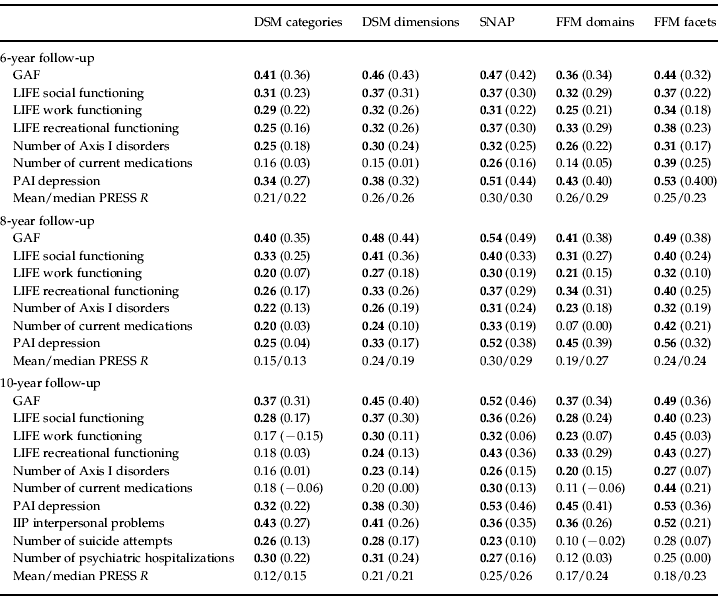
Table 1 shows the uncorrected and cross-validated model effect sizes for predicting outcome variables at the 6-, 8- and 10-year follow-ups. The results of these analyses are reported as both multiple correlations and the square root of PRESS r 2 values. A type I error rate of 0.001 was selected to adjust for the probability of spuriously significant values given the considerable number of (multiple) analyses. With respect to predictive validity, the results were generally consistent with those from the first 4 years of follow-up as noted in Morey et al. (Reference Morey, Hopwood, Gunderson, Shea, Skodol, Grilo, Yen and McGlashan2007). First, there was substantial support for the validity of all five models in predicting a wide range of outcomes, with all models demonstrating significant predictive validity for the majority of outcome variables, and the SNAP model significantly predictive of all outcomes, including those newly assessed, at all three times points. Second, as was the case in Morey et al. (Reference Morey, Hopwood, Gunderson, Shea, Skodol, Grilo, Yen and McGlashan2007), the categorical DSM-IV diagnoses demonstrated appreciably inferior predictive validity relative to their dimensional counterparts, with the dimensional version demonstrating larger PRESS R than categorical diagnosis in 22 out of 24 outcomes (sign test, p<0.001). Furthermore, and also consistent with Morey et al. (Reference Morey, Hopwood, Gunderson, Shea, Skodol, Grilo, Yen and McGlashan2007), the five higher-order FFM domains demonstrated better validity upon cross-validation than the 30 lower-order FFM facets (larger PRESS R in 17 of 24 comparisons, sign test p<0.04), also replicating previous findings. The relative predictive validity advantage of the SNAP dimensions noted in the Morey et al. (Reference Morey, Hopwood, Gunderson, Shea, Skodol, Grilo, Yen and McGlashan2007) report over the first 4 years of follow-up, relative to the FFM domains or the DSM dimensional model, was still evident, with the SNAP demonstrating the largest PRESS R of these three models in 14 out of 24 outcome variables (binomial p<0.01).
Multiple R's (and PRESS multiple R's) for personality models predicting clinical outcomes

PRESS, Predicted residual sums of squares; SNAP, Schedule for Nonadaptive and Adaptive Personality; FFM, Five-Factor Model; GAF, Global Assessment of Functioning; LIFE, Longitudinal Interval Follow-up Evaluation; PAI, Personality Assessment Inventory; IIP, Inventory of Interpersonal Problems.
Suicide attempts and hospitalizations occurred between years 4 and 10.
Significant (p<0.001) multiple correlations are in bold.
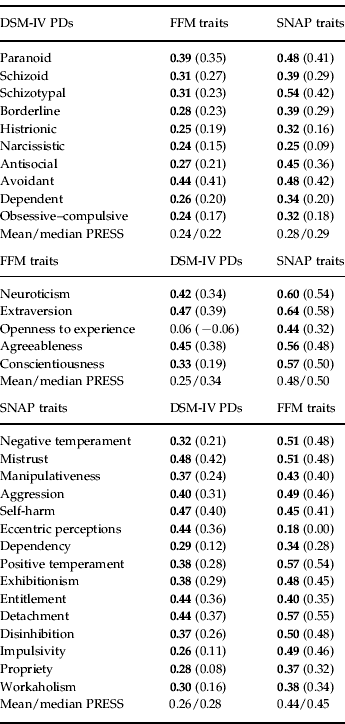
Given the relatively limited predictive validity of the categorical DSM-IV and FFM facet models, subsequent analyses focused on the remaining three models to explore their relationship to one another and the unique contribution of each model independent of the others. Table 2 depicts the ability of the baseline dimensional DSM-IV diagnoses, SNAP traits and FFM domains to predict the variables in the other models at the 10-year follow-up. All models demonstrated significance in predicting each other, which supports the contention that they are accounting for some overlapping variance. The baseline SNAP traits tended to be better at predicting 10-year DSM dimensions than the FFM domains, and better at predicting the 10-year FFM domains than the DSM dimensions; the baseline FFM domains tended to predict the 10-year SNAP traits better than the DSM dimensions.
10-year cross-model predictions in multiple R and (PRESS multiple R) metrics

PRESS, Predicted residual sums of squares; SNAP, Schedule for Nonadaptive and Adaptive Personality; FFM, Five-Factor Model; PD, personality disorder.
Predictor set in columns, predicted dimension in rows.
Significant (p<0.001) multiple correlations are in bold.
The next set of analyses examined the incremental validity of each model in terms of its unique contribution to prediction beyond that provided by alternative models. In these analyses, PRESS predicted scores were computed for participants for each of the three models, predicting each validity criterion, thus allowing each model to be represented by one independent variable, which reflects its estimate of each participant's criterion score. Then, the part-correlation between these estimates (controlling for the estimates derived from the alternative models) were computed for the various outcome measures. This part-correlation indicates the incremental validity added by the first model in estimating the specified criterion over and above the estimate provided by the second model. Thus, for example, a significant part-correlation between the DSM and 10-year GAF, controlling for SNAP, would indicate that the DSM model provides information about the 10-year functional outcome above and beyond that provided by the SNAP traits.
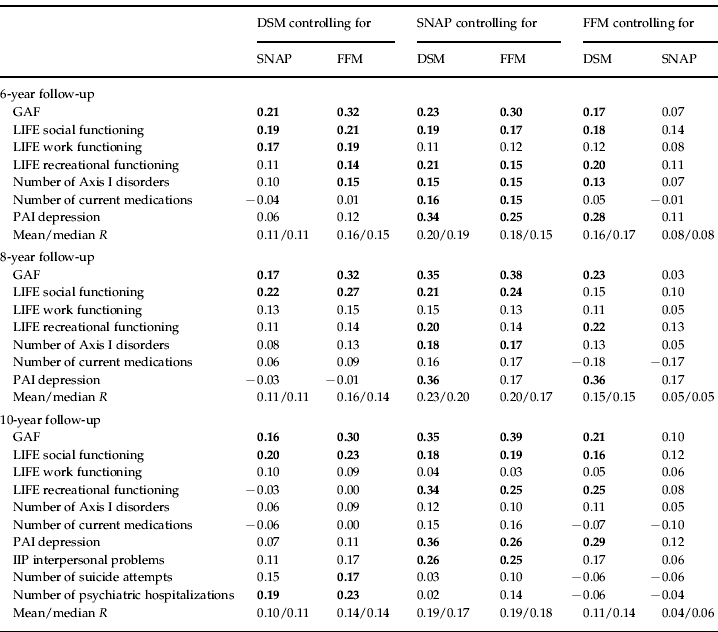
The results of these analyses are reported in Table 3. Statistically significant part-correlations were observed between the SNAP and most of the criteria after controlling for the contribution of the DSM-IV disorder dimensions. However, less than half of the part-correlations of the DSM-IV with outcomes after controlling for the SNAP are statistically significant. The results also indicate that the SNAP incremented the information provided by the FFM to a greater extent than was true of the converse. It seems that the DSM-IV model tended to add significant incremental validity to the SNAP in the prediction of GAF and social functioning, whereas the FFM did not demonstrate any significant incremental validity over the SNAP dimensions on any outcome variables. Both the FFM and the DSM demonstrated incremental contributions over the other model, in that the FFM incremented the DSM and the DSM also incremented the FFM.
Part correlations of PRESS-derived predicted scores with outcomes##

PRESS, Predicted residual sums of squares; SNAP, Schedule for Nonadaptive and Adaptive Personality; FFM, Five-Factor Model; GAF, Global Assessment of Functioning; LIFE, Longitudinal Interval Follow-up Evaluation; PAI, Personality Assessment Inventory; IIP, Inventory of Interpersonal Problems.
Only the FFM domains and DSM dimensions were considered.
Significant (p<0.001) incremental correlations are in bold.
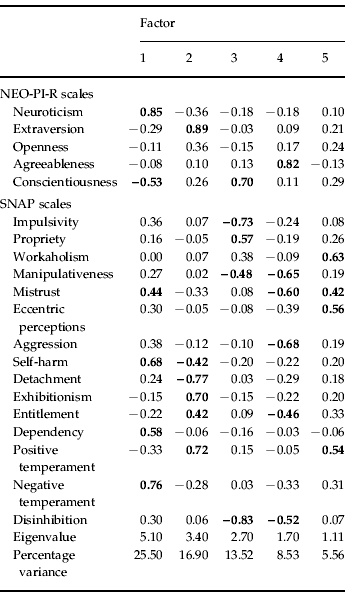
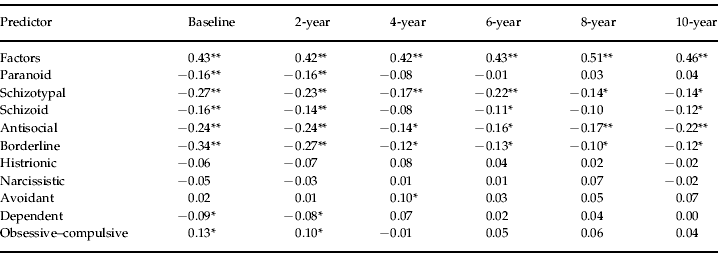
Given the apparent overlap between the SNAP and FFM models, additional analyses were conducted to explore the extent to which specific DSM-IV PDs incremented the predictive validity of an aggregation of these trait-based models. The first step in this process involved the creation of a composite dimensional trait model using a conjoint exploratory factor analysis of study baseline scores on the 15 SNAP dimensions and the five FFM domains, using a principal axis factoring (PAF) method followed by an oblimin rotation. This analysis resulted in five factors with eigenvalues greater than one, cumulatively accounting for 60% of the variance. The structure matrix for this solution is found in Table 4, which indicates that these five factors resemble the broad domains thought to describe the pathological ranges of the FFM (e.g. Widiger, Reference Widiger2011). Then, hierarchical regression analyses were conducted to predict GAF scores at 2-year intervals between study baseline and the 10-year follow-up; these analyses entered the five-factor scores from the conjoint factor analysis as the first block, and then the dimensional symptom counts from the DSM-IV disorders as the second block.
Conjoint factor analysis of baseline SNAP and NEO-PI-R variables

NEO-PI-R, Neuroticism–Extroversion–Openness Personality Inventory – Revised; SNAP, Schedule for Nonadaptive and Adaptive Personality.
Loadings above 0.40 denoted in bold.
The results of these incremental analyses are presented in Table 5. The first row of this table reveals that the five conjoint SNAP/FFM factors measured at baseline demonstrated multiple correlations ranging from 0.42 to 0.51 in predicting GAF scores over the 10 years of the study. Nonetheless, symptom counts from three DSM-IV disorders (borderline, schizotypal and antisocial) demonstrated significant β coefficients (i.e. incrementing variance explained by the five conjoint factors) in predicting GAF at every observation point, whereas a fourth disorder (schizoid) providing incremental prediction at four of the six intervals. Two disorders, histrionic and narcissistic, failed to increment prediction at any of the observed study intervals.
Multiple R's for conjoint NEO-PI-R/SNAP factors and β coefficients for PDs predicting GAF

NEO-PI-R, Neuroticism–Extroversion–Openness Personality Inventory – Revised; SNAP, Schedule for Nonadaptive and Adaptive Personality; PD, personality disorder; GAF, Global Assessment of Functioning.
* p<0.05, ** p<0.001.
Discussion
One of the central aims of the CLPS was to compare the validity of three general models of personality pathology (and variants of two of these models) in predicting outcome in PD over a 10-year period. With respect to this aim, it is important to note that all models (categorical and dimensional DSM-IV, SNAP, and factor- and facet-level FFM) demonstrated significant predictive validity with respect to both intermediate (as shown in Morey et al. Reference Morey, Hopwood, Gunderson, Shea, Skodol, Grilo, Yen and McGlashan2007) and longer-term outcome, as shown here. However, although each model demonstrated predictive validity, it was also the case that all of the dimensional models examined consistently outperformed the DSM-IV categorical PD diagnoses, including a dimensional representation of the DSM-IV disorders. Thus, the data presented here and in the earlier report (Morey et al. Reference Morey, Hopwood, Gunderson, Shea, Skodol, Grilo, Yen and McGlashan2007) provide consistent evidence that any of the examined dimensional models would provide greater predictive utility than the DSM-IV categories, supporting the move toward a dimensional system for classifying PDs in DSM-5.
Although the evidence seems clear that the categorical representation of PD presented in DSM-IV leads to significant loss of predictive information relative to a dimensional representation of the same information, the data concerning the relative validity of the alternative dimensional models examined in this study are less clear. As was the case in our earlier study (Morey et al. Reference Morey, Hopwood, Gunderson, Shea, Skodol, Grilo, Yen and McGlashan2007) and in a subsequent study using a community sample (Grucza & Goldberg, Reference Grucza and Goldberg2007), it seemed that use of lower-order features in a normative trait hierarchy (i.e. the 30 FFM facets) failed to improve upon the higher-order factors (i.e. the five FFM domains) in predicting outcome upon cross-validation. Although the potential gain in precision afforded by the use of lower-order traits may hold promise, it seems that some of this gain may be illusory, with enhanced statistical prediction reflecting an overfitting of a particular data set. Given the increased complexity associated with the use of larger numbers of lower-order traits within a descriptive personality system, there is a need to demonstrate that this complexity is offset by a true increment in validity above that provided by the higher-order trait domains, which did not seem to be the case in this study. As the DSM-5 trait proposal (e.g. Krueger et al., Reference Krueger, Eaton, Derringer, Markon, Watson and Skodol2011) includes lower-order facets and also higher-order domains, it is important to examine this issue with respect to that proposal.
When comparing the dimensionalized DSM-IV, FFM domains and SNAP dimensions, the SNAP model tended to demonstrate the greatest capacity to predict outcome. The SNAP was also able to significantly increment the other models in predicting a wide range of criteria, whereas the opposite was not always true. This finding replicates our earlier observations (Morey et al. Reference Morey, Hopwood, Gunderson, Shea, Skodol, Grilo, Yen and McGlashan2007). As the SNAP was developed to be a hybrid model of PD composed of both general personality traits (which the SNAP describes as ‘adaptive’ traits) and trait features of particular relevance to PD (which the SNAP describes as ‘maladaptive’ traits), this hybrid nature may account for its enhanced predictive capacity. Further supporting this view, it seems that the FFM and the DSM models increment one another in clinical prediction. However, it should also be noted that the limited increment in predictive validity of the FFM over the SNAP may derive from differences in the instruments used to assess these models, with the SNAP providing greater information in the pathological range of constructs similar to those assessed in the more normative range by the NEO-PI-R. Nonetheless, the comparison of the DSM model with the SNAP and FFM suggests that the DSM concepts increment those models in clinical prediction of areas such as global functioning, social functioning and future hospitalizations.
One important extension of the 4-year CLPS results (Morey et al. Reference Morey, Hopwood, Gunderson, Shea, Skodol, Grilo, Yen and McGlashan2007) involved the time course of the predictive capacity of the different models. The pattern over the first 4 years of the study indicated that the validity of the DSM dimensions was fairly high at baseline, but diminished relatively rapidly over the 4 years, whereas the FFM traits sustained a lower but more consistent predictive capacity over the same interval. Although this pattern might produce the expectation that the predictive capacity of the DSM disorders would continue to diminish and ultimately asymptote below that of traits, the data from years 6 to 10 indicate otherwise. The validity of the DSM dimensions for predicting long-term functioning remained as high, if not higher, than the FFM traits, suggesting that aspects of the DSM-IV criterion sets are indeed capturing enduring and also more evanescent problems. Furthermore, the finding of incremental validity of the DSM (in contrast to the FFM) over the SNAP dimensions in the prediction of outcomes, such as global functioning, suicidal behavior and need for hospitalization, suggests that those incremental aspects of the DSM concepts provide prediction of variables that are of considerable clinical relevance. This incremental validity supports perspectives of researchers such as Shedler et al. (Reference Shedler, Beck, Fonagy, Gabbard, Gunderson, Kernberg, Michels and Westen2010), who have argued that a solely trait-based approach to PD diagnosis might be less clinically useful in certain respects than DSM-IV concepts.
This possibility raises an important issue for the consideration of personality trait and disorder concepts in DSM-5: if a trait-based model is incorporated into the new diagnostic manual, which existing DSM-IV concepts are important to retain to increment the validity of information provided by those traits? The results described in Table 5 provide important data addressing this issue. It is noteworthy that a conjoint factor analysis of the SNAP and NEO-PI-R instruments produced a factor structure similar to the pathological trait model proposed for DSM-5 (i.e. Krueger et al. Reference Krueger, Eaton, Derringer, Markon, Watson and Skodol2011), and that these conjoint factors provided appreciable prediction of later functioning over intervals as long as 10 years. However, three DSM-IV disorders in particular, borderline, schizotypal and antisocial, each significantly incremented these conjoint factors at every measurement interval. These results suggest that these diagnostic concepts provide valid information above and beyond that provided by the conjoint trait model, supporting the need to retain these concepts even if such a trait model were implemented. It is important to note that, at least for borderline PD, similar conclusions have been derived from other data sets (Morey & Zanarini, Reference Morey and Zanarini2000; Distel et al. Reference Distel, Trull, Willemsen, Vink, Derom, Lynskey, Martin and Boomsma2009). By contrast, certain DSM-IV disorders, such as histrionic personality disorder, seemed to provide no prediction of functioning beyond that offered by a pathological trait model. It should be recognized that the CLPS focused upon four disorders, and thus lack of incremental predictive validity might be related to the representation of these disorders in this sample, although it should be noted that antisocial personality criteria demonstrated incremental predictive validity even though it was not a focal study group.
The results of this study have important implications for DSM-5, and are consistent with the efforts in DSM-5 to develop a dimensional personality system that integrates personality trait, disorder and core pathology concepts (Skodol et al. Reference Skodol, Bender, Morey, Clark, Oldham, Alarcon, Krueger, Verheul, Bell and Siever2011a , Reference Skodol, Clark, Bender, Krueger, Morey, Verheul, Alarcon, Bell, Siever and Oldham b ), although the hybrid dimensional model of personality and PD assessment and diagnosis proposed for DSM-5 does not include the exact measures or models tested in this study. First, all dimensional models in this study measured at baseline outperformed the DSM-IV categorical approach in predicting important clinical outcomes from 6 to 10 years into the future. These results are consistent with our earlier report (Morey et al. Reference Morey, Hopwood, Gunderson, Shea, Skodol, Grilo, Yen and McGlashan2007) in supporting the shift toward dimensions in DSM-5. Second, personality trait variables predicted outcomes as well as or better than DSM-IV PDs, supporting the inclusion of a pathological trait model in the DSM-5 (e.g. Krueger et al. Reference Krueger, Eaton, Derringer, Markon, Watson and Skodol2011). Third, because certain DSM-IV PD dimensions incremented such trait dimensions in predicting outcomes out to 10 years of follow-up, the decision to include both disorders and pathological traits in the DSM-5 hybrid model is supported. Each approach contributed unique information about prognosis, which would argue against exclusively trait-based or disorder-based models. Finally, our findings that lower-order FFM facets did not increase the predictive validity of the higher-order factors raise questions about the levels at which personality traits should be assessed in DSM-5, as the proposed model includes both lower-order facets and broad trait domains (Krueger et al. Reference Krueger, Eaton, Derringer, Markon, Watson and Skodol2011). Additional research on the reliability and validity of these different hierarchical levels will be particularly important, as will research to determine whether the predictive validity of the systems assessed here can be sustained when implemented in routine clinical practice. It should be noted that there is evidence to suggest that clinicians can provide dimensional trait ratings that provide results similar to those obtained using questionnaires such as the SNAP and NEO-PI-R (Miller et al. Reference Miller, Maples, Few, Morse, Yaggi and Pilkonis2010). Nonetheless, the results described here document that careful assessments of both traits and disorder criteria provide considerable long-term prediction of clinically useful information such as functional outcome and treatment utilization.
Acknowledgments
This publication has been reviewed and approved by the Publications Committee of the CLPS. This study was supported by National Institute of Mental Health (NIMH) grants MH 50837, 50838, 50839, 50840, 50850; MH01654 (to T.H.M.); MH073708 (to C.A.S.); and MH75543 (to C.J.H.). Some of this research was presented at the 2009 American Psychiatric Association annual meeting in San Francisco, CA. We thank M. B. Donnellan for helpful comments on an earlier draft of this paper.
Declaration of Interest
None.