Introduction
Following the launch of the Doha Round of trade negotiations in 2001, the number of WTO Members signing regional trade agreements rose sharply (Crawford and Fiorentino, Reference Crawford and Fiorentino2005). This pattern has given rise to an increase in scholarly interest in the effects of regional trade agreements on international economic relations (Bhagwati, Reference Bhagwati2008). Within this focus on the regionalization of trade governance two basic questions have become important. The first is: What effect do proliferating governance arrangements have on the larger global economic liberalization project (Kurihara, Reference Kurihara2011)? This has been primarily a question of economic outcomes, but political scientists also engage it, examining, for example, the ways that changing patterns of firm behaviour inform the political incentives of governmental actors and the way that narratives of liberalization gains are constructed using counterfactual propositions rather than historical and/or comparative economic data Ciuriak et al., Reference Ciuriak, Lapham, Wolfe, Collins-Williams and Curtis2015; De Ville and Siles-Brugge, Reference De Ville and Siles-Brugge2014).
The second question is: What effect do regional trade agreements (RTAs) have on the multilateral governance of the global trading system? Much of this literature theorizes RTAs as having a decentralizing effect on the law and politics of multilateralism (Drahos, Reference Drahos2007). As preferential deals proliferate, governments focus their attentions on building trading blocs rather than the larger multilateral project (Viner, Reference Viner1952; Summers, Reference Summers, Bhagwati, Krishna and Panagariya1999). Scholars and policy analysts are split on the outcome of this regionalization of governance. Some suggest that as long as liberalization is occurring in such a way as to not directly conflict with the process at the WTO, the net effects will likely be more growth and more trade (Anderson and Yotov, Reference Anderson and Yotov2011), while others argue that regionalization results in inefficient patterns of trade, lower levels growth, and may even undermine multilateral governance by ‘diluting prior [governance] focal points’, to use an evocative phrase of Drezner's (Reference Drezner, Finnemore and Goldstein2013).
This article adds to the latter body of literature by studying exclusion clauses in regional dispute settlement mechanisms and their relationship to the WTO's Dispute Settlement Understanding. It shows that in practical terms, RTAs may only have a decentralizing effect on international economic law in the sense that they embody what Fabricotti has termed a ‘right or freedom to prefer’ (Fabbricotti, Reference Fabbricotti2008: 1). Furthermore, even though some of these arrangements venture beyond the frontiers of WTO governance, it is not clear that RTAs, as instruments of law, will contribute to the fragmentation of international economic law in the realm of trade dispute settlement.
Research has shown that certain large economies are more likely to choose WTO dispute settlement over regional arrangements (Froese, Reference Froese and Deese2014b). As a result, this study begins with the hypothesis that the evolving contours of the aggregate system of regional trade agreements work to channel certain disputes to the WTO. There are two main ways to undertake such a study of RTA dispute settlement. First, one might look at the actual outcomes of regional dispute settlement panels. However, there are precious few of these to examine. Only a handful exist, located notably in regional bodies in the Americas. In fact, the dearth of regional dispute settlement suggests a basic confidence in the WTO system as well as a basic paradox at the heart of the regionalization process, both of which have been examined elsewhere (Froese, Reference Froese2014a). Second, one could undertake an empirical study of the legal texts of regional trade agreements so as to measure the scope of their dispute settlement provisions in relation to that of the WTO, which this paper sets out to do.
The first section reviews key literature on the rise of regional trade agreements. The second section develops an empirical assessment of dispute settlement exclusion clauses and special arrangements in the more than two hundred regional trade agreements currently notified to the WTO. Data were compiled using information available from the WTO's Regional Trade Agreement Information System (RTAIS), The World Bank's Global Preferential Trade Agreements database, The Organization of American State's Foreign Trade Information System, the Investment Policy Hub maintained by the United Nations Conference on Trade and Development (UNCTAD), and national textual online repositories. The texts are analyzed using an empirical method for comparing data across regional agreements in order to show patterns in the deployment of exceptions and exclusions in regional dispute settlement mechanisms.
The third section examines the implications of these exclusion clauses and special procedures for dispute settlement.Footnote 1 Dispute settlement mechanisms in RTAs do not deepen the juridical reach of these agreements as much as scholars and policy makers first imagined they would because most agreements tend to revolve around the WTO, and draw much of their regulatory energy from it (Chase et al., Reference Chase, Yanovich, Crawford and Ugaz2013). Further, in controversial areas, such as technical barriers to trade and antidumping measures, these exemptions may even channel future cases to the WTO. The paper concludes with a brief discussion of future research trajectories, noting that as we move beyond debates around constitutionalism and fragmentation, we are able to foresee a terrain of scholarship in which interdisciplinary scholars may begin to theorize regional trade politics as a function of international economic law, rather than as a series of treaties with a tenuous relationship to the multilateral trading system.
The present and future of regional trade governance
In the introduction above, I briefly discussed two questions scholars ask when discussing regional trade agreements. First, they ask: What effect do proliferating governance arrangements have on the larger global liberalization project? This question is largely beyond the scope of this paper, although the empirical study does contain a number of inferential insights that may be used to qualify this question in the future. The second question is: What effect do regional trade agreements have on the governance of the global trading system? The literature that attempts to answer this question, directly informs this empirical study, and so a brief overview of the most significant features is instructive.
It ought to be noted at the outset that the goal of this literature review is not to provide an exhaustive overview of the vast body of work on regional trade agreements. That would be a scholarly undertaking all its own. Rather, this literature review is divided into two sections dealing with the present and future of regional trade governance respectively. There is a great deal of literature dealing with the potential implications of regional trade governance from a legal perspective. With so few actual disputes to examine, legal scholars have turned to hypothetical scenarios to flesh out insights into the interaction between regional and multilateral agreements (Hammond, Reference Hammond2012). This brief overview will leave aside this realm of legal possibility, focusing instead on the institutional and functional dynamics of the regional/global relationship. By the future of governance, I mean the likely outcomes of current trends and therefore I focus on current scholarly attempts to prognosticate about of the shape of the system in the twenty-first century based upon its current evolutionary trajectory.
The present challenge of regional trade governance
Bhagwati's is perhaps the most evocative warning of the dangers facing multilateralism in the face of rapidly proliferating regional agreements (1998). He argues that RTAs undercut the hard-won principle of non-discrimination and thereby weaken multilateral efforts. Preferential agreements create a patchwork of rules of origin disciplines, which create protectionist barriers to incoming trade. Furthermore, the application of these rules of origin becomes increasingly arbitrary in an interdependent system, and their administration lends itself to corruption as firms attempt to avoid adverse decisions by national regulatory agencies (Bhagwati, Reference Bhagwati1998: 290).
Bhagwati does not consider preferential agreements between developing countries to be as damaging as are agreements among the world's largest traders, partly because of the small volume of trade moving between these economies and partly because these agreements may lower aggregate levels of protectionism. But when large countries participate in regional agreements it undermines the principle of non-discrimination in the multilateral system, with two exceptions: the first being projects of deep economic integration, such as the European Union, that seek to erase national boundaries for the purposes of trade; and the second being regional agreements undertaken for the purposes of jumpstarting multilateral liberalization.Footnote 2 Of course, Bhagwati does not consider early regionalization processes undertaken by the United States to fall into this category. And when considering this wisdom almost 20 years later, it remains clear that whether undertaken for multilateral purposes or not, the regionalization of trade governance has not sparked the political will necessary to renew the post-Uruguay project (Bhagwati, Reference Bhagwati2008).
Whereas Bhagwati locates the fragmentation of the international trade governance system in the short-sighted strategies of governments unwilling to invest in the WTO, Koskenniemi (Reference Koskenniemi2011) locates the fragmentation dynamic in the developmental process of international law, wherein the problems of governance are addressed by legal specialization. This process ‘started to reverse established legal hierarchies in favour of the structural bias in the relevant expertise’ (p. 334). Koskenniemi is concerned about the ways that bodies of experts craft law in the shape of their own visions of order and the public good. Structural bias is based on the assumptions made by experts about the rights and wrong ways to craft rules.
These assumptions are conditioned through training and socialization and tend to inform the conventional wisdom, as it is understood by technocratic elites regardless of nation of origin. Structural bias works alongside specialized bodies of law to create legal silos. In turn, the institutions that operate within these silos reproduce the structural bias in their decision making processes. In certain ways, Koskenniemi's warning of the dangers of structural bias fit neatly with Bhagwati's argument about the short-sighted nature of governmental strategies that allocate political capital away from multilateral processes in favour of easier deals that do not consider the larger philosophical issues at stake.
In a significant theoretical update to Bhagwati's position, Drezner (Reference Drezner, Finnemore and Goldstein2013) examines the regionalization dynamic through the lens of international relations theory. He develops a series of hypotheses for the analysis of what he terms the tragedy of the institutional commons. Drezner offers four ways that the regionalization dynamic works against the grain of multilateralism. First, he suggests that the proliferation of institutions dilutes the power of prior institutional focal points. It is not entirely clear how this power may be drained away, although perhaps if we look at the power of multilateral institutions as a function of the political will of the membership, there may be a testable hypothesis. Second, overlapping institutions enable forum shopping, which makes it easier for states to defect from existing regimes (Drezner, Reference Drezner, Finnemore and Goldstein2013: 283–292). In the legal research, much work examines this potential in the context of forum shopping and the proliferation of forum exclusion clauses in RTAs (Busch, Reference Busch2007).
Third, conflicting legal mandates may weaken existing legal obligations. There is little research in this area, and indeed the empirical study in this paper and the recent work by Chase et al. (Reference Chase, Yanovich, Crawford and Ugaz2013) goes some way in examining this hypothesis. Drezner's fourth hypothetical concerns the financial costs of increasing governance complexity. He suggests that costs may increasingly constrain the governments of small economies. This is a proposition that can only be tested over time; most RTAs are too recent to offer many answers in this regard. Currently, small economies are some of the most enthusiastic signers of RTAs, and it is not clear that they anticipate an increased financial burden as one outcome of trade regionalism. In early days at the WTO, similar arguments were made about multilateralism (Shaffer, Reference Shaffer and Hartigan2009). A cost–benefit analysis ought to consider the differential cost structures associated with the regional and multilateral governance of trade.
Lynch (Reference Lynch2010) considers a number of patterns in the present shape of regional trade governance. Regions with security challenges are unlikely to have highly developed RTAs, likewise for regions where the rule of law is weak. Lynch calls these ‘façade RTAs’ because they provide headlines at international summits but little else, although he notes that facades may be fleshed out and rebuilt as needs and contextual challenges change. Perhaps the biggest development in regional trade governance has been the growth of cross-regional RTAs that greatly add to the ‘complexity of an already complex picture’ (Lynch, Reference Lynch2010: 31). Ultimately, Lynch likens the proliferation of RTAs to the Keynesian paradox of thrift, noting that engaging in RTAs in order to increase regional market efficiency may be rational, but in the aggregate the system of RTAs is a much less effective road to liberalization (p. 235). The paradox of thrift metaphor references Bhagwati's initial concern and speaks to the theoretical concerns of Koskenniemi about the unintended consequences of progress where no larger principle guides structural outcomes.
Elms (Reference Elms and Deese2014) notes that in Asia, where RTAs are robust and play a large role in governing trade flows, the increasing complexity of these arrangements creates significant challenges. The exclusive nature of preferential agreements means that they are not as ‘market-opening as similar commitments made in global agreements’ (p. 264). Even so, progress on trade facilitation issues and the treatment of investment may have salutary spill-over effects that benefit the larger global community. Of greater concern is the trend towards larger regional arrangements, such as the Trans-Pacific Trade and Investment Partnership (TPP), which aim to set standards across a large set of member countries. This increases the potential for conflict between countries with different standards, and increases the challenges faced by exporters moving goods between regions with different sets of standards. Even so, this may ultimately benefit the multilateral system because ‘dealing with multiple, overlapping FTAs may become so cumbersome that firms will start to lobby once more for sorting it all out at the system level’ (Elms, Reference Elms and Deese2014: 264). Intensive regionalization may create incentives to make progress at the WTO.
Fabbricotti (Reference Fabbricotti, Marchisio, Gialdino, Cadin and Manca2014) examines the connection between the politics and law of regional integration, noting that scholars usually employ a top-down method that examines RTAs in terms of their conformity with multilateral principles and rules. In this way, they explain non-conforming agreements as instances of politics overriding law. However, she suggests that there is a long tradition in customary international law of the regional exception to the most-favoured nation principle. It may be more accurate to shift perspective on RTAs from law versus politics to a bottom-up view that examines state practice as a ‘practical case of interrelation between different sources of international law’ (Fabbricotti, Reference Fabbricotti, Lewis and Frankel2010: 139). Such a shift suggests new avenues of research that may examine RTAs as legitimate forms of integration in their own right, rather than insisting upon them as derivatives of an optimal multilateral model.
Overall, the literature on the present challenges of regional trade governance spans a large divide between Bhagwati, who considers RTAs to be a sloppy and indefensible approach to the challenges of multilateralism; Koskenniemi, who considers international law, as a concept, to be increasingly riven with short-term rationality; and others, such as Drezner, Lynch, and Elms, who consider the regionalization dynamic to represent a decentralizing process, with varying degrees of opportunity and challenge represented in this governance form. Finally, Fabbricotti suggests a substantially different road forward, taking RTAs on their own merits, and ascribing to them a place in global trade governance that is protected by customary international law. This range of thought begs the question: What lies ahead for regional trade governance?
Future trajectories of regional trade governance
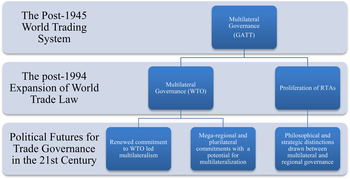
It is something of a false distinction to draw a body of thought on the future of regionalism out of the literature on RTAs because the future implications of regionalism are one of the main preoccupations of this body of work. Nevertheless, some work goes farther than others in speculating about the possible political futures of trade governance (Pauwelyn, Reference Pauwelyn2008). Using Bhagwati's metaphor of the spaghetti bowl, Anderson (Reference Anderson and Deese2014) draws links between the past, present, and future of regionalism, and asks whether we may look forward to a low-carb pasta option (p. 243). Following Menon (Reference Menon2009), he considers four possible futures for the regional governance of trade. The first is consolidation, which Menon also suggests may be a way to negotiate larger, inter-region agreements that supersede the current patchwork of agreements (p. 1395). A second possible future is one of multilateralization, which would be the extension of preferences in one agreement to other parties covered by different agreements, and in this way approach the most-favoured nation principle from a bottom-up direction. Alongside this multilateralization process, a third process of dilution may deal with the worst instances of discriminatory elements in RTAs. Examples include harmonizing the many different procedures that make up rules of origin. Of course, the most obvious way to reduce the carbs in the spaghetti bowl, is to eat fewer noodles – that is to kick-start the WTO process and finally deal with Article XXIV preferences at the heart of the problem (Alavi, Reference Alavi2010).
Liang (Reference Liang and Deese2014) is less sure that the problems with regionalism are institutionally rooted. She argues that regionalism has shifted the focus of liberalization from trade in goods and services to reducing barriers to trade behind the borders of states. The best example of this is the mega-regionalism project currently underway in TPP negotiations that go far beyond traditional issues to include investment policy, competition policy, intellectual property rights, and state-owned enterprises. These issues are frequently included in many, if not most, modern RTAs, but they are also just as frequently exempted from dispute settlement provisions, making them impossible to enforce. Following Baldwin, Liang terms this the trade–investment–services nexus, where a ‘commitment for domestic reform is more important than market access per se’ (Liang, Reference Liang and Deese2014: 408–409; see also Baldwin, Reference Baldwin2011).
A mega-regional approach may have unintended consequences in terms of asymmetrical bargaining, or what Drahos (Reference Drahos2003) calls the weak bargaining with the strong. Drahos' concern about the regionalization process is that the creation of many small agreements is also a proliferation of asymmetrical bargaining processes, in which the more dominant partner could leverage their economic power in order to gain advantages. For example, larger economies could use forum exclusion clauses to direct disputes into regional arrangements where differentials in economic power could influence decisions that benefit the larger partner (Drahos, Reference Drahos2007).
While this possibility has not occurred to date, Drahos' concern about the outcomes of weak/strong bargaining bears scrutiny, if only because the behind the border reforms required by current mega-regional negotiations are driven by the interests of the largest traders; although it ought to be noted that the same is true of the multilateral process (Stone, Reference Stone2011; Goldsmith and Posner, Reference Goldsmith and Posner2005). Scholars and policy makers in developing nations during the Uruguay Round of trade negotiations voiced concerns not unlike these (Bello, Reference Bello2005). If anything, the mega-regional process allows for self-selection by which countries interested in entering into an agreement may join partly because they feel they can pay the price of admission when it comes to reform. We could call this a move from a multilateral to a more selective plurilateral process.
Regionalism is a tacit recognition of what Beckett has described as a trap that snares international law ‘between an incomprehensible reality of fragmentation and a sentimental dream of constitutional order: between Apology and Utopia’ (Beckett, Reference Beckett, Lewis and Frankel2010: 44). Of course, the possibilities that one infers from this liminal space depend upon how optimistic one is about the future trajectory of the international legal project, from the politics of trade to the technocratic turn in legal specialization. Perhaps a better way to put it would be to say that much depends upon one's temperament when it comes to what Trachtman has termed the futurology of international law (Trachtman, Reference Trachtman2013: 66–84). It may be that the relationship between regionalism and multilateralism will change in ways we will not predict, or it may turn out that regionalism is a product of forces we have not yet properly identified. The future is not written, and as the study below will show, sometimes the processes underway have impacts that were impossible to foresee even a few years ago.
The literature on the future of regional trade governance tends to focus upon the costs of the regional shift, both in terms of opportunity costs, as well as in terms of a political cost‒benefit analysis. The future trajectory of regional agreements depends to a great deal upon the agreements themselves, their significance to trading partners, and their importance to firms trading in these regions. Anderson (Reference Anderson and Deese2014) and Liang (Reference Liang and Deese2014) have shown how the future of regionalism is likely to be one of both deeper behind the border integration as well as a mega-regional approach that bears a similarity to what is termed plurilateralism at the WTO (Jones, Reference Jones2014).
Finally, legal theorists, such as Beckett (Reference Beckett, Lewis and Frankel2010) and Trachtman (Reference Trachtman2013), shine a predictive spotlight on the future theoretical and practical challenges of regional governance. Globalization, political and economic development, demography, democratization, and the pace of technological development all play roles in the evolving shape of international law. While we cannot know the future, this delineation between the present and future in regional trade governance literature is useful because it highlights the trajectories we can predict with reasonable certainty. Trade dispute settlement is one such area where we are now beginning to better understand the implications of the previous two decades of legal and political economic change.
Trajectories of global trade governance

Scope and exclusion in regional dispute settlement mechanisms
This empirical study of regional dispute settlement mechanisms examines clauses that exempt certain aspects of the agreement from dispute settlement, or significantly modify dispute settlement procedures vis-à-vis the article or chapter in question. It begins with the 258 active RTAs notified to the WTO as of September 2014. Sixty-one do not contain dispute mechanisms. Following Chase et al. (Reference Chase, Yanovich, Crawford and Ugaz2013), These are coded as reserving political strategies for dispute settlement rather than pursuing juridical means.Footnote 3 There was one more agreement for which the legal text is not widely available (Taiwan–Singapore) making a database of 196 RTAs.
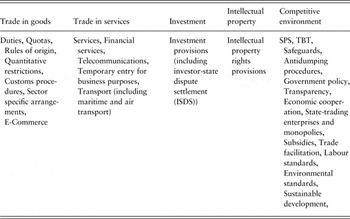
Considering the wide variety of economic goals and textual approaches employed in the drafting of these agreements, the study requires a research method that is sensitive to the linguistic comparisons used to organize the main features of almost 200 RTAs. A thematic typology was developed for cataloguing the scope of each agreement and the existence of exclusion clauses, or lack thereof, and the special procedures for dispute settlement. It ought to be noted at the outset that the scope of dispute settlement, as it is presented in this study, is not meant to be an exhaustive list of all legal clauses contained in these RTAs. Rather, the study takes as its starting point an ideal-type trade agreement, which is cast as a list of the 28 basic features that are developed in various ways across the majority of RTAs notified to the WTO.
Table 1 below lists this standardized set of articles across five thematic categories. The categories were developed using a basic typological decision matrix to categorize trade agreement chapters according to whether they deal with treatment of goods and services at the border or whether they require a deeper form of integration, as do behind border measures such as safety standards. This methodological approach deals with certain complex issues, such as how to categorize rules of origin by acceding to historical precedent. If the issue is one that is dealt with frequently in first generation agreements, and is thus frequently formalized in a way that treats it as a border issue, then it was assigned accordingly, and vice versa for those issues that populate the domain of second generation agreements, that is those RTAs that have been negotiated since the founding of the WTO.
Thematic typology: legal clauses across five categories

The first four categories, Trade in Goods, Trade in Services, Investment, and Intellectual Property are fairly standard representations of the basic chapters included in agreements that cover these areas. The last category, Competitive Environment, includes those chapters that address deeper integration, including both basic approaches to regulatory harmonization that favour existing WTO disciplines for sanitary standards and technical barriers to trade, as well as so-called WTO-plus or WTO-extra disciplines governing competition policy, labour, and environmental standards.
Using the thematic typology as organizing schema, the author developed a dataset of regional dispute settlement arrangements using the 28 sub-categories (see Table 1 below), and analyzed that data looking for patterns in the deployment of exclusion clauses and special procedures that narrow the scope of dispute settlement arrangements. The result is an exhaustive study of clauses that narrow the scope of dispute settlement in all RTAs notified to the WTO. Annex 1 shows that out of 196 RTAs, 95, or 48%, have at least one dispute settlement exclusion clause, and 109, or 56%, have at least one special procedure, including investor–state dispute settlement provisions. Excluding the EU enlargements that the WTO counts as RTA's in its information system, only 63 agreements, or 32%, do not have any exclusion clauses or special procedures.
Turning to a finer-grained examination of the deployment of exclusion clauses and special procedures, Table 2 below shows exclusions and special procedures across the thematic categories. Competition issues are by far the most excluded category of clause, and 84 agreements contain an exclusion clause in this category. In terms of special procedures, services and investment articles are most likely to contain a modified approach to dispute settlement. This includes standard wording that excludes from dispute settlement portions of temporary entry clauses as well as investor–state dispute settlement mechanisms.
Agreements containing at least one exclusion/special procedure, by category

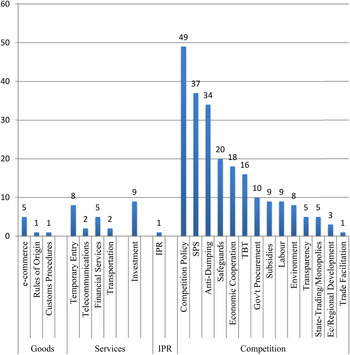
At a higher magnification, we can break down each thematic category into its constitutive legal clauses. Turning first to exclusion clauses, Figure 2 below shows excluded commitments organized by thematic category. The Trade in Goods category contains five clauses excluding e-commerce commitments from dispute settlement, one exclusion for rules of origin and one exclusion for customs procedures. The Services category includes eight temporary entry exclusions, two telecommunications clause exclusions, five financial services exclusions, and two exclusions of transportation disciplines. For investment, there are nine instances of some aspect of investment agreements excluded from dispute settlement. There is just one instance of intellectual property rights being excluded from dispute settlement, and the competitive environment category includes 224 exclusions, which are discussed in more detail below.
All excluded commitments, organized by category

There are a number of significant inferences that can be made from exclusions in the competitive environment category. The most important implications are twofold. First, competition policy is not yet a completed negotiation at the WTO, so exempting it from dispute settlement at the regional level effectively removes it from trade governance oversight completely, which may be a rational strategy on the part of regional partners who wish to benefit from a level playing field for competition policy without necessarily giving up latitude for political action. One hundred and eighteen agreements, or 60% of regional agreements, contain competition policy provisions and of those, 49, or 42%, exclude it entirely from dispute settlement provisions. The reasons that competition policy is frequently excluded from dispute settlement are not entirely clear. One explanation is that governments are reluctant to tie their own hands without recourse to a set of norms or legal principles that create standards for fair competition in the global political economy (Kratochwil, Reference Kratochwil1991). Another is that competition policy, like the issue of temporary entry for business purposes, is already handled by extensive domestic regulation in most states. Bringing issues such as these into a regional trade agreement would be costly, complex, and possibly unnecessary, given the well-developed bureaucracy already in place.Footnote 4
The second point of significance pertains to sanitary and phytosanitary standards (SPS) and antidumping disciplines (AD). The high rate of exclusion of these basic features is not surprising. Standards and antidumping determinations have become primary strategies by which domestic interests push back against the disciplinary features of economic interdependence (Mankiw and Swagel, Reference Mankiw and Swagel2005). Of the 196 RTAs included in this study, 151 and 159 contain SPS and AD chapters respectively. Approximately one in five of these exclude SPS and AD from dispute settlement. By and large when these disciplines are excluded from a regional dispute settlement mechanism (DSM) it is because the parties have agreed to take cases arising from SPS and AD disciplines to the WTO. This suggests that at least for some parties, WTO regulation of these areas is more acceptable and less controversial than regional governance mechanisms.
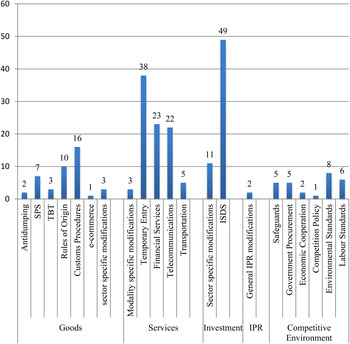
Turning now to clauses that modify dispute settlement, the Trade in Goods category contains 42 special procedures with the most common being customs procedures with 16 modified rules, and rules of origin with ten agreements containing modified rules (see Figure 3 below). In the category of Trade in Services, we see 90 special procedures with the most common being temporary entry for business purposes, with 38 modifications to dispute settlement rules, followed by financial services, with 23 modified rules. In the category of Investment, we find 60 special procedures of which 49 are investor–state dispute settlement mechanisms. Only two agreements modify dispute settlement rules for intellectual property rights, and in the category of Competitive Environment, there are 23 modifications to dispute settlement rules. Figure 3 below ranks special procedures in each of the five categories.
All special procedures, organized by category

It is clear from a basic inspection of the above figure that the standout issues here are investor–state dispute settlement and temporary entry for business purposes. In the case of the latter, 69 agreements contained specific provisions governing the movement of professionals for the purposes of service provision. Approximately 55% also included modifications of those provisions in order to preclude disputes based upon denial of entry. The standard text requires that parties to the agreement refrain from bringing disputes based upon denial of entry unless such a denial constitutes a pattern of action; thereby maintaining the scope of discretion of border services.
Approximately 56% of regional trade agreements contain investment provisions. Of these 109 agreements, 60, or 55%, contain an investment-related modification to dispute settlement provisions. The most common special procedure concerning investment was the inclusion of investor–state dispute settlement, which was present in 45% of agreements that contain investment provisions. In this case, the modification to the dispute settlement mechanism does not limit its scope, but rather enlarges its parameters to include non-state complainants. Perhaps what is most significant here is the prevalence of investor-state dispute settlement (ISDS) provisions in the RTAs signed following the creation of the WTO. This is one of those WTO-extra provisions that has proven to be popular with investors even as it has become a lightening rod for civil society dissent. In ongoing mega-regional negotiations, ISDS is putting a brake to negotiating momentum, but it is interesting that from the standpoint of recent history, the inclusion of ISDS provisions has been relatively uncontroversial, appearing as it does in almost half of all RTAs that deal with investment.
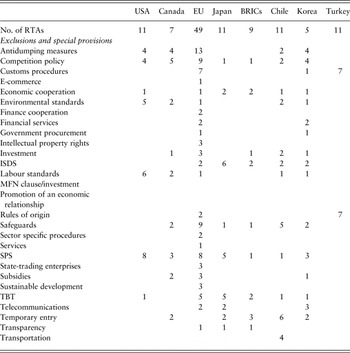
Perhaps the question of most interest concerns the regional distribution of dispute settlement exclusions and special procedures. First, we look at these clauses in RTAs initiated by major trading partners, including the US, Canada, the European Union (including the EFTA), and Japan. Then we compare these with the clauses in RTAs initiated by large emerging economies, including the BRICS (Brazil, Russia, India, China, and South Africa) and three other notable emerging economies, Chile, Korea, and Turkey (see Table 3 below). From the figure below, we can see that in these agreements, exclusions may be a way to introduce progressive disciplines in a politically sensitive manner. The development of special procedures for dispute settlement suggest a well-developed RTA with a full suite of disciplines as well as a range of mechanisms to fully extend dispute settlement to WTO-extra and WTO-plus arrangements.
Dispute settlement exclusions and special procedures in RTAs, by trading partner

US RTAs exhibit the basic trend of excluding from dispute settlement those areas where the WTO has a great deal of legitimacy, such as SPS and TBT, as well as those areas that extend beyond WTO disciplines, such as environmental and labour standards. Of the 11 RTAs on record, seven include investor–state dispute settlement mechanisms and special provisions for the settlement of financial services disputes. Eight contain special provisions for the settlement of telecommunications disputes.
In the Canadian context, of the seven RTAs on record, five exclude emerging issue areas, such as competition policy. Antidumping is also excluded from dispute settlement in four of the agreements, presumably in order to take it up at the WTO. In Canadian initiated RTAs, special procedures for investment usually involve the carving out of policy space for the Investment Canada Act that requires a federal government review of proposed investments in certain sectors of the Canadian economy. Overall, Canada tends to exempt clauses from dispute settlement or provide a special procedure in order to channel cases to the WTO that are politically contentious. For example, RTAs with Panama and Jordan contain provisions that send subsidy disputes to the WTO, and Canada–Costa Rica mandates all disputes involving standards to be handled according to WTO rules.
Exclusions and special procedures in European RTAs tend to follow a similar pattern. Of the 49 agreements signed by the EU and the EFTA with partners outside Europe, nine excluded competition policy, 13 excluded antidumping measures, and seven excluded safeguards from dispute settlement. The table above shows the variety of exclusions and special procedures used in European RTAs. Most notably, EFTA–Korea allows the minority opinion of panelists to be represented in the final dispute settlement panel report – an advance not available in the WTO system. EFTA–Mexico is the only RTA notified to the WTO to exclude intellectual property rights from dispute settlement. Similarly, the European Union's agreements with Central America and Mexico create special procedures to deal with intellectual property.
Japan's RTAs follow the same template laid down by the US, Canada, and Europe. Certain contentious chapters of the agreements, notably SPS, TBT, and competition policy, are excluded from dispute settlement in five of the 11 agreements. In terms of special procedures, six contain investor–state dispute settlement provisions. Like Canada, Japan also tends to defer to the WTO when necessary. For example, Japan–Philippines gives priority to the WTO's Dispute Settlement Body whenever an infringement of the agreement is also an infringement of WTO obligations. In this case, however, it may be that deferring to the WTO is a tacit acknowledgement of the geopolitical complications inherent in the regional governance of trade in the midst of history, culture, and conflict.
Turning to the emerging BRICS economies, we see a much thinner approach to regionalism and with it a less-developed set of RTAs, many of which do not contain well-developed dispute settlement procedures, let alone a well-developed set of exclusions and special procedures, with the sole exception being India. Brazil has not initiated any regional arrangements that have been notified to the WTO. While Russia has notified the WTO of ten regional agreements, none of them has dispute settlement procedures, and I have classified them as political, rather than legal approaches to dispute settlement. India has signed four RTAs, and they do exhibit the basic exclusions, including SPS, TBT, and competition. China has signed five RTAs, and two have investor-state dispute settlement provisions. South Africa has not initiated any agreements, although it is a party to a number of regional arrangements. However, none of the nine African regional economic governance arrangements has specific dispute settlement exclusions or special provisions, although several create customs unions and offer access to a separate court system.
Even so, other emerging economies have been very active in regionalization of trade governance, and their agreements bear a certain resemblance to those of the world's largest economies. In particular, Chile has signed 11 RTAs, and has excluded chapters on safeguards, antidumping, competition policy, and SPS/TBT, to name a few. Special procedures include rules for temporary entry for business purposes, transportation, and two agreements that include ISDS provisions. Likewise Korea's five RTAs include special procedures for ISDS and temporary entry, as well as exclusions for safeguards, antidumping, competition policy, and SPS/TBT. Turkey is a bit of an outlier, having signed 14 RTAs, 11 of which have dispute provisions. Of these, seven contain special procedures for chapters on customs procedures and rules of origin.
It is instructive to compare the emerging economies of Chile, Korea, and Turkey with the BRICS. Despite their status as major emerging economies, the BRICs nations have been slow to develop RTAS. It may be that, in the cases of Brazil, India, China and South Africa, they rely more heavily on WTO rules. Russia is the institutional outlier, having developed a number of regional arrangements, including the Commonwealth of Independent States and a number of bilateral agreements while avoiding the inclusion of dispute settlement provisions, for the most part.
Future trajectories for regional and multilateral dispute settlement
The study above developed a thematic typology of legal clauses that make up a standard regional trade agreement, like the dozens signed in the post-Uruguay Round period. It then examined the scope of dispute settlement by looking at dispute settlement exclusions and other special procedures for augmenting dispute settlement rules. Next we compared exclusions and special procedures within five trade governance themes. Chapters relating to trade in Goods, Services, Investment, and Intellectual Property are seldom excluded from dispute settlement, although there are a number of ways that the rules can be changed to deal with particular areas of concern in these categories. Most exclusions are found in the chapters related to competition. This thematic category contains rules shaping the competitive environment of cross-border trade, from basic features such as SPS/TBT rules through to higher level provisions for competition policy and labour and environmental standards.
Turning to special procedures, this study showed that most of the rules that augment dispute settlement take place in the Investment and Services categories, and relate to investor–state dispute settlement rules as well as rules for disputes concerning telecommunications, financial services, and temporary entry for business purposes, all areas of relatively recent trade governance concern. In particular, it is important to note that more than half (56%) of RTAs contain investment provisions, and of these, almost half (45%) contain ISDS provisions, making it one of the most significant of the WTO-extra processes to arise from regional trade governance.
We then moved to a regional, state-centred snapshot of dispute settlement, looking for patterns in the use of these clauses by major trading partners. We found that above all, exclusions and special procedures correlate closely with so-called ‘full service’ RTAs, like those developed by the United States, Canada, and the European Union. These states tend to negotiate dispute settlement mechanisms that have more exclusions than special procedures, and those exclusions tend to be concentrated in areas where the WTO has significant legitimacy, and in newer trade disciplines like competition policy and labour and environmental standards. With the exception of India, the BRICS have made few entries into the RTA game. Little can be said of their approach to shaping the scope of dispute settlement, although India's approach appears to be consistent with RTAs negotiated by the largest economies. Finally, we turned to three other emerging economies that have been particularly active in negotiating RTAs, Chile, Korea, and Turkey. Of these, two in particular, Chile and Korea, have negotiated exclusions and special procedures along the lines of those seen in other ‘full-service’ RTAs: exclusions for antidumping measures and competition policy, for example, and special procedures for investment and services.
There are a select few RTAs that require dispute settlement panels to take into consideration previous WTO panel decisions when interpreting RTA provisions that relate to WTO provisions. Examples include EU–Korea and the nascent Transpacific Partnership (TPP). The final negotiated text of the TPP was released to the public on 5 November 2015, and the final agreement has not as yet entered into force. As a result, it was not included in this study. Even so, such provisions may mark the beginning of a legal and political–economic process of coherence enhancement (Bernstein and Hannah, Reference Bernstein, Hannah, Narlikar, Daunton and Stern2012). Of course, in formal terms WTO dispute settlement does not create precedent per se. However, the multilateral trading system has a rich history of bringing legal considerations in through the back door (Marceau, Reference Marceau2015). This may be one of those times when next level juridical processes become necessary for the proper functioning of international economic law.
The empirical study suggests that there are two potential institutional trajectories for regional dispute settlement mechanisms in relation to WTO governance. The first is the reinforcement of the centrality of the WTO for dispute settlement. This is usually accomplished by excluding certain basic features of the RTA from dispute settlement, such as SPS and/or antidumping provisions. The second is the decentralization of dispute settlement, which may be accomplished by prescribing alternative dispute settlement options, or by developing dispute mechanisms that go beyond what is on offer at the WTO, such as investor–state dispute settlement mechanisms. Either way, the WTO remains a foundation for the regional dispute settlement process. One of the factors in the successful signing of so many regional agreements in such a short period of time has been that many of these RTAs exclude controversial or leading edge disciplines from dispute settlement. At the same time, one of the most important features of RTAs has been their ability to gain consensus among a smaller number of parties on contentious governance issues, such as investor–state dispute settlement. So how do we weigh the overall impact of these exclusions and special provisions in regional dispute settlement mechanisms?
This study further argues that at least in the realm of dispute settlement, RTAs have been an attempt to build on the momentum of the Uruguay Round that has not moved as far or as fast in WTO-extra and WTO-plus issues as many Members would like. If anything, we can see in the exclusions and special procedures an enlarged role for the WTO. Even so, only a few agreements, such as Japan–Philippines, explicitly prefer WTO dispute settlement to the regional mechanism, and only one prefers its own mechanism for a particular issue (government procurement in Korea–Singapore). Preference for the WTO system is mostly found in the exclusions. Overall, it appears that dispute settlement in RTAs does not deepen the juridical reach of trade disciplines as much as might first be surmised because the chapters not covered at the WTO, such as competition policy, are frequently exempted in RTAs as well. And of course for the most part, governance flows predominantly in one direction because most agreements have boilerplate language stating that actions authorized by the WTO are not subject to dispute settlement at the RTA.
Conclusion: beyond fragmentation
This paper contextualized the empirical study in a body of literature that is primarily concerned with the present and future governance implications of the proliferation of regional trade agreements. However, this research also has implications for another dimension of the literature. One of the most significant debates has been around how to theorize the development of trade law. Scholars in the realist and critical traditions have shown how the development of the GATT/WTO was a strategy on the part of the European Union and the United States to remake the global political economy in their own image. As Steinberg notes, ‘GATT/WTO rules and procedures have been drafted with a particular range of permissible state structures in mind, structures that reflect those of the United States and Western Europe’ (Steinberg, Reference Steinberg, Finnemore and Goldstein2013: 180). Liberal theory tends to place the emphasis on the convergence of ideas that accompanies rising levels of economic interdependence (Slaughter, Reference Slaughter2003).
The rise of RTAs wrinkles the fabric of international relations theory, although it does not fully undermine Steinberg's conception of trade governance as a moulding process or Slaughter's idea of a community of courts. Nevertheless, the proliferation of RTAs raises the spectre of multilateral decline as envisioned by Drezner (Reference Drezner, Finnemore and Goldstein2013) and others, and points towards a future of economic blocs and lower rates of multilateral cooperation. Although as the literature review in the first section showed, some scholars see a silver lining in the shape of more freedom to determine the contours of economic integration.
Even so, this research suggests that the fragmentation of trade law may not be quite what we thought it would be for several reasons.Footnote 5 First, countries do not really use regional dispute settlement bodies, at least not at this time. Second, when they do use these bodies, it is to a far lesser extent than they do the WTO itself. And it is for different reasons. So Canada, Mexico, and the US, for example, use the WTO system for state-to-state cases that could conceivably go to NAFTA, presumably because the WTO's legitimacy means a better possibility of compliance. This flies in the face of the concerns of some scholars who thought that regional agreements would lead to a predatory dynamic in which large economies use these arrangements to gain the upper hand in regional bargaining.Footnote 6
Third, it appears that the arrangements currently in place are a somewhat incomplete set. They rely heavily upon the WTO itself for their institutional form and function, and they tend to want to exclude from dispute settlement areas that are not covered by settled treaty at the WTO. Further, contentious areas of governance that are likely to become sticking points in bargaining processes between regional partners, such as SPS, TBT, antidumping, and safeguards, are frequently excluded from the regional dispute settlement arrangements entirely. This leaves the WTO as the final juridical arbiter in these areas.
Future research ought to further consider the place of politics in the development of international economic law, moving beyond the realist/liberal divide to engage international legal theory and institutional economics. Political scientists have long imagined the development of international law and foreign policy to be a function of what Putnam called a two level game between national and international governance mechanisms. The regional dynamic does not fully displace Putnam's two level game, but it does offer a number of new ways in which to consider the interplay between states and international law (Putnam, Reference Putnam1988).
This study suggests that a more nuanced view is needed to account for the implications of regional trade governance. As regionalism forwards the project of economic integration, albeit with a fragmenting consensus on the efficacy of big-tent multilateralism, there is a sense in some corners that this phenomenon represents a back to basics approach to asserting state autonomy through the customary right to prefer (Fabbricotti, Reference Fabbricotti2008, Reference Fabbricotti, Marchisio, Gialdino, Cadin and Manca2014). While RTAs may indeed represent a new and important body of international economic law, they represent less a break with the WTO system than a LEGO brick approach to building upon the existing architecture of global trade governance in order to customize it for regional potential.
Supplementary material
For supplementary material accompanying this paper visit http://dx.doi.org/10.1017/S1474745616000057.