Introduction
Dementia remains a cause of significant disability and presents multiple challenges for primary care. Increasing prevalence associated with population aging has driven government responses internationally. In England, dementia is a national policy priority with the Prime Minister's Dementia Challenge placing General Practitioners (GPs) at the center of post-diagnostic care and increasing emphasis on prevention while searching for a cure (Department of Health, 2015). With low evidence to support population screening, modifiable risk factor reduction has been seen as the most effective way to potentially reduce and delay the onset of new dementia cases (Norton et al., Reference Norton, Matthews, Barnes, Yaffe and Brayne2014). Risk scores to predict an individual's future susceptibility to developing dementia, utilizing a combination of these risk factors, could also be used to guide clinical management (Tang et al., Reference Tang2015). Early identification and intervention of dementia symptoms has the potential to improve outcomes for the person with dementia (PwD) and their families (Banerjee et al., Reference Banerjee, Willis, Matthews, Contell, Chan and Murray2007). GPs are well positioned to notice the possible cognitive decline of individuals because of the continuity of care and existing inter-personal relationships. However, GPs are often anxious about labeling patients as “early/pre-dementia” (Cahill et al., Reference Cahill, Walsh, O'Connell and Lawlor2006) despite the fact that most patients and families would want to know as it empowers the individual to participate in the planning of their care (Carpenter et al., Reference Carpenter2008). There is also wide variation in primary care physicians’ abilities and confidence in diagnosing and managing dementia (Iliffe et al., Reference Iliffe2009). The aim of this study was to explore the current views and attitudes of future GPs toward dementia care and management.
Methods
All GP trainees based in the North of England were approached to participate in the study (July to October 2014). The survey was formatted and delivered in both electronic and paper formats. It was based on a previous survey carried out on GPs nationally (Ahmad et al., Reference Ahmad, Orrell, Iliffe and Gracie2010) and derived from an earlier trial (Turner et al., Reference Turner2004) but amended for GP trainees by including questions on demographics, attitudes to dementia training, and risk assessment. This questionnaire was piloted to academic GP trainees (Tang and Robinson, Reference Tang and Robinson2014). Trainees were invited to participate via email; a reminder email was sent out two months later. Other routes of publicity included face-to-face encouragement at teaching sessions. A financial prize was offered to two randomly selected participants. Analysis was performed using Microsoft Excel 2013.
Results
There were 153 respondents from a total of 513 (response rate 29.8%, 66.7% female) with all areas and years of training represented. The average age of the respondent was 31 years old (range 25–55 years). Less than a third (27.5% n = 42) reported that they would have some form of training in dementia diagnosis and management during their trainee years compared to 57.5% (n = 88 trainees) who reported that they would not receive any training.
Management of dementia
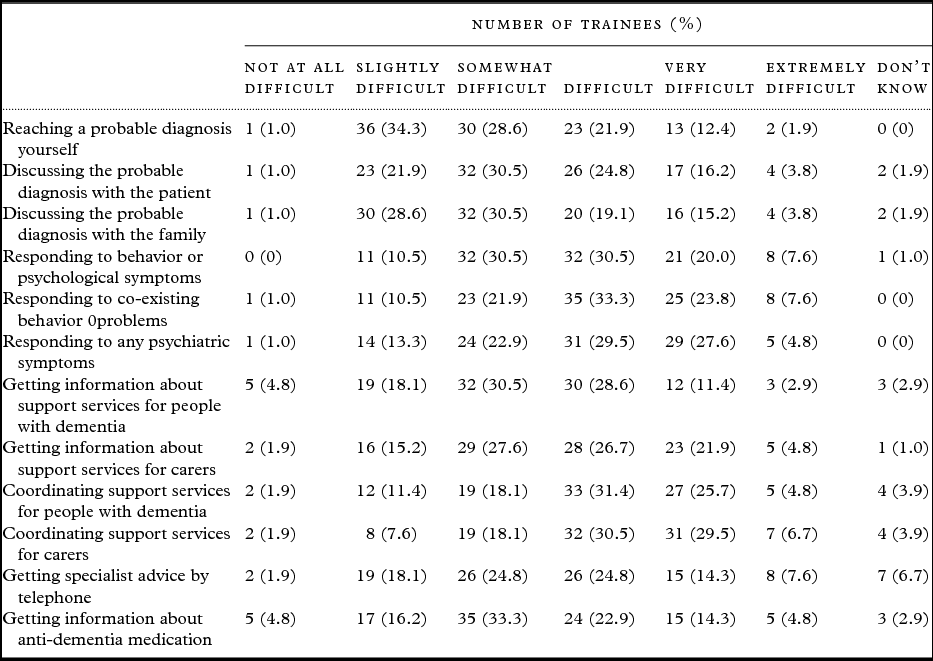
Trainees who had completed at least six months of primary care (69% of trainees, n = 105) were asked to evaluate their experience and attitudes to specific aspects of dementia management (Table 1).
Management of dementia (n = 105)

The main difficulties encountered by trainees included coordinating supporting services for carers (66.7%, n = 70) and the PwD (61.9%, n = 65) and responding to co-existing behavior (64.8%, n = 68) and psychiatric symptoms (61.9%, n = 65). Fewer trainees found issues such as discussing the probable diagnosis with the PwD (44.8%, n = 47) and their families (38.1%, n = 40) as being a difficult issue.
Attitudes to dementia care
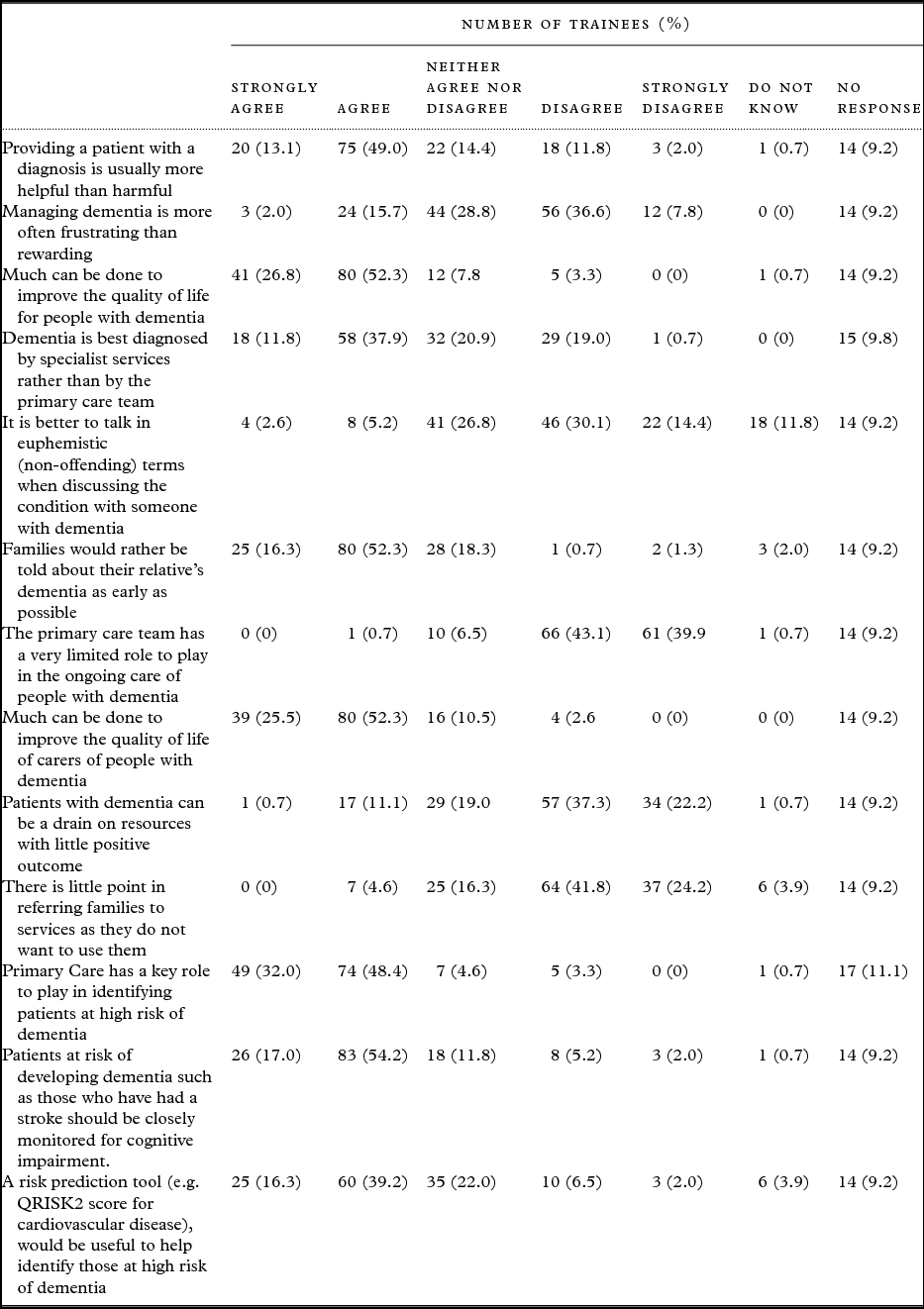
Over 90% (n = 123) of trainees agreed that primary care has a key role to play in identifying those at high risk of dementia with a further 78% of trainees (n = 109) feeling that those at high risk (e.g. post-stroke) should be closely monitored for cognitive impairment (Table 2). Around two-thirds of trainees felt that a risk prediction tool may be useful. Over 90% of trainees (n = 127) disagreed that GPs have a limited role in the ongoing management of dementia with over 85% of trainees (n = 121) feeling that much can be done to improve the lives of the PwD. Referral to services for families’ was also felt to be important with 73% (n = 101) of trainees disagreeing with the statement that “there is little point in referring families to services as they do not want to use them.” Trainees were less decisive when it came to who should be diagnosing dementia as although 55.1% (n = 76) of trainees agreed that specialist services should diagnose dementia around one in five trainees disagreed or strongly disagreed with the same statement. Similarly although just under half of trainees disagreed that managing dementia was more frustrating than rewarding, one in five trainees again felt that this statement was true.
Attitudes to dementia care (n = 153)

Barriers to care
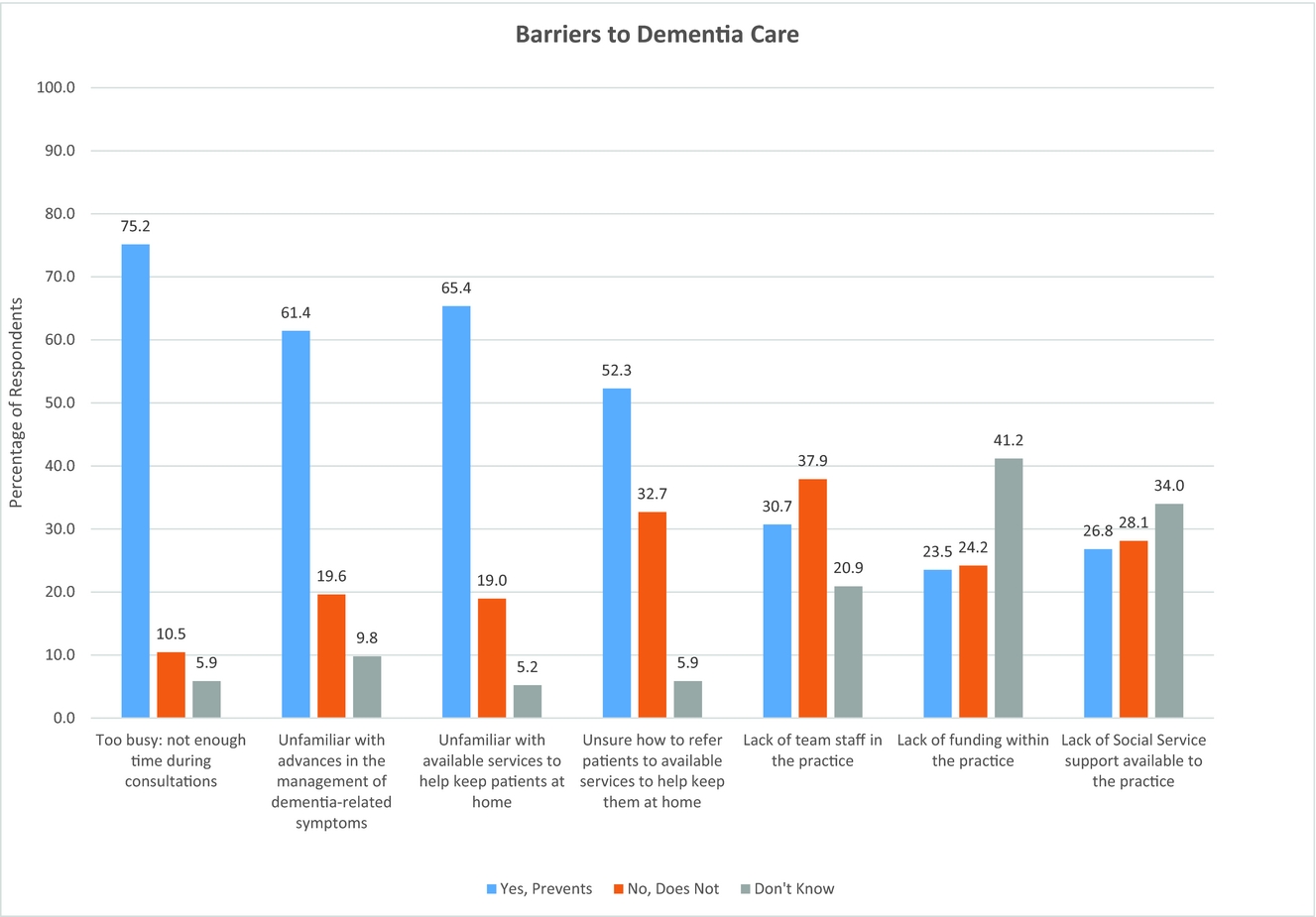
The main barriers to care (Figure 1) included lack of time and familiarity with advances in dementia management and community services available. Despite these barriers, over two-thirds of trainees felt that by the end of training they would be confident in diagnosing dementia (70%) and managing it in the community (68.1%) with 77% feeling confident providing information on dementia to PwD and their carers.
Barriers to dementia care.

Dementia training
Around 80% of trainees agreed or strongly agreed with further training in dementia management during their years in GP training (83.1%) and also following completion of training in the form of a dedicated educational program in dementia (79.7%).
Discussion
This survey of future GPs in one area of England has revealed a very positive approach to dementia care, with 85% of respondents feeling that “much can be done to improve the lives of PwD.”
Dementia management
Trainees were generally positive about dementia management in the community. In the absence of a cure for dementia, the PwD and their families rely on their GP for information to help manage the condition in the community. The lack of time and difficulties in coordinating care in the community for the PwD and their families’ identified by GP trainees is consistent with previous studies (Turner et al., Reference Turner2004). However, the PwD and their families/carers do not receive either sufficient information or receive information in an acceptable format (van der Roest et al., Reference van der Roest2009). GPs are key sources of information for the PwD and their families. The persistent unfamiliarity with both the available services and how to refer to such services will become a hindrance to post-diagnostic care. However, when GPs are exposed to dementia-specific training, GPs were generally more positive about post-diagnostic services compared to those that had not gone through any formal training (Moore and Cahill, Reference Moore and Cahill2013). Behavioral disorders have consistently been found to be a perceived difficulty when managing the PwD in the community. These areas may be well targeted by educational programs, which surveyed future GPs are keen for.
Risk assessment in dementia
There has been an international push toward early detection of dementia (Borson et al., Reference Borson2013). Future GPs surveyed in this study are keen to identify these high-risk individuals to ensure timely diagnosis. It has been suggested that early detection and management of dementia could be improved through GP training and education (Koch and Iliffe, Reference Koch and Iliffe2010). The majority of the trainees in this survey have acknowledged this. Furthermore, around two-thirds of trainees felt that a risk assessment tool may prove to be useful in this area. GPs are familiar with risk assessment tools, such as the ones that have been used in cardiovascular disease (e.g. QRISK2 (Siontis et al., Reference Siontis, Tzoulaki, Siontis and Ioannidis2012)). Similar tools could be used to help risk assess an individual for dementia. Dementia is a complex disease caused by a combination of genetic and environmental risk factors. However, although many risk factors for the occurrence and progression of dementia have been identified, their utility for identifying dementia risk through prediction models remains unclear (Tang et al., Reference Tang2015). No model has gained widespread acceptance or utilization in clinical or research practice.
Limitations of the study
Although to the authors’ knowledge, this is the first survey of GP trainees that has looked at the experience, barriers, and attitudes to dementia care, there are several limitations. The response rate of 30% is low but the age, gender, and years of training are representative of the trainee population in this area. A further limitation of this study is that this was conducted in a single area of England. We have not explored whether other areas may be able to offer more dementia-specific training. Nor have we explored whether other areas have similar levels of perceived barriers e.g. service access or referral pathway familiarity. These limitations may limit the generalizability of these findings. However, when compared to previous surveys of GPs, our findings are comparable.
Conclusions
GPs play an important role in identifying those at the greatest risk of dementia and to manage these individuals and their families post-diagnosis. To ensure that these individuals continue to live well in the community, GPs need to be well supported themselves via access to services, specialist advice, and potentially through educational programs.
Conflict of interest
None.
Description of authors’ roles
Eugene Yee Hing Tang formulated the research question, designed, and carried out the study and wrote the paper. Ratika Birdi was responsible for collating and analyzing the data as well as critically reviewing the manuscript. Louise Robinson was responsible for assisting in the formulation and design of the study. She was also responsible for critical review of the manuscript.
Acknowledgments
The authors would like to thank Prof. S. Iliffe and Jane Wilcock for the use of the questionnaire used in the EVIDEM:ED trial, which has been adapted for GP Trainees in this study. Eugene Tang is supported by a NIHR Doctoral Research Fellowship (DRF-2015-08-006); Louise Robinson is supported by a NIHR Professorship (NIHR-RP-011-043). This study was funded by the Royal College of General Practitioners, Scientific Foundation Board Grant (SFB 2014-03). The funders played no role in the in the design, execution, analysis and interpretation of data, or writing of the study