INTRODUCTION
The choice by plant breeders of source germplasm determines the potential improvement for traits under selection in the breeding programme (Fountain & Hallauer Reference Fountain and Hallauer1996). Proper choice of base population is a key to success in recurrent breeding programmes (Duvick Reference Duvick1996). The parents used in a plant breeding programme generally fall into two categories: locally adapted varieties and varieties chosen for a particular attribute without regard to local adaptation (Simmonds Reference Simmonds1979). All programmes concentrate upon economical means of exploiting the genetic variability of unrelated foreign parents and locally well-adapted genetic backgrounds. In addition, the utilization of heterosis improves the performance of varieties through developing high-yielding single-cross hybrids in allogamous or autogamous species. The literature includes many estimates of the advantage of hybrids relative to the mid-parent (heterosis), the high parent (heterobeltiosis), or the best standard (inbred or open-pollinated varieties; Wehner Reference Wehner, Coors and Pandey1999).
Heterosis has a dual influence in the breeding procedure: firstly, it enriches the cultivation categories of varieties with single-cross hybrids; commercial single-cross hybrid-varieties are often the major component of seed companies' catalogues, as for example in maize (Zea mays L.; Troyer Reference Troyer1996), or in tomato (Lycopersicon esculentum Mill.; Scott & Angell Reference Scott, Angell, Banga and Banga1998). Secondly, it creates a new gene pool by using the F2 generation as germplasm; for example, in maize, an increased use of F2 and backcrosses for second-cycle inbred development programmes was reported (Jenkins Reference Jenkins and Walden1978).
Heterosis in tomato has been studied over the course of the 20th century (Scott & Angell Reference Scott, Angell, Banga and Banga1998) and, as its exploitation in breeding programmes has increased, variety improvement has accelerated accordingly. Even though benefits of heterosis in tomato have long been recognized and some hybrid-varieties were available in the 1940s, widespread use of hybrids has occurred only since the 1970s. The use of hybrids is not due so much to the benefits of heterosis per se, such as increased earliness and greater yields, but has more to do with several other factors. A primary benefit is the protection of parental inbreds used in the production of elite hybrids. This is important, since there has been an increase in the involvement of private companies in tomato breeding research (Scott & Angell Reference Scott, Angell, Banga and Banga1998). A second important benefit of hybrids is the uniformity of trait expression among plants of a variety (Wehner Reference Wehner, Coors and Pandey1999). Hybrids offer additional advantages when important traits are controlled by dominant genes (Kalloo Reference Kalloo, Kalloo and Bergh1993), which need not be fixed in all breeding lines. Examples include resistance to Fusarium wilt races 1, 2 and 3, Fusarium crown and root rot, Verticillium wilt race 1, root-knot nematodes, tobacco mosaic virus and spotted wilt virus (Scott & Angell Reference Scott, Angell, Banga and Banga1998). Also, there are cases where hybrids may offer benefits that are not possible in inbred or open-pollinated varieties, as for example, the ripening inhibitor (rin) gene or the nonripening gene (nor), which in the heterozygous form can reduce postharvest damage if fruit is harvested at more mature stages of development (Tigchelaar et al. Reference Tigchelaar, McGlasson and Buescher1978). Finally, heterosis may be sufficient by itself to justify the production of hybrids. In tomato, hybrid advantage ranges from 0 to 300% over the best inbreds (Wehner Reference Wehner, Coors and Pandey1999). New F1 hybrids grown under improved methods of crop culture and management have resulted in fourfold increase in yield per hectare.
Tomatoes are heterotic for vigour, increased growth and development, earliness, yield, uniformity, or adaptability to a range of environments (Scott & Angell Reference Scott, Angell, Banga and Banga1998). Several theories have been proposed to account for heterosis. Griffing (Reference Griffing1990) showed that heterosis in a cross of two tomato inbreds was due to increased nutrient uptake, as opposed to being more efficient at utilizing limited nutrients. In spite of commercial hybrid-varieties, a number of local varieties or open-pollinated varieties are cultivated by farmers, which are mainly grown in the open-field under lower-input systems.
As the inbred-hybrid system still remains the most important breeding scheme for the commercial production of hybrid seeds (Miranda Filho Reference Miranda Filho, Coors and Pandey1999), the narrowing of the genetic base and the genetic vulnerability to abiotic and biotic stresses, as well as limited future gains from selection (Taller & Bernardo Reference Taller and Bernardo2004) are matters of concern. The maize paradigm showed that among the maize inbreds available in 2001 from foundation seed companies, most derived from only eight inbreds (Lu & Bernardo Reference Lu and Bernardo2001). This point attracted the attention of tomato breeders, although tomato has three advantages: (i) in temperate zones, the proportion of natural outcrossing has been between 0·005 and 0·04 (Rick Reference Rick1949), because there is a requirement for physical movement of flowers for pollination to take place (Jones Reference Jones1999), and the stigma receptivity begins 1–2 days before anthesis (Scott & Angell Reference Scott, Angell, Banga and Banga1998); (ii) there are many well-adapted varieties that complement the source germplasm, and they are themselves either at or near local varietal standard in performance; and (iii) in self-fertilized crops, like tomato, additive genetic variation predominates, and it is always feasible to fix and transgress heterosis (Burdick Reference Burdick1954; Christakis & Fasoulas Reference Christakis and Fasoulas2001).
The purpose of the present paper was to focus on a proposal for an approach to discriminate the breeding value of tomato source material, i.e. commercial single-cross hybrids or open-pollinated varieties, by applying a mating design block test so as to determine the germplasm that: (a) can be used to develop elite recombinant lines quicker than others and (b) needs to be maintained and grown for strategic breeding activities by seed companies.
MATERIALS AND METHODS
Source material
To assess fresh-market tomato parental source material, a mating design between and within two different gene pool resources is suggested. The first source consists of single-cross commercial hybrid-varieties, which have become the major segment of the modern tomato seed industry and continue to predominate high-input agricultural systems and expand under some lower-input systems. The second source consists of open-pollinated well-adapted varieties, which are mainly grown in the open field under lower-input systems. The assessment of source materials is based on mating designs into each group, which evaluate commercial and breeding value, by applying criteria of agronomic performance, general combining ability (GCA) and specific combining ability (SCA). The two gene pools are represented as follows: (a) commercial single-cross hybrids by Iron and Sahara (Geoponiko Spiti, Greek seed company) and (b) commercial open-pollinated varieties by Artemida, Makedonia, Areti and Olympia (National Agricultural Research Foundation, NAGREF, Greece).
The hybrids Iron and Sahara were introduced for cultivation in the 1990s and were distributed by the above seed company. During those years, the cultivation area of these hybrids reached almost 0·2 of the total area cultivated with tomato in Greece (A. Lokas, Geoponiko Spiti, personal communication). Thus, these hybrids possessed an optimum combination of favourable alleles for this region, as well as sufficient additive genetic variation in the F2 generation (Hallauer & Miranda Filho Reference Hallauer and Miranda Filho1995) to make gains from selection.
Makedonia is an old open-pollinated cultivar, which was developed by pure line selection from a local population in the late 1950s, in NAGREF, Agricultural Research Centre of Northern Greece (ARCNG), Thessaloniki, Greece, and supported the traditional farming and the low-input cultivation system of the previous era. The cvs Areti, Artemida and Olympia are new open-pollinated varieties from NAGREF; cv. Areti was developed in 1998 by D. Mourizakis (personal communication), and cvs Artemida and Olympia by Christakis & Fasoulas (Reference Christakis and Fasoulas2001, Reference Christakis and Fasoulas2002). They used the honeycomb selection method for fixing hybrid superiority, which was proposed by Fasoulas (Reference Fasoulas1988). The first variety is maintained by ARCNG, Thessaloniki, Greece, and the other two by the Institute of Viticulture and Horticulture, Pyrgos, Greece. Two varieties were used as testers, Makedonia developed in late 1950s and Artemida developed in 2003. All the above source materials are indeterminate types and well-adapted to both the protected and open-field conditions of the Mediterranean region. The fresh fruits are attractive in appearance, large, fleshy, firm and tasty.
The following criteria for assessment of each source material were applied:
Source A. This approach evaluated the commercial single-cross hybrids Iron and Sahara, by: (i) estimating tolerance to inbreeding; (ii) determining undesirable traits of F2 compared to F1; and (iii) estimating GCA effects and SCA constants from the half-diallel cross of the two hybrids and the varieties Artemida and Makedonia used as testers.
Source B. This approach evaluated the commercial open-pollinated varieties Artemida, Makedonia, Areti and Olympia, by: (i) estimating heterosis of the diallel hybrids between them, with reciprocals; (ii) determining undesirable traits of the above F1 compared to the parents; and (iii) estimating GCA effects and SCA constants from the diallel cross between the varieties, with reciprocals.
Assessment procedure
All the experiments were conducted at the farm of the ARCNG, near Thessaloniki: crossing experiments in 2003 and 2004, and evaluation experiments in 2003, 2004 and 2005.
The experiments were carried out in the open field during 2003 and in a polythene greenhouse during 2004 and 2005. The experimental plant material was prepared conventionally. Uniform seedlings were hand transplanted on 16 May 2003 in the open-air experiment and on 20 April 2004 and 13 April 2005 in the greenhouse experiments. The intra-row distance was 0·5 m and the inter-row distance 1 m (25 000 plants/ha). The high wire one-stem training system was applied. The greenhouse was shaded in June, July and August. Randomized complete block designs (RCBDs) were used for the 3-year experimentation, with three replications, each consisting of ten plants. Experiments were terminated on 3 August 2003, 3 August 2004 and 2 August 2005.
Briefly, the following procedure was applied: in 2003, the hybrids Iron and Sahara were evaluated in comparison to their corresponding F2 lines, the latter being developed by mass selection in 2001 at 0·18 selection pressure. The mating designs included the diallel cross of the hybrids and the test crosses of the hybrids with the testers, i.e. the varieties Artemida and Makedonia. In 2004, the hybrids Iron and Sahara were evaluated in comparison to their diallel cross and test crosses. The mating designs included the diallel hybrids of the varieties. In 2005, the four varieties were evaluated in comparison to their simple diallel hybrids.
All the experiments were subjected to growing conditions promoting high yields. For each entry yield potential, fruit quality, physiological disorders and plant description were obtained from each plant individually. Table-ripe fruit yield was measured on each plant over seven harvests in 2003, over five harvests in 2004 and over three harvests in 2005. Fruit harvested was transported to the laboratory, where it was counted, graded into different classes according to quality standards and sensitivity to physiological disorders, and weighed. Fruit quality was averaged across a sample of two fruits per plant. A penetrometer was used to measure the resistance to pressure across two areas of each sampled fruit. To measure the internal quality, each sampled fruit was cut in half along the equatorial plane. The total solids (TS) were determined on blended samples of the two sections of the fruit after oven drying at 70°C. The total soluble solids (TSS) were determined with the use of an Atago PR-100 hand refractometer on the juice taken from the above samples. The pH was determined with the use of an HI-931400 microprocessor pH meter. Reported data on plant and fruit descriptors were taken from each plant according to the International Union for the Protection of New Varieties of Plants (UPOV 2001).
Statistical analyses
The current paper presents plant performance of the above-mentioned different source materials, by evaluating: (a) the tolerance to inbreeding of the commercial hybrids or the corresponding heterosis of the single-cross diallel hybrids of the varieties; (b) the appearance of serious undesirable characteristics of the proposed mating products, such as lack of stability of performance, lack of earliness, deterioration of edible fruit quality, sensitivity to physiological disorders and instability to plant descriptors; (c) the combining abilities from the diallel cross between hybrids and testers; and (d) the combining abilities from the diallel cross between varieties. For assessing the proposed criteria, two different statistical techniques were followed simultaneously: (a) analyses of variance and (b) analyses of diallel crosses for partitioning the genotype variability into general and specific effects.
All RCBD experiments were analysed by standard analyses of variance and tests of significance at P<0·05 for each trait. For the determination of inbreeding depression, heterosis, heterobeltiosis, stability of performance and combining abilities, the variables total and early yield were used. To assess tolerance to inbreeding, the inbreeding depression of each F2 was calculated as the relative difference with reference to the commercial hybrid (Meghji et al. Reference Meghji, Dudley, Lambert and Sprague1984). The heterosis and heterobeltiosis of the crosses were calculated as the F1 proportional performance compared to the average value of the parents (mid-parent heterosis) and the best parent (high-parent heterosis or heterobeltiosis), respectively. The stability of performance was defined by the standardized mean (i.e.  /s=mean/standard deviation) of individual plants (Fasoula & Fasoula Reference Fasoula and Fasoula2000, Reference Fasoula and Fasoula2002), which is the reciprocal of the coefficient of variability (CV) among individual plants of a crop stand. This value represents the estimates of h 2, i.e. the heritability of superiority of the selected varieties to become parents. This suggests that when evaluation is practised in the absence of competition that maximizes both and σg, may replace σg in the Falconer (Reference Falconer1989) general response equation (Fasoula & Fasoula Reference Fasoula, Fasoula and Kang2003). In the case of varieties, the variety combining the largest mean yield with the largest /σp is the most productive and stable across environments (Fasoula & Fasoula Reference Fasoula and Fasoula2000). For this reason, /s is also a way of estimating genetic yield improvement (Tollenaar & Wu Reference Tollenaar and Wu1999). Earliness was estimated on the basis of fruit produce, which was harvested during the first third of the harvest period. Each one of the commercial hybrids was crossed with each tester but the reciprocal crosses were not made, while each one of the varieties was crossed in a diallel mating design with reciprocals. The GCA and SCA were determined according to the Griffing (Reference Griffing1956) diallel crossing system analyses: Method 2, with parental values but without reciprocal crosses for commercial hybrids; and Method 1, with parental values and reciprocal crosses for varieties. Crosses were considered as random effects, so the GCA mean square was tested against SCA mean square (or M*) for estimating the significance of F values.
RESULTS
Evaluation through inbreeding depression
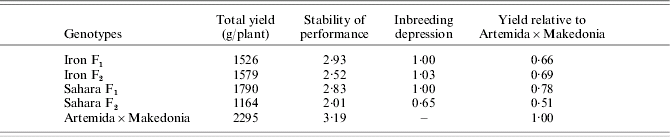
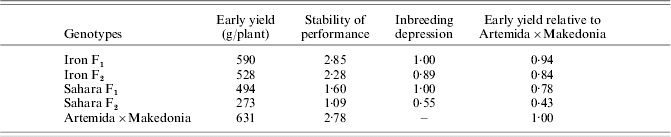
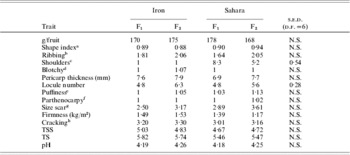
The commercial hybrid Iron showed low inbreeding depression for early maturity/plant (0·11) and inbreeding vigour for yield/plant (0·03), which means that its productivity was not affected by selfing (Tables 1 and 2). The commercial hybrid Sahara showed more than 0·3 and more than 0·4 inbreeding depression in yield and early maturity, respectively (Tables 1 and 2). The comparison of average values in fruit descriptive and qualitative traits between F1 and F2 of the two hybrids did not show significant differences on the whole, i.e. fruit size, shape index, ribbing, blotchy ripening, pericarp thickness, puffiness, parthenocarpy, size of scar, firmness, cracking, TSS, TS and pH. However, green shoulder expression before maturity of hybrid Sahara appeared unstable even in F1 (Table 3). Also, a significant difference was found in loculi number of hybrid Iron.
Total fruit yield (g/plant) and stability of performance (/s) in F1 and F2, and the inbreeding depression of each commercial tomato hybrid. The yield as a proportion of that of hybrid Artemida×Makedonia in the same experiment is also given (s.e.d.: standard error of difference)
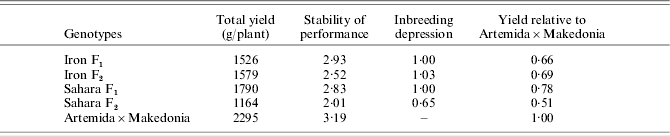
s.e.d. (d.f.=8) for total yield means 99 g/plant.
Early fruit yield (g/plant) and stability of performance (/s) in F1 and F2, and the inbreeding depression of each commercial tomato hybrid. The early yield as a proportion of that of hybrid Artemida×Makedonia in the same experiment is also given (s.e.d.: standard error of difference)
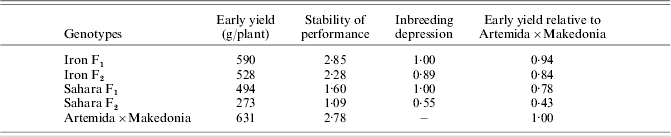
s.e.d. (d.f.=8) for early yield means 18 g/plant.
The mean performance for certain fruit descriptive and qualitative traits in F1 and F2 of the two commercial tomato hybrids (s.e.d.: standard error of difference)

N.S., not significant.
a Fruit shape index was determined by the quotient of polar to equatorial diameter.
b Fruit ribbing at peduncle end, on a 1–9 scale, where 1=absent or very weak, 3=weak, 5=medium, 7=strong and 9=very strong.
c Green shoulder (before maturity), on a 1–9 scale, where 1=absent and 9=present.
d Blotchy ripening, on a 1–3 scale, where 1=absent, 2=2–3 areas and 3=more than 2–3 areas.
e Fruit puffiness, on a 1–9 scale, where 1=absent or very weak, 3=weak, 5=medium, 7=strong and 9=very strong.
f Fruit parthenocarpy, on a 1–9 scale, where 1=absent or very weak, 3=weak, 5=medium, 7=strong and 9=very strong.
g Size of blossom scar, on a 1–9 scale, where 1=very small, 3=small, 5=medium, 7=large and 9=very large.
h Fruit cracking, on a 1–9 scale, where 1=absent or very weak, 3=weak, 5=medium, 7=strong and 9=very strong.
Evaluation through diallel and test crosses
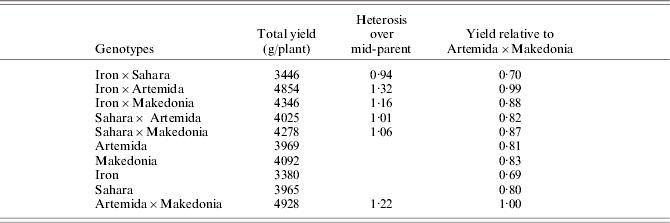
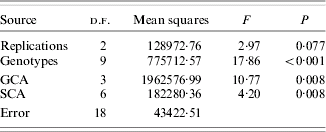
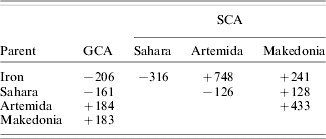
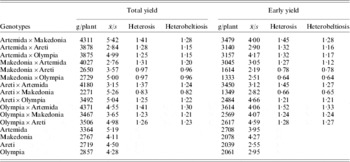
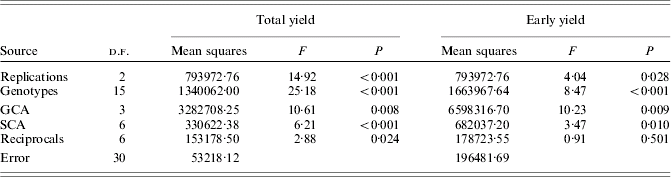
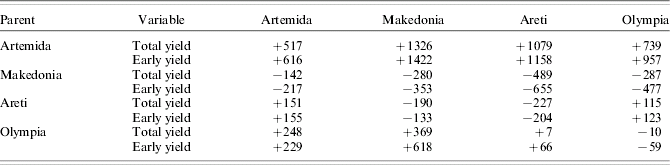
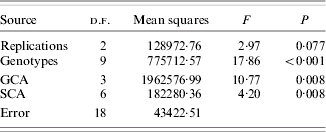
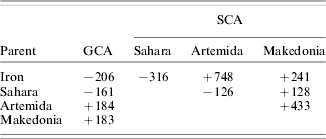
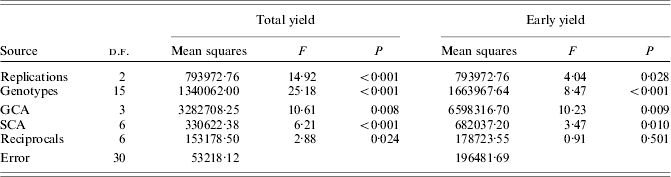
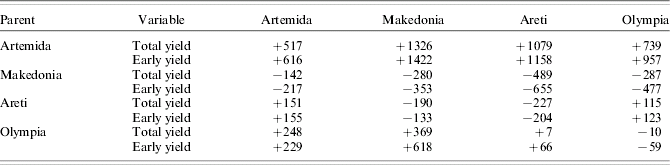
The diallel cross of hybrids yielded 0·06 less than the mid-parent performance, the crosses of hybrids with testers yielded equally to the hybrids with the exception of Iron×Artemida cross compared to cv. Iron, and mid-parent heterosis ranged from 0·16 to 0·32 in cv. Iron and from 0·01 to 0·06 in cv. Sahara (Table 4). The yield of the open-pollinated varieties Artemida and Makedonia was equal to the yield of the hybrids. Highly significant genotypic differences were observed for total fruit yield of commercial hybrids and their crosses with testers (Table 5). The diallel analysis showed that both GCA and SCA contributed significantly to this variation. The relative contribution of individual parents to yield potential was estimated by comparison of GCA effects (Table 6). Cultivars Artemida and Makedonia had significant positive GCA effects (+184 and +183, respectively), and cvs Iron and Sahara had significant negative ones (−206 and −161, respectively). Constants of SCA indicated several crosses performed better in regard to yield than would be expected from the GCA of the parents (Table 6). Crosses between cv. Iron, the lowest yielding parent, and cvs Artemida and Makedonia had significant positive SCA effects (+748 and +241, respectively), and also the cross between cv. Sahara and cv. Makedonia had significant positive SCA effect (+128). The cross between cv. Artemida and cv. Makedonia had significant positive SCA effect (+433). The evaluation through maintaining well-adapted varieties included the open-pollinated varieties Artemida, Makedonia, Areti and Olympia, as well as their diallel crosses with reciprocals (Table 7). The GCA effects of the four varieties and SCA obtained in the four-parent diallel with reciprocals for total and early yield is presented in Table 8. Highly significant effects were detected for GCA and SCA in total and early fruit yield. The reciprocal effect was significant for total yield. The relative contribution of individual parents to total and early yield potential was estimated by comparison of GCA effects (Table 9). Only cv. Artemida had significant positive GCA effects (+517 for total yield and +616 for early yield). The contribution of cv. Artemida to total and early yield potential can also be supported by its high hybrid yield ratings (Table 7). Estimates of SCA indicated that crosses with cvs Artemida and Olympia as female parents had significant positive SCA both for total and early yield, whereas crosses with cv. Makedonia as female parent and also the reciprocal between cv. Makedonia and cv. Areti had significant negative SCA (Table 9). The mid-parent heterosis for yield of diallel crosses (Table 7) was higher in cvs Artemida and Olympia (0·34 and 0·23, respectively). Corresponding values for heterobeltiosis of the two varieties were 0·22 for cv. Artemida and 0·18 for cv. Olympia. The mid-parent heterosis for early maturity of the two varieties was 0·39 in cv. Artemida and 0·20 in cv. Olympia, while the best-parent heterosis was equal to 0·22 in cv. Artemida and 0·14 in cv. Olympia.
Total fruit yield (g/plant) and heterosis as the proportion of F1 with reference to mid-parent of the half-diallel crosses of the commercial tomato hybrids and the testers. The yield as a proportion of that of hybrid Artemida×Makedonia in the same experiment is also given (s.e.d.: standard error of difference)
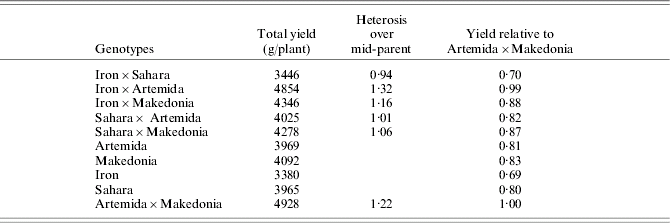
s.e.d. (d.f.=18) for total yield means 342 g/plant.
Partitioning of genotypes variance in GCA and SCA of the two commercial tomato hybrids and their test crosses for total yield
GCA effects of the two commercial tomato hybrids and the two testers, and SCA obtained in the four-parent diallel without reciprocals for total yield
Total and early fruit yield (g/plant), stability of performance (/s), heterosis as the proportion of F1 with reference to mid-parent, and heterobeltiosis as the percent of F1 with reference to best parent of the simple diallel hybrids of the open-pollinated tomato varieties (s.e.d.: standard error of difference)

s.e.d. (d.f.=30) for total yield means 330 g/plant.
s.e.d. (d.f.=30) for early yield means 246 g/plant.
Partitioning of genotypes variance in GCA and SCA of the four open-pollinated tomato varieties, their hybrids and reciprocals for total and early yield
GCA effects of the four open-pollinated tomato varieties (diagonal) and SCA obtained in the four-parent diallel with reciprocals for total and early yield
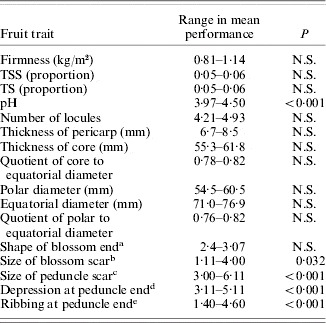
The comparison of average values in fruit descriptive and qualitative traits between the varieties Artemida, Makedonia, Areti and Olympia, as well as their diallel crosses did not show significant differences in traits, such as fruit size, shape, internal structure, firmness and technological quality (Table 10).
The range of mean performance and the probability for fruit descriptive and qualitative traits of the tomato varieties – parents and their diallel crosses

N.S., not significant.
a Shape of blossom end, on a 1–5 scale, where 1=indented, 2=indented to flat, 3=flat, 4=flat to pointed and 5=pointed.
b Size of blossom scar, on a 1–9 scale, where 1=very small, 3=small, 5=medium, 7=large and 9=very large.
c Size of peduncle scar, on a 1–9 scale, where 1=very small, 3=small, 5=medium, 7=large and 9=very large.
d Depression at peduncle end, on a 1–9 scale, where 1=absent or very weak, 3=weak, 5=medium, 7=strong and 9=very strong.
e Ribbing at peduncle end, on a 1–9 scale, where 1=absent or very weak, 3=weak, 5=medium, 7=strong and 9=very strong.
DISCUSSION
The present evaluation through mating designs showed that the commercial hybrid Iron possesses a desirable load of genes due to low inbreeding depression in early yield/plant (0·11) and 0·03 inbreeding vigour in total yield/plant (Tables 1 and 2). Besides, descriptive and qualitative traits comparison between F1 and F2 generations did not show significant differences in the majority of the traits (Table 3). Green shoulder expression before maturity of cv. Sahara source material was unstable even in F1. These results may indicate that there was no significant change in the fruit of the F2, which would influence the broad acceptability of consumers. In other words, the produce similarity after one generation of selfing means that the genetic background of these two hybrids did not reveal unexpected traits, although the heterozygosity decreased by one half. However, based on the results of the diallel analysis, using cv. Iron as source material is not supported by the negative GCA (−206) and the positive SCA (+673) (Table 6), provided that single-cross hybrids with low inbreeding depression, positive GCA and negative SCA have a desirable assemblage of genes that correspond to an F2 generation capable of developing elite recombinant lines. The trustworthiness of the proposed pattern of mating designs was applied in maize commercial hybrids (Koutsika-Sotiriou Reference Koutsika-Sotiriou and Basra1999; Koutsika-Sotiriou & Karagounis Reference Koutsika-Sotiriou and Karagounis2005), and demonstrated that the process for the choice of the certain germplasm was acceptable.
The tactic of public or private sectors in the maintenance of open-pollinated varieties as source material may be reconsidered because: (i) standard varieties and hybrids show similar yields; however, the hybrids are more stable than standard varieties under stress (Janick Reference Janick, Coors and Pandey1999). Partly, this advantage may be due to disease resistance, which is easier to combine in hybrids than in pyramiding genes using conventional breeding strategies. This means that future tomato breeding in selection programmes for tolerance to stress should include genetic materials at the inbred-line level, such as open-pollinated varieties; (ii) the higher risk that uniformity imposes in response to severe stress; (iii) a comparison of modern varieties and long-established landraces: Ceccarelli & Grando (Reference Ceccarelli and Grando1996) reported that new varieties selected under well-managed conditions have been superior to local varieties only under conditions of improved management, but not under extreme low-input conditions. Nevertheless, introgression of exotic germplasm into adapted maize breeding populations has been proposed as a guard against genetic vulnerability and selection plateaus (Hallauer & Miranda Filho Reference Hallauer and Miranda Filho1995; Ragot et al. Reference Ragot, Sisco, Hoisington and Stuber1995; Sfakianakis et al. Reference Sfakianakis, Fotiadis, Evgenidis and Katranis1996; Goodman & Brown Reference Goodman, Brown, Sprague and Dudley1998; Evgenidis et al. Reference Evgenidis, Fotiadis, Georgiadis, Ligos, Mellidis and Sfakianakis2001).
In the present study, the assessment of the open-pollinated varieties Artemida, Makedonia, Areti and Olympia showed that only cv. Artemida had significant positive GCA effects (+517 for total yield and +616 for early yield) (Table 9). Cultivar Artemida showed average heterosis 0·34 and 0·39 for total and early yield, respectively, while for heterobeltiosis the corresponding values were equal to 0·22 (Table 7). In cv. Artemida, there appears to be a close agreement between yield and GCA. This suggests that the better yielding varieties for a locality will probably produce the better yielding hybrids (Currence et al. Reference Currence, Larson and Virta1944). This variety can be used as a good example for explaining the recovery of recombinant inbreds outyielding the hybrid in tomato by applying selection in the F2 generation (Christakis & Fasoulas Reference Christakis and Fasoulas2001), or fixing and transgressing heterosis (Burdick Reference Burdick1954). The assessment of certain fruit descriptive and qualitative traits of the parents, as well as simple diallel crosses estimated some significant differences, mainly in descriptive traits, without any degradation of the fruit quality in any trait (Table 10). This is a scale of work beyond feasibility and a method of eliminating those varieties with poor combining ability (Currence et al. Reference Currence, Larson and Virta1944).
The flux of parental material in any breeding programme (private or public) is based on a working strategy, known as the assessment of the continual turnover of the varieties. As older parents retreat, new ones enter from locally adapted varieties and recombinant lines resulting from F2 of elite hybrids. The suggested mating design block test, taking into account both the tolerance to inbreeding for hybrid-varieties and the substantial GCA component or heritability of general worth (Simmonds Reference Simmonds1979) for the selection of the most promising sources of material, may provide a criterion for avoiding a performance ‘plateau’ in plant selection programmes.