The most frightening scene in Philip Pullman's trilogy His Dark Materials (1995–2000) – a nominal children's book with apocalyptic dimensions – is the imprisonment of the main character Lyra in an experimental laboratory where scientists, indoctrinated by church dogma about original sin, are severing children from their demons, their visible soul, in order to prevent the full development of their personalities and their potential corruption. In Lyra's world children's demons are playful animals that can change their shapes freely before a child reaches puberty. Separation from one's demon causes excruciating pain and shock that often results in death; with the new experimental methods, however, the child lives, but in a zombie-like state. Pullman's description of Lyra's immensely fearful anticipation of the fall of the surgical blade is much more unsettling than any murder scene – for here the result of violence is not death but a truncated life deprived of human consciousness. What the experimental scientists do not know – and another character in the book discovers – is that separation from one's demon releases immense energy that can open a gateway to other, parallel worlds.
In Arthur Lourié's last opera The Blackamoor of Peter the Great (1948–61), based on Alexander Pushkin's unfinished novel The Moor of Peter the Great, we witness the result of a similar, if less frightening, truncation. In the opera it is not the act of separation that is significant but its consequence: released energy that the main characters cannot control and that spurs violence unmatched in Pushkin's story. This unconstrained energy is the erotic drive of the main character, Ibrahim, which, separated from him, becomes an independent agent. Embodied as Eros, this liberated, autonomous force turns against its former master and, like nature in Pushkin's epic poem ‘The Bronze Horseman’, challenges the autocratic power of Peter the Great. I explore the significance of this detached erotic force in Lourié's opera, showing how the de-eroticisation of his hero and the simultaneous eroticisation of the plot distinguish this Silver Age inspired opera from its Golden Age source.Footnote 1 The separation of Eros from Ibrahim, a life force from the body, also provides a strong symbolist impulse for the opera that, in one reading, might be understood as an expression of decadent fin-de-siècle artists' obsession with what Nietzsche described as the disintegration of the whole into autonomously functioning parts,Footnote 2 and the artistic manifestation of the experimental ‘life-creation’ practices of Russian symbolist artists around the turn of the twentieth century.Footnote 3
Despite the ardent support of such prominent conductors as Charles Munch and Leopold Stokowski, The Blackamoor of Peter the Great has never been performed. Its composer, despite recent renewed interest in his work, is still little known. For this reason, three other stories need to be told in order to explain the significance of the liberated life force embodied as Eros and its symbolist connotations. They pertain to the career of Lourié, whom Richard Taruskin has described as ‘one of the most interesting forgotten composers of the twentieth century’;Footnote 4 to the biographical details of the creation of his Blackamoor, which occupied Lourié for a decade and a half; and to Pushkin's unfinished novel about his great-grandfather, Peter the Great's godson, whose African heritage might have been one of the reasons why an opera about him failed to attract American opera companies in the early 1960s.
A forgotten composer
The fate of Lourié's unperformed opera was tied to his thwarted career. A student of Glazunov at the St Petersburg Conservatory, Arthur Vincent Lourié (1891–1966) reached the zenith of his career in his twenties.Footnote 5 At that time he was associated with virtually every artist who mattered in St Petersburg's avant-garde circles. Portraits of him were painted by Yuri Annenkov (1889–1974), Pyotr Miturich (1887–1956), Georgy Yakulov (1884–1928), Lev Bruni (1894–1948) and Saveliy Sorin (1878–1953), and he counted among his friends Nikolay Kulbin (1868–1917), Alexander Blok (1880–1921), Velimir Khlebnikov (1885–1922), Aleksey Kruchenïkh (1886–1968), Benedict Livshits (1886–1939), David Burlyuk (1882–1967), Elena Guro (1877–1913), Fyodor Sologub (1863–1927), Osip Mandelstam (1891–1938) and Mikhail Kuzmin (1872–1936). Anna Akhmatova (1889–1966) was his lover and remained, even after their separation, one of the most influential people in his life. As a co-author of the 1914 futurist manifesto ‘We and the West’, he was considered one of the leading futurists of his generation – experimental piano pieces such as Synthèses, op. 14 (1914) and Formes en l'air (1915) testify to his daring spirit.Footnote 6 The young Lourié was also at home among the symbolists and the Acmeists, who regarded him as the musical representative of their ideals.Footnote 7
The fever of cultural excitement did not diminish with the onset of the Revolution.Footnote 8 Because Anatoli Lunacharsky (1875–1933), the head of the National Commissariat for Enlightenment (Narodnïy komissariat prosveshcheniya or Narkompros for short), favoured the futurists, Lourié became the first musical commissar of Narkompros at age twenty-five.Footnote 9 His career as a communist commissar was, however, short lived. By 1921 it became clear that representatives of Proltekult (proletarskaya kul'tura), a movement created to abolish ‘bourgeois’ values, were taking over the cultural establishment. In January 1921 Lourié was dismissed from Narkrompros.Footnote 10 Disillusioned, he summed up the situation: ‘We find ourselves in hopelessness, music-lessness, in a spiritual wasteland … The Russian Revolution ended with Blok's death.’Footnote 11
In 1922 Lourié left on an official journey to Berlin never to return. Because of his desertion, his name was erased from the official history of Russian music. If mentioned, it was with scorn and hostility.Footnote 12 In Soviet music history books he was described as a ‘formalist’ and ‘cosmopolitan’, politically tainted by his supposed relationship to the Mensheviks and to Trotsky.Footnote 13 As late as 1976 Juriy Keldïsh characterised him as ‘an aestheticising decadent, a composer devoid of individuality, an eclectic but with pretensions to innovation and originality’.Footnote 14 More positive assessments began to appear only after the fall of the Soviet Union.Footnote 15
Unlike Stravinsky, Lourié failed to carve out a career for himself in the West, where the Russian emigrant community received the former Communist commissar with considerable suspicion.Footnote 16 After a short stay in Berlin, Lourié moved to Paris.Footnote 17 There he met the Catholic philosopher Jacques Maritain (1882–1973) who inspired him to exchange his previous nihilism for ardent Catholicism.Footnote 18 He also became an intimate of Stravinsky, whom, according to Pierre Souvchinsky, Lourié ‘set out to tame, introducing him to Philosophy in the person of Maritain, and to Literature in other august persons’.Footnote 19 Lourié's religious ardour left a lasting influence on Stravinsky whose Poétique musicale, as Taruskin has shown, ‘often lapses into virtual paraphrases of [Maritain's] Art et scholastique of 1921’.Footnote 20 Works like Lourié's Sonate liturgique (1928) and Concerto spirituale (1929) – a likely inspiration for Stravinsky's Symphony of Psalms (1930) – attest to his philosophical Catholicism The exiled compatriots' intense relationship ended after Stravinsky married Vera Sudeikina in 1939 because Sudeikina disliked what she saw as Lourié's meddling in Stravinsky's family affairs.Footnote 21
Lourié escaped Europe in 1941, leaving behind a promised but unrealised performance of his opera-ballet The Feast During the Plague. Footnote 22 He moved to New York at the encouragement of Sergei Koussevitzky (1874–1951) who remained his strongest supporter in the West.Footnote 23 Besides Koussevitzky, only Stokowski and Hugh Ross took up the cause of propagating Lourié's music in the United States.Footnote 24
Lack of support was not the only reason for Lourié's gradual disappearance from the musical scene. A more important explanation for his failed career was his strong attachment to the culture of Silver Age Russia, to a pre-revolutionary, decadent spirit that did not survive the deprivation and terror of Stalinism. The aging Lourié never lost the elegant and snobbish attitude of his youth and gradually became, according to V. L. Andreyev, ‘a shadow of pre-revolutionary Petersburg’.Footnote 25 Lourié described himself in similar terms. Hearing about Akhmatova's illness he anxiously wrote to a friend: ‘The news upsets me greatly. For she is a close and old friend of mine. We two are the last shadows of her masquerade here on this earth.’Footnote 26 Lourié's reports from the United States are permeated with the pain of a truncated existence, a life detached from its motivating force, the culture of his youth. He described his life in Princeton, where he spent his last years in the house of Jacques Maritain, as a monotonous, dreamlike existence trapped in the past: ‘life stopped a hundred years ago and since then nothing has changed. There is a certain charm in this, but also a certain monotony. A closed circle and at meetings everything is repeated … Sometimes it seems as if this were a dream …’Footnote 27 Yet the disruption caused by the geographical and cultural displacement that truncated Lourié's career did not end in creative paralysis. Paradoxically, it was precisely this detached existence that enabled Lourié to write a Russian symbolist opera almost half a century after symbolism had been eradicated in Russia.Footnote 28The Blackamoor of Peter the Great was, as Lourié described it in a letter to Akhmatova, ‘a monument of Russian culture, the Russian people and Russian history’,Footnote 29 in other words a cultural autobiography in which the composer summed up the only culture he felt truly his own.Footnote 30
Lourié had been working on The Blackamoor since 1949, when he persuaded Koussevitzky to accept the opera instead of a commissioned symphonic work.Footnote 31 As his diary reveals, Lourié's initial idea was to write a short opera, on the model of Pushkin's little tragedies, one-act miniatures on familiar European topics one of which, The Feast During the Plague, he had already set in Paris as a two-act opera-ballet.Footnote 32 ‘There is no need for a lot of words in the libretto’, he advised his librettist, at the time also his lover, Irina Graham (1921–96). ‘No more than in Pushkin's little dramas.’Footnote 33 Lourié thought he could finish such a short chamber opera quickly and have it performed in Tanglewood in the 1949–50 season in connection with the 150th anniversary celebrations of Pushkin's birth.Footnote 34 But his plan to complete even a short opera in such a limited time was unrealistic. As hopes for an immediate performance faded after Koussevitsky's death in 1951, the writing process slowed significantly. At the same time the project expanded and by 1955, the date of Lourié's completion of the piano-vocal score, instead of a short chamber opera The Blackamoor of Peter the Great had become an opera on a grand scale in three acts and nine scenes.Footnote 35 Lourié finished the orchestral score in 1961, a decade after Koussevitzky's death, and offered it to Stokowski.Footnote 36
At the suggestion of Charles Munch, Koussevitzky's successor at the Boston Symphony, Lourié created a suite from the opera, which Stokowski premièred in St Louis, then played in New York in November 1961.Footnote 37 Despite Stokowski's and Munch's enthusiasm, plans for full performances in Belgrade, New York and Vienna fell through.Footnote 38 The disappointed composer attributed the City Opera's refusal of the work to the opera's black protagonist: ‘I am sure that the real reason is the black problem … What would have become of Pushkin had he been born in America, especially at his time? He would never have been able to become the greatest poet of the nation and would have been forced to live in Harlem’, he wrote to Maritain.Footnote 39 Akhmatova, whom Lourié contacted naïvely hoping that she could help him secure a production in the Soviet Union, had the same reaction; she found it proof of Lourié's impracticality that he had written an opera ‘about a negro among whites’ in the United States at a time when race tensions were running high.Footnote 40 The superstitious composer ascribed the final refusal of the Metropolitan Opera to the victory of demonic powers.Footnote 41 ‘The devil does not want it, that's all, for it would be too dangerous [to let it happen]’, he wrote, believing, in symbolist fashion, that the opera possessed some spiritual force that, if set free, would fight evil, the imagined presence of which oppressed the composer in his old age.Footnote 42
It seems that the opera's black protagonist was indeed an obstacle to the Blackamoor's performance in the political atmosphere of the 1960s, at least at the Metropolitan Opera. The company's assistant manager John Gutman told Lourié that there was no hope of producing his opera. Gutman believed that, considering the company's infrequent performances of new works, they would be attacked for choosing one by a Russian composer on a Russian subject. Additionally, he feared that the opera's ‘black’ topic could lead to a Ku Klux Klan cross-burning in front of the theatre.Footnote 43 One can well understand why Lourié and his proponents had difficulties in finding the right venue for The Blackamoor of Peter the Great. Considering the opera's saturation with Russian cultural references, the perfect place for its première would have been the Soviet Union; but since 1922 Lourié was persona non grata in his native land. Even without Lourié's ambiguous status in the Soviet Union, his ‘monument’ to pre-revolutionary Russian culture would have had little chance of performance in post-Stalinist Russia, especially because its main literary and cultural inspiration, symbolism, did not survive Russia's transformation into a Soviet state.
A symbolist palimpsest
Writing an opera based on Pushkin came naturally to Lourié, who considered him the first poet able to represent the spirit of music in poetry.Footnote 44 The topic of Peter the Great occupied the composer as early as 1946, when he copied out excerpts from the article ‘A Few Words in Defence of Peter the Great’ by Vladimir Solov'yev (1853–1900),Footnote 45 whose ideology of love provided inspiration for the alternative life styles of leading symbolist figures.Footnote 46 Solov'yev's defence of Peter the Great's forced Europeanisation of Russia was an important inspiration for Lourié, who shared the philosopher's Christian universalism and critical approach to conservative nationalism.Footnote 47 Peter the Great's ‘national self-denial’, Solov'yev argued, made possible Russia's absorption of European culture, a late effect of which was the development of a specifically Russian version of nineteenth-century French symbolism.
An opera that represented this open conception of Russia would naturally be culturally inclusive. The initial impetus for the insertion of various poems and literary texts into the libretto was a practical problem: Irina Graham was too inexperienced to dare to write her own text. In fact, Graham was not even Lourié's first choice as a librettist. He would have engaged his former friend Alexey Remizov (1877–1957), had the writer not lived in Paris at the time, which would have made collaboration impractical. Through the émigré set designer Mstislav Dobuzhinsky (1875–1957) Lourié also approached Vladimir Nabokov, who had already turned down the composer's former offer to write a libretto based on Dostoyevsky's The Idiot. Nabokov flatly refused the new project too, using his busy schedule as an excuse – in fact he had no sympathy for Lourié's artistic ideas, and was also reluctant to meddle with Pushkin's fragment.Footnote 48 Later, Lourié admitted to Graham that he himself had had misgivings about such a collaboration: ‘I no longer think I could have gotten along with him: he's very capricious, and I am capricious, and what I need is cooperation’.Footnote 49 As much as we might regret that this collaboration never came to pass, Lourié was right to suspect that Nabokov would not have been an ideal librettist for the project. As his later unflattering treatment of Pushkin's forebear in the appendix to his translation of Eugene Onegin indicates, Nabokov had an aversion to presenting Pushkin's great-grandfather Gannibal as a hero. Indeed, his fifty-page study on Gannibal, completed in 1964, three years after Lourié had finished his opera, is an aggressive deflation of the myth surrounding Pushkin's great-grandfather.Footnote 50
Because of Graham's insecurity about writing an original libretto and her fear of defiling the text of Russia's greatest poet (Lourié initially asked for a libretto ‘the way Alexander Sergeyevich [Pushkin] would have done it if he wanted to make a libretto based on his prose’), the composer authorised her to insert poems by Pushkin – initially only for Ibrahim's arias, but eventually for the arias of other characters and for choruses as well.Footnote 51 Graham gradually expanded the poetic palette of the libretto by incorporating lines of poetry by Vasily Trediakovsky (1703–68), Alexandr Griboyedov (1795–1829), Mikhail Lermontov (1814–41), Afanasy Fet (1820–92), Fyodor Tyutchev (1803–73), Evgeny Baratynsky (1800–44), and Alexander Blok (1880–1921). Graham also used some original texts from the time of Peter the Great.Footnote 52 Her main literary source, however, was the novel The Antichrist: Peter and Alexei by Dmitri Merezhkovsky (1865–1941), one of the most influential figures in Russian symbolism.
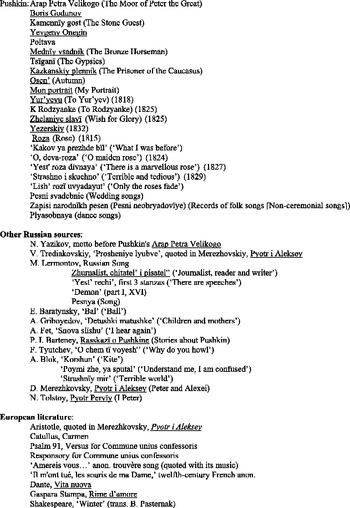
Graham did not limit her borrowing to Russian sources. Using quotations from a wider range of European literature in the Parisian scenes was a natural choice,Footnote 53 but Russian translations of foreign poetry also appear in the Russian scenes. Ultimately the libretto became a compilation of texts ranging in length from single phrases to entire poems, in style from Catullus to Blok, and in time and geography from Ancient Rome to modern Russia by way of medieval France, Renaissance Italy, Enlightenment France, Romantic England, Decadent France, and eighteenth- and nineteenth-century Russia (for the literary sources of Graham's libretto, see Fig. 1).Footnote 54
The compilation of the libretto from such a historically and geographically diverse collection of Russian and Western literature represents Peter the Great's famous programme of Europeanisation. More significant, it generated a text the overlapping cultural layers of which form a palimpsest in which newer texts imperfectly cover older strata. The surface veneer is Russian and predominantly symbolist: Shakespeare in Boris Pasternak's Russian translation, Aristotle and Trediakovsky as quoted by Merezhkovsky. One example that demonstrates the complexity of this web of literary references is a quotation from Pushkin's The Stone Guest: ‘Of all the happy pleasures life supplies, / To love alone does music yields in sweetness; / But love itself is melody’.Footnote 55 These lines about love and music are related to those by Shelley (‘No, Music thou art not “the food of love”. / Unless love feeds upon its own sweet self / Till it becomes all Music murmurs of’), also quoted in the opera, and indebted to Shakespeare's famous lines (‘If music be the food of love, play on’, from Twelfth Night, 1.1.1–3) that Shelley modified in his above-quoted fragment To Music (1817). For Lourié, Pushkin's comparison of love and melody also relates to Akhmatova who inscribed it into one of Lourié's books (exchanging ‘melody’ for ‘harmony’ in the last line).Footnote 56 In addition, the quotation of Shelly also refers to Lourié himself, who, according to Benedict Livshits, wanted to add Percy Bysshe to his name in honour of the poet.Footnote 57 The references thus flow back to the composer and also to the Russia of his youth, which he nostalgically re-created with the dense intertextuality of his opera.
Literary sources of Lourié/Graham's libretto for The Blackamoor of Peter the Great.


Neoclassical in its subject matter (Lourié called it ‘the first realisation of the Russian Baroque’),Footnote 58 in its reliance on ‘purely musical forms’ (‘each moment of the action must find its own expression in musical forms, in arias, duets, trios, choruses, marches, sarabandes, minuets and serenades’, Lourié wrote to Graham),Footnote 59 and in its adherence to tonality (most of the set pieces are in recognisable keys), Lourié's Blackamoor is nevertheless an exemplary symbolist opera. Its symbolist aspects include a reliance on symbolist texts;Footnote 60 the palimpsest-like, multi-layered references originating from the rich cultural associations of quoted texts; and, perhaps most important, Lourié's decision to separate Eros from its original carrier Ibrahim. In so doing he created a divide not, as is common in symbolist texts, between the separate realities of this world and another, but between an elemental force and the human origin of that force.Footnote 61 Focusing on Eros and the power of liberated erotic energy, Lourié also recalled Solov'ev's erotic utopia that inspired Merezhkovsky's and Blok's celibate marriages in which unconsummated sexual desire was supposed to harness erotic energy in the service of radical, life-transforming experiences.Footnote 62 This last is the most original part of Lourié's interpretation of Pushkin's story and will be discussed in detail in the last part of this article.
As in other Russian symbolist operas,Footnote 63 the main characters of Lourié's Blackamoor move freely between the opera's past, present and future, just as Pullman's Lyra in His Dark Materials can cross between geographically and chronologically separate worlds. The Blackamoor, Lourié believed, was genuine theatre precisely because of its lack of internal boundaries, for in it ‘the fantastic and the realistic, the contemporaneous and the old’ exist simultaneously.Footnote 64 What Lourié meant by ‘contemporaneous’ is not the 1950s, the time of the opera's composition, however, but the time of his youth; not the art of the mid-century, but the symbolism of Silver Age Russia. This chronological discontinuity is manifest not only in the culturally multilayered text of the opera but also in the incompleteness of its main character Ibrahim, who, travelling without restraint between three centuries, remains oddly misplaced everywhere. His unrooted identity makes him a prime candidate for the truncation that deprives him of sexual energy and turns him into a decadent hero, strangely placed in the service of Peter the Great who, according to Lourié, undertakes the construction of St Petersburg against decadent Europe.Footnote 65
Part of the difficulty in comprehending Lourié's Blackamoor stems from the symbolist-inspired demands the opera puts on its audience, for it requires, as Caryl Emerson has observed, ‘a high level of cultural knowledge as well as phenomenal powers of recall and conjugation, … the experience of living thickly inside a culture, reverent toward its traditions and alert to the art that fills it’.Footnote 66 Akhmatova was right about the impracticality of Lourié's opera, not so much because its black hero was unlikely to attract a major American opera house in the 1950s or 1960s, but because of the immense density of its cultural subtext, unfamiliar at the time outside of the circles of the Russian émigré community in the West and repressed in the Soviet Union.
Pushkin's Blackamoor
Comparing Lourié's Blackamoor to its inspiration, Pushkin's unfinished Moor of Peter the Great, brings the symbolist aspects of Lourié's opera to the fore. The earliest unfinished story about Pushkin's ancestor was Gannibal's own autobiography, which he started to write after he had retired to his estate at Mikhailovskoye. This memoir is lost because Gannibal, terrified that after his death it would fall into the hands of his enemies, burned the manuscript.Footnote 67 Planning his story, Pushkin relied on an unpublished, 4,000-word German biography, written by Gannibal's Estonian son-in-law Adam Karpovich Rotkirch. This biography, based on notes Rotkirch took down from the aging Gannibal, mixes real events that Rotkirch could have learned only from his father-in-law with literary inspirations and family legends (including the astounding claim, invented by Gannibal himself after the death of Peter the Great, that he was a direct descendant of the Carthaginian military commander Hannibal).Footnote 68
The completed parts of Pushkin's novel introduce Peter the Great's African godson Ibrahim as a dashing young man in Paris who enjoys the admiration and curiosity of fashionable women. ‘This Negro is so charming’, Karamzina reported, ‘that you are not at all surprised that he could inspire passion in a lady of the court of the Regent’.Footnote 69 Ibrahim falls in love with Countess D., who returns his feelings. The countess gives birth to a black baby, who is skilfully replaced with a white one to reassure the countess's husband and keep up decorum. Having avoided scandal, Pushkin's Romantic hero decides to break his liaison with the countess who, he suspects, would soon get tired of an exotic moor. ‘Why strive to unite the fate of so tender and beautiful a creature as yourself’, Ibrahim writes in his farewell letter to the countess, ‘to the miserable lot of a negro, a pitiful creation scarcely worthy to be classed as a human?’Footnote 70 Contradicted by Pushkin's own story about Ibrahim, this self-degrading view was nevertheless historically accurate. Voltaire, who was Gannibal's friend and publicly praised his intellectual achievements, voiced a prevalent opinion when he stated that blacks had only ‘a few more ideas than animals’.Footnote 71
Despite the Regent's advice, Ibrahim returns to Russia to help his godfather the tsar build his new empire. In a scene that recalls the biblical story of the return of the prodigal son, Peter himself awaits his godson at the border.Footnote 72 After his return, Ibrahim exchanges his former Parisian life of idleness for the new Russian life of work and reassumes his role as Peter's secretary. The routine of his work is broken only by the arrival of Korsakov, an acquaintance from Paris. Korsakov is a typical comic figure in Russian literature, a caricature of Russians who, having spent most of their life abroad, became alienated from their own culture.Footnote 73 At the tsar's assembly the Frenchified Korsakov is humiliated for his ignorance of local customs. In the Russian environment of rapid change Korsakov acts an outsider whereas the ‘foreigner’ Ibrahim fits in seamlessly. As Svetlana Evdokimova writes, because his ‘personal merits, education, and devotion are opposed to tradition, race, and social origin’, Ibrahim is an emblematic figure of the Petrine epoch.Footnote 74
To secure the protection of the Russian nobility for his godson after his death, the tsar decides to marry Ibrahim into the old aristocratic family of Rzhevskiy.Footnote 75 Despite his respectable social status, Ibrahim has no chance of winning the love of the seventeen-year-old Natasha Rzhevskiy. At the news of her betrothal to the tsar's moor Natasha faints and falls into a long delirium. Although the patient Ibrahim eventually receives encouragement from Natasha's family, Korsakov's warning foreshadows a Shakespearean outcome: ‘Don't marry. If you want my opinion, your betrothed can't stand the sight of you. Besides it's useless to hope for female fidelity; happy is he who can look upon it with indifference’. ‘With your ardent, brooding and suspicious nature, with your flat nose, your thick lips and your rough, wooly head – for you to hurl yourself into the dangers of marriage!’Footnote 76 the story's Korsakov tells Ibrahim, probably expressing Pushkin's doubts about his plan to settle by marrying Natalya Goncharova. In Pushkin's story nothing substantiates Korsakov's description of Ibrahim's character. His words echo Pushkin's own about his earlier unsuccessful marriage proposal to his distant relative Sofya Fedorovna Pushkina.Footnote 77 The anxiety about the potential failure of his marriage that he, like Ibrahim in the novel, pursued for rational reasons rather than out of passion,Footnote 78 casts a personal shadow on Pushkin's historical novel.
Pushkin's story breaks off at the moment Valerian, orphan of an old boyar family who after his father's death was taken in by Natasha's father, returns. In Pushkin's story Natasha resists her proposed marriage to Ibrahim not only because of Ibrahim's dark features, but also because of her secret love for Valerian, her childhood playmate. Although Pushkin breaks off his story at the point of Valerian's return, had he continued, it is likely he would have had Natasha obey her parents by marrying Ibrahim, and also consummate her true love for Valerian (as her nurse had advised her earlier in the story). Pushkin's plan seems to have been to re-create the sad story of his great-grandfather's first marriage, in which his wife gave birth to a white baby and thus produced physical evidence of her infidelity. ‘The main denouement of this novel will be’, Pushkin said to his friend Aleksei Vul'f, ‘the infidelity of the blackamoor's wife, who bore him a white child and for that was imprisoned in a convent’.Footnote 79 The black baby that had to be spirited away to hide the countess's infidelity at the beginning of the story and the white baby that proved the Russian's wife's unfaithfulness to Ibrahim provide the type of perfectly symmetrical plot much favoured by Pushkin.
Besides personal anxieties about marriage, the story's projected ending also foreshadows Pushkin's later, more ambivalent attitude towards the consequences of Peter's actions. As Emerson suggests, Ibrahim's failure in the novel is caused by his ties to Peter the Great who, ‘in defiance of nature (at least according to Russia's conservative boyar class), forces his godson to enter into a “hybrid” marriage’.Footnote 80 In Pushkin's poetic world, both the tsar's creation of St Petersburg on the northern sea and his intention of marrying a former slave into Russian nobility are wilful actions against nature's course. Nature rises up against St Petersburg in the form of a horrible flood in Pushkin's The Bronze Horseman, and Peter's will is countered by love's natural power in The Moor of Peter the Great.
Operatic artifice
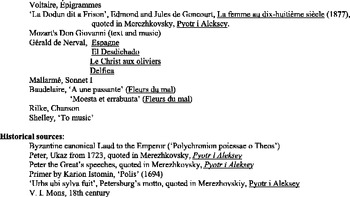
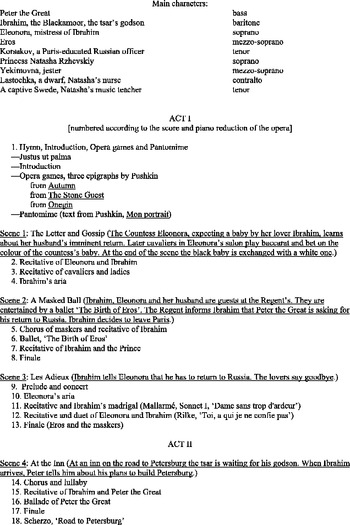
The plot of Lourié's opera follows Pushkin's story closely. Yet Lourié and Graham also add anachronistic commentaries and a veneer of artificiality to the basic plotline (for an outline of the opera see Fig. 2). The most striking difference between Pushkin's and Lourié's stories is Lourié's introduction of Eros into the opera. The inspiration came from Merezhkovsky's Peter and Alexei, in which Peter the Great celebrates the arrival of the statue of Venus from Greece with extravagant festivities. Lourié and Graham used this episode as the centre of scene 6, replacing the statue of Venus with that of the symbolically more significant Eros. With this addition, Lourié seems to emphasise that Peter's efforts to civilise Russia would not have been complete without recognising the necessity for art in a civilised country. The attempted unification of old, barbarian Russia with ancient, Hellenic Greece also resonates with Merezhkovsky's attempt to renovate Russian Orthodoxy through ideas borrowed from Greek philosophy. Eros's presence is not limited to this scene. It spreads over the entire opera and strongly affects its outcome. In Lourié's Blackamoor it is because of Eros that the attempt to unify Russia and Greece misfires: instead of helping to civilise savage Russia, the imported Eros joins forces with nature and becomes a destructive element that permeates the texture of the entire opera – and foils Peter's plans.
Arthur Lourié and Irina Graham, The Blackamoor of Peter the Great.


Act I opens with a religious procession accompanied by a Latin hymn sung in honour of Saint Benedict the Moor, a scene that is both chronologically and culturally incongruous with Russia at the time of Peter the Great. The invention of a patron saint for Ibrahim, which was one of Lourié's fantastic additions to Pushkin's story, lends a religious aura and the framework of an oratorio to the opera.Footnote 81 The procession is followed by a display of what the libretto describes as ‘knights in armour, pompous sultans, monks, midgets, African kings, Greek beauties, giants, corsairs, Spanish grandees, Chinese emperors, captive princesses and worldly ladies’, whose appearance is accompanied by the chorus's backstage singing of three epigraphs selected from the work of Pushkin.Footnote 82 In a peculiar conjunction of historical verisimilitude and artistic stylisation, the spectacle of this heterogeneous group re-creates both the atmosphere of Peter the Great's court and the highly stylised stagings familiar from Vsevolod Meyerhold's theatre. The short pantomime that follows the introductory hymn features a black-faced Eros chased by women who eventually capture and drag him off stage (depicting, as the libretto informs, a fourteenth-century Florentine engraving entitled The Crucifixion of Eros by Women).Footnote 83
Meyerholdian artifice affects almost every scene. In scene 1 cavaliers and ladies, waiting for the birth, bet on the baby's colour in the countess's anteroom. The scene ends with an aria for Ibrahim who appears on stage escorted by two ballerinas dressed as maids. In the masked ball in the Regent's palace in scene 2 the costumes of the countess and the count (one dressed in a medieval garb, the other disguised as a white unicorn) recall the late fifteenth-century Flemish tapestries of the Lady and the Unicorn that depict the six senses (taste, hearing, sight, smell, touch and love/understanding) and thus reinforce visually (and synesthetically) the sensuous environment of the French court. The middle of the scene features a ballet performance depicting the birth of Eros. As he leaves the ball, Ibrahim must make his way his way through the crowd of dancing maskers. Scene 3, which is subtitled, like Beethoven's famous piano sonata, ‘Les Adieux’, opens with Eros leading a soldier, a shepherd, a Turk and a marquis onto the stage arm-in-arm with their sweethearts. The farewell scene between the countess and Ibrahim ends with Eros and the maskers making another appearance, this time in front of closed curtains.
The Russian scenes are also full of artifice. In scene 4 Lourié juxtaposes the historical Peter the Great and Pushkin's paradigmatic representation of the reformist tsar by inserting excerpts from Pushkin's The Bronze Horseman for Peter's description of St Petersburg. The next scene, in which Lourié contrasts the working, uncouth tsar and the idle, refined Korsakov, ends with the waters rising, a glimpse at the Bronze Horseman (the statue of Peter the Great) and a warning from nature: ‘Ah, architect with thy creation of marvels … Ah, beware of me!’ (Lib2). The Russian equivalent of scene 2, scene 6 also features a festival, now in the tsar's palace, to which Peter has invited guests to celebrate the arrival of a statue of Eros from Greece. These guests are strikingly different from those at the Regent's masked ball, but no less artificial. Instead of ballerinas wearing pink costumes and cavaliers in Venetian apparel, the tsar sits among shipmasters and seamen who dance a jig with their wives. The entertainment in the old boyar Rzhevskiy's home in scene 7 contrasts with both previous ball scenes: gypsies appear, one of them dressed as a bear, then skomorokhi (itinerant pagan minstrels associated with old Russia), some with animal masks, some with iron caps decorated with bells, some with toy parrots and toy monkeys. Their performance is interrupted by the tsar's sudden visit. Peter dances a minuet with Natasha, then withdraws with Count Rzhevskiy to discuss his marriage plans.
In the last two scenes of the opera the degree of artifice increases. In scene 8, which Lourié subtitled ‘The Magic Lantern’, Natasha waits for her husband Ibrahim with her nurse after the wedding in early Empire Style:
Natasha's room. Covered bed, silver mirror… Big window, on which the frozen pattern of a huge rose appears. Natasha, wearing farthingale and powered wig, sits at the dressing-table; she lowers her hand with a rose. Lastochka is busy with preparing Natasha's nightgown. After finishing, she sits at Natasha's feet on a bench and takes a lute.Footnote 84
The beginning of the scene, Lourié wrote to Graham, should evoke the eighteenth century as if it were ‘a primitive study for Onegin’.Footnote 85 In the window, the figure of Korsakov (a substitute for Valerian in the libretto) appears like a vision, a premonition of the final outcome. The substitution of Korsakov for Valerian was a practical solution in the opera, but it also affected the character of Natasha because it deprived her of deep Romantic feelings and thus turned her into a light character akin to the caricatural Korsakov.
Stylisation reaches its climax in the puppet theatre of scene 9, in which the participants act like marionettes. We learn about the end of the story only from Natasha's Swedish tutor who, at Eros's request, relates what took place between the last two scenes. The Swede recounts Natasha's adultery, the birth of the white baby, the tsar's punishment of Korsakov, and Natasha's departure for a convent, while the puppets/actors in the story make short illustrative appearances on stage. The last figure to leave is the Swede, playing his flute. After his departure only the marble statue of Eros remains, recalling Meyerhold's 1906 direction of Alexander Blok's Balaganchik (The Fairground Booth), where a pedestal bearing the statue of Eros appeared behind the dejected Pierrot in scene 2.
Eros, ‘Black-amour’ and Don Juan
Whereas in Pushkin's story the power of Eros is felt only by the implied conclusion, in the opera Eros is a central figure who, more than the passive Ibrahim or the powerful tsar, acts as the main motivating force of the plot. Eros, like his French equivalent Amour in ‘Black-amour’ (a spelling Lourié considered using instead of Blackamoor), is initially an attribute of the sexually intriguing African protagonist.Footnote 86 In the first scene Ibrahim is described as ‘the offspring of moors’ who, in Pushkin's words in the poem ‘To Yuryev’, pleases some young beauties by his ‘enticing, shameless passion’ (besstïdnïm beshenstvom zhelaniy).Footnote 87 These lines, however, are misleading if taken out of context. Although Graham imagined Ibrahim as a ‘black panther’,Footnote 88 she also maintained that his ‘African passion’ is ‘combined with melancholy’.Footnote 89 Lourié tamed him even more, seeing in him ‘something subtle and mysterious’. ‘There's nothing animal about him’, he wrote to Graham, contradicting Pushkin's sexually charged description of the moor in ‘To Yuryev’: ‘His cruel elemental impulses are subordinated, already bridled’.Footnote 90
Lourié's initial interest in transforming Pushkin's enlightened Ibrahim into a decadent ‘black Eros’ (or black Amour) stemmed from his intent to tie his opera – as Stravinsky did his almost contemporaneous neoclassical The Rake's Progress – to Mozart's Don Giovanni. ‘I want a libretto in the spirit of Mozart [and] Lorenzo da Ponte’, he wrote to Graham in 1949, ‘a libertine opera in the taste of the eighteenth century’.Footnote 91 Yet after he renounces love in Paris and returns to Russia, Ibrahim lacks all the dynamic features of Don Juan. It is as if the ritualistic pantomime representing the birth of Eros in scene 2 signaled the separation of Ibrahim and his erotic drive, which no longer needs the exotic moor to exercise its power over the characters. The autonomous Eros has many functions in the opera. It is an elemental force that drives the plot; a disinterested, objective observer; an impersonator of Pushkin's sensuous side; and, last but not least, an operatic reflection of Lourié's own promiscuous sexuality.
In the introduction to the opera Lourié and Graham deliberately cast this independent Eros as Pushkin himself.Footnote 92 As Eros is pursued by women, the chorus sings two lines from Pushkin's Mon Portrait: ‘Vrai demon pour l'espièglerie / Vrai singe par sa mine’ (‘A real demon for mischief / A real monkey in his appearance’). Yet Graham and Lourié also establish Eros's ties to Ibrahim by making Eros appear on stage with the makeup of a Blackamoor.Footnote 93 Here the identities of Eros, Ibrahim and Pushkin are still in close symbiosis. The last image of the opera, showing the statue of Eros wearing, like the young Pushkin, a cloak, a tri-cornered hat and Hessian boots, reinforces the link between Eros and Pushkin,Footnote 94 and produces symmetry between the first and last scenes.
The presence of Eros is detectable in almost every scene; significantly, Lourié gives the final word (or gesture) to him at the end of each act. At the conclusion of Act I Eros and the maskers who have presented the pantomime ‘The Birth of Eros’ in the previous scene form a line in front of the curtain; Eros finishes the act with a short arioso about his mission to guide lovers. Eros also plays an important part in the last scene of Act II. Before Ibrahim starts his dance with Natasha, the statue of Eros comes to life and tries to keep him away from his future bride. Here Eros's behaviour strangely contradicts his function as facilitator of love. Unlike in the first act finale of Don Giovanni, no seduction takes place during the minuet Ibrahim dances with Natasha. Eros's odd conduct and the un-erotic dance, in which the awkward movements are represented by music mainly in duple metre notated in the triple metre of the ‘Tempo di minuetto’, highlight the contrast between the opera's Russian and French scenes. Scene 6 is the Russian equivalent of scene 2, both featuring celebrations of Eros. But while Eros comes to life in the Parisian pantomime depicting ‘The Birth of Eros’, in scene 6 he appears as a statue brought to the tsar's palace from far-away Greece. Savage Russia does not seem to be a natural environment for Eros – he has to be forcefully dragged into Peter's new capital. No wonder that in this new Russian milieu Ibrahim's sexually intriguing exotic blackness becomes repulsive. Act II also ends with Eros, now swirling alone on the stage. At the end of the opera Eros appears once again and quietly evokes Natasha's melancholy aria on Pushkin's poem ‘Gde nasha roza, druz'ya moi?’ (‘Where is our rose, my friends?’).
Even when Eros is not on stage, his presence can be sensed by frequent references to his human embodiment, Don Juan. Perhaps the subtlest of these is Lourié's decision to assign Ibrahim's role to a baritone, the range of Don Giovanni in Mozart's opera (and of Onegin in Tchaikovsky's opera). Casting Eros as a statue coming to life in scene 6 also has Mozartian resonances. And although the live statue in the Blackamoor is much less threatening than the otherworldly Commendatore in Don Giovanni, his appearance similarly forecasts a doomed ending. Lourié's strange decision to merge the statue/Commendatore and the Eros/Don Juan figures may be explained partially by a peculiar Russian focus on the figure of the Commendatore (see Pushkin's The Stone Guest, Blok's The Steps of the Commendatore, and Akhmatova's references to the statue in the Poem Without a Hero),Footnote 95 and partially by Lourié's decadent interpretation of Mozart's Don Giovanni as an opera in which the Don and his unearthly avenger have equal share in lust and demonic power. The parallel between these two seemingly opposing figures is the clearest in an essay Lourié wrote about Mozart, in which he compares the famous seduction scene ‘Là ci darem la mano’ (‘There we'll join hands’) between Don Giovanni and Zerlina with the final scene between the Don and the Commendatore (‘Dammi la tua mano in segno’ [‘Give me your hand as a sign’]). Lourié argues that although musically contrasting, both scenes show the sensuous aspect of physical human contact. The sensuality of the attempted seduction of Zerlina needs no explanation. But in a highly decadent fashion Lourié also interprets the Don and the Commendatore's final meeting not as a sudden shock, but as a gradual, sumptuous, cruel consumption of a human body – almost like an ironic, grotesque doubling of Don Giovanni's last voracious dinner:
The impression this monotony creates is merciless and terrifying … It's like breaking bones, and dislocating joints; man is mysteriously destroyed piece by piece with a merciless appetite, and with a quiet gluttony. It is not death but a kind of subtle voracity, which, as a contrast, suddenly reminds us of Don Juan's last feast. By the end of the dialogue nothing remains of Don Juan.Footnote 96
Lourié's cannibalistic description of the last scene of Don Giovanni suggests that ultimately Don Juan, consumed by the Commandatore, becomes one with the very demon that destroys him (thus unifying, in this final moment, the drives Freud identified as eros and thanatos).Footnote 97
In the Blackamoor there are more (and less subtle) references to Mozart's Don Giovanni. The conversation between young Natasha and seductive Peter the Great during their dance in scene 7 evokes the very duet Lourié contrasted with the last scene of Don Giovanni:
Peter: Thought of love I try to banish / And your beauty to forget!
Natasha: Oh! Ah, me! I must avoid you!
P: You drive my rest and peace away!
N: Your deceits are known to me!
P: You have heard of my misfortunes, / You can see my cruel torments! / I'm a captive held by thee!
N: To confusion you've reduced me!Footnote 98
The last scene of the Blackamoor, where the Swedish tutor recounts to Eros what happened to the characters after the previous scene, seems like a distorted, grotesque gesture towards the lieto fine of Don Giovanni, in which the characters tell the audience about their future in a Don Juan-free world.
The Blackamoor's ties to Don Giovanni are made explicit at the end of Peter the Great's Assembly in scene 6, in which Lourié brings on the shadows of Don Giovanni and Leporello, quoting what in the final dinner scene of Mozart's opera was already a reference to another opera on a da Ponte libretto, Martín y Soler's Una cosa rara (1786).Footnote 99 Above a low rambling chromatic accompaniment that reminds the listener more of the statue's music from Don Giovanni than the light tune of Soler's opera, Lourié quotes the music and text of Don Giovanni and Leporello:
Don Giovanni: Che ti par del bel concerto?
Leporello: È conforme al vostro merto.
[Don Giovanni: How do you like this music?
Leporello: It's just the thing for you, sir.]
With this shadowy double entrance, which follows Peter and Ibrahim's dialogue in the opera, Lourié, for a moment, casts the tsar as Don Giovanni and Ibrahim as his accommodating comic sidekick.
For Lourié, most references to Don Juan come through specifically Russian interpretations. Because of its represented time period, African protagonist and frequent references to Don Juan, Lourié's Blackamoor recalls Meyerhold's famous 1910 production of Molière's Don Juan at the Alexsandrinsky Theatre in St Petersburg with its stage full of little blackamoors,
floating about the stage sprinkling intoxicating perfumes from crystal bottles … darting about the stage picking up a lace handkerchief dropped by Don Juan, offering a stool to a tired actor … fastening Don Juan's shoelaces as he argues with Sganarelle … appearing with lanterns for the actors when the stage is plunged into semi-darkness … removing cloaks and rapiers from the stage after Don Juan's desperate fight with the brigands … crawling under the table at the appearance of the Commander's statue … summoning the public with tinkling silver bells and announcing the intervals.Footnote 100
Lourié also recalls the most famous Russian version of the Don Juan legend by quoting from Pushkin's little tragedy The Stone Guest in the first epigraph that the chorus sings backstage during the introduction to the Blackamoor. Its above-quoted three lines, which establish the relationship between love and melody, will be central to the opera. The same quotation also appears in scene 3, sung by the husband of the countess and answered by Ibrahim with another line from The Stone Guest: ‘What sounds! What depth of feeling in the words!’Footnote 101
These quotations from The Stone Guest intimately connect Lourié's opera to Pushkin's perception of Don Juan, whose seductions are ‘a series of improvised artistic performances in which he re-creates himself time and again’.Footnote 102 ‘Attentively reading The Stone Guest’, Akhmatova remarks in her essay on Pushkin's tragedy, ‘we make the following unexpected discovery: Don Juan is a poet.’Footnote 103 In Pushkin's thinking, Don Juan's insatiable libido is a metaphor for artistic creativity. In The Stone Guest Don Juan seduces verbally, relying on what Pushkin considered the most difficult poetic form, improvisation.Footnote 104 In Mozart and da Ponte's version, his main tool of seduction is music, the style of which he deftly adapts to the object of his desire. In this respect, Ibrahim's wide range of poetic utterances – he can sing Pushkin's poem ‘O deva roza’ (‘Oh rose maiden’, scene 6) just as well as a Mallarmé sonnet, a Rilke chanson (scene 3), a Baudelaire poem (scene 5) or a passage from Dante's Vita nuova (scene 7) – can be seen as an aestheticised, decadent version of erotic versatility.
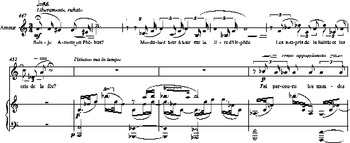
This relationship between music and love, more specifically between love and melody, can also be explained by the Pushkinian concept of Don Juan. In the opera, the presence of melody indicates free, socially unconstrained, natural love, promoted by the liberated Eros. Lourié believed that melody, which he considered to be the ‘soul of music’,Footnote 105 is ‘a liberation in spirit from the chains of spatial and temporal limitations’. Melody, like the evasive but effective Don Juan, is free of function and obligation.Footnote 106 For Don Juan every new seduction is a new artistic creation, a new poem, a new song, a new melody. No wonder that Eros's aria in scene 2 of the Blackamoor begins and ends with unaccompanied, freely flowing melody, unrestrained by harmony (Ex. 1). In the first Parisian scene Eros is still close enough to Ibrahim to lend him the power to conjure a similarly free, unaccompanied melody at the end of his first aria. The deliberate destruction of melody in the last scene of the opera, as I will show, suggests the deliberate destruction of love.
Arthur Lourié, The Blackamoor of Peter the Great, Act I, scene 2 (piano reduction, KölnMusik): beginning of Eros's aria. Text from Gérard de Nérval's El Destichado: ‘Am I Eros? Phobus? When I touch the strings of Orpheus's lyre, They echo a sigh of a saint and a call of a fairy!;’ and Nérval's Le Christ aux Oliviers: “I traveled through the world.”

The central role of Eros in the opera, however, is not only a tribute to Pushkin; it also had biographical significance for Lourié, who, as his librettist Irina Graham willingly attested, was a veritable Don Juan. According to Graham, Lourié, like da Ponte's Don Giovanni, took pleasure in trying out different flavours of love. Once, Graham recalled, he seduced a huge Scottish woman just because her stunning corpulence reminded him of Baudelaire's erotic poem ‘Giantess’.Footnote 107 Despite his spiritual aspirations, for Lourié, as for Pushkin, a promiscuous lifestyle and artistic creativity were manifestations of the same elemental force.Footnote 108 In an unpublished essay entitled ‘Iskusstvo i grekh’ (‘Art and Sin’) Lourié attempted to give a theoretical basis to the promiscuous habits of creative artists.Footnote 109 Using Pushkin's poem ‘The Tenth Commandment’ as a poetic example of the inability of artists to resist the temptation of love,Footnote 110 Lourié asserts that creativity presupposes the elimination of ethics, for, ‘if the artist is subjugated to it, he kills the creative possibility with regard to life and to art’. Lourié argues that ‘in the true ethical, i.e. creative experience, all that is “sinful” [according to the official church] becomes positive. The stronger the creativity, the more sinful it is. The more ethical it is, the weaker it is as art.’
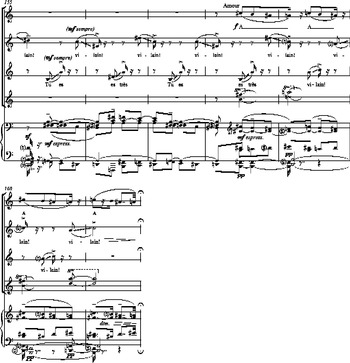
The music associated with Eros in the opera contains age-old musical references to the sensuous and to the demonic. Although descending chromaticism, tritones and augmented triads are not limited to scenes with Eros, their concentration tends to mark his presence on stage. The women pursuing Eros in the introduction alternate ascending and descending glissando intervals, featuring prominently the tritone, the ‘diabolus in musica’, to illustrate the demonic (‘vrai démon’) and evil (‘très vilain’) in Pushkin's text (Ex. 2). The tritone also functions as a sign of illicit love, as well as a marker of Ibrahim. The end of Ibrahim's first aria contains the same C–F♯ (or F♯–C) tritone that earlier characterised the women's cries. Tritones (B–F and D–G♯) appear when the cavaliers bet on the baby's colour in scene 1. At the parallel moment in scene 9 (when the chorus announces that Natasha's baby is white) we hear tritones with the same pitch classes. The orchestra starts the countess's aria in Act I with a tritone. Her pronouncement of Ibrahim's name also receives tritones (F–B, G♯–D). Most significant, Ibrahim's last utterance in the final scene is built on an octatonic collection (containing four tritones: C–F♯, D–G♯, D♯–A, F–B), as if to signify the closing of the circle that trapped Ibrahim in an impotent state.
The Blackamoor of Peter the Great, Introduction: glissando tritones of the women pursuing Eros.

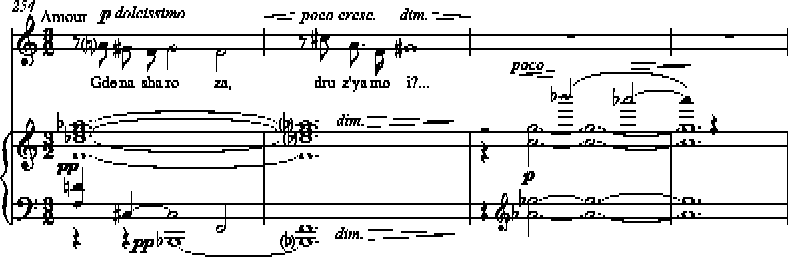
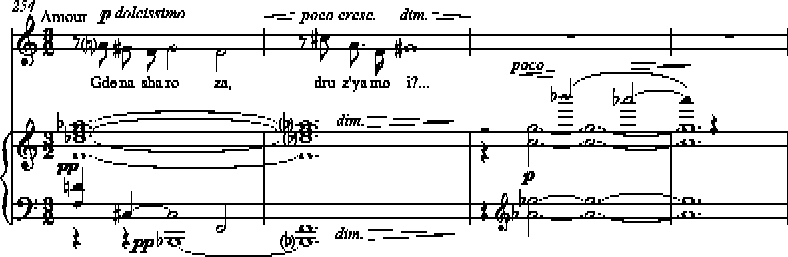
Eros's wordless cry of pleasure in the introduction to the opera consists mainly of descending chromatic lines, which, since Bizet's Carmen (and Borodin's Prince Igor) have been strongly associated with eroticism (Ex. 2). Besides descending chromatic motion and tritones, the music of Eros's appearances almost always includes a characteristic phrase, containing a major/minor third motif and occasionally an augmented triad (A–G♯–E♯/F; A–F–G♯; C♯–A–G♯–E♯). We first hear this phrase in Eros's aria in scene 2 at the end of the ballet performance. It occurs again at the beginning and end of scene 3 as well as in scene 6 when Eros warns Ibrahim before his dance with Natasha. Finally, it appears in its two most characteristic forms for Eros's final line in the opera (Ex. 3).
The Blackamoor of Peter the Great, Act III, scene 9: Eros's last phrase. Text from Pushkin's Gde nasha roza: ‘Where is our rose, my friends?’
Puppet show
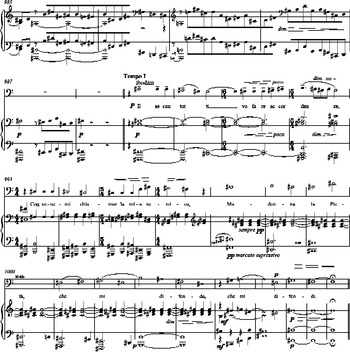
Ending the opera with Eros's utterance lends dramatic significance to the detached erotic power he embodies. But because his melody here is an abridged recapitulation of previous music, it also forms an integral part of a final scene that consists of disconnected, distorted fragments taken from earlier episodes. In the spirit of Pushkinian symmetry Lourié constructs the last act as a reversed, darker version of the first, French act. Scene 1 ends with Ibrahim's farewell aria. Scene 7 also ends with an aria for Ibrahim, which, as its title indicates, he sings ‘in maschera’. Its Italian text by Dante recalls the Italian text by Gaspara Stampa in Act I (‘Ma che, sciocca’), there sung by the countess (Ex. 4). The Italian text, like Ibrahim himself, is strangely displaced in this Russian scene (besides Korsakov, Ibrahim is the only character who sings ‘foreign’ poetry in the Russian acts). Although almost all of Ibrahim's arias convey diatonic clarity, this last one is his most rhythmically and melodically constrained expression. Its slow moving, functionally indifferent harmonies (see the rigid tonic and minor dominant chords in the right hand that remain indifferent to the chromatically descending bass in bars 998–1001), stepwise, plain melodic line, and shifting metres convey melancholy and archaic elegance; its spare use of dominants suggests a lack of passion and desire. Characteristically, the strongest dominant in the voice, with the leading tone in D-sharp minor in bar 1000, clashes with the accompanying harmonies and remains melodically and harmonically unresolved. The leading tone to F-sharp, the key of the final cadence, moves to the tonic via G♯ in the voice. But in the orchestra G♯ lingers on: the lack of resolution creates a bitter-sweet dissonance as the last sound.
The Blackamoor of Peter the Great, Act III, scene 7: last verse of Ibrahim's aria. Text from Dante, La vita nuova: ‘Until, (my peace with all of them to make,) Unto mine enemy I needs must pray, My lady Pity, for the help she brings.’

To distinguish the part of the plot not written by Pushkin, Lourié and Graham presented scenes 8 and 9 as stylised performances, 8 as a ‘magic lantern’ show, 9 as a puppet theatre. The characters in scene 8 gradually turn into shadows, as if anticipating the puppet show at the end of the opera. In the Russian libretto, the description of scene 8 – the nurse prepares her mistress for the night and sings a song – creates a strong connection between Lourié's Blackamoor and Verdi's Otello. Here when the melancholy Ibrahim appears at the end of the scene and bows deeply to the petrified Natasha, he has the threatening character of Otello. But whereas in Verdi's opera Otello is mad with rage and kills the innocent Desdemona, in Lourié's Blackamoor the cuckolded Ibrahim remains melancholy and passive: Peter the Great punishes the illicit lovers while Ibrahim withdraws into the shadows. Giving up all semblance of realist theatre, in the last scene the characters are reduced to puppets who, with their short entrances and exits, illustrate the conclusion of the story the Swedish tutor recounts to Eros. Besides Korsakov's aria at the beginning of the scene, none of the main characters on stage sings an extended number. Natasha merely repeats a line from Korsakov's aria, Ibrahim sings a fifteen-bar arioso, and Peter rages for a brief thirteen bars – even Eros's role is limited to four short phrases. Only the fool has her say in a thirty-two-bar grotesque song that she sings while dancing with Korsakov, dragging him around as if he were a rag doll. Although this episode has historical accuracy – Peter the Great enjoyed arranging weddings for the freaks in his All-Drunken Assembly – in the opera the marriage between Korsakov and the fool stands for more than historical veneer. By letting the tsar, rather than Eros, pair the characters with disregard for nature's will, the scene represents the total degradation of love.
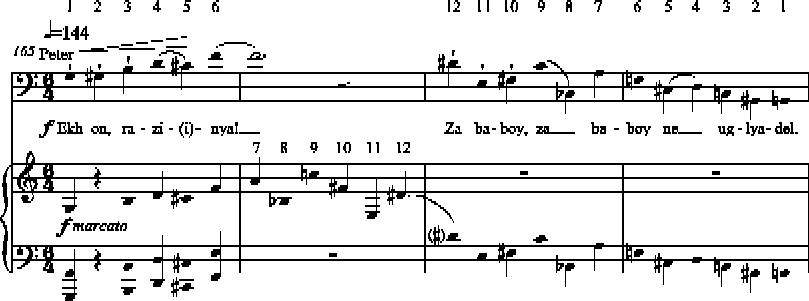
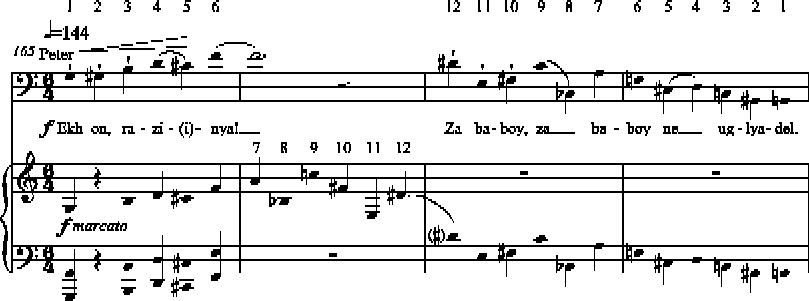
Lourié emphasises the violence of this last act by giving Peter the Great a twelve-tone melody, reinforced in unison by the low strings, muted horns and bassoons of the orchestra (Ex. 5). The tsar first directs his anger at Ibrahim, the ‘simpleton’ who ‘did not keep an eye on his wife’. He then turns against the ‘dandy’ Korsakov whom he first orders to the torture chamber, and then, in response to Korsakov's pleas for mercy, commands to marry the fool. The twelve-tone passage is repeated three times unvaried, which seems to suggest that its rigid construction cannot be influenced by human emotions. The difficult leaps in the second half of the row, played by two alternating horns, and then in retrograde by alternating bassoons, underline the anti-melodious character of the tsar's angry outbursts. This artificial, strictly constructed row underscores the unnatural imperial control over love. Its presence suggests that Peter, maddened by his obvious impotence in commanding Natasha's love, ultimately turns to violence against melody and thus, according to Lourié (and Pushkin), love itself. For although the twelve-tone row could be seen as the symbol of the tsar's omnipotence because it contains all pitch classes, it is an element alien to Lourié's musical style, an unnatural order that Lourié exploits to demonstrate Peter's constriction of nature. Melody, which is, according to Lourié, the ‘moving force and organic essence’ of music capable of ‘revealing the truth’, is replaced here by ‘substantiality, a tangible materiality, something manufactured’. Since Lourié believed that ‘our melodic gift is in direct ratio to our capacity for good’, this violation of melody by the tsar's twelve-tone row suggests moral degradation.Footnote 111 This last act of violence does not restore the tsar's lost power. In this grotesque and disillusioned puppet world the tsar, like Ibrahim, Natasha and Korsakov, becomes a shadow of the previous story in whose conclusion he cannot participate and whose outcome he cannot influence.
The Blackamoor of Peter the Great, Act III, scene 9: Peter the Great's twelve-tone phrase. (‘Eh, that simpleton! Did not keep an eye on his wife’).
By showing his characters as passive, shadowy puppets, Lourié transforms the comical symmetrical ending of Pushkin's novel into a frightening pantomime. As in the Greek satyr plays or in Alexander Blok's first lyric drama The Fairground Booth, the farcical elements of Lourié's puppet show parody the previous seriousness of the story. The fool's dance with Korsakov is a grotesque device out of the fairground booth, perfectly fulfilling Meyerhold's requirement for the grotesque as ‘hideous and strange … which with no apparent logic combines the most dissimilar elements’.Footnote 112
The discontinuity of the genre, achieved by the replacement of the stylised opera with the even more extremely stylised puppet theatre at the end, not only marks Pushkin's story as a fragment, but also becomes a symbol of an incomplete life. Like Blok's The Fairground Booth, which the poet conceived as an attack on symbolism's more solemn manifestations, Lourié's puppet show creates distance from the previous story and from symbolism itself. In the Blackamoor this distance is self-consciously ironic, but in Lourié's career, which never came to fruition to the extent that the composer's artistic talent had promised, the same ironic distance became tragic; for like the main characters in the opera, Lourié himself turned into something of a shadow. The Blackamoor of Peter the Great – the opera about the Russian Baroque based on a fragmentary novel by Russia's greatest Golden Age poet and realised with the help of texts by Silver Age authors – is ultimately about Lourié's past. As such it is, as Lourié believed, a personalised monument to Russian culture, which, by the evocative power of music, re-creates a lost world preserved in memory as a shadowy, fragmentary existence.
The difference between Pushkin's unfinished novel and Lourié's operatic rendition of it lies in the difference between their authors' cultural perspectives on the Petrine epoch. The perspective of the Silver Age completely changes the dynamics of the historical period represented in the opera. Whereas Pushkin's St Petersburg is a construction site filled with enthusiasm for its future, Lourié's St Petersburg is sealed and wrapped in its past. Pushkin's story of transformation has an optimistic outlook; Lourié's opera is historically fixed and lacks perspective on the future. It is not a site of new construction, but a monument to the past, or, to describe it in decadent terms, a tombstone that seals the past while at the same time it functions as a sign of remembrance. (It is in this sense that Innokentiy Annensky [1855–1909], one of the first symbolist poets, compared art to a tomb.)Footnote 113 That is why Ibrahim, who in Pushkin's novel is an appropriate tool through whose ‘domesticity’ Pushkin can display the characteristics of the epoch, becomes alienated from his own erotic potential in Lourié's opera. Despite the numerous historical references, the main character of Lourié's Blackamoor is not the Petrine epoch (as in Pushkin's story) but Ibrahim, who, instead of being the embodiment of his epoch, is transformed in Lourié's opera into an aloof, melancholy, decadent, aestheticised, stylised and passive character, devoid of energy and erotic force, in other words into a pitiable shadow of Silver Age, decadent St Petersburg where Eros and the Muses reigned supreme.
Eros's transforming presence in the opera originates in Pushkin's life-long preoccupation with the limits and dangers of autocratic power. But since Eros turns not only against Peter the Great, but also against Ibrahim in the opera, it is also a manifestation of Nietzsche's conception of decadence, which he characterised as the revolt of part against the whole.Footnote 114 Eros's detachment from Ibrahim has symbolist connotations, too, for it reflects the Russian symbolists' belief that detaching the erotic drive from its source and its sexual expression can generate world-transforming energy. What is particularly decadent about Lourié's symbolist opera is that Eros's power is solely destructive and lacks the potential for positive transformation and change.
In its rich cultural references Lourié's monument reminds us of Akhmatova's Poema bez geroya. Both works project fear of the potential emptiness that lurks behind culture's multilayered games. In Akhmatova's Poema this fear manifests itself in her horror of the dangerously evasive identity of the frightening superfluous shadow ‘with “neither face nor name”’ who slipped among her imaginary maskers. In Lourié's Blackamoor it is the text of the work itself that creates the sense of evasiveness, for it produces, like most decadent texts, ‘a sense of the inevitability of textuality, of texts behind texts like a succession of masks without a face’.Footnote 115 But whereas in the second and third parts of the Poema Akhmatova re-establishes strong ties to the poem's present tense, Lourié purposefully severs his museum of shadows from his émigré existence. It is this tragic, decadent truncation of the old Lourié's life that ultimately enables him to represent in the Blackamoor both the lost culture of Silver Age Russia and the painful distance from it that the new political brutality of Soviet Russia, and the émigré existence of those who escaped it, forced on its last representatives.