


%20--%3e%3c!DOCTYPE%20svg%20PUBLIC%20'-//W3C//DTD%20SVG%201.0//EN'%20'http://www.w3.org/TR/2001/REC-SVG-20010904/DTD/svg10.dtd'%3e%3csvg%20version='1.0'%20id='Layer_1'%20xmlns='http://www.w3.org/2000/svg'%20xmlns:xlink='http://www.w3.org/1999/xlink'%20x='0px'%20y='0px'%20width='64px'%20height='64px'%20viewBox='5.5%20-3.5%2064%2064'%20enable-background='new%205.5%20-3.5%2064%2064'%20xml:space='preserve'%3e%3cg%3e%3ccircle%20fill='%23FFFFFF'%20fill-opacity='0'%20cx='37.785'%20cy='28.501'%20r='28.836'/%3e%3cpath%20fill='%23595959'%20d='M37.441-3.5c8.951,0,16.572,3.125,22.857,9.372c3.008,3.009,5.295,6.448,6.857,10.314%20c1.561,3.867,2.344,7.971,2.344,12.314c0,4.381-0.773,8.486-2.314,12.313c-1.543,3.828-3.82,7.21-6.828,10.143%20c-3.123,3.085-6.666,5.448-10.629,7.086c-3.961,1.638-8.057,2.457-12.285,2.457s-8.276-0.808-12.143-2.429%20c-3.866-1.618-7.333-3.961-10.4-7.027c-3.067-3.066-5.4-6.524-7-10.372S5.5,32.767,5.5,28.5c0-4.229,0.809-8.295,2.428-12.2%20c1.619-3.905,3.972-7.4,7.057-10.486C21.08-0.394,28.565-3.5,37.441-3.5z%20M37.557,2.272c-7.314,0-13.467,2.553-18.458,7.657%20c-2.515,2.553-4.448,5.419-5.8,8.6c-1.354,3.181-2.029,6.505-2.029,9.972c0,3.429,0.675,6.734,2.029,9.913%20c1.353,3.183,3.285,6.021,5.8,8.516c2.514,2.496,5.351,4.399,8.515,5.715c3.161,1.314,6.476,1.971,9.943,1.971%20c3.428,0,6.75-0.665,9.973-1.999c3.219-1.335,6.121-3.257,8.713-5.771c4.99-4.876,7.484-10.99,7.484-18.344%20c0-3.543-0.648-6.895-1.943-10.057c-1.293-3.162-3.18-5.98-5.654-8.458C50.984,4.844,44.795,2.272,37.557,2.272z%20M37.156,23.187%20l-4.287,2.229c-0.458-0.951-1.019-1.619-1.685-2c-0.667-0.38-1.286-0.571-1.858-0.571c-2.856,0-4.286,1.885-4.286,5.657%20c0,1.714,0.362,3.084,1.085,4.113c0.724,1.029,1.791,1.544,3.201,1.544c1.867,0,3.181-0.915,3.944-2.743l3.942,2%20c-0.838,1.563-2,2.791-3.486,3.686c-1.484,0.896-3.123,1.343-4.914,1.343c-2.857,0-5.163-0.875-6.915-2.629%20c-1.752-1.752-2.628-4.19-2.628-7.313c0-3.048,0.886-5.466,2.657-7.257c1.771-1.79,4.009-2.686,6.715-2.686%20C32.604,18.558,35.441,20.101,37.156,23.187z%20M55.613,23.187l-4.229,2.229c-0.457-0.951-1.02-1.619-1.686-2%20c-0.668-0.38-1.307-0.571-1.914-0.571c-2.857,0-4.287,1.885-4.287,5.657c0,1.714,0.363,3.084,1.086,4.113%20c0.723,1.029,1.789,1.544,3.201,1.544c1.865,0,3.18-0.915,3.941-2.743l4,2c-0.875,1.563-2.057,2.791-3.541,3.686%20c-1.486,0.896-3.105,1.343-4.857,1.343c-2.896,0-5.209-0.875-6.941-2.629c-1.736-1.752-2.602-4.19-2.602-7.313%20c0-3.048,0.885-5.466,2.658-7.257c1.77-1.79,4.008-2.686,6.713-2.686C51.117,18.558,53.938,20.101,55.613,23.187z'/%3e%3c/g%3e%3c/svg%3e)
%20--%3e%3c!DOCTYPE%20svg%20PUBLIC%20'-//W3C//DTD%20SVG%201.0//EN'%20'http://www.w3.org/TR/2001/REC-SVG-20010904/DTD/svg10.dtd'%3e%3csvg%20version='1.0'%20id='Layer_1'%20xmlns='http://www.w3.org/2000/svg'%20xmlns:xlink='http://www.w3.org/1999/xlink'%20x='0px'%20y='0px'%20width='64px'%20height='64px'%20viewBox='5.5%20-3.5%2064%2064'%20enable-background='new%205.5%20-3.5%2064%2064'%20xml:space='preserve'%3e%3cg%3e%3ccircle%20fill='%23FFFFFF'%20fill-opacity='0'%20cx='37.637'%20cy='28.806'%20r='28.276'/%3e%3cg%3e%3cpath%20fill='%23595959'%20d='M37.443-3.5c8.988,0,16.57,3.085,22.742,9.257C66.393,11.967,69.5,19.548,69.5,28.5c0,8.991-3.049,16.476-9.145,22.456%20C53.879,57.319,46.242,60.5,37.443,60.5c-8.649,0-16.153-3.144-22.514-9.43C8.644,44.784,5.5,37.262,5.5,28.5%20c0-8.761,3.144-16.342,9.429-22.742C21.101-0.415,28.604-3.5,37.443-3.5z%20M37.557,2.272c-7.276,0-13.428,2.553-18.457,7.657%20c-5.22,5.334-7.829,11.525-7.829,18.572c0,7.086,2.59,13.22,7.77,18.398c5.181,5.182,11.352,7.771,18.514,7.771%20c7.123,0,13.334-2.607,18.629-7.828c5.029-4.838,7.543-10.952,7.543-18.343c0-7.276-2.553-13.465-7.656-18.571%20C50.967,4.824,44.795,2.272,37.557,2.272z%20M46.129,20.557v13.085h-3.656v15.542h-9.944V33.643h-3.656V20.557%20c0-0.572,0.2-1.057,0.599-1.457c0.401-0.399,0.887-0.6,1.457-0.6h13.144c0.533,0,1.01,0.2,1.428,0.6%20C45.918,19.5,46.129,19.986,46.129,20.557z%20M33.042,12.329c0-3.008,1.485-4.514,4.458-4.514s4.457,1.504,4.457,4.514%20c0,2.971-1.486,4.457-4.457,4.457S33.042,15.3,33.042,12.329z'/%3e%3c/g%3e%3c/g%3e%3c/svg%3e)
Introduction
Population aging represents one of the most significant demographic shifts of the twenty-first century, intensifying the need for strategies that support autonomy and functional confidence in later life. Aging in place – the ability to live safely and independently in one’s home and community for as long as possible—has become a central objective of gerontological research, policy, and practice [Reference Rowe and Kahn1]. Beyond physical capacity alone, aging in place reflects the dynamic alignment between individuals’ internal resources and the demands of their home environments [Reference Wahl and Oswald2]. Confidence in managing routine household tasks represents a tangible expression of this person–environment fit and may serve as a meaningful indicator of perceived autonomy. Mobility and social participation have similarly been shown to predict life-space engagement and perceived functional capacity in older adulthood [Reference Portegijs, Rantakokko, Viljanen, Sipilä and Rantanen7]. Psychological resources are increasingly recognized as foundational to successful aging. Perceived control, resilience, and adaptive coping have been consistently linked to life satisfaction and well-being in older adulthood [Reference Pinquart and Sörensen3].
Recent work also highlights associations between mental health literacy, perceived control, and coping capacity among community-dwelling older adults [Reference Kobayashi, Wardle, Wolf and von Wagner5,Reference Grove and Smith6]. Effective stress regulation may be particularly important, as stress influences executive functioning, decision-making, and problem-solving capacity – skills central to managing daily household responsibilities. While mental health literacy and self-care behaviors are often studied independently, broader stress management capacity may more directly shape perceived functional competence.
From a translational perspective, routine home maintenance is a practical and observable domain through which aging-in-place needs may become visible before a crisis occurs. Difficulty or reduced confidence with home maintenance may signal emerging challenges related to physical function, coping capacity, support availability, home safety, or service navigation. Understanding factors associated with this form of task-specific confidence can help inform community-based education, screening, and referral strategies designed to support aging in place earlier in the disablement or relocation pathway.
Psychological and environmental factors may both shape confidence in managing routine home-based tasks. Stress management capacity may support planning, problem-solving, and coping with the demands of household maintenance. At the same time, perceived home-based support may reflect access to assistance, but it may also indicate emerging support needs or reduced confidence in managing some tasks independently. Guided by a person–environment perspective on aging in place, we conceptualized routine home maintenance confidence as reflecting both individual psychological resources, such as stress management capacity, and environmental or support conditions, such as perceived home-based support.
Study purpose
This study examined associations between perceived home-based support, stress management capacity, age, gender, and confidence in performing routine home maintenance among adults aged 50 years and older affiliated with a university-based lifelong learning program. Routine home maintenance was used as a task-specific indicator of functional confidence relevant to aging in place. Because the outcome was originally measured using ordered response categories, the study also assessed whether findings from the primary binary model were consistent with an ordinal sensitivity analysis using the original response structure.
Materials and methods
Study design and setting
This cross-sectional study used an anonymous online survey to examine health-related behaviors, perceived supports, and aging-in-place confidence among adults aged 50 years and older affiliated with a university-based lifelong learning program in the western United States. The study was designed to explore psychological, behavioral, and environmental correlates of perceived functional confidence in later adulthood, with a specific focus on comfort performing routine home maintenance.
Participants and recruitment
Eligible participants were adults aged 50 years or older who were members of the Osher Lifelong Learning Institute (OLLI) program at the study institution. Recruitment occurred through OLLI program-based email communication. OLLI distributed one initial survey invitation and one follow-up reminder to members. The survey was not publicly posted; however, the Qualtrics link was technically accessible to anyone with the link. The survey was also set to prevent indexing by search engines.
Participation was voluntary and anonymous. No monetary compensation was provided. Participants could optionally enter a drawing for a 20-minute aging-in-place consultation after survey completion. The optional drawing was separate from the survey responses to preserve anonymity.
A total of 123 survey records were generated. Three records reflected individuals who declined informed consent and were excluded from the study, leaving 120 consenting respondents. Of these, 101 completed the survey and 19 discontinued before completion. The survey consent materials indicated an estimated completion time of approximately 40 minutes; however, reasons for discontinuation were not collected and therefore cannot be determined.
Survey administration and data quality procedures
Data were collected using Qualtrics. The survey included informed consent information prior to the questionnaire. Respondents who consented could proceed to the survey items. The Qualtrics export included standard survey metadata, including progress, completion status, duration, IP address, response ID, and distribution channel. Qualtrics bot-detection, duplicate-detection, and reCAPTCHA fields were not enabled. Responses were reviewed for consent, completion status, and availability of the primary outcome before analysis.
Survey instrument and measures
The study used a 65-item questionnaire organized into five domains: sociodemographic characteristics, mental health, behavioral health, physical health, and aging in place. The broader survey assessed health-related behaviors, perceived support, psychological self-regulation, functional limitations, technology confidence, use of community resources, and aging-in-place preparedness. The full survey instrument is provided in Supplementary Appendix A.
The present analysis used a subset of study-specific single-item measures selected for their conceptual relevance to task-specific functional confidence in aging in place. These measures were not derived from multi-item validated scales; therefore, estimates of internal consistency, such as Cronbach’s alpha, were not applicable.
The primary outcome was comfort performing routine home maintenance, assessed with the item, “Are you comfortable doing routine maintenance on your home yourself?” Response options were No, Somewhat, and Yes. For the primary binary logistic regression analysis, “Yes” was coded as 1, indicating full comfort performing routine home maintenance, while “No” and “Somewhat” were coded as 0, indicating less than full comfort. Because the original response structure was ordinal, an ordinal logistic regression sensitivity analysis retained the original three categories.
Perceived home-based support was assessed with the item, “Do you feel you have adequate home-based support?” The survey described this support as assistance with household chores, meals, money management, health care tasks, transportation, and general home safety. Response options ranged from Not at all to Extremely, with higher values indicating greater perceived support.
Stress management capacity was assessed with the item, “How well do you manage stress in your daily life?” Response options ranged from Very poorly to Very well, with higher values indicating better perceived stress management. Age was included as a continuous covariate in years, and gender was included as a categorical covariate. Additional survey items assessing mental health self-care, exercise frequency, and other health-related behaviors were examined descriptively or in exploratory analyses but were not included in the primary adjusted model.
Data analysis
Descriptive statistics were used to summarize participant characteristics and key study variables. Frequencies and percentages were calculated for categorical variables. Valid and missing responses were examined for the primary outcome and model predictors.
Binary logistic regression was used for the primary analysis because the central analytic contrast was between participants who reported full comfort performing routine home maintenance and those who reported less than full comfort. The adjusted model included perceived home-based support, stress management capacity, age, and gender. Odds ratios (ORs), 95% confidence intervals (CIs), and p-values were used to interpret associations.
Complete-case analysis was used for the multivariable regression model. Of 120 consenting respondents, 101 completed the survey and provided valid responses to the primary outcome. The final adjusted model included 77 participants with complete data on the outcome, perceived home-based support, stress management capacity, age, and gender.
Because the primary outcome was originally measured using three ordered response categories, an ordinal logistic regression sensitivity analysis was conducted using the original No, Somewhat, and Yes response structure. This analysis assessed whether substantive conclusions were consistent with the primary binary logistic regression model. Statistical significance was evaluated at α = .05. Analyses were conducted using IBM SPSS Statistics.
Because the underlying missing-data mechanism could not be definitively classified from the observed data, complete-case analysis was retained for the primary multivariable model. To assess potential selection bias associated with this approach, participants included in the final analytic sample were compared with those excluded because of missing model variables on available demographic characteristics.
Results
Participant flow and analytic sample
A total of 123 survey records were generated. Three records were excluded because the individuals declined informed consent, leaving 120 consenting respondents. Of these, 101 completed the survey and provided valid responses to the primary outcome assessing comfort with routine home maintenance. Nineteen consenting respondents discontinued the survey before reaching the primary outcome. The final adjusted binary logistic regression model included 77 participants with complete data on the outcome and all model variables. Cases with missing data on any model variable were excluded through complete-case analysis.
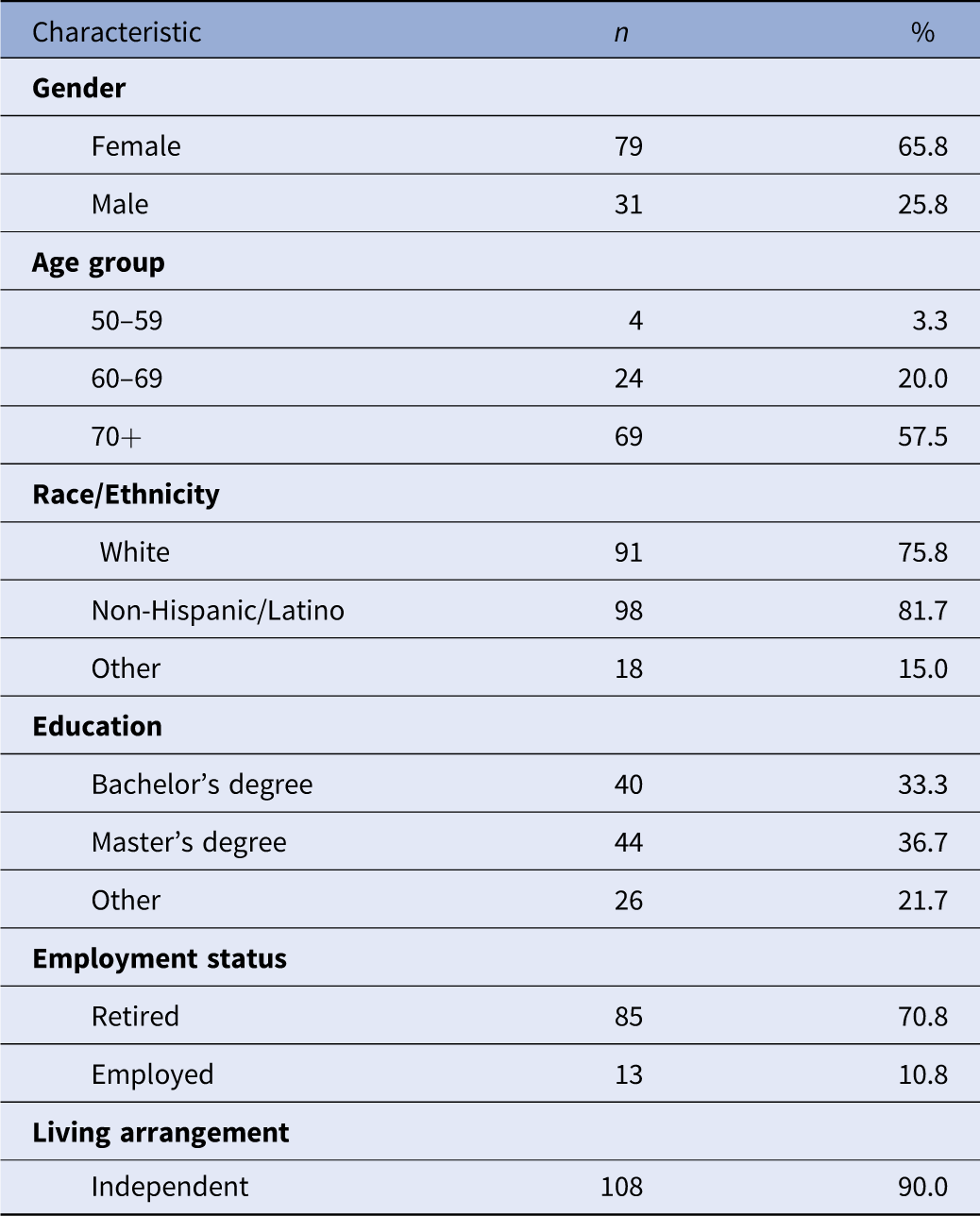
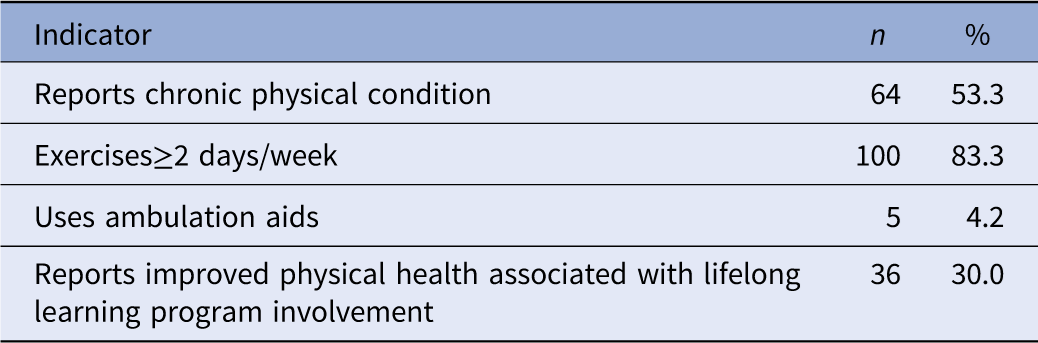
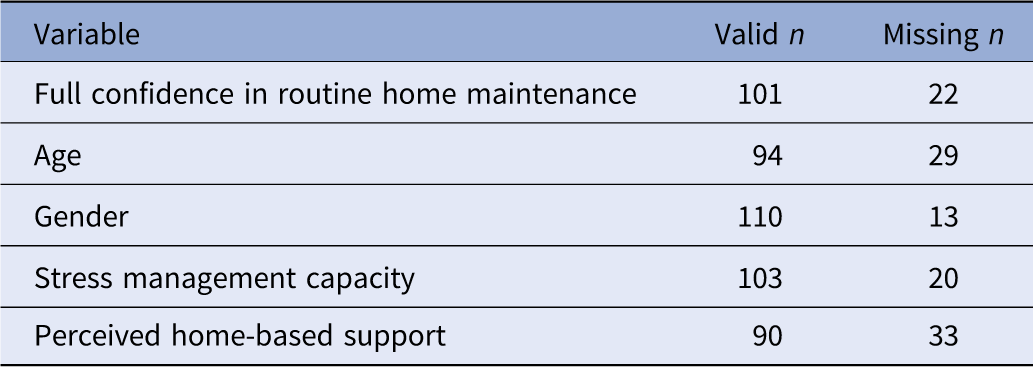
Participant characteristics are summarized in Table 1. Descriptive health indicators are presented in Table 2. Patterns of valid and missing responses for the primary outcome and adjusted model variables are shown in Table 3. No statistically significant differences were observed for age, gender, Hispanic/Latino ethnicity, or educational attainment.
Participant demographic characteristics (N = 120)

Table 1. Long description
The table presents participant characteristics in a structured format with six columns and eleven rows. The columns are labeled ʼCharacteristicʼ, ʼnʼ, and ʼ%ʼ. The rows are grouped under different categories: Gender, Age group, Race/Ethnicity, Education, Employment status, and Living arrangement. Each row lists specific details under these categories along with corresponding values for ʼnʼ and ʼ%ʼ. For example, under Gender, there are 79 females (65.8 percent) and 31 males (25.8 percent). The Age group category includes ranges like 50-59, 60-69, and 70+, with respective values. The Race/Ethnicity category lists White, Non-Hispanic/Latino, and Other, with their corresponding values. Education details include Bachelorʼs degree, Masterʼs degree, and Other. Employment status is divided into Retired and Employed, and Living arrangement is specified as Independent.
Note: Percentages are calculated using the 120 consenting respondents as the denominator. Totals may not sum to 100% because of missing item responses and because only selected response categories are presented.
Descriptive health indicators (physical, behavioral, etc.)

Table 2. Long description
A table summarizing descriptive health indicators with four rows and four columns. The columns are labeled Indicator, n, and %. The row labels are Reports chronic physical condition, Exercises >= 2 days/week, Uses ambulation aids, and Reports improved physical health associated with lifelong learning program involvement. Row 1: Reports chronic physical condition, 64, 53.3 percent. Row 2: Exercises >= 2 days/week, 100, 83.3 percent. Row 3: Uses ambulation aids, 5, 4.2 percent. Row 4: Reports improved physical health associated with lifelong learning program involvement, 36, 30.0 percent.
Note: Percentages are calculated using the 120 consenting respondents as the denominator. Missing item responses may be present.
Missing data for variables included in the primary adjusted model

Table 3. Long description
A table comparing the number of valid and missing responses for different variables in a study. The table has five rows and three columns. The columns are labeled ʼVariableʼ, ʼValid nʼ, and ʼMissing nʼ. The rows are labeled with the following variables: Full confidence in routine home maintenance, Age, Gender, Stress management capacity, and Perceived home-based support. The values in the ʼValid nʼ column are 101, 94, 110, 103, and 90 respectively. The values in the ʼMissing nʼ column are 22, 29, 13, 20, and 33 respectively.
Note: Counts reflect item-level availability among the 123 survey records. The primary adjusted model used complete-case analysis and included 77 participants with nonmissing data on all model variables.
Primary outcome
Among participants with valid outcome data (N = 101), 47 participants (46.5%) reported that they were comfortable doing routine maintenance on their home themselves. Forty-three participants (42.6%) reported that they were somewhat comfortable, and 11 participants (10.9%) reported that they were not comfortable. For the primary binary analysis, participants who reported being fully comfortable were compared with those who reported being somewhat comfortable or not comfortable.
Primary binary logistic regression model
In the complete-case analytic sample used for the adjusted model (N = 77), 31 participants reported full comfort performing routine home maintenance, and 46 reported less than full comfort. The adjusted binary logistic regression model was statistically significant, χ2(4) = 18.42, p = 0.001, with a Nagelkerke R 2 of .287. The model correctly classified 71.4% of cases.
Greater perceived home-based support was associated with lower odds of reporting full comfort performing routine home maintenance independently (OR = 0.64, 95% CI [0.44, 0.92], p = 0.015). Better perceived stress management was associated with higher odds of reporting full comfort with routine home maintenance (OR = 3.19, 95% CI [1.43, 7.13], p = 0.005). Older age was associated with lower odds of reporting full comfort (OR = 0.90, 95% CI [0.83, 0.97], p = 0.009). Gender was not significantly associated with the outcome (OR = 0.67, 95% CI [0.22, 2.08], p = .490).
Full results from the adjusted binary logistic regression model are presented in Table 4.
Adjusted binary logistic regression predicting full comfort performing routine home maintenance

Table 4. Long description
A table with five rows and five columns presenting results from an adjusted binary logistic regression model. The columns are labeled Predictor, B, SE, OR, 95% CI for OR, and p. The rows are labeled Perceived home-based support, Stress management capacity, Age, and Gender. Row 1: Perceived home-based support, B: -0.451, SE: 0.186, OR: 0.637, 95% CI for OR: 0.442-0.917, p: 0.015. Row 2: Stress management capacity, B: 1.161, SE: 0.410, OR: 3.193, 95% CI for OR: 1.430-7.131, p: 0.005. Row 3: Age, B: -0.106, SE: 0.040, OR: 0.899, 95% CI for OR: 0.831-0.973, p: 0.009. Row 4: Gender, B: -0.399, SE: 0.578, OR: 0.671, 95% CI for OR: 0.216-2.082, p: 0.490.
Note: N = 77. The dependent variable was full comfort performing routine home maintenance independently, coded 1 = Yes and 0 = No/Somewhat. OR = odds ratio; CI = confidence interval. The overall model was statistically significant, χ2(4) = 18.42, p = 0.001, Nagelkerke R2 = .287.
Ordinal sensitivity analysis
Because the primary outcome was originally measured using three ordered response categories, an ordinal logistic regression sensitivity analysis was conducted using the original No, Somewhat, and Yes response structure. The ordinal model included the same complete-case analytic sample as the primary model (N = 77) and was statistically significant, χ2(4) = 16.17, p = 0.003, with a Nagelkerke pseudo-R 2 of.221. The proportional odds assumption was not statistically violated based on the test of parallel lines, χ2(4) = 8.07, p = 0.089.
The ordinal sensitivity analysis produced a substantively similar pattern of findings. Greater perceived home-based support was associated with lower likelihood of being in a higher comfort category (estimate = −0.33, p = 0.047). Better perceived stress management was associated with greater likelihood of being in a higher comfort category (estimate = 1.07, p = 0.003). Older age was associated with lower likelihood of being in a higher comfort category (estimate = −0.08, p = 0.021). Gender was not statistically significant (p = .269).
Full results from the ordinal logistic regression sensitivity analysis are provided in Supplemental Table 1.
Discussion
Overview of key findings
This study examined psychological, behavioral, and environmental correlates of comfort performing routine home maintenance among adults aged 50 years and older affiliated with a university-based lifelong learning program. In the adjusted model, better perceived stress management was associated with higher odds of reporting full comfort performing routine home maintenance independently. In contrast, greater perceived home-based support and older age were associated with lower odds of reporting full comfort. Gender was not significantly associated with the outcome. An ordinal logistic regression sensitivity analysis using the original three-category outcome produced a substantively similar pattern of findings, suggesting that the primary results were not solely an artifact of dichotomizing the outcome. Together, these findings suggest that task-specific confidence in aging-in-place activities may reflect both individual psychological resources and perceived support needs within the home environment.
Stress management interpretation
The positive association between perceived stress management and comfort performing routine home maintenance suggests that psychological self-regulation may be an important component of aging-in-place confidence. Routine home maintenance can involve planning, problem-solving, physical effort, financial decisions, and coordination with others. Adults who perceive themselves as better able to manage stress may also feel more capable of navigating these demands, even when specific maintenance tasks are challenging. This finding is consistent with a broader understanding of aging in place as a process shaped not only by physical function or environmental conditions, but also by perceived coping capacity and confidence in managing day-to-day demands.
Home based support interpretation
The negative association between perceived home-based support and full comfort performing routine home maintenance should be interpreted cautiously. Rather than suggesting that support itself reduces independence, this finding may indicate that participants who perceive greater need for home-based support also experience lower confidence in completing maintenance tasks independently. Home-based support may therefore function as a marker of underlying support needs, emerging functional limitations, household complexity, or awareness that certain tasks require assistance. From an aging-in-place perspective, this finding underscores the importance of distinguishing between support as a resource and support as an indicator of need. For some adults, access to home-based support may help preserve autonomy by enabling them to remain safely in their homes even when they are less comfortable completing all maintenance tasks on their own.
Age interpretation
The association between older age and lower odds of full comfort performing routine home maintenance is consistent with the possibility that task-specific confidence may change across later adulthood. Routine maintenance activities can require physical mobility, strength, balance, sustained energy, decision-making, and coordination with service providers. [Reference Chodzko-Zajko, Proctor and Fiatarone Singh4] As adults age, changes in health, function, household composition, or access to informal assistance may affect how comfortable they feel managing these responsibilities independently. This finding reinforces the importance of considering aging in place as a dynamic process rather than a fixed preference. Planning for home maintenance, safety, and support needs may be especially important before functional challenges become urgent.
Translational implications
These findings have implications for translational approaches to aging in place. At the individual level, interventions that strengthen coping, planning, stress management, and confidence may complement home modification or service-based approaches [Reference Owen, Berry and Brown8]. At the household and community levels, routine home maintenance may serve as an early indicator of emerging support needs before a crisis, injury, or forced relocation occurs. Community-based organizations, lifelong learning programs, health systems, and aging services providers may be well positioned to integrate practical aging-in-place education with screening or referral pathways related to home safety, maintenance burden, and support planning. Because this study was exploratory and cross-sectional, these findings should be viewed as hypothesis-generating. Future translational research should examine whether interventions that combine psychological self-management, home safety planning, and support navigation can improve aging-in-place confidence and reduce unmet home-based needs over time.
Strengths and limitations
This study has several strengths. First, it addresses aging in place from a translational perspective by focusing on task-specific functional confidence, a construct that connects individual behavior, perceived support, and the home environment. Second, the study draws on data from adults aged 50 years and older who were affiliated with a community-based lifelong learning program, providing insight into a population that may be actively engaged in planning for later-life health, independence, and home-based needs. Third, the analysis incorporated both psychological and environmental predictors, allowing stress management capacity and perceived home-based support to be examined together rather than in isolation. Finally, the revised analytic approach included an ordinal logistic regression sensitivity analysis using the original three-category outcome, which strengthened confidence that the primary binary findings were not solely an artifact of dichotomizing the outcome.
Several limitations should also be considered when interpreting these findings. First, this study used a cross-sectional design, which limits the ability to determine temporal ordering or causality. Although stress management capacity, perceived home-based support, and age were associated with comfort performing routine home maintenance, these findings should be interpreted as associations rather than evidence that these factors directly influence functional confidence.
Second, the study relied on self-reported survey data. Participants may have interpreted items differently, and responses may have been influenced by recall, social desirability, or individual differences in how respondents assess their own abilities and support needs. Several measures used in the analysis were study-specific single-item indicators rather than multi-item validated scales. While these items were useful for exploratory analysis, they may not capture the full complexity of stress management, home-based support, or functional confidence. In addition, perceived home-based support and stress management capacity were measured using ordered response categories and modeled numerically in the regression analyses. This approach supported a parsimonious exploratory model, but it assumes a consistent change in log odds across adjacent response categories and may not fully capture nonlinear or threshold effects.
Third, the primary outcome was originally measured using three ordered response categories: No, Somewhat, and Yes. For the primary analysis, the outcome was dichotomized to distinguish participants who reported full comfort performing routine home maintenance from those reporting less than full comfort. This approach aligned with the study’s focus on full task-specific confidence, but it also reduced variation in the original response structure. To address this limitation, an ordinal logistic regression sensitivity analysis was conducted using the original three-category outcome. The sensitivity analysis produced a substantively similar pattern of findings, which supports the robustness of the primary model while acknowledging the limitations of dichotomization.
Fourth, missing data reduced the analytic sample for multivariable modeling. Although 120 consenting respondents were available and 101 participants provided valid responses to the primary outcome, the final adjusted model included 77 participants with complete data on the outcome, perceived home-based support, stress management capacity, age, and gender. The final model included 31 outcome events among 77 complete cases. Given the modest number of events, the adjusted model was intentionally limited to four conceptually relevant predictors to reduce overfitting risk; however, model stability should still be interpreted cautiously.
Review of survey response patterns indicated that missing primary-outcome data were attributable to survey noncompletion: all 101 participants who completed the survey provided a response to the home-maintenance outcome, whereas the 19 consenting participants who discontinued the survey did not reach that item. Additional missingness was present for selected predictor variables and therefore reflected both survey attrition and item-level nonresponse. Because reasons for survey discontinuation and item nonresponse were not collected, the underlying missing-data mechanism cannot be definitively classified as missing completely at random, missing at random, or missing not at random from the observed data alone.
To assess potential selection bias associated with complete-case analysis, participants included in the final analytic model were compared with those excluded because of missing model variables on available demographic characteristics. No statistically significant differences were observed for age (Welch p = 0.264), gender (χ2 [Reference Rowe and Kahn1] = 2.33, p = 0.127), Hispanic/Latino ethnicity (Fisher exact two-sided p = 1.000), or educational attainment categorized as bachelor’s degree or less versus graduate/professional degree (χ2 [Reference Rowe and Kahn1] = 2.28, p = 0.131). These findings reduce concern regarding observable demographic differences between included and excluded participants but do not rule out bias associated with unobserved factors or the missing-data mechanism itself. Complete-case analysis was therefore retained, and the potential for bias related to missing data remains an important limitation.
Fifth, the sample was drawn from members of a university-affiliated lifelong learning program. Participants in such programs may differ from the broader population of adults aging in place in terms of education, health awareness, socioeconomic resources, digital access, and engagement with health-related learning opportunities. As a result, findings may not generalize to older adults with fewer resources, lower educational attainment, greater functional limitations, or less connection to community-based educational programs.
Finally, the survey was distributed through program-based email communication rather than public recruitment channels, and the survey was not indexed by search engines. However, the Qualtrics link was technically accessible to anyone with the link, and automated bot-detection, duplicate-detection, and reCAPTCHA tools were not enabled. Although responses were reviewed for consent, completion status, and availability of the primary outcome before analysis, the possibility of duplicate, ineligible, or otherwise invalid responses cannot be entirely ruled out.
Conclusion
Overall, this study suggests that comfort with routine home maintenance may be an important and practical indicator of aging-in-place confidence. The findings point to the relevance of both individual psychological resources and perceived home-based support needs, while also highlighting age-related differences in task-specific confidence. For translational aging research, these results support the value of earlier, community-based conversations about home maintenance, coping capacity, and support planning before functional challenges become crises. Future longitudinal and intervention-focused research is needed to determine whether strengthening stress management, home safety planning, and support navigation can improve confidence and preparedness for aging in place.
Supplementary material
The supplementary material for this article can be found at https://doi.org/10.1017/cts.2026.10846.
Data availability statement
The data that support the findings of this study are available from the corresponding author upon reasonable request.
Acknowledgements
The author thanks Dr Brian Kwan for his contributions to survey design and preliminary analytic planning that informed the drafting of the Methods section. Appreciation is also extended to graduate research assistants Julie Nguyen and Patricia Cortez, who assisted in developing select survey items and programing the Qualtrics instrument under Dr Kwan’s supervision. Special thanks are extended to Patti LaPlace, Executive Director of the Osher Lifelong Learning Institute at California State University, Long Beach, for her collaboration and support in facilitating participant recruitment and data collection.
Author contributions
Rebecca M. Perley: Conceptualization, Data curation, Formal analysis, Investigation, Methodology, Project administration, Visualization, Writing - original draft, Writing - review & editing.
Funding statement
This research received no specific grant from any funding agency in the public, commercial, or not-for-profit sectors.
Competing interests
The author declares no potential conflicts of interest with respect to the research, authorship, and/or publication of this article.
Study registration
This study was retrospectively registered with the Open Science Framework (DOI: 10.17605/OSF.IO/PD573).
Artificial Intelligence use disclosure
An artificial intelligence–assisted language model (ChatGPT, OpenAI) was used to support editorial revision and language refinement during manuscript preparation. The tool was not used to generate data, conduct analyses, or create figures or tables. The author reviewed and approved the final manuscript and takes full responsibility for the accuracy, originality, and integrity of the content.
Statement of informed consent
Informed consent was obtained from all participants involved in the study.
Ethical standards
All study procedures were reviewed and approved by the Institutional Review Board at California State University, Long Beach (IRBNet Project #2239703; approval date October 11, 2024). The research was determined to involve minimal risk and was approved under Expedited Review procedures. Data collection adhered to university and federal guidelines for confidentiality and data protection.



 Open access

