INTRODUCTION
During field work carried out by the second and third authors in two different survey programmes (on benthic invertebrate ecology and on fisheries) on the coast of Pakistan, a number of interesting crabs were caught from subtidal regions, four of which are reported elsewhere (Kazmi & Moazzam, in press). Of particular interest was Sonmiani Bay, situated off the western coast of Pakistan, and an important shrimp fishing centre for the province of Balochistan. Due to the presence of mangrove forest around, Sonmiani lagoon is one of the most productive habitats on the coast. It is perhaps due to this that historically more attention had been focused on fish and shrimp catches. However, it is expected that more systematic surveys for crabs will reveal new and rare species. During the survey in Sonmiani Bay on-board the RV ‘Firdouw-I’, two unusual xanthid crab specimens were collected by trawl, and it became apparent that there were no previous records of these species from Pakistan. These crabs were sent to Professor Peter K.L. Ng (National University of Singapore), who in turn passed them to the first author for identification, and are the subject of this report. Considering the rarity of these species, short diagnoses are provided and the available literature on these two species is reviewed. An update on the taxonomy of these two species, in light of relevant recent studies, is also provided.
Measurements are expressed as carapace width × carapace length in millimetres. The following abbreviations are used: coll., collected by; det., determined by; don., donated by; G1, male first gonopod; G2, male second gonopod; mxp3, third maxillipeds; P1–P5, first to fifth pereopods, respectively.
Materials examined are deposited in the Muséum National d'Histoire Naturelle (MNHN), Paris; the National Museum of Natural History (USNM); Smithsonian Institution, Washington, DC; and the Zoological Reference Collection (ZRC), Raffles Museum of Biodiversity Research, National University of Singapore.
SYSTEMATICS
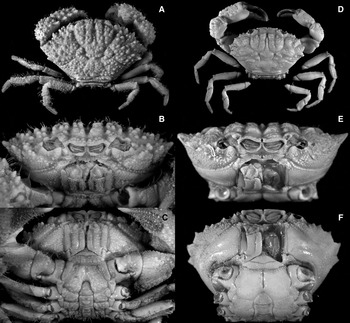
(A–C) Odhnea echinus (Alcock, Reference Alcock1898), male, 31.7 by 21.4 mm (ZRC 2010.0222), Pakistan; (D, E) Paraxanthodes cumatodes (MacGilchrist, Reference MacGilchrist1905), male, 17.0 by 10.8 mm (ZRC 2010.0223), Pakistan. (A, D), dorsal view; (B, E), anterior view; (C, F), ventral view.

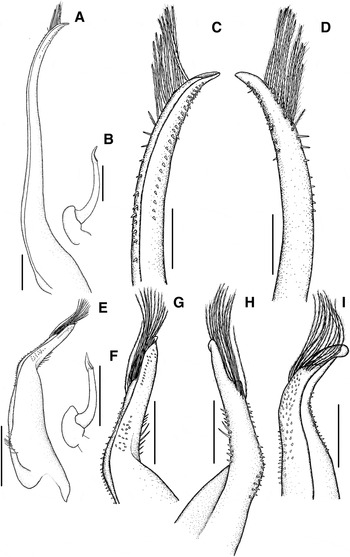
Male gonopods: (A–D) Odhnea echinus (Alcock, Reference Alcock1898) (ZRC 2010.0222); (E–I) Paraxanthodes cumatodes (MacGilchrist, Reference MacGilchrist1905) (ZRC 2010.0223). A, E, left G1, external view; B, F, left G2, external view; C, G, distal tip of left G1, external view; D, H, distal tip of left G1, internal view; I, distal tip of left G1, mesial view. Scale bars: A, B, E, F, 1.0 mm; C, D, G–I, 0.5 mm.

Actaea echinus Alcock, Reference Alcock1898: 149; Alcock & Anderson, Reference Alcock and Anderson1899: pl. 37, figure 3; Sakai, Reference Sakai1965a: 40, 44, pl. 6, figure 11; 1976: 444, pl. 158, figure 4.
Actaea nodulosa var. echinus, Odhner, Reference Odhner1925: 57, pl. 5, figure 11.
[Actaea] echinus, Guinot, Reference Guinot1976: 204.
Odhneria echinus, Sakai, Reference Sakai1983: 14, pl. 2, figure 1; Ng et al., Reference Ng, Guinot and Davie2008: 195 (list).
MATERIAL EXAMINED
One male, 31.7 × 21.4 mm (ZRC 2010.0222), 25°01.7′N 66°42.9′E, 24 m depth, Sonmiani Bay, coll. M. Moazzam, 6 November 2009, don. Q.B. Kazmi.
DIAGNOSIS
Carapace transversely subovate, width 1.5 times length; dorsal surface gently convex, filled with conical or subconical tubercles, sparsely setose; regions well defined, 2M completely divided longitudinally, 4M distinct; grooves deep and smooth. Anterolateral margins indistinctly divided into five lobes, each with conical, denticulate tubercles of varied sizes. Subhepatic, pterygostomian regions, thoracic sternum and third maxillipeds distinctly granulate. Third maxillipeds with antero-external angle of merus slightly produced. Sternite 4 of thoracic sternum with distinct transverse and oblique furrows, without distinct median line externally; all episternites delimited from respective sternites by distinct furrow. Chelipeds subequal; superoexternal surfaces with conical tubercles. Ambulatory legs short, slender, dorsal surface finely granulate; anterior margin of meri minutely serrated; anterior margins of carpi and propodi serrated, dorsal surface of carpi with granulate crest. Male abdomen relatively long, tip of telson anterior to level of sternal condyles of P1 coxae; somite 6 quadrate, lateral margins straight; telson subtriangular, slightly longer than broad. G1 long, slender, slightly sinuous; apical lobe short, spatuliform, curving laterally; distal tip with several long, stiff, plumose, subterminal setae; G2 about one-quarter length of G1, slender, gently curved, with short terminal segment.
LIVE COLORATION
Dorsal surface of carapace with patches of red-orange on gastric and anterior branchial regions, yellow on postorbital regions and white on posterior branchial regions. Fingers of chelipeds dark-brown throughout their length; brown pigment also extending into distal ventral portion of palm. Ambulatory legs banded with red-orange and white. Ventral surface appearing mottled, raised portions in thoracic sternum red-orange, amidst a white background.
REMARKS
Actaea echinus Alcock, Reference Alcock1898, was described from a single male, collected from the Malabar coast, south-western India, at a depth of 29 fathoms (52 m) (Alcock, Reference Alcock1898: 149). Alcock (Reference Alcock1898) distinguished this species from Actaea nodulosa (White, Reference White1848) (now in the genus Epiactaea, cf. Ng et al., Reference Ng, Guinot and Davie2008), which he opined was its closest congener by: (1) the conical (rather than pearliform) tubercles on the surfaces of the carapace and coarse serrated spines on the anterolateral margins and on the chelipeds; (2) the broadly bilobed front, with angular lobes; (3) the irregular and indistinct lobulation of the carapace anterolateral margins; and (4) the thin, compressed and tomentose ambulatory legs, with the anterior margins of the carpi and propodi serrated and cristate. Odhner (Reference Odhner1925) considered it to be merely a variety of Actaea nodulosa. Sakai (Reference Sakai1965a, Reference Sakai1976) considered Actaea echinus as a distinct species, noting in his comparison of new specimens (collected from off the Kii Peninsula, southern Japan) with the original illustration of A. nodulosa by Adams & White (Reference Adams, White and Adams1848: pl. 8, figure 4) that the Japanese specimens were separable by their narrower carapace and by the much lesser degree of tuberculation and granulation on the ambulatory meri.
Guinot (Reference Guinot1976: 204) was the first to exclude A. echinus from the genus Actaea, although she did not establish any new taxa for this species. Actaea echinus was eventually transferred by Sakai (Reference Sakai1983) to a new genus, Odhneria, along with the type species, O. acutidens Sakai, Reference Sakai1983. He (Sakai, Reference Sakai1983: 13) provided a short diagnosis distinguishing this genus from Actaea: ‘The carapace of this new genus is a little broader than long, compared with that of Actaea, the proportion between length to breadth being 1:1.5, while that of Actaea is 1:1.4. The dorsal surface is elegantly separated into areolae by deep grooves. Each areolae [sic] are covered sparingly with conical tubercles of various sizes. In the gastric area, 2M is longitudinally divided into two elongate lobules. The front is deeply bilobate, each one of which is margined with tubercles. The anterolateral border is cut into five teeth, each of which is covered with tubercles and its top is larger and pointed. Chelipeds are large and the wrist and palm are massive but not separated into lobules and are covered with conical tubercles of various sizes.’ The validity of this genus, with respect to the subfamily Actaeinae, needs to be ascertained. But this is better done within the larger context of a systematic revision of the subfamily, which recent studies have shown to be polyphyletic, and with more attention given to the ventral or sternal characters and other non-traditional characters (see Lai et al., Reference Lai, Mendoza, Guinot, Clark and Ng2011). Furthermore, Odhnea (as Odhneria echinus) was shown to have a closer affinity to species traditionally classified under Xanthinae, such as Demania intermedia, rather than to actaeines (Lai et al., Reference Lai, Mendoza, Guinot, Clark and Ng2011: figure 1).
A nomenclatural issue was raised by Ng & Low (Reference Ng and Low2010: 36), who proposed the replacement name Odhnea, for Odhneria Sakai, Reference Sakai1983, as the latter was a junior homonym of Odhneria Travassos, 1921, and Odhneria Baer, 1924 (Platyhelminthes: Trematoda). The new name is used in this report.
The present material from Pakistan agrees well with the descriptions and illustrations provided by previous workers (cf. Alcock & Anderson, Reference Alcock and Anderson1899: pl. 37, figure 3; Sakai, Reference Sakai1965a: pl. 6, figure 11; 1976: pl. 158, figure 4; 1983: pl. 2, figure 1). The type was not examined, its status is not known, although it is most probably deposited in the Indian Museum in Calcutta. Odhnea echinus is now known from the Malabar Coast in south-western India, the waters off the Kii Peninsula in southern Japan, and Sonmiani Bay in Pakistan. It has been collected from depths of 15–52 m.
Xanthodes cumatodes MacGilchrist, Reference MacGilchrist1905: 205; Alcock & Annandale, Reference Alcock and Annandale1907: pl. 79, figure 1, 1A.
Xanthias cumatodes, Balss, Reference Balss1929: 24; Stephensen, Reference Stephensen1945: 148.
Paraxanthodes cumatodes, Guinot, Reference Guinot1968: 723, figure 60; Reference Guinot1971: 1069; Serène, Reference Serène1968: 77; Reference Serène1984: 209, pl. 30, figure C; Ng et al., Reference Ng, Guinot and Davie2008: 204 (list).
Not Paraxanthodes cumatodes, Davie, Reference Davie and Crosnier1997: 369; Mendoza & Ng, Reference Mendoza and Ng2010: 69, figure 4H.
MATERIAL EXAMINED
One male, 17.0 × 10.8 mm (ZRC 2010.0223), 25°00.9′N 65°41.6′E, 138 m depth, Sonmiani Bay, Pakistan, coll. M. Moazzam, 6 November 2009, don. Q.B. Kazmi.
COMPARATIVE MATERIAL
Paraxanthodes aff. cumatodes: 1 male, 6.7 × 4.9 mm (MNHN-B27721), Station 367, 105 m, 22°37′S 167°04′E, Grand Récif Sud, New Caledonia, coll. B. Richer de Forges/ORSTOM, no date, det. P. Ng as P. cumatodes; 1 male, 8.9 × 6.3 mm (MNHN-B27725), Station 387, 225 m, 22°39′S 167°07′E, Grand Récif Sud, New Caledonia, coll. B. Richer de Forges/ORSTOM, 22 January 1985; 1 male, 12.1 × 8.5 mm, 1 female, 8.9 × 6.3 mm (USNM 268715), Station 151, 200 m, 19°07′00″S 163°22′00″E, New Caledonia, coll. MUSORSTOM IV, 14 September 1985, det. P. Davie as P. cumatodes.
DIAGNOSIS
Carapace transversely subhexagonal, width 1.6 times length; dorsal surface gently convex, coarsely granulate, some granules arranged in transverse rows on anterior areolae; regions well defined anteriorly, 2M completely divided longitudinally, 2P with distinct transverse ridges on either side. Anterolateral margins with five teeth, first tooth small, subhepatic, subsequent teeth more broadly triangular, particularly third and fourth. Subhepatic, pterygostomian regions, thoracic sternum regularly covered with rounded granules. Third maxillipeds granulate, with antero-external angle of merus slightly produced. Chelipeds unequal; superoexternal surfaces pronouncedly granulate, eroded; carpus with two teeth on inner angle. Ambulatory legs moderately long; anterior margin of meri cristate; carpi with central portion of anterior margin distinctly concave with slightly projecting lobes on either end, dorsal surface carinate. Male abdomen short; somite 6 broad, lateral margins concave; telson rounded, subtriangular. G1 short, stout, distinctly twisted along longitudinal axis, with strong lateral crest on proximal half; distal half with row of spiniform setae along lateral margin, with low, conical spines on mesial surface, and with several long, plumose, subterminal setae; apical lobe long, spatuliform; G2 half as long as G1, gently curved, with short terminal segment.
LIVE COLORATION
Dorsal surface of carapace mottled orange and yellowish-white, pereopods similarly coloured. Fingers of chelipeds dark-brown throughout most of their length, becoming lighter at distal tips. Ventral surface, particularly third maxillipeds, pterygostomian region, thoracic sternum and abdomen, white with scattered orange spots.
REMARKS
MacGilchrist (Reference MacGilchrist1905) described Xanthodes cumatodes on the basis of one male and six female specimens trawled from the Persian Gulf during the ‘Investigator’ expeditions, from a muddy bottom at a depth of 53 fathoms (96 m). An illustration of a syntype subsequently appeared in Alcock & Annandale (Reference Alcock and Annandale1907: pl. 79, figure 1, 1A). A female specimen from the Red Sea, collected by the ‘Pola’ expedition from a depth of 168 m, was also reported by Balss (Reference Balss1929), as Xanthias cumatodes, using Rathbun's (Reference Rathbun1897) replacement name for Xanthodes Dana, Reference Dana1852. Guinot (Reference Guinot1968) eventually transferred this species to a new genus she had established, Paraxanthodes, together with the type species, Micropanope obtusidens Sakai, 1965. Guinot (Reference Guinot1968: 725) opined that Paraxanthodes has a close affinity to genera such as Paraxanthias Odhner, Reference Odhner1925 (particularly the West African and East Pacific species) and Pseudomedaeus Guinot, Reference Guinot1968; and that Paraxanthodes could be most easily distinguished from other genera by the morphology of the G1 (then only known for P. obtusidens), though similar to what she considered Paraxanthias s. str. Guinot further distinguished Paraxanthodes from Paraxanthias by the lobulation of the dorsal surface of the carapace, the condition of the orbits, ambulatory legs and G1. The G1 morphology of the present specimen of Paraxanthodes cumatodes from Pakistan (Figure 2E, G–I), makes its placement in Paraxanthodes doubtful (see Sakai, Reference Sakai1965b: figure 3E; Guinot, Reference Guinot1968: figure 51A, B). The generic placement of this species is now part of a systematic revision of the subfamily Euxanthinae currently being undertaken by the first author together with P.K.L. Ng (National University of Singapore).
No further records of Paraxanthodes cumatodes from the general western Indian Ocean have been made until now, although Davie (Reference Davie and Crosnier1997) and Mendoza & Ng (Reference Mendoza and Ng2010) reported P. cumatodes from New Caledonia and the Philippines, respectively. However, upon re-examination of the material studied in those two reports, it appears that they are not conspecific with P. cumatodes and, in fact, comprise a distinct and novel species. The description of this new species is also included in the revisionary work on Euxanthinae.
The present material from Pakistan agrees well with the detailed description of P. cumatodes by MacGilchrist (Reference MacGilchrist1905: 205) and illustrations of the syntype (cf. Alcock & Annandale, Reference Alcock and Annandale1907: pl. 79, figure 1, 1A) and of the female specimen from the Red Sea (Guinot, Reference Guinot1968: figure 60; Serène, Reference Serène1984: pl. 30, figure C), particularly in the lobulation and pattern of granulation on the dorsal surface of the carapace, and in the cristate anterior margin of the ambulatory meri, which also does not have a well separated subdistal tooth. The Pakistani specimen differs from earlier specimens in having a broader carapace, although this increased width–length ratio may be due to the larger size of this specimen (the largest specimen recorded before now was the syntype male: 11.3 × 8.0 mm). None of the syntypes were examined, and their status is unknown, though they may still be in the Indian Museum in Calcutta. Paraxanthodes cumatodes is now known from the Persian Gulf, the Red Sea, and Sonmiani Bay in Pakistan. It has been collected from depths of 96 to168 m.
ACKNOWLEDGEMENTS
The authors gratefully acknowledge Professor Peter K.L. Ng (National University of Singapore) for facilitating this collaborative work. The second author thanks the Director and staff of the Marine Reference & Collection Center, University of Karachi, for provision of laboratory facilities.