Disaster mitigation is becoming increasingly important to protect community health. The growing number of natural hazards due to rapid demographic and environmental changes has forced more people than ever to confront disasters. Although disaster mitigation can be achieved through a variety of approaches, such as infrastructure recovery and educational programs, all of these activities have a shared goal, ie, to protect community health. Therefore, health facilities, the principal factors for health protection, must be one of the key stakeholders of disaster planning.
Even so, most hospitals remain insufficiently prepared for natural disasters, and critical damage to hospitals has been repeatedly reported.Reference Redlener and Reilly 1 , Reference Schultz, Koenig and Lewis 2 This is inherent, at least partly, to the increased complexity of modern cities’ systems and technology development. For example, once a distribution channel is disrupted, resources will rapidly and easily be in short supply, which will require mass evacuation of patients outside of the community. In return, dysfunction of emergency communication tools due to power outages could be assumed to leave hospitals uninformed and may delay rescue calls, even when transportation systems for rescue activities are secured. These cases underscore the importance of capacity assessment of hospitals from various points of view.
Another reason for this insufficient preparedness might be the fact that risk analyses of hospitals are usually conducted independently by each hospital in an uncoordinated fashion. This discrete surveillance may lead to heterogeneity in disaster preparedness among hospitals, and even more, may hinder disaster preparedness at the community level. Because hospitals often compete with each other for a limited budget, hospitals providing only nontrauma care are more likely to be ill-prepared for disasters owing to a lack of resources. Nevertheless, practically speaking, the need for chronic care was reported to be increased in recent disasters.Reference Roggen, van Berlaer and Gijs 3 Therefore, to achieve local disaster mitigation, community-wide surveillance will need to be conducted. Local governments must play a central role in this surveillance to make effective resource allocation possible.
Japan, one of the most disaster-prone countries, has developed strict countermeasures against natural hazards. Hospital buildings are also strictly regulated by a number of laws, such as building standards law, fire prevention law, and medical care law, which are continuously updated. The national government has also designated disaster-base hospitals (DBHs), which are intended to work as hub hospitals during and after a disaster. However, thus far, no monitoring system exists to assess compliance with these designated countermeasures. Moreover, legislation for infrastructural preparedness is limited at the present time. For example, a power generator is mandated only for large hospitals and DBHs. Stockpiles and alternative communication tools are required conditions for DBHs, but such preparedness is not mandated by law in Japan. Therefore, there is an increasing need for nationwide surveillance with regard to hospital preparedness.
Recently, a global assessment tool for hospital preparedness, called the Hospital Safety Index, was established by the World Health Organization. 4 Although simple and easy to use, the Hospital Safety Index still requires time and human resources to some extent. Because Japan has 8701 hospitals nationwide, which vary in terms of founder, size, and types of care provided, it is practically impossible to assess all of these hospitals with this tool. A preliminary study with a simple methodology is preferable before using such assessment tools.
Responding to these needs, the national government commissioned a nationwide surveillance on hospital preparedness to assess the vulnerability and needs of local hospitals according to hospital background. This study revealed that several hospitals appeared to be at higher risk than others when disasters occur. The present results also suggest that the types and specialties of hospitals must be considered in further surveillance efforts.
Methods
This was a cross-sectional national study commissioned by the Japanese Ministry of Health, Labour and Welfare. A paper-based questionnaire was conducted from June 1 to July 1, 2011. All of the 8701 registered hospitals in Japan were recruited for the questionnaire, which comprised background questions and questions about disaster preparedness (online data supplement 1). Securing space for a helicopter platform was specifically included in the questions. For mountainous countries like Japan, residential areas are separated by mountains and preparing helicopter transportation systems could be critical in case of patient evacuation.Reference Tanaka, Iwai and Oda 5
DBHs are further subcategorized into core DBHs (CDBHs) and local DBHs (LDBHs). LDBHs are designated to accept severely injured patients and provide medical care in the local area, whereas CDBHs are also designated to provide training and drills for disaster medical assistance teams. Preparedness included compliance with the new seismic-resistance building code revised in 1981 and the existence of measures to secure electricity, water, communication tools, and helicopter platforms.
Statistical analyses
The statistical analyses were conducted by using STATA SE13 (STATA, College Station, TX). Logistic regression was applied for binary outcomes and linear regression was applied for continuous outcomes. Explanatory factors included founder types, hospital category, geographic area (online data supplement 2), number of hospital beds, presence of nursing care beds, and presence of psychiatric care beds. Statistical significance was set at p<0.05.
Results
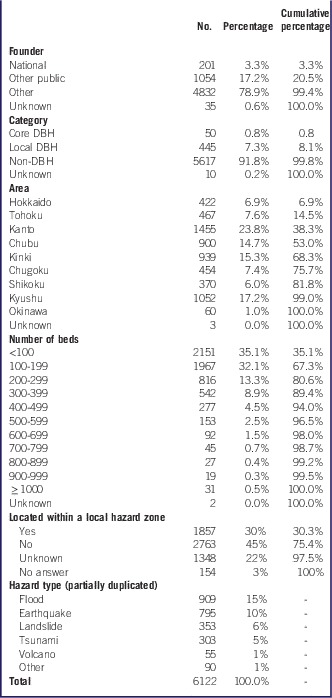
Answers were obtained from 6122 hospitals (response rate: 70.3%), among which 20.5% were public (national or city-run) hospitals and others were private. Eight percent were the hospitals assigned as DBHs and the others were non-disaster-base hospitals. Approximately two-thirds of the hospitals had fewer than 200 beds (Table 1).

Hazards
Thirty percent of the hospitals responded that they were located in an area with natural hazards. The most frequent hazard was flood (909 hospitals, or 15%), followed by earthquake (795, or 13%), landslide (353, or 6%), tsunami (303, or 5%), and volcano (55, or 1%).
Preparation of resources and logistics
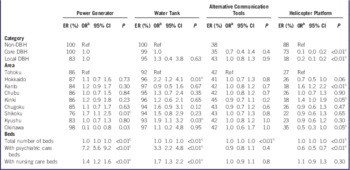
The proportion of hospitals equipped with power generators, water tanks, emergency communication tools, and helicopter platforms is shown in Table 2. Hospitals without power generators, water tanks, emergency communication tools, or helicopter platforms may experience power outages, water loss, communication loss, and loss of transportation, respectively. On the basis of this assumption, the risks of losing this equipment were calculated.
Risks of Losing Lifelines After a Huge DisasterFootnote a

a Abbreviations: CI, confidence interval; DBH, disaster-base hospital; ER, equipment ratio; OR, odds ratio; Ref, reference value.
b OR of losing the equipment (power, water, communication tool, transportation tool) at the time of disaster.
c Statistically significant.
Electricity
Over 80% of the hospitals were equipped with power generators. Hospitals with psychiatric care beds and nursing care beds were 7.2 and 1.4 times as likely to lose electricity, respectively. Among geographic areas, the risk was higher in Shikoku and Okinawa.
Water
More than 90% of the hospitals were equipped with water tanks. Among geographic areas, Hokkaido (odds ratio [OR]: 2.2) and Kyusyu (OR: 1.9) had a significantly higher risk of water loss. Hospitals with psychiatric care beds and nursing care beds were 3 times and 1.7 times as likely to lack water, respectively.
Communication Tools
When telephone lines and cell phone towers are destroyed after a disaster, disruption of communication tools could affect more than half of the hospitals, although no significant risk groups existed with respect to category, geographic area, or types of care.
Transportation Tools
Only one-third of the hospitals had secured areas for emergency helicopter platforms, which are essential for long-distance transportation, though CDBHs and LDBHs were more likely to secure the space. The risk of losing a transportation tool was significantly higher among hospitals in the Kanto and Kinki areas, with ORs of 1.7 and 1.5, respectively.
Compliance to Building Code
Rates of compliance to the national building code among the hospitals with earthquake hazards were calculated (online data supplement 3). Overall, 90% of the hospitals (100% of DBHs, 96% of local DBHs) responded that they followed the new building code. However, only 53% (62% of DBHs, 57% of local DBHs) answered that all of the buildings that patients may use met the standard. Only 21% introduced seismically isolated structures, and the compliance rate was lower among DBHs (19%).
The Japanese national government recommends that buildings with an earthquake hazard be assessed for seismic resistance. However, only 37% of the hospitals answered that they had taken the assessment, among which national hospitals (62%) and DBHs (46%) showed better compliance. Although 71% of the assessed hospitals were diagnosed as requiring retrofitting, only one-quarter completed this process.
Discussion
This is the first nationwide surveillance of hospital preparedness in Japan. Because this study was commissioned by the Japan Ministry of Health, Labour, and Welfare, the response rate was high enough (70.3%) to assume the result to be representative of all the hospitals in Japan. The compliance rate to the building code and assessment for seismic resistance seemed to be unsatisfactory. In addition, two major vulnerabilities among Japanese hospitals emerged. First, hospitals located in mega-city areas such as Kanto and Kinki were less prepared for helicopter transport. Second, hospitals with psychiatric and nursing care beds were less likely to be able to secure power and other resources in disaster settings.
Preparedness of helicopter transportation systems for inpatients to other hospitals in unaffected areas seems indispensable in Japan, where small flatlands are separated by mountains. In such geographical conditions, railways and roads are often blocked after severe geographical and meteorological disasters.Reference Ukai 6 Especially, the areas containing mega-cities with dense populations are more likely to be overloaded by patients requiring care immediately after a disaster. As a result, the local hospitals will inevitably require evacuation of hospitalized patients to conserve limited resources. This mass transfer can easily overwhelm the capacity of the local ambulance system, as was seen after the 1995 Hanshin-Awaji Earthquake in Kobe and Osaka.Reference Tanaka, Iwai and Oda 5 Therefore, securing heliports for long-distance evacuation is essential, especially in mega-cities. In Japan, of the largest 10 cities (online data supplement 2), the Kanto area contains 4 and the Kinki area contains 3. However, these areas were the least prepared with regard to helicopter platforms, which suggests a major vulnerability.
This vulnerability is partly due to a paucity of open space and high land costs. In dense cities, it is preferable that public areas such as gymnasiums or parks be flexibly used for helicopter platforms. The national government working groups for disaster relief setup in 1995 after the Great Hanshin-Awaji Earthquake in the Kinki area recommended that local governments use public space as bases of relief activity. However, several legal and nonlegal barriers to the execution of this plan have arisen, such as who should be allowed to establish a heliport and how it should be operated.Reference Nagata, Rosborough and VanRooyen 7 Therefore, systems for more flexible use of public space for heliports need to be developed in advance.
Another finding of the present study was that hospitals providing chronic care were less likely to have enough stockpiles. This is partly because these hospitals were more likely to be under economic strain and thus to need to reduce inventory costs.Reference Barbera, Yeatts and Macintyre 8 However, preparedness of stockpiles for hospitals is more important among the hospitals providing chronic care than among those providing emergency care for two reasons. Immediately after a disaster, patients with acute and severe conditions are to be evacuated at first. Therefore, patients with chronic conditions, such as those receiving psychiatric or nursing care, would be rescued after several days or weeks. This scenario happened after the Great East Japan Earthquake, and several nursing care hospitals were left for weeks without electricity. 9 If resources for these patients run out, these patients may need to be evacuated to nearby hospitals, most likely acute care hospitals, which may already be preoccupied by disaster victims. Therefore, to maintain a network of community health systems after a disaster, hospitals with psychiatric and nursing care beds are expected to secure sufficient electricity, water, and food supplies so that they can remain self-sufficient until the rescue team arrives. Subsidizing the purchase of supplies and forming coalitions between community hospitals is one possible solution to this issue.
As a whole, the present research also revealed a large amount of heterogeneity in preparedness among hospitals. This might be due to differences in risk perception, challenging economic status, or legal and nonlegal barriers. Filling the gap between well-prepared large hospitals and ill-prepared small hospitals is key to responding to any kind of health needs and achieving disaster mitigation. Currently, risk and vulnerability assessment of hospitals usually target only large hospitals that specialize in disaster management.Reference Mulyasari, Inoue and Prashar 10 The present study showed that future intensive surveillance is needed to assess hospitals of any size, geographic area, founder, and function to achieve a common standard.
The major limitation of this research was the validity of the answers. For example, if hospital staff did not have enough knowledge about natural hazards, they may have answered that their hospital is not located within a hazard zone in question 1, even if the hospital actually is located within such a zone. Another limitation is that detailed information about each risk, eg, the age of the buildings to assess risk of collapse, could not be obtained by use of this simple questionnaire. Additionally, this surveillance did not evaluate emergency plans and training programs of the hospitals, which are also key to achieving effective disaster mitigation. For further intensive and more valid surveillance, the use of global assessment tools like the Hospital Safety Index will be preferable.
Conclusion
Nationwide surveillance was conducted of disaster preparedness among hospitals in Japan. Major gaps between health needs and supplies were identified in the logistics in mega-cities and stockpiles at hospitals with chronic care beds. Further study using global assessment tools such as the Hospital Safety Index is required. To conduct this intensive survey in a manner that meets community health needs, appropriate sampling methods should be established according to the results of this preliminary study. Vulnerability analysis of community hospitals as a whole will lead to more robust local disaster mitigation.
Funding
This research was funded by the Japan Ministry of Health, Labour, and Welfare.
Conflict of Interest
This research was funded by a Health and Labour Sciences research grant.
Supplementary Material
To view supplementary material for this article, please visit http://dx.doi.org/10.1017/dmp.2015.101.