In response to the traditional emphasis of Psychology, which focused primarily on the study of the pathology of human functioning and the healing of negative experiences, Positive Psychology emerges at the beginning of the twentieth century and is primarily concerned with quality of life and well-being, in other words, the construction of positive qualities (Seligman & Csikszentmihalyi, Reference Seligman and Csikszentmihalyi2000). Such a movement quickly spread to the organizational context, leading researchers to devote more time to analyzing positive organizational phenomena (Luthans, Reference Luthans2002). The objective is to understand, explain and predict the occurrence, causes and consequences of states, processes and positive relationships that had been previously ignored in the area of Organizational Psychology.
One of the most studied phenomena in the context of Positive Organizational Psychology is occupational well-being, a multidimensional construct that integrates physical, emotional, cognitive and social manifestations (Fisher, Reference Fisher, Chen and Cooper2014). According to the Job Demands-Resources Theory (JD-R) (Bakker & Demerouti, Reference Bakker and Demerouti2007), occupational well-being derives from characteristics of the work context, which can be classified into two categories: job demands and resources. Job demands are associated with health-impairment processes that erode employee well-being, while job resources are responsible for triggering a motivational process that increases employee well-being (Bakker & Demerouti, Reference Bakker and Demerouti2007). These processes are independent but closely interrelated, which is why they should be studied together, although the study of the role played by job resources in occupational well-being has been prioritized, in detriment of the role of job demands (Schaufeli & Taris, Reference Schaufeli, Taris, Bauer and Hämmig2014).
Therefore, one of the objectives of the present study was to jointly identify the relationships of one job demand (work overload) and two job resources (autonomy and social support) on occupational well-being. The choice of the referred job demand and resources was based on the fact that they have been systematically correlated with various occupational well-being indicators (Schaufeli & Taris, Reference Schaufeli, Taris, Bauer and Hämmig2014), and can be found in most work groups (Bakker, Demerouti, & Sanz-Vergel, Reference Bakker, Demerouti and Sanz-Vergel2014). However, although such factors may prove to be useful in explaining well-being, independently, there are few studies that consider them simultaneously, and yet only in a context of job stress (Kim & Stoner, Reference Kim and Stoner2008) and not in a context of occupational well-being.
Moreover, the great majority of JD-R theory-oriented studies have adopted burnout as a health-impairment process indicator due to job demands, and engagement in work as an indicator of the motivation process driven by job resources (Albrecht, Reference Albrecht2012). However, the results consistently found so far indicate that these two basic processes reflect more general processes of human functioning at work, whose manifestations are not restricted to burnout and work engagement (Balducci, Schaufeli, & Fraccaroli, Reference Balducci, Schaufeli and Fraccaroli2011). In this sense, the present work aimed to test the robustness of the JD-R theory beyond burnout and engagement by including manifestations of subjective occupational well-being not traditionally included in the scope of research from the perspective of the JD-R theory. For this reason, in the present research, job satisfaction, positive affects and negative affects were adopted as indicators of occupational well-being (Diener et al., Reference Diener, Wirtz, Tov, Kim-Prieto, Choi, Oishi and Biswas-Diener2010).
Still according to the JD-R theory, personal resources can moderate the effects of job demands and resources on occupational well-being (Schaufeli & Taris, Reference Schaufeli, Taris, Bauer and Hämmig2014). However, research into the moderating role of personal resources in the relationship between job resources and well-being has been neglected, with studies prioritizing the interaction between personal resources and job demand. In other words, one of the limitations of this theory is the fact that it has hitherto neglected the shed light on the more specific relationships between job resources, personal resources and their consequents (Airila et al., Reference Airila, Hakanen, Schaufeli, Luukkonen, Punakallio and Lusa2014).
In order to contribute to a better understanding of this issue, the present study aimed to identify the moderating role of a personal resource in the relationships between job demands and resources and occupational well-being. More specifically, an attempt was made to analyze the moderating role of psychological flexibility in the relationships of work overload, autonomy and social support with job satisfaction and work related positive and negative affects.
Psychological flexibility has been positively associated with a wide range of outcomes, such as mental health, job performance and the ability to learn new skills at work, and also negatively associated with absenteeism and burnout (Lloyd, Bond, & Flaxman, Reference Lloyd, Bond and Flaxman2013). In a recent study, psychological flexibility also served as a moderator of the relationships between emotional demands and exhaustion (Onwezen, van Veldhoven, & Biron, Reference Onwezen, van Veldhoven and Biron2014). However, there are no reports of studies on the moderating role of psychological flexibility at work on the relationship between job resources and well-being. As such, this personal resource was adopted for the current research, to allow for greater understanding of the psychological mechanisms that moderate the relationships between job demands and resources, and occupational well-being.
The present study therefore provides several contributions to the available literature on the field of occupational well-being. In this sense, it contributes to the expansion of the JD-R theory, by testing a model that adopts constructs that are usually not researched within the scope of this theory as indicators of occupational well-being, such as job satisfaction, positive affects and negative affects. It also provides research into personal resources (psychological flexibility) not considered in previous research, in a role of moderator of the relationships between work context resources and work results, and also contributes to the expansion of the empirical results regarding the ways in which the personal resources shape the necessary conditions for such relationships to occur, from a perspective of the JD-R theory. A third contribution of the study is associated with the testing of a complex, and as of yet not empirically verified model, that seeks to integrate job demands, job resources and personal resources in the understanding of occupational well-being. Finally, deepening the understanding relating to the nature of such relationships may also be useful to human resource managers and technicians for implementing practices designed to provide greater well-being to the members of the organization.
Job Demands and Occupational Well-Being
According to the JD-R theory, job demands refer to the physical, psychological, social, or organizational aspects of the job that require physical and psychological efforts from the worker. Such demands can trigger psychological processes that lead to the exhaustion of their physical and psychological resources, i.e., of all their energy, which results in compromising their health and negatively interfering with occupational well-being (Bakker & Demerouti, Reference Bakker and Demerouti2007). In this sense, the job demands have been shown to be the most important predictors of burnout and of psychosomatic complaints (Schaufeli & Taris, Reference Schaufeli, Taris, Bauer and Hämmig2014).
In the present work, the demand focused on is work overload, which consists in the subjective perception of the individual regarding the excess of tasks he/she performs in quantitative and qualitative terms and the unavailability of resources necessary to perform such tasks (Bowling & Kirkendall, Reference Bowling, Kirkendall, Houdmont, Leka and Sinclair2012). From the perspective of the JD-R theory, overload can therefore be seen as a job demand as it requires efforts from the worker that can exhaust his resources and compromise his well-being (Bakker & Demerouti, Reference Bakker and Demerouti2007).
Consistent with such assumptions, empirical studies have shown that work overload is negatively related to job satisfaction (Bowling, Alarcon, Bragg, & Hartman, Reference Bowling, Alarcon, Bragg and Hartman2015) and to affective organizational commitment (Bowling et al., Reference Bowling, Alarcon, Bragg and Hartman2015). In addition, work overload has demonstrated positive relationships with occupational stress (Bowling et al., Reference Bowling, Alarcon, Bragg and Hartman2015), emotional exhaustion (Bowling et al., Reference Bowling, Alarcon, Bragg and Hartman2015), negative affects at work (Ilies et al., Reference Ilies, Schwind, Wagner, Johnson, DeRue and Ilgen2007), psychosomatic complaints (Bowling et al., Reference Bowling, Alarcon, Bragg and Hartman2015), the intention to quit work and absenteeism (Bowling et al., Reference Bowling, Alarcon, Bragg and Hartman2015).
It is therefore to be expected, as recommended in the JD-R theory, that the fact that the individual realizes that he regularly does not have enough time to perform the tasks that are assigned to him, results in the exhaustion of his physical and psychological resources, which may in turn reflect negatively on his well-being at work. In other words, overload can be seen as a demand that lead an employee to experience situations of physical and emotional stress. In this sense, the following hypothesis was formulated: Work overload is negatively related to job satisfaction and positive job affects and positively related to negative job affects (H 1).
Job Resources and Occupational Well-Being
According to the JD-R theory, job resources are physical, social or organizational aspects that are functional in achieving work goals and reduce the demands and the psychological and physical costs associated with them (Bakker & Demerouti, Reference Bakker and Demerouti2007). Such resources have intrinsic and extrinsic motivational qualities. Their intrinsic motivational qualities enable them to meet basic human needs (such as the need for autonomy, belonging and competence) that stimulate learning, growth, and personal development (Bakker & Demerouti, Reference Bakker and Demerouti2007). Their extrinsic motivational qualities are manifested in the individual’s desire to make an effort and use his/her own abilities in the completing tasks to achieve their work goals, which also contributes to the mitigation of the negative effects of job demands (Bakker & Demerouti, Reference Bakker and Demerouti2007). In summary, job resources are responsible for a motivational process that leads the employee to successfully deal with job demands and to experience well-being in his/her work context. In this way, job resources have been the main predictors of engagement at work (Schaufeli & Taris, Reference Schaufeli, Taris, Bauer and Hämmig2014).
The present research encompassed two job resources, namely autonomy and social support. Job autonomy refers to the degree of freedom and independence granted to an individual in scheduling their work, in decision making and in the choice of procedures he/she adopts in the performance of tasks (Morgeson & Humphrey, Reference Morgeson and Humphrey2006). Various empirical studies have shown that autonomy has positive associations with job satisfaction (Humphrey, Nahrgang, & Morgeson, Reference Humphrey, Nahrgang and Morgeson2007), positive affects (Mäkikangas, Feltd, & Kinnunen, Reference Mäkikangas, Feldt and Kinnunen2007) and affective organizational commitment (Park & Searcy, Reference Park and Searcy2012). On the other hand, the referred job resource has demonstrated negative relationships with negative affects (Mäkikangas et al., Reference Mäkikangas, Feldt and Kinnunen2007), burnout (Humphrey et al., Reference Humphrey, Nahrgang and Morgeson2007) and absenteeism (Humphrey et al., Reference Humphrey, Nahrgang and Morgeson2007).
Social support at work consists of the degree to which the individual has the opportunity to receive support and assistance from his colleagues and supervisors in the working environment (Morgeson & Humphrey, Reference Morgeson and Humphrey2006). Empirical studies have shown that the perception of social support in the workplace is positively associated with job satisfaction (Hombrados-Mendieta & Cosano-Rivas, Reference Hombrados-Mendieta and Cosano-Rivas2013), with positive affects in the workplace (Mäkikangas et al., Reference Mäkikangas, Feldt and Kinnunen2007) and with organizational commitment (Humphrey et al., Reference Humphrey, Nahrgang and Morgeson2007). Moreover, social support has shown negative relationships with negative affects (Mäkikangas et al., Reference Mäkikangas, Feldt and Kinnunen2007) and absenteeism (Humphrey et al., Reference Humphrey, Nahrgang and Morgeson2007).
Therefore, according to the JD-R theory (Bakker & Demerouti, Reference Bakker and Demerouti2007), it would be expected that employees who are afforded independence and autonomy while carrying out the tasks assigned to them, would see triggered in themselves a motivational process of an intrinsic nature associated with satisfying the need for autonomy, as well as an extrinsic motivational process, characterized by the greater opportunities for personal development resulting from greater control over their tasks. Moreover, it would be expected that employees receiving the support and encouragement of their colleagues and supervisors would see triggered in them an intrinsic motivational process associated with satisfying the need for belonging and an evident extrinsic motivational process in endeavoring to achieve work goals. Therefore, both autonomy and social support are characterized as job resources that have intrinsic and extrinsic motivational qualities capable of causing the employee to attenuate the interference of the job demands and to enjoy greater occupational well-being. Thus, the following hypotheses were formulated: autonomy is positively related to job satisfaction and positive affects towards work, and negatively related to negative affects directed towards work (H2); social support at work is positively related to job satisfaction and positive affects towards work, and negatively related to negative affects towards work (H3).
The Moderating Role of Psychological Flexibility in the Relationship between Job Demands and Resources and Occupational Well-Being
Personal resources refer to the psychological capabilities that serve as the basis for an easier adaptation to the changes and circumstances of life (Hobfoll, Reference Hobfoll2002). According to the JD-R theory, such resources can act as moderators of the relationships between job demands and resources and occupational well-being, in order to cushion the negative effects of job demands or to accentuate the positive effects of job resources on occupational well-being (Schaufeli & Taris, Reference Schaufeli, Taris, Bauer and Hämmig2014). It is thus assumed that individuals with higher levels of personal resources have greater control over their lives, which helps them to cope more effectively with the job demands, in order to mitigate the negative results they create and strengthen the positive results arising from job resources.
In the few studies that have already been carried out regarding the moderating role of personal resources in the relationship between job demands and occupational well-being, it has been verified, for example, that satisfaction due to compassion moderated the relationship between overload and work stress (Tremblay & Messervey, Reference Tremblay and Messervey2011). With regards to the relationships between job resources and well-being, the limited evidence available indicates that intrinsic value orientation moderated the relationship between learning opportunities and emotional exhaustion, and between autonomy and engagement in work (van den Broeck, van Ruysseveldt, Smulders, & De Witte, Reference van den Broeck, van Ruysseveldt, Smulders and De Witte2011).
The personal resource adopted for the present research was psychological flexibility, which consists in the degree to which people adapt to fluctuating situational demands, reconfiguring their psychological resources and shifting their perspectives, conflicting desires and needs (Kashdan & Rottenberg, Reference Kashdan and Rottenberg2010). The more developed the psychological flexibility, the more capable the individual is to reconfigure their psychological state and optimize their psychological resources to meet the demands and challenges of everyday life and adapt to situations, with the aim of achieving objectives and goals (Kashdan & Rottenberg, Reference Kashdan and Rottenberg2010). As such, empirical studies have shown that psychological flexibility has acted as a moderator of the relationships between emotional demands and exhaustion (Onwezen et al., Reference Onwezen, van Veldhoven and Biron2014) and job performance (Onwezen et al., Reference Onwezen, van Veldhoven and Biron2014).
Considering, therefore, that psychological flexibility facilitates the adaptation of the individual to the circumstances of life (Kashdan & Rottenberg, Reference Kashdan and Rottenberg2010), and can be characterized as a personal resource, it would be expected that more psychologically flexible individuals would adapt more easily to their work tasks, as a way to achieve their work goals. Such a resource, in turn, according to the JD-R theory (Bakker & Demerouti, Reference Bakker and Demerouti2007), would help them to cope more effectively with job demands, in order to mitigate their negative interference in well-being, and strengthen the positive results arising from job resources. In this sense, the following hypotheses were formulated: psychological flexibility at work moderates the negative relationship of work overload with job satisfaction and the positive affects towards work, as well as the positive relationship of overload with the negative affects towards work, meaning that such relationships will become weaker when psychological flexibility is high and stronger when flexibility is low (H4); psychological flexibility at work moderates the positive relationship between autonomy and job satisfaction and the positive affects towards work, as well as the negative relationship between autonomy and social support with the negative affects towards work, meaning that such relationships will become stronger when the flexibility is high and weaker when the flexibility is low (H5); psychological flexibility at work moderates the positive relationships of social support with job satisfaction and positive affects towards work, as well as the negative relationships of social support with negative affects towards work, meaning that such relationships will become stronger when flexibility is high and weaker when flexibility is low (H6).
Method
Participants
The sample consisted of 4,867 workers from public (21%) and private organizations (71.6%), from various regions of Brazil (Southern Region - 22.8%, Southeast Region - 20.5%, Northern Region - 20.8%, Northeast Region - 19.3 %, Central West Region - 16.6%), who voluntarily agreed to participate in the survey. The majority of the participants were female (70.6%) and their ages ranged from 18 to 67 years (M = 30.70, SD = 9.10). With regards to schooling, 35.4% had not completed higher education and 30.0% completed higher education courses. As for marital status, 55.4% were single and 37.6% were married, and, with regard to the salary range, 77.7% were earning between 1 to 3 minimum salaries. The participants’ duration of employment at their current companies ranged from 1 to 41 years (M = 2.97, SD = 3.88), while total duration of employment ranged from 1 to 49 years (M = 8.23, SD = 7.51). With regards to job performed, 67.7% carried out administrative work.
Data Collection and Analysis Procedures
Initially, the study project was approved by the Research Ethics Committee of the institution the authors belong to. Next, a search was undertaken identifying approximately 10,000 public and private organizations that had an Internet page, belonged to various sectors of the economy and were located throughout all regions of Brazil. The respective Human Resources departments were contacted by email explaining the objectives of the research and requesting the link to the data collection questionnaire on Google Drive be disclosed among the members of the organization.
Upon accessing the link to the questionnaire, participants were initially informed about the objectives of the study and the confidentiality of the information being provided, and furthermore, participation was voluntary. No blank answers were accepted by the system. At the end, participants were required to deliver the completed questionnaire through a link for this purpose and received a message of thanks.
During data analysis, initially, items of each scale were grouped into parcels of items. This strategy aimed to simplify measurement models seeing that the large number of items and factors would entail a large number of parameters to be estimated. The items were grouped based on covariance and intercept, in such a way that the parcels encompassed different levels of probability of endorsement (Kline, Reference Kline2016).
The relationship models between variables were tested using structural equations. Moderations were tested through latent interactions. To do so, the model proposed by Little, Bovaird and Widaman (Reference Little, Bovaird and Widaman2006) was used, in which latent variable interaction is estimated according to the following procedures: (i) Creation of interactions between the items of the moderating and independent variables; (ii) orthogonal classification of the items by means of linear regression residuals between the interactions (of step i) and the items of the moderating and independent variable; (iii) estimation of the latent variable (or latent interaction) based on the orthogonal classification of the items (from step ii). This procedure avoids the collinearity between item interactions and allows for the estimation of a latent interaction. In addition, the parameterization of this model is simpler, which facilitates the identification of complex models with several latent variables.
The parameters of the structural equation models were estimated using the Robust Maximum Likelihood (MLR) method, which is robust to assumption infringement of normal data distribution. Model fit to the data was evaluated by means of the following indicators and respective reference values: Bentler Comparative Fit Index - CFI > .95; Tucker-Lewis Index - TLI > .95; Root Mean Square Error of Approximation - RMSEA < .05 (Kline, Reference Kline2016). All analysis was undertaken using Mplus software, version 7.11
Instruments
To evaluate the work overload, the scale developed by Spector and Jex (Reference Spector and Jex1998) was used. It consists of five items (for example: How often does your current job require you to work hard?) to be answered on five-point Likert scales, ranging from never (1) to several times a day (5). No publications were found on the validation of the Brazilian version of this scale. However, the one-dimensional model, tested using structural equation modelling, presented adequate fit to the data, CFI = .99; TLI = .99; RMSEA = .04; and factorial loads ranged from .53 to .81. In the present study, the internal consistency coefficient of the scale, calculated through Cronbach’s alpha coefficient, was equal to .74.
Work autonomy was measured by the scale assigned for this purpose in the Work Design Questionnaire, developed by Morgeson and Humphrey (Reference Morgeson and Humphrey2006). This scale consists of five items, and answers will be provided according to a five-point Likert scale, ranging from total disagreement (1) to full agreement (5). Example of an item: I can decide the order in which things are done in my work. Considering that no published data on the validation of the Brazilian version of the scale was found, its one-dimensional structure was tested through structural equation modelling. The model presented an adequate fit to the data, CFI = .99; TLI = .99; RMSEA = .03; and factorial loads varied between .62 and .82. The internal consistency of the scale in the current study was equal to .78.
Social support at work was evaluated by two scales of the Job Content Questionnaire (JCQ) (Karasek et al., Reference Karasek, Kawakami, Brisson, Houtman, Bongers and Amick1998) which are the social support of the supervisor and the social support of colleagues, validated in a Brazilian context by Araújo and Karasek (Reference Araújo and Karasek2008). Answers are provided on a five-point Likert scale, ranging from total disagreement (1) to full agreement (5) and both are made up of three items. Example of a supervisor social support item: My direct supervisor usually pays attention to the things I say. Example of a colleague social support item: The people I work with are friendly. In the present research, however, social support was considered to be one-dimensional, through the joining of the supervisor and colleague social support scales. This one-dimensional model fit the data, CFI = .98, TLI = .96, RMSEA = .06; and factorial loads varied between .37 and .74. The coefficient of reliability for the social support scale, in the current research, was equal to .68.
In order to evaluate psychological flexibility at work, Work-related Acceptance and Action Questionnaire (WAAQ) (Bond, Lloyd, & Guenole, Reference Bond, Lloyd and Guenole2013) was used, which was validated in a Brazilian context by Novaes, Ferreira, and Valentini (Reference Novaes, Ferreira and Valentini2015). It consists of seven items (for example: I can admit my mistakes at work and still be successful), with answers provided according to a seven-point Likert scale, varying from never (1) to always (7). The internal consistency of the scale in the present study was equal to .80.
In the evaluation of job satisfaction, the scale developed and validated in a Brazilian context by Silva and Ferreira (Reference Silva and Ferreira2009) was used. It consists of five items, with answers being provided on a five-point Likert scale, ranging from total disagreement (1) to full agreement (5). Example of an item: I feel satisfied with my current job. The internal consistency coefficient of the scale, calculated by Cronbach’s alpha coefficient, was equal to .88.
Negative and positive affects were measured through a reduced version of the Positive and Negative Affects towards Work, developed and validated in Brazil by Ferreira, Silva, Fernandes, and Almeida (Reference Ferreira, Silva, Fernandes and Almeida2008). It consists of 18 items, with answers being provided on a five-point Likert scale, ranging from never (1) to always (5). These items are distributed on a scale of positive affects (example: motivated, active) and another of negative affects (example: tense, anxious). The reliability coefficients of these scales were .82 and .91 respectively. The data collection instrument also included questions relating to the sociodemographic data of the participants and a free and informed consent form.
Results
Measurement Model
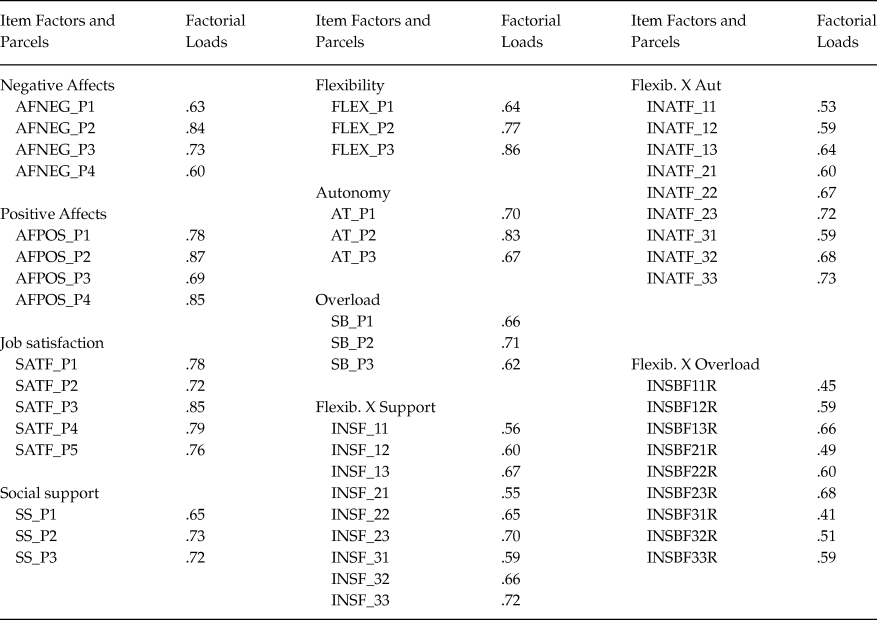
In order to create parcels of items, confirmatory factor analysis models were estimated for each scale used in the study. Measurement models were estimated based on the item plots to evaluate the discrimination between the factors. The first model was structured based on only one latent dimension for all items of all scales and presented poor fit indicators, χ2(gl) = 26,032.94 (275); CFI = .39; TLI = .34; RMSEA = .14; AIC = 365,210.8; BIC = 365,697.6. This model was only estimated for the purpose of comparison with the other models. In the second model, different latent variables were estimated for Positive Affects, Negative Affects and Satisfaction, as well as a general variable for the items of the explanatory variables of the model. This model also presented an unacceptable fit, χ2(gl) = 11,434.32 (269); CFI = .74; TLI = .71; RMSEA = .09. Nevertheless, the model fit is an improvement over the previous one, ΔAIC = 16,282.7; ΔBIC = 16,243.8). Finally, in the third model, latent variables corresponding to the scales used in the study were estimated. This model had acceptable fit indicators, χ2(gl) = 2,592.20 (254); CFI = .95; TLI = .94; RMSEA = .04, as well as being better fitted to the data than the second model, AIC = 26,039.8; BIC = 25,903.5). It should be noted that, in the last measurement model, the latent interactions between the explanatory variables were not estimated. The results of the three measurement models provide evidence of the absence of multicollinearity, especially between the explanatory variables, as well as the plausibility of using the factorial structures, with parcels of items, to estimate the moderation model. Factorial loads are presented in Table 1, for which values were all higher than .40 and, in most cases, greater than .60. For the scales, the factorial load averages were equal to or greater than .70, with the exception of the work overload scale, whose average was equal to .66.
Confirmatory Measurement Model Latent Dimension Factorial Loads

Note: Model fit: χ2(gl) = 2,984 (1.175), p < .01; RMSEA = .02, 90% CI [.017, .019]; TLI = .97; CFI = .97.
X = latent variable interaction (e.g.: Flexib. X Support = latent variable estimated from the interaction between flexibility and social support item parcels); P1 = first item parcel, P2 = second item parcel, etc.
AFNEG = negative affects; AFPOS = positive affects; SATE = job satisfaction; SS = social support; FLEX = psychological flexibility; AT = autonomy; SB = job overload; INSF = psychological flexibility X support; INATF = psychological flexibility X autonomy; INSBF = psychological flexibility X overload.
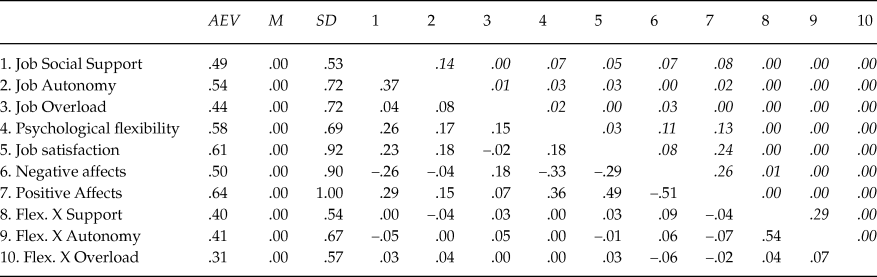
To broaden the analysis of the measurement model, an evaluation was undertaken to assess if the correlations between the observed items contributed more towards the evaluation of the latent dimensions or the correlations between the factors. In this sense, Table 2 shows the average variance extracted (AVE), the correlations between the latent variables and the determination coefficients (the coefficient of determination indicates the proportion of shared variance, i.e.: r 2). With regards to the relationships between variables, it can be seen that the AVE values were higher than the coefficients of determination (r 2) among the latent variables (i.e.: AVE > r 2), which also indicates the absence of multicollinearity. These results also suggest that shared variance between items can be better explained by latent dimensions in detriment of correlations between factors (i.e.: most of the covariance observed among the items is used to estimate factorial loads and not estimate the correlations between factors).
Correlations between Latent Variables, Determination Coefficients and AEV

Note: Correlations between the latent variables estimated by means of structural equations are presented in the lower diagonal. Coefficients of determination (i.e.: the square of the correlation) are presented in the upper diagonal. All correlations above .06 were statistically significant (i.e.: p < .05 if r > .06). The averages and SD described in the tables refer to latent scores.
Flex. = Flexibility; X = latent variable interaction (for example, Flexib. X Support = latent variable estimated from interactions between flexibility and social support item parcels).
AEV = average extracted variance.
Relationships Between Variables
Structural equation modelling was used to evaluate the relationship model between the variables of the study, using gender (0 = male, 1 = female) and job performed (0 = administrative or operational employees; 1 = director, supervisor, managers) as control variables. Such a hypothetical model assumes there are direct relationships between the social support, autonomy and work overload variables and the job satisfaction, positive affect and negative affect variables, as well as relationships that are moderated by the psychological flexibility at work variable (Figure 1). The model fit the data, χ2(gl) = 3,342.58 (1.282), TLI = .97, CFI = .97 and RMSEA = .02; and the relationships observed were weak to moderate. In addition, the model explained 22.0%, 18.2% and 9.4% of negative affects, positive affects and job satisfaction, respectively.
Final Model of the Relationships between Social Support, Autonomy, Overload, Flexibility, Job Satisfaction, Positive and Negative Affects.
Model fit: χ2(gl) = 3,342.58 (1,282), p < .01; RMSEA = .02, 90% CI [.017, .019]; TLI = .97; CFI = .97. All regression parameters presented above are standardized and were statistically significant (p < .05); The control variable effects of gender and job performed were omitted from the figure;
The items of each factor were omitted from the figure. See the factorial loads in Table 1. X = latent variable interaction (for example, Flexib. X Support = latent variable estimated from the interactions between the flexibility and social support item parcels).

Work overload demonstrated a significant negative association with job satisfaction (β = – .06) and positive association with negative affects (β = .24). However, there was no significant relationship between work overload and positive affects (β = .02; p = .37). It was thus verified that higher levels of work overload are associated with lower degrees of job satisfaction and higher degrees of negative affects towards work, which partially confirmed Hypothesis 1.
Autonomy, on the other hand, demonstrated a significant and positive relationship with job satisfaction (β = .08) and negative affects (β = .08). As such, higher levels of autonomy were associated with higher degrees of job satisfaction and negative affects towards work, which also partially confirmed Hypothesis 2.
Finally, social support showed positive relationships with job satisfaction (β = .17) and positive affects towards work (β = .20), and showed a negative relationship with negative affects towards work (β = –.21). This data indicates that higher levels of social support are associated with higher degrees of job satisfaction and positive affects towards work and lower degrees of negative affects towards work, which fully confirmed Hypothesis 3.
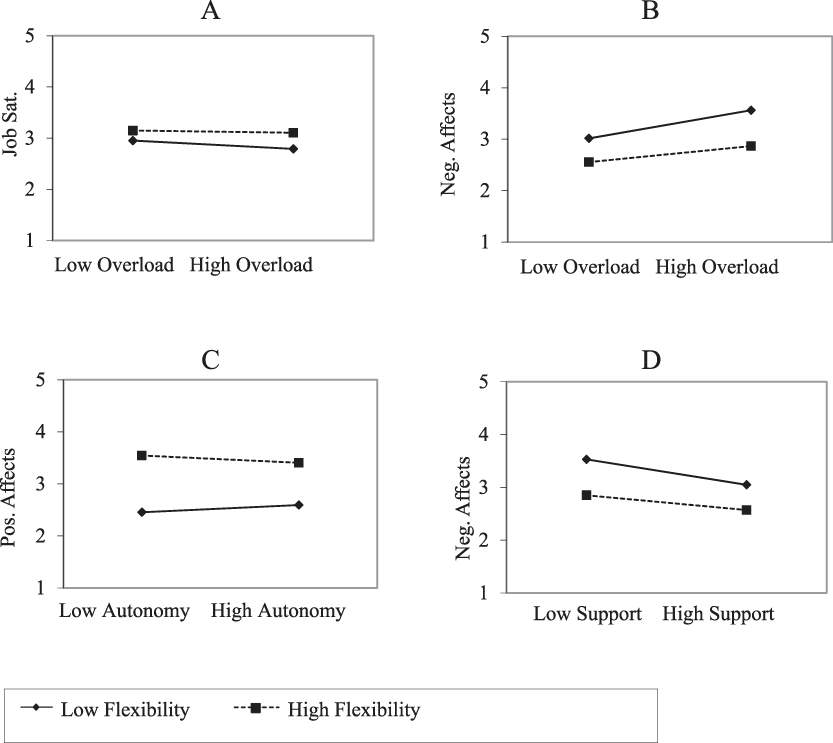
As regards the effects of the interaction between psychological flexibility and work overload on job satisfaction (β = .04), Figure 2 (Graph A) shows that among individuals with high psychological flexibility, the negative relationship between work overload and job satisfaction is minimized. However, among individuals with low psychological flexibility, the higher the work overload the lower the job satisfaction. These results partially confirm Hypothesis 4 of the study.
Relationship between Affects, Job Satisfaction, Overload, Autonomy and Support at different levels of the Psychological Flexibility Moderating Variable.
Job Sat. = Job Satisfaction; Neg. Affects = Negative affects; Pos. Affects = Positive affects.

Graph B of Figure 2 shows that the relationship between overload and negative affects at work is less pronounced among individuals with higher psychological flexibility than among individuals with lower psychological flexibility (β = .08). Thus, as work overload increases so do negative affects, especially among those who have lower psychological flexibility. These results provide partial support for Hypothesis 4.
A significant effect of the interaction between psychological flexibility and autonomy on positive affects towards work was also observed (β = –.06). Inspection of Chart C of Figure 2 shows that this interaction demonstrated that autonomy, among individuals with high psychological flexibility, is not related to the positive affects towards work. However, when individuals have lower levels of psychological flexibility, a higher degree of autonomy is associated with an increase in positive affects towards work. In other words, lower levels of psychological flexibility contribute towards a positive relationship between autonomy and positive affects. These results partially confirm Hypothesis 5.
Regarding the nature of the effects of the interaction between psychological flexibility and social support on negative affects towards work (Graph D of Figure 2), one can observe that the negative relationships between social support and negative affects towards work were less pronounced in individuals with higher levels of psychological flexibility (β = .08). These results indicate that psychological flexibility contributes towards the weakening of negative associations between social support and negative affects. These findings partially confirm Hypothesis 6.
Furthermore, the results indicate a positive association between gender and job satisfaction (β = .05, p < .01), as well as negative associations between job performed and satisfaction (β = –.11, p < .01), negative affects (β = .04, p < .01) and positive affects (β = .06, p < .01). Thus, male participants presented higher satisfaction at work, and employees in administrative positions showed lower satisfaction and lower positive and negative affects. It should be noted, however, that the effect sizes were low, which is why they are not shown in the final model of Figure 1, nor are they discussed.
Discussion
The present study investigated the direct associations of one job demand (work overload) and two job resources (social support and autonomy) with three indicators of subjective occupational well-being (job satisfaction, positive affects and negative affects towards work), as well as the moderating role of psychological flexibility in such relationships. The results showed that the work overload was negatively associated with job satisfaction, and positively associated with negative affects towards work, but did not present a significant relationship with positive affects towards work. Therefore, these findings partially confirm Hypothesis 1 and support earlier studies that have demonstrated positive associations between work overload and job satisfaction (Bowling et al., Reference Bowling, Alarcon, Bragg and Hartman2015) and with work-related negative affects (Ilies, Dimotakis, & De Pater, Reference Ilies, Dimotakis and De Pater2010).
However, overload was not negatively associated with positive affects, as expected, although no studies were found regarding such a relationship. One possible explanation for such results may be that positive and negative affects do not constitute opposing poles of the same dimension, but are rather characterized as two distinct systems, with positive affects being associated with a system of approach and the negative affects with a system of avoidance (Watson, Wiese, Vaidya, & Tellegen, Reference Watson, Wiese, Vaidya and Tellegen1999). Consequently, one particular job characteristic does not necessarily have to have opposing relationships with these two systems of affect, in other words, it is plausible that overload has maintained distinct relationships with these two systems, when demonstrating that it is related to negative affects but not to positive affects. In other words, it may be that experience with job demands (as is the case of overload), which constitute negative aspects of the work environment, only results in an approach of avoidance. Nevertheless, such an affirmation needs empirical verification in the future.
Autonomy presented positive associations with job satisfaction and negative affects towards work, which also allowed for the partial confirmation of the Hypothesis 2. These results are consistent with previous findings relating to the coherent positive associations that autonomy has been showing with job satisfaction (Humphrey et al., Reference Humphrey, Nahrgang and Morgeson2007).
However, autonomy did not show a negative relationship with negative affects as one would expect, on the contrary, it showed a positive relationship with the negative affects. This data is inconsistent with previous findings in which there has been a negative association between autonomy and negative affects towards work (Mäkikangas et al., Reference Mäkikangas, Feldt and Kinnunen2007). The fact that autonomy has maintained a positive relationship with positive affects and has not been associated with negative affects can once again be due to the fact that these consist in distinct systems (Watson et al., Reference Watson, Wiese, Vaidya and Tellegen1999), as already pointed out, which would not prevent such a job resource from only being related to the approach system.
Social support at work was positively associated with job satisfaction and positive affects towards work, and, negatively associated with negative affects towards work, which allowed for the full confirmation of Hypothesis 3 of the study. These results are in agreement with the data obtained in other studies, in which the positive association of social support with job satisfaction (Hombrados-Mendieta & Cosano-Rivas, Reference Hombrados-Mendieta and Cosano-Rivas2013) and positive affects towards work (Mäkikangas et al., Reference Mäkikangas, Feldt and Kinnunen2007) was also observed, as well as being negatively associated with negative affects towards work (Mäkikangas et al., Reference Mäkikangas, Feldt and Kinnunen2007).
Therefore, generally, the resulting findings confirm the assumptions of the JD-R theory (Bakker & Demerouti, Reference Bakker and Demerouti2007; Bakker et al., Reference Bakker, Demerouti and Sanz-Vergel2014), by showing that work overload, while a job demands, is associated with a detrimental health process that can lead to the exhaustion of the employee’s physical and psychological resources, which results in a negative impact on their subjective occupational well-being. It was also observed that autonomy and social support, which are characterized as job resources that have motivational properties, were associated with the subjective well-being of employees.
In the JD-R theory, it is also recommended that personal resources can cushion the negative relationships of job demands, as well as emphasize the positive relationships of job resources on occupational well-being (Schaufeli & Taris, Reference Schaufeli, Taris, Bauer and Hämmig2014). Based on this assumption, there was also an attempt in the present study to analyze the moderating role of psychological flexibility in the relationships of work overload, autonomy and social support with job satisfaction, positive affects and negative affects.
The results showed that psychological flexibility moderated the relationship of work overload with satisfaction and negative affects towards work, which provided partial support for Hypothesis 4. Psychological flexibility thus contributed towards attenuating the negative relationship between work overload and job satisfaction, as well as the positive relationship of work overload with negative affects towards work. It has been found, therefore, that employees who are more flexible psychologically, due to their greater ability to cope with job demands, tend to perceive them without pre-judging, which results in them resorting to lesser cognitive efforts to deal with such demands (Hayes, Luoma, Bond, Masuda, & Lillis, Reference Hayes, Luoma, Bond, Masuda and Lillis2006). As a result, they are less susceptible to demands such as work overload.
These results are consistent with Trembley and Messervey’s (Reference Tremblay and Messervey2011) earlier empirical findings of the role played by a personal resource (compassion satisfaction) in attenuating the relationships between work overload and job stress. More specifically, such results converge with data obtained from recent studies in which the moderating role of psychological flexibility in the relationships between emotional demands and exhaustion has been observed (Biron & van Veldhoven, Reference Biron and van Veldhoven2012; Onwezen et al., Reference Onwezen, van Veldhoven and Biron2014).
However, the results obtained further expand these findings, by showing that the moderating role of psychological flexibility is maintained in the relationships between job demands and other well-being indicators, such as job satisfaction and negative affects towards work. Furthermore, they are consistent with the affirmation of the JD-R theory that personal resources can mitigate the impact of job demands on occupational well-being (Schaufeli & Taris, Reference Schaufeli, Taris, Bauer and Hämmig2014), seeing that such resources provide individuals with strategies for protection and to combat the negative circumstances present in their work environment (Hobfoll, Reference Hobfoll2002).
Contrary, however, to what was expected, psychological flexibility only moderated the relationship of social support with negative affects towards work, and that of autonomy with positive affects, and, even then, only among individuals with low psychological flexibility, which provided only partial support for Hypotheses 5 and 6, respectively. This data contradicts the earlier findings of van den Broeck et al. (Reference van den Broeck, van Ruysseveldt, Smulders and De Witte2011), who verified that a personal resource (intrinsic value orientation) accentuated the relationship between autonomy and work engagement. However, they are aligned with the research undertaken by Boudrias et al. (Reference Boudrias, Desrumaux, Gaudreau, Nelson, Brunet and Savoie2011), in which it was verified that job related social resources were related with stress among individuals with lower personal resources, but no relationship was found between social resources and stress among individuals with higher personal resources.
A possible explanation for such results may be that, although psychological flexibility contributes towards a greater investment of energy by the individual in his work without being overwhelmed by the harmful effects of job demands (Hayes et al., Reference Hayes, Luoma, Bond, Masuda and Lillis2006), it is still not enough, however, to fully benefit from the effects of job resources, seeing that they already have motivational properties that lead individuals to invest in their personal development and in achieving their work goals (Bakker & Demerouti , 2007). In other words, it is likely that job resources will result in the individual not requiring to resort to individual risk protection factors when in a work context.
Another plausible explanation for the hypothesized and unobserved interactions may be that the current research used a rather heterogeneous sample in occupational terms. However, working context characteristics usually vary between occupations and organizations. In this sense, the probability of finding interactions between different groups becomes smaller (Szczygiel & Baka, Reference Szczygiel and Baka2016).
Regarding the limitations of the present study, it should be noted that in the research only self-reporting instruments were adopted and data were collected from a single source. Consequently, the common method variance may have overestimated the correlations between the study variables. In addition to this, the study was of a cross-sectional nature, which prevents causal relationship inference between the variables investigated and only allows for the analysis of the variance between individuals. Finally, data collection was totally online, which may have limited the possibilities of generalization of the study.
In this sense, although the self-reporting instruments are more adequate to the collection of individual psychological reactions, future studies could draw on different sources of information by pairing, for example, the self-report of individual psychological reactions with the evaluation of the job demands and resources by colleagues. Such research could also encompass job demands and resources not considered in the present study (such as, for example, role conflict, emotional demands and organizational justice), and be conducted in the form of diary studies capable of examining the intraindividual variance of the constructs of interest and detecting the dynamics of affective reactions to the characteristics of the work context over time. On the other hand, other personal resources (such as emotional intelligence and self-efficacy) could be included in the testing of such models. It would be interesting, moreover, that studies of this nature collect data online and face-to-face, and compare these results, in order to verify the differences that might occur between both methods of data collection.
Nevertheless, the current results contribute to the research within the scope of the JD-R theory. It is thus that the present research responds to the need for more studies on personal resources in the context of this theory, as pointed out by some authors (Airila et al., Reference Airila, Hakanen, Schaufeli, Luukkonen, Punakallio and Lusa2014), seeing that such resources constitute an important factor of adaptation of the employee to their working environment. In this sense, psychological flexibility was adopted here as a personal resource, acting mainly as a moderator of the relationships between work overload and subjective occupational well-being. In addition, such findings were not observed with pathological well-being indicators (as in the case of emotional exhaustion), but rather with reactions commonly experienced within the context of work, such as job satisfaction and negative affects towards work, which also contributes to the expansion of empirical findings guided by the JD-R theory. Finally, considering that the assumptions of the JD-R theory have been verified mainly in European and North American employee samples, the present study contributes to the greater generalization of these assumptions when testing them on a Brazilian sample.
As far as the practical implications of the research are concerned, the resulting findings point to the importance of organizations seeking to avoid high levels of demands, such as overload, as these constitute risk factors to occupational well-being. On the other hand, they should optimize the levels of resources, such as autonomy and social support, insofar as they act as factors promoting well-being. Also considering the role played by psychological flexibility in the relationship between the work context and different well-being indicators it would be interesting for organizations to try and identify the levels of psychological flexibility of their employees and offer training aimed at increasing this personal resource. Training programs with this objective are available and are proving effective, even when implemented during short periods of time (Hayes et al., Reference Hayes, Luoma, Bond, Masuda and Lillis2006). As such, welfare interventions should focus on both personal factors and work context factors that contribute to an increase of employee motivation and a reduction of stress to foster the development of healthy working environments and promote the well-being of employees.