Introduction
Sheep have long been recognized as major contributor to protein supply and family income in most developing countries. The choice of breed in a locality is influenced by the production objectives and the environmental conditions, with increased productivity as the underlying objective. There is a considerable potential for increased sheep production, if proper management is employed (Birteeb et al., Reference Birteeb, Peters, Yakubu, Adeleke and Ozoje2012), and this demands a look at their genetic resources. At present, many countries are losing their genetic resources which may have lasting effects on food security and sustainable development especially in the light of global warming changes (Hoffman, Reference Hoffman2010). This is why the Food and Agriculture Organization of the UN deemed it necessary to promote the conservation of farm animal diversity with the view that humankind may need to keep this specific genetic biodiversity to face future (unknown) challenges such as changes in demand for livestock products, spread of new diseases, reducing environmental impact and climate change (FAO, 2011). In general, Animal Genetic Resources (AnGRs) in developing countries are being eroded through the rapid transformation of the agricultural systems in which the main cause of the loss of indigenous AnGRs is the indiscriminate introduction of exotic genetic resources before proper characterization, utilization and conservation of indigenous genetic resources (Yakubu, Salako and Abdullah, Reference Yakubu, Salako and Abdullah2011). Nevertheless, AnGRs conservation is receiving keen attention of late as livestock researchers explore classical multivariate methods to study and characterize livestock populations genetically and phenotypically especially through the use of quantitative information, particularly body measurements.
Linear body measurements have become very useful in livestock research, as alternative body measurements and indices estimated from various combinations of conventional and non-conventional body parameters not only provide superior guide to weight but also served as indicators of type and function in domestic animals (Salako, Reference Salako2006a). Body weight is a major characteristic associated with animal breed types. Precise measurement of weight is by using weighing scales or bridges. However, proper weighing scales are neither readily available to nor affordable by smallholder livestock farmers, but even if they were, it would be inconvenient and a huge task to carry and assemble those weighing scales each time to weigh animals especially during management practices.
According to Traoré et al. (Reference Traoré, Tamboura, Kabore, Royo, Fernandez, Álvarez, Sangare, Bouchel, Poivey, Francois, Toguyeni, Sawadogo and Goyache2008), the definition of the breed as the operational unit for the assessment of livestock diversity all over the world, necessitates the characterization of local domestic animal populations in developing countries. The characterization of African small ruminant populations through the use of classical multivariate methods in analyzing morphological traits to assess variations within and between populations will play a major role in the maintenance of autochthonous genetic resources (Birteeb et al., Reference Birteeb, Peters, Yakubu, Adeleke and Ozoje2012).
Factor analysis is a multivariate technique for examining the interrelationships among a set of variables that are correlated. It deals with the reduction of a set of observable variables in terms of a small number of latent factors (Rencher, Reference Rencher2002). Principal component factor analysis has been effectively used to study cattle (Yakubu, Ogah and Idahor, Reference Yakubu, Ogah and Idahor2009a; Pundir et al., Reference Pundir, Singh, Singh and Dangi2011), sheep (Riva et al., Reference Riva, Rizzi, Marelli and Cavalchini2004; Salako, Reference Salako2006b; Yakubu, Salako and Abdullah, Reference Yakubu, Salako and Abdullah2011; Birteeb et al., Reference Birteeb, Peters, Yakubu, Adeleke and Ozoje2012), and even poultry (Ogah, Alaga and Momoh, Reference Ogah, Alaga and Momoh2009; Yakubu, Kuje and Okpeku, Reference Yakubu, Kuje and Okpeku2009b; Ogah, Reference Ogah2011). Cluster analysis is another multivariate technique in which a search is made for patterns in a data set by grouping the (multivariate) observations into clusters, with the goal of finding an optimal grouping for which the observations or objects within each cluster are similar, but the clusters are dissimilar to each other (Rencher, Reference Rencher2002). In grouping the observations, the similarities between all pairs of observations are considered. Cluster analysis is similar to factor analysis in the following ways: (1) neither the number of groups nor the groups themselves are known in advance; (2) when clustering variables, the similarity is based on a correlation (matrix).
Among the existing sheep breeds, the Djallonke (West African dwarf) sheep is known to be trypano-tolerant hence has become a dependable asset to the local farmers in West Africa (Wafula et al., Reference Wafula, Jianlin, Sangare, Sowe, Coly, Diallo and Hanotte2005). It is well adapted to and produces under the local environmental conditions and so contributes significantly to the African small ruminant genetic resources. Despite the availability of this breed of sheep, detail information on its characteristics is limited. Hence this study was undertaken to provide a detailed description of the Djallonke sheep breed as well as determine the multivariate approach that explains better the variation in its body composition.
Materials and methods
Management of study animals
A total of 172 (28 males and 144 females) Djallonke (West African Dwarf) sheep, reared at the Pong-Tamale Livestock Breeding Station, were used for this study. Pong-Tamale is located at latitude 9°40″N and longitude 0°49″W and is about 32.7 km north of Tamale, the Northern Regional capital in Ghana (Encarta, 2009). The sheep were managed semi-intensively. They were housed in properly constructed pens throughout the night and sometimes during the day when there was the need to restrict their movement. Feed and water were provided for the animals ad libitum throughout the year. Conventional disease and pest control regimes were practised.
The Breeding Station practises open nucleus breeding programme, where occasionally, outstanding sires from different farms are selected and brought to the station for improvement. Among the progenies, very superior rams are retained on the station for breeding while all yearling rams are supplied to farmers. The breeding sires and/or rams (which were all >2 years) included in this study, were second and third generation progenies of sires that were selected from different smallholder farms for improvement at the station. Hence the animals under study were quite varied in terms of pedigree.
Data collection
The sex and age of each sheep were noted. Ages of animals were identified using their birth records and categorized into two groups (2 years and ≥3 years). Eight biometric traits which include live weight (LW), heart girth (HG), neck girth (NG), chest depth (CD), height at withers (HW), rump height (RH), body length (BL) and pin-bone width (PBW) were measured on each animal. LW was measured with a hanging scale while all linear body dimensions were measured using a measuring tape. The traits were defined and measured in accordance to Birteeb et al. (Reference Birteeb, Peters, Yakubu, Adeleke and Ozoje2012) as follows:
-
HG: The circumference around the chest just behind the front legs and withers.
-
NG: This is the circumference around the neck near the withers.
-
CD: The distance from the backbone at the shoulder to the brisket between the front legs
-
HW: The distance from the surface of a platform on which an animal stands, to the withers of the animal.
-
RH: This is the distance from the surface of a platform to the rump.
-
BL: The distance from the base of the tail to the base of the neck.
-
PBW: It is the distance between the outer edges of the major hip bones on the right and left sides.
Statistical analysis
The fixed effects of sex and age on the biometric traits were tested using general linear model (GLM). The model was defined as:
 $${Y_{ij}} = \mu + {S_i} + {A_j} + {\lpar SA\rpar _{ij}} + {\varepsilon _{ij}}\comma \;$$
where Y ij is the individual biometric trait; μ the overall mean; S i fixed effect of the ith sex (i = ram, ewe); A j the fixed effect of the jth age (j = 2 years old, ≥3 years old); (SA) ij the interaction effect of ith sex and jth age; ε ij the random error associated with each biometric trait [ε ~ N(0, δ)].
A paired sample t-test was used to compare the heights (wither and rump) and BL. The Nearest Neighbor method of Hierarchical Cluster Analysis was used to group the various body traits into clusters. Pearson's coefficients of correlation (r), among the various traits, were estimated, which were then used for the principal component factor analysis. Anti-image correlations, Kaiser–Meyer–Olkin (KMO) measures of sampling adequacy and Bartlett's Test of Sphericity were computed to test the validity of the factor analysis of the data set. The factor matrix was subjected to varimax rotation to enhance interpretability of the extracted factors. All analyses were done using the appropriate programmes in SPSS version 17 (SPSS, 2008).
Results
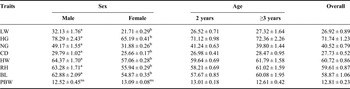
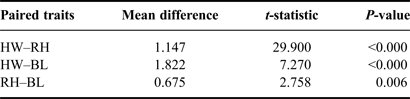
The analysis of variance of LW and linear body measurements of Djallonke sheep are presented in Tables 1 and 2. The biometric traits were significantly (P < 0.01) influenced by sex, with the rams (males) being generally superior to the ewes (females) in all the biometric traits under consideration except for the PBW where the females were larger (P > 0.05) in absolute terms (Table 2). However, age did not have any significant influence on the LW and linear body traits as all the body traits of the 2–year-old sheep were statistically similar (P > 0.05) to those of the older sheep, even though the later recorded slightly higher values. Sex by age interaction was significant (P < 0.05) only for RH (Table 1). The S.E. values revealed that HG was the most varied trait, whereas the animals were more consistent by the PBW irrespective of their sex or age. A t-test between the HW and RH revealed that the animal was significantly (t = 29.9; P < 0.001) higher at the withers by 1.15 cm (Table 3). Also, the sheep were significantly taller than longer.
Analysis of variance for morphological traits in Djallonke sheep.

**Highly significant (P < 0.01); *significant (P < 0.05); all other traits are not significant.
DF, degrees of freedom; LW, live weight; HG, heart girth; NG, neck girth; CD, chest depth; HW, height at Withers; RH, rump height; BL, body length; and PBW, pin-bone width.
Least-square means (±S.E.) of live weight (kg) and linear body measurements (cm) of Djallonke sheep as affected by sex and age.

a,bMeans within the same row having different superscripts differ significantly (P < 0.05/0.01) between the two sexes. ns = not significant
S.E., standard error; LW, live weight; HG, heart girth; NG, neck girth; CD, chest depth; HW, height at Withers; RH, rump height; BL, body length; and PBW, pin-bone width.
Comparison of selected linear traits (cm) of Djallonke sheep.

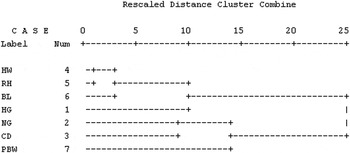
The cluster analysis revealed the formation of two distinct clusters from the linear body traits of which the first cluster comprised four traits (Figure 1). The first agglomeration occurred between HW and RH, which then combined with BL and finally HG to form the first cluster. The second cluster resulted from the agglomeration of NG, CD and PBW.
Dendrogram indicating the agglomeration of body traits into clusters.

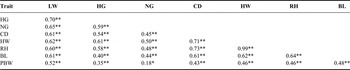
Pearson's correlation coefficients between all pairs of the various body traits are shown in Table 4. Even though LW was moderately (0.52–0.70) correlated with all the body conformation traits, the highest coefficient (0.99) was obtained between RH and HW. All correlations between pairs of traits were highly significant (P < 0.01) except that between NG and PBW, which was only significant at (P < 0.05).
Phenotypic correlations among body traits of matured Djallonke sheep.

**Highly significant (P < 0.01); *significant (P < 0.05). LW, live weight; HG, heart girth; NG, neck girth; CD, chest depth; HW, height at Withers; RH, rump height; BL, body length; and PBW, pin-bone width.
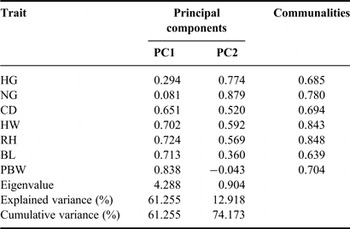
The KMO measure of sampling adequacy, which was significantly in the middle (0.791) supported the use of the correlation matrix of the data set for factor analysis. Bartlett's test of sphericity (chi-square = 1118.89; P < 0.001), coupled with the high communalities (0.639–0.848), which represent the explained variance, and the determinant (0.001) obtained from the correlation matrix, all provided support for the validity and reliability of the principal component factor analysis.
The estimated factor loadings extracted by factor analysis, eigenvalues and variation explained by each factor, are presented in Table 5. After a varimax (orthogonal) rotation of the component matrix, two principal component factors were extracted. The variance of a variable was partitioned into a common portion ‘communality’ shared with some or all of the other variables, which showed that 63.9–84.8 percent of the variation in conformation traits were brought about by the underlying factors (PC's). The first principal component which was associated with five linear body traits (CD, HW, TH, BL and PBW), explained about 61.26 percent of the generalized variance in the body measurements with moderate (0.651) to high (0.838) emphasis given to these body measurements. This factor can be considered as a generalized conformation or size of the sheep. The second factor comprised the HG and NG and accounted for 12.92 percent of the generalized variance, thereby bringing the total variance accounted for to 74.17 percent.
Varimax rotated factor loadings and communalities of body traits of Djallonke sheep.

LW, live weight; HG, heart girth; NG, neck girth; CD, chest depth; HW, height at Withers; RH, rump height; BL, body length; and PBW, pin-bone width.
Discussion
Production of the autochthonous Ghanaian sheep breeds is directly associated with the concept of sustainable agriculture (Birteeb et al., Reference Birteeb, Peters, Yakubu, Adeleke and Ozoje2012). For centuries, the Djallonke sheep has been an integral component of African AnGRs as it is kept and reared throughout the continent. This breed has varied names and exhibits biometric variations across geographic regions, hence could be referred to as a traditional population (FAO, 2011). Genetic variation is fundamental for livestock populations to adapt to varying environments and to respond to artificial selection; therefore, any conservation and development scheme should start from assessing the state of variation in the population (Toro et al., Reference Toro, Meuwissen, Fernandez, Shaat and Maki-Tanila2011). The superiority of males over females in this study was in agreement with the works of Birteeb et al. (Reference Birteeb, Peters, Yakubu, Adeleke and Ozoje2012), Legaz et al. (Reference Legaz, Cervantes, Perez-Cabal, de la Fauente, Martinez, Goyache and Gutierrez2011), Carneiro et al. (Reference Carneiro, Louvandini, Paiva, Macedo, Mernies and McManus2010) and Yakubu and Akinyemi (Reference Yakubu and Akinyemi2010) who attributed such differences to sexual dimorphism. Sexual dimorphism is thought to develop post-weaning because of faster mass gain by males during the age of 1–2 years (Festa-Bianchet et al., Reference Festa-Bianchet, Jorgenson, King, Smith and Wishart1996). These same researchers suggested that males might have a longer season to amass (gain) body mass each year throughout their lives, while females divert annual resources into reproduction, rather than body mass.
The insignificant influence of age on any of the body traits in this study was analogous to the findings of Kunene, Nesamvuni and Fossey (Reference Kunene, Nesamvuni and Fossey2007) in Zulu sheep where all matured (2 and 3 years) sheep recorded similar body traits, suggesting that at maturity sheep exhibited negligible zoometric trait variations as a result of age difference. Hence the growth and development of Djallonke sheep reach a peak after 2 years of age and then seem to remain almost constant afterwards. The report by Traoré et al. (Reference Traoré, Tamboura, Kabore, Royo, Fernandez, Álvarez, Sangare, Bouchel, Poivey, Francois, Toguyeni, Sawadogo and Goyache2008) that the Djallonke sheep is generally small in size was confirmed in this study since the sheep herein was much smaller when compared to Zulu sheep in South Africa (Kunene, Nesamvuni and Fossey, Reference Kunene, Nesamvuni and Fossey2007) and Yankasa, Uda and Balami sheep in Nigeria (Yakubu and Ibrahim, Reference Yakubu and Ibrahim2011). Nevertheless, they were comparable to Sudan-Sahel sheep of Burkina Faso (Traoré et al., Reference Traoré, Tamboura, Kabore, Royo, Fernandez, Álvarez, Sangare, Bouchel, Poivey, Francois, Toguyeni, Sawadogo and Goyache2008) and Karayaka sheep of Turkey (Cam, Olfaz and Soydan, Reference Cam, Olfaz and Soydan2010). The animal is a typical tropical breed, being higher (taller) than long except that it slopes slightly from the withers towards the rump just like the Nigerian indigenous sheep (Yakubu and Ibrahim, Reference Yakubu and Ibrahim2011). Since the Djallonke sheep is a traditional population (FAO, 2011) in sub-Saharan Africa, it may be biologically favoured in its ability to adapt to changes in management, climate, nutrition and marketing.
The significant phenotypic correlations observed herein were similarly reported by Legaz et al. (Reference Legaz, Cervantes, Perez-Cabal, de la Fauente, Martinez, Goyache and Gutierrez2011), Cam, Olfaz and Soydan (Reference Cam, Olfaz and Soydan2010) and Salako (Reference Salako2006a, Reference Salako2006b). Slightly higher values were earlier reported by Afolayan, Adeyinka and Lakpini (Reference Afolayan, Adeyinka and Lakpini2006). High correlations indicate the interrelationships between/among the traits and such knowledge is very useful in breeding and management practices of livestock, as selection for a given trait directly favours other positively associated traits but disfavours negatively associated traits. Nevertheless, selection for positively or negatively associated traits is influenced by the production objectives, selection goals and even the socio-cultural demands or conditions of the farmer. Correlations among body traits also serve as the basis for employment of further multivariate techniques (Yakubu, Salako and Abdullah, Reference Yakubu, Salako and Abdullah2011; Birteeb et al., Reference Birteeb, Peters, Yakubu, Adeleke and Ozoje2012) like Principal Component, Factor and Cluster analyses in quantifying trait variability and characterizing breeds. The agglomeration of the traits into two clusters suggests that body conformation of Djallonke sheep could be explained in two dimensions. Explicitly the traits on the first cluster are associated with bone growth hence give information about the general body conformation of the sheep. The second cluster seemed to indicate body thickness which may result from muscle development and/or fat deposition. However, the amount of variation attributable to each cluster could not be estimated.
The measure of sampling adequacy, KMO was significantly high but slightly lower than 0.85 reported for Uda sheep (Salako, Reference Salako2006b). Recently Birteeb et al. (Reference Birteeb, Peters, Yakubu, Adeleke and Ozoje2012) and Yakubu, Salako and Abdullah (Reference Yakubu, Salako and Abdullah2011) reported KMO's of 0.91 and 0.92 for sheep in Northern Ghana and Nigeria, respectively. High KMO values were equally reported for cattle (Yakubu, Ogah and Idahor, Reference Yakubu, Ogah and Idahor2009a; Pundir et al., Reference Pundir, Singh, Singh and Dangi2011). The KMO test shows whether the partial correlations among variables are low. In this study, the high KMO obtained implied that the proportion of the variance in the body traits/measurements caused by the underlying factors is high hence true factors existed and the data are factorable.
The extraction of two PC factors in the Factor Analysis is comparable to the results of the Cluster Analysis where traits were grouped into two clusters. Except the replacement of HG by the PBW, the association of major linear measures (HW, RH and BL) with the first PC was analogous to the trait clustering in Figure 1. The similarity of the results of these two procedures suggests that variations in body composition of Djallonke sheep are best explained in two dimensions. The result of this study is similar to earlier reports on Djallonke sheep (Birteeb et al., Reference Birteeb, Peters, Yakubu, Adeleke and Ozoje2012) and Uda sheep (Salako, Reference Salako2006b; Yakubu, Salako and Abdullah, Reference Yakubu, Salako and Abdullah2011) in which two underlying factors each were extracted to explain the generalized variance in body traits. However, the respective total explained variances of 87.19, 86.27 and 78.7 percent by those earlier reports were higher than that obtained in this study. In studying Bergamasca sheep, Riva et al. (Reference Riva, Rizzi, Marelli and Cavalchini2004) extracted two and four factors for young and adult sheep, respectively, in the sedentary flock, and three factors each for both age groups in the transhumant flock. In a similar study in cattle, Pundir et al. (Reference Pundir, Singh, Singh and Dangi2011) extracted three latent factors to explain a total variance of 66.02 percent. Again in the White Fulani cattle of Nigeria, two factors were extracted in the age group of 1.5–2.4 years to account for 85.37 percent of total variation, while four factors extracted in the age group of 2.5–3.6 explained 86.4 percent of the total variance (Yakubu, Ogah and Idahor, Reference Yakubu, Ogah and Idahor2009a). Except the lower coefficient of HG, the high loadings of body height (RH and WH), BL and PBW on the first factor in the present study is very much comparable to the report of Pundir et al. (Reference Pundir, Singh, Singh and Dangi2011) in Kankrej cows although the later study was on a different species. Most researchers (Riva et al., Reference Riva, Rizzi, Marelli and Cavalchini2004; Salako, Reference Salako2006b; Yakubu, Ogah and Idahor, Reference Yakubu, Ogah and Idahor2009a; Pundir et al., Reference Pundir, Singh, Singh and Dangi2011; Yakubu, Salako and Abdullah, Reference Yakubu, Salako and Abdullah2011) have described the first factor as a representation of the general body size. In this Djallonke sheep, the first factor equally describes the general body size, while the second seems to indicate the size of the thoracic region. Both principal components could play a role in the ranking of the animals, and thus provide an opportunity to select the animals based on a group of variables rather than on isolated traits (Yakubu, Salako and Abdullah, Reference Yakubu, Salako and Abdullah2011). Such knowledge will be valuable in obtaining animals with highly coordinated bodies from fewer traits amidst many body measurements, as a result of exploiting underlying factors. In recent times, linear body measurements have become very useful in livestock studies especially breed characterization. Analyses of morphometric variables that are easy to measure make it possible to explore areas such as the structure of breeds, the degree of variability between various populations, the harmony of morphological models and the definition of morphological models for a given breed (Birteeb et al., Reference Birteeb, Peters, Yakubu, Adeleke and Ozoje2012).
Conclusion
It may be concluded that the Djallonke sheep is generally small in body size. Both the Cluster and Factor analyses yielded very similar results, thus categorizing linear body measurements into two groups each (clusters and factors). This implies that the linear body measurements considered herein can best be grouped into two main dimensions, and factor analysis approach is preferable because of its ability to quantify the explained variance in body composition. Finally, an easy way to describe the Djallonke sheep is by considering the linear measurements on the first factor.
Acknowledgement
The authors are grateful to the staff of the Pong-Tamale Livestock Breeding Station especially the Manager, Mr Ibrahim Shahadu and Head of the Sheep Unit, Mr Lawrence Dartay for providing the experimental animals and support during the data gathering process.