Introduction
Cowpea (Vigna unguiculata L. Walp.) is the most important grain legume grown in sub-Saharan Africa (Ehlers and Hall, Reference Ehlers and Hall1997; Timko et al., Reference Timko, Ehlers, Roberts and Kole2007; Timko and Singh, Reference Timko, Singh, Moore and Ming2008). The majority (~64%) cowpea grain production, 12.5 million tons worldwide, takes place on low-input, subsistence farms in this region (Langyintuo et al., Reference Langyintuo, Lowenberg-DeBoer, Faye, Lambert, Ibro, Moussa, Kergna, Kushwaha, Musa and Ntoukam2003). Referred to as the ‘poor man's meat’ because of its good protein quality and high nutritional value (Diouf and Hilu, Reference Diouf and Hilu2005), cowpea hay is also critical in the feeding of animals during the dry season in many parts of West Africa (Tarawali et al., Reference Tarawali, Singh, Gupta, Tabo, Harris, Nokoe, Fernandez-Rivera, Bationo, Manyong, Makinde, Odion, Fatokun, Tarawali, Singh, Kormawa and Tamo2002). In addition, cowpea is a nitrogen-fixing plant, and helps restore soil fertility when used in rotation with cereal crops (Eloward and Hall, Reference Eloward and Hall1987; Sanginga et al., Reference Sanginga, Dashiell, Diels, Vanlauwe, Lyasse, Carsky, Tasawali, Asafo-Adjei, Menkir, Schulz, Singh, Chikoye, Keatinge and Ortiz2003).
A major goal of cowpea breeding and genetic improvement programmes around the world is to combine desirable agronomic traits (e.g. time to maturity, photoperiod sensitivity, plant type and seed quality) with resistances to the major diseases, insect pests or parasites that afflict cowpea in agroecologically adapted cultivars (Timko et al., Reference Timko, Ehlers, Roberts and Kole2007; Timko and Singh, Reference Timko, Singh, Moore and Ming2008). At present, depending on the source of the trait being introgressed, a decade, more or less, is needed to breed a superior improved line using traditional selection and hybridization strategies. Leveraging emerging gene-based tools for tracking single genes and quantitatively inherited traits linked to important diseases and pest resistances and the establishment of breeder-friendly protocols for marker-assisted selection (MAS) and breeding can substantially reduce this time frame. The overall efficiency and effectiveness of cowpea improvement programmes can also be enhanced by knowledge of the genetic diversity available within local and regional germplasm collections (Hall, Reference Hall2004; Hegde and Mishra, Reference Hegde and Mishra2009).
Previous studies of diversity in wild and cultivated cowpea germplasm have used a variety of approaches including analysis of morphological and physiological traits (Fery, Reference Fery, Singh and Rachie1985; Perrino et al., Reference Perrino, Laghetti, Spagnoletti Zeuli and Monti1993; Ehlers and Hall, Reference Ehlers and Hall1996), allozymes (Panella and Gepts, Reference Panella and Gepts1992; Pasquet, Reference Pasquet1993, Reference Pasquet1999, Reference Pasquet2000; Vaillancourt et al., Reference Vaillancourt, Weeden and Barnard1993), seed storage proteins (Fotso et al., Reference Fotso, Azanza, Pasquet and Raymond1994), and chloroplast DNA polymorphisms (Vaillancourt and Weeden, Reference Vaillancourt and Weeden1992); random amplified polymorphic DNA (RAPD; Mignouna et al., Reference Mignouna, Ng, Ikca and Thottapilly1998; Nkongolo, Reference Nkongolo2003; Fall et al., Reference Fall, Diouf, Fall-Ndiaye, Badiane and Gueye2003; Ba et al., Reference Ba, Pasquet and Gepts2004; Diouf and Hilu, Reference Diouf and Hilu2005; Xavier et al., Reference Xavier, Martins, Rumjanek and Filho2005; Zannou et al., Reference Zannou, Kossou, Ahanchédé, Zoundjihékpon, Agbicodo, Struik and Sanni2008); restriction fragment length polymorphisms (Fatokun et al., Reference Fatokun, Danesh and Young1993); amplified fragment length polymorphisms (Fatokum et al., Reference Fatokun, Mignouna, Knox and Ellis1997; Fang et al., Reference Fang, Chao, Roberts and Ehlers2007); DNA amplification fingerprinting (Simon et al., Reference Simon, Benko-Iseppon, Resende, Winter and Kahl2007) and analysis of simple sequence repeats (SSRs Wang et al., Reference Wang, Barkley, Gillaspie and Pederson2008; Ogunkanmi et al., Reference Ogunkanmi, Ogundipe, Ng and Fatokun2008; Uma et al., Reference Uma, Hittalamani, Murthy and Viswanatha2009; Xu et al., Reference Xu, Wu, Wang, Liu, Quin, Ehlers, Close, Hu, Lu and Li2010) or sequence tagged microsatellite sites (Choumane et al., Reference Choumane, Winter, Weigand and Kahl2000; Li et al., Reference Li, Fatokun, Ubi, Singh and Scoles2001; Abe et al., Reference Abe, Xu, Suzuki, Kanazawa and Shimamoto2003; He et al., Reference He, Poysa and Yu2003). Of these techniques, analysis of SSRs has proven to be particularly useful since these sequences, besides being abundant and distributed throughout eukaryotic genomes, are highly polymorphic, inherited codominantly and reproducible, with simple screening requirements (Dib et al., Reference Dib, Faure, Fizames, Samson, Drouot, Vignal, Millasseau, Mare, Hazan, Seboun, Lathrop, Gyapay, Morisselte and Weissenbach1996). SSRs have also been extensively used in genotype identification, seed purity evaluation and variety protection (Brown et al., Reference Brown, Hopkins, Mitchell, Senior, Wang, Duncan, Gonzalez-Candelas and Kresovich1996; Senior et al., Reference Senior, Murphy, Goodman and Stuber1998), pedigree analysis (Ayres et al., Reference Ayres, McClung, Larkin, Bligh, Jones and Park1997; Bowers et al., Reference Bowers, Boursiquot, This, Chu, Johansson and Meredith1999), and genetic mapping of simple and quantitative traits and MAS (Blair and McCouch, Reference Blair and McCouch1997; Chen et al., Reference Chen, Temnykh, Xu, Cho and McCouch1997; Weising et al., Reference Weising, Winter, Huttel and Kahl1998).
Different forms of cowpea are cultivated in the savannah and forest regions of Ghana based on local preferences for growth characteristics and culinary properties (Quaye et al., Reference Quaye, Adofo, Madode and Abizari2009). For the most part, farmers practise traditional methods of seed selection and conservation, and little effort has been made for germplasm characterization and breeding for genetic improvement within the country. In recent years, the Plant Genetic Resources Research Institute (PGRRI) located in Bunso, Ghana, has been collecting germplasm from farmers' field and conserving these accessions in the PGRRI genebank with the aim of tracking local diversity and facilitating breeding for improved varieties in Ghana in the face of changing biotic and abiotic factors affecting production of the crop. In this study, we developed paired primer combinations that amplify polymorphic SSRs from cowpea, and used these to examine the genetic diversity and relatedness of the cowpea germplasm being conserved at the PGRRI in Ghana. Our results provide a framework for future studies aimed at the conservation, improvement and management of cultivated cowpea in Ghana.
Materials and methods
Plant material
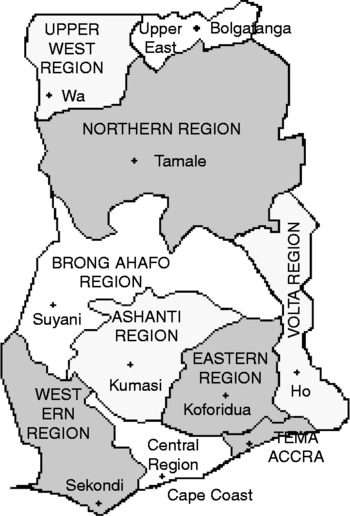
Seeds of 141 accessions of cowpea (V. unguiculata L. Walp.) collected from different localities in nine geographical regions of Ghana (Fig. 1; Table S1, available online only at http://journals.cambridge.org) were obtained from the PGRRI of Ghana at Bunso. The cowpea breeding line, IT84S-2049, developed at the International Institute for Tropical Agriculture (IITA, Ibadan, Nigeria), served as an outgroup in this work.
Regional map of Ghana. The nine regions of Ghana from which cowpea accessions were collected for use in this study are shown.

Plant growth and genomic DNA isolation
Cowpea seeds were germinated and grown on a moistened Whatman filter paper in Petri dishes held at 33°C under 12-h light photoperiods. Young leaves of 7-day-old seedlings were harvested, frozen immediately in liquid nitrogen and stored at − 80°C until used for nucleic acid preparation. Total DNA was isolated from the leaf tissues using DNAzol ES® (MRC, Inc., Cincinnati, OH, USA) according to the manufacturer's protocol with slight modifications. The precipitated DNA was resuspended in 200 μl of 10 mM Tris–Cl, pH 8.0, and 1 mM EDTA buffer, and the concentration was determined spectrophotometrically on a ND-1000 spectrophotometer (Thermo Scientific, Wilmington, DE, USA). The intactness of the DNA was accessed by electrophoresis through a 0.8% (w/v) agarose gel. Working solutions of 10 ng/μl were prepared for each of the samples.
SSR identification and polymerase chain reaction (PCR) amplifications
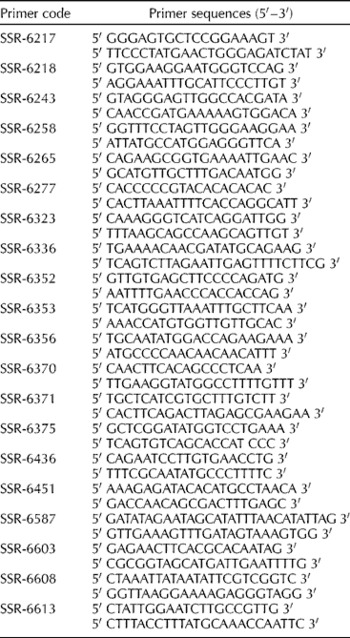
Cowpea gene-space sequence reads (GSRs) (Timko et al., Reference Timko, Rushton, Laudeman, Bokowiec, Chipumuro, Foo Cheung, Town and Chen2008) annotated for homology to pathogen and pest resistance genes were analyzed for the presence of SSRs (Chen et al., Reference Chen, Laudeman, Rushton, Thomas and Timko2007) using the Tandem Repeats Finder program (Benson, Reference Benson1999). GSRs containing potential SSRs were tested for their ability to amplify a target sequence using a panel of highly divergent cowpea genotypes, and information on band size, composition and the primers for their amplification were loaded into relational tables found on CGKB database (http://cowpeagenomics.med.virginia.edu/CGKB). Twenty-five pairs of primers (Table 1) were commercially synthesized (Sigma-Aldrich, St Louis, MO, USA) and used to amplify SSRs in PCRs using 10 mM Tris–HCl, 1.5 mM MgCl2 and 50 mM KCl (pH 8.3), 1 μM of each forward and reverse primer, 1 mM dNTPs, 0.5 units of Taq DNA Polymerase and 10 ng/μl template DNA in a final volume of 25 μl PCR mixture. The PCR amplifications were performed in an Eppendorf Mastercycler with the following settings: 35 cycles of denaturation at 94°C for 1 min, annealing at 55°C for 1 min and extension at 72°C for 2 min. The reaction ended with a 10-min final extension at 72°C, and the PCR products were stored at 4°C until analysis.
Sequences of oligonucleotide primer pairs used in PCR amplifications to detect SSRs in cowpea

The PCR products were resolved for 1.5 h at 250 V on 6% (w/v) polyacrylamide gels in 0.5 × Tris/borate/EDTA buffer using a vertical gel electrophoresis apparatus (Model V16.2 or V16; Gibco BRL, Gaithersberg, MD, USA). The gels were stained with ethidium bromide and photo-documented with a digital camera (Alpha Innotech, Inc., San Leandron, CA, USA). The size of DNA bands in base pairs was determined using the 100 bp DNA standard (Invitrogen, Carlsbad, CA, USA), ladder standard marker, and a data matrix was generated for analysis.
Data analysis
The individual SSR fragments were scored for size and polymorphism. Amplified bands present across all genotypes (monomorphic bands or invariable markers) were not included in the statistical analysis because they are not informative. PowerMarker version 3.25 (http://www.powermarker.net) (Liu and Muse, Reference Liu and Muse2005) was employed to carry out cluster analysis and construct dendrogram from the SSR data for 142 accessions of cowpea involving the unweighted pair group method with arithmetic mean based on Nei's genetic distances (Nei and Li, Reference Nei and Li1979). Allele frequency and heterozygosity, polymorphism information content (PIC) and genetic distances were calculated using PowerMarker version 3.25, and the pattern of distribution of cowpea accessions with respect to the geographical regions in Ghana was also aligned with the generated phylogenetic tree using Mega 4 (http://www.megasoftware.net/mega.html).
Results
Polymorphism of SSRs in cowpea germplasm
A set of 25 primer combinations pre-selected by their ability to PCR amplify SSRs in cowpea germplasm were used to examine the genetic diversity and phylogenetic relationships among 141 cowpea accessions (Table S1, available online only at http://journals.cambridge.org) collected throughout nine geographical regions of Ghana: the Northern zone, Central zone, Eastern, Upper Eastern and Upper Western regions, Volta, Greater Accra, Ashanti and Brong Ahafo regions (Fig. 1).
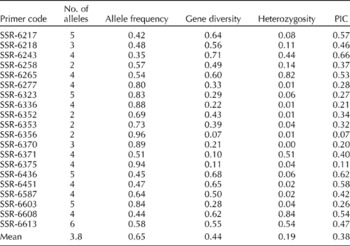
Twenty of the primer combinations reproducibly gave polymorphic DNA fragments following electrophoretic analysis of PCR amplification products. Five primer combinations generated monomorphic allelic amplification profile across all cowpea genotypes tested, and were excluded in the analysis. The sizes of amplified polymorphic DNA fragments (bands) ranged from 80 to 500 bp. The primer pairs, their sequence, allele number and frequency, gene diversity, heterozygosity and PIC are given in Table 2.
Number of alleles, gene diversity, heterozygosity and polymorphism information content for the primers used in this study

The informative SSRs were able to distinguish 138 (97.2%) accessions of the cowpea including those with the same local name, seed coat colour and growth habits independent of geographical regions from which samples were obtained. A total of 74 alleles at 20 loci could be scored. The number of alleles detected per primer pair varied from a minimum of 1 to a maximum of 6 with an average of 3.8. Gene diversity also ranged from 0.12 to 0.68 with an average of 0.44. Variation in heterozygosity among cowpea SSRs increased from 0.01 to 0.84 with an average occurrence of 0.19. The PIC varied from 0.07 to 0.66 with an average of 0.38 (Table 2).
Phylogenetic analysis
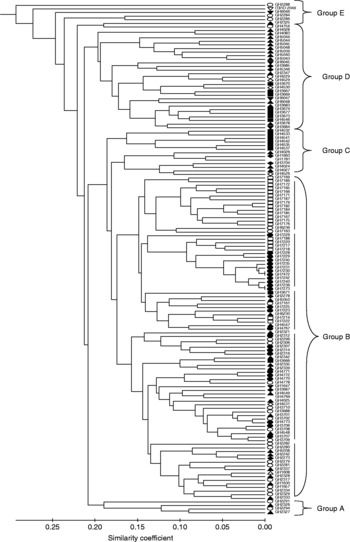
Based on their molecular profiles resolved using informative SSRs, the 141 cowpea accessions from Ghana clustered into five main groups, which we designated as groups A to E (Fig. 2). Groups A and E are the two smallest groups, with the latter containing the accessions that are the most diverged. Group A consists of four accessions, two each from the Eastern and Northern regions that differ in seed colour and plant type. Group E consists of six Ghanaian genotypes and the outgroup IT84S-2049 from Nigeria. The Ghanaian genotypes were predominately collected in the Northern region of the country, and the majority are brown or mottled brown seeded types. Groups C and D made up cowpeas from mainly the Volta, Eastern, Ashanti and Northern regions of Ghana. Within each of these larger groups are distinct subclusters at different genetic distance levels that reflect regional origin. For example, clear subclusters of genotypes from Volta exist within both groups C and D. Group B contains the largest number of accessions, and could easily be broken into four or five subgroups. One subgroup contains the majority of genotypes collected from the Upper Eastern portion of the country, and the other subgroup is dominated by accessions representing the Upper Western portion indicating that the cultivars grown in these regions share many common characteristics. The other subgroups seem to cluster accession collected more broadly over the whole of Ghana, encompassing geographical regions of both the savannah and forest ecological zones.
Phylogenetic relationship among cowpea accessions in the PGRRI germplasm collection in Ghana. A dendrogram illustrating the relatedness of 141 cowpea accessions collected in Ghana and one outgroup is shown, which was generated using 20 informative SSR markers and the sequential clustering algorithm (UPGMA) based on genetic similarity (Nei and Li, Reference Nei and Li1979). The cowpea accessions are defined as in Table 1. Key to geographical regions are as follows:  , IT84S-2049 from IITA;
 , Northern;
 , Upper Eastern;
 , Upper Western;
 , Eastern;
 , Central;
 , Volta;
 , Greater Accra;
 , Ashanti;
 , Brong Ahafo.

Generally, genetic distances among cowpea genotypes are low, reflecting the initial bottleneck during domestication, and maintained by the inherent self-pollination mechanism in the crop. On the whole, the genetic distance among the cowpea accessions analyzed here varied from 0.00 to 0.68. Two pairs of accessions had genetic distances of 0.00 (GH7236 and GH7273; GH7230 and GH7472), suggesting that the members of these pairs may in fact be separately collected, but had identical germplasms. Accessions GH2325 and GH6046 had the highest genetic distance (0.68) among the accessions compared. The genetic distance between GH2325 and GH6046 was even greater than the largest distance between a Ghanaian genotype GH5039 and the outgroup IT84S-2049, which was measured to be 0.63. Of the accessions analyzed, GH2288 was the most genetically diverged (Fig. 2). It has genetic enrichment with 9.9% frequency of genetic distances exceeding 0.60 compared with 0.7% frequency of genetic distances exceeding 0.60 expressed by the outgroup IT84S-2049.
Discussion
Consistent with previous reports, genetic variability among the Ghanaian cultivated cowpea genotypes considered in this study was low. This is not surprising since it is well documented that cowpeas in general have a narrow genetic base due to the fact that a single domestication event is involved in the origin of this crop (Doebley, Reference Doebley, Soltis and Soltis1989; Pasquet, Reference Pasquet2000; Coulibaly et al., Reference Coulibaly, Pasquet, Papa and Gepts2002; Ba et al., Reference Ba, Pasquet and Gepts2004). The accessions used in this study were part of the germplasm collection at the PGRRI, and for the most part, these materials were collected from farmers' fields, open markets and agricultural stores. Traditionally, subsistence farmers in both the savannah and forest ecological regions of Ghana save seed and rely on their own experience to select and improve their varieties (Quaye et al., Reference Quaye, Adofo, Madode and Abizari2009). Seed conservation limits the exchange of germplasm throughout the country, and also inhibits the integration of genotypes from other sources outside of Ghana into local breeding programmes. These factors surely contribute to limiting genetic diversity.
Conventionally, cowpeas grown in Ghana are identified by local names based on morphological characteristics alone (such as plant morphology, seed coat colour or other visible seed/pod characteristics). One could anticipate that this could lead to redundancy within the PGRRI collection if the same genotype were collected under different names depending on the ethnic group or locality responsible for its collection. It would also contribute to decreasing measures of diversity within the target population of samples. We found relatively few examples where such redundancy might exist. For example, accession GH7230, a red seeded type grown in the Upper Western part of Ghana called Bene, appears to be genetically similar to GH7472, a white seeded cowpea called Sompla grown in the same region. Similarly, accession GH7236, a mottled brown seeded variety also called Bene, is very genetically similar to GH7273, a white seeded cowpea called Sompla (Fig. 2).
The type of DNA markers employed can also affect the level of polymorphism revealed among genotypes. Previous studies aimed at looking at local genetic diversity of cowpea have used a variety of different molecular marker tools including isozymes, RAPDs, gene sequencing and SSRs. Li et al. (Reference Li, Fatokun, Ubi, Singh and Scoles2001) used 12 cowpea-derived SSR primers to examine the genetic similarities and relationships among cowpea breeding lines developed at the IITA. In this study, the different primer combinations detected between 4 and 13 alleles among 48 wild cowpea lines with an average of 7.5 alleles per primer. Diouf and Hilu (Reference Diouf and Hilu2005) were able to resolve between 1 and 9 alleles per SSR primer combination in germplasm from Senegal. Uma et al. (Reference Uma, Hittalamani, Murthy and Viswanatha2009) reported that 80% of the SSR primer combinations tested were able to detect polymorphisms within a collection of 83 Indian genotypes representing different geographical regions, pedigrees and morphological characteristics, but did not report on the degree of allelic variability observed. In the present study, the 20 informative SSR primer combinations used to analyze the Ghanaian germplasm yielded one to six alleles per primer pair or locus with an average of 3.8. Our results are consistent with what has been observed in other legumes (e.g. chickpea from 1 to 8 (Winter et al., Reference Winter, Pfaff, Udupa, Huttel, Sharma, Sahi, Arreguin-Espinoza, Weigand, Muehlbauer and Kahl1999), alfalfa from 9 to 14 (Mengoni et al., Reference Mengoni, Gori and Bazzicalupo2000), soybean from 11 to 26 (Rongwen et al., Reference Rongwen, Akkaya, Bhagwat, Lavi and Cregan1995) and yardlong bean from 2 to 6 (Li et al., Reference Li, Fatokun, Ubi, Singh and Scoles2001; Xu et al., Reference Xu, Wu, Wang, Liu, Quin, Ehlers, Close, Hu, Lu and Li2010)). Therefore, we feel that the use of variations in SSRs is reflective of the extent of genetic variation present in the Ghanaian cowpea gene pool. On the whole, the SSR markers used could differentiate 97.2% of the 141 cowpea accessions.
Defining the exact genetic relationship among accessions is inherently difficult, and clearly, the ability to resolve subtle differences is enhanced with a greater number of markers and with a good distribution of markers throughout the genome. Nonetheless, we were able to roughly place the various cowpea accessions from Ghana into several main groups that more or less reflect their origins and relatedness. Not surprisingly, in some cases, there was a clear geographical origin component to the grouping. In other cases, the groups comprised accessions collected more broadly throughout the whole of the country. We found little if any evidence to suggest that clustering of any sort was related to reported phenotypic characteristics such as seed colour or plant growth type. The highest heterozygosity of 0.84 indicated by primer SSR-6608 may suggest variations in the genome of the cowpea accessions including hybrids under open field cultivation.
Edaphic and climatic factors can dramatically influence plant physiology and morphology, and therefore, classification schemes relying only on visible characteristics are inherently flawed. The use of molecular markers provides a much more reliable approach to distinguish cowpea genotypes for germplasm conservation, and for the identification of parental lines for use in breeding for genetic improvement. Here, we have demonstrated the utility of SSR markers for analysis of the currently available cowpea germplasm in Ghana. The results described here provide a solid foundation upon which working towards a molecular marker-based breeding programme for germplasm improvement in Ghana can be begun, and underscore the need for including new sources of germplasm into current breeding efforts.
Acknowledgements
The authors wish to thank the members of the Timko Laboratory for their help in various aspects of this work and for helpful suggestions on this manuscript. They are also grateful to the PGRRI of Ghana for supplying the cowpea accessions used in this work. These studies were supported by funds from the Kirkhouse Trust awarded to M. P. T. While the research reported here was funded by the Kirkhouse Trust, the design, execution and interpretation of the research remain wholly the responsibility of the authors.