Introduction
In Latin America (LA), many countries are undergoing or have gone through a process of demographic transition in which the elderly represent a significant proportion of the total population. The total number of individuals aged 60 and over in LA and the Caribbean in the year 2000 was 41.3 million, and a further 57 million are estimated to join this population by 2025. Another important demographic aspect pertains to the socioeconomic status and educational level of the elderly population in LA: the poverty rate is high and the illiteracy rate among the elderly is around 10% or even higher (Centro Latinoamericano y Caribeño de Demografia, 2002).
A natural consequence of this rapid demographic transformation, together with the low rates of socioeconomic and educational levels, is an increasing prevalence of chronic medical conditions, including dementia. For these reasons, dementia is becoming a major public health problem in LA. However, despite the magnitude of this problem, epidemiological information on dementia remains scarce in this region (Mangone and Arizaga, Reference Mangone and Arizaga1999; Kalaria et al., Reference Kalaria2008).
In a review of the global prevalence burden of dementia, LA (with the exception of Cuba) was considered to be a region in which studies with good methodological quality were lacking (Ferri et al., Reference Ferri2005). In that review it was suggested that the prevalence of dementia in developing countries is lower than in developed regions.
The main objective of this collaborative study was to analyze data from population surveys on the prevalence of dementia in LA countries and to verify whether the prevalence of dementia and of the diseases causing dementia are different from those of developed regions of the world.
Methods
We performed a search on Medline and the Latin America and Caribbean (LILACS) databases using the words “dementia” or “Alzheimer's disease” and “prevalence”, “frequency” or “epidemiology” and “Latin America” or each of the 20 Latin American country names, using the English, Spanish and Portuguese languages. The authors of the population surveys identified were contacted by email to ask whether they would be willing to participate in this collaborative study, and if so, to send their most recent data on the prevalence of dementia. The requirements were that data had to be available for age (divided into five-year periods starting from 65), gender and prevalence according to levels of education.
Since we were aware of a few investigations on the prevalence of dementia that had been presented as communications in scientific or clinical meetings, we sent messages by email to the authors of these studies in Brazil, Chile, Colombia and Peru, inviting them to send their data in order to participate in this study.
Only studies performed on large general populations were included. The data were combined to obtain pooled estimates of prevalence of dementia which were subsequently compared with the findings from similar studies or with systematic reviews that were mainly based on studies conducted in developed countries.
Statistical analysis was performed using χ2 to evaluate differences between prevalence according to educational level, employing the EpiInfo (2002 version) software. For each study and age group, prevalence and 95% confidence intervals were calculated using the GraphPad StatMat Version 1.0 software. The standardized prevalence of dementia according to age was calculated using as the standard population the global world population in 2000 (United Nations Department of Economic and Social Affairs, 2005), following the method used by Scazufca et al. (Reference Scazufca2008). In each case, the standardized prevalence may be seen as the estimated prevalence if the population of our study had the same age structure as the standard populations. The significance level adopted was 0.05.
Results
Studies carried out in five LA countries were identified in the databases, namely, Brazil (Herrera et al., Reference Herrera, Caramelli, Silveira and Nitrini2002; Ramos-Cerqueira et al., Reference Ramos-Cerqueira2005; Bottino et al., Reference Bottino2008), Colombia (Pradilla et al., Reference Pradilla, Vesga and Leon-Sarmiento2003; Diaz-Cabezas et al., Reference Diaz-Cabezas, Ruano-Restrepo, Chacon-Cardona and Vera-Gonzalez2006), Cuba (Llibre et al., Reference Llibre1999; Reference Llibre2005), Uruguay (Ketzoian et al., Reference Ketzoian1997) and Venezuela (Maestre et al., Reference Maestre2002; Molero et al., Reference Molero, Pino-Ramírez and Maestre2007). One Chilean (Albala et al., Reference Albala, Quiroga, Klaassen, Rioseco, Pérez and Calvo1997) and one Peruvian (Custodio et al., Reference Custodio2007) study, presented as abstracts, were also identified.
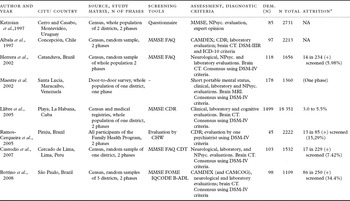
The Colombian surveys encompassed the whole population of an area, investigating the prevalence of other common neurological diseases, such as migraine and epilepsy (Pradilla et al., Reference Pradilla, Vesga and Leon-Sarmiento2003; Dias-Cabezas et al., Reference Diaz-Cabezas, Ruano-Restrepo, Chacon-Cardona and Vera-Gonzalez2006). These studies were not included because the number of elderly was not large. We finally included eight studies from six countries (Table 1).
Population-based studies included in the present review (all data from urban areas)

*Attrition between screening and assessment phases.
B-ADL = Bayer-Activities of Daily Living Scale; CAMDEX = Cambridge Examination for Mental Disorders; CAMCOG = cognitive section of the CAMDEX; CDR = Clinical Dementia Rating; CDT = clock drawing test; CI = Confidence Interval; CHW = community health worker; CT = computed tomography; Dem = dementia; FAQ = Functional Activities Questionnaire; FOME = Fuld Object Memory Evaluation; IQCODE = Informant Questionnaire on Cognitive Decline in the Elderly; MRI = magnetic resonance image; MMSE = Mini-mental State Examination; N = number of individuals; NA = not available; NPsyc = neuropsychological.
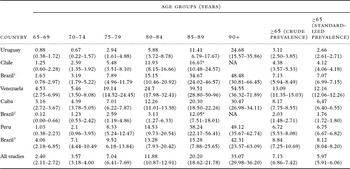
Prevalence of dementia according to age in each of the eight studies and standardized prevalence are depicted in Table 2.
Prevalence of dementia (%) and 95% CI in eight Latin American studies, according to age groups

*Prevalence in individuals aged 85 or over.
Brazilian studies: 1 Herrera et al., Reference Herrera, Caramelli, Silveira and Nitrini2002; 2 Ramos-Cerqueira et al., Reference Ramos-Cerqueira2005; 3 Bottino et al., Reference Bottino2008.
NA = not available.
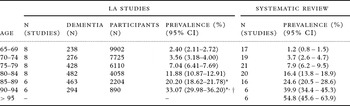
Pooled data from these studies were compared with the worldwide prevalence of dementia reported in a recent systematic review (Lopes and Bottino, Reference Lopes and Bottino2002; Lopes et al., Reference Lopes, Hototian, Reis, Elkis and Bottino2007) (Table 3).
Prevalence of dementia according to age (pooled data of eight Latin American studies from six countries) and comparison with a systematic review of dementia prevalence studies by Lopes et al. (Reference Lopes and Bottino2002; Reference Lopes, Hototian, Reis, Elkis and Bottino2007)

CI = confidence interval.
*For the Chilean study (Albala et al., Reference Albala, Quiroga, Klaassen, Rioseco, Pérez and Calvo1997) and one Brazilian study (Herrera et al., Reference Herrera, Caramelli, Silveira and Nitrini2002), only data for subjects up to 84 years old were included.
†Prevalence in the 90 years or over age group.
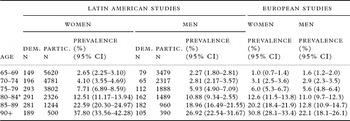
The prevalence according to gender was available from seven studies (except Chile) and was compared with pooled data from European countries reported by Lobo et al. (Reference Lobo2000) (Table 4).
Comparison of prevalence of dementia according to gender between pooled data of seven Latin American studies (Chilean data not included) and pooled data from European studies reported by Lobo et al. (Reference Lobo2000)

Legend: Dem. = dementia; Partic. = participants; CI = confidence interval.
*For one Brazilian study (Herrera et al., Reference Herrera, Caramelli, Silveira and Nitrini2002), only data for subjects up to 84 years old were included.
†prevalence in the 90 years or over age group.
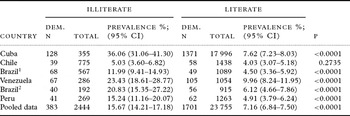
The prevalence of dementia according to educational level was available for six of the eight studies. However, the classification into low and high educational level was not the same in these studies. Therefore, we included only the data comparing the prevalence of dementia among illiterate and literate subjects (Table 5). Illiterate subjects constituted 9.3% of the elderly population in these studies.
Prevalence of dementia among illiterate and literate subjects in Latin American studies

Data from the Uruguay study (Ketzoian et al., Reference Ketzoian1997) and one Brazilian study (Ramos-Cerqueira et al., Reference Ramos-Cerqueira2005) are not included.
Brazilian studies: 1Herrera et al., Reference Herrera, Caramelli, Silveira and Nitrini2002; 2Bottino et al., Reference Bottino2008
CI = confidence interval; Dem. = dementia
Regarding the diseases causing dementia, Alzheimer's disease was the most frequent cause of dementia in all studies, ranging from 49.9% in Maracaibo, Venezuela, to 84.5% in Concepción, Chile. Vascular dementia was the second most prevalent disease causing dementia, ranging from 8.7% in Lima, Peru, to 26.5% in Maracaibo, Venezuela.
Discussion
The analysis of these eight LA population-based cohort studies shows that the general prevalence of dementia in the elderly is similar, and in some instances even higher, than the prevalence reported by most studies and meta-analyses performed in developed countries and regions (Jorm et al. Reference Jorm, Korten and Henderson1987; Lobo et al., Reference Lobo2000; Lopes and Bottino, Reference Lopes and Bottino2002; Lopes et al., Reference Lopes, Hototian, Reis, Elkis and Bottino2007). The global prevalence rate of these LA studies was 7.1%, while two systematic reviews of prevalence studies conducted from 1994 to 2000 found prevalence rates ranging from 4.2% in Canada to 14.5% in Spain, whereas most studies from European countries, Japan and the U.S.A. reported prevalence rates of between 5.5% and 9.0% for those aged 65 or over (Lopes and Bottino, Reference Lopes and Bottino2002; Lopes et al., Reference Lopes, Hototian, Reis, Elkis and Bottino2007). The age-standardized prevalence when the world population was used as the standard was 5.97%, reflecting the fact that the population of the LA studies was older.
There is a considerable difference in the prevalence among the LA studies, from 2% in a Brazilian study (Ramos-Cerqueira et al., Reference Ramos-Cerqueira2005) to 13% in the Venezuelan study (Maestre et al., Reference Maestre2002). In analyses of prevalence surveys conducted in developed countries, similar (Lobo et al., Reference Lobo2000) or even greater differences in rates have been found (Jorm et al., Reference Jorm, Korten and Henderson1987). These differences are often attributed to the different diagnostic criteria for dementia used (Erkinjuntti et al., Reference Erkinjuntti, Ostbye, Steenhuis and Hachinski1997) or to the types of sampling and assessment (Jorm et al., Reference Jorm, Korten and Henderson1987).
In terms of gender, the LA studies depicted higher rates for both genders in the 65–69 age group, and for women in the 70–74 age group, compared to the pooled data from European studies (Lobo et al., Reference Lobo2000). For the 90 years or over age group, higher rates in the LA studies were also found for both genders, but the smaller numbers for this age range prevents a more precise comparison with the review presented by Lobo et al. (Reference Lobo2000). Considering gender as a possible risk factor for dementia, the LA studies showed slightly higher rates for women compared to men in all age groups. A similar finding was reported in the European pooled data analysis (Lobo et al., Reference Lobo2000) and also in a recently published study conducted in Latin America, India and China (Llibre Rodriguez et al., Reference Llibre Rodriguez2008).
However, as Lobo et al. (Reference Lobo2000) have stated, these results may be caused by differences in survival between men and women. On the pooled analysis of incidence of dementia in Europe, the authors also found higher rates of dementia and AD among women, speculating that selective survival of men in older ages, earlier occurrence of dementia in men, and lower level of estrogen in older women may explain these differences (Fratiglioni et al., Reference Fratiglioni2000). In the only study on the incidence of dementia published in LA, performed in Brazil (Nitrini et al., Reference Nitrini2004), gender was not associated with AD as it was in the prevalence study (Herrera et al., Reference Herrera, Caramelli, Silveira and Nitrini2000), but the incidence of dementia was higher in women older than 85 years. In summary, additional studies on the incidence of dementia are needed in LA countries to further address the role of gender as a risk factor for dementia or AD.
Another finding of our study is related to the probable higher reported prevalence of dementia in relatively young individuals among the elderly population. The prevalence in those aged 65–69 was significantly higher than that observed in developed countries. On the other hand, the prevalence in the oldest elderly individuals showed a trend toward lower rates than in the developed world.
Several reasons may contribute to this higher prevalence of dementia in the relatively young subjects in developing regions. Limited access to primary care services along with low educational level probably ranks highest among them. The lack of primary health care may predispose individuals to presenting dementia caused by controllable or curable diseases such as systemic arterial hypertension or syphilis. Low educational level, particularly illiteracy, has also been consistently associated with higher rates of dementia (Zhang et al., Reference Zhang1990; Caamaño-Isorna et al., Reference Caamaño-Isorna, Corral, Montes-Martínez and Takkouche2006; Manly et al., Reference Manly, Schupf, Tang, Weiss, Stern and Stern2007; Llibre Rodriguez et al., Reference Llibre Rodriguez2008).
The prevalence of dementia in illiterate individuals was two times higher than in literate individuals, which is particularly important given that our pooled data show that the rate of illiteracy among the elderly was approximately 10%. For the diagnosis of dementia, informant questionnaires and adjusted cut-off scores of the tests for illiterate and low educated individuals were used at the screening and assessment phases. Differences of prevalence between illiterate and literate individuals were observed in seven out of the eight studies, with the exception of the Chilean study. In Concepción, where the Chilean study was performed, most of the illiterate subjects were of Indian Mapuche ancestry, who still preserve their original language and habits. The diagnosis of dementia in this population was probably much more difficult than in populations with a more homogeneous cultural background and this feature may have accounted for the lack of difference in the Chilean study.
It has been argued that low educational level is associated with earlier manifestations of cognitive decline, while more educated individuals have a higher cognitive reserve delaying the emergence of clinical signs of dementia (Fratiglioni and Wang, Reference Fratiglioni and Wang2007; Manly et al., Reference Manly, Schupf, Tang, Weiss, Stern and Stern2007). Our findings support this hypothesis, especially because the prevalence rates in LA studies are highest in relatively young subjects.
On the other hand, the possible lower prevalence in the very old may be due to higher mortality in dementia patients in LA countries. In a Brazilian study, the mortality risk ratio of dementia was higher than in developed countries (Nitrini et al., Reference Nitrini2005), approaching that reported for Nigeria (Perkins et al., Reference Perkins2002).
In a recent review of the global burden of dementia, it was suggested that the prevalence of dementia in developing countries is lower than in developed regions (Ferri et al., Reference Ferri2005). To explain this low prevalence the authors presumed that differences in level of exposure to environmental risk factors (low levels of cardiovascular risk factors and hypolipidemia) or even high levels of mortality in early life could also be implicated, where “constitutional and genetic factors that confer survival advantage in early years might go on to protect against neurodegeneration or delay its clinical manifestation” (Ferri et al., Reference Ferri2005). Nevertheless, our data do not support the assertion that the prevalence of dementia is lower in LA countries compared to developed countries. Moreover, in a paper analyzing the demographic and health conditions of aging in LA and the Caribbean, the authors stated that the increase of the populations above age 60 in these regions is associated with reduction in mortality caused by infectious diseases in the first ten years of life (Palloni et al., Reference Palloni, Pinto-Aguirre and Pelaez2002).
A similar finding to the present study was recently reported by the 10/66 Dementia Research Group, in which the prevalence of dementia in urban areas of LA was found to be similar to (crude prevalence = 4.6%) or even higher (crude prevalence = 9.7%) than, depending on the adopted diagnostic criteria, the rates in Europe and other developed countries (Llibre Rodriguez et al., Reference Llibre Rodriguez2008).
There are, however, limitations in our study. We have been able to include eight studies but from only six countries, comprising one third of LA countries. These countries are not concentrated in one or two regions of LA but are dispersed from Central America to the more southern countries of South America, making this study reasonably representative of the LA countries. Data from Chile (Albala et al., Reference Albala, Quiroga, Klaassen, Rioseco, Pérez and Calvo1997) and Peru (Custodio et al., Reference Custodio2007) were included based on abstract presentations, a point that deserves explanations. The Peruvian study has already been submitted for publication, whereas the Chilean study has not been completely published so far. However, the study of the prevalence of dementia in Chile (Albala et al., Reference Albala, Quiroga, Klaassen, Rioseco, Pérez and Calvo1997) was a branch of a cross-national research program on age-associated dementias, supported by the World Health Organization and led by Amaducci (Amaducci et al., Reference Amaducci1991), which evaluated screening and diagnostic tests. At least two other Latin American studies (Herrera et al., Reference Herrera, Caramelli, Silveira and Nitrini2002; Custodio et al., Reference Custodio2007) used the screening instruments proposed by the Chilean study (Quiroga et al., Reference Quiroga, Albala and Klaasen2004).
Another limitation is related to the different design of the studies where even the diagnostic criteria were not the same across all countries and studies. Indeed, this is an obstacle to reviews of this kind, but is also a rather common observation in reviews of cross-sectional population-based studies in the literature. Also, although all studies had used the same definition of illiteracy, which states that “adult illiteracy is the percentage of the population aged 15 years and over who cannot both read and write a comprehensible short simple statement on their everyday life” (UNESCO, 2006), there was not one uniform evaluation for classifying the participants as illiterate. Finally, while the authors of these LA studies have expertise in the diagnosis of dementia in low educated individuals, and while informant-based questionnaires and adjusted scores or specially designed tests were used in all these studies, the diagnosis of dementia among illiterate and low educated individuals remains a difficult task, where this may in turn have increased the prevalence of dementia in this group of individuals.
To conclude, the prevalence of dementia in LA is similar to that reported in developed countries, being highest among the illiterate population and higher in relatively young subjects compared to developed countries.
Conflict of interest
None.
Description of the authors’ roles
Ricardo Nitrini and Paulo Caramelli conceived the study and wrote the manuscript; Ricardo Nitrini was also responsible for the analysis of the data. Cássio M. C. Bottino provided data for the study and also participated in the preparation of the manuscript. Cecilia Albala, Nilton Santos Custodio Capuñay, Carlos Ketzoian, Juan J. Llibre Rodriguez, Gladys E. Maestre and Ana Teresa A. Ramos-Cerqueira provided data for the study and reviewed the manuscript.
Acknowledgments
We gratefully acknowledge the contribution of Professor Antonio Lobo and Professor Guillermo Marcos from the University of Zaragoza, Spain, for making available the unpublished confidence intervals of a previous study. We are grateful to Ivaldo Olympio da Silva, Ulysses Doria Filho, Julio Litvoc and Reinaldo J. Gianini for their assistance in the statistical analysis and to Andrew Clifford Davis for English language support.
Funding of the Maracaibo Aging Study, Venezuela (Dr. Gladys E. Maestre) is from Fonacit Grant G-9700726. Funding of the Brazilian prevalence studies in Catanduva (Dr. Ricardo Nitrini) and in São Paulo city, Brazil (Dr. Cássio M. Bottino) are from FAPESP Grants 1997/12366-0 and 01/05959-7, respectively. The Estudio Demencia and Alzheimer Playa (EDAP), Cuba (Dr. Juan Jesus Llibre Rodriguez) was funded by the Cuban Disability Program and the Ministry of Public Health of Cuba.