Introduction
The need for tracheostomy in patients in neurocritical care is higher than in the general critical care population, with published rates ranging from 15 to 35 per cent in the neurocritical care setting compared with 10 to 15 per cent in general intensive care.Reference Alsherbini, Goyal, Metter, Pandhi, Tsivgoulis and Huffstatler1 There is also an association between underlying neurological diagnosis and poorer clinical outcome.Reference Gerber, Chaaya, Schoor, Markley and Abouzgheib2 The majority of the published literature regarding tracheostomy in the critical care population focuses on the timing and method of tracheostomy insertion.Reference Flanagan, Childs, Moore and Vallier3–Reference Romera Ganuza, Garcia Forcada, Gambarrutta, Merlo-Gonzales, Marin-Ruiz and Diez De La Lastra-Buigues6 There is a paucity of literature regarding tracheostomy management, weaning and decannulation rates, especially in neurocritical care patients.Reference Chagas de Medeiros, Chiarion Sassi, Lirani-Silva and Furquim de Andrade7,Reference Freeman-Sanderson, Togher, Phipps and Elkins8
The success of endotracheal extubation in patients with neurological impairment has been associated with age, presence of intact cough reflex and Glasgow Coma Score.Reference McCredie, Ferguson and Pinto9 In those patients where extubation fails or those who are unsuitable for extubation and are expected to require an artificial airway for more than 21 days,Reference Blot and Melot10–Reference De Leyn, Bedert, Delcroix, Depuydt, Lauwers and Sokolov13 the benefits of tracheostomy include improved comfort, decreased laryngeal trauma, decreased airway resistance, decreased requirement for sedation and a more secure airway when compared with endotracheal intubation.Reference Bosel, Schiller, Hook, Andes, Neumann and Poli5,Reference Romera Ganuza, Garcia Forcada, Gambarrutta, Merlo-Gonzales, Marin-Ruiz and Diez De La Lastra-Buigues6,Reference Childs, Moore, Como and Vallier14 Tracheostomy in neurocritical care patients has the added benefits of allowing assessment of vocal fold mobility and phonation, more effective airway suctioning to aid secretion management, and improved ability to assess swallow. The procedure also facilitates transfer from critical care to ward level care once the requirement for mechanical ventilation has ceased.
Once a patient has been tracheostomised, the input of the multidisciplinary team (MDT) into assessment and active weaning with the aim of tracheostomy decannulation with vocalisation and an effective swallow of secretions is of paramount importance. Studies have shown that a multidisciplinary care model can significantly expedite the decannulation process, decreasing the number of tracheostomy days and tracheostomy associated complications.Reference Bianchi, Barbara and Monini15,Reference Cetto, Arora, Hettige, Nel, Benhamin and Gomez16 The involvement of doctors, physiotherapists, speech and language therapists, and nurses has been shown to improve the safety and efficacy of the tracheostomy weaning process.Reference Welton, Morrison, Catalig, Chris and Pataki17–Reference Mah, Staff, Fisher and Butler20 However, there is no consensus in the literature as to the steps and timing of weaning. The process is largely patient, institution and health-professional specific.
Our hypothesis was that a multidisciplinary approach to decision making regarding tracheostomy weaning and decannulation in patients tracheostomised on the neurocritical care unit improves patient outcomes. We present a longitudinal study of all tracheostomised patients in the neuromedical and neurosurgical critical care units of a quaternary neurological and neurosurgical centre in the UK over 17 years. All tracheostomised patients were managed by a tracheostomy team with core membership of an intensive care unit consultant, senior speech and language therapist, and senior physiotherapist with the addition of a patient-specific nurse, speech and language therapist, and physiotherapist. Consultant ENT and palliative care input was requested as required.
Materials and methods
This was a prospective longitudinal study of all patients admitted to the Neurosurgical Intensive Therapy Unit or Neuromedical Intensive Therapy Unit who had a tracheostomy inserted during their neurocritical care stay over a 17-year period from September 2001 to September 2018.
The Neurosurgical Intensive Therapy Unit and Neuromedical Intensive Therapy Unit are situated within the National Hospital for Neurology and Neurosurgery, a quaternary centre for neurology and neurosurgery in the UK. The Neurosurgical Intensive Therapy Unit is a 15-bed facility with 9 level 3 beds and 6 level 2 beds providing a regional referral service for neurosurgical patients and treating 1100 patients on average per year. The Neuromedical Intensive Therapy Unit is a 5-bed level 3 facility providing the only dedicated critical care unit in the UK for neuromedical disorders, treating 150 patients on average per year.
The core members of the tracheostomy team were constant throughout the data collection period: intensive care unit consultant for tracheostomy care, senior speech and language therapist, and senior physiotherapist. Patient-specific input was given by the patient-specific nurse, speech and language therapist, and physiotherapist. Further input from ENT and palliative care consultants was given as requested by the core team members. All patients were discussed at a weekly MDT meeting with the core team members and reviewed on a weekly tracheostomy ward round with core and patient-specific team members present. The core members were available at the request of the patient-specific team members daily. In this way, tracheostomy team care starts in the Neuromedical Intensive Therapy Unit or Neurosurgical Intensive Therapy Unit, and the same core team members are involved in the patient's care until decannulation or discharge.
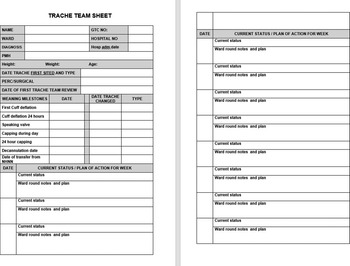
The weekly tracheostomy ward round formally reviews all tracheostomised patients in the hospital, including those who have been stepped down to ward level care. A standardised tracheostomy team proforma ‘Trache Team Sheet’ is filled out during the ward round documenting ongoing issues and actions relating to weaning (Figure 1). Prior to April 2019, this was filed in the patient's paper records and subsequently entered into the patient's electronic records.
Trache team sheet standardised tracheostomy team proforma filled in weekly on the tracheostomy ward round. GTC NO = Global Tracheostomy Collaborative Number; Hosp adm = hospital admission date; PMH = past medical history; PERC = percutaneous tracheostomy; NHNN = National Hospital for Neurology and Neurosurgery

The Trache Team Sheets were collated in September each year for review and analysis by the core members of the tracheostomy team. Data were collected from the date of tracheostomy until decannulation or, if decannulation was not achieved, until discharge, transfer with tracheostomy tube in-situ, or death. In addition, data were recorded on the number and complexity of tracheostomy tube changes required, the use of non-standard tracheostomy tubes (standard tube defined as a non-adjustable tracheostomy tube with an inner cannula and without a suction aid), complications, patient outcomes and duration of weaning process. In this study, all Trache Team Sheets from September 2001 to September 2018 were reviewed. All patients were adults (defined as aged 18 years or older), a criterium for admission to the centre. There were no exclusion criteria. All patients who underwent tracheostomy from September 2001 to September 2018 by either surgical or percutaneous methods while in-patients on Neurosurgical Intensive Therapy Unit or Neuromedical Intensive Therapy Unit were included in the study.
Results
Number of tracheostomy procedures
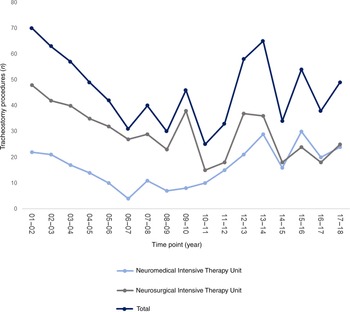
From September 2001 to September 2018, a total of 784 patients had a tracheostomy inserted, of which 279 were in-patients on the Neuromedical Intensive Therapy Unit and 505 were on the Neurosurgical Intensive Therapy Unit. The mean number of tracheostomy procedures in both units over the time period was 46 (range, 25–70) per year with mean of 16 (range, 4–24) per year in the Neuromedical Intensive Therapy Unit and 30 (range, 25–70) in the Neurosurgical Intensive Therapy Unit. The lower total number of tracheostomy procedures in the Neuromedical Intensive Therapy Unit reflects the smaller size of the unit and lower patient turnover in comparison with the Neurosurgical Intensive Therapy Unit. Over the time period, the number of tracheostomy procedures being performed showed no discernible trend (Figure 2).
Number of tracheostomy procedures over 17-year period (September 2001 to September 2018).

Outcomes
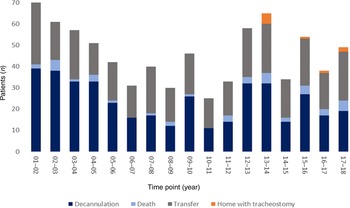
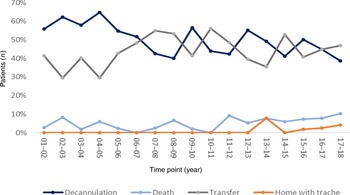
Outcomes were recorded for all patients. Fifty-one per cent (403 of 784) of patients were successfully decannulated, and 42 per cent (331 of 784) were transferred to another hospital or rehabilitation facility with a tracheostomy tube in situ. Five per cent of patients (41 of 784) died before decannulation in hospital, and 1 per cent (9 of 784) were discharged home with a tracheostomy in situ (Figures 3 and 4).
Patient outcomes as a proportion of total tracheostomy procedures performed each year.

Patient outcomes as a percentage of total tracheostomy procedures performed each year.

Number of tracheostomy days
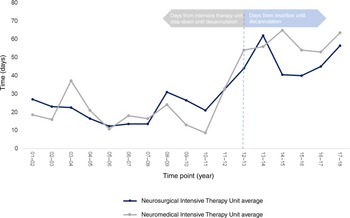
The duration of tracheostomy wean from insertion until decannulation was reviewed on a yearly basis. From September 2001 to September 2012, data for tracheostomy days were collected from the date of discharge from the Neurosurgical Intensive Therapy Unit or Neuromedical Intensive Therapy Unit until decannulation, which ranged from 12.3 to 32.5 days (mean, 20.8 days) in the neurosurgical group and from 10.8 to 37.2 days (mean, 19.7 days) in the neuromedical group.
After September 2012, data were collected from the day of insertion of tracheostomy until decannulation, thus including the number of days on Neuromedical Intensive Therapy Unit or Neurosurgical Intensive Therapy Unit. This change was implemented to capture the input of the tracheostomy team while the patient remained ventilated. Early rehabilitation, including cuff down trial while ventilated, was implemented for all suitable patients to encourage laryngeal sensation, secretion effective swallow, breathing reciprocity, speech and smell.
From September 2012 to September 2018, patients who achieved decannulation as an in-patient had an average of 48 tracheostomy days (range, 40–62 days) in the neurosurgical group and an average 57.6 days (range, 53–65 days) in the neuromedical group. In the neuromedical group, there was one patient who was an outlier who was decannulated after 138 days because of instability related to their underlying neuromedical diagnosis, anti-N-methyl-D-aspartate receptor encephalitis; this patient was excluded from the analysis as a significant outlier (Figure 5).
Time in days from tracheostomy to decannulation. Prior to September 2012, the data collected show days from Neurosurgical Intensive Therapy Unit and Neuromedical Intensive Therapy Unit discharge until decannulation. After September 2012, the data collected show days from tracheostomy insertion until decannulation.

Tracheostomy tube changes
Planned tracheostomy tube changes were performed by the tracheostomy team speech and language therapist and physiotherapist after training from the intensive care consultant. The timing of tracheostomy tube changes was determined by MDT discussion and affected by rate of progression through the steps of weaning and identification of any airway issues requiring a different size or type of tracheostomy tube. Tube changes that were thought to be potentially difficult (because of patient anatomy, use of anti-coagulation or poor patient compliance) were performed in the operating theatre with anaesthetic and ENT support. All first tracheostomy tube changes were routinely performed over a bougie to maintain the newly formed tract in case of unexpected difficulty.
From 2001 to 2005, it was accepted practice for some clinicians performing tracheostomy to insert a tracheostomy tube without an inner cannula primarily at the time of tracheostomy. Early first tube change to a tracheostomy tube with an inner cannula was routinely performed because of the added safety benefits in the event of tube occlusion. A total of 111 such changes were made during this time period at an average of 28 per year. After 2005, tubes without inner cannulas were no longer used at the time of tracheostomy insertion.
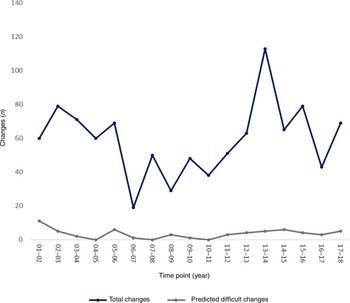
The timing and number of tracheostomy changes was determined by the tracheostomy team within the MDT setting, taking into account the individual patient's clinical condition and progress in tracheostomy weaning. A total of 1006 tracheostomy tube changes were performed over the study period. Of these, 59 tracheostomy tube changes were clinically determined to be potentially difficult and were performed in the operating theatre with anaesthetic and ENT support. Throughout the study period, a mean of 3 (range, 0–11) patients per year were predicted to have difficult tracheostomy tube changes. There was no morbidity or mortality associated with tracheostomy tube changes during the study period (Figure 6).
Total number of tracheostomy tube changes per year and number of predicted difficult tracheostomy tube changes.

Use of non-standard tracheostomy tubes
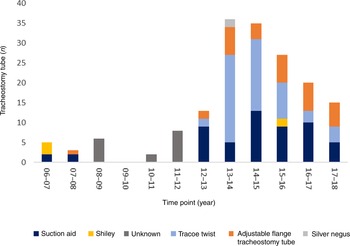
The use of non-standard tracheostomy tubes (standard tube defined as a non-adjustable tracheostomy tube with an inner cannula and without a suction aid) increased over the period of the study. No non-standard tubes were used prior to 2006. Five non-standard tubes were used from 2006 to 2007 increasing to a maximum of 36 in 2013 to 2014 (Figure 7).
The use of non-standard tracheostomy tubes.

Complications
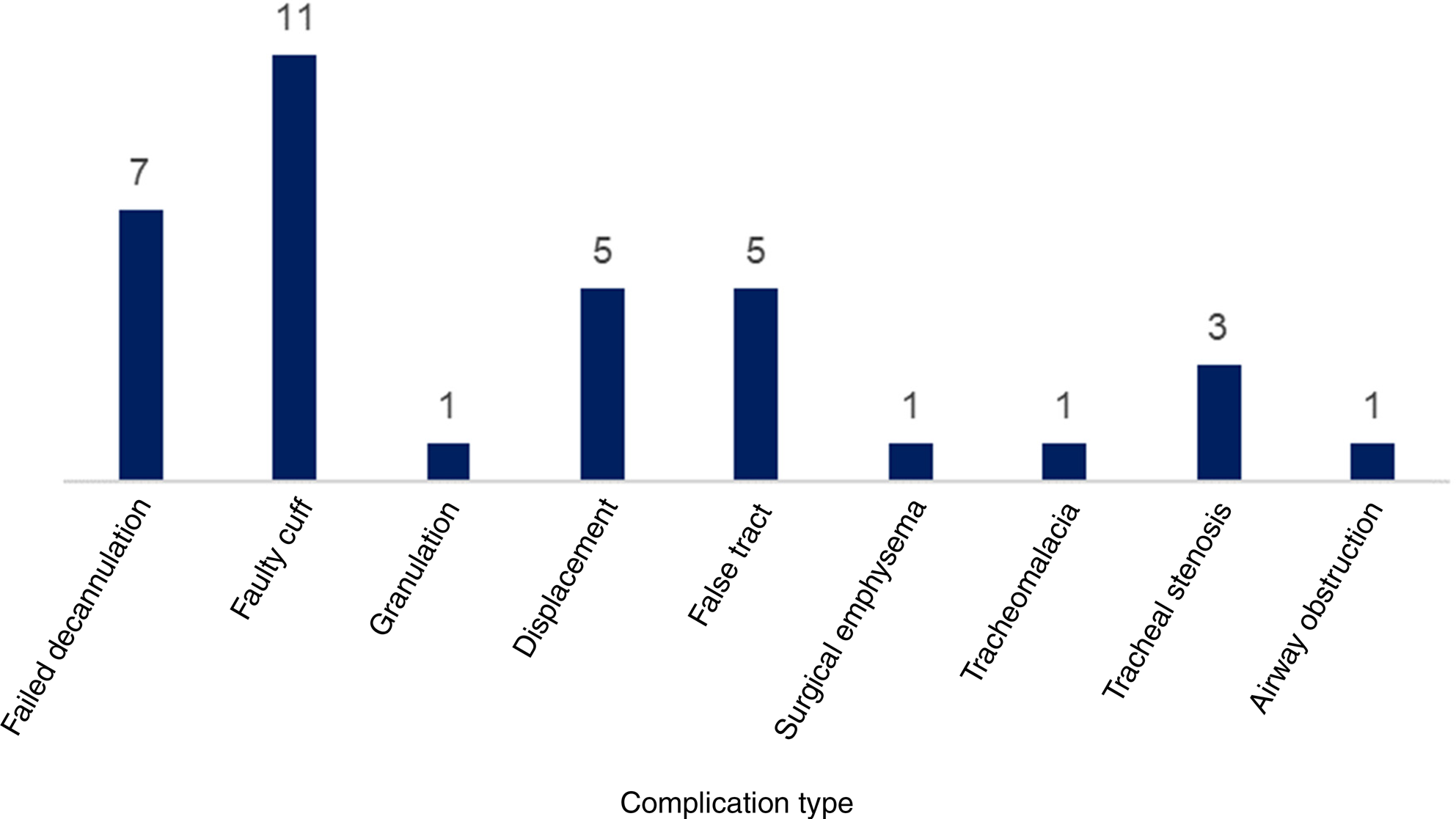
A total of 4.8 per cent (38 of 784) of patients had complications related to their tracheostomy. The most common complication was a faulty tracheostomy tube cuff; this occurred in a total of 11 patients and in 6 cases between 2003 and 2005. This was reported to the manufacturer. Seven patients failed decannulation. Five patients suffered haemorrhage, defined as bleeding uncontrolled by local measures and requiring surgical intervention. Four patients had tube misplacement into a false passage, and three had tracheal stenosis requiring ongoing ENT intervention. Granulation tissue partially occluding the tracheostomy tube lumen, surgical emphysema, tracheomalacia and airway obstruction requiring emergency tracheostomy tube change occurred in one patient each. There was no discernible trend in complications throughout the study period. There were no deaths because of tracheostomy complications (Figure 8).
Total complications per category from September 2001 to September 2018.

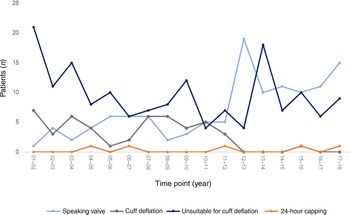
Stage of weaning prior to transfer
As a result of the quaternary nature of our centre, the percentage of patients discharged home with a tracheostomy was low at 1 per cent. The percentage transferred to either a local hospital or a rehabilitation facility with a tracheostomy in situ was high at 42 per cent. Because of this, the stage of weaning achieved prior to transfer was recorded. Weaning data were available for 336 of the 340 patients transferred or discharged with a tracheostomy. Thirty-six per cent (120 of 336) were using a speaking valve for the majority of the day (defined as over 12 hours), and 14 per cent (48 of 336) had undergone a trial of cuff deflation and commenced tracheostomy weaning but were not undergoing this on a daily basis because of their underlying neurological function. A total of 49 per cent (163 of 336) of patients had not trialled cuff deflation as this was deemed unsuitable because of their concomitant neurological diagnosis. A total of 1.5 per cent (5 of 336) of patients were on 24-hour capping at the time of transfer (Figure 9).
Stage of tracheostomy weaning before transfer or discharge with tracheostomy tube in situ.

Discussion
This study represents, to the best of our knowledge, the only prospective longitudinal study in the literature examining MDT involvement in the care of patients tracheostomised in the neurocritical care setting. The data collected over 17 years shows MDT guidance in all aspects of tracheostomy care from the point of insertion and provides a safe, effective and reproducible model of care for non-specialist centres and non-neurocritical care patients. Our results are in keeping with other studies of MDT-managed tracheostomy patients in the general intensive care population over shorter study periods.Reference Cetto, Arora, Hettige, Nel, Benhamin and Gomez16,Reference Welton, Morrison, Catalig, Chris and Pataki17
Historically, as reported by Seder,Reference Seder21 the outcomes of patients requiring mechanical ventilation for acute brain injury were poor, with a high proportion being dead or fully dependant at six months after admission.Reference Mayer, Copeland, Bernardini, Boden-Albala, Lennihan and Kossoff22 Outcomes for patients with severe acute brain injury have significantly improved, and tracheostomy is a marker of commitment to ongoing treatment.Reference Mayer, Copeland, Bernardini, Boden-Albala, Lennihan and Kossoff22 Neurocritical care patients commonly require a tracheostomy until they regain their airway protective reflexes, pharyngeal tone, and levels of activation and cognition sufficiently to enable them to clear secretions and maintain a patent upper airway.Reference Schönenberger, Al-Suwaidan, Kieser, Ulmann and Bosel23 This accounts for the greater number of tracheostomised patients in neurocritical care than in the general critical care population.Reference Alsherbini, Goyal, Metter, Pandhi, Tsivgoulis and Huffstatler1
In this study, there was no significant variation in the number of patients undergoing tracheostomy over 17 years. Our data is in line with data from France showing an average of 7.2 per cent of ventilated patients undergoing tracheostomyReference Durbin11 and 10 per cent in Swiss institutions,Reference Fischler, Erhart, Kleger and Frutiger24 although both of these papers do not report specifically on a neurocritical care population.Reference Gerber, Chaaya, Schoor, Markley and Abouzgheib2 Tracheostomy has been shown in several studies to decrease the number of ventilator-dependant daysReference Shibahashi, Sugiyama, Houda, Takasu, Hamabe and Morita4,Reference Bosel, Schiller, Hook, Andes, Neumann and Poli5 and the need for sedation.Reference Romera Ganuza, Garcia Forcada, Gambarrutta, Merlo-Gonzales, Marin-Ruiz and Diez De La Lastra-Buigues6 This facilitates step-down to ward-level or rehabilitation care.Reference Martinez, Fernandez, Casado, Cuena, Lopez-Reina and Zamora25
Early step-down from critical care both expedites patient rehabilitation and has a healthcare cost implication because critical care beds are a premium and limited resource within almost all healthcare models.Reference Bianchi, Barbara and Monini15,Reference Welton, Morrison, Catalig, Chris and Pataki17 The impact of ward step-down with tracheostomy is debated in the literature with some authors suggesting an increased rate of post-critical care mortality;Reference Frutos-Vivar, Esteban, Apezteguia, Anzueto, Nightingale and Gonzalez26–Reference Clec'h, Alberti, Vincent, Garrouste-Orgeas, de Lassence and Toledano28 however, this is yet to be conclusively provenReference Romera Ganuza, Garcia Forcada, Gambarrutta, Merlo-Gonzales, Marin-Ruiz and Diez De La Lastra-Buigues6 or compared with the excess morbidity and mortality of a prolonged endotracheal intubation or critical care stay.
In the published literature, there is a reported association between an underlying neurological diagnosis and a poorer clinical outcome.Reference Gerber, Chaaya, Schoor, Markley and Abouzgheib2 The nature of neurological disease is such that it can take time for the airway protective reflexes to recover, if they recover at all. This is reflected in the 49 per cent of patients in this study who were transferred with a tracheostomy tube in situ who were at that point unsuitable for cuff down trials because of inability to manage secretion load. In this study, 51 per cent of patients were successfully decannulated prior to transfer or discharge. Of those patients transferred in this study with a tracheostomy in situ, 37.5 per cent were at an advanced stage of tracheostomy weaning (defined as a minimum use of speaking valve for over 12 hours per day).
The length of time from tracheostomy until decannulation (often called tracheostomy days) in this study was expected to be longer than in the general critical care population and longer than the general neurocritical population because of the quaternary nature of our centre. This makes direct comparison with other published cohorts difficult. The mean number of tracheostomy days in this study was 48 days for neurosurgical patients and 57.6 days for neuromedical patients. In a systematic review of the literature on tracheostomy decannulation in mixed critical care populations, Chagas de Medeiros et al. reported a range of 16–91 days.Reference Chagas de Medeiros, Chiarion Sassi, Lirani-Silva and Furquim de Andrade7 There are no neurocritical care specific data available to make a direct comparison with our data.
It is our belief that the low number of tracheostomy days demonstrated in this study is the direct result of the input of the tracheostomy MDT from the point of decision to undertake tracheostomy until successful decannulation or transfer out of hospital. However, the authors accept that without a matched control group of patients this is not possible to prove conclusively. Weaning and decannulation protocols are far from standardised worldwide and are largely clinician or institution specific.Reference Frutos-Vivar, Esteban, Apezteguia, Anzueto, Nightingale and Gonzalez26 It has been shown that early intervention by a speech and language therapist decreases the time to identification and treatment of voice and swallowing pathology in tracheostomised patients.Reference McCredie, Ferguson and Pinto9 The use of the Trache Team Sheet with key weaning milestones of first cuff deflation, cuff deflation for 24 hours, speaking valve (always trialled at each cuff deflation), capping during the day and 24-hour capping acts as a skeleton guide for weaning and an assessment of stage of weaning for patients being discharged or transferred (Figure 1).Reference Ringrose, Brown, Walton and Sivan29 Of note in this study, cuff deflation trials start while the patient is still ventilated so that weaning plans can be made prior to ward discharge.
The process of tracheostomy decannulation in neurological patients is, in our experience, too patient specific and MDT dependant to adhere to a generic timeline. This is evidenced by the fact that there is no widely accepted timeline protocol for this group of patients. Within the MDT, each member provides specialist input. The team are involved from the point of decision for tracheostomy and advise on the ideal size of the tracheostomy tube and need for a non-standard tube after patient assessment. The use of non-standard tubes increased significantly over the study period, which is a reflection of the increased market availability of a wider range of tracheostomy tubes and also, possibly, of increased patient habitus requiring the use of adjustable flange tube; however, body mass index data were not collected in this study.
Some studies have attempted to quantify the improvements seen before and after the implementation of an MDT tracheostomy team.Reference Cetto, Arora, Hettige, Nel, Benhamin and Gomez16,Reference Thomas, Sauter, Starrost, Pohl and Mehrolz18,Reference Seder21 One of the main benefits seen by Welton et al. was earlier tracheostomy changes and swallowing assessments.Reference Welton, Morrison, Catalig, Chris and Pataki17 We believe that this reflects the empowerment of trained speech and language therapist and physiotherapist professionals to provide early interventions, with physician overview as required. A similar improvement in the time between the decision for, and performance of, an intervention was seen when intensive care physicians started performing percutaneous tracheostomy.Reference Mayer, Copeland, Bernardini, Boden-Albala, Lennihan and Kossoff22 In this study, the standardisation of tracheostomy tube changes by the onsite tracheostomy team who were available every day, having the first change over a bougie, and ENT and anaesthetic input as required for predicted difficult changes enabled safe changes with no incidents over the study period.
The complications of tracheostomy are well documented. In this study, complications were low with 4.8 per cent of patients experiencing a tracheostomy-related complication in comparison with 23.6 per cent reported in the 2014 National Confidential Enquiry into Patient Outcome and Death review of tracheostomy care in the UK.Reference Wilkinson, Freeth and Martin30 The most common complication was equipment related with tracheostomy cuff failure in 11 patients (1.4 per cent), which was reported to the manufacturer. Three patients (0.4 per cent) suffered tracheal stenosis which hindered decannulation until after ENT intervention; however, this was more likely to be associated with prolonged endotracheal intubation than tracheostomy. No patients died from a tracheostomy-related complication.
The low rate of complications in this study is attributed to the daily involvement of the patient-specific tracheostomy team (nurse, speech and language therapist, physiotherapist), weekly review and ad-hoc on-request interim involvement of the core tracheostomy team (intensive care unit consultant, senior speech and language therapist, and senior physiotherapist) and availability of an ENT consultant for weekly review from an allied hospital. Several studies have commented on the gap in ongoing tracheostomy management from the critical care unit to the ward when patients are stepped down.Reference Thomas, Sauter, Starrost, Pohl and Mehrolz18,Reference Ringrose, Brown, Walton and Sivan29 The MDT tracheostomy team spans this gap, and in this study, there was no change in the frequency or core personnel involved in a patient's care when stepped down from a critical care to a ward setting.
In our centre, ENT availability became formalised in 2015 to 2016 at which point the number of requests from the tracheostomy team for flexible nasendoscopy and tracheoscopy increased 500 per cent. In many studies, an ENT surgeon does not form part of the tracheostomy MDT.Reference Freeman-Sanderson, Togher, Phipps and Elkins8,Reference Thomas, Sauter, Starrost, Pohl and Mehrolz18 Bianchi et al. found that decannulation time, management of the tracheal tube and recovery of swallowing function was significantly shorter in patients treated by an ENT inclusive MDT.Reference Bianchi, Barbara and Monini15 It was our experience that regular ENT input not only aided in difficult weaning but also enabled prompt surgical input in patients requiring surgical intervention, such as the three patients with tracheal stenosis in this study.
Of paramount importance is the ability for this model of care to be extrapolated to non-specialist centres. There were no team members or weaning peculiarities in the population group in this study that were non-comparable to a general critical care population. One of the greatest strengths of the MDT in this study was the stability of the core membership which spanned the 17-year study period. This provided continuity care for the patients and continuity of teaching and supervision for junior staff members. We have found this to be crucial in the empowerment of the more junior staff who are involved in the patient specific teams to make decisions regarding tracheostomy weaning with the support of the core tracheostomy team members.
Limitations of this study
There are several limitations of this study. Firstly, although data were collected prospectively it was analysed retrospectively on a yearly basis which has inherent weaknesses and potential for bias. Secondly, the data collected from September 2001 until September 2012 regarding tracheostomy days was from the day of discharge from Neuromedical Intensive Therapy Unit or Neurosurgical Intensive Therapy Unit until decannulation, thus not including the number of tracheostomy days while in the critical care setting. From September 2012, the criteria for data collection was extended to encompass all days from the day of tracheostomy insertion until the day of in-hospital decannulation regardless of location. Thirdly, data for the stage of weaning prior to transfer or discharge home with a tracheostomy tube in situ were only available for 336 out of 340 patients discharged from the centre with a tracheostomy tube in situ. Lastly, this data set is formed from a highly specialised cohort of patients tracheostomised in a neurocritical care setting for which no direct comparative data is available within the published literature.
• Multidisciplinary team (MDT) care of patients with a tracheostomy can improve care and minimise complications
• Incidence of tracheostomy is higher in neurocritical care populations, but there is a paucity of literature on neuro-specific outcomes
• This study presents the longest prospective longitudinal study of MDT tracheostomy care in a neurological cohort
• Dedicated tracheostomy teams can achieve comparable outcomes for neurocritical tracheostomised patients as for general intensive care patients
• Tracheostomy team functionality, with senior members overseeing all patients and patient-specific teams, can be replicated
Conclusion
This study has shown that in a quaternary neuromedical and neurosurgical centre a dedicated tracheostomy MDT can deliver a service with a low rate of complications and high rate of decannulation. The model of a tracheostomy team with a senior core membership, overseeing care for all tracheostomised patients, and a patient-specific team providing daily care effectively spans the gap between critical care and ward level tracheostomy care. It is a model that can be replicated in a non-specialist centre to provide high-quality care for patients who have undergone tracheostomy procedures.
Competing interests
None declared