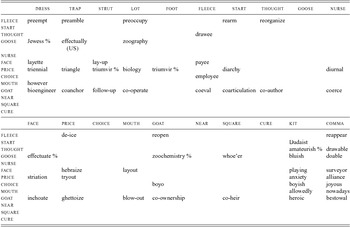
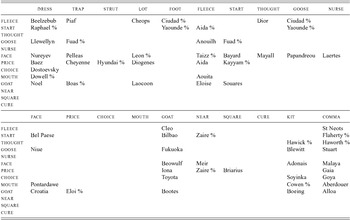
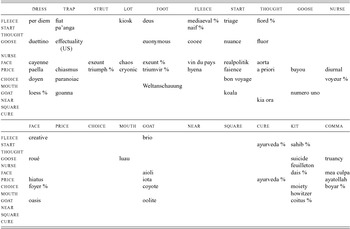
1 Introduction
This article presents a description of the phonotactic patterns of English as shown in a single database. Gimson (Reference Gimson and Cruttenden2001 and earlier editions) provides an excellent first approach to English phonotactics, which has served most researchers well for many years. However, it is not a very sophisticated approach, in that it has, for example, nothing to say about vowels. While the current presentation leaves open some important questions – as will become clear in the course of the exposition – it is hoped that it provides an update on the Gimson material which may be of value to phoneticians, phonologists, morphologists, language historians and language teachers. Other treatments cover different aspects of phonotactics, including Kruisinga (Reference Kruisinga1943) and Dziubalska-Kołaczyk et al. (Reference Dziubalska-Kołaczyk, Zydorowicz and Janowski2013), and many phonologists give a more or less complete discussion of English phonotactics in discussing syllable structure, morpheme structure rules or sonority. The sources of their data are rarely explicit, and statements on what is not possible are often of dubious validity.
A brief introductory comment is required on notation. Apart from the usual transcription symbols, I use the names of the lexical sets from Wells (Reference Wells1982) (so the dress vowel is the same as /e/ in the system used here), C to stand for any consonant, V to stand for any vowel, X to stand for any random string of sounds, including no sound at all, and # to indicate a word-boundary. Following IPA practice, a syllable division is indicated by a full stop/period where required. I use the percentage sign (%) to indicate a pronunciation where my source (see below) gives more than one variant. The source does not generally indicate how frequent the variants are, so this should not be read as suggesting either a majority form or a minority form. The alternative(s) may, of course, not show the feature being discussed.
The examples used for this study are taken largely from Jones (Reference Jones, Roach, Hartman and Setter2003), and even more specifically from the searchable CD version (henceforth EPD). There was a conscious decision not to use Wells (Reference Wells2008) because of its syllabification, and EPD is then not only the most recently up-dated pronouncing dictionary, but also the only one with a CD.
The value of having a dictionary as a database is great: coverage is extensive (it can never be exhaustive) and not restricted by the vagaries of the topics covered in a corpus, the material has not been prepared with the study of phonotactics to the fore and so is independent of the problems it is being used to solve, and the transcriptions are independent of the scholar who is examining the question of phonotactic structure. Nevertheless, dealing with a database like this does have some drawbacks.
Some care is required with this database, since the search engine is not as useful as it might be. Not only does it treat both face + comma and dress + near (an impossible sequence, as it happens) as the same sequence of three symbols ([eɪə]), it also fails to allow the use of syllable boundaries in a search string (even though they are marked). The main problem, though, is that the search engine has difficulty in interpreting those places where the authors have left some partially transcribed sequence as an alternative or as an addition to some other transcribed sequence. For example, the word defibrillation comes up as having a geminate /bb/ in its structure, which is not, in fact, intended, and all twenty hits for /ff/ are erroneous. There are also significant numbers of typographical errors, especially with final /s/ for /z/ (see e.g. sv subtotal, where the plural is marked with an /s/, or search for final /ŋs/, which is said to be found in helpings). Nevertheless, in general terms, the information provided by EPD was taken at face value. This means, for instance, that I do not query the validity of the transcriptions provided of individual words except where there seems to be some inconsistency involved.
This has two very important implications. The first is the variety of English transcribed. The editors of EPD reject the term ‘R[eceived] P[rounciation]’ in favour of ‘BBC English’. Whichever label is used, what is referred to is a non-localizable accent of England (and, to some extent, Scotland), and even of some of the Commonwealth countries. I retain the old label ‘RP’ here, because ‘BBC English’ seems to me to give too much focus to the broadcast nature of the accent, and RP is no longer ubiquitous in broadcasting.
The second point is that I accept the syllabification given by EPD. Any syllabification of English is controversial, but that in EPD seems to me to be less controversial than that used by Wells (Reference Wells2008). Having said that, both these sources agree that elements of morphological compounds like houseboat appear in separate syllables (and, although EPD does not specifically mention this, the same is true for many prefixes), both reject ambisyllabicity and, within their constraints, maximize onsets. Wells, though, does not demand that a stressed short vowel should have a coda consonant within the same syllable, allows /tr/ as a coda cluster, and maximizes stressed syllables (Wells Reference Wells2008: xxvii). While these points are well justified (see also Wells Reference Wells and Ramsaran1990), it is my judgement that they make his syllabification more controversial. From time to time, this has implications for the analysis, but it is important that I should not provide my own syllabification in order to avoid prejudging the outcome. Where readers prefer alternative strategies of syllabification from those used in EPD, they may find that they accept different solutions to those I present.
Where morphology is concerned, what is important for this article is the notion of morpheme boundary (and hence, indirectly, the notion of morpheme or morph). While there are cases where the borderline between morphs may be in dispute, such examples are largely irrelevant for present purposes. There are instances, though, where the degree of morphological analysability of a word may be in question, and such words are specifically mentioned.
There are many questions of a theoretical nature that arise from the data I present here. In general terms I ignore these. Not only would they make this article far too long, but it is also the case that I see my role here as providing better data for theoreticians to work with, rather than providing a theoretical interpretation of my own. Even the presentation of data is controversial (since we can argue about the limits of good data); interpretations would be much more so.
2 Some preliminaries
Any attempt to look at phonotactic patterns immediately raises a number of fundamental issues. In this section I consider some of these, and, where possible, justify a stance.
2.1 Cluster and sequence
Following Abercrombie (Reference Abercrombie1967: 76) and other authors (e.g. Giegerich Reference Giegerich1992 and Kenstowicz Reference Kenstowicz1994 who specifically comment on the syllable as the ideal domain for phonotactic statements, and Ashby & Maidment Reference Ashby and Maidment2005: 146), I distinguish between a consonant cluster and a consonant sequence. A consonant cluster is found within the confines of a syllable, while a consonant sequence may go beyond the confines of the syllable. Thus in sphere there is a /sf/ cluster, but in dysfunctional, the sequence /sf/ is not cluster because the source shows the two consonants to be divided by a syllable boundary. In general terms, I am interested here in consonant clusters – which is why the syllabification given by the source is so important. Clusters are more constrained than sequences, even if sequences are restricted to those found within the word (assuming some suitable definition of ‘word’). This means that any study of consonant sequences must contain at least all of the consonant clusters, and expand from there, which makes clusters the most restrictive set, and thus, to my mind, the most interesting. This also means, though, that I am rather inconsistent in my treatment of consonants and my treatment of vowels. Vowel clusters in English are involved only in the creation of diphthongs and triphthongs; by definition, other groups of vowels are found over syllable boundaries, and are thus sequences. By treating all vowels as unitary (see section 2.5), I exclude diphthongs and triphthongs from my study, and thus deal with sequences of vowels, but clusters of consonants.
2.2 Native and loan
From a phonotactic point of view, native words do not behave in precisely the same way as non-native words do. There are very few words in English that begin with #/sf/. Examples are sphere, sphincter, sphinx all borrowed, originally if not directly, from Greek. If there are words in English that begin with #/dv/ they are the name of the composer Dvorak, and the Sanskrit loan dvandva. Words with final /ʒ/#, such as beige, garage (%), liege (%) are direct borrowings from French. Clearly, the phonotactics of loan words does not necessarily match the phonotactics of native words, although in many instances a loan word is forced into an English pattern. For example, the name of the country Sri Lanka is usually in my experience pronounced in English with an initial #/∫/ despite the spelling.
The difficulty is in deciding what is native and what is foreign. The word milked is a perfectly ordinary native word, but the final cluster /lkt/# occurs with no morpheme boundary before the final /t/ only in the word mulct, which is originally Latin. Is mulct sufficiently nativized to count as native for phonotactic purposes or not? Such questions must remain rhetorical, because any answer to them requires taking a stance on some other factors. All that can be done is to take care to indicate where words which illustrate a particular pattern are clearly or probably non-native in origin, and also to be aware of the variation in pronunciation of words like tsunami, which sometimes fit (/suːnɑːmi/) and sometimes break (/tsuːnɑːmi/) the most general patterns of English phonotactics.
In principle, it is possible to find some kind of independent measure of foreignness which might solve this problem, and allow a non-circular definition of ‘native’. It has been suggested to me that lexical strata might allow this. However, not only would I dispute the notion that lexical strata give a consistent and coherent view of the distinction (see Bauer et al. Reference Bauer, Lieber and Plag2013: esp. chapter 27), but lexical strata generally categorize affixes rather than bases, and the distinction would have to apply to both to be valuable for phonotactic purposes.
2.3 Speech style
It is one of the commonplace observations about English phonotactics (e.g. Gimson Reference Gimson and Cruttenden2001: 243; Roach Reference Roach2000: 71) that the maximum final consonant cluster length is four, as illustrated by the words sixths, pronounced /sɪksθs/. However, for many speakers, including the author, a particularly clear pronunciation may actually contain five consonants in the final cluster, /sɪkstθs/, while in less pedantic speech, for most speakers, many of the consonants are omitted, and we find [sɪksː] or even /sɪks/, indistinguishable from six. What style should be used as a basis for statements about phonotactics?
One of the factors to be taken into account here is that in less explicit styles, there may be an indefinite number of extra sound types which cannot be known a priori. Consider, for instance, Brown's (Reference Brown1977) transcription of a British newsreader's pronunciation of the word because (in unstressed position) as [pxǝz]. In one sense, English does not ‘have’ a voiceless velar fricative; yet such a segment can occur when articulatory gestures are not carefully completed. Similarly, there is no real contrast in English between [sp=ɔːt] ‘sport’ and [sphɔːt] ‘support’, because the aspirated plosive in the second example arises because of the deletion of a vowel before the plosive, so that the /s/ and /p/ do not form – at some level of analysis – a cluster at all. Pronunciations like [pxǝz] and [sphɔːt] can be predicted by general principles from the more formal or careful pronunciation. The same is true of labio-dental plosives, and a host of other forms which, in the structuralist tradition, are termed allophonic or free variants, or diaphones (Jones Reference Jones1960: 53–4). Another way of looking at this is to ask about the level of analysis at which phonotactic generalizations are assumed to be valid. The string [pxəz] is a superficial, phonetic level rather than a phonemic or underlying level. Presumably, there is a phonotactics of phonetic segments as well as a phonotactics of more abstract entities, and the question is where the possible, interesting or most valuable generalizations can be made. Fudge (Reference Fudge1969) discusses phonotactics of systematic phonemes, and Kruisinga (Reference Kruisinga1943) makes some reference to phonotactics of allophones.
Accordingly, the style (or level of representation) that is used as a basis for discussion here is a careful but not pedantic style, which might occur in natural speech in formal but un-self-conscious production. This is fundamentally the style that all commentators have described, and is the style which is transcribed in pronunciation dictionaries including EPD. Ashby & Ashby (Reference Ashby, Ashby and Ramsaran1990: 176) call this ‘orthoepistic style’. It is not enough to term it a ‘phonemic level’, since phonemes can be used to describe various styles of elision and assimilation. Scholars often provide no overt comment about what might happen in other styles (though see McMahon Reference McMahon2002: 129 for a brief comment, and Algeo Reference Algeo1975 for a deeper investigation of one aspect), despite the importance of this topic for a study of phonotactics.
2.4 Variation
Even within the kind of style that has been described above, there is a certain amount of variation in pronunciation. Some of this is dialectal, and it is easy to dismiss a great deal, if not all, of this variation as dialectal in a wide sense (i.e. including social, gender and age dialects as well as regional ones). The homogeneity myth, though, is potentially dangerous. Among other things, it may mask change in progress. But even where we have no particular reason to suspect change in progress, as with word-final /ŋ/, the variation between [ŋ] and [n] at the end of a word like hunting contrasted with the variation between [ŋ] and [ŋk] in words like something, anything, shows important lexically defined areas of pronunciation variation. Where phonotactics is concerned, gemination over morpheme boundaries in words like seal-less, soul-less may be variable, and this means that the bi-morphemic nature of the words in which it occurs is only variably overtly signalled.
One major problem for the phonotactics of English tied up with variation is the question of epenthetic stops in words like dance, length and the variable assimilated pronunciation of twopence as /tʌpəms/ varying with /tʌpms/. In each of these instances, and the hundreds that are like dance, we have two options: /dɑːns/ and /dɑːnts/, /leŋθ/ and /leŋkθ/, /tʌpəms/ and /tʌpəmps/. EPD simply shows the stop as optional, and searches of the database find a word like length illustrating either /ŋkθ/# or /ŋθ/#. In my experience, which is not, it must be admitted, largely of speakers of Received Pronunciation, most younger speakers include the /t/ and cannot without training produce a word like prince so that it is not homophonous with prints. The length case is rather more complex, not least because there is also an alternative assimilated form, [len θ], which may be a feature of some regional dialects. The tuppence case usually occurs word-internally, in a name like Gimson, for instance, and the /p/ is usually pronounced – perhaps by analogy with words like attempt and glimpse where there is an orthographic <p> to support the [p]. Both varieties of these strings will be found at different points in the transcriptions here, on the basis that both varieties provide strings which form part of the phonotactics of English. It would, however, be reasonable to exclude one of each of these pairs of possibilities.
Another similarly problematical area is what to do with words like amidst, breadth, svelte, Svengali, width. In each of these cases the orthography supports the notion that there is a cluster of a voiced obstruent with a voiceless obstruent within the syllable, something which is usually seen as contravening one principle of English phonotactics.Footnote 2 In all such instances there is an alternative pronunciation with only voiceless obstruents (although this alternative is not always listed in EPD). Gimson (Reference Gimson and Cruttenden2001) overtly takes the voiceless sequences as the default pronunciation, and ignores the version with mixed voicing (at least in coda-position). EPD lists both options with the all-voiceless option first in most, but not all cases (in hundredth, the /dθ/ pronunciation appears to be given precedence). In svarabhakti and Sverdlovsk no /sf/ option is listed, though it is for svelte and Svengali. Pronunciations with mixed voicing are certainly found, probably supported by the spelling (and, where relevant, the morphology). I have included all of these here, on the same principle as was given above for the /ns/ and /nts/ variants.
2.5 The elements
Phonotactic statements depend crucially on the elements that are assumed to be in syntagmatic relationship with each other. The consonant /j/ is generally assumed to have a very limited distribution by most transcribers, never occurring word-finally, or closer to the nucleus than a liquid or an obstruent. However, in the Trager-Smith transcription system (Trager & Smith Reference Trager and Smith1956), where the face vowel is transcribed /ej/,Footnote 3 /j/ no longer has the same limits on its distribution. Words like stay, stale, staid show strings of /j/#, /jl/# and /jd/# respectively.
There are four places where there are particular questions to answer, each of which will be discussed below: the transcription of long vowels and diphthongs, the nucleus in a word like cute, the initial consonants in words like spill, still, skill and the analysis of the affricates. Most other questions of the phonemic structure of English are generally agreed and have no particular relevance for phonotactic statements.
There is a firmly established view of diphthongs in English that they should be transcribed with a string of vowel symbols, so that face is transcribed /eɪ/ (this is the case in virtually all British textbooks, dictionaries and pronunciation dictionaries). In systems which take this approach, long vowels such as fleece are generally marked with a length mark, or else the length is taken as being predictable from the quality of the vowel (see, e.g., the transcription systems in Giegerich Reference Giegerich1992 and McMahon Reference McMahon2002). The Trager-Smith tradition uses /j/ and /w/ as the end points of diphthongs (and long vowels – goose is transcribed as /uw/), and one of the arguments in favour of this approach is precisely that it increases the regularity of phonotactic statements. Trager & Smith use the notation /ah/ for the palm vowel, since there are no length marks in the system, and none of /r, j, w/ is appropriate. Because I am fundamentally using a British transcription, and the use of the symbol /h/ for vowels palm is phonetically very dubious, I shall use the vocalic symbols here. However, I do not wish to consider /eɪ/ and other diphthongs as clusters of vowels, because then we would find a large number of clusters of /e/ and /ɪ/ (every time face occurs) but no clusters of /e/ and /ʊ/, which might be considered a phenomenon which required explanation. Thus for my purposes here these symbols will be treated as unitary. The transcription symbols do not reflect this unitariness, but will be maintained because of their familiarity and to avoid attempting to set up a pseudo-phonetic set of symbols to replace them. For some discussion and a different conclusion, see Sommerstein (Reference Sommerstein1977: 32–4).
Brown (Reference Brown1977), Giegerich (Reference Giegerich1992: 157–8), Roca & Johnson (Reference Roca and Johnson1999: 277) and, particularly, Davis & Hammond (Reference Davis and Hammond1995) argue that the vowel in a word like cute should be seen as diphthong, so that cute is transcribed /kɪut/. The default view of this, as indicated in the pronunciation dictionaries, for instance, is that the first element here is consonantal /j/. Whatever happens here, there are phonotactic consequences. If we transcribe this element with a vowel symbol, the initial CCC clusters described in most textbooks are made up of /s/ + stop + {l, r, w} (with /j/ missing in the last slot, although it is part of the same class as /w/); it would also turn out that the diphthong /ɪu/ would have a very limited distribution; if we transcribe it with a consonant symbol, onsets whose last element is /j/ occur only before a very small subset of vowels. On the whole, the system which sees cute as being /kjuːt/ seems to make fewer presuppositions, although each has its strengths. This transcription will be used, but the alternative will be borne in mind.
The clusters /sp, st, sk/ provide a number of well-known problems for English phonology.Footnote 4 They are often cited as an example of phonological neutralization, since there is no contrasting */sb/ etc., and the phonetic quality associated with what is transcribed /p/ in such clusters is suitably ambivalent between the qualities associated elsewhere with /p/ and those associated with /b/, being voiceless like /p/ and unaspirated like /b/. Some authorities run into problems because these clusters appear to break the sonority profile of the syllable (e.g. Giegerich Reference Giegerich1992: 137) when they occur in initial position because /s/ is considered more sonorous than /p/ (or the other plosives) and sonority is expected to decrease from the nucleus of the syllable to the periphery. I say ‘appear’, since a less nuanced sonority hierarchy in which all obstruents were attributed the same degree of sonority in English would accommodate such cases easily. In phonotactic terms, /sp, st, sk/ provide a problem since most initial CCC strings in English begin with one of these clusters. If /sp/ were taken to be a single consonant (rather like the affricates, for instance), perhaps transcribed /π/ (and similarly for the other two clustersFootnote 5), then we would gain a generalization that a maximum onset consonant cluster in English has two slots in it (though note the rare /slj/ in words like sleuth added in the discussion in this article, not used by all speakers, but still listed in EPD). Sprang would then be /πræŋ/. Unfortunately, if this monophonemic solution would provide one benefit, it would create other disadvantages. If we consider the final clusters [sp] and [ps], it is the latter which has the potential to upset sonority gradation, and yet it is presumably the former which would have to be associated with the initial cluster. So apse would have to be /æps/, while asp would be /æπ/, and the breach of sonority gradation would remain at the ends of words. Moreover, we would not see any corresponding reduction in the length of possible final clusters. Accordingly, there seems to be little benefit to a monophonemic reanalysis, and the transcriptions /sp, st, sk/ will be retained.
Several contrasting theoretical analyses of such forms have been provided in the literature. Wiese (Reference Wiese1996) terms the corresponding German forms ‘suffricates’, and opts for a monophonemic analysis like the one just rejected above; the facts of German do not precisely match those of English, when it comes to justifying this analysis, though. Kaye (Reference Kaye, Kardela and Szymanek1992) analyzes the /s/ in such forms as the coda in a preceding syllable that has no nucleus, and thus not as part of a cluster at all. Many others, and we can cite Giegerich (Reference Giegerich1992) as representative of them, treat the /s/ as an appendix, prosodically different from the other consonants in the cluster. This plethora of treatments just makes it clear that many theoretical analyses of the same phonetic data are possible, and shows that the analysis with the fewest theoretical presuppositions has benefits in an article like this one.
Finally, there is the question of the status of the affricates. Most analyses of English treat the affricates as monophonemic, contrasting them with a biphonemic sequence in a form like nutshell /nʌt.ʃel/. The case for this is made by, for example, Martinet (Reference Martinet1939), and the case has been made even stronger by subsequent commentators including Vachek (Reference Vachek1973) and Harris (Reference Harris1994). Yet it might appear that it would be more economical in terms of the number of segments (if not in terms of rules) to say that the reason that we get the /ɪz/ allomorph of the plural morpheme on arch is because it ends in a sibilant /ʃ/, rather than having to add an extra two phonemes (/ʧ/ and /ʤ/) to the list of sounds that require this allomorph, and having to allow non-continuant sounds to be classified as sibilant.Footnote 6 Such economy, however, would come at some cost, since there is no other place where English allows initial clusters of plosive + fricative (except for the occasional pronunciation of clusters such as /ts/, /dv/ and /kv/ in loan words). There are, it is true, phonotactic problems with the affricates: why do they not allow following /l, r, j, w/ in initial position as the other plosives do? But it seems better to face such problems than to create further problems in trying to solve them. The affricates, like the diphthongs, will here be seen as unitary, as, indeed, is generally the case.
It should be noted that the alternative (and here discarded) analyses are motivated by appeal to phonotactic structure. To adopt them in an article on phonotactic structure would therefore run the risk of circularity of argument. This is perhaps the best argument for discarding these alternatives for the basic analysis, even if I shall refer to these analyses from time to time where they are relevant.
3 VC sequences
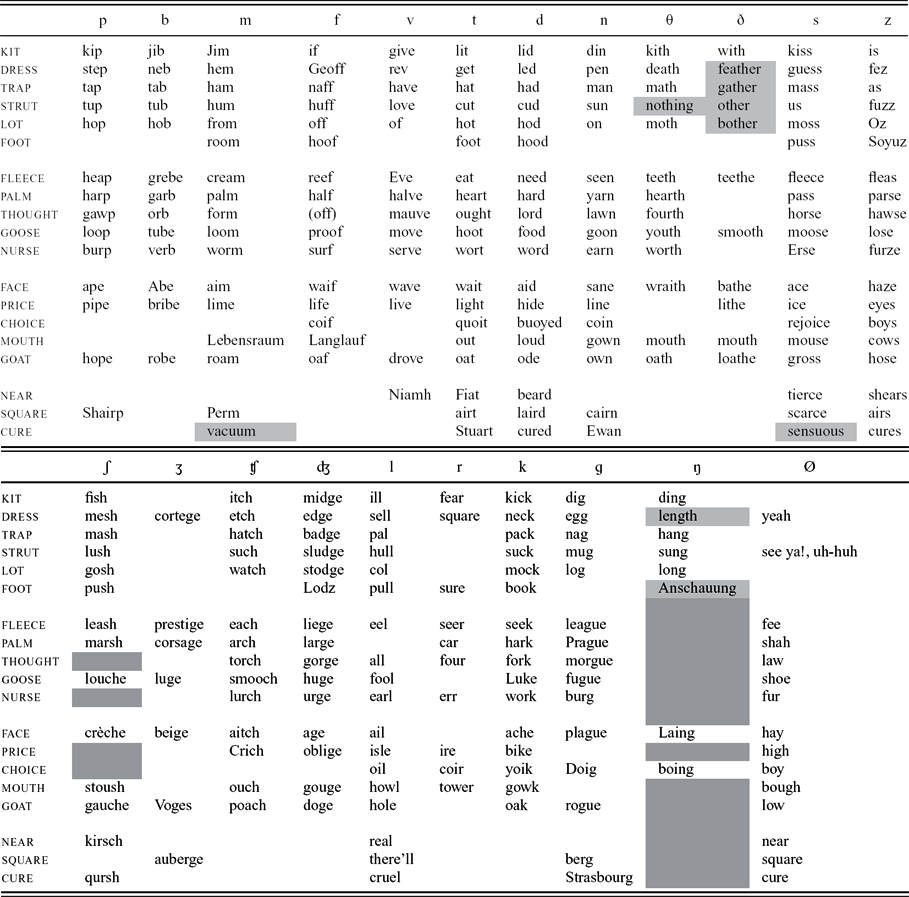
Most vowels can be immediately followed by most consonants, except where there is some general systematic rule against it, such as the lack of final /h/. This is illustrated in table 1, where lightly shaded cells indicate that there is some factor which makes the included example at that point slightly odd – the presence of an extra consonant, an extra syllable or stress on a different syllable, for example.
Vowels with following consonants

The words in table 1 are not necessarily from EPD, and even those that are may have alternative pronunciations in EPD. Vowels with following /r/ in the same syllable are not found in RP, but in rhotic varieties such as standard varieties of North American English. If more rhotic varieties were considered, it would be possible to find a greater range of vowels before /r/: for example, four may be /fəʊr/ in varieties not covered by EPD, but captured by Kenyon & Knott (Reference Kenyon and Knott1953). In general, EPD does not distinguish the north and force lexical sets, and this distinction is not reflected in the table. Consonants following near, square and cure are a subset of those that, in an earlier stage of the language, could have appeared as the final consonant in an /rC/ cluster.
Some of the gaps in the combinations of vowel and consonant have sometimes been pointed out as significant. Most of these generalizations do not hold, or hold only with reservations. Shaded but empty cells show some of the gaps which may be significant. Other gaps are assumed to be accidental (for instance, due to the rarity of certain consonants or vowels).
The mouth vowel is often said (e.g. Spencer Reference Spencer1996: 87) to be followed only by coronal consonants, but is illustrated followed by labials in German loans and by /k/ in the word gowk ‘cuckoo’, a Scottish and dialectal form. Increasingly, young New Zealanders report that they have mouth before labials in words such as twelve when the /l/ is vocalized. The report is not entirely accurate in that there is a slight phonetic distinction between how and hell, but if speakers cannot hear the difference, it is likely to prove unstable. If this occurs in New Zealand, it may also spread to other varieties with vocalized /l/, including innovative versions of RP. The consonant /ʃ/ is often said (e.g. Iverson & Salmons Reference Iverson and Salmons2005) not to follow long vowels, but is found following fleece; in RP it is also found following start; it has been borrowed following goose in louche and for some speakers following face in crèche (where it varies with dress); as pointed out by Iverson & Salmons, it can occur following long vowels in more onomatopoeic words like sheesh and swoosh; and in New Zealand and Australian English it is found following mouth in the word stoush ‘squabble, fight’, which suggests that the gap here is purely lexical. The short vowels may, despite standard claims to the contrary (e.g. Carr Reference Carr1999: 76), appear with no following consonant, but typically in expressions which, because they are phonologically reduced phrases or interjections, might not be considered ‘real’ words. The author (but not EPD) has a pronunciation of yes as /je/ with final dress (also supported in Upton et al. Reference Upton, Kretzschmar and Konopka2001, where a final /æ/ is noted in the US pronunciation of the same word), and also an interjection of mild disappointment, of the form [ʔɒ]. On the other hand, the EPD reports /te/ as a pronunciation of tay in the tonic sol-fa (something I have not been able to confirm elsewhere). Many Australians and New Zealanders have farewells of the form see you, spot you, catch you, where the final vowel is what they would themselves recognize as a stressed strut vowel, more open and longer than their /ə/. EPD (and also Upton et al. Reference Upton, Kretzschmar and Konopka2001) reports final strut in positive uh-huh. Some speakers for whom the happy vowel overlaps in quality with kit might be said to have final kit, but this is not in stressed syllables. The same is true of final foot, transcribed by EPD as short /u/, which may occur at the end of words like onto, continue.
It is also often claimed that /ŋ/ can only follow a short vowel (see e.g. Harris Reference Harris1994: 86), but it can be found following some diphthongs in some names (e.g. Laing %) and onomatopoeic words (e.g. boing). While it is clearly not true that all interjections have phonotactic structures which reflect the ‘real’ words of the language (after all, English has interjections of the form [| |] and [‖ ‖] even though clicks are not part of the normal phonemic structure of English words), the difficulty with the examples above is that they shade from clear interjections into more lexical types, and that they shade from an orthoepistic style to a style which may show elisions and the like. The examples here require evaluation; while they should not be accepted as evidence on quite the same footing as names or nouns and verbs, neither can they all be dismissed out of hand.
Gimson (Reference Gimson and Cruttenden2001: 240) reports that initial single consonants are fundamentally unrestricted by the vowels to which they attach, and I am not aware of any counterclaim. The only thing that might be worth noting is the lack of voiced fricatives (including here /ʤ/) initially before foot, except in foreign words. This would not happen in varieties of Northern English that have not undergone the foot–strut split. The rarity of initial /ð/ is accounted for by its peculiar grammatical distribution, of initial /ʒ/ by the fact that it occurs only in loans, and the gaps before /ʊə/ arise through the rarity of that vowel. The lack of initial /ŋ/ has a well-known historical explanation.
4 Top and tail
There does not seem to be any general problem with putting the same consonant on either side of a vowel (with clusters where possible), unless there is some wider phonotactic problem, such as the inability for /h/ to occur finally, /ŋ/ to occur initially or, given the transcription system, for /j/ or /w/ to occur finally. The sounds /ð/ and /ʒ/ happen not to occur twice in the same monosyllable, but both are rare. While not all consonants can occur on the two sides of every kind of vowel (short, long, diphthong), most can. There are, of course, many lexical gaps, so that /baɪb/ happens not to be a word of English, but the basic principle seems clear.
Similarly, any vowel (except /ɪə/ and /ʊə/, which are rare) can occur either side of a consonant in a XV1CV1X pattern.
This makes the following set of restrictions all the more exceptional. Where we have a cluster with an initial /s/, there are restrictions on what may come in the coda of the same monosyllabic word. That is, given a syllable of the form sC1VC2, there are restrictions between C1 and C2.Footnote 7
Given an initial /sl/, for example, C2 is never another /l/: /sleɪl/ does not appear to be a possible English form.Footnote 8 Given initial /sm/ or /sn/, C2 is never a nasal. And given /sf/, C2 is never a fricative, although the sample of possible words here is so small that this observation may not mean very much.
With an initial /sk/, C2 may well be a plosive (scope, skit), but is rarely a velar (sole exception: scag, whose status is slightly odd, since it is a recent instance of word-manufacture). Similarly, following /sp/ a bilabial consonant in C2 is dispreferred (sole exception: spam, originally a blend). However, note that labiodental fricatives may occur: spoof, spiv (again, words with unusual etymologies). Given this, we might expect to find similar restrictions after /sw/, but we find both labial and velar consonants in the C2 position: sweep, swab, swim; swig, swing. An initial /st/ does not appear to cause any systematic gaps. It may also be significant that given an initial /sC/, monosyllabic words never end with the same /sC/ cluster, and despite counterexamples like space and slice, any /s/ appears to be dispreferred here.
It should be noted that these restrictions are not found where there is no initial /s/: lull, man, name, face, king, gawk. Why the restrictions should arise only with /sC/ is obscure. There is no reason to believe that the Obligatory Contour Principle is in operation (pace Pierrehumbert Reference Pierrehumbert and Keating1994: 186 and references there) (a) because that would require evidence that the consonants were on one tier and the vowels on another and (b) because the restrictions disappear in the absence of the /s/.
This, of course, raises the question as to whether similar restrictions are found with other two-consonant onsets. None of /pl, bl, kl, ɡl/ permit a coda-/l/ in a monosyllabic word, though /fl/ permits final /l/ in flail. Neither /fr/ nor /ʃr/ allow a coda /r/ (in rhotic varieties) in a monosyllabic word. However, all of /pr, br, tr, dr, kr, ɡr/ allow coda /r/, though not in high-frequency words: prayer, br'er, Trier, drawer and drear, crore, Greer. Clearly, there is no overarching constraint in place here, but neither is choice completely free for all of these clusters.
Not only do three-consonant clusters in general not allow their third consonant to appear in a coda of a monosyllabic word (that is, there are no words of the form /*splVl/ and so on), if we reinterpret long vowels as strings consisting of vowel + approximant (to allow for the possibility of coda /j/ or /w/) the only possibly awkward example we find is squaw (or, similar, squawk). The question is how we should interpret the thought vowel in such a transcription system. The string /ow/ would be the goat vowel, so that thought must simply be /o/, in which case the generalization holds. This might be awkward for anyone who says /θᴐːwɪŋ/ for thawing, but we can leave this aside here.Footnote 9
5 Initial clusters
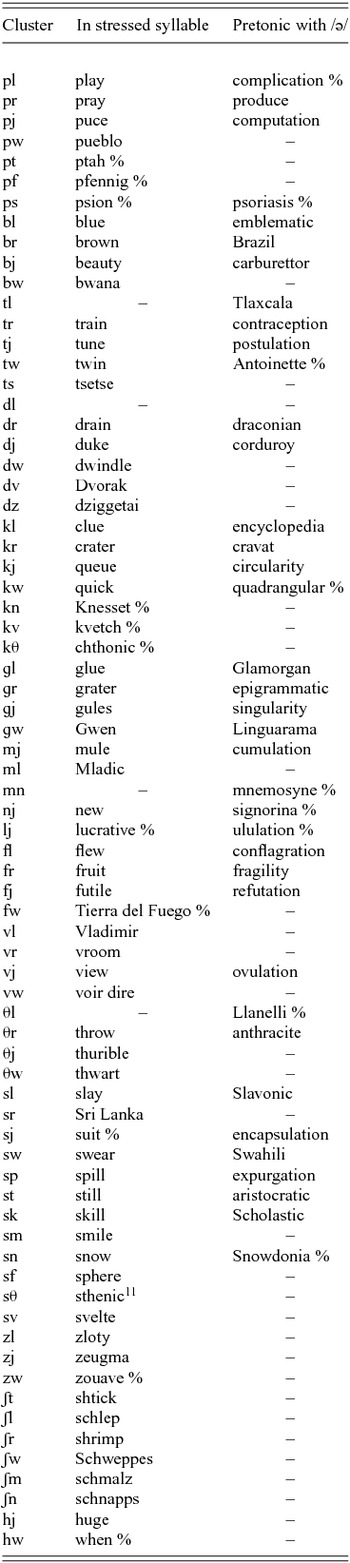
In the tables below, initial clusters from the Gimson (Reference Gimson and Cruttenden2001) list are illustrated (with the addition of a number of others not found in Gimson but used in EPD), and then illustrated in the pretonic syllable with a /ə/ vowel. This environment allowed for easy searching using the EPD search engine. The use of /ə/ guarantees an unstressed syllable (though, of course, in many cases there are alternative pronunciations with full vowels). It should be noted that the lack of a particular cluster from a pretonic syllable does not imply that the relevant string is not found pretonically. For instance, the string /sprə/ is found pretonically in disproportion, but only the /prə/ is marked in EPD as being the pretonic syllable, with the /s/ belonging to the antepretonic. On the other side of the coin, some of the clusters listed, such as /sr/ and /tl/, though given in the EPD, strike this author at least as entirely unlikely from someone who is not at least partly bilingual (or trained). The country name Sri Lanka is typically pronounced with initial /ʃr/ in news broadcasts (except by professional broadcasters on BBC Radio 4), and the website http://ecc.pima.edu/~tourism/TVL104/Mexico/MexicoColonialSouthernCities-Tlaxcala.html (accessed 24 April 2013) gives an English pronunciation of Tlaxcala with initial /təl/.
Note that the methodology used here does not allow any comment on post-tonic unstressed syllables. Not only is it much more difficult to search for them, many of the sequences that precede them are split over syllables in the transcription given by EPD. Thus Edward, according to the EPD, shows only /w/ preceding the /ə/ and not /dw/, since the /d/ is analysed as being in the first syllable. It may well be that some of the gaps in tables 2 and 3 could be filled with evidence from words where the relevant structure occurs in post-tonic positions, but such evidence seems to be more controversial than that I have presented. Of course, there is an alternative view which considers simply consonant sequences (as, for instance, Hammond Reference Hammond1999), and pays no attention to whether they are or are not in the same syllable, and thus clusters in the definition provided above. My method produces a more conservative result. The results that I present here are for clusters found within the same syllable (and, as stated earlier, that is defined by EPD, not by me).
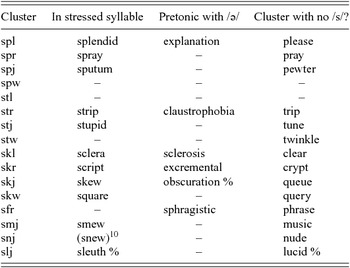
Initial CCC clusters
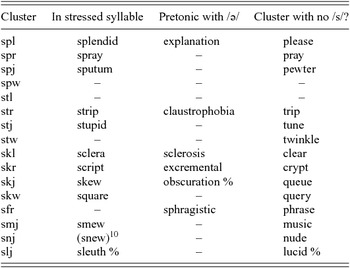
Initial CC clusters

In general terms, the onset clusters found in pre-tonic syllables simply confirm the patterns described by Gimson. The gaps with clusters beginning with /ʃ/ are predictable given that such clusters are all found in loan words, specifically from Yiddish, and since Yiddish has fundamentally initial stress, the number of pretonic syllables in the language is low. Rare clusters and those that are found only in loans or onomatopoeic words are also missing from the onsets to pretonic syllables. However, the foreign onsets reported in EPD do raise questions. The inclusion of the name Mladic is clearly a political decision, but the pronunciation with /ml/ is a linguistic decision. Bdellium and P(h)nom Penh are not cited with initial clusters, but Ptah has a variant with /pt/, and several plosive + fricative clusters are listed. There is a certain amount of inconsistency (which may or may not reflect speaker behaviour). Kvetch has initial /kv/ (with an alternate pronunciation with initial /kəv/) but kvass has no clusterless alternative listed in EPD. Knish is given as having an initial /kn/ cluster by Silverman (Reference Silverman2006: 8) but not by EPD, although Knesset is given an optional initial /kn/. The cluster /sf/ is given as an alternative to /sv/ in svelte and Svengali, but not in svarabhakti or Sverdlovsk.
In table 2 a column is added showing examples of the C2C3 cluster from a C1C2C3 cluster where that occurs. In most instances the lack of a given C1C2C3 cluster corresponds to the lack of the equivalent C2C3 cluster.
Interestingly, EPD also lists /sɡr/ in sgraffito, which is really odd. Given that the /k/ in /skr/ is unaspirated, it is not clear what the difference between /k/ and /ɡ/ would be here; it would seem that only someone with some competence in Italian would be likely to produce the difference.
6 Final clusters
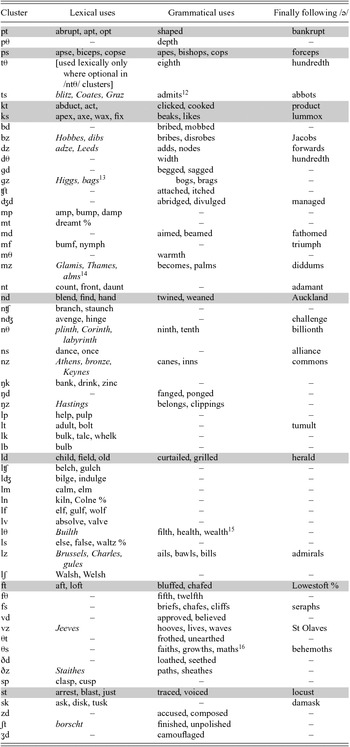
Final two-consonant clusters are set out in detail by Gimson (Reference Gimson and Cruttenden2001: 241–2). What is not clear from the Gimson presentation, however, is the extent to which the clusters are in quasi-complementary distribution as to whether they show grammatical (morphological) information – in that one or more of the consonants represents a morpheme on its own – or whether they are purely lexical clusters. I say ‘quasi’-complementary distribution, because proper nouns and loans may fall on the lexical side even when the cluster is otherwise used, for the most part, to mark grammatical information (shown with italics in table 4). There are also a few clusters which have a dual function (shaded in table 4). Clusters such as the /nt/ in spent are taken here (slightly controversially) to be lexical in that they provide a second stem for the verb (like gave), rather than the /t/ part being an unambiguous past tense or past participle marker. The clusters that I mark as having ‘grammatical usage’ in table 4 are those that Dressler & Dziubalska-Kołaczyk (Reference Dressler and Dziubalska-Kołaczyk2006) term morphotactic clusters (see also Ritt & Kazmierski Reference Ritt and Kazmierski2015).
CC final clusters and their uses

Fewer than 50 per cent of these two-consonant clusters appear to be used in unstressed syllables. Given the algorithm used in EPD for syllabification, most medial sequences are split across syllables and most single consonants are attributed to the following syllable. To check use in unstressed syllables, therefore, these clusters were searched for in word-final position following /ə/. It may be that they arise elsewhere (particularly if they are part of longer consonant strings), but the search engine on the CD of the EPD makes it virtually impossible to search for them. Examples of the clusters following /ə/ are in the final column of table 4: some of these occurrences are alternative pronunciations to variants with a full vowel, but the important thing for present purposes is that they can occur in unstressed syllables. It should be noted that those clusters which have lexical uses when in stressed syllables retain that feature when used in unstressed ones, and similarly for grammatical usage.
Parenthetically, it is not true, as claimed by Spencer (Reference Spencer1996: 87–8), that a long vowel or diphthong cannot occur before a CC-cluster where there is no morpheme boundary between the consonants. Examples which break this postulated constraint include excerpt, corpse, traipse; coax, hoax, luxe; chant, daunt, pint, point; range; somersault %; baulk; child, field, gold, shield; aft, craft; clasp; blast, boost, Christ, foist, waist; ask, basque.
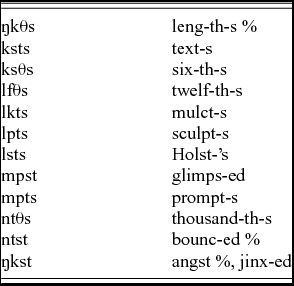
Three-consonant final clusters are said by Gimson (Reference Gimson and Cruttenden2001: 242–3) to be made up of a subset of CC clusters plus one of /t, d, s, z, θ/. The first four of these go onto the lexical clusters given in table 4 as well as onto clusters from the table ending in /θ/. There are no instances of gemination (so, for example, /pt/ cannot take a following /t/) and some gaps, since words ending in /θ/ tend to be nouns, and thus cannot be marked for the past tense with /t/, and words ending in /lb/ are, as it happens, also nouns. Very few three-consonant clusters occur in monomorphemic words, and where this happens, the words are not generally native: attempt, calx, chintz (but bounce %, native), extinct, glimpse (native!), lynx, mulct, sculpt, text (but betwixt, native), waltz (see also Ashby & Ashby Reference Ashby, Ashby and Ramsaran1990). Rhotic varieties can add corpse, excerpt, infarct, Marx, quartz, world.
Oddly, there are some extras: /ŋst/ as in amongst and /dst/ as in amidst. The final cluster /ŋs/ is found only in the word phalanx as an optional pronunciation (/ŋks/ seems more likely). The three-consonant cluster with final /t/ is found in two words, one of which, angst, is a loan. The cluster /dst/ is also found in two words (midst and amidst), where it may be replaced by /tst/. EPD lists both pronunciations, but gives /dst/ first.
Gimson (Reference Gimson and Cruttenden2001: 243) lists very few four-consonant clusters, all of which have at least one morpheme boundary in them. In table 5, which lists some CCCC clusters not included by Gimson (Reference Gimson and Cruttenden2001: 243), morpheme boundaries are shown by hyphens.
CCCC final clusters

7 Native and non-native
While it is the case that some final clusters occur predominantly or exclusively in non-native words, while others occur more frequently in native words, this does not seem to lead to any particularly insightful analysis. There may once have been a tendency for any final cluster which contains a morphological boundary not to occur in monomorphemic native words (for example, /ps/, which can mark plural or third-person singular present tense, occurs in only 7 native morphemes, and some of those (e.g. tuppence as /tᴧpəmps/), are derived by processes of assimilation. However proper names (and I have not here distinguished between native and foreign) provide a bridging category between the morphologically complex and the morphologically simple. EPD gives 16 names ending in /ps/, and 19 loans ending in /ps/. EPD also lists over 700 forms where the /s/ in the /ps/ clusters is a separate morpheme. Where there is no grammatical boundary in the cluster, the cluster is sometimes used more with native and sometimes more with non-native words. Thus /mp/ occurs more often in native than in non-native words, as does /ŋk/, while /ns/, because of the number of Latinate words ending in -ance and -ence, occurs far more often in non-native than in native words. The clusters /ts/ (the most frequent cluster to illustrate a morpheme boundary) does not occur in native words with no morpheme boundary at all. Neither does /kt/. The cluster /pt/ occurs in native words only in irregular past tenses like slept (which is an argument for treating these as morphologically complex, despite what was said above). The clusters /bz/ and /ɡz/ occur once each in words which might be considered to be native and morphologically simple (dibs and bags respectively), though the morphological simplicity of both of these might be in doubt. Neither occurs in loans, but both occur in proper names.
Having said that, drawing the borderline between native and non-native is by no means simple (and the OED is not always helpful, especially with words which might be intended as onomatopoeic or which might be corruptions of similar forms). Words such as brank, fink, jounce, nance, askance, ounce, ponce – to give a very small set of examples – are difficult or impossible to attribute to these categories. And words like act and fact, which are etymologically foreign (hence the comment on /kt/ above), might be considered to have become naturalized by being part of English for so long.
Where initial clusters are concerned, at least /ɡj/, /vj, /zj/, /zw/, /pw/, /pt/, /pf/, /ps/, /bw/, /ɡw/, /dv/, /dz/, /kn/, /kθ/, /kv/, /fw/, /sf/, /sv/, /sr/, /sθ/, /vl/, /vr/, /vw/, /tl/, /ʃl/, /ʃw/, /ʃm/, /ʃn/, /ʃt/, /ml/, /mn/ occur exclusively in loan words, and many of these are correspondingly rare and likely to be replaced by phonotactically more regular alternatives (see section 9 below for frequencies). There are many clusters here not listed by Gimson (Reference Gimson and Cruttenden2001), yet used in EPD. If we ignore these clusters, it means that there is no initial cluster beginning with a voiced fricative (except /vj/) and that /s/ and /ʃ/ are neutralized in the first position of English clusters, that there are no plosive + fricative initial clusters in English, or plosive + stop initial clusters in English, or fricative + fricative initial clusters.Footnote 17 This leads to a more restricted set of patterns. We might argue that these cases show just how vague the cut-off point for non-native clusters in English is. Does discussion of the regime of Josaia Voreqe (Frank) Bainimarama in Fiji, add an initial /mb/ cluster to English (and if so, is it, as the Fijian is, within a single syllable or is it disyllabic, which seems more likely given disyllabic pronunciations of Nkrumah)? Discussion of Al-Quaeda has clearly not introduced a uvular plosive into English, just as the use of Ravenna has introduced neither a tap in word-initial position nor a geminate /nn/. Decisions as to which of these phonological events are part of English are either circular (this is not what English allows, and so it must be non-native) or arbitrary (/vl/ is part of English, but /vw/ is not).
8 Word class
Despite the occasional exception like /lb/# (only in nouns) and /lkt/# (only in verbs, but only one lexical example), there does not seem to be any particular specialization of final clusters for word class. This is perhaps not surprising, given how much conversion there is in English between word classes. A cluster like /ks/# occurs in more nouns than verbs, but does occur with fix and its derivatives, and in verbs created by conversion such as cox and fox. This situation is typical. Since there are more nouns than verbs, we find more final clusters in nouns than in verbs, but the clusters are rarely exclusive to any word class, and when they are, it appears to be an accidental distribution.
9 Frequency
There are marked differences in the frequencies of the various clusters. It might seem that given a facility like the EPD, it would be a simple matter to give a count of lexical frequency of clusters, but there are a large number of problems in doing this. For instance, the status of proper names is awkward, since they clearly have the possibility of adding to the amount of exposure there is to a particular cluster, and yet they do not have the same status as other words. With the final cluster /ld/# with no morpheme boundary between the /l/ and the /d/, over 50 per cent of the items in EPD are proper names. Native and foreign again might be relevant factors to consider. More important, it seems to me, are the number of cases where the same affix or compound element is repeated in a large number of items (for instance, the suffix -esque adds considerably to the number of /sk/# clusters, and the suffix -fold has the same effect on /ld/# clusters). Different spellings of the same word (such as odalisque, odalisk) and single listings for homonyms (such as cricket ‘sport’ or ‘insect’) add to the problems of getting an accurate lexical count.
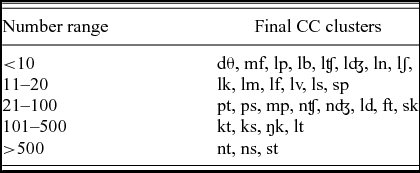
Despite these problems, the range of numbers of attestations in EPD is so wide that it seems worthy of reporting. I have classified non-proper-name items into broad number bands: 10 and under, 20 and under, 21–100, 101–500 and over 500. I have not considered the clusters which are overwhelmingly found with a morpheme boundary between the consonants, and where a cluster has dual use (see above, section 6), I have ignored those instances with a morpheme boundary.
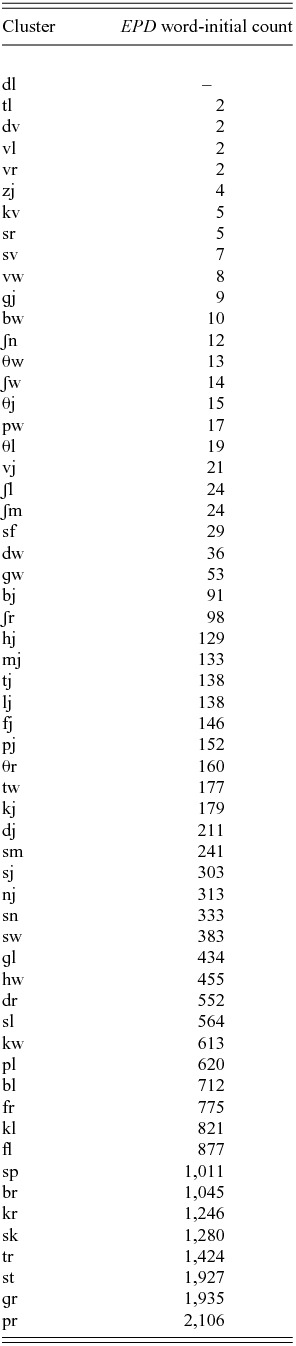
In table 7, I present initial CC clusters in order of frequency, from least frequent to most frequent. These figures are simply the number of hits from the EPD, and ignore the difference between names and other words. This counting system also includes something beginning with, say, #/str/ as beginning with #/st/ (a potentially confusing factor which was avoided in table 6). Because the EPD lists inflected forms and derivatives of headwords on a par, it is not easy to separate the two out, and no attempt has been made to do that here. Some of the lower figures are proportionately inflated by the fact that inflected forms are included. On the other hand, the figures given are simply for the number of times the cluster appears word-initially. If the number of hits for the same cluster at the beginning of a stressed syllable (which is not always word-initial) were added, some of these figures would be considerably increased. Unfortunately, this is not easily done using the EPD’s search engine, since while it is possible to search for stressed syllables, it is not possible to search for initial stressed syllables or non-initial stressed syllables.
Lexical frequency of CC# clusters
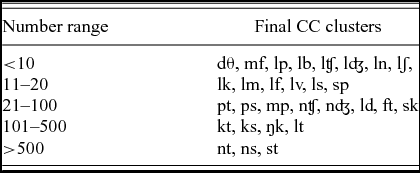
Frequencies of #CC clusters

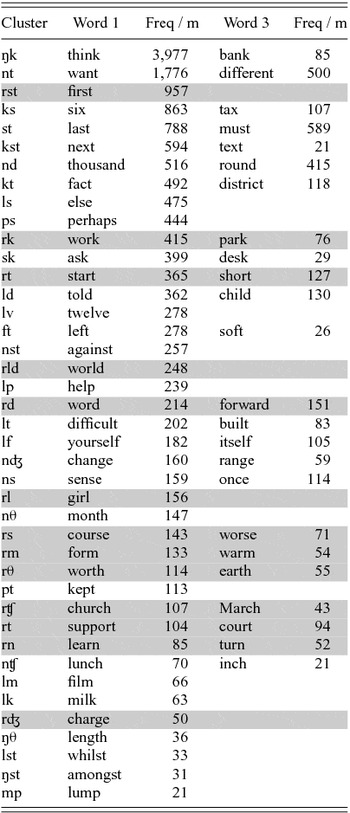
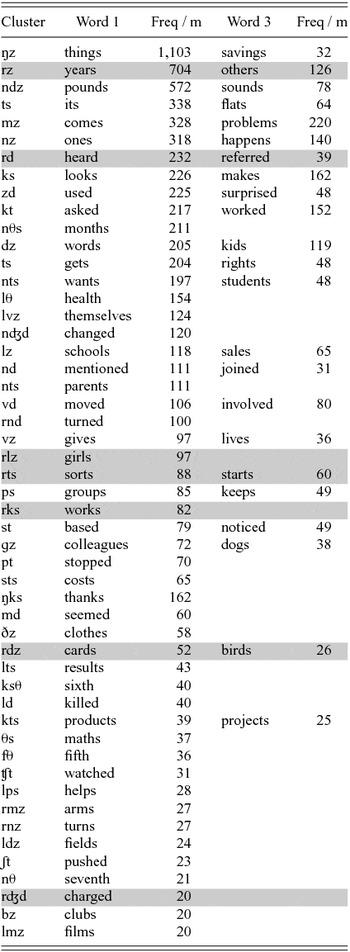
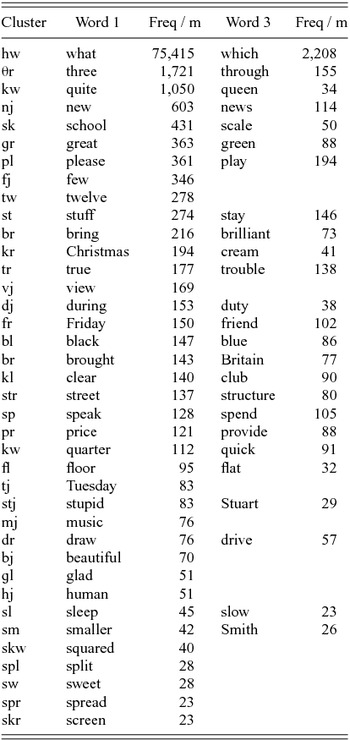
The interpretation of these figures is not necessarily straightforward. Many of the most frequent initial clusters are ones that can occur both in two- and three-consonant clusters, which might, in principle, double their chances of occurrence. The counts are lexical counts, not text counts, so that the figures given here are only an indirect guide to frequency of listener exposure to the different clusters, such as might be useful to those working within exemplar theory (see e.g. Hay Reference Hay2003). However, the rare clusters tend to occur in rare words, which will reduce their text frequency, while the common clusters also occur in common words, so we would expect to see the range of exposure increased in any textual count. It is notable that we do not get fairly uncontroversial non-loans until a frequency of 13 for initial clusters, but it seems a huge step to turn this into some kind of principled cut-off point for viability, genuineness or importance of clusters. Clearly, some clusters are better established in English than others, but the interpretation of that in any theoretical framework requires argumentation. Dziubalska-Kołaczyk et al. (Reference Dziubalska-Kołaczyk, Zydorowicz and Janowski2013) provide a corpus study of sequence frequencies, but do not distinguish between lexical and grammatical (morphotactic, in their terms) sequences, and do not give frequencies for initial clusters. An alternative approach is to consider how frequently the words containing particular clusters are in English. If we use the counts per million words of running text for spoken material in the British National Corpus as provided by Leech et al. (Reference Leech, Rayson and Wilson2001), we find the results shown in tables 8a–c (clusters with post-vocalic /r/ are listed, and shaded in the tables, but a cluster like /rld/ is not also counted as a /ld/, which will boost the counts of some clusters). The frequency per million of the most frequent and (where possible) the third most frequent word to show the cluster are listed.Footnote 18 Words with a frequency of under 20 per million are not considered.
Word-final cluster frequency: lexical
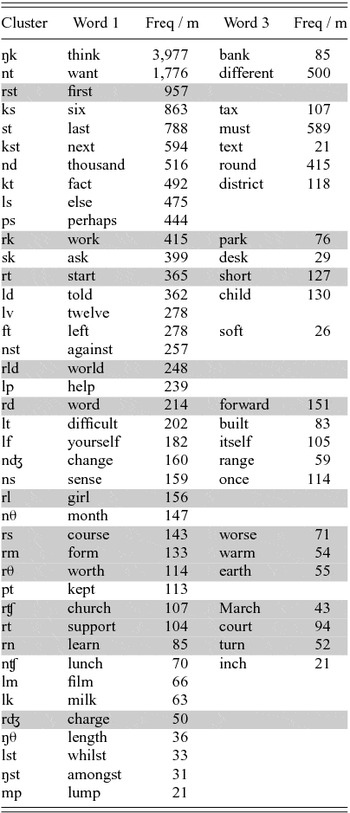
Word-final cluster frequency: including a morpheme boundary

Word-initial clusters

10 Geminates
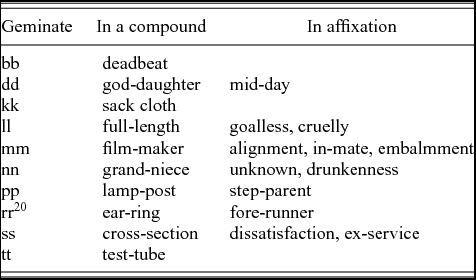
Although most consonants can be found geminated in English, gemination almost always indicates a morphological boundary, even when the gemination arises as the result of elision and/or assimilation. There are very few exceptions, and they are names: Denmark, Sudbury.Footnote 19 Regular examples are listed in table 9, but since compounds are in principle creatable with any words, geminates not illustrated in table 9 can presumably arise in compounds as the need occurs, and can almost certainly arise in syntax (even, perhaps beige jabot to give /ʒʒ/). Note that geminates, even over boundaries, arise only where each of the repetitions of a consonant is supported by its own syllable structure: that is, although we find a suffix -t in height and a suffix -th in warmth, we never find words which end in /tt/ or /θθ/.
Geminate consonants over morphological boundaries
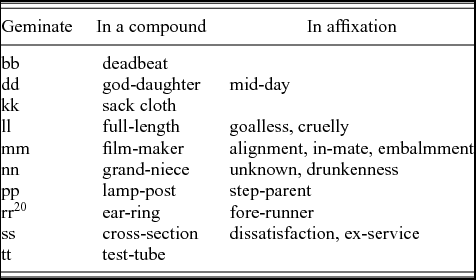
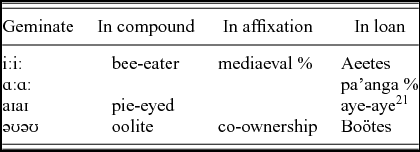
Geminate vowels over morphological boundaries

Geminate vowels are much less common, and some of them are ruled out by principles of the system. Again, they mark morphological boundaries, but vowel geminates can be found in loan words.
Again, it seems that more of these could be created: re-equalize, day-ale, bargee-ese; but even these may feel slightly awkward because of the low level of gemination met in English.
11 Vowel sequences
Vowel final prefixes end in a limited range of segments, when we are talking about the productive variants:
• /ɪ/ anti- (%), ante- (%)
• /ə/: hyper-, mega-, super-
• /iː/: de-, pre-, re-
• /aɪ/: bi-, by-, di-, anti- (%)
• /əʊ/: co-, pro- (and many neoclassical forms which can attach to words, such as neo-, proto-, pseudo, electro-, etc.)
Vowel-initial suffixes are slightly more varied:
• /ɪ/: -ible, -ic, -ify, -ing, -ish, -ism, -ist, -ity, -y (%)
• /e/: -ess, -esque, -ette
• /eɪ/: -ate
• /aɪ/: -ize
• /iː/: -ee, -ese
• /əʊ/: -o, -ose
• /ə/: -able, -er, -ous
There are other, less productive, affixes which have a lesser effect on phonotactic possibilities. Apart from those prefixes that end in /ə/, where an /r/ is invariably present before a vowel-initial base (e.g. superintendent), these give rise to a large number of vowel sequences over morpheme boundaries. We might hypothesize that, given that the morphology is productive here, no vowel would be excluded, provided that the semantics and pragmatics were appropriate. Thus, although I have not found any sequence of palm + price over a boundary, shah-ize might be possible under appropriate circumstances, and would automatically give rise to the missing value. Accordingly, the gaps here have to be seen as accidental gaps in the distribution. This is different from the lack of near, square and cure before another vowel, which is a systematic gap, given that these arise in English by the historical deletion of final /r/, which is not deleted if there is a following vowel. Accordingly, a hypothetical deer-ize would have an /r/ between the elements, and no vocalic hiatus (note that the loan kia ora manages to circumvent this general rule because it has no <r>). There are a few instances which appear to be rather random instances of vowels indicating a morphological boundary, such as whatsoe'er, where the sequence of goat + square has arisen through univerbation rather than through word formation, but in general terms the vowels in hiatus that indicate morphological boundaries do so in a systematic manner given the segments that happen to occur in edge-position in affixes.
In principle, vowel hiatus could also occur at the boundary in compounds. Although it seems that very few such instances are lexicalized enough to feature in EPD, a potential combination such as sea-orgy would give rise to a hiatus. This process must also be entirely free, limited only by the tendency to the insertion of an intrusive /r/ or a linking /j/, /w/ (and in some varieties /l/) in appropriate environments.
Some of the same constraints that apply in cases of affixation also apply to names and loans: nurse, near, square and cure are consistently absent as the first of two vowel phonemes in hiatus; palm and thought are rare, perhaps because in many varieties they are merged with start and force and consequently we usually find a following /r/ in both of these cases. Strut and foot, being historically the same vowel, occur rather rarely. Rather more surprising is the low occurrence of price, choice and mouth. Choice is of low frequency in English as a whole, as is mouth (Davis & Hammond Reference Davis and Hammond1995: 162), but price is noticeably lacking as a second vowel in a hiatus, and mouth is also rare in first position. But there does not appear to be any combination which is excluded in principle. Vowel sequences may not arise in morpheme-internal position in ordinary English words (see some comments immediately below), but there does not appear to be any difficulty in principle with pronouncing them when they are found in names and in loan words.
It seems that, except for names, a vowel hiatus in a native English word always marks a morphemic boundary. There are many loans where the hiatus is morpheme-internal (and also instances where the vowel hiatus marks a morphemic boundary within a loan word), and some of those loans are so well established in current English that their foreign status may have been compromised. Common or old loans include poet, druid, fluid, real% and idea%. An interesting case is that of prowess, where there is no modern morphological boundary, but the hiatus still marks a historical boundary. Miaow (variously spelt), which might be thought to be purely onomatopoeic, is first attested in English in the early seventeenth century, apparently taken from French (OED), though it now also appears in Dutch and German (and respelt in Danish). The vast majority of the names which contain a vocalic hiatus are also borrowed, so that we can summarize the basic situation by saying that a vowel hiatus in English either indicates a morphological boundary or indicates non-native status. Examples are provided in tables 11–13.
Vowel sequences indicating morphological boundaries

Vowel sequences in proper names

Vowel sequences in loans

12 Variation once more
The discussion above has largely been couched in terms of British RP (the primary variety transcribed by EPD), with some acknowledgement of rhotic varieties, especially North American rhotic varieties. The transcriptions in EPD are for fairly conservative varieties of English. However, if we look at English more widely, there are places where the phonotactic system of English has been changed or is being changed, and these have implications for what is or is not possible ‘in English’.
In Australian and New Zealand Englishes, clusters like /ʃj/ and /ʒj/ occur, variably, in words like assume and presume. There are four variant pronunciations for these words in these varieties: one with /s/, /z/, one with /sj/, /zj/, one with /ʃ/, /ʒ/ and one with /ʃj/ and /ʒj/. The proportion of each is currently in flux, and the eventual outcome is accordingly uncertain. A more general effect of palatalization can be found in initial /stj/ clusters, which are becoming /ʃtj/ or /ʃʧ/ clusters in words like student. My own observation tells me that this is also happening in some varieties of Scottish English and of the English in England.
In some varieties of English, and New Zealand is again one, /tr/ is being replaced by /ʧr/, thus filling one of the unexpected gaps in the system as it has been presented above, but creating another. The /str/ cluster in words like strong is being replaced (in some New Zealand, Australian and US varieties of English) with /ʃtr/ or /ʃʧr/. There is, as yet, little parallel development in /spr/ or /skr/ clusters.
What Wells (Reference Wells1982) calls ‘yod-dropping’ (the loss of /j/ following coronal consonants) is leading to either the loss of the diphthong /ɪu/ or the loss of generalization about #CCC clusters (depending upon one's theoretical point of view – see above). Some sequences of /tj/ and /dj/ have already become /ʧ/ and /ʤ/ respectively in many British accents (so that due and Jew become homophones – even EPD acknowledges this change), and they have already been removed from the potential domain of yod-loss. For most speakers of English it is already the case that /lj/ and /sj/ have virtually vanished (which may be why the cluster #/slj/ has not been commented upon in the wider literature), although they have done so within living memory.
The loss of the #/hw/ cluster is well advanced in most English-speaking areas, and it is showing signs of weakness in (at least urban varieties in) Scotland (Douglas Reference Douglas, Kachru, Kachru and Nelson2006: 49). The retention of #/hj/ under these circumstances is striking.
The vocalization of /l/ in Australian, New Zealand and southern English varieties is giving rise to a whole new set of diphthongs (and in some cases, vowel mergers). New contrastive elements of this type are likely to have a rather limited distribution, but will probably not upset the overall pattern of vowel phonotactics.
The number of varieties in which the happy vowel can be equated with the kit vowel seems to be falling, and although EPD transcribes the happy vowel as distinct from both kit and fleece, for some speakers it is clear that the vowel is to be equated with fleece. This is unlikely to have any great effect on phonotactics, since the kit vowel will remain where two consonants follow.
If Sell's (Reference Sell, Migge and Chiosáin2012) finding that vowel epenthesis is becoming less common in words like film in Galway English can be generalized to Irish English as a whole, then we may see Irish English becoming phonotactically more like Received Pronunciation. However, it seems likely that among the New(er) Englishes consonant clusters will be simplified – either by vowel epenthesis or by elision – where the substrate language does not allow complex clusters.
These examples indicate – if the demonstration is needed – that the phonotactics of RP is not necessarily the same as the phonotactics of other varieties, and that there can be no overall ‘English’ phonotactics. It might be possible to separate out more central phonotactic statements and more peripheral ones, but it is not clear what the value of this would be. The examples here also indicate that the phonotactics of different varieties of English is, as one might expect, always changing, so that we cannot necessarily assume that generalizations which hold today will continue to hold. Interestingly, this is sometimes a matter of global politics. The inclusion of the name Mladic in EPD has already been commented upon: if the port of Gdansk became a centre of international attention, would a new cluster be added to English (at least for some speakers)? In my experience (but pace EPD, for Myanmar) the words Hyundai and Myanmar are rarely pronounced with initial clusters by English speakers, but that may partly be a problem with English orthography rather than a problem with adding new clusters. So there are external factors which affect phonotactics as well as the internal factors of assimilation, elision and the like.
13 Conclusion
In this article I have listed some clusters which have not previously been noted as clusters of English, debunked several widely cited ‘truths’ about English consonantal phonotactics, and provided a brief introduction to the phonotactics of vowels in English. The phonotactic status of proper names, often containing clusters which are largely restricted to occurring over morpheme boundaries, and the difference between initial and final clusters in signalling degrees of foreign-ness are both results which arise from a consideration of the data. The use of vowel sequences to signal foreign-ness is not unexpected, and the coincidence of vowel hiatus with morphological boundaries outside foreign vocabulary is an important matter for morphotactics. Further research would be required into the lexical frequency (and perhaps also text frequency) of the various clusters of English and into the actual phonetic use of cluster-simplifying phonetic rules of connected speech, and the potential of cluster complication by resyllabification. I have not considered the question of sequences of consonants which may occur over syllable boundaries (or possibly over morpheme boundaries), as the whole question of syllabification in English is extremely vexed (but see Harris Reference Harris1994: 66, 175 and Hammond Reference Hammond1999 for some observations). The link between phonotactic statements and syllabification strategies is perhaps the most difficult but most necessary future research strategy to emerge from this study.
There is a view of phonotactics as providing a grammar of segment sequences, such that sequences not permitted by the ‘rules’ are not possible in the language concerned, and are eliminated in the production of, for example, foreign words, or not permitted in the formation of, for instance, acronyms or neologisms (Abercrombie Reference Abercrombie1967: 76, citing Firth). Such a view is clearly an oversimplification, in the light of the data from EPD. Foreign words are adopted despite apparently illegal phonotactics, but not without limits. Spencer (Reference Spencer1996: 85) proposes weak and strong phonotactic constraints. But it would appear that there is a cline of strength in phonotactic constraints: even Chomsky & Halle (Reference Chomsky and Halle1968: 416–17) allow for ‘degrees of admissibility’ (see Gorman Reference Gorman2013: 15–17 for a useful summary). For example, in general it seems that English does not permit onset clusters of stops: native words do not begin with /bd/, /pt/, /bm/, /mn/ and so on. However, the data from EPD allows individual exceptions with /mn/ and with /pt/ but not with /bd/ or /bm/ (even though this last would fit within the sonority envelope and /kn/ is allowed). We might question how far EPD accurately reflects ‘RP’ or ‘English’ usage, how far the lack of /bm/ indicates anything other than the lack of opportunity to borrow any such word, or to what extent the editors of EPD assume a certain amount of bilingualism among speakers who use particular words. But if we take EPD seriously, we might start to consider the prohibition of /bd/ to be stronger than the prohibition of /pt/, and neither of these to be a strong as the prohibition of /tp/, /db/, which appear to be impossible because of difficulties in articulating and/or perceiving them. Other apparently illegal clusters (such as /ʃl/ and /ɡw/) have been adopted without any apparent problems, yet others (such as /sr/ and /ts/) are avoided rather more regularly, but are still found. Perhaps the time has come to stop seeing all phonotactic constraints as indefeasible constraints, and start seeing some of them as phonetic and phonological structures which speakers prefer to avoid. This opens up the field to questions of relative strength in these constraints, and, more interesting, it seems to me, reasons underlying the preferences speakers show. Perhaps linguistic theorizing is now in a position to adopt such insights and provide a suitable basis for including them in theory and practice, in a way that does not seem to have been easy in the wake of Chomsky & Halle (Reference Chomsky and Halle1968).