“Wherever I go, it is the same to me. I adapt myself; nothing is ever strange.”
—Tórtola Valencia, interview in Woman's Life, June 6, 1908Footnote 1In 1907, the Nicaraguan poet Rubén Darío published the collection El canto errante [The Wandering Song], containing a poem entitled “La bailarina de los pies desnudos” [“The Barefoot Dancer”]. The title leads the reader to anticipate an aesthetic of lightness and simplicity, yet the poem is weighted down by its many cultural references: at least one per line, and barely harmonizing amongst themselves. Its space is heavily perfumed, thickly ornamented, animated by the movements of a dancer who invokes different cultural references and plastic forms with each extended limb, each trembling body part. At first sight sinuously seductive, this central figure unravels into a welter of fragments and contradictions: both animal and divine, eroticized and chaste, a lunar deity (Selene) and a literary character (Anactoria), a “constellation of examples and of objects” (constelada de casos y de cosas) whose body, as the line suggests, barely contains its referential chaos.
The poem has frequently been read as inspired by Tórtola Valencia, the Spanish early modern dancer who generally performed barefoot, and who featured a dance titled “La gitana de los pies desnudos” [The Barefoot Gypsy] in her repertoire.Footnote 2 The fact that she first appeared on stage in 1908 makes this an impossibility, albeit one glossed over by Tórtola herself in her canny self-promotion: she included the designation in her publicity materials, likely devised her “Barefoot Gypsy” dance to play off the poem, and occasionally referred to her unlikely acquaintance with Darío. Yet she did in fact inspire more than two hundred poems by Spanish, Latin American, and even German poets during her lifetime, not to mention harvesting accolades from d'Annunzio and Maeterlinck (Amor y Vázquez 1987; Garland Reference Garland1999b). Tórtola was performing in a historical moment in which dance, on its way to becoming a high art-form, had begun to call forth essays and poems by such writers as Mallarmé, Yeats, and Rilke. Those writings simultaneously veil and unveil the bodies of performers; in the case of the many dancers who left little material record of their performances—still photographs, brief film clips—it is a challenge to try to extricate their bodies from the layers of textuality in which they are swathed. The question is less the obligatory “how can we know the dancer from the dance?” than the only slightly less urgent “how can we know the dancer from the writing?”
Darío's poem may in any case be important insofar as it does not restrict itself to a particular dancer: In its myriad cultural references, it might seem to refer to any number of dancers performing in the early years of the century, from the Hellenic-inflected Isadora Duncan, through the Indian-inspired Ruth St. Denis, to the Orientalist Maud Allan—or to their host of imitators, who performed repertories notable for their cultural eclecticism. Viewed in this light, Darío's poem points not to the uniqueness of any one dancer, but rather to a generalized practice of cultural hybridity in early modern dance. Indeed the very eclecticism of the standard repertoire allowed its practitioners to be measured against one another, as audiences learned to distinguish between them on the basis of their interpretation of various set-pieces in constant circulation: a vision of Salome, a Chopin funeral march, a serpentine dance, a Peer Gynt sequence.
As several critics have noted, Tórtola and her contemporaries formed the first generation of female dancers to attempt to seize full hold of their public image, both on and off stage, aiming to become subjects rather than mere objects of representation (Garland Reference Garland, Kirschner and Domínguez1999a; Manning Reference Manning and Desmond1997). But their drive to produce new images of themselves as solo female performers was fraught with paradoxes. Working independently, with a keen eye on the practices of their rivals, dancers performing in the music-halls of Europe began to circulate a specific repertory of dances, producing a circuit of borrowings and remakes that made it inordinately difficult to escape the circle of imitation. Alongside a quasi-European catalog of Hellenic poses, Spanish dances, and sentimental pieces (such as funeral marches), the repertory featured a broad panoply of non-European dances, including incense rites, Indian Nautch dances, “Oriental,” “Arab,” and occasionally “African” dances, incongruously set to a specific group of baroque, classical, romantic, and contemporary composers: Bach, Haydn, Chopin, Rubinstein, Delibes, Saint Saens, and Debussy. Embedded in a series of music-hall acts (comprising singers, performing animals, circus artists, and short films), the eclectic content of the repertory played to a new mode of consuming the foreign in fragmentary fashion—a mode fostered by world's fairs, museums, department stores, and, of course, variety programs.
Moreover, as this list suggests, dancers frequently found that they could represent themselves with greatest liberty by representing other peoples, whether from an indistinct “Orient” (Desmond Reference Desmond1991; Koritz Reference Koritz1994) or an idealized Greece. Partly as a result of this repertory, music-hall dancers were increasingly branded as being of a determined ethnicity, even if that ethnicity shifted from performance to performance: from St. Denis (née Dennis) through Mlle Roshanara (born under the less melodious name Olive Craddock to British parents stationed in India) to Mata Hari, originally Margarite Zelle, whose ethnic shape-shifting would lead to her execution as a double agent during the war. This proliferation of allegedly foreign bodies points to a newly charged conception of dance in the early 1900s, one shared by popular and elite audiences: that its central role was to provide a bodily image—and simultaneously, a somatic experience—of other cultures, often as part of variety shows that had much in common with world's fairs or amusement parks.Footnote 3 This placed significant pressure on dancers to embody foreign types, sometimes in a succession of performances, sometimes collapsed or confused in their own body, as hinted at by the multiple cultural echoes of Darío's poem.
This article will focus on one of those dancers, Tórtola Valencia, who currently is barely remembered, but who in the 1910s and 1920s was considered one of the outstanding solo dancers of the period.Footnote 4 In her twenty-two year career, from 1908 to her abrupt retirement in 1930, she ceaselessly toured the main theaters of Europe, North America, and Latin America, leaving a wealth of visual and textual responses in her wake; her movements allow us to trace the emergence of distinct local cultures as they project themselves onto her body, almost as if that body were itself a receptive photographic plate. In the places where she performed, poets and painters were routinely encouraged by local governments to produce artworks commemorating her visit in the hope that she would carry them with her for exhibition in other locations, which was in fact often the case. Moreover, Tórtola herself was a collector as well as a dancer, which makes her a crucial figure for thinking about the circulation of culture in the modernist period via artists on tour; what she collected were artifacts, costumes, cultural ideas, and clippings, and through performances that built on those collections, she offered an image of dance's struggle to engage with other contemporary cultures and their prehistories. What we can read through the traces of her moving body, I suggest in what follows, are debates over the role and place of dance in modernist culture, the shifting relation between high and mass culture, the antagonisms of international and various regional cultures, and new forms of accessing and understanding local histories.
“A Well-Known Spanish Dancer Comes to England”
During 1908, the stages of London played host to a striking variety of dance performances. From March onward, Maud Allan presented her Orientalist Vision of Salomé at the Palace Theatre; in July, Isadora Duncan performed her classical Greek dances at the Duke of York Theatre; the Russian dancers Lydia Kyasht and Adolph Bolm appeared at the Empire in August; Loie Fuller's dance troupe was on stage at the Hippodrome in September, followed by the art nouveau dancer and technological pioneer herself at the Palace Theatre in November (Carter Reference Carter2005). That same year also saw the curious double-debut of Tórtola Valencia.
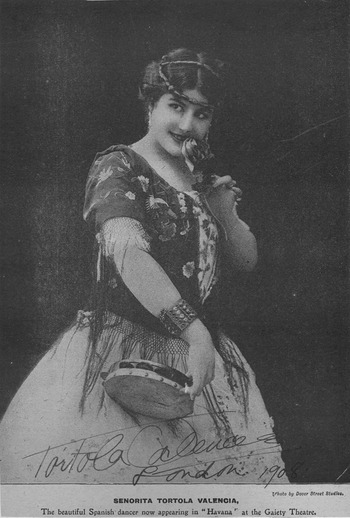
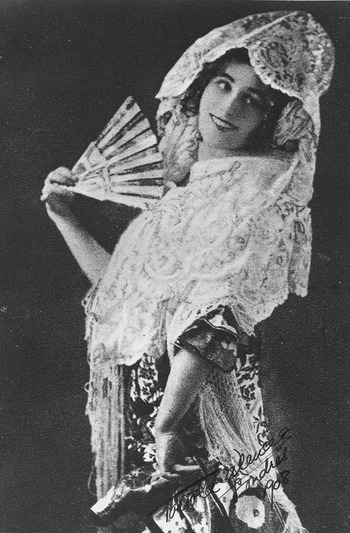
In April 1908, Tórtola was presented to the public as a Spanish dancer in the musical Havana at the Gaiety Theater. Her appearance was carefully stage-managed by the impresario George Edwardes, who released photos and a short narrative of her background to a range of newspapers and fashion magazines: Tatler, The Sketch, The Daily Chronicle, The Daily Mirror. Each one carried a similar story. The notice in The Sketch, for instance, presented her as “the well-known Spanish dancer who is to come to England,” declaring that “She is now one of the most toasted beauties and one of the most admired dancers of Spain, and she has just completed a very successful professional tour of the world” (February 5, 1908). Others took care to assure audiences that Tórtola was well-known in several European courts, and a particular favorite of the king of Spain. The photos accompanying these notices presented a demure Spanish señorita smiling coyly into the camera while clutching a tambourine (Photo 1), or swathed in lace and carrying a fan (Photo 2)—an image later reworked and made famous by the Myrurgia cosmetics line.
Publicity photograph for Tórtola's 1908 debut in Havana. (Courtesy of the MAE-Institut del Teatre, Barcelona.)

Studio photograph, 1908. (Courtesy of the MAE-Institut del Teatre, Barcelona.)

In a context overrun with foreign (or foreign-sounding) dancers and music-hall performers, who in their eclectically exotic repertoires were becoming virtually indistinguishable, Tórtola's image was carefully crafted to emphasize her difference—as a Spanish rather than an American, Russian, or pseudo-Indian dancer. Her photographs, as reviewers noted, carried clear echoes of the popular nineteenth century Spanish dancer Carmencita, made famous by a John Singer Sargent painting of 1890 and an 1894 short film.Footnote 5 Both the campaign and the performance were a success; new images of Tórtola quickly began to circulate in the press, which presented her as a “national beauty,” the epitome of Spanish radiance (Daily Mirror, April 1, 1908).
What is particularly interesting about this public portrait is that Tórtola had to this point never appeared anywhere on stage, and in fact was only nominally Spanish. Very little is known about her childhood, beyond her place and date of birth and parentage: Carmen Tórtola Valencia, born in Seville on June 18, 1882, to Llorenc Tortola Ferrer (from Catalonia) and Georgina Valencia Valenzuela (from Andalusia). Tórtola and her admirers would later draft a sequence of different narratives for her childhood and adolescence, casting her most often as the illegitimate child of a gypsy dancer and either a Spanish aristocrat or a seminarian-turned-Egyptologist; these stories had her learning to dance by (a) watching her mother in the caves of southern Andalusia; (b) practicing secretly in a convent; (c) immersing herself in dance traditions in India; or (d) learning natural responses to music in the kind of school being run by Isadora Duncan in Germany and France in the early years of the century. (An increasingly media-literate performer, Tórtola soon learned that what the press required from her as an “ethnic” dancer was a cannily crafted tale of exoticism and abandonment—ideally, in multiple and conflicting versions—hence her shift from an early reticence to increasingly colorful and unlikely stories about her personal life.) The most plausible version of Tórtola's childhood was tragic enough: She was left, at the age of three, in the care of a still-unidentified English aristocrat in London; her parents departed for Mexico, where they died in obscure circumstances just a few years later. Nothing is known about her education. After the death of her guardian, and Tórtola's rejection of various marriage proposals, his family members apparently severed her from her inheritance, forcing her into one of the only professions open to an unattached young woman: stage performance, in which she would begin by capitalizing on her Spanish appearance.
Once British audiences had been informed that they were watching a Spanish dancer celebrated in the best theaters of Europe, responses to her first stage appearance were uniformly positive—and occasionally a little ambiguous. The Morning Post, for example, stated that “as a Spanish dancer, Señorita Valencia makes good her claim” (April 27, 1908), which seemed to suggest that she was either conforming to type, or doing an excellent impression of it. This ambiguity was in fact inherent in the reception of Spanish dancers in Europe in the early years of the century. Several of the most famous “Spanish” performers of preceding generations had a notoriously tenuous relationship to their supposed country of origin: the ground-breaking Spanish dance “La Cachucha,” first presented in 1836, was performed by the Austrian Fanny Essler; the notorious “Spanish dancer” and courtesan Lola Montes—active on the stages of Europe from 1843—was actually born in Ireland under the name Eliza Gilbert. And by the early years of the twentieth century, the number of “Spanish dancers” had multiplied on European stages to such an extent as to become interchangeable types: Audiences often understandably failed to distinguish between performers with such similar-sounding names as “La Bella Otero” and “La Bella Oterito,” “La Argentina” and “La Argentinita,” even if in reality these pairs often consisted of pioneers and their dubious imitators.
This interchangeability was compounded by the fact that Spanish dancers were expected to perform a series of conventional gestures and folkloric dances: to be a Spanish dancer was thus less a question of nationality or provenance (as in the case of American, English, French, or Russian dancers) than of style. J. E. Crawford Flitch argued in his 1912 book, Modern Dancers and Dancing, that Spanish dancing's repertoire of gestures brought it closest of all modern European modes to the movements of “ancient civilization,” primarily Greek (195); by this surprising logic, it was easier for a Spanish dancer to achieve the aims of Duncan and her followers—an emulation of classical dance modes. But Flitch complicates this negotiation between authenticity (grounded in origin) and performance (a matter of deliberate style) still further. To be a successful Spanish dancer, he contended, the performer not only had to adopt certain poses; rather, in a tautology that he does not probe further, “she must first transform herself into a Spaniard” (196)—a paradoxically conscious assumption of an identity presented elsewhere as innate. Finally, for the illusion to triumph completely, this perception of Spanish personality had to be shared by both performer and audience, in a kind of fictive contract. Flitch might almost be describing Tórtola's English debut.
After Tórtola had been transformed into a plausible Spaniard in London, she embarked on a brief tour of Europe, performing in variety shows in Vienna's Ronacher Theater, Berlin's Wintergarten, and Paris’ Folies Bergère. In each location she was presented as “La bella Valencia,” a celebrated Spanish dancer, appearing on programs that also featured quartets, trapeze artists, jugglers, female cyclists, and short films—like many of her contemporaries, situated on the border between popular entertainment and art (for more on this hinge position, see Carter Reference Carter2005). Just a few months later, in December 1908, she returned to London, to replace the injured Maud Allan at the Palace Theatre. Rather than hailing the return of a recently triumphant Spanish dancer, however, press materials now repackaged her for the British public as a celebrated Algerian dancer performing Moorish dances—a move so successful that reviewers and audiences alike seemed not to notice that this was “positively the same dame.” Tórtola's rebranding was partly of her own making—she had developed her “danse mauresque” while performing in Paris—and it evidently helped to ease the transition from the riotously successful (Canadian) Salome Maud Allan, to a still little-known “Spanish” dancer. But more significant is the fact that the metamorphosis from Spaniard to Algerian clearly did not stretch the bounds of plausibility, with regard to either dance styles or European cultural hierarchies. Both countries were considered sufficiently distinct from Northern Europe to justify their effective severance from it; European intellectuals and artists routinely pushed Spain off the southern edge of the continent in the direction of either North Africa or the Near East, treating it effectively as the “Orient” within (Colmeiro Reference Colmeiro2002). Indeed Flitch's book (Reference Crawford Flitch1912), which divides its study among various national styles (Russian, English, etc.), has no qualms about including a hybrid chapter on “Oriental and Spanish Dancing,” without providing any explicit rationale for their linkage, thereby hinting at the easy collapse of Spanish identity into Oriental fantasy.
Between 1909, when her repertoire featured just two dances, and mid-1911, when it consisted of ten, little is known of Tórtola's actual movements. She would later claim to have spent part of this period studying in India and Egypt, participating in collective and sometimes religious rituals, and developing a sense of the different cultural histories and contemporary practices of dance, complemented by the study of statues, friezes, and pottery in the British Museum and the Louvre, while keeping her image in the public eye through a series of high-profile romances and occasional advertisements (for hats, corsets, etc.). In both the fictions and the facts, Tórtola was emulating Ruth St. Denis, Isadora Duncan, and countless other contemporaries. Inspired by Maurice Emmanuel's 1896 study of ancient Greek dance as represented in vases and sculptures, dancers in the early decades of the century flocked to the halls of Europe's museums—and occasionally to far-flung locales—in search of models at once past and present (Brandstetter Reference Brandstetter1995, 58–117). Whether performing alongside or claiming inspiration by statues, dancers offered the illusion of reanimating the past through an emphatic corporeal presentness; and in their representations of other civilizations, they leapt over a spatial gap frequently conceived of in temporal terms, bringing to life cultures not simply foreign but frozen in an idealized past.
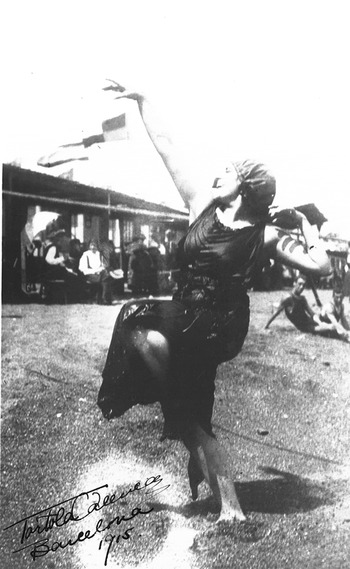
Tórtola stands out among her contemporaries for her peculiar adeptness at manipulating public images of herself. Even before developing a repertory of dances that might lift her out of the lower-tier music-hall circuit, she began to commission studio portraits of herself in various ethnic costumes and attitudes, turning them into “real photo postcards” to be sold to the public, frequently colorizing them by hand—sometimes retouching copies of the same pose in a variety of colors. This attention to scene-setting for her performances would later find a new outlet in increasingly lavish stage sets, and in the oil-paintings of her own dances, which she began to produce in the mid-1910s (exhibited in Montevideo in 1916, and in Barcelona in 1920). Most striking in all these early self-figurations is Tórtola's desire to move beyond her initial appearance as a Spanish dancer, remaking herself as a figure for eclecticism: She aligns herself not only with the “Oriental” dancers proliferating on European stages, but with the Greek-inspired movements of the early modern pioneers. In 1911 she was photographed dancing on a beach at Ostend, clad in a Duncanesque tunic, which caused a splash in magazines across Europe and North America; the copy of Tatler she carries in her hand in these photos—reprinted in Tatler and other publications—intimates that it was not an entirely spontaneous physical display (and one recreated in Barcelona in 1915; see Photo 3).
Striking a Duncanesque pose on the beach at Barcelona, 1915. (Courtesy of the MAE-Institut del Teatre, Barcelona.)

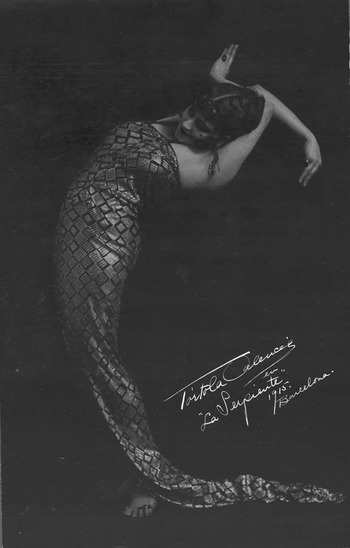
As this suggests, Tórtola was quickly inscripted into the general cycle of dance-borrowing in the period, partly through the influence of Mlle. Roshanara, whose incense dance was remarkably similar to one performed by Ruth St. Denis (Jowitt Reference Jowitt1988, 147). Tórtola choreographed an “Oriental” dance for Roshanara in the play Kismet at the Garrick Theater in June 1911; when the run was over, and Roshanara had been subsumed into the Ballets Russes and Pavlova's entourage, Tórtola not only borrowed her St. Denis-derived incense dance, but also reappropriated the dance from Kismet. That new piece was the “Danza del serpiente” (Snake Dance), and it demonstrates Tórtola's particular talent for self-fashioning. Serpentine dances had been all the rage since Loie Fuller's performances in the 1890s; because of their stunning visuality, they were particularly well-suited to the emergent medium of film, which disseminated them throughout Europe and North America. As Albright (Reference Albright2007) notes, Fuller had been reacting to the prurience of music-hall skirt dancing, whose main point was the peek-a-boo revelation of the body; in her own dance, by contrast, the costume took over from the body, swallowing its contents in unending swirls of movement (15–49). Tórtola, however, brings the focus resolutely back to her own body, wrapped in a skintight dress, which both impedes movement and showcases her stunning flexibility (Photo 4).
“Snake Dance,” studio photograph, 1915. (Courtesy of the MAE-Institut del Teatre, Barcelona.)

She performs her Snake Dance in one of the only films that exists of her dancing—a French melodrama from 1913 titled Coeur de femme, in which two young artists visit the studio of a musician to watch a rehearsal by “La Valencia,” who winds her way around the carpeted space, her upper torso spiraling and twisting and propelling her forward over barely moving feet. Her movements in this sequence are a practical animation of Flitch's (Reference Crawford Flitch1912) observation that “Oriental” dance turns on its own axis, covering a minimal amount of space (190).
The only other full-length dance captured on film is of Tórtola's original Spanish dance La maja, which she performed in the 1914 film La lutte pour la vie.Footnote 6 In this second film, a young man from the provinces happens upon a Spanish dancer's performance on an outdoor stage. For all her confident posturing, as Tórtola whirls her skirts and whips her fan with abandon, she nonetheless seems caught on the spot, still unsure of how to use the space around her beyond minimal sideward movements. It seems peculiarly fitting that these should be the only good surviving records of Tórtola's performances, given their condensation of the hybrid Hispanic-Oriental fantasy that undergirds both her early choreography and its audience reception. And it is striking that in both films, her dancing is presented as a sight to be seen by visitors to Paris, part of a dynamic that placed performing female bodies at the center of new practices of spectatorship in the modern metropolis (Hindson Reference Hindson2007, 19–33).
Strange Homecoming
Once Tórtola had established both a repertoire and a reputation in Northern Europe, the natural next step was a tour of Spain, presented as an extraordinary homecoming. Spanish audiences were curious about this unknown native daughter who had conquered cold British hearts, and were determined to give her a good reception (Hoja de Parra, December 2, 1911). What we find in the main Spanish newspapers after her first performances in Madrid in late 1911, however, are expressions of concern: over her minimal Spanish stiffened by a British accent, but more importantly, over the cultural capacity of Spanish audiences, who were proving notably resistant to her art. Tórtola had chosen to perform in the kind of theater she was accustomed to in Europe—Madrid's Teatro Romea—as part of a variety show; this proved to be a serious miscalculation, as dancers on this theater's program were known for relatively piquant song-and-dance numbers involving conventional Spanish costumes. In this context, Tórtola's repertoire—her Maja and Snake dances, alongside others of Arab, Indian, and Greek inspiration, accompanied by classical European music—was considered excessively high-brow by her working-class audience, who pelted her with insults. The simple solution would have been to change her venue. Spanish intellectuals, however, were keenly aware of Tórtola's success in the music-halls of Northern Europe, and began to ask themselves whether the problem lay in the cultural capacity of the Spanish public per se rather than in a particular stratum of it. Cognizant of the scandal that would ensue if national audiences were to reject this local daughter celebrated throughout the rest of Europe, and suspecting that this would simply confirm Northern impressions of Spanish cultural barbarism, a group of the most prominent intellectuals, writers, and artists took on the task of re-educating the audience by raising the level of the national music-hall. What might seem a purely local problem reveals much about the place of solo dance in the early twentieth century, caught between art and popular entertainment: Several of Tórtola's earliest reviews had already noted that her performance helped to raise the level of the English stage, lifting it “out of the rut of sheer music-hall clownery” (Daily Mail, April 27, 1908), offering a poignant if short example of “poetry in motion” (The Sunday Times, April 26, 1908).
This group of elite cultural arbiters adopted a multipronged strategy. First, they effectively occupied the theater for the next month, charging exorbitant prices for tickets in order to keep out the working-classes, buying themselves time to fine-tune the program in which Tórtola was to appear, weeding out other performers on the menu, and replacing those short films—likely featuring practical jokes, voyeurism, and magical illusions—with more edifying vistas of foreign locales (Scandinavia being a particular favorite).Footnote 7 Second, they mounted a vigorous press campaign, which included personal interviews, prurient descriptions of her body-parts (on stage and off), poems dedicated to her, high-minded explanations of her dances, affirmations of their base in study and travel, and justifications for the eclecticism of her repertoire. As a review in España Nueva on December 14, 1911, put it:
Her poses are the product of infinite experiments, imbued with the vision of sculptures and frescoes from the epochs they evoke. Her carefully chosen costumes are inspired by archaeological models, and she has sought out the spirit of her dances in books and artworks from past times. The entirety of the sumptuous, fanatical, poetically mysterious Orient, the Orient of luminous splendors and of shining exoticisms, the Orient unknown and imagined, legendary and obscure, sensual and languid, warlike and artistic, comes to life in Tórtola de [sic] Valencia. As do the serene beauty of Hellenic rhythms and the cosmopolitan elegance of the “music-halls” of Europe. [my translation]Footnote 8
Most significantly, these writings impressed upon Spanish audiences that they were themselves on display while watching a dancer celebrated in the rest of Europe. This sense is in fact apparent in press reviews from all areas of Europe and the Americas through which Tórtola and other solo dancers toured during these decades, suggesting that these traveling icons were far more significant in the circulation of interwar international culture than has been properly acknowledged in cultural history.
Tórtola's show reopened, after a brief stint in Seville and Barcelona, at the Romea in early February 1912. It generated a flood of enthusiastic reviews, including an article by Pompeyo Gener, which situated Tórtola's dances in the broader context of the art form's history and revitalization. The triumph of the intellectuals was cemented in an unprecedented invitation to Tórtola to perform in (and later join) the Madrid Athenaeum, the cradle of privileged male artistic culture. Her performance took place on January 24, 1913, and included not only a program of her dances, but speeches about her art by her intellectual sponsors; in preparation for her appearance, Tórtola herself published a short article entitled “My Dances” (in Nuevo Mundo, January 16, 1913), drawn from a much larger study of dance in its historical and regional variations, and which she mapped out twice—in handwritten English—in London and Frankfurt, but left unpublished. Subsequent newspaper reviews comprised a rash of rhapsodic statements about her art, which would be incessantly reprinted on her playbills in her subsequent career. The only dissenter was the prominent Guatemalan prose-writer Enrique Gómez Carrillo, who complained—to Tórtola's great frustration, but arguably with some justification—that the presence of “Oriental” dances in her program hindered the proper evolution of Spanish dance (El Liberal, February 1, 1913).
Between 1912 and 1914, Tórtola was still largely restricted to performances in music-halls, in the provinces of Spain and the cities of Northern Europe, where she would continue to hone her performance skills and develop new dances. By late 1912, her repertoire featured twenty dances, including imitations of well-known dancers (e.g. Pavlova's “Dying Swan,” set to Saint-Saens); a new suite of three dances of Northern mythology inspired by Grieg's Peer Gynt (building on work by Maud Allan); and finally, Spanish regional dances, such as “La gitana de los pies desnudos” (The Barefoot Gypsy), which she developed on a visit to Andalusia with the composer Enrique Granados, and which would add greater nuance to her credentials as a Spanish dancer. It is important to note, however, that Spanish dance had by this point become only one aspect of Tórtola's unusually eclectic repertory, rather than her defining mode—as would be the case with her contemporaries Antonia Mercé (La Argentina) and Pastora Imperio, for example. Instead, Tórtola presented herself—with the help of her newly formed battalion of Spanish intellectual defenders—as the incarnation of a modernist cosmopolitanism, skillfully blending concepts of authenticity and performance in both her dances and her explanations of them. As a journalist in Mexico's El Universal would later put it (January 17, 1918), “Her art […] is astonishingly universal and cosmopolitan […] Through her dances we see a parade of different civilizations and races, some of them lost to history, others still living” [my translation]. In the space of just four years, Tórtola had shifted the focus away from her nationality and toward her idiosyncratic talent as a performer, showcasing her determination to change the place and importance of dance.
In late 1914, she returned to Spain as a more clearly defined solo performer determined to conquer the country. In her one-woman shows—punctuated by short films and by classical music—the stage was now entirely at her disposal, and she could begin to use the space around her to complement the moods she was attempting to create in her dances. The lavish, meticulously researched, and self-made costumes that had always been a feature of her performances were now fleshed out by props and scenery calculated to quickly evoke sentiments, narratives, and cultures. Explanations of her dances, by herself and her many admirers, appeared on playbills, framing a bewildering series of dances from different cultural repertories—Spanish, Arabic, Indian, Norwegian—for audiences unaccustomed to so many divergent images embodied in a single figure. We might say that Tórtola—anticipating Buster Keaton's gag in the 1921 film The Playhouse—had by this point turned herself into her own variety show, held together by the force of her own personality and her commanding face and figure.Footnote 9
Over the next seventeen months, she would travel the length and breadth of Spain, meeting largely with ecstatic reviews, although occasionally running afoul of local Catholic groups for the “salacious” content of her dances. (Upon meeting with similar criticisms in the intensely Catholic provinces of Chile in the 1920s, Tórtola would take the canny step of reworking these dances as sacred rites, sublimating the erotic in the mystical.) She also began to extend the reach of her fame by starring in two films made by Barcelona's Condal company, La pasionaria and Pacto de lágrimas, both released in late 1915, in purely acting roles. Around the same time, she commissioned a new series of studio photographs of her dances, including some serial shots, which give a sense of her figure in motion (Photo 5).
“Incense Dance,” studio photograph, 1915; an animated version can be viewed at http://www.cornermag.org/corner02/page09a.htm. (Courtesy of the MAE-Institut del Teatre, Barcelona.)

Meanwhile, her image was further fleshed out by the many novellas, portraits, and poems issuing from some of Spain's most prominent modernista writers and artists. But by early 1916, Tórtola felt she had exhausted the European circuit, and set sail for Latin America for the first of what would ultimately be four extensive tours, carrying her through to her retreat from the stage in 1930.
Touring History
Tórtola was not the only dancer to tour Latin America in the early twentieth century: the Ballets Russes, Anna Pavlova, Isadora Duncan, Maud Allan, and others all passed through the continent in the years comprising and following the First World War. The substance of many of these tours has been almost entirely omitted from dance histories, due to the traditional inability of many scholars to work with materials in Spanish. As we will see from Tórtola's example, however, the Latin American tour offers a revealing picture of dance's intercultural significance in the first decades of the century. At the same time, Tórtola's tours through Latin America are unusual on three accounts: for their duration and extension; for her ability to interact with audiences and critics in Spanish, which made her both a more identifiable visitor and an easier target for attack; and for the change that those tours prompted in her choreography, specifically in her conception of dance's ethnographic and historiographic potential.Footnote 10
Between 1916 and 1930, Tórtola traveled the length and breadth of the continent several times, by ship, by train, and by car. On her travels, she was laid low by altitude sickness and mosquito bites, shaken by rail and ship accidents, battered by critics, and troubled by fluctuating weight and advancing age. When we take into account that she was giving performances of between forty and ninety minutes, sometimes several times a day, while moving on very tight schedules from town to town, her tours stand as an astonishing physical feat. In 1916 she took the southern route, through Argentina, Montevideo, and Chile, making a surprise visit to Peru, which really was caught by surprise: as the cultural commentator José Carlos Mariátegui confessed, local intellectuals had given up hope that a world-renowned figure would travel up the long coast of Chile. After a brief return to Spain and an unremarkable short stint in New York's Ziegfeld Follies in late 1917, she went on to Mexico, where she spent more than a year traveling throughout the country to resounding applause, cultivating an entourage of poets and painters. After another two-year sojourn in Spain, she embarked on a third tour of Latin America, which would ultimately last five years, from 1921 to 1926, and which saw her travel the length and breadth of the continent, circling several times through Central America. Her fourth and final tour, from 1928 to 1930—which brought her dancing career to an end—once again wound its way up the Pacific coast to Ecuador, where she abruptly retired from the stage. Despite the obvious fatigue brought on by all this travel—and which inevitably took a toll on her performance at times—her repertory swelled through these years: from under thirty dances in 1918, to sixty-five in 1921, to more than ninety by 1929.
Adding to the exhaustion of those tours was her expanding baggage. Because of the number of costumes and props that Tórtola had begun to deploy on stage, and her growing interest in collecting objects on her travels, the number of her trunks swelled from thirty to more than seventy (weighing a breathtaking 2300 kilograms). In another instance of her canny self-marketing, Tórtola often emphasized the opulence and expense of her costumes, underlining that a dance performed on a previous tour was quite a different event in a new and costly dress, and therefore merited a second viewing. The flyer for her show in Guayaquil, Ecuador, in mid-1922, for instance, is devoted not to her dances but to her jewel-spangled attire, and she occasionally devoted special performances to upper-class women in various cities, promising to wear her most sumptuous costumes, such as in Caracas in 1930.
Tórtola treated her tours not simply as an occasion to disseminate her dances and display her costumes, but as an opportunity to collect objects, including pre-Columbian ceramics, costume jewelry, cigar wrappings, and most importantly, press clippings, which she had begun to organize into various enormous albums that she would display with delight—and a hint of a threat—to visiting interviewers.Footnote 11 One of the interesting aspects of working with Tórtola's corpus is that she actually organized her archive for researchers in advance. Housed in Barcelona's Institut del Teatre, it consists of twenty-eight enormous scrapbook albums—most covered with decorative paper, several of them about three feet tall, and all containing several hundred double-sided pages of press clippings, ranging between five and thirty to a page—as well as some fifty costumes, thirty oil-paintings, hundreds of photographs, and miscellaneous playbills. As she explained in a 1918 interview, she assiduously collected and preserved every single review of her work, which appeared in any country or language, pasting them into her scrapbook albums. Because she postponed reading the reviews until breaks in her travels, these albums constitute a surprisingly frank document of her travels, even including clippings that were critical of her work—although these tend to be heavily annotated in irate red pencil, or in a couple of cases, torn out.Footnote 12 What these albums document is Tórtola's significance as a screen onto which local audiences could project their own anxieties, aesthetics, and agendas. She traveled through Latin America on these four tours as a carrier of culture—bringing in dances, taking out new materials—but she also gave different publics in Latin America the opportunity to stage their own relationship to other parts of the continent and to the broader West based on their reactions to this traveling icon. In seeing Tórtola, in other words, everyone knew that they were seeing what everyone else was seeing, and this established a basis for dialogue, for parity, but also for assertions of difference.
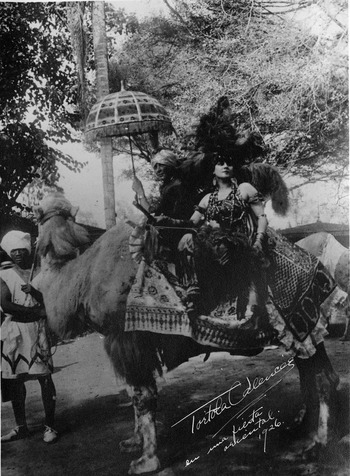
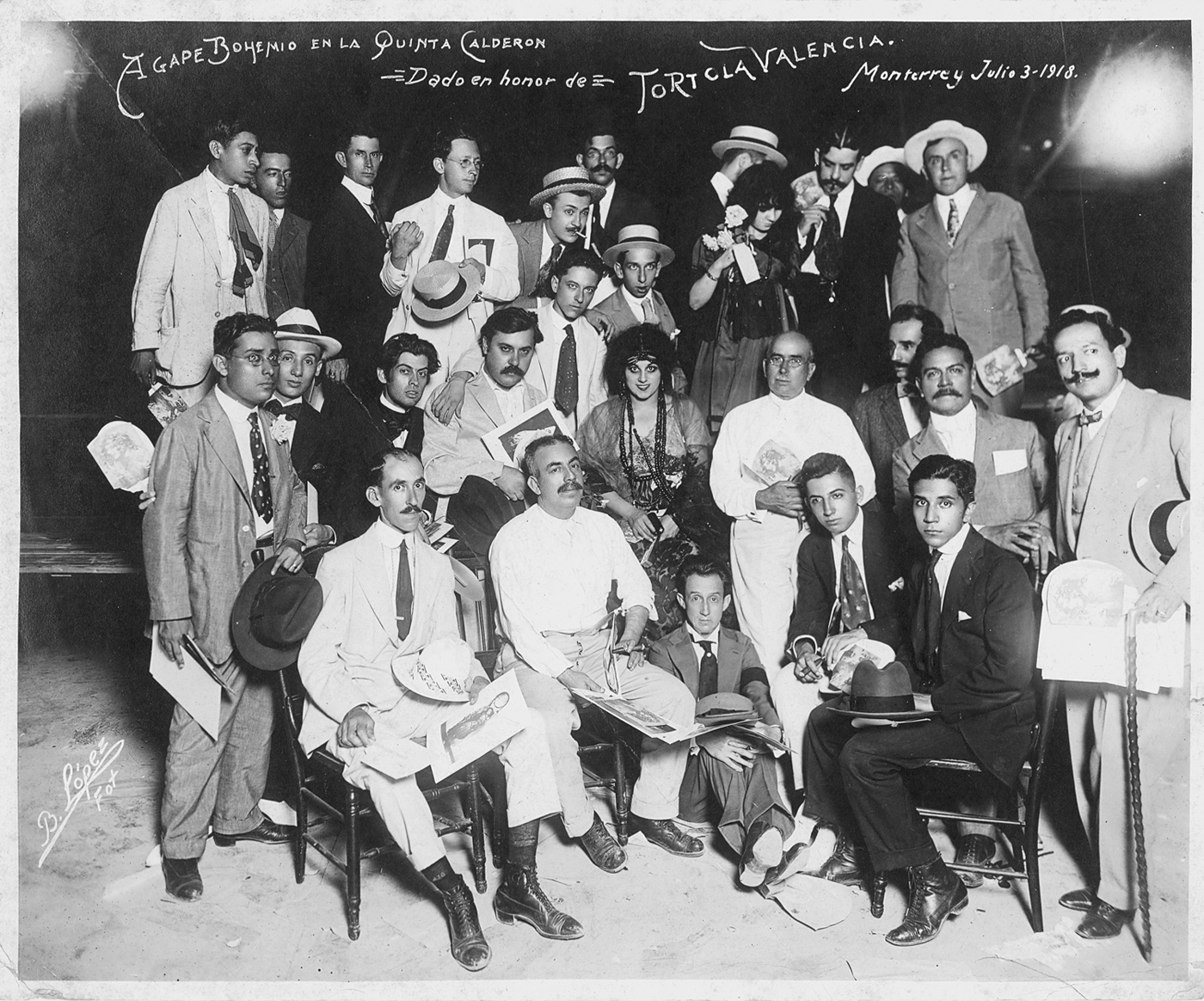
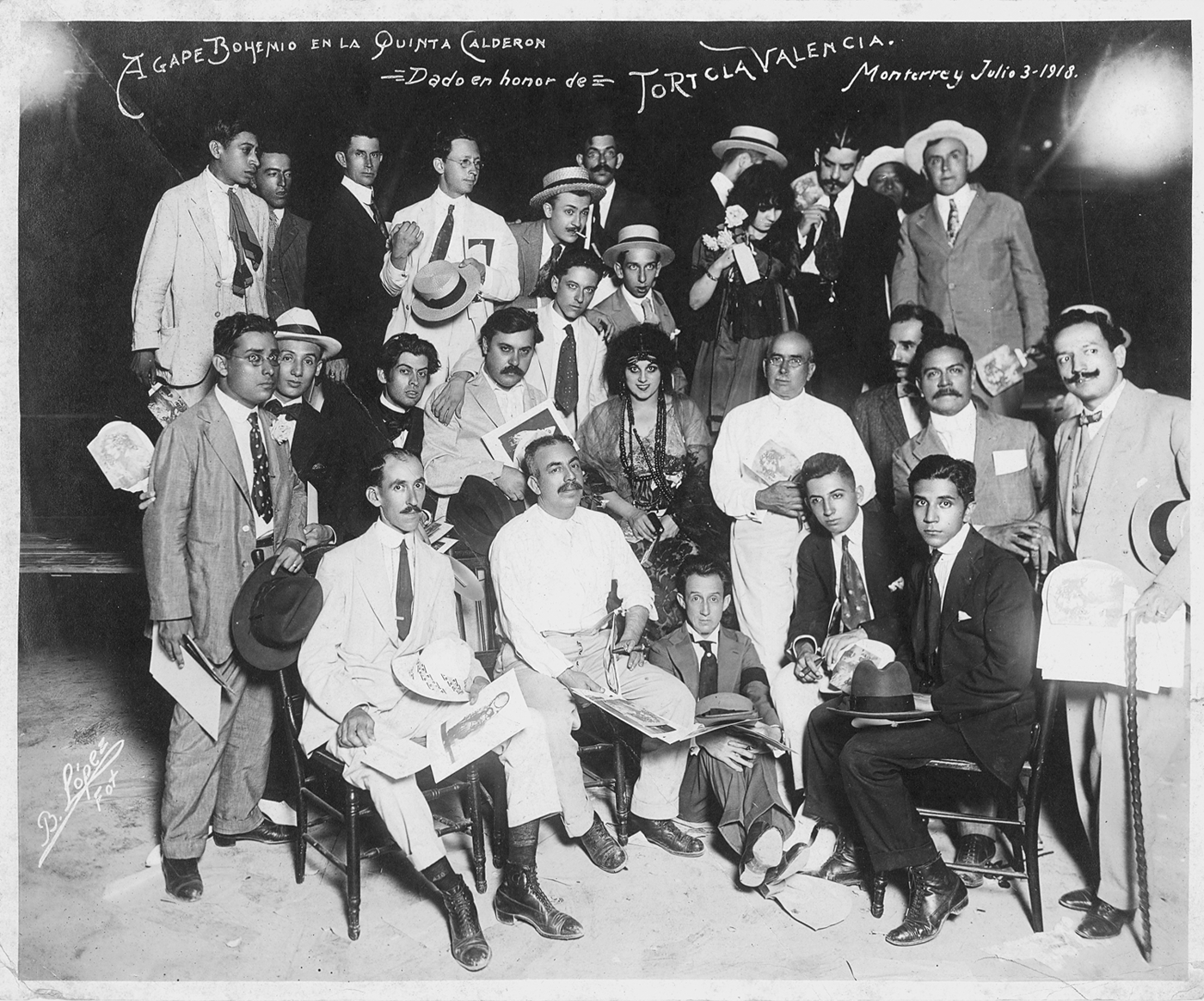
In the provinces of larger countries, as well as in the less accessible capital cities, audiences and critics were clearly concerned to prove themselves capable of engaging with one of the most successful international performers of the period. Just as in Madrid, theaters were reorganized, the public was educated in advance by press notices, and events outside the theater were carefully staged to draw Tórtola into local culture with an eye to having her report back on it in Europe. In Lima, for example, she was conscripted into a carnival procession, posed on a camel surrounded by “Bedouin” servants—not simply a nod to her Oriental dances, but more pointedly, an attempt to raise the cultural level of Lima's somewhat dissolute carnivals (Photo 6). (A witty journalist later interviewed the camel.) In Mexico, she was routinely surrounded by poets and painters who were invited—by Tórtola herself, but also by the press and state—to produce artworks commemorating her visit (Photo 7).
Participating in a carnival in Lima, 1926. (Courtesy of the MAE-Institut del Teatre, Barcelona.)

With members of Monterrey's “bohemia,” Mexico, 1918. (Courtesy of the MAE-Institut del Teatre, Barcelona.)
In countries with a sizeable demographic of recent immigrants from Europe (such as Argentina), or which were routinely visited by foreign performers while sending their own representatives abroad (such as Brazil), the response was more complex, and also increasingly virulent. The first Argentinean reviews of her 1916 tour, for example, seized the opportunity to demonstrate the level of their own cultural sophistication—not by appreciating a figure who was celebrated in Europe, but by finding her anachronistic, which allowed local intellectuals to make the case that Argentina was far more advanced in cultural terms than the European elites. In Brazil in 1921, reviews of her performances verged on the vicious: they derided her technical awkwardness, her corporeal bulk—quite sizeable by this point—even her age, suggesting that Europe only sent over its exports once they were well past their prime, expecting the barbaric Latin Americans not to notice. Along the continent's Pacific coast, whose countries had less sustained contact with European artists, she met with a consistently warm and engaged reception, and this would begin to have distinctive effects on her choreography.
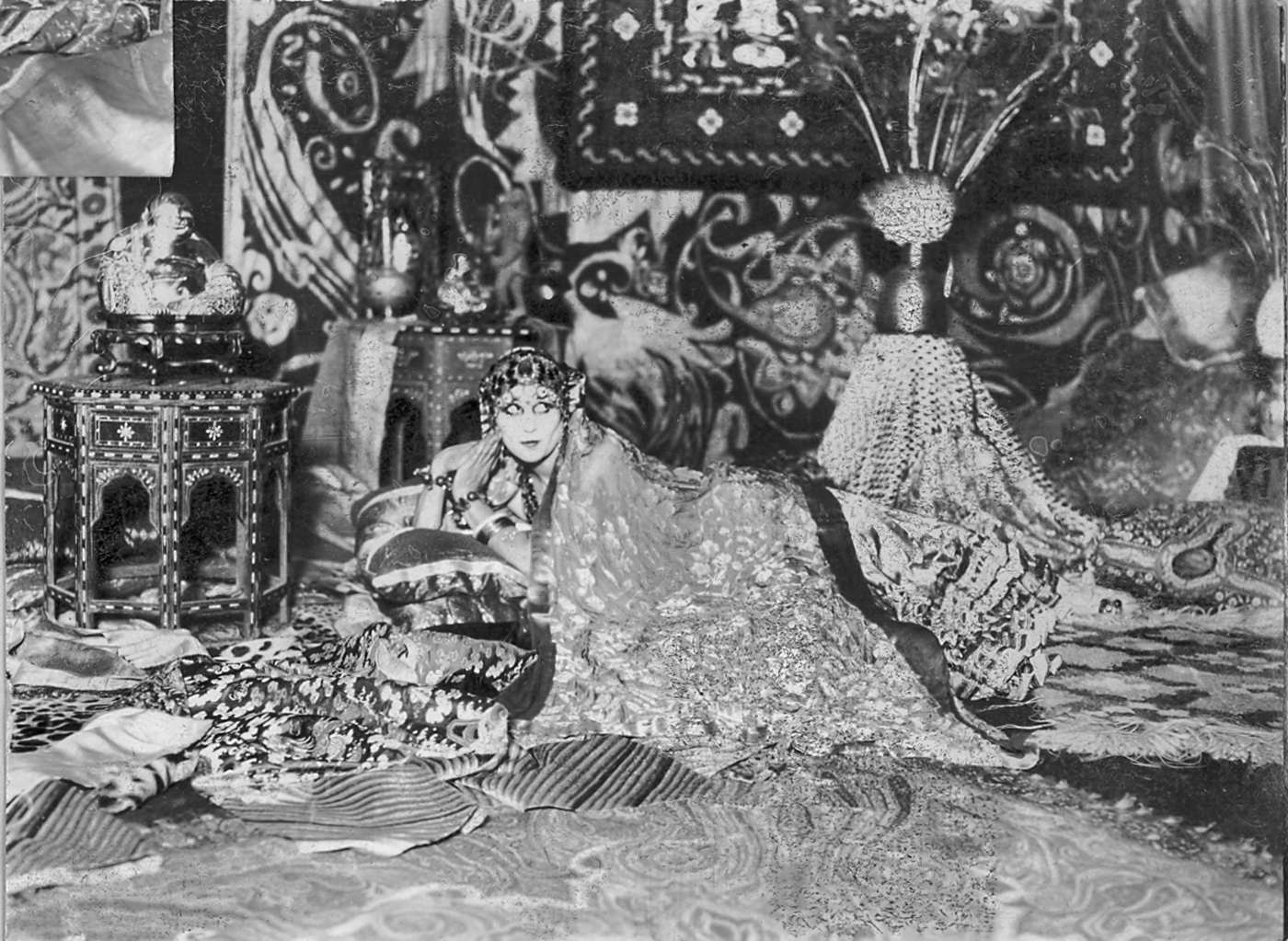
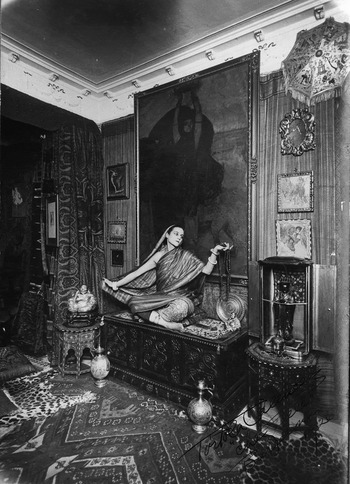
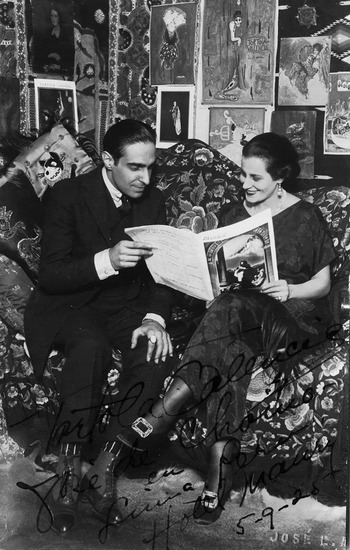
From her very earliest performances, Tórtola had taken a keen interest in her role as an ambassador for foreign cultures, which she attempted to transmit not only through gesture but through scenography. In Latin America, despite the difficulty of traveling with props, this desire became even more pronounced, partly as an attempt to compensate for traveling—unlike Pavlova or Nijinsky—as a solo performer; Tórtola clearly thought of her décor as an extension of her performing body, a mode of filling the stage and the vision of the spectator.Footnote 13 Press clippings and photographs from these tours attest to a décor that threatened to run rampant, as Tórtola amassed ever more costumes, draperies, carpets, and jewels, and increasingly underlined their importance in her performances (Photos 8 and 9). These elements proliferated both on-stage and off, filling her hotel rooms, which she decorated with a flair and excess, which stunned her frequent visitors—covering her floors with animal skins and her walls with sketches, paintings, and portraits by artists who competed for her favors in each one of the cities she visited (Photo 10). There is a sense of over-saturation in all of Tórtola's environments on these tours, as though she were never quite satisfied with a single role or setting, turning herself virtually into a traveling world's fair, through which audiences and visitors could experience the greatest variety of cultures incarnated in a single figure.
Posing at home with textiles and artifacts collected on tour and incorporated into her performances (undated photograph). (Courtesy of the MAE-Institut del Teatre, Barcelona.)
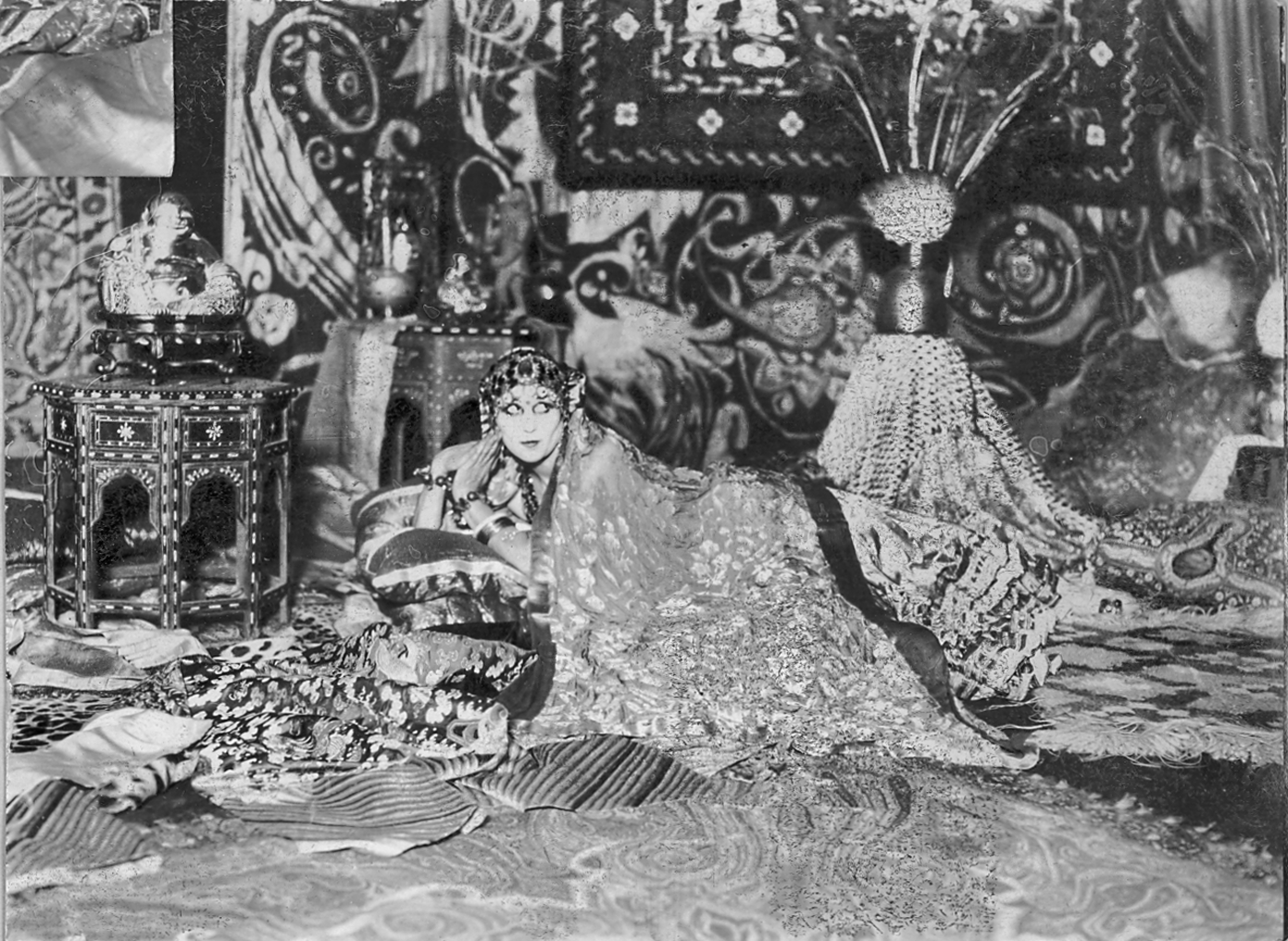
Posing at home, surrounded by artifacts and textiles collected on tour (1926). (Courtesy of the MAE-Institut del Teatre, Barcelona.)

In her Lima hotel room with journalist Juan de Ega [José de Chioino] (1925). (Courtesy of the MAE-Institut del Teatre, Barcelona.)

But the effect of these tours on her choreography is far more radical. What in Europe had been a somewhat clichéd approach to representing foreign bodies and rites took on a post-colonial dimension in Tórtola's performances in Latin America. On the one hand, her “Oriental” dances, which might be seen to carry specific ideological freight in Europe, changed their sign when performed in a continent whose modernist artists, including the poet Rubén Darío, had used “Oriental” images ambivalently, as a mode of declaring both their contemporaneity with Europe and their affinity with other under-represented peripheries (Kushigian Reference Kushigian1991; Molloy Reference Molloy, Patton and Sánchez-Eppler2000). Indeed Tórtola's “Spanish” dances—and her habit of parading the streets of former colonies in her “Maja” costume—were far more likely to cause offence than any residual Orientalism in her dances.
More importantly, from her very first visit to Latin America, Tórtola demonstrated an interest in indigenous cultures, which would take her away from the European fascination with classical Greek and Asiatic civilizations and toward inspiration by quite different pre-modern cultures, specifically Mayan and Inca. Her explorations here dovetailed with contemporaneous endeavors by Latin American intellectuals and artists—capitalizing on recent developments in Greek, Roman, and Egyptian archaeology—to draw attention to their own under-studied, unprotected pre-Columbian heritage. One of the most significant of those figures was Peru's Rafael Larco Herrera, who in 1903 began to assemble a collection of pre-Columbian ceramics, which would eventually result in the groundbreaking Museo Larco in 1926; Tórtola's most sustained contact with pre-Columbian Peruvian ceramics came through his collection. Larco Herrera was also an extraordinary patron of the arts; his Chiclín estate in Northern Peru—established to house 2,500 workers in optimal conditions—played host to an astonishing variety of foreign performers in the 1920s, from Spanish actress Margarita Xirgu to cinematic idol Douglas Fairbanks, from La Argentina to Anna Pavlova (Larco Herrera Reference Larco Herrera1947). And, of course, to Tórtola Valencia, who performed at Chiclín in mid-1922, where she was somewhat overwhelmed by the smell of so much humanity, and allegedly required her host to perfume the crowd from on high.
Tórtola's engagement with indigenous Latin American culture at times displays the contradictory hallmarks of a romantic indigenism prevalent among the continent's elites: a fascination with pre-Columbian civilization shadowed by a neglect of, or even contempt toward, contemporary indigenous groups, which partly mirrors the structures of European Orientalism. This romanticism is mirrored in the stories she invented for journalists on her first tours about her contacts with indigenous groups. In a 1917 interview, for instance, she produced a novelesque episode straight out of colonial captivity narratives, with a touch of Salome into the bargain: on a visit to the sierra, she claimed, herself and her companions were surrounded by bloodthirsty natives whose leader was only placated when she agreed to dance for him. When pilloried by Peruvian journalists, Tórtola explained somewhat unconvincingly that the story was invented to mock the credulity of the European press (even though it was published in Mexico's El Universal, September 19, 1917). Yet her case is not straightforward. Interviews also make clear that her inclination toward indigenous motifs began on her early tours, particularly in Chile and Peru, and was strengthened by contact with indigenous groups, especially musicians and textile-workers, in Central America (Photo 11).Footnote 14
Studying with indigenous musicians/dancers, Izalco, El Salvador, 1923. (Courtesy of the MAE-Institut del Teatre, Barcelona.)

On her very first tour of Latin America, she began conceptualizing dances that would pay tribute to Chilean and Mexican folk culture (El Heraldo de Cuba interview, March 12, 1923), and over the next few years would add Hawaiian and African dances to her repertoire, in an attempt to stretch conceptions of ethnic dance beyond their most conventional “Orientalist” molds.
It was in Peru that her engagement with indigenous communities was most thorough-going, and the dance she decided to develop as a result of these contacts gave her particular trouble, due to a newfound sense of responsibility in the attempt to represent another culture through dance; it tells us much about Tórtola's shifting conception and practice of choreography under the influence of her Latin American tours. As early as 1916, she pledged to her Peruvian circles that she would soon begin work on an “Inca” dance, guided by the composer José María del Valle Riestra, who had himself stretched the bounds of Peruvian music by incorporating pentaphonic Incan motifs in his 1900 opera Ollanta. Her primary sources of inspiration, she claimed, were indigenous huaynos (Andean tunes) heard at a banquet, and costumes and ceramics she had studied at the Museo Histórico Nacional (El Tiempo, December 17, 1916). What Tórtola attempted here was quite radical, in terms of recovering a covered-up past and engaging with its present-tense iterations—not merely as remnants, but as living history. In so doing, I would argue, she made a practical gesture toward the constitution of a postcolonial museum, grounded in performance as much as in preservation. She took the brave stance of calling attention to the Peruvian government's failure to protect its patrimony, noting that the number of artifacts in the national museum was actually decreasing with the passing years. Nonetheless, she was careful to note that her own interest lay less in archaeological reconstruction than in sensorial inspiration, filtered through images found on ceramics, costumes, and most importantly, music. She may have claimed somewhat glibly in the same interview that, once the music and poses were assembled, it would take her only an hour to choreograph her Inca dance; yet she ultimately dedicated nine years to its elaboration, refusing to perform it until perfecting all aspects of its narrative, décor, music, and movements, giving only a private performance for close friends in New York while commissioning studio portraits to mark this new facet of her performing image (Photo 12).
“Inca Warrior Dance,” studio portrait, 1926. (Courtesy of the MAE-Institut del Teatre, Barcelona.)

These studio portraits, and several glowing reviews in the Lima press, constitute the only record of Tórtola's Inca dance. Yet by studying the process of its construction, we can gather specific conclusions about the shift in Tórtola's conception of dance over the course of her traveling career. Her initial studies of Greek friezes and Egyptian hieroglyphics had brought her close to the work of Isadora Duncan and others, with their common roots in the dance writings of Maurice Emmanuel (Reference Emmanuel1896): a grounding in static poses glimpsed on ceramics or in sculptures, channeled into a kinetic flow.Footnote 15 For Isadora, classical poses were not so much a mode of accessing a past civilization as a conduit to a “dance of the future”; Tórtola's growing commitment, by contrast, was to representing a past or a contemporary culture known only in fragments. Her technique of composition was to imagine individual postures that could later be worked into a sequence, adopting a series of poses in order to generate a sense of transport—to the past or to another cultural site—in and through her moving body, transmitted kinesthetically to her audience.Footnote 16 And rather than basing her choreography purely on visual stimuli (ceramics, sculptures, paintings), she insisted increasingly on the importance of costumes and, especially, music in generating a flow between her poses. If her earlier choreography had featured carefully selected yet incongruously modern music—Debussy, Saint Saens, Granados—for both her classical and “ethnic” dances, in Latin America she began to draw inspiration from indigenous themes, working closely with individual composers and folk collectives while plotting out her movements.
Immersing herself in a fleshed-out historical code of gesture allowed Tórtola to transport herself through bodily techniques into a different historical period or cultural setting. Perhaps even more importantly, it trained the audience in the art of viewing cultures that circulated or survived solely in the form of fragments. This constitutes a decisive break with the practices of her European contemporaries. Where they based themselves on examples of Greek and Roman (and occasionally Egyptian) civilization collected in European museums, Tórtola's inspiration for her Latin American indigenous dances was grounded in far more fragmentary materials: a tiny portion of pre-Columbian artifacts had to that date been excavated and preserved in museums, and Latin American archaeology as a discipline was in its infancy. The museum archive with which Tórtola was working, in other words, was not just made up of fragments, but was itself known to be particularly fragmentary.Footnote 17 In choreographing a pre-Columbian dance on the basis of pottery shards, fraying textiles, and contemporary indigenous music, in other words, Tórtola was not simply repeating scholarly discoveries about foreign cultures, but was attempting to body forth an image of a little-understood past for a local audience.
There was tremendous critical and popular anticipation for Tórtola's “danza incaica guerrera” (Inca Warrior Dance), which she finally premiered in 1925 in Lima's main theater. This special event featured the President of the Republic and a Municipal Council, which awarded her a medal of honor for her service to the nation, and extracted from her a promise to perform it abroad, underlining her perceived importance as a carrier of culture between cultures. Among various rapturous reviews, an article in El Comercio (September 19, 1925) stands out for a differently inflected emphasis on the dancer's capacity to connect different cultures, polemically arguing that her Inca dance connected directly to her earlier “Oriental” dances—not for their superficiality or distance, but for their grounding in two great civilizations: “With someone who has so fully understood the artistic soul of the Orient, why should it be a surprise that her soul should also have opened itself to that of our glorious Inca race?”
Lima, significantly, was not the dance's final resting-place, nor was stage performance its only form. Tórtola's publicity photograph for the event would continue to circulate—as the planned frontispiece for an English-language book on Inca civilization that was never published, and far more importantly, as the centerpiece in Peru's exhibition at the 1929 Panamerican Exhibition in Seville. In this final palimpsestic image, which synthesizes many of the complexes I have teased out in this essay, the choreography of a Spanish-born, British-raised dancer known primarily in Europe for her “Oriental” dances became the means for Peru to represent its patrimony—to itself, to other American nations, and to its former colonial master. This looping together of dance, cultural hierarchies, and postcolonial history in the figure of a forgotten “Spanish” dancer stands as a provocation to rethink the reach of the early modern dancers as carriers of culture across historical and national boundaries. Tracing their movements, and their effects on the places through which they passed, has implications not only for dance history, but for a richer understanding of cross-cultural modernist entanglements.