INTRODUCTION
Tokugawa Japan was a land of peasants. They were family-farm cultivators, accounting for 80 per cent of the population. This percentage may suggest that land was hardly a commodity while the size of the workforce in industry and trade was small, and also that occupational differentiation did not go much further beyond the official division of warriors (samurai), peasants, artisans and merchants. Under Tokugawa rule (1603–1868) institutional frameworks for land and labour markets were never favourable for the flexible use of land and people as factors of production. Indeed, it was only after the Meiji Restoration of 1868 that in an effort to institute ‘westernization’ reforms, property rights were granted to peasant farmers and the restrictions on land sales and individual liberty lifted.Footnote 1 Hence, one may argue, market forces must have hardly operated in the allocation of land and labour, so that a functional division of labour was limited during the Tokugawa period. However, given a recent consensus that Tokugawa Japan achieved Smithian growth – a gradual process of market-led output growth, with rural industrialization and agricultural improvements as major engines of progressFootnote 2 – how could such a picture of factor markets be consistent with the rural-centred growth scenario?
In order to answer this question, the present article will investigate land and labour markets in traditional Japan. In the Japanese historiography, the modern era is said to have begun with the Meiji Restoration. In this article I also focus my attention on the pre-1868 period, although paucity of Tokugawa evidence compels me to turn sometimes to the post-1868 period for statistical information, which I hope can be justified for the countryside, where much continuity was found even after the Meiji reforms. The first section looks at land and tenancy issues, and the subsequent sections on labour will cover both rural and urban markets, examining how large the markets were, how they operated and how skills were formed in different sectors of the economy. In the final section, suggestions will be made based on the findings for larger issues such as the theses of proto-industrialization and Smithian growth.
LAND AND LEASE MARKETS
In ancient and medieval times, there was no coherent concept of land ownership. In ancient times, a Chinese-style land and tax system had been adopted by the state; however, from the eleventh century on, the land area outside the state sector expanded in the form of private estates (shōen) held by aristocrat-bureaucrats in Kyoto and, to a lesser extent, by Buddhist temples and monasteries. The Japanese estate system thus established was very different from the medieval European manor. It did not centre on a proprietor's residence. Being scattered all over the provinces and having no demesne, the running of each estate was left to a local manager. This implied that between the absentee proprietor and the actual cultivator of the land were various claimants of a share in the total revenue the land yielded. Added to the intermediate-level claimants was a land steward on the aristocratic estate; these were first appointed in the twelfth century by the first samurai government. All those claimants' rights to receive revenue were divisible and alienable. One development from such a layered structure was tax contracting, which in fact led to the rise of tax-farming moneylenders in and around Kyoto in the fourteenth and early fifteenth centuries. However, the longer-term trend was in a different direction. Samurai stewards, who had been managing tax collection and other estate affairs since the twelfth century, increasingly saw contiguous estate lands as their own power bases. From this class of warrior-landholders emerged a hierarchal relationship between overlords (daimyo) and vassals, leading to the fall of the Kyoto aristocracy and the age-old estate system during the subsequent period of warring states (1467–1568).Footnote 3
However, it was not until the period of unification (1568–1603) that the regional overlords began to extend direct control over peasant-cultivators. Policies and measures taken in the process of unification – such as the Taiko's cadastral surveys at the end of the sixteenth century and similar surveys taken regionally in the subsequent decades – furthered the separation of the samurai from the peasantry. The cadastres were essential for a system adopted by the successive unifiers for determining the value of land for tribute purposes. Under this system, called the kokudaka system because both land value and tribute were expressed in koku of rice, the individual peasant's tribute payment became directly linked with his possession of land.Footnote 4
The final product of the three-century-long process was a regime built by the Tokugawa shogunate. Under Tokugawa rule, the samurai overlord held an exclusive right to administer the whole territorial land; at the same time, paradoxically, the peasant-cultivator's right to possess farm and residence land was also strengthened. In the Tokugawa system, legally speaking, it is still difficult to determine who actually ‘owned’ the land. The shogunate and overlords could exercise their leverage over the peasantry by, for example, declaring in 1643 against the ‘sale of land in perpetuity’.Footnote 5 Yet, the Tokugawa policy of the removal of rural samurai-landholders to castle towns made them unable to keep their claims to landed property. Without landed gentries, therefore, the peasants gained a substantial degree of influence within their village communities and a greater degree of control over the political and economic spheres of local life in general. All this meant that the peasants in the Tokugawa era collectively gained a greater security for their landholding than in the medieval period. And the holders' ‘rights’ were guaranteed to a large extent by village authorities. Indeed, a cursory look at both sample transcripts of seventeenth-century village codes and the collections of materials compiled by the Meiji government concerning Tokugawa customary law reveals that registers listing all plots of cultivated land, as well as the names of holders of the fields concerned and the titles thus certified, were kept by village officials, not by samurai administrators.Footnote 6
As noted above, Tokugawa peasants were not allowed to sell land if the sale were made ‘in perpetuity’. This ban on the permanent sale was interpreted by contemporaries to mean that peasants were allowed to sell a parcel of land for a limited period of time, which in practice meant ‘pawning’ (shichiire).Footnote 7 It appears that this manoeuvring was sanctioned by the Tokugawa authorities since its foreclosure (shichinagare) was eventually given tacit recognition. Thus small parcels of cultivated land in the village moved frequently from family to family by this method or by mortgage. The movement of land ownership, it is often assumed, took place within the community, but it is not entirely unlikely that the possession went out of the village. Across the country, the total area of land pawned increased as the century wore on, and so did that of land left unredeemed by the original landholder. During the Tokugawa regime, it appears that about 10 per cent of peasant cultivators in agriculturally backward provinces (chiefly in north-eastern Japan) and a little over 30 per cent in the most advanced areas (the region around Osaka and Kyoto) lost their landholding, while nearly 30 per cent of the total land area came under tenancy.Footnote 8 Despite government restrictions, therefore, there were land transactions in the countryside. This resulted eventually in a differentiation of the peasantry and the rise of landlordism, the tendency that featured in the agrarian history of subsequent periods.
In the first half of the twentieth century, landlordism was much blamed by contemporary economists and historians for recurring tenant disputes and other political and economic difficulties that hovered over the country between the two World Wars. At the core of the problem, they thought, was a very high level of rent – so high that a bare subsistence was left to tenant farmers. It is true that the overall rate in the Tokugawa period was well over 50 per cent in the case of rice fields. However, it should be realized that the percentage does not appear to have changed for much of the period until about 1900.Footnote 9 Also, over the same period, landlord–tenant relations exhibited a surprisingly long spell of stability. Differentiation of the peasantry did not lead to proletarianization: there emerged no class of landless agricultural workers in the Japanese rural past (see the next section below).Footnote 10
One reason for this stability was that the landlord–tenant relations were not built on single-stranded contractual ties between two free individual agents. Especially those in earlier centuries, it is often argued, resembled multi-stranded bilateral relations of benevolent masters and subordinate families. Indeed, it is documented that there were cases where landlord–tenant relations were disguised as main-branch family relationships between two ie (stem family organizations that were supposed to continue from generation to generation). Another reason which has been put forward is that, being members of the village elite, all landlords were expected to act to the benefit of villagers, giving, for example, soft loans to their tenants, providing capital for improving village infrastructures, taking leadership in experimenting with new rice varieties on their own farm and helping others introduce new methods of cultivation. Moreover, while the predominant form of rent contract was one in which the amount of rent was fixed, the landlord was expected to reduce rents when crops failed. In many regions, moreover, there were customary practices according to which the family of the original landholder was entitled to buy the land back and in cases of dispute village authorities would intervene. Custom varied from region to region. In some cases this applied only to land that had been registered at the beginning of the Tokugawa period, and in other cases to families whose ancestors were said to have cleared the land for cultivation. Whatever the customary practice within the village, it appears that reciprocity between quasi-parental benevolence and quasi-filial piety, or a priority of village harmony, or both, overrode all other ill effects of landlordism until the beginning of the twentieth century.
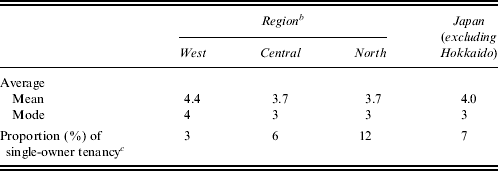
However, economics must have also played a part in the landlord–tenant relationship. One suggestive fact is that tenants did not necessarily rent land from one single landowner: they usually rented parcels of land from several landlords. A magazine article published after World War I noted that while a majority of tenant farmers had two to three landlords, there were cases where they rented land from eight or nine landowners.Footnote 11 According to a more systematic survey taken in the late 1930s, whose results are summarized in Table 1,Footnote 12 a typical tenant cultivator rented land out from three landlords and only 7 per cent of all the lands surveyed was under single-owner tenancy. Tenancy in the interwar period was no longer based on patron–client-like relationships, but on multilateral, more or less businesslike relations. Such a social space where tenancy contracts were made must, therefore, have had some resemblance to a market.
Numbers of landlords from whom a Japanese tenant farmer rented land: survey results by region, 1937Footnote a

a The total number of observations is 436. This excludes 30 tenant farmers in Hokkaido where, being a newly colonized island, there were fewer landlords than in the other regions of Japan, while each of those landlords had far larger landholdings. As a result, more than two-thirds (70 per cent) of the tenant farmers surveyed in Hokkaido rented land from only one landlord, with the mean size of land rented being four times larger than the average for all the other regions.
b The regions (excluding Hokkaido) are classified as follows: ‘West’=Kyushu, Shikoku, Chugoku and Kinki; ‘Central’=Tokai and Tozan; and ‘North’=Hokuriku, Kanto and Tohoku.
c ‘Single-owner tenancy’ means cases in which a tenant rented land from one single landowner only.
Source: Miyamoto Michihiko, ‘Kosakunin ha ikunin no jinushi kara kariirete iruka’, Shakai seisaku jihō 225 (1939), 150.
Unfortunately no comparable evidence is available for earlier periods. But a regional pattern like that indicated in Table 1 is suggestive in this respect. The number of landlords from whom a tenant farmer rented land was fewer and the proportion of single-owner tenancies higher in the agriculturally disadvantaged northern provinces while the opposite was the case for more advanced western regions. If this sort of regional pattern reflected a kind of change over time, then it would be probable that the long-term trend was a shift away from the vertical kind of multi-stranded bonds to a market-like multilateral relationship. Although this should not be taken to imply that the community ethos was being eroded, it is likely that, by the late Tokugawa period, tenancy came to function as if there had existed a genuine lease market for land. A poor peasant with a large family who wanted to increase his farm size in order to maintain his subsistence level could probably do so by making a tenancy contract with another landowner. A small but enterprising tenant farmer may have been able to find a lessor for an additional farm. It is not unlikely, therefore, that the workings of such de facto lease markets tended to keep the peasantry on the land. Indeed, a suggestion has already been made that ‘An important reason for the non-emergence of a class of landless agricultural workers in Japan in spite of the very high pressure of population on limited land appears to have been the high incidence of tenancy, which gave access to land to those not owning any, or only owning very small parcels.’Footnote 13
THE RURAL WORKFORCE
Thus rural society at the end of the Tokugawa period featured a somewhat stratified but fairly solid agrarian workforce. Perhaps the best numerical evidence we have for the structure of this kind of agrarian population is a pilot census for Yamanashi prefecture taken in 1879.Footnote 14
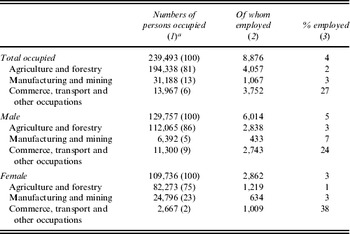
The Yamanashi census was a comprehensive survey of population conducted by a group of Meiji-government statisticians in the hope that the exercise would be a preparation for the taking of a national census. Yamanashi (formerly Kai province), an inland prefecture surrounded by mountain ridges and peaks including Mount Fuji, is only 100 kilometres west of Tokyo. It was chosen for the pilot study because the prefecture was relatively small, with a population of 397,000, and geographically compact, with no change made in administrative boundaries at the time of the Meiji Restoration, and because it retained much of the Tokugawa legacy as an early modern agrarian society. Caution must be invoked, however. First, by the late Tokugawa period the Yamanashi village society had attained a substantial level of commercialization and the social structure of its villages was fairly stratified, due primarily to a tradition of sericulture and of the production of raw silk and silk fabrics.Footnote 15 Second, when the census was taken, two decades had already passed since the opening of the Treaty ports in 1859. One of its economic impacts was a spectacular increase in silk exports, which led to an even stronger growth of Yamanashi's silk trade in the rural provinces. In the subsequent decades, the prefecture became more specialized in the supply of cocoons and in the making of fabrics than in the production of raw silk. Yamanashi, therefore, may be viewed as a typical proto-industrializing region in eastern Japan. Third, although Yamanashi remained rural, its workforce was not entirely unscathed by the Meiji government's westernization programmes. By 1879 there was a small but sizeable number of firms and offices which may be classified as belonging to the ‘modern’ sector, a majority of which were found in silk reeling and in administration, banking and transport. (See Table 2.)
Occupational structure and proportions employed: Yamanashi prefecture, 1879

a Figures in parentheses in column 1 are percentage distributions of those of the total, male and female.
Source: Tōkei-in, Kai no kuni genzai ninbetsu shirabe (Tokyo, 1882).
The census report of 1879 allows us to have a glimpse into the structure of a traditional rural workforce. From its occupation tables, not only can we classify the occupied male and female populations between the primary, secondary and tertiary sectors, but we can also identify the numbers and proportion of workers who worked for wages and salaries, as distinguished from the self-employed, across the three sectors. The latter category of occupied people consisted of day labourers (hiyatoi such as masons' hiyatoi), apprentices and learners (deshi such as carpenters' deshi), various kinds of white-collar workers and those described just as ‘employees’ (yatoi such as corn merchants' yatoi); so those in this category may collectively be termed those ‘employed’.
Table 2 shows these two-way classifications of the Yamanashi workforce at the end of the 1870s. First, one may notice that the total number of working females (109,736) was not much different from that of males (129,757), implying that the rate of female workforce participation was high. With respect to the population aged 15 and over, the female proportion was 82 per cent while the male proportion was 99 per cent. Both percentages may have been slightly overstated since it is likely that there were some under-15-year-olds who had already started working. However, there can be no doubt that the proportion of working women was unmistakably high, suggesting that a vast majority of married women were in the workforce.
Secondly, column (1) of the table indicates that the structure of the Yamanashi economy was very much agricultural: 86 per cent of the 129,757 males were found in agriculture and forestry. The percentage was somewhat lower for females (75 per cent of the 109,736) and comparatively more were found in manufacturing. The latter is associated with the fact that this was a silk region where both reeling and weaving were carried out almost exclusively by females. Out of the 24,796 gainfully occupied females 16,763 were in textiles, of whom silk reeling and weaving alone accounted for 15,694 (94 per cent). Altogether, however, about 80 per cent of the working population were in agriculture, which happens to fit with the aforementioned share of the peasantry in the Tokugawa population.
Thirdly, column (3) of the table examines how the proportion of those ‘employed’ varied across the sectors. As noted above, the employed were day labourers and those employed in the modern sector, on the one hand, and craft apprentices and ‘employees’ (yatoi) on the other. In traditional terminology, both the third and fourth of these groups were called hōkōnin because they were supposed to live in their master's household. The ‘servant’ in traditional Japanese society was a term that covered not only domestic and farm servants but apprentices in craft occupations and clerks and their apprentices in merchant houses as well. Despite this wide coverage of the term, however, the overall proportion of the employed was as low as 4 per cent in the Yamanashi region. In the case of its tertiary sector the level was rather exceptionally high, but it was due to the considerable numbers of male office workers, on the one hand, and of female domestic servants, on the other. Men in public administration and education amounted to 1,178, 43 per cent of the male wage/salary earners, while 660 domestic servants alone accounted for 65 per cent of the female figure. In agriculture and manufacturing, on the other hand, men and women working for wages were either exceptional or small in absolute numbers.
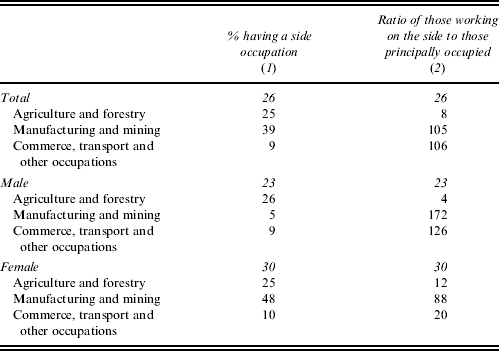
However, it should be noted that Table 2 is based solely on their principal occupation. In fact, many of the Yamanashi people were returned as dually occupied. As Thomas Smith and Shunsaku Nishikawa have already pointed out, by-employment was widespread in the late Tokugawa countryside,Footnote 16 and it is likely that the more commercialized a rural economy was the more pronounced the phenomenon of dual-occupation became. A typical case would be combinations of agriculture and non-agriculture, as both Smith and Nishikawa based their arguments on evidence from a south-western region called Chōshū, where proto-industrial by-employments such as cotton weaving, paper making, sake brewing and salt making were already widespread in the late Tokugawa countryside. However, judging from various pieces of contemporary evidence, it seems that the notion could include combinations of two agricultural activities as well. One problem here is that not all agricultural tasks were regarded as by-employments. For example, sericulture was often considered the farm family's by-employment but the combination of wet rice and cotton was never mentioned as a dual occupation, despite the fact that sericulture and cotton cultivation were two of the peasants' typical responses to proto-industrialization in the late Tokugawa countryside, sericulture representing the eastern half and cotton the western half of rural Japan.Footnote 17 A close look at the Yamanashi occupation tables reveals that sericulture was regarded by the census enumerators as a subsidiary activity of farming while none of cash cropping was. This implies that the proportion seen as dually occupied derived from the Yamanashi census with sericulture included would probably be closer to the upper end of a range of probable estimates for the whole economy.

Table 3 thus looks at the patterns of dual occupation without sericulture. According to column (1) of the table, 26 per cent of the working population were dually occupied, which reflects the fact that about a quarter of both male and female agricultural population had a non-agricultural side-occupation (if sericulture were to be added in the side-occupation category, the proportion dually occupied would become somewhat higher, at 32 per cent). Such dual occupation was less frequent in the manufacturing and service sectors. Column (2) reveals that in the non-agricultural activities generally there were more part-time, by-employment workers than those whose principal occupation was in the said sectors. This is particularly marked for males. In manufacturing and mining, there were 72 per cent more part-time male workers than those whose principal pursuit was recorded as being in industry and mining. In the case of female by-employment, the ratios in the column do not exceed 100, which is because many of them returned their side occupation as in the agricultural sector. In fact, of the 16,763 women who were principally textile workers, 9,752 (58 per cent) were engaged in the raising of silk worms as a side occupation. They were wives and daughters of the farm households. All this, therefore, indicates that the peasant family was the major supplier of by-employments to manufacturing, commerce and other service occupations, while virtually no households in the agricultural sector were wholly dependent on wage labour.
However, persons working for wages did exist. They were found not just in towns but in rural villages as well, and it is important to get to know what sort of people they were, and where they came from. Although it is not possible to obtain further breakdowns from the published census report, four village census returns that survived in exceptional circumstances enable us to examine what sort of farm household supplied wage workers to the labour market.Footnote 18
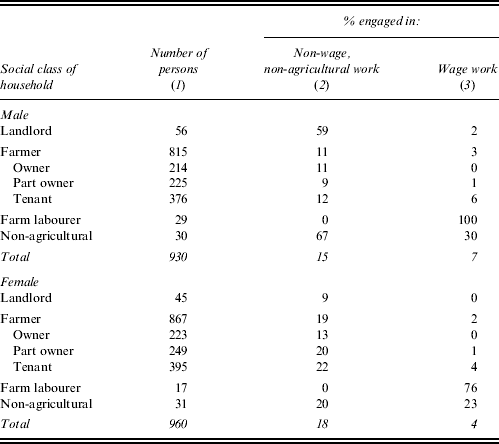
Table 4 shows the profiles of those working for wages in the four villages. The villages were located in a sericultural area, with 94 per cent of the population belonging to farm households. Many villagers combined rice cultivation with sericulture, as a result of which fewer than average industrial by-employments were found in the villages. A rather exceptionally high percentage for male landlord family members engaged in non-wage, non-agricultural labour (59 per cent) was accounted for by their commercial orientation: many of them were merchants as well. The proportion of female farm-family members having non-agricultural, domestic by-employment, such as reeling and weaving, was in the range of 13–22 per cent, and the wealthier the family the less likely they were to get engaged in non-agricultural by-employment. Yet those who worked for wages, either full-time or part-time, were even fewer. Only 64 males (7 per cent) and 39 females (4 per cent) worked for wages. The farm households supplied a less than half share of each number, and most of these came from poorer families of tenant cultivators. Another source of wage labour was from day labourers' families, who represented only 2 per cent of the population and were, unlike farm households, all female- or child-headed households.
Social classes of village populations working for wages: four Yamanashi villages, 1879Footnote a

a Those who were under 10 years of age, those whose age and occupation are unknown and those whose social class of household is unknown are excluded from the denominator.
Source: Kai no kuni genzai ninbetsu shirabe returns for four villages (Masuda, Kita Yatsushiro, Minami Yatsushiro, and Oka) in Higashi Yatsushiro-gun, Yamanashi prefecture, 1879. I thank Yatsushiro town officers for allowing me access to those documents.
Here it is worth remembering that there were two different kinds of workers of employee status: workers employed by the day and those on a longer-term contract. The latter were usually live-in servants and apprentices. As we will see in the next section, apprentices were found mostly in urban merchant and artisan households, although there existed a non-negligible number of rural carpenters and smiths who may have employed live-in apprentices. In the case of servants, their historical precursor was hereditary family subordinates on the farm (called nago or fudai). According to Thomas Smith, they were ‘probably the oldest form of agricultural labor recruited outside the family, except slaves, with whom they had something in common and with whom they may even had been related in origin’.Footnote 19 The hereditary subordinates were still numerous at the beginning of the Tokugawa period. They were often allowed to form their own family in the master family's multi-household compound, hence constituting the core workforce of the family's farm for generations. However, they were gradually replaced by those employed for a fixed period or payment. What emerged in the seventeenth century is a type in which a servant's service was considered the interest on money that his or her parents had borrowed from the employer. His or her freedom was redeemed only when the loan was repaid. The nature of this arrangement was so close to the aforementioned pawning of land that the servant was commonly described by the loan agreement as having been ‘placed in pawn’ (shichimotsu).Footnote 20 Indeed, after the enactment by the shogunate in the late 1610s of successive laws prohibiting the permanent sale of people, many desperate families interpreted this as permission for a temporary sale of their children,Footnote 21 leading to an increase in such ‘pawn service’ and a decline in hereditary servants. Over the long run, however, both types of service declined in importance and developed into wage labour on a shorter contract during the subsequent centuries. The change was particularly pronounced in the case of servants in husbandry and commercial businesses: long-term service gave way to short-term service, which in turn gave way to day labour.Footnote 22 By the Meiji period, therefore, wealthy farmers' demand for outside labour was met more by those employed by the day, who were in all likelihood their own tenant farmers and their families, than by live-in farm servants on yearly contracts.
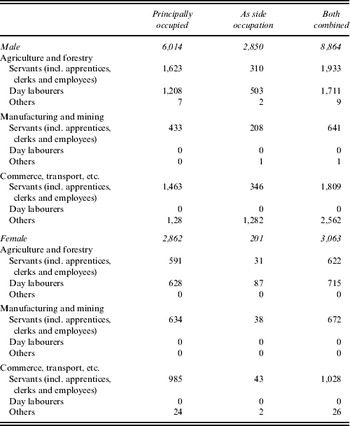
The Yamanashi census allows us to differentiate day labourers from the servant type, since ‘employee’ (yatoi) is separately categorized from ‘day labourer’ (hiyatoi) and it is safe to assume that in those days a vast majority of ‘employees’ were live-in servants and apprentices. In agriculture, according to Table 5, the number of day labourers was not much different from that of live-in servants. There were comparatively more servants in the case of men and slightly more day labourers in the case of women, but the overall ratio was about fifty–fifty. In manufacturing, commerce and other service occupations, on the other hand, no day labour was recorded. There is evidence that large urban merchants such as the House of Mitsui in Kyoto employed day labourers regularly, and it is not unlikely that such labourers were found in Yamanashi towns too. In other words, those employed by the day are likely to have been included in the urban group of ‘employees’, although ‘yatoi’ is so general a word that it is difficult to know exactly how many workers were actually employed on a daily basis. We have to assume that a majority of those in the ‘servant’ group were in fact apprentices and live-in clerks of traditional type, including even head clerks who may have lived out of the master's household. In the case of men in the tertiary sector, there were a sizeable number of ‘others’. Many of them were in fact in public administration, which was a new category in the Meiji period.
The structure of the wage-earning workforce: Yamanashi prefecture, 1879

Source: As in Table 2.
All in all, the Yamanashi evidence appears to support the view that the extent of the Tokugawa labour market was rather limited. Let us take up the servant group, lumping all types of servants together. A vast majority of them were unmarried, so that we may compare them with Yamanashi's unmarried male and female population in the 15–24 age group, that is 4,383 and 2,322 respectively. This means that 17 per cent of the male and 13 per cent of the female population experienced live-in service at least at some point in their life course. These percentages are low – unmistakably lower than those for early modern English youths, whom Peter Laslett labelled as ‘life-cycle servants’Footnote 23 – but they cannot be regarded as negligible. What separated rural Japanese youths from their English counterparts was not a difference in the percentage, but that Japanese live-in service was not a step to another life-cycle stage in which marriage took place and a labourer's family household was formed. Instead, Japanese servants became self-employed when they married.
THE URBAN WORKFORCE
Although there were no ‘day labourers’ recorded in Yamanashi's commercial and industrial sectors, cities and towns of the Tokugawa period were full of casual labour. Indeed, as I have argued elsewhere,Footnote 24 the urban workforce was being casualized during the latter half of the Tokugawa period. I demonstrated, based on a sample of population registers in the 1860s, that the proportion of live-in servants (workers on longer-term contracts) to the town population hardly reached 10 per cent in provincial towns and in all Edo boroughs.Footnote 25 Moreover, while many towns lost population over the same period,Footnote 26 the proportion of such servants in the population declined, suggesting that casual work increased in the urban labour market. According to a statistics compiled from household registers of Tokyo (formerly called Edo) in 1873, which classified family heads into five occupational groups, the largest group was ‘miscellaneous occupations’ (collectively called zatsugyō), including not just day labourers but hawkers, petty stallholders, street entertainers and waste pickers as well.Footnote 27 The latter kinds of people are likely to have been classified in the self-employed category in later Meiji statistics. At any rate, it is those people whose numbers increased in towns of the late Tokugawa period.
Casualization took place in craft occupations too. In cities such as Edo, Kyoto and Osaka there were craft guilds. The guild functioned in much the same way as in the European past: it was an institution that controlled the trade within the town, as well as a system of training in craft skills. Because of this training system Tokugawa Japan produced a good deal of fine arts and handicrafts such as lacquer ware and ceramics. As a body exercising restrictive power over the trade, however, the Tokugawa craft guild was not very effective. Especially in the building and metal trades, which were much larger than the artistic craft occupations, some Edo evidence suggests that the enforcement of apprenticeship became ineffective and regulation of wages difficult as numbers of both journeymen and migrant, part-time craftsmen from the countryside increased over time.Footnote 28 For example, just after a devastating earthquake of 1855 in Edo, while guild-regulated wage rates for carpenters were kept fixed the market rates reported to the city authorities were five times as high as the regulated wage levels.Footnote 29 Also, as we will see in the section on skill formation below, many craftsmen in cities appear to have begun training their own sons at home.
On the other hand, the aforementioned samples of urban population registers indicate that there was a trend in an opposite direction. In Osaka and in one central Edo borough, where many Osaka and Kyoto merchants had branch shops, the proportion of live-in servants in the population seems to have increased (although they were called ‘servants’, their numbers did not include kitchen and other household staff but consisted of business apprentices and clerks only). The level reached was generally high but it varied at between 25 and 50 per cent. Higher percentages were found in wealthy areas. In circles of tradesmen the employment of servants expanded in the eighteenth and early nineteenth centuries as the size of their business operations grew. For example, Mitsui's drapery business, Echigoya, owned nine shops in Kyoto, Osaka and Edo, employing a total of 1,020 servants. These were all male and lived in the master's household. The merchants not only employed large numbers of them but also kept them longer than the term for which the ‘servant’ was customarily bound. Amongst tradesmen, there was a clear tendency for the average length of their live-in service to get longer. Case studies show that successful servants who reached the status of head clerk (bantō) or who were allowed to establish their own business spent more than 20 years in the master's household. They entered the house as an apprentice (detchi) at the age of 12 or 13 and were promoted to shop assistant (tedai) and to various positions before joining the management. This did not mean that all apprentices were guaranteed life-long employment. On the contrary, according to Mitsui's records, internal competition was rather tough. Four in nine dropped out before the age of 18 and only one in ten reached the position of head clerk. This mercantile version of apprenticeship developed into a system of on-the-job training and internal promotion. In the small- and medium-sized enterprises of, say, Kyoto, the development may have been less clear,Footnote 30 yet, as far as big businesses are concerned, eighteenth- and nineteenth-century Osaka witnessed the rise of an internal labour market in the merchant houses.Footnote 31
Significant as was the mercantile system of apprenticeship as a historic precursor of the present-day Japanese style of employment, however, it appears that the tendency towards casualization outweighed that of the internal labour market during the latter half of the Tokugawa period. In quantitative terms, those involved in the former outnumbered those in the latter system and the gap must have widened over time.
THE WORKINGS OF THE LABOUR MARKETS
The overwhelming significance of family labour in the workforce means that the extent of the labour market was rather limited in traditional Japan, implying that the market existed only for seasonal demands in agriculture and for the rural–urban allocation of labour. Just as for farm land, so did the samurai administrations issue regulations against freedom of movement for peasant families, as indicated by a statement by one domain lord in 1632 that no one was allowed to ‘work outside the domain, or to work in a mine elsewhere. Even if he wishes to work within the domain … he must secure permission from the authorities ahead of time.’Footnote 32 Strict as it may sound, however, both the samurai's and the village authorities’ concerns were more to do with a reduced number of village households as tax units than with movements of individual villagers. Actual policies taken by domain lords varied from province to province and also from period to period, but the administrations' attitude became unmistakably permissive towards individual mobility. One of the reasons for their permissiveness was that those out-migrants, whether long- or short-distance, yearly or seasonal, were expected to come back to their native village eventually. Probably many actually came home while some did not. Whichever the dominant pattern was, the incidence of out-migration increased over time and, as Akira Hayami has demonstrated in his case study of a village in central Japan, the rural–urban flow of people became substantial in the latter half of the Tokugawa period.Footnote 33
Under a vertically constructed stem family system, only one child stayed in the parental household. Other children should leave the household before or soon after their marriage. This implies that there were always those who left the native village for work and settled elsewhere. Most of them must have headed towards towns and cities.Footnote 34 In other words, even in this kind of peasant society rural–urban flows of migrants existed. As for such an inter-sectoral labour market, there was a widely held view among economists that pre-World War II Japan was in a regime of the Lewisian unlimited supply of labour.Footnote 35 According to this interpretation, when there was disguised unemployment in agriculture, the wage level for unskilled jobs in the non-agricultural sector was equal to average rather than marginal productivity of labour in the farm sector: in other words, wages did not function as signals for labour suppliers and employers. Whether or not this view would hold for the Tokugawa period, therefore, has a direct bearing upon the question of the workings of the labour market in traditional Japan.
Recently Konosuke Odaka and Tang-Jun Yuan revisited the issue and confirmed that wage earnings of the farm worker were roughly comparable to the estimated average, rather than the marginal, productivity of agriculture in the period 1906–1940.Footnote 36 It is noted, however, that while the finding is consistent with the Lewisian interpretations, it does not agree with another finding with respect to the period before the Meiji. Odaka and Yuan cite the work by Shunsaku Nishikawa on a regional economy called Chōshū in the 1840s,Footnote 37 which shows that the average wage earnings for the unskilled working on salt farms was close to marginal labour productivity in farming, derived from production function estimates based on other sources. Nishikawa notes that salt workers were seasonal, and were supplied from nearby farm households. It is therefore likely that there was a mechanism by which agricultural and non-agricultural wages, on the one hand, and marginal productivity of agricultural production, on the other, were equilibrated with each other (for details, see the Appendix, below).
Seemingly, this is a puzzle. There are several points to be made, however. First, margins of error are fairly wide in any production-function estimates, so that it is difficult to determine whether or not an exact equilibrium was actually established. Second, it may not be that what determined the supply price of non-farm labour from the self-employed peasant family was the marginal productivity of labour in farming alone. If their asking price in the labour market had been influenced by the household's rather than the individual's ability to produce incomes from all sorts of sources, then the equilibrium between the observed wage rate and the marginal productivity of labour estimated solely from the agricultural-production function would have been disturbed. Third, on the other hand, it is possible to show that equilibrating forces were at work in the late Tokugawa period. Wage data from a village in the Kobe–Osaka area, for example, reveal that by the end of the eighteenth century the recorded wage rate for agricultural workers employed in the village by the day came very close to the urban market-wage level for casual labourers in Kyoto, a city some 50 kilometres away from that village.Footnote 38 At the macro level, moreover, the long-term rate of increase in representative agricultural wage series was almost equal in real terms to that of estimated farm output over the entire 1700–1870 period.Footnote 39
As long as the peasant farm household was an independent decision-making unit of production, therefore, the rural labour market, however limited its extent was, must have worked reasonably well. And this gave rise to the emergence of a well-integrated labour market between the peasant farm household and non-farm sectors within a regional setting. Indeed, as early as the late eighteenth century, such labour-market workings in a pre-factory setting attracted Adam Smith's attention. In a chapter on wages in his Wealth of Nations, he examined the effects of the harvest on wages for servants and journeymen:
In years of plenty, servants frequently leave their masters, and trust their subsistence to what they can make by their own industry … The price of labour, therefore, frequently rises in cheap years. [On the other hand, i]n years of scarcity, the difficulty and uncertainty of subsistence make all such people eager to return to service … [As a result] wages of both servants and journeymen frequently sink in dear years.Footnote 40
His account tells us that their parental household's ability to produce ‘subsistence’ determined their asking price in the labour market, a reasoning which can easily be re-stated and generalized in marginal productivity terms. Furthermore, it is this reasoning that, unlike the Lewisian model of unlimited supply of labour, enabled the market wage rate for the non-farm unskilled to keep pace with output growth in agriculture.
As for big businesses in the urban mercantile economy, however, the workings of their employment system became very different. The rise of the internal labour market within a firm must have affected the ways in which shop apprentices were recruited. In Osaka, for example, as the institution of internal promotion took root, it became less and less likely for the apprentices to be in-migrants from the countryside. Instead, most of them were supplied from the families of urban merchants. In the case of a wealthy money-changer, Kōnoike, documents covering the period 1801–1848 indicate that 43 per cent of the new recruits were sons of Kōnoike's branch families and former employees, 37 per cent were from urban communities of Osaka and Kyoto and only 18 per cent came from rural areas. Other evidence from Osaka reveals that most of those rural-born apprentices were likely to be sons of merchants, not of farmers. Even in the Edo branch shops of Osaka merchants virtually no local-born apprentices were found. They were all employed at the headquarters in Osaka or Kyoto, and then sent to Edo.Footnote 41
During the latter half of the Tokugawa period, it is documented that there emerged numerous job agents (called kuchiire) in Edo and Osaka. According to a contemporary book on the two cities, however, it was rare for the Osaka merchant houses to rely on those outside labour market agents for their apprentices.Footnote 42 The agents were for seasonal and casual workers, for whom market forces operated openly, whereas the merchants' recruits in all likelihood came from among former shop clerks and from personal acquaintances, who are likely to have been city merchants themselves. The urban market for mercantile white-collar workers, therefore, became increasingly closed.
SKILL FORMATION
Undoubtedly the rise of an internal labour market in the form of merchant apprenticeship was associated with the need for the formation of skills within the firm. Many of the merchant houses in Osaka and Kyoto were organizationally large, having a multiple departmental structure. Their apprentices and shop clerks were required to go round all the departments and, if successful, they were allowed to climb the ladder step by step before reaching the rank of head clerk. A head clerk required all-round and, perhaps, firm-specific training to be able to run a shop or a franchised business.
Apprenticeship as a model institution for skill formation is a system which combines two separate elements. The core element is an on-the-job training of apprentices that allows the guild to restrict entry into the trade, while the system assumes that, once qualified, they will set forth into the outside labour market. Set against this model, the type of merchant apprenticeship that developed in the Osaka–Kyoto world may be seen as a variant that internalized the latter element. However, this distinct system of skill formation gained significance in a much later period of twentieth-century industrialization. More important in the Tokugawa period were the traditional skills found in craft occupations, and also in the farm household, since it was their members who supplied a major workforce to expanding rural industries.
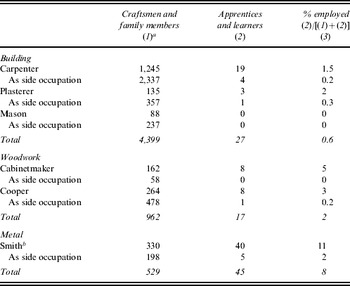
The Yamanashi census of 1879 reveals that there was a sizeable group of rural craftsmen working either full-time or part-time. Since it is difficult to tell from the census occupational tables who were ‘traditional’ craftsmen and who were not, Table 6 gives a selected list of such craft occupations. With the exception of two female smiths, they were all male, and a majority of them were rural craftsmen. Of those working full-time (that is as a main occupation), only 20 per cent were in the provincial capital of Kofu. If those working as smiths on the side (having another occupation as well) are included, the percentage drops down to 8 per cent. In the countryside (including, of course, small market towns), therefore, there were far more craftsmen than in the city and a vast majority of those rural craftsmen were part-timers with their main occupation in agriculture. Most specialized in terms of full-time working of the six craft occupations listed in the table were cabinetmakers and smiths. The proportion full-time was 74 per cent for cabinetmakers and 63 per cent for smiths, although in both trades there was a substantial number of craftsmen living in the countryside, who must have worked in agriculture part-time. In all the building trades and also in the coopers' trade, on the other hand, there were on average twice as many such part-timers as principally occupied craftsmen. Those craft occupations were peasant-family by-employments.
Traditional craftsmen: selected examples, Yamanashi prefecture, 1879

a The original wording in the census for column (1) was ‘craftsmen and tetsudai’; tetsudai literally means ‘helpers’. Since apprentices (totei) and learners (deshi) were classified separately in column (2), those ‘helpers’ were presumably family members of the masters. It is also likely that ‘craftsmen’ included the masters' sons.
b The 330 smiths include 2 women.
Source: As in Table 2.
Table 6 also lists the number of apprentices in each trade. The highest proportion of apprentices was found in the smithy: 11 per cent in the case of the principally occupied. Even this percentage suggests that only one in nine masters took an apprentice. In the other five craft occupations, the percentages were far lower and the chance of finding an apprentice among part-time craftsmen was virtually nil. Given a possibility that among ‘apprentices and learners’ there were some who did not enjoy apprentice status, and another possibility that the ‘craftsmen’ category here must have covered both masters and family helpers, the overall impression is that traditional urban guilds was not functioning well. Formal apprenticeship was no longer important at the beginning of the Meiji period, and it was probably the training of sons at home that was important as a medium of transmitting craft skills from generation to generation. Since it was industries outside the craft sector that expanded in the period of rural industrialization, and since each craftsman's occupation was to be handed to his son, it may be that in all these craft occupations the intra-family transmission of skills was more important than formal apprenticeship, irrespective of whether they were full-time or part-time craftsmen.
This, however, does not necessarily imply that the significance of markets for skills declined because the home- and informally-trained may have changed employers frequently before establishing themselves as skilled. Although very little is known for the Tokugawa period, there is a piece of Meiji evidence that there existed markets for workers trained as factory apprentices. Indeed a small sample of ‘inventors’ of humble origins and their personal histories reveals that there were two separate routes to the world of the workshop, as distinct from that of the modern factory, in the manufacturing industry of the Meiji period. One was home-trained sons of urban craftsmen and the other those who came from the countryside through factory apprenticeship. Given the fact that the latter outnumbered the former in that sample, and given the probability that factories and workshops outside the modern sector were very much traditional, it is likely that elements of both on-the-job training and market forces were at work between the rural and urban sectors.Footnote 43
Through this inter-sectoral channel, moreover, it is not unlikely that some kind of attitude towards work and skills was transmitted from the farm household. The Tokugawa farm household was a place in which skills were taught. As for agriculture, having made a comparison with other rice-growing societies, Koji Tanaka maintains that Japanese farming methods were not just more labour-intensive but also substantially more skill-intensive. Indeed, there is evidence that in many villages competitions were held for ploughing, transplanting and other farming activities, suggesting that, although there was no formal training institution, such skills were highly appreciated socially.Footnote 44 Moreover, according to Thomas Smith, the farm household taught its individual members time discipline and co-ordination skills. Based on farm manuals published in Tokugawa times and a couple of farm diaries, he argued that since each crop entailed a number of ‘narrowly timed tasks’ and since double-cropping was virtually the norm, the cropping decisions ‘set a work schedule for an entire growing season’, and that the decision-making became even more complicated if we take into consideration the spread of by-employment. The farm household had to shift family labour ‘back and forth from farming to by-employments, not only seasonally but from day to day and within the day, and also to use the off-farm earnings of individuals for the benefit of the farm and the family. This flexibility encouraged the spread of by-employments and thus put even tighter pressure on agriculture.’Footnote 45
In the farming sector too, therefore, much of labour was allocated internally and skills were formed internally. But the co-ordination skills and time discipline learnt in the farm household may well have been transferable to a non-agricultural world, and to an emerging industrial sector in a later period, through the inter-sectoral labour market.
CONCLUDING REMARKS
In this article I have demonstrated that the market size for both land and labour was small in Tokugawa Japan. The land market existed only in the form of tenancy contracts while the labour market operated only for fluctuating seasonal demands and also for the rural–urban transfer of manpower. In the countryside, therefore, family land was passed on from generation to generation, and in each generation the land was cultivated almost exclusively by family labour. Even in the urban sector, craftsmen worked in family businesses where craft skills were also transmitted from generation to generation, while merchant apprentices and shop clerks were increasingly internalized within the firm, although this tendency was confined to big businesses such as the House of Mitsui.
Such limited growth of the factor markets was not, however, necessarily a consequence of tight regulation from above. Neither state nor guild control appears to have played a particularly decisive role. It is true that measures taken by Tokugawa administrations were never market-friendly, but it is important to realise that the guild organizations were much less prescriptive than their European counterparts.Footnote 46 And the state tended to leave reasonably wide room for the spontaneous growth of markets from below. Some arrangements such as lease contracts for land became quasi-markets while others, especially those for casual labour, functioned just like genuine markets. Also important is the flexibility the farm household exhibited in relation to adjustments to changes in market demands – both short- and long-term, and both intra- and inter-sectoral – for products and labour, and to a lesser extent for land as well. Since longer-term changes were likely to have been consequences of either rural industrialization or a spread of commercial agriculture, or both, it is implied that the peasantry did respond to changing market forces with respect to commodity as well as land and labour transactions. Therefore, however overwhelming the size of the non-market, familial space in the economy, market forces in both product and factor markets must have played an indispensable part in the process of Tokugawa Japan's proto-industrialization and Smithian growth.
APPENDIX: A NOTE ON ESTIMATION OF THE MARGINAL PRODUCTIVITY OF LABOUR
In the studies cited in the text, the marginal productivity of labour values were derived from production-function estimates in agriculture. Nishikawa based his Cobb–Douglas production-function estimation on village-level data derived from a survey of more than 300 villages in Chōshū, conducted by the domainal government in the 1840s. In his specification of regression estimation, the output is the village's agricultural output expressed in local currency, which is regressed on land, labour (farm population in this case), oxen and horses, and commercial fertilizer. Calculation is made for lowland and upland regions separately. Results of logarithmic regression allow us to interpret each regression coefficient as an output elasticity of an individual factor of production (which in his specification equals to the share of that factor in the total value added). By multiplying this coefficient to the average productivity, we arrive at the marginal productivity estimate. The regression results indicate that the output elasticity of labour was in the narrow range of 0.49–54 for both lowland and highland villages, so that the share of labour may be assumed to have been the same for the two sub-regions, that is 0.5. However, since the average agricultural output per farm population differed between the two regions, the estimated marginal product of labour ranged from 191 momme for lowland to 101 momme for upland on a yearly basis (the momme is a unit of silver). These estimates are compared with available wage data in the non-agricultural sector. One typical job that went to seasonal workers from villages in lowland regions was doing unskilled tasks on the salt farm. On the assumption that they worked for six months a year, their annual wage earnings amounted to 180 momme. This is only marginally lower than the estimated marginal productivity of labour in the agriculture sector, from which those workers were supplied. Unfortunately, no such data are available for highland regions. If non-agricultural jobs existed there, wage levels must have been substantially lower, but if no such job opportunities were available, then a phenomenon of disguised unemployment must have prevailed.Footnote 47
Odaka and Yuan's estimates of production function for the modern period are based on similar specifications, but differ at the following two points: (1) they take into account the technological progress and human-capital accumulation that characterized the period after Meiji, and (2) that regression is made on time-series data (1895–1960) for Japan as a whole. Their estimates are a development from Ryoshin Minami's similar exercise based on the same set of data. Indeed, their result – that the share of labour was at 0.4 for the period before 1946 – is an improvement from Minami's rather unrealistic estimate of 0.24 (although it still remains a little low compared with the level of 0.5 derived from Nishikawa's for Chōshū in the 1840s and also by Hayami and others’ cross-sectional regressions on prefectural data for the 1930s).Footnote 48 Nevertheless, as mentioned above, their results arrive at the same conclusion: that the wage level for unskilled jobs was equal to the average rather than the marginal productivity of labour. It is worth noting, however, that the wage rate used for comparison with the estimated marginal productivity of labour is that of agricultural, not non-agricultural, day labour and, as I have argued in this article, there was no farm worker who relied entirely on his agricultural wage earnings to support his family.