


One of the most consistent and surprising findings in the social sciences in more recent years is the religious origins of some of the most powerful secular social and political movements of our times (Kalyvas Reference Kalyvas1996). Contrary to the dominant consensus in the social sciences that religion is primarily a tool of social and political control, in the past three decades scholars have shown that religion can also be a powerful source of social and political change. This finding has led to a new consensus: the practice of most world religions can produce a set of social assets that facilitate dissident collective action (McAdam Reference McAdam1982; Morris Reference Morris and Smith1996; Putnam Reference Putnam2000; Smith Reference Smith and Smith1996). Religious beliefs and narratives often provide the cultural, emotional, and normative justifications that motivate people to act collectively and challenge governments, even under conditions of high risk. And the practice of religion involves the creation of organizational resources—social networks, shared solidarities, and leadership structures—that facilitate collective dissent. We now know that religion facilitates collective action because it can create the ideological frames, collective identities, and mobilizing structures on which social movements thrive.
Although significant progress has been made in explaining how religion may facilitate both collective action and the construction of new social identities, the conditions under which religion actually becomes a powerful source of social mobilization, rather than a guarantor of passive obedience, are still relatively unexplored. We do not have systematic explanations of why some religious authorities promote the social and political mobilization of their flock, whereas others simply encourage them to comply with the status quo. We also lack consistent explanations of the conditions under which followers successfully demand of their religious authorities dramatic changes in the practice of religion that may contribute to social mobilization and changes in their economic and social well-being.
This article analyzes the critical role that some Catholic bishops and priests played in the unprecedented wave of indigenous mobilization that swept across Latin America during the last quarter of the twentieth century (Cleary and Steigenga Reference Cleary, Steigenga, Cleary and Steigenga2004; Van Cott Reference Van Cott2000; Yashar Reference Yashar2005). After centuries of neglecting the religious and social needs of the poor, particularly of indigenous populations, a few members of the Catholic clergy came to play a leading role in building the social and communal networks and movements and the ethnic discourse that served as mobilizing vehicles and ideological frames for indigenous protest and for the renaissance of indigenous identities in Latin America's public sphere.
To be sure, not all Catholic bishops and priests became active promoters of indigenous movements in Latin America. Propoor and pro-Indian clergy were never a majority in the region. In fact, one of the most striking features of Catholicism in Latin America in this period was the great diversity in theological and pastoral practices across episcopates, dioceses, and parishes (Gill Reference Gill1998). In almost any Latin American country, activist bishops committed to the cause of the poor were surrounded by many others who sided with economic and political elites and discouraged popular movements.
Why did some Catholic bishops and priests in Latin America become active promoters of indigenous communal organizations and movements, while others ignored or discouraged indigenous collective action? What impelled some members of the Catholic clergy to become some of the most powerful institutional supporters of indigenous cultures, identities, and rights, after centuries of oblivion?
Unlike prevalent explanations that account for the social activism of religious authorities in terms of religious doctrines, radical theological transformations, or conflict between church and state, the main proposition I make and test in this article is that religious competition between mainline Protestant churches and the Catholic Church in heavily indigenous municipalities led Catholic bishops and priests to become active promoters of indigenous communal organizations, social movements, and ethnic identities. In the context of a centuries-old Catholic monopoly, competition brought a significant number of Catholic clergy closer to the spiritual and material needs of the poor for virtually the first time in Latin American historyFootnote 1; however, the decision of Catholic clergy to promote indigenous mobilization was contingent on the doctrinal nature and institutional structure of the churches in competition and on the extent of the reputation deficit the Catholic Church faced for having sided with local economic elites for centuries.
Three Protestant strategies of evangelization played a critical role in unleashing the Catholic potential for mobilization and defined the issue space for the renegotiation of a new religious contract between Catholic authorities and parishioners empowered by competition: (1) the use of indigenous languages for purposes of evangelization, allowing indigenous peoples direct access to the Bible; (2) the creation of local autochthonous churches and the training of a native clergy; and (3) the provision of social and welfare services. The Catholic Church being unable to decentralize ecclesiastical power to indigenous community members as Protestant missionaries did, as well as incapable of compelling rich parishioners to provide the financial resources for the Church to become a long-term social service provider for the poor, Catholic bishops and priests were forced by competition to innovate on cultural and social grounds, initially promoting cooperatives and self-help groups. However, an acute reputation deficit for having sided with the rich and powerful in the past forced them to adopt more radical measures to prove their long-term commitment to the cause of poor indigenous Catholic parishioners. The promotion and sponsorship of peasant indigenous movements, which first fought for material redistribution under class (peasant) identities and eventually for indigenous peoples’ rights to autonomy and self-determination under ethnic (Indian) identities, was the preferred strategy to avoid a defection en masse to Protestantism.
Three decades of research in contentious politics (Tarrow Reference Tarrow1998) have taught us that, given an external shock that creates incentives for mobilization, dissident collective action depends on the existence of (1) cultural and ideological frames that justify dissent, (2) mobilizing structures that provide the organizational infrastructure for collective action, and (3) political opportunities and threats that define strategies and tactics of dissident action. The main theoretical claim of this article is that the spread of religious competition in poor, unequal multiethnic societies historically dominated by a single religious supplier can be an important causal mechanism to explain why traditional religious authorities become major providers of the ideological frames and the mobilizing structures—the social bases—for poor peoples’ and ethnic minority protest movements. Although in this article I control for the effect of political opportunities, my central focus is on the organizational and ideological infrastructure for mobilization.
After discussing alternative explanations of the religious origins of social mobilization, I develop a simple analytic model of religious competition and social mobilization that lays out the article's leading hypotheses. I then present the results of tests for the religious sources of indigenous mobilization and ethnic claim making based on quantitative and qualitative evidence from a long cycle of indigenous protest that took place across Mexico's 883 indigenous municipalities as the country transitioned from authoritarian rule to democracy, from a state-led to a market economy, and from Catholic monopoly to limited religious plurality. This triple transition allows me to assess the impact of religious competition on ethnic mobilization alongside economic and political factors typically associated with indigenous mobilization and ethnic claim making. Rather than using nation-states as units of analysis, I rely on subnational units for hypothesis testing for two reasons: (1) because indigenous mobilization in Latin America typically begins as a local phenomenon that later may or may not branch out to the regional, national, or transnational spheres, and (2) because the dynamics of religious reaffiliation are more effectively captured at the village level.
The statistical analysis is based on information from the Mexican Indigenous Insurgency Dataset (MII), which I constructed. Drawing on a systematic review of eight Mexican daily newspapers from 1975 to 2000, the MII contains information on 3,553 indigenous protest events and approximately 4,500 claims. Results establish the likely existence of a strong and unambiguous effect of religious competition on indigenous mobilization and ethnic claim making. Building on the quantitative evidence, through life histories and case studies I assess the religious and social behavior of Catholic authorities and parishioners under different religious market structures: intense competition and mobilization (Chiapas), low competition and no mobilization (Puebla), and no mobilization despite high levels of competition (Yucatán). These comparisons allow me to assess alternative explanations I was unable to test statistically and help me illustrate the incentives that move traditional clergy to become major promoters of the social bases for indigenous mobilization and for the politicization of ethnicity.
THE RELIGIOUS SOURCES OF SOCIAL MOBILIZATION
Four explanations of the religious sources of social mobilization are prevalent in the literature: religious doctrines, changes in religious doctrines, state–church conflict, and religious competition.
Following the Weberian tradition that associates religious values and ideas with social behavior (Weber Reference Weber1930/1993), several studies suggest that the social values associated with some religious traditions (e.g., Catholicism) are conducive to passive social obedience, whereas the values of others (e.g., Protestantism) encourage a more participatory civic culture that facilitates collective action. Quantitative studies of political regimes covering all countries of the world during the second half of the twentieth century find that Protestantism (measured as a country-based dummy variable) is strongly associated with democracy. Woodberry and Shah (Reference Woodberry and Shah2004) explain this association in terms of Protestant doctrine: Protestant churches and missionaries, they argue, strive for religious plurality, encourage literacy and education, and instill into Protestant converts participatory and civic attitudes conducive to the development of a modern civil society on which democracy rests. Survey-based studies find that predominantly Protestant societies are more likely to show greater levels of civic engagement and that individuals in predominantly Protestant societies are more likely to participate in civic associations (Lam Reference Lam2006; Norris and Inglehart Reference Norris and Inglehart2004). As Lam puts it, in terms of societal mobilization, Protestantism offers a “double advantage” (as societies and as individuals) and Catholicism a “double disadvantage.”
The “Protestant advantage” (and “Catholic disadvantage”) hypothesis finds little evidence in Latin America because it underpredicts Catholic social activism and overpredicts Protestant action. Catholicism in the region is more pluralistic than often assumed and tested using a dummy variable in cross-national studies, and Protestantism behaves differently than in other parts of the world. Although Catholic authorities have historically played an authoritarian role, first as partners of three-centuries-old colonial regimes, and later in support of dictatorships, a few national churches and a few Catholic bishops and priests played prominent roles in launching some of the most powerful antiauthoritarian movements in late twentieth-century Latin America (Gill Reference Gill1998; Smith Reference Smith and Smith1996). In contrast, neither mainline Protestant nor Pentecostal churches played an active role in building protodemocratic movements.
The second explanation of the social activism of religious authorities emphasizes doctrinal change. Students of Latin American social movements commonly argue that the radical theological transformation that Catholicism experienced under the Second Vatican Council in the 1960s—and a series of related meetings that followed in Latin America—in favor of a Christian commitment to the socially underprivileged and a more culturally diverse church led Latin American bishops to develop theological and pastoral practices in support of the poor and the Indians.Footnote 2 In rural and urban mestizo areas, these meetings gave rise to Liberation Theology, and in predominantly indigenous areas, to Indigenous Theologies.Footnote 3 Under the influence of Vatican II, the argument goes, Latin American clergy became conscious of the region's striking poverty, embraced the cause of the poor and of indigenous peoples, and sponsored social protest movements (Cleary and Steigenga Reference Cleary, Steigenga, Cleary and Steigenga2004; Yashar Reference Yashar2005).
The “doctrinal change” hypothesis helps explain the timing of the social activism undertaken by the Catholic Church, but it overpredicts the number of clergy that adopted progressive policies and fails to explain spatial variation across Latin American dioceses (Gill Reference Gill1998; Mainwaring and Wilde Reference Mainwaring and Wilde1989).
The third explanation of the social and political activism of religious authorities suggests that under conditions of state–church conflict, religious authorities face incentives to encourage the laity to mobilize for institutional self-defense. Kalyvas (Reference Kalyvas1996) explains the rise of Christian Democratic (CD) parties in nineteenth-century Europe as a contingent outcome of conflict between Catholic authorities and liberal elites. The Catholic hierarchy in several European countries mobilized Catholic parishioners to defend its privileges against liberal attacks. Catholic authorities did not want to create mass movements or confessional parties; their aim was solely to create a powerful social force that would help them protect their privileges and the regulatory status quo. But the social mobilization and unexpected electoral success of these Catholic mass movements allowed the lay leadership to strive for independence from the Catholic hierarchy, politicize the Catholic identity, and create CD parties.
The state–church conflict hypothesis is most useful in comparing the political behavior of national churches (episcopates), but less useful for explaining subnational variation across dioceses and parishes. In Mexico, as in most countries, religious regulations are determined at the national level, and state laws only reflect the spirit of national laws. Although throughout the twentieth century Mexican bishops followed different patterns of cooperation and conflict with governors, the major issues that defined state–church relations were regulated under a single set of national laws. Hence, in terms of research design, this article controls for state–church relations and allows other factors to covary with indigenous mobilization.
The fourth explanation of the religious sources of social mobilization builds on the economics of religion (Iannaccone Reference Iannaccone and Young1996; Stark and Finke Reference Stark and Finke2000) and emphasizes the explanatory role of religious competition. Gill (Reference Gill1998), in accounting for different strategies of cooperation and conflict that Catholic episcopates followed during the era of military rule in Latin America, suggests that in countries with more intense histories of Protestant competition, Catholic episcopates sided with the socially underprivileged and the politically repressed, and opposed military dictatorships. Where Protestant competition was marginal, the Catholic Church remained largely uncritical of military rule.
Although Gill's (Reference Gill1998) influential account does not explicitly develop the link between Protestant growth and social mobilization or ethnic claim making, the religious competition hypothesis is a good starting point for explaining different levels of Catholic-sponsored indigenous mobilization. However, as critics have pointed out, the religious competition hypothesis is underspecified (Chesnut Reference Chesnut2003; Hagopian Reference Hagopian2005; Kalyvas Reference Kalyvas2000). Catholic clergy may react to competition in poor rural indigenous areas by taking a host of actions, including (1) lobbying state authorities to restrict the liberties of religious challengers; (2) inciting Catholic parishioners to coerce defectors; (3) improving the church's spiritual and sacramental services to the poor, without moving into the material world; (4) demanding subsidies from state authorities or financial resources from rich parishioners to serve the poor; (5) promoting poor peoples’ self-help groups and cooperatives; or (6) sponsoring the creation of secular protest movements for material redistribution or cultural rights. Explaining the conditions under which Catholic authorities choose (6) over (1) through (5) is the main theoretical challenge of a theory of religious competition and social mobilization.
RELIGIOUS COMPETITION AND SOCIAL MOBILIZATION
Consider a poor, unequal multiethnic society served by a single religious supplier. The dominant religion is a universalizing creed—namely, a proselytizing religion without significant barriers to entry. Assume the monopoly clergy maximize membership (Gill Reference Gill1998; Iannaccone Reference Iannaccone and Young1996), material resources, and state protection. Membership includes rich and poor parishioners, and ethnic minorities are predominantly poor. The economic interests of the rich and the poor are inversely related, as in a plantation economy. Although the poor are the largest group, the rich are the main contributors of private resources to the monopoly clergy. State protection involves favorable legal provisions and state subsidies.
Under monopolistic conditions, membership is fixed, and the utility of religious authorities depends on material resources and state protection. In the context of a state-sponsored religious monopoly, the monopoly clergy will serve the interests of state elites and will thus develop theological interpretations and pastoral practices that justify the political status quo. As Adam Smith (Reference Smith1776/1994) predicted long ago, this clergy will behave like a “lazy monopoly” and will grossly underserve its members (Iannaccone Reference Iannaccone and Young1996). In a context marked by the strict separation of church and state, in which state protection and subsidies are unavailable, the monopoly clergy will rely on private donors and will develop theological interpretations and religious practices that justify the economic status quo. In Marx's formulation (Reference Marx and O'Malley1844/1994), religion will be “the opium of the people.” Unless the state or capital threaten religious authorities with the withdrawal of privileges, the monopoly clergy will typically discourage parishioners from engaging in any type of dissident social mobilization.
Now consider the introduction of an external shock that brings new religious suppliers into the market. In this poor, unequal, ethnically diverse society, religious challengers will most likely target the religiously underserved and socially marginalized members of the community for conversion—the poor in general and ethnically discriminated minorities in particular. In a state-protected monopoly, religious authorities can demand that the state suppress the spread of competition through legal or violent means. If successful, the monopoly clergy will become increasingly dependent on the state. If unsuccessful, however, the spread of competition will result in intercommunal violence, as in the European Wars of Religion that followed the collapse of the Catholic medieval order.
Under conditions of strict separation of church and state in which the monopoly church has no access to state protection, the clergy will be forced to compete for souls and respond to the demands of parishioners that can no longer be taken for granted. The availability of an exit option will indirectly empower parishioners of the (now) former monopoly church. Membership is no longer a constant but a variable, and as a result, the preferences of the “median parishioner” become a key component of the utility function of the former monopoly clergy. Competition enables parishioners in competitive districts to demand a new religious contract—a doctrinal reinterpretation of the scriptures and of pastoral practices now aimed at satisfying their preferences and no longer the needs of the state or the rich.
Under this context of separation of church and state, the critical question, then, is what the former monopoly church can offer to its members in increasingly competitive districts (the supply-side question), and what parishioners themselves, now empowered by competition, will demand—short of defecting en masse (the demand-side question).
Let us start with demand. Assume that parishioners maximize doctrine (d), worldly rewards (w), and spiritual or other worldly rewards (s) (Azzi and Ehrenberg Reference Azzi and Ehrenberg1975). Doctrine defines the guiding theological principles and religious beliefs shared by members of a particular church. Worldly religious rewards include material goods and services (wm) that religious suppliers of universalizing religions typically offer to their members (e.g., education and health care), and ecclesiastic rewards (we) involve mainly the decentralization of clerical authority to the laity (e.g., entrusting clerical functions to parishioners and allowing native community members to run their own churches from the bottom up). While wm can be an important source of economic mobilization for parishioners, we can be a major source of social status differentiation. Finally, other worldly or spiritual rewards involve answers to existential questions about the soul and the afterlife (Stark and Finke Reference Stark and Finke2000).
The main issues involved in the renegotiation of a new religious contract between parishioners of the former monopoly religion and their clerical authorities will critically depend on the proselytizing strategies of the market's most successful incoming challenger. The leading challenger is, in fact, the agenda setter of the game—the single actor that defines the issues that will dominate the new religious market and the terms of negotiation of a new religious contract.
This assumption takes us back to the supply side of the story. By construction, the conversion strategy of new religious challengers may focus on improving the supply of d, w, or s. Whether challengers focus on one factor or on all three is a question of doctrine and strategy. But to the extent that challengers proselytizing in poor, unequal multiethnic societies are more likely to target the “unchurched” and underserved members of the monopoly religion, incoming missionaries are most likely to concentrate their actions in poor regions, including ethnic minority areas. Challengers will therefore face strong incentives to devise proselytizing strategies that emphasize w.
For convenience, assume the challenger in this society is a foreign-based mainline Protestant Church and the monopolist is the Roman Catholic Church—as was the case in many indigenous regions in twentieth-century Latin America. Protestant missionaries, following the quintessential Protestant evangelizing strategy, will (1) translate Bibles to native languages to facilitate an “unmediated” relationship between new converts and God; (2) establish decentralized local autochthonous churches led by newly trained native clergy; and (3) provide basic social services to converts, including literacy and basic health care. Bible translations will channel competition into the linguistic and ethnocultural arena; building decentralized ecclesiastic hierarchies into the institutional structure of churches; and social-service provision into parishioners’ material living conditions. This strategy, in fact, will narrow the negotiating agenda of a new religious contract between Catholic parishioners and their authorities to cultural (wc), ecclesiastic (we), and material (wm) rewards.
Catholic parishioners in competitive districts will condition their allegiance to Peter's Church to the clergy's capacity to credibly supply them with a future stream of wc, we, and wm that is greater than that which Protestant converts receive. However, the capacity of Catholic authorities to surpass the competition will depend on the church's own doctrinal and institutional constraints and the size of the church's reputation deficit for having had served the interests of the rich and powerful for centuries.
Improving on the Protestant decentralization of ecclesiastic rewards is a major challenge for a centralized and hierarchical organization such as the Catholic Church. A multinational and multilayered corporation, Roman Catholicism is institutionally structured into national episcopates, which are in turn subdivided into subnational dioceses and local parishes. Within these multiple layers, dioceses are the most important ecclesiastic jurisdictions, and bishops are the most influential actors in the everyday operations of Catholicism (Camp Reference Camp1998). Bishops enjoy a great degree of relative autonomy and centralized power in their local churches. But they are accountable to the Pope, who appoints and removes them at will. The decentralization of diocesan ecclesiastic hierarchies is unlikely because bishops would face few incentives to give up powers to parish (indigenous) priests and would be institutionally impeded from doing so unless they changed the entire “industrial organization” of Roman Catholicism.
Unable to even closely match the Protestant provision of ecclesiastic rewards, Catholic authorities in competitive districts would need to oversupply material rewards to Catholic parishioners. In a context of strict separation of church and state, Catholic authorities would be incapable of extracting public resources from the state to finance social services for the Indian poor. In a rural and unequal society, it would be highly unlikely that Catholic authorities could transform economic elites and landowners into long-term sponsors of sufficient financial resources to satisfy the material needs of thousands of poor parishioners.Footnote 4 In the absence of a credible threat to their personal wealth, it is unlikely that elites would concede a significant share of future private profits to safeguard the monopoly of their church.
Given the financial inability of the Catholic clergy to become a long-term provider of social services to the poor and to credibly surpass the Protestant supply of material and ecclesiastic rewards, the promotion of self-help groups for the provision of social services would become an attractive option. However, two problems make the “self-help” strategy an unlikely long-term solution to stem massive defections to Protestantism. One is that it would not assure a strictly greater provision of material rewards than that offered by the challengers. Because Protestant missionaries also offer material rewards, simply matching or barely surpassing the Protestant stream of social services would not be enough to persuade Catholic parishioners to remain in the fold. Another problem is that the creation of self-help groups would not solve the reputation deficit that afflicts Catholic authorities; there is simply no credible guarantee that this would not be a short-term opportunistic strategy to hold back the formation of a critical mass of defectors.
The creation, promotion, and direct sponsorship of the organizational and ideological infrastructure for Indian peasants to directly demand from the state public policies of material redistribution would be a more radical and credible member retention strategy. In the context of a poor and highly unequal rural indigenous setting, and under conditions of strict separation of church and state, this would mean that the Catholic clergy would become a major institutional promoter of rural indigenous movements for material (land) redistribution. Although Protestant challengers would offer education and health care services, Catholic authorities could match this offer via self-help groups but would better it by sponsoring social movements for material redistribution. Siding with poor rural indigenous movements demanding a radical transformation of rural economic structures, even in the event of state repression or a violent reaction by the rich, would be a powerful and credible signal of a long-term Catholic commitment to the material well-being of poor parishioners. Put more succinctly, my expectation is that
H.1.a. The spread of Protestant competition will motivate Catholic bishops and priests to promote communal organizations and social movements for poor peoples’ secular contentious mobilization.
H.1.b. All else being equal, villages with higher levels of religious competition between Catholic and mainline Protestant churches should experience greater levels of secular mobilization.
Promoting the revitalization of indigenous languages, cultures, and ethnic identities is a second powerful member retention strategy Catholic clergy could follow. If Protestants translated Bibles into local minority languages, Catholic clergy could go a step further, embracing indigenous cultures and reinterpreting the Christian gospel in terms of indigenous peoples’ cultures, histories, and prevailing socioeconomic circumstances, particularly in the aftermath of Vatican II. The quintessential Protestant strategy of translating Bibles to local native languages in Latin America—like the early translations of the Bible to European vernacular languages in the times of the Reformation—would contribute to an indigenous linguistic renaissance. But the Catholic (more encompassing) reaction of embracing indigenous cultures would contribute to the mobilization of a public ethnic consciousness. It follows that
H.2.a. Catholic bishops and priests facing more intense levels of Protestant competition would be more likely to develop Indigenous Theologies and promote ethnic identities.
H.2.b. All else being equal, villages with histories of more intense Catholic–Protestant competition would be more likely to experience ethnic claim making by indigenous movements.
For purposes of hypothesis testing, I first test statistically for the effect of religious competition on indigenous mobilization and ethnic claim making (H.1.b and H.2.b). Building on these results, I then provide qualitative evidence of the changing behavior of religious authorities and parishioners under different contexts of religious competition (H.1.a and H.2.a) and show how the spread of competition motivates Catholic clergy to become major promoters of the social bases for indigenous mobilization.
CONCEPTS AND DATA
In defining ethnic mobilization, I distinguish two conceptual aspects that are often conflated: collective mobilization and ethnic identification proper. As students of collective identities have shown, social identities do not precede mobilization but are endogenous to it (Kalyvas Reference Kalyvas1996). In Latin America, rural indigenous populations first took to the streets mainly demanding land redistribution, and only later made ethnic claims (Trejo Reference Trejo2008; Yashar Reference Yashar2005). Hence, I test for the impact of religious competition on two separate dependent variables: (1) collective mobilization of rural indigenous populations regardless of their claim and (2) indigenous collective mobilization for explicitly ethnic goals. This distinction suggests that mobilized “ethnic” groups do not always make ethnic claims.
I understand indigenous mobilization as a process of social contestation undertaken by indigenous populations and targeted at state authorities. For most of the twentieth century, indigenous mobilization took the form of social protest or armed rebellion. I concentrate on social protest and include all acts of social contestation, legal and illegal, violent and nonviolent, undertaken by individuals and social movements against public authorities, and with the goal of modifying state policies or actions. The main difference between protest and armed rebellion is that protesters are not members of armed groups. Under this definition, indigenous mobilization does not necessarily involve ethnic claims.
I define indigenous ethnic mobilization as a process of social contestation against state authorities undertaken by indigenous populations, in which ethnic claims become the critical demand. Indigenous ethnic claims in Latin America have traditionally included a broad spectrum of rights ranging from demands for cultural recognition, bilingual or intercultural education, to demands for autonomy and self-determination. Under this definition, ethnic claim making is an indicator of the politicization of ethnicity.
Mexican censuses, which use linguistic criteria, reported that in 1990 nearly 8% of Mexico's population was indigenous. With approximately 62 different ethnolinguistic groups dispersed mainly across central and southern states and the Gulf of Mexico, in absolute terms Mexico's indigenous population is the largest of any Latin American country. Note that I do not use language as an indicator of the politicization of ethnicity. Rather, I use linguistically defined indigenous populations to delimit the sample and then assess the dynamics of indigenous protest and ethnic claim making in municipalities that at any time between 1970 and 2000 had at least 10% indigenous population (the national mean for this period). My purpose is to compare the intensity of protest and ethnic claim making across indigenous municipalities and not between indigenous and nonindigenous municipalities.Footnote 5
The statistical analysis of indigenous mobilization is based on the Mexican Indigenous Insurgency Dataset (MII). The MII contains information on all indigenous protest events and cases of government repression against indigenous populations in the country's 883 indigenous municipalities between 1975 and 2000. Based on a systematic review of eight Mexican daily newspapers, the MII covers all indigenous regions during this period. The use of multiple national sources allows the MII to maximize coverage of indigenous contentious events while minimizing for biases associated with uneven reporting across time and space by individual news sources.Footnote 6
DEPENDENT VARIABLES
The MII records 3,553 acts of peasant indigenous protest in Mexico's indigenous municipalities between 1975 and 2000. Acts of protest include public denunciations, marches, demonstrations, sit-ins, hunger strikes, road blockades, land invasions, occupation of government buildings, destruction of government buildings, and kidnapping and lynching of government authorities. Public denunciations, marches, demonstrations, sit-ins, and occupation of government buildings were the most common acts of indigenous dissent. Unlike large urban demonstrations, which often comprise thousands of protesters in a country's capital, these rural indigenous acts of nearly invisible social contestation involved on average 200 participants. These were Indian peasants who traveled for days from their villages in the mountains or the jungles to municipal public squares or state capitals.
As shown in Figure 1a, Mexico's cycle of indigenous protest was a protracted one; it grew steadily from the mid-1970s to the early 1990s, experienced a dramatic increase in 1994 (the year of the Chiapas rebellion), and slowed down by the end of the transition process, particularly after 2001. Formal peasant indigenous organizations carried out 60% of all acts of protest, and informal communal networks led the remaining 40%. Indigenous protest was predominantly peaceful.
Indigenous Mobilization in Mexico, 1975–2000

Indigenous claims and identities were not fixed but malleable, changing endogenously throughout the period. Figure 1b illustrates the evolution of indigenous claims. In the mid-1970s, economic demands for land redistribution were dominant and ethnic demands were practically inexistent; in the 1980s, political claims against human rights violations became paramount, but ethnic demands remained absent; and ethnic demands appeared for the first time in the early 1990s, and by 1997, had become nearly as frequent as political claims, whereas economic demands for land redistribution gradually faded.
The intensity of indigenous protest and the making of ethnic claims varied widely across regions. Only 8.9% of municipalities scored high levels of protest, 15.1% registered moderate levels, and the remaining 76% saw low levels or no protest at all. Moreover, less than 10% of municipalities made ethnic claims. This shows that indigenous mobilization was led mainly by fewer than 100 municipalities. The power of indigenous organizations from these municipalities rested mainly in their geographic scope; they operated in three geographic regions: Chiapas, Guerrero, and Oaxaca (South Pacific); Jalisco, Michoacán, and Hidalgo (Central); and Tabasco and Veracruz (Gulf of Mexico). Within these states, municipal protestors concentrated on specific subregions that served as epicenters of protest. The state of Puebla in central Mexico and the Yucatán Peninsula rarely experienced any protest at all.
QUANTITATIVE EVIDENCE
Based on information from the MII and from Mexican censuses, I first test for the impact of religious competition on indigenous mobilization and then on ethnic claim making.
Religious Competition and Indigenous Mobilization
Indigenous mobilization is measured by the annual number of protest events undertaken by indigenous populations and movements from any of the 883 Mexican indigenous municipalities between 1975 and 2000. To avoid biases associated with a count of protest simply based on the geographic location of events, I distinguish between the site of protest and the place of residence of protesters for purposes of statistical analysis. A protest event is assigned to a municipality every time indigenous villagers or groups from that municipality participate in a protest event, regardless of where the event takes place. Although MII surveys 3,553 protest events, I use as measure of the dependent variable the number of municipalities represented per protest event (N = 6,114). Pit expresses the intensity of indigenous protest in municipality i in year t. This panel includes 22,958 observations of which only 10.3% are nonzero counts.
I use the effective number of religions (ENR) as an indicator of Religious competition. ENR is defined as 1/∑ri2, where ri represents the proportion of a municipal population that adheres to religion i as reported by the Mexican population censuses of 1970, 1980, 1990, and 2000. Mexican census information groups religious affiliation into six categories: Catholic, Protestant, Jewish, Other, None, and No Response. The Protestant category includes all non-Catholic Christian creeds. In indigenous municipalities, the Jewish category is generally empty, but the latter three categories are unusually high and, in some places, represent up to 30% of responses. Garma (Reference Garma1994) suggests that these residual categories may be a good proxy for la costumbre—a syncretic mix of Catholic and pre-Hispanic indigenous religious practices. I consider la costumbre as a religious affiliation distinct from Catholicism and, in calculating ENR, take the sum of the residual categories as a proxy for la costumbre. In the absence of competition, when membership was not an issue, the Catholic Church learned to “tolerate” costumbristas, but as soon as the Protestant expansion rendered membership relevant, Catholic clergy in competitive dioceses actively sought to win costumbristas back into the church.Footnote 7
The average ENR for the entire sample is 1.32. This is clearly a monopoly situation. But at one standard deviation from the mean, the average ENR is 1.65—a semicompetitive situation. Levels of religious competition changed from one decade to the next; while 8.8% of Mexico's indigenous municipalities experienced a semicompetitive situation in 1980, 23.5% had more than 1.65 effective religions by 2000. Religious competition varied also across regions. At one extreme, the average indigenous municipality in Chiapas was already experiencing a semicompetitive situation in 1980 (ENR = 1.68) and was fully competitive by 2000 (ENR = 2.1), whereas at the other extreme, Puebla remained a Catholic monopoly throughout the entire period (ENR = 1.2).
Because the Catholic Church waged a “two-front war” against Protestants and costumbristas, ENR is the most appropriate indicator of religious competition. Nevertheless, to show the independent effect of Catholic–Protestant competition on indigenous mobilization, I test for the difference in the proportion of Catholics and Protestants, Cath.-Prot. difference.
As previously discussed, given external shocks that motivate mobilization, the likelihood of contentious collective action depends on the existence of ideological frames, mobilizing structures, and political opportunities (Tarrow Reference Tarrow1998). Although this article focuses on the effect of religious competition on creating the mobilizing structures and ideological frames for mobilization, I test the religious competition hypothesis along with competing hypotheses about mobilizing structures, as well as control for political, economic, and demographic factors typically associated with social protest.
The literature on indigenous mobilization in Latin America suggests that major economic crises associated with the unraveling of Import Substitution Industrialization policies and the neoliberal policy shift motivated indigenous collective action (Van Cott Reference Van Cott2000; Yashar Reference Yashar2005). I test for the effect of stagflation and currency collapses and create a dummy variable (Economic crises) for the years 1976, 1982, 1983, 1985, 1986, 1987, and 1995. I also test for major Economic policy shifts and create a dummy variable for the years when Mexico entered General Agreement on Tariffs and Trade (GATT; 1986) and North American Free Trade Agreement (NAFTA; 1994) and when the government ended the country's six-decade-long program of land reform and liberalized land tenure (1992).Footnote 8
The literature also argues that rural corporatist unions provided the organizational bases for indigenous mobilization. Le Bot (Reference Le Bot1994) and Yashar (Reference Yashar2005) argue that when states lost their financial capability to sustain traditional corporatist loyalties, underfunded corporatist rural unions became the main organizational vehicle for dissident indigenous mobilization. Yashar (Reference Yashar2005) argues that where state corporatism did not destroy indigenous communal autonomy, and served as a façade enabling the survival of indigenous languages, cultures, and political institutions, local peasant indigenous leaders used formerly corporatist organizational structures to engage in independent protest. In her influential account, these communities provided the cultural and ideological frames for the politicization of ethnicity, and unions and churches served as the vehicles for mobilization. I use as an indicator of Corporatism a multiplicative variable that combines turnout and vote share for the Institutional Revolutionary Party (PRI) in municipal elections. My assumption is that municipalities in which all eligible rural indigenous voters participated and all cast their vote in favor of the PRI were cases of successful corporatism, whereas those with low turnout and low PRI support were instances of weak corporatism. I take the proportion of indigenous language speaking population, Indigenous pop. (%), as a proxy of cultural survival (communal autonomy).
Following the political process approach to social movements, the literature suggests that democratization (Van Cott Reference Van Cott and Van Cott1994) and declining levels of repression (Yashar Reference Yashar2005) facilitated indigenous collective dissent. I use the effective number of parties in municipal elections as an indicator of Electoral competition and of the opportunities for protest, and a count of acts of government Repression to assess the effect of state threats on mobilization.Footnote 9 Finally, I include four control variables: Poverty (measured as the arithmetic average of the municipal proportion of illiterate population and of households earning less than one minimum wage), Indigenous pop. (ln), a dummy variable for the South (Chiapas, Guerrero, and Oaxaca), and a one-year lag of the dependent variable to control for the cyclical nature of protest.Footnote 10
I test for random effects (RE) and fixed effects (FE) negative binomial (NB) regression models. NB models are the most appropriate estimation technique because Mexico's cycle of indigenous protest, like most cycles of contention, presents a problem of overdispersion and because protest events are not independent (Cameron and Trivedi Reference Cameron and Trivedi1998). To check robustness and specifically to address the potential for bias due to the large number of zero counts, I distinguish between those municipalities with zero and positive protest counts, and run a logit model with a dichotomous (0, 1) dependent variable, where 1 indicates a municipality with a nonzero count. I subsequently run NB models only with those cases that have positive counts (the number of protest events ranged from 1 to 36).
Table 1 presents regression models of the total frequency of protest by indigenous municipality for the period January 1975–December 2000. For purposes of substantive interpretation, I rely on Model 1. Models 2 and 3 are robustness checks, and Model 4 tests for alternative indicators of religious competition. RE and FE regressions yield similar results. Poverty is the only variable for which the FE results (not significant) are systematically different from RE (significant). Models 2 and 3 are the only ones in which FE and RE results differ for two or three of the control variables. Note, however, that in most cases it is the RE coefficients that remain statistically significant. These differences can be partly explained by the inclusion in the models of a few variables that change very slowly over time (e.g., Indigenous pop. or Poverty), which renders the use of FE less appropriate. It is for this reason that I emphasize cross-sectional variation over temporal change and rely on RE models. I transform coefficients of RE models into incidence rate ratios (IRRs).
Negative Binomial Models of Intensity of Indigenous Protest by Mexican Indigenous Municipality, 1975–2000

*** Significant at the .01 level; ** Significant at the .05 level; * Significant at the .1 level. Entry cells are unstandardized coefficients; standard errors are in parentheses. TSCS, time-series-cross-section models; RE, random effects; FE, fixed effects; IRR, incidence rate ratios.
Results across models show that religious competition is a strong predictor of indigenous mobilization. Model 1 suggests that, all else being equal, for every additional effective religion that entered Mexico's indigenous municipalities, indigenous protest would increase by 96.2% (IRR = 1.962). This means that, relative to a Catholic monopoly, protest would nearly double in a municipality experiencing a Christian duopoly (with Protestants controlling one half of the market and Catholics the other half). Another way to understand the substantive effect of religious competition on indigenous mobilization is to compare a situation of perfect Catholic monopoly (ENR = 1) with the average level of religious competition for the whole sample (ENR = 1.32). A shift from 1 to 1.32 (one standard deviation from the mean) would imply a 29.4% increase in the intensity of protest.
As an illustration, consider the Mayan Tzeltal municipality of Chilón in Eastern Chiapas and the Zoque municipality of Ocotepec in Northwestern Chiapas. Between 1970 and 2000, the two municipalities shared many socioeconomic and electoral features but differed notably in one: the level of religious competition. Chilón was one of the most successful U.S. Protestant missionary fields in twentieth-century Mexico and, in 1976, had 1.53 effective religions. During the same year, Ocotepec had 1.27 effective religions. Model 1 predicts that protest in Ocotepec in 1976 would have been 25.5% more intense had the municipality experienced Chilón's level of religious competition. If we take a longitudinal view and analyze both municipalities two decades later, by 1996 Chilón had 2.24 effective religions, but Ocotepec had experienced little change. Model 1 predicts that protest in Ocotepec in 1996 would have been 81.3% more intense had the municipality experienced the same level of religious competition as Chilón did. Over the course of three decades, while Chilón experienced 103 protest events and became an epicenter of protest in Chiapas and a site of recruitment for the Zapatista Army of National Liberation (EZLN), Ocotepec did not partake in any of the multiple cycles of mobilization in Chiapas.
Results across models suggest that economic policy shifts, rather than economic crises, were the main external shocks motivating poor indigenous villages into mobilization. They also show that indigenous protest was more intense in municipalities with relatively weaker corporatist controls and less intense where corporatism remained strong. It is unclear from these results whether weak corporatist peasant unions served as mobilizing structures for independent indigenous mobilization or if the erosion of corporatist controls simply lifted an important control for independent mobilization. What is clear, however, is that more culturally autonomous communities did not serve as mobilizing structures for protest. The negative sign associated with the proportion of indigenous language speakers would in principle cast some doubt on the argument that culturally autonomous communities led the cycle of protest. In fact, a closer inspection of the overall results shows that smaller municipalities with greater proportion of indigenous language speakers and more homogenous religious and political structures were less likely to engage in protest. In contrast, larger and more heterogeneous municipalities with greater linguistic, religious, and political diversity were more likely to mobilize. This does not mean that external agents mobilized otherwise passive indigenous communities; rather, as I show in the qualitative section, it means that the penetration of new religious and political actors into the indigenous world created new local leadership structures, organizations, and ideological frames that facilitated indigenous mobilization.
In sum, statistical results across models show that even if we consider the effect of other potential sources of mobilization (corporatism and culturally autonomous communities), political opportunities (electoral competition) and threats (repression), and the impact of economic structures and fluctuations, religious competition appears to be a strong predictor of indigenous mobilization.Footnote 11 This result is consistent even if we use a binary transformation of the dependent variable (Model 2), test only for positive counts (Model 3, RE), or rely on alternative indicators of religious competition (Model 4).
Religious Competition and Ethnic Claim Making
Mexican indigenous communities and movements did not publicly raise the ethnic banner for the first time until the early 1990s—eighteen years into the cycle of peasant indigenous protest! Although ethnic claims never came to dominate, by 1997 ethnic autonomy rights had become a critical demand of Mexico's indigenous movements, accounting for nearly 40% of indigenous protest claims.
I measure ethnic identification as the number of ethnic claims made in indigenous protest events. Yet, following the same criteria used to measure the number of protest events in the previous section, I do not take the raw number of ethnic demands (N = 462) as a measure of the dependent variable, but the number of municipalities making ethnic claims per protest event (N = 1,142). The most common ethnic claims range from demands for public funds for ethnically differentiated groups (10%), to constitutional recognition of Mexico as a multicultural state (40%), and indigenous peoples’ rights to autonomy (50%). To be sure, this is a different set of events from the ones tested in the previous section. For one thing, this is not a measure of protest events but one of claims. The MII reports on average 1.26 claims per protest event. For another, this indicator only includes ethnic claims (13% of total protest event claims) and excludes economic (29%) and political (58%) demands.
I use ENR as an indicator of Religious competition and alternatively test for the level and Growth rate of religious competition on ethnic claim making. Recall that my theoretical claim was that the Protestant strategy of social service provision to converts would serve to channel competition for souls toward social and redistributive issues, and that the quintessential Protestant strategy of translating Bibles into historically stigmatized indigenous languages would contribute to a linguistic revival. The inability of the Catholic Church to respond to the Protestant strategy of decentralizing ecclesiastic hierarchies would force Catholic authorities to oversupply material and cultural rewards to their parishioners to avoid a defection en masse. In the cultural realm, this would result in the “inculturation” of the Gospel, the rise of Indigenous Theologies, and the mobilization of ethnic claims.
However, the mobilization of ethnicity in the public realm requires more than networks and ideology; it also requires material incentives and political opportunities for “ethnic” minorities to express their renewed ethnic consciousness in the public plazas.
Although some anthropological accounts of the politicization of ethnicity in Latin America still hold to primordial arguments, for the most part the literature on indigenous ethnic mobilization assumes that identities are socially and politically constructed (Eisenstadt Reference Eisenstadt2009). Yet, the process by which ethnic identities become politicized remains an open question. One of the few agreements is that the end of the region's experiences of land reform, the liberalization of land tenure, and the dismantling of traditional agricultural policies based on subsidies and price supports for agricultural producers provided peasant indigenous populations with powerful incentives to give up on class as the master cleavage for mobilization (Trejo Reference Trejo2008; Yashar Reference Yashar2005). At the same time, the emergence of a new international regime of indigenous rights motivated Indian peasants to embrace ethnic claims and identities (Brysk Reference Brysk2000). What remains under dispute, however, is the mobilizing agent that facilitated the politicization of ethnicity. In some accounts, peasant indigenous leaders of underfunded rural corporatist union organizations and indigenous communities that received collective land and succeeded in safeguarding indigenous cultural autonomy served as mobilizing agents for the politicization of ethnicity (Yashar Reference Yashar2005). In others, after the collapse of Communism in the Soviet sphere and the discrediting of class identities, Leftist opposition parties in rural indigenous regions became active promoters of ethnic identities (Van Cott Reference Van Cott and Van Cott1994). In most accounts, the advent of democracy opened a window of opportunity for ethnic mobilization (Van Cott Reference Van Cott and Van Cott1994; Yashar Reference Yashar2005).
I test the religious competition hypothesis against four alternative mobilization vehicles for ethnic claim making: corporatism, communal autonomy, Left electoral opposition presence, and the presence of the EZLN and other rebel groups. I use the same indicator of Corporatism as in Table 1 and continue to use Indigenous pop. (%) as an indicator of cultural autonomy. Because leftist parties were the main opposition to the PRI in rural indigenous regions up to the late 1990s, the effective number of municipal parties captures both dynamics of Electoral competition and leftist presence. I use a three-point scale of Guerrilla activity by municipality drawn from Trejo (Reference Trejo2008). I also include controls for Economic crises and Economic policy shifts as in Table 1 and introduce a dummy variable for the 1992–2000 period, Post-1992 dummy, to distinguish between the years before and after the liberalization of land tenure and the emergence of a new international regime of indigenous rights. Finally, I use a count of government Repression as an indicator of political opportunities and threats, and add economic (Poverty), demographic (Indigenous pop., ln), and geographic (South) controls, as well as a one-year lag of Economic, Ethnic, and Political protest to assess whether ethnic claims grew out of prior ethnic or nonethnic claims.
Table 2 presents negative binomial regression results of the total frequency of ethnic claim making by indigenous municipality for the period 1975–2000. Models 1 and 2 show RE and FE regression results covering the period 1975–2000, and Models 3 and 4 aggregate all ethnic claims made in the 1990s and run cross-sectional regressions. I concentrate on the 1990s for two reasons: (1) the large substantive effect of the Post-1992 dummy on ethnic claim making in Model 2 suggests that this is indeed a critical time period for analysis, and (2) as Figure 1b shows, practically no ethnic claims were made prior to the 1990s. By focusing on this segment of the cycle, Models 3 and 4 partially reduce the potential for bias due to the large number of zero counts. In testing for the 1990s, I introduce one additional variable (not shown), Communal Land (the municipal proportion of nonprivate land plots, 1990), to further assess the mobilizing role of autonomous communities on ethnic claim making. Note that I average all explanatory variables for the 1990–2000 period, the only exception being the protest lags, which result from the aggregation of all protest events in the 1980s. The Rate of growth of religious competition variable includes the period 1975–2000. I continue to rely on RE rather than FE for the reasons previously stated.
Negative Binomial Regressions of the Intensity of Ethnic Claim-Making by Mexican Indigenous Municipality, 1975–2000

*** Significant at the .01 level; ** Significant at the .05 level; * Significant at the .1 level. Standard errors in parentheses (Models 3 and 4, robust standard errors). CS, cross-section models. Lagged economic and ethnic protest, Communal Land, and Guerrilla are not shown.
Models 1 to 4 show that the level and growth rate of religious competition are strong predictors of indigenous ethnic claim making. Model 1 shows that for every additional religion in an indigenous municipality's religious marketplace, ethnic claims are likely to increase by 114.5% (IIR = 2.145). Model 4 reports, moreover, that not only levels but also a history of religious competition is an important predictor of ethnic mobilization.Footnote 12 As an illustration, consider the neighboring Tzotzil municipalities of Teopisca and Venustiano Carranza in Chiapas. Both municipalities shared many economic and demographic factors and had similar histories of intense social mobilization, and electoral competition. One major difference that drew them apart, however, was their histories of religious competition: in the 1990s, the mean level of religious competition in Teopisca was 1.85 and 1.32 in Venustiano Carranza. Another difference was that in the 1990s, 42% of protest events in Teopisca involved ethnic claims but only 18% in Venustiano Carranza. In the absence of competitive pressures from Protestant missionaries, Catholic authorities in Chiapas did not develop similar theological and pastoral practices of “inculturation” of the Gospel in Venustiano Carranza as they did in Teopisca, and hence, peasant indigenous protest turned ethnic in the latter but not in the former.
Results show that economic policy shifts, particularly the liberalization of land tenure in 1992, were major stimuli for ethnic mobilization in impoverished indigenous villages. Yet, ethnicity was not politicized in the more culturally and politically homogenous indigenous municipalities but in the more heterogeneous ones—in larger and more racially mixed municipalities, where religious and partisan competition, as well as political protest and the presence of the EZLN, had been more intense. Results also suggest that corporatism depressed, rather than encouraged, ethnic mobilization. And neither cultural autonomy nor communal structures of land tenure provided the structural context for the politicization of ethnicity.Footnote 13
In sum, statistical results across models show that religious competition is a strong predictor of indigenous ethnic mobilization. This result is consistent after controlling for major economic policy shifts in agricultural policies, alternative channels for mobilizing ethnicity, political opportunities and threats, and whether using levels or rates of growth of religious competition.
QUALITATIVE EVIDENCE
Although the statistical results showed that religious competition has a statistically significant and strong substantive effect on ethnic mobilization, regression results only provide ecological information linking religious competition with mobilization. The statistical coefficients do not tell us much about why religious competition motivated Catholic indigenous parishioners to demand, nor Catholic clergy to supply, a new religious contract by which Catholic local authorities would become major promoters of the social bases for indigenous mobilization. To understand these mechanisms, we turn to the study of individuals, communities, and historical processes. Consider the following life histories.
Three Life Histories
Bishop Ruiz. On a cold, misty Sunday afternoon in January 1960, in a ceremony that resembled the crowning of a medieval prince, Samuel Ruiz was ordained bishop of San Cristóbal de Las Casas (SCLC) in the heavily indigenous highlands of Chiapas. As a young, conservative mestizo Catholic clergyman from the central state of Guanajuato, who had trained at the prestigious Gregorian University in Rome, Ruiz was candid in his first encounter with the press about his plans for the predominantly Catholic diocese: to civilize the Mayan Indians, fight communism, check the secularizing tendencies of the PRI, and fight Protestantism (Benítez Reference Benítez1967). Forty years later, Tzeltal, Tztotzil, Chol, and Tojolabal Indians took center stage in a colorful ceremony that celebrated Ruiz as he entered retirement. In his last sermon, the bishop spoke eloquently on the ethical superiority of Mayan cultures and ways of life, and of the Christian responsibility of the Catholic Church to contribute to the empowerment and liberation of indigenous peoples. Over the course of four decades, Ruiz underwent a dramatic transformation from a socially conservative, paternalistic cleric to the most influential promoter of Indigenous Theologies in Latin America (Meyer Reference Meyer, Ríos and Anaya2000; Ríos Reference Ríos2005). At the same time, the diocese of SCLC became a major institutional promoter of peasant indigenous movements and of indigenous peoples’ rights to autonomy and self-determination. With Bishop Ruiz's full support and sponsorship, these networks came to serve as the organizational infrastructure on which peasant indigenous movements in Chiapas launched the most powerful subnational cycle of protest in Mexico. These organizational resources also became—without Ruiz's consent—a critical source of recruitment to the EZLN.
Cardinal Corripio. After serving as bishop in his northern home state of Tamaulipas for almost a decade, Ernesto Corripio was named Archbishop of Antequera in 1967 in the heavily indigenous southern state of Oaxaca. A traditional and conservative cleric also educated at the Gregorian University, Corripio experienced a personal transformation in Oaxaca, embraced the cause of the Indian poor, developed an incipient Indigenous Theology, and became one of the founders of CEDIPIO, the state's pastoral center for training catechists in progressive religious, social, and cultural practices (Hernández Díaz Reference Hernández Díaz2001; Norget Reference Norget, Cleary and Steigenga2004). However, when Pope Paul VI transferred him to the central state of Puebla in 1976 and then promoted him to Archbishop of Mexico City, Cardinal, and Primate of Mexico, Corripio quickly returned to his traditional conservative identity. During his brief stay in Puebla, he did not develop any Indigenous Theology, and in Mexico City, he did not promote progressive practices. It stands as a great irony that in Puebla, the host state of the 1979 Latin American Bishops’ Conference, in which Latin American Catholic authorities famously confirmed their “preferential option for the poor,” neither Corripio nor any of his successors ever opted for the Indian poor and never encouraged indigenous ethnic mobilization.
Archbishop Castro. A traditionalist cleric from the western state of Michoacán, Manuel Castro trained under the influence of the conservative clergy from his home state and from neighboring Guanajuato, and then attended the Pontifical Pio Latin American College and the Gregorian University in Rome. Pope Paul VI appointed Castro archbishop of the heavily Mayan southeastern state of Yucatán in 1969. A practitioner of Catholic conservative orthodoxy among middle- and upper-class Yucatecos, in the late 1970s Bishop Castro became an enthusiastic supporter of charismatic and spiritual forms of Catholicism among poor urban and rural Mayan populations, at the expense of materialist or culturally driven theological and pastoral practices. Even though he promoted the translation of the Bible to Yucatec Mayan, Castro never embraced Liberation or Indigenous Theologies but fought to suppress them. Economically and socially conservative, Castro encouraged the adoption of heterogeneous practices for the Mayan poor, including charismatic preaching, spiritual healing, and psychological self-improvement. Rather than organize economic cooperatives or indigenous movements, Castro's diocesan team encouraged the Mayan poor to adopt a spiritual approach to everyday problems as part of the statewide Movement of Catholic Charismatic Renewal in the Holy Spirit (Garma Reference Garma1994; Várguez Reference Várguez2008).
In this section, I show that the intensity and nature of religious competition is one of the critical factors in explaining the differences in theological, pastoral, and social practices followed by Bishop Ruiz, Cardinal Corripio, and Archbishop Castro, and that these practices, in turn, contribute strongly to explaining the development (or absence) of the organizational infrastructure and ideological discourses for indigenous mobilization and ethnic claim making. Based on the statistical results, we can situate the case of Bishop Ruiz and SCLC as one of high religious competition and high ethnic mobilization, that of Cardinal Corripio and Puebla as one of low competition and low mobilization, and that of Archbishop Castro and Yucatán as one of low mobilization despite high levels of religious competition.
Bishop Ruiz and Chiapas: Protestant Competition and Indigenous Mobilization
Luther Goes to Indian Mexico. Since the mid-twentieth century, the indigenous regions of Chiapas have been among the most dynamic religious marketplaces in Mexico. Although Pentecostals, Jehovah's Witnesses, and Mormons are among the fastest-growing denominations in Chiapas today, for most of the twentieth century mainline U.S. Protestant churches were the leading challengers to the Catholic monopoly (Meyer Reference Meyer, Ríos and Anaya2000). Presbyterianism once was the state's second largest Christian denomination, and some of the most fundamental transformations that took place in the diocese of SCLC were a direct response to half a century of successful Presbyterian proselytizing.
U.S. mainline Protestant churches began their international missionary activity in the first quarter of the twentieth century. Discouraged from working in Asia by political instability (Gill Reference Gill1998), they opted to concentrate their missionary activity in Latin America. The U.S. Northern Presbyterian Church was charged with proselytizing in southern Mexico (Esponda Reference Esponda1986). Presbyterian missionaries first unsuccessfully targeted Catholics in Mexico's urban centers, but soon shifted their strategy to evangelize the most marginalized and underserved Catholic group, namely, rural indigenous populations. Without much missionary experience, the Presbyterians turned to other churches and nongovernmental organizations (NGOs) with expertise in the evangelization of indigenous peoples, particularly the Reformed Church in America (with Native Americans) and the Summer Institute of Linguistics (SIL; with Guatemalan Mayans).
The SIL was particularly influential in shaping the evangelizing strategies of U.S. Protestant missionaries in Latin America. The SIL is the largest NGO specializing in the study of minority languages in the world today. Founded in 1934 by William Townsend, it was created as a network of U.S. Protestant missionaries and professional linguists who traveled around the world to study minority languages, translate Bibles into minority languages, and establish Protestant missionary fields (Hartch, Reference Hartch2006; Rus and Wasserstrom Reference Rus, Wasserstrom, Hvalkof and Aaby1984). The SIL first flourished in Mexico under the sponsorship and political protection of the Mexican presidents of the day, who actively invited Protestant and SIL missionaries in order to counter the power of the Catholic Church—particularly after the Cristero War between Catholic militias and the Mexican government in the 1920s.
John Kempers, a Reformed missionary from Iowa, led the first U.S. Protestant missionary groups into the state in the 1930s. Protestant missionaries entered Mexico in the midst of the Cristero War and the violent attempt of the Mexican postrevolutionary elites to enforce the anticlerical 1917 constitution. The timing of Kempers’ missionary expansion into the Mexican religious marketplace left important long-term legacies. Because the constitution banned foreign-born clergy from clerical activity, U.S. Protestant missionaries were institutionally limited to training native clergy and setting up predominantly local churches. As the constitution suppressed all civil and political rights of clerics, U.S. missionaries and their native trainees were compelled to adopt an unusually low political profile. Moreover, the strategic partnership established by William Townsend and the SIL with every president from Lázaro Cárdenas (1934–1940) to Carlos Salinas (1988–1994) discouraged Protestant missionaries from becoming promoters of an independent critical civil society as Protestant missionaries did elsewhere.
The pastoral conversion strategy that Kempers and other mainline Protestant missionaries followed in Chiapas and Mexico's indigenous regions rested on a scheme of decentralized evangelization based on the study of the Bible (Esponda Reference Esponda1986). Missionaries first learned and translated Bibles to indigenous languages, then established Bible study and literacy groups, trained a local indigenous clergy, built houses of worship and local health clinics, and established workshops for training agricultural labor. After a decade of missionary work, they would move on to another community. Their work was aimed at creating Protestant native focal points—groups of indigenous ministers and pastors who then became local missionaries and evangelized others of their own ethnolinguistic group.
Young Indian males living in poor, overpopulated areas, facing shortages of land, and largely unattended by Catholic authorities were the first to join Protestantism (Garma Reference Garma1994). On material grounds, conversion to Protestantism entailed attractive economic rewards: access to informal education (literacy) and basic health care, and economic savings that came along with the social norms and lifestyle changes of Protestant converts (e.g., the ban on alcohol consumption and their refusal to contribute to financing the annual festival honoring the municipality's Catholic patron saint). On cultural grounds, the use of native languages and translation of the Bible contributed to creating a new linguistic pride among natives whose languages had been stigmatized as backward “dialects” doomed to disappear. On social grounds, by encouraging the creation of a native clergy, Protestantism introduced a powerful source of status differentiation, simply because Indians had been de facto excluded from the Catholic priesthood.
The Protestant provision of economic, cultural, and ecclesiastic rewards to communities that had been historically marginalized both by the Mexican state and the Catholic Church had dramatic consequences. Between 1940 and 1990, the percentage increase of Protestant membership grew in double and triple digits across several indigenous municipalities. Protestant rates of conversion reached their highest level in Tzeltal and Chol municipalities in eastern and northern Chiapas, where U.S. missionaries had developed the most successful missionary sites; conversions were also sizeable in Tzotzil, Mam, and Tojolabal municipalities, whereas the Zoque region experienced few conversions.
The Catholic Church Reacts. Although initially Bishop Ruiz had deemed communism and the “uncivilized” ways of the indigenous lifestyle as the main challenges to his church, after visiting every single township in the state he realized membership retention was his greatest challenge. Not only was Protestantism rapidly spreading in indigenous regions, but also la costumbre was more entrenched than he had initially realized. Ruiz's personal radical transformation and the reconstitution of his diocese's theological, pastoral, and social practices began here (Ríos Reference Ríos2005).
Ruiz reacted to the Protestant expansion like a gifted entrepreneur. Like his Presbyterian challengers, he favored specialization and, in 1963, persuaded Vatican authorities to let him redraw Chiapas’ ecclesiastic geography so that the state's indigenous population would be served under one diocese (SCLC), whereas the mestizo population would be served under two dioceses (Tuxtla Gutiérrez and Tapachula). By institutional design, Ruiz forced himself to serve the Indians, who represented two thirds of his new diocese and the single most important population segment under Protestant “threat.”
Like his Presbyterian challengers, who had subcontracted SIL and Reformed missionaries for proselytizing, Ruiz subcontracted three religious orders to help him defend the Catholic hegemony and strategically placed them in areas of rapid Protestant growth: Jesuits (who had been initially attracted by Ruiz's predecessor) in the Tzeltal/Chol region; Dominicans in Tzotzil and Tzeltal municipalities; and Marists in Tojolabal, Tzeltal, and Mam municipalities. Ruiz's diocesan team was multinational, including missionaries from Argentina, Belgium, France, Spain, and the U.S. (Meyer Reference Meyer, Ríos and Anaya2000).
Like his Presbyterian challengers, Bishop Ruiz introduced a series of important pastoral transformations to provide material and cultural rewards to Catholic indigenous parishioners in the most religiously contested regions of his diocese. Following the dictums of Vatican II, Ruiz quickly dropped Latin as the liturgical language of his diocese and, following the Presbyterian example, began to learn and encourage his pastoral team members to use indigenous languages. He also initiated the Catholic translation of the Bible to indigenous languages. Following a long tradition of communalism that dates back to the early years of Christianity, and also mirroring the competition, Ruiz encouraged the creation of communal Bible study groups. Thousands of lay workers from these communal study groups were trained as catechists and soon became the leading lay members of the diocesan pastoral team.
Like the Presbyterian missionaries who emphasized social service provision, throughout the 1960s and early 1970s, Ruiz actively encouraged the creation of hundreds of economic and social cooperatives for the production and marketing of agricultural commodities, transportation, education, and health care. Bible study groups served as the organizational basis on which these cooperatives were built, and catechists led this process. Unlike U.S. Protestant missionaries, however, Ruiz did not encourage the institutional decentralization of his diocese's ecclesiastic structures. Although by the 1960s U.S. missionaries had established Tzeltal, Chol, and Tzotzil presbyteries under native control, in the early 1970s there were no equivalent autochthonous Catholic churches. And even though Tzeltal, Chol, or Tzotzil Indians had been ordained Protestant ministers and were part of a rising clerical indigenous elite, communal Catholic indigenous leaders could only aspire to be catechists—lay assistants to the mestizo and white clergy.
Catholic Parishioners Demand a New Religious Contract. A decade after Samuel Ruiz had been ordained bishop of SCLC, catechists and indigenous Catholic loyalists in religiously competitive areas were not entirely satisfied with the bishop's initial wave of ambitious theological and pastoral transformations. Throughout the 1970s, catechists voiced their concerns to the bishop and demanded more radical and credible transformations, threatening otherwise to leave the Catholic Church.
Belgian historian Jan De Vos—a former Jesuit missionary who served in the Bachajón mission in the Tzeltal region in the 1970s—provides a detailed account of the intense negotiation processes that took place between catechists and Bishop Ruiz, as parishioners tried to renegotiate a new “religious contract” with the local Catholic Church. The content of these negotiations was profoundly influenced by the proselytizing strategy and worldly rewards Presbyterian and other mainline Protestant missionaries offered to converts to their creed in such places as Oxchuc and Chilón (see quantitative analysis).
Ecclesiastic decentralization was at the top of the agenda. Catechists sensed that Protestant converts were getting a better deal than they were. Presbyterian converts were not religious instructors (catechists), but ministers (pastors); they were no longer part of the laity, but heads of churches. A Presbytery had been founded as a Tzeltal institution, and it was run by Tzeltal Indians. In a heated debate chronicled by De Vos (Reference De Vos2002, 216), catechists confronted Bishop Ruiz and demanded both full ecclesiastic decentralization and the transformation of the Catholic gospel to the Tzeltal culture: “If the Church does not turn Tzeltal here,” they challenged him, “we don't understand how it can be Catholic at all.”
Material redistribution and the diocese's long-term commitment to the Indian cause were the two other major issues at stake. During the 1970s, catechists became convinced that their material situation could not be dramatically improved in the absence of more radical action beyond the promotion of economic cooperatives for self-help. Thus, they confronted Bishop Ruiz again: “The Church and the gospel have told us how to save our souls, but we don't know how to save our flesh. While we work for the salvation of our souls [. . .] we are victims of hunger, illness, poverty and death” (De Vos Reference De Vos2002, 220–1). In the closing plenary session of an Indian Congress convened in 1974 by Bishop Ruiz and state authorities to celebrate the five hundredth anniversary of the birth of Dominican Friar Bartolomé de Las Casas, a passionate defender of the Indians in the early years of Spanish Colonial rule, a participant hinted at the need to politicize their communal organizations: “Who will be the new Bartolomé [de Las Casas] now? Will there be one? No, brothers, it is us now the ones who must become the new [de Las Casas]; it is our communities coming together that will make us strong” (Morales Reference Morales1992, 262).
Faced with growing threats that community leaders might exercise their exit option and defect to the Presbyterian missions, Ruiz introduced a series of radical reforms to improve the Catholic ecclesiastic and material rewards to loyalists in competitive regions and reassure them that this was not a short-term opportunistic response to avoid a defection en masse, but a genuine long-term commitment to their cause.
On the ecclesiastic front, Ruiz initiated an ambitious program to promote hundreds of catechists to permanent deacons, that is, low-ranking members of the Catholic clergy with some sacramental rights, including the right to celebrate baptisms and marriages. He also began a radical process of “inculturation” of the gospel that entailed the reinterpretation of the Bible through the lens of indigenous peoples’ own cultures and histories and the nominal creation of what Ruiz termed the Tzeltal, Tzotzil, Chol, and Tojolabal “churches.” For all practical purposes, however, permanent deacons only enjoyed limited ecclesiastical authority and, despite the nominal existence of local indigenous churches, decision-making power remained in the hands of the bishop.
If Bishop Ruiz was unable (or unwilling) to match the ecclesiastic rewards dispersed by the competition, he was left with the possibility of responding with major innovations to the material and cultural claims the catechists were making. Unable to tax rich landowners to finance a long-term program of material redistribution to the poor, and with no access to public resources, Ruiz responded to the unified demand expressed at the Indigenous Congress to encourage the politicization of communal associational networks and, from the late 1970s on, became a major promoter of peasant indigenous movements, which first fought for material redistribution (land reform) and later for indigenous rights (ethnic autonomy). Bible study groups and economic cooperatives provided the networks and mobilizing structures for the creation of some of the most powerful peasant and indigenous movements in Chiapas. By reinterpreting the Bible in terms of economic exploitation and cultural alienation of indigenous peoples, both the clergy and the Bible study groups gave rise to Land and Indigenous Theologies. These theological developments contributed in important ways to the creation of a militant opposition consciousness against capitalism and authoritarian rule and for indigenous rights (Norget Reference Norget, Cleary and Steigenga2004) and to the development of a dual public consciousness of Mayans as Indians and peasants (Mattiace Reference Mattiace2003).
Throughout the 1980s and 1990s, some of the most influential peasant indigenous movements in Chiapas emerged in the Tzeltal, Chol, Tzotzil, Mam, and Tojolabal regions, particularly in municipalities facing intense levels of religious competition. These movements became a major source of recruitment for the EZLN in the 1990s and played a major role when the state's leading peasant indigenous movements and the EZLN strategically shifted from class (peasant) to indigenous (ethnic) identities and embraced a radical discourse of rights to autonomy and self-determination for indigenous peoples.
Competition forced Catholic clergy to transform Catholicism in radical ways. Although they did not give up ecclesiastic powers to indigenous communities, they introduced radical social transformations that provided catechists and loyalists in competitive districts with incentives to remain in the Catholic fold. Materially, although Protestants offered converts basic education and health services and economic savings, Catholics received similar benefits but were also organizationally empowered to fight for land redistribution and indigenous rights. Culturally, while the Protestant God had learned to speak Tzeltal, the Catholic God had become Tzeltal. In the social sphere, although Catholic catechists and deacons had not been ordained as regular members of the clergy, as their Protestant peers had, over the course of two decades they became major social leaders in state and national politics, tilting the balance of communal status differentiation in their favor. Finally, any suspicions of opportunistic behavior by the Catholic authorities were dissolved when Bishop Ruiz and his pastoral team became the most radical defenders of indigenous peoples’ human rights as indigenous dissidents confronted state repression and landowners’ violence.
Similar, though less intense dynamics of religious competition led Catholic clergy to become major institutional promoters and sponsors of the mobilizing structures and ideologies on which peasant indigenous movements were partly launched in a number of Mexican indigenous regions, including Oaxaca, Veracruz, Tabasco, and, to a lesser extent, Guerrero, Jalisco, and Hidalgo (Trejo Reference Trejo2008).
Cardinal Corripio in Puebla: No Religious Competition and No Ethnic Mobilization
Puebla has been a Catholic stronghold since the arrival of Catholicism to the New World. Although SIL missionaries penetrated the northern indigenous highlands of the state and succeeded in converting a few Catholic indigenous villagers, the Catholic monopoly has never been seriously challenged in Puebla's indigenous regions (Garma Reference Garma1994). When Corripio was transferred to Puebla in 1976, the resilience of the state's monopolistic structure provided him with no incentives to introduce the incipient progressive indigenous practices he had previously developed in Oaxaca. This monopolistic structure turned Corripio and his successors into conservative traditionalist bishops and provided them with no motives to create Bible study groups, cooperatives, or peasant indigenous movements, or to embrace indigenous cultures. The absence of these mobilizing structures and identities, together with the strong corporatist grip of PRI-affiliated corporatist unions, and the unsuccessful development of leftist parties, explains why no major peasant indigenous movement emerged in Puebla and why ethnicity was never politicized (Trejo Reference Trejo2008).
Archbishop Castro in Yucatán: Pentecostal Competition and Catholic Charismatic Renewal
Despite relatively high levels of religious competition, Catholic Mayan peasants in Yucatán did not renegotiate their own religious contract in ways similar to Mayan peasants in Chiapas. Unlike Bishop Ruiz, who had moved his theological and pastoral practices into the arena of worldly rewards and developed Land and Indigenous Theologies, Castro focused on otherworldly spiritual rewards and favored the development of Catholic charismatic practices. Castro's focus on charismatic renewal and spiritual rewards reflected the practices of the most dynamic competitor in the state's religious marketplace: U.S. Pentecostalism. Although Presbyterian missionaries had been the first non-Catholic Christian church to proselytize in Yucatán, by the time the local Catholic clergy began to respond to competitive challenges in the 1980s, Pentecostalism was viewed as the leading competitor. In a long interview held in the 1980s, Castro and his pastoral team made this point clear (Guzmán Reference Guzmán1989). While in Chiapas mainline Protestants had set the agenda of renegotiation of a new religious contract between Catholic parishioners and clergy centered on worldly rewards, in Yucatán Pentecostals shifted the arena of competition to the spiritual realm. Concerns about charismatic renewal and spirituality outweighed material concerns for land redistribution or indigenous rights. No major independent peasant or indigenous movement emerged in Yucatán, partly because Pentecostalism shifted the arena of competition to spiritual concerns and partly because PRI rural corporatist structures were effective in deterring independent mobilization (Mattiace Reference Mattiace2008) and because no leftist party emerged in the state (Trejo Reference Trejo2008).
CONCLUSION
The main theoretical goal of this article has been to explain the conditions under which religion becomes a major provider of the organizational and ideological infrastructure for the social mobilization of poor peoples’ movements and for the renaissance of previously suppressed ethnic identities in multiethnic societies. I have presented a simple theoretical model and quantitative and qualitative evidence to suggest that the rise of U.S. Protestant competition in traditional Roman Catholic strongholds in Mexico's indigenous regions provided Catholic bishops and priests with powerful incentives to become major providers of the social bases on which peasant indigenous protest mobilization was launched.
I argued that the spread of religious competition in poor rural indigenous areas empowered indigenous Catholic parishioners to demand a new “religious contract” by which Catholic authorities would serve their interests for the first time in centuries. The doctrinal nature and institutional configuration of the churches in competition, together with a severe reputation deficit that plagued the Catholic Church for having served the interests of rich and the powerful elites in the past, shaped the content of this new religious contract. The Protestant proselytizing strategy set the agenda of religious renegotiation on material, cultural, and ecclesiastic rather than spiritual rewards. Unable to decentralize ecclesiastic hierarchies to villagers as U.S Protestant missionaries did, Catholic authorities tried to surpass the Protestants on the provision of cultural and material rewards. Hoping to compensate for the shortage of ecclesiastic rewards and to show a long-term commitment to the Indian cause, Catholic authorities became major promoters of economic cooperatives, social movements, and ideological frames that served Indian peasants to launch protest movements for material redistribution and ethnocultural rights.
Quantitative evidence covering Mexico's 883 indigenous municipalities from 1975 to 2000 showed that tested against rival hypotheses of indigenous mobilization in Latin America, religious competition persistently appeared as a strong predictor of indigenous mobilization and ethnic claim making. Although statistical results showed that economic policy shifts in agricultural policy and political opportunities and threats associated to the spread of electoral competition and state repression played an important role in accounting for the intensity of indigenous mobilization and ethnic claim making across Mexican indigenous municipalities, results also consistently showed that the spread of religious competition was a critical explanatory factor of indigenous protest and the politicization of ethnicity.
Qualitative evidence from life histories and comparative case studies provided fine-grained historical evidence to illustrate the mechanisms that link (1) changes in religious market structures to changes in clerical behavior and (2) changes in clerical behavior to the creation of the organizational infrastructure and ideological frames for indigenous ethnic mobilization. Qualitative evidence showed that otherwise conservative traditionalist Catholic bishops adopted “progressive” theological and pastoral practices and became enthusiastic promoters of rural indigenous movements after they were confronted by rising levels of U.S. Protestant competition. Bishop Ruiz adopted progressive religious and social practices shortly after he learned firsthand about the exponential growth of Protestantism in the indigenous regions of Chiapas. And Cardinal Corripio dropped all progressive practices once he was transferred from a diocese facing rising levels of Protestant competition to a Catholic stronghold. Both Ruiz and Corripio attended Vatican II and were deeply influenced by its conclusions; however, their Vatican II experience is not a good predictor of their actions. Ruiz built on Vatican II and implemented progressive practices in those villages where he faced intense Protestant competition, but did not develop similar practices in predominantly Catholic municipalities. Under the influence of Vatican II, Corripio first embraced but then dropped progressive practices.
Beyond Mexico, more recent scholarship on the religious sources of indigenous mobilization provides important evidence of the impetus of religious competition as a driver of progressive Catholicism in indigenous areas in other parts of Latin America, including in Guatemala, Ecuador, Bolivia, and Brazil (Le Bot Reference Le Bot1994; Santana Reference Santana1992). More recent studies also shows the rise of Catholic Charismatic Renewal movements in Latin America when Catholic authorities are faced with competition from Pentecostal churches (Chesnut Reference Chesnut2003). The spread of mainline Protestantism and the dramatic growth of Pentecostalism across the developing world in recent decades present a unique opportunity to assess the effect of changing religious market structures on secular social mobilization. As the oldest form of globalization, the spread of religions across continents will continue to transform national and local religious market structures, and this, in turn, will continue to transform the mobilizing potential of societies.
Beyond Mexico and Latin America, this article makes two theoretical contributions to the study of the religious sources of secular social mobilization. First, it makes a strong case for religious competition as an explanatory mechanism of the organizational bases of secular contentious movements. It is widely accepted among students of social movements that the prior existence of organizational vehicles for mobilization is a sine qua non for dissident collective action. It is also widely accepted that religion is one of the most powerful sources for the creation of the organizational bases for contentious collective action. Yet, the conditions under which religion becomes an engine for mobilization are unclear. This article introduced the theoretical rationale and provided empirical evidence to suggest that religious competition can be an important explanatory mechanism of the mobilizing role of religion.
Second, the article shows that religious competition can be a powerful explanatory mechanism of the rise of secular ethnic identities. Some of the most influential theories of identity formation consider religion to be one of the main sources for ethnic identification. Anderson's (Reference Anderson1991) seminal account of the rise of nationalism in Europe emphasizes technological change (the invention of the printing press), literacy (the spread of newspapers and novels), and religious transformations (the collapse of the Medieval Catholic order and the Reformation) as the main factors that allowed dispersed communities to “imagine” themselves as nations. Although religion is a critical element in Anderson's story, he fails to unearth the religious competition mechanism that underlies his account. Looking at a completely different time period and a different world region, this article highlights the remarkable and unintended impact that the translation of God's word to vernacular languages can have in forging ethnic identities. The Catholic God, I have argued, became Tzeltal only after the Protestant God had learned to speak Tzeltal; that is, the revival of vernacular languages contributed to the awakening of an ethnic consciousness.
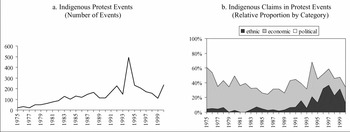
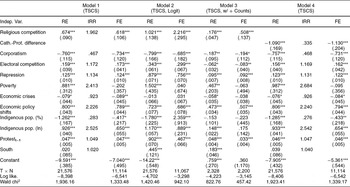
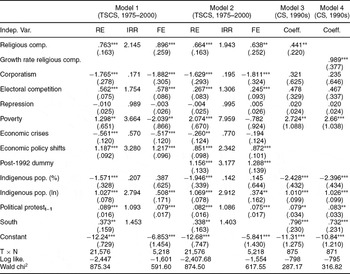



Comments
No Comments have been published for this article.