INTRODUCTION
Numerous paleoenvironmental records from the circum-Caribbean have identified drought as a major influence on prehistoric civilizations of the region (Haug et al., Reference Haug, Günther, Peterson, Sigman, Hughen and Aeshlimann2003; Peterson and Huag, Reference Peterson and Huag2006; Gill et al., Reference Gill, Mayewski, Nyberg, Haug and Peterson2007; Lane et al., Reference Lane, Horn, Mora and Orvis2009, Reference Lane, Horn and Kerr2014; Stahle et al., Reference Stahle, Villaneuva Diaz, Burnette, Cerano Paredes, Heim, Fye, Acuna Soto, Therrell, Cleaveland and Stahle2011; Kennett et al., Reference Kennett, Breitenbach, Aquino, Asmerom, Awe, Baldini, Bartlein, Culleton, Ebert and Jazwa2012; Luzzadder-Beach et al., Reference Luzzadder-Beach, Beach and Dunning2012; Rodríguez-Ramírez et al., Reference Rodríguez-Ramírez, Caballero, Roy, Ortega, Vázquez-Castro and Lozano-García2015). These droughts, including the well-documented Terminal Classic Drought (TCD) from 1200–850 cal yr BP that corresponds with the collapse of the Maya civilization ~1200 cal yr BP, are hypothesized to have resulted from changing Intertropical Convergence Zone (ITCZ) dynamics that led to reduced regional precipitation totals, particularly during the wet season (Bhattacharya et al., Reference Bhattacharya, Chiang and Cheng2017). The area affected by these late Holocene droughts extended beyond the seasonally arid regions of central Mexico and the Mayan lowlands to more humid areas of southern Central America and the Caribbean (Lane et al., Reference Lane, Horn and Kerr2014).
Laguna Zoncho, a small lake in southern Pacific Costa Rica, offers a unique opportunity to study the effects of drought because of the numerous and detailed paleoenvironmental records that exist at the site. Clement and Horn (Reference Clement and Horn2001) recovered a core from the lake in 1997 and performed pollen and microscopic charcoal analyses. Their 3200-year pollen record showed that maize agriculture occurred at Laguna Zoncho for at least the past 3200 years and agricultural activities transformed the surrounding vegetation from premontane forest to an environment dominated by grasses and other weedy species. Lane et al. (Reference Lane, Horn and Mora2004) refined this record with bulk sediment stable carbon isotope analysis. Consistent with the pollen record, the δ13Cbulk data showed that C4 vegetation was more prevalent in the watershed during periods of prehistoric maize agriculture. Further confirming the importance of prehistoric agriculture at Laguna Zoncho, Filippelli et al. (Reference Filippelli, Souch, Horn and Newkirk2010) examined the geochemical fractions of phosphorus (P) in the sediments. For the first 2700 years of the record, the phosphorus fractions varied between 10–20% occluded P, 35–50% mineral P, and 30–50% organic P. Shortly after 500 cal yr BP, occluded P increased at the expense of organic and mineral P. Filippelli et al. (Reference Filippelli, Souch, Horn and Newkirk2010) interpreted this shift as the result of agricultural abandonment in the watershed. Haberyan and Horn (Reference Haberyan and Horn2005) performed diatom analyses on the 1997 core, which showed the effects of agriculture on lake productivity. During periods of intense agriculture, the lake became more acidic due to increased inputs from the watershed. Diatom assemblages also indicated that lake levels were lower from 1060–530 cal yr BP, a shift interpreted as evidence that Laguna Zoncho was also responding to changes in regional climate (this and all date ranges for proxies in the 1997 core are adjusted to reflect a new age model presented in this paper). Wu et al. (Reference Wu, Porinchu and Horn2017), who analyzed chironomids in the 1997 Laguna Zoncho core, provided additional insights into past climate. Their chironomid-based temperature reconstruction revealed mean annual air temperatures warmer than the late Holocene average from 2750–1240 cal yr BP and cooler than average from 460–90 cal yr BP. In addition, Wu et al. (Reference Wu, Porinchu and Horn2017) interpreted a dearth of chironomids in sediments deposited between 1240 and 880 cal yr BP as evidence of a very low lake level brought about by much drier conditions.
Laguna Zoncho was cored again in 2007, when a network of six sediment cores were recovered to create a spatially explicit record of agricultural impacts using palynological and bulk geochemical proxies (Taylor et al., Reference Taylor, Horn and Finkelstein2013a, Reference Taylor, Horn and Finkelstein2015). Consistent with earlier work, the suite of indicators showed that sediments throughout the lake basin were affected by agriculture, with evidence of forest clearance, greater erosion, and slightly increased productivity in all cores. Comparisons between cores recovered from near the shore and a core from the center of the lake revealed the center core lags approximately 100 years behind the outer cores as sediment reworking processes transported material to the center of the lake. Both the geochemical proxies described in Taylor et al. (Reference Taylor, Horn and Finkelstein2015) and the maize pollen concentrations in the same network of cores (Taylor et al., Reference Taylor, Horn and Finkelstein2013b) indicated that the core at the center of the lake represented an average of basin-wide inputs. The high-resolution records from the 2007 cores also provided information on the connections between agriculture and climate. Taylor et al. (Reference Taylor, Horn and Finkelstein2013a) used bulk sedimentary stable carbon isotope (δ13Cbulk) and organic content to better define two periods of agricultural decline from 1060–920 cal yr BP and 830–640 cal yr BP. The timing of this decline is important because it predates the arrival of the Spanish to the region (Fernández Guardia, Reference Fernández Guardia and Van Dyke1913) and implies that the Conquest was not the reason for agricultural abandonment at Laguna Zoncho. While these periods of agricultural decline correspond temporally with droughts in central Mexico (Stahle et al., Reference Stahle, Villaneuva Diaz, Burnette, Cerano Paredes, Heim, Fye, Acuna Soto, Therrell, Cleaveland and Stahle2011), bulk sedimentary proxies, influenced by multiple environmental variables beyond precipitation, cannot be used to definitively identify drought signatures at Laguna Zoncho.
Compound-specific techniques, such as the analysis of n-alkanes extracted from lake sediments, offer significant advantages over bulk analysis because they can distinguish between autochthonous and allochthonous organic matter and contain nonexchangeable hydrogen. Long-chain, odd-numbered alkanes are established biomarkers for terrestrial vegetation (Diefendorf and Freimuth, Reference Diefendorf and Freimuth2017). In their extensive methodological review, Sachse et al. (Reference Sachse, Billault, Bowen, Chikaraishi, Dawson, Feakins, Freeman, Magill, McInerney and Van Der Meer2012) documented the sensitivity of δ2H values of terrestrially derived alkanes (δ2Halkane) to changes in meteoric δ2H and evapotranspiration. While strictly quantitative reconstructions of precipitation variability using the δ2Halkane alkane proxy are precluded by species-specific fractionation of 2H during lipid biosynthesis, semiquantitative assessments of relatively arid vs. wet periods in δ2Halkane time series are feasible. In tropical locales, increased aridity generally results from lower rainfall totals and increases in evapotranspiration to precipitation ratios, both of which are processes that result in increased δ2Halkane values in terrestrial vegetation (Garcin et al., Reference Garcin, Schwab, Gleixner, Kahmen, Todou, Séné, Onana, Achoundong and Sachse2012; Douglas et al., Reference Douglas, Pagani, Canuto, Brenner, Hodell, Eglinton and Curtis2015).
In this paper, we present a δ2Halkane record from Laguna Zoncho, Costa Rica, that spans the past 3600 years. In conjunction with stable carbon isotope (Taylor et al., Reference Taylor, Horn and Finkelstein2013a, Reference Taylor, Horn and Finkelstein2015) and pollen data from Laguna Zoncho (Clement and Horn, Reference Clement and Horn2001), our δ2Halkane records indicate that southern Pacific Costa Rica experienced drought coincident with the TCD in the Yucatan, which resulted in agricultural decline.
STUDY SITE
Physical setting
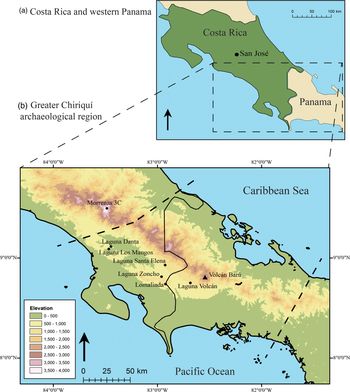
Laguna Zoncho, at 8.8121°N, 82.9607°W, 1190 m asl (Horn and Hayberyan, Reference Horn, Hayberyan and Kappelle2016), is situated in southern Pacific Costa Rica (Fig. 1). The lake is small (0.75 ha) and generally shallow, with a maximum depth of 4.3 m at the time of coring in 2007. However, water depth varies considerably, and we have observed lake levels as low as 2.3 m. Laguna Zoncho formed from slumping, faulting, or a combination of these processes, and has no inlet or outlet streams. Water in the lake has a near neutral pH (7.37) and is quite fresh, with an alkalinity of 12 mg l-1 (Horn and Haberyan, Reference Horn, Hayberyan and Kappelle2016). Vegetation surrounding the lake is classified as premontane rainforest, according to the Holdridge bioclimatic classification (Hartshorn, Reference Hartshorn and Janzen1983), though most modern forests in the area have been heavily disturbed by human activities. The nearest meteorological station, located at Lomalinda, approximately 9 km south-southeast of the lake, indicates a mean annual temperature of approximately 20.5°C and mean annual rainfall totals of approximately 3300 mm. Precipitation in the region is highly seasonal, with 88% of precipitation at the Lomalinda station occurring between May and November. This pattern is primarily controlled by the seasonal migration of the ITCZ, with a pronounced wet period during the Northern Hemisphere summer when the northerly position of the ITCZ brings moisture-laden, westerly flows to Pacific Costa Rica (Lachniet et al., Reference Lachniet, Burns, Piperno, Asmerom, Polyak, Moy and Christenson2004; Poveda et al., Reference Poveda, Waylen and Pulwarty2006). Within this wet period, there is often a brief midsummer drought during July and August (Poveda et al., Reference Poveda, Waylen and Pulwarty2006).
(color online) (a) Map of Costa Rica and western Panama. (b) Location of Laguna Zoncho and other sites referenced herein. The Greater Chiriquí archaeological region is indicated by the heavier dashed lines.

Interannual variability in precipitation is controlled by a host of factors, including regionally prevalent atmospheric oscillations, such as the El Niño Southern Oscillation (ENSO), and sea surface temperatures in the Pacific and Caribbean adjacent to Costa Rica. In general, positive (negative) ENSO conditions create drier (wetter) conditions in Pacific Costa Rica (Lachniet et al., Reference Lachniet, Burns, Piperno, Asmerom, Polyak, Moy and Christenson2004; Poveda et al., Reference Poveda, Waylen and Pulwarty2006). An analysis of ENSO-related drought in Mexico found that conditions in the equatorial Pacific, specifically increased subsidence and weakened southeasterly winds, were responsible for reduced precipitation (Bhattacharya and Chiang, Reference Bhattacharya and Chiang2014). The mechanisms that control latitudinal positioning of the ITCZ are complex, with the Walker circulation serving as a teleconnection between the Atlantic and the Pacific (Chiang et al., Reference Chiang, Kushnir and Zebiak2000). Analysis of the role of ITCZ dynamics in Mesoamerican droughts indicates that relatively cooler sea surface temperatures in the Atlantic along with a stronger North Atlantic subtropical high result in a more southerly position of the ITCZ (Bhattacharya et al., Reference Bhattacharya, Chiang and Cheng2017).
Cultural setting
Archaeologically, Costa Rica is part of the Chibchan–Chocoan Cultural Area, which includes Honduras, Nicaragua, Costa Rica, Panama, western Venezuela, western Columbia, and western Ecuador. Cultures in this region did not demonstrate the elaborate hierarchies found in Mesoamerican and Andean civilizations, and small chiefdoms were the rule with little development of larger states (Sheets, Reference Sheets and Lange1992). The Chibchan–Chocoan Cultural Area is divided into region and subregions. Laguna Zoncho lies in the Greater Chiriquí region (consisting of southern Pacific Costa Rica and western Panama) and the Diquís subregion (the portion in Costa Rica).
The human history of the Diquís subregion extends back thousands of years (Sánchez and Rojas, Reference Sánchez and Rojas2002; Soto and Gómez, Reference Soto and Gómez2002; Anchukaitis and Horn, Reference Anchukaitis and Horn2005; Palumbo, Reference Palumbo2009; Sánchez, Reference Sánchez2013). The two most recent pre-Contact archaeological periods are the Aguas Buenas period and the Chiriquí period (Fig. 2). The onset of the Agua Buenas period is still under debate (Anchukaitis and Horn, Reference Anchukaitis and Horn2005) but likely occurred between 500 BC (2450 cal yr BP) and AD 200 (1750 cal yr BP). The Aguas Buenas period was characterized by small, dispersed populations that were not integrated (Hoopes, Reference Hoopes and Lange1996), contributing to the heterogeneity of this spatially and temporally expansive period. There is also considerable debate regarding the role of agriculture during this period (Anchukaitis and Horn, Reference Anchukaitis and Horn2005). Some authors (e.g., Linares and Sheets, Reference Linares, Sheets, Linares and Ranere1980) argue that maize and beans were farmed intensely, while others (e.g., Drolet, Reference Drolet and Lange1988) contend that gathering was still the primary source of subsistence. Paleoecological evidence, in the form of maize pollen grains preserved in lake sediments, from the Diquís subregion indicates that maize was cultivated through the Aguas Buenas period (Horn, Reference Horn, Staller, Tykot and Benz2016). Maize pollen grains are present in sediments dated to 1800 cal yr BP at Laguna Volcán in western Panama (Behling, Reference Behling2000) and in sediments dated to 1780 cal yr BP at Laguna Santa Elena in southern Pacific Costa Rica (Anchukaitis and Horn, Reference Anchukaitis and Horn2005; Kerr et al., Reference Kerr, Horn and Lane2019). The Laguna Zoncho sediment record contains evidence of maize at 3200 cal yr BP (Clement and Horn, Reference Clement and Horn2001), just slightly younger than the first maize pollen found at ~3360 cal yr BP at the lower elevation site of Laguna Los Mangos (Johanson et al., Reference Johanson, Horn and Lane2019).
Timeline of archaeological periods and major events at Laguna Zoncho.

The Chiriquí period, which began ~ AD 800 (1150 cal yr BP) and ended with the arrival of the Spanish, was characterized by more complex, hierarchical societies with larger population centers (Anchukaitis and Horn, Reference Anchukaitis and Horn2005). The role of maize agricultural in this transition has been debated. Corrales (Reference Corrales, Quintanilla and Barrantes1988) argued that increasing agricultural production catalyzed the cultural changes that marked the onset of the Chiriquí period, while Hoopes (Reference Hoopes and Lange1996) pointed out that increased maize agriculture may have resulted from increased societal complexity. An expedition by Juan Vásquez de Coronado in AD 1562–1563 reported extensive gardens and large-scale agricultural fields growing maize, beans, and fruit (Fernández Guardia, Reference Fernández Guardia and Van Dyke1913). Coronado also described a series of fortifications, conflicts between different groups, and fierce resistance from the native populations, demonstrating considerable social conflict before the arrival of the Spanish. After the Conquest, the region remained lightly settled until the completion of the Inter-American highway in 1946.
Within the Laguna Zoncho catchment, archaeological sites provide evidence of human occupation. Laurencich de Minelli and Minelli (Reference Laurencich de Minelli and Minelli1966) excavated cemeteries on hilltops near the lake that contained artifacts interpreted to be from both the Aguas Buenas and the Chiriquí periods. Soto and Gómez (Reference Soto and Gómez2002) found lithics and ceramics that date to the Aguas Buenas period on the lakeshore as well as a structure of boulders thought to date to the late Chiriquí period.
MATERIALS AND METHODS
We recovered the sediment core analyzed here (core 6) from Laguna Zoncho in June 2007 (Fig. 3), using a Colinvaux-Vohnout locking piston corer (Colinvaux et al., Reference Colinvaux, de Oliveira and Moreno1999). The core site was located in the middle of the lake, near our 1997 core site. We collected overlapping, parallel cores (6A and 6B) to ensure complete recovery and matched the cores based on stratigraphy and comparisons with the 1997 core. Core 6A was approximately 3 m long, and core 6B was approximately 2 m long. After collection, the core sections were returned to the University of Tennessee in their original aluminum coring tubes, where they were opened, described, photographed, and stored at 4°C. The 6A and 6B cores were previously sampled for δ13Cbulk analysis and other geochemical analyses at 1 cm intervals (Taylor et al., Reference Taylor, Horn and Finkelstein2015).
Map showing the approximate location of the 1997 core and the 2007 core within Laguna Zoncho and the surrounding areas. The dashed lines are unpaved roads.

Chronological control for the 2007 core is provided by three AMS radiocarbon dates (Table 1) and the Barú tephra (Behling, Reference Behling2000). For the tephra layer, we used the date of 500 ± 60 14C yr BP obtained from lake sediments immediately below the Barú tephra at Laguna Volcán (Behling, Reference Behling2000). We excluded the UGAMS-04555 date because it predates the formation of the lake. The age model for the 1997 core includes the Barú tephra, three AMS dates from the 1997 core, and the AA-94893 date on the initiation of lake formation in the 2007 core, which we stratigraphically matched to the 1997 core. We chose to use CLAM software (Blaauw, Reference Blaauw2010) to calibrate the radiocarbon dates using the Intcal13 dataset of Reimer et al. (Reference Reimer, Baillie, Bard, Bayliss, Beck, Bertrand and Blackwell2004) and create an age-depth model. As noted by Kerr et al. (Reference Kerr, Horn and Lane2019), the linear interpolation approach used by CLAM better suits lakes, such as Laguna Zoncho, with variable inputs due to human impacts than more sophisticated Bayesian approaches, such as that used by BACON (Blaauw and Christen, Reference Blaauw and Christen2011), that tend to create overly smooth age-depth curves that are less sensitive to rapid fluctuations in sedimentation rate.
Radiocarbon determinations from the Laguna Zoncho cores.

a Letters before the lab numbers denote samples processed at the University of Georgia Center for Applied Isotope Studies (UGAMS), Beta Analytic, Inc. (Beta), and the Accelerator Mass Spectrometry Laboratory at the University of Arizona (AA).
b Depths reported differ slightly from Taylor et al. (Reference Taylor, Horn and Finkelstein2015) because they are based on a new depth model for core 6.
c This date was excluded from the age model.
d This date from the 2007 core was also used in the age model for the 1997 core, at 293 cm depth.
For n-alkane analyses, we lyophilized 22 sediment samples and ground them to a fine powder with a mortar and pestle. The dried sediment samples were solvent-extracted three times using an accelerated solvent extraction system (ASE 350, Dionex, California, U.S.A.) with a 1:1 (v/v) mixture of dichloromethane and methanol at 125°C, at a pressure of 1500 psi for 10 min. We base-saponified the total lipid extract with 1.0 N KOH in 4:1 (v/v) MEOH:H2O for 2 h at 80°C and extracted the total lipids using hexane. We isolated the aliphatic fraction of the total lipid extract using silica column chromatography, with hexane as the eluting solvent, and isolated straight-chain monomers from branched and cyclic compounds in the aliphatic fraction using urea adduction.
We conducted compound-specific hydrogen and carbon isotope analyses of n-alkanes using a Thermo Delta V plus mass spectrometer interfaced with a Thermo 1310 gas chromatograph via an Isolink II device. Injections on the gas chromatograph were performed in splitless mode at 300°C. We used a TG-5 SILMS silica column (60 m, 0.25 mm i.d., 0.25 mm film thickness) with an oven temperature program of 70°C isothermal for 1 min, 20°C/min to 180°C, 4°C/min to 320°C, 320°C isothermal for 5 min, 30°C/min to 350°C, and 350°C isothermal for 1 min. We injected alkane standards (Indiana University mixture B4) following every third sample to monitor sample precision. We analyzed all samples in duplicate, corrected data to the VPDB or VSMOW scales using the Indiana University mixture B4 standard, and calculated standard error propagation using the methods of Polissar and D'Andrea (Reference Polissar and D'Andrea2014).
Using the approach of Feakins (Reference Feakins2013), we estimated the mean annual value δ2H of paleoprecipitation (δ2HMAP_reconstructed) used by terrestrial vegetation from the δ2H of n-C29 alkanes. Following Feakins (Reference Feakins2013), we corrected for varying apparent isotopic fractionations (ε) between precipitation and leaf waxes due to vegetation isotope effects, an important factor at Laguna Zoncho because of the vegetation changes caused by agricultural activities (Clement and Horn, Reference Clement and Horn2001; Lane et al., Reference Lane, Horn and Mora2004; Taylor et al., Reference Taylor, Horn and Finkelstein2015). We incorporated relative C3 vs. C4 plant abundance from n-alkane δ13C analyses using an end-member mixing model and used pollen data to make this correction. We modified our mixing model to account for the different production of n-alkanes by woody angiosperms, C3 grasses, and C4 grasses in the tropics as outlined by Lane et al. (Reference Lane, Taylor, Spencer and Jones2018) using the alkane abundances for these plant categories reported by Diefendorf and Freimuth (Reference Diefendorf and Freimuth2017). To estimate δ2HMAP_reconstructed, we subtracted a correction factor, εcoor, which is the apparent hydrogen isotope fractionation between n-alkanes from the terrestrial vegetation that contributes to the sedimentary organic carbon pool and mean annual precipitation, using the equation:

We calculated (ɛcoor) as:

where f is the fraction of the total n-C29 alkane pool estimated to have originated from each vegetation type, and associated isotopic values represent the modern ɛn-C29/MAP in the region draw from values in Sachse et al. (Reference Sachse, Billault, Bowen, Chikaraishi, Dawson, Feakins, Freeman, Magill, McInerney and Van Der Meer2012). The f values were calculated based on pollen data from Clement and Horn (Reference Clement and Horn2001) and assume relative contributions of n-alkanes and pollen following Feakins (Reference Feakins2013) and account for the differential production of n-alkanes drawn from Diefendorf and Freimuth (Reference Diefendorf and Freimuth2017).


To determine the contributions of n-alkanes from C3 and C4 grasses, we used this two end-member mixing model:

and:

Based on data from Diefendorf and Freimuth (Reference Diefendorf and Freimuth2017), we assigned the C3 end-member a δ13Calkane value of –35‰ and the C4 end-member a value of –20‰.
Methods for determining bulk sediment stable carbon isotopes are detailed in Taylor et al. (Reference Taylor, Horn and Finkelstein2013a, Reference Taylor, Horn and Finkelstein2015). Pollen analysis methods are summarized in Clement and Horn (Reference Clement and Horn2001).
RESULTS
The 1997 and 2007 cores show evidence of lake formation ~3300 cal yr BP (Table 1) and contain a 1- to 1.5-cm-thick deposit of the Barú tephra. Prior to lake formation, the recovered material is weathered regolith. After lake formation, both cores consist of fine-grained sediments that are relatively low in organic content during times of maize agriculture because of increased erosion and are relatively more organic after forest recovery. Age-depth models show a similar pattern of sediment deposition in the two cores (Fig. 4).
(color online) Age-depth models prepared using CLAM (Blaauw, Reference Blaauw2010) for the Laguna Zoncho 1997 core and 2007 core.

The n-C29 alkane δ2H and the δ2HMAP_reconstructed values vary by 45‰ and 33.8‰, respectively, through the 2007 core (Fig. 5). The two lowermost n-C29 alkane δ2H samples (3550 to 3400 cal yr BP), which predate lake formation, have the most positive values of the entire record (δ2HMAP_reconstructed values were not calculated for these samples because they predate the pollen record). Both the n-C29 alkane δ2H and the δ2HMAP_reconstructed values gradually become less enriched upcore and reach their most positive values ~1930 cal yr BP. There is another large positive excursion in both the n-C29 alkane δ2H and the δ2HMAP_reconstructed values from 1080–920 cal yr BP. The n-C29 alkane δ2H values also show a positive excursion ~ 410 cal yr BP (these data points were not corrected because n-C29 alkane δ13C values were not available for these samples).
(color online) n-C29 alkane δ2H, ε2Hn-C29/MAP, and δ2HMAP_reconstructed data are from this study, bulk δ13C values are from Taylor et al. (Reference Taylor, Horn and Finkelstein2013a), pollen and charcoal data are from Clement and Horn (Reference Clement and Horn2001), and the Ti record is from Haug et al. (Reference Haug, Houghen, Sigman, Peterson and Rohl2001). Error bars represent one standard deviation of replicate analysis. The C:P (charcoal:pollen) ratio includes all fragments >5 μm in longest dimension tallied during pollen counts.

DISCUSSION
δ2Halkane signatures of drought at Laguna Zoncho
In tropical environments, such as those of southern Pacific Costa Rica, alkane-derived δ2H values have been shown to be useful paleohydrologic proxies (Garcin et al., Reference Garcin, Schwab, Gleixner, Kahmen, Todou, Séné, Onana, Achoundong and Sachse2012; Lane et al., Reference Lane, Horn and Kerr2014, Reference Lane, Taylor, Spencer and Jones2018). δ2Halkane values in lake sediments are the result of several factors, including the isotopic composition of precipitation, evapotranspiration, and biological processes (Sachse et al., Reference Sachse, Billault, Bowen, Chikaraishi, Dawson, Feakins, Freeman, Magill, McInerney and Van Der Meer2012). At Laguna Zoncho, estimated modern precipitation δ2H values range from -23‰ during the dry season in March to -69‰ during the monsoon in July, with an annual mean of -60‰ (Bowen and Revenaugh, Reference Bowen and Revenaugh2003; IAEA/WMO, 2015; Bowen, Reference Bowen2019). This pattern is largely a result of the “amount effect,” where δ2H values are inversely correlated to the amount of rainfall (Lachniet et al., Reference Lachniet, Burns, Piperno, Asmerom, Polyak, Moy and Christenson2004). Evapotranspiration is also an important control on δ2Halkane values, with greater moisture stress resulting in increased δ2H values. In conjunction, these two factors make alkane-derived δ2H measurements a useful proxy of water stress, particularly when they are combined with pollen and other vegetation indicators to control for species-specific fractionations (Feakins, Reference Feakins2013).
For nearly all the record, δ2HMAP_reconstructed paleoprecipitation values at Laguna Zoncho are more positive than modern δ2HMAP. This is likely because δ2HMAP_reconstructed values reflect plant available water (Sachse et al., Reference Sachse, Billault, Bowen, Chikaraishi, Dawson, Feakins, Freeman, Magill, McInerney and Van Der Meer2012). Such water, which includes the vadose and phreatic zones, is mixed and evaporated before it is incorporated into plant tissues (Sachse et al., Reference Sachse, Billault, Bowen, Chikaraishi, Dawson, Feakins, Freeman, Magill, McInerney and Van Der Meer2012). As pointed out by Feakins et al. (Reference Feakins, Bentley, Salinas, Shenkin, Blonder, Goldsmith, Ponton, Arvin, Wu and Peters2016), the fractionations between plant available water and leaf water change seasonally. Tropical plants produce leaves continually and leaf waxes are synthesized soon after leaf formation, so the seasonal nature of precipitation at Laguna Zoncho may also contribute to the positive shift in δ2HMAP_reconstructed. The annual mean δ2HMAP is strongly affected by the large amount of summer precipitation, which is isotopically lighter, but δ2HMAP_reconstructed reflects the water the plants are using throughout the year, much of which is considerably isotopically heavier than the summer rains.
Another challenge posed by the use of n-alkane δ2H data is the issue of pre-aging of n-alkanes prior to their deposition in lake sediments. Compound-specific radiocarbon dating of lake sediments by Douglas et al. (Reference Douglas, Pagani, Eglinton, Brenner, Hodell, Curtis, Ma and Breckenridge2014) and Gierga et al. (Reference Gierga, Hajdas, van Raden, Gilli, Wacker, Sturm, Bernasconi and Smittenberg2016) revealed significant differences between the ages of terrestrial biomarkers, such as n-alkanes, and the surrounding sediment. While the controls on this process are likely complex, this delay is thought to be the result of organic matter residing in soil carbon pools prior to deposition into the lake sedimentary organic matter pool. Douglas et al. (Reference Douglas, Pagani, Eglinton, Brenner, Curtis, Breckenridge and Johnston2018) compared the ages of leaf waxes in soils and sediments at three lakes in the Maya lowlands and concluded that the mean soil transit time of leaf waxes from soil to sediment was up to 2500 years. Their data also indicated that forest clearance and prehistoric maize agriculture dramatically reduced soil transit time for leaf waxes. The declines, which ranged from 800–2300 years, were temporally coincident with periods of deforestation caused by Mayan agricultural activities. Lane et al. (Reference Lane, Horn, Taylor and Kerr2016) investigated the issue of pre-aging by comparing bulk sediment δ13C and n-alkane δ13C values and found good temporal correspondence between the two variables at Laguna Castilla, a small (1.5 ha), mid-elevation lake in the Dominican Republic with an extensive history of prehistoric agriculture in the catchment. Climate, geology, and geomorphology can contribute to the large amount of variability in n-alkane pre-aging (Douglas et al., Reference Douglas, Pagani, Eglinton, Brenner, Curtis, Breckenridge and Johnston2018), but human land use seems to accelerate soil to sediment transfer of soil leaf waxes.
Laguna Zoncho and Laguna Castilla are similar in terms of lake size, watershed size, and are surrounded by relatively steep slopes. This arrangement likely creates a situation in which the lakes are tightly coupled to their watersheds, with sediments rapidly responding to conditions in the catchment. Agriculture would increase this connection if agricultural residues make up a significant portion of organic material incorporated into the sediments. Laguna Zoncho has been the site of agricultural activities since the formation of the lake, perhaps reducing the amount of old soil carbon in the watershed. Taken together, along with the agreement between the n-alkane and δ13Cbulk records, it seems likely that biomarkers are deposited near contemporaneously with bulk sediment at Laguna Zoncho.
Paleohydrology of Laguna Zoncho from δ2Halkanes
Based on agricultural indictors, Taylor et al. (Reference Taylor, Horn and Finkelstein2015) identified three stratigraphic zones across five cores recovered from Laguna Zoncho in 2007. Zone 1 (2000–1000 cal yr BP) was dominated by agricultural signals; Zone 2 (1000–675 cal yr BP) was a transitional period during which agriculture declined; and Zone 3 (675 cal yr BP–present) was the post-agricultural period. The core 6 record we present here is longer than previously reported, spanning the past 3600 years. δ13Cbulk and pollen data indicate that agricultural intensity is an important driving force through the record so we kept the same general zonation scheme as Taylor et al. (Reference Taylor, Horn and Finkelstein2015) but divided Zone 1 (3600–1000 cal yr BP) into three parts.
Zone 1A (3600–2800 cal yr BP)
Zone 1A comprises the period 400 years before and after lake formation. While pollen data are only available for the upper portion of the zone, bulk sediment δ13C data indicate that much of the organic matter during this time originated in C4 vegetation, suggesting that agriculture was occurring throughout the zone. Maize pollen grains found in sediments from the 1997 core date to 3200 cal yr BP (Clement and Horn, Reference Clement and Horn2001), so agriculture was certainly present after that date. In Zone 1A, the n-alkane δ2H and δ2HMAP_reconstructed values are strongly positive, especially at the beginning of the core. The open environment brought on by forest clearance may have created locally drier conditions through enhanced sun exposure and evapotranspiration. However, Rosenmeier et al. (Reference Rosenmeier, Hodell, Brenner, Curtis and Guilderson2002) argued that anthropogenic deforestation can increase soil moisture residence times by reducing transpiration rates. The chironomid-based temperature record (Wu et al., Reference Wu, Porinchu and Horn2017) also begins at 3200 cal yr BP and indicates relative warm conditions during this time.
Zone 1B (2800–1700 cal yr BP)
More negative δ13C values, increased tree pollen, and lower charcoal: pollen ratios in Zone 1B indicate a reduction of agricultural activity. δ2HMAP_reconstructed values are more negative than average for Zone 1, particularly ~1930 cal yr BP, when they reach their most negative value in the entire record. The gradual negative shift in the δ2HMAP_reconstructed data in Zone1B is coincident with an increase in C4 vegetation and decline in tree pollen toward the top of the zone. The temperature reconstruction from chironomids indicates relatively warm conditions during this time, particularly ~1800 cal yr BP. Regardless of temperature, it appears that moisture increases during this time were sufficient to overwhelm any local drying resulting from forest clearance and warmer conditions ~1800 cal yr BP.
Zone 1C (1700–1000 cal yr BP)
Zone 1C shows evidence of intensive agricultural activity, with very positive δ13CTOC values, decreased tree pollen, and increased grass pollen. Maize pollen grains were found consistently in the sediment (Clement and Horn, Reference Clement and Horn2001), and charcoal: pollen ratios are high. Diatom data (Haberyan and Horn, Reference Haberyan and Horn2005) and geochemical indicators, specifically total organic content and total nitrogen δ15N (Taylor et al., Reference Taylor, Horn and Finkelstein2015), indicate that terrestrial inputs were high. Two large positive peaks (-18.4‰ and -17.9‰) in δ13CTOC occur at 1185 and 1125 cal yr BP, respectively, indicating that almost 90% of sedimentary organic matter inputs resulted from C4 vegetation for brief periods.
δ2HMAP_reconstructed values begin relatively negative in Zone 1C, but there is a large positive excursion ~1180 cal yr BP that is temporally coincident with the TCD. This is consistent with the chironomid record from the Zoncho 1997 core, in which head capsule counts dropped, possibly because of lower water levels during this period (Wu et al., Reference Wu, Porinchu and Horn2017). It is difficult without a modern alkane δ2H calibration dataset from Costa Rica to quantify the severity of this drought at Laguna Zoncho, but data from the northern neotropics (Douglas et al., Reference Douglas, Pagani, Canuto, Brenner, Hodell, Eglinton and Curtis2015) indicate that the approximate 35‰ increase in δ2HMAP_reconstructed is consistent with a 60% increase in the aridity index (mean annual precipitation/potential evapotranspiration). This figure is a crude estimate at best, but clearly Laguna Zoncho experienced a severe drought event during the TCD.
The δ2HMAP_reconstructed data also support the hypothesis of Taylor et al. (Reference Taylor, Horn and Finkelstein2013a), based on correspondence with records in Mexico and Panama (Lachniet et al., Reference Lachniet, Burns, Piperno, Asmerom, Polyak, Moy and Christenson2004; Stahle et al., Reference Stahle, Villaneuva Diaz, Burnette, Cerano Paredes, Heim, Fye, Acuna Soto, Therrell, Cleaveland and Stahle2011), that agricultural decline at Laguna Zoncho was related to drought. Laguna Zoncho currently receives more than 3 m of precipitation per year, so even a 60% increase in the aridity index would not necessarily have caused moisture stress. However, as pointed out by Taylor et al. (Reference Taylor, Horn and Finkelstein2013a), changes to the ITCZ could have delayed the arrival of summer rains and extended the dry season, which may have increased the chances of crop failure. While the first Spanish who arrived reported agricultural activities in the area (Fernández Guardia, Reference Fernández Guardia and Van Dyke1913), the paleoenvironmental record from Zoncho shows that agricultural activity declined notably shortly after the TCD, indicating that stress brought on by regional droughts may have been a driving force behind population decline. Interestingly, the spatially explicit record presented by Taylor et al. (Reference Taylor, Horn and Finkelstein2015) indicated that agricultural decline began well before the peak of the TCD. Cores from closer to the edge of the lake recorded more negative δ13CTOC values at 1400, 1100, 1000, and 800 cal yr BP. This pattern may indicate a gradual abandonment of fields in different parts of the watershed, as drought conditions, shown by progressively increasing δ2HMAP_reconstructed values, worsened at Laguna Zoncho.
Zone 2 (1000–675 cal yr BP)
Zone 2 represents a transitional period at Laguna Zoncho, when agriculture had significantly decreased and forest regrowth was occurring. The high-resolution, spatially-explicit δ13C data from Taylor et al. (Reference Taylor, Horn and Finkelstein2013a, Reference Taylor, Horn and Finkelstein2015) indicated that agricultural abandonment began as early as 1400 cal yr BP in some parts of the basin, and that agriculture largely ended between 1000 and 800 cal yr BP. After their peak during the TCD, δ2HMAP_reconstructed values steadily decrease in this zone, indicating relatively moist conditions. Substantial vegetation changes were occurring in the watershed during this time as agricultural clearing gave way to forest. However, forest regrowth, and its appearance in the pollen and sediment records, are likely not synchronous. Mueller et al. (Reference Mueller, Islebe, Anselmetti, Ariztegui, Brenner, Hodell, Hajdas, Hamann, Haug and Kennett2010) reported that soil stabilization required 120–280 years, and forest regrowth needed between 80 and 260 years, after agriculture ended at Lake Petén Itzá, Guatemala. At Laguna Zoncho, the pollen record indicates that forest regrowth did not begin until after 600 cal yr BP. As a small lake, Laguna Zoncho sediments are expected to respond quickly to soil stabilization, but it likely took some time for forest vegetation to be reestablished. It is possible that as reforestation progressed, evaporative stress on the vegetation decreased, partially explaining the more negative δ2HMAP_reconstructed values from 1000–790 cal yr BP. While forest clearance is likely to be a factor within the watershed, widespread land clearance may have also played a role in worsening regional drought conditions, a proposed explanation for the severity of drought in the Maya lowlands (Kennett and Beach, Reference Kennett and Beach2013; Beach et al., Reference Beach, Luzzadder-Beach, Cook, Dunning, Kennett, Krause, Terry, Trein and Valdez2015).
Zone 3 (675 cal yr BP–present)
In Zone 3, human impacts on the landscape from agriculture had largely ended. The relatively negative bulk sediment δ13C values, along with the increase in tree pollen at the expense of grasses, indicate forest recovery over a period of 100 years. Charcoal:pollen ratios also decrease dramatically in this zone. The n-alkane δ2H data show a large positive excursion ~ 400 cal yr BP. The severity of this drought, which occured during the Little Ice Age (LIA), is comparable to the TCD, indicating very dry conditions at Laguna Zoncho. During the LIA, the chironomid record indicates that temperatures were approximately 1.3°C cooler than the late Holocene average (Wu et al., Reference Wu, Porinchu and Horn2017). Pollen data (Clement and Horn, Reference Clement and Horn2001) indicate that the drought did not strongly affect watershed vegetation. However, despite cooler temperatures that would have reduced evapotranspiration, the n-alkane δ2H data show that the vegetation in the watershed experienced moisture stress.
This zone also contains the Barú tephra layer, approximately 1 cm thick in the 2007 core. As would be expected, the tephra layer reduced %OC (Taylor et al., Reference Taylor, Horn and Finkelstein2015) but did not noticeably affect other geochemical indicators.
Comparisons with regional records
The deepest sediments from Laguna Zoncho, spanning the period 3600–2800 cal yr BP, indicate extremely dry conditions. The Cariaco Basin (Haug et al., Reference Haug, Houghen, Sigman, Peterson and Rohl2001) indicates extremely wet and dry conditions during this period. Approximately 65 km to the northwest, at Laguna Los Mangos, Johanson et al. (Reference Johanson, Horn and Lane2019) reported a large fire event at 3700 cal yr BP, hinting that other locations in Costa Rica may have experienced drought at this time. Complicating climate reconstructions during this time is the adoption of maize agriculture and the attendant alterations of the landscape by 3200 cal yr BP at Laguna Zoncho and 3360 cal yr BP at Laguna Los Mangos.
Following this dry period, conditions from 2000–1400 cal yr BP were relatively mesic, according to our δ2HMAP_reconstructed precipitation values, and warm, based on the chironomid temperature record (Wu et al., Reference Wu, Porinchu and Horn2017). The Cariaco record also shows an increase in moisture (Haug et al., Reference Haug, Houghen, Sigman, Peterson and Rohl2001), indicating this was a regional trend. Like Laguna Zoncho, the climate records from nearby lakes are complicated by the presence of maize agriculture. Agricultural activities were relatively low at Laguna Los Mangos (Johanson et al., Reference Johanson, Horn and Lane2019) through this period but expanded at Laguna Santa Elena (Kerr et al., Reference Kerr, Horn and Lane2019) at 1590 cal yr BP. Interestingly, at Laguna Zoncho, agricultural indicators are near their lowest levels when δ2HMAP_reconstructed values are at their highest. Direct evidence of the TCD and its severity with δ2HMAP_reconstructed analysis at Laguna Zoncho is important regionally. Previous diatom analysis at Zoncho indicated that the lake may be out of phase with the Cariaco record, with the lake experiencing drier conditions from 1020–460 cal yr BP, though drier conditions may have begun slightly earlier (Haberyan and Horn, Reference Haberyan and Horn2005). Chironomid data from Wu et al. (Reference Wu, Porinchu and Horn2017, Reference Wu, Porinchu and Horn2019) disagreed with this interpretation and found dry, and possibly cooler, conditions from ~1340–960 cal yr BP (dates adjusted to reflect the new age-depth model presented in the paper). The δ2HMAP_reconstructed data are more consistent with the chironomid record and indicate that Laguna Zoncho was strongly affected by the TCD, especially from 1080–920 cal yr BP.
The TCD affected other locations in southern Costa Rica. Wu et al. (Reference Wu, Porinchu and Horn2019) reported cooler and drier conditions at Morrenas 3C, a high-elevation site on the continental divide, 95 km northwest of Laguna Zoncho, based on chironomid and bulk sediment δ13C analyses. At Laguna Los Mangos in the southern Pacific lowlands, Johanson et al. (Reference Johanson, Horn and Lane2019) found evidence of drying in the form of a 500-year sediment hiatus that began during the TCD. At nearby Laguna Santa Elena, Kerr et al. (Reference Kerr, Horn and Lane2019) found evidence of population collapse at the onset of the TCD ~ 1189 cal yr BP, population reestablishment at 1011 cal yr BP, and then a second collapse at 955 cal yr BP before a permanent reestablishment of agriculture ~ 942 cal yr BP. At Laguna Los Mangos, agricultural activities declined slightly after the TCD but had resumed by 450 cal yr BP. Laguna Zoncho, despite its nearly 2000 years of agriculture, had no such population recovery. Kerr et al. (Reference Kerr, Horn and Lane2019) postulated that populations in this area were relocating to larger population centers as a result of the TCD, and perhaps were maintaining agricultural sites at Laguna Santa Elena and Laguna Zoncho. This could explain the somewhat gradual decline in agriculture at Laguna Zoncho and reduced agriculture at Laguna Santa Elena.
N-alkane δ2H values at Laguna Zoncho show a strong signature of drought from 500 cal yr BP to at least 400 cal yr BP (our sampling resolution is not sufficient in this portion of the core to delineate clearly the end of the dry period). This drought is coincident with dry conditions during the LIA, as is evident in records from the Cariaco Basin (Haug et al., Reference Haug, Günther, Peterson, Sigman, Hughen and Aeshlimann2003), the Yucatan Peninsula (Hodell et al., Reference Hodell, Brenner and Curtis2005), and the highlands of the Dominican Republic (Lane et al., Reference Lane, Horn, Mora and Orvis2009, Reference Lane, Horn, Orvis and Thomason2011). At Zoncho, this LIA drought appears to have been as severe as drought during the TCD but without a strong impact on prehistoric agriculture, as agriculture had largely ended before this time. At Laguna Los Mangos, fire increased at 450 cal yr BP (Johanson et al., Reference Johanson, Horn and Lane2019) and agriculture declined, likely a result both of the arrival of the Spanish and of the cool and dry conditions of the LIA. A charcoal record from Laguna Danta, near Laguna Los Mangos, indicates an increase in fire activity from 550–450 cal yr BP and agricultural decline by the time of the Spanish Conquest (Johanson et al., Reference Johanson, Horn, Lane, Sánchez and Cecil2020). There is a second pulse of fire activity from 350–300 cal yr BP, which Johanson et al. (Reference Johanson, Horn, Lane, Sánchez and Cecil2020) attributed to the arid conditions of the LIA making wildfires more prevalent.
CONCLUSION
We reconstructed δ2HMAP_reconstructed values using the composition of n-alkanes from a sediment core recovered from Laguna Zoncho, Costa Rica. Over the 3600 years of the record, the n-alkane δ2H and δ2HMAP_reconstructed data are sensitive to changes in moisture stress and reveal the presence of several dry periods, most notably during the TCD and LIA. The Laguna Zoncho drought record broadly agrees with regional drought records (Haug et al., Reference Haug, Günther, Peterson, Sigman, Hughen and Aeshlimann2003; Lane et al., Reference Lane, Horn and Kerr2014) and other proxy records from the lake. The severity of the TCD in the δ2Halkane record supports the hypothesis of Taylor et al. (Reference Taylor, Horn and Finkelstein2013a) that drought was a contributing factor to agricultural abandonment in the watershed prior to the arrival of the Spanish.
The numerous studies at Laguna Zoncho also confirm the value of multiple proxy analyses. The combination of pollen (Clement and Horn, Reference Clement and Horn2001), diatom (Haberyan and Horn, Reference Haberyan and Horn2005), high-resolution δ13Cbulk (Taylor et al., Reference Taylor, Horn and Finkelstein2015), chironomid (Wu et al., Reference Wu, Porinchu and Horn2017), and n-alkane analysis (this study) offers a uniquely detailed paleoenvironmental record. This is particularly useful at lakes like Laguna Zoncho, where it is necessary to separate the amalgamated climate and human signals in the sediment record.
ACKNOWLEDGMENTS
Our work was supported by funds from Berry College, the University of North Carolina– Wilmington, and the University of Tennessee. We thank S. Kwon and A. Taylor for help with sediment extractions, and K. Duernberger for assistance with isotopic analyses. Core recovery and previous analyses were funded by NSF grants 0825406 and 0538420 and by the Geological Society of America.