Introduction
The retention of human capital is essential for organizations. High turnover rates are negatively related to organizational performance and cost thousands of dollars in losses every year for organizations (Park & Shaw, Reference Park and Shaw2013; Work Institute, 2018). Understanding what drives individuals to stay in their jobs is imperative to design human resources strategies to retain human capital. Several personal, organizational, and contextual factors induce people to leave and stay in their jobs (Hom, Lee, Shaw, & Hausknecht, Reference Hom, Lee, Shaw and Hausknecht2017). For example, a recent report shows that work characteristics and well-being (e.g., emotional, physical, and family-related aspects) are among the 10 reasons employees value staying in a job (Work Institute, 2018).
Intention to stay refers to the employees' willingness to remain in their current organization (Chew & Chan, Reference Chew and Chan2008), and it is a critical determinant of turnover behavior (Tett & Meyer, Reference Tett and Meyer1993). Work environments that offer job resources will help reduce job demands, achieve goals, and stimulate personal growth, learning, and development to promote employee retention (Schaufeli & Bakker, Reference Schaufeli and Bakker2004). Administrative support, challenging tasks, excellent communication, and work control are factors that support employees' decisions to remain in the current position (Cregård & Corin, Reference Cregård and Corin2019). Similarly, job stressors and work-related attitudes (e.g., employee engagement, job satisfaction, organizational commitment) are critical antecedents for employees to decide to stay in the organization (Podsakoff, LePine, & LePine, Reference Podsakoff, LePine and LePine2007).
According to the Job Demands-Resources Model (JD-R model), job resources, as motivational work features (e.g., skill variety, task variety, and task significance) promote positive psychological states that relate to favorable employees and organizational results (e.g., intention to stay at work) (Bakker & Demerouti, Reference Bakker, Demerouti, Diener, Oishi and Tay2018; Bakker & de Vries, Reference Bakker and de Vries2021; Demerouti, Bakker, & Xanthopoulou, Reference Demerouti, Bakker, Xanthopoulou, Taris, Peeters and De Witte2019; Demerouti, Van den Heuvel, Xanthopoulou, Dubbelt, & Gordon, Reference Demerouti, Van den Heuvel, Xanthopoulou, Dubbelt, Gordon, Copper and Leiter2017; Schaufeli & Bakker, Reference Schaufeli and Bakker2004). These job resources and their consequent positive psychological states support employees' decision to remain in the organization (Humphrey, Nahrgang, & Morgeson, Reference Humphrey, Nahrgang and Morgeson2007; Schaufeli & Bakker, Reference Schaufeli and Bakker2004). These emphasize the importance of creating positive workplaces to attract and retain qualified employees. Based on the JD-R model motivational-driven process, we propose that job resources predict meaningful work, and this, in turn, predicts work engagement. Job resources provide meaning and satisfy employees' basic needs, which lead to increased work engagement (Bakker & Demerouti, Reference Bakker, Demerouti, Diener, Oishi and Tay2018). Meaningful work generally refers to work that is personally significant and worthwhile, has been a primary psychological mechanism associated with motivational work features (Allan, Duffy, & Collisson, Reference Allan, Duffy and Collisson2018; Humphrey et al., Reference Humphrey, Nahrgang and Morgeson2007; Lysova, Allan, Dik, Duffy, & Steger, Reference Lysova, Allan, Dik, Duffy and Steger2019; Schnell, Höge, & Pollet, Reference Schnell, Höge and Pollet2013), and a significant predictor of work engagement (Allan et al., Reference Allan, Batz-Barbarich, Sterling and Tay2019; Hulshof, Demerouti, & Le Blanc, Reference Hulshof, Demerouti and Le Blanc2020; Nel & Linde, Reference Nel, Linde, Nel and Linde2019).
Therefore, it is expected that meaningful work and work engagement are significant psychological mechanisms to explain the relationship between job resources and intention to stay at work. This work contributes to the literature in two ways: (1) it integrates meaningful work as a psychological mechanism to explain work engagement based on the motivational process of the JD-R model; (2) and it examines the fundamental role that psychological features, in particular, the meaningful work and work engagement, play in the job design and the retention of human capital in organizations.
Theoretical background
The JD-R model builds on other theories and influential models (e.g., the demands Control Model [Karasek, Reference Karasek1979], job characteristics theory [Hackman & Oldham, Reference Hackman and Oldham1976], and conservation of resources [COR] theory [Hobfoll, Halbesleben, Neveu, & Westman, Reference Hobfoll, Halbesleben, Neveu and Westman2018]) to explain why job characteristics influence employee well-being and organizational outcomes (Bakker & Demerouti, Reference Bakker and Demerouti2017; Jenny, Bauer, Füllemann, Broetje, & Brauchli, Reference Jenny, Bauer, Füllemann, Broetje and Brauchli2020; Schaufeli & Taris, Reference Schaufeli, Taris, Bauer and Hämmig2014). The JD-R model (Bakker & Demerouti, Reference Bakker and Demerouti2017, Reference Bakker, Demerouti, Diener, Oishi and Tay2018; Demerouti et al., Reference Demerouti, Bakker, Xanthopoulou, Taris, Peeters and De Witte2019) proposes that all job characteristics can be classified into job demands and job resources with a unique predictive value to work and well-being. Job demands are aspects of work that require effort and are associated with physical and psychological costs, such as workload and complex tasks (Bakker & de Vries, Reference Bakker and de Vries2021; Demerouti, Bakker, Nachreiner, & Schaufeli, Reference Demerouti, Bakker, Nachreiner and Schaufeli2001). Whereas job resources are those physical, psychological, social, and organizational aspects of the job that are functional in achieving work goals, reduce job demands and the associated psychological costs, or stimulate personal growth, learning, and development, such as skill and task variety (Bakker & Demerouti, Reference Bakker and Demerouti2017; Demerouti et al., Reference Demerouti, Bakker, Nachreiner and Schaufeli2001; Schaufeli & Taris, Reference Schaufeli, Taris, Bauer and Hämmig2014). The JD-R model is broader and more flexible than previous models (i.e., Job characteristics model, Job Demands Control Model), and it includes a wide range of potential job demands and resources (Schaufeli & Taris, Reference Schaufeli, Taris, Bauer and Hämmig2014). In the context of JD-R research, a variety of job characteristics and instruments has been used according to a recent meta-analysis (Lesener, Gusy, & Wolter, Reference Lesener, Gusy and Wolter2019).
The JD-R model proposes that job demands and job resources initiate two processes: a health-impairment and a motivational process. Job demands initiate the health-impairment process through increases in stress and chronic exhaustion, which results in health problems and a negative impact on performance. Meanwhile, job resources start a motivational process through the increase of work engagement, ‘a positive, fulfilling, work-related state of mind that is characterized by vigor, dedication, and absorption’ (Schaufeli, Salanova, González-Romá, & Bakker, Reference Schaufeli, Salanova, González-Romá and Bakker2002, p. 74). This motivational process leads to positive employee and work-related outcomes. Influenced by the COR theory (Hobfoll et al., Reference Hobfoll, Halbesleben, Neveu and Westman2018), the JD-R model assumes that resource gain has a positive effect on well-being and positive outcomes. This aligns with the central proposition of the COR theory, which assumes that people strive to maintain and expand their resources or those things that they centrally value. Employees with adequate job resources are better equipped to deal with challenging situations and are less susceptible to stress, and hence, experience positive motivational and well-being states.
Job resources (task variety, skill variety, and task significance) have a motivating potential and contribute to making work more meaningful, satisfying, and engaging (Albrecht & Marty, Reference Albrecht and Marty2020; Hackman & Oldham, Reference Hackman and Oldham1976; Van den Broeck, Vansteenkiste, De Witte, & Lens, Reference Van den Broeck, Vansteenkiste, De Witte and Lens2008). Early conceptualization of engagement proposed by Kahn (Reference Kahn1990) included three psychological conditions (meaningfulness, safety, and availability) ‘whose presence influenced people to personally engage and whose absence influenced them to personally disengage’ (p. 703). Kahn (Reference Kahn1990) indicated that personal engagement was connected to higher levels of psychological meaningfulness and that three factors generally influence psychological meaningfulness: task characteristics, role characteristics, and work interactions. Although Kahn's (Reference Kahn1990) early work was pivotal for the inception of work engagement and recent evidence has proved the role of meaningful work as an antecedent of engagement (Allan et al., Reference Allan, Batz-Barbarich, Sterling and Tay2019; Fletcher, Bailey, & Gilman, Reference Fletcher, Bailey and Gilman2018; Soane et al., Reference Soane, Shantz, Alfes, Truss, Rees and Gatenby2013), meaningful work is argely excluded from the JD-R model (Berthelsen, Hakanen, & Westerlund, Reference Berthelsen, Hakanen and Westerlund2018).
Bakker and Demerouti (Reference Bakker and Demerouti2017) argued the need for future research on the psychological processes involved in the health impairment and motivational process in the JD-R model. In this line, Dan, Roşca, and Mateizer (Reference Dan, Roşca and Mateizer2020) introduce work meaning within the JD-R model's motivational framework and found that job crafting impacts work engagement through meaningful work. Similarly, based on Kahn's (Reference Kahn1990) ideas, Fletcher et al. (Reference Fletcher, Bailey and Gilman2018) found that meaningfulness mediated the relationships between perceptions of the work context and state engagement. These findings encourage further research on how meaning relates to positive outcomes through its link with work engagement (Dan et al., Reference Dan, Roşca and Mateizer2020). We expand this previous research studying the role of job resources as the predictors of meaningful work and how it relates to work engagement (Kahn, Reference Kahn1990) to promote positive employee outcomes (intention to stay), suggesting the pivotal role of meaning in the motivational-driven process of the JD-R model.
Job resources
Job resources are essential for rewarding and meaningful work (Van Veldhoven et al., Reference Van Veldhoven, Van den Broeck, Daniels, Bakker, Tavares and Ogbonnaya2020). According to Bakker and Demerouti (Reference Bakker, Demerouti, Diener, Oishi and Tay2018), ‘job resources provide meaning and satisfy people's basic needs, job resources are motivating and contribute positively to work engagement’ (p. 2). Meta-analytical evidence links job resources to well-being and positive employee and organizational outcomes (i.e., performance, proactivity) (Christian et al., Reference Christian, Garza and Slaughter2011; Rudolph et al., Reference Rudolph, Katz, Lavigne and Zacher2017). For example, research has found positive associations of job resources with meaningful work (Allan et al., Reference Allan, Batz-Barbarich, Sterling and Tay2019), work engagement (Saks, Reference Saks2019), and turnover intentions (Wan, Li, Zhou, & Shang, Reference Wan, Li, Zhou and Shang2018). As indicated by the COR theory and the motivational-driven process of the JDR, resources motivate and energize employees (Van den Broeck, Ferris, Chang, & Rosen, Reference Van den Broeck, Ferris, Chang and Rosen2016).
The JD-R model expands on previous models (e.g., Job Characteristics Model, Job Demands-Control), indicating that different jobs and organizations may have distinctive job characteristics. Therefore, it is more flexible in the inclusion of diverse job resources (and demands) (Schaufeli & Taris, Reference Schaufeli, Taris, Bauer and Hämmig2014). Based on the idea of Kahn (Reference Kahn1990), who indicated that task characteristics influence meaningfulness, and empirical evidence related to job characteristics, we considered task variety, skill variety, and task significance as job resources in this paper. Empirical evidence demonstrates that task variety and task significance are strongly related to meaningful work compared to other dimensions of job characteristics (Allan et al., Reference Allan, Duffy and Collisson2018; Schnell et al., Reference Schnell, Höge and Pollet2013). Skill utilization is also related to work engagement, particularly among employees with an intrinsic work value orientation (Van den Broeck, Schreurs, Guenter, & Van Emmerik, Reference Van den Broeck, Schreurs, Guenter and Van Emmerik2015). These resources have been demonstrated to be essential job design elements to enhance meaningfulness as a psychological state with beneficial outcomes (e.g., engagement, performance) (Bailey, Madden, Alfes, Shantz, & Soane, Reference Bailey, Madden, Alfes, Shantz and Soane2017; Kahn, Reference Kahn1990; Lysova et al., Reference Lysova, Allan, Dik, Duffy and Steger2019). Employees who perceive more resources will also experience more meaningful work. We proposed the following hypothesis:
H1: Job resources (task variety, skill variety, and task significance) are positively related to meaningful work.
The mediating role of meaningful work and work engagement
Based on the JD-R model motivational-driven process, the recent propositions of understanding its possible underlying mechanisms (Bakker & Demerouti, Reference Bakker and Demerouti2017), and building on the early proposal of meaning as a psychological condition for engagement (Kahn, Reference Kahn1990), we propose that meaningful work is a psychological mechanism which links job resources to work engagement, which in turn predicts positive work outcomes such as the intention to stay.
Work plays a vital role in people's lives and fosters satisfaction, meaning, and purpose (Blustein, Reference Blustein2008; Steger, Dik, & Duffy, Reference Steger, Dik and Duffy2012a, 2012Reference Steger, Littman-Ovadia, Miller, Menger and Rothmannb). Meaning at work refers to the subjective experience that people have about whether their work has purpose and meaning and whether it allows them to generate a more significant benefit (Pratt & Ashforth, Reference Pratt, Ashforth, Cameron, Dutton and Quinn2003; Steger, Reference Steger, Oades, Steger, Delle Fave and Passmore2017). Meaning at work has indispensable benefits for individuals, groups, and organizations (Wrzesniewski, Reference Wrzesniewski, Cameron, Dutton and Quinn2003). For example, it is related to higher psychological well-being (Arnold, Turner, Barling, Kelloway, & McKee, Reference Arnold, Turner, Barling, Kelloway and McKee2007) and a lower level of anxiety and depression (Steger et al., Reference Steger, Dik and Duffy2012a, Reference Steger, Littman-Ovadia, Miller, Menger and Rothmann2012b). Furthermore, people who find meaning at work report greater satisfaction (Douglass, Duffy, & Autin, Reference Douglass, Duffy and Autin2016; Steger et al., Reference Steger, Dik and Duffy2012a, Reference Steger, Littman-Ovadia, Miller, Menger and Rothmann2012b), more commitment (Jung & Yoon, Reference Jung and Yoon2016), experience greater enjoyment (Steger & Dik, Reference Steger, Dik, Linley, Harrington and Garcea2010), are more intrinsically motivated, experience less job boredom (Sánchez-Cardona, Vera, Martínez-Lugo, Rodríguez-Montalbán, & Marrero-Centeno, Reference Sánchez-Cardona, Vera, Martínez-Lugo, Rodríguez-Montalbán and Marrero-Centeno2020), and have more intention to stay at their work (Duffy, Dik, & Steger, Reference Duffy, Dik and Steger2011; Fairlie, Reference Fairlie2011; Steger et al., Reference Steger, Dik and Duffy2012a, Reference Steger, Littman-Ovadia, Miller, Menger and Rothmann2012b).
Previous research provides evidence of meaningful work's relevance as a psychological mechanism in the relationship between job resources and employee well-being (Fletcher et al., Reference Fletcher, Bailey and Gilman2018) as well as of engagement as a mediator between meaningful work- and work-related attitudes and outcomes (e.g., absence, commitment) (Geldenhuys, Laba, & Venter, Reference Geldenhuys, Laba and Venter2014; Soane et al., Reference Soane, Shantz, Alfes, Truss, Rees and Gatenby2013). However, neither of these previous research addresses job resources, engagement, and positive outcomes, as proposed by the motivation-driven process of the JD-R model, along with meaningful work. More recent models introduce meaningful work as a central mediator between job resources, motivational states, and job-related outcomes (Barrick, Mount, & Li, Reference Barrick, Mount and Li2013).
Employees with a clear understanding of their strengths, purposes, and contributions are likely to physically, mentally, and emotionally dedicate themselves to their work duties. Therefore, it is expected that the meaning at work motivates people to be more engaged and improve their performance (Bakker & Demerouti, Reference Bakker, Demerouti, Diener, Oishi and Tay2018; Steger & Dik, Reference Steger, Dik, Linley, Harrington and Garcea2010). Work engagement refers to a positive, fulfilling, work-related state of mind characterized by vigor, dedication, and absorption. Vigor is characterized by high levels of energy and mental resilience while working, the willingness to invest effort in one's work, and persistence even in the face of difficulties. Dedication is characterized by a sense of significance, enthusiasm, inspiration, pride, and challenge. Finally, absorption is characterized by being fully concentrated and deeply engrossed in one's work, whereby time passes quickly, and one has difficulties with detaching oneself from work (Schaufeli et al., Reference Schaufeli, Salanova, González-Romá and Bakker2002, p. 74–75).
Employees improve their level of engagement when they experience high meaning at work; thus, meaningful work can be a way to improve employees' work engagement (Steger et al., Reference Steger, Littman-Ovadia, Miller and Menger2013). Kahn (Reference Kahn1990) indicated that ‘Lack of meaningfulness was connected to people's feeling that little was asked or expected of their selves and that there is little room for them to give or receive in work role performance’ (p. 704). Therefore, employees with a high sense of meaning could be physically and mentally energized by their work (vigor), found it easier to focus their attention on work tasks and feel deeply absorbed in their work (absorption), and valued their work as deeply significant and as a source of enthusiasm, inspiration, and pride (dedication) (Barrick et al., Reference Barrick, Mount and Li2013; Johnson & Jiang, Reference Johnson and Jiang2017; Steger et al., Reference Steger, Littman-Ovadia, Miller and Menger2013). According to Chen, Zhang, and Vogel (Reference Chen, Zhang and Vogel2011), when employees report more meaning at work, their engagement increases much more than other psychological factors. Although meaningful work and work engagement are strongly related , they are conceptually distinct constructs. Allan et al. (Reference Allan, Batz-Barbarich, Sterling and Tay2019), in their meta-analysis, concluded that, meaningful work is a motivational force that propels people toward goal-directed behaviors and leads to positive affective states associated with work engagement. Moreover, these authors suggested that meaningful work leads to motivational or attitudinal change first, which only then influences behavioral change. That is, it makes sense to think that meaningful work leads to work engagement, leading to intention to stay. This motivates the following hypothesis:
H2: Meaning at work is positively related to work engagement.
Both meaning and engagement are critical factors that contribute to employees' decision to stay at work. Most of the research focuses on intention to leave (turnover) (Gabel Shemueli, Dolan, Suárez Ceretti, & Nuñez del Prado, Reference Gabel Shemueli, Dolan, Suárez Ceretti and Nuñez del Prado2016; Steffens, Yang, Jetten, Haslam, & Lipponen, Reference Steffens, Yang, Jetten, Haslam and Lipponen2018) in comparison to intention to stay (Cho, Johanson, & Guchait, Reference Cho, Johanson and Guchait2009; Li et al., Reference Li, Zhang, Yan, Wen and Zhang2020), considering both as the same construct (Mitchell, Holtom, Lee, Sablynski, & Erez, Reference Mitchell, Holtom, Lee, Sablynski and Erez2001). Both refer to employees' subjective estimation regarding their future in their current job (either deliberatively looking to leave or remain in their current job). They may also be driven by different antecedents. For example, Cho et al. (Reference Cho, Johanson and Guchait2009) found that perceived organizational support and organizational commitment decreased intent to leave, while only perceived organizational support positively impacted the intention to stay. Interpersonal fairness, organizational-based self-esteem, and affective commitment have shown a significant association (indirectly and directly) to predict intention to stay (Tetteh, Osafo, Ansah-Nyarko, & Amponsah-Tawiah, Reference Tetteh, Osafo, Ansah-Nyarko and Amponsah-Tawiah2019). Likewise, Arnoux-Nicolas, Sovet, Lhotellier, Di Fabio, and Bernaud (Reference Arnoux-Nicolas, Sovet, Lhotellier, Di Fabio and Bernaud2016) showed that meaningful work is negatively related to turnover intentions and mediates the association between adverse working conditions and turnover intentions.
Although previous research demonstrates the association between work engagement, meaningful work, and intention to stay (Allan et al., Reference Allan, Batz-Barbarich, Sterling and Tay2019; Landells & Albrecht, Reference Landells and Albrecht2019; Wan et al., Reference Wan, Li, Zhou and Shang2018; You-De, Wen-Long, & Tzung-Chen, Reference You-De, Wen-Long and Tzung-Chen2019), no previous study has considered both psychological resources together in the same researcher model to explain the association of job resources and employees' willingness to remain at work. Additionally, most of this research is focused on turnover intention and not on the intention to stay. Therefore, within the JD-R model's motivational-driven process, job resources are motivational work features that promote positive psychological states. More specifically, we expect task variety, skill variety, and task significance to have a positive relationship with meaning at work since these resources have been demonstrated to be essential job design elements to enhance meaningfulness as a psychological state. In turn, the experience of meaningful work has beneficial outcomes such as work engagement (i.e., Allan et al., Reference Allan, Batz-Barbarich, Sterling and Tay2019; Bailey et al., Reference Bailey, Madden, Alfes, Shantz and Soane2017; Kahn, Reference Kahn1990). Within this motivational-driven process, job resources enhance meaningful work, which in turn affects work engagement (i.e., Allan et al., Reference Allan, Batz-Barbarich, Sterling and Tay2019). As a result, employees would increase their intention to stay at work (i.e., Astvik, Welander, & Larsson, Reference Astvik, Welander and Larsson2020). Finally, and considering the prior evidence on the association between work engagement, meaningful work, and intention to stay (i.e., Landells, & Albrecht, Reference Landells and Albrecht2019), we aim to extend research by including job resources in the model to test the relationship between these variables as a serial mediation based on the propositions of the JD-R model. Thus, we hypothesize:
H3: Meaning at work and work engagement mediate the relation between job resources and the intention to stay at work.
Method
Sample and procedure
This study sample consisted of 217 employees (66.3% women; 32.7% men) working in different Puerto Rico organizations. Human Resource managers or general supervisors of 16 organizations in the service, health, education, and nonprofit sectors were invited to forward to colleagues a confidential online voluntary questionnaire, aiming to learn more about associations with job -related demands and resources. The voluntary nature of participation was stressed, and contact details for the independent research team were provided; all participants electronically read and agreed to accept the potential risks and benefits. The questionnaire was confidential and did not include questions asking for information that could identify the participants. Therefore, it was not possible to compile information about how many participants from each organization completed the survey. The Research Committee for the Protection of Human Subjects in Research from the University of Puerto Rico, Río Piedras Campus, approved this study.
The age of the participants ranged from 22 to 70 (M = 34.02, SD = 9.63). Most of the participants reported having a university degree: Bachelor's (39.2%), Master's (31.3%), and Doctorate (13.4%) (15.7% had an associate degree or less). Sixty-five percent (65%) were working in private organizations, mostly in the health sector (26.3%), followed by services (25.3%), education (16.1%), and sales (6.5%) sectors. In terms of employment status, 78.3% reported having a full-time contract, while the majority (69.1%) did not hold a supervisory position.
Measures
Job resources
A Spanish version of the task variety, skill variety, and task significance subscales from the Work Design Questionnaire was used to measure job resources (Bayona, Caballer, & Peiró, Reference Bayona, Caballer and Peiró2015; Morgeson & Humphrey, Reference Morgeson and Humphrey2006). Each subscale has four items: task variety (e.g., My work includes a wide variety of tasks), task significance (e.g., My work has an important impact on people outside the organization), and skill variety to perform the work (e.g., My work requires a wide variety of skills). All items were answered with a 5-point Likert scale (1 = Strongly disagree; 5 = Strongly agree). Since these three subscales refer to job resources as conceptualized and measure in other research, we used a latent factor composed of each of the three subscales as observable variables. Each subscale showed adequate internal consistency: task variety (α = .92), task significance (α = .87), skill variety (α = .84). The job resources composite variable also showed good internal consistency (α = .71).
Meaningful work
We used three items translated and adapted to Spanish (Sánchez-Cardona et al., Reference Sánchez-Cardona, Vera, Martínez-Lugo, Rodríguez-Montalbán and Marrero-Centeno2020) of the meaningful work scale developed by Arnold et al. (Reference Arnold, Turner, Barling, Kelloway and McKee2007). These authors conceptualized meaning ‘as finding a purpose in work that transcends the financial’ (p. 198). In this measure, items included: ‘The work I do in this job is fulfilling’ and ‘I am able to achieve important outcomes from the work I do in this job’. Participants answered the items using a 7-point Likert scale (1 = Strongly disagree; 7 = Strongly agree). This scale showed good internal consistency (α = .86).
Work engagement
We use the ultra-short version of the Utrecht Work Engagement Scale in Spanish (Schaufeli et al., Reference Schaufeli, Shimazu, Hakanen, Salanova and De Witte2019). This abbreviated version presents psychometric properties comparable to the nine-item version in several languages, including Spanish. It includes an item belonging to each of the dimensions of work engagement: ‘In my work, I feel full of energy’ (vigor); ‘I am excited about the work I do’ (dedication); ‘I am immersed in my work’ (absorption). The items were answered using a 7-point Likert scale (0 = Never; 6 = Everyday). This scale showed good internal consistency (α = .86).
Intention to stay
It was measured with four items that refer to employees' intention to remain in their current job (Price & Mueller, Reference Price and Mueller1986). We translated this measure using the back-translation technique with two bilingual organizational psychologists with expertise in psychometrics. Confirmatory factor analysis showed a good fit to the one-factor solution: χ2 = 14.45, df = 2, SRMR = .03, CFI = .97, TLI = .90. An example of an item is: ‘I plan to stay in this job as much as I can’ and ‘Under any circumstances would you voluntarily leave this job.’ All items were answered with a 5-point Likert scale (1 = Strongly disagree; 5 = Strongly agree). This measure showed good internal consistency (α = .86).
Control variable
We included age as a control variable in our model. Recent meta-analysis results demonstrated that age has a significant effect on intentions to leave the organization (Rubenstein, Eberly, Lee, & Mitchell, Reference Rubenstein, Eberly, Lee and Mitchell2018). These results indicate that older workers are less likely to quit, while younger workers are more likely to quit. This pattern has been attributed to the differences in expectations that younger and older workers have regarding what they want from their employers (Rubenstein et al., Reference Rubenstein, Eberly, Lee and Mitchell2018).
Data analysis
We used structural equation modeling (SEM) with a maximum likelihood estimation method through AMOS v 27 to test the hypothesized model. Using SEM allows testing the effect of multiple variables simultaneously, which is essential to test the hypothesized serial mediation. Following the recommendations to conduct SEM analysis, we first tested the measurement model through a confirmatory factor analysis followed by the structural model.
This study was cross-sectional with self-reported measures; therefore, Harman's single-factor test was performed to examine common method bias. Although the potential limitations of cross-sectional and self-reported design, some authors have demonstrated that they provide useful evidence for relationships among variables (Spector, Reference Spector2019), especially among constructs that require the perception of participants.
We used the following absolute goodness-of-fit indices to assess the fit of the models: χ2, goodness of fit, root mean square error of approximation (RMSEA), and the standardized root mean square residual (SRMR). Since the χ2 value is sensitive to the sample size, the use of relative goodness-of-fit indices is recommended (Bentler, Reference Bentler1990). We used three relative goodness-of-fit indices: incremental fit index (IFI), normed fit index (NFI), Tucker–Lewis index (TLI), in addition to the comparative fit index (CFI). RMSEA values that lower from .08 to .05 are indicative of an acceptable and good fit, respectively. A value of .08 or less for the SRMR is generally considered a good fit (Hu & Bentler, Reference Hu and Bentler1999). Values higher than .95 in the CFI, TLI, NFI, and IFI indicate a good model fit (Hu & Bentler, Reference Hu and Bentler1999). Finally, we computed the Akaike information criterion (AIC) to compare competing models (Huang, Reference Huang2017; Weston & Gore, Reference Weston and Gore2006). Lower values indicate a better fit; therefore, the model with the lowest AIC is the best-fitting model. The lower the AIC index, the better the fit is. To examine the significance of the indirect effect, we calculated bias-corrected bootstrapped confidence intervals using 5000 samples. If the confidence intervals do not include 0, it implies a significant indirect effect. We also tested an alternative model to determine how mediator variables in the model are not arbitrary (Kline, Reference Kline2016; Weston & Gore, Reference Weston and Gore2006).
Results
Preliminary analysis
Before testing the structural model, we conducted a series of confirmatory factor analyses with AMOS v. 27 in order to assess the discriminant validity of the scales. The four-factor model demonstrated a good fit to the data (χ2 = 154.41, df = 58, RMSEA = .08, SRMR = .07, CFI = .94, TLI = .92, IFI = .94, NFI = .91). This four-factor model fits the data better compared to a three-factor model grouping meaningful work and work engagement items into the same factor (Δχ2 = 147.68, df = 3, p < .001; χ2 = 302.09, df = 61, RMSEA = .14, SRMR = .09, CFI = .85, TLI = .80, IFI = .85, NFI = .82). Besides, the four-factor model fits the data better compared to a two-factor model grouping meaningful work, work engagement, and intention to stay items into a single factor (Δχ2 = 324.46, df = 5, p < .001; χ2 = 478.87, df = 63, RMSEA = .18, SRMR = .12, CFI = .73, TLI = .67, IFI = .74, NFI = .70) and to a one-factor model grouping items of all four constructs into a single factor (Δχ2 = 411.14, df = 6, p < .001; χ2 = 565.55, df = 64, RMSEA = .19, SRMR = .13, CFI = .68, TLI = .61, IFI = .68, NFI = .65). Standardized factor loadings on this model (four factors) were higher than .50 (convergent validity), and correlations between latent variables were lower than .85 (discriminant validity) (Kline, Reference Kline2016). Therefore, we conclude that all measures correspond to distinct constructs.
Besides, the average variance extracted (AVE) values for all variables were higher than .50, which indicates convergent validity for each measure (Fornell & Larcker, Reference Fornell and Larcker1981). Likewise, the square root of the AVE indicates discriminant validity, with indices higher than inter-construct correlations. The composite reliability for each latent factor was also higher than the recommended value of .70 (Fornell & Larcker, Reference Fornell and Larcker1981; Hair, Black, Babin, Anderson, & Tatham, Reference Hair, Black, Babin, Anderson and Tatham2006). These results provide evidence for the convergent and discriminant validity of the measures.
In this study, our data came from self-report data, which may be subject to common method bias. We used Harman's single-factor test to assess common method bias (Podsakoff et al., Reference Podsakoff, Mackenzie and Podsakoff2012). The results show that a single factor explains 37.03% of the variance, suggesting that common method bias is not a serious concern in this study.
Finally, before conducting the structural model, we checked for possible multicollinearity. Predictors' tolerance was higher than .20 (.50–.77), and the variance inflation factor was below 10 (1.28–1.29), showing no multicollinearity (Field, Reference Field2018).
Descriptive analysis
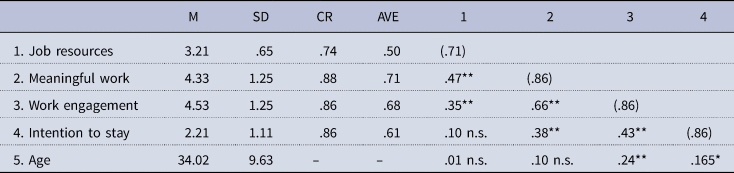
Table 1 shows the descriptive statistics and correlations between variables. Job resources are not significantly related to the intention to stay at work. However, job resources are significantly related to meaningful work (r = .47, p < .01) and work engagement (r = .35, p < .01). Additionally, intention to stay is significantly related to work engagement (r = .43, p < .01) and meaningful work (r = .38, p < .01).
Descriptive statistics, reliability, and correlations of the study variables
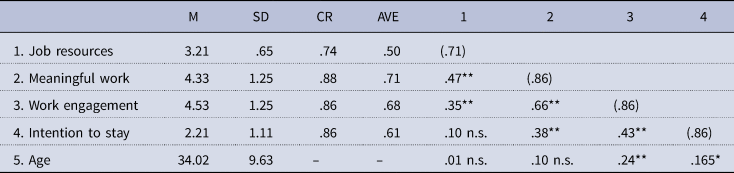
**p < .01; n.s., nonsignificant; M, mean; SD, standard deviation; CR, composite reliability; AVE, average variance extracted. Cronbach's reliability index is shown in parenthesis in the diagonal.
Hypothesized model
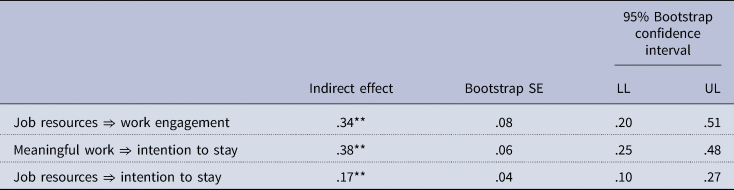
We tested the hypothesized serial mediation model through SEM. The model showed a good fit to the data (see Table 2) and supported the proposed hypothesis. Job resources are significantly related to meaningful work (β = .46, SE = .275, p < .01) (H1), and meaningful work is related to work engagement (β = .74, SE = .05, p < .01) (H2). Finally, work engagement significantly relates to intention to stay at work (β = .51, SE = .082, p < .01) (see Figure 1). We tested the direct effect of job resources on the intention to stay, but it was not significant (β = −.05, SE = .20, p = .526). The indirect effect of the serial mediation job resources on the intention to stay through meaningful work and work engagement was also significant (indirect effect = .17, SE = .04, 95% CI [.10–.27]) (see Table 2) (H3). As hypothesized (H3), these results indicate a serial mediation of meaningful work and work engagement in the association between the job resources and intention to stay at work.
Mediation models with standardized effects.

Indirect effects of the final mediation model
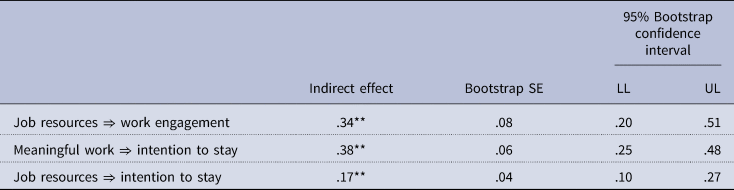
Finally, an alternative model (Model 2) was tested in which the order of the mediating variables was reversed to examine the possible nonarbitrariness of the causal process. This model showed a poor fit to the data compared to the previous model (Table 3). We compared the AIC of both models to determine which competing model shows the best fit (Huang, Reference Huang2017; Weston & Gore, Reference Weston and Gore2006). The hypothesized model showed a lower AIC indicating that this model has a better fit. These findings offer additional support to the proposed serial mediation model (Model 1), in which meaningful work predicts work engagement, and both serve as mediators in the association between job resources and intention to stay.
Goodness-of-fit indices of the mediation model

χ2, chi-squared; RMSEA, root mean square error of approximation; SRMR, standardized root mean residual; CFI, comparative fit index; TLI, Tucker–Lewis index; IFI, incremental fit index; NFI, normed fit index; AIC, Akaike information criterion.
Discussion
This article aimed to examine the mediating role of meaningful work and work engagement in the relation between job resources and the intention to stay at work. Based on the motivational-driven process proposed by the JD-R model, we examined meaningful work and work engagement as relevant psychological mechanisms to explain intention to stay at work. The findings indicate that job resources (task variety, skill variety, and task significance) are positively related to meaningful work (H1 is supported), meaningful work is positively related to work engagement (H2 is supported), and job resources are indirectly related to intention to stay through meaningful work and work engagement (H3 is supported). The test of the alternative model in the serial mediation in which work engagement predicts meaning showed a poor fit to the model. Taking together these results support the proposition of Kahn (Reference Kahn1990) that meaningfulness predicts engagement as well as the key position of meaningful work in the motivational-driven process of the JD-R model. The need for meaningful work seems relevant in order to raise the levels of motivation and retention in organizations (Cartwright & Holmes, Reference Cartwright and Holmes2006).
The JD-R model provides a useful theoretical framework for understanding employees' intention to stay at work. Employees who perceive high job resources, specifically, task variety, task skill variety, and task significance, may experience their work as personally significant and worthwhile (increasing their meaningful work). Consequently, and as suggested by the motivational process, employees will feel more vigorous, dedicated, and absorbed in their work (increasing their work engagement). All this together will enhance their desire to stay in their current job (increasing their intention to stay). This is in line with Kahn's (Reference Kahn1990) proposition of meaning as an antecedent of engagement and job characteristics as one of the possible precursors of meaningfulness. Following the JD-R model, we can conclude that job resources initiate a motivational process that contributes to making work more meaningful and engaging, ending in a desire to stay in the job. Thus, these findings support the proposition of the relevant role of meaningful work in the motivational process of the JD-R model.
Meaningful work and work engagement play a crucial role in the association between job resources and positive employee outcomes, such as the intention to stay. Previous meta-analytical results (Allan et al., Reference Allan, Batz-Barbarich, Sterling and Tay2019) found that the best-fitting model was meaningful work predicting work engagement, which subsequently predicted withdrawal intentions. Furthermore, this meta-analysis revealed that engagement and meaningful work are distinctive constructs and that meaningful work adds significant value to the literature. Meaningful work seems to be a pivotal piece to understand why people decide to remain at work. Meaningful work originates from workers' evaluations about the job they perform and the purposes they derive from it. In this way, people may be less likely to leave a job that provides meaning and energizes their working lives (Steger, Reference Steger, Oades, Steger, Delle Fave and Passmore2017). These results present an integrated model that helps understand the positive psychological mechanism that explains why workers decide to remain at work.
Theoretical and practical implications
Turnover is an expensive process for organizations. Thus, finding ways to increase employees' intention to stay will be crucial for human resources management. Moreover, although it is implicitly assumed that intention to stay and intention to leave are two sides of the same coin (Johnston, Reference Johnston1995), both constructs may entail unique antecedents. For example, Cho et al. (Reference Cho, Johanson and Guchait2009) concluded that factors affecting the intention to leave and stay are different. Since an organization's employment goal is to retain talented employees, human resources management researchers need to investigate other factors influencing employees' intention to stay, rather than focusing on what makes employees leave an organization.
Therefore, this study adds empirical evidence to the literature regarding the role of positive and well-being states as predictors of employee's intention to stay at work. First, this study's findings support the proposition that meaningful work is a relevant mechanism to explain the relationship between job resources and work engagement and intention to stay (Bakker & Demerouti, Reference Bakker, Demerouti, Diener, Oishi and Tay2018). As suggested in recent developments of the JD-R model, additional psychological mechanisms are still needed in the model's proposed health impairment and motivational process (Bakker & Demerouti, Reference Bakker and Demerouti2017). Hence, this study contributes to consider meaningful work as an essential mechanism to link job resources and work engagement within the motivational process. This study also contributes to providing evidence of the association of these variables in a culturally different sample of employees. Most research in psychology and organizations has been conducted with samples from western, educated, industrialized, rich, and democratic (WEIRD) nations, limiting their results' generalizability (Muthukrishna et al., Reference Muthukrishna, Bell, Henrich, Curtin, Gedranovich, McInerney and Thue2020). As presented in this study, the hypothesized model is consistent with the theoretical basis and previous empirical evidence, which cross-validates the theoretical assumptions in a culturally diverse sample. However, more research is still needed to understand any cultural impact on the proposed model.
Job resources that are linked to intrinsic motivation may generate meaning (Barrick et al., Reference Barrick, Mount and Li2013; Humphrey et al., Reference Humphrey, Nahrgang and Morgeson2007). According to Sonnentag (Reference Sonnentag2017), resources and meaning are needed for employees to be engaged. Recent research suggests that meaning is an essential predictor of work engagement (Fairlie, Reference Fairlie2011; Johnson & Jiang, Reference Johnson and Jiang2017); thus, when employees perceive their work as meaningful, they are more likely to dedicate themselves physically, mentally, and emotionally at their work and less likely to leave their workplace (Shuck, Reio, & Rocco, Reference Shuck, Reio and Rocco2011). The results from this study further the dialogue on the fundamental role of meaningful work within the JD-R model's motivational process as a psychological driver to promote work engagement and how both constructs promote the retention of human capital.
These findings contribute to managerial practice highlighting the role of well-being in employees' retention. This study demonstrates that the link between job resources and the intention to stay is fully mediated by meaning and work engagement. Job redesign strategies are crucial to optimize and enrich the work environments and promote meaning, motivation, and satisfaction (Bailey et al., Reference Bailey, Madden, Alfes, Shantz and Soane2017; Lysova et al., Reference Lysova, Allan, Dik, Duffy and Steger2019; Parker, Morgeson, & Johns, Reference Parker, Morgeson and Johns2017). Job redesign to enhance job resources helps to create a more thriving work environment that will support employees' decisions to stay. Job redesign also contributes to the person-job fit, supporting the use of employees' knowledge, skills, and interests, contributing to increasing meaning and well-being at work (Hansen, Reference Hansen, Dik, Byrne and Steger2013; Sánchez-Cardona et al., Reference Sánchez-Cardona, Vera, Martínez-Lugo, Rodríguez-Montalbán and Marrero-Centeno2020; Shuck et al., Reference Shuck, Reio and Rocco2011). Bottom-up strategies, such as job crafting interventions (through which individuals proactively increase their job resources, challenging job demands, or reduce hindrance demands), increase both meaningful work and work engagement (Bakker, Reference Bakker2017; Lysova et al., Reference Lysova, Allan, Dik, Duffy and Steger2019). Therefore, the design of optimal jobs and the appropriate selection and employees' development strategies are essential to stimulate meaning, motivation, and well-being, which contribute to employees' retention. Besides, continuous evaluation of meaning and engagement at work is necessary to develop and optimize strategies that promote these positive attitudes and well-being states among employees.
Limitations and future research
Although the findings of this study provide contributions to the organizational and human resources literature and practice, they should be interpreted considering their limitations. First, the sample is relatively small; however, it represents employees from several organizations from diverse sectors across the country, allowing more heterogeneity and representativeness of the sample. Additionally, the data is limited to one country, which might constrain the generalizability of the results. Future studies should include larger and more representative samples from different countries to validate these results and to assess the association between these variables from a cross-cultural perspective.
Second, future studies should consider the inclusion of multiple job resources (as well as job demands) to explore their association with meaningful work to advance further the investigation of meaning within the motivational process of the JD-R model. Previous theoretical and empirical evidence provided support to the relation of task significance, skill variety, and ability variety with meaningful work (Hackman & Oldham, Reference Hackman and Oldham1976). Likewise, other job resources, such as leadership (Arnold et al., Reference Arnold, Turner, Barling, Kelloway and McKee2007), have been shown to predict meaningful work significantly. Considering that the JD-R model ‘does not restrict itself to specific job demands or job resources’ (Schaufeli & Taris, Reference Schaufeli, Taris, Bauer and Hämmig2014, p. 44), it would be appropriate to expand on the investigation of diverse job resources as the predictors of meaningful work in the process to promote work engagement.
Third, common method bias could affect the data since all measures were collected using self-report and at a single point in time (Podsakoff et al., Reference Podsakoff, LePine and LePine2007). Despite this limitation, methodological strategies were established to try to identify any severe deficiency. First, a single-factor Harman's test was performed using confirmatory factor analysis. Results indicate that the one-factor model showed a poor fit to the data compared to the four latent factors model. Convergent and discriminant validity results also support the distinctiveness of each measure. Second, an alternative model was tested where the order of mediating variables was reversed to examine the possible nonarbitrariness of the proposed causal process. This alternative model presented a poor fit to the data compared to the hypothesized model. Even though this alternative model's results support the hypothesized proposition, the study used a cross-sectional design, which limits causal inference between the relations of the variables. Future studies should further examine these associations using longitudinal designs or temporal separation in data collection of predictors and outcome variables. Besides, although it has been found that meaning is a predictor of work engagement, there is a lack of longitudinal designs to assess the causal effect of meaning on work engagement or reciprocal association that may exist between them. This research would be useful to understand further the association between meaningful work and engagement and its possible reciprocal and long-term effects and to understand better the role of meaningful work within the JD-R model's motivational process.
Conclusion
This study examines the role of meaningful work and work engagement as psychological mechanisms that explain the intention to stay at work. The results indicate that job resources (task variety, skill variety, and task significance) influence the intention to stay at work through meaningful work and engagement. Building on the JD-R model motivational process, these findings support the role of meaningful work in predicting work engagement and promoting the intention to stay at work. Managers and human resources professionals should design jobs and advance strategies that stimulate meaning and engagement to retain human capital.