Implications
Herbage intake of grazing cattle can be estimated easily and accurately enough for practical purposes, through concurrent measurements of chewing behavior and sounds. Energy flux density (EFD) of chewing sounds was the best single predictor of the short-term herbage intake of dairy cows offered experimental swards. Further validation of the present technique is necessary to assess herbage intake in noisy, natural environments and over prolonged time periods.
Introduction
Most grazing systems seek efficient herbage utilization and animal production by practices that are both economically and ecologically sound. Consistent with this goal is the need to routinely monitor, assess and manage relationships between grazing resources, herbage intake and animal production. Grazing involves nested feeding choices within specific domains of time and space (Bailey et al., Reference Bailey, Gross, Laca, Rittenhouse, Coughenour, Swift and Sims1996) and herbage intake is the consequence of several underlying trade-offs that directly or indirectly influence intake rate (Laca, Reference Laca2008). Hence, herbage intake rate by livestock is an essential quantity for management that necessitates improved measurement techniques.
Grazing animals generally prefer the forages they can eat faster (Black and Kenney, Reference Black and Kenney1984) and the rate of herbage consumption can vary widely with plant structure (i.e. height and bulk density) and coupled chemical and physical attributes of forages, such as dry matter content, type and amount of fiber, particle size and resistance to fracture. These characteristics can significantly affect the effort necessary to crop and chew a bite, and hence, herbage intake rate (Inoué et al., Reference Inoué, Brookes, John, Kolver and Barry1994; Benvenutti et al., Reference Benvenutti, Gordon and Poppi2006; Galli et al., Reference Galli, Cangiano, Demment and Laca2006).
Most models of ruminant intake rate predict feed ingestion as a function of two mutually exclusive actions, biting and chewing. So, time per bite is the sum of time invested in jaw movements for biting and chewing (Laca and Demment, Reference Laca and Demment1991). This assumption implies negligible average search cost per bite, so that any increase in time per bite is function of the chewing requirements per bite and hence bite mass (Laca et al., Reference Laca, Ungar and Demment1994). Consequently, extensive research has been conducted to examine major determinants of bite mass, but given past methodological difficulties in measuring jaw movements precisely, comparatively less effort was made to quantify variations in time per bite and its effects on intake rate.
Biting and chewing sounds can reveal important features of the foraging behavior of free-ranging (WallisDeVries and Laca, Reference WallisDeVries and Laca1998) and stall-fed (Galli et al., Reference Galli, Cangiano, Demment and Laca2006) animals. Indeed, studies using acoustic methods have found that cattle (Laca et al., Reference Laca, Ungar and Demment1994; Ungar et al., Reference Ungar, Ravid, Zada, Ben-Moshe, Yonatan, Baram and Genizi2006), giraffe (Ginnett and Demment, Reference Ginnett and Demment1995) and sheep (Galli et al., Reference Galli, Cangiano, Milone and Laca2011) use discrete jaw movements to chew, bite, or to simultaneously chew and bite on the same jaw opening-closing cycle (i.e. chew-bite jaw movement). Acoustic biotelemetry successfully discriminated ingestive bites and chews of grazing cattle (Laca and WallisDevries, 2000), and has been successfully applied to monitor the timeline and extent of eating activity in both grazing sheep (Klein et al., Reference Klein, Baker, Purser, Zaknich and Bray1994; Galli et al., Reference Galli, Cangiano, Milone and Laca2011) and cattle (Ungar and Rutter, Reference Ungar and Rutter2006).
Today, acoustic biotelemetry has promising applications as a reliable on-farm monitoring system to estimate rumination activity in grazing (Watt et al., Reference Watt, Clark, Krebs, Petzel, Nielsen and Utsumi2015) and non-grazing (Schirmann et al., Reference Schirmann, von Keyserlingk, Weary, Veira and Heuweieser2009) cattle, and there is potential for additional automation of the analysis of ingestive sounds to further monitor grazing activity (Milone et al., Reference Milone, Galli, Cangiano, Rufiner and Laca2012). Moreover, the energy contained in chewing sounds appears to be linearly related to the intake and characteristics of grazed forages, suggesting that dry matter intake (DMI) could be predicted fairly well based on measurable chewing sound parameters. Laca and WallisDeVries (Reference Laca and WallisDeVries2000), found that intake of steers offered experimental turfs of setaria (Setaria lutescens) was accurately predicted by the total energy flux of chewing sounds, the energy flux of chewing sounds per chew, and the average intensity of chewing sounds (R 2=0.90; CV=17%). More recently, Galli et al. (Reference Galli, Cangiano, Milone and Laca2011) found that the best predictors of DMI in sheep (R 2=0.92; CV=18%) grazing experimental micro-swards of orchardgrass (Dactylis glomerata) and alfalfa (Medicago sativa) were the chewing sound energy per bite and the total energy flux of chewing sounds, two acoustic variables that provided combined information of intake rate and eating time.
The present study builds upon previous experimental findings of acoustic monitoring and was specifically designed to validate the integration of ingestive sounds and behavioral variables for estimation of DMI in dairy cows offered different sets of experimental micro-swards of alfalfa and fescue (Festuca arundinacea) varying in herbage mass. Specific objectives were: (1) to examine likely determinants of bite mass, bite rate and intake rate; (2) to examine variation in chewing energy sound flux as a function of sward characteristics, herbage mass intake, ingestive behavior and associated biting and chewing sound data, and (3) to test predictions of DMI based on behavioral and acoustic variables obtained from ingestive sound data.
Material and methods
All feeding trials were performed at the Campo Experimental J. Villarino, Facultad de Ciencias Agrarias, Universidad Nacional de Rosario, Argentina (33°01'00" S 60°53'00" W). The approach integrated the use of micro-swards of alfalfa and fescue for direct measurement of herbage intake, and recording of ingestive sounds. Animal handling and experimental procedures were reviewed and approved by the Committee on Ethical Use of Animals for Research of the Universidad Nacional de Rosario.
Experimental procedure
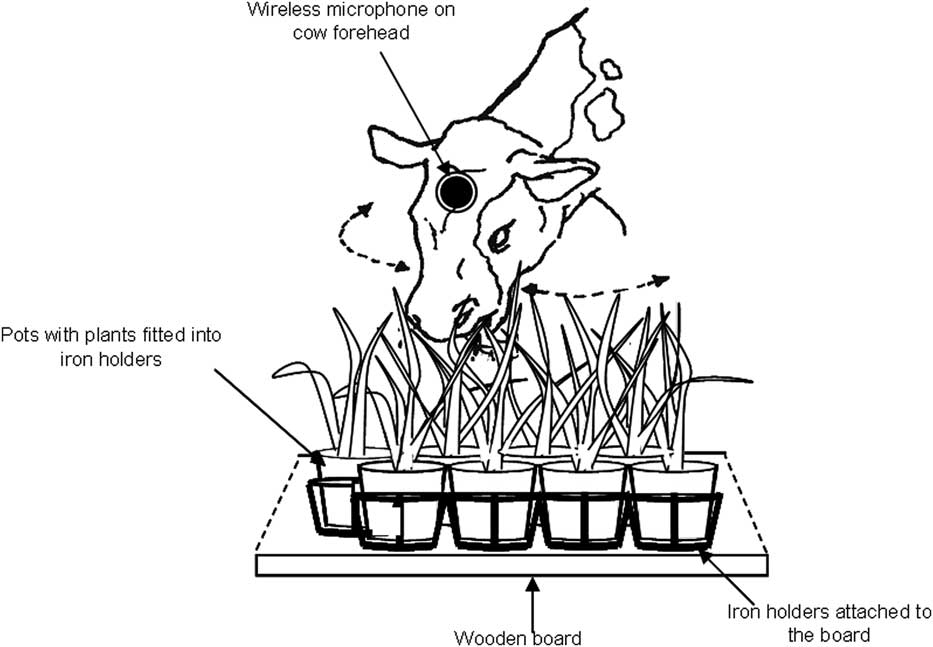
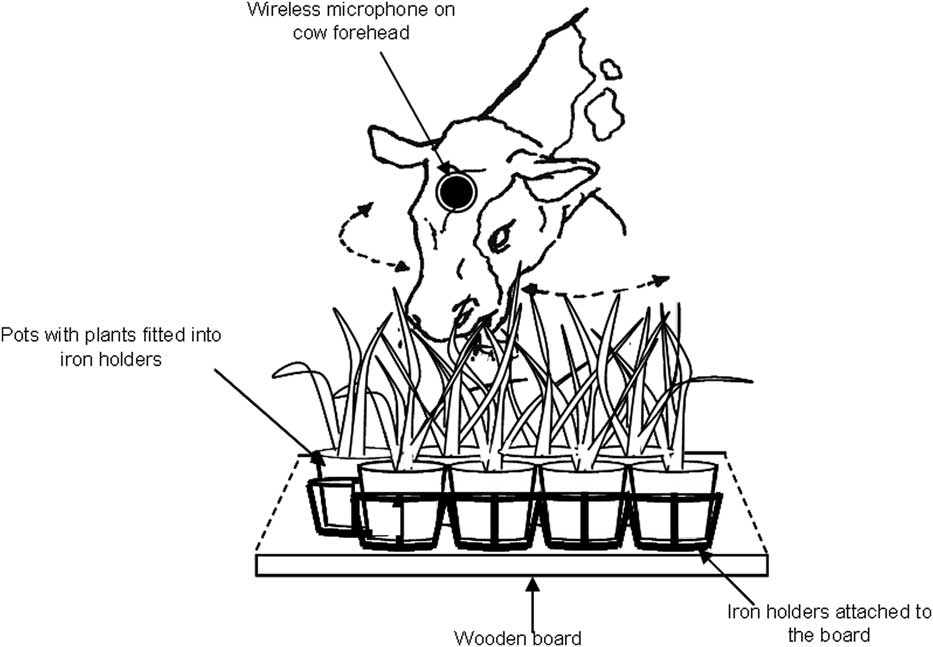
Micro-swards were established using alfalfa or fescue sown in 4 l plastic pots, firmly attached with metallic clamps to iron holders bolted to a wooden baseboard (Figure 1). Treatments were a 2×2 factorial combination of two plant species (fescue or alfalfa) and two plant heights (short or tall) offered in sets of 10, 16, 24 or 30 pots from which an animal was allowed to remove 10, 20, 30 or 40 bites. This design allowed a gradient of DMI level for which predictive DMI models were developed and tested. Both tall (intact) and short (cut to 50% of tall) plants were in a vegetative state (based on Kalu and Fick, Reference Kalu and Fick1981, for alfalfa and Moore et al., Reference Moore, Moser, Vogel, Waller, Johnson and Pedersen1991, for fescue), and were intentionally manipulated to generate micro-swards that cows could eat with negligible displacement (i.e. small feeding stations). Potted plants were kept in an outdoor nursery near the experimental site and were irrigated and fertilized with urea (a single application with a dose equivalent to 50 kg/ha) to ensure adequate growth. Each day, about 80 to 100 alfalfa and fescue pots with plants of homogeneous herbage mass and height were selected and transported to the experimental barn where grazing sessions took place.
Schematic illustration of experimental micro-swards and acoustic device on dairy cow’s forehead.
Three placid multiparous lactating Holstein cows (608±24.9 kg) previously trained to graze micro-swards and to wear acoustic equipment were used. By the time this study started all cows were very well accustomed to the experimental procedures. Cows were guided with a halter and rope, and were allowed to take up to 10, 20, 30 or 40 bites, as micro-sward size increased. This grazing prescription was used to minimize differences in herbage depletion among treatments that otherwise could affect intake rate (Laca et al., Reference Laca, Ungar and Demment1994). In all, 10 to 12 grazing sessions were performed between 0900 and 1600 h each day. The order of treatments and cows were randomized with the restriction that all four treatments (species×height) and three cows were observed each day. Cows were milked twice daily and grazed a mixed sward of alfalfa and fescue near the experimental site where they had ad libitum access to fresh water and shade. Animals were fasted for 1 h before grazing sessions. All grazing sessions were conducted inside a closed barn to minimize environmental background noises such as wind, machinery or neighboring animals.
Video and sound recording
Grazing sessions were recorded using a Sony CCD-TR517 camcorder (Sony Corporation, Japan). Sounds of biting and chewing were recorded with a remote wireless microphone (Nady Systems 151 VR, Nady Systems, Inc., USA). The microphone was protected by half of a rubber foam ball, placed inwards on the animal’s forehead and fastened to the halter where a transmitter was attached (see Supplementary Material Figure S.1 for more details). Two microphones were used and were randomly rotated among cows during the study.
Measurements and calculations
Herbage DMI was determined as the difference between forage mass before and after grazing. Each pot was weighed individually with 0.1 g accuracy using a digital scale (Setra 140 CP, Setra Systems, Inc., USA). Two ungrazed pots (control pots) were weighed before and after each grazing session to estimate evapotranspiration losses. Plant height was measured before and after grazing in five extended stems (in alfalfa) or leaves (in fescue) in a randomly selected subset of pots. After each grazing session, representative samples of grazed forage were obtained by hand plucking of control pots and offered pots that were not grazed. Samples were oven-dried at 65°C, weighed and analyzed for NDF content (Robertson and Van Soest, Reference Robertson and Van Soest1980).
Sound tracks from video recordings were digitized and analyzed using Cool Edit Pro V.2. software (Syntrillium Software Corporation, 2002). Sound sampling rate was 44.100 kHz, and sample size (resolution) was 16 bits. A total of 48 individual grazing sessions were recorded and processed. One signal from a cow grazing short alfalfa had to be discarded because it was distorted by an unknown source of noise. Two different sets of variables were obtained from the analysis of recordings: behavioral measurements from sounds (BMS) and acoustic measurements of ingestive sounds (AMS) as detailed below.
Behavioral measurements from sounds
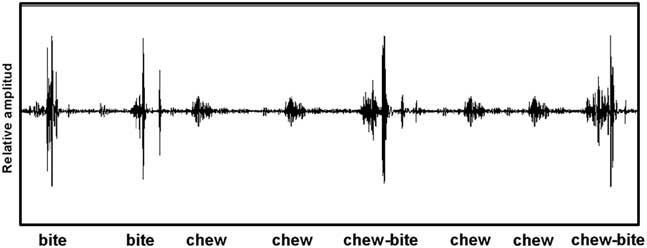
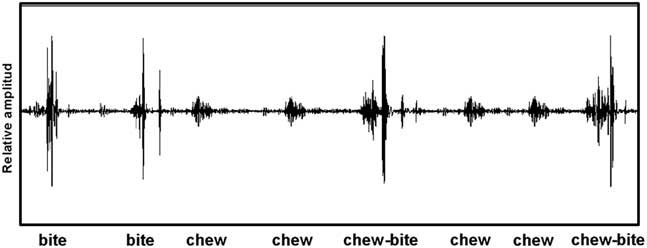
Number of bites and eating time were used to calculate intake rate (DMI per eating time), bite rate (number of bites per eating time) and bite mass (DMI per number of bites). Eating time (T) started with the grasping of the first bite and lasted until all prescribed number of bites were removed and swallowed. Bites were identified and counted by the characteristic ripping sound produced during the grasping and severance of standing herbage, chews were identified and counted by the characteristic grinding sound of masticatory jaw movements, and composite chew-bites were identified anytime a chew followed and partially overlapped with a bite on the same jaw movement.
Chewing and biting sounds were classified and analyzed as in previous studies (Galli et al., Reference Galli, Cangiano, Demment and Laca2006 and 2011) to obtain number of bites (B), number chews (C, includes exclusive chews and chews of chew-bites), number of chew-bites (ChB), biting time (TB) and chewing time (TC). Total jaw movements (TJM) was B+C−ChB, total jaw movement rate was TJM/T, chew rate (CT) was C/T, chew per bite was C/B and exclusive chews per bite was (C−ChB)/B. Jaw movements that did not produce any detectable sound signal were disregarded and ignored in calculations. The number of chews per g DMI was C/DMI, and the number of chews per g NDF intake (NDFI) was C/NDFI.
Acoustic measurement of sound
Acoustic measurements were used to estimate the EFD of biting and chewing sounds. Acoustic EFD is the product of the acoustic intensity and the duration of the sound. The EFD is mechanistically linked to the amount of forage being severed and/or progressively crushed in a given jaw movement. The average intensity (in decibels) of bites (logVB) and chews (logVC) were measured by the statistics option of Cool Edit Pro, and other variables were calculated as Galli et al. (Reference Galli, Cangiano, Milone and Laca2011):
 $${\rm Biting}\,{\rm intensity}\,\left( {{\rm fW}/{\rm m}^{2} } \right),\,{\rm VB}=10^{{\left( {{\rm logVB}/10} \right)}} {\times}{\rm Iref}$$
 $${\rm Chewing}\,{\rm intensity}\left( {{\rm fW}/{\rm m}^{2} } \right),\,{\rm VC}=10^{{\left( {{\rm logVC}/10} \right)}} {\times}{\rm Iref}$$
 $${\rm Biting}\,{\rm total}\,{\rm EFD}\left( {{\rm pJ}/{\rm m}^{2} } \right),\,{\rm EB}={\rm VB}{\times}{\rm TB}$$
 $${\rm Chewing}\,{\rm total}\,{\rm EFD}\left( {{\rm pJ}/{\rm m}^{2} } \right),\,{\rm EC}={\rm VC}{\times}{\rm TC}$$
 $${\rm Biting}\,{\rm duration}\left( {{\rm ms}} \right),\,{\rm TB}_{{\rm B}} ={\rm TB}/{\rm B}$$
 $${\rm Chew}\,{\rm duration}\left( {{\rm ms}} \right),\,{\rm TC}_{{\rm C}} ={\rm TC}/{\rm C}$$
 $${\rm Biting}\,{\rm EFD}\left( {{\rm fJ}/{\rm m}^{2} } \right){\rm per}\,{\rm bite},\,{\rm EB}_{{\rm B}} ={\rm EB}/{\rm B}$$
 $${\rm Chewing}\,{\rm EFD}\left( {{\rm fJ}/{\rm m}^{2} } \right){\rm per}\,{\rm chew},\,{\rm EC}_{{\rm C}} ={\rm EC}/{\rm C}$$
 $${\rm Chewing}\,{\rm EFD}\left( {{\rm fJ}/{\rm m}^{2} } \right){\rm per}\,{\rm bite},\,{\rm EC}_{{\rm B}} ={\rm EC}/{\rm B}$$
 $${\rm Chewing}\,{\rm EFD}\left( {{\rm fJ}/{\rm m}^{2} } \right){\rm per}\,{\rm unit}\,{\rm intake},\,{\rm EC}_{{\rm 1}} ={\rm EC}/{\rm DMI}$$
 $${\rm Chewing}\,{\rm EFD}\left( {{\rm fJ}/{\rm m}^{2} } \right){\rm per}\,{\rm unit}\,{\rm eating}\,{\rm time},\,{\rm E}_{{\rm T}} ={\rm EC}/{\rm T},$$
 $${\rm Chewing}\,{\rm EFD}\left( {{\rm fJ}/{\rm m}^{2} } \right){\rm per}\,{\rm unit}\,{\rm NDF}\,{\rm intake},\,{\rm EC}/{\rm g}\,{\rm NDF}$$
where VB and VC are average intensities in W/m2 of bites and chews, logVB and logVC are the average intensities in dB of bites and chews, Iref is the reference intensity in air (arbitrarily was assumed to be 1 pW in order to have meaningful dimensions), chewing time and biting time are the duration of the signal excluding all ‘silences’ between chews or bites. Chew duration and biting duration are measures of the time during which herbage is being either crushed or severed, and are not therefore an exact measure of the total time spent on either a single chew or bite event. For example, total time per chew is composed of both a chew duration and silence time between chews. Chewing EFD per unit of eating time is equivalent to the gross average intensity when the ‘silences’ are included in the analysis of a given chewing signal. Formulas 1 to 4 were adapted from (Charif et al., Reference Charif, Mitchell and Clark1995). Characteristic sounds of bites, chews and chew-bites were described using average sound properties of 60 events.
Statistical analysis
A mixed model was used for ANOVA analyses of BMS and AMS variables. Fixed effects were forage species (alfalfa v. fescue), plant height (tall v. short) and the interaction between both factors. The random effect was the combination of microphone, animal and day. The model also included the actual DMI as a continuous covariate because by design, this variable was controlled by the predefined number of bites (~10 to 40) and micro-sward size (10 to 30 pots). The use of DMI as a covariate applies only to the ANOVA for effects on behavioural and acoustic measurements. It is important to emphasize that none of the models to predict intake or intake rate uses information about DMI. The use of DMI as covariate in the statistical analysis with ANOVA allowed control of confounding effects associated with the offering of micro-sward treatments.
Forage characteristics were modeled as a factorial of forage species×plant height with day (from 1 to 5) as a continuous covariate. Differences among least squares means were compared by a protected Tukey–Kramer honest significant difference (HSD) test with significant effects determined using a F-test (P<0.05). Residuals plots were examined to check deviations from linearity and logarithmic transformation (logDMI) was used when data did not meet assumptions for normal distribution (P<0.01; Shapiro–Wilk test) or homogeneous variance (P<0.05, Levenne test). All statistical analyses were performed with JMP® 12 software (SAS Institute Inc., 2015). Differences among sounds of bites, chews and chew-bites were compared by a protected Tukey–Kramer HSD with significant effects determined using a F-test (P<0.05).
Variables calculated from sound tracks were divided into BMS and AMS variables to compare predictions of DMI based on different sets of variables. Dry matter intake was regressed on BMS, AMS or both sets of variables, by using a variable model selection based on the lower Akaike information criterion, a measure of the relative quality of statistical models for a given set of data (SAS Institute Inc., 2015). All possible models including one to 10 variables were explored. In addition, selected models were further tested with the inclusion of categorical effects for plant species (alfalfa v. fescue) and plant height (tall v. short), respectively. Categorical effects were determined and interpreted as deviation units from the overall intercept, where the effects for the alternative factor (fescue plants or short plants) have the exact same absolute value but with opposite sign. External validation of models was assessed by K-fold adjusted cross-validation (SAS Institute Inc., 2015). Path analysis (Li, Reference Li1975) was used to evaluate and describe direct and indirect effects of plant treatments on intermediate chewing variables and total chewing EFD. Chewing sound energy was described as a function of its three components: chewing intensity, chewing duration and number of chews per g DMI.
Results
Forage characteristics
Fescue pots had 38% more herbage biomass than alfalfa pots (6.5 v. 4.7 g DM per pot, P<0.001). Similarly, herbage mass was 51% greater in tall than short plants (7.5 v. 3.7 g DM per pot, P<0.001). Alfalfa and fescue did not differ in height (18 cm, P>0.05), but in both species short plants were 52% shorter than tall plants (25 v. 12 cm, P<0.001). Dry matter content did not differ (P>0.05) among treatments and was on average 190±10 g DM per kg. Fiber content (NDF) was lower in alfalfa than in fescue (360 v. 631 g per kg, P<0.001), but similar between short and tall plants (490 g per kg, P>0.05) (see Supplementary Material Table S.1 for more details).
Ingestive behavior
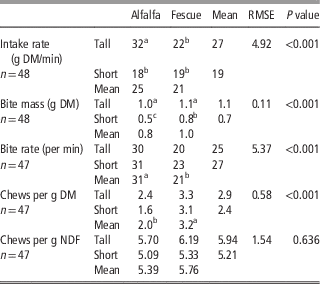
On average, grazing sessions lasted 61.4 s (from 19 to 121 s) and cows removed 25 bites (from 9 to 48) and consumed 23 g of dry matter (from 4 to 52 g). The actual number of bites was slightly different from the number of bites predefined by design. This was due to inherent difficulties of aurally assessing and controlling the harvest of an exact number of bites during a grazing session. Intake rate was affected (P<0.01) by an interaction between plant species and plant height due to a greater (P<0.05) intake rate in tall alfalfa than in the other three micro-sward treatments (Table 1). Similarly, a significant (P<0.05) interaction between species and plant height was observed in bite mass, due to greater (P<0.05) bite mass in tall v. short micro-swards and in short fescue v. short alfalfa (Table 1).
Effect of forages on ingestive behavior of cattle

RMSE=root of the mean squared error.
Means followed by different letters differ significantly (Tukey–Kramer HSD, P<0.05).
Bite rate was greater (P<0.05) in alfalfa than fescue (Table 1) and was not affected (P>0.05) by plant height (P>0.05). Number of chews per g of DMI was greater (P<0.05) in fescue than alfalfa, but both species had a similar (P>0.05) number of chews per g of NDF intake (Table 1). Time per bite was longer in fescue than alfalfa (2.88 v. 2.01 s), and about the same (P>0.05) between the plant height treatments (2.40 s). There were no significant differences in total jaw movement rate among all 4 treatments (57 movements per min, P>0.05), but chewing rate (51 v. 44 per min), jaw movements per bite (2.97 v. 1.85), chews per bite (2.60 v. 1.45), and the number of exclusive chews per bite (1.97 v. 0.85) were higher (P<0.05) in fescue than in alfalfa. Number of chew-bites per bite was different (P<0.05) between plant height treatments (0.65 v. 0.54 for tall and short, respectively), but it was not affected (P>0.05) by plant species. Proportion of total jaw movements involving chew-bites was greater in alfalfa than in fescue (0.33 v. 0.23, P<0.05) and was about the same (0.27, P>0.05) for both plant height treatments (see Supplementary Material Table S.2 for more details).
Biting and chewing sounds
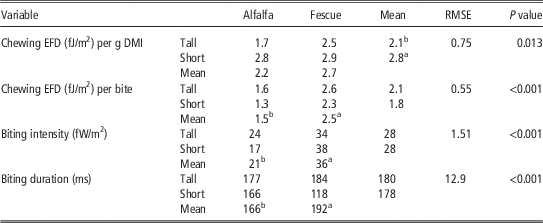
Exclusive bites and chews, and compound chew-bites were accurately distinguished by their sound characteristics (Figure 2). Bites had greater (P<0.05) average intensity (values dB), and were louder (P<0.05, 28.2±3.42 v. 4.0±0.74 fW/m2) and shorter (P<0.05, 178±9.1 v. 252±64.7 ms) than chews. Short plants produced greater (P<0.05) chewing EFD per g of DMI than tall plants, whereas fescue plants had greater (P<0.05) chewing EFD per bite, biting intensity and biting duration than alfalfa (Table 2). All treatments produced similar (P>0.05) chewing EFD per g of NDF intake (4.86±1.73 fJ/m2). Neither chewing EFD per unit eating time (0.83±0.22 fJ/m2) nor chewing EFD per chew (1.00±0.22 fJ/m2) differed significantly (P>0.05) among treatments.
Example of soundtrack showing a typical sequence of bites, chews and chew-bites, collected with a dairy cow grazing a micro-sward of tall alfalfa.
Effect of forage species and plant height on acoustic variables in cattle

RMSE=root of the mean squared error; EFD=average energy flux density of sound; DMI=dry matter intake.
Means followed by different letters differ significantly (Tukey–Kramer HSD, P<0.05).
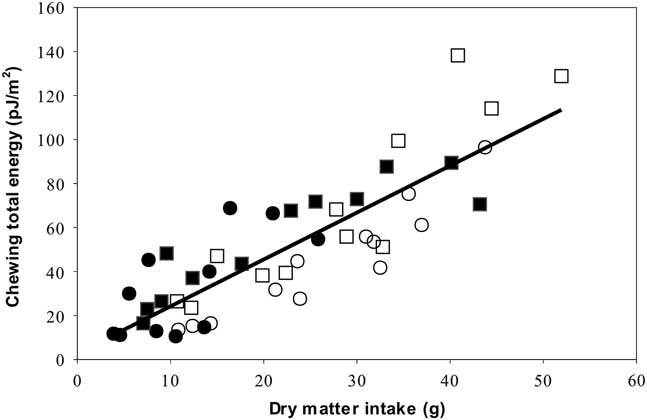
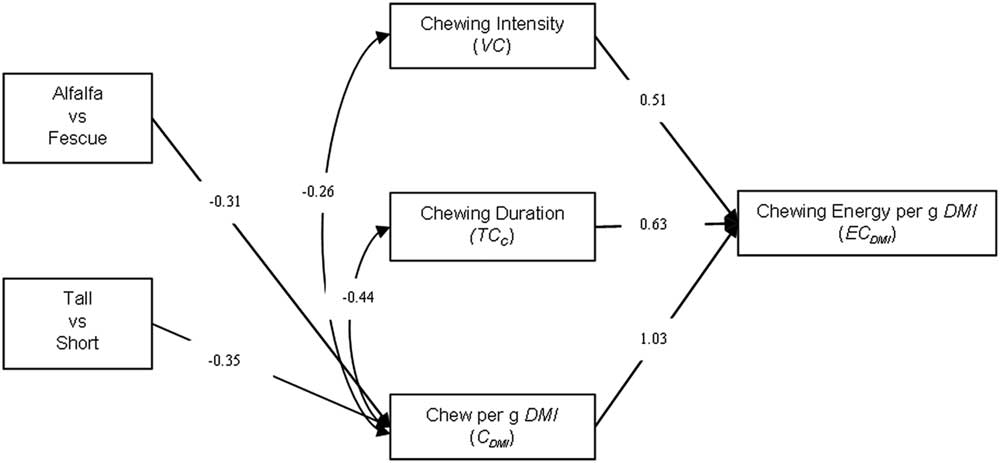
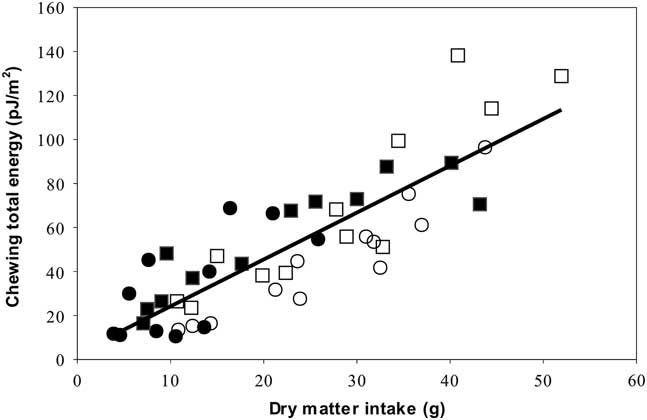
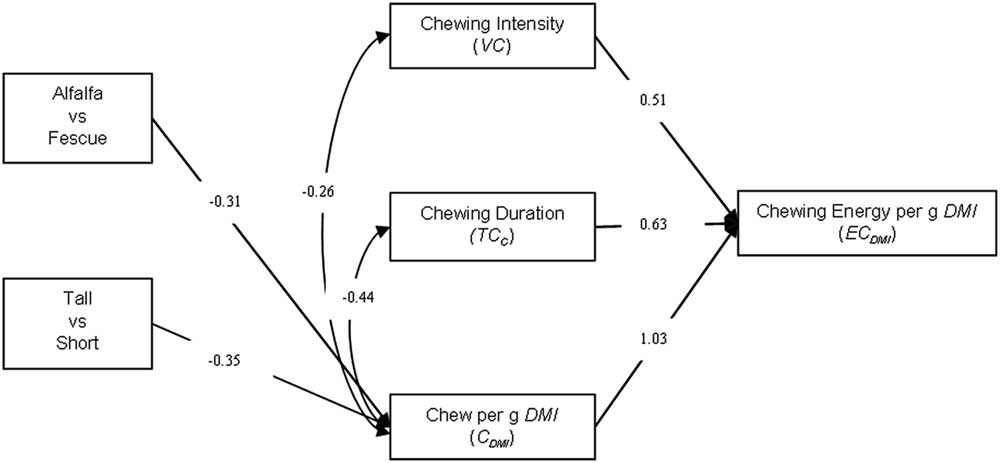
Total EFD of chewing sounds was linearly related to DMI (P<0.0001), with 74% of the total variation in chewing EFD explained by differences in DMI (Figure 3). Different direct and indirect effects and correlations between plant treatments, chewing intensity, chewing duration and chewing EFD per mass were detected (Figure 4). Plant treatments affected the number of chews per unit DMI, which in turn had a positive direct effect on the final chewing EFD per unit DMI. Conversely, neither chewing sound duration nor intensity were influenced by plant treatments but both were negatively correlated with number of chews per unit DMI, indirectly reducing chewing EFD per unit DMI.
Relationship between dry matter intake (DMI) and total energy flux density of chewing sounds (EC) in dairy cows, EC=3.2+2.13 DMI, P<0.0001, R 2=0.74, n=47. Solid line: overall linear regression, (○): tall alfalfa, (●): short alfalfa, (□): tall fescue, (■): short fescue.
Path diagram depicting direct and indirect effects of plant treatments and acoustic chewing variables on total chewing energy flux density (EC) per gram of dry matter intake (DMI) in dairy cows. Only significant (P<0.05) paths are shown. Forage species×plant biomass interaction and number of bites were also considered in structural equations but the effects were not significant and are not shown in this diagram. Paths from categorical plant variables are given for ‘Alfalfa’ and ‘Tall.’ For example, a change from fescue to alfalfa reduces chews per g DMI.
Prediction of dry matter intake
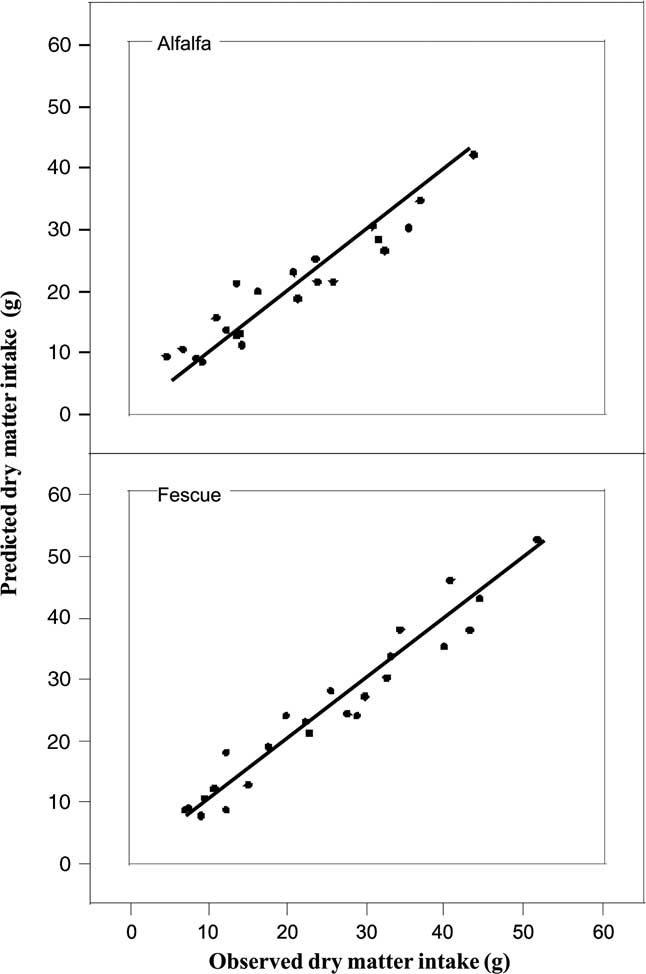
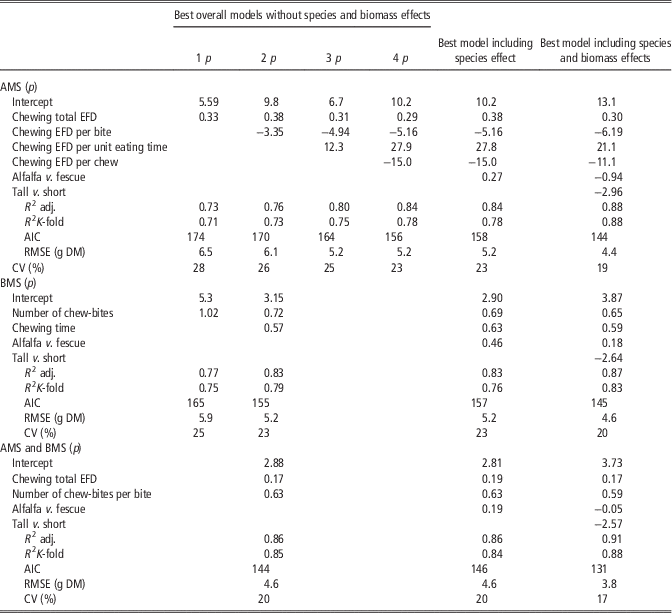
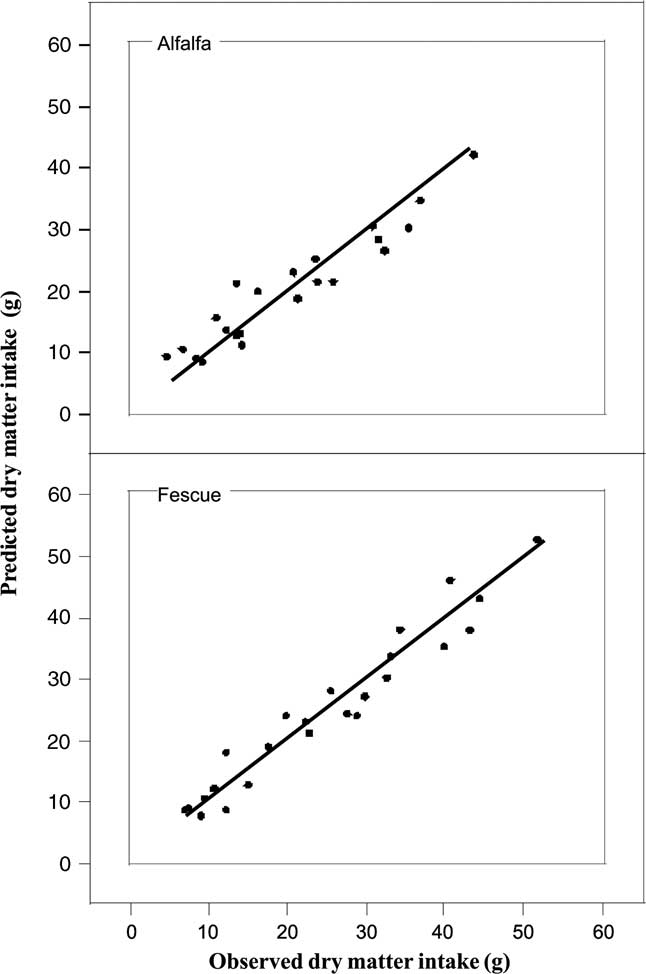
The best predictive model of DMI (R 2=0.86) combining BMS and AMS variables included two predictors, chewing total EFD and number of chew-bites (Table 3, bottom). The best predictive model for DMI based on AMS variables (R 2=0.84) included variables chewing total EFD, chewing EFD per bite, chewing EFD per unit of eating time and chewing EFD per chew (Table 3, upper). The best model using only BMS variables (R 2=0.83) included number of chew-bites and chewing time (Table 3, middle). Predictions of DMI based on BMS, AMS or combinations of both sets of variables were significantly improved by inclusion of categorical effects for plant height and species (Table 3). Models that included categorical plant effects as well as BMS and AMS variables explained up to 91% of DMI variance (Figure 5). The best models based on a single predictor included number of chew-bites (R 2=77%), total chewing EFD (R 2=72%) or chewing time (R 2=65%).
Relationship between observed (x) and predicted (y) dry matter intake (DMI) of dairy cows grazing alfalfa or fescue, based on behavioral (BMS), acoustic (AMS) predictors and categorical effects for plant species and plant height (P<0.0001, R 2=0.91, RMSE=3.8 g DM, CV=17%). Solid line: y=x. Predictive models were: DMI=33.73+0.17 chewing total EFD+0.59 number of chew-bites=0.05 alfalfa v. fescue=2.57 tall v. short.
Models to estimate dry matter intake of cattle based on acoustic (AMS) or behavior (BMS) measurements from sounds

n=46; EFD=average energy flux density of sound, R 2 adj.=R 2 adjusted by p, R 2 K-fold=R 2 from K-fold cross-validation, AIC=Akaike’s information criterion, RMSE=root of the mean squared error.
Each column represents the best model with a given number of predictors (p). Coefficients for tall v. short plants and alfalfa v. fescue are the effects for tall plants and alfalfa plants, respectively.
Discussion
The experiment was designed to examine the main determinants of intake rate, and to predict herbage DMI based on easily observable behavioral and acoustic variables. Dairy cows were offered various micro-swards differing in amount and height of alfalfa or fescue herbage. Such treatments generated a wide range of DMI both within and between sward structures, as well as different relationships between plant structure, plant tissue chemistry, biting and chewing requirements and intake rate. Therefore, we were able to test whether behavioral and acoustic measurements can predict DMI when DMI differences are driven by both grazing time and bite mass.
Overall, results clearly show that the acoustic methods can account for changes in DMI caused both by changes in grazing time and by changes in intake rate. Cows were able to maintain a relatively high intake rate across a wide range of herbage mass and sward structure by exhibiting different biting and chewing behavior when grazing alfalfa or fescue. Alfalfa and fescue did not differ in average intake rate and bite mass, but greater biting rate was observed in alfalfa over fescue (Table 1). Moreover, the greater biting rate in alfalfa was associated with less time per bite because cows spent less time chewing per bite and had a greater proportion of jaw movements to compound chew-bites than when grazing fescue. Taller swards resulted in greater bite mass and greater intake rate (Table 1), because bite rate and time per bite were about the same when tall or short swards were offered. Ultimately, results suggest that intake rate may be controlled by a constant rate of jaw movements that are allocated to biting, chewing or simultaneous chewing and biting as animals encounter forages with different structural properties that affect ease of prehension, fracture and swallowing. Consequently, different relationships between sward structure, bite mass, biting rate and intake rate can be generated (Table 1).
As expected, the relationship between overall chewing sound energy and DMI was linear (Figure 3), in spite of the clear differences in NDF content and chewing requirements between alfalfa and fescue. Alfalfa had lower NDF but the same ingestive chewing per unit of NDF intake as fescue (Table 1). Consequently, more diluted NDF content resulted in lower ingestive chewing per unit of DMI in alfalfa over fescue (Table 1). Interestingly, less chewing per bite and per unit of mass in alfalfa were associated with less chewing sound energy per bite, and with a similar chewing sound energy per unit of DMI in alfalfa and fescue (Table 2), which is consistent with previous comparisons of chewing sounds between orchardgrass and alfalfa in grazing sheep (Galli et al., Reference Galli, Cangiano, Milone and Laca2011). Based on these results, estimations of DMI by the acoustic method would be possible when ruminants (cows or sheep) are grazing a variety of pastures, even if different plant species are present.
Partly, chewing sound is produced by rupture of cells and extrusion of water (Galli et al., Reference Galli, Cangiano, Demment and Laca2006). Therefore, the relationship between DMI and sound may depend on plant water content. In practice, this could be overcome by recalibrating the equations for forages with widely different water content, such as standing dry annual grass in summer. Certainly, changes in forage characteristics such as water content, anatomy of tissues, and fiber content, and animal characteristics such as dentition, head size and anatomy will tend to affect the relationship between intake and sound produced by the ingestion of forage. Sound is produced as a result of waves created in the air and in the bones of the head as plant structures are comminuted by biting and chewing. The waves are transmitted, filtered and modified by the bones, cavities and soft tissues of the animal’s head. However, this work shows that for cows of similar size and breed, one equation that includes a term for species was sufficient to predict intake with relatively high precision.
Chewing rate and efficiency per unit of mass can also decrease when bites are small (Laca and WalliesDeVries, 2000), and particularly when fiber content is low (Mcleod et al., Reference Mcleod, Kennedy and Minson1990). In short swards, smaller bites require more chews per unit mass, particularly in alfalfa. Moreover, when factored alone, bite mass was able to explain about 41% of the variation in chews per unit of mass, but it only accounted for 16% of the observed variability in chewing EFD per unit of mass. This suggests that chewing sound data is more consistent and carries a more precise and robust measure of intake rate than biting and count of chewing events alone. Chewing EFD contains direct information about amount and quality (i.e. NDF) of the forage processed at each single chewing event. In other words, the sound of chewing should be a better predictor of DMI than biting and chewing behavior, which is supported by the fact that chewing sound EFD and not biting or chewing appeared in the best predictive models for DMI (Table 3).
Path analysis of chewing sounds confirmed several meaningful relationships between plant characteristics, components of chewing sounds, and chewing EFD per DMI previously reported for grazing sheep (Galli et al., Reference Galli, Cangiano, Milone and Laca2011). When cows allocated more chews per g of DMI in direct response to plant treatments, chews had lower intensity (indirect effect) and shorter duration (indirect effect). Conversely, when cows invested fewer chews per g of DMI in direct response to plant treatments, chews were more intense (indirect effect) and of longer duration (indirect effect), which indicates a high degree of compensation between overall chewing efforts and properties of chewing sounds. This compensatory chewing mechanism may explain why significant differences in chewing requirements (i.e. alfalfa v. fescue) can result in similar chewing EFD per DMI, even when chew duration and intensity are not responsive to plant differences. Hypothetically, when cows reach a ‘full mouth’ of forage, the number of chews per DMI is inevitably reduced, although it is possible that the greater amount of food present in the mouth would result in longer and more intensive chews that would stabilize chewing EFD per unit of DMI against the effects of varying bite mass.
Energy of chewing sounds measured as overall chewing sound EFD was the strongest predictor of DMI, as previously noted in studies with steers (Laca and WallisDevries, 2000; Galli et al., Reference Galli, Cangiano, Demment and Laca2006) and sheep (Galli et al., Reference Galli, Cangiano, Milone and Laca2011). As a single predictor, the total chewing EFD (R 2=72%, CV=28%) was more accurate than grazing time (R 2=67%, CV=30%) or the number of total chews (R 2=64%, CV=32%). A plausible explanation is that total chewing EFD captures information from both eating time and intake rate. Therefore, for any given eating time an increase in chewing EFD will indicate greater intake rate and vice versa.
The results of the present study therefore confirm the potential to accurately estimate DMI of grazing animals by means of ingestive sounds. Furthermore, sound-based estimation of DMI could be successfully scaled across different sward types, and plant-specific models could be developed to further improve predictions, in particular by adding factors to adjust for differences in sward height or plant species (Table 3). The best model combining total chewing EFD, number of chew-bites, and categorical factors for plant species and plant height accounted for most of the variability in DMI (R 2=0.91), while rendering a CV equal to 17%, which is in the order of the 18% CV estimated for sound-based predictions of DMI in sheep (Galli et al., Reference Galli, Cangiano, Milone and Laca2011). Furthermore, in both dairy cows and sheep, the number of chew-bites was the only ingestive behavior variable that added relevant information to DMI predictions, reinforcing the value of acoustic methodologies to accurately discriminate compound events of chewing and biting, which are ignored by most of the alternative jaw recording techniques.
The acoustic method could bring accurate estimations of DMI when cows are grazing pastures, even if many forage species are present. Based on the cross-validation, the best predictive model had a square root of the mean squared prediction error equal to 3.8 g (R 2 K-fold=0.88). This is a good estimate of the standard error for predictions of expected DM intake for observations not included in the training data set. As DMI was 22.4 g DM, the CV was 17%.
This research brings new insights into the ingestive process of grazing ruminants. The combined manipulation of grazing and micro-sward treatments, and acoustic recording of biting and chewing sounds, allowed testing of sound-based predictions of DMI while bringing insights into the regulation of herbage intake rate. Future research is necessary to extend acoustic measurements of forage intake over longer time periods (i.e. complete grazing bouts or daily measurements) and to assess the feasibility of scalable sound-based predictions of DMI. Ingestive sounds integrate valuable information to predict intake, while offering an unprecedented opportunity to remotely monitor sensible differences of feeding behavior in free-ranging animals. Further work is also necessary to strengthen progress on the automation of sound signal analysis to develop recording and processing systems for direct estimation of grazing intake under on-farm conditions.
Conclusions
Findings support the hypothesis that herbage intake rate is controlled by a constant (maximum) jaw movement rate, and by the ability of cows to differentially allocate jaw movements to biting, chewing or simultaneous chewing and biting as they encounter forages with different structural, physical and chemical properties that affect ease of apprehension, fracture and swallowing. In this study, different intertwined relationships between sward structure, bite mass, biting rate and intake rate were encountered between plant treatments. Chewing sound energy was the single best predictor of DMI and low variability of chewing sound energy was seen in response to plant tissue characteristics and feeding behavior. Therefore, findings of the present study reinforce the idea of applying generalized sound-based predictions of DMI, using chewing sound energy as the main predictor.
Acknowledgments
The authors wish to thank Lucas Lieber, Vanina Jankovic and Leandro Ventroni for their assistance with grazing sessions. Leonardo Vazquez and Matías Re for their assistance with feeding animals. The help of the staff of the Campo Experimental J. Villarino of the Facultad de Ciencias Agrarias, UNR is greatly appreciated. This work was carried out under Projects of UNR-AGR113, ANPCT PICT 2011-2440, UNL PACT CAID 2011 and CAID 2011-525. Additional support was provided by the USDA-National Institute of Food and Agriculture, project (Utsumi/MICL02387).
Supplementary material
To view supplementary material for this article, please visit https://doi.org/10.1017/S1751731117002415