In the mid-1680s a Lichfield physician began investigating the properties of soot. He collected samples from a wood fire and a coal fire and popped each one in turn into his mouth, rolling it around his palate in order to distinguish and describe their tastes.Footnote 1 About the same time he visited London and went to Chelsea Physic Garden. There he was ‘pleas'd with many Curiosities’ and the ‘Ingenuity’ of their ordering; he admired the ‘great Number’ of specimens, and chewed the plants.Footnote 2
This was not mere recreational grazing: Sir John Floyer was chewing experimentally. He recorded his perceptions of the tastes and smells, having conferred with the keeper, Mr Watts, whose ‘Taste and Smell did very much agree with Mine’, and with his companions, the London Collegiate physicians, Edward Baynard and Edward Betts Junior.Footnote 3 He fed the results of these and other oral-olfactory investigations in which he ‘consulted the Tastes of all sorts of persons’ into a remarkable work entitled Pharmako-basanos: or, the touch-stone of medicines: discovering the vertues of vegetables, minerals, & animals, by their tastes & smells.Footnote 4 Published in two volumes in 1687 and 1690, it expounded a system of medicine based on gustatory principles.
Pharmako-basanos begins by cataloguing (in an increasingly complex, sometimes contradictory, and deeply confusing fashion) the simple, the compound, the compound-simple, and the compound-compound tastes of plants.Footnote 5 Among six hot and four cool bitters, for example, are bitter sweet, bitterish astringent, watery bitter, bitter acid, pure bitters and elder-bitters.Footnote 6 Heroically compendious catalogues of the tastes of vegetable, animal, and mineral substances fill most of its almost 800 pages. Gooseberries, we learn, are ‘Sweetish and Acid’, but the bark of the plant is ‘very Rough, Bitterish, and Astringent’; the leaves of pansies ‘are Hot, Acrid, Mucilaginous, and Mealy’; arsenic ‘tastes of a burning heat, and is also Acid’; ‘An Acrid Taste may be observed by chewing live Millipedes, with a savor of the rotten Wood on which they feed’; ‘dryed Millipedes are Fetid’.Footnote 7 Internal and external medicines are listed by taste in one appendix and plants are classified by the taste of their oily juices in another. And all this valuable information sprang from Floyer's palate and tongue. ‘I have oft blistered my Mouth, and disorder'd my Stomach’, he revealed in the preface. Reading this, we may not be overly surprised that the second volume was delayed by the ‘desperate Sickness’ of the author.Footnote 8 From all this gustatory information, Floyer shaped a key to therapeutics. Taste was the physician's most reliable guide, he explained, because the taste of a substance indicated how it affected the body. ‘Acids taste Cool, Sowre, and Pungent … From the Coolness on the tongue we inferr, that Acids will cool the Blood … and that outwardly they will repell and cool Inflamations.’Footnote 9
Twenty years later, Floyer was behaving in a way that made munching millipedes and savouring soot (which, after all, were materia medica) seem almost ordinary. On one occasion, he experienced ‘a great Passion of Anger’. Thereupon, he placed a single finger by the base of his thumb and counted the number of beats that he felt in the next minute, drank a glass of water and repeated the procedure, fasted till dinner, sat in a cool place and did it again, and kept feeling and counting for three or four days, all the while recording the number of beats made by his pulse in sixty seconds.Footnote 10 This was strange, as much for the manner, as the degree of self-monitoring. Taking the pulse was an ancient diagnostic technique long emblematic of the physician's ability to discern otherwise hidden information about a sick person's condition.Footnote 11 Practitioners could identify the regularity, frequency, strength, breadth, and depth of a pulse and feel whether it was ‘formicant’ or ‘vermicular’ – ant-like or worm-like in motion; but they did not count.Footnote 12 In The physician's pulse-watch (1707–10) Floyer set out to revise the ‘Old Art’ of sphygmology (the study of pulse-taking) and to place it once more at the heart of medical practice.Footnote 13 Although he began by summarizing William Harvey's refutation of the Galenic account of the relation between heartbeat and pulse, he nevertheless commended Galen's ‘useful Observations about the Pulse’.Footnote 14 He was sure that the pulse could reveal otherwise imperceptible information about the movement of the blood and other bodily fluids. Claiming to have discovered ‘a Rule whereby we may know the natural [and therefore healthy] Pulse, and the Excesses and Defects from that in Diseases’, he asserted that the most basic way to discriminate between pulses was by recording the number of beats in a minute.Footnote 15 He had started trying to do this with various clocks and watches, and had improved his accuracy by using a ‘Sea-Minute-Glass’ which he had previously employed to judge the length of time patients were immersed in a cold bath.Footnote 16 The 1707 publication shows that Floyer was now using a portable pulse watch with an innovative second-hand constructed for him by the skilled watchmaker, Samuel Watson.Footnote 17
The first volume of The physician's pulse-watch records the effect of weight, food, drink, and emotion on the pulse rate of various individuals. One table reveals that the pulse of ‘a thoughtful, temperate, but obstinate Man’ of sixty was 60 beats a minute and that the pulse rate ‘an old Man’ of eighty rose from 60 to 105 beats a minute after drinking ale and having dinner.Footnote 18 Another plots his own morning pulse rates over several months against barometric and temperature measurements.Footnote 19 On the basis of this data, Floyer argued that a healthy pulse was 70–5 beats per minute and that maladies were not only associated with, but also produced by, aberrant pulses and excessive or inadequate circulation, and suggested therapy and regimen for lowering excessive and raising deficient pulses. The book is generally agreed to be the first work to record and recommend the quantitative measurement of the pulse in clinical practice. However, its contents are much richer and more complex than a blend of medicine and enumeration.
Floyer knew from travellers' and missionaries' reports that ‘the Chinese … probably have the most exact Knowledge of the Pulse’, basing their medicine upon 4,000 years' ‘Experience of this Practice’.Footnote 20 As the Dutch embassy to China had reported, they were ‘very skilful in discovering’ by the pulse ‘the inward Distempers of the Body’.Footnote 21 Such expertise inspired Floyer's deep respect, and he evidently longed to understand Chinese practice. Shortly after he had finished his main text, however, a copy of Specimen medicinae Sinicae (The pattern of Chinese medicine) – a ‘liber rarus’ according to one Augustan bibliophileFootnote 22 – ‘fell into’ his hands.Footnote 23 The Specimen had been published in Frankfurt in 1682, and bore the name of the Dutch physician, Andreas Cleyer, on its titlepage.Footnote 24 Crucially, it contained a Latin version of Chinese pulse interpretation treatises, which Floyer summarized with a partial translation and commentary in an appendix to the first volume of The pulse-watch. The second volume presented further research and reflection in all these areas. Like Galen's tomes, it listed the various pulses characteristic of different diseases and the ways by which they could be restored to a healthy condition;Footnote 25 it also correlated rates of respiration and of the pulse, and reconciled Chinese and European pulse classification.Footnote 26 Throughout, Floyer explained the ‘Advantages Physicians may have by a right use of the sense of Feeling’.Footnote 27The pulse-watch now features prominently in standard accounts of the history of physical examination in Western medicine.Footnote 28
This article elucidates not only Floyer's thought, but also his taste and feeling, approaching his work as a microhistory of the senses. In recent years, at least one anthropologist has declared that the ‘ “linguistic turn” ’ has ‘spent itself’, to be replaced by a sensual turn or sensorial revolution in the humanities and social sciences.Footnote 29 Whether or not such hyperbolic claims are justified, a striking number of publications on the history of the senses have appeared in the last decade, including longue durée surveys, books on senses in particular periods,Footnote 30 and many specialized monographs and collections.Footnote 31 Some sketch soundscapes and smellscapes in an attempt to evoke the past with ‘vividness’, thereby invoking an unsophisticated transhistorical notion of experience.Footnote 32 Many more build upon psychological and sociological research which understands sense perception as embedded in specific cultural contexts. This kind of approach is comparatively recent. As Stuart Clark observed in his 2007 study of vision in early modern Europe, ‘In 1966 three American scholars could ask: “Is human perception culturally influenced?” … and conclude merely that this was highly likely’. Nowadays, Clark continued, the proposition commands ‘virtually unanimous assent.’Footnote 33 This consensus has fostered an avowedly cultural historiography of the senses, which has shown, for example, how in early modern Europe you could hear green and smell sanctity.Footnote 34
What follows is an analysis of the sensory work and worlds of this late seventeenth- and early eighteenth-century English physician, which not only relates his taste and touch to each other and to his social and intellectual context, but also critiques the unexamined model of culture and the senses which underpins this emergent historiography.
I
Floyer was born in 1649, the second son of a Staffordshire gentry family. He was educated at Oxford, matriculating in 1664, taking his BA in 1667, his MA in 1671 and a DM in 1680, by which time Floyer had begun practising medicine in the small Midlands cathedral city of Lichfield, where he would remain as a physician for the rest of his life.Footnote 35 He followed contemporary intellectual developments with enthusiasm, and exchanged letters and information with several prominent metropolitan medical men, including the anatomist, Edward Tyson, and the advocate of cold bathing, Edward Baynard.Footnote 36 Floyer had contacts with the chorographer of his native Staffordshire, Robert Plot,Footnote 37 was elected to the Oxford Philosophical Society,Footnote 38 and sent papers to the Royal Society in London, some of which were published.Footnote 39 He wrote on (inter alia) asthma, bathing, gerontology, and Hippocrates, but received his knighthood for services in the Tory reaction after the Exclusion Crisis.Footnote 40 Monarchist and pious High Church Anglican, he published works of exegesis and chronology, notably commentaries on Revelation and Esdras and a translation of the Sibylline Oracles, as well as more purely medical works.Footnote 41
What are we to make of Floyer's sensory projects? We should first note that early modern physicians were expected to give advice about diet,Footnote 42 particularly since there was only the slenderest and most ambiguous of divides between foodstuffs and medicaments.Footnote 43 Moreover, from Dioscorides onwards, herbals and natural histories commented on the tastes of some plants.Footnote 44 Dispensatories describing the compounding of medicines also contained gustatory information: in Schröder's The complete chymical dispensatory (1669), for instance, Floyer read about the tastes of earths.Footnote 45 Other medical genres devoted pages to these issues. William Coles's Art of simpling (1655) surveyed tastes and smells: apparently rocket tastes like burnt milk. Thomas Moffett's Healths improvement (1655) explained how the taste of foods affected the body: sharp foods, for instance, ‘dry the body exceedingly, being hurtful to the eyes and liver’.Footnote 46 Medical practitioners were also often called on to differentiate between tastes in the course of their practice. Apothecaries relied heavily on gustation to judge the quality of drugs and to detect adulteration.Footnote 47 Many physicians would have agreed with Juan Bravo, professor of medicine in late sixteenth-century Salamanca, that ‘tastes have the first place in making known the temperaments of things, and hardly ever deceive us’.Footnote 48 A central theme of Book iv of Galen on simples, this remained medical common sense well after 1700.Footnote 49 But few displayed Floyer's truly omnivorous induction. He went out and savoured everything from gourds to galangal root and the ‘inward Skins’ of pigeons' gizzards,Footnote 50 recorded a myriad gustatory distinctions such as those between the mosses growing on the bark of various trees (and a dead man's skull), noted unexpected similarities such as that between the flavour of these mosses and that of mouldy cheese,Footnote 51 and matched these tastes with those of substances in apothecaries' shops, because the latter's medical properties were ‘more experimented and known’.Footnote 52
Floyer's researches had more immediate and more specific inspirations. First, Pharmako-basanos was much influenced by the botanical studies so important in medical education at the time.Footnote 53 As a student Floyer surely attended the lessons of Jacob Bobart, keeper of the Oxford Botanical Garden, and went on simpling expeditions, learning to identify medicinal plants necessary for the herbal remedies known as simples.Footnote 54 On some of his gustatory safaris around Lichfield, Floyer was armed with John Ray's catalogue of English plants.Footnote 55 Although the rest of the text is in English, Pharmako-basanos is laid out like Ray's works, listing substances in the alphabetical order of their Latin names.Footnote 56
Floyer emphasized, however, that his approach was medical. He deliberately omitted ‘particular External Accidents of … Seed, Leaf, Root, or Flower, for the Distinction of the Individuals in each Species’, precisely the things upon which Ray concentrated and on which his posthumous reputation depends; later in life Floyer wrote that botanists' classifications by seeds and flowers were ‘noe way … soe usefull to physicians as the distinction by tastes, and the virtues produced by them’.Footnote 57 Tastes guided the wise and sensible physician in ways that counting petals never could. Indeed Pharmako-basanos explained that there was ‘no Vertue yet known in Plants, but what depends on Taste and Smell, and may be known by them.’Footnote 58 In setting out the systematic knowledge derived from his investigations, Floyer echoed the argument of Christopher Merrett, a contemporary critic of apothecaries, that the physician was properly a naturalist – ‘one well vers'd in the full extent of … Natural things’, discovering ‘their full Nature’ through ‘tryals … by all the Senses’, ‘especially tast and smell’.Footnote 59 But Floyer's equation of a plant's taste and its effect on the human body also rested upon the recent work of Thomas Willis, Anthoni van Leeuwenhoek, and Marcello Malpighi on the anatomy of the tongue and taste buds, and especially Willis's suggestion that ‘Tasting’ was ‘a certain Species of Feeling’.Footnote 60 In Floyer's words, the ‘Texture and Motion’ of bodies produced gustatory sensation: taste was ‘a more curious and exquisite touching of the minute Particles of an Object’.Footnote 61 He was uninterested in the mechanics of this process, considering it ‘unnecessary’ to ‘describe the different Affections of the Organ by Taste’. Far more important was that the sense of taste ‘knows’ the various tastes ‘immediately’, revealing fundamental and particular information about the nature of a substance.Footnote 62 Through the apprehension and mastery of this sensory information, the physician could follow his ‘chief Business’ – ‘to chuse, and apply Tastes’.Footnote 63
An ontological realist in matters of the palate, Floyer was not blind to social and cultural factors. He emphasized that he had ‘not wholly trusted to my own Taste’, comparing his judgements with others'; he recognized the difficulty of describing tastes in words; he noted how the perception of savours was dulled by ‘Intemperance and Tobacco’ and by sampling too many substances in succession.Footnote 64 He emphasized that gustatory perception was to be combined with experiment.Footnote 65 And, although historians, perhaps intimidated by Foucault's famous declaration that seventeenth-century natural history developed through an ocularcentric restriction of observation, have paid it little attention, taste did feature in the experimental world of the mid- and late seventeenth century.Footnote 66 For example, when exploring St Paul's Cathedral after the Great Fire of 1666, Edmund Wyld FRS and the mathematical instrument maker, Ralph Greatorix, came upon the damaged coffin of John Colet, they promptly tasted the liquid in which the cadaver was lying, reporting that it was ‘insipid’ with ‘something of an ironish tast’.Footnote 67 The Royal Society discussed whether additives and freezing altered the taste of wines, beer, and cider, and whether animals' diet affected the taste of their milk and flesh.Footnote 68 Robert Boyle examined how combinations of different substances produced different tastes and the effects of fermentation upon taste.Footnote 69 There was also a gustatory strand to contemporary physiological research: Reinier De Graaf's investigations of the pancreas relied upon the tasting of its fluids; the anatomist and physician, Clopton Havers, commented on the flavour of the medullary fluids which he discovered in human joints.Footnote 70
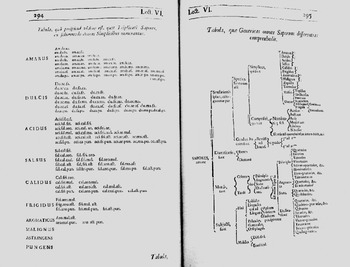
Moreover, several natural philosophers gave thought to how one might systematize these findings, drawing up catalogues of tastes. Robert Hooke thought it ‘not improbable … that with Diligence there might be found out such a Theory of Tastes and Smells, as that from the Mixture of some few with their Gradations, might be explain'd all the Tastes and Smells in the World’, an undertaking which ‘seems to be likely to afford us as great Assistance towards the Discovery of the Nature and Constitutions of Bodies, as to their Medicinal Use, as any way imaginable’.Footnote 71 Thomas Willis surveyed and listed nine simple savours in natural and artificially produced forms.Footnote 72 Floyer frequently invoked Nehemiah Grew, author of the Anatomy of plants, and the most ambitious contemporary taxonomist of taste. In 1675 Grew delivered a paper on plants and tastes to the Royal Society. He reckoned it ‘strange’ that ‘Philosophers and Physicians’ treated so little of the many ‘Diversities of Tasts’, not least because they appeared ‘to be of great import unto’ and could indicate specific virtues in medicines.Footnote 73 Grew listed what he declared were the sixteen simple tastes, showed how they combined into ‘a great number’ of compound ones and how these in turn had many degrees, concluding that there were ‘1800 sensible and defineable Variations of Taste’. He set these out in a complex taxonomic diagram listing the possible combinations of tastes (Figure 1).Footnote 74 Informed by, but not adopting, Grew's classification Floyer tried minutely to map the world of, and by, tastes.Footnote 75
N. Grew, The anatomy of plants (1682), pp. 294–5.

Floyer's gustatory project also advanced a medicine of place, rooted in his Midlands milieu.Footnote 76 He ‘Designed’ Pharmako-basanos while attending the Digby household at Coleshill Hall, in Warwickshire, some fifteen miles from Lichfield;Footnote 77 like several of his works, it was published by Michael Johnson, a bookseller of that city.Footnote 78 Except for the brief metropolitan sojourn when he tasted plants in Chelsea Physic Garden,Footnote 79 Floyer did his research for his book in ‘Country-Gardens’,Footnote 80 among county gentry,Footnote 81 and with neighbouring ‘Divines, Apothecaries, Chyrurgeons, Gentlewomen, and Young Persons’ who were his patients.Footnote 82 He reported how ‘a poor Woman at Elford’, less than ten miles from Lichfield, had fed the cuttings of yew boughs to her cow, which had promptly died.Footnote 83 The informants whose lore and specimens were noted in Pharmako-basanos, were figures like George Antrobus, schoolmaster in Tamworth,Footnote 84 and George Plaxton, clergyman of Sheriffhales on the Shropshire/Staffordshire border,Footnote 85 individuals who all came from within a twenty-mile radius.Footnote 86 Botanizing and simpling appealed to many lay people in seventeenth-century England. It offered clear practical benefits: Herbert of Cherbury, for instance, conceived it ‘a fine Study and worthy a Gentleman to bee a good Botanique that soe hee may know the nature of all herbes and plants being … made for the use of man’.Footnote 87 It was also often sociable, with botanizers eating and drinking together.Footnote 88 Floyer's expeditions doubtless developed his social bonds, as he compared notes on the tastes of plants, but his companions probably left the millipedes, metals, and soot to the physician.Footnote 89
One might even say that, in tasting for the virtues of plants and medicines, Floyer made a virtue out of necessity. He styled himself a ‘country physician’.Footnote 90 Such practitioners (normally based in towns) could make a good living;Footnote 91 his practice and marriages gave Floyer an extremely comfortable lifestyle.Footnote 92 However, he found himself in an unmistakably provincial setting, seemingly unable to attend meetings of the Oxford Philosophical Society,Footnote 93 and working with decidedly limited research resources.Footnote 94 He had no microscope, and so had to rely on one owned by a patron and neighbour, Sir Charles Holt, of Aston Hall, near Birmingham, some fifteen miles from his home.Footnote 95 (Holt also provided access to chemical equipment.)Footnote 96 Floyer also experimented with animals. While preparing Pharmako-basanos, for instance, he fed hemlock, henbane, and various types of nightshade to dogs and recorded their response (death in several cases); in later years he vivisected puppies.Footnote 97 Between the 1680s and the 1700s Floyer dissected pigs, calves, dogs, hawks, hares, and at least five horses, not to mention conjoined turkeys.Footnote 98 However, in 1710 he explained that although he wanted to carry out ‘the Dissection of such Persons’ who had died of asthma in his ‘Neighbourhood’ in order to examine whether their ‘Air Bladders’ were ruptured, he had been frustrated because ‘my Country-men are averse to such Practices’.Footnote 99 (One wonders how far his neighbours' reluctance sprang from witnessing the experiments in which Floyer took the ‘small Guts of a Cow’, nailed one end to a stool, attached a hand-pump to the other, and proceeded to pump water through them.)Footnote 100 Such was their resistance that, when Floyer wanted to know the relative distance of internal organs from the heart, he was obliged to measure with a compass a fold-out plate in James Drake's 1707 anatomy text, Anthropologia nova, and to be content with learning, for instance, that ‘the distance from the Aorta cut off from the Heart, to the basis of the Head’ was ‘about fourteen … degrees’, while that from the same point to the diaphragm was thirteen.Footnote 101
Investigation by taste, by contrast, fitted Floyer's habitus, exploiting his social and his geographical setting. He worked towards compiling ‘a dispensatory for the countrey physician’ in which medicaments were classified by taste, clearly considering that gustatory analysis should be the core of such a practice.Footnote 102 Indeed he advocated an autochthonous therapeutics, and hoped to find a native substance to match the power of Jesuits' Bark, the bark of the South American cinchona tree widely used against fevers.Footnote 103 With taste-based medicine, the physician responded to local circumstances and temperaments, and rooted his therapies in the locality. Floyer bewailed as ‘a great Shame to our Profession’ that ‘the Ignorant Indians should know more of Plants in their Native Country, and do greater Cures by Them, than our Artists can by Ours’.Footnote 104 Convinced that the English were ‘too apt to Imitate their neighbors’ and were damaging their health with imported, overheating, and ‘Modish habits’ like tea, spices and sauces,Footnote 105 he declared in Pharmako-basanos that he wished to ‘encourage our Country-Men to enquire into the Vertue of our Native Plants’. The listing of vegetables' tastes began with the plants ‘spontaneous’ to England; the project developed a tradition of medical indigeneity, suspicious of foreign drugs, and emphasizing that English herbs would cure most English diseases.Footnote 106
Moreover, for Floyer, going out and tasting materials was not merely an active Baconian engagement with his surroundings, but a re-enactment of humankind's originary researches into foods and the healing properties of herbs. He gave a more precisely sensory dimension to the passage in Ecclesiastes 38, regularly cited in sermons and medical treatises, ‘The Lord hath created medicines of the earth.’Footnote 107 Floyer argued not only that gustatory experiment could advance the understanding of ancient medical authorities,Footnote 108 but that medicine began with tasting. During the period after the Fall and before the Flood, ‘when men lived much on herbes they must soon discerne the tastes of all plants, and thence came the knoledge of the virtues of Medicines’.Footnote 109 By recapturing the pristine sensitivity of ancient palates, undulled by meat, tobacco, and overheating regimens, we might match the effectiveness of ancient medicine, achieve the longevity of the patriarchs,Footnote 110 and recognize ‘that all our Knowledge of religion and morality, and usefull arts come to us from the first ages by tradition and are no Inventions of humane reason’.Footnote 111 In Floyer's view, trusting to, and developing this project of embodied discrimination would refute the pretensions of astrologers, the ‘Whims’ of Helmontians, and the mystificatory claims of quacks.Footnote 112
II
Comparable forms of embodied discrimination – some simple and open to lay people, others sophisticated, and dependent upon minute sensitivities developed in physicians' long and attentive practice – were central to his work on the pulse. Like his gustatory research, Floyer's sphygmology combined mechanical models of the body with ancient art and observations, and threatened to collapse into incoherence as he revised, supplemented, and sophisticated its taxonomies. The Lichfield physician's ambitions resembled some of his contemporaries'. Half of De motu cordis was concerned with the relation between the movements of the heart and the beating of the pulse, and Floyer reported that William Harvey had planned ‘a Tract about the Pulse’. Floyer's inquiries thus resembled work done in Oxford during his student days when researchers re-examined the workings of the body in the light of Harvey's discovery.Footnote 113 Furthermore, several seventeenth-century investigators had attempted to count pulses using pendulum-based pulsilogia or time-pieces. In 1658, for instance, the Scottish royalist and future first president of the Royal Society, Sir Robert Moray, claimed to have ‘a second-watch’ which could measure pulses better than the earl of Kincardine's pulsilogium.Footnote 114 Floyer's pulse counting also grew out of the “statical medicine” of Sanctorius, professor of medicine in early seventeenth-century Padua,Footnote 115 which aimed to preserve a perfect balance between what was ingested and what excreted through faeces, urine, and apparent and insensible perspiration. To ensure the maintenance of this equilibrium, Sanctorius had promoted regular self-weighing in his famous chair, and devised a carefully calibrated regimen to ensure good health.Footnote 116 In the late 1690s, Floyer cited his work with enthusiasm and began regular self-examination on the scales.Footnote 117 He began systematic quantitative haptic self-inspection during the next decade, and supplemented this in 1706 by examining inmates in Lichfield almshouses.Footnote 118 Like his gustatory investigations, therefore, Floyer's pulse-work fitted his habitus. It used his body and his immediate surroundings as primary research materials.Footnote 119 It also related physiology to place: Floyer explored the possible relation between pulse rate and atmospheric pressure and lunar phases, and correlated pulse rates with latitude, suggesting that the colder the temperature, the faster the healthy pulse rate.Footnote 120
Floyer also stressed, however, that an individual's pulse varied according to their temperament. It would, therefore, be wise, he suggested, for everyone to get to know their own healthy pulse. Not only would this permit a monitoring of self, but it would also enable the ‘intelligent Patient’ to give their physician this important information when he arrived to attend them in bouts of sickness.Footnote 121 But, importantly, The pulse-watch was no self-help book. Populist works of dietetics set out simple rules for life; The pulse-watch set out the art of feeling.
Moreover, for Floyer, counting the pulse by a watch was only one elementary haptic register. Whereas modern commentators celebrate the sensory simplification implied by Floyer's quantification as a stepping stone on the path to the modern heart monitor,Footnote 122 he in no way considered that this exhausted what could be, should be, and had been, felt by skilled physicians. As he explained in the first volume of The pulse-watch, the impulse of the blood through the arteries ‘distends and vibrates them to make an Impression on our Fingers’, an impression which ‘differs according to its Strength, Magnitude, Celerity, Frequency and Equality’. One could, for instance, differentiate between great and small pulses, assessing their magnitude – the amount of blood projected in each beat of the heart. As he explained, ‘The great Pulse we know by the great distension … of the Artery; and the small by the small distension’ when blood is pumped into it. In ‘great Pulses’, he continued, ‘the Artery appears like a large tense Circle, and in small Pulses like a small and more flaccid Circle’.Footnote 123 Floyer's fingers could also judge the strength of a pulse, gauging the forcefulness of its beat, and its celerity – the rapidity with which the artery was distended in that individual beat:
[A] strong Pulse makes a strong Impression on the Fingers, and gives a great resistance to the Touch, and a week [sic] Pulse resists little.
The Celerity of the Motion is discern'd by a quick Stroke, and a sudden recess from our Touch.Footnote 124
Echoing, and sometimes excerpting Galen, who described an astonishing range of pulses, and whose ‘diligence … in distinguishing the uses and actions of the Pulsifick Faculty’ he greatly respected,Footnote 125 Floyer argued that different diseases, even different manifestations of the same disease, had different pulsific profiles. Just as Pharmako-basanos exhaustively and exhaustingly listed the combinations of gustatory qualities in each plant, lengthy sections of both volumes of The Pulse-watch catalogued the qualities of pulse characteristic of particular conditions. His (entirely qualitative) account of ‘the pulse in the Small pox,’ which was read at the Royal Society in 1710, for instance, explained that ‘The Pulse is quick & frequent in all sorts of Small Pox, but more strong & greater in ye beginning of a mild Small Pox, but … very small & weak & very unequall where ye Small Pox is very malignant.’Footnote 126
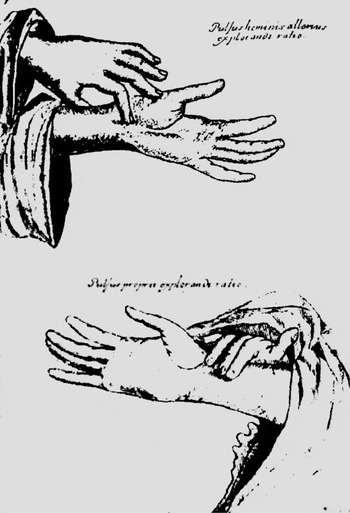
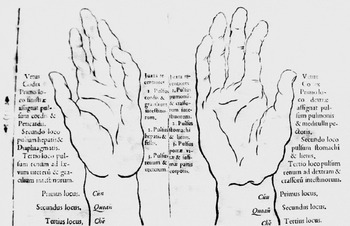
Although Floyer always considered pulse-taking to be important, he felt the pulse differently at different stages of his life. Early in his career he took it without counting, describing pulses in qualitative terms. In the 1690s, for instance, he wrote of ‘the quick Pulse’ which revealed a feverish state of the blood and the ‘slow and hard’ one to be found in melancholy constitutions affected by a ‘vitriolic’ quality in the ‘Nervous Lympha’.Footnote 127 As we have seen, in the first decade of the eighteenth century, he reoriented his haptic technique as he came to take the pulse according to a watch. At the same time, he came to prefer taking the pulse with one finger rather than with two or three, which was the ‘Old Direction’. Floyer now considered that ‘one is more discerning, and less apt to impose on us, because the feeling with three Fingers may give us a false Notion of that we feel’ and because it was now known that the artery moves ‘in all parts at once’.Footnote 128 After several years' close study of Andreas Cleyer's book, wrestling with the ‘Chinese Symbolical manner of expressing … the Pulses’, he felt differently again.Footnote 129 In 1710, he recommended that the physician ‘apply three Fingers of the right Hand to the Patient's left, … one Finger above the bone of the Wrist, the second below, and the third next to it’. Furthermore, the physician should take the pulse in both arms and ‘measure the Pulse by his own Respiration’.Footnote 130 Convinced of, and by, the antiquity of Chinese sphygmology, which he considered to have been developed, or even revealed, before the Flood,Footnote 131 and to be ‘adjusted to the real Phænomena, and … grounded upon curious Experience, examined and approved for four thousand Years’,Footnote 132 Floyer was now following and advocating ‘the Chinese Rules for feeling the Pulse’, adopting or adapting the positioning of the fingers depicted in Specimen medicinae sinicae Footnote 133 (see Figure 2). Qiemo, the Chinese medical practitioner's palpation of the mo – the haptic examination of the wrist which European observers perceived as taking the pulse and which was described in Cleyer's book – involves feeling at the three points on each wrist illustrated in that volumeFootnote 134 (see Figure 3).
A. Cleyer, Specimen medicinae Sinicae (Frankfurt, 1682), Plate 5.

A. Cleyer, Specimen medicinae Sinicae (Frankfurt, 1682), Tractatus de Pulsibus, p. 5.

After ‘long Observation’ of this technique, Floyer's fingers sensed things at each of these sites, providing him with additional information about the nature and the location of disease.Footnote 135 In the case of a patient who was spitting blood, for example, Floyer found in ‘the middle place of the left Arm … a great, soft, quick, and frequent Pulse’ running at 98 beats per minute, indicating a great rarefication of the blood and an excessively hot regimen. However, his fingers also detected an ‘exundancy [an overflowing] of the Pulse in the left Arm in the first place of the Pulse’ and that the Pulse ‘in the first place of the right Arm’ was ‘great soft and frequent’. These latter signs revealed the location of the problem: the thorax, where the blood was stagnating.Footnote 136 His ‘Rule’ clarified his method and the nature of diagnostic signals which he could now detect:
Feel the second place in the left Arm to know the greatness and strength of the general Circulation, and if it tends towards the upward place, which the Chinese call the place of the Calor Primigenius, ‘tis a Disease in the upper branches of the Aorta; but if the Pulse seem to tend more to the third Place of the Pulse, ‘tis a Disease in the branches descending of the Aorta, which the Chinese call the place of the Humidum Radicale. Thus we find which way the general Circulation tends upwards or downwards in Diseases.Footnote 137
Floyer had not stopped using a pulse watch. In 1710, he gratefully acknowledged the gift of a new and more accurate one, and he continued to publish tables of pulse rates for the next fifteen years.Footnote 138 Nor had he abandoned the anatomical insights of Harvey. But he also accepted that Chinese practitioners had ‘discover'd by their Touch more than any European’, producing the ‘best Observations’. These were authoritative, Floyer argued, because their haptic examination of the pulses yielded superior diagnostic information about the ‘Part affected’,Footnote 139 even though Chinese anatomical knowledge was currently inferior to Europeans' and their sphygmology corrupted by the admixture of philosophy and by the ‘mystical Cant’ in which it was expressed.Footnote 140 Moreover, by teaching himself (as he thought) their finger positioning, he had come to detect subtly different movements of the arteries at each point of examination. These signs, Floyer reckoned, enabled him ‘to know … Diseases’,Footnote 141 and he made sense of them through an ingenious and idiosyncratic refinement of circulation physiology.
‘The Blood’, Floyer reasoned, ‘ordinarily, in Health, is carry'd equally into all the places of the Body, and thro’ all the particular Circulations alike, but in many Diseases it runs … to one part more than another … because the Blood is stopt or check'd by external Accidents, or … inward Causes'. If, for example, ‘its siziness or grumosity’ inhibited it ‘from descending by the Aorta’, then it would ‘regurgitate’ through the arterial and venous system of the head (which Floyer termed the ‘the Cephalic Circulation’). This would lead to inflammation, convulsions, or fevers in that region. Such ‘disorders of the Cephalick Circulation’, Floyer explained, were revealed by ‘the first place of the Pulse in the left Arm’ (which he called the ‘Exundant Pulse’), ‘because this Pulse requires the greatest force of the Heart to produce it; and the same force is necessary to carry the Blood upwards into the Head’.Footnote 142 The other upper and lower pulse points revealed information about circulation in other areas. The third place on the right arm, for instance, registered the state of circulation through the iliac arteries and lower parts of the body.Footnote 143 For ‘Where the parts are most altered, there the Pulse of each Circulation appears preternatural.’Footnote 144
Floyer admitted that the methods of diagnosis and prognosis which he had described and developed required ‘some Experience to know what we feel, and what to call each Pulse’. In the first volume of the Pulse-watch, he had already emphasized that the physician needed to get ‘the right Idea of a moderate Pulse as to strength and Celerity, by often feeling of the Pulse of healthful People in a Morning Fasting’, improving his powers of discrimination just as musicians improved their hearing through listening and painters their judgement of colours through attentive and prolonged observation.Footnote 145 One might argue that Floyer's claims to be able to judge the speed of an artery's dilation or to trace the movements of a pulse's strongest point along the wrist exemplified the power of suggestion, and that the physician finally felt what he had read he should feel.Footnote 146
More interesting, perhaps, is the relation between Floyer's active touch, the ways in which he felt wrists and necks, and his tactual perceptions at these sites.Footnote 147 The two shifted together. Galen had written that, in their bellows-like motion, the arteries expanded in three directions – length, breadth, and height. By taking the pulse with a single finger, Floyer circumscribed the possibilities of feeling, making it impossible to detect movement along the first of these axes.Footnote 148 Only when he adopted a Chinese style of pulse-taking could he begin to compare what was detected by different fingers at different points and thus develop an understanding and an orientation to the body which ‘accomodated the Europæan and Chinese pulses’.Footnote 149 His sensing practices and sense perceptions were thus mutually constitutive: he came to know the pulse differently because he felt it differently.Footnote 150
Floyer's haptic style changed over time, but he never abandoned tasting in favour of touching. In 1726, he insisted that the young physician ‘who knows not the sensible qualities of the Humours, and their contrary Tastes in the Medicines, cannot cure by contraries, as Hippocrates did’, stressed that ‘we chiefly know the several states of our Fluids by their Tastes’ and urged ‘Anatomists’ to ‘taste the Lympha in the … Spleen’.Footnote 151 Furthermore, both volumes of the Pulse-watch explained how to use the tastes of medicines to restore an optimum pulse rate. When, for example, treating the ‘small, slow, rare Pulses’ which lead to Melancholy, ‘by hot Tasts we must promote the Circulation’.Footnote 152 One section even described a cabinet of medicaments that every English physician should possess, divided into drawers ‘according to the … Physical-Tastes’.Footnote 153 The unpublished fourth part was another catalogue of medicines by taste.Footnote 154 Floyer therefore frequently linked touch-based diagnostics and taste-based therapeutics, and more generally emphasized that ‘all I aim at is … retaining Things sensible’ amongst the many new experiments and hypotheses of this age and that in ‘Physical Matters … our Senses can sufficiently inform us of all the most usefull Phœnomena whereby we know or cure our Diseases, or prognosticate concerning them.’Footnote 155
Floyer never explained why he concentrated on taste and touch. He may well, like Sanctorius, have considered the physician a ‘sensatus philosophicus’, who could make the truth not only visible but tangible, and may consequently have oriented his practice through what were commonly considered the two most corporeal of the senses.Footnote 156 Nor was Floyer the only contemporary physician to perceive common features, or ontological parallels, between the two. As we have seen, Thomas Willis highlighted their physiological affinity, asserting that taste was a kind of touch. In 1685, the Scottish physician, David Abercromby, published a two-part study of pulses and tastes.Footnote 157 Nehemiah Grew revealingly compared the difficulty of cataloguing every taste with the impossible complexity of Galenic lists of pulses; he admitted that some might think he had ‘over done’ in drawing up his ‘Inventory’ of tastes, ‘and that as Galen hath been censured for being too curious in the Distinctions of Pulses; so have I been, in these of Tasts’.Footnote 158 The physician's uses of touch and taste, therefore, were wedded together not only by the complementarity of diagnosis and therapeutics, but also by the way in which both pulse and palate always seemed to generate a supplement, to resist the definitive categorization and itemization of their species.
III
The overlapping features of Floyer's sensorium outlined above have wider implications for the historiography of the senses. Virtually every example of this scholarship fragments the field. Monographs generally examine one sense in a particular place and time, exploring odours in Victorian novels or sound in Shakespeare's England;Footnote 159 surveys usually contain chapters discussing each sense in turn.Footnote 160 One reason for the latter approach is that most metanarratives of sensory history either build upon, or test, the idea that if one sense grows in significance, others must decline correspondingly – that the triumph of vision was, for instance, necessarily accompanied by a diminution of aurality. However, there is precious little evidence that the history of the human sensorium is this kind of zero sum game. Furthermore, and more significantly, this approach neglects the synaesthetic nature of human perception.Footnote 161 Monosensual histories obscure the ways in which the senses work and worked together and occlude the reasons why one or more sense is, or was, foregrounded by particular historical actors.
The particularities and peculiarities of a case study such as Floyer also reveal the limitations of the cultural overviews usually essayed in the historiography of the senses. Many monographs claim to delineate the sensory realm of a period and a nation – the subtitle of Alain Corbin's The foul and the fragrant: smell and the eighteenth-century French social imagination is a case in point.Footnote 162 In seeking (very properly) to demonstrate that people in a particular historical context felt, heard, or saw differently from ourselves, such studies all too easily, and all too often, assume that there was just one cultural frame of perception at that time and thus fail to examine divergent sensory regimes shaped not only by gender, class, ethnicity, and age,Footnote 163 but also (perhaps more importantly) located in work and other lived practices. A monolithic cultural model of the sensory world of seventeenth-century England is of little use when trying to understand groups and/or individuals engaged – like Floyer – in particular (and possibly innovative) forms of sensory practice.
Most fundamentally, however, our assumptions about the relation between culture and perception need to be re-examined. The historiography of the senses certainly mostly shares in the ‘virtually unanimous assent’ that ‘perception [is] culturally influenced’. Many authors working in this field believe that cultural frames, screens, grids, or lenses mediate perception. Others argue that discourses, mentalities, or ideologies organize or police what we apprehend. Stuart Clark, for instance, cites with approval the art historian, Norman Bryson, who proposed that ‘Between the subject and the world is inserted the entire sum of discourses which make up visuality, … and make visuality different from vision, the notion of unmediated visual experience. Between retina and world is inserted a screen of signs.’ W. F. Bynum and Roy Porter described the contributors to Medicine and the five senses (1993) as wrestling with the question of ‘how … the faculties of the mind convert the raw data of the senses into something like coherence’.Footnote 164 In both lines of analysis, culture is an intermediary, something lying between human beings and the world; perception originates in the passive reception of information from which sense is culturally made.Footnote 165
This kind of approach misses entirely how sensing is not only shaped by cultural categories, but also is and was part of an individual's active engagement with, and participation in, the world. Floyer felt the pulse and tasted vegetables in both the active and the passive senses of those verbs. The impressions that he struggled to render into words were the result of a range of sensory skills and diverse techniques of the body.Footnote 166 Pressing the wrist in order to judge the strength and the hardness of the pulse would, for instance, have involved many carefully trained groups of muscles, as well as the tips of his fingers, and his memory of other physical examinations.Footnote 167 The information which Floyer gained from his senses was thus constituted in practice, within what Bourdieu would have termed his hexis, within the bodily regime of a Galenic country physician, and more specifically within some of his particular ways of being-in-the-world, ones inflected by his religious opinions.Footnote 168 This case study and these loosely phenomenological reflections suggest that, if we are to develop the historical analysis of the senses, we need to shift ‘cultural history’ towards an approach which unites perception and practice, the mental and the physical.