Introduction
In the Declaration of Caracas in 1990, Latin American countries committed themselves to psychiatric reforms including the implementation of mental health care in primary care and the deinstitutionalization of chronically mentally ill persons (Larrobla & Botega, Reference Larrobla and Botega2000). These reforms were implemented to favour community recovery, social inclusion, human rights and quality of life of people living with mental illnesses. Furthermore, reforms included the removal of psychiatric beds, decentralization of psychiatric beds, using them preferably for short-stay hospitalization and building community housing facilities for chronically mentally ill persons (Caldas de Almeida & Horvitz-Lennon, Reference Caldas de Almeida and Horvitz-Lennon2010). In most Western high-income countries, psychiatric reforms had been implemented in earlier decades. Psychiatric beds were removed from higher levels than in Latin America (Priebe et al., Reference Priebe, Badesconyi, Fioritti, Hansson, Kilian, Torres-Gonzales and Wiersma2005) with rates after the reforms still higher than in Latin America before starting the reforms (Mundt et al., Reference Mundt, Franciskovic, Gurovich, Heinz, Ignatyev, Ismayilov and Priebe2012; Priebe et al., Reference Priebe, Frottier, Gaddini, Kilian, Lauber, Martinez-Leal and Wright2008). In recent years, a lack of psychiatric beds and a possible relationship with very high incarceration rates has been discussed for the USA (Allison et al., Reference Allison, Bastiampillai, Licinio, Fuller, Bidargaddi and Sharfstein2018), the UK (Lancet, 2013) and low- and middle-income countries (Mundt et al., Reference Mundt, Chow, Arduino, Barrionuevo, Fritsch, Girala and Priebe2015a). Low numbers of psychiatric beds were also related to overcrowding of emergency departments and untreated patients with severe mental disorders (Bastiampillai, Sharfstein, & Allison, Reference Bastiampillai, Sharfstein and Allison2016; Lamb & Weinberger, Reference Lamb and Weinberger2016; Lancet, 2011; Sisti, Segal, & Emanuel, Reference Sisti, Segal and Emanuel2015; Tyrer, Reference Tyrer2011). Lower numbers of beds can result in shorter lengths of stay and/or fewer admissions, which can worsen the outcome of treatments (Glick, Sharfstein, & Schwartz, Reference Glick, Sharfstein and Schwartz2011). Community-based outpatient services were established to compensate reductions of capacities to hospitalize. However, those services are most effective where strong inpatient care systems are in place (Elpers & Crowell, Reference Elpers and Crowell1982; Tyrer, Reference Tyrer2011). Despite the lack of internationally accepted standards and recommendations (Tyrer, Sharfstein, O'Reilly, Allison, & Bastiampillai, Reference Tyrer, Sharfstein, O'Reilly, Allison and Bastiampillai2017), mental health service experts estimate a minimum rate of 50 psychiatric beds per 100 000 population to be necessary under the assumption that potent outpatient services are available (Torrey, Entsminger, Geller, Stanley, & Jaffe, Reference Torrey, Entsminger, Geller, Stanley and Jaffe2008). Prison population rates are high in Central (mean: 298 per 100 000 population) and in South America (mean: 217 per 100 000 population) compared to the world average estimation (mean: 144 per 100 000 population) (Walmsley, Reference Walmsley2016). The conditions in Latin American prisons are characterized as poor to extremely harsh and at times life-threatening (Almanzar, Katz, & Harry, Reference Almanzar, Katz and Harry2015). Prison populations can face inadequate provision of basic needs like access to sanitation, drinking water, ventilation, medical care and lighting (Almanzar et al., Reference Almanzar, Katz and Harry2015; Walmsley, Reference Walmsley2016). Mental health conditions are rarely controlled while serving a sentence in prison. However, studies have shown that the prevalence of psychiatric morbidities was consistently higher among prison populations than in general populations (Baranyi et al., Reference Baranyi, Scholl, Fazel, Patel, Priebe and Mundt2019). A recent investigation on Ecuador's largest prison estimated the prevalence of depression and psychosis to be 50% and 26%, respectively (Benavides et al., Reference Benavides, Chuchuca, Klaic, Waters, Martin and Romero-Sandoval2019); from Chile similarly high rates were reported (Mundt, Kastner, Larrain, Fritsch, & Priebe, Reference Mundt, Kastner, Larrain, Fritsch and Priebe2016). Continued drug consumption among prisoners was found in 41% in Ecuador and 50% even fulfilled criteria for drug use disorders after 3 years of imprisonment in Chile (Gabrysch, Fritsch, Priebe, & Mundt, Reference Gabrysch, Fritsch, Priebe and Mundt2019). Notwithstanding the expansion of carceral facilities, overcrowding is a constant problem in Latin American prisons. Brazilian jails accommodate four to six times more people than intended, while further detainees are held in police lock ups, at times, up to eight individuals in a single-person cell for a period that can amount up to 1 year (Wacquant, Reference Wacquant2008). Within the understaffed correctional system, prisoners are often living on their own resources, depending on relatives to provide them with medication and basic equipment. This void leads to a hierarchical network within the prison community, where access to vitally important goods and services is controlled by powerful prisoners, often gang leaders, whose dominion is not limited by the walls of the prison and the period of the sentence (Wacquant, Reference Wacquant2008). Under conditions that violate basic human rights, the social reintegration of the convicted, which is supposed to be one of the main goals of imprisonment, can hardly be guaranteed.
In 1939, Lionel Sharples Penrose described for the first time an inverse relationship between the numbers of psychiatric beds and prison populations (Penrose, Reference Penrose1939). This possible relationship has not been replicated using cross-sectional research designs (Large & Nielssen, Reference Large and Nielssen2009). However, one of the few ecological studies using statistical models reported an inverse relationship between numbers of psychiatric hospital beds and prison population rates for South America (Mundt et al., Reference Mundt, Chow, Arduino, Barrionuevo, Fritsch, Girala and Priebe2015a).
Aim of the present study was to assess rates of psychiatric hospital beds and prison populations across Latin America between 1991 and 2017 and to test for associations between the two indicators.
Material and methods
We built an international research network for the purpose of the study spanning the entire Latin American region as performed for previous research in the South American region (Mundt et al., Reference Mundt, Chow, Arduino, Barrionuevo, Fritsch, Girala and Priebe2015a). Possible collaborators were contacted based on the scientific literature, snowballing and personal contacts. Between December 2017 and September 2018, participating researchers collected data on the number of psychiatric beds and prison populations. In countries without collaborators, we contacted ministries of health and justice. Data published by the WHO (World Health Organisation) in the Mental Health Atlas for the years 2001, 2005, 2011, 2014 and 2017 were retrieved and included when data from primary and secondary national sources were unavailable. For six countries (Argentina, Bolivia, Brazil, Chile, Paraguay and Uruguay), data from a previous study were included for the years 1991–2011, if primary or secondary data sources were unavailable (Mundt et al., Reference Mundt, Chow, Arduino, Barrionuevo, Fritsch, Girala and Priebe2015a). We defined psychiatric bed as any bed in hospital settings assigned to mental health treatment in psychiatric hospitals or in psychiatric units of general hospitals including beds specifically assigned to child and adolescent psychiatric care or forensic psychiatric care. Rates of prison populations were retrieved from the Institute for Criminal Policy Research (www.prisonstudies.org) when primary or secondary national sources were unavailable. Rates of psychiatric beds and prisoner populations were calculated per 100 000 population using numbers of the annual national population provided by the World Bank (updated 28.06.2018). The shortage of psychiatric beds was classified using the criteria of the Treatment Advocacy Center (Torrey et al., Reference Torrey, Entsminger, Geller, Stanley and Jaffe2008) established for the USA. We compared findings for Latin America with countries forming part of the Organization for Economic Cooperation and Development (OECD) to put regional data from mostly middle-income economies in the context of current developments in high-income economies, for which data are publicly available. The OECD is an international organization of 36 countries, most of which are high-income economies. Numbers of psychiatric beds for OECD countries were retrieved from www.stats.oecd.org. Prison population rates of the OECD countries were retrieved from the Institute of Criminal Policy Research (www.prisonstudies.org). Per capita gross national income (GNI) based on purchasing power parity in US dollars and the Gini Index were retrieved from the World Bank. GNI per capita is shown in international dollars corresponding to equivalent purchasing power of US dollars in the USA. The Gini Index measures the income inequality within a country on a scale from 1 (total equality) to 100 (total inequality).
Analysis
We calculated the absolute change and percentage changes of psychiatric bed rates and prison population rates between the first and last available data points and calculated the median and mean changes. In addition to the rates per 100 000 population, absolute numbers of psychiatric beds and prison populations were summed up for all countries to estimate the absolute change in the region since 1991. Furthermore, we compared the last two available data points to describe the most recent trends. The annual mean rates for the Latin American region and the OECD countries were graphed using interpolated data. The annual mean rates were used to estimate rate ratios between both country groups for the years 2000–2016. The slopes of linear regression lines were compared between the country groups.
Associations of trends over time were calculated using panel data regression analyses with country fixed-effects robust sandwich estimators. When data for bed occupancy were available, we used the rate of occupied beds per 100 000 population for the panel data regression analyses. First, we conducted a univariate analysis of psychiatric bed rates, the GNI and the Gini Index as independent variables and prison population rates as a dependent variable adding time fixed effects as suggested by Tsai and Venkataramani (Mundt, Chow, & Priebe, Reference Mundt, Chow and Priebe2015b; Tsai & Venkataramani, Reference Tsai and Venkataramani2015). Second, we conducted multivariate regression analyses using the numbers of beds as an independent variable and the size of prison population as a dependent variable, adding GNI and Gini Index as covariates. Analyses were conducted using Stata/SE 12.0 and SPSS 23.0.
Results
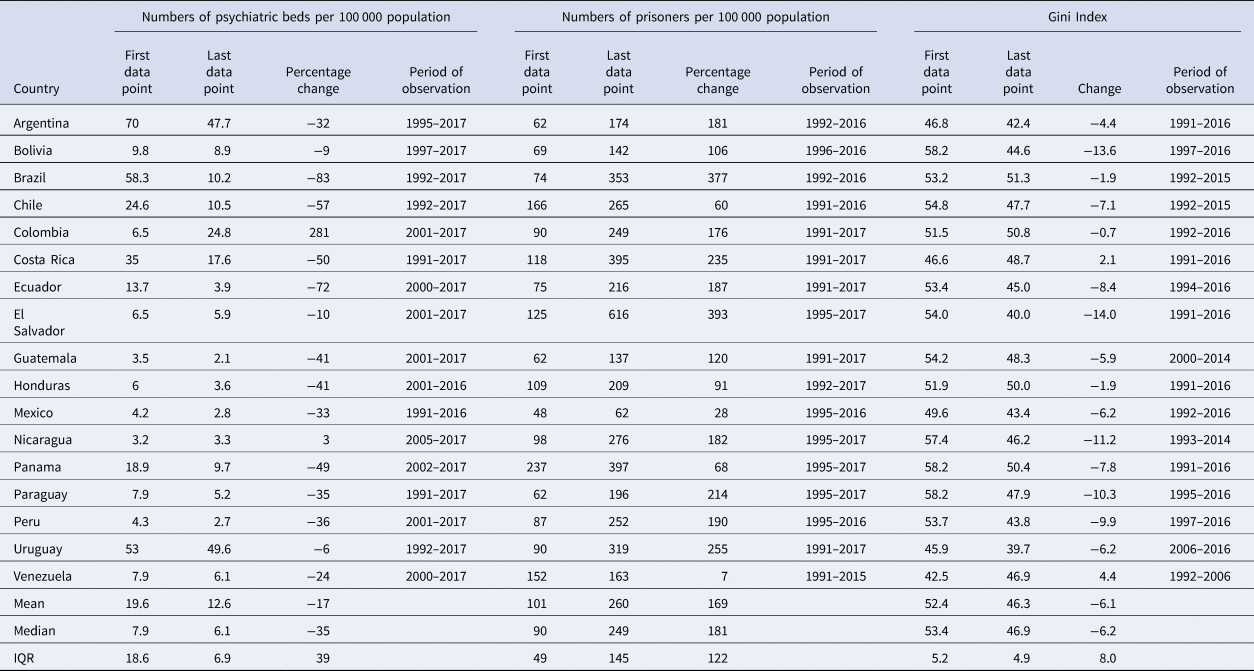
We retrieved numbers of psychiatric beds and prison population rates from 17 Latin American countries (Argentina, Bolivia, Brazil, Chile, Colombia, Costa Rica, Ecuador, Honduras, Guatemala, Mexico, Nicaragua, Panama, Paraguay, Peru, El Salvador, Uruguay and Venezuela) with a population of more than half a billion people. In 2017, Brazil and Mexico accounted for more than half of the population (56%) in the 17 countries. Most countries included in the study were middle-income economies. For Nicaragua, primary data sources were not available, for El Salvador only sizes of the prison population were available from primary sources. The WHO and the Institute for Criminal Policy Research provided data for all countries when reliable primary sources were unavailable. We eliminated one data point of psychiatric bed numbers from WHO sources for El Salvador in the year 2011 that was an outlier (>1.5s.d.) from trends within the country without a clear explanation from local sources. Table 1 shows the absolute numbers and percentage changes of psychiatric bed rates, prison population rates, GNI and Gini Index between the first and last available observation within the time span of 1991–2017.
Rates of psychiatric beds, rates of prison population and Gini Index with changes between first and last data points in 17 Latin American countries 1991–2017

IQR, Interquartile range.
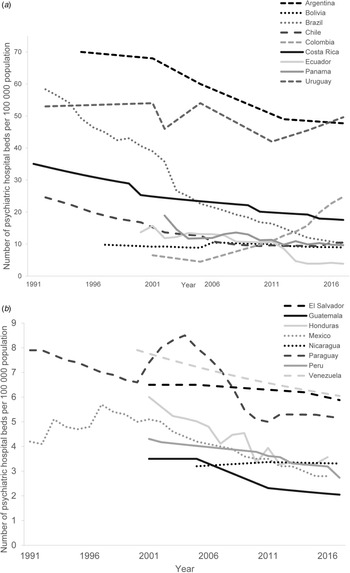
Figure 1 shows the trends of psychiatric bed rates for the 17 Latin American countries.
Numbers of psychiatric beds per 100 000 population (1991–2017). (a) Countries with numbers higher than 10 per 100 000 population. (b) Countries with numbers lower than 10 per 100 000 population.
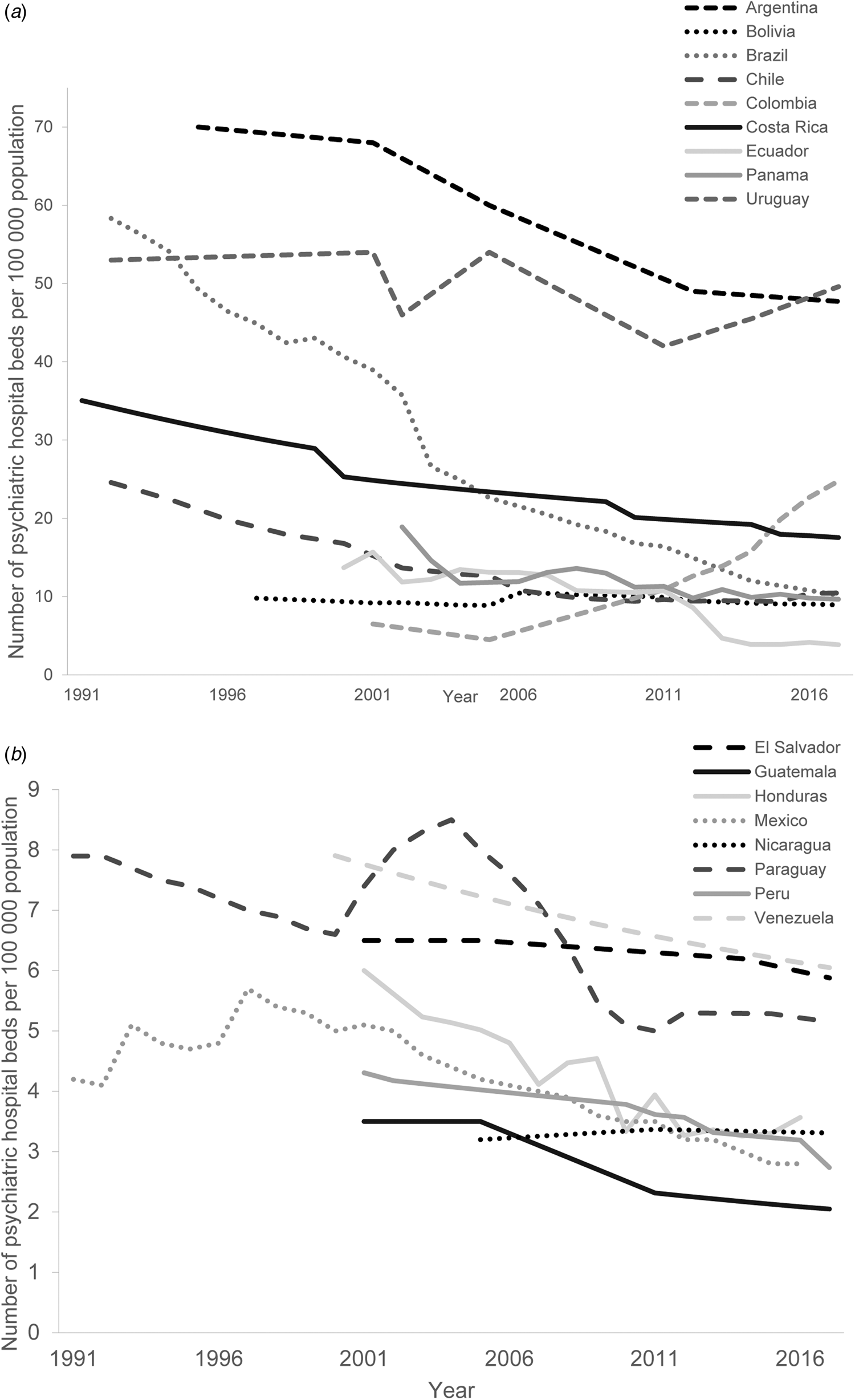
Fifteen out of 17 countries had lower psychiatric bed rates at the last compared to the first data point. The median percentage change of psychiatric bed rates was −35%, ranging from an increase in Colombia (+281%) to the strongest decrease in Brazil (−83%); the interquartile range (IQR) was 39 and the country-weighted mean percentage change was −25%. The highest psychiatric bed rates within the region were reported for Argentina and Uruguay. Brazil had relatively high numbers in the early 1990s and decreased to 10.2 psychiatric beds per 100 000 population in 2017. The lowest rates were reported for Guatemala, Peru, Mexico, Nicaragua, Honduras and Ecuador, all below 5 beds per 100 000 population in the last 5 years of observation. Although 11 out of 17 countries showed a decrease in rates of psychiatric beds between the last two available data points, the absolute number of psychiatric beds decreased in only five countries, whereas five countries had unchanged absolute numbers and one country an increase during the last year. The decrease in rates was solely due to population growth, not the result of bed removals in those six countries. Five countries increased absolute numbers of psychiatric beds by more than 1% per year (Chile, Colombia, Honduras, Mexico and Uruguay). Accounting for all available data points, out of a total number of 138 496 psychiatric beds in Latin America at the first data point, 69 415 psychiatric beds were removed and 69 081 psychiatric beds remained at the last available data point. The population-adjusted mean decreased from 30.0 in 1997 to 11.5 beds per 100 000 population in Latin America. Psychiatric bed rates in the OECD countries were more than five times higher than in Latin America over the last 15 years. The slope of the linear regression line was steeper in the OECD countries (−1.4) than in the Latin American countries (−0.5).
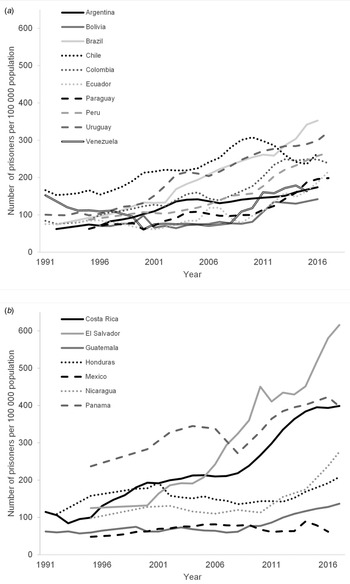
Trends of prison population rates are shown in Fig. 2 for the South and Central American regions. Prison population rates increased in all countries.
Numbers of prisoners per 100 000 population (1991–2017): (a) in 10 South American countries, (b) in 7 Central American countries.

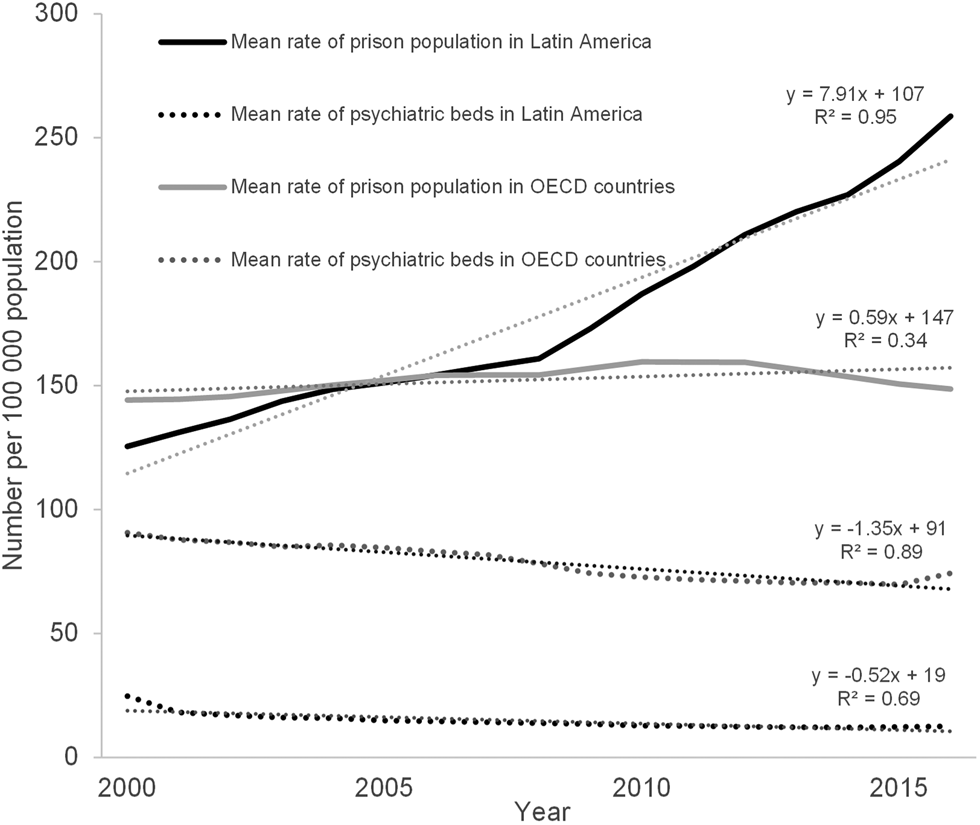
The median increase was 181%, ranging from 7% in Venezuela to 377% in Brazil, IQR 122. The country-weighted mean increase was 202%. Central American countries presented on average higher rates than the South American region. Over the entire period, the prison population increased by 1 062 004 people in the region. The rate ratio between OECD countries and Latin American countries ranged from 1.1 in 2000 to 0.57 in 2016 with crossing linear regression lines between 2005 and 2006 (Fig. 3). Rates of prison populations increased between 2000 and 2016 in both regions, but the slope of the regression line between 2000 and 2016 was more than 10 times higher in Latin America (7.9) as compared to the OECD (0.6). Mean prison population rates were on the decrease in the OECD since 2012, whereas they continue to rise on a much higher level in Latin America. In the OECD countries, psychiatric bed rates started to increase in the last few years, whereas they continue to decrease in Latin America on a much lower level. Figure 3 shows mean rates for psychiatric beds and prisoners in Latin America compared to OECD countries between 2000 and 2016.
Mean numbers of psychiatric beds and prison populations per 100 000 population in Latin American and OECD countries (2000–2016).

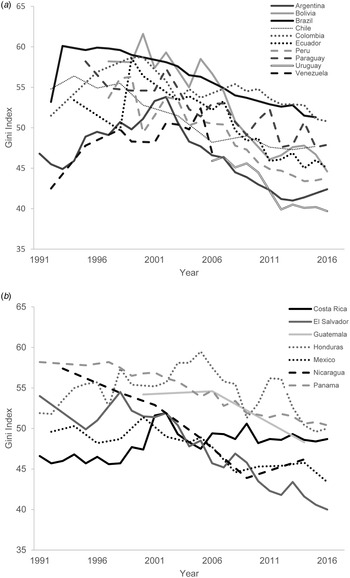
GNI increased in all countries and in most of the years. The median growth of GNI was of 177% in the region. Fifteen out of 17 countries had a lower Gini Index by the end of the period and thus showed a trend towards more income equality, albeit on a generally higher level of inequality than observed in OECD countries (OECD, 2016). Only Venezuela and Costa Rica had a trend to more income inequality (plus of 5 and 2 points, respectively). The median change was −6 points. Figure 4 shows the development of Gini Index in 10 South American and seven Central American countries during the period 1991–2017.
Gini Index (1991–2017) measuring income inequality: (a) in 10 South American countries, (b) in seven Central American countries.

Panel data regression analysis based on 228 observations using year fixed effects showed a significant negative correlation between psychiatric bed rates and prison population rates with a coefficient of −2.7 (95% CI −4.3 to −1.1; p < 0.01). Univariate regression analyses with GNI and Gini Index as independent variables and prison population rates as a dependent variable adding year fixed effects did not show any significant association. Multivariate regression based on 147 observations with psychiatric bed rates as an independent variable, adding GNI and Gini Index as covariates and prison population rates as a dependent variable resulted in a lower but still significant coefficient of −2.4 (95% CI −3.9 to −0.8; p < 0.01) for psychiatric beds and no significance for the covariates.
Discussion
In line with global trends, Latin American countries removed psychiatric beds in the decades following the Declaration of Caracas in the year 1990. Compared to OECD high-income countries, the removal started from relatively low numbers of psychiatric beds leading to a critical shortage in most countries. Compared to Latin America, OECD countries had five times higher psychiatric bed rates. Latin American and OECD countries showed increasing trends for incarceration rates, but the slope was about 10 times steeper in Latin America reaching much higher levels than in the OECD countries. Panel data regression analyses indicated an inverse association between numbers of psychiatric beds and prison populations in Latin America.
To our knowledge, this study presents the first systematic assessment of psychiatric bed numbers for the Latin American region over a time period of more than two and a half decades following the Declaration of Caracas. In comparison to one previous study that assessed psychiatric bed rates and prison populations in South America (Mundt et al., Reference Mundt, Chow, Arduino, Barrionuevo, Fritsch, Girala and Priebe2015a), we included 11 more countries and updated 5 years for the countries previously reported. This is also the first study to test the Penrose Hypothesis for the entire Latin American region.
The study also has several limitations. Firstly, primary data sources were not available for all countries and had to be replaced by secondary data in two countries. The quality of the data regarding numbers of psychiatric beds was variable. Actual occupancy of psychiatric beds was not available for most countries and may differ from the number of beds: in the context of scarce human resources, the actual availability of beds may even be lower than the number of beds. Secondly, especially for the first decade following the Declaration of Caracas, data were scarce. Therefore, the estimated total number of removed psychiatric beds may be an underestimation. Thirdly, correlations of ecological time trend data bear the risk to be spurious. This risk was reduced adding time fixed effects to the model. Fourthly, possible effects of community outpatient and housing services on the relationship between the numbers of psychiatric beds and prison population rates were not considered due to the lack of available data. Further potential mediators may include other socioeconomic variables than the ones acknowledged in our models. In addition, criminal justice reforms can lead to changes in prison population rates.
Applying the criteria of expert consensus in the USA (Treatment Advocacy Centre) (Torrey et al., Reference Torrey, Entsminger, Geller, Stanley and Jaffe2008), three countries in Latin America (Argentina, Brazil, Uruguay) met the minimum standard of 50 psychiatric beds per 100 000 population at the beginning of the time span under observation. Only one country (Uruguay) still met the level in the year 2017. Thirteen Latin American countries provided less than 12 psychiatric beds per 100 000 population in 2017 indicating critical bed shortage (Torrey et al., Reference Torrey, Entsminger, Geller, Stanley and Jaffe2008). A total of 299 854 psychiatric inpatient treatment places would be needed to meet minimum standards in Latin America (Torrey et al., Reference Torrey, Entsminger, Geller, Stanley and Jaffe2008). Present findings pointed to about 20% of the required minimum. In the absence of local recommendations, a standard from the USA was applied to the Latin American region. However, in the context of less developed community services in place, minimum requirements of beds may be higher. The current rate of psychiatric beds in Latin America is about one-third of the global and half of the rate of the entire American region (WHO, 2018).
Trends of service utilization and structure after the Declaration of Caracas were analysed in Brazil including alternative places in day-hospitals and community services. The rate in 2005 was 32 units per 100 000 population (Andreoli, Almeida-Filho, Martin, Mateus, & Mari, Reference Andreoli, Almeida-Filho, Martin, Mateus and Mari2007), 10 per 100 000 population more in comparison to the findings reported here. The same study reported a decrease in beds by 41% between 1995 and 2005 (Andreoli et al., Reference Andreoli, Almeida-Filho, Martin, Mateus and Mari2007), compared to 54% during the same period in this study.
The world prison population has grown by approximately 20% between 2000 and 2015, in the Americas by more than 40% (Walmsley, Reference Walmsley2016). In the Latin American region, the growth was more than 150% according to primary sources and more than 125% according to data published in the World Prison Briefs (Walmsley, Reference Walmsley2016). This disproportional growth of prison populations in the Latin American region has not yet been sufficiently explained.
Rising crime rates, harsher public attitudes, ethnic tensions, rapid social and economic change and penal populism may not have any essential impact on incarceration rates, since they can be found in most developed countries with grossly varying rates, which may contradict independent causality (Tonry, Reference Tonry2007). However, it has been argued that predominant social inequality, inadequate provision of social institutional support and instable governments contribute to rising punitiveness (Tonry, Reference Tonry2007). In Latin America, the political development needs to be considered. While the expansion of the correctional system has been persistent over the last three decades, most Latin American countries underwent democratization processes. Surprisingly, current democratic systems tend to imprison more citizens than former dictatorships (Hathazy & Müller, Reference Hathazy and Müller2015). During the course of democratic transition processes, violence did not decrease (Müller, Reference Müller2018). Neoliberalism started to prevail as an economic system. Governmental war-waging on drugs and narco-trafficking and the expansion of penitential facilities may have contributed to the rising incarceration rates (Hathazy & Müller, Reference Hathazy and Müller2015). The Latin American region is characterized by high homicide rates, described by the WHO as an epidemic (UNDP, 2013). Nevertheless, growth of prison population occurred in countries with increasing (Chile, Venezuela), constant (Argentina, Brazil) and decreasing homicide rates (Mexico, Colombia) (Hathazy & Müller, Reference Hathazy and Müller2015). Similarly, different trends in social inequality and Gini coefficients were accompanied with increasing imprisonment. So far, evidence for correlations between indicators of social inequality and prison populations is still lacking (Hathazy & Müller, Reference Hathazy and Müller2015). Regarding the political changes, neither left or right-wing governments nor presidential or dispersed systems put a halt to rising incarceration. Although death penalty and life sentences are de facto not enforced in Latin-America, long-term prison sentences are frequently used and the maximum term of imprisonment is high, in comparison to standards in Western European legal systems. Over the years, average length of sentence has increased, which accounts for a higher number of incarcerated individuals (de Leon Villalba, Reference de Leon Villalba2017).
Following the US American law-and-order strategy, most Latin American countries established a model of punitive containment to deal with drug use problems in urban marginalities and to curb organized crime (de Leon Villalba, Reference de Leon Villalba2017; Wacquant, Reference Wacquant2008). In Brazil, this method went out of proportion leading to 700 civilians shot by the military police of Sao Paolo in 2000, a remarkably higher number than in US American metropolis (Wacquant, Reference Wacquant2008). Inhabitants of Latin American favelas encounter law-enforcement acts that would clearly be unacceptable in middle and upper class districts (Wacquant, Reference Wacquant2008).
Unemployment is another socioeconomic variable frequently considered as a possible driver of rising incarceration rates. For the Latin American region, trends of unemployment rates were variable during the period of observation. The highest level was reached around and shortly after the year 2000 in Argentina, Colombia, Uruguay and Venezuela. All countries had unemployment rates between 15% and 20%. Lower unemployment rates were reported for the first and second decade of the 21st century (World Bank, 2017). Therefore, unemployment may be a modifying factor for rising prison populations, but does not thoroughly explain the long-lasting continuous increase in most countries.
Our findings indicate a significant relationship between the removal of psychiatric beds in Latin America and the growth of prison populations. Mental disorders are highly prevalent among prisoners (Baranyi et al., Reference Baranyi, Scholl, Fazel, Patel, Priebe and Mundt2019; Fazel & Seewald, Reference Fazel and Seewald2012; Mundt, Baranyi, Gabrysch, & Fazel, Reference Mundt, Baranyi, Gabrysch and Fazel2018; Mundt et al., Reference Mundt, Kastner, Larrain, Fritsch and Priebe2016) and people with severe mental disorders may have elevated risks of committing violent crimes due to psychopathological symptoms and social risk factors related to the psychiatric conditions (Heinz, Beck, Meyer-Lindenberg, Sterzer, & Heinz, Reference Heinz, Beck, Meyer-Lindenberg, Sterzer and Heinz2011; Moberg et al., Reference Moberg, Stenbacka, Tengstrom, Jonsson, Nordstrom and Jokinen2015; Monahan, Vesselinov, Robbins, & Appelbaum, Reference Monahan, Vesselinov, Robbins and Appelbaum2017). Adequate treatment interventions and community facilities may reduce the risk of violent crimes (Fazel, Zetterqvist, Larsson, Langstrom, & Lichtenstein, Reference Fazel, Zetterqvist, Larsson, Langstrom and Lichtenstein2014). Removing psychiatric beds may cause an increase of pressure on the criminal justice systems to receive people with mental health problems and violent behaviours. The relationship between numbers of psychiatric beds and prison population rates was in line with a previous ecological study conducted in South America (Mundt et al., Reference Mundt, Chow, Arduino, Barrionuevo, Fritsch, Girala and Priebe2015a) and was now reported for a larger group of countries comprising Latin America and a longer period of observation.
Contrary to findings from OECD nations (Allison et al., Reference Allison, Bastiampillai, Licinio, Fuller, Bidargaddi and Sharfstein2018) and comparative studies on factors influencing incarceration rates (Tonry, Reference Tonry2007), the Gini Index and prison populations were not significantly associated in this study. The OECD member states with a Gini Index higher than 30 (indicating high-income inequality) had the lowest psychiatric bed rates (Allison et al., Reference Allison, Bastiampillai, Licinio, Fuller, Bidargaddi and Sharfstein2018). High-income inequality may result in more crime (Swanson & Belden, Reference Swanson and Belden2018). However, crime rates and prison population rates do not necessarily relate (Tonry, Reference Tonry2007). Furthermore, the Gini Indices in Latin America remained at much higher levels than in the OECD countries. The minor oscillations observed did not seem to change the overall picture of great income inequality in the Latin American region. Nevertheless, our findings do not support that a change in income equality was one of the drivers for increasing incarceration rates during the time span under observation.
Our study did not account for the availability of outpatient community-based services and residential housing facilities, which may play a role in reducing criminal justice involvement of people with mental health problems (Priebe et al., Reference Priebe, Badesconyi, Fioritti, Hansson, Kilian, Torres-Gonzales and Wiersma2005; Sisti, Sinclair, & Sharfstein, Reference Sisti, Sinclair and Sharfstein2018). However, the development of such services is still poor in most parts of Latin America and reliable data are not available for most places. For Brazil, the largest country of the region, an analysis of service delivery and utilization estimated that the pace of elimination of psychiatric beds has not been accompanied by the corresponding availability of community care (Andreoli et al., Reference Andreoli, Almeida-Filho, Martin, Mateus and Mari2007).
In conclusion, our study indicates that quality and availability of data on the provision, capacity and occupancy of psychiatric beds are still limited. Governments in Latin America should therefore systematically collect and publish data. Although trends in recent years showed less bed removals, the overall trend is still ongoing in a majority of the countries. We could show that the rates of psychiatric beds have reached critically low levels in most Latin American countries. Further downsizing of psychiatric hospitals should be accompanied by implementing equivalent numbers of inpatient treatment places in general hospitals. Meanwhile, the remaining beds in psychiatric hospitals may be used for short-stay acute interventions and interact with community services to grant continuous care. Since we do not suggest a return to a psychiatric hospital-based inpatient care system, discussions about policies to faster expand current numbers of psychiatric inpatient treatment places in general hospitals need to be started. Local consensus on minimum standards of psychiatric bed numbers is needed. Community-based mental health services should be further developed in Latin America, in parallel with the development of decentralized psychiatric inpatient care systems. Rising numbers of imprisoned individuals have put pressure on already exhausted correctional systems. Further contributing factors should be identified and addressed in future research.
Data
Data are available upon request from the corresponding author. See supplementary online content raw data.
Supplementary material
The supplementary material for this article can be found at https://doi.org/10.1017/S003329172000269X.
Acknowledgements
The authors thank Carolina Biénzobas and Carolina Sepúlveda (Universidad Academia de Humanismo Cristiano, Santiago, Chile) for contributions to building the research network and for data collection.
Author contributions
Fritz, Mundt and Siebenförcher had full access to all of the data in the study and take responsibility for the integrity of the data and the accuracy of the data analysis. Study concept and design: Mundt; Acquisition, analysis and interpretation of data: all authors; Drafting of the manuscript: Mundt, Siebenförcher; Critical revision of the manuscript for important intellectual content: all authors; Statistical analysis: Mundt, Siebenförcher; Administrative, technical, or material support: all authors. Study supervision: Mundt.
Financial support
This work was funded by the Agencia Nacional de Investigación y Desarrollo (ANID) of the Chilean government (FONDECYT Regular grant number 1190613 to APM).
Conflict of interest
None.