

I. INTRODUCTION
Music itself is a fleeting art. But in the early modern period music was also a heavily book-based phenomenon with its own textual culture and pedagogical methods. The business of printing music textbooks reached a high point around 1600, especially in Germany, where authors of textbooks, frequently teachers in local schools, took it upon themselves to write and publish pedagogical texts for pupils in their charge.Footnote 1 The transmission and use of early seventeenth-century music textbooks remains a fruitful field of study,Footnote 2 not least because research on music printing and publishing has hitherto focused primarily on musica practica.Footnote 3 Furthermore, print was not the only medium through which musical knowledge was transmitted in the seventeenth century, as evidenced by the considerable number of treatises circulating in manuscript throughout German-speaking territories. In particular, treatises dealing with musica poetica and those outlining the principles of composition were often closely connected to the pedagogical activities of organists and composers, such as Jan Pieterszoon Sweelinck (1562–1621) or Heinrich Schütz (1585–1672). They also regularly circulated only in manuscript, in Schütz’s case via his student Christoph Bernhard (1628–92). Typically aimed at students who expressed a greater than average interest in the craft of composition, such texts could contain more individualised instruction, even if a number of the extant sources convey little more than the basic rules of counterpoint.Footnote 4
Unfortunately, our knowledge of a great number of instructional texts remains fragmentary. For some texts, only their titles are known, whereas knowledge of other textbooks comes only from passing references in other contemporaneous sources.Footnote 5 For example, the existence of Johann Hermann Schein’s ‘Etzliche Lehren so einem Incipienten in der Musica Poetica . . . fürnehmlich zu wissen’ (rules for beginners in ‘musica poetica’) has been known until now only via a reference in Johann Mattheson’s Ehren-Pforte. This once lost text, however, has now been discovered. Found in the private library of Johann Caspar Trost the Elder, it is bound in a composite volume (Sammelband) alongside a short and previously unknown treatise by Michael Altenburg. Our archival discovery not only reveals detailed evidence of the teaching methods of one of the foremost German composers of the early seventeenth century, but also allows us to contexualise this genre of instructional literature in greater detail, and to explore broader questions of how musical knowledge circulated in the early modern period. In this article we examine the known readership and the uses of these two treatises, as well as their presence in specific private or public libraries. Our discussion draws upon new evidence from the books’ histories, provenance marks, traces of use and manuscript annotations.
The survival of a nearly complete private library of a practising musician or scholar of music of the early modern period is a rare occurrence. Indeed, it is unusual to find any collection from the period that has survived as a coherent entity.Footnote 6 Therefore, the largely intact library of Johann Caspar Trost the Elder (1616/17–1676) – a member of a family of jurists and organists in Thuringia, and grandfather of the prominent organ builder Tobias Heinrich Gottfried Trost (c. 1680–1759)Footnote 7 – is particulary noteworthy. Today, the majority of the collection is preserved in the Herzog August Bibliothek Wolfenbüttel (D-W), with some items from the library held in the Juleum Helmstedt (D-HSj).
The libraries of musicians and scholars of music usually comprised a combination of scientific, literary and musical books in both print and manuscript. However, because early modern libraries of individuals rarely survive as coherent collections, the music and non-music books that once stood next to one another on a musician’s shelves are today frequently scattered amongst different collections. As a result, one encounters great difficulty in determining the precise proportion of books per subject which the libraries originally contained.
As each private library from the early modern period was unique and should therefore be treated as a special case, it is difficult to classify such libraries based on their former holdings. Methodologically, it is important to distinguish between two categories of sources: (1) direct book-historical evidence gained from surviving private libraries, or substantial fragments thereof (e.g., a coherent group of books bearing common provenance marks), sometimes supported by manuscript inventories or printed catalogues; (2) indirect book-historical information from surviving printed catalogues or manuscript inventories. These ‘serial sources’ regularly provide the researcher with structured title data and indicate the format, which may permit library reconstructions, while their fragmentary or altered nature requires they be subjected to source criticism. Both categories of sources are limited, usually providing no more than a snapshot in time, and often supplying precious little information about fluctuations in the library holdings over time due to the acquisition and the re-sale of books, or the giving and receiving of books from the collection as gifts. Indeed, book-historical evidence (whether direct or indirect) reveals above all which books were at the disposal of the book owner, and is not proof that the books were actually used.
To date, musicians’ libraries and their holdings have only seldom been studied, and none of the known examples could be classified as a specialised music library. Indeed, few of the sixteenth-century music collections which are well known today belonged to professional musicians, but were instead contained in universal libraries owned by collectors with largely bibliophilic or encyclopedic interests.Footnote 8 However, professional musicians as a group – together with princely, religious and educational institutions – were arguably one of the most important markets for music textbooks and books containing practical music.Footnote 9 Some private libraries were connected to professionals with teaching duties, be they mainly practically orientated libraries of Kantoren and school teachers or those reflecting higher levels of education. An example of the latter is the library of the Swiss professor and music theorist Heinrich Glarean (1488–1563), from which 120 books have been traced. Among these, however, one finds only a few musical treatises and partbooks.Footnote 10 By contrast, the library of Francesco Scudieri, a music teacher in Padua, is a good example of a book collection orientated towards more practical ends. Interrogated by the inquisition in 1560, he created (in his own hand) an inventory of his belongings, which for us represents an authentic indirect source of information concerning his library. Among many books on other subjects, Scudieri owned twenty-three volumes of musica practica, including madrigal books and manuscript lute tablatures.Footnote 11
No complete private library belonging to any prominent German composer of the seventeenth century is known to have survived. What we have is only fragmentary or indirect evidence. Personal papers belonging to the Wolfenbüttel court chapel master, Michael Praetorius (1571–1621), were still known to Andreas Werckmeister, but he does not mention a library.Footnote 12 Similarly with Heinrich Schütz, a copy of the first volume of Praetorius’s Syntagma Musicum bearing an ownership entry ‘Henrici Schützii’ and the stamp of the ‘Bibliotheca Afrana’ in Meissen, near Dresden, may constitute the only remnant of Schütz’s (1585–1672) library. However, the identity of the owner cannot be confirmed beyond any doubt.Footnote 13 Regarding the library of the Augsburg Kantor and composer Adam Gumpelzhaimer (1559–1625), his private collection of music books was catalogued in order to sell them to the library of St. Anna in Augsburg – meaning that many of Gumpelzhaimer’s books should, in principle, be traceable in the Stadtbibliothek Augsburg, provided that distinct provenance marks have been preserved.Footnote 14 Meanwhile, the library of the Hamburg Kantor and director musices Thomas Selle (1599–1663) is another exception, but again the titles known to have belonged to him are predominantly made up of practical music (including Selle’s own compositions), alongside a few theoretical works.Footnote 15 An important source for seventeenth-century music is the collection of music theory and practical music, in both print and manuscript, assembled by Sébastien de Brossard (1655–1730), composer and chapel master at Strasbourg cathedral. Today merged into the holdings of Bibliothèque nationale de France, this collection encompasses 152 printed editions of music theory, 273 compositions of sacred music, 95 works of secular vocal music, 70 pieces of instrumental music, and 369 manuscripts containing both vocal and instrumental music, most copied by Brossard himself.Footnote 16 A number of libraries belonging to lesser-known musicians (such as Kantoren), who were often active as teachers in Latin schools and universities or who performed other administrative duties, are also known to have existed. Indeed, in some cases, these collections have preserved unique musical sources. One well-known example is the holdings of manuscript sacred concertos collected by the Wolfenbüttel Kantor Heinrich Bokemeyer (1679–1751), now in the Staatsbibliothek zu Berlin – Preußischer Kulturbesitz.Footnote 17 Bokemeyer is also known to have possessed a separate private library containing music and non-music books, whose whereabouts, unfortunately, are unknown.Footnote 18
For other private libraries, only indirect information based on inventories and catalogues survives.Footnote 19 As is well known, the library of the Italian music theorist, priest and chapel master Gioseffo Zarlino (1517–90) consisted of 998 volumes. But in the post-mortem inventory of his belongings, books were catalogued only according to format – meaning that music books unfortunately went unmentioned.Footnote 20 The auction catalogue of the library of the Leiden organist Cornelis Schuyt (1557–1616) features 108 entries, among them printed partbooks, books of music theory, and manuscripts of musical works by Schuyt himself, alongside two harpsichords and only twenty-three entries of non-music books, including a Bible.Footnote 21 The inventory of the Regensburg Kantor Andreas Raselius (d. 1602), by contrast, lists roughly 600 books – 475 of which were literary and scientific works, with the remaining books being mainly practical music.Footnote 22 Similarly, a unique Lübeck auction catalogue from 1695 features 136 lots of musica practica, mostly in manuscript, but also printed books on medicine, philology and science. Efforts have been made to link the musical portion of this catalogue with the property of the Lübeck organist Bernhard Olffen (d. 1691), although no name appears on the catalogue’s title page.Footnote 23 Finally, the library of Valentin Bartholomäus Haußmann (1678–1736), who belonged to a family of organists active in Saxony, deserves mention here. Haußmann was first employed in various places as an alto singer before finding work as a court musician in Köthen, and finally, in 1694, becoming mayor of Schafstädt. Meanwhile, however, he also practised ‘in literis, musicis & arithmeticis’ at the newly founded Halle University, and later also became a notary and treasurer. Mattheson lists eighty-one volumes of music theory in print and manuscript clearly selected from Haußmann’s library, as well as the novels by Johann Beer, Johann Kuhnau and Wolfgang Caspar Printz featuring musician-protagonists.Footnote 24 As all of these individual cases suggest, even if the musical and non-musical holdings of libraries were shelved separately by their owners or if integrated collections were separated later on, it is nevertheless necessary – and fruitful – to consider the musical elements of a library within the larger context of its non-music holdings, as a means of assessing with greater accuracy the place of music within the particular book owner’s wider professional pursuits or scientific interests.
Auction catalogues, book inventories or historical book holdings – despite the uncertainty about their completeness or their indirect character – represent reasonably concrete evidence of reading interests. More importantly, they make plain the educational and intellectual horizons of early modern musicians and scholars of music who, frequently and seamlessly, combined musical with non-musical activities, a fact still commonly neglected in musicological research. The typical profile of a German Kantor illustrates this situation very well: a cantor taught languages and other subjects at school, while at the same time being responsible for music education and matters of performance.Footnote 25 This fusion of general and literary education with music education was a highly typical byproduct of the Lutheran school system in Germany. All disciplines were intended to contribute to the understanding of God’s Word, while music was considered one of the most powerful means of catechesis.Footnote 26 Particularly in the early seventeenth century, young students commonly started their careers as Kantoren before progressing to the position of pastor.Footnote 27 In similar fashion, court musicians are known to have served in various non-musical posts at court or in administration, in addition to their musical position. The same can be observed in urban contexts in seventeenth-century Germany, where musicians who also trained as jurists were engaged in non-musical activities like finance or legal administration.Footnote 28 Such is also true of Johann Caspar Trost the Elder, whose library mirrors his diverse professional activities. The music textbooks in the Trost library invite closer reflection on the fact that music was only one component of an early modern scholar’s library, and allow an insight not only into the life and experience of an owner of books, but also on the relationship of music to other disciplines as seen through the eyes of an individual collector.
II. LIFE AND LIBRARY OF JOHANN CASPAR TROST THE ELDER
Fortunately, both the musical and non-musical portions of the library of Johann Caspar Trost the Elder have survived. This fact makes his library a rare example for understanding how music textbooks stood alongside (not separate from) other scholarly texts, and how a scholar’s interests were reflected in his collection – which in this case included books on theology, law, science, alchemy and literature.Footnote 29 Although the volumes once owned by Trost entered into the library of Helmstedt University, most were eventually integrated into the holdings of the ducal library in Wolfenbüttel after the university closed in 1806, with some remaining in Helmstedt in the old university building. What precisely happened to Trost’s books between his death and their transfer to the library of Helmstedt University is still unclear.Footnote 30 While systematic provenance research into the libraries of Helmstedt and Wolfenbüttel is still ongoing, it has already brought to light more than 600 volumes bearing Trost’s signature or initials, most of which also include a year. The latest entries date from 1672, while the earliest are from 1625. It is possible, therefore, to attempt a reconstruction of the private library belonging to Trost, who himself was both a trained jurist as well as practising musician. Most of the books have a uniform shelfmark preserved on the spine, a numerus currens under a bracket. This is the latest ‘layer’ of provenance marks, with the highest shelfmark observed thus far being 880.Footnote 31 Given the number of books in the library, however, which books were closest to the owner and constituted his preferred reading? Equally, which books were less important to him? And are there changes in his tastes during the course of his life? While material evidence displayed in a small number of music textbooks allows us to come close to identifying those books which played an important role throughout the course of Trost’s life, provenance marks in the books themselves help to supply new biographical information about Trost the collector.
It is surprising that Musica practica, whether in print or manuscript, is almost completely absent from Trost’s surviving books. The ownership entry ‘Ex Musicis Joh. Caspar. Trost, Jenensis Thur.’ in the only partbook extant from Trost’s collection suggests that this manuscript partbook was not the only musica practica item in his possession.Footnote 32 If Trost owned printed partbooks at all, he could have kept them separate from his other books – a tendency well documented in both institutional as well as private contexts. Indeed, partbooks were most commonly stored not in schoolhouses or private libraries, but close to the performance spaces in which they actually found use.Footnote 33 Particularly noteworthy in Trost’s collection are his books of musica theoretica. Trost owned an impressive number of theoretical writings by well-known German authors, as well as examples of more local or regional production. Most important for our purposes here is the presence of a unique manuscript, mentioned in the introduction, which contains the two unknown musical treatises by Michael Altenburg (1584–1640) and Johann Hermann Schein (1586–1630).
Johann Caspar Trost was born in 1616 or 1617 in the village of Herbsleben, north-west of Erfurt. He was the first child of the organist Caspar Trost (1589–1651) and Anna Dölcke (d. 1651), Caspar’s third wife.Footnote 34 Of the three children born to Caspar’s first wife, Magdalena Spira, two sons died in infancy, while a daughter later perished in the turmoil of war in Würzburg in 1636.Footnote 35 Caspar’s second wife, Elisabeth Schwemler, died childless in 1613, not long after their marriage. In 1606 Caspar Trost became Kantor and organist in the village of Orlishausen, near Sömmerda, where in 1611 he was charged with the instruction of boys.Footnote 36 In 1617 the family moved to Jena, where Caspar and Anna fruitfully bore twelve children. Caspar Trost now worked as organist at the parish church of St Michael and served as treasury clerk (Kastenschreiber). He also acted as a depositor at Jena University,Footnote 37 and conducted the initiation rites for new students. In this university context, he also published occasional compositions. In 1618, for example, Trost collaborated with the pastor and former Kantor Georg Quitschreiber (1569–1638) (who had written several instruction books on music and continued to compose music even while working as a preacher) and the Jena Kantor Nicolaus Erichius (1588–1631) (actually Quitschreiber’s successor) in the creation of a motet celebrating the promotion of Christian Schenck zu Tautenburg to the rectorate in Jena. This joint publication illustrates well not just the collaborative nature but the required range of a musician’s professional profile.Footnote 38 Trost and Erichius were also contributors – alongside Heinrich Schütz, Tobias Michael, Michael Praetorius, Rogier Michael and other composers from Saxony and Thuringia, such as Michael Altenburg, Christoph Demantius and Andreas Finolt – to Burckhard Großmann the Elder’s (1605–45) anthology of settings of Psalm 116, Angst der Hellen vnd Friede der Seelen (Jena, 1623).Footnote 39
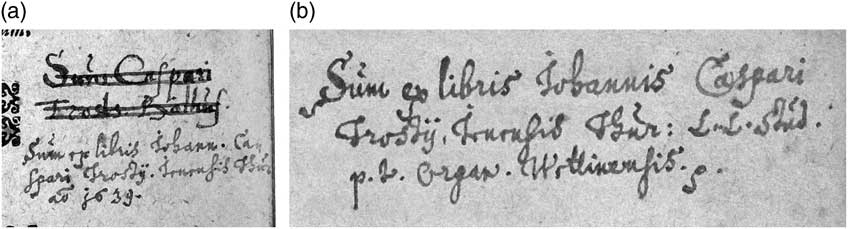
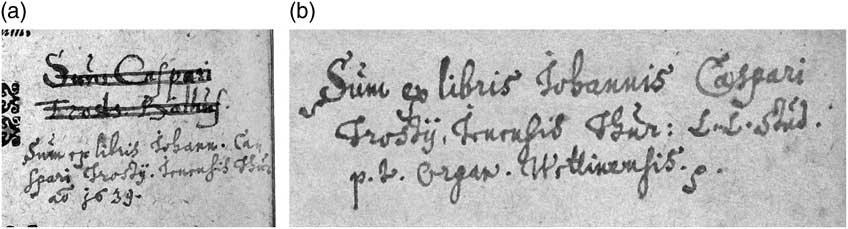
The name Johann Caspar Trost ‘Herbslebiensis’ appears in the register of Jena University as early as 1627, when Johann Caspar the Elder was no more than ten years old.Footnote 40 However, Johann Caspar never studied at this university but was most likely registered there by his father, Caspar Trost, when he was still a child – which is suggested by the fact that he was identified by Herbsleben, his genuine birthplace, rather than Jena, his place of residence since infancy. In actual fact, Johann Caspar Trost seems first to have attended the gymnasium in Halle/Saale, where as an eighteen- or nineteen-year-old he delivered a disputation on 16 September 1635 on the theoretical aspects of music, presided over by the rector and renowned educational reformer Christian Gueintz (1592–1650).Footnote 41 Published in 1635, the disputation is the only original work of music theory which can be ascribed to Johann Caspar Trost the Elder.Footnote 42 Newly discovered provenance marks add more to the story, however. We now know that from 1635 to 1639 Trost attended the University of Leipzig, where he matriculated in the winter semester of 1635 as a student of law.Footnote 43 And as one would expect, the Leipzig register gives Jena (where Trost spent the majority of his childhood) as his place of origin, not Herbsleben.Footnote 44 At the same time, Trost referred to himself in an ownership entry as ‘L.L. stud. p.t. Organ. Wettinensis’ (see Figure 1b below),Footnote 45 meaning that as a student of law he had also taken up a post as organist in the town of Wettin on the Saale River, north-west of Halle.Footnote 46 It was probably in Wettin that Trost first encountered local organ builders and met his (first?) wife Dorothea, the daughter of the Wettin organist, organ builder and mayor Johann Wilhelm Stegmann, and the niece of the renowned organ builder Christian Förner (1610–18).Footnote 47
(a) Signatures of Caspar Trost and his son Johann Caspar Trost the Elder (on the title page of D-W, J772.8o Helmst [1], courtesy of Herzog August Bibliothek Wolfenbüttel); (b) Signature of Johann Caspar Trost the Elder, from his time as a student of law at Leipzig University (1636–9) and pro tempore organist in Wettin (on the title page of D-HSj, L-1334)
From 1641 to 1646 Trost can be traced to Goslar, where he served as vicar and organist at the collegiate church of SS Simon and Jude, while also working as an organist at Goslar’s main church, SS Cosmas and Damian.Footnote 48 It was also in Goslar that Trost’s children, Heinrich Georg and Maria, were born, in 1641 and 1644 respectively.Footnote 49 It is still unclear both why Trost relocated to Goslar and when exactly he moved on from Goslar to Halberstadt, where he had acquired the post of a ‘Regierungs Advocatus Ordinarius’,Footnote 50 an appointment as government lawyer to the court of electoral Brandenburg in Halberstadt.Footnote 51 In 1667 Christoph Stegmann (d. 1682), pastor in Kirchenedlau (north of Wettin), published a pamphlet dedicated to his uncle Christian Förner and his brother-in-law and former ‘instructor’ (informator) Johann Caspar Trost, the latter of which was granted the title ‘Juris practicus und Advocatus ordinarius’ in Halberstadt.Footnote 52 Thus, it seems that it was at some point after 1667 that Trost became organist at St Martin in Halberstadt and the teacher of Andreas Werckmeister (1645–1706), noted music theorist and organist.Footnote 53 When Trost died in 1676, his son, Johann Caspar Trost the Younger (fl. 1673–96), succeeded him as organist at St Martin; subsequently Werckmeister took over the post in 1696.
Musicologists first took notice of Johann Caspar Trost the Elder as a presumed editor and translator of musical treatises, fifteen of which were advertised in the Leipzig fair catalogue of 1673.Footnote 54 Five of these were described as his own works and eight as translations of Italian, French and English treatises. Also included are editions of Michael Praetorius’s Organographia and the Ausmachung deß Clavicymbel-Claviers, as well as a work by the Haarlem amateur and music theorist Joan Albert Ban (c. 1597–1644). The latter was possibly meant to be a German edition of Ban’s Kort sangh-bericht (Amsterdam 1643), with a treatise on a ‘perfect’ keyboard tuning system.Footnote 55 None of these works, however, has been found in the material we have verified as coming from Trost’s library, and it is possible that his editions were never published. That said, the most verifiable of Trost’s publication projects relates to his surviving copy of Thomas Morley’s Plaine and Easie Introduction, which he acquired in 1649.Footnote 56 The book is interleaved with blank folios throughout, probably with a view to preparing a translation, which was indeed announced with the other titles in the 1673 fair catalogue. Moreover, Trost owned relevant works by Artusi and Diruta, translations of which are also advertised. The 1673 list was reprinted by his son, Johann Caspar Trost the Younger, in his book on the Weissenfels organ, with the comment that these fifteen music theoretical texts left behind by his father – called parerga (supplements) – were still awaiting a publisher. From Johann Gottfried Walther’s Lexicon onwards, this list has been the main source of information about Johann Caspar Trost the Elder as an author.Footnote 57
Trost’s books and family biography prove to be closely interrelated over at least two generations, with many of the stations of his own life reflected in the dated ownership entries found in almost all of his books.Footnote 58 Various traces of Trost’s father, brothers and sons also exist. Provenance research therefore fills significant gaps in scholarly knowledge regarding both the educational background of, and the contemporary knowledge available to, Johann Caspar Trost the Elder and his family. Indeed, Trost’s library seems to have functioned as a ‘living library’,Footnote 59 a centre of (social) interaction between book owner, reading family members and books. The books that have surfaced thus far represent a snapshot of the knowledge which stood on the shelves of Johann Caspar Trost the Elder’s library at the end of his lifetime. Meanwhile, the presence of number of extremely rare music textbooks – which, significantly, were never given away during his lifetime – bears witness to Trost’s early musical education in the 1620s, and highlights the musical interests and activities of his father, the Kantor and organist Caspar Trost.
In what follows, we focus on books which, in regard to both space and content, we believe occupied a privileged place in the life and musical development of Johann Caspar Trost. We first explore the newly discovered manuscript treatises of Altenburg and Schein in both their narrower material context (a composite volume connected to Trost’s youth and his educational interests as an adult) as well as their broader intellectual context (namely, the contemporary conception of a music textbook). In the final section of this article, we widen our study to address the practice of music education via printed and manuscript textbooks in contemporary Thuringia.
III. NARROWER CONTEXT: THE MANUSCRIPT TREATISES IN THEIR COMPOSITE VOLUME
The practice of trading printed books unbound, or sewn with only a temporary stitching, gave book-buyers the opportunity to fashion their own composite volumes with great ease.Footnote 60 Indeed, it is not unusual for composite volumes to contain a combination of printed and handwritten texts. Composite volumes of the early modern period, still widely overlooked by historians of the book, are monuments at risk. In the intervening centuries since their creation, early modern composite volumes have all too often been disassembled and their component parts separated – not just at the hand of antiquarian book dealers but librarians as well, even into the twentieth century. Unique binding sequences (when they exist intact), however, are unusually clear windows onto a reader’s personal interests, and this fact makes composite volumes the more valuable as sources for constructing the history of reading and reception of printed texts, musical and otherwise.Footnote 61 Generally speaking, provenance marks in composite volumes typically appear on either the title page of the first item in the volume or the volume’s front pastedown. When different provenance marks appear on title pages of subsequent items bound in the composite volume, this typically indicates earlier traces of book ownership. Printed texts were often heavily annotated by the reader, and these material features – especially when viewed alongside the individual combination of titles in a composite volume – are powerful lenses through which to view the wider contexts of education, communication and how knowledge was acquired.
The treatises by Schein and Altenburg appear together in one manuscript, bound with five printed instructional texts, in a quarto volume. Together, these six bound items represent a striking case study of how precisely to explore the aspects mentioned above. 14 Musica Helmst. was rebound in the 1960s in half-leather. However, the original binding was preserved separately and bears the original shelfmark label ‘39’. The volume displays the following binding sequence:
-
(1) Johann Crüger, Synopsis Musica Continens Rationem Constituendi & Componendi Melos Harmonicum, Conscripta variisque exemplis illustrata. [Berlin]: Johannes Kally, 1630. 4°. VD17 1:643762P; RISM B VI, p. 246. Provenance mark/inscription: Ex libris Johann. Caspar. Trost. Jenensis Thur: Ao 1633.
-
(2) Georg Quitschreiber, De Canendi Elegantia, Octodecim Praecepta, Musicae Studiosis necessaria. Jena: Johannes Weidner, 1606. 4°. VD17 3:014655F; RISM B VI, p. 679.
-
(3) Adam Gumpelzhaimer, Compendium Musicae Latino-Germanicum. Augsburg: Ulrich Schöniger, 1616. 4°. VD17 1:644979P; RISM B VI, pp. 387–8.
-
(4) Michael Altenburg, De Musica; Johann Hermann Schein: Etzliche Lehren so einem Incipienten in der Musica Poëtica (wie sie genennet wirdt) fürnemlich zu wissen von nöthen, aufgesetztet, von Johann. Hermano Schein. MSS 4o. There is no record of this manuscript in the modern library catalogues of the Herzog August Bibliothek.Footnote 62 For an edition of this item, see the Appendix.
-
(5) Maternus Beringer, Musicae Das ist: Der freyen lieblichen Singkunst, Erster und Anderer Theil. Nuremberg: Georg Leopold Fuhrmann, 1610. 4o VD17 1:643644L; RISM B VI, p. 139.
-
(6) [Anderer Theil]. VD17 1:643644L; RISM B VI, p. 139.
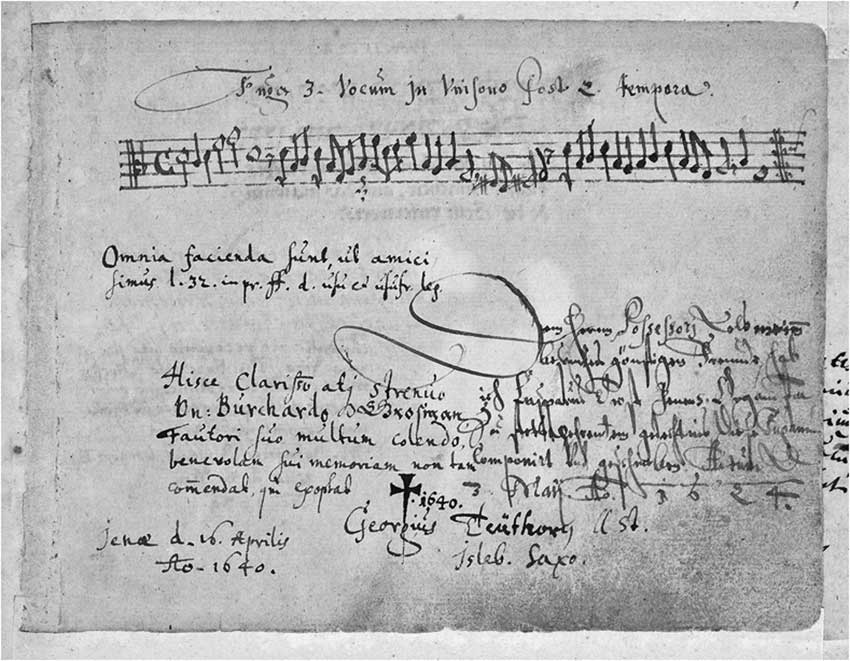
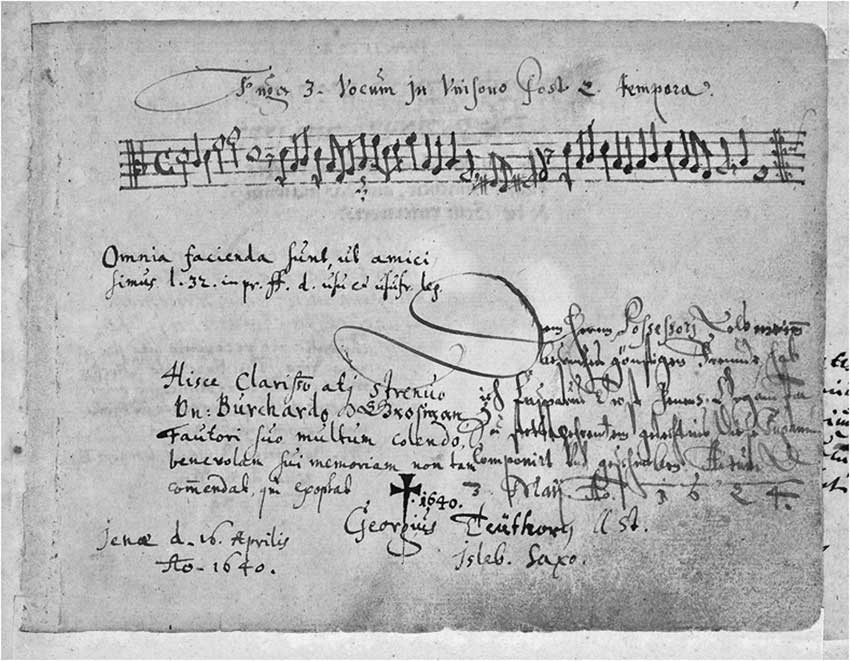
The title page of the first item in this composite volume bears the inscription ‘Ex libris Johann Casparis Trost Jenens. Thur. Ao. 1633’. By contrast, none of the other title pages bears any provenance marks whatsoever. It is therefore highly likely that Johann Caspar Trost assembled the composite volume himself and included as the fourth item the manuscript treatises, which were written in the hand not of Johann Caspar the Elder but of his father, Caspar Trost. We were able to clearly identify the handwriting by comparing it with an entry by Caspar Trost in the album amicorum of Burckhard Großmann the Younger from 3 May 1624 (see Figure 2, and Figures 3–4 below).Footnote 63 Moreover, Johann Caspar Trost the Elder is not the author of the manuscript treatises, as has been asserted in earlier publications, despite the obvious mention of Schein in the heading of the second treatise.Footnote 64
Entry and canon of Caspar Trost in the album amicorum of Burckhard Großmann the Younger, 3 May 1624 (right), to which Georg Teuthorn added his entry in 1640 (left; NL-DHk, 133 C 14–B)
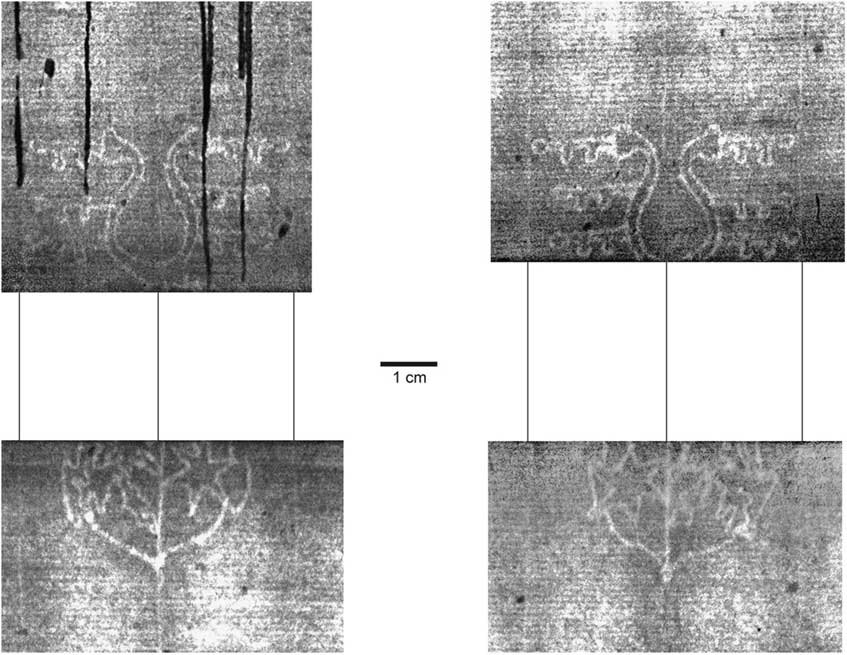
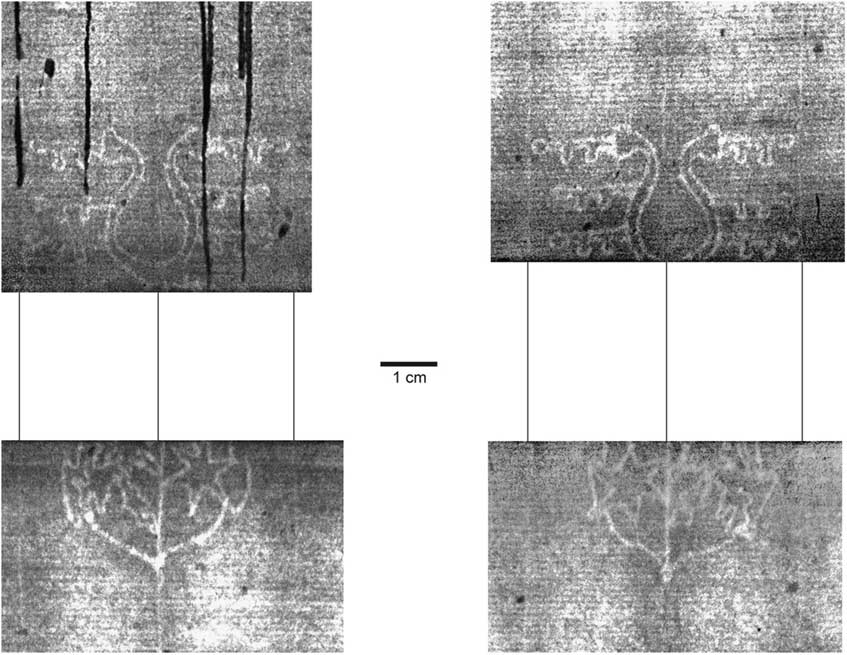
Watermark of D-W, 14 Musica Helmst. (4) (courtesy of Herzog August Bibliothek Wolfenbüttel)
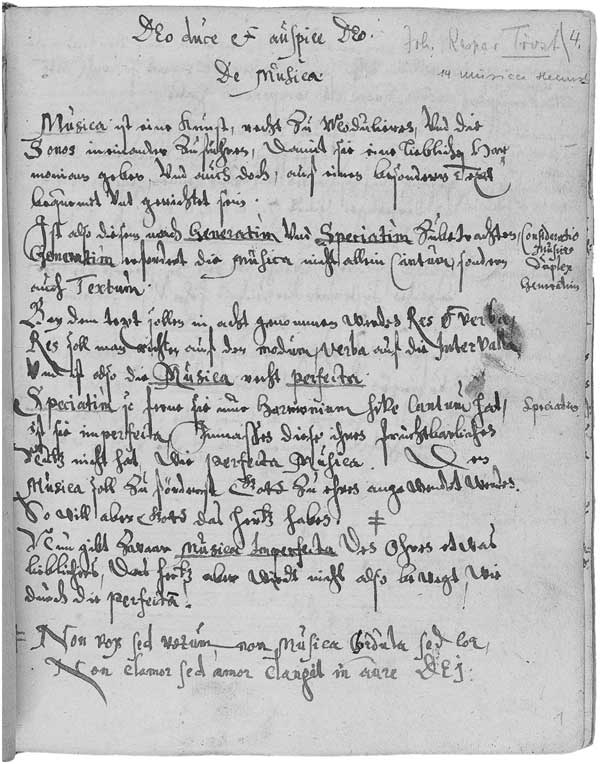
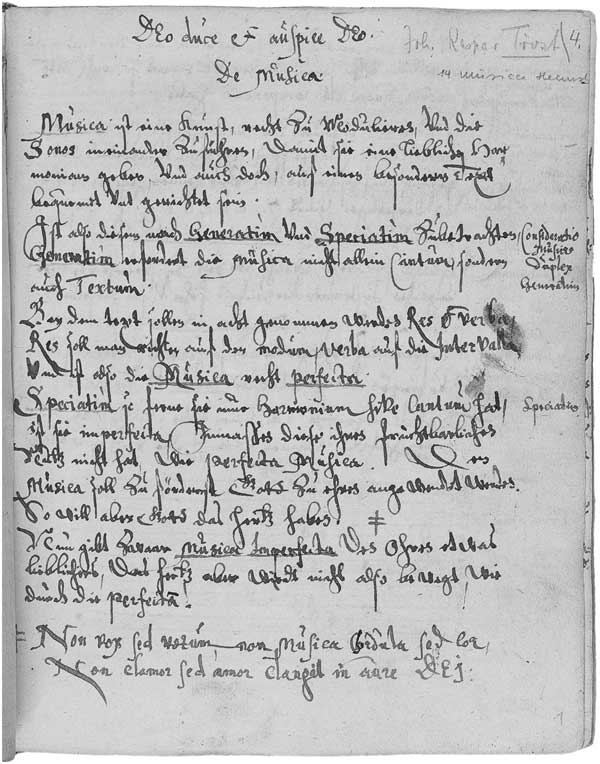
First page of the manuscript treatise De musica by Michael Altenburg, written by Caspar Trost (D-W, 14 Musica Helmst. [4], courtesy of Herzog August Bibliothek Wolfenbüttel)
The quarto manuscript, measuring 18×15 cm, is made up of ninety-seven leaves, but is bound as an octavo (eight leaves per quire). Only fourteen leaves contain writing, however. As is typical for quartos, the watermark is partially hidden in the fold, but shows a shield parted per pale with half-a-lion and two stars, while the crest consists of two buffalo horns with linden branches (Figure 3). The fact that these heraldic elements are found in the old coat of arms of the landgraves of Thuringia suggests that the paper was produced in a Thuringian paper mill.Footnote 65
The manuscript copied by Caspar Trost is a compilation of at least two different texts. Regarding the second, it can be identified conclusively as a copy of a treatise by Johann Hermann Schein. Its title corresponds verbatim to the title of a manuscript mentioned by Johann Mattheson, ‘Etliche Lehren, so einem Incipienten in der Musica poetica, wie sie genennet wird, vornehmlich zu wissen und von nöthen, von Johann Hermann Schein’, as an appendix to ‘Etliche nothwendige Fragen von der poetischen oder Tichtmusik’ by the Freiberg composer Stefan Otto (1603–56) from 1632.Footnote 66 Meanwhile, the first text in the manuscript was not a work by Caspar Trost either. Instead, Trost himself wrote that it was by ‘M. Michaëlis Altenburgij Past: Sömmerdani’. Born 1584 in Alach, Michael Altenburg was Kantor and school rector in Erfurt until 1609, after which point he became pastor in Tröchtelborn and, from 1622 to 1637, in Sömmerda. He published a number of musical compositions, amongst others a collection of occasional music entitled Gaudium christianum celebrating the Reformation centenary of 1617.Footnote 67 Moreover, Michael Praetorius entrusted Altenburg with the musical education of his sons.Footnote 68 Although Altenburg’s primary profession was that of pastor, the nature of his pedagogical duties and the strength of his musical interests make it plausible that he was indeed the author of a small musical textbook which, although unpublished, evidently circulated in manuscript.
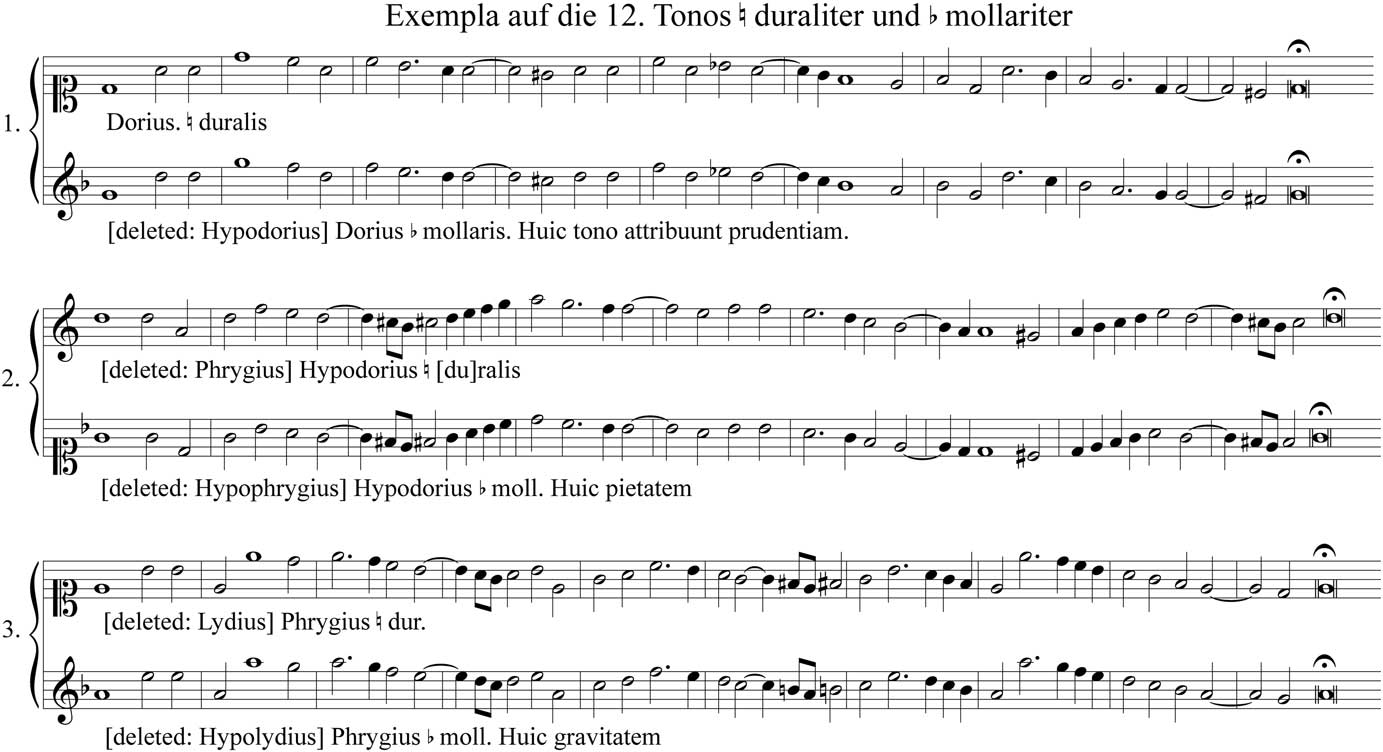
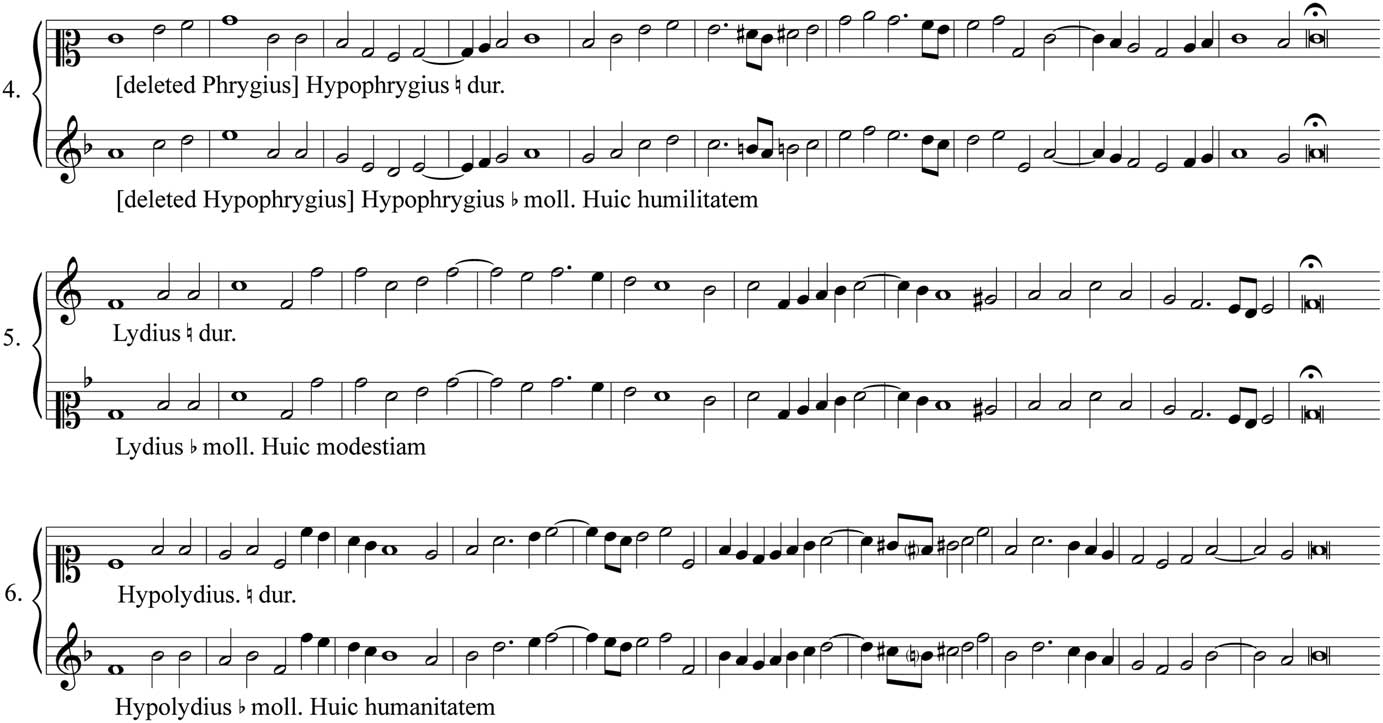
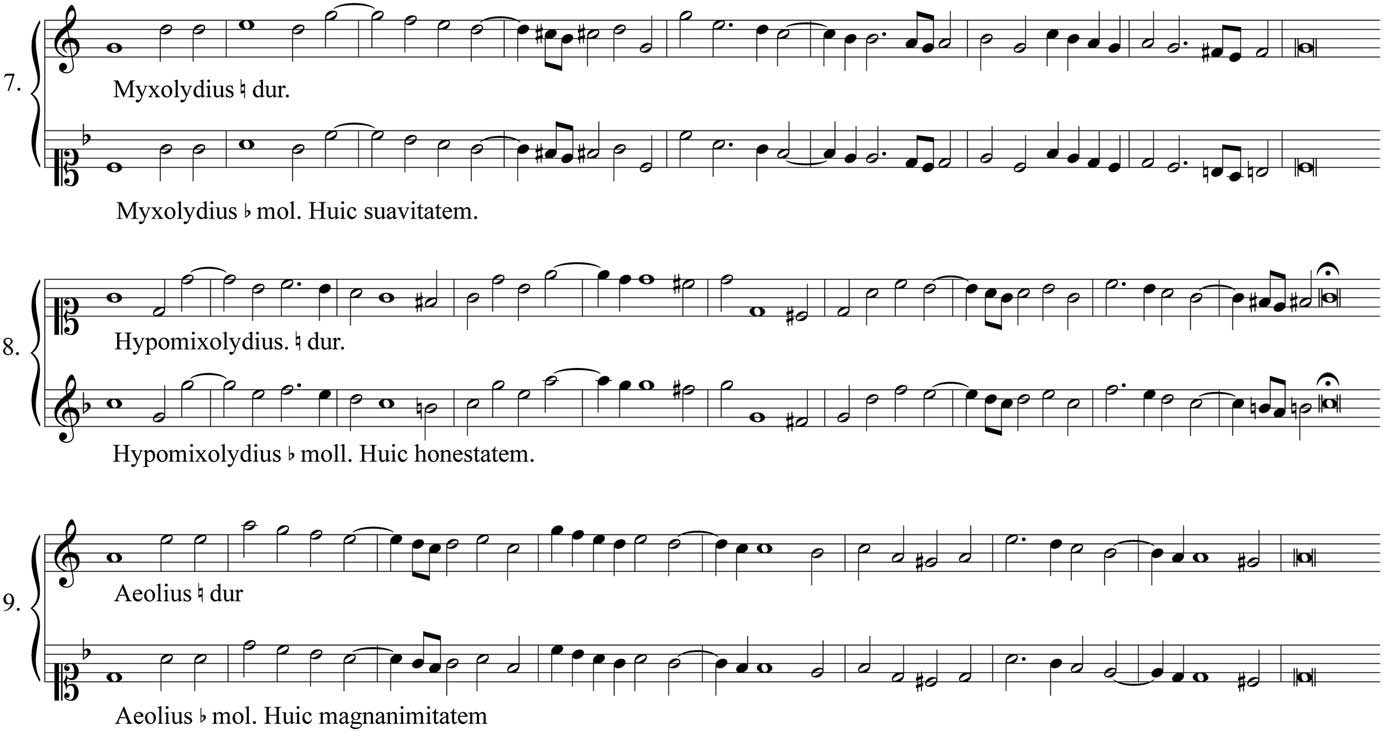
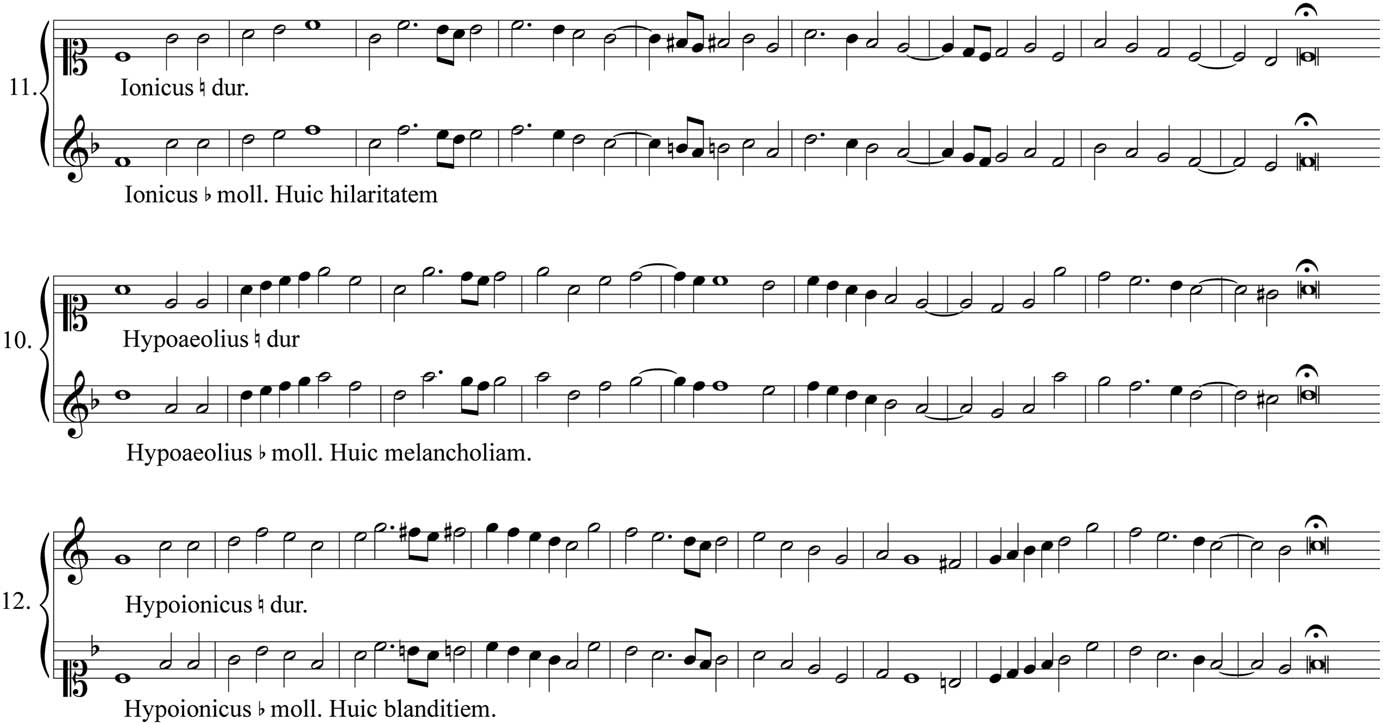
The manuscript containing the two treatises consists of three parts in all, as signposted in the document by three headings. The first part begins with the motto ‘Deo duce et auspice Deo’ and bears the title ‘De musica’ (fols. [1r]–[7r]) (see Figure 4); the second part is entitled ‘Etzliche Lehren so einem Incipienten in der Musica Poetica (wie sie genennent wird) fürnemlich zu wißen von nöthen, aufgesetztet, von Johann: Hermano Schein’ (fols. [7v]–[12v]) (see Figure 5), followed by the final part under the headings ‘Principal Cadentien von allen 12. Modis’ and ‘Exempla auf die 12. Tonos, ♮ duraliter vnd ♭ mollariter’ (fols. [13r]–[14v]).
First page of the manuscript treatise Etzliche Lehren by Johann Hermann Schein, written by Caspar Trost (D-W, 14 Musica Helmst. [4], courtesy of Herzog August Bibliothek Wolfenbüttel)
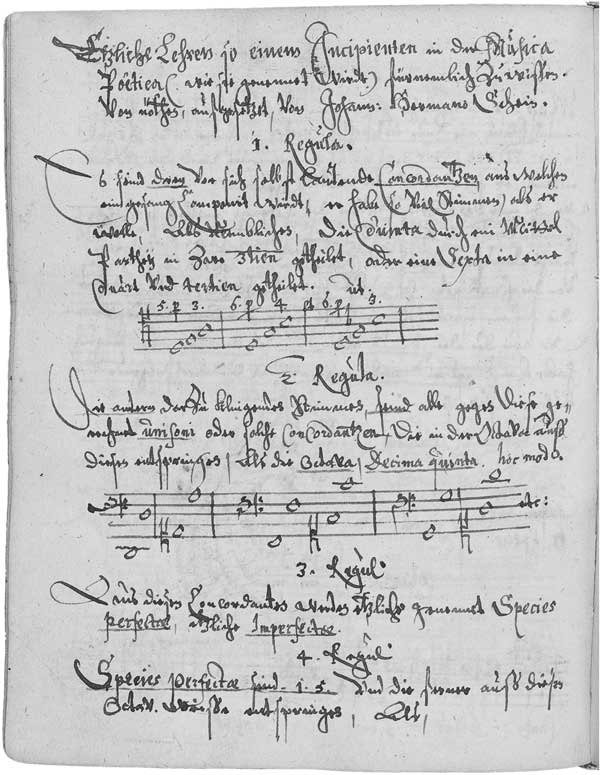
The manuscript is clean and in a clear layout, copied almost completely without error. Only three staves were left empty (fols. [2r], [6v], [7r]), suggesting that the manuscript was possibly left unfinished. The appearance of the manuscript suggests that it was probably intended to be shared with pupils or colleagues. Underlined keywords and marginalia facilitate the reader’s orientation, and the attributes of Trost’s volume bear resemblances to the extant manuscript textbook Anleitung zur Singekunst (Instruction on the art of singing, c. 1642) by the Hamburg Kantor Thomas Selle. The Anleitung was intended for the Johanneum School in Hamburg, where Selle was responsible for teaching pupils to sing polyphonic music. Some slightly later texts on composition also circulated in clean copies, notably the so-called Compositions-Regeln (rules on composition), which circulated in manuscript among pupils of Jan Pieterszoon Sweelinck and can be viewed as a recourse to Zarlino’s Istitutioni harmoniche.Footnote 69 The transmission of manuscript copies was seen as an effective means of circulation, equal to distribution by printing, especially for more specialised writings on music. The presence of texts by Schein and Altenburg, as clean copies alongside printed textbooks, in Trost’s Sammelband illustrates well the coexistence of both methods of circulation. Regarding the content of Altenburg and Schein’s treatises, their texts cover different yet complementary topics. Altenburg’s De Musica treats basic topics (general principles and qualities of music), while Schein’s Etzliche Lehren explores the concrete application of such topics to musical composition. As a whole, therefore, the manuscript displays a logical and practical coherence. Interestingly, the manner in which Altenburg’s rudimentary instruction combines with Schein’s more sophisticated rules mirrors Otto’s manuscript, as described by Mattheson. Otto’s own treatise, which itself treats the principles of music with a slightly wider variety of topics than Altenburg’s,Footnote 70 is also followed by Schein’s rules. Otto’s text is even introduced by a German motto that resembles Altenburg’s Latin phrase Deo duce auspice Deo (‘under God’s guidance and protection’), namely ‘Der beste Musikant, der alles kann regieren / Der wolle dieses Werck fein glücklich hinaus führen’ (May the best musician who rules over all [i.e., God] bring this work to a favourable end).Footnote 71 Together, these examples suggest that it was not unusual for musicians and teachers to combine more basic instructional texts with Schein’s rules for composition.
Interestingly, Crüger’s printed Synopsis musica – also bound into Trost’s composite volume ahead of the manuscript – treats a similar range of topics. The other printed textbooks found in the composite volume, meanwhile, are concerned with more fundamental elements of musical instruction (Gumpelzhaimer and Beringer), or explore the proper performance of music (Quitschreiber). Quitschreiber’s book is a clear outcome of the author’s activities as a Kantor in Jena from 1598 onwards. He became pastor in Hainichen and Stiebritz in 1614, and by 1629 he lived and worked in Magdala and Ottstedt, all villages near Jena. His De canendi elegantia is a small pamphlet in which he places relatively widely known rules for singing properlyFootnote 72 within a more elaborate referential framework, thereby underlining the theological and erudite bases for the practice of singing as found in numerous contemporary German sources. Quitschreiber’s text begins with a quotation from Luther’s famous letter to Ludwig Senfl, and includes marginal references to earlier writings on music (Andreas Ornithoparchus, Hermann Finck and Claudius Sebastiani) as well as biblical and literary references (St Augustine, Erasmus, Homer, Plutarch and Baptista Mantuanus). That Quitschreiber referenced such a wide range of authorities underscores again the multifaceted nature of a Kantor’s competences. Quitschreiber also sought to promote and celebrate music as an educational subject by emphasising the learned background of music, situating his work within the tradition of earlier German pedagogical literature, and citing the verses ‘Non vox sed votum, non chordula Musica sed cor, Non clamans sed amans, cantat in aure DEI’.Footnote 73 These verses, as we shall see, also appear in the first part of Altenburg’s text.Footnote 74 Quitschreiber’s publication, at any rate, bears testimony to the vibrant interest in music in Jena in the early seventeenth century.
The fifth and the sixth items in the composite volume are Maternus Beringer’s Musicae Das ist: Der freyen lieblichen Singkunst, Erster und Anderer Theil. Once again, this is a fairly typical musical instruction book. While based partly on Gumpelzhaimer’s Compendium (as the latter noted with a hint of sarcasm in the music inventory of St. Anna in Augsburg),Footnote 75 Beringer’s text also relies heavily on the Artis musicae methodicae (1596) by Johannes Magirus, most notably with regard to how he arranged the text’s subject matter. At the same time, Magirus – active primarily in Hannover and Braunschweig – displayed distinct elements of individual thought, especially when arguing for a ‘natural’ ordering of the modes.Footnote 76 Gumpelzhaimer, responsible for the aforementioned music collection in Augsburg, was the author of the third item found in Trost’s composite volume, namely the Compendium musicae Latino-Germanicum (published in various editions from 1595 on). This publication represents one of the most successful instruction manuals of the seventeenth century, with thirteen new editions produced over a period of ninety years.Footnote 77 Hence, both Beringer and Gumpelzhaimer’s texts round off Trost’s composite volume by complementing other German texts that address the fundamentals of music. Moreover, these two titles provide a variety of pieces that could be used for practical training. The second part of Beringer’s text, for instance, is explicitly labelled as an ‘Exempelbüchlein’, with about two dozen pieces bearing a handwritten note identifying the composer (in most cases, ‘A.G.’ for Adam Gumpelzhaimer). The hand is most probably that of Johann Caspar Trost, which supports the notion that he used this volume in his own musical studies. In any case, these marginalia attest to the user’s awareness of the need to identify composers and pieces, and they serve as evidence of a rudimentary philological interest. In some cases, differences have even been noted, such as the transposition of In dich hab ich gehoffet, or smaller discrepancies in Pietas omnium: ‘A.G. aber etwan anders’ (Adam Gumpelzhaimer, but with slight differences).
Today, this composite volume is a unique combination of rare music textbooks. But to its owner, it was an internally coherent tool for music education. Although much is still unknown, we can be sure that Caspar Trost copied the manuscript for the purpose of either using it personally or educating his sons in music through its didactic contents. Regarding the volume as a whole, the dated provenance marks on the title page of Crüger’s Synopsis (the first item in the composite volume) suggest that Johann Caspar Trost the Elder had the printed editions and the manuscript bound in 1633, and therefore provide traces of musical education in this family over at least two generations.
IV. THE BROADER CONTEXT: ALTENBURG, SCHEIN AND THE NETWORK OF GERMAN MUSIC THEORISTS
The treatises by Schein and Altenburg, copied by Caspar Trost and surviving in his son’s composite volume, must be placed within the larger context of musica poetica – a phenomenon which reached its height at the close of the sixteenth century and which, importantly, was closely linked to the reception of Zarlino in German lands and the ever-increasing importance of treating compositional rules in pedagogical texts. The first traces of the term and concept of musica poetica (Nicolaus Listenius’s Musica, and the manuscripts by Heinrich Faber and Gallus Dressler) appeared around the mid-sixteenth century. Yet there was a steep rise in the number of musica poetica texts towards the end of the sixteenth century, particularly writings with a focus on the pragmatic treatment of the rules of counterpoint. By way of illustration, representative authors of musica poetica included, among others, Avianus (Isagoge in libros musicae poeticae, 1581), Dedekind (Praecursor metricus, 1590), Cyriacus Schneegaß and Calvisius, whose Melopoiia (1592) exerted a strong influence on the texts in question here.Footnote 78 And the fact that a large number of these works were printed in Erfurt (primarily by Baumann) highlights the importance of this city as a centre for the diffusion of books on music theory – a trend supported, at least in part, by the acquisition habits of the Trost family.Footnote 79 The geographical context in which Caspar Trost lived was a particularly fruitful one. During his time in Orlishausen from 1606 to 1614, and thereafter when he worked in Herbsleben as Kantor and organist between 1614 and 1617, Trost may well have come into contact with Michael Altenburg in Sömmerda and, in a small window of time, also with Johann Hermann Schein. In 1615, Schein was appointed Kapellmeister at the nearby Weimar court, although by 1616 he had already left Weimar in order to take up the Thomaskantorat in Leipzig.Footnote 80 Indeed, Trost’s Thuringian environment had been a vibrant hub for musicians and authors of instructional texts since the mid-sixteenth century – principally in Jena with its university, the residential city of Weimar, and Erfurt as a place of trade and printing, as well as the flourishing musical culture in the towns and villages in the surrounding countryside.Footnote 81
In addition, we see something of an informal network of composers and writers – comprising a number of Thuringian musicians whose writings bear striking similarities to one another – who were guided and influenced by Calvisius and his successor in Leipzig, Schein. Not only did this network include a considerable number of well-known writers active in early seventeenth-century Germany, some of whom cultivated their personal connections visibly in the form of dedications or correspondence, but the content and presentation of these writers’ texts were distinctly shaped by Calvisius’s thought. In the case of Schein, however, the lack of published texts makes it more difficult to identify his genuine contributions to this circle. Apart from their dependence on Gioseffo Zarlino, they share common ground in a thoroughly pragmatic approach to teaching, which amongst other things included experimentation with alternatives for solmisation. Indeed, figures like Christoph Demantius, Nicolaus Gengenbach, Johannes Lippius or Thomas Selle, but also Michael Praetorius and Henricus Baryphonus, can be counted as direct (or indirect) followers of this tradition.Footnote 82
These contexts, namely Caspar Trost’s Thuringian network and aspects of Johann Hermann Schein’s biography, offer clues that help with dating both Schein’s text and Trost’s manuscript. Although Schein may indeed have adopted certain approaches from Calvisius, in all likelihood he did not actually teach music before 1613, when he became instructor to the sons of Gottfried von Welffersdorf in Weißenfels, Schein’s former schoolmate at the Landesschule Pforta. Schein remained in Weißenfels until 1615 and maintained close ties with musicians active in the town.Footnote 83 However, writing down the rules of composition was not an absolute necessity for either his job as music tutor or his next position, chapel master at the Weimar court. Therefore, the Etzliche Lehren, in all likelihood, was not written until sometime after Schein had taken up his post as Thomaskantor in Leipzig – a suggestion made all the more likely when one considers that Selle’s Anleitung was written at a similar moment in his career, namely the beginning of his tenure at the Johanneum.
One explanation for how Caspar Trost came to copy the text is that Schein’s treatise may have circulated among composers contributing to Burckhard Großmann’s publication project Angst der Hellen vnd Friede der Seelen of 1623. As mentioned above, Trost could easily have come into contact with Schein when the latter was employed at the Weimar court. But it seems more likely that Schein’s text became available to Trost via his personal network during the following decade. The density of his network is visible both in the album amicorum of Burckhard Großmann the Younger (fl. 1614–25), mentioned above, as well as in the anthology Angst der Hellen collected by the latter’s father. Even if we do not know the criteria Großmann the Elder used to select the contributors to Angst der Hellen, it is noteworthy that his choice closely reflected current musical trends in the surrounding regions, with many of the composers being personally acquainted with one another.Footnote 84 Indeed, when one examines the settings found in Angst der Hellen striking similarities emerge between the musical settings of Psalm 116 by local composers and those by Schein and Praetorius, making it highly likely that at least some of the settings circulated among the contributors prior to publication.
On the basis of these dense personal contacts, one can imagine Caspar Trost gaining access to Schein’s Etzliche Regeln via this network. Großmann himself could have been the intermediary for the dissemination of the text, especially in view of the fact that his library is reported to have contained a considerable number of music books.Footnote 85 One part of Großmann’s collection was donated to the local church and municipal school, while the other part was retained for use by his son, and it is conceivable that copies of Schein’s as well as Altenburg’s text were in Großmann’s library. Regarding Altenburg, the short geographical distance between him and Caspar Trost also makes personal exchange more than possible. At any rate, though it is impossible to prove with any certainty that Caspar Trost enjoyed direct contact with the authors of the treatises, he had a vast personal network at his disposal for accessing the writings of his colleagues.
The content of Altenburg’s treatise also reflects the impact of the Calvisius–Schein network, seen when one takes a closer look at the text’s arrangement and content. As already stated, Altenburg’s De musica tackles primarily the basic elements of music – a fairly typical aim for many German textbooks of the time (presenting, for instance, definitions, note names, solmisation, notational signs, mensuration and modes).Footnote 86 The arrangement of Altenburg’s text is quite clear. He begins with a definition of music, followed by three sections: ‘ars canendi’, ‘ars componendi’ and ‘modorum cognitio’. Throughout his prose, Altenburg systematically develops twofold distinctions in a way reminiscent of the strictly ‘methodical’ layout of earlier textbooks like Friedrich Beurhusius’s Erotemata, which adopted dichotomies as a means of organising the content.Footnote 87 Although it is difficult to know precisely on which instructional text he modelled his treatise, Altenburg’s text shows clear parallels with other works from the beginning of the seventeenth century, and can be situated most securely within the tradition of Sethus Calvisius and Johannes Lippius. The treatise attests to Altenburg’s familiarity with contemporary trends in music-theoretical and music-pedagogical thought and recent publications. Comparing Altenburg’s text with those of others (Calvisius and Lippius, and, to a minor extent, Quitschreiber, Andreas Finolt, and Crüger) reveals that the choice of authors overlaps considerably with the names of those in Altenburg’s own network. Evidently, Altenburg did read books written by colleagues with whom he was personally acquainted. Aside from Calvisius,Footnote 88 Johannes Lippius is an important author for comparison. He was closely connected to Calvisius, and the organisation of topics in his Synopsis shows, at least in the first part, a striking similarity to that of Altenburg’s text. Lippius was, in his own words, encouraged by Calvisius in his endeavours and wrote some texts on his own.Footnote 89
Altenburg’s definition of music conflates several concepts. He defines music as ‘the proper patterning of sound’ (a literal translation of the ‘bene modulandi’ of Augustinian origin), and as combining sounds in a way that produces a pleasant ‘harmonia’ which must conform to a text. This formulation, to be sure, strongly resembles the opening definition in Calvisius’s Melopoiia (1592).Footnote 90 Then, music must be considered either in a general way (generatim) if it includes a text, or in particular if it is without text, which is imperfect since it lacks the semantic power of words.Footnote 91 The inclusion of textless music (harmonia nuda) is also found in Calvisius’s Melopoiia. But whereas with Calvisius the discussion centres on instrumental music, Altenburg’s text does not develop the topic further. Within his definition of music, Altenburg refers to the aforementioned device ‘Non vox, sed votum . . .’ (Appendix, fol. 1r), cited in order to stress the importance of vocal music in praising God and expressing devotion through music. Although the quotation was a common one, Altenburg used the verb ‘clangere’ (to sound) rather than the more common form ‘cantare’ (to sing). When referencing this quotation in the preface to his Syntagma musicum I, for instance, Praetorius preferred the more common version using ‘cantare’. Altenburg’s unique wording, however, also appears in Großmann’s preface to Angst der Höllen,Footnote 92 signalling that this was possibly Altenburg’s source for the device. At the very least, the similarity between Altenburg’s and Großmann’s texts underscores again the close relationship between them as well as the vitality of their personal network.
Specifically regarding the relationship between text and music, Altenburg opens with an original statement: namely, ‘res’ (the topic) and ‘verba’ (the wording) both have to be observed; ‘res’ is said to be connected with the chosen mode and ‘verba’ with the intervals. This is a concise synthesis of contemporary rhetorical approaches to general and specific means of textual expression, in agreement with the late sixteenth-century conceptions of modal ethos and the acknowledgement of certain kinds of rhetorical figures. The res–verba pairing harks back to the Poetics of Joseph Scaliger (1561), who highlighted the difference between content and presentation (‘res’ is understood as ‘idea orationis’ and ‘verba’ as ‘materia orationis’), but such a formulation appears in German writings on music only from Calvisius onwards.Footnote 93 Calvisius recommends the use of modes as the proper way of rendering the content of a text, particularly if a composer is still inexperienced.Footnote 94 To be sure, his predecessors – especially those following Glarean’s modal theory – had already insisted on the importance of the various affective qualities of different modes.Footnote 95 The same ideas indeed informed Altenburg’s definition, but through assigning intervals to words and modes to general topics, he highlights two issues of textual expression.
The ars canendi section (Appendix, fol. 1v), first, offers the reader an introduction to musical signs. It starts with the ‘systema’ (the stave), which can be either ‘totale’ (comprising fourteen lines) or ‘partiale’ (the common five-line stave), from which the location of the individual sounds (by means of different clefs) is developed. The systema is treated in a similar way to the opening of Lippius’s Synopsis, but in Lippius it is related to its use in composition. It is thus conceived and presented as a descendant of the tabula compositoria, the early score format. In a performance-orientated way, the ‘systema generale’ (with fifteen lines) appears as a synoptic representation of the whole gamut in Selle’s Anleitung zur Singekunst.Footnote 96 That Selle approaches this similarly may be a possible indication that this mode of presentation was widespread among students of Calvisius and Schein. Altenburg’s treatment of intervals is equally noteworthy. He assigns certain affective qualities to the different species of intervals, depending on the positions of the semitone. The fourths on C, D, E are designated as ‘festive’, ‘sweet’ and ‘weak’ respectively. Meanwhile, the fifths on C, E, E and F are deemed ‘festive’, ‘sweet’, ‘weak’ and ‘querulous’ (fols. 3v–4r). In Lippius we again find a number of affects assigned to the different intervals, but without considering the different attributes of each interval.Footnote 97 A similar classification, however, is found later in Wolfgang Caspar Printz’s Exercitationes.Footnote 98 Furthermore, in discussing the unison (which for Altenburg is the ‘aequalis sonus’, in opposition to ‘unequal’ sounds according to his bipartite classification scheme), Altenburg states that unisons are called ‘redeuntes’ by the organists, a reference to instrumental pieces with this title which include one part consisting of a single repeated note. Whereas the status of the unison is treated differently in contemporary discussions (namely, as the simplest interval or as the origin of other intervals), this connection of the abstract interval to instrumental practices is indeed unique. It can only be speculated whether this is an addition made by Caspar Trost in the course of copying the text (who was himself familiar with organ literature), or if it was already part of Altenburg’s text. The distinction of ‘intervalla contigua’ and ‘intervalla interrupta’ for intervals being reached stepwise or by leap can also be found in other texts. Altenburg’s definitions attempt to strike a balance between precision and concision: he explains the comma and the different sizes of the semitone on the one hand, while on the other he simplifies the description of larger intervals by giving the number of lines or spaces they comprise in the stave (fols. 3r–4v).
The greater part of ‘ars componendi’ is devoted to explaining the different intervals, while a smaller section is dedicated to the handling of intervals in composition, albeit in a quite rudimentary way (hence Trost’s inclusion of Schein’s Regeln, which adds a substantial and advanced treatment of the subject). Remarkably, Altenburg does not mention solmisation, giving only the letters to designate the claves (fol. 1v). This restriction to letter notation was part of Altenburg’s text either as a reaction against solmisation, which occurred within Calvisius’s circle amongst those who considered the system to be difficult to use in practice.Footnote 99 Or, it could be an alteration made by Caspar Trost given that organists like him were used to reading tablature. At the same time, Altenburg does not suggest one of the alternative systems using seven syllables, like the so-called bocedisatio, which were advocated by Calvisius and Lippius and influenced a number of writers after 1600.Footnote 100 Nevertheless, it can be speculated that Altenburg was familiar with its existence. In the only notated example where syllables are used for designating the notes, he specifies a ‘di’ to mark the raised semitone – after which a semitonium fictum, ascending and consisting of four commas, is heard.Footnote 101 This implies that Altenburg tried to assign this particular case (where the note is raised by the cancellation sign) a special syllable.Footnote 102
Finally, Altenburg includes a minimal description of ‘compositio’, defining it as the handling of intervals, namely the combination of consonances and dissonances (fols. 4v–5v). After defining the dissonances (second, tritone, augmented fourths, sevenths, diminished and augmented octaves), he presents two fundamental ways of using dissonance in a piece – either as passing notes (‘per celeritatem’) or by preparation (‘per syncopationem’).Footnote 103 He also distinguishes two kinds of composition, ‘pura’ and ‘ornata’, which equate to counterpoint note against note and florid counterpoint. He defines imitation (‘fuga’), and adds the classification of perfect and imperfect consonances. Concerning the use of consonances, he mentions only the prohibition of parallel perfect consonances, while parallel movement of imperfect consonances is allowed. With this set of prescriptions, Altenburg delineates – abstractly yet concisely – the basics of counterpoint. This information would, however, probably not have sufficed for applying the rules in practice (that is, for composing pieces independently) but instead summarises basic principles. This makes the more developed treatment found in Schein’s text an appropriate supplement. The explanation of the modes (fol. 5v–7r) also keeps to a relatively abstract level. The construction by octaves is explained together with transposed forms, but neither affective qualities nor examples of the modes are mentioned. Altenburg begins with the Ionian mode, following the Zarlinian order, while at the very end a scheme indicates the vocal ranges from Cantus to Bassus (fol. 7r).
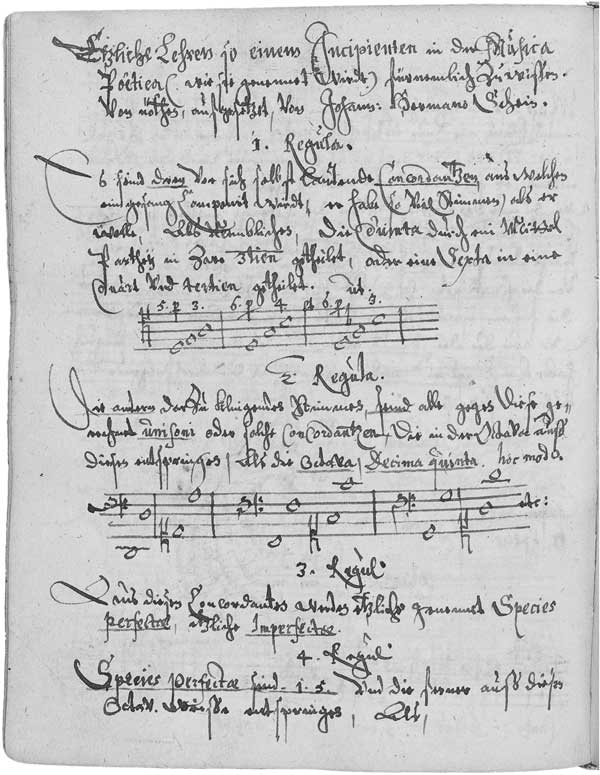
As Schein makes clear in his treatise’s title (‘Etzliche Lehren so einem Incipienten in der Musica Poetica . . . fürnehmlich zu wißen’), the work is targeted at ‘beginners’. (See Figure 5 above.) In total, the Regeln consists of thirty-eight paragraphs that cover the different types of intervals and their combination in (mostly two-voice) counterpoint. Schein also explains the principles of introducing dissonances, and provides some general remarks on cadences and voice-leading. Compared with similar texts, Schein’s limitation of subject matter becomes apparent in his classification of consonances and dissonances, and their use in two-voice counterpoint and general rules on voice-leading. His attempt at simplicity is also evident on a methodological level, in that he makes prescriptions rather than mere suggestions, the latter of which would require more experience on the part of the reader. This, again, resembles the presentation of topics in Calvisius’s Melopoiia.Footnote 104 Compared with a text like Calvisius’s, however, Schein’s treatise is much more concise because it restricts itself to a set of rules, mostly illustrated by a few notated examples. Comparable sets of rules are those, mentioned above, by Sweelinck or Christoph Bernhard’s Tractatus compositionis augmentatus or Ausführlicher Bericht vom Gebrauch der Con- und Dissonantien, written around the middle of the century.Footnote 105 Those texts are more elaborate, however. They include three- and four-voice setting and extensive treatment of cadences and imitation, in addition to providing (in Bernhard’s case) a discussion of stylistic levels and rhetorical means. Further, Joachim Burmeister’s Musica poetica of 1606 (and its predecessors) can be distinguished from this type of text through his strong emphasis on the analysis and understanding of music according to rhetorical criteria. Nevertheless, the first part also covers the classification of intervals and their combination in composition. Seen against this group of more or less contemporary texts, Schein’s Regeln do indeed appear to be an exposition for beginners in composition, with a clearly practical orientation.
Schein’s first rule (fol. 7v) implies a definition of composition which sees it as a combination of certain concordances in a harmony. In principle, it can be reduced to three voices, and Schein enumerates the combinations of three sounds (‘concordantzen’) that can be used: they form either a triad, or a six-three chord, or a six-four chord, which can be doubled in compositions for more voices (rule 2, fol. 7v). This issue was one which underwent a conceptual innovation in theory around 1600, as the concept of chords or triads was not yet fully developed.Footnote 106 It is addressed only in passing by Calvisius in his Melopoiia, when he explains the mediation of octaves by fifths and the ways in which a fourth can be used in forming a six-three or six-four chord. By contrast, it received a much more conceptual and original treatment in Johannes Avianus’s Isagoge in libros musicae poeticae (Erfurt, 1581).Footnote 107 There, it is understood that the formation of three-voice chords upon a basis (the lowest note) can be done in three different ways, which Avianus calls ‘perfect consonances’ (chords consisting of third and fifth), ‘imperfect consonances’ (six-three chords), and ‘absurd consonances’ (six-four chords).Footnote 108 This is, evidently, the earliest treatment of a three-voice chord as an entity integrating the three forms, while it is with Johannes Lippius’s treatment of the triades in his Synopsis that the idea of chordal inversions first appears.Footnote 109 Situated in between is Joachim Burmeister, who considered the chords contained in fifths and sixths, and mentioned the possibility of ‘augmenting’ the chord by doubling notes, still considering the basis of the sixth chord to be the lowest note.Footnote 110 In general, this implies a presentation of possible combinations – be it of intervals or of chords, often in the form of catalogues – which indicate ‘good’ and ‘bad’ forms (as is also the case in some of Schein’s two-part examples).Footnote 111 Within this range of possibilities for describing three-voice chords, Schein’s formulation appears to be located at an intermediary point between Calvisius’s, Burmeister’s, and Avianus’s ideas. He does not mention a basis in the sense of a root, but clearly describes three kinds of chords which can be obtained from the mediation of a fifth or sixth. In both Avianus’s treatise as well as in Schein’s, however, this topic is discussed at the beginning of the texts.
The rules that follow are devoted to the different classes of consonances (rules 3 to 25) and dissonances (rules 28 to 32). For each group, possible ways of proceeding are given, and the preparation and resolution (‘ligatura’) of dissonances are explained. The first specific rule to be mentioned is the prohibition of parallel perfect consonances (rule 6), but it is immediately mitigated for compositions with several voices. Pauses do not mend parallel fifths and octaves, but again this should be observed less strictly in pieces with several voices (rule 25). Alternation of movement (rules 23, 24 and 33) is mentioned as a general principle; in bicinia, only the discant and tenor cadence formulas are admitted (rule 21). The use of dissonances as passing notes is described positively, as is the use of consonances on the [stronger parts] of the measure. Large distances between two voices should be avoided (rule 35). In a three-voice piece the aforementioned three ‘concordantzen’ are preferred (rule 36) and should prevail in compositions for four and more voices (rule 37). The last rule warns against the excessive use of small note values, which can spoil a piece in the same way as excessive diminution (rule 38). With these precepts, the reader or student was made familiar with the general rules of compositionFootnote 112 in a way that probably would have facilitated their use in simple settings.
The third and last part of the manuscript compilation, as has already been mentioned, concludes with examples of cadences and melodies for all twelve modes (with transpositions). This is virtually identical to the material contained in the so-called ‘Compositions-Regeln’ which were transmitted in manuscript by pupils of Jan Pieterszoon Sweelinck. The cadences show the same layout in two columns.Footnote 113 The Principal Cadentien and the Exempla begin with Dorian (a difference from Altenburg’s ordering). However, Trost’s copy differs compared to known examples from Sweelinck’s circle: it gives the normal and the transposed forms immediately following one another, while the affective and ethical characteristics mentioned for each mode show slight differences from those mentioned in Sweelinck and other sources.Footnote 114 The qualities enumerated in Trost do not immediately coincide in their precise wording with any one of the other known catalogues from this time. At the same time, they do not contradict the characteristics mentioned elsewhere, and it may have been an original draft.Footnote 115 In the process of copying the ‘Exempla auf die 12 tonos’, a change (or an error) seems to have occurred. On the first page, the inscriptions originally gave the sequence of untransposed authentic and plagal modes from Dorian to Hypophrygian, without transpositions. From the third entry on, however, the names have been crossed out and replaced by the original/transposed form. It is not clear if this happened in the course of setting up the page, or if the first sequence of names was copied erroneously. Some of the examples are spaced quite closely at the end, suggesting that the layout of one line per example must have been decided first. Another inconsistency occurs with the last modes (fol. 14v): they are given in the order Aeolian–Ionian–Hypoaeolian–Hypoionian. Notwithstanding these minor incongruencies in the notational process, the presentation in the final form gives the correct information. While the Cadentien and Exempla were copied by Caspar Trost, a remark at the end of the Principal Cadentien can be clearly identified as written in the hand of his son, Johann Caspar Trost the Elder, once again connecting this topic closely with its application in composition. He cautions against confusing modes, which would constitute a vice in composition, and he advises the reader to learn more about the modal system elsewhere. In a very condensed form, this annotation reflects the appropriation and reception one can imagine for a volume like this: namely, it is evidence of Johann Caspar Trost’s continued use of his father’s books of and about music. At the same time, it hints at the son’s differentiated approach to and use of his father’s books. The chart with cadences was obviously considered insufficient for a thorough understanding of modal theory. Thus, Trost advises future readers to consult other texts if he wants to become familiar with the topic.
The manuscript compilation arranged by Caspar Trost proves to be a well-balanced music textbook on the basics of counterpoint, even if its different parts do not constitute a fully coherent systematic presentation. One notes, for example, the co-existence of Glareanian and Zarlinian ordering of the modes, as well as smaller redundancies between Altenburg’s and Schein’s texts. With the text transmitted in this source, Altenburg gains a surprisingly sharp profile as a theoretical writer, and Schein’s hitherto lost rules of composition are a concise and pragmatic introduction for beginners. On this basis, it is easy to imagine this text finding wide dissemination amongst his direct and indirect pupils.
V. READING PRACTICES, PARENTAGE AND THE ACQUISITION OF MUSICAL KNOWLEDGE
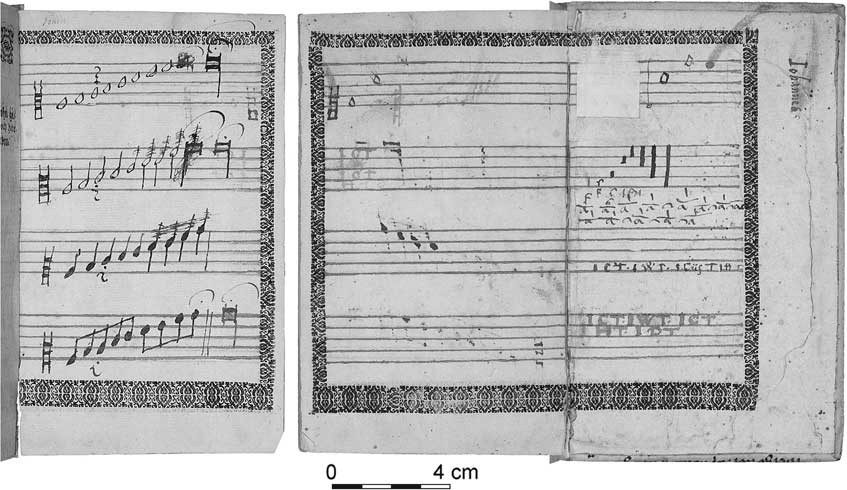
The manuscript containing treatises by Altenburg and Schein was written in the hand of Caspar Trost and was part of his library – which brings us to the question of the relationship between father and son and the consequences for the books in their possession. Until now, only two books with the signature of Caspar Trost have surfaced among the books from Johann Caspar Trost’s library. They include a Leipzig edition of Cicero from 1562Footnote 116 (a standard textbook) and, remarkably, another composite volume with two music textbooks by Cyriacus Schneegaß. The latter are bound with two other pedagogical works: a catechism-like text by Wolfgang Mamphrasius and a homiletic handbook by Jacob Andreä, both of which may have been of particular use to students.Footnote 117 Hand-drawn musical staves with scales on the front flyleaf are evidence for the likely educational use of this volume.Footnote 118 Three staves with series of ascending and descending fourths, fifths and sixths closely resemble exercises found in certain printed editions that prescribed a similar progression through which a student practised solmisation syllables.Footnote 119 This exercise was, in all probability, copied by a young Johann Caspar, as the hand does not resemble that of Caspar Trost, with the form of the clefs differing fundamentally from that found in his manuscript 14 Musica Helmst [4].
Another window into the formative years of Johann Caspar Trost, including aspects of his musical instruction, can be gleaned from another composite volume in his collection, 22 Musica Helmst. It contains four pedagogical books, including a Latin–German collection of quotations and three music textbooks by Andreas Finolt, who also had contributed to Burckhard Großmann’s anthology ‘Angst der Hellen’, and Daniel Friderici. The criteria for collecting these texts into a composite volume seems to lie in their wide pedagogical orientation, differing from the more advanced composite volume 14 Musica Helmst., whose compiler appears to have desired the full range of one single discipline (music in this case) to be included. 22 Musica Helmst. bears two dated signatures by Johann Caspar Trost the Elder, one from 1625 on the front pastedown, the other from 1634 on the title page of the first item bound in the volume (see Figure 6). The 1625 signature is the earliest ownership entry by Johann Caspar Trost known to date. All of the items bound in the volume pre-date these entries, from which one can deduce that the eight- or nine-year-old Johann Caspar used this book during his schooldays in Jena. With one exception, the texts were printed by Philipp Wittel in Erfurt.Footnote 120 No other copies of these works are known, a fact which suggests that such ephemeral textbooks were primarily produced for and distributed within the local market. The spine of the first Finolt title bound in the composite volume is pasted over with green paper, illustrating how this type of literature was sold unbound as a leaflet (see Figure 6).
D-W: 22 Musica Helmst. Vellum over cardboard, with the original shelfmark label 875. Provenance mark/inscription in black ink on the front pastedown: Iohannes Casparus Trost Anno 1625.
-
(1) Libellus Sententiarum Selectiorum Latino Germanicarum. In usum tyronum, ex probatissimis auctoribus singulari studio collectus. Erfurt: Philipp Wittel for Johann Birckner, 1623. 8º. Unicum. VD17 23:669664F. Provenance mark/ inscription on title: Johann. Casparus Trost. 1634.
-
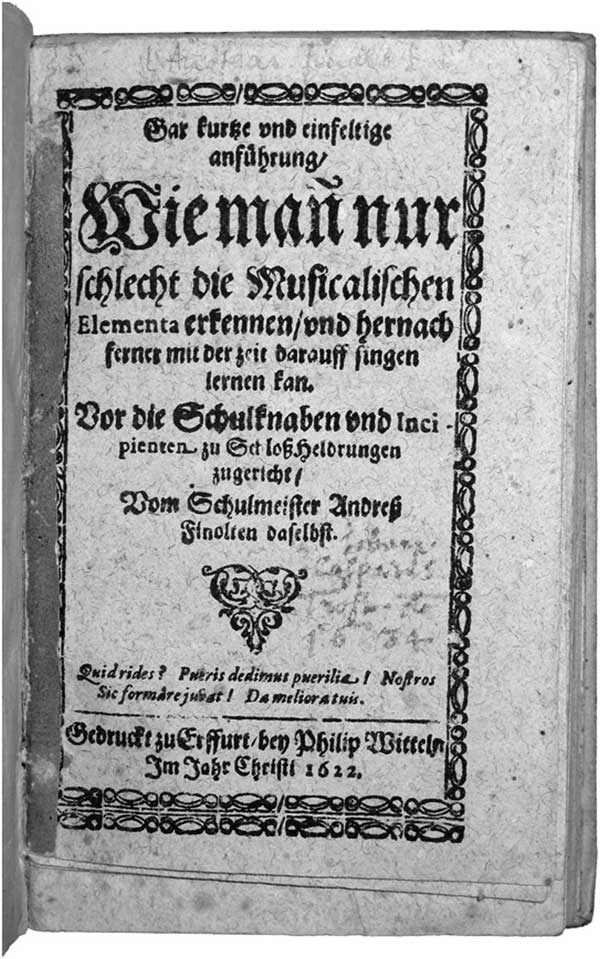
(2) Andreas Finolt: Gar kurtze und einfeltige anführung/ Wie man[n] nur schlecht die Musicalischen Elementa erkennen/ und hernach ferner mit der zeit darauff singen lernen kan/ Vor die Schulknaben und Incipienten zu Schloß Heldrungen zugericht. Erfurt: Philipp Wittel, 1622. 8o. Unicum. VD17 23:669721N. RISM B VI, p. 317. According to the preface, first printed in 1618, now enlarged by additional music examples. Provenance mark/inscription on title: Johann. Casparus Trost. Ao. 1634.
-
(3) Andreas Finolt: Anderweit Summarische Continuation der beschehenen einfeltigen anführung / Wie nun einn Knab / wenn er ein wenig singen kann / allerhandt progrediren, unnd in der Musica fortschreiten soll. Erfurt: Philipp Wittel, 16[22]. 8º. Unicum. VD17 23:669727H. RISM B VI, p. 318. Provenance mark/signature on title: 1634. Johann: Casparus Trost.
-
(4) Daniel Friderici: Musica Figuralis, Oder Newe Klärliche Richtige/ und vorstendliche unterweisung/ Der SingeKunst. Mit gewissen Regulen . . . neben vollkommener erklärung der Modorum Musicorum / Vor die Particular Schul zu Rostock zugerichtet. Rostock: Joachim Fueß for Johann Hallervordt, 1619. 8o. VD17 23:000030H. RISM B VI, p. 332. Provenance mark/inscription on title: Johann. Casparus Trost. Ao 1634.
Music textbook by Andreas Finolt, preserved in the composite volume D-W, 22 Musica Helmst. (2), as issued with its spine lined with green paste paper (courtesy of Herzog August Bibliothek Wolfenbüttel)

Finolt’s slim musical textbooks, written for the school at Heldrungen some 50 km north of Erfurt, where Finolt taught, are instructive because of their highly pragmatic and concise approach. As Finolt declared in the preface to the Anführung, the first book deals with basic elements of music (the notes, keys, and pauses, solmisation, and notational signs), while the second book adds instruction on modes (in chant and polyphony, with examples) as an advanced topic for more experienced pupils.Footnote 121 In order to complete his treatment of music, Finolt announced the publication of a short book on composition, De artificio compositionis ‘in dergleichen acht oder zwölff Blätlein’, in eight or twelve leaves, which seems never to have appeared.Footnote 122 This size corresponds roughly to that of Schein’s Etzliche lehren, suggesting again that this was considered a feasible length for young readers. Indeed, length was a typical way authors differentiated their publications for distinct levels of readers. Finolt’s texts are also based, at least in part, on Calvisius. Finolt not only uses examples which are consistent with Calvisius’s choice in the Exercitatio, but he also refers explicitly to Calvisius’s text at the end of the chapter on the transposition of the modes. In Finolt’s prefaces, he expresses bitterness about the supposed neglect of music, which could make it difficult to make a living as a teacher.Footnote 123 Although the difficult reality of everyday life for musicians seems to show through here, it can only be speculated that this made Finolt’s text particularly appealing for a colleague like Trost. Furthermore, Finolt’s paratexts are noteworthy in the light of his comments on the conditions and methods of teaching music, in which he emphasised the importance of personal instruction and repetition.Footnote 124 Given that these publications were already in the possession of Johann Caspar Trost as a child, one can assume that his father was involved in the selection and acquisition of these books, and that, from the point of view of an organist like Caspar Trost, these textbooks were deemed particularly useful. If true, this offers clues as to how contemporary textbook production was assessed from a practitioner’s perspective.
As far as Finolt’s general conception of music is concerned, the manner in which he arranged the content in his writings bears resemblances to the texts of composite volume 14 Musica Helmst. – above all, to Altenburg’s De musica (generalities and modes) and Schein’s Etzliche Lehren (composition rules, additional material on the modes, printed texts, etc.). Such resemblences are strong indications that this manner of presentation was considered effective to those in Caspar Trost’s circle at the beginning of the seventeenth century. Friderici’s Musica figuralis, the last piece bound in 14 Musica Helmst., is similarly pragmatic in treating the fundamentals of music. Here, for instance, the author provided a simplified explanation of the modes through the use of a scalar model.Footnote 125 He also added a series of rules concerning singing, and thereby addressed a related topic, namely performing music well, which would also have been of great relevance for young readers.
Practical engagement with music can also be seen in the binding material of 22 Musica Helmst. An oblong sheet of printed music paper measuring c. 18.2 × 15 cm has been half pasted to the rear pastedown of the binding, with staves printed on both sides in red within a black ornamental border, on which the young Johann Caspar Trost notated scales in different values (see Figure 7). This, as far as we can tell, is a unique example from the German territories in the sixteenth and seventeenth centuries which shows the use of this type of pre-printed material in actual musical exercises.Footnote 126 As on the flyleaf in the composite volume J 772.8o Helmst., the scales resemble exercises found in printed textbooks. The form seen here may well be the simplest way of practising solmisation syllables, which sometimes took the form of rudimentary canons at the unison; that the notation places signa congruentiae on the third note of each example suggests this possibility.Footnote 127 However, a second obvious function of the scales is also to illustrate and reinforce the different rhythmic note values, as each scale is notated in different note values, from longer to shorter. A series of different types of pauses and note values in tablature notation, written on the last part of this sheet, adds another synoptic presentation of notational signs. From our vantage point, the musical notation has an awkward appearance. Several corrections were made to the stemming of the higher notes, to make the notes resemble the orthographically more correct downward form above the middle line. It is reasonable to believe, then, that these scales were used as exercises in notation and reading by the young Johann Caspar Trost, who as an eight- or nine-year-old was probably not yet fully fluent in notational practices. Finally and no less importantly, Johann Caspar has given the page a familial hue by adding a number of small monograms between the lines of the staves. These initials probably represent Trost’s own name and those of his younger brothers, revealing an element of boyhood identity or memoria, and reinforcing once again the value of provenance marks for biographical research.Footnote 128
Printed ruled paper with writing exercises by the eight- or nine-year-old Johann Caspar Trost, who also seems to have added the initials of his younger siblings. Trost’s signature on the front pastedown of this Sammelband with a Latin–German collection of aphorisms and music textbooks by Andreas Finolt and Daniel Friderici is dated 1625 (D-W, 22 Musica Helmst., courtesy of Herzog August Bibliothek Wolfenbüttel)
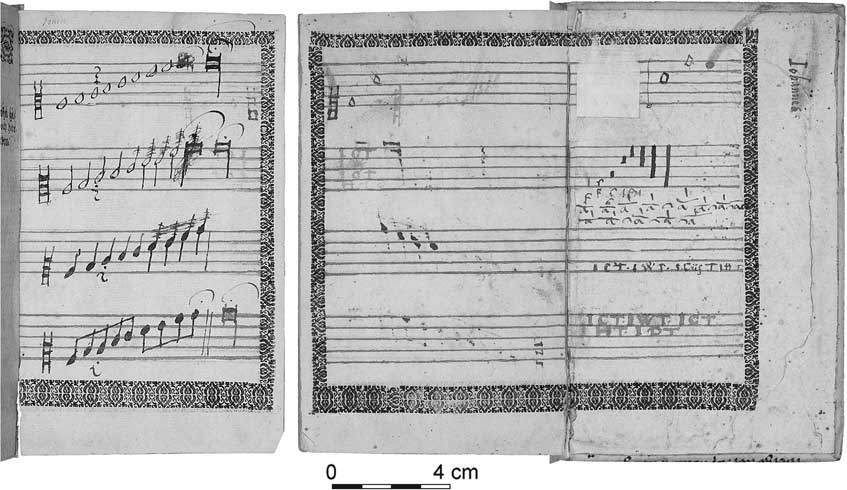
Moving forward in the musical formation of Johann Caspar Trost, the disputation held at the Halle gymnasium in 1635 under the title Pars Specialis Musicae Footnote 129 reveals the outcome of his early study of the texts in his composite volumes – despite the lingering question of whether this study took place at school, with a tutor, under the supervision of his father, or by his own independent reading. Although Trost’s disputation can be considered his only original contribution to the field of musica theoretica,Footnote 130 it mainly illustrates the knowledge he had acquired by the end of his school education. The Pars specialis covers the classification of intervals, the modes, the disposition of voices and counterpoint rules, and represents a compilation of standard material. It was the second of a pair of disputations dedicated to music; these ‘parts’ made a distinction between systematic topics in music and their practical application to composition.Footnote 131 In addition to a few ancient authors (probably known indirectly), Trost cited a number of recent German writers, among whom Calvisius was particularly important. Evidence for this comes not only from the number of references to him, but also because it was Calvisius’s writings that most likely informed Trost’s choice of examples for the modes. Significantly, copies of the texts cited by Trost in the disputation (Lippius, Schneegaß, Faber/Vulpius and Thomas Walliser) were, as far as we can gather, indeed physically present in the Trost library, at least from a certain point in time.
In Halberstadt, Trost later practised two professions, music and law, and the acquisition of rare printed legal texts relating to musicians – acquired immediately upon their publication – indicates that he maintained an interest in both of his professions. He owned, for instance, the articles of the Instrumental-Musicalisches Collegium from 1653,Footnote 132 ratified by Emperor Ferdinand III, which became authoritative as a charter for musician guilds (in a way, comparable to the charters for craft guilds) and was signed by 107 instrumental musicians from forty-three towns in Saxony and Brandenburg, the latter of which formed its own guild in 1653.Footnote 133 Hence, Trost was obviously interested in, or even concerned with, the legal conditions and the reputation of the town musicians.
VI. CONCLUSION
As a whole, the composite volumes discussed above illustrate different ways of engaging with music books in early seventeenth-century Germany: how the needs of practical learning intersected with both the acquisition and reproduction of knowledge, and the combination of different professional competencies and responsibilities. The context of Trost’s library gives us an idea of the range of his educational and intellectual background, not only documenting different fields of interest but also presenting the process of acquiring knowledge. The music textbooks in print and manuscript discussed throughout the article give us insight, however fragmented, into the ways in which a schoolboy acquired musical knowledge – ways which may not have been wholly atypical for the majority of schoolchildren in seventeenth-century Germany. The act of reading texts elaborating the fundamentals of music theory was combined with practical information necessary for the actual performance of music. This foundational musical knowledge could, of course, also have been useful for a variety of musical professions, such as organ playing and organ building, the latter being an occupation with which Trost had very close contact during his time as an organist in Wettin. Also, Trost’s case illustrates a musician with a certain penchant for acquiring and consuming books written by authors from his home region (or distributed by the nearest printing centre). The newly discovered treatises by Michael Altenburg and Johann Hermann Schein fit comfortably within the context of instruction and add to the corpus of known texts from this period. Moreover, we see Johann Caspar Trost the Elder engaging, with some independence of thought, with the theoretical and practical knowledge of music – a result, at least in part, of his school education. Indeed, his 1635 disputation at the Halle gymnasium reveals that he had not only encountered the standard ideas on music, but was able to use them and repeat them in his argumentation. For some – such as Calvisius or Lippius – disputations were the place for the elaboration and defence of new theoretical ideas, whereas for students like Trost disputations were opportunities to reproduce established knowledge. The 1635 disputation nevertheless demonstrates the level of competence that could be reached in the course of normal schooling. Finally, Trost’s professional career, with its combination of musical and administrative positions, is mirrored in the make-up of his library as it grew during his lifetime. From the unique combination of texts in composite volumes, from the traces of use, and from the provenance marks and the reliable biographical information they provide, the Trosts and their music books give clear and concrete insights into the ways in which musical knowledge was approached in Jena and Halberstadt, as well as the many cities of Germany like them. Their case, moreover, illuminates the often undocumented interplay between musical and non-musical interests, and provides an excellent basis for analysis using a library (and the readership it implies) as a framework. In the same way, the circulation of abstract ideas, like music theoretical concepts or pedagogical methods, can be explored in a very concrete way on the basis of the material evidence of the respective textual culture. To understand how changes in musical thought were transmitted from one place to another, it is crucial to consider not merely the intellectual horizons of the authors involved, but the networks of their audiences as well. This becomes very clear in the case of the manuscript treatises by Schein and Altenburg – the former presenting the fundamentals of composition in a way easily comprehensible to readers, and the latter amalgamating pedagogical and theoretical ideas from his personal environment. Both texts, at the same time, show their indebtedness to the Leipzig tradition established by Calvisius. This context clearly demonstrates how the circulation of musical thought – itself a fleeting phenomenon which often appears equally as ephemeral as musical sound itself – could leave its mark in distinct sources and individual traces of use.
APPENDIX
EDITION OF D-W, 14 MUSICA HELMST. (4)
Editorial note: Inconsistent use of upper and lower case in early modern German handwriting has been normalised so that only proper names are capitalised. In the manuscript, most Latin terms are written in Latin cursive and underlined in green ink. Consonantal ‘u’/‘i’, intervocalic ‘v’/‘j’ and the vowel ‘ÿ’ as well as the original punctuation have been retained. Abbreviations have been tacitly resolved.
[fol. 1 r ] (see Figure 4 above)
DEO duce et auspice DEO.
De musica.
Musica ist eine kunst, recht zu modulieren, vnd die sonos ineinander zu führen, damit sie eine liebliche harmoniam geben, vnd auch doch, auf einen besondern text bequemet vnt gerichtet sein.
[margin: Consideratio musices duplex generatim] Ist also diesem nach generatim vnd speciatim zubetrachten, generatim erfordert die musica nicht allein cantum, sondern auch textum.
Bey dem text sollen in acht genommen werden res et verba, res soll man richten auf den modum, verba auf die intervalla, vnd ist also die musica recht perfecta.
[margin: speciatim] Speciatim so ferne sie nur harmoniam sive cantum hat, ist sie imperfecta. Jnmaßen diese ihren fruchtbarlichen platz nicht hat, wie perfecta musica. Den musica soll zu förderest Gott zu ehren angewendet werden. So will aber Gott das hertz haben. ‡
Nun gibt zwaar musica imperfecta den ohren etwas liebliches, das hertz aber wirdt nicht also bewegt, wie durch die perfectam.
‡ Non vox sed votum, non musica chordula sed cor
Non clamor sed amor clangit in aure DEJ:
[fol. 1 v ]
[margin: Ad dirigendam harmoniam in textum requiritur ars canendi & componendi] Soll man nun eine gute harmoniam auf den text richten so will von nöthen sein, das der musicant sowohl artem canendi, quam artem componendi habe.
[margin: quid requirat ars canendi.] Ars canendi erfordert die wißenschaft clavium et characterum,
[margin: Claves quid?] Claves seind regenten, dardurch der gesang aufgeschloßen und zuerkennen gegeben wirdt.
[margin: Claves duplices sunt signatæ & intellectæ] Vnd derselbigen seindt 7. a. b. c. d. e. f. g. Diese sind auch zweyerley signatæ et intellectæ.
[margin: Signatæ quid?] Signatæ sind diese, welche alle zeit zu förderst bey einem ieglichen systemate verzeichnet stehen, vnd sin [sic] derselben 3., als,  ,
 ,
 .
[margin: 3 claves | systema quid? | Systema duplex totale aût partiale] Nota systema ist eine beschreibung etzlicher linien so gewiße claves in sich begreiffen, vnd ist entweder totale uel partiale,
[margin: Totale quid?] Totale begreifft 14. linien vnter welchen das innen hat die 6. linien, das die 8. daz 10. linien.
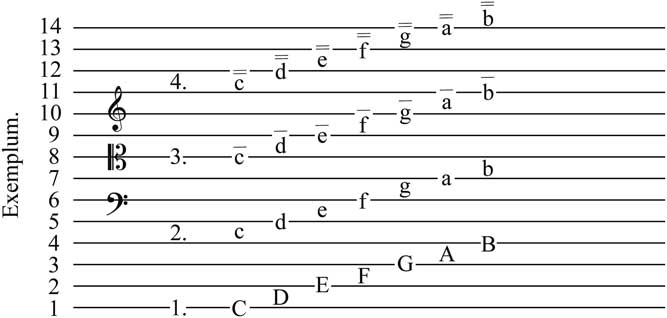
[fol. 2 r ]
[margin: Partiale quid?] Partiale begreift nur 5. linien aus dem sÿstemate totali genommen, vnd wird mit einem gewißen clave signata zuerkennen gegeben,

[margin: quæ intellectæ] Intellectae sind diese, welche hernach durch die forn angezeichneten claves angedeutet vnd vernommen werden[,] aus diesen kommen soni vnd voces.
[margin: Sonus quid?] Sonus ist ein hall oder schall, der hoch oder niedrig aufeinmahl gehört wirdt.
[margin: voces quid?] Voces seind gewiße claves syllabæ, damit im auf- oder niedersteigen die soni nahmhaftig gemacht werden, deren sind 6. ut. re. mi. fa. sol. la.
[margin: quid characteres | Characteres duplices principales et minus principales] Characteres sind die einwohner, welche des gsangs sonos vel voces an den tag geben, dieselben sind principales et minus principales. Principales seindt notae et pausae.
Nota ist ein zeichen welches anzeiget den sonum, vnd wie lang derselbe weeren soll.
[margin: Nota duplex choralis et figuralis] Es ist aber nota zweyerley, choralis et figuralis.
Nota choralis, gilt eine so uiel als die ander, 
[margin: Pausa quid?] Pausa ist ein Zeichen, welches anzeigt, das man schweigt, vnd wie lang solches wehren soll.
[margin: Minus principales quod] Minus principales, seindt zeichen, die da anzeigen, das man den gesang entweder repetiren soll, als  oder wieder anfahet als
 in fugis etc. oder das man soll still
 halten oder zum finall gar außhalten
 .
[fol. 2 v ]
De arte componendi.
[margin: Artis componendi definitio] Ars componendi ist eine solche kunst, da man aus unterschietlichen intervallen, eine wohlklingende harmoniam zusammen führt vnd gleichwohl auf einen sonderbahren text gerichtet ist, vnd erfordert zuförderst intervallorum cognitionem.
[margin: Intervallum quid] Intervallum ist ein hall oder schall welcher 2. sonos begreifft.
[margin: sonus duplex æqualis et inæqualis] Sonus ist æqualis uel inæqualis vel unisonus et dispar, uel contiguus et interruptus der grobe vnd helle.
[margin: Æqualis quid] Æqualis sonus ist unisonus, welcher nichts anders ist, als eine wiederholung des ersten soni. Exempli gratia.

/Organici nominant Redeuntem.
[margin: Quid inæqualis | Intervalla duplicia, contigua interrupta] Inæqualis sonus ist entweder höher oder niedriger als der erst gehörte laut oder sonus, vnd dieselben jntervallen seindt entweder contigua vel interrupta.
[margin: Quæ contigua] Contigua intervalla seind solche, da man aus einer 2den in die ander, auf oder niederwarts steiget,

[margin: 2da quid?] Secunda aber ist ein solch intervallum welches von der linien in das nechste spacium, oder auß dem spacio auf die nechste lineam auf oder niederwarts steiget, vnd ist
fol. [3 r ]
[margin: 2da duplex major et minor | Major quid?] zweÿerleÿ major & minor, maior secunda begreiffet 9 vnterschietliche commata wird sonst genen tonus, und hat 4. species, ut-re, re-mi, fa-sol, sol-la.
[margin: Comma quid?] Comma ist ein gar subtiler sonus, kan allein auf einer seiten verstanden vnd eigentlich gehöret werden.
[margin: 2da minor quid?] Minor 2da ist ein intervallum vom mi biß ins fa wird sonst semitonium genenn,
NB. Es mag gleich sein mi naturale oder mi fictum per signum Chromaticum ♯ so ist doch der folgende sonus, ein semitonium.
[margin: Semitonium duplex minus et maius | Minus duplex naturale et fictum | Naturale quid? fictum quid?]
Semitonium ist zweyerleÿ minus et maius.
Minus begreift 4. commata vnd ist naturale uel fictum, das naturale ist das mi fa de linea ad spacium
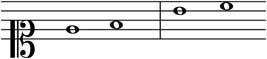
Fictum semitonium ist das welches nach dem fingirtem mi gehöret wirdt, als

NB. Signum chromaticum ♯ zeigt 5. commata in die höhe, dargegen ♭ rotundum 5. nieder.
[margin: Semitonium maius quid?] Maius ist zwahr auch ein semitonium fictum, aber der sonus welcher nach dem ersten gehört wirdt, begreift 5. commata, geschieht im gleichen clave, wirdt fingirt, per signum chromaticum oder ♭. rotundum.

fol. [3 v ]
[margin: Quae interrupta intervalla] Intervalla interrupta sind die, welche per saltum den andern sonum von sich geben, vnd derselben seind 6. Tertia. 4. 5. 6. 7. 8va.
[margin: 3tia quid?] Tertia ist ein intervallum, welches von der linien in die negstfolgende linien, oder aus dem spacio in das negst spacium schreitet, vnd ist zweÿerleÿ minor & maior.
[margin: Minor quid?] Minor begreift einen tonum vnd ein semitonium, daher sie genennet wirdt semiditonus. Hat 2 species, re fa, mi sol,

[margin: 4ta quid?] Quarta ist ein intervallum, welches von der linien in das ander ander [sic] negstfolgende spacium, oder aus dem spacio auf die andere nechstfolgende lineam schreitet, vnd ist zweierley [margin: 4ta duplex Harmonica & Arithmetica] harmonica et arithmetica.
[margin: Harmonica quid?] Harmonica 4ta bestehet aus dem drittentheil essentiæ begreift 2. tonos vnd ein semitonium wird sonst genennet quarta usitata hat 3. species.

[margin: Arith. quid?] Arithmetica 4ta begreift 3. tonos, daher sie genennet wirdt tritonus, ist ein intervallum inusitatum.

fol. [4 r ]
[margin: 5ta quid? | 5ta duplex usitata et inusitata] Quinta ist ein intervallum welches von der linia auf die nechst folgende ander lineam, oder aus dem spacio in das andere spacium schreitet, vnd ist auch zweyerleÿ usitata et inusitata.
5ta usitata bestehet auf dem ersten gedritte des dritten theils essentiæ begreift 3. tonos vnd ein semitonium hat 4. species.

Quinta inusitata schreitet fort wie usitata, aber sie percirt in defectu, den sie der sachen zu wenig hat.

[margin: 6ta quid? | 6ta duplex maior, minor | minor quid? major quid?] Sexta ist ein intervallum, welches von der linien ins 3. spacium oder aus dem spacio auf die 3. lineam steiget, vnd ist 2erleÿ, minor & major. Sexta minor begreift 3. tonos vnd 2. semitonia, hat 2. species mi fa per saltum vnd re fa über die quint. Sexta maior aber begreift 4. tonos vnd ein semitonium hat auch 2. species.

[margin: 7tima quid?] Septima ist ein jntervallum von der linien aufs dritte folgende lineam oder aus dem spacio in das 3te spacium

fol. [4 v ]
[margin: Octava quid] Octava ist ein jntervallum von der linea in das viertde spacium, oder aus dem spacio auf die 4. lineam bestehet aus dem halben theil essentiæ, begreift 5. tonos vnd 2. semitonia, hat 7. species. Als.

Wan ein clavis octavæ auf der linien ist der andere es sey gleich oben oder vnten ein spacio zu finden.
[margin: Ex intervallis octavorum compositio et modorum compositio] Aus erlernten intervallis kömmet nun compositio & modorum cognitio.
Compositio ist ein lieblicher concent, welcher zusammen gebracht wirdt, so wohl aus intervallis dissonis als consonis. Dissona aber seindt 2da, tritonus, falsche 4ten, septima, semidiaπασῶν, falsche octaven. Vnd werden miseiret entweder per celeritatem, oder per syncopationem durch abreißung oder zertheilung der noten. In celeritate aber müßen observirt werden, nachfolgende Regulas.
Regula. 1. Das die erste nota einen punct habe.
Regula. 2. Das alle Zeit eine nota vmb die andere klinge.
Regula. 3. Wen die eine leufft das die andre helt.

fol. [5 r ]
[margin: Quid syncopatio?] Syncopatio ist ein abreißung einer noten von der consonantia zu der dissonantia; doch das gleichwohl sölche dissonans im aufheben des tacts oder singens in consonantiam verwandelt werde.

[margin: Quid consona?] Consona sind 3tia. 4. 5. 6., octava.
Compositio consonantiæ ist pura et ornata.
[margin: Pura quid?] Pura wen nota zur noten klinget, wird sonst genennet contrapunctus et quidem simplex.
[margin: Ornata quid?] Ornata wen fugen mit vnterlauffen et tunc nominatur contrapunctus fractus uel coloratus.
[margin: Fuga quid?] Fuga aber ist eine wiederholung einer clausulen in vnisono, 4ta. 5ta. octava, uel etiam vicinioribus.
[margin: Consonantia duplex, perfecta et imperfecta] Es ist aber consonantia zweyerley perfecta et imperfecta. Consonantia perfecta ist, welche sich nicht endert, sondern alzeit in seiner dimension bestehet, als da ist 4ta. quinta octava.
[margin: Perfecta quid?]
Regula de consonantijs perfectis.
Consonantia perfecta soll nicht fort schreiten weder per gradum noch per saltum, neque continuè neque interruptè.
[margin: imperfecta quid?] Consonantia imperfecta ist ein sollicher concent oder harmonia welches zwar wohlklinget, aber nicht vollkommentlich bestendig bleibet, sondern den klang verwandelt, vnd das sein diese,
Tertia, da wirdt balt 3tia minor balt major gehört.
Sexta. Da wirdt auch balt minor bald major, vnd daher
fol. [5 v ]
nicht so vollnkömlich, als consonantia perfecta, welche alzeit in seiner essens vnd wesen bestehet.
Regula de consonantijs imperfectis.
Consonantia imperfecta mag fort schreiten, also das zwey ditoni oder semiditoni, bald 2. 6ten vnd mehr fort gehen können.
De modorum cognitione
[margin: Modi quid sunt?] MODI MVSICORVM sind gewiße wege, darinnen der gesang wandeln, vnd seinen ambitum oder cursum haben muß. Derselben sind 14 welcher ein iedes bahr [Paar], ein gewiße speciem octavæ innen hat, vnd werden genennet.
Jonicus et Hÿpojonicus
Dorius et Hypo:
Phrygius et Hypo:
Lydius et Hypo:
Mixolydius et Hypo:
Æolius et Hypo:
Hyperæolius et Hyperphrygius
[margin: Modi duplices legitimj et illegitimi | Quid jllegitimj?] Diese erzehlte 14 modi, sind legitimi et jllegitimj.
Jllegitimj seindt, welche aus einer falschen quinta vnd quarta componirt werden, als das ist,

fol. [6 r ]
[margin: Legitimi quid?] Legitimi das ist die rechtmeßigen modi sind diese, welche zwischen einer reinen octav seindt, die aus einer guten 5. und 4ten. bestehet, auch ihren cursum vnd ambitum rein haben. Vnd das sind die vorerzehleten modi, dan Ionicus vnd sein Hypo: ihren cursum führen, duriter zwischen C vnd c. molliter aber zwischen F. vnd f. als primam speciem 8vae, ut sol. ist prima species 5tae, ut fa, est 1. species 4tae.

Dorius vnd Hypodorius führen ihren cursum vnd ambitum duriter zwischen D und d molliter zwischen G vnd g. begreift 2dam speciem 5tæ vnd 2dam speciem 4tæ. Als.

Phrygius vnd Hypophrygius führen ihren cursum vnd ambitum duriter zwischen E vnd e. molliter zwischen A und a. als 3.tiam speciem octavæ, welche begreift 3tiam speciem 5tæ. vnd tertiam speciem 4tæ.

Lydius vnd Hypolydius führen ihren ambitum zwischen F vnd f. molliter. Zwischen B vnd b haben innen 4tam speciem octavæ. 4tam spec: 5tæ. vnd primam speciem quartæ.

fol. [6 v ]
Mixolydius vnd sein Hypo: führen ihren cursum vnd ambitum duriter zwischen G vnd g. molliter zwischen C vnd c als quintam speciem octavæ, welche 1. speciem 5tæ, vnd 2dam speciem 4tæ. begreiffet.

Æolius vnd Hypoæolius führen ihren cursum vnd ambitum duriter inter A & a. molliter inter D et d. als 6tam speciem octavæ, welche begreift 2. spec. 5tæ v. 3 speciem 4tæ.

[margin: Legitimi duplices, primarij et secundarij] Es sind aber diese erzehelte modi legitimi zweyerley, primarij vnd secundarij.
Primarij sind diese, welche mit dem Hypo: nicht genennet werden, führen im Tenor vnd Discant die quintt vnten, die quart oben, jm Alt aber vnd Baß das gegentheil, haben licentiam vnd freÿheit ihren lauff aufwertz zu führen, wie auß folgendem abriß zu ersehen

Secundarij sind diese, welche im Discant vnd Tenor die 4ten vnten die 5ten oben arithmeticè führen. Im Alt vnd Baß das gegentheil, haben freyheit vnterwartz zu steigen. Als.
fol. [7 r ]

Muß also ein ieglicher gesang im Baß, als auß dem fundamental claue am ende betrachtet werden, nach der alten Regul, in fine videtur cuius toni, h.e. am ende wird der modus erkand, er sey durus, oder mollis, genant.
Wen du nun den letzten clavem des gesangs ansihest, so zehle 1. hinunterwertz ob du füeglichen eine quart haben kanst, betracht darauf was dieselbig quart vor ein species sey, zehle, von der finall noten hienauf, vnd betracht die quintam, was die für ein species seÿ, so hastu gewiß modum secundarium.
Wo aber du die quintam vnten vnd die quartam oben fürglich haben kanst, ist es modi primarij, wie nachfolgende tabula außweiset.
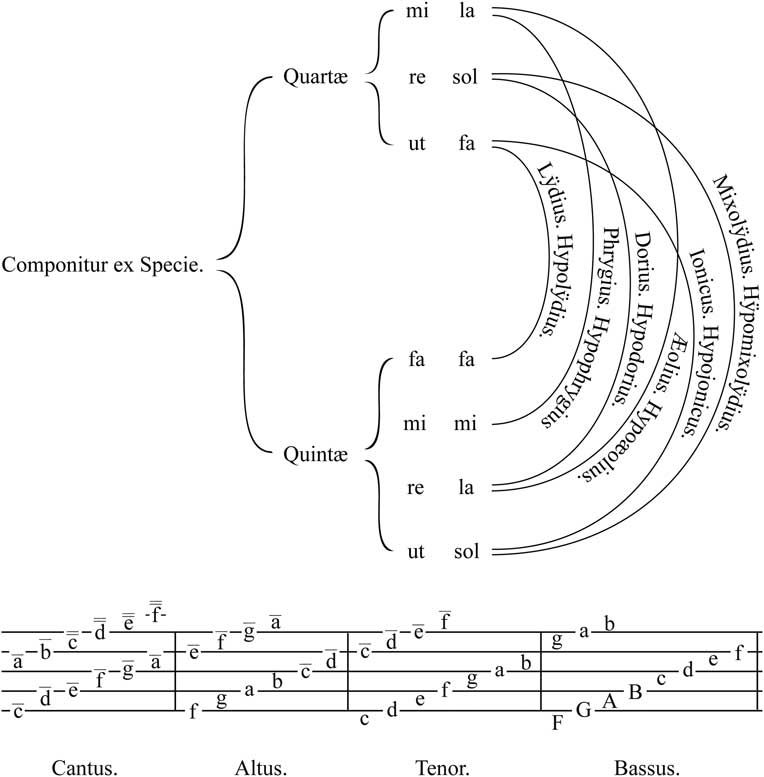
M. Michaëlis Altenburgij Pastoris Sömmerdani.
fol. [7 v ] (see Figure 5 above)
Etzliche lehren so einem incipienten in der musica poetica (.wie sie genennet wirdt.) fürnemlich zu wißen von nöthen, aufgesetzet, von Johann: Hermano Schein.
1. Regula.
Es seind drey vor sich selbst lautendt concordantzen, aus welchen ein gesang componirt wirdt, er habe so viel Stimmen, als er wolle, als nemblichen, die quinta durch ein mittel partheÿ in zwo 3tien getheilet, oder eine sexta in eine quart vnd tertien getheilet ut.

2. Regula.
Die andern darzu klingenden stimmen, seind alle gegen diese gerechnet unisoni oder solche concordantzen, die in der octava auß diesen entspringen, als die octava, decima quinta. Hoc modo.

3. Regula.
Aus diesen concordantzen werden etzliche genennet species perfectæ, etzliche imperfectæ.
4. Regula.
Species perfectæ sind 1. 5. vnd die ferner auß diesen octav.weiße entspringen, als,
fol. [8 r ]
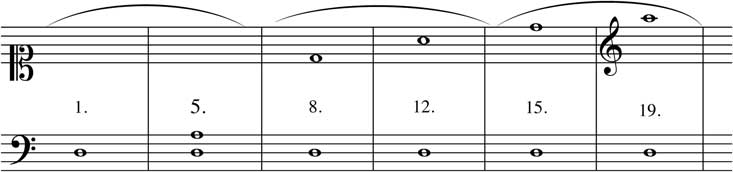
5. Regula.
Jmperfectæ species werden genant 3. 6. vnd die, welche ferner aus diesen octav weiß ihren vrsprung haben, als,
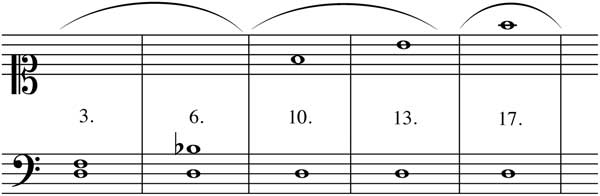
6. Regula.
Die species perfectæ werden daher also genent, das sie einen thon vollkömlichen beschließen, darum auch nicht zwo oder drey (.beuorauß in einem bicinio.) nach einander gesetzt werden können, wen die stimmen zugleich fallen oder steigen. Als.
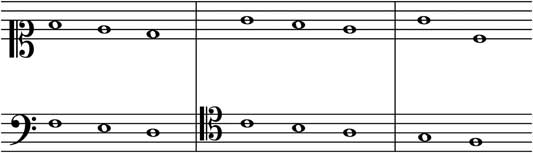
Dieses letzte exempel wird in 3. oder mehr stimmen paßiret.
fol. [8 v ]
7. Regul. Die species imperfectæ werden daher also genennet; das sie einen thon nicht volnkömlichen beschließen, sondern zugelaßen ist, das 2. oder 3. derselben (.auch nicht wohl mehr.) nacheinander mögen gesetzt werden, die stimmen steigen oder fallen.
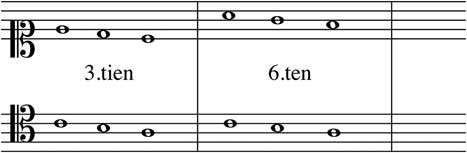
NB. Wiewohl 3. tertien oder 3. sexten mit bescheidenheit gesetzt werden sollen.
8. Doch ist dieses zumercken, von der sexta, das auf dieselbe, eine quinta folgen vnd die eine stimme in ihrem clave oder thon verharren muß. Als.
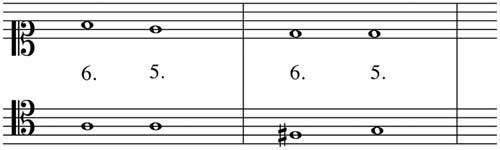
9. Oder soll darauf folgen eine octav, also das die eine stimme steiget die ander aber fallet, als,
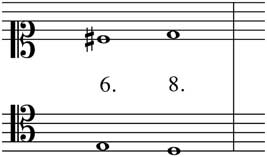
10. Darauf kahn auch wohl eine tertz folgen, als.
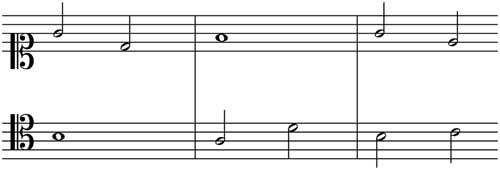
fol. [9 r ]
11. Die sexta wirdt getheilet in duram vnd mollem, duram
12. nenne ich die mit diesem signo ♯ in der einen stimme gezeichnet ist, oder die keinen tonum mollem hatt, als,
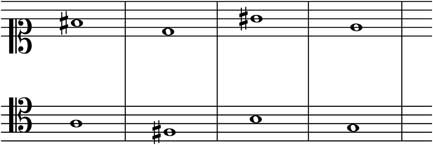
13. Mollem 6tam nenne ich, welche in einer stimme einen tonum mollem hat, als,
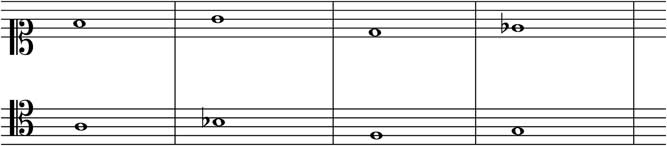
14. Sexta dura ist beßer, als sexta mollis, doch nach gelegenheit.
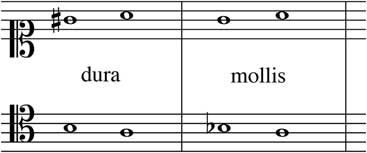
15. Eben auf diese weise, wirdt auch die 3tia getheilet, als.

fol. [9 v ]
16. Von der perfect specie mag man wohl auf die imperfectam zu gleich steigen oder fallen, als,
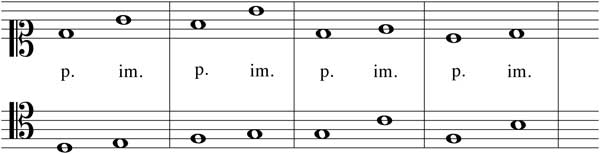
17. Von der jmperfecta auf die perfectam, darff man in einem bicinio nicht springen, es sey den, das die eine steige die 2. falle, oder die eine still stehe, vnd die andre fort gehe, als.
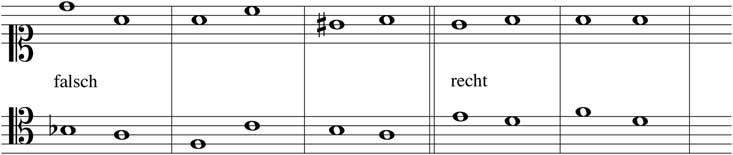
18. [margin, green: NB] Von dem vnisono, auf die die octav oder von der octav auf die decimam [inserted: 5tam] Item von der quinta auf die duodecimam, darf man nicht steigen. Als,

doch wirdt dieses in 4. oder mehr stimmen nicht so gar gnaw observirt.
19. [margin, green: NB] Diese sprünge sollen beuoraus in einem bicinio vermieden werden. Als.
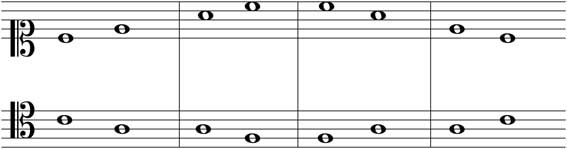
fol. [10 r ]
20. Die quinta ist zweyerley, nemblichen justa et falsa. Die quinta justa hat volnkömliche thone, die quinta falsa hat nur fünfte halben thon, vnd ist auß einem molli vnd duro tono zusammen gesetzt. Als.

21. Die quinta falsa wirdt gut wen eine 3tia darauf folget, also das die eine stimme steiget, die ander fellet, als.

22. Es soll keine Baß, noch Alt clausull in einem bicinio gefunden werden, den der Tenor, für die erste stimmen, der Discant für die ander, der Baß für [die] dritte, der Alt für die viertte gerechnet wirdt, wen man nun eine Baß oder Alt clausul setzt, so wirdt diese ordtnung ordnung [sic] turbirt, darüm man die Discant vnd Tenor clausulen observiren soll.
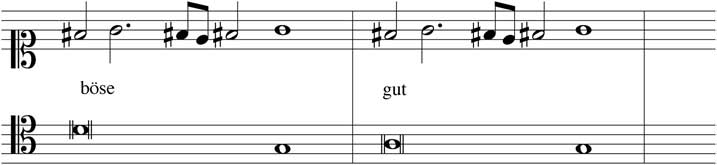
23. Es soll auch in einem bicinio (.außgenommen die erste vnd cadentz nota.) kein gantzer, wie den auch kein halber schlag mit einem punct gegen einen gantzen schlag zugleich haltente gefunden werden. Als.
fol. [10 v ]
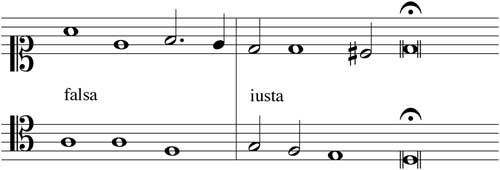
24. Den darümb wirdt das contrapunctum genennet, das gleichsam eines wie das ander gehet, in dem eine stimme haltet, die ander fort gehett. Als.

25. Die pausen können das vitium zweÿer quinten oder octaven nicht erwehren, es sey den ein gantz pausirent tempus verhanden.

Wiewohl es in einem gesange, der über 6. oder 7. stimmen ist, nicht also genaw gehaltten wirdt.
26. Ferner so seindt etzliche species consonantes, etliche dissonantes, consonantes, als, 1. 3. 5. 6. 8. 10. 12. 13. 15. etc:
Dissonantes. 2. 7. 9. 14. 16. etc: Exemplum vide.
fol. [11 r ]

27. Die species dissonantes welche sie deutsch böse oder falsche species nennen, werden zuweilen gutt ligatione. Ligatura aber ist diese, wen eine nota mit dem tact die andere darzu klingente nota wider den tact geführet werden, als,
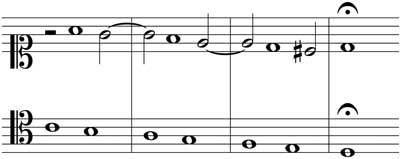
28. Die sexta vnd septima werden mit einander ligirt im herunder steigen aber nicht contra (.wie auß vorgehendem exempel zuersehen.), also das die oberste stimme nach gelegenheit des valoris etwas auf der septima verzeucht, vnd auf die sextam wieder den tact hernach fellet, durch welche den die septima gut gemachet wirdt.
29. Die sexta vnd quinta werden auf zweÿerleÿ arth miteinander ligirt, als erstlich, das auf die sext die quint folgett, die stimmen steigen oder fallen. Als,

fol. [11 v ]
30. Die tertz und quart werden miteinander ligirt, also, das die vnter stimme mit dem tact gehet, die obere aber von der 4. wieder den tact auf die 3tiam fellet, vnd solches nur im herunter steigen, als,

31.
32. Auch soll man in acht nehmen folgende exempla ligaturarum, so hin vnd wieder in den authoribus gefunden werden, vnd fast durch keine regulen können gewust werden, als da sindt,
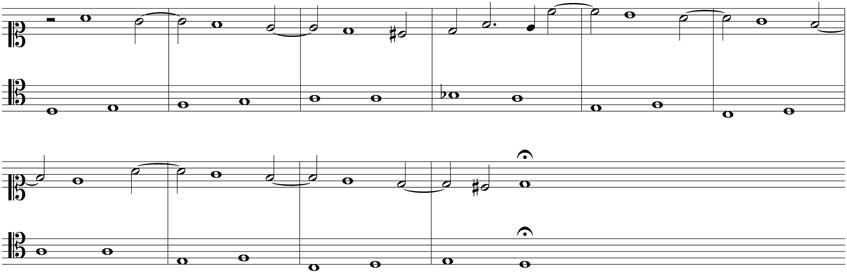
33. Man soll sich befleißigen, das man beuoraus in einem bicinio contrapuncts weise gesetzt, die stimmen also in eim feinen gange erhaltte, das sie nicht alle beyde so müeglich zugleich mit dem tact gehen, sondern die eine wieder den tact lauffe.

fol. [12 r ]
34. Wan die noten in der einen stimme lauffen, die andere aber helt, so muß die erste 3. 5. vnd so fort an (also das allezeit eine überhüpft wirdt) guth sein. Als,

35. Auch soll man in acht haben, das die stimmen in einem bicinio für nemblich nicht zu weit von einander kommen, e.g.
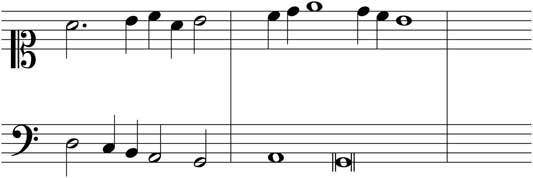
36. Jn einem tricinio sollen so viel müeglich mehrentheils die dreÿ zusammen klingenden concordanzen aufs genaweste gesucht werden.
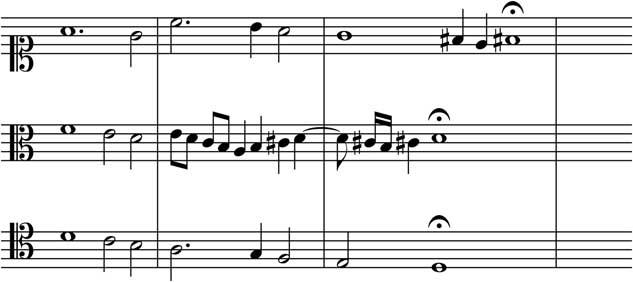
fol. [12 v ]
37. Jn einem gesang von vieren oder mehr stimmen sollen itzt gedachte drey concordantzen allewege gefunden werden, als,
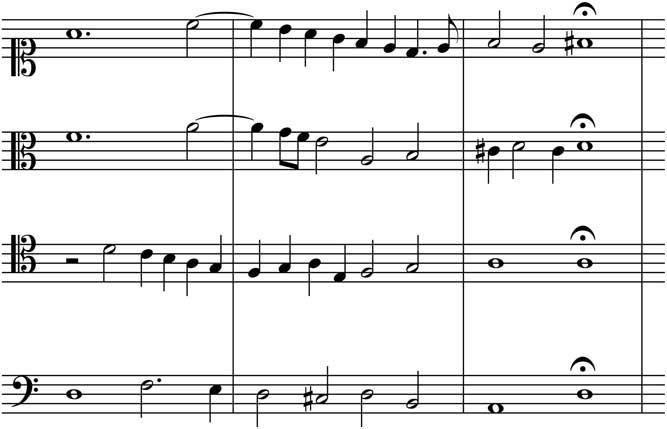
38. Für allen dingen soll man sich befleißigen, das ein richtiger gang vnd gute ahrt inn dem gsang gehaltten werde, sonderlich in einem bicinio contrap. Das man dasselbige nicht durch zu viel lauffen oder gleichsam als mit coloraturen verderbe.
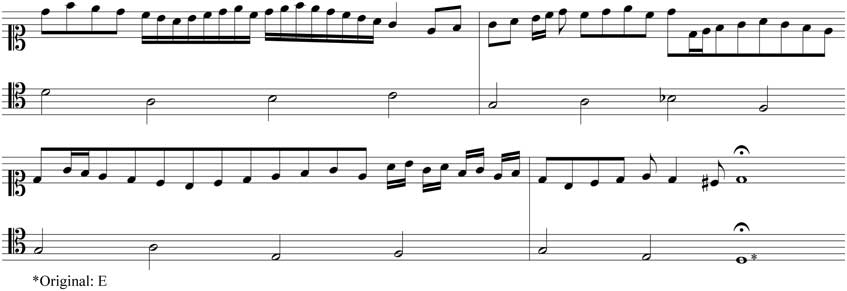
fol. [13 r ]
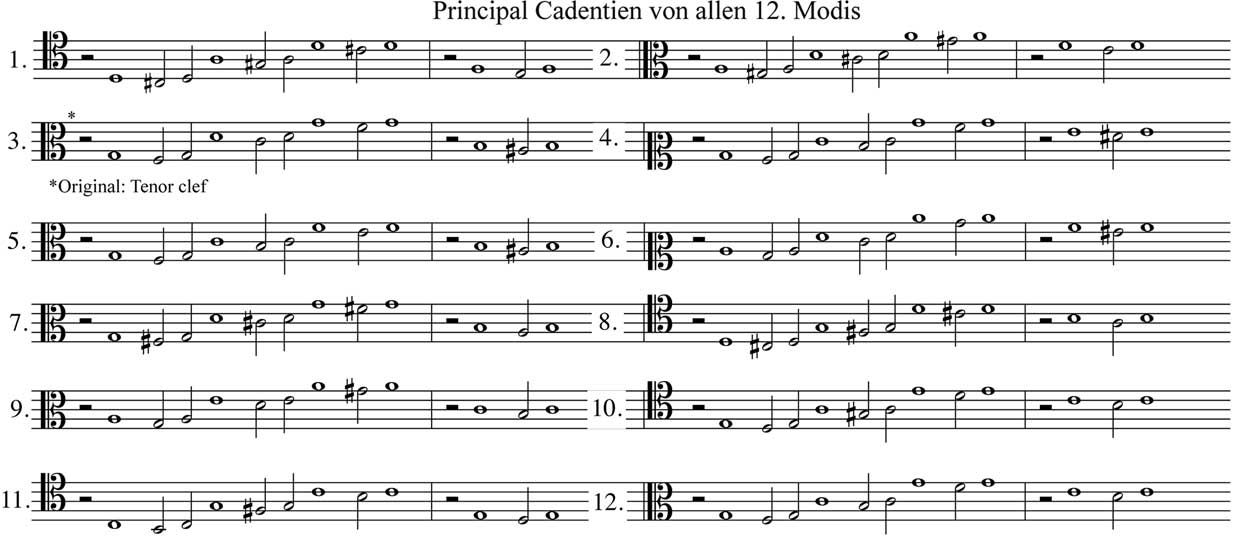
[addition in black ink in the hand of Johann Caspar Trost the Elder] NB. Man soll sich auch fleißig hüten, daß man nicht unvorsichtiger und unverständiger weise, auß einem tono oder modo, wie sie genandt werden, in einen andern falle, den solcheß auch vor ein vitium zu achten ist. Waß aber, und wie viel toni seind, mag man anderßwo lernen.
fol. [13 v ]