Implications
Iron content in pork has declined over time, which has reduced the nutritional value of pork. This study demonstrates that iron content in pork is moderately heritable and will respond to selection. Genetic improvement strategies will be aided by the use of blood haemoglobin levels and more importantly by measures of pork colour, which had moderate to high genetic correlations with iron content in pork. The use of blood haemoglobin levels before selection offers opportunities for breeding programmes, although the procedure used to measure haemoglobin on farm requires refinement if low heritability estimates for this trait are to be improved.
Introduction
Livestock products contribute a significant amount of trace elements and vitamins to the human diet, with meat being the main source of iron from livestock products (Rooke et al., Reference Rooke, Flockhart and Sparks2010). It is well known that red meat has greater iron content than pork or chicken and there is evidence that iron content in pork has declined over time (Barton-Gade, Reference Barton-Gade1990; Greenfield et al., Reference Greenfield, Arcot, Barnes, Cunningham, Adorno, Stobaus, Tume, Beilken and Muller2009), although causes of this decline in iron content in pork over time are poorly understood.
Organisms regulate their iron homoeostasis to avoid accumulation of iron to potentially toxic levels in tissue (Cottam et al., Reference Cottam, Reynolds and Purchas2007; Rooke et al., Reference Rooke, Flockhart and Sparks2010). Increasing the dietary levels of iron beyond the requirements for maintenance and growth does not lead to increased deposition of iron in muscle tissue, but to the removal of excess iron in storage (in the liver) or increased excretion of iron. Therefore, opportunities are limited to manipulate iron content in pork by dietary avenues, highlighting the need for alternative strategies to improve iron content in pork.
Oksbjerg et al. (Reference Oksbjerg, Petersen, Sørensen, Henckel, Vestergaard, Ertbjerg, Møller, Bejerholm and Støier2000) found lower myoglobin concentration in pork from a sample of Danish Landrace pigs available in 1995 in comparison to a sample of pigs available in the 1970s, indicating that selection for efficient lean meat growth may have affected iron content in pork. Further, there is evidence that genetic variation exists for measures of iron content in pork (Larzul et al., Reference Larzul, Lefaucheur, Ecolan, Gogué, Talman, Sellier, Le Roy and Monin1997; Newcom et al., Reference Newcom, Stalder, Baas, Goodwin, Parrish and Wiegand2004; Oksbjerg et al., Reference Oksbjerg, Henckel, Andersen, Pedersen and Nielsen2004).
Cost-effective measurements recorded on the live pig before selection are beneficial for breeding programmes. Haemoglobin levels in blood may be used as a selection criterion for iron content in pork. The HemoCue Hb 201+ device (HemoCue® 2011) developed to measure haemoglobin levels at point-of-care in human medicine has been used successfully in veterinary studies (Auvigne et al., Reference Auvigne, Perrin, Laval, Bertucat and Normand2010; Vanderhaeghe et al., Reference Vanderhaeghe, Dewulf, Vangroenweghe, Steyaert, de Jong, Villareal, Lopez, Del Pozo Sacristan and Maes2010) to measure haemoglobin levels in sows and piglets on farm. This technology provides opportunities for pig breeding programmes to develop a simple on-farm measurement as a selection criterion for iron content in pork and pork quality, which also requires estimates of genetic correlations with performance and carcase traits. It was the aim of this study to obtain genetic parameters for haemoglobin levels in blood and iron content in pork and to estimate genetic correlations between these haematological measures and meat quality, carcase or performance traits.
Material and methods
Description of haematological data
A routine iron injection of 200 mg iron dextran was given to all piglets shortly after birth. Blood haemoglobin levels were recorded on 4974 piglets from two terminal sire lines at 32.3 (±3.0) days of age (HAEM5). This age was chosen as it corresponded to the collection of blood samples for recording juvenile IGF1, a selection criterion for efficient lean meat growth (Bunter et al., Reference Bunter, Hermesch, Luxford, Graser and Crump2005). The two terminal sire lines were Duroc and Large White-based sire lines of PrimeGro™ Genetics (Rivalea (Australia) Pty Ltd, Corowa, NSW, Australia). A proportion of these pigs (2405 pigs) also had haemoglobin levels measured at ∼21 weeks (145 ± 4.5 days, HAEM21). These haematological measurements were recorded from September 2009 until January 2011. Reduction in heritability estimates over time during the course of this project resulted in the definition of a second trait for haemoglobin levels at 21 weeks of age based on excluding records from 22 July 2010 to 19 August 2010 (HAEM21ex). Records during this time had contributed to a decrease of additive genetic variance and increase in variance due to the common litter effect. Blood haemoglobin was measured on farm by collecting blood via jugular venipuncture. Fresh blood samples were then stored in the fridge for a maximum of 30 h and manually shaken before recording haemoglobin levels using the HemoCue Hb 201+ analyser (HemoCue®2011). Limits imposed for haemoglobin at 5 and 21 weeks were 60 to 145 g/l and 70 to 135 g/l, respectively. These boundaries reduced residual variance without overly affecting additive genetic variance (Jones and Hermesch, Reference Jones and Hermesch2010).
Description of pork quality and performance data
Iron content in pork was recorded in the m. longissimus dorsi (IRON) for 2255 boars, which had already been recorded for haemoglobin level at ∼21 weeks. Iron measurements were obtained by totally digesting duplicate muscle samples with a wet weight of ∼1 g in concentrated nitric/perchloric acids to white fumes of perchloric. The digest was then cooled, water was added and total iron content was measured by flame atomic absorption spectrometry using an air/acetylene flame (Haswell, Reference Haswell1991). Results of duplicate samples were expected to be within 10% of each other (relative percent difference). This criterion was initially not achieved and procedures in the lab were modified by increasing sample weight of pork to 1000 mg wet weight and by using ceramic or plastic utensils instead of steel utensils. Only measurements based on the modified and more accurate procedure were included in genetic analyses.
Meat quality traits were recorded on the same boars tested for iron content in pork. The tristimulus parameters L*, a* and b* of the Minolta Chroma Meter CR-400 were recorded on the ventral and dorsal section of m. longissimus dorsi. The L* value is a measure of luminance on a scale of 0 to 100 where 0 is completely black and 100 is white, positive a* values measure red colours, while negative a*values measure green colours. Positive b* values measure yellowness and negative b* values measure blue colours. In addition, pH was measured on the m. longissimus dorsi at 45 min (pH45) and 24 h (pH24) post mortem. Finally, loin depth (LD) and fat depth (FD) both recorded at the P2 site, 65 mm from the midline of the carcase at the last thoracic rib (Greer et al., Reference Greer, Mort, Lowe and Giles1987) on the carcase using PorkScan™ equipment (PorkScan Pty Ltd, Canberra, Australia) were available for these boars.
Performance data for pigs born from January 2004 to September 2010 for the two terminal sire lines were used for the genetic analyses and were available for all pigs with haematological and meat quality data. Lifetime growth rate (average daily gain), backfat (BF) depth at the P2 site and loin muscle depth (MD) between the third and fourth last ribs were recorded on pigs at 150 ± 7.52 days of age. BF and MD were recorded using real-time ultrasound. Any trait measure exceeding three standard deviations from the mean was excluded from analyses.
Pedigree information was available for 82 795 animals from 537 sires and 4463 dams born from January 2004 until September 2010. The subset of pigs that had haemoglobin or iron traits recorded originated from 91 sires and 876 dams. Both sire lines were similarly represented with regard to the number of records and pedigree structure.
Statistical analysis
The following mixed linear animal models were used for the analyses of traits:
 $$\[<$$> {\bf {{y}}}\,{\rm{ = }}\,{\bf {{Xb}}}\,{\rm{ + }}\,{\bf {{Za}}}\,{\rm{ + }}\,{\bf {{e}}} \eqno<$$>\]$$
 $$\[<$$> {\bf {{y}}}\,{\rm{ = }}\,{\bf {{Xb}}}\,{\rm{ + }}\,{\bf {{Za}}}\,{\rm{ + }}\,{\bf {{Wc}}}\,{\rm{ + }}\,{\bf {{e}}} \eqno<$$>\]$$
where y represents the vector of observations, b the vector of fixed effects, a the vector of random additive genetic effects of animals, c the vector of common litter effects and e the vector of residual effects. The terms X, Z and W are incidence matrices relating records to fixed, animal and common litter effects, respectively. The expectations of random effects were zero and the variances were assumed to be  $$)(--><$>{\rm var}({\bf {{a}}})\, = \,\sigma _{a}^{2} {\bf {{A}}}<$><!--$$,
 $$)(--><$>{\rm var}({\bf {{c}}})\, = \,\sigma _{c}^{2} {\bf {{I}}}<$><!--$$, and
 $$)(--><$>{\rm var}({\bf {{e}}})\, = \,\sigma _{e}^{2} {\bf {{I}}}<$><!--$$, where A is the numerator relationship matrix among animals and I the identity matrix. Random effects were assumed to be correlated between traits and all remaining covariances between separate random effects were assumed to be zero. Traits of the piglet are usually affected by maternal genetic effects. However, it was not possible to estimate maternal genetic effects for haemoglobin at 5 weeks because of the lack of records across generations required for their estimation. Variance components were estimated with ASReml (Gilmour et al., Reference Gilmour, Gogle, Cullis and Thompson2006) in univariate and bivariate analyses.
The GLM (SAS, 1999) procedure was used to derive the fixed effect model for each trait. The fixed effect model for haemoglobin at 5 weeks included test date, sire line, as well as the linear covariables such as age of the piglet at recording, birth weight of the piglet and total number of piglets born in the birth litter of each piglet. The models for haemoglobin levels at 21 weeks (HAEM21 and HAEM21ex) included test date, sire line and sex as fixed effects. In addition, birth weight of the piglet was fitted as a linear covariate for HAEM21ex. Test date, sire line and the linear covariate of age at recording were significant fixed effects for iron in pork. Although sire line was statistically significant for haematological traits, the effect was of minor biological importance, explaining less than one percent of the variation observed (Tickle et al., Reference Tickle, Grigg, Jones, Luxford and Hermesch2011).
Slaughter date was the only significant fixed effect for L* value. The fixed effects of slaughter date and breed were fitted for the tristimulus parameters L*, a* and b*, both pH measures as well as FD and LD. In addition, the models for ph24, FD and LD included hot standard carcase weight as a linear covariable.
The models for growth rate, BF and MD included test date, sire line, sex and management group as fixed effects. Backfat and MD were also adjusted for test weight, which was fitted as a linear covariate.
Results
Heritability estimates
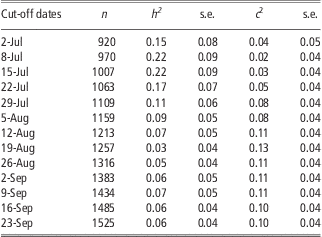
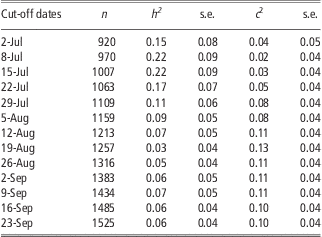
The common litter effect was the main random effect (0.11 ± 0.02; Table 1) for haemoglobin at 5 weeks of age, which had a low heritability of 0.04 ± 0.02. Haemoglobin at 21 weeks had a low heritability of 0.09 ± 0.04 and a significant common litter effect estimate of 0.08 ± 0.03 using the complete data set. Additional analyses revealed that measurements taken from the 22 July 2010 until the 19 August 2010 caused a shift of variance from additive genetic to common litter variance (Table 2). Excluding these records resulted in a higher heritability of 0.18 ± 0.04 using the best model without the common litter effect, which was not significant (HAEM21ex in Table 1). Causes of this shift in variances over time are unknown. Descriptive data statistics did not differ significantly between data subsets. However, there were slightly fewer piglets per litter in the excluded data subset (1.9 v. 2.2) because of a higher incidence of litters with one representative only. Further investigations showed that a higher incidence of litters with fewer representatives obtained by excluding litters with more than three litter mates slightly increased the estimate of the common litter effect at the expense of the heritability estimate in this data set, which had limited pedigree depth for pigs with haemoglobin measures. Owing to the limited duration of the trial, there were no parents who had their own records for our main traits of interest (HAEM5, HAEM21 and IRON) in contrast to performance traits, which were recorded over multiple generations. Similar issues were not found for iron content in pork, which was moderately heritable (0.34 ± 0.07) and less affected by the common litter effect (0.06 ± 0.03) as may be expected for a pork quality trait. Further, a similar shift in variance components was also not observed for growth rate or BF in additional analyses that were based on limiting records to the same data structure as was available for haemoglobin at 21 weeks. Variance components were estimated for growth rate and BF using the same cut-off dates as were used for haemoglobin at 21 weeks and only including animals that also had haemoglobin levels at 21 weeks recorded. Overall, these additional analyses indicate that the shift in variance components observed over time for haemoglobin levels at 21 weeks was related to the measure of haemoglobin itself rather than sampling effects of the given data structure.
Number of records (n), means and standard deviations (s.d.), heritability (h 2) and common litter effect (c 2) estimates, both with standard errors (s.e.), along with phenotypic variance (σ 2p) for haematological traits

a Records from 22 July 2010 to 19 August 2010 were excluded.
Number of records (n), heritability (h 2) and common litter effect (c 2) estimates for haemoglobin at 21 weeks using various data cut-off dates in 2010
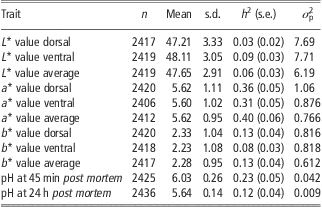
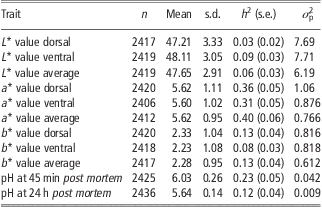
Heritability estimates differed among the individual measurements of the Minolta Chroma Meter (Table 3). Estimates were lowest for L* values ranging from 0.03 ± 0.02 at the dorsal site to 0.09 ± 0.03 at the ventral site and highest for a* values with estimates of 0.36 ± 0.05 and 0.31 ± 0.05 for the dorsal and ventral sites with the average being slightly higher (0.40 ± 0.06). Heritability for b* value varied from 0.08 ± 0.03 for the measure at the ventral site to 0.13 ± 0.04 for b* value at the dorsal site and based on the average value at both sites. Potential genetic improvement for both pH measurements is limited by the extremely low variability in these traits despite their low to moderate heritabilities.
Number of records (n), means and standard deviations (s.d.), heritability estimates (h 2) with standard errors (s.e.) along with phenotypic variance (σ 2p) for meat quality traits
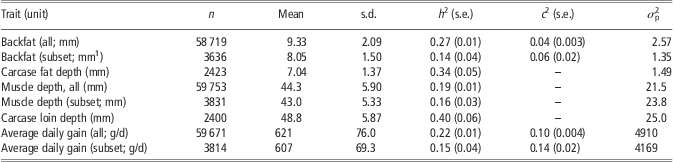
Both carcase measurements had higher heritability estimates (FD: 0.34 ± 0.05, LD: 0.40 ± 0.06) in comparison to the corresponding trait recorded on the live animal (BF: 0.27 ± 0.01, MD: 0.19 ± 0.01; Table 4). Growth rate was moderately heritable and had a higher common litter effect in comparison to BF as is usually observed. For completeness, variance components were also estimated based only on pigs with haematological records. Heritability estimates were lower and estimates of litter effects were higher for this data subset in comparison to the complete data set, although most differences were not significant.
Number of records (n), means and standard deviations (s.d.), heritability (h 2) and common litter effect (c 2) estimates, both with standard errors (s.e.), along with phenotypic variance (σ 2p) for carcase traits and growth rate
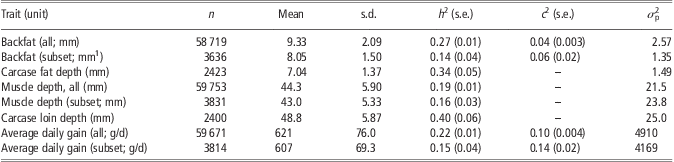
1Based only on pigs with haematological data.
Genetic correlations
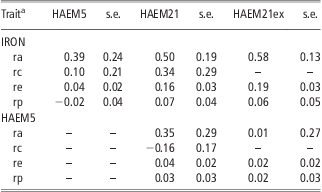
Iron content in pork had high positive genetic correlations, with both traits describing haemoglobin levels at 21 weeks of age (0.50 ± 0.19, 0.58 ± 0.13; Table 5). Genetic correlations between blood haemoglobin levels at 5 weeks of age and any of the other three haematological traits were positive, although not significant given the standard errors of estimates.
Genetic (ra), common litter (rc), environmental (re) and phenotypic (rp) correlations, along with their standard errors (s.e.) between haematological traits
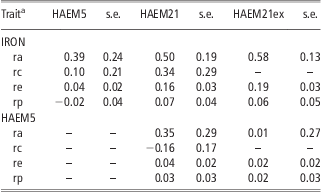
aHAEM5: haemoglobin at 5 weeks, HAEM21: haemoglobin at 21 weeks, HAEM21ex: haemoglobin at 21 weeks with records from 22 July 2010 to 19 August 2010 excluded, IRON: iron content in pork.
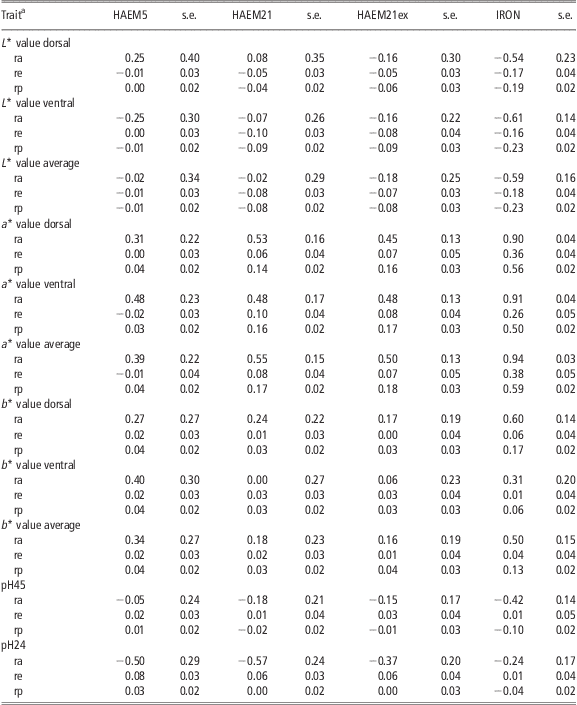
The magnitude of genetic correlations between iron content in pork and tristimulus parameters L*, a* and b* were high for most trait combinations (Table 6). High iron content was genetically associated with darker meat (lower L* value), with genetic correlations ranging from −0.61 ± 0.14 to −0.54 ± 0.23. The magnitude of genetic correlations was even higher between iron content in pork and a* values with estimates of 0.90 ± 0.04 (a* value dorsal), 0.91 ± 0.04 (a* value ventral) and 0.94 ± 0.04 (average of both a* values). In addition, measures of blood haemoglobin levels at 21 weeks had positive and significant genetic correlations, with a* value measurements ranging from 0.45 ± 0.13 to 0.55 ± 0.15. High genetic correlations were found between iron content in pork and b* value at the dorsal site (0.60 ± 0.14) and the average b* value (0.50 ± 0.14). In contrast to a* value, b* value had no significant genetic association with haemoglobin measures. Iron levels in pork had negative genetic correlations with both pH measurements, which were significant between iron and pH45 (−0.42 ± 0.14).
Genetic (ra), environmental (re) and phenotypic (rp) correlations, along with their standard errors (s.e.) between haematological and meat quality traits
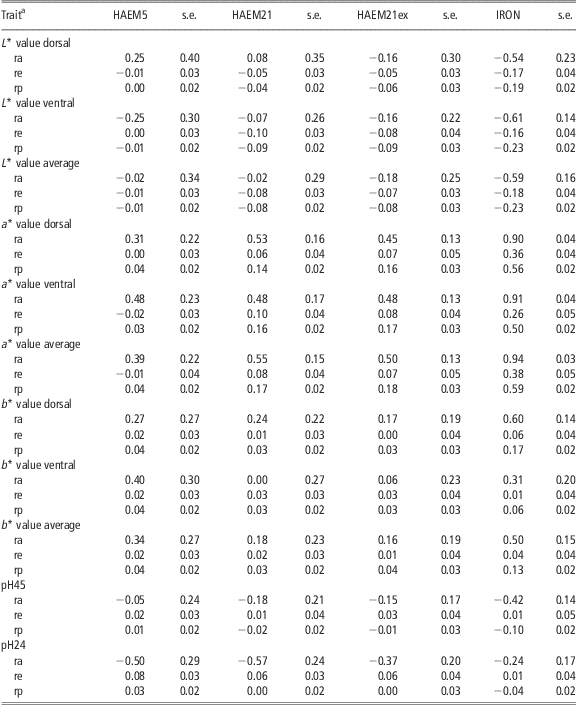
aHAEM5: haemoglobin at 5 weeks, HAEM21: haemoglobin at 21 weeks, HAEM21ex: haemoglobin at 21 weeks with records from 22 July 2010 to 19 August 2010 excluded, IRON: iron content in pork.
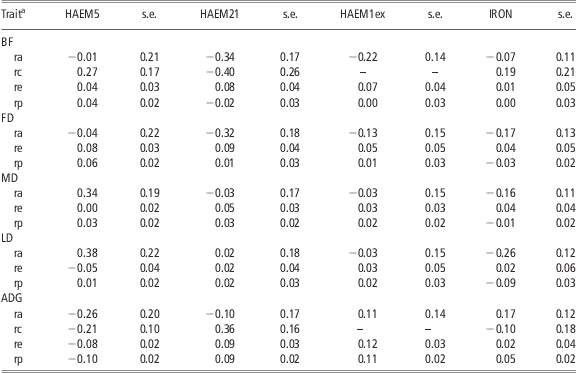
There were no significant genetic correlations between the haematological traits and any growth or carcase characteristic, although the direction between both fat measures (BF and FD) and haematological traits were consistently negative and therefore favourable (Table 7).
Genetic (ra), common litter (rc) environmental (re) and phenotypic (rp) correlations, along with their standard errors (s.e.) between haematological traits and carcase traits or growth rate
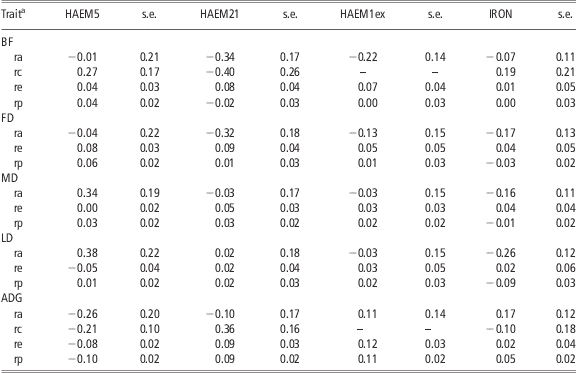
aHAEM5: haemoglobin at 5 weeks, HAEM21: haemoglobin at 21 weeks, HAEM21ex: haemoglobin at 21 weeks with records from 22 July 2010 to 19 August 2010 excluded, IRON: iron content in pork, BF: backfat recorded on the live pig, FD: fat depth recorded on the carcase, MD: muscle depth, LD: carcase loin depth, ADG: lifetime average daily gain.
Discussion
Haemoglobin
Blood haemoglobin levels are used to quantify the iron status of pigs. Haemoglobin levels above 100 g/l are considered adequate, whereas haemoglobin levels of 80 or 70 g/l are generally considered borderline anaemic or anaemic (National Research Council, 1998). Mean haemoglobin levels at 5 and 21 weeks of age observed in this study were in the normal range and were similar to mean haemoglobin levels observed in a recent Australian study by Payne (Reference Payne2009) who reported mean haemoglobin levels of 97, 105 and 112 g/l for 35-day old piglets that were raised indoor and fed either no creep feed, creep feed or an outdoor mix, respectively. The outdoor mix consisted of straw, sow feed and soil to resemble the substrates available to outdoor piglets. As in our study, these piglets had been given a routine 200 mg intramuscular or subcutaneous iron dextran injection shortly after birth.
There is a paucity of literature reporting heritability estimates for haemoglobin. Our range of heritability estimates for haemoglobin measures was lower than the range of estimates (0.45 ± 0.12 to 0.51 ± 0.14) presented by Bolormaa et al. (Reference Bolormaa, Van der Werf, Walkden-Brown, Marshall and Ruvinsky2010) for haemoglobin levels recorded at 3, 5 and 6.25 months of age in ∼600 sheep. Heritability of haemoglobin levels in humans ranged from 0.34 to 0.42 in geographically and genetically isolated Italian populations (Sala et al., Reference Sala, Ciullo, Lanzara, Nutile, Bione, Massacane, D'Adamo, Gasparini, Toniolo and Camaschella2008). In mink, heritability estimates based on half-sib analyses were highly variable and often negligible for individual measures of haemoglobin at four different ages (Gedde-Dahl and Helgebostad, Reference Gedde-Dahl and Helgebostad1971). Only the heritability estimate for the weighted mean of multiple haemoglobin measures was presented, which still had a high level of uncertainty (0.28 ± 0.23) despite the improved accuracy of the repeated measure.
In summary, this comparison with other studies and the effect of excluding some recording dates on heritability estimates indicates that procedures to measure haemoglobin with the HemoCue Hb201+ equipment should be evaluated. Blood was collected by jugular venipuncture and stored overnight before recording haemoglobin in accordance with measurement procedures outlined in the manual for human blood (HemoCue®2011). On the basis of veterinary advice (B. Frey, personal communication), pig blood samples stored in this way should be agitated for at least 10 min before haemoglobin measurement, which was not practised in this study. Therefore, further investigations and procedural recommendations are required to improve the accuracy of the on-farm haemoglobin measurement in pigs, as this proven measurement technology does provide opportunities for pig breeding programmes. The HemoCue Hb 201+ analyser is designed to work in less than one minute on a small amount of blood (10 μl). This amount of blood can be collected at various ages of pigs and provides opportunities for the use of blood haemoglobin levels as a selection criterion in pig breeding programmes.
Iron
The mean iron content in pork of 2.87 mg/kg observed in this study was slightly below the range of 3 to 30 mg/kg reported by Rooke et al. (Reference Rooke, Flockhart and Sparks2010). Pork cuts differ in their iron content (Reichardt et al., Reference Reichardt, Müller and Leiterer2002; Greenfield et al., Reference Greenfield, Arcot, Barnes, Cunningham, Adorno, Stobaus, Tume, Beilken and Muller2009) and a comparison of mean iron content with other studies should only be based on iron content in m. longissimus dorsi. For this muscle, mean iron content varied from 3.60 to 4.60 mg/kg in the studies by Reichardt et al. (Reference Reichardt, Müller and Leiterer2002), Lombardi-Boccia (2002) and Greenfield et al. (Reference Greenfield, Arcot, Barnes, Cunningham, Adorno, Stobaus, Tume, Beilken and Muller2009). Pork was ground in the two earlier studies and Lombardi-Boccia (2002) states that the food processor was equipped with stainless steel blades. ‘Contact with metal was minimised wherever possible’ in the study by Greenfield et al. (Reference Greenfield, Arcot, Barnes, Cunningham, Adorno, Stobaus, Tume, Beilken and Muller2009). The use of steel knives for the preparation of pork samples in the laboratory increased the mean iron content in pork in this study (unpublished results). Therefore, only studies that used ceramic knives to determine iron content in m. longissimus dorsi can be used for a valid comparison of the mean iron content found in this study. Dannenberger et al. (Reference Dannenberger, Reichardt, Danier, Nümberg, Nümberg and Ender2007) used such an approach. However, sample size was small with 11 to 24 pigs per genotype, and the range of means from 4.1 ± 0.15 to 5.0 ± 0.21 mg/kg fresh weight may have been affected by sampling effects.
The mean iron content of pork was 6.3 mg/kg in the review by Rooke et al. (Reference Rooke, Flockhart and Sparks2010) in comparison to iron concentrations of 18, 11 and 5.5 mg/kg for beef, sheep and chicken, respectively. To put these mean iron levels in perspective for human nutrition, the recommended iron intake of males and females is 8 and 18 mg/day (Institute of Medicine, Food and Nutrition Board, 2001).
The moderate heritability estimate for iron content in pork found in this study confirms previous heritability estimates for iron characteristics in pork of 0.39 ± 0.09 for haem pigment (Larzul et al., Reference Larzul, Lefaucheur, Ecolan, Gogué, Talman, Sellier, Le Roy and Monin1997) and 0.27 ± 0.09 for soluble myoglobin content (Newcom et al., Reference Newcom, Stalder, Baas, Goodwin, Parrish and Wiegand2004). Heritability estimates were somewhat lower for pigment in pork (Oksbjerg et al., Reference Oksbjerg, Henckel, Andersen, Pedersen and Nielsen2004) and for total iron content in sheep meat (Mortimer et al., Reference Mortimer, van der Werf, Jacob, Pethick, Pearce, Warner, Geesink, Hocking Edwards, Gardner, Ponnampalam, Kitessa, Ball and Hopkins2010) with estimates of 0.17 ± 0.02 and 0.12 ± 0.05, respectively.
Genetic correlations
The three haemoglobin measures had moderate genetic correlations with iron content in pork, indicating that haemoglobin may be used as a selection criterion for iron content in pork. Estimates were slightly higher, and significant, for haemoglobin traits at 21 weeks in comparison to the earlier haemoglobin measurement, which were supported by positive and significant phenotypic correlations with pork iron content. Haemoglobin at 5 weeks had no significant genetic or phenotypic associations with haemoglobin measures at 21 weeks, indicating that haemoglobin shortly after weaning is genetically and physiologically a different trait to haemoglobin at 21 weeks. It is uncertain whether iron dextran injections contributed to these low associations. Comparable estimates of genetic correlations were not found in the literature.
Among pork quality traits, positive a* values, which are measures of redness, had the highest genetic correlations with iron content in pork accompanied by significant positive genetic correlations with haemoglobin measures at 21 weeks of age. Genetic correlations between iron content in pork and L* values ranged from −0.54 ± 0.23 to −0.61 ± 0.14, indicating that pork with a higher iron content is darker. The magnitudes of genetic correlations were slightly lower in Oksbjerg et al. (Reference Oksbjerg, Henckel, Andersen, Pedersen and Nielsen2004), who found estimates of genetic correlations of pigment in pork with a* value of 0.59 ± 0.04 and with L* value of −0.46 ± 0.06. At the phenotypic level, Lindahl et al. (Reference Lindahl, Lundström and Tornberg2001) found that 86% and 90% of the variation in L* and a* value of pork was explained by pigment content and myoglobin forms, highlighting the strong association between these colour characteristics and measures of iron content in pork. The study by Newcom et al. (Reference Newcom, Stalder, Baas, Goodwin, Parrish and Wiegand2004) was based on 255 pigs and only residual correlations between myoglobin and pork quality traits were presented. Magnitude of residual correlation was highest for a* value (0.23) followed by L* value (−0.17), consistent with the direction of genetic correlations in this study.
Positive b* values describe yellowness of pork. This trait had positive genetic correlations with iron content, which were variable ranging from 0.31 ± 0.20 to 0.60 ± 0.14 for alternative measures of b* values. Pigment content and fraction of metmyoglobin, which had been the main factors affecting L* and a* value, had no significant effect on b* value in the study by Lindahl et al. (Reference Lindahl, Lundström and Tornberg2001). Further, the residual correlation presented by Newcom et al. (Reference Newcom, Stalder, Baas, Goodwin, Parrish and Wiegand2004) between myoglobin content and b* value was −0.15. The direction of genetic correlations of individual colour traits with iron content of pork reported in this study corresponds to genetic associations between the colour measurements L*, a* and b* observed by Gjerlaug-Enger et al. (Reference Gjerlaug-Enger, Aass, Ødegård and Vangen2010) and Wijk et al. (Reference Wijk, Arts, Matthews, Webster, Ducro and Knol2005). A lower L* value (darker meat) was genetically associated with a higher a* value (redder meat) and higher b* values (more yellow colours).
In summary, all colour measures had moderate to high genetic correlations with iron content, which were consistent with genetic relationships observed between these traits. Gjerlaug-Enger (Reference Gjerlaug-Enger2011) recommended the use of a* value in pig breeding programmes instead of L* value, as it had no major unfavourable genetic correlation with other meat quality traits and could be used as a selection criterion for iron content in pork. The high genetic correlations found in this study between a* values and iron content in pork support the recommendation by Gjerlaug-Enger (Reference Gjerlaug-Enger2011). However, variation in total haem pigment has been shown to influence colour of the meat (Warris et al., Reference Warris, Brown and Adams1990), and although variation in total haem pigment was relatively small this variation could be important in genetic improvement programmes that use colour measurements to improve pork quality with regard to pale, soft, exudative or dark, firm, dry pork (Warris et al., Reference Warris, Brown and Adams1990).
Both pH measurements had moderate negative genetic correlations with iron content in pork. The direction of these genetic correlations does not correspond to genetic associations observed between L* value and iron content in pork. Genetic correlations between pH measurements and L* value are usually highly negative (Hermesch et al., Reference Hermesch, Luxford and Graser2000; Wijk et al., Reference Wijk, Arts, Matthews, Webster, Ducro and Knol2005; Gjerlaug-Enger et al., Reference Gjerlaug-Enger, Aass, Ødegård and Vangen2010). Therefore, genetic correlations between pH measures and iron content are expected to be positive to remain consistent among these traits. Comparable genetic correlations between in vivo pigment and pH measurements were not significant (Oksbjerg et al., Reference Oksbjerg, Henckel, Andersen, Pedersen and Nielsen2004) and the residual correlation between soluble myoglobin content and ultimate pH recorded 24 hours post mortem was zero in the study by Newcom et al. (Reference Newcom, Stalder, Baas, Goodwin, Parrish and Wiegand2004).
Genetic correlations between haematological traits and BF, MD and growth were generally not significantly different from zero. Estimates had a low to moderate magnitude and were not always consistent with regard to the direction of genetic associations within trait groups. For example, genetic correlations between growth rate and haematological traits varied from −0.26 ± 0.20 to 0.17 ± 0.12. A Danish comparison of faster growing pigs available in 1995 with slower growing pigs, representing a genotype of the 1970s, found lower haematin and myoglobin in pork for the faster growing pigs, although no significant differences in meat haemoglobin were observed (Oksbjerg et al., Reference Oksbjerg, Petersen, Sørensen, Henckel, Vestergaard, Ertbjerg, Møller, Bejerholm and Støier2000). It was suggested that correlated responses in muscle fibre types may have contributed to these differences. Growth rate and lean meat percentage were genetically positively associated with higher myofibre cross-sectional areas, which were genetically related to higher pigment (Larzul et al., Reference Larzul, Lefaucheur, Ecolan, Gogué, Talman, Sellier, Le Roy and Monin1997) indirectly supporting the low and favourable genetic associations between iron content in pork and growth or BF traits found in this study. The unfavourable genetic association between measures of iron in pork and efficient lean meat growth indicated by Oksbjerg et al. (Reference Oksbjerg, Petersen, Sørensen, Henckel, Vestergaard, Ertbjerg, Møller, Bejerholm and Støier2000) were not supported in a subsequent study by Oksbjerg et al. (Reference Oksbjerg, Henckel, Andersen, Pedersen and Nielsen2004), who found a positive genetic correlation (0.28 ± 0.05) between lean meat percentage and in vivo pigment. No genetic association was found between growth rate and in vivo pigment. In the study by Oksbjerg et al. (Reference Oksbjerg, Petersen, Sørensen, Henckel, Vestergaard, Ertbjerg, Møller, Bejerholm and Støier2000), age at slaughter of pigs was positively correlated with concentration of haematin. The lower haematin and myoglobin levels of the fast growing animals may have been a reflection of the younger slaughter age of these animals. Further, the two pig genotypes originated from an experimental test station (slow growing pigs) or Danish breeding herds (fast growing pigs). No information was provided about iron status of pigs at the beginning of the experiment and it is not known whether this confounding of pig genotype with herd of origin of piglets has affected results. For example, Payne (Reference Payne2009) found that different pre-weaning environments affected iron status of piglets at weaning with possible effects on subsequent performance of growing pigs.
The moderate heritability for iron content in pork and lack of unfavourable genetic associations with performance traits demonstrate opportunities for pig breeding programmes to improve this trait via selection. The genetic improvement in iron content in pork will depend on the emphasis placed on this trait in breeding objectives and the amount of relevant information recorded. Practical livestock breeding programmes have achieved annual genetic gains of 10% to 20% of the additive genetic standard deviation of a trait in a multi-trait context (Hermesch, Reference Hermesch2006), which is equivalent of 0.02 to 0.04 mg/kg iron given the mean and variation observed for iron content in this study. However, annual genetic gain may be higher for other muscles with higher mean and variability in iron levels because of scaling effects. Colour measurements and haemoglobin levels in blood were identified as selection criteria for iron content in pork. The benefits of using these measurements for genetic improvement of iron content in pork were evaluated in an index that only included iron content as a breeding objective trait to evaluate differences in specific settings relevant to iron without interference of other traits. The base scenario was defined as recording iron content in one full sib only, which resulted in a response of 0.06 mg/kg iron content in pork per generation and assuming a selection intensity of one at a cost of about Australian $35. In comparison to this base scenario (base = 100%), measuring colour measurements on two full sibs led to a 27% higher genetic gain (127%) at a lower cost (43%), while recording haemoglobin at 21 weeks (HAEM21) on the selection candidate and seven full sibs, resulted in 65% of the genetic gain achieved in the base scenario at 57% of the costs. However, for this testing scheme, genetic gain in iron content would be similar to the base scenario assuming a heritability of 0.27 for haemoglobin levels in blood, which may be achieved with more precise recording procedures on farm.
Conclusions
Iron content in pork was moderately heritable and can be improved via selection. Colour measurements had moderate to high genetic correlations with iron, providing good avenues for selection strategies to improve iron content in pork. The HemoCue Hb 201+ analyser provides rapid measures for blood haemoglobin levels on farm and may be used as a selection criterion for iron content in pork and redness of pork. Current selection practices are not expected to affect iron content in pork, given that no significant genetic correlations between performance and haematological traits were found.
Acknowledgements
Data recording was funded by the PorkCRC (Project 3B-102). Australian Pork Limited (APL) funded data analyses (Project APL2133). The authors thank Kristy Tickle and Helen Griggs at Rivalea (Australia), as well as David Paynter from Regional Laboratory Services for diligent data collection, Brian Luxford from Rivalea (Australia) for coordinating the project at Rivalea (Australia) and Heather Channon from APL for valuable discussions.