INTRODUCTION
Venus played a number of different roles in Maya culture and was differentiated in each of its aspects investigated here: 1) as morning and evening star, when it was visible in the eastern and western skies and, 2) in its phases of disappearance (superior and inferior conjunction), when it was believed to be residing in the underworld. Our best source of information concerning prehispanic Maya conceptions of Venus derives from the screenfold codices, which are believed to have been painted by Yucatec speakers in the northern Maya lowlands in the fourteenth or fifteenth century, and from the Dresden Venus table in particular. In the discussion that follows, emphasis will be placed on Venus’ early morning and evening appearances and its link to deities of the hunt, as well as to warriors armed with darts and atlatls (spear-throwers).
HUNT DEITIES AND VENUS ASSOCIATIONS
Hunting was of considerable importance to prehispanic Maya populations and continued to have both ritual and dietary significance among Maya groups documented ethnographically in the early twentieth century (see, e.g., Redfield and Villa Rojas Reference Redfield and Villa Rojas1934). Its importance is emphasized by depictions of hunting in prehispanic painted sources (pottery vessels and codices, in particular), as well as the central role hunting plays in Maya narratives such as the Popol Vuh and more recent stories told by groups such as the Lacandon, Q'eqchi’, and Mopan Maya (Christenson Reference Christenson2007; Thompson Reference Thompson1930, Reference Thompson1970). For the Yucatec Maya, hunting took place primarily during the dry season (December through April), when agricultural work was suspended, but it was also undertaken to provide food and offerings for important ceremonies, such as the ch'a-chaak (rainmaking ritual), which took place at the start of the rainy season (Redfield and Villa Rojas Reference Redfield and Villa Rojas1934).
The Hero Twins in the Popol Vuh represent a specific regional and temporal variant of a tradition of supernatural twins occurring in the Maya area from the Late Preclassic period (400 b.c.–a.d. 200) onwards. There, they go by the names Hunahpu and Xbalanque and are the sons of Hun Hunahpu, whom Taube (Reference Taube1992:50) and others have identified as the Maize God, and the underworld maiden Xquic. Their mother left the underworld to avoid being sacrificed and journeyed to the surface of the earth, where she gave birth to the twins in the house of their grandmother, Hun Hunahpu’s mother (Christenson Reference Christenson2007:131–144).
As boys, Hunahpu and Xbalanque were mistreated by their grandmother and twin half- brothers and had to fend for themselves. They became adept hunters—indeed, Hunahpu’s name may originally have been read as “One/First Blowgunner” (Christenson Reference Christenson2007:94, n163; Tedlock Reference Tedlock1996:238, n77)—and are also seen as having a special relationship with animals, which aid them in their various adventures. These include ridding the world of menaces, including the Maker of Mountains (Zipacna), the Destroyer of Mountains (Cabracan), and their father Seven Macaw, who set himself up as the sun of the era prior to this one, associated with the wooden people. By defeating the three of them, the Hero Twins made the earth safe for human habitation (Christenson Reference Christenson2007:91–111).
They were also responsible for defeating the underworld lords who had sacrificed their father and uncle, thereby freeing maize and the other foods and seeds that were previously hoarded in the underworld realm. Using maize seeds found within the mountains Paxil and Cayala, the creator goddess (the twins’ grandmother) ground them and mixed them with water to form the first people (Christenson Reference Christenson2007:185–195).
By this time, however, the twins’ earthly existence was over. While still in the underworld, they immolated themselves so that they could transform into the sun and moon (Christenson Reference Christenson2007:177–179, 190–191). Prior to their dawning, the world and humanity existed in darkness. It was only with the initial rise of the morning star—known as Ik'oq'ij “Accompanies/Bears/Passes Before Sun” (Christenson Reference Christenson2007:218, n569)—that the world was made as it is today (Christenson Reference Christenson2007:223–230). The identity of the morning star is not revealed in the Popol Vuh, although more contemporary stories focus on three brothers, the eldest of whom was the morning star. It was his birth into the sky that allowed the sun (the middle brother) to appear. The younger brother is described in some of the stories as having been turned into a monkey (similar to the second set of twins in the Popol Vuh) or as becoming one of the other planets, such as Mars (Thompson Reference Thompson1970:355–357).
Among the Mopan and Q'eqchi’ Maya, the brothers are associated very specifically with hunting, and the eldest brother is referred to as Lord Xulab, a bearded deity who is both the keeper of wild animals, with a specific connection to deer, and Venus in its morning star aspect (Thompson Reference Thompson1930:60–63, 120–125, 129). Xulab is also said to be responsible for all aspects of fishing, as well as hunting (Villa Rojas Reference Villa Rojas and Vogt1969:272). This bearded figure has clear parallels with Yax Balam in the Maya codices, the Late Postclassic Yucatec version of the Popul Vuh's Xbalanque, suggesting the possibility that he played a role not only as a hunting deity, but also as the morning star aspect of Venus. Xbalanque has been interpreted as having associations with the sun or the nighttime sun in the underworld (see Christenson Reference Christenson2007:94–95, n164), but evidence from the Maya codices suggests that the Postclassic Yucatec variant of this deity (Yax Balam) was instead linked with Venus.Footnote 1
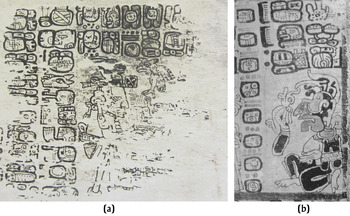
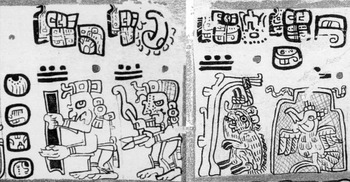
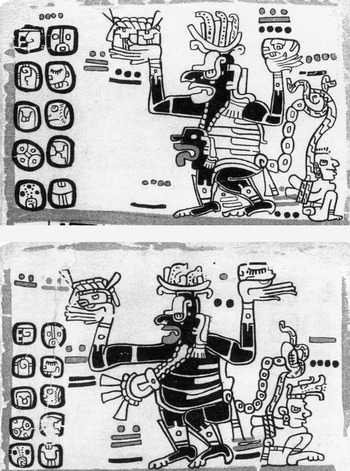
According to ethnohistoric and ethnographic sources, the deity of the hunt in Yucatan is known as Sip, or Ah Wuk Yol Sip [Ah Uuc Yol Zip] in the Colonial period (a.d. 1519–1697) (Barrera Vásquez et al. Reference Barrera Vásquez, Bastarrachea Manzano, Sansores, Salas, Góngora and Poot1980:730, 899). This term, or an abbreviated variant (Wuk Sip, or simply Sip) occurs in relation to two different deities in the Maya codices who appear to have associations with deer and/or hunting. The first of these, a black-painted figure known as God Y, is associated with a series of ceremonies depicted in the Madrid Codex with connections to deer and the month Sip (Bill Reference Bill, Bricker and Vail1997), which includes a dance for hunters in which they hold arrows and the skull of a deer (Landa Reference de Landa and Gates1978:72). The Sip epithet is also used on several occasions in reference to a figure with jaguar skin markings, perhaps a variant of Yax Balam, also known as God CH (Figures 1a–1b). This figure plays an important role not only as a hunter, but also as a manifestation of Venus in a series of almanacs in the Madrid Codex, discussed below.
Deities named as Sip: (a) God CH on Paris, p. 10 (de Rosny Reference de Rosny1888); (b) God Y on Madrid, p. 69a (Gates Reference Gates1933).

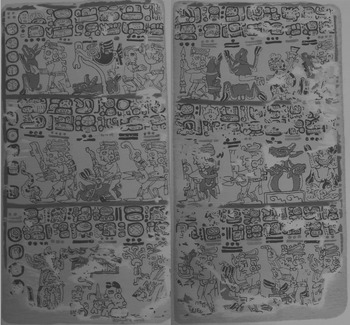
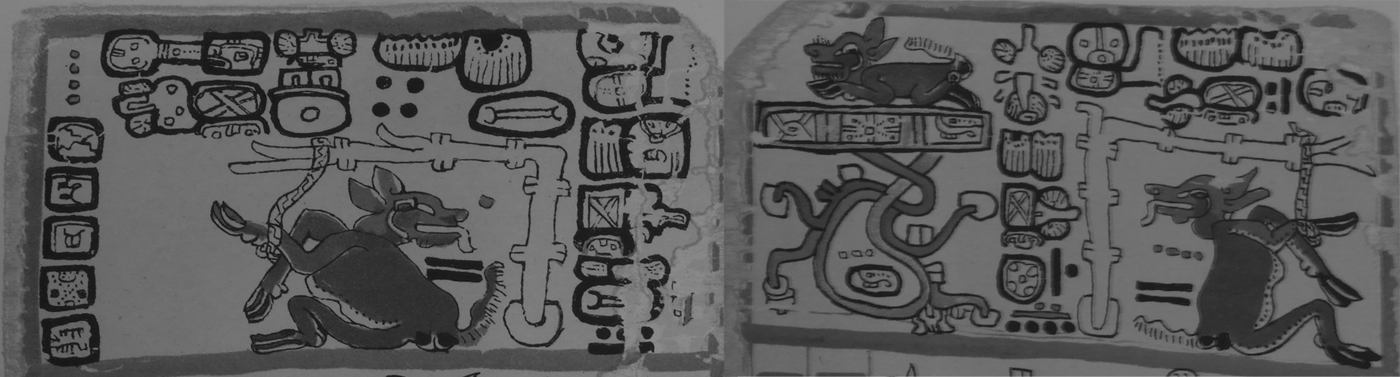
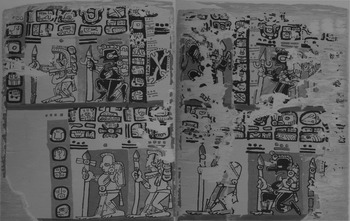
There is good evidence to suggest that Sip, as a complex of hunting deities, may be linked to the Earth Lord of various contemporary Maya cultures. In an account of “Don Juan” of the Ch'ol, we learn that the Earth Lord, also called the “Owner of the Mountain” or the “Earth Owner,” lives in a cave and controls the distribution of all of the game animals, including deer and peccaries, and that these “gifts” to people were tied or trussed up before being carried home (Cruz Guzmán et al. Reference Cruz Guzmán, Josserand, Hopkins and Robertson1980). This description helps us make sense of some of the almanacs featuring God Y as Sip in the Madrid Codex in light of his possible role as Earth Lord (Figure 1b). Moreover, there are some interesting ties between this folktale and three separate almanacs found on pp. 40–41 of the Madrid Codex featuring deer, hunters, and possible Venus deities or events (Figure 2). While there is some overlap among the almanacs, each of them also contains individual elements that do not occur in the others. Their texts, iconography, and calendrical structure are detailed in Table 1.
Hunting almanacs on Madrid, pp. 40–41 (Brasseur de Bourbourg Reference Brasseur de Bourbourg1869–Reference Brasseur de Bourbourg1870:Plates XVI–XVII).

Hunting almanacs on Madrid, pp. 40–41

a This location is repeated in six of the almanac's seven frames. It was originally read as hem “valley” (Schele and Grube Reference Schele and Grube1997) and has been interpreted more recently as akan “grasslands, bajo” (Stuart Reference Stuart2005:180). Both of these terms are of interest in relation to the folktale related previously, in which the earth lord is named as either “Mountain-Valley” (among the Q'eqchi’) or “Mountain-Grasslands” (among the Chuj) (Cruz Guzmán et al. Reference Cruz Guzmán, Josserand, Hopkins and Robertson1980:116).
b This iconography is repeated in frame 4 of the almanac below.
c This iconography may refer to the heliacal rise of Venus.
d A hunter in the almanac on Madrid, pp. 92a–93a, is associated with the same glyphic collocation. There, he is named as “one who binds/traps ?? [T1036c]” and is pictured holding a large obsidian implement.
e von Nagy (Reference von Nagy, Bricker and Vail1997:50) suggests this may refer to the strange behavior of deer during the fall months, when they transform into snakes according to the Yucatec Maya of Chan Kom (Redfield and Villa Rojas Reference Redfield and Villa Rojas1934:208). It is also interesting to note that, in the Ch'ol folktale discussed previously, there is a snake that turns out to be a rope. Rattlesnakes also have celestial associations (they represent the Pleiades), although there is nothing in the iconography or text to suggest that this scene was linked in any way to the sky.
f The weapons and appearance of the figure suggest an association with the morning star aspect of Venus.
g Compare this arrangement to that of the three stones in a Maya hearth.
h Compare to frame 1 on Madrid, pp. 40b–41b.
i Whether this was intended to represent a bloodletter remains uncertain.
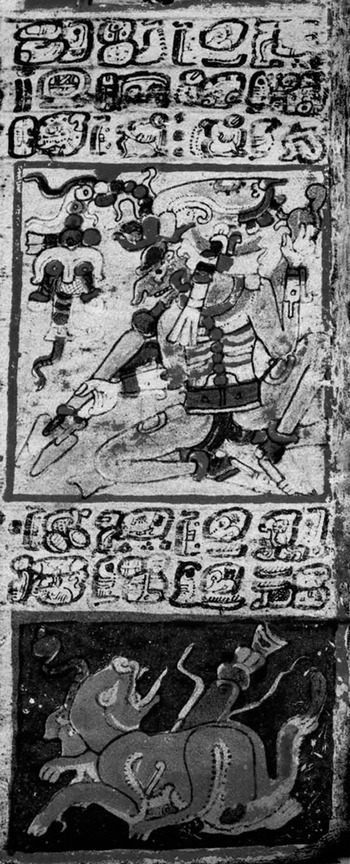
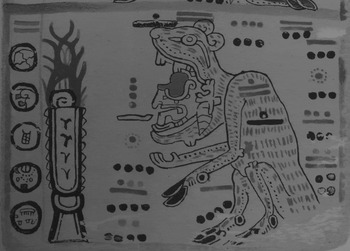
The almanac on pp. 40a–41a of the Madrid Codex begins on the day 4 Ahaw (day 160) in the 260-day ritual calendar or tzolk'in, an important date in the codex for its mythological associations and links to renewal rituals (Vail and Hernández Reference Vail and Hernández2013:385–410). The sixth frame of the almanac contains a clear reference to a Venus event—the spearing of Chak Balam (“Great Jaguar”), which also occurs on p. 47 of the Dresden Venus table (Figure 3), where Chak Balam has been speared by Lahun Chan, a warrior manifestation of the morning star aspect of Venus associated with Lamat days in the tzolk'in.Footnote 2 In addition to their iconographic similarities, the caption to the Dresden scene picturing the speared animal includes a reference to ah kimil “dead person” (which also occurs in the Madrid almanac) and to tok’ ba'ate’ “flint warrior” (compare to frame 3 of the Madrid almanac). Although the taking of captives is not specifically mentioned in relation to Venus’ heliacal rise in other sources, there is good evidence to suggest that sacrifices were made to Venus at this time. From the evidence presented in the Madrid almanacs (pp. 40–41), these sacrifices may have included deer, as well as people.
Lahun Chan and Chak Balam on Dresden, p. 47 (Förstemann Reference Förstemann1880).

An even closer connection between the Madrid frame featuring the speared jaguar and Dresden p. 47 is implied by the calendrical connections between the two. The Madrid frame highlights potential Venus heliacal rise dates in each of the five runs through the almanac (see Table 1), beginning with 1 Kib’ in the first run (day 193 + 3 days), followed by 1 Lamat (day 245 + 3 days), 1 Ahaw (day 37 + 3 days), 1 Eb’ (day 89 + 3 days), and 1 K'an (day 141 + 3 days). The date 1 Lamat is also found on Dresden p. 47, and is also one of the dates associated with the fifth frame of the almanac on Madrid, pp. 40b–41b, and the third frame of Madrid, pp. 40c–41c, which includes a figure identified in the hieroglyphic caption as Lahun Taan, which may well be a misspelling of Lahun Chan. The figure pictured lacks the characteristic features of Lahun Chan depicted in the Dresden Venus table, but so too does the figure named as Lahun Chan on a capstone from Chichen Itza (Vail and Hernández Reference Vail and Hernández2013:322–324). The Madrid figure does have markings suggesting either jaguar skin or a beard around the mouth, indicating a correspondence with descriptions of contemporary Maya hunt/morning star deities. In this respect, he resembles the figure named as Sip in the Paris Codex on p. 10b (Figure 1a; de Rosny Reference de Rosny1888). That figure wears a deer head as a headdress, as do the examples of God Y as Sip on Madrid, pp. 50b, 51c, and 68b (Figure 1b). The reference to Lahun Chan on Madrid p. 40c is followed by the name “Four/Sky Jaguar,” who is also named in the first frame of the almanac. While this may be the same figure as Chak Balam, this proposition requires further support.
As previously discussed, the Sip epithet refers to several deities with distinct physical representations who are identified as Gods CH and Y in the codices. The former has close associations with the Q'eqchi’ deity Lord Xulab, whereas God Y does not. There is no reason to suppose, however, that the Sip figure with a beard and/or jaguar skin markings may not also have had other epithets or appellatives as well, much as is the case with deities named in contemporary prayers or in texts such as the Popol Vuh and the Yucatec Books of Chilam Balam. Lahun Chan, therefore, was likely the epithet used in relation to the Venus/morning star aspect of the hunting deity Sip.
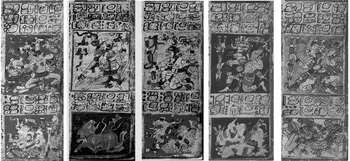
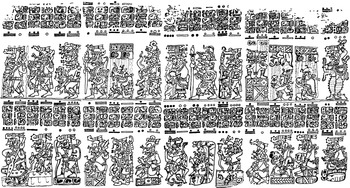
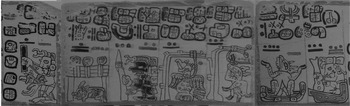
The same figure appears in the third frame of the almanac on Madrid, pp. 40b–41b, and possibly also in the final frame of the almanac on pp. 40a–41a. The former example depicts a hunting deity with jaguar skin markings who holds an atlatl and darts. There is good reason to suppose that this is the morning star aspect of Venus, as he holds the same implements as the Venus deities on the Dresden Venus table, pp. 47–50 (see Figure 4).
Venus heliacal rise deities (middle register) and their victims (lower register) on Dresden, pp. 46–50 (Förstemann Reference Förstemann1880).

An interesting correspondence occurs in relation to the first and third frames and the first and second frames of the almanac on Madrid, pp. 92a–93a (Figure 5). They are thematically very similar and are separated by almost the same interval of days (13 in the case of Madrid, pp. 92a–93a, and 12 for pp. 40b–41b). The first frame in each refers to the hunter pictured as the trapper of T1036c, a glyphic collocation that has not yet been satisfactorily deciphered. The second frame of the Madrid Codex, pp. 92a–93a, and the third on pp. 40b–41b picture a figure with similar facial markings who holds darts in one hand and an atlatl in the other. In both instances, the figures are associated with appellatives that name them as deer hunters, suggesting that both may be identified as hunting deities who are also associated with the morning star aspect of Venus. The following frames in each almanac include references to Sip—ah hok' sip “sip trapper” on Madrid, pp. 92a–93a (sip, in this case, referring to a peccary, rather than a deer) and Wuk (“seven”) Sip on pp. 40b–41b.
Hunting almanac on Madrid, pp. 92a–93a (Brasseur de Bourbourg Reference Brasseur de Bourbourg1869–Reference Brasseur de Bourbourg1870:Plates XX–XXI).

The almanac on Madrid, pp. 40c–41c, has three frames with possible celestial associations. The first, as previously discussed, pictures a jaguar that is referred to as Kan Balam (“Four or Sky Jaguar”) in the text caption. The following frame depicts a female figure (possibly the earth deity Goddess I) piercing her tongue with a bone awl, surrounded by vessels with various types of offerings. Above her is a skyband on which a deer lies, similar to that seen in the third frame of the almanac on Madrid, pp. 46a–47a (Figure 6). The deer may be an asterism corresponding to the Western constellation of Virgo in terms of its positioning in the sky; alternatively, it may be symbolic of the sun, who carries a stuffed deerskin in a contemporary Mopan tale in order to woo the young moon goddess (Thompson, in Milbrath Reference Milbrath1999:22).Footnote 3
Deer on skyband on Madrid, pp. 46a–47a (Brasseur de Bourbourg Reference Brasseur de Bourbourg1869–Reference Brasseur de Bourbourg1870:Plates X–XI).

The following frame, as previously discussed, depicts who is likely Lahun Chan. The caption tells us that “Kan Balam is the god Lahun Chan’s offering.” It is not clear what the figure pictured carries in his hand, although it may be some sort of plant. How it relates to the text caption or to Venus in its morning star aspect remains unclear. It is of interest, however, that this frame overlaps calendrically with the spearing of the jaguar (Madrid Codex, p. 41a) and that they both occur on days that are associated with Venus’ heliacal rise in the Dresden Codex.
As the preceding discussion makes clear, Venus and other celestial imagery occurs in all three of the almanacs on Madrid, pp. 40–41. We know that offerings were made to the god of the hunt—the caretaker of the animals and a Venus deity—by Mopan and Q'eqchi’ Maya groups as late as the 1930s, and perhaps for several decades thereafter. Friar Landa (Reference de Landa and Gates1978:70) mentions bloodletting (the piercing of the ears, as well as the tongue) as one of the rituals performed by hunters and their wives during the month of Sip, which may be the significance of the picture in the second frame of Madrid, pp. 40c–41c. This is further suggested by the rubber incense seen in the bowl, as rubber incense is being burned to a Sip deity dressed in a peccary skin on Madrid 39c (Figure 7). Perhaps the deer on the skyband is meant to signify the month in which the event occurred, rather than having a specific celestial association. It is interesting to note, however, that there is a possible Venus glyph in the skyband (in the central section, which is partially eroded), perhaps specifying that Venus was in the sky when the Sip rituals depicted in this frame were being performed. This would serve as a further link between the ceremonies Landa describes and the hunt/morning star deity known to us today from the Q'eqchi’ and Mopan Maya (but who was likely to have been more widespread in the past).
Sip deity dressed in peccary skin on Madrid, p. 39c (Brasseur de Bourbourg Reference Brasseur de Bourbourg1869–Reference Brasseur de Bourbourg1870:Plate XVIII).

VENUS IN THE UNDERWORLD
In considering other Venus references in the codices, it is instructive to review both central Mexican mythology and contemporary Lacandon references to the morning and evening star aspects of the planet. A brief passage from the Colonial period Nahuatl text Anales de Quauhtitlan relates how the mythic hero Quetzalcoatl became transformed into Tlahuizcalpantecuhtli, the Lord of the Dawn, by immolating himself, after which he spent eight days in the Underworld fashioning weapons. He thereafter rose as the morning star, appearing ahead of the sun, and was said to shoot his arrows at particular classes of people or things (Bierhorst Reference Bierhorst1992:36–37).
This aspect of Venus is depicted in both highland Mexican and Maya screenfolds, as originally documented by Seler (Reference Seler1904) and Förstemann (Reference Förstemann1906). It is of considerable interest that, in the Dresden Venus table, the deities representing Venus’ heliacal rise are all from the western Maya region (Gods L and Lahun Chan on pages 46–47) or represent highland Mexican deities (Tawisikal on Dresden, p. 48, Xiuhtecuhtli on p. 49, and Kakatunal on p. 50) (Figure 4).Footnote 4 This emphasis contrasts with the upper and lower pictures on each page, which emphasize traditional Maya deities, with the exception of the figure on Dresden, p. 50c, who is associated with “the foreigners from the west” (Schele and Grube Reference Schele and Grube1997:156).
The structure of the Dresden Venus table has been discussed in considerable detail elsewhere (e.g., Aveni Reference Aveni2001; Bricker and Bricker Reference Bricker and Bricker2011:163–195; Milbrath Reference Milbrath1999; Vail and Hernández Reference Vail and Hernández2013). Here, a brief summation will suffice to provide the background necessary for our consideration of other examples of Venus deities in the Dresden Codex.
Three separate entry dates for the Venus table are given, each corresponding to a different register of the table itself. In effect, this separates what appears to be a single table into three separate tables. The earliest two, associated with starting dates of 1 Ahaw 18 K'ayab’ (November 23, a.d. 934) and 1 Ahaw 13 Mak (June 16, a.d. 1123) according to the model proposed by Harvey and Victoria Bricker (Reference Bricker and Bricker2011:188), record the four “stations” of the planet: 1) its morning star appearance, 2) its disappearance behind the sun during inferior conjunction (when it was believed to be in the underworld), 3) its evening star appearance, and 4) its disappearance in front of the sun during superior conjunction (when it was again believed to be in the underworld) for each of its five cycles through the sky (one associated with each page of the table). For the prehispanic Maya, Venus was associated with the east as a morning star for a period of 236 days, the north when it was in superior conjunction for a period of 90 days, the west as an evening star for a period of 250 days, and the south when it was in inferior conjunction, or in the underworld, for a period of 8 days (Bricker and Bricker Reference Bricker and Bricker2011).Footnote 5 This 584-day period, when multiplied by the five pages of the table, creates a cycle of 2,920 days.
The final version of the table, associated with a starting date of 1 Ahaw 3 Xul (January 23, a.d. 1221), is an expanded version, in which the morning star aspect of the planet is highlighted by the pictures and captions on the right side of each page. A detailed discussion of this version of the table is provided in Vail and Hernández (Reference Vail and Hernández2013:274–296). Of interest to the current discussion are the weapons wielded by Venus and the idea of Venus’ sojourn in the underworld (sometimes seen as a journey) before its heliacal rise ahead of the sun. This is visualized as Venus emerging out of the sea, based on the fact that the underworld is viewed as a watery realm that is accessed through various types of portals such as caves or cenotes (Miller Reference Miller1982:87).
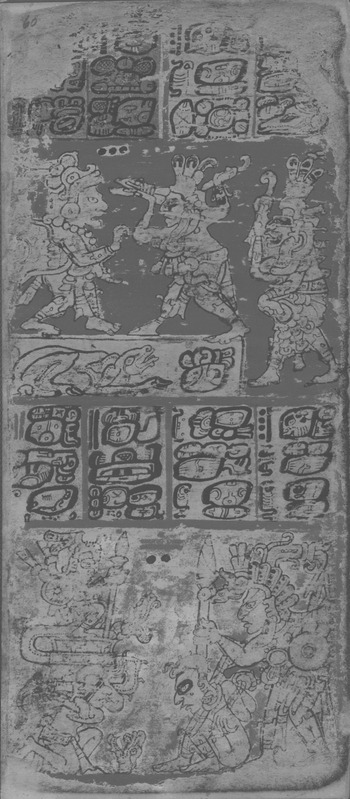
Iconography indicative of Venus’ underworld sojourn and its emergence from the watery realm occurs in two interrelated tables that occupy the upper and lower of Dresden, pp. 65–69, known as the Dresden seasonal table (Figure 8). Together, the two comprise a period of 364 days, or a single computing year, although they were recycled to cover a much longer span of time. They highlight seasonal events such as the spring equinox and summer solstice, as well as astronomical occurrences including eclipses (Bricker and Bricker Reference Bricker and Bricker1988, Reference Bricker and Bricker2011). They also, as I demonstrate below, emphasize the role of the rain deity Chaak as both the morning and evening star aspects of Venus (see Vail and Hernández Reference Vail and Hernández2013).
Upper and lower seasonal tables on Dresden, pp. 65–69 (Bricker and Bricker Reference Bricker and Bricker2011:Figure 11.2).

In his role as morning star, we see Chaak journeying through the underworld in a canoe (the text tells us that he is “in the earth”) in frame 1 of the lower register, which I have previously interpreted as Venus in inferior conjunction (Vail and Hernández Reference Vail and Hernández2013:301–302), when the planet is hidden from the sun for a period of approximately eight days.Footnote 6 The following frame pictures Chaak emerging from a frothy sea (the text notes that he is “in the foam”), carrying the weapons (darts and an atlatl) of Venus at its heliacal rise. The period of danger associated with Venus’ rise as morning star is considered to be five days, which is of interest in light of the five-day interval associated with this frame. Also of interest is the fact that the type of offering being made is “deer hunter [or slayer] bread” (Bricker Reference Bricker, Robertson and Fields1991), which recalls depictions of Venus deities as hunters in the Madrid Codex.
A similar sequence showing Chaak within the earth followed by his appearance in the water occurs later in the same almanac. In this instance, however, Chaak is pictured “in the white earth” (Dresden seasonal table, in frame 8 of the lower register), and in the following frame he rises “from the water” (or sea). Rather than holding an atlatl and darts, however, he wields his lightning axe and grasps what may be a water lily, which calls to mind descriptions of Lord Xulab, who is said to be the deity of fishing, as well as hunting. These two frames together suggest the morning star aspect of Venus, both in terms of Chaak’s rise from the sea and the sak kab’ reference. Among the Lacandon Maya today, äh säh kab’ refers to the morning star aspect of Venus. Likewise, the Lacandon refer to Venus in its evening star aspect as Säh K'in “False Sun” (Bruce et al. Reference Bruce, Robles U. and Ramos Chao1971:15), a phrase that is used in the frame directly above that picturing Chaak seated in the sak kab’ (“white earth”). In the frame in question (Dresden, frame 8 of the upper register), Chaak is pictured striding with a spear in his left hand and wearing a shield. Further evidence suggesting that this frame represents the evening star aspect of Chaak is that the appellative used—Ek’ Xib’? Chaak. Ek’—refers to black, which is the color associated with the west and Venus’ evening appearance. Chaak is said to have “thrown down” the god of sustenance K'awil. K'awil is one of the victims of the heliacal rise aspect of Venus on Dresden, p. 46. Furthermore, it is of interest that the date associated with the frame (5 Imix 19 Sotz’) falls just one day before the date targeted for Venus’ evening star appearance (6 Ik’ 0 Tzek) in the 18 K'ayab’ version of the Dresden Venus table (Vail and Hernández Reference Vail and Hernández2013:204).
The following frame (Dresden, frame 9 in the upper register) also appears to be associated with Chaak as the evening star aspect of Venus. Two days after K'awil is “thrown down” in frame 8 of the Dresden seasonal table, Chaak binds K'awil (u hok’ k'awil). The verb hok’ is also used in the almanac on Madrid, pp. 92a–93a, as discussed previously, although there the morning star aspect of Venus is highlighted, and it appears on Madrid, pp. 90a–92a (Figure 9), in an almanac that has a number of correspondences to the deer hunting scenes on Madrid, pp. 40–41. Of note here is the reference to Wuk Sip in the second frame, associated with the west, the picture of God M carrying a spear and pack in the following frame, the snared deer in the fifth frame, the deer sacrifice in the sixth frame, which takes place in a cenote, and the figure paddling a canoe in the final frame. The latter can be linked to the two frames that highlight the proposed heliacal rise of Venus as morning star in the lower seasonal table of the Dresden Codex, whereas the frame that is linked to the west (Dresden, frame 2) and that showing God M with a spear (Dresden, frame 3) may have associations with the evening star aspect of Venus, as discussed below.
Hunting almanac on Madrid, pp. 90a–92a (Brasseur de Bourbourg Reference Brasseur de Bourbourg1869–Reference Brasseur de Bourbourg1870:Plates XXI–XXIII).

Another depiction of Chaak in his black (western) aspect, in which he has the same weapons as those depicted in frame 8 of the upper seasonal table, occurs in the preface to the Dresden water tables. Here, he arises from the open mouth of a serpent, suggesting that he is emerging from the portal that connects the underworld and the earth. Chaak wears a peccary head as a headdress, and the text preceding this frame refers to “5 arrivals from the water” (ho’ tal ti’ ha’). As previously suggested, this likely is a reference to the cycle completed by the five evening star passages of Venus during the course of 2,920 days (Vail and Hernández Reference Vail and Hernández2013:158–160).
Other references to the evening star aspect of Venus have been proposed for Dresden, p. 74, and the cognate almanac on Madrid, p. 32a. In both instances, a black-painted deity known as God L or God Z holds a spear and darts (note that he also has a shield on Madrid, p. 32a, as well as a “club” similar to that seen on p. 40b).Footnote 7 The black coloration in combination with the spear is suggestive of an evening star manifestation of Venus, and dating models proposed by Hernández (in Vail and Hernández Reference Vail and Hernández2013:168, 172–174) provide support for this interpretation.
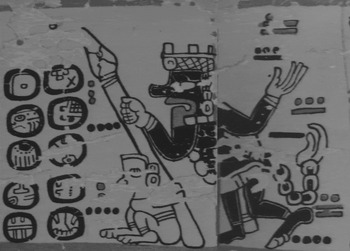
Another possible evening star manifestation of Venus, as suggested by the spear and shield, occurs on Dresden, p. 60b (Figure 10). The deity holding these items can be identified as Xiuhtecuhtli, the fourth of the five heliacal rise manifestations of Venus in the Dresden Venus table. In this instance, however, his pose and the fact that he has a captive tied to a spear, are highly suggestive of the evening star aspect of the planet. As the previous discussion of Chaak has shown, there is good evidence to suggest that a particular deity could have associations with more than one aspect of Venus (i.e., both the morning and evening star). The iconography of Dresden, p. 60b, recalls frame 8 from the upper seasonal table in which K'awil is tied to Chaak’s spear in a context with clear evening star associations. Dating models proposed by Harvey and Victoria Bricker (Reference Bricker and Bricker2011:231), however, favor a heliacal rise date. This fits well with the iconography of the upper register of the page, where two figures with atlatls and spears threaten the deity Pawahtun. This is not the same figure as the captive pictured in the lower register, however, whose appearance suggests he may be Central Mexican in origin. Based on his face paint, it is possible that he is associated with Mixcoatl, the Mexican god of the hunt.
Almanac on Dresden, p. 60, showing Xiuhtecuhtli as a Venus deity in the lower register, accompanied by his captive (Förstemann Reference Förstemann1880).

Similar iconography in the Madrid Codex, as seen in the almanac on Madrid, pp. 83a–84a (Figure 11), suggests that the merchant deity God M may also have played a role as the evening star aspect of Venus. In the scene in question, he appears almost to be floating (although the reason for this is not clear), and he wears a scorpion tail, as do various other deities in this section of the codex. He holds a spear with a flint point, to which a prisoner is tied. The similarity of this iconography to that discussed previously, in addition to God M's black coloration, provides support for the interpretation that he is here representing the evening star aspect of Venus, whose role seems to have been that of securing a captive for sacrifice. God M also appears in two other almanacs earlier in the codex on Madrid, pp. 52a–53a and 52b–53b (Figure 12), in the kneeling position assumed by the morning and evening star aspects of Venus (as seen on Dresden, pp. 48, 49, and 74). He holds a spear in both examples and wears his merchant's pack on his back. Of interest in light of this possible identification is the fact that the third frame of Madrid, pp. 52a–53a, also shows a black-painted figure tied to a spear who has been sacrificed.
God M with captive and scorpion tail on Madrid, pp. 83a–84a (Brasseur de Bourbourg Reference Brasseur de Bourbourg1869–Reference Brasseur de Bourbourg1870:Plates XXIX–XXX).

Almanacs on Madrid, pp. 52a–53a and 52b–53b, showing God M as a possible Venus deity (Brasseur de Bourbourg Reference Brasseur de Bourbourg1869–Reference Brasseur de Bourbourg1870:Plates IV–V).

Given God M's possible role as a Venus deity, a comparison with other deities having these associations appears warranted, in particular with Xiuhtecuhtli, given the commonalities of the scenes in which they both appear. The two share an association with fire and hearths, and God M also appears to be of central Mexican origin, related to the Yacatecuhtli complex of merchant deities (Taube Reference Taube1992:90). Despite several studies of the black-painted deities in the Maya codices (see, e.g., Bill Reference Bill, Bricker and Vail1997), however, he is still an enigma in many ways. Like Xiuhtecuhtli, he is linked specifically to fire and calendrical cycles (he is seen on several occasions in the Madrid Codex drilling new fire; e.g., Madrid, pp. 38b, 38c, and 51a). Moreover, Landa (Reference de Landa and Gates1978:46) notes his association with the three-stone hearth, which merchants constructed when they stopped traveling for the night to give offerings of incense to their patron deity.
The significance of black-painted deities with scorpion tails seen in the almanacs on Madrid, pp. 79a–84a, may be linguistically motivated or it may be suggestive of a celestial association. As Bill (Reference Bill, Bricker and Vail1997:143) points out, the Yucatecan merchant deity Ek’ Chuwah is described as “a large, black scorpion” in the Cordemex dictionary (Barrera Vásquez et al. Reference Barrera Vásquez, Bastarrachea Manzano, Sansores, Salas, Góngora and Poot1980:151). The scorpion is one of the constellations depicted in the Paris Codex's zodiacal almanac and is associated with the same portion of the sky as the Western constellation Scorpius (Bricker and Bricker Reference Bricker and Bricker2011:736). There is also ethnographic evidence suggesting a link between Venus and scorpions among the Lacandon (Blom and LaFarge Reference Blom and LaFarge1926–1927).Footnote 8 The two depictions of God L/Z on Madrid, pp. 79a and 80a (Figure 13), are of interest for several reasons—not only does God L play a role as both the morning and evening star aspect of Venus in the Dresden Codex, but the figures in the Madrid almanacs have the skeletonized ribs of Lahun Chan from the Dresden Venus table, as well as the paper tie worn in the ear signifying sacrifice. Moreover, these almanacs depict the capture of prisoners, although here tied to a scorpion tail rather than to a spear, and highlight an association with maize and other sacred objects (seen in the figures’ right hands), on the one hand, and death (epitomized by the skulls held in the figures’ left hands), on the other. This presentation likewise serves to link these figures with the depiction of Lahun Chan in the Dresden Venus table, where he sports a headdress of maize but also has clear associations with death and the underworld.
God Z with scorpion tail on Madrid, pp. 79a and 80a (Brasseur de Bourbourg Reference Brasseur de Bourbourg1869–Reference Brasseur de Bourbourg1870:Plates XXXIII–XXXIV).

TWIN MYTHOLOGIES AND VENUS
Previous discussions of Venus deities among prehispanic Maya cultures have focused almost exclusively on the morning star aspect of the planet. Although references to this aspect are clearly more prevalent in the Maya codices, it is important to note that deities representing Venus as evening star are also depicted. Moreover, the current analysis indicates that the same deity could have both morning and evening star manifestations, calling to mind the War Gods of the Zuni culture of the U.S. Southwest. These figures can be compared not only with the Maya Hero Twins but also with specific Venus deities identified in the previous discussion.
In the Maya codices, the Hero Twins appear in sacrificial contexts and are also sometimes conflated, either with each other or with the maize god. The sacrifice of the codical deities Hun Ahaw and Yax Balam, like that of Hunahpu and Xbalanque in the Popol Vuh, can be best interpreted as a necessary requirement for their later ascendance as celestial beings. Whether they are associated with the sun and the moon or with the sun and Venus varies depending on the specific time period and cultural group represented (see previous discussion).
The Zuni likewise recognize a pair of twins—the Zuni War Gods—as their culture heroes. They, too, are responsible for helping to bring humanity out of the underworld and for using their supernatural powers to rid the world of monsters and other dangers that made it unsafe for human habitation. Their father is the sun, rather than maize, but they live with their grandmother on top of Corn Mountain (Young Reference Young, Williamson and Farrer1992:88), an interesting detail in light of the fact that Sustenance Mountain plays an important role in Mesoamerican creation stories associated with the creator grandmother (Miller and Taube Reference Miller and Taube1993).
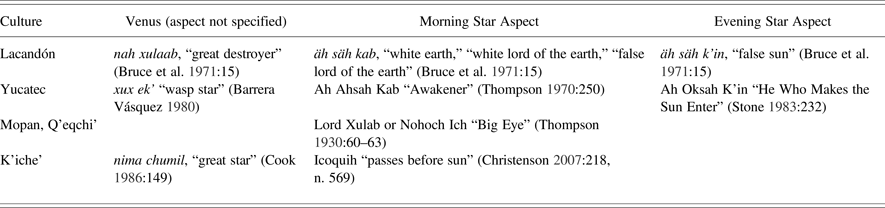
The War Twins are identified explicitly as having celestial connections to the morning and evening stars but, like the Hero Twins, the narratives surrounding the twins focus primarily on their exploits in the earthly realm. Nevertheless, the Zuni used the morning and evening star to herald specific ceremonies and agricultural events, as was also the case for the prehispanic Maya. Their names are reminiscent of those given to the different aspects of Venus by the Maya (compare to Table 2)—the evening star is “the one that follows the sun,” and the morning star is “big/great star” (Young and Williamson Reference Young, Williamson and Williamson1981:185–186) or “the one that goes before the sun” (Cushing Reference Cushing1896:381, Reference Cushing1901:378–379). Various planets play the role of morning and evening star for the Zuni, including Venus, Mars, and Jupiter (Bunzel Reference Bunzel1932:487; Stevenson Reference Stevenson1904:26).
Names for Venus in contemporary Maya cultures

Whereas the Hero Twins are recognized specifically for their role as hunters, the War Twins serve as patrons of the Zuni war societies. In this respect, they have more in common with the warrior aspect of Venus highlighted in the Maya codices, as seen in the planet's morning and evening star phases. In addition to their war associations, however, the Zuni War Twins also play an important role in relation to the rains, as suggested by the fact that their primary symbols include the rainbow, lightning arrows, and a cloud shield (Young Reference Young, Williamson and Farrer1992). This role of Venus is emphasized in several places in the Maya codices, specifically in relation to the deities God L and Chaak (see also Šprajc Reference Šprajc1993 for a discussion of connections between Venus and the rainy season in the Maya area).
Another commonality between the Zuni War Gods and the Venus deities in the Maya codices is the role they play in the timing of ceremonies. In this respect, the position of the morning star is especially important for the Zuni (as is likewise emphasized in the Dresden Venus table). Among the Zuni, the rise of the morning star during the winter solstice ceremony (Shalako) was a signal to ignite the New Fire that was lit following the extinguishing of all fires that were kindled during the old year (Bunzel Reference Bunzel1932:536; Stevenson Reference Stevenson1904:130–131), and it served to mark the end of the all-night Shalako ceremony (Stevenson Reference Stevenson1904:249). New Fire ceremonies in Mesoamerica likewise have celestial associations, although not explicitly with Venus (Miller and Taube Reference Miller and Taube1993:87).
The connections seen between warriors, sacrifice, and Venus in Mesoamerican cultures are also evident among the Skidi Pawnee, where a sacrificial ritual to the morning star deity was documented ethnohistorically (Chamberlain Reference Chamberlain1982). The ritual was performed to symbolize the union of Great Star and Bright Star, the morning and evening star aspects of the planets specifically, which led to the creation of the earth and its inhabitants. While the Pawnee mythology does not focus on Hero or War Twins, it does express the duality of the morning and evening star aspects of Venus and the other visible planets.
CONCLUDING THOUGHTS
Much of Maya Venus mythology lies shrouded in the past, although more and more of the stories are being recovered from sources such as the Maya codices and ethnohistoric documents, as well as contemporary mythic narratives and folktales. The dichotomies that are most evident in Mesoamerica are those highlighting the sun and the moon, or Venus and the sun. Nevertheless, the analysis of the Maya codices presented here suggests that, although less prevalent, a morning star/evening star dichotomy was another important consideration for prehispanic Maya cultures, much as it is among the Zuni, Pawnee, and other Native American groups in North America. That the same deity can be seen representing both aspects suggests that figures such as Chaak, God L, and possibly Xiuhtecuhtli may have been visualized as having dual manifestations—one of whom was associated with the eastern sky and the other with the western. This is further suggested by the fact that morning and evening star iconography appears to be distinctive, with the former characterized by particular weapons, specifically an atlatl and darts, and also at times by an association with the sea, whereas evening star deities carry a spear and sometimes a shield and are shown capturing prisoners, who are often shown tied to the spear. They also usually wear black body paint, indicating their association with the west.
The possibility that God M may have Venus evening star associations is of special interest, as is the possibility that he plays a role like that of Xiuhtecuhtli’s in certain respects relating to his associations with fire, hearths, and calendrical cycles. Despite many decades of study, God M's role in the Maya codices remains poorly defined, especially his mythological associations. By comparing the contexts in which God M and Xiuhtecuhtli appear in both the Maya and highland Mexican screenfold traditions, it may be possible to form a better understanding of what God M represented for the Late Postclassic Maya and to uncover the underlying mythic narratives with which he was associated.
RESUMEN
Este estudio amplía nuestro entendimiento de la mitología acerca de las apariciones y desapariciones de Venus en el cielo y el papel que los aspectos del lucero del alba y el lucero vespertino desempeñaron en los textos adivinatorios y astronómicos de la cultura maya prehispánica. El aspecto del lucero del alba de Venus ha sido reconocido hace muchos años en las representaciones visuales de la tabla de Venus en el Códice de Dresden (en las páginas 24 y 46 á 50), donde cinco manifestaciones separadas del planeta están representadas como dioses de la guerra, correspondientes a los cinco patrones que demuestra el lucero del alba en el cielo durante un período de 2.920 días.
Otros aspectos de Venus conocidos en las fuentes etnográficas y etnohistóricos corresponden a Xulab, una figura con una barba, y Wuk Sip, ambos como patrones de las animales silvestres, así como deidades de la caza. Varias representaciones de estas figuras han sido identificadas recientemente en los almanaques de caza del Códice de Madrid, donde muestran los avíos de Venus. Otras manifestaciones de Venus en los códices mayas incluyen la deidad de la lluvia Chaak, que asume el papel del lucero del alba además del lucero vespertino en la tabla estacional del Códice de Dresden (en las páginas 65 á 69) y posiblemente la deidad mercantil dios M, que también podría haber tenido asociaciones con Venus en su aspect del lucero vespertino en ciertas ocasiones.
Las correspondencias significativas también existen entre los Gemelos Héroes mayas del Popol Vuh y los Gemelos de la Guerra destacados en las narrativas de creación de la cultura zuni del sudoeste de los Estados Unidos, quienes corresponden a Venus en ambos aspectos—el lucero del alba y el lucero vespertino. Los papeles celestes de ambos grupos de gemelos serán explorados para comprender mejor sus funciones en los contextos ceremoniales y calendáricos.
ACKNOWLEDGMENTS
I appreciate the invitation from Anne Dowd to participate in the special section of the journal on “Mesoamerican Cultural Astronomy and the Calendar” and her editorial assistance and helpful comments on an earlier draft of my manuscript, as well as those of an anonymous reviewer. Many of the ideas expressed in my article were developed in close association with Christine Hernández during the writing of our monograph Re-creating Primordial Time: Foundation Rituals and Mythology in the Postclassic Maya Codices. Our collaboration has been very fruitful over the years, as have been my collaborative projects with Tony Aveni, who has been a mentor, friend, and close colleague. I dedicate this article to him.