INTRODUCTION (BY A.J.N.W. PRAG)
In recent years the study of human remains has become an increasingly contentious subject, but chiefly among those who perhaps do not appreciate their full potential as a source for the proper understanding of mankind. Facial reconstruction – putting the flesh back onto the dry bones of a skull – will at the very least provide a vehicle for conveying the appearance, and with it some of the life story, of a person from the past in a form that is quickly and easily comprehended by the ‘layman’ – the person without the necessary specialised training to interpret the osteological and archaeological evidence. Reconstructions of various qualities have become a commonplace in museums, and that must be a good thing. However, it is not a short cut to a quick answer. Ever since we began to develop and refine the technique in Manchester I have believed that, properly researched and properly used, facial reconstruction could also be employed to apply a new set of skills to archaeological problems which other methods did not reach, and could in turn stimulate further research and the application of additional and sometimes unanticipated techniques (Prag and Neave 1997, 10–11).
At Vergina the reconstruction of the skull from Tomb II drew attention to a hitherto unnoticed facial injury which became a cornerstone of the identification of the dead man as Philip II, and thus of Vergina as ancient Aigai (e.g. Prag and Neave 1997, ch. 4; most recently, e.g. Musgrave and Prag 2011). The reconstruction of seven faces from Grave Circle B at Mycenae provided the basis for a kinship study that was then confirmed by an examination of the DNA (itself a pioneering project) (Bouwman et al. 2008; Bouwman et al. 2009; Chilvers et al. 2008; Prag et al. 1995). This in turn led to the proposal to study and reconstruct the two ‘missing’ individuals from Shaft Grave VI in Grave Circle A, a project that rapidly grew into a complete restudy of all the available human remains from Schliemann's excavations at Mycenae. For me the excitement now is that the study of the faces, carried out not in isolation but, as far as the remains allow, in conjunction with an analysis of the anatomy of the whole person, has led to a reassessment of many different aspects of the story of the Grave Circle: the excavations of 1876–7; the relationship between Schliemann and Stamatakis and a proper appreciation of Stamatakis' contribution to the original excavation; the lifestyle, status and relationships of the dead; and the external relations of Mycenae with other centres of the Aegean Bronze Age.
This article is the final part of the series of ‘Mycenae Revisited’ in which we describe this work. From the first we promised five articles, of which Part 4 was to be a study of the ‘mummy’ from Shaft Grave V (Papazoglou-Manioudaki et al. 2009, 234; 2010, 157). However, the detailed study of the remains from Grave V and of the accounts of their excavation and transfer to Athens confirmed what many already suspected, that the term ‘mummy’ was a misnomer, while the bones associated with the plaster casing later described as containing it appear to have become separated from the casing and either lost or mislaid (Papazoglou-Manioudaki et al. 2010, 164–6, 213–14; see further below). Like the human remains from Grave VI, it is of course always possible that one day they will unexpectedly reappear, but that day has not yet come. Therefore this final article has become number four in the series.
Even so the story is not finished yet: every draft of every part of this series has produced new ideas, and we would be surprised – indeed disappointed – if some of our suggestions did not provoke further comment. For example, we draw some social and political conclusions from the ages and sexes of the individuals buried in the Grave Circle. However, anyone interested in this material faces two main problems: first, its incompleteness and poor state of preservation; and second, the tools currently available to age it, principally macroscopic assessment of dental attrition, cranial suture fusion, and signs of skeletal wear and tear.
It was perhaps to be expected that in the hands of a forward-looking osteologist what began as a relatively straightforward anatomical and osteological reassessment should now lead to isotope ratio analysis as part of a widening study of the origins and movement of people in the Argolid and beyond during the disturbed period of the Middle Bronze Age/Late Bronze Age transition. Nonetheless when we started reconstructing faces some thirty-odd years ago I would not have dared hope that it could lead to detailed, thoughtful reconsideration of the world of the Shaft Graves of the kind that Dr Dickinson has undertaken. It is very exciting – and I am deeply grateful to him for taking us seriously, and for appreciating the wider potential of this evidence. He read a draft of the very first version of ‘Mycenae Revisited’ and suggested that someone should use these new data to reconsider the historical background, thereby unwittingly offering himself up as the natural candidate for the task. All this has been a team effort and none of us could have worked without the others nor without the help of those other individuals and bodies named in our earlier articles: my gratitude of course extends to my other colleagues all through this project, particularly to Dr Jonathan Musgrave, who has read through several drafts of this final article, but above all to Dr Papazoglou-Manioudaki for having the vision to see what could be done with those bones that she had found ‘in the wrong storeroom’, for her enthusiasm and commitment to push it through despite innumerable other calls on her time and despite the problems that have afflicted Greece and the Archaeological Service as this article was being put together, and for her continuing welcome and hospitality at the National Archaeological Museum, Athens. We have indeed come a long way from the scepticism and the charges of publicity-seeking that greeted facial reconstruction thirty years ago. But then that is all part of the story of Schliemann and Mycenae.
THE VALUE OF STAMATAKIS' REPORTS AS COMPARED WITH SCHLIEMANN'S ACCOUNT (BY O.T.P.K. DICKINSONFootnote 1 WITH LENA PAPAZOGLOU-MANIOUDAKI)
It cannot often happen that, almost a century and a quarter after the original excavation and publication of a site of great significance, important new data should become available. But this is undoubtedly the case with Grave Circle A at Mycenae. The series of events which led to a thorough re-examination of the skeletal material from Circle A has been described by Professor Prag in Papazoglou-Manioudaki et al. 2009, 234–5. The rediscovery of the Grave VI bones, the publication of plans and details of the grave, and the study of the bones of the burials, the best preserved from Circle A (Papazoglou-Manioudaki et al. 2009), would constitute a valuable enough contribution on their own, but to have a full account of all the stored bone material attributed to Graves III–V, and plans of the position of the burials and at least of some major finds in all the graves, together with many other previously unknown details (Papazoglou-Manioudaki et al. 2010), can only be described as priceless.Footnote 2
This new documentation derives from the reports of Panayiotis Stamatakis, a senior member of the Archaeological Service who was appointed by the Archaeological Society to act as its representative at Schliemann's excavations. For too long unjustly ignored or dismissed, he is now conclusively demonstrated to have been far closer to the modern ideal of an archaeologist than Schliemann himself. This might already have been suspected from his attempts to persuade Schliemann that all remains of antiquity deserved equal care (Dickinson 1976, 45). There is also an indication that he had a better eye for style than Schliemann, in his recognition that his finds in what is now known to be a rich Mycenaean chamber tomb at Spata were related to those in the Shaft Graves (see Papazoglou-Manioudaki et al. 2009, 235), an interpretation that Schliemann himself vigorously but erroneously disputed (1880, xli–xlviii, especially xlv, xlvii).
Now we can see that Stamatakis was also aware of the potential value of detailed documentation. This was remarkable for the period, when even trained scholars were most concerned with finding portable art works and antiquities of historical significance, and rarely gave more than a very summary account of the setting in which they found them (see Daniel 1975, ch. 5, especially 152–9, 161–2 on activities in Mesopotamia and Egypt). Schliemann himself expressed such hopes at the end of a letter to The Times about his investigations at Tiryns: ‘I confidently hope to find in Mycenae important inscriptions and more of such sculpture as the two lions above the entrance gate’ (The Times, 11 September, 1876, p. 11; these words do not appear in the version of this letter published as ch. 1 of Schliemann 1880).
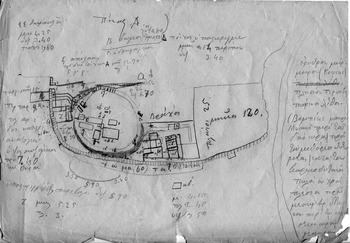
Schliemann had not excavated graves before, and it is hardly surprising that his approach was fairly rough and ready, concerned essentially with clearing them and taking note of the more significant finds. In this respect he was no different from many other excavators, who did not consider it important to give an account of the layout of finds in a grave or of associations of finds with a particular burial if there was more than one. But Stamatakis clearly had other ideas. He methodically numbered the burials in order of discovery, including those found outside Graves II and III, and noted the position of many significant finds within the graves and often their association with particular burials. To illustrate his reports to the Archaeological Society he produced plans of Graves I–V which are admittedly schematic, but are clearly based on notes that he made during excavation. When he returned in 1877 he also produced a rough drawing of the whole Grave Circle and the surrounding area (Fig. 1). It forms a separate page in his report to the Archaeological Society on his excavations from 10 November 1877 to 15 January 1878 (the first page of the report is illustrated in Papazoglou-Manioudaki et al. 2009, 237 fig. 3). Marked ‘Pinax A’ in ink but otherwise drawn in pencil, it shows the Lion Gate, the Granary, the Grave Circle and its six tombs, the House of the Warrior Vase, a wall of the South House and part of the Ramp House. After giving a detailed description of Grave VI Stamatakis' report continues with an account of the area around the graves. Some features and houses are identified by Greek letters on the drawing and he refers to them in his text. The drawing may have been intended for the final publication of Grave VI which he never realised.
Plan of the Shaft Grave area from Stamatakis' original report: the Granary, the House of the Warrior Vase and part of the Ramp House are clearly visible. The Greek letters refer to descriptions in his final report.

However schematic, his plans are extremely welcome, for they offer details that students of the Shaft Graves had never expected to know. For example, Stamatakis' plan of Grave IV (Papazoglou-Manioudaki et al. 2010, 162, fig. 6) clears up the problem of where the pair of burials laid out north–south were placed in relation to the three laid out east–west. Neither of the previously favoured solutions, putting the pair of burials to the north or south of the others (Graziadio 1991, 436, n. 260), proves to be correct; Stamatakis shows them to the west.
Such a detail simply fills out Schliemann's account, but Stamatakis' reports flatly disagree with his statements at several other points. Stamatakis reports four burials in Grave I, not three as Schliemann states, and two burials in Grave II, not one. He also states that there were two burials in the earth over each of Graves II and III (Papazoglou-Manioudaki et al. 2010, 159–60), each with associated vases, while Schliemann simply mentions an unspecified number of bodies over Grave III, with five vases (1880, 162; ‘many’ in Calder and Traill 1986, 195). Further, Stamatakis' account of which burials in Grave IV wore which masks is quite different from Schliemann's (1880, 219–22), as has already been noted (Papazoglou-Manioudaki et al. 2010, 162; see further below), and Schliemann states that the three burials in Grave V were laid out east–west, side by side (1880, 295), while Stamatakis shows the southernmost burial as laid out north–south (Papazoglou-Manioudaki et al. 2010, 164, fig. 10). There are further disagreements on less significant matters, e.g. the position of certain finds within Graves III and IV, and the attribution of the tiny gold oinochoe (National Archaeological Museum, Athens [hereafter NAM] inv. no. 74). Schliemann illustrates it as from Grave IV (1880, 232, fig. 341), but Karo attributed it to Grave III, as its NAM catalogue number, in sequence with those of other miniature gold vessels from Grave III, would suggest. Stamatakis confirms this, stating quite clearly that it was found in Grave III with the other miniature vessels, all in association with Burial M (Papazoglou-Manioudaki et al. 2010, 160–1).
As Traill points out in relation to another vessel (Calder and Traill 1986, 226 n. 249; but in this case Schliemann was right to state that it was from Grave III, see further below), it is easy to see how Schliemann could have made such a mistake, since work finished in Grave III and began in Grave IV on the same day. But it does suggest that Schliemann was capable of making mistakes when under pressure, as he is likely to have been by this time. His remark in a letter of 24 November to Müller, ‘I write you this in the midst of a great turmoil’ (Meyer 1962, 93), is very relevant here. The mass of data to be absorbed was becoming enormous and he had many other things on his mind apart from continuing the excavation in worsening weather with workmen harder to find, such as making a record of the results, listing and organising the photography and storage of finds, conferring with Stamatakis about such matters, dealing with the Ministry of Public Instruction in Athens, the nomarch of the Argolid, and serious visitors, sending telegrams and writing letters to The Times and private correspondents like Max Müller, etc. etc.
At least one clear example of a lapse in memory can be identified, in the Tagebuch entry for 28 November concerning the resumption of excavation in Grave IV; there had been a two-day break while waiting for the arrival of assistants from Athens, as insisted upon by the nomarch (Meyer 1962, 93). Schliemann states that the bones of ‘4 more persons, thus in all 6’ were found, and thinks at least two must be women, even identifying one of the masks as that of an old woman (Calder and Traill 1986, 202). However, he had already corrected this by the time he wrote a letter to The Times describing the excavation of Grave IV, in which he reports five, thus agreeing with Stamatakis' plan, and now identifying all as men (Calder and Traill 1986, 249, cf. 131).
But several of the disagreements listed above are more fundamental, and they require more explanation than a simple confusion over the source of an item or a lapse in memory. One is in fact ready to hand, but to accept it requires a considerable reappraisal of Schliemann's role in the excavation of the graves. Briefly, Schliemann's account has led all who have written about him or the Shaft Graves, including his critics, to assume that he was personally involved throughout. The language that he uses in his letters to Max Müller and The Times and his book, which was closely based on the Times letters, contributes very largely to this impression. In particular, he constantly writes ‘I found’ or something similar, though he quite often speaks of objects or features that ‘was/were found’. This need not be taken absolutely literally, that he always excavated the item(s) referred to with his own hands, although he claimed exactly that of himself and his wife in a letter to The Times dated 25 November, so written in the enforced break in excavation. In this he stated that his method was to have the workmen dig down to within a foot of the layer of pebbles which covered the burials, and then ‘Mrs. Schliemann and I – we have to do the work ourselves’, used knives to uncover and remove the finds (Calder and Traill 1986, 249). In his book, however, as Traill has noted (Calder and Traill 1986, 131), he excises this reference to himself and his wife, and in the preceding sentence replaces ‘I have merely to direct my workmen’, the wording of the letter, with ‘we have merely to direct our labourers’ in the book. Either way, this is the only place where he gives any indication that he had any assistance in the excavation; the general impression given by his phraseology is that the excavation of each tomb was conducted under his close personal supervision, and that many items were retrieved by his own hand.
Certainly, his accounts in the Tagebuch of the excavation of Graves I and III, and the beginning of work on Grave IV, give a strong impression of personal involvement, with many circumstantial details (Calder and Traill 1986, 191, 193–4, 199–200), and must come the closest to a primary record of his impressions. Yet even here there are signs of later ‘editing’: he made two changes to his original comment on the burials in III (Calder and Traill 1986, 199, see 224, nn. 239–40), to fit what the excavation went on to reveal and his own change of mind about the sex of the burials. This gives the impression that its excavation was completed in one day, whereas in fact it took two, as is clear from his letter of 24 November to Max Müller (Meyer 1962, 92), where he speaks of the bodies of a man and a woman being found on the first day, as in his original text in the Tagebuch.
On the other hand, his extremely terse comments in the Tagebuch on Grave II (Calder and Traill 1986, 198–9), listing only a few major finds, present a remarkable contrast with these circumstantial accounts, and could easily be interpreted as notes from information given by someone else. Yet in his letter to The Times and his book (Calder and Traill 1986, 253, slightly altered and expanded in Schliemann 1880, 291–3) he gives a detailed and circumstantial account of the grave, which nevertheless speaks solely of a single burial, thus completely overlooking the second burial, unaccompanied by goods, that Stamatakis recorded. Similarly, his comments on the last finds from Grave I (Calder and Traill 1986, 195, ‘the 2nd tomb’), which included the Late Mycenaean figurines whose presence has always been a puzzle, are unconsciously revealing, for the figurines are reported by Stamatakis to have been found in association with the northernmost burial, Δ (I am grateful to Dr Papazoglou-Manioudaki for this information). That it was designated Δ indicates that it was the fourth, and so last, to be excavated in the grave, which Schliemann surely failed to mention because he did not observe the final clearing of the grave. In fact, his Tagebuch entry suggests that at this time he was paying much more attention to the clearing of the strata below the level on which the stelae were erected, on which he makes interesting comments that surely represent personal observation (Calder and Traill 1986, 194). His account of Grave I is clearly incomplete, therefore, while that of Grave II seems likely to be a fabrication intended to give the impression that he had been personally involved.
In each of these cases Stamatakis was clearly present throughout the excavation of the grave, effectively, and the degree of detail in his notes strongly supports the supposition that this was the case with all the graves. For Grave V we have independent confirmation in a report in the local newspaper Argolis, which speaks of Schliemann, Stamatakis and Phintiklis, the vice-president of the Archaeological Society, one of those who had come to assist Schliemann, all excavating in the grave at the same time, using knives (Calder and Traill 1986, 233). Phintiklis could well have played a role in the excavation of Grave IV also, since it was on his arrival that excavation was resumed. In his sole reference to him in his book, Schliemann speaks of his having come simply to assist him in ‘guarding the treasures’ (1880, 214), but one cannot help suspecting that, given Schliemann's notorious smuggling of ‘Priam's Treasure’ out of Turkey and the 1874 trial in Athens that ensued, in the eyes of the nomarch Schliemann was one of those against whom the treasures, the property of the Greek state, were to be guarded.
In any case, the principal point is that Schliemann makes no reference at all to Stamatakis' involvement in the excavation of Grave V, any more than of the graves previously cleared. He had ceased to write in the Tagebuch by this point, and for his account of Grave V we are entirely dependent on his letters to The Times, whose text is repeated almost word for word in ch. IX of his book. Again, he gives the impression of close personal involvement with the excavation of both the northern and southern burials in the grave. His concern with recording the appearance of the northern burial, which had survived in an unusually well-preserved state, and with conserving the remains does suggest that he played a major personal role in this, but one may well wonder how much of the detail that he records of the finds with and near this and the other burials comes from his own notes, and how much from the observations of Phintiklis and Stamatakis.
It is evident that Schliemann was determined to write Stamatakis out of the story and keep himself at centre stage the whole time. This would have been entirely in keeping with his previous behaviour over the excavations at Troy, in which he made no attempt to acknowledge the major role played by Frank Calvert, whom he barely mentions, although Calvert was the one who had demonstrated to him that Hisarlık was the most likely site for Troy and gave him valuable advice during the excavation, derived from his own considerable experience of excavating at Hisarlık and other sites in the Troad (Allen 1999, chs. 7–9). But there is more to it than Schliemann's determination to hog the limelight. He does not name Stamatakis anywhere in his account of his Mycenae excavation, though he makes a veiled and hostile reference to him as the ‘delegate of the Greek government’ (1880, 139). He does not even mention that he was the excavator of the Spata tomb whose dating he wrongly criticised in a section at the front of his book, as we have seen. He names him once only, dismissively, as the ‘government clerk’ who excavated the ‘Golden Treasure’ after Schliemann had left Mycenae (1880, 352).
In fact, there is plenty of evidence that a strong mutual antagonism developed between the two men from the start of the excavation (Dickinson 1976, 161–2, cf. Meyer 1962, 90). Stamatakis was an ephor in the Archaeological Service, seconded to the Archaeological Society for work on their behalf (not, as I erroneously stated in Dickinson 2005, 305, Director of Antiquities), and it was his duty to protect the archaeological remains and supervise Schliemann. He might well have considered Schliemann untrustworthy, following his wholly illegal test excavations at Mycenae in 1874, conducted under false pretences (as Schliemann admitted in a letter to Müller: Meyer 1962, 86). An interesting view of Stamatakis is given by Dr A. Milchhoeffer, a member of the Deutsches Archäologisches Institut at Athens, who visited Mycenae on 16 November, and noted the open distrust and near-contempt that Stamatakis showed for Schliemann (Calder and Traill 1986, 222–3, n. 214). He later got to know Stamatakis and described him as somewhat rigid, but honourable and honest, and he clearly felt that the reasons Stamatakis gave for his behaviour towards Schliemann, not specified by Milchhoeffer, were justified.
I have no doubt that these related to Schliemann's continual attempts to exceed the conditions laid down in the permit and violent displays of rage when Stamatakis tried to insist on his adhering to these conditions and to protect remains of later antiquity (Dickinson 1976, 161–2; relevant documents are cited extensively in Ludwig 1931, 201–7). One feels that in Stamatakis Schliemann may have met his match. Calvert had no authority to control Schliemann's activities at Troy, and was conciliatory; Stamatakis did have some authority, and had no reason to be conciliatory. He evidently expressed himself forcibly on matters on which the permit imposed limits, such as the size of workforce and the number of excavation areas, considering that one should be appropriate for the work of a ‘serious scientist’ (I am grateful to Dr Papazoglou-Manioudaki for informing me of this comment, written in his unpublished diary). This would no doubt have particularly infuriated Schliemann, who had already shown at Troy a determination to do things his own way and an unwillingness to take advice, let alone instruction, even from persons who had much greater experience of ancient sites than Schliemann himself. While he seems to have remained rather in awe of university-based professors and scholars like Max Müller, trained in the study of the classical sources, and he did show some respect for Calvert's knowledge and experience, he does not seem to have felt an equivalent respect for holders of official posts in an archaeological service like Stamatakis. In general, his approach to government officials seems to have been to ignore or circumvent any controls that they attempted to impose, although evidently he did not dare to defy the ‘governor’ (nomarch) of the Argolid, who was acting on the orders of the Greek government.
In the circumstances, while Schliemann clearly felt himself in no position to prevent Stamatakis participating in the excavation of the graves, he was certainly not going to give him any credit for it, and it seems very unlikely that he would have discussed the excavation with him or consulted him more than occasionally for information that he did not have. Stamatakis, for his part, is very unlikely to have gone out of his way to inform Schliemann of his own observations if he did not ask for them. He may not have known that Schliemann's letters to The Times included erroneous statements and passed over his involvement in the excavation of the graves completely, though he will surely have discovered this when various editions of Schliemann's books began to appear from 1878 onwards. As a further insight into Schliemann's shamelessly unethical behaviour, it may be noted that later, when it suited his purpose, he would refer to Stamatakis (now dead) as a ‘distinguished archaeologist’ and claim his support for Schliemann's theory that the burials were simultaneous (1885, liv), asserting that all his statements were corroborated by Stamatakis' diary. Of course, this was to ignore Stamatakis' excavation of a sixth shaft grave which had clearly been used on two occasions.
It may be speculated that the greater amount of detail that Schliemann presents in his published accounts of Graves IV and V, particularly Grave V, could be due to the influence of Phintiklis, who could have seen the point of producing a detailed account, as the graves' contents became so strikingly rich and impressive, and have ensured that for Grave V, in which they all excavated together, information was shared. Schliemann could have been ready to accept this, seeing that it would enhance his account, once he began to develop the theory that Grave V was the burial place of Agamemnon. Earlier, he had believed this to be Grave IV, as indicated by his letter to Müller dated 27 November (Meyer 1962, 93, quoted by Müller in a letter to The Times published on 13 December). As this letter makes clear, Schliemann was at that point ready to believe that not only Agamemnon but his charioteer Eurymedon and Cassandra, whose graves Pausanias was shown at Mycenae (2.16.5), were buried in Grave IV. But his account of the finds in this grave remains largely unspecific, where it does not actually clash with Stamatakis', and he abandoned his original idea that it contained the burials of both men and women. Probably this was because he had decided that Cassandra was buried in Grave III, though he was not explicit about this; but it is implied by his linking of evidence that a child was buried in that grave with the implausible tradition cited by Pausanias, that Cassandra bore Agamemnon twin children, who were murdered by Aegisthus and whose grave Pausanias was also shown at Mycenae, though apparently this was not the same grave as Cassandra's, as Schliemann seems to have assumed (1880, 198–9).
As I have commented elsewhere (Dickinson 1976, 164), Schliemann left Mycenae in an evident state of angry frustration, impulsively telling Müller that he would never excavate in Greece again and vilifying Stamatakis to him (Meyer 1962, 94–5). His publication of the Mycenae excavation was admirably swift, but consisted largely of somewhat revised and expanded versions of his letters to The Times. Its principal virtues are the gathering together of these, so giving a fairly detailed account of the excavation as a whole, and the provision of a considerable amount of information about individual finds, a very generous quantity of illustrations, and some appendices on analyses of metal and (appearing first in the New York edition of Schliemann 1880) the spectacular decoration of the Lion Hunt Dagger, revealed by cleaning. But it did not include a fully developed version of his theory that reconciled his discoveries with the text of Pausanias, nor even identify which of the burials he thought to be Agamemnon (Dickinson 2005, 306); it made no reference to Stamatakis' discovery of a sixth shaft grave, barely a year later; and its account of the arrangements in the graves, it is now clear, was not simply vague and unspecific in general, but incorrect in important details.
It can never be known for certain why Schliemann gave an erroneous account. That he did so deliberately seems unlikely, for he had no motive to alter information that he had or was given, since his theory that he had found the burials of Agamemnon and his retinue did not depend on details like the numbers of burials in the graves or their orientation. It seems more likely that he got his information piecemeal, only partly from personal observation, did not always remember it correctly, and when he came to write an account simply put down what seemed most likely to him, because it fitted his theory better or seemed a neater arrangement. Thus, he could have stated that the three burials in Grave V were laid out side by side because this made it easier to believe that they were simultaneous, and he may have made both the north–south burials in Grave IV mask-wearers because it seemed a neater arrangement; also his account of the disposition of the large copper vessels in IV (Schliemann 1880, 273–4) seems to make their distribution much neater than it was, to judge from Stamatakis' plan, which groups them in the northeast and southwest corners of the grave (Papazoglou-Manioudaki et al. 2010, 162, fig. 6; I am grateful to Dr Papazoglou-Manioudaki for further information on this). The general impression given by his account, as well as his comments in letters to Müller, is that he was far more interested in the items themselves, especially if they were of gold, than in their exact position within the graves, about which he is rarely specific except in his account of Grave V.
Reading (rather belatedly, to my regret) Allen's account of Schliemann's activities at Troy in the early 1870s and his dealings with Calvert is an enlightening if depressing experience. From the start, in his obsessive drive for fame and scholarly recognition, and also eagerness to possess spectacular antiquities, he was perfectly prepared to lie and even cheat on occasion. Any form of opposition, including challenges to his account of events and reasoned criticisms of his theories, was likely to send him into a rage. Hence, none of his behaviour at Mycenae should come as a surprise. But I do not think he was guilty of fraud, as Calder and Traill have suggested, by inserting among the contents of the graves either finds made elsewhere at Mycenae and held back (as we know that he held back an item found earlier at least once at Troy: Allen 1999, 146–7, 151) or objects which he had purchased, or even had had forged to his order, as argued specifically in the case of the ‘face of Agamemnon’ mask. Quite apart from the general implausibilities involved in these theories (see Dickinson 2005), what we now know about the degree of supervision that Stamatakis exercised and the care that he took in keeping records must make it extraordinarily unlikely that, even if he had wanted to – and there is no clear indication that he did – Schliemann could have got away with anything like this unnoticed.
SUMMARY OF THE INFORMATION NOW AVAILABLE ON THE BURIALS IN GRAVES I–VI (BY O.T.P.K. DICKINSON, LENA PAPAZOGLOU-MANIOUDAKI AND A. NAFPLIOTI)
Until now no one has found much reason to dispute Schliemann's account of the number of burials in the graves, although it has been generally agreed that the burials in Graves I and III, and two of those in IV, were women, and the ‘factoid’ that skeletal remains of two children were found in III has become widely current. Kilian-Dirlmeier has come closest to expressing doubt, in suggesting that in Graves IV and V the remains of older burials, moved aside, had decayed so much that they went unnoticed (Kilian-Dirlmeier 1986, 176–7). Whether any significant skeletal remains would have escaped Stamatakis' notice may be considered questionable, since he did observe the poorly preserved remains of several of the Grave IV burials, but it is possible that what he interpreted as single, very poorly preserved burials, O and P, actually included parts of more than one skeleton. However, as will be seen below, the largest quantity of remains that might represent ‘extra’ burials comes from Grave V.
The point has some significance, for reconstructions of the sequence of burials and their distribution between phases by Kilian-Dirlmeier, Dietz and Graziadio, and discussions of the development of social hierarchy at Mycenae and the relationship between Grave Circles B and A, have essentially taken Schliemann's reports of the number of burials to be accurate. For this reason alone, as well as in belated justice to his contribution to the excavation and preservation of the finds, the full publication of Stamatakis' reports is much to be desired.
Combining the information from his reports that we have received so far with the new evidence from the study of the skeletal material presents some problems, because no boxes of bones explicitly attributed to Graves I and II have been discovered. Since it is clear that the material from different graves has become mixed in the boxes (Papazoglou-Manioudaki et al. 2010, 168), it seems quite possible that the I and II bones, noted by Schliemann as poorly preserved (Papazoglou-Manioudaki et al. 2010, 159), or some of them, are among those catalogued as from other graves, especially V, and there is the further possibility that the remains of the burials found above Graves II and III may have got into the boxes. But these, and the bones from Graves I and II, may simply be missing, as the so-called ‘mummy’ from Grave V must be, since what has been recovered bears no resemblance to what Schliemann describes (Papazoglou-Manioudaki et al. 2010, 165–6, 212–13). It is also worth noting that many of Nafplioti and Musgrave's identifications of skulls and skeletal remains with the burials numbered by Stamatakis must be considered plausible inferences rather than certainties, although there is useful supplementary evidence for Burials M, Π, Σ, Τ, ϒ, Χ and Ψ in Stamatakis' reports.
Below, we present a summary that combines data from the reports of Stamatakis and Schliemann with the information derived from Nafplioti and Musgrave's study, and offer comments on some salient features. It is unlikely that this will be improved on significantly in the future, but it needs to be stressed again how far from certain many statements are. In the discussion of the human skeletal remains, particularly, the inherent limitations deriving from early excavation practice need to be borne in mind, as well as the uncertainties referred to in the previous paragraph: the paucity of detailed contextual information, the lack of technical drawings and excavation photographs, the primitive standards of recovery, and the skeletal incompleteness and poor bone condition (see further Papazoglou-Manioudaki et al. 2010, 166–8). The bracketed comments at the beginning of the account of each grave represent Dr Nafplioti's final views on the evidence.
Grave I
(None of the Grave Circle A skeletal material currently present in the Apotheke of the Prehistoric Collection at the National Archaeological Museum, Athens can be confidently associated with Grave I.)
As noted, Schliemann was not aware of the existence of a fourth body in this grave, but he gave a detailed account of the distribution of items of gold plate on the three bodies that he did know about in a letter to Müller, passed on to The Times and published on 30 November (part of this appears in Meyer 1962, 91–2, but not the section referred to in Dickinson 1977, 50). In describing the first body uncovered, at the south end of the grave, Schliemann stated that ‘5 immense gold leaves’ covered the body, and that five gold ‘crosses’, each made up of four leaves, were found upon these, a detail not found in his letter to The Times that covered Grave I (Calder and Traill 1986, 245). He stated in a later letter, published on a different page of the same Times issue, that two more bodies were covered with precisely the same number of leaves and crosses. Although he does not state that these ornaments were laid out down the bodies (as claimed in Dickinson 1977, 50), it is difficult to see how else they could be arranged. This account is effectively corroborated by Stamatakis' report of ‘gold foil in the shape of laurel leaves’ and ‘gold foil larger in the middle with narrow ends’ being found on all three of the burials that he numbered A–Γ (Dr Papazoglou-Manioudaki provided this information, including the translated quotations). Stamatakis also reported that the glass ‘Nuzi beads’ found in this tomb were with the southernmost burial, A, while attributing the pottery, shown on his plan as in the northeast corner (Papazoglou-Manioudaki et al. 2010, 159, fig. 1), and the gold-covered lip of a silver cup (NAM inv. no. 213) to the northernmost, Δ.
This is very interesting, because the bulk of the pottery is Late Helladic IIA, according to Mountjoy (1999, 87 [nos. 23–8], 92 [no. 47] and 95 [no. 64]; but in 1986, 12, she dated NAM inv. nos. 190–2 to Late Helladic I, a preferable dating for 190 and 192 in Dickinson's view). This is also likely to be the date of the ‘Nuzi beads’, for the other contexts in which these and other clearly Near Eastern forms of bead, products of the glass industry of Nuzi in Mesopotamia, are found are Late Helladic IIA at the earliest, especially Mycenae Tomb 516 (erroneously cited as Tomb 515 in Dickinson 1977, 50) and Kakovatos Tomb A (Dickinson here wishes to express indebtedness to Mrs H. Hughes-Brock for much helpful information and bibliography on these beads; for the Nuzi glass industry see a summary in Moorey 1994, 196–7). Thus at both ends of the grave there are items belonging to the very latest phase of the circle's use as a burial ground. Taken together with the remarkable fact that Burials A–Γ were apparently covered with almost identical sets of gold ornaments, this suggests that the bodies and goods in the grave may have been rearranged on the occasion of the final burial(s). Such rearrangements clearly took place in many of the later graves of Circle B, also in Grave VI. This should serve as a salutary reminder that the position in which grave-goods were found during excavation need have little to do with where they were placed during the original burial rite.
As noted above, Stamatakis recorded that two Late Mycenaean Psi figurines were found near Burial Δ, and thus would have been among the last finds, as Schliemann's reference to them indicates (Calder and Traill 1986, 195). Stamatakis' report should thus acquit Schliemann of the charge of fraudulently inserting them among the finds, as Calder and Traill have suggested (1986, 222, n. 212). It is in fact clear from other comments by Schliemann (1880, 154, 161, 163) that material of later date, including such figurines, which he called Hera or Juno idols, had penetrated the lower strata, even below the stelae that stood above Grave III. This could well have happened in the course of the large-scale refurbishment of the circle in the mid-thirteenth century bc, and it is possible that figurines were deliberately placed as propitiatory offerings to the dead during that operation, but Schliemann's determination to reach and clear the graves resulted in the loss of most information about the strata above them.
Grave II
(None of the Grave Circle A skeletal material currently present in the Apotheke of the Prehistoric Collection at the National Archaeological Museum, Athens can be confidently associated with Grave II.)
As noted above, Stamatakis reported two burials, one without any associated goods, both shown on his plan (Papazoglou-Manioudaki et al. 2010, 160, fig. 2) as laid out east–west, and Schliemann's apparently eye-witness account of a single burial must be considered effectively fictional. Its details may nevertheless be mostly correct, but it seems unlikely that the gold item identified as a headband was actually found on the head, a feature not reported from any other male burial, although in the Aigina warrior grave a rather longer headband was found at shoulder level (Kilian-Dirlmeier 1997, 54, pl. 1). This was thought to have been worn on the head, around which it would have been fastened by a cord or similar at the back, and to have been shifted to its present position by the collapse of the roof; it might be better to consider it a clothing ornament, like a gold band of slightly smaller size, though bigger than the Grave II example, found in Grave N (Mylonas 1973, 161). Schliemann may well have added this detail, as he certainly appears to have done with the much more elaborate head-dress NAM inv. no. 1 in Grave III (see below). Unfortunately, Stamatakis records no information relevant to this point.
Grave III
(The human skeletal remains from this grave represent one definite female [probably Stamatakis' Burial M], aged 30–35 years, and one probable male [probably Burial N] and one definite male [probably Burial Λ], aged 35–40 and less than 35 years respectively. Among the unassigned skeletal remains there is a very incomplete sub-adult individual and an incomplete animal scapula.)
Schliemann and Stamatakis are agreed that there were three burials in this grave, and on the likelihood, from the presence of gold plates shaped to cover parts of an infant body, that there was a child buried here. It has been demonstrated that there are only enough plates to cover a single child, front and back (Papazoglou-Manioudaki et al. 2010, 161, figs. 4–5). The quantity of plates may have led Tsountas, the apparent originator of the idea, and many others (most recently Kilian-Dirlmeier 1986, 167 n. 29) to suggest that there were two burials, but there is only one face-piece, to be paired with a blank piece that would cover the back of the head, and so it seems most likely that there was only one child.
It is of great interest that, according to Stamatakis, these plates were found on the body of the central Burial M, identified by Nafplioti and Musgrave with MYC2, III (Papazoglou-Manioudaki et al. 2010, 175–9), which led him to assume that the child's body was laid on top of this burial – its mother? Did they perhaps die at much the same time from some disease? Both were clearly highly important burials, especially the child, which may have been the repository of dynastic hopes, to judge from its being granted the unique honour of being wrapped in gold (a practice for which Dickinson knows of no parallel from within the Aegean or beyond). Burial M's importance is underlined by the mass of valuable goods with which she was provided; according to Stamatakis' description (see Papazoglou-Manioudaki et al. 2010, 160–1), she must have been wearing not only the most massive of all the headbands in the Shaft Graves (NAM inv. no. 3, Dickinson 1977, 74, fig. 9.9), but, apparently fitted in some way to this, seven ‘half-bands’ decorated in precisely the same style (NAM inv. no. 5). These may then, despite previous doubts (Dickinson 1977, 75), have all been attached to a backing of hide, leather, or stiffened cloth to form a gigantic crown, as in the National Museum restoration. The likely size of such an item would suggest that it was only worn on very special occasions. Further, the diadem with blooms attached (NAM inv. no. 1) was laid on the chest of this burial, not around the head of a second burial as Schliemann reports (1880, 184); the silver crook-pin with an attached gold cutout, representing a female figure in full Minoan dress (NAM inv. no. 75), perhaps a goddess, was also associated with Burial M. All this strongly suggests that this woman held a very high rank, which could have been an important priesthood or similar ritual position, given the Minoan ritual associations of the cutout attached to NAM inv. no. 75 and other gold cutouts in the grave (see further below). It is worth noting that strontium isotope ratio (87Sr/86Sr) analysis carried out as part of this project (Nafplioti 2009) and corroborative evidence from further research (Nafplioti 2011) suggest a non-local origin for this individual.
Stamatakis confirms Schliemann's statement that another vase whose attribution has been thought problematic, the gold Vapheio cup decorated with dolphins (NAM inv. no. 73), was from Grave III (Schliemann 1880, 204), although Schliemann appears to attribute it to Grave IV in his Tagebuch entry for 23 November (Calder and Traill 1986, 200 with n. 249). Dickinson's belief that this entry was more reliable (1977, 114, Ch. III [3] n. 2) thus proves to be mistaken. Stamatakis associates the cup with Burial Λ, which was poorly preserved, with a few other finds (Papazoglou-Manioudaki et al. 2010, 160). Schliemann also states in a letter to Müller that both the first two burials were covered by at least 5 kg of gold ornaments (Meyer 1962, 92). Since very large quantities of gold ornaments come from this grave, this certainly sounds plausible; Stamatakis may have concentrated on noting the larger individual finds. Remarkably, the skull and jawbone piece identified as probably from Burial Λ may be classified as certainly male (Papazoglou-Manioudaki et al. 2010, 179), and thus Schliemann's original belief that the first two burials encountered in III, Λ and M, were a man and a woman could well be correct. The skeletal remains thought to belong to the third burial, N, have also been classified as probably male (Papazoglou-Manioudaki et al. 2010, 172–5, MYC1, III).
The abundance of ornaments in the grave that have female associations, judging from the appearances of comparable items in Circle B, and the absence of weapons make these identifications surprising, to say the least, and it should be noted that Nafplioti and Musgrave regard their identifications of groups of bones with Burials Λ and Ν as probable only. Yet, unless these likely male remains actually belong to the two burials reported by Stamatakis as found above Grave III, and the two burials that accompanied M (whose identification with MYC2, III is also probable only) are represented only by the bones not assigned to the three main individuals identified (Papazoglou-Manioudaki et al. 2010, 179–80), it seems hard to question the identification. It is not, in fact, totally unparalleled for males to be buried in the Shaft Graves without weapons: this is true of several of the earliest burials in Circle B, and also of the occupant of Grave K, a burial likely to be of similar date to the earlier Circle A graves, who was apparently a relatively old (c.45?) male (Mylonas 1973, 382). The final burial in Grave Γ, Γ51, is generally agreed to have been an adult male in his prime (28?), but there may be special reasons why he was not provided with weapons (Dickinson 1977, 46). However, neither of these late burials was provided with other rich grave-goods, as Λ and Ν clearly were.
A further reason for suspecting that Burial Λ was male is the association with it of the gold Vapheio cup NAM inv. no. 73. There is a very strong link in the Shaft Graves between gold drinking vessels and male burials. If – and it is a big ‘if’, because of all the uncertainties about the identification of the burials – this identification is accepted, this suggests that it was not an absolute social requirement that high-ranking males be given a warrior persona in death, common though this was for early Mycenaean elite male burials. It was, after all, normal for high-ranking Minoan males of the same period not to be provided with weapons; there are only a very few examples of the provision of ‘warrior’ grave-goods. The best evidence comes from Poros Tombs 1 and 6, in which spearheads, daggers, possible fragments of swords and boar's tusk plates that were presumably helmet-attachments were found (Dimopoulou 1999, 28; cf. Kilian-Dirlmeier 1988, 164–5). As Kilian-Dirlmeier points out (1985, 208), daggers of earlier date were buried quite frequently in the Mesara tombs and others; noteworthy because of their late contexts are a dagger and three spearheads from Mochlos tombs, attributed to MM III by Seager (1912, 23, 37 fig. 31: II.51, 75 fig. 45: XX.10–12). None of these could have accompanied more than one or two burials in each tomb. The absence of weapons accompanying Burials Λ and N might be tentatively interpreted as a sign of emulation of Minoan practice, possibly thought appropriate to the position that the men held in life; they might, for example, have been priests or something similar.
The human remains that could not be associated with the three main groups identified as MYC1–3, III are problematic. There are various possibilities; they could belong to older burials made either in this tomb or in an earlier tomb or tombs destroyed by its construction, or to the burials found above III, or even some of the ‘missing’ burials from Graves I and II (Papazoglou-Manioudaki et al. 2010, 214, referring to the ‘extra’ remains from Grave V, applies equally here). There is no basis for deciding between these possibilities, and more than one could apply.
Grave IV
(The human skeletal remains from Grave IV represent a minimum of three definite adult males and two probable adult females. The three male individuals may be identified as Burial Π [Angel 1973, 384: 27 Myc.], and probably Burials Ξ [Angel 1973, 384: 22 Myc.] and O, who died at the age of 25–35, 30–35 and 17–20 respectively. Of the two individuals tentatively identified as females, one is Burial Σ, aged 20–25, while the second one was 25–35 years old and could not be linked to any particular burial from this grave. There were also a few unassigned human skeletal fragments as well as animal bones.)
Schliemann's final account and Stamatakis' report agree on five as the number of burials in this tomb, but the difference between their accounts of the distribution of gold masks is stark. Schliemann states that the two north–south burials wore the flat masks of the type thought to be earliest (NAM inv. no. 253–4), but thought that they had different faces, perhaps because one was badly damaged, and that one of the east–west burials wore the heavier mask with a more developed face (NAM inv. no. 259), which in his Tagebuch he described as like that of an old woman with broken teeth (Calder and Traill 1986, 202), but in his book as that of an older man. He also places the Lion's Head Rhyton, which he thought to be a mask, near the head of another (Schliemann 1880, 219–22). Stamatakis states that the inner north–south burial, Π, wore mask NAM inv. no. 259, and also a plain gold ‘breastplate’, which Schliemann reports in the Tagebuch as found on the east–west burial with mask NAM inv. no. 259, but more vaguely in his book simply as on one of the two east–west masked burials, counting the Lion's Head Rhyton as a mask (Schliemann 1880, 228). Stamatakis states that the outer north–south burial, O, had no mask, the flat masks were found on the northern and central east–west burials, Σ and P, and the Lion's Head Rhyton was associated with the southern east–west burial, Ξ. The only thing the two accounts have in common is that the two flat masks were found on burials found side by side.
Here, as in other comments on the finds in Grave IV and generally, Stamatakis is much more precise than Schliemann, and his account should be accepted. Schliemann's account, as noted above, is generally rather vague and imprecise, and he often does no more than state that a particular item was found ‘with the five bodies in the sepulchre’ or something similar. In contrast, Stamatakis noted many interesting details (see Papazoglou-Manioudaki et al. 2010, 162–3 for what follows). He placed the Bull's Head Rhyton as well as the Lion's Head Rhyton close to Burial Ξ, indicated by its designation as the first to be excavated in the tomb (Schliemann's account in the Tagebuch agrees with this interpretation, reporting that the Bull's Head Rhyton was one of the first finds [Calder and Traill 1986, 201]). This burial also seems to have worn a gold armband (NAM inv. no. 286, cf. Schliemann 1880, 227 fig. 336), and had a heap of weapons, mainly swords, to its left. The excavation then clearly moved to uncover the north–south burials O and Π, of which O was much less well preserved than Π, consisting of only a few bones, but had some extremely valuable items associated with it, notably the silver ‘Battle Krater’, which contained a group of gold and silver vessels, including the ‘Cup of Nestor’. The poor preservation of this burial might suggest it was the oldest, and had been moved aside to make room for another, perhaps Π, described as the best preserved (Papazoglou-Manioudaki et al. 2010, 162) and so quite possibly the latest.
As already noted, Burial Π wore a gold mask and breastplate, while between Burials P and Σ, the other two east–west burials, which wore the other masks, were important finds: the Stag Rhyton (which Schliemann, unusually precise for once, places in a copper vessel in the southeast corner of the grave [Schliemann 1880, 257] but this is evidently wrong, for no copper vessels were found there), the two gold signet rings (NAM inv. nos. 240–1), the massive gold bracelet adorned with a silver cutout that represents three axes in a whirling pattern (NAM inv. no. 263), and the gold rosette that was originally attached to the bracelet in error, but has now been correctly attached to the Bull's Head Rhyton. Either this rosette or the rhyton had thus been moved from its original position, another warning that items' positions when excavated need not represent their original placement in the grave. There must in fact have been several rearrangements, just as there evidently were in Grave Γ in Circle B, but the much greater space available in most of the Circle A graves meant that this would not be so obvious. The poor preservation of the bones of Burials P and Σ suggests that, like Burial O, they were among the earlier burials in the grave.
The distribution of masks recorded by Stamatakis throws up an astonishing possibility, that at least one, that found on Burial Σ, was associated with a probable female burial, for an incomplete skull, MYC4, IV, which was probably that of a young woman, had the letter Σ written on one of its fragments (Papazoglou-Manioudaki et al. 2010, 198). Whether its neighbour Burial P, wearer of an almost identical mask, was also female is impossible to say, since no group of bones could be identified as belonging to this burial, which was described by Stamatakis as consisting of dispersed and poorly preserved bones (Papazoglou-Manioudaki et al. 2010, 162). But there is clear evidence that there were other probable females in the grave: the group of bones, mostly from a skull, isolated as MYC5, IV belongs to a second probable female, and part of the upper jawbone of a third probable female was identified (Papazoglou-Manioudaki et al. 2010, 199: Maxilla B, IV), so it is at least a distinct possibility. Schliemann states that what certainly seems to be a headband, identified by Karo with NAM inv. no. 229, was found on the chest of one of the two east–west burials with a mask, which recalls the placing of a crown-like item on the body of Burial M, definitely female. In this case, he may be correctly referring to either P or Σ, as also when he states that another headband with attached ornaments, which is NAM inv. no. 230, was found near the head of another (Schliemann 1880, 228). Since crown-like items and headbands seem to be particularly associated with females, this could be considered corroborative evidence that both Burials P and Σ were female.
The electrum mask found in Grave Γ of Circle B notoriously bears a considerable similarity to those of Burials P and Σ. If at least one of these masks was actually placed on a female burial this raises the possibility that the Γ mask was also female. In this case, it would not be associated with the central, male, burial Γ55, as has normally been argued, although it was not found over his face but near his head (Mylonas 1973, 47), nor with the badly preserved remains of the earliest burial in the grave, pushed to one side, nor, as Kilian-Dirlmeier implies in her tabulation of burials (1986, 178, table 2; and 1988, 166, fig. 1), with a fifth and presumably even earlier burial that had almost totally vanished (see further below), but with the certainly female Γ58, a likely sister or close cousin of Γ55, estimated to have been buried only a few months before him (for the relationship see Bouwman et al. 2009, 304). Since none of these masks clearly shows the distinctively male feature of facial hair, and the association with a female burial is strong in the case of Burial Σ, this possibility cannot be ignored. It would follow that either the association of masks with male burials was a secondary development, or both males and females could hold a position which was recognised in burial by provision of a burial mask; either possibility must radically affect our ideas about the nature of the social hierarchy at Mycenae.
As in III, there were other bone fragments that could not be associated with any of the five individuals isolated as MYC1–5, IV, including the lower jawbone of a person 17–25 years old (Papazoglou-Manioudaki et al. 2010, 199). The same problem arises as with the ‘extras’ in III, compounded by the fact that Nafplioti and Musgrave found good reason to associate one fragment of an upper jawbone found among the Grave IV material with MYC3, III, and the incomplete tibia of an infant from this grave with the incomplete humerus of an individual of roughly the same age from Grave V (MYCB, IV-V). However, given that Grave IV is a very large grave that was clearly used several times, it seems quite possible that, as Kilian-Dirlmeier hypothesised, there were earlier burials than the five found more or less in situ. The remains of these earlier burials would have been largely destroyed during the repeated use of the grave, as demonstrably happened in some later Mycenaean chamber tombs, and also, it appears, in Grave Γ of Circle B (here evidence for a fifth burial was reported by Dr S. Triantaphyllou at the Round Table and One-Day Conference on the Middle Helladic Argolid Project, 17–19 December 2007). If so, Grave IV would have been something like a ‘family grave’, used over approximately two generations (the nature of the skeletal material suggests no more than this).
Grave V
(The human skeletal material from Grave V represents a minimum of five adults, one sub-adult and one infant aged less than two years. Of the five adults, a 30–35 year old male has been identified as Burial Y [the skull of Angel 1973, 384: 25 Myc.], and a younger male, approximately 25 years old, is probably Burial T [the skull of Angel 1973, 384: 26 Myc, associated by Angel with the post-cranial skeleton of 25 Myc]; the remaining three represent two males, aged older than 25 and 25–30 years respectively, and a third young adult individual of unknown sex. In addition to the incomplete skeleton of a sub-adult and an infant [probably the misplaced infant skeleton from Grave III], aged less than 2 years, there are the skeletal remains associated with Burial Φ.)
Further discussion of Burial Φ (by Argyro Nafplioti)
According to Schliemann's account (1880, 296–8 with fig. 454), due to the exceptional preservation of the remains of Burial Φ, he asked a local pharmacist to conserve them and had them recovered by enclosing the soil where this individual rested in a plaster frame. However, when in 1997 this plaster casing was excavated at the National Archaeological Museum, Athens (Demakopoulou 2002), it yielded some very poor skeletal fragments only, 72 small-sized bone fragments and 5 loose teeth (Papazoglou-Manioudaki et al. 2010, 212–13, table 27). It is a reasonable inference that the skeleton that had once rested on this soil structure had been removed and stored elsewhere, although at least some of the bone fragments recovered from the plaster casing may be associated with Burial Φ. The few bone fragments and teeth excavated and collected from the soil probably represent a minimum of two adults. Due to poor bone preservation and skeletal incompleteness, the sex of these remains cannot be determined with certainty and only one of the two individuals was tentatively identified as female, while their age at death may be estimated as below 30 years. Despite ongoing research in order to locate/rediscover the remains of Burial Φ, there has unfortunately been no definitive identification to date.
One point that merits special comment, however, is the identification of Burial Φ with a mummified corpse (Papazoglou-Manioudaki et al. 2010, 164–6). Although Schliemann did mention that the ‘round face, with all its flesh, had been wonderfully preserved … both eyes were perfectly visible’, he never referred to it as the ‘mummy’. Instead his precise words were that ‘the color of the body resembled very much that of an Egyptian mummy’ (Schliemann 1880, 296; this comment was published in Greek, unacknowledged, in the newspaper Athenaïs, 1879, vol. 4, no. 7), and he spoke of a ‘nearly mummified body’ only after it was covered with gum-sandarac for conservation purposes (Schliemann 1880, 298).
It is noteworthy that comments/observations on the skeletal remains associated with this burial are conspicuously absent from the account of Stamatakis, who meticulously recorded finds from Graves I–VI (both artefacts and skeletal remains), and described both good and poor bone preservation. Although he refers to the east–west orientation of the body and proceeds to the description of the associated grave furnishings, the gold mask (NAM inv. no. 623) and plain breastplate (NAM inv. no. 626) among them, there are absolutely no comments on the condition of the bones. Could this silence be significant, suggesting a disagreement between the two men on the nature and description of this find? Further references in museum guides (e.g. Cavvadias 1894, 18; Stais 1909, 62; 1915, 70) or by museum visitors before the Second World War are restrained and refer to skeletal rather than mummified remains. Similarly, J.L. Angel, who was the first to study and publish six of the Grave Circle A skulls, with general comments on and some measurements of the skeletal remains of two burials, as part of a study that focused on Grave Circle B material (Angel 1973), was also silent about the so-called ‘mummy’. Finally, the figure in the relevant oil painting (now in the possession of Mr Sinclair Hood) does not closely resemble a mummified skeleton.
Grave V: General remarks
Again there is no disagreement between Schliemann and Stamatakis on the number of burials, only on their arrangement. The different alignment of the southern burial, likely to be the final burial in the grave, may be compared with the similar north–south alignment of Burial Π in Grave IV; since this arrangement would actually have required more space than laying it out east–west, it was surely deliberate. The detailed account of the major goods found with the north and south burials that is given by Schliemann (comments scattered through Schliemann 1880, 298–317, summarised in Dickinson 1977, 49) fits that given by Stamatakis. The goods buried with the northern burial, and the actual remains plausibly attributable to the central and southern ones, support the idea that all three burials were male. But analysis of the bones, mostly skull parts, also found in the box of remains from V identifies a surprising number of further individuals, at least three adults (two certainly male), a sub-adult, and an infant aged less than two, to whom an incomplete long bone found in the box of Grave IV material also belongs (Papazoglou-Manioudaki et al. 2010, 210–12). In addition there are the few small-sized bone fragments and teeth recovered from the plaster casing (Papazoglou-Manioudaki et al. 2010, 212–13). It seems quite possible that at least some of these are the remains of earlier burials within the grave, cleared from the space that was used for Burial T, but, as noted above under Grave III, there are other possibilities.
Grave VI
(The skeletal remains from this grave represent two adult males, aged 20–25 [Burial Ψ, Angel 1973, 384: 24 Myc.] and 25–35 [Burial Χ, Angel 1973, 384: 23 Myc.] respectively. A left zygomatic bone that could not be assigned to either of the two represents a third individual.)
Little needs to be added to the account of Grave VI in Papazoglou-Manioudaki et al. 2009. There were two successive male burials, both provided with weapons and other items, which in the case of the later one include a gold cup almost identical to examples from II and V (Dickinson 1977, 48). The remains of the first were cleared to one side on the occasion of the second burial, in the manner familiar from Grave Circle B. The identification of a single skull bone that did not belong to either should not be ignored, but it need not represent an even earlier burial within the grave. Rather, it could be a surviving fragment from a grave of the time preceding the establishment of the Grave Circle, destroyed in the construction of Grave VI, for not too far away further burials were found. One, described as a shaft grave by its excavator, Papadimitriou, was reported to hold an adult male, and two were small pit graves (Alden 2000, 7, with references: C *55 Shaft Grave, Pit Graves 1 and 2).
In fact, these tombs, like the burials near Graves II and III, surely had nothing to do with Grave Circle A, but belonged to the Prehistoric Cemetery, which extended even beyond the area of the Grave Circle to that of the Citadel House (Alden 2000, 30–4). Although the great majority of the Prehistoric Cemetery graves were for women and children (Alden 2000, 42), Tomb XLI held an adult male, and it is not impossible that there could have been other such graves in the area of Circle A, apart from that found by Papadimitriou, that were unknown to or ignored by those constructing the big Shaft Graves and so were destroyed. Conceivably, these included ancestors of the Circle's occupants, and this was a reason for the choice of the Circle's position. But, although the pottery found with the burials above Grave III is of similar types to what is found with the earliest burials in Grave Circle B, no vases from the Circle A graves themselves can be confidently assigned to the middle phases of Circle B's use, equivalent to the later graves of Graziadio's Early Phase and his Late Phase I; the clear links are all with his Late Phase II (Graziadio 1988, 372). It therefore still seems most likely that Circle A was founded not long before the conventional transition from Middle to Late Helladic, and that its position was chosen mainly because it was conspicuously placed on the route up to the citadel (Dickinson 1977, 46). Its period of use was relatively short, but probably more should be allowed than the 50 years once suggested (Dickinson 1977, 51). For most of this period, well into the Late Helladic I pottery phase, burials were still being made in Grave Circle B, as demonstrated by Graziadio (1988, summarised on 372; see further below).
CONCLUSIONS AND SPECULATIONS (BY O.T.P.K. DICKINSON, LENA PAPAZOGLOU-MANIOUDAKI AND A. NAFPLIOTI)
The new data on the Circle A burials largely confirm the impressions gained from the study of the Circle B ones with regard to the good dental and skeletal health and general robusticity of the group, reflecting a protein-rich diet, although several showed in their teeth signs of stress in childhood, and a few probably suffered from thalassaemia, while only two showed probable traces of vitamin B12 deficiency, linked to hypertrophy of the diploë and faint cribra orbitalia respectively (Walker et al. 2009). The evidence also suits the impression that most of the males, especially five from Graves IV, V and VI, led lives involving strenuous physical activity, but mostly died before they could develop osteoarthritis, a common feature of ordinary Middle Helladic burials. Indeed, hardly any are as old as the oldest Circle B males; most, male and female, fall in the 25–35 range, and it seems that those who received the highest honours, including burial masks, included some of the shortest-lived. Proportionately more women were buried in Circle A than in Circle B, although they remain a minority; but those found were accompanied by rich grave-goods, including insignia that suggest high rank, craftwork of the highest quality, and exotic items such as amber necklaces, probably brought already strung from European sources.
The relatively young age at death for the majority of Grave Circle A adults, despite their overall good health, would be compatible with rather sudden, even violent deaths. Seven were under 30 at the time of death, another seven were aged 30 to 35, and only one probably died between 35 and 40. Although on present skeletal data the hypothesis that individuals from Grave Circle A at Mycenae were involved in fighting and warfare cannot be confirmed, as there is no clear evidence for weapon-related injuries in any of the skeletal material examined, the hypothesis cannot be rejected either. Not only might this lack of evidence partly reflect the poor recovery of skeletal remains (skeletal completeness ranges between less than 10% and 60%), but individuals could easily have died from lethal injuries of the soft tissues which would have minimal or no effect on bone. On the basis of the size and skeletal robusticity of the majority of males from Graves IV and V, as well as the skeletal evidence for involvement in strenuous physical activities shown by five males from Graves IV, V and VI, it can be inferred that these people were perfectly capable of engaging in fighting and warfare. However, being capable of fighting is different from actual participation (Nafplioti [in press]).
The best-preserved Circle A burials, from Grave VI, contribute to another general impression gained from the evidence of the Circle B burials and Angel's original study of six Circle A skulls, that the burials made in the two circles were very heterogeneous. Indeed, the Grave VI males differ notably from their contemporaries in Graves IV and V in having a relatively slender build. They are also likely to have been related to each other, but cannot be easily linked to any of the three groupings tentatively identified on the basis of distinctive facial types in Circle B; because of the limited sample of reconstructable skulls available, these actually include only a minority of the burials, but some of the most important (Bouwman et al. 2009, 303). Interestingly, analysis of skeletal non-metric morphological data in relation to intra-population biological distance suggests that the individuals from Grave V are also more closely related to each other than to any other of the Grave Circle A individuals (Papazoglou-Manioudaki et al. 2010, 220), and may well belong to the same family. The natural presumption that individuals buried in the same grave were related is thus reinforced.
A further indication of heterogeneity is provided through the identification of potentially ‘foreign’, i.e. non-local, persons in Circle A, on the basis of strontium analyses of their teeth (Nafplioti 2009) and corroborative data now published from the South Aegean (Nafplioti 2011). Three, including one definite and one probable female, may be truly ‘foreign’. The definite female is MYC2, III, identified above with Burial M, the woman of very high rank buried in the centre of Grave III (Nafplioti 2009, 286, 289). She and the other probable female, to whom is assigned a tooth found in Grave V material, serve as a reminder that one age-old method for leading families to strengthen their position within a community and extend their influence outside and make alliances is through marriage. Almost certainly Mycenae will have been helped in its rise to dominant status by such alliances. Men, too, may have been attracted to Mycenae by the success of its leaders, but there is no evidence that points unequivocally in this direction. Although four males among the individuals examined using strontium isotope analysis showed values higher than the local signatures, this finding is just as likely to reflect a variegated diet and consumption of non-local foodstuffs coming from the periphery of Mycenae, i.e. more than 20 km distant from the acropolis, and possibly marine resources too, as a non-local origin (Nafplioti 2009, 287–9).
Yet more evidence of heterogeneity may be sought in the choice of orientation for the burials. Originally it seemed that the Circle A burials almost all had an east–west orientation, strengthening the impression that this was a closely knit group like a family. But Burial T in Grave V, probably the last, is now shown by Stamatakis' plan to have the same north–south orientation as Burials O and Π in Grave IV, of which Π may similarly be the last burial in the grave. This choice of orientation may have some special significance, for several important burials in Circle B, notably at least two in Γ, including the female Γ58, both burials in N, and the later burials in Λ and Ξ, as well as burials of an earlier stage in B and I, all have the same orientation, while the other clearly female burials in Circle B apart from Γ58, those in E, M (a girl), O, and Y, had a south–north orientation. Only a few Circle B burials have an east–west orientation, those in Σ, Z, A, and the last in Γ (which may have been necessitated by the space available in the grave), but the southeast to northwest burials in other graves (Δ, Π) should perhaps be grouped with these. Most of these are relatively late, but Σ and Z are early. The adult male in Tomb XLI of the Prehistoric Cemetery is also laid out north–south, but this is the only adult in that cemetery for whose burial an orientation is recorded, and among the children's burials just about every possible variation is found, so that no pattern is obvious.
Comparable variation may be observed in the evidence for Middle Helladic burials at other Argolid sites. Thus at Lerna it has been noted as characteristic that Middle Helladic men's burials were laid with head to north, but women's with head to south, although there are exceptions, but at Asine these positions are reversed (this information was given at the Middle Helladic Argolid Project conference mentioned above), and definable groups with a north–south and east–west orientation can be identified in Argos cemeteries, but the sex of the burials has rarely been established (Protonotariou-Deilaki 2009). At Mycenae, Argos, and Lerna no obvious constraints were imposed by the terrain on the orientation chosen for the grave, so it is hard not to believe that the choice had some significance, but what this was remains elusive. One could speculate that it related to tribal, clan, family or even cult differences that are not otherwise reflected in the homogenous-seeming archaeological material.
The heterogeneous nature of the Shaft Graves burial group leads to a conclusion of considerable relevance to the question of the organisation of Middle Helladic society and the social changes that must have lain behind the appearance of the early Mycenaean elite groups, a topic which has received much attention recently (Dickinson 2010, 24–5, citing Voutsaki 2001 and Wright 2001; Dickinson is grateful to Professor Wright for providing a full copy of this paper. See also Voutsaki 2010, 107; Wright 2008, 238–9, and 2010, especially 810–15). It is difficult to interpret the evidence from the Shaft Graves as representing a kin group as the term is normally understood, even allowing for non-related spouses; although there is evidence that various individuals were related, there are no dominant family traits. Rather, it seems that several families could have been involved, which formed relationships, as suggested by the fact that facial resemblances can be detected between older and later burials in Circle B and likely contemporary burials in Graves A and Γ (Prag et al. 1995, 125–31; Bouwman et al. 2009, 303).
The most economical way of explaining this is through Wright's theory of factions (Wright 2001). A faction could easily have a family or small group of families at its core, but might well draw in unrelated adherents, even in other communities, and encourage persons identified as talented to marry into the ‘core’ group. What would distinguish the Mycenae faction from the standard type, as classically imagined, is that it endured, presumably because its successive leaders maintained their focus on the same objective, the acquisition of power and domination of their neighbourhood. The early successes of the Mycenae faction would have strengthened the bonds within the faction and attracted new adherents, thus making further success more likely. The contemporary rise of elites in other provinces, most clearly in Messenia, but also in Boeotia (mostly at Thebes), at Thorikos in Attica, and at Sparta, shows that, for whatever reason, this objective was being widely aimed at on the mainland in this period.
Such an interpretation would explain the considerable preponderance in the circles of adult males, who would represent successive leaders of the faction and their most important relatives, allies and subordinates. The relatively few women could be wives or, if more than one generation was present in a grave, mothers or sisters of the male leaders. The evidence for male burials in Grave III and possible earlier female burials in Grave V suggests the sexes were more mixed in the graves than the standard distribution had suggested; if all the burials in Grave I actually were female, this would be an exceptional case of segregation, which might signify that they held some special status. In general, it seems likely that the relatively few females in both grave circles may owe their position to more than being the wife of a leading figure in the faction; if that were the case, one might expect more women's burials. They may also, as suggested for Burial M in Grave III, have held important ritual positions that helped to ensure the favour of gods or ancestral spirits towards the faction or the community of Mycenae in general. The even fewer children would probably be those of leaders or their most favoured relatives and/or subordinates who had been granted the privilege of burial in the circle; it is noteworthy that after the very earliest they are always supplied with quite a range of valuable grave-goods, suggesting that they were viewed as important to the faction, presumably as potential leaders or holders of important ritual positions in the future.
Some speculations can be offered on the history of the faction. Initially, Circle B was founded to hold the burials of its leading members, on a knoll that would be conspicuous when approaching Mycenae. As previously noted (Dickinson 1977, 42), the graves that seem earliest form little groups in different parts of the circle – each representing a different family group? – and already these have different orientations. The graves of the middle phase (Dickinson 1977, 43) contain evidence of the exceptional success of the faction, in the form of exotic grave-goods that are without contemporary parallel in the Argolid or anywhere else on the mainland at present, such as the gold-rimmed silver cup and amber bead in I, the faience beads in Ξ and Y, and more general evidence of wealth, in the gold ornaments provided for both male (B, I) and female (Y) burials. The majority of the male burials are provided with the trappings of leading warriors, especially swords; as Kilian-Dirlmeier notes (1988, 164), none are provided with simply a spearhead or bow and arrows. But it is very likely that there was still competition between different Argive centres at this time. This is suggested particularly by the one or two well-supplied burials at Argos, especially the child's burial E–5, which includes among its goods a Type A sword, knives, gold ornaments, and jars that are very close to two from Grave I (Protonotariou-Deilaki 2009, 163–8; pl. E10: 1–4 is virtually identical to Mylonas 1973, pl. 95β, and pl. E9 has very similar decoration to Mylonas 1973, pl. 95α), and the rather later pair of large shaft graves at Lerna (a type also represented by smaller examples at Argos), which had been cleared, but whose fill can be interpreted as the remains of one or two massive funerary meals (Lindblom 2008).
Already, to judge from the appearance of a probably Late Minoan IA askos in Y, vases likely to be of the Mainland Polychrome ware from Λ, and Cycladic imports of late type from various graves, we are entering the phase that would see the establishment of Circle A. But here it is possible to suggest that the likely growth of the faction, following its success, contained the seeds of its potential dissolution. Groups that advocated different policies could have developed (cf. Graziadio 1991, 440, citing Wright's personal view); one potential source of discord would surely have been how to react to the powers of Crete and whether to ‘Minoanise’ or not. The variations in the orientation of burials might even signify allegiance to different groups. But, if there were internal struggles and competitions for allegiance, this did not lead to the break-up of the faction. Rather, Circle A must represent the burial place of the group that became dominant within it (cf. Mee 2010, 285), in what was now a two-tier hierarchy of leadership. The most prominent persons were buried in Circle A, placed at a point on the natural approach to the citadel that would be passed by the great majority of visitors; but persons who were still well above the average in social significance continued to be buried in Circle B. A degree of competition may have continued within the faction, so that symbols of status and exotic rarities that are particularly associated with Circle A might also appear in Circle B, such as grave stelae (A, Γ, N, O), very elaborate swords (A, Δ), large copper vessels (E), an amber necklace and rock crystal vase (O), even a burial mask (Γ).
Even within Circle A a difference can be detected; gold burial masks, crown-like headdresses, armbands, and a wealth of gold discs and shaped cutouts that could have been used to decorate robes or shrouds occur only in Graves III, IV, and V, and these are the ones that contain the best evidence for features apparently emulating the Minoan elite style of dress and ornament. The armband worn by Burial Ξ in Grave IV and the necklace worn by Burial T in Grave V particularly recall Minoan representations of high-status males (Kilian-Dirlmeier 1988, 164), though not specifically Minoan types, and there are likely armbands of gold wire incorporating spirals from Grave III (NAM inv. no. 63–6). Two massive groups of amber beads, reported by Schliemann (1880, 245) as associated with one of Burials O and Π (male) and with Burial P (uncertain sex, see above) in Grave IV, may have been imported directly from Europe as already strung necklaces, but they could have been worn with the intention of imitating Minoan elite custom. There is material with strong Minoan links from Grave III, such as the silver crook-pin with pendant gold cutout NAM inv. no. 75, already noted, and the dress-ornament cutout types that represent shrine facades (NAM inv. no. 26) and female figures (NAM inv. no. 27–8, 36). Shrine cutouts also appear in Grave IV (NAM inv. no. 242–4), along with double axes, some on bucrania (NAM inv. no. 353–4, 364), and both graves contain examples of other familiar Minoan artistic themes such as octopuses. Further, the type of the most elaborate earrings found in Grave III (NAM inv. no. 61) is identical with that shown on one of the girls wearing Minoan-style elite dress on the Saffron Gatherers fresco at Akrotiri (Doumas 1992, pls. 154–5).
Interestingly, nothing comparable comes from Grave I, although it contained some of the latest burials. Is the distinction simply a reflection of differences in wealth and prominence within the faction, or was a ‘more Minoan’ versus ‘less (or anti-) Minoan’ dispute still being carried on during the period of Circle A at a subtle level? If so, the ‘more Minoan’ group surely prevailed, for it is the latest male burials, like T, that show the clearest evidence of Minoan-style practices. But it must be emphasised that this ‘Minoanisation’ was only partial, for the Minoan elite style of body jewellery is seen to be combined with un-Minoan features such as headbands, masks and ‘breastplates’, in a way that foreshadows the mixture of Minoan and non-Minoan traits that is distinctive of Mycenaean elite culture as a whole.
For a period of something like two generations the two circles coexisted, receiving a considerable number of burials, still mostly adult males in their twenties and thirties, which would represent the prime of life, given the life expectancy of the period. The sequence of Circle A graves traditionally suggested (VI; II; IV and V; III and I) must be abandoned. This was never a very likely interpretation, for this sequence would have placed all the male burials before most of the female ones. Nothing certain can be said about the graves' actual order of construction, although it seems possible that the two ‘pairs', I and V, III and IV, were constructed at the same time, but at one time all must have been in use concurrently. As previously emphasised (Dickinson 1977, 48), examples of precisely the same types and wares that are contemporary or overlap considerably – Mainland Polychrome, Late Minoan IA, Late Helladic I – can be found in most if not all of the Circle A graves, and there are further links to be identified in various forms of precious metalwork – vessels, ornaments, sword-hilts – that are so similar that they are likely to have been made over a relatively short period of time by the same craft specialists or, like the masks and inlaid daggers, by a closely linked succession. Only Graves V and I contain vases and some goods that look significantly later than the rest, and as already noted only some burials in these, and possibly the likely last in Grave IV, Burial Π, would have postdated any in Circle B (and, it seems likely, the eruption of Thera). The construction of Grave P in Circle B, a bicameral vaulted grave, should fall significantly later than any others, to judge from the mature ‘palatial’ Late Helladic IIA jars found in it; its positioning may still be plausibly interpreted as reflecting a desire on the part of those who had it constructed to claim an association with the famous dead.
A general lesson can be drawn from this study of the Circle A bones, that we should recognise how much we have relied on assumptions in the past in interpreting the material, such as that masks were only provided for male burials and that elite male burials should almost invariably be provided with a ‘warrior’ persona. We may need to rethink our whole approach to how the early elite, at Mycenae and elsewhere on the mainland, was constituted, but, even if we draw the conclusion from the considerable preponderance of adult males among the burials that it was a male-dominated hierarchy, we should be wary of thinking in terms of a monarchy resembling those of the contemporary Near East, conditioned though we are by Homer and the Greek myths to expect kings. Although the Circle A burials represent the topmost tier of the hierarchy, the patterns of grave use simply cannot be reduced to burials of husband and wife together, or parents and children, nor can they represent an orderly succession of ‘kings’ and ‘queens’. The reasons behind the choice of this or that grave for a particular burial may well have been complex, even if blood or marriage relationships were one important criterion.
Overall the evidence suggests a much more fluid and potentially fragmented system of supreme authority than a monarchy expected to be inherited from father to son, near relative, or son-in-law, on the pattern normal in the Near East. As has been suggested by Rehak, several functionaries, who could be both male and female, may have held differently based positions of power, forming a ‘collective leadership’ (Rehak 1995, 113–14, citing Kilian-Dirlmeier 1986, and 116–17; cf. also Laffineur 1995, 93 for doubts about ‘kings’ in Grave Circle A). The proliferation of tholos tombs in the next generations at Mycenae, as in the central Argolid generally, their appearance in pairs, apparently used simultaneously, at several Messenian sites from the beginning of the Mycenaean period, and the strong indications that they were normally used for some generations of burials, hint at continuing complexity in the distribution and inheritance of positions of power (the problems arising from the simplistic identification of tholos tombs as ‘royal’ are discussed in Darcque 1987). By the full palace period, perhaps under the influence of growing familiarity with the Near East, things had apparently changed in the most developed states. The wanax of the Linear B texts of Knossos and Pylos certainly seems to behave very like a king, although his relationship with the lawagetas is still not fully understood (cf. most recently Shelmerdine and Bennet 2008, 292–3), and the Hittite kings treated the kings of Ahhiyawa, surely a major power in Mycenaean Greece, with respect, as monarchs on a similar level. Nevertheless, a closer look at the evidence underlines the point that Aegean civilisation was not a smaller-scale and simpler version of Near Eastern civilisation, but something with a very distinctive character.