Yaks (Bos grunniens) fill an important niche in the Himalayan region, especially on the extended grasslands of the Qinghai-Tibetan plateau. Through thousands of years of evolution, the yak has adapted to survive in a cold and anoxic environment, which, in addition, provides only low quality forage (Long et al. Reference Long, Ding, Shang and Guo2008). Efficient yak husbandry practices have evolved over time and involve nomadic year-round grazing on alpine meadows and the utilisation of almost all of its products, including its dung. Policy measures have increasingly reduced nomadism and promoted grazing around settlements (Long et al. Reference Long, Ding, Shang and Guo2008). Because no crops (except Tibetan barley) can grow in this area, yak milk and its products (butter, yogurt and crude cheese) are the primary foods consumed by the local herders. These foods are considered to have several specific properties that are favourable for human health (Guo et al. Reference Guo, Long, Kreuzer, Ding, Shang, Zhang, Yang and Cui2012), which is due to a particular fatty acid (FA) profile. Among these FA, conjugated linoleic acids (CLA) and n-3 FA are of particular interest due to their properties, which are presumed to prevent various diseases (Parodi, Reference Parodi1997).
Yaks typically graze throughout the year without any feed supplementation. It is known that increasing the proportion of fresh grass in the diet enhances the proportion of unsaturated FA in milk fat and improves the nutritional value of the butter (Couvreur et al. Reference Couvreur, Hurtaud, Lopez, Delaby and Peyraud2006). In particular, CLA and n-3 FA concentrations in the milk are higher in pasture-fed animals compared with those fed conserved feeds (Khanal & Olson, Reference Khanal and Olson2004; Mel'uchová et al. Reference Mel'uchová, Blaško, Kubinec, Górová, Dubravská, Margetin and Soják2008), especially when these diets contain maize silage or substantial amounts of concentrate (Leiber et al. Reference Leiber, Kreuzer, Nigg, Wettstein and Scheeder2005). Furthermore, grazing at higher altitudes, with a low oxygen partial pressure and an elevated body fat mobilisation, reinforce this increase in CLA and n-3 FA (Leiber et al. Reference Leiber, Kreuzer, Nigg, Wettstein and Scheeder2005). Hypoxia is typical for high altitude areas and can cause an increase in the use of less efficient anaerobic glycolytic pathways (Hays et al. Reference Hays, Bianca and Näf1978), reducing the metabolic availability of energy and requiring intense body fat mobilisation (Leiber et al. Reference Leiber, Kreuzer, Nigg, Wettstein and Scheeder2005). As yaks are generally kept at high altitudes, it is anticipated that their milk lipid composition is always favourable. However, changes in the grass composition of pasture according to the seasons may lead to changes in the fat composition of their milk. For instance, the proportion of CLA was found to decrease with increasing maturity of the plants (Khanal & Olson, Reference Khanal and Olson2004; Mel'uchová et al. Reference Mel'uchová, Blaško, Kubinec, Górová, Dubravská, Margetin and Soják2008). The findings of a preliminary study by Liu et al. (Reference Liu, Ren, Jiang, Ma, Qiao, Zeng, Gan and Guo2011) suggested that there might be differences in the FA profile of yak milk according to the progressing seasons. However, their study only covered the period from September to December (late summer to early winter), and their results were not related to potential changes in the FA profile of the pasture grass. On the Qinghai-Tibetan plateau, the most critical feeding period is from mid-winter to early summer, when there is no grass growth, and pasture consists solely of limited, highly lignified forage.
The present study tested the hypothesis that in the yak (a rarely investigated species) under the specific high altitude conditions associated with severe seasonal feed scarcity, pronounced changes take place in the FA composition of yak milk throughout the year that modify the nutritional quality of the milk and its products. Changes are, therefore, expected to be influenced by both feed composition, especially its FA profile, and feed scarcity, i.e. the situation that may be associated with an energy deficiency of the yaks, where mobilisation of body fat to maintain milk and milk fat production occurs (Leiber et al. Reference Leiber, Kreuzer, Nigg, Wettstein and Scheeder2005). In addition, emphasis was placed on the occurrence of c6c9c12 18 : 3 (γ-linolenic acid), a FA typically not found in cattle (Bos taurus; Hermansen et al. Reference Hermansen, Jonsbo and Andersen1995).
Materials and methods
Experimental site
The experiment was conducted from July 2009 to March 2010 at Wushaoling (37812·4790°N, 102851·6950°E; research farm building at 3154 m a.s.l.) in the autonomous Tibetan county of Tianzhu, Gansu Province, northwest China. The climate of the research area is dominated by both the southeast monsoon and high atmospheric pressure from Siberia, with severe, long winters and cool, short summers. In the area, four seasons are distinguished: spring (March to May), summer (June to August), autumn (September and October) and winter (November to February). The mean annual temperature is −0·1 °C, and the mean annual precipitation is 416 mm. The experimental pasture was an area of around 300 ha, which could be freely grazed by the yaks in all seasons. It is an alpine meadow habitat characterised by sedges (Carex qinghaiensis L. and Kobresia pygmaea). Together these two species proportionately made up >85% of the total vegetation; Ding & Long Reference Ding and Long2010). The pastures were not improved, irrigated or fertilised, which follows the major form of grazing management in this area.
Yaks and their management
Ten multiparous (two to five parities) White Tianzhu yaks were used throughout the experiment. All experimental animals calved in April or May and, thus, were 2 to 3 months into lactation at the start of the experiment. The natural mating season of yaks is in August and September, i.e., the time with the best climatic conditions. Traditionally, the yaks give birth every two years and have a very flat lactation curve allowing the production of milk almost as long. However, lactation cannot always be sustained as long and sometimes the yaks get pregnant already after one year. In cases where the lactating dams have become pregnant, the previous calves will be weaned at late winter (January to February). For the duration of the experiment, the calves remained with their dams. The experiment covered four contrasting grazing seasons, namely, summer (July; green pasture, large biomass), autumn (September; green pasture, moderate amount of biomass), winter (November to December; dried up grass) and spring (March; dried up grass, scarce availability). In the last season, only four of the ten experimental yaks were still lactating because the other six yaks became pregnant in the year of calving. Following common practice, these yaks had been weaned to support the recovery of the body condition of the yak cow for the soon following calving. This is why milk sampling in spring was restricted to four animals. No supplements were given except in the spring period when the yaks received, following herders’ practices, a supplement consisting of crushed rape stalk and barley flour (0·9 : 0·1) at a rate of 0·6 kg/d dry matter in the morning in order to cope with limited, low quality forage. The pasture area was situated around the farm building, included mountain and valley terrain and ranged from 2900 to 3600 m a.s.l. The average temperatures in the four seasonal periods were 16, 8, −9 and −4 °C, respectively. The experimental yaks were part of a larger yak herd and were subjected to traditional management, which was carried out without fencing in open pastures. The yak pen where the daily milking took place was located in a valley, and the lactating yaks and calves grazed two sides of the adjoining mountainous area (shady slope and sunny slope) throughout the year. In summer and autumn, the calves were separated from their dams at night and were kept in a corral while their dams resumed grazing. In winter and spring, the adult yaks were also retained overnight, but in a separate corral.
Sampling, analysis and calculations
Sward height was assessed during grazing at 30 points on the pasture being 20 walking steps diagonally apart by using a 30 cm diameter foam plate with a metre stick. The herbage biomass available during grazing was measured by cutting all herbage to ground level on ten randomly selected quadrats (50 cm×50 cm) in the grazing area. The herbage was cut close to the ground as yaks can graze very close to the ground, using their incisors and lips like sheep. The biomass samples were dried in a forced draught oven at 70 °C for 48 h in order to calculate dry matter biomass. In March the remaining plants were too short to be collected in a way which allowed reasonably close estimates of sward height and biomass for the larger area, and therefore, these measurements were omitted.
Each of the seasons during the experiment included a 10-d sampling period. In each of these periods, forage samples representative of those ingested by the ten individual yaks were taken by hand based on observations made by a telescope from morning (around 0900 h) to evening (around 1700 h) for 6 of the 10 d. The grass samples representing the material ingested by the individual yaks and collected within the 6 d were then mixed prior to further analysis (n=10 per season, except for spring where n=4). As the swards were relatively homogenous, any deviations compared with the actual ingested forage were considered small. Part of each sample was frozen at −20 °C and lyophilised before being subjected to FA analysis. The other part of each sample was used to determine selected proximate contents.
In the four 10-d periods, the yaks were hand milked once daily at 0900 h, and milk yield was recorded. The volume of milk consumed by calves during the daytime was not considered. About 400 mg milk was sampled at each milking and stored at −20 °C for later analysis. The girth of the yaks was measured after each milking using a ‘Cattle & Pig Weighing Tape’ (Dalton Supplies Ltd., Nettlebed, Henley-On-Thames, Oxon, England). From the girth, estimates of the yaks’ body weights were obtained using the scale printed onto the tape. As it is difficult to evaluate and compare the body condition score in yaks between seasons due to the thick fur covering their skin in winter and hair loss in summer, this trait was not assessed.
For the FA analysis, the lyophilised forage samples were milled through a 1-mm screen, and milk was thawed in a hot water bath at 40 °C. Lipids from the milk and forage samples were extracted using a chloroform-methanol mixture (2 : 1), as described by Jensen et al. (Reference Jensen, Ferris and Lammi-Keefe1991), except 1 ml of an internal standard (1 mg/l methyl 10-heptadecenoate [C17 : 1]) dissolved in chloroform was added. About 50 mg of the lipids from the samples were then dissolved in 5 ml hexane, and 0·5 ml Na-methylate (0·5 m) was added. The mixture was vortexed and allowed to react for 5 min. Following this, 1 g NaHSO4 was added, and after vortexing for a further 2 min, the samples were centrifuged for 5 min at 4000 rpm. The upper liquid layer was used for the determination of fatty acid methyl esters (FAME) by gas chromatography with attached mass spectrometry (GC-MS, model 6890N-5975C, Agilent, Wilmington, US) fitted with a fused-silica capillary column (30 m×0·25 mm×0·50 μm, DB-FFAP, Agilent). Helium was used as the carrier gas, and the injector and detector temperatures were both 230 °C. The oven temperature was programmed as follows: an initial temperature of 80 °C was maintained for 1 min, then it was increased to 180 °C at 10 °C/min, held at 180 °C for 1 min, then raised to 220 °C at 2 °C/min and maintained at the final temperature for 48 min. The total run time was 80 min for each sample. A FAME mixture containing 37 FA obtained from Sigma (Supelco 37 component, Supelco Inc. Bellefonte, PA, USA) was used as a standard to identify individual FA.
The nitrogen content of forage and milk samples were determined by the Kjeldahl method following the procedure of AOAC (1990). Crude protein in feed was calculated as N×6·25, and for milk N×6·38 was used. Ether extract contents of the forage samples were determined by weight loss of the dried samples upon extraction with diethyl ether in a Soxhlet extraction apparatus for 6 h, and ash was determined by complete combustion in a muffle furnace at 600 °C for 6 h (AOAC, 1990).
Statistical analysis
Data was subjected to analysis of variance using the MIXED procedure of SAS (version 9.0, SAS Institute Inc., Cary, NY). Season was treated as a fixed effect and individual yak was considered as a random effect. Because of the low number of animals and the supplementary feeding practiced, the spring data were excluded from this statistical analysis, but the obtained means are presented in brackets in the tables to indicate these findings. Occasionally, outliers were removed from the milk FA data. Tukey–Kramer test was used for multiple comparisons between season means. Differences were considered significant at P<0·05. The tables give the least squares means and the standard errors of the means (sem). Arithmetic means and standard deviations are given for sward characteristics.
Results and discussion
Sward characteristics and composition of the forage consumed
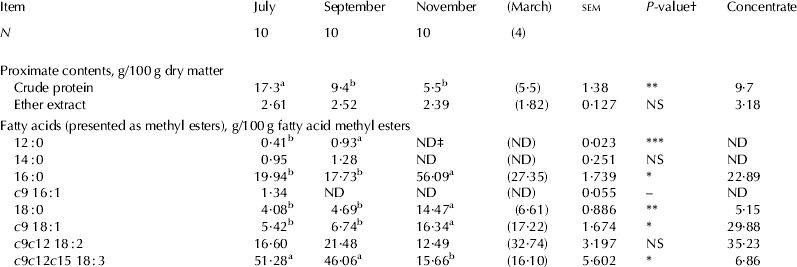
Sward height and biomass showed significant seasonal changes, with gradually declining values from the two main grass growing seasons (July to September) to the winter season (November) (Table 1). The grass, as indicated by comparison with the yaks’ consumption behaviour, was richest in crude protein in July, followed by September, and was low in the mostly yellow (dead leafed) forage in winter (P<0·05), with a similar trend found in spring (Table 2). The small amounts of concentrate supplemented in spring yielded some extra crude protein. There were no significant seasonal effects on the ether extract content of the grass, even though the trend was similar to that of crude protein, i.e., decreasing with the maturity of sward (Leiber et al. Reference Leiber, Kreuzer, Nigg, Wettstein and Scheeder2005). Some FA in the grass were above the detection limit only in the grass growing season. These FA include lauric acid (12 : 0), myristic acid (14 :v0) and cis-9 palmitoleic acid (c9 16 : 1; only detected in July). The proportions of palmitic acid (16 : 0), stearic acid (18 : 0) and cis-9 oleic acid (c9 18 : 1) were higher in November than in July and September. Numerically, the proportion of c9c12 18 : 2 tended to be higher in September compared with July and November (not significant, P>0·05), and the concentration of c9c12 18 : 2 was numerically highest in March. Proportions of c9c12c15 18 : 3 were higher (P<0·05) in July and September than in November. The latter is consistent with the findings by Leiber et al. (Reference Leiber, Kreuzer, Nigg, Wettstein and Scheeder2005), who found that c9c12c15 18 : 3 decreases in proportion with maturation of the grass. The seasonal variation in FA profile of the herbage can be explained by the associated changes in leaf proportion and growth stage. Stems contain only around one third to half of the amount of FA than leaves (Boufaïed et al. Reference Boufaïed, Chouinard, Tremblay, Petit, Michaud and Bélanger2003). This is consistent with the trend in seasonal changes in ether extract concentration.
Sward height (n=30 per pasture) and biomass (n=10) (means±sd)†

† No data available for March because the remaining plants were too short and scarce to be harvested for reasonable calculations of sward height and biomass
Nutrient composition of the forages in the different seasons and of the concentrate supplemented in March. Values without a common superscript are different at P<0·05. March data excluded from analysis of variance

† NS, not significant; *P<0·05; **P<0·01; *** P<0·001 between seasons (forage only)
‡ ND, not detected
Performance of the yaks
The body weight of the yaks, as estimated by girth measurements, was highest in September (P<0·05; Table 3). This is in agreement with the forage biomass available and with the findings of Ding et al. (Reference Ding, Long, Yang and Xu2007). A low biomass composed of low-quality forage not only provides low amounts of energy, but also forces the animals to expend additional energy on travelling larger distances to find the scarce feed. On the other hand, the late weaning time of yak calves (up to 2 years after parturition; Ding et al. Reference Ding, Long, Yang and Xu2007) was another factor compelling yaks to transfer more energy to milk, which restricted their increase in body weight. In accordance with the high availability of high-quality forage, milk yield was highest in July (P<0·05 for uncorrected milk), when the volume additionally consumed by the calves was most likely also high. There was a delayed response in body weight to the improved nutrient supply during the summer. The reason for this is likely to be due to the lower milk production in September than in July, thus triggering compensatory growth of the yaks in response to their low nutritional status in spring. This issue requires investigated in more detail in subsequent studies.
Performance and milk composition in different seasons. Values without a common superscript are different at P<0·05. March data excluded from analysis of variance

† *P<0·05; **P<0·01; *** P<0·001
‡ Estimated from girth circumference
Outside the grass growing seasons, milk yield was low and it is likely that this was not only because of the progressing stage of lactation. The milk fat content started to increase when the grass became increasingly mature (P<0·05) between July and September, which was a trend that progressed until March. This can be primarily explained by the likely increased fibre content of the grass and, associated with this, the structural property of fibrousness, resulting in high concentrations of acetate in the ruminal fluid, which is the main substrate for synthesising milk fat (Al Zahal et al. Reference Al Zahal, Or-Rashid, Greenwood, Douglas and McBride2009). However, dilution caused by the higher volume of milk produced in summer and the effect of the progressing stage of lactation (Neitz & Robertson, Reference Neitz and Robertson1991) probably also contributed to changes in milk fat. Milk had a higher content of protein outside the growing season than in July (P<0·05 vs. November). This change is consistent with changes in the stage of lactation (Neitz & Robertson, Reference Neitz and Robertson1991), where protein content decreases from initially high values during the first and second month of lactation and thereafter increases gradually. On the other hand, energy deficiency, as prevalent outside of the growing season, is typically associated with a decline in milk protein content. However, in spring this may have been counterbalanced by the supplementary feeding and in summer by the negative energy balance as a result of the peak in milk secretion (Long et al. Reference Long, Apori, Castro and Ørskov1999). Freezing temperatures in winter may have additionally increased milk protein content (Neitz & Robertson, Reference Neitz and Robertson1991).
In the present experiment, it was often not clear whether trends in milk production and composition occurred as a result of changes in season or the stage of lactation of the animals. Uncoupling these two influential factors was prevented by the extreme conditions on the Tibetan plateau during winter and spring and would have resulted in animals in their highest productive phase becoming seriously ill and even dying let alone maintaining an acceptable milk production. In evaluating the following findings, the confounding of these two factors must be kept in mind.
Fatty acid composition of the milk fat
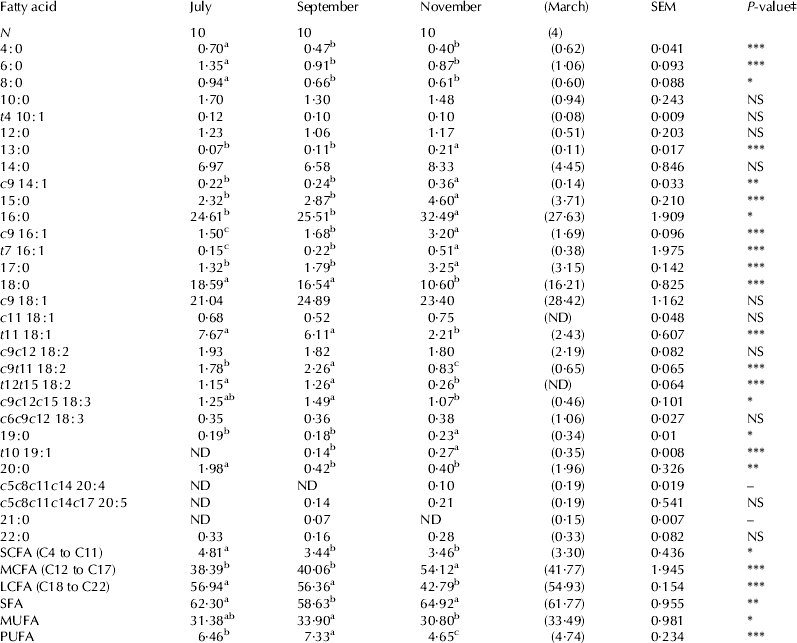
The three dominant FA in the yak milk, making up about half of all FA, were 16 : 0, 18 : 0 and c9 18 : 1 (Table 4). This is consistent with other studies by Liu et al. (Reference Liu, Ren, Jiang, Ma, Qiao, Zeng, Gan and Guo2011) and Peng et al. (Reference Peng, Brown, Wu, Wei, Wu and Sanbei2008). The proportions of most FA in yak milk fat changed (P<0·05) with season (Table 4). Mel'uchová et al. (Reference Mel'uchová, Blaško, Kubinec, Górová, Dubravská, Margetin and Soják2008), who studied lowland ewes, and Liu et al. (Reference Liu, Ren, Jiang, Ma, Qiao, Zeng, Gan and Guo2011), who studied yaks in late summer to early winter at high altitude, also described clear seasonal effects. In the present study, the few FA which did not significantly change according to season included 8 : 0, 10 : 0, t4 10 : 1, 12 : 0, 14 : 0, c9 18 : 1, c11 18 : 1, c6c9c12 18 : 3, 20 : 5 and 22 : 0, bearing in mind that c11 18 : 1 and 20 : 5 were not detected in the milk at all in March or July, respectively.
Composition of fatty acids (presented as fatty acid methyl esters in g/100 g total fatty acid methyl esters analysed) of yak milk in different grazing seasons. Values without a common superscript are different at P<0·05†. March data excluded from analysis of variance
† LCFA, long-chain fatty acids; MCFA, medium-chain fatty acids; MUFA, monounsaturated fatty acids; ND, not detected; PUFA, polyunsaturated fatty acids; SCFA, short-chain fatty acids; SFA, saturated fatty acids
‡ NS, not significant; *P<0·05; **P<0·01; *** P<0·001
Looking at the main groups of FA, the proportions of the sums of saturated, monounsaturated and polyunsaturated FA clearly varied with season (P<0·05). The proportions of saturated FA were lowest in September and highest in November with the converse being true for the total monounsaturated FA. Consistent with Lock & Garnsworthy (Reference Lock and Garnsworthy2003), the polyunsaturated FA were high in the growing season, especially in September, and low in November and March, although these differences were not statistically significant. The high saturated FA proportion in milk in November could have been due to the mobilisation of the yaks’ bodily reserves at this time, where feed scarcity was increasingly severe and their body weight began to decline again. This would also coincide with the findings of Kgwatalala et al. (Reference Kgwatalala, Ibeagha-Awemu, Mustafa and Zhao2009), who found that the proportion of saturated FA was lower in Holstein cows in their early lactation stage.
The proportions of short-chain FA as a whole were not significantly different between seasons, even though some individual short-chain FA were affected. Higher proportions of 4 : 0 and 6 : 0 were found in summer than in September and November. The total medium-chain FA were clearly (P<0·001) variable between seasons, being highest in November. This was also true for 14 : 0, 16 : 0 and 17 : 0, which made up a major proportion, of the medium-chain FA but not for 12 : 0. Concerning 16 : 0, the proportion found in March appeared to be in between the November value and the values found in July and September. Both short- and medium-chain FA can be synthesised de novo e.g. from carbohydrates in the rumen and the metabolism of the animals even though milk 16 : 0 can also originate from feed.
Among the C18 FA, 18 : 0 and c9 18 : 1 are quantitatively the most important representatives. The c9 18 : 1 is the predominant unsaturated FA in milk, which plays an important role in maintaining milk fluidity (Demeyer & Doreau, Reference Demeyer and Doreau1999). Therefore, with the help of the Delta-9-desaturase, a major transformation of 18 : 0 to c9 18 : 1 takes place in the mammary gland. Thus, 18 : 0 and c9 18 : 1 may have the same origin. Liu et al. (Reference Liu, Ren, Jiang, Ma, Qiao, Zeng, Gan and Guo2011) showed a higher proportion of 18 : 0 in yak milk in August and December than in September and October. The present study shows that this low plateau seems to be only occurring somewhere in the transition from autumn to winter, as it was low (P<0·05) only in November. Conversely, Mel'uchová et al. (Reference Mel'uchová, Blaško, Kubinec, Górová, Dubravská, Margetin and Soják2008) found no seasonal effect in 18 : 0 in sheep milk. The variation was smaller in the proportion of c9 18 : 1 than in 18 : 0 and it was also not concomitant in nature. There was a trend for a low proportion of c9 18 : 1 in July and a high proportion in March, possibly indicating mobilisation of this FA from body stores (Timmen & Patton, Reference Timmen and Patton1988). Both FA are also direct (18 : 0) or indirect (c9 18 : 1 after desaturation of 18 : 0) end products of ruminal biohydrogenation. Overall, it appears that the explanation of the observations in seasonal shifts is very complex.
Long chain polyunsaturated FA, especially members of the n-3 group, are of particular interest with respect to human health (Sinclair et al. Reference Sinclair, Attar-Bashi and Li2002). In the present study, the availability of fresh forage stimulated higher milk fat concentrations of c9c12c15 18 : 3 in September compared with November (P<0·05; Table 4) and numerically the value of c9c12c15 18 : 3 was lowest in spring. This is favourable as it concerns the majority of the milk consumed by humans in the grass growing season. Very little 20 : 5 n-3 has been detected in the yak milk, except in summer time, and no 22 : 6 n-3. It seems that with grazing a rather high baseline level of c9c12c15 18 : 3 is maintained in milk fat, which remains constant even when its proportion in dietary lipids increases (Khiaosa-Ard Siepmann et al. Reference Khiaosa-ard Siepmann, Kreuzer and Leiber2012). The concentration of the most important n-6 FA in milk fat, c9c12 18 : 2, did not follow a clear seasonal pattern (Table 4).
Recently, intermediates of the ruminal biohydrogenation of C18-polyunsaturated FA attained particular interest because the main resulting isomers have a trans-11 nature, which is considered healthier than other trans isomers (especially t10). Furthermore, t11 18 : 1 is the precursor of c9t11 18 : 2, a particularly desired CLA isomer. In the present study, proportions of t11 18 : 1 and c9t11 18 : 2 were much higher (P<0·05) in milk fat in summer and autumn than in winter (Table 4), which is consistent with the findings of Lock & Garnsworthy (Reference Lock and Garnsworthy2003) and Banni et al. (Reference Banni, Carta, Contini, Angioni, Deiana, Dessi, Melis and Corongiu1996). Possible reasons for this include higher proportions of the precursors c9c12 18 : 2 and c9c12c15 18 : 3 in the forage lipids and a partial inhibition of the final hydrogenation step from t11 18 : 1 to 18 : 0 in the rumen (Lock & Garnsworthy, Reference Lock and Garnsworthy2003). Also, the amount of biomass on offer may have contributed to this effect. Furthermore, some studies have shown that increasing the daily intake of fresh grass increased the CLA content of cow's milk (Stanton et al. Reference Stanton, Lawless, Kjellmer, Harrington, Devery, Connolly and Murphy1997; Kelly et al. Reference Kelly, Kolver, Bauman, Van Amburgh and Muller1998; Dhiman et al. Reference Dhiman, Anand, Satter and Pariza1999; Lock & Garnsworthy, Reference Lock and Garnsworthy2003).
We also detected another isomer of 18 : 3, namely c6c9c12 C18 : 3 (γ-linolenic acid), in yak milk, which has rarely been detected in cattle (Bos taurus) milk, except when deliberately supplemented (Hermansen et al. Reference Hermansen, Jonsbo and Andersen1995). However, this FA was not detected in the grass samples in the present study. The possible health benefits of c6c9c12 C18 : 3 include preventive action against cancer, cardiovascular diseases and hypertension, as well an improvement in vision (Wright et al. Reference Wright, McBride and Holub1998). The preliminary data obtained in spring (four cows only) indicated that the proportion of c6c9c12 C18 : 3 in milk fat could be highest in this season (more than 2-fold higher by value comparison without statistical analysis). This could have been the result of poor forage availability and composition, the fatty acids offered with the supplement given at that time, as well as the latter stages of lactation, as these animals had been in lactation for approximately one year at this stage.
In conclusion, the present study verified the hypothesis to be tested, namely that under the specific high altitude conditions there were various seasonal modifications in the fatty acid composition of the milk which were associated with some human nutritional implications. These changes seem to be the result of a complex interplay of forage composition, altitude-caused hypoxia and seasonal feed scarcity. The highest proportions of functional FA considered to be particularly favourable to human health (α-linolenic acid and CLA) were found in yak milk fat during the grass growing seasons (summer and autumn). A rare functional FA, γ-linolenic acid (c6c9c12 18 : 3), was detected in yak milk in spring (March); whether or not this was a result of the particular forage quality or of the supplementary feeding practice is yet to be determined.
This work was financially supported by the Basic Research Foundation for Central Government University of Lanzhou University (Lzujbky-2011-31), the National Natural Science Foundation for China (31170378) and the Non-profit Industry-specific (Agriculture) Research Project (201203007).