Introduction
A quantitative review in 2010 of 175 cross-sectional studies of ‘big’ personality traits in relation to affective and substance abuse disorders (Kotov et al. Reference Kotov, Gamez, Schmidt and Watson2010) showed that all diagnostic groups were high on neuroticism (cf. Malouff et al. Reference Malouff, Thorsteinsson and Schutte2005). Various mechanisms, alone or in combination, can account for this strong association of affective disorders with neuroticism (for a review see Klein et al. Reference Klein, Kotov and Bufferd2011). First, some models (common cause, continuum/spectrum and precursor models) view personality and affective disorders as having similar causal influences, but do not see one as having a causal influence on the other. Sources of stability in neuroticism and affective disorders are correlated, as indicated by the considerable genetic correlation between neuroticism and affective disorders, suggesting substantially overlapping genetic determinants (e.g. Kendler et al. Reference Kendler, Neale, Kessler, Heath and Eaves1993; Carey & Dilalla, Reference Carey and Dilalla1994; Middeldorp et al. Reference Middeldorp, Cath, Van Dyck and Boomsma2005; Hettema et al. Reference Hettema, Neale, Myers, Prescott and Kendler2006; Kendler & Myers, Reference Kendler and Myers2010). For instance, Hettema et al. (Reference Hettema, Neale, Myers, Prescott and Kendler2006) analyzed data on neuroticism and internalizing disorders from more than 9000 male and female twins and found that the genetic correlations between neuroticism and these disorders were high, whereas the environmental correlations were much lower, suggesting that phenotypic neuroticism-affective disorder associations are largely due to shared genetic factors. These findings strongly support the common cause model for affective disorders.
Second, neuroticism could have causal effects on the onset and maintenance of affective disorders (predisposition and pathoplasticity models). Several studies using large community samples have reported that higher levels of neuroticism predict the onset of first lifetime episodes of major depressive disorder (MDD) (e.g. Kendler et al. Reference Kendler, Neale, Kessler, Heath and Eaves1993; de Graaf et al. Reference de Graaf, Bijl, Ravelli, Smit and Vollenbergh2002; Ormel et al. Reference Ormel, Oldehinkel and Vollebergh2004; Kendler et al. Reference Kendler, Gatz, Gardner and Pederson2006; Fanous et al. Reference Fanous, Neale, Aggen and Kendler2007). Moreover, there is evidence that neuroticism has pathoplastic influences on the course of depression after the onset of the disorder. Studies have reported that higher neuroticism predicts a poorer course and response to treatment (e.g. Duggan et al. Reference Duggan, Lee and Murray1990; de Fruyt et al. Reference de Fruyt, van Leeuwen, Bagby, Rolland and Rouillon2006; Quilty et al. Reference Quilty, De Fruyt, Rolland, Kennedy, Rouillon and Bagby2008a ; Morris et al. Reference Morris, Bylsma and Rottenberg2009; Spinhoven et al. Reference Spinhoven, Elzinga, Hovens, Roelofs, van Oppen, Zitman and Penninx2011). Of note, some clinical trials suggest that the depression-reducing effects of pharmacological treatment may be mediated by reductions in neuroticism and that changes in depressive symptoms follow changes in neuroticism (Quilty et al. Reference Quilty, Meusel and Bagby2008b ; Tang et al. Reference Tang, DeRubeis, Hollon, Amsterdam, Shelton and Schalet2009).
Third, the association between affective disorders and personality could be due to the causal influence of affective disorders on personality (concomitants and consequences model). Studies investigating personality during and after a depressive episode indeed found that individuals with MDD report higher levels of neuroticism when they are depressed than when they are not depressed (e.g. Hirschfeld et al. Reference Hirschfeld, Klerman, Clayton, Keller, McDonald-Scott and Larkin1983; Kendler et al. Reference Kendler, Neale, Kessler, Heath and Eaves1993; Ormel et al. Reference Ormel, Oldehinkel and Vollebergh2004; Karsten et al. Reference Karsten, Penninx, Riese, Ormel, Nolen and Hartman2012). Moreover, a few studies have investigated personality before and after a depressive episode to test the consequences or scar hypothesis. The results of these studies have been inconsistent. Kendler and colleagues reported increases in neuroticism after a depressive episode in two separate samples (Kendler et al. Reference Kendler, Neale, Kessler, Heath and Eaves1993; Fanous et al. Reference Fanous, Neale, Aggen and Kendler2007) whereas other studies have found that neuroticism did not change from before to after an MDD episode (e.g. Shea et al. Reference Shea, Leon, Mueller, Solomon, Warshaw and Keller1996; Ormel et al. Reference Ormel, Oldehinkel and Vollebergh2004; Jylhä et al. Reference Jylhä, Melarin, Rytsälä and Isometsä2009). Importantly, the studies reporting scarring used less stringent criteria for recovery and shorter follow-up times, suggesting that the findings may be due to residual symptoms (Ormel et al. Reference Ormel, Oldehinkel and Vollebergh2004) and/or that the scars dissipate over time (Klein et al. Reference Klein, Kotov and Bufferd2011).
To date, most studies have focused on cross-sectional or unidirectional relationships of neuroticism with one particular type of affective disorder (mostly MDD) and did not examine reciprocal effects of affective disorders on neuroticism or the temporal character of the effects while taking co-morbidity among affective disorders into account. Based on the models reviewed here, we hypothesized that affective disorders and neuroticism could be mutually reinforcing each other over time, resulting in a positive feedback cycle that can be stopped by factors such as treatment, suicide or exposure to positive life events. Conceivably, neuroticism influences the onset and course of affective disorders whereas the development of affective disorders results in possibly sustained higher levels of neuroticism. Such a positive feedback cycle could be one of the mechanisms underlying kindling (Post, Reference Post1992).
The Netherlands Study of Depression and Anxiety (NESDA) is an ongoing cohort study designed to investigate determinants, course and consequences of several depressive and anxiety disorders in a relatively large and representative sample of participants with depressive and/or anxiety disorders from different recruitment settings. The NESDA, with three-wave data currently available on affective disorders and neuroticism, offered a unique possibility to analyse the temporal and directional character of possible reciprocal relationships between affective disorders and neuroticism, including cross-lagged effects of changes in affective disorder on subsequent changes in neuroticism and vice versa. Moreover, the three-wave data allowed us to test the scar hypothesis by investigating the level of neuroticism before and after the incidence of a first affective disorder using stringent criteria for recovery while taking the effects of residual symptoms into account.
Method
Sample
A total of 2981 persons aged 18–65 years were included, consisting of healthy controls, persons with a prior history of depressive and anxiety disorders and persons with a current depressive and/or anxiety disorder. Respondents were recruited from the general population either through a screening procedure in general practice or when newly enrolled in specialized health care, so that different health-care settings and different developmental stages of psychopathology were represented. General exclusion criteria were a primary diagnosis of psychotic, obsessive–compulsive, bipolar or severe addiction disorder and not being fluent in Dutch.
Procedure
A detailed description of the NESDA design and sampling procedures is presented elsewhere (Penninx et al. Reference Penninx, Beekman, Smit, Zitman, Nolen, Spinhoven, Cuijpers, De Jong, Van Marwijk, Assendelft, Van der Meer, Verhaak, Wensing, De Garaaf, Hoogendijk, Ormel and Van Dyck2008, Reference Penninx, Nolen, Lamers, Zitman, Smit, Spinhoven, Cuijpers, de Jong, van Marwijk, van der Meer, Verhaak, Laurant, de Graaf, Hoogendijk, van der Wee, Ormel, Van Dyck and Beekman2011). The baseline assessment (at T1) included assessment of demographic and personal characteristics, a standardized diagnostic psychiatric interview and a medical assessment including blood draw. The research protocol was approved by the ethics committees of participating universities and all respondents provided written informed consent.
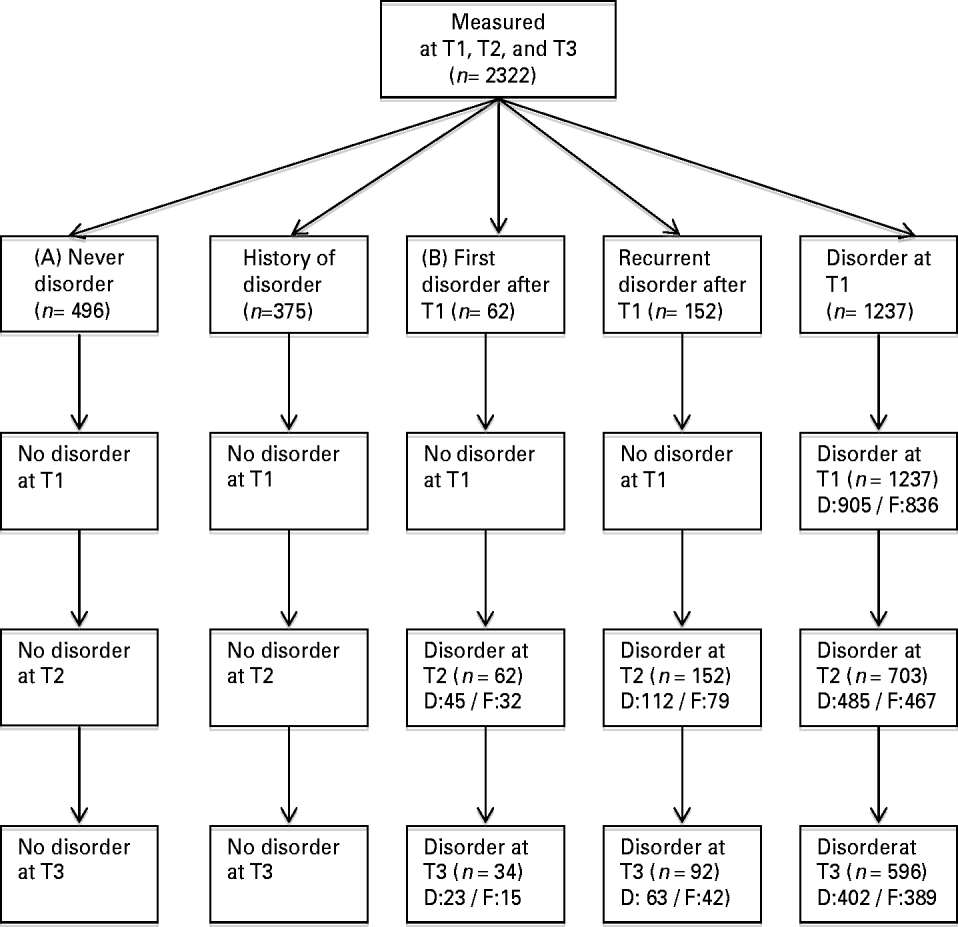
After 2 (T2) and 4 (T3) years, a face-to-face follow-up assessment was conducted, with a response rate of 87.1% (n = 2596) at T2 and 80.6% (n = 2402) at T3. The presence of DSM-IV (APA, 1994) based depressive [MDD, dysthymia (DYS)] or anxiety [panic disorder with or without agoraphobia, social anxiety disorder (SOC), generalized anxiety disorder (GAD), agoraphobia without panic (AGO)] disorders was established using the Composite Interview Diagnostic Instrument (CIDI), version 2.1, a highly reliable and valid instrument for assessing depressive and anxiety disorders (Wittchen, Reference Wittchen1994). The presence of the disorders was defined as the occurrence of the disorder at any time during the 6 months preceding each assessment: (T, T2 and T3). The mean age at T1 was 41.9 years (s.d. = 13.1), the mean number of years of education attained was 12.1 (s.d. = 3.3) and 66.4% were female. Of the participants at T1, 1701 (57.1%) had a 6-month depressive or anxiety diagnosis at baseline (MDD = 37.4%, PD = 22.5%, SOC = 22.3%, GAD = 15.6%, DYS = 10.2%, AGO = 6.3%). Co-morbidity among disorders was high: of those with a depressive disorder at baseline, 67% had a current co-morbid anxiety disorder, and of persons with a current anxiety disorder, 63% had a current depressive disorder (Lamers et al. Reference Lamers, van Oppen, Comijs, Smit, Spinhoven, van Balkom, Nolen, Zitman, Beekman and Penninx2011). A flowchart of the construction of groups is shown in Fig. 1.
Flowchart of construction of groups. Assessments of affective disorders and neuroticism were conducted at baseline (T1) and 2 (T2) and 4 years (T3) later. Disorder is a 6-month recency affective disorder according to DSM-IV criteria for Distress Disorder [(D), which includes dysthymia, major depressive disorder and generalized anxiety disorder] and Fear Disorder [(F), which includes social anxiety disorder, panic disorder without agoraphobia and/or agoraphobia without panic]. Note that D and F do not add up to total number of disorders because of co-morbidity.

We examined whether sample attrition had introduced response bias. Compared with completers, drop-outs at T2 and at T3 were younger and less educated, showed higher latent factor scores for both distress and fear disorders, and also manifested higher levels of neuroticism (all p < 0.001). There was no significant association of gender with attrition.
Measures
Psychiatric diagnosis
Diagnostic status was determined using the CIDI 2.1, which determined the 6-month prevalence of DSM-IV-classified depressive and anxiety disorders at T1, T2 and T3. Organic exclusion rules were used in defining diagnoses and hierarchy-free diagnoses.
Neuroticism–Extraversion–Openness Five Factor Inventory (NEO-FFI)
Neuroticism was operationalized using the 60-item version of the longer 240-item NEO Personality Inventory Revised (NEO-PI-R), known as the NEO-FFI (Costa & McCrae, Reference Costa and McCrae1992). The NEO-FFI measures the following five personality domains: Neuroticism, Extraversion, Agreeableness, Conscientiousness and Openness to Experience. The NEO-FFI scales show correlations of 0.75 to 0.89 with the NEO-PI-R scales. In NESDA, the internal consistency of the subscale for neuroticism was satisfactory to good (α = 0.75 at T1, 0.93 at T2, and 0.93 at T3).
Symptom severity
Severity of depressive symptoms was measured with the 30-item Inventory of Depressive Symptoms self-report version (IDS-SR), which has shown high correlations with observer-rated scales such as the Hamilton Depression Rating Scale (HAMD) and with established responsiveness to change (Rush et al. Reference Rush, Gullion, Basco, Jarrett and Trivedi1996). Severity of generalized anxiety and panic symptoms was measured using the 21-item Beck Anxiety Inventory (BAI; Beck et al. Reference Beck, Epstein, Brown and Steer1988). This scale has shown sound psychometric properties such as factorial validity, internal consistency and test–retest stability, in addition to adequate convergent and divergent validity.
Statistical methods
Structure and stability of psychopathology measurement models
In an attempt to account for the high co-morbidity among disorders, first a confirmatory factor analysis (CFA) model of mental disorders was performed. CFA was used considering the T1, T2 and T3 assessments of the six diagnostic variables (i.e. MDD, DYS, PAN, SOC, AGO and GAD) as repeated measures. Error covariances of analogous disorders were freely estimated (Ferrando, Reference Ferrando2000) and analogous factors across groups of responses were allowed to be correlated. Factor loadings of the observed disorders on their latent trait factor(s) were constrained to be equal over time to obtain a unique interpretation of the latent factor(s).
Goodness of fit was assessed with the common fit indices (Jackson et al. Reference Jackson, Gillaspy and Purc-Stephenson2009): the χ 2 test of the model (p > 0.05), the Comparative Fit Index (CFI; ⩾ 0.96), the Tucker–Lewis Index (TLI; ⩾ 0.95), the root mean square error of approximation (RMSEA; ⩽ 0.05), the weighted RMS residual (WRMR; ⩽ 1.0; Marsh et al. Reference Marsh, Hau and Wen2004) or the standardized RMS residual (SRMR; < 0.08). We considered RMSEA as the main index of model fit as it has been shown to be sensitive to model misspecification and less sensitive than other global fit measures to distribution and sample size in badly fitting covariance structure models (Hu & Bentler, Reference Hu and Bentler1998). On the basis of previous studies (for a review see Beesdo-Baum et al. Reference Beesdo-Baum, Höfler, Gloster, Klotsche, Lieb, Beauducel, Buhner, Kessler and Wittchen2009), we expected to find a stable two-factor solution with one Distress (DYS, MDD, GAD) and one Fear (SOC, PD, AGO) factor. Next, factor scores derived from CFA were used as observed variables in subsequent Trait and State (T&S) models.
Description of the T&S model
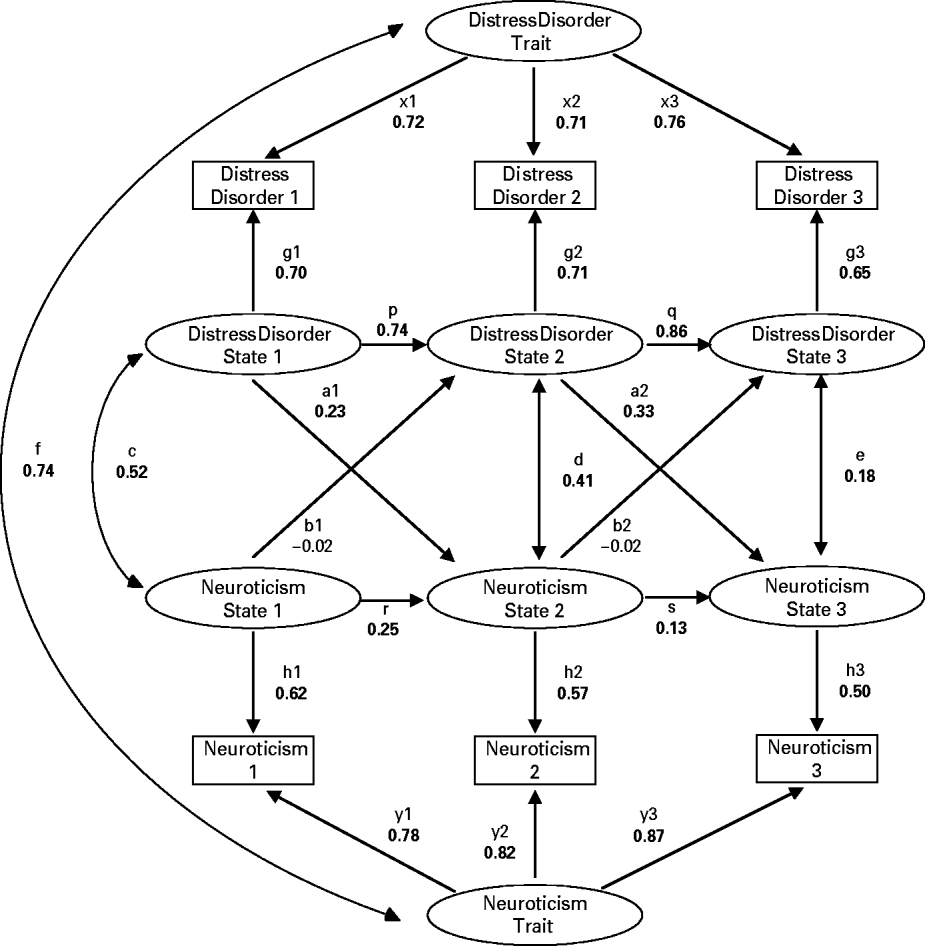
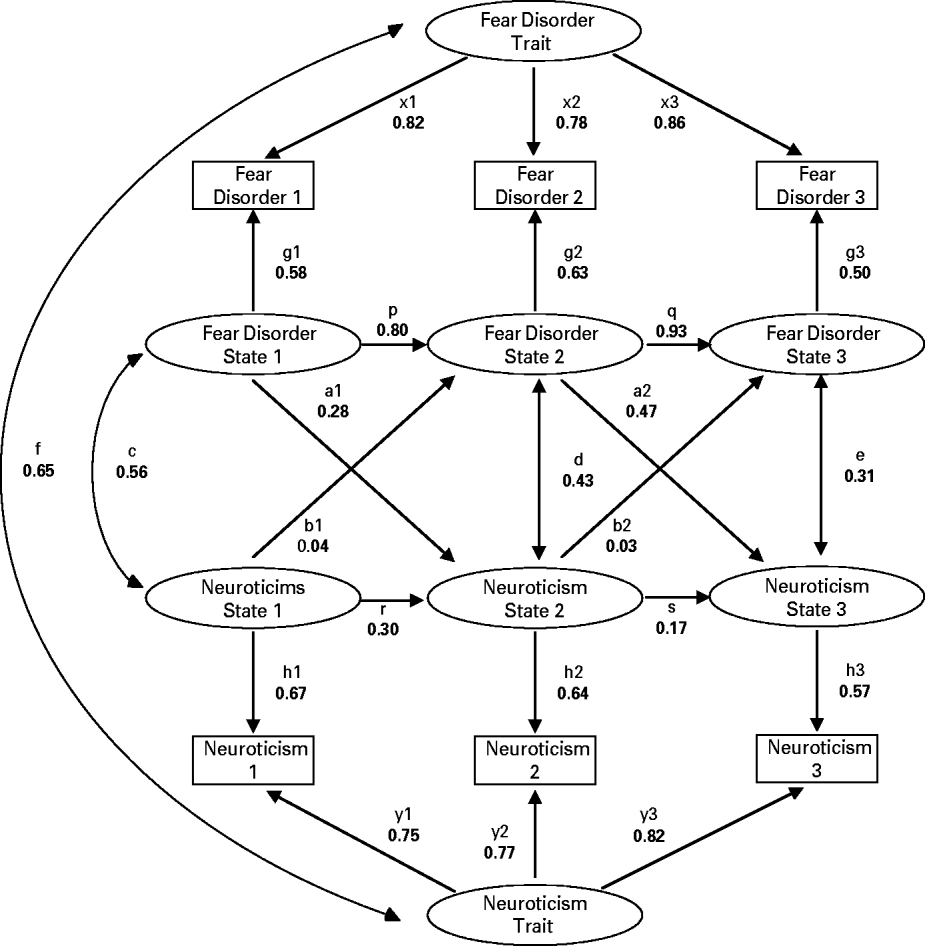
Figures 2 and 3 depict the two models (Distress Disorders with Neuroticism and Fear Disorders with Neuroticism) respectively. Both models consist of three parts: two identical T&S models (cf. Duncan-Jones et al. Reference Duncan-Jones, Fergusson, Ormel and Horwood1990; Ormel & Schaufeli, Reference Ormel and Schaufeli1991) for three time points, one addressing the psychopathology (Distress or Fear Disorders) and one Neuroticism, and four correlations (paths c, d, e and f) and four regression effects (paths a1, a2, b1 and b2) linking the T&S models. The T&S Disorders model assumes that the psychopathology (Distress or Fear Disorders) at each time point can be decomposed into a stable latent (unobserved) variable (common factor) and a state component. The state component represents the variance not accounted for by the common factor and consequently reflects within-subject changes over the whole study period of 4 years, in part as a result of measurement error. The T&S neuroticism model makes the same assumptions.
Path diagram of the full model of Distress Disorders and Neuroticism, each modeled as a Trait and State (T&S) model, and 2-year lagged (a,b) cross-variable effects linking their state components (State) and correlations between the trait factors (f) and contemporaneous correlations between the state components at T1 (c), T2 (d) and T3 (e). Included also are the standardized estimates of the full model. Note that the following equality constraints were applied to identify model equations: x1 = x2 = x3; y1 = y2 = y3; a1 = a2; b1 = b2. Correlation and regression coefficients significant at p < 0.05 are presented in bold.

Path diagram of the full model of Fear Disorders and Neuroticism, each modeled as a Trait and State (T&S) model, and 2-year lagged (a,b) cross-variable effects linking their state components (state) and correlations between the trait factors (f) and contemporaneous correlations between the state components at T1 (c), T2 (d) and T3 (e). Included also are the standardized estimates of the full model. Note that the following equality constraints were applied to identify model equations: x1 = x2 = x3; y1 = y2 = y3; a1 = a2; b1 = b2. Correlation and regression coefficients significant at p < 0.05 are presented in bold.

The across-time structure of the latent state psychopathology variables (State 1, State 2, State 3) in the T&S model was modeled as a first-order autoregressive model. Hence, State 2 and 3 variances consist of variance transmitted from an earlier time point (paths p and q) and new variance resulting from the effects of unobserved variables active during the interval between the measurement points (not shown). The across-time structure of the latent state personality variables was modeled in a similar way (paths r and s indicating transmitted variance).
By combining the T&S models for psychopathology and personality, an integrated model is obtained in which the latent state variables of psychopathology can act as a change agent of personality and, vice versa, the cross-variable effects. The associations can be contemporaneous (d and e) and/or the effects can be more lagged (paths a1, a2, b1 and b2). Finally, the model allows correlation between the common trait factors (path f) and between the first state component of psychopathology and personality (path c).
Model specification and identification
To solve the structural equations of the full model, the following assumptions for both the psychopathology and personality T&S parts of the models were made: (a) the regressions of the observed personality scores and psychopathology factors scores (as derived from the CFA modeling) on their respective latent trait factor are equal over time (equality constraints x1 = x2 = x3; y1 = y2 = y3); (b) the lagged cross-variable effects at T2 equal those at T3 (a1 = a2, b1 = b2) (cf. Duncan-Jones et al. Reference Duncan-Jones, Fergusson, Ormel and Horwood1990; Ormel & Schaufeli, Reference Ormel and Schaufeli1991); and (c) the residual variances of the observed variables equal zero.
Descriptive statistics and model fitting were obtained using MPlus version 6.11 (Muthén & Muthén, Reference Muthén and Muthén1998–2010). Participants who did not attend the T2 and T3 assessments were included in the analyses. The full model necessitates the estimation of 18 parameters (variance of the six latent state variables was fixed at unity), and consequently has 3 degrees of freedom left. Standardized estimates, or path coefficients, with a theoretical range from zero (no effect) to ± 1 (maximum positive or negative effect) are provided. As the estimation method we used maximum likelihood ratio (MLR) parameter estimates with standard errors and a χ 2 test statistic; these are robust to non-normality and non-independence of observations.
Scarring effects in participants with first disorder onset after baseline
To investigate possible scarring effects in more detail, we separately analyzed personality scores of participants with no disorder at T1 and the incidence of a first disorder at T2 or T3 with repeated-measures analysis of variance (rmANOVA). The listwise deletion method was applied. First, we controlled for time effects by using the participants with no previous disorder and no disorder at all three waves as a control group. Significant group × time effects were followed up by an rmANOVA contrasting neuroticism scores of participants with no disorder at T1 and remitted versus persistent first affective disorders at T3. To investigate whether differences in neuroticism could reflect differences in symptom severity, similar rmANOVAs were performed with depression (IDS) or anxiety severity (BAI) as dependent variables. Significant interaction effects were followed up by paired t tests. Differences in neuroticism and symptom severity scores are expressed using Cohen's effect sizes: |d| = 0.20–0.50 is considered a small effect size, |d| = 0.50–0.79 is viewed as medium and |d| ⩾ 0.80 is large (Cohen, Reference Cohen1988).
Results
Participant characteristics
We constructed several subgroups on the basis of the CIDI data collected at T1, T2 and T3 (see Fig. 1). In total, 2322 participants completed the T1, T2 and T3 measurements. The ‘Never disorder’ group (n = 496; A in Fig. 1) refers to participants who never had an affective disorder (T1 CIDI) and did not develop one during the follow-up periods. The ‘History of disorder’ group (n = 375) refers to participants who had at least one disorder before T1 but did not develop a recurrent disorder during the follow-up periods. Of the remaining 214 participants with no disorder at T1, 62 developed a first disorder at T2 (B in Fig. 1) and 152 a recurrent disorder. The ‘Disorders at T1′ group refers to participants who had an affective disorder at T1 (n = 1237), of whom 703 had a persistent or recurrent disorder at T2 and 596 at T3.
Comparative evaluation of structure and stability of psychopathology measurement models
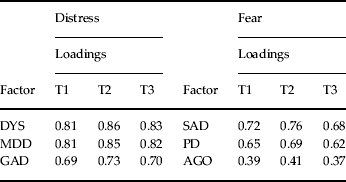
Regarding the three CFA competing models considered (at all three time points), the goodness-of-fit indices of the Distress–Fear (MDD, DYS and GAD versus PAN, SOC and AGO) model were satisfactory (χ 2 110 = 201.140, TLI = 0.988, CFI = 0.991, RMSEA = 0.017, WRMR = 1.056), and slightly better than those of the single-factor model (χ 2 124 = 374.281, TLI = 0.971, CFI = 0.976, RMSEA = 0.026, WRMR = 1.491) and the DSM-IV (MDD and DYS versus PAN, SOC, AGO and GAD) model (χ 2 110 = 275.464, TLI = 0.978, CFI = 0.984, RMSEA = 0.022, WRMR = 1.258). Consequently, consistent with the results of the majority of available studies, we chose the Distress–Fear model as best representing the latent structure and stability of affective disorders and used latent factor scores for both Distress and Fear Disorders as input variables in subsequent T&S models (see Table 1 for factor loadings on the latent variables in the Distress–Fear model).
Factor loadings on the latent variables in the Distress–Fear model

DYS, Dysthymia; MDD, major depressive disorder; GAD, generalized anxiety disorder; SAD, social anxiety disorder; PD, panic disorder with or without agoraphobia; AGO, agoraphobia without panic.
Model fitting of T&S models
Goodness-of-fit indices of the Neuroticism and Distress model [χ 2 3 = 5.308, p = 0.151, TLI = 0.999, CFI = 1.00, RMSEA = 0.016, 90% confidence interval (CI) 0.000–0.038, SRMR = 0.005] and the Neuroticism and Fear model (χ 2 3 = 29.270, p < 0.001, TLI = 0.992, CFI = 0.998, RMSEA = 0.054, 90% CI 0.037–0.073, SRMR = 0.015) using MLR estimation were satisfactory to good.
Interpretation of standardized estimates in the latent T&S models
The estimated trait variance in distress scores ranged from 52% (0.722) at T1 to 50% (0.712) and 58% (0.762) at T2 and T3 respectively. This suggests that about half of the between-subject differences in distress scores were stable across the 4-year period. Correspondingly, the amount of state variance in distress scores (the proportion that is unique to each occasion) ranged from 48% at T1 to 50% and 42% at T2 and T3 respectively. This state variance, however, contains both true and measurement error variance.
Sixty-seven percent of the variance in fear scores at T1 (0.822) and 61% and 74% at T2 and T3 respectively could be accounted for by the trait fear factor. These results suggest that individual differences in distress scores are slightly less stable than those in fear scores.
The estimated trait variance in neuroticism scores ranged from minimally 56% (0.752) at T1 to minimally 59% (0.772) and 67% (0.822) at T2 and T3 respectively, depending on whether the model included distress or fear scores. This suggests that about half to two-thirds of the between-subject differences in neuroticism scores were stable across the 4-year period.
Trait neuroticism proved to be strongly related to trait distress and trait fear (correlations of 0.74 and 0.65 respectively). These results show that the stable components of neuroticism and psychopathology are highly interwoven.
The standardized estimates of the cross-variable effects show that all contemporaneous relationships were statistically significant and, on average, moderately strong, suggesting that participants who became more distressed or feared also became more neurotic and vice versa. We also found small to moderately strong lagged effects of changes in state distress disorders on state neuroticism and small to moderately strong lagged effects of changes in state fear disorders on changes in state neuroticism, with more distress and fear resulting in higher levels of neuroticism 2 years later. Changes in neuroticism, however, had no lagged effects on changes in distress or fear disorders (size of regression coefficients varying from −0.02 to 0.04). Thus, changes in neuroticism seem to be driven by changes in psychopathology, not vice versa.
Scar effect in participants with remitted first affective disorders
Comparing neuroticism scores of the never disorder groups (n = 496; A in Fig. 1) with those of the first disorder group (n = 62; B in Fig. 1) yielded a significant group × time effect (F 2,1056 = 4.332, p = 0.013), indicating that the incidence of disorder affected the course of personality (data not shown). Subsequently, we compared neuroticism scores of participants with remitted first (n = 28) versus persistent first affective disorders (n = 34) by rmANOVAs. A significant group × time effect (F 2,112 = 6.106, p = 0.003) was followed by paired t tests showing that, in participants with a remitted first disorder, neuroticism scores at T2 differed significantly from pre-morbid scores at T1 (d = 0.63) whereas T3 scores were no longer significantly different from T1 scores (d = 0.10) (see Table 2).
Differences in neuroticism and symptom severity scores across waves in participants with remitted (n = 28) first disorder

IDS-SR, Inventory of Depressive Symptoms self-report version; BAI, Beck Anxiety Inventory; s.d., standard deviation; n.s., not significant.
Repeating the rmANOVAs with symptom severity (IDS or BAI) as the dependent variable showed a significant interaction effect for group × time for depression severity (IDS: F 2,110 = 10.010, p < 0.001) but not for anxiety severity (BAI; F 2,110 = 2.094, n.s.). Subsequent paired t tests indicated that, although IDS scores of participants with a remitted first disorder at T2 differed significantly from pre-morbid scores at T1 (d = 0.52), at T3 their depression and anxiety severity scores were not significantly different from their pre-morbid scores (d = 0.16 and d = 0.15 respectively) (see Table 2).
Discussion
In accordance with results of previous studies (Krueger Reference Krueger1999; Beesdo-Baum et al. Reference Beesdo-Baum, Höfler, Gloster, Klotsche, Lieb, Beauducel, Buhner, Kessler and Wittchen2009), the latent structure and stability of affective disorders could best be represented by the Distress–Fear model subsuming MDD, DYS and GAD under the distress disorders and SOC, PAN and AGO under the fear disorders. By using latent factor scores for distress and fear disorders we were able to analyze temporal and reciprocal relationships of the personality trait of neuroticism with different affective disorders simultaneously while taking the high co-morbidity among these disorders into account. As expected on the basis of previous studies, we found a strong relationship of trait distress disorders and trait fear disorders with trait neuroticism and a moderate contemporaneous relationship of state distress disorder and state fear disorder with state neuroticism. Moreover, using a three-wave design, we are the first to show small to moderately large lagged effects of change in distress and change in fear disorder on change in neuroticism, whereas no lagged effects of change in neuroticism on change in affective disorder were observed. Moreover, no differences in pre- and post-morbid levels of neuroticism after the first incidence of an affective disorder were found (scarring), although the incidence of disorder clearly affected the morbid levels of neuroticism (state effect).
Our finding that the estimated trait variance in neuroticism scores ranged from 56% to 67% across waves is consistent with a trait model, which asserts that neuroticism is correlated over time because of an immutable underlying trait. The large positive associations of trait neuroticism with both trait distress disorders and trait fear disorders are in line with Clark & Watson's tripartite model (1991) or Mineka's integrative hierarchical model (1998) in which neuroticism (or negative affect) reflects a general distress component common to both depressive and anxiety disorders.
As we did not investigate the mechanisms underlying the strong association of trait neuroticism with trait distress and fear disorders directly, an interpretation of these associations must remain speculative. Our findings are consistent with the common cause model suggesting substantially overlapping genetic determinants of neuroticism and affective disorders (e.g. Kendler et al. Reference Kendler, Neale, Kessler, Heath and Eaves1993; Carey & Dilalla, Reference Carey and Dilalla1994; Middeldorp et al. Reference Middeldorp, Cath, Van Dyck and Boomsma2005; Hettema et al. Reference Hettema, Neale, Myers, Prescott and Kendler2006; Kendler & Myers, Reference Kendler and Myers2010). However, neuroticism may also be seen as representing high genetic risk for affective disorders, producing a sort of pre-kindling effect and putting persons at high risk for affective disorder even without a history of previous disorder episodes or major environmental stressors (Kendler et al. Reference Kendler, Thornton and Gardner2000, Reference Kendler, Thornton and Gardner2001). This view is consistent with a recent etiological model for self-reported symptoms of anxiety and depression (Kendler & Gardner, Reference Kendler and Gardner2011) consisting of a more stable, trait-like, and an occasion-specific, more state-like, etiological pathway. In the first trait-like pathway the effects of genetic and early environmental risk factors on stable levels of anxiety and depression are largely mediated by the stable component of neuroticism.
In addition, as described in a recent review by Ormel et al. (Reference Ormel, Riese and Rosmalen2012), there is considerable overlap in item content between measures of neuroticism and measures of common forms of psychopathology, in particular those of internalizing disorders. More specifically, items of measures of neuroticism use somewhat vague descriptors of frequency, intensity and duration of symptoms. Moreover, they do not define their time frame, increasing the likelihood that respondents disclose their self-perceived level of negative affect over a prolonged time period. In other words, the strong association of trait neuroticism with trait affective disorders may also reflect two closely related versions of the same construct and the interpretation of a causal relationship of neuroticism with affective disorders may be unwarranted.
Using a T&S model we were able to show that a participant's level of psychopathology and neuroticism at each time point could be operationalized as the function of two latent variables: a trait component (common factor) and a state component reflecting within-subject change over the 4-year study period. By combining both T&S models we could further analyze whether changes in affective disorders have contemporaneous or lagged cross-variable effects on changes in neuroticism and vice versa. Consistent with the concomitants model, the results showed that increases in psychopathology were associated with contemporaneous increases in neuroticism. These findings replicate previously reported state effects of both depressive and anxiety disorders on neuroticism in the NESDA sample (Karsten et al. Reference Karsten, Penninx, Riese, Ormel, Nolen and Hartman2012) and in other study samples (e.g. Fergusson et al. Reference Fergusson, Horwood and Lawton1989; Jylhä et al. Reference Jylhä, Melarin, Rytsälä and Isometsä2009). However, the associations were modest, showing a relative stability of neuroticism in persons with affective disorders, with modest changes in neuroticism associated with changes in psychopathology. These state effects may reflect true, albeit temporary, personality changes (Clark et al. Reference Clark, Vittengl, Kraft and Jarrett2003; Costa et al. Reference Costa, Bagby, Herbst and McCrae2005) or alternatively may be due to mood-state distortion (Brown, Reference Brown2007), consisting of biased self-perception and recall processes.
In the context of the present three-wave study, we were in a unique position to extend these findings by also analyzing lagged cross-variable effects. Consistent with the consequences model, the results indicated that changes in distress and fear disorders also impacted with some delay upon subsequent changes in neuroticism. Of note, changes in neuroticism had no prospective association with changes in affective disorders. These results do not concur with Tang et al. (Reference Tang, DeRubeis, Hollon, Amsterdam, Shelton and Schalet2009), who, in the context of a placebo-controlled randomized controlled trial (RCT) of selective serotonin re-uptake inhibitors (SSRIs) for MDD reported that SSRIs produced changes in neuroticism that contributed to subsequent depression improvement and not vice versa. These divergent findings may be explained by the fact that personality changes in the study of Tang et al. (Reference Tang, DeRubeis, Hollon, Amsterdam, Shelton and Schalet2009) occurred over an 8-week course of depression treatment with SSRIs whereas the current study determined the long-term stability of neuroticism in treated and untreated persons with affective disorders in general. Taken together, our findings suggest that cross-variable state effects are not reciprocal and do not mutually reinforce each other over time. It is more likely that only changes in psychopathology result in simultaneous and delayed effects on neuroticism.
The question remains whether the delayed effect of changes in psychopathology on personality constitutes a scar effect. According to an immutable trait model of neuroticism, personality scores fluctuate with short-term perturbations in reaction to positive and negative experiences but always return to their person-specific set point. This stable trait model can be expanded by separating the variation in neuroticism scores into stable and changing components (Ormel et al. Reference Ormel, Riese and Rosmalen2012). The changing component is experience dependent and, in a so-called mixed model, it is assumed that an individual's set point can change after exposure to far-reaching experiences. The present three-wave study allowed us to investigate possible scarring effects of a particular type of potentially far-reaching experiences, having an affective disorder, in more detail. Neuroticism scores of remitted first affective disorders did not differ from pre-morbid neuroticism scores although, as expected, participants with a first depressive disorder showed a significant increase in level of neuroticism during a depressive episode (state effect). Of note, this absence of a scar effect at T3 in participants remitted from a first disorder was not accompanied by elevated residual anxiety or depressive symptoms at T3 compared to baseline. The present study used fairly strict criteria to assess remittance (i.e. no affective disorder during the past 6 months according to a structured psychiatric interview at T3) and a relatively long follow-up period. Our results do not suggest enduring scar effects in the absence of persistent residual symptoms as has also been found in previous studies (Shea et al. Reference Shea, Leon, Mueller, Solomon, Warshaw and Keller1996; Ormel et al. Reference Ormel, Oldehinkel and Vollebergh2004; Jylhä et al. Reference Jylhä, Melarin, Rytsälä and Isometsä2009).
Strengths of this study include: (i) a prospective and longitudinal design in a representative sample of participants with depressive and/or anxiety disorder from different recruitment settings; (ii) use of a structured diagnostic interview to assess the presence of depressive and anxiety disorders; (iii) examination of the structure of anxiety and depressive disorders instead of individual disorders separately; and (iv) use of a combined T&S model in analyzing temporal and reciprocal relationships of affective disorders with personality traits.
Finally, at least four limitations of this study merit consideration: (i) distress and fear disorders had to be analyzed in separate models and, as a consequence, the results may have been confounded by the high co-morbidity of distress with fear disorders; (ii) statistical analyses of scar effects in participants with a first disorder at T2 were statistically underpowered and should be interpreted with caution; (iii) by using the NEO-FFI, only the higher-order trait of neuroticism was investigated; and (iv) the response rate was 87.1% at T2 and 80.6% at T3, and non-response was significantly higher among those with younger age, lower education, higher levels of psychopathology and higher levels of neuroticism, somewhat restricting the generalizability of the study results.
In conclusion, the strong association of distress and fear disorders with neuroticism can be attributed primarily to the strong relationship of the stable trait-like components of affective disorders with the stable trait component of neuroticism. On top of these structural and stable relationships, contemporaneous and lagged effects of fluctuations in psychopathology on the level of neuroticism were observed and not vice versa. No evidence was found for a positive feedback cycle of changes in psychopathology and changes in neuroticism propelling an upward spiral of increasing levels of psychopathology and neuroticism with the passage of time.
Acknowledgments
The infrastructure for the NESDA (www.nesda.nl) is funded through the Geestkracht program of the Netherlands Organization for Health Research and Development (Zon-Mw, grant no. 10-000-1002) and is supported by participating universities and mental health-care organizations (VU University Medical Center, GGZ inGeest, Arkin, Leiden University Medical Center, GGZ Rivierduinen, University Medical Center Groningen, Lentis, GGZ Friesland, GGZ Drenthe, Scientific Institute for Quality of Healthcare (IQ healthcare), the Netherlands Institute for Health Services Research (NIVEL) and the Netherlands Institute of Mental Health and Addiction (Trimbos).
Declaration of Interest
None.