

Throughout American history editorial cartoons have exposed corruption, offered criticism of people in power, questioned and supported policies, and in general given the public another format assisting in the understanding of current events. The freedom to caricature politicians and visually comment on social and political issues has been a hallmark of the editorial cartoonist's profession. In the aftermath of the worldwide furor over Danish cartoonists' use of the Prophet Muhammad's image in early 2006, it is useful to ask whether certain images from the War on Terror have become taboo as a subject for American editorial cartoonists. For example, Mike Marland's February 8, 2002, cartoon in the Concord (New Hampshire) Monitor garnered much criticism (see Figure 1); the artist eventually apologized for using an image of President George W. Bush piloting a plane into the twin towers of “Social Security,” and subsequently destroyed the original artwork, although he later re-drew it and questioned why he had been so criticized (Lamb 2004, 15B6; USA Patriot Art 2006). Furthermore, while not a cartoon image, the 2004 Bush reelection campaign was heavily criticized for using images of the World Trade Center site in political ads (Malone 2004; New Bush Ads 2004). Was it simply the image of the hallowed World Trade Center that earned this enmity, or was it the context in which the images were used? “A cartoonist, political or otherwise, relies on a shorthand language of signs and symbols, the more conventional the better. Ours, however, is the age of political correctness, and the range of permissible symbols has been vastly constricted” (Lewis 2003). Did the images of the terrorist attacks become one of these constricted symbols?
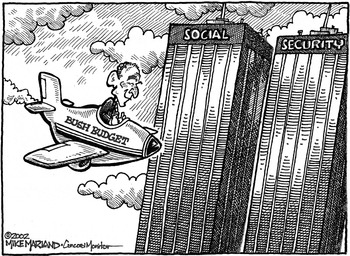
Mike Marland, February 8, 2002. Concord Monitor. Reprinted with permission.
The events of September 11, 2001, fundamentally changed the direction of U.S. foreign and domestic policy. The issue of terrorism, both at home and abroad, became a primary focus of the Bush administration and, as a result, became a natural subject matter for editorial cartoonists. We examine how American editorial cartoonists utilized the images of September 11 in the aftermath of the worst terrorist attack on U.S. soil. These images consist of the twin towers of the World Trade Center (WTC) and ground zero, as well as any images of the attacked Pentagon, and Flight 93 that crashed in Pennsylvania. Cartoons were collected from two web-based catalogs of editorial cartoons: The Association of American Editorial Cartoonists (AAEC), and Daryl Cagle's Professional Cartoonists Index. These two web sites were utilized because they are relatively comprehensive, contain search engines, and have thematically organized cartoons.1
It should be noted that neither site is perfect in any of these respects. The AAEC's web site has an excellent search engine, but is less comprehensive the further back one goes in time. Cagle's web site is very comprehensive, but the search engine is extremely limited. Most American artists are not included in the search, but a large number of their works are available on the main site by browsing by artist's name. Both sites also organize cartoons thematically.
Initial Representations
While most cartoons in the immediate aftermath of the attacks focused on the events of 9-11 and the response in some way, not all of them included images of the attack sites themselves.
In the first time period, the images of 9-11 were primarily used in non-political ways. They were used to memorialize the event; the World Trade Center or a smoking ground zero overwhelmingly dominate these images. In no way did these cartoons attempt to provoke any feelings other than sorrow, rage, dismay, and patriotism. Of the memorializing cartoon type, there were three dominant themes: WWII references, patriotism, and remembrances of heroes and victims. For example, in the immediate aftermath of the attacks, many artists used WWII images (Bok 2001a; Draughon 2001a; Benson 2001a; Anderson 2001; Horsey 2001; Payne 2001a; Ramsey 2001b). Most of these artists made comparisons to the Pearl Harbor attack, but the image of the American flag being hoisted at Iwo Jima was also used, with WWII soldiers replaced with firefighters and a policeman raising a flag amidst the rubble at ground zero. Another prominent theme of the immediate post-attack cartoons involved the patriotic symbol of the Statue of Liberty, Uncle Sam, and/or an eagle paired with smoking twin towers or ground zero (Benson 2001b; 2001c; Parker 2001a; Ramsey 2001a; Margulies 2001a; Stantis 2001a; 2001b; Cole 2001). A final type of editorial cartoon represented images of ground zero that included a tribute to the heroes and victims (Keefe 2001a; Stahler 2001; Margulies 2001b; Ohman 2001; Payne 2001b). On subsequent anniversaries of the attacks during our first time period, many of the patriotic themes are repeated. None of these cartoons included any kind of political statement or critical social commentary, but were simply tributes, memorials, and remembrances.
It is striking that these cartoons bear a strong resemblance to the cartoons that were drawn in the wake of the John F. Kennedy assassination. Collected in a volume entitled A Nation Grieved (Rajski 1967), one encounters the very same themes seen in the cartoons that used the images of 9-11 immediately after the attacks. Many of the cartoons of the Kennedy assassination showed various symbols of the nation (Uncle Sam, Statue of Liberty, eagle) grieving, much like in the immediate post-9-11 cartoons. Pictorial representations of words and images associated with JFK were also prominent, such as his rocking chair, references to Profiles in Courage, and his inaugural address.
There were, however, a group of cartoons after Kennedy's death that did attempt social commentary regarding the assassination; mostly this subset dealt with issues of hatred and gun violence (Rajski 1967). Similarly, in the initial period after the attacks, we do see some editorial cartoonists move away from simply using images of 9-11 in the memorializing type of cartoon, and begin to use the attacks' images in cartoons for social and political commentary, but these are few in our first time period.
In the month after the attacks, three cartoons stand out in this regard. One of the first to attempt social commentary using the WTC was Jeff Parker, who a little more than one week after the attacks, on September 19, drew a cartoon in which the image of the smoking twin towers appeared on the television screen of an Arab-American family, identifiable by the woman's head covering, who, watching in horror, said: “What kind of people could do such a thing?” In the very next frame, the father repeats these words when they encounter anti-Arab graffiti as they open the door to their home, to which the woman responds “I was BORN in New York” (Parker 2001b). The next day, Chip Bok produced a cartoon that questioned why we “never saw it coming” given the 1993 WTC attacks, the 1995 nerve gas attacks in Japan, the 1998 U.S. embassy bombings in Africa, and the 2000 USS Cole attacks (Bok 2001b; 2002, 15). On September 27, Dennis Draughon used a two-panel cartoon to illustrate “Terrorism …” with a picture of the twin towers burning in the first panel, followed by a second panel labeled “Counter-Terrorism …” which showed a member of Congress burning a document with the label “civil liberties” (Draughon 2001b). In these three cartoons, which all appeared within a week of each other and began a little more than a week after 9-11, we see the artists becoming progressively more provocative, moving from a mild social commentary about Americans' behavior, to specific questioning of the state of U.S. intelligence, to criticism of congressional actions. None of these cartoons, however, became controversial.
The cartoon drawn by Mike Marland, which appeared about five months after the attacks, did provoke significant controversy. Shown in Figure 1, the Marland cartoon specifically used the image of the twin towers to comment on a Bush domestic policy unrelated to terrorism, the state of Social Security. It places Bush in the role of a terrorist by having him pilot a plane, labeled “Bush budget,” toward two towers, one labeled “Social,” and the other “Security.” After significant reader criticism, this cartoon prompted the editor to apologize for running the image, caused the artist to destroy the original image, induced a White House statement about the cartoon, and moved CNN's Talkback Live to devote a portion of the show to its discussion (Buncombe 2002; When is Satire Appropriate? 2002). Why did this particular cartoon cause such controversy? Fellow cartoonist Mike Luckovich felt, “it was probably just not the right image to use, because emotions are so raw from September 11 that that kind of overwhelmed the message that he was trying to get across” (When is Satire Appropriate? 2002). This would suggest that to some degree the “unofficial rules of political correctness” mentioned by Hess and Northrop (1996, 20) applied, at least for a time. The key differences between the three earlier cartoons and the Marland cartoon is the subject of the criticism. Marland specifically criticizes the president while using an image of the WTC. Whereas the 9-11 terrorists attacked the heart of New York financial institutions, Marland likens the president to a terrorist attacking a popular and long standing social institution—Social Security.
After the Marland cartoon appeared and shortly before the first anniversary of the attacks, cartoonist Lalo Alcaraz (2002) drew a cartoon with the caption “Remembering 9-11.” It featured some of the same images as the Marland cartoon. Alcaraz shows an image of President Bush, eyes closed with a pleasant expression on his face, with a thought bubble over his head that shows not words, but an image of Saddam Hussein's head as an airplane flying into the twin towers, the implication being that this was how Bush (erroneously) remembered 9-11. There was no ensuing controversy as with the Marland cartoon. Alcaraz's criticism of the president was more subtle than Marland's, and he was also dealing with a related foreign policy issue, rather than making an analogy relating the terrorist attacks to an unrelated domestic policy area.
After the initial crush of memorializing cartoons drawn in the immediate aftermath of the attacks and then on subsequent anniversaries, the images from the 9-11 attacks did not prove to be popular with editorial cartoonists. Only a few cartoons in the three years after the attacks ventured into a category where the images were used politically.2
As a very rough approximation of the proportion of cartoons that used 9-11 imagery in a political manner, the AAEC catalogs 2,152 cartoons from September 11, 2001, to December 31, 2004. A search of the keywords world trade building, World Trade Center, Pentagon, Flight 93, terrorism, terrorist, 9/11, and 9-11 returned 110 cartoons. Of these, only three (2.7%) used images of the 9-11 attacks in a policy-oriented manner. Cartoons, however, were collected both from the AAEC as well as Daryl Cagle's Professional Cartoonists Index.
Recent Representations
In 2005 and until July 31, 2006, our second time period, there is a large decrease in the memorializing type of cartoon; as time passed, the need for this kind of depiction largely ceased. The use of 9-11 images for politically oriented commentary stays roughly constant.3
As another rough approximation of the proportion of cartoons that used 9-11 imagery in a political manner, of the 17,811 cartoons indexed from January 1, 2005, to July 31, 2006, on the AAEC web site, a search of the keywords world trade building, World Trade Center, Pentagon, Flight 93, terrorism, terrorist, 9/11, and 9-11 returned 614 cartoons. Thirteen (2.1%) of these used images of the terrorist attacks in a policy-oriented manner.
Most editorial cartoonists who use images of the terrorist attacks in this time period are critical of some aspect of current policy or politics. One cartoonist, however, has used the images of the twin towers in a way that is critical of those who question Bush administration tactics in the War on Terror. In two very similar cartoons from 2006, Michael Ramirez depicted the burning twin towers in an attempt to remind viewers of the outrage felt after the attacks and uses this outrage to engender support for current policies. In the first cartoon, Ramirez shows both burning towers before collapse. One unseen occupant says “I'm horrified.” Another answers “I know. Can you believe the NSA has been tracking our phone calls?” (Ramirez 2006a). In the second cartoon, Ramirez shows a segment of one of the burning towers before collapse with an airliner headed in that direction. From a military plane above the airliner someone intones “You have the right to remain silent. Anything you say or do can be used against you in a court of law. You have the right to an attorney …” (Ramirez 2006b). Ramirez conjures up the iconic image of the WTC as the vividness of the attacks may be fading from the memory of Americans to justify controversial administration tactics in the War on Terror.
Constricted Symbol?
Have the images of the 9-11 attacks become a constricted symbol? The answer appears to be a qualified yes. Few cartoonists have relied on these images for social and political commentary, but yet these images are an important visual representation of a pivotal event in American social and political history.
As Bok points out, editorial cartoonists tend to be of two types: hard-hitting and funny (2002, 7). There is certainly nothing funny about 9-11 images. The hard-hitting camp of editorial cartoonists, however, did not often resort to using these powerful images even though their profession primarily seeks to provoke their audience. Furthermore, when the images were politicized, they tended to steer away from criticism of the president. The first cartoon that incorporated both an image of President Bush and the WTC engendered a public controversy, perhaps causing many other cartoonists to refrain from pairing these two powerful symbols.
Several commentators have lamented the state of the editorial cartoon in the United States (Lewis 2003; Marlette 2004). Our examination of the use of 9-11 representations suggests a mixed picture of the editorial cartoon's health. While the image of the president was rarely included in editorial cartoons with the images of the 9-11 attacks, it is not as if all editorial cartoons ceased criticism of the president. Political cartoons have a long history of capturing the essence of public policy debates and encouraging the public to question its political officials. Editorial cartoonists need to be free to comment on public policy and criticize (or even support) current policy debates and decisions. The fact, however, that editorial cartoonists rarely used the powerful images of 9-11 in conjunction with an image of the president suggests that the images of 9-11 maintain a unique status, and one that constricts their free usage.


