I. INTRODUCTION
Nowadays, the tantalates semiconductors are widely applied in environmental procedures such as air purification, water disinfection, hazardous waste remediation, and water purification due to their nontoxicity, good stability, and excellent photocatalytic activity. Reference Maeda, Teramura, Lu, Takata, Saito, Inoue and Dome1–Reference Kaschak, Lean, Waraksa, Saupe, Usami and Mallouk4 For example, many tantalates, K3Ta3Si2O13, Reference Kato and Kudo5 alkali tantalates [ATaO3 (A = Li, Na, K)] and alkaline earth tantalates [BTa2O6 (B = Ca, Sr, and Ba)], Reference Kato and Kudo6–Reference Xu, Zhao and Zhu9 lanthanum-doped NaTaO3, Reference Kato, Asakura and Kudo10 lanthanide tantalates LnTaO4 (Ln = La, Ce, Pr, Nd, and Sm), Reference Machida, Murakami and Kijima11 have been reported. It is worth to mention that most of these active photocatalysts are perovskite-related oxide compounds, such as Sr2Ta2O7, Reference Hwang, Kim, Kim, Cha and Lee12,Reference Kudo, Kato and Nkagawa13 KTaO3, Reference Sayama, Arakawa and Domen14,Reference Ishihara, Nishiguchi, Fukamachi and Takkkita15 RbNdTa2O7, Reference Machida, Yabunaka and Kijima16 and so forth. Most of these perovskite structure tantalates photocatalysts, Wiegel Reference Wiegel, Emond, Stobbe and Blasse17 reported that they are consisted of corner-shared TaO6 octahedra in their crystal structure, and the bond angle of Ta–O–Ta is close to 180°. Thus the photogenerated electron–hole pairs can migrate easily in the corner-shared framework of TaO6 units, which is benefit to the photocatalysis reactions. Therefore, tantalates photocatalysts with perovskite-like structure are currently a hot research topic.
In general, these tantalates photocatalysts are mainly synthesized via a conventional solid-state reaction (SSR) at high temperature (typically 1000–1300 °C). Reference Sasaki, Watanabe, Hashizume and Nakazawa18–Reference Sasaki, Ebina, Kitami and Watanabe22 However, it is difficult for the SSR route to control the crystallinity, particle size, and localized segregation of components. It is well known that the morphology and size have extensive influence on the properties of materials. For several applications, particularly as catalysts and for screen printing resistors, a small particle size and high surface area for powders are hope to be synthesized at low temperature. It is obvious that hydrothermal synthesis is a promising method for the direct preparation of advanced nanostructures due to its advantages as a traditional chemical process. Reference Yu, Liu, Mo, Huang, Liu and Qian23 Zhu have reported ultrafine monomolecular-layer Ba5Ta4O15 and Chen have reported Sr2Ta2O7 nanosheet photocatalysts with pyrochlore structure synthesized by hydrothermal method. Reference Xu, Zhang, Shao, Wu and Zhu24,Reference Zhou, Chen, Li, Zhang and Pei25 In both works, the nanosheets showed high photocatalytic activity in the degradation of gaseous formaldehyde and methyl orange. So it is believed that hydrothermal synthesis method can generate highly crystalline products with high purity, narrow size distribution, and low aggregation. Moreover, the morphology and crystalline phase of the products can also be controlled by adjusting the hydrothermal reaction conditions.
Recently, 3D structures photocatalysts consisted of nanoribbons, nanorods, nanosheets have been considered as promising semiconductor nanostructures for decomposing harmful organic contaminants and detecting hazardous gases effectively because of the low density, higher surface area, and higher separation efficiency of photogenerated electrons and holes than the traditional powder. Reference Dong, Feng, Li, Hu, Liu, Wang, Pi, Sun and Sun26–Reference Wu, Lin, Wang, Wang, Guo, Qi, Peng, Hagfeldt, Grätzel and Ma30 Therefore, design and constructing of novel 3D semiconductor architectures are desired, which are significant for achieving high-efficiency photocatalysts.
In this work, we report a simple hydrothermal route for the synthesis of 3D Ba5Ta4O15 flower-like microsphere photocatalyst. The optimum reaction parameters, microstructure, and morphology of resultant photocatalyst were investigated to improve photocatalytic activities, and a possible growth mechanism is proposed. The photocatalytic performance of this 3D Ba5Ta4O15 flower-like microsphere photocatalyst for the photodegradation of Methylene Blue (MB) has been investigated and found to be distinctly more active than the bulk Ba5Ta4O15 microsphere obtained by SSR at 1000 °C.
II. EXPERIMENTAL SECTION
A. Synthesis of 3D Ba5Ta4O15 flower-like microsphere
3D Ba5Ta4O15 flower-like microsphere was synthesized by a hydrothermal method. All chemicals were analytical grade and used as received without any further purification. In a typical synthesis procedure, the 3D Ba5Ta4O15 flower-like microsphere structure was synthesized from a mixture of 10 mL Ba(OH)2·8H2O solution (0.2, 0.3, and 0.4 M) and 0.110 g of Ta2O5 (0.25 mmol) were added into a Teflon-lined stainless steel autoclave (20 mL capacity) that was filled with the mixture to 50% of the total volume. After heating the autoclave at a temperature between 160 and 200 °C for a designed period of time under autogenerous pressure, it was allowed to cool to room temperature naturally. The white product was collected by centrifugation at 8000 rpm, washed with deionized water and ethanol three times, and finally dried at 80 °C in an oven for 24 h before further characterization.
B. Characterization
The powder x-ray diffraction (XRD) measurements were performed on a Bruker D8 diffractometer (Bruker Corporation, Karlsruhe, Germany) using the Cu Kα radiation source. The morphologies and composition of the photocatalyst were examined with scanning electron microscopy (SEM; Hitachi S-4800 II, Tokyo, Japan) equipped with an energy-dispersive x-ray spectroscope (EDS) operating at an acceleration voltage of 10 kV. The microstructure of the photocatalyst was analyzed by transmission electron microscopy (TEM) and high-resolution transmission electron microscopy (HRTEM), which was performed with a FEI JEM-2100 and FEI Tecnai G2 F20 transmission electron microscope (FEI Company, Tokyo, Japan) using an accelerating voltage of 200 KV. X-ray photoelectron spectroscopy (XPS) was performed with a VG ESCALAB 250 spectrometer (Thermo Fisher Scientific, Yokohama, Japan) using a nonmonochromatized Al Kα x-ray source. The UV–vis diffusereflectance spectra (DRS) of the photocatalyst was recorded with a UV–vis spectrophotometer (Shimadzu UV-3100, Shimadzu Corporation, Tokyo, Japan) using BaSO4 as a reference. Steady state luminescence (PL) experiment was performed using a Quantamaster-QM4m spectrofluorimeter (Photon Technology International, Edison, New Jersey) equipped with a 75 W lamp and dual excitation monochromators. The specific areas of the powders were determined with a Micromeritics ASAP 2020 specific area analyzer (Micromeritics, Norcross, Georgia) using the Brunauer–Emmett–Teller (BET) method. The photocurrent was measured with an electrochemical analyzer (CHI 660B, Chenhua Instrument Company, Shanghai, China).
C. Photocatalytic tests
The photocatalytic degradation of MB using the 3D Ba5Ta4O15 flower-like microsphere photocatalyst was carried out in a home-built reactor. 0.1 g of the photocatalyst was dispersed into a beaker with a water jacket so that the suspensions were kept at constant temperature by circulating thermostatted water through the jacket. The beaker was filled with 100 mL of 10 mg/L MB. Prior to irradiation, the suspensions were ultrasonically sonicated for 10 min and magnetically stirred for 30 min in the dark. After it reached the adsorption balance, the initial absorbance was determined. The photocatalytic reaction was performed by irradiating with a 300 W medium voltage UV lamp. 5.0 mL of solution was taken out every 15 min, centrifuged and sent to UV–vis absorption measurement.
D. Photoelectrochemical measurements
To investigate the photoelectrochemical properties of as prepared 3D Ba5Ta4O15 flower-like microsphere and bulk Ba5Ta4O15 microcrystal photocatalysts, the procedure for the preparation of the modified electrodes was described as follows: colloidal suspensions were synthesized by 0.3 g photocatalyst obtained according to in 3 mL ethanol, 0.01 g polyvinylpyrrolidone (PVP), and 0.03 mL oleic acid, where the ethanol was used as a solvent and PVP as well as oleic acid were used as a dispersant agent. The resulting colloidal dispersion then getting dropped onto a piece of FTO slice. All the photoelectrochemical measurements were measured on an electrochemical analyzer in a standard three-electrode system using the prepared photocatalysts as the working electrodes, a Pt wire as the counter electrode, and Ag/AgCl (saturated KCl) as a reference electrode. A 50 W Xe arc lamp served as a light source. The photocurrent was performed in sodium sulfate solution (Na2SO4, 0.5 M, pH 7.0).
III. RESULT AND DISCUSSION
A. Effect of alkaline concentration
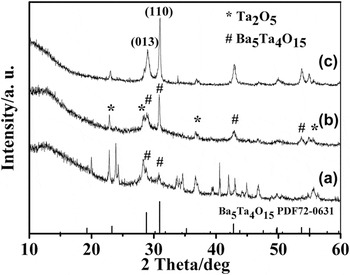
It is well known that in the hydrothermal process, the concentration of Ba(OH)2 is the key factor that affects the growth of the 3D Ba5Ta4O15 flower-like microsphere photocatalyst structure and component. Therefore, the investigations have been conducted with different Ba(OH)2 concentrations in the 3D Ba5Ta4O15 flower-like microsphere preparation. Figure 1 shows the XRD patterns of the photocatalysts derived from different Ba(OH)2 concentrations. It can be seen that when the Ba(OH)2 solution concentration is 0.2 M, several sharp peaks of Ba5Ta4O15 are observed. And these peaks can be attributed to the crystalline Ba5Ta4O15 which based on standard diffraction patterns of Ba5Ta4O15 with the reported data in the JCPDS cards (18-0193/72-0631). Reference Dobal, Katiyar, Jiang, Guo and Bhalla31,Reference Yang, Kong, Hou and Yan32 When the concentration is increased to 0.3 M, the peaks of Ba5Ta4O15 become much sharper and more intense, but the diffraction peaks of the raw material (Ta2O5) are still existent, suggesting that the hydrothermal reaction is not completed. However, when the Ba(OH)2 concentration is 0.4 M, the Ba5Ta4O15 microcrystal as the main phase. Therefore, we can conclude that the high Ba(OH)2 concentration favored the Ba5Ta4O15 microcrystal formation.
XRD patterns of the as-prepared photocatalyst at 200 °C for 7 days, with different Ba(OH)2 concentrations (a) 0.2 M, (b) 0.3 M, and (c) 0.4 M.

B. Effect of the reaction temperature and time
To determine the reaction temperature and time for the 3D Ba5Ta4O15 flower-like microsphere to be well crystallized, the precursor suspension was heated for 7 days at different temperatures from 160 to 200 °C with the 0.4 M Ba(OH)2 solution. The resulting XRD patterns are shown in Figure S1. It is clearly seen that when the reaction temperature as 160 °C, the XRD pattern of the Ba5Ta4O15 remains the same as that of Ta2O5. With the increase of hydrothermal temperature, the peaks attribute to the Ta2O5 phase decreased and the phase of Ba5Ta4O15 are strength. When the temperature is further increased to 200 °C, the Ba5Ta4O15 microcrystal is obtained mostly. Therefore, the reaction temperature plays an important role to govern the formation of Ba5Ta4O15 microcrystal, and in our study the optimum temperature for the preparation of pure phase Ba5Ta4O15 is 200 °C or higher.
Figure S2 shows the XRD patterns of the Ba5Ta4O15 synthesized at 200 °C for various reaction times with 0.4 M Ba(OH)2 solution. It can be seen that the Ba5Ta4O15 microcrystal phase was not formed incompletely when the reaction time was less than 7 days. Until 7 days of the hydrothermal reaction, a well crystallized Ba5Ta4O15 phase was formed. The Ta2O5 was converted to Ba5Ta4O15 gradually and the intensity of the diffraction peak becomes stronger as the reaction time prolongs. In addition, it is worthwhile to mention that Ba5Ta4O15 microcrystal photocatalyst was prepared by a hydrothermal method at 200 °C for 7 days with 0.4 M Ba(OH)2 solution.
C. XPS analysis
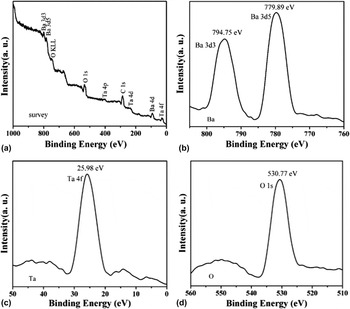
The XPS analysis provided further information for the evaluation of the 3D Ba5Ta4O15 flower-like microsphere photocatalyst. As shown in Fig. 2(a), the XPS survey spectrum demonstrates no peaks of other elements than Ba, Ta, O, and C. The XPS spectra are charge corrected to the adventitious C1s peak at 284.6 eV. The two peaks of Ba region at 794.75 and 779.89 eV correspond to Ba3d3 and Ba3d5, respectively [Fig. 2(b)]. The Ta4f peak for the Ba5Ta4O15 is shown in Fig. 2(c), with the value of about 25.9 eV. Meanwhile, the peak located at 530.77 eV can be assigned to O1s [Fig. 2(d)]. The XPS results are consistent with the XRD analysis.
XPS survey spectrum (a) and XPS spectra of Ba3d (b), Ta4f (c) and O1s (d) of the flower-like Ba5Ta4O15.

D. Morphology characterizations
The SEM and EDS images are shown in Fig. 3 to further investigate the influence of the concentration of Ba(OH)2, reaction temperature and time on the 3D Ba5Ta4O15 flower-like microsphere morphology evolution and microstructures. As shown in Figs. 3(a) and 3(b), with the addition of Ba(OH)2 at 0.2 and 0.3 M concentration, the 3D Ba5Ta4O15 flower-like microsphere start to emerge, but there are many small irregular colloids coexisted on the surface of the Ba5Ta4O15, which are ascribed to the reactant of Ta2O5. A similar and obvious phenomenon for the different reaction temperature and time are shown in Fig. S3, respectively. Finally, when the addition of Ba(OH)2 at 0.4 M concentration, the reaction temperature is 200 °C and the time is 7 days, the smaller colloids disappear, almost all the products exhibit the 3D flower-like microsphere morphology with the average size of 1 µm as shown Fig. 3(c). The evolution process of Ta2O5 to 3D Ba5Ta4O15 flower-like microsphere in SEM images is in good agreement with the XRD results. This means that the growth of 3D Ba5Ta4O15 flower-like microsphere advances with the passage of the concentration of Ba(OH)2, reaction temperature and time. At the same time, the chemical composition of the 3D Ba5Ta4O15 flower-like microsphere is further confirmed by EDS analysis. As shown in Fig. 3(d), Ba, Ta, and O peaks are observed in this spectrum. It proves that the Ba5Ta4O15 photocatalyst is prepared successfully.
The 3D Ba5Ta4O15 flower-like microsphere SEM images: (a) Ba(OH)2 0.2 M, 7 days and 200 °C, (b) Ba(OH)2 0.3 M, 7 days and 200 °C, (c) Ba(OH)2 0.4 M, 7 days and 200 °C, (d) EDS image of Ba5Ta4O15.

Detailed structural information about the 3D Ba5Ta4O15 flower-like microsphere was further investigated by TEM, HRTEM, and SAED. Figure S5a gives typical low-magnification TEM image of 3D Ba5Ta4O15 flower-like microsphere and indicates that some black microspheres could be found. Meanwhile, there are some scattered nanosheets which can be observed among the particles. Figure S5b shows the arrangement of the 3D Ba5Ta4O15 flower-like microsphere via HRTEM and selected area electron diffraction (SAED). It can be seen clearly that the Ba5Ta4O15 crystallites have distinct lattice spacing, and the lattice spacing is determined to be 0.297 nm, corresponding to the (110) crystallographic planes and the SAED pattern shows a hexagonal array of sharp spots, and can be indexed as hexagonal Ba5Ta4O15. The results of HRTEM and SAED patterns which are consistent with the XRD.
E. Possible growth mechanism of 3D Ba5Ta4O15 flower-like microsphere
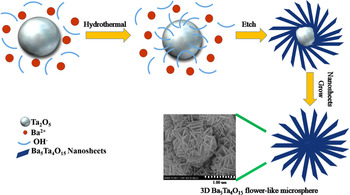
It is well known that Ta2O5 powders can translate to the corresponding hydroxide, i.e., Ta2O5·xH2O or Ta(OH)5, under the high temperature and pressure with the hydroxide. Reference Xu, Zhang, Shao, Wu and Zhu24,Reference Liu, Shao, Liang, Liu, Jia and Xu33 In our work, based on the above SEM images and XRD patterns results of the products obtained in the different time and temperature series, we propose a mechanism that the formation of the 3D Ba5Ta4O15 flower-like microsphere. As shown in Scheme 1, firstly, the surface of Ta2O5 powders is dissolved gradually and hydroxylated into the corresponding hydroxide with the OH−. Namely, the dissolved Ta2O5 formed a highly disordered colloidal precursor such as Ta2O5·xH2O and Ta(OH)5 with increasing temperature and pressure. Secondly, with the time prolonged and temperature elevated, the Ta2O5·xH2O and Ta(OH)5 could grow to form Ba5Ta4O15 nanosheets on the surface of Ta2O5 powders. The Ba5Ta4O15 nanosheets grow along the a- and b-axes as Zhu reported. Reference Xu, Zhang, Shao, Wu and Zhu24 Finally, the 3D Ba5Ta4O15 flower-like microsphere with a size of about 1 µm were formed at 200 °C and after 7 days of hydrothermal processing with the Ta2O5 etched by Ba(OH)2 at 0.40 M concentration.
Schematic growth mechanism of the formation process for 3D Ba5Ta4O15 flower-like microsphere.

F. Comparison to the bulk Ba5Ta4O15 microcrystal
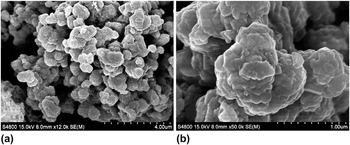
The bulk Ba5Ta4O15 microcrystal was obtained by a SSR at 1000 °C and serves as a standard for comparison to the materials obtained by the hydrothermal method. Reference Marschall, Soldat and Wark34 The XRD patterns of Ba5Ta4O15 crystallized are shown in Fig. S4. The peaks in the 3D Ba5Ta4O15 flower-like microsphere are the same as the SSR Ba5Ta4O15, suggesting that we achieved Ba5Ta4O15 by two kinds. Figure 4 exhibits the typical SEM images of Ba5Ta4O15 crystallized prepared using SSR. It can be seen that the spherically shaped Ba5Ta4O15 with nonuniform sizes is formed.
SEM images of the Ba5Ta4O15 synthesized using SSR: (a) the low magnification SEM image, (b) the high magnification SEM image.

G. Photoabsorbance property
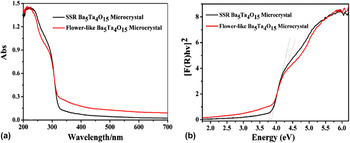
The absorbance of the 3D Ba5Ta4O15 flower-like microsphere and the bulk Ba5Ta4O15 microcrystal were examined by using a UV–vis spectrometer. Figure 5(a) shows the typical diffuse reflection spectra. It is of interest to observe that the onsets of the absorption for the specimens are different and have values of 316 and 320 nm for the hydrothermal and solid states, respectively. From Fig. 5(b), it could be found that Ba5Ta4O15 was a wide band gap semiconductor which only can be photoexcitated under UV light. The band gap of 3D Ba5Ta4O15 flower-like microsphere was about 3.74 eV which was lower than that of bulk Ba5Ta4O15 microcrystal (about 3.79 eV). A lower band gap favors the electronic transitions and could excite easier production of active species, which subsequently result in an enhanced photocatalytic activity.
(a) UV–vis absorption spectra and (b) calculated band gap of the 3D Ba5Ta4O15 flower-like microsphere and SSR sample.

H. Photocatalytic properties of 3D Ba5Ta4O15 flower-like microsphere
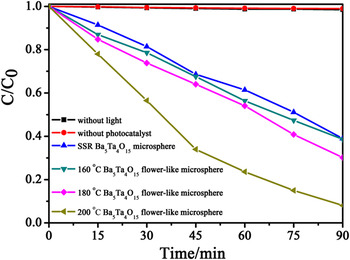
The photocatalytic activity of the 3D Ba5Ta4O15 flower-like microsphere has been studied in photodegradation reactions of MB under UV light irradiation. Before the photocatalytic reaction, the MB solution was first photolyzed in the absence of the photocatalyst to examine their stability. Figure 6 shows the degradation curves for MB in the presence of Ba5Ta4O15 microcrystal prepared at different temperatures. The degradation ratio of MB without light and any photocatalyst is almost unchanged in 90 min under UV light irradiation. Therefore, the presence of both catalysts and illumination is necessary for efficient degradation. From Fig. 6, it is obviously found that the photocatalyst prepared by 7 days reaction at 200 °C has the highest photocatalytic activity. After irradiation for 90 min, 60% of MB was photodegraded by bulk Ba5Ta4O15 microcrystal (SSR), while 60, 70, and 92% of MB can be photodegraded using 3D Ba5Ta4O15 flower-like microsphere which was synthesized by the hydrothermal method at 160 °C, 180 °C, 200 °C, respectively. The 200 °C Ba5Ta4O15 shows an improvement of 32% than bulk Ba5Ta4O15 microcrystal, which indicate the 3D Ba5Ta4O15 flower-like microsphere plays a crucial role on the improvement of photocatalytic performance. At the same time, the photocatalytic activity of the photocatalysts increases with the reaction temperature used for the preparing the microcrystal, owing to the better crystalline order of structure formed at higher temperatures.
Photodegeradation reactions of MB under UV light irradiation.

I. Nitrogen adsorption analysis
Considering our prepared photocatalysts, the enhancement may be attributed to large surface area. The Brunauer–Emmett–Teller (BET) specific surface areas of the Ba5Ta4O15 photocatalysts were investigated using nitrogen adsorption and desorption isotherms. The Ba5Ta4O15 photocatalyst from the solid-state routes was calculated to be 9.748 m2/g, which was much lower than the 3D Ba5Ta4O15 flower-like microsphere (16.640 m2/g) prepared by hydrothermal process. It is known that the larger surface areas can absorb more active species and reactants on its surface. Reference Di, Xia, Ge, Xu, Xu, He, Zhang and Li35 Compared to bulk Ba5Ta4O15 microsphere, the 3D flower-like microsphere structure has a significant promotion of the holes generated inside the crystal, which can be transferred to the surface and can interact with the organic molecules. Reference Xu, Shi, Fan, Dong, Shi and Hu36 Therefore, it can be assumed that the 3D Ba5Ta4O15 flower-like microsphere with higher BET surface area have the enhanced photocatalytic activity.
J. Photoluminescence spectra analysis
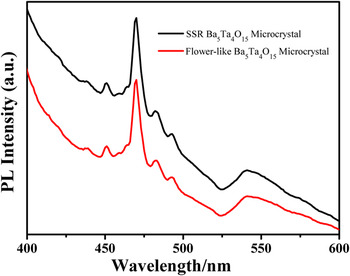
It is well-known that photoluminescence spectra could be used to confirm the recombination of photogenerated electrons and holes. The higher intensity of PL spectra represents the higher recombination probability of photogenerated charges. Reference Xu, Xia, Wang, Wang, Li, Xu, Huang and He37 Figure 7 shows the PL spectra of 3D Ba5Ta4O15 flower-like microsphere and SSR Ba5Ta4O15 microcrystal, with the excitation wave length at 362 nm. The 3D Ba5Ta4O15 flower-like microsphere displays lower PL intensity than SSR Ba5Ta4O15 microcrystal, which means the 3D Ba5Ta4O15 flower-like microsphere has a higher separation efficiency of photogenerated electrons and holes. It can be seen from the SEM images that the 3D Ba5Ta4O15 flower-like microsphere are tightly self-assembled by nanosheets. The excellent interface contact favors the faster interfacial charge transfer. Therefore, the designed 3D flower-like architectures could contribute to the improvement in the separation efficiency of photogenerated electrons and holes and hence, a higher photocatalytic activity. Reference Cheng, Huang and Dai38
PL spectra of the as-prepared 3D Ba5Ta4O15 flower-like microsphere and the SSR Ba5Ta4O15.

K. Electrochemistry analysis
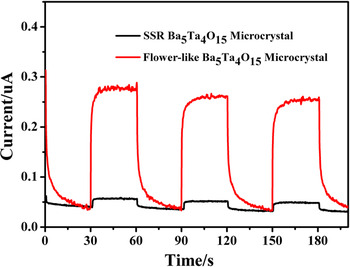
The as-prepared 3D Ba5Ta4O15 flower-like microsphere and SSR Ba5Ta4O15 were applied as electrode materials to test their electrochemical impedances. Figure 8 reveals the photocurrents measured for 3D Ba5Ta4O15 flower-like microsphere and SSR Ba5Ta4O15 photocatalysts. It can be seen that the photocurrent intensity of the 3D Ba5Ta4O15 flower-like microsphere was 2.5 times higher than that of SSR Ba5Ta4O15, which means an improvement of the separation efficiency of photoinduced electrons and holes. Reference Xu, Hessel, Ren, Yu, Jin, Yang, Zhao and Wang39 The result of the photocurrents analysis was consistent with the PL analysis, which further confirmed the higher interfacial charge transfer rate and enhanced photoinduced charge carrier separation efficiency of the 3D Ba5Ta4O15 flower-like microsphere.
Photocurrent spectra of the as-prepared 3D Ba5Ta4O15 flower-like microsphere and the SSR Ba5Ta4O15.

IV. CONCLUSION
The 3D Ba5Ta4O15 flower-like microsphere photocatalyst was successfully synthesized by a facile hydrothermal method. The formation conditions of the 3D flower-like microspheres such as alkaline concentration, reaction temperature, and time played important roles. The growth mechanism of the 3D flower-like microsphere morphology was proposed. The photocatalytic degradation of MB indicated that 3D Ba5Ta4O15 flower-like microsphere had high photocatalytic activity under UV light radiation. The higher photocatalytic activity of the 3D Ba5Ta4O15 flower-like microsphere mainly resulted from the large surface area and the charge carrier separation efficiency than the bulk Ba5Ta4O15 microsphere. Importantly, our work suggests that this hydrothermal method can be utilized for preparing other tantalates semiconductor materials with high photocatalytic activity.
Supplementary Material
To view supplementary material for this article, please visit http://dx.doi.org/10.1557/jmr.2016.280.
ACKNOWLEDGMENTS
The authors would like to acknowledge the National Natural Science Foundation of China (21477050, 21301076 and 21303074), the Chinese-German Cooperation Research Project (GZ1091), the Excellent Youth Foundation of Jiangsu Scientific Committee (BK20140011), the Program for New Century Excellent Talents in University (NCET-13-0835), the Henry Fok Education Foundation (141068), and Six Talents Peak Project in Jiangsu Province (XCL-025).