

Introduction
Before every election, ordinary citizens step forward to seek political candidacy and pursue elected office. Political ambition, or the desire to seek political office, is therefore a fundamental element of the democratic system and is a requirement for a well-functioning representative democracy (Lawless and Fox, Reference Lawless and Fox2015). While political parties play important gatekeeper and recruitment functions (Caul, Reference Caul1999; Norris and Lovenduski, Reference Norris and Lovenduski1995; Pruysers and Cross, Reference Pruysers and Cross2016; Pruysers et al., Reference Pruysers, Cross, Gauja, Rahat, Scarrow, Webb and Poguntke2017), citizens must nonetheless have a desire to pursue such a career before agreeing to run for office.Footnote 1 It is therefore important to explore the individual differences in political ambition and understand who is most likely to express interest in a political career.
The political ambition literature has grown substantially in the last three decades, with much attention devoted to understanding individual differences in the decision to run for office or, at the very least, a desire or interest to run for office. To date, this scholarship has uncovered a number of correlates to political ambition, including socio- demographic factors such as religion and race (Moore, Reference Moore2005; Shah, Reference Shah2015), childhood political socialization (Fox and Lawless, Reference Fox and Lawless2005; Greenlee et al., Reference Greenlee, Holman and Vansickle-Ward2014), negative gender stereotypes (Pruysers and Blais, Reference Pruysers and Blais2017), political recruitment (Fox and Lawless, Reference Fox and Lawless2010; Preece et al., Reference Preece, Stoddard and Fisher2016), life circumstances and family roles (Fox and Lawless, Reference Fox and Lawless2011, Reference Fox and Lawless2014; Galais et al., Reference Galais, Öhberg and Coller2016), attitudes about politics (Schneider et al., Reference Schneider, Holman, Diekman and McAndrew2016), competition aversion (Kanthak and Woon, Reference Kanthak and Woon2015), and gender (Burt-Way and Kelly, Reference Burt-Way and Kelly1992; Costantini, Reference Costantini1990; Palmer and Simon, Reference Palmer and Simon2003; Pruysers and Blais, Reference Pruysers and Blais2018a).
The purpose of this study is threefold. First, although the literature on the topic has identified an impressive list of correlates to political ambition, it has largely ignored the importance of an individual's personality. Personality refers to an individual's characteristic way of being. Personality is generally thought to be stable within every individual and predicts how individuals will behave in a variety of situations. As Feist and Feist (Reference Feist and Feist2009: 4) note: “Although no single definition is acceptable to all personality theorists, we can say that personality is a pattern of relatively permanent traits and unique characteristics that give both consistency and individuality to a person's behavior.” Several models of personality are widely accepted and typically distinguish between general and dark personality traits. The HEXACO model (Ashton et al., Reference Ashton, Lee, Perugini, Szarota, de Vries, Di Blas, Boies and De Raad2004; Ashton and Lee, Reference Ashton and Lee2008), for instance, captures the general traits of honesty-humility, emotionality, extraversion, agreeableness, consciousness and openness, while the Dark Triad model of personality (Paulhus and Williams, Reference Paulhus and Williams2002) describes Machiavellianism, narcissism and psychopathy. The exclusion of personality is an important oversight in the ambition literature, as these traits are consistently related to a number of political outcomes such as vote choice, ideology, civic duty and political participation (Blais and Labbé-St-Vincent, Reference Blais and Labbé-St-Vincent2011; Mondak, Reference Mondak2010; Schoen and Schumann, Reference Schoen and Schumann2007). In this study, we therefore pay close attention to the role of personality.
Second, while two studies of personality and nascent political ambition have been conducted (Blais and Pruysers, Reference Blais and Pruysers2017; Allen and Cutts, Reference Allen and Cutts2018), both explore the role of personality without controlling for any other factors. Our analysis, by contrast, considers the role of personality while controlling for a variety of other confounds, including gender, age, income, education, political interest and political knowledge. It is therefore the first study of its kind to demonstrate how individual differences in general and dark personality traits contribute to our understanding of political ambition above and beyond a number of traditional explanations found in the literature.
Third, the vast majority of the political-ambition literature is derived from the United States (see, for example, Carroll, Reference Carroll1985; Costantini Reference Costantini1990; Elder, Reference Elder2004; Lawless and Fox, Reference Lawless and Fox2005, Reference Lawless and Fox2013; Fox and Lawless, Reference Fox and Lawless2005). To date, research on political ambition in Canada has relied on university students (Blais and Pruysers, Reference Blais and Pruysers2017; Pruysers and Blais, Reference Pruysers and Blais2017; Pruysers and Blais, Reference Pruysers and Blais2018b), and we address this limitation by examining political ambition among a more representative sample of Canadian voters.
Using a sample of 371 Canadian citizens, we examine the role of personality in predicting both interest in and efficacy for a political career. Across several measures of political ambition, we find considerable support for the importance of personality, even after controlling for well-established socio-demographic variables (for example, gender, political interest). More specifically, political ambition is most consistently related to lower levels of honesty-humility and higher levels of extraversion and narcissism. These findings have important implications for understanding why some individuals may choose a career in politics while others may avoid such a vocation.
Political Ambition
Political ambition does not refer to a singular concept. Progressive ambition, for example, refers to the desire of already elected officials to further advance their political careers (see, for example, Dietrich et al., Reference Dietrich, Lasley, Mondak, Remmel and Turner2012; see also Schlesinger, Reference Schlesinger1966). Although important information can be obtained from studying political elites, these studies do not provide information on people's initial motivation to pursue a political career. Additionally, selection into a political career has already occurred for these individuals, reducing the influence of social, demographic, and personality factors on progressive ambition. Instead, we are interested in nascent political ambition, which refers to the initial thinking of, or desire for, a career in politics. Thus we focus our attention on ordinary citizens rather than on existing elected officials. The literature has also sometimes distinguished between interest in a political career (that is, thought about running for office) and efficacy in a political career (that is, qualifications for office) as two potentially distinct components of ambition (see, for example, Pruysers and Blais, Reference Pruysers and Blais2017). Here we consider both components in our analyses.
In a seminal study of nascent political ambition, Fox and Lawless (Reference Fox and Lawless2005) examined socio-demographic variables (such as gender, age, income) and structural variables (for example, likelihood of winning, term limits) among a large sample of potential political candidates in their candidate eligibility pool. Participants were asked whether they had ever considered running for office, and the results revealed that higher levels of ambition were predicted by self-perceived qualification, political interest, being a white man, lower income, younger age and early socialization (family socialization and ran for office in school). None of the structural variables considered in the analysis significantly predicted political ambition.
Several other studies have also confirmed the importance of variables such as race (Moore, Reference Moore2005), gender (Burt-Way and Kelly, Reference Burt-Way and Kelly1992; Costantini, Reference Costantini1990; Palmer and Simon, Reference Palmer and Simon2003; Pruysers and Blais, Reference Pruysers and Blais2017), attitudes about politics (Schneider et al., Reference Schneider, Holman, Diekman and McAndrew2016) and political socialization (Greenlee et al., Reference Greenlee, Holman and Vansickle-Ward2014) in predicting political ambition. One variable that has been largely ignored in the study of political ambition, however, is personality. Personality refers to identifiable traits that are stable and enduring within any individual. As individuals interact with their environment, personality traits can result in consistent and predictable outcomes (Larsen and Buss, Reference Larsen and Buss2010). For example, personality can be used to predict whether someone would engage in conversation with a stranger (that is, high extraversion) or enjoy visiting an art museum (that is, high openness).
Despite the relative lack of attention to personality in the literature, to the extent that we desire politicians who are competent and capable of working together to construct legislation, the personality traits that predict ambition are of significant importance. An extensive body of research demonstrates the importance of the Big Five (DeShong et al., Reference Deshong, Grant and Mullins-Sweatt2015), HEXACO (Lee et al., Reference Lee, Ashton and de Vries2005) and Dark Triad (O'Boyle et al., Reference O'Boyle, Forsyth, Banks and McDaniel2012) personality traits in predicting pro- and anti-social workplace behaviours, suggesting that the personality selection pressures for political ambition are likely to have downstream consequences on the style and substance of policy making, representation and deliberation within legislatures.
General Personality
For several decades, the most prominent taxonomy of personality has been the five-factor model (FFM), also known as the Big Five personality traits (Costa and McCrae, Reference Costa and McCrae1995; McCrae and John, Reference McCrae and John1992; Saucier and Goldberg, Reference Saucier and Goldberg1996). The traits included are openness to experience (for example, ideas, actions), conscientiousness (for example, competence, order), extraversion (for example, gregariousness, assertiveness), agreeableness (for example, trust, compliance) and neuroticism (for example, anxiety, anger hostility). Subsequent research has consistently identified these five dimensions across a variety of populations, including adults, youth and students (for example, Botwin and Buss, Reference Botwin and Buss1989; Digman and Inouye, Reference Digman and Inouye1986; McCrae and Costa, Reference McCrae and Costa1989). The vast majority of studies of personality in politics utilize the FFM (for example, Gerber et al., Reference Gerber, Huber, Doherty, Dowling and Ha2010, Reference Gerber, Huber, Doherty, Dowling, Raso and Ha2011; Mondak, Reference Mondak2010; Mondak and Halperin, Reference Mondak and Halperin2008).
Despite the wide acceptance of the FFM, several large-scale English and non-English lexical studies conducted within the last 10 years have identified six dimensions of personality known as the HEXACO model (Ashton et al., Reference Ashton, Lee, Perugini, Szarota, de Vries, Di Blas, Boies and De Raad2004; Ashton and Lee, Reference Ashton and Lee2008) consisting of: honesty-humility (H), emotionality (E), extraversion (X), agreeableness (A), conscientiousness (C), and openness to experience (O). Although the extraversion, conscientiousness, and openness to experience dimensions closely resemble those of the FFM (Lee and Ashton, Reference Lee and Ashton2004; Lee et al., Reference Lee, Ashton and de Vries2005), the remaining dimensions of honesty-humility, emotionality, and agreeableness are distinct from the FFM (see Lee and Ashton, Reference Lee and Ashton2006). The new factor, honesty-humility, is characterized by modesty, sincerity and trust (Ashton and Lee, Reference Ashton and Lee2008). Emotionality within the HEXACO model is defined as fearfulness, anxiety, dependence and sentimentality, as opposed to the low emotional stability that defines FFM neuroticism. Agreeableness in the HEXACO model is defined as forgiveness, tolerance and being even-tempered, in contrast to the FFM, which does not include emotional stability within the agreeableness factor (Lee and Ashton, Reference Lee and Ashton2006).
In this sense, the greater specificity of the HEXACO model, especially with regard to emotional stability, represents an important improvement over the FFM for political scientists. To the extent that anxiety and low emotional stability produce distinct political responses (Huddy et al., Reference Huddy, Feldman, Cassese, Marcus, Russell Neuman and MacKuen2007; Valentino et al., Reference Valentino, Brader, Groenendyk, Gregorowicz and Hutchings2011), the FFM problematically conflates these within the neuroticism domain in a way that the HEXACO does not. Furthermore, others have argued that honesty and integrity are important factors to consider in the examination of political behaviours and that these traits are captured only within the HEXACO model of personality (Chirumbolo and Leone, Reference Chirumbolo and Leone2010).
The Dark Triad
In addition to the FFM and the HEXACO, personality scholars have identified more negative or “dark” personality traits. The most prominent model of dark personalities is the Dark Triad (Paulhus and Williams, Reference Paulhus and Williams2002), consisting of Machiavellianism (for example, manipulative and calculating; Christie and Geis, Reference Christie and Geis1970), narcissism (for example, arrogant, entitled and grandiose; Rhodewalt and Peterson, Reference Rhodewalt, Peterson, Leary and Hoyle2009), and psychopathy (for example, callous affect, interpersonal manipulation, erratic lifestyle and antisocial behaviour; Hare, Reference Hare2003). The Dark Triad has been correlated with a number of negative outcomes such as antisocial behaviour (Furnham et al., Reference Furnham, Richards and Paulhus2013), short-term mating strategies (Jonason et al., Reference Jonason, Valentine, Li and Harbeson2011), desire for power and money (Lee et al., Reference Lee, Ashton, Wiltshire, Bourdage, Visser and Gallucci2013), and bullying (Book et al., Reference Book, Volk and Hosker2012). To be sure, aspects of the Dark Triad have also been associated with positive outcomes, such as enhanced leadership abilities, persuasiveness and crisis management (Lilienfeld et al., Reference Lilienfeld, Waldman, Landfield, Watts, Rubenzer and Faschingbauer2012; Watts et al., Reference Watts, Lilienfeld, Smith, Miller, Keith Campbell, Waldman, Rubenzer and Faschingbauer2013).
Personality and Political Behaviour
Although the ambition literature has largely ignored the importance of personality, personality has actually been examined as a predictor for a number of other established political behaviours, such as political ideology (Chirumbolo and Leone, Reference Chirumbolo and Leone2010; Schoen and Schumann, Reference Schoen and Schumann2007; Gerber et al., Reference Gerber, Huber, Doherty, Dowling and Ha2010), vote choice (Barbaranelli et al., Reference Barbaranelli, Caprara, Vecchione and Fraley2007; Schoen and Schumann, Reference Schoen and Schumann2007), a sense of civic duty (Blais and Labbé-St-Vincent, Reference Blais and Labbé-St-Vincent2011), and political participation (Vecchione and Caprara, Reference Vecchione and Caprara2009; Gerber et al., Reference Gerber, Huber, Doherty, Dowling, Raso and Ha2011). For example, studies have consistently reported that openness to experience is related to more liberal views, while conscientiousness is related to more conservative views (Barbaranelli et al., Reference Barbaranelli, Caprara, Vecchione and Fraley2007; Chirumbolo and Leone, Reference Chirumbolo and Leone2010; Jonason, Reference Jonason2014; Jost et al., Reference Jost, West and Gosling2009). Additionally, Vecchione and Caprara (Reference Vecchione and Caprara2009) report that higher levels of extraversion and openness to experience are significantly related to self-efficacy, which in turn is related to higher levels of political participation among university students.
In terms of the added benefit of considering the HEXACO model of personality in the prediction of political behaviours, Jonason (Reference Jonason2014) finds that higher levels of honesty-humility are significantly related to increased levels of conservatism, a finding that would not have been evident within the FFM. Interestingly, this finding may be specific to the United States, as other studies conducted in Europe have indicated the opposite—that honesty-humility is related to voting and support for more liberal parties and values (Chirumbolo and Leone, Reference Chirumbolo and Leone2010; Kajonius and Dåderman, Reference Kajonius and Dåderman2014; Zettler and Hilbig, Reference Zettler and Hilbig2010). In terms of other HEXACO factors, Valentino et al. (Reference Valentino, Brader, Groenendyk, Gregorowicz and Hutchings2011) find that anxiety is significantly related to less political participation. When examining the incremental validity of both the FFM and HEXACO, Chirumbolo and Leone (Reference Chirumbolo and Leone2010) conclude that the HEXACO model adds incrementally to the prediction of political ideology over the FFM but that the opposite is not the case (the FFM did not add incrementally over and above the HEXACO model).
Given that personality has emerged as an important predictor of so many other political outcomes, it seems reasonable to expect that a consideration of personality has the potential to greatly add to our understanding of political ambition. To our knowledge, however, only three studies have ever explored personality and political ambition (Allen and Cutts, Reference Allen and Cutts2018; Blais and Pruysers, Reference Blais and Pruysers2017; Dietrich et al., Reference Dietrich, Lasley, Mondak, Remmel and Turner2012). In their study of state legislators, Dietrich et al. (Reference Dietrich, Lasley, Mondak, Remmel and Turner2012) find significant relationships between extraversion, emotional stability and progressive ambition. Blais and Pruysers (Reference Blais and Pruysers2017) include a larger number of personality traits and find that extraversion and openness to experience are related to nascent ambition, while Machiavellianism and narcissism are related to perceptions of qualifications for a career in politics. Allen and Cutts (Reference Allen and Cutts2018) report results consistent with Blais and Pruysers (Reference Blais and Pruysers2017), finding a significant relationship for openness, extraversion and emotional stability.
While all three studies conclude that personality plays an important role, they are limited in what they can tell us for at least two reasons. First, Dietrich et al. (Reference Dietrich, Lasley, Mondak, Remmel and Turner2012) explore progressive ambition (that is, the desire for already elected officials to move up the career ladder) and therefore cannot speak to the issue of nascent political ambition. Second, both Blais and Pruysers (Reference Blais and Pruysers2017) and Allen and Cutts (Reference Allen and Cutts2018) only consider personality variables as predictors, therefore making it impossible to assess whether personality actually adds to the prediction of political ambition once controlling for a host of other potential explanatory factors. A more comprehensive account of nascent political ambition that considers both personality and socio-demographic factors is therefore needed.
Hypotheses
We look to prior work on ambition (Allen and Cutts, Reference Allen and Cutts2018; Blais and Pruysers, Reference Blais and Pruysers2017) and political participation more generally (Mondak, Reference Mondak2010; Vecchione and Caprara, Reference Vecchione and Caprara2009) to inform our hypotheses. Beginning with interest in a political career, we have a number of hypotheses. In terms of general personality (the HEXACO), we predict that individuals higher in extraversion will be more likely to express interest in a political career (H1). This follows logically from the trait of extraversion, in that gregarious and assertive individuals should see a political career as a better “functional match” (Lavine and Snyder, Reference Lavine and Snyder1996; Snyder, Reference Snyder1993) than individuals lower in this trait. Running for office entails public scrutiny—or, at the very least, public attention—and this is something that individuals scoring low in extraversion may find unappealing. Conversely, individuals higher in emotionality should be less likely to express interest in a political career (H2). As defined by the HEXACO, emotionality equates with fearfulness and anxiety (Ashton et al., Reference Ashton, Lee and de Vries2014), and again, a political career could pose a negative functional match for individuals higher in this trait.
In terms of the Dark Triad and interest in a political career, we expect that Machiavellianism and psychopathy should both produce higher levels of political ambition. Machiavellians are characterized as cunning, self-interested and power- oriented (Barker, Reference Barker1994; Judge et al., Reference Judge, Piccolo and Kosalka2009; McHoskey, Reference McHoskey1999). We suspect that individuals who are power-oriented are more likely to see a career in politics as a useful pursuit and will therefore show more interest in a political career (H3). Finally, although prior research found little evidence for psychopathy as a predictor of ambition, we believe that the manipulative aspects of psychopathy (Hare, Reference Hare2003) may lead to a functional match with a career in politics and produce higher levels of ambition as levels of psychopathy increase (H4).
In terms of efficacy in a political career, we hypothesize that individuals high on the honesty-humility trait should show lower levels of expressed qualifications and likelihood to win (H5). We suspect this relationship derives less from functional matches between the action and trait than from a tendency toward modesty and sincerity (Ashton et al., Reference Ashton, Lee and de Vries2014). Thus, while those scoring higher on honesty-humility are likely as qualified to run for office as many other people, greater levels of self-awareness and modesty should lead these individuals to express less ambition. Narcissists, by contrast, tend to be characterized by arrogance and entitlement (Rauthmann and Kolar, Reference Rauthmann and Kolar2012). For narcissism, we suspect that arrogant and grandiose individuals will see themselves as uniquely qualified to serve the public and view themselves as highly qualified for the job, thus leading to greater ambition (H6).
Methods
Sample
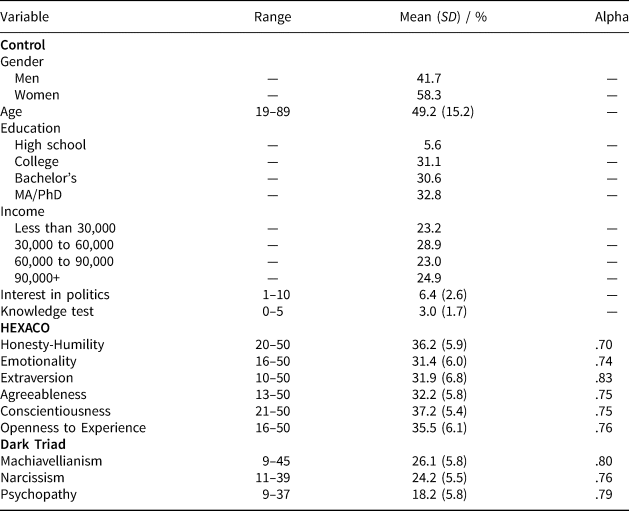
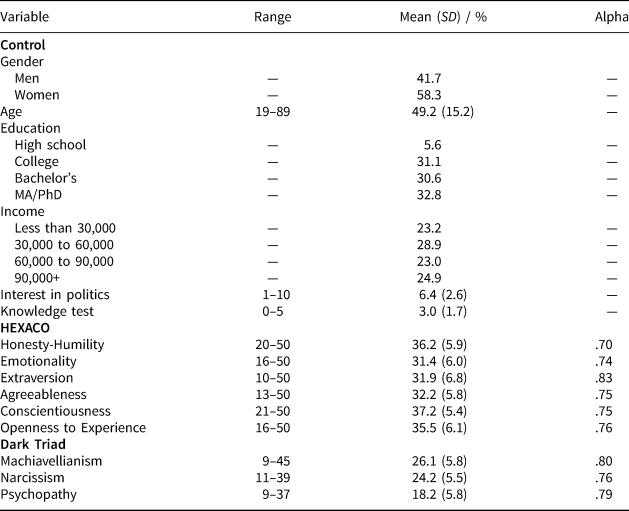
The sample comprised 371 Canadian citizens over the age of 18 (M age = 49.2, SD = 15.2) recruited from the Qualtrics participant pool. The majority of participants were women (58.3%), from Ontario (46.6%), and 34.4 per cent had completed a university degree (24.4% bachelor's, 7.6% master's, and 2.4% PhD). The remaining participants had completed some university or less (8.7% some university, 21.1% college degree, and 36.1% some college or less). Participants reported an income between $30,000 and $60,000 (28.9%), followed by more than $90,000 (24.9%), less than $30,000 (23.2%), and $60,000 to $90,000 (23%). The appendix compares the current sample to the broader Canadian population on these characteristics, revealing that while the data are not completely representative, they do approximate the Canadian population in many respects.
Measures
HEXACO Personality Inventory (HEXACO-60)
The HEXACO-60 (Ashton and Lee, Reference Ashton and Lee2009) is a 60-item self-report scale that assesses the six factors of the HEXACO model of personality: honesty-humility (H), emotionality (E), extraversion (X), agreeableness (A), conscientiousness (C), and openness to experience (O). The reliability between self- and other-reported scores on the HEXACO-PI has been reported as high in Canadian (Lee and Ashton, Reference Lee and Ashton2006) and Dutch samples (de Vries et al., Reference de Vries, Ashton and Lee2009). In the current sample, Cronbach's alpha coefficients were all within the acceptable range (range: .70 to .83).
The Dark Triad
Machiavellianism, narcissism and psychopathy were measured using the Short Dark Triad (SD3) (Jones and Paulhus, Reference Jones and Paulhus2014). The SD3 is a 27-item self-report measure assessing Machiavellianism, narcissism and psychopathy. The SD3 has been cross-validated with community and student samples and has demonstrated good reliability (Jones and Paulhus, Reference Jones and Paulhus2014). The internal consistency of the subscales used in the current analyses was acceptable (Cronbach's alpha: Machiavellianism = .80; narcissism = .76; psychopathy = .79).
Control variables
Participants were also asked demographic questions regarding gender, age, level of education and income. Participants also indicated how interested they were in politics on an 11-point Likert scale and answered a five-question political knowledge test. We include political interest and knowledge to capture unmeasured variation that may not be captured by our demographic variables. To the extent that the effect of personality on ambition is mediated through interest and knowledge, including these as controls provides a conservative test of our expectations. Descriptive statistics for all predictors can be found in Table 1.
Descriptive Statistics
Political ambition
Political ambition was assessed through four questions adapted from the political ambition literature (Fox and Lawless, Reference Fox and Lawless2014; Pruysers and Blais, Reference Pruysers and Blais2018b) and divided among the interest and efficacy dimensions. In terms of interest in a political career, participants were first asked how often they had thought about running for political office (thought about it many times, has crossed my mind, never thought about it). Due to low frequencies in some of the categories (for example, less than 3% of participants had thought about a career in politics many times), this variable was dichotomized (25.9% have thought about running). Second, participants were asked to rank their job preferences from a list containing both political (for example, member of Parliament) and nonpolitical (for example, lawyer) options. Whether they placed one of the political career options in the top five choices was then calculated (39.5% yes and 60.5% no).
For the efficacy dimension of ambition, participants were asked how qualified they would be to run for elected office (very qualified, qualified, somewhat qualified, not at all qualified). Lastly, participants were asked if they thought they would win an election should they seek office (very likely, likely, unlikely, very unlikely). Due to low frequencies in some of the categories (for example, 5% felt very qualified and 4% thought it very likely they would win), these variables were also dichotomized (39.4% feel at least somewhat qualified; 21.3% at least likely to win).
Results
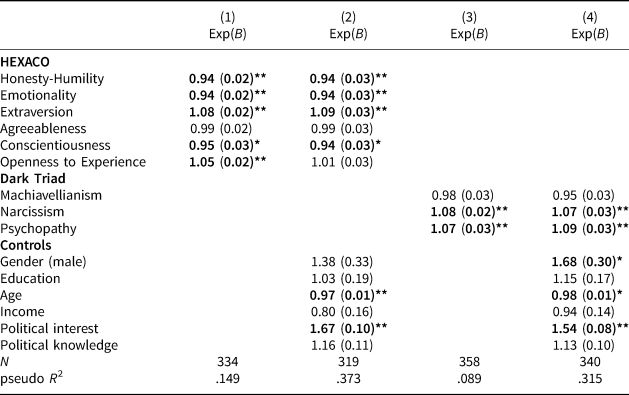
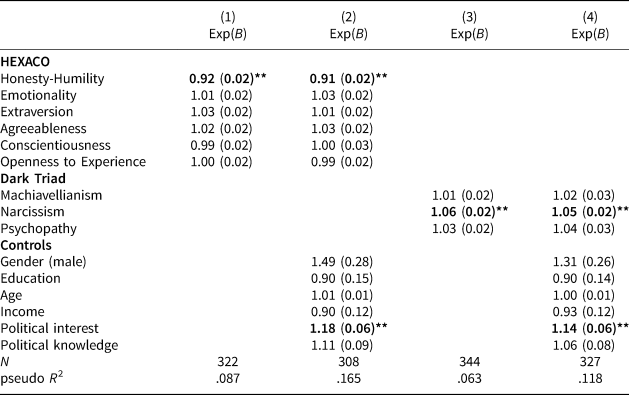
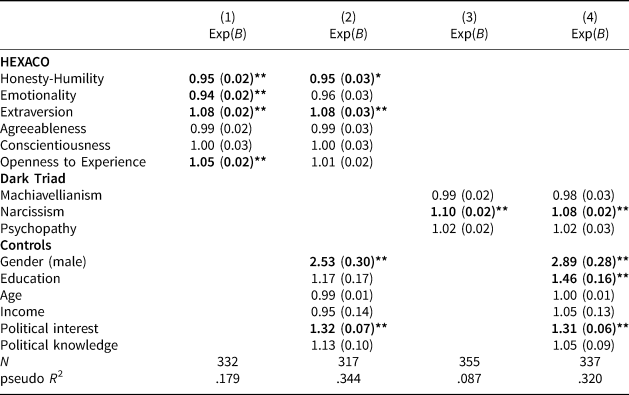
Four separate logistic regression analyses were conducted on the individual political ambition items, assessing both the HEXACO and Dark Triad models of personality while controlling for several important socio-demographic variables (for example, gender, political interest). These results appear in Tables 2, 3, 4, and 5. In each table, we present four models: a model with only the HEXACO personality traits (1), a model with the HEXACO personality traits and the controls (2), a model with only the Dark Triad personality traits (3), and a model with the Dark Triad personality traits and the controls (4).
Logistic Regression Results Assessing Both the HEXACO and Dark Triad Models in Predicting Political Ambition (Thought about Running)
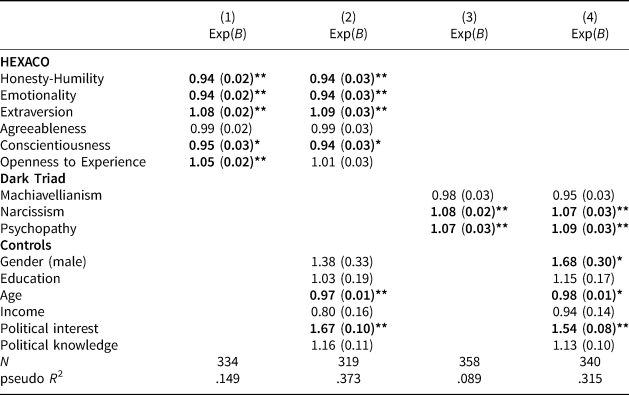
Note: Standard errors in parentheses. Log likelihood ratio: (1) χ2 = 35.9, p < .001; (2) χ2 = 93.6, p < .001; (3) χ2 = 22.6, p < .001; (4) χ2 = 82.8, p < .001.
*p < .10
**p < .05
Logistic Regression Results Assessing Both the HEXACO and Dark Triad Models in Predicting Political Ambition (Politics in Top 5 Jobs)
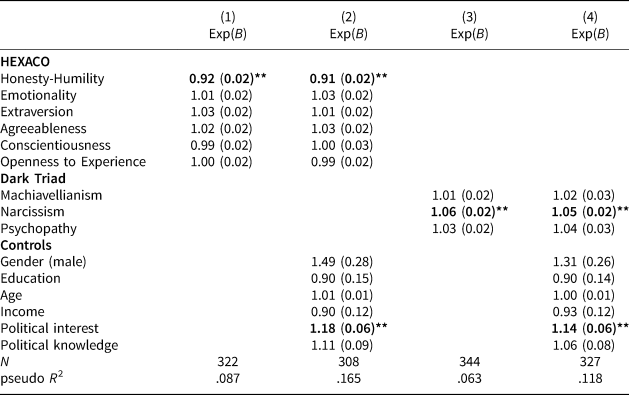
Note: Standard errors in parentheses. Log likelihood ratio: (1) χ2 = 21.5, p = .002; (2) χ2 = 40.1, p < .001; (3) χ2 = 16.5, p = .001; (4) χ2 = 29.9, p < .001.
**p < .05
Logistic Regression Results Assessing Both the HEXACO and Dark Triad Models in Predicting Political Ambition (Qualified to Run)
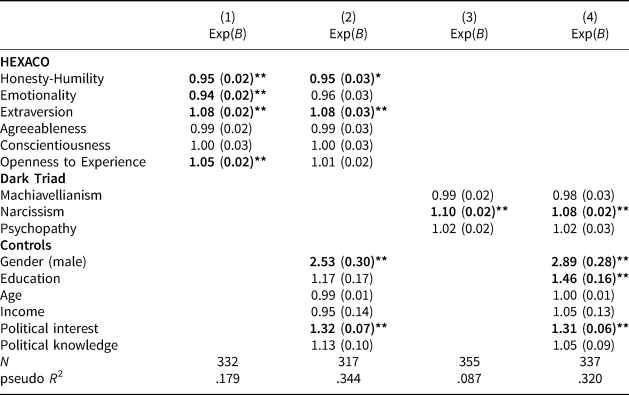
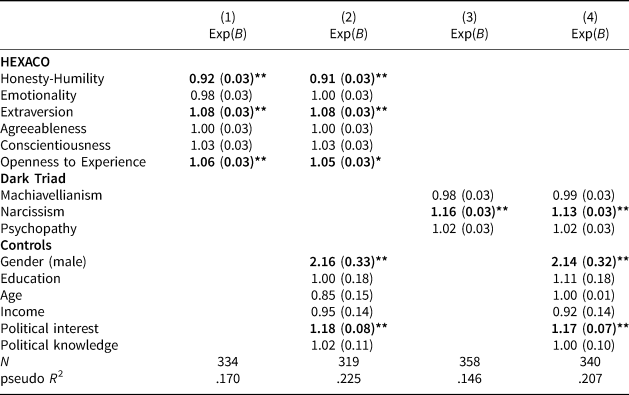
Note: Standard errors in parentheses. Log likelihood ratio: (1) χ2 = 47.1, p < .001; (2) χ2 = 92.6, p < .001; (3) χ2 = 23.4, p < .001; (4) χ2 = 90.9, p < .001.
*p < .10
**p < .05
Logistic Regression Results Assessing Both the HEXACO and Dark Triad Models in Predicting Political Ambition (Likely to Win)
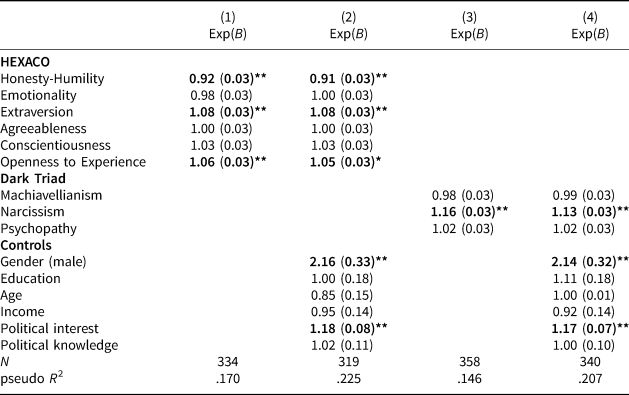
Note: Standard errors in parentheses. Log likelihood ratio: (1) χ2 = 39.2, p < .001; (2) χ2 = 50.5, p < .001; (3) χ2 = 35.4, p < .001; (4) χ2 = 48.9, p < .001.
*p < .10
**p < .05
Beginning with the interest dimension of political ambition, Table 2 shows the results for individuals who have thought about a career in politics (has at least crossed their mind vs. never thought about it). Here we find considerable support for the importance of general personality traits. More specifically, even with the inclusion of control variables, honesty-humility (lower levels), emotionality (lower levels), extraversion (higher levels) and conscientiousness (lower levels) are significant predictors of having thought about a political career. Turning now to the Dark Triad, we find support for the importance of both narcissism (higher levels) and psychopathy (higher levels).
Table 3 presents the results for the second outcome variable representing an interest in a political career—namely, whether the respondent ranked one of three political jobs (member of Parliament, prime minister, or mayor) in their top five from a broader list of ten possible careers. Here we find modest support for the importance of both general and dark personality traits, in that lower levels of honesty-humility and higher levels of narcissism were predictive of placing a political career in the top five.
In terms of the efficacy dimension of political ambition, Table 4 shows the results for whether an individual thinks they are at least somewhat qualified to run for elected office. After adding the socio-demographic controls, lower levels of honesty-humility and higher levels of both extraversion and narcissism were significantly related to perceived qualification. Finally, Table 5 presents the results for whether an individual thinks they are likely or very likely to win if they run for office (versus being unlikely or very unlikely). Consistent with the results for perceived qualification, we find a strong relationship between personality and confidence in the ability to win an election—namely lower levels of honesty-humility and higher levels of both extraversion and narcissism.
Taken together, these results offer strong support for the predictive power of personality in general. Support for the individual personality trait hypotheses, however, is somewhat more mixed. Consistent with the hypotheses for interest in a political career, higher levels of extraversion (H1) and psychopathy (H4) and lower levels of emotionality (H2) were significant; however, this was only true for the first outcome: having thought about a political career. Our hypothesis regarding Machiavellianism (H3) was not supported, as individuals scoring higher on this trait did not report significantly higher interest in a political career. In terms of efficacy in a political career, our hypotheses were completely supported in that both lower levels of honesty-humility (H5) and higher levels of narcissism (H6) were predictive of both of the political ambition efficacy outcomes. Considering all four outcomes of political ambition, we find the strongest support for the importance of honesty-humility, extraversion, and narcissism.
Discussion
The study of political ambition has often relied on retroactive analyses of people already in office. Although examining the features of existing politicians can provide important information on who is currently governing, it does not provide information on how these people differ from those who do not seek a political career. An examination of nascent political ambition, or the initial desire to run for office, is therefore crucial in understanding political ambition more broadly and for increasing ambition among marginalized groups such as women and ethnic minorities.
The current study is the first to examine a more comprehensive model of nascent political ambition that includes general and dark personality traits as well as established socio-demographic variables. Overall, we find considerable support for the importance of personality and believe the findings have at least three important implications. Our results 1) highlight the personality traits that characterize those most interested in a political career, 2) provide insight into the long-standing gender gap in ambition, and 3) call attention to how personality might help us better understand legislative behaviour.
Personality of the politically ambitious
Honesty-humility, extraversion and narcissism were the most consistent personality correlates across all ambition outcomes. Taken together, the personality profile of politically ambitious people appears to describe individuals who are greedy and do not value sincerity and fairness (low honesty-humility), who are bold and have high self-esteem and sociability (high extraversion), and who are self-entitled, ego-centred and aggressive (high narcissism). When examining the correlations between these constructs, however, it is clear that these three traits would not necessarily be manifested within the same individual.
More specifically, across all of the outcomes (that is, those who endorse each of the political ambition items individually), honesty-humility is unrelated to extraversion and either unrelated or negatively related to narcissism. In contrast, extraversion and narcissism are highly correlated for individuals in each outcome. Therefore the first profile of politically ambitious people appears to describe those who tend to be pretentious, greedy and insincere (low honesty-humility; Lee and Ashton, Reference Lee, Ashton and de Vries2005). Furthermore, low honesty-humility was not correlated with political interest, revealing that these individuals are interested in a political career without being particularly interested in politics generally. Their motivations for pursuing this type of career therefore are likely to lie elsewhere. The second profile of politically ambitious people describes those who are social and bold and who have high (even inflated) self-esteem (high extraversion combined with high narcissism). Unlike low honesty-humility, extraversion is significantly correlated with political interest, suggesting that these individuals are not only interested in a political career but also genuinely interested in politics more broadly.
Gender, personality and political ambition
It is also worth noting that the personality traits that predict political ambition are not merely a curiosity for researchers. Understanding the personality correlates of political ambition, for instance, can also help us understand the long-standing gender gap in ambition. Two of the three traits that are consistently related to ambition in the current study (that is, low honesty-humility, high narcissism) are traits typically found more frequently in men than in women (Ashton and Lee, Reference Ashton and Lee2001; Jones and Paulhus, Reference Jones and Paulhus2014; Lee and Ashton, Reference Lee and Ashton2004). Furthermore, when examining the different facets of these traits, these describe people who generally lack humility, are self-aggrandizing and have a sense of entitlement. This links nicely to research that suggests that women are less politically ambitious because they are election- or competition-averse (Kanthak and Woon, Reference Kanthak and Woon2015) and are less interested in a political career when it is framed as serving power-related goals (Schneider et al., Reference Schneider, Holman, Diekman and McAndrew2016).
Men scoring higher on narcissism and lower on honesty-humility would not typically be election-averse and would, in fact, be drawn to a career in a competitive environment that provides power over others and allows them to increase their social stature. Women, by contrast, are typically characterized by lower levels of narcissism and higher levels of honesty-humility. It is therefore unsurprising that many women are election-averse or uninterested in a political career when it is framed as power-related. This suggests that the gender gap in political ambition is, at least partly, rooted in personality.
Personality and legislative behaviour
As scholars continue to study political ambition, we would also be wise to consider not only the predictive importance of personality traits but also the consequences of certain traits on how politicians behave. For example, an examination of American presidents found that they score higher on narcissism than the general public and that although some narcissistic traits are related to positive outcomes, such as overall leadership ability, crisis management and agenda-setting, other narcissistic traits are related to negative outcomes, such as placing one's own political success above effective policy, being motivated by power, overall unethical behaviour, and the initiation of impeachment proceedings (Watts et al., Reference Watts, Lilienfeld, Smith, Miller, Keith Campbell, Waldman, Rubenzer and Faschingbauer2013). That narcissism was consistently related to having thought about a political career in our sample raises some potential concerns about the kinds of individuals most likely to step forward for political office and about the quality of deliberative democracy that can be achieved with these individuals in power. These concerns, of course, could also apply to our findings regarding psychopathy and low honesty-humility. In a deliberative political body, an overrepresentation of individuals disinclined toward trust and cooperation can be particularly detrimental to policy making and consensus building.
Personality has implications not only for how legislators might work with one another but also for the career trajectories of elected officials. The literature on legislative careers has often found a distinction between those who progress through the ranks (that is, those who demonstrate progressive political ambition) and those who remain perennial backbenchers with little desire to advance their political career (see, for example, Docherty Reference Docherty1997; Kam, Reference Kam2009). In their study of US legislators, Dietrich et al. (Reference Dietrich, Lasley, Mondak, Remmel and Turner2012) find a strong relationship between extraversion and progressive political ambition. This, of course, is consistent with our finding regarding extraversion and nascent political ambition. This may suggest that our second profile (the social, confident and bold) describes the legislators who are the most likely to advance through the political ranks. Future research regarding personality and progressive ambition, however, must consider the dark traits in order for us to understand the career paths of the more pretentious, insincere and cold individuals who we find are interested in a political career.
Limitations
In this article, we have made a number of advancements to the study of personality and political ambition. In particular, we utilize full batteries of personality traits (as opposed to truncated 10-item batteries); we include both general and dark personality traits compared to most studies of personality and political behaviour, which simply consider the Big Five; and we draw on a more representative sample than previous work on the subject. Nonetheless, there are several limitations that must be noted.
The first limitation is the modest sample size. Although moving beyond a student sample is an important strength of the study, it will also be necessary to replicate the findings among a larger sample of citizens. In addition, it would be beneficial to compare results cross-nationally, with a broader set of countries included in the analysis. A second limitation is the relatively low level of political ambition in the sample overall. This may necessitate selecting a sample from a population that is known to have higher levels of ambition, such as professionals in disciplines such as law and business. This alternative approach, however, may result in a sample of individuals who already exhibit some self-selection based on socio-demographic and personality factors, potentially reducing the predictive value of these items. A third limitation is that the current study does not include an exhaustive list of predictors and, in fact, half of the variability in political ambition is still left unexplained. In the prediction of any behaviour, it is important to consider both distal and proximate factors. Therefore, future studies may include other factors such as early socialization (distal) and structural factors (proximate) such as salary, recruitment and number of open positions.
Conclusions
The results of the current study have important implications for both the study of political ambition and for our understanding of those who may one day hold political office. In terms of research, it seems clear that any examination of political ambition should consider not only socio-demographic variables but also individual differences in personality. Personality has been found to predict a number of behavioural outcomes, both positive (for example, completion of personal goals, perseverance in a difficult task) and negative (for example, criminal behaviour). It is therefore not surprising that personality would also help predict a person's propensity toward a career in politics.
Additionally, our analysis reveals that it is important to consider both general and dark personality traits in order to gain a more complete understanding of the different types of people who are interested in running for office. The results of this study identify two distinct personality profiles; although some may seek a political career because of a genuine interest in politics combined with a social and extraverted personality, others may seek office because of the increased power and control that such a position would afford them (for example, those exhibiting lower honesty-humility and higher narcissism). Differences in the personality profile and motivation to seek office have important implications for how these individuals will ultimately work with one another in a deliberative democracy.
Appendix
Sample vs. Canadian Population