Introduction
Malignant otitis externa is a progressive, necrotising infection primarily caused by Pseudomonas aeruginosa and predominantly affecting older, diabetic or immunocompromised individuals. The infection originates in the external auditory canal and can spread to the skull base, potentially compromising cranial nerves, including the facial nerve, through involvement of the stylomastoid foramen.
Facial nerve palsy, as a complication of malignant otitis externa, indicates advanced disease and significantly impacts patient quality of life. Given the high morbidity associated with facial nerve palsy, identifying predictive factors for it in the malignant otitis externa setting is critical for early intervention and improved outcomes. In this study, we leveraged the large-scale TriNetX databaseReference TriNetX1 to perform a retrospective analysis, seeking to identify demographic, biochemical and co-morbidity-related predictive factors for facial nerve palsy in malignant otitis externa patients. Our analysis focused on differences between malignant otitis externa patients with and without facial nerve palsy, using statistical methods to evaluate the significance of various risk factors and their potential clinical implications.
Methods
We conducted a retrospective analysis of malignant otitis externa patients using the TriNetX network. The TriNetX platform is a global, federated real-world data and analytics network that provides access to statistics on de-identified electronic health record data (diagnoses, procedures, medications, laboratory values, genomic information) from approximately 214 million patients across 173 large healthcare organisations, predominantly academic and non-academic medical centres.
Malignant otitis externa cases were identified using the International Classification of Diseases, 10th Revision with the specific code H60.2, which encompasses malignant otitis externa and includes subcategories such as H60.20 for unspecified ear, H60.21 for the right ear and H60.22 for the left ear, while facial nerve palsy cases were identified using the relevant International Classification of Diseases, 10th Revision code G51.0, which corresponds to Bell’s palsy, G51.8 for other disorders of the facial nerve.
In this study, a range of variables were evaluated to identify predictive factors for facial nerve palsy in patients with malignant otitis externa, categorising them into three groups, demographic characteristics, biochemical markers and co-morbidities, with significance determined by the TriNetX platform. The demographic characteristics assessed included gender and ethnicity, specifically comparing Hispanic and/or Latino versus non-Hispanic and/or Latino patients. The biochemical markers analysed encompassed albumin, blood urea nitrogen, glucose, erythrocyte sedimentation rate (ESR), creatinine, iron, activated partial thromboplastin time and lactate levels. Additionally, we examined several co-morbidities, including hypertension, chronic kidney disease, electrolyte imbalances, malnutrition, migraines and headaches, to determine their association with the development of facial nerve palsy in this patient population.
Statistical analyses were performed to evaluate differences between cohort 1 (patients with malignant otitis externa only, n = 12 032) and cohort 2 (patients with malignant otitis externa and facial nerve palsy, n = 719). For demographic comparisons, such as gender and ethnicity, proportions were compared using a z-test for two proportions, with z scores and corresponding p values reported to assess significance. Biochemical markers (e.g. albumin, blood urea nitrogen, ESR) were analysed using a two-sample t-test with Welch’s correction for unequal variances, given the differing sample sizes and standard deviations between cohorts; t-statistics and p values were calculated to determine significant differences.
For co-morbidity associations, 2 × 2 contingency tables were constructed, and odds ratios were computed to quantify the strength of association between each co-morbidity and facial nerve palsy; chi-square tests were used to assess statistical significance, with Fisher’s exact test applied when expected frequencies were small (e.g. for migraine and other headaches). A significance threshold of p less than 0.05 was used for all tests, with p values reported to indicate the likelihood of observed differences occurring by chance. Data analysis was conducted using the TriNetX platform, with statistical computations performed on 30 April 2025.Reference TriNetX1
Results
Demographics
Of the 12 751 malignant otitis externa patients, 48.91 per cent were female and 46.88 per cent were male. Among the 719 patients with facial nerve palsy, the male-to-female ratio shifted significantly (62.86 per cent male, 35.05 per cent female; p = 4.65 × 10⁻¹⁵). Similarly, Hispanic and/or Latino ethnicity was more prevalent in the facial nerve palsy group (17.66 per cent) compared with the malignant otitis externa-only group (13.02 per cent), indicating a strong association (z score = 3.19, p = 0.0014).
Biochemical markers
Several biochemical markers exhibited statistically significant differences between cohort 1 (malignant otitis externa only) and cohort 2 (malignant otitis externa with facial nerve palsy), with albumin and blood urea nitrogen showing the most pronounced differences (p < 10−32) (Table 1). In particular, facial nerve palsy was associated with lower albumin levels and higher blood urea nitrogen levels compared with the malignant otitis externa-only cohort.
Comparison of biochemical markers between cohort 1 (MOE only, n = 12 032) and cohort 2 (MOE and FNP, n = 719), listed in order of p values from lowest to highest (most significantly correlated to least)

Significant differences (p < 0.05) indicate potential risk factors for FNP. Note that p values less than 0.0001 are reported as <0.0001 for consistency. MOE = malignant otitis externa; FNP = facial nerve palsy; SD = standard deviation; ESR = erythrocyte sedimentation rate
Co-morbidities
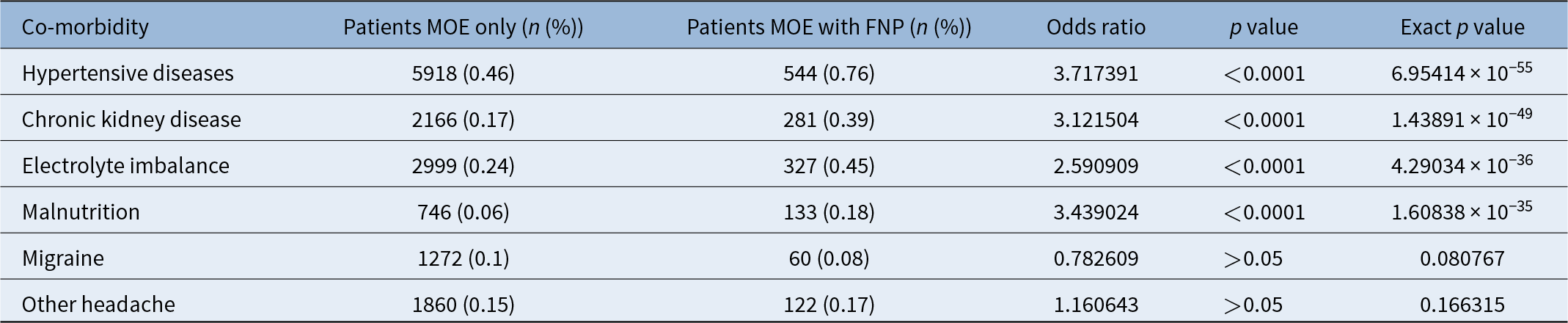
Multiple co-morbidities were significantly associated with facial nerve palsy (Table 2). Hypertension (odds ratio = 3.72, p = 6.95 × 10−55) and chronic kidney disease (odds ratio = 3.12, p = 1.44 × 10−49) were more prevalent in patients with facial nerve palsy. In contrast, migraine (odds ratio = 0.78, p = 0.081) and other headaches (odds ratio = 1.16, p = 0.166) were not significantly associated with facial nerve palsy.
Associations between co-morbidities and FNP in patients with MOE, comparing cohort 1 (MOE only, n = 12 032) and cohort 2 (MOE with FNP, n = 719), listed in order of p values from lowest to highest (most significantly correlated to least)

No significant association (p > 0.05). Data were analysed using chi-square tests, with p values less than 0.0001 reported as <0.0001. FNP = facial nerve palsy; MOE = malignant otitis externa
Discussion
The significant male predominance in the facial nerve palsy group (62.86 per cent male vs 35.05 per cent female, p ≈ 4.65 × 10⁻¹⁵) aligns with prior literature suggesting that older males are more susceptible to complications of malignant otitis externa, including facial nerve palsy.Reference Soudry, Hamzany, Nageris, Ben-David, Segal and Hilly2, Reference Loh, Loh, Yuen, Sun, Wang and Tan3 This gender disparity may be attributed to several factors.
Firstly, males may exhibit differences in immune responses, potentially due to sex-based variations in cytokine production or hormonal influences on immune function, which could impair their ability to combat severe infections like malignant otitis externa.Reference Klein and Flanagan4 For instance, testosterone has been shown to suppress certain immune responses, potentially increasing susceptibility to infection progression in males.Reference Trigunaite, Dimo and Jørgensen5 During the coronavirus disease 2019 pandemic, data revealed that men had higher mortality rates than women, a disparity partially attributed to differences in immune responses influenced by sex hormones.
Secondly, the higher prevalence of co-morbidities such as diabetes in older males, a well-documented risk factor for malignant otitis externa, likely contributes to this trend.Reference Loh, Loh, Yuen, Sun, Wang and Tan3 Diabetes, which is more prevalent in males in certain populations, compromises immune function and vascular health, facilitating the spread of infection to critical structures like the facial nerve.Reference Peled, Jotkowitz and Shvartzman6 In addition, behavioural factors, such as delayed healthcare-seeking behaviour in males, may exacerbate disease severity by the time of diagnosis, increasing the likelihood of complications like facial nerve palsy.
The increased prevalence of Hispanic and/or Latino ethnicity in the facial nerve palsy group (17.66 vs 13.02 per cent, p = 0.0014) introduces an important socioethnic dimension to facial nerve palsy risk in malignant otitis externa patients. This finding may reflect disparities in healthcare access, which can lead to delayed diagnosis and treatment, allowing malignant otitis externa to progress to more severe stages.Reference Velasco-Mondragon, Jimenez, Palladino-Davis, Davis, Escamilla-Cejudo and Vargas-Rosales7 Hispanic and/or Latino populations often face barriers such as limited access to specialty care, language problems and socioeconomic challenges, which can impede timely intervention.Reference Morales, Lara, Kington, Valdez and Escarce8 Moreover, underlying health conditions prevalent in this demographic, such as a higher incidence of uncontrolled diabetes or hypertension, may contribute to the observed association.Reference Schneiderman, Llabre, Cowie, Barnhart, Carnethon and Gallo9 For example, studies have shown that Hispanic and/or Latino individuals may have a higher burden of undiagnosed or poorly managed diabetes, which is a major risk factor for malignant otitis externa severity.Reference Peled, Jotkowitz and Shvartzman6 These findings underscore the need for targeted public health initiatives to address healthcare disparities in this population, as well as further research to disentangle the contributions of socioeconomic, genetic and environmental factors to facial nerve palsy risk in Hispanic and/or Latino malignant otitis externa patients.
The highly significant differences in albumin level (p < 10−32) between the malignant otitis externa-only and malignant otitis externa with facial nerve palsy groups highlight its utility as a predictive marker for facial nerve palsy risk. Low albumin levels in the facial nerve palsy group reflect a state of malnutrition and systemic inflammation, both of which are known to exacerbate the progression of malignant otitis externa.Reference Chen, Prakash, Nair, Menon, Pillai and Thomas10 Albumin, a negative acute-phase reactant, decreases during inflammation because of increased capillary permeability and reduced hepatic synthesis, a process driven by pro-inflammatory cytokines such as interleukin-6.Reference Don and Kaysen11 In the context of malignant otitis externa, this suggests that patients with facial nerve palsy experience a more severe inflammatory response. Furthermore, hypoalbuminemia is a marker of poor nutritional status, which impairs immune function and wound healing, further increasing susceptibility to complications like facial nerve palsy.Reference Gatta, Verardo and Bolognesi12 Clinically, these findings advocate for routine albumin assessment in malignant otitis externa patients because this may serve as an early warning sign of progression to facial nerve palsy, allowing for timely nutritional support and anti-inflammatory interventions.
Elevated blood urea nitrogen levels (mean 25.4 vs 18.6 mg/dL, p < 0.0001) and creatinine levels (mean 1.54 vs 1.21 mg/dL, p < 0.0001) in the facial nerve palsy group indicate renal impairment as a significant risk factor for facial nerve palsy in patients with malignant otitis externa, potentially worsening outcomes through related mechanisms.Reference Hollis, Evans, Palmer, Singh, Rahman and Gormley13 Blood urea nitrogen elevation can result from dehydration, a common complication in severe infections like malignant otitis externa because of reduced oral intake, or from intrinsic renal dysfunction, particularly in patients with co-morbidities such as chronic kidney disease, while, similarly, higher creatinine levels reflect impaired renal function, compromising the clearance of inflammatory mediators and toxins.Reference Hoste, Kellum, Selby, Zarbock, Palevsky and Bagshaw14, Reference Chonchol and Berl15 This renal dysfunction exacerbates systemic inflammation and facilitates the spread of infection, with elevated blood urea nitrogen also potentially reflecting a catabolic state driven by the severe infection, further impairing systemic resilience and compounding facial nerve palsy risk.Reference Preiser, Ichai, Orban and Groeneveld16 These findings underscore the importance of routine renal function assessment, including blood urea nitrogen and creatinine levels, in malignant otitis externa management to identify patients at risk of facial nerve palsy and to guide interventions such as hydration and renal-protective strategies aimed at mitigating these systemic effects.
The elevated ESR observed in the facial nerve palsy group (mean 44.1 mm/h compared with 31.5 mm/h in the malignant otitis externa-only group, p < 0.0001) highlights the critical role of systemic inflammation in the severity of malignant otitis externa and its progression to facial nerve palsy.Reference Esaki, Yamano, Katsumi and Fukuda17 Erythrocyte sedimentation rate, a non-specific marker of inflammation, increases in response to elevated levels of acute-phase proteins such as fibrinogen, which are produced in greater amounts during the necrotising infection characteristic of malignant otitis externa.Reference Bedell and Bush18 The significantly higher ESR in patients with facial nerve palsy suggests a more aggressive inflammatory process, likely driven by Pseudomonas aeruginosa, the predominant pathogen in malignant otitis externa, known for its ability to invade deeper tissues and compromise structures like the facial nerve via the stylomastoid foramen. This heightened inflammatory response may exacerbate tissue damage and facilitate the spread of infection, increasing the likelihood of cranial nerve involvement. Consequently, ESR emerges as a valuable tool for follow up in malignant otitis externa patients, enabling clinicians to assess disease activity and treatment response, with persistently elevated levels potentially signalling the need for more aggressive therapeutic interventions to prevent complications like facial nerve palsy.
Elevated glucose levels in the facial nerve palsy group (mean 145 mg/dL compared with 124 mg/dL in the malignant otitis externa-only group, p < 0.0001) reinforce the strong association between poor glycaemic control and the severity of malignant otitis externa, particularly its progression to facial nerve palsy.Reference Peled, Jotkowitz and Shvartzman6 Hyperglycaemia, a hallmark of uncontrolled diabetes, impairs neutrophil function by reducing phagocytosis and bactericidal activity, thereby creating a favourable environment for bacterial proliferation, including Pseudomonas aeruginosa, the primary causative agent in malignant otitis externa. The significant difference in glucose levels between the two cohorts underscores the importance of tight glycaemic control in diabetic malignant otitis externa patients because maintaining euglycemia can mitigate the risk of severe outcomes by enhancing immune function and limiting bacterial growth. These findings advocate for routine glucose monitoring and aggressive diabetes management as integral components of malignant otitis externa treatment protocols to reduce the incidence of facial nerve palsy and improve overall patient outcomes.
Lower iron levels (mean 57.9 vs 67 µg/dL, p < 0.001) in the facial nerve palsy group may indicate anaemia of chronic disease, a common finding in severe infections like malignant otitis externa.Reference Weiss and Goodnough19 Iron sequestration during inflammation, mediated by hepcidin, reduces available iron for erythropoiesis, impairing immune responses and increasing susceptibility to complications.Reference Ganz20 This is particularly relevant in malignant otitis externa, where anaemia may exacerbate tissue hypoxia, further compromising the facial nerve’s resilience to infection.Reference Nemeth and Ganz21 Together, these biochemical markers highlight the multifaceted systemic impact of malignant otitis externa and the need for a comprehensive metabolic assessment to predict and prevent facial nerve palsy.
Hypertension and chronic kidney disease emerged as the strongest predictors of facial nerve palsy in this study, with odds ratios of 3.72 (p = 6.95 × 10−55) and 3.12 (p = 1.44 × 10−49), respectively. Hypertension impairs microvascular circulation by causing endothelial dysfunction and reducing tissue perfusion, which can exacerbate the ischaemic effects of malignant otitis externa on the cranial nerves where the nerves are anatomically vulnerable to compression and ischaemia. Similarly, chronic kidney disease compromises immune function through uraemia-induced immunosuppression and oxidative stress, increasing susceptibility to severe infections and cranial nerve complications.Reference Kato, Chmielewski, Honda, Pecoits-Filho, Matsuo and Yuzawa22 The strong association between chronic kidney disease and facial nerve palsy is further supported by the elevated blood urea nitrogen and creatinine levels observed in the facial nerve palsy group, suggesting a synergistic effect between renal dysfunction and malignant otitis externa progression.
Malnutrition (odds ratio = 3.44, p = 1.61 × 10⁻³⁵) and electrolyte imbalances (odds ratio = 2.59, p = 4.29 × 10−36) further highlight the role of systemic health in facial nerve palsy risk. Malnutrition, as evidenced by low albumin and iron levels, impairs immune responses and tissue repair, increasing the likelihood of malignant otitis externa progression to facial nerve palsy.Reference Chen, Prakash, Nair, Menon, Pillai and Thomas10 Electrolyte imbalances, often secondary to renal dysfunction or dehydration, can exacerbate neurological complications.Reference Liamis, Filippatos and Elisaf23
Migraine and headache were included as exploratory variables because they may raise clinical concern for disease progression and intracranial involvement. The non-significant association between headaches and facial nerve palsy in patients with malignant otitis externa, as evidenced by a chi-square test result (χ 2 = 0.005, p ≈ 1.0), underscores the lack of specificity of headaches as a clinical marker for malignant otitis externa-related complications.Reference Friedman24 In this study, the prevalence of headaches was comparable between the malignant otitis externa-only group (15 per cent, approximately 1913 of 12 751 patients) and the malignant otitis externa with facial nerve palsy group (17 per cent, approximately 122 of 719 patients), indicating suggesting that headaches do not reliably differentiate between these two cohorts.
This finding indicates that headaches are a common and non-specific symptom in many infectious and inflammatory conditions, including malignant otitis externa. Typically, the necrotising infection caused by Pseudomonas aeruginosa in malignant otitis externa primarily affects the external auditory canal and skull base, resulting in localised symptoms such as severe otalgia and cranial nerve deficits, rather than headaches as a primary manifestation, unless the infection progresses to involve intracranial structures. The involvement of the facial nerve in malignant otitis externa, as observed in this study, does not necessarily indicate intracranial extension of the disease, although it differs mechanistically from the involvement of other cranial nerves.
Facial nerve palsy typically arises because of the anatomical vulnerability of the facial nerve at the stylomastoid foramen, where the nerve exits the skull just at the skull base, inferior proximal to the external auditory canal, the primary site of infection in malignant otitis externa. In contrast, the involvement of other cranial nerves, such as the glossopharyngeal (IX), vagus (X) or hypoglossal (XII) nerves, often indicates a more advanced stage of disease with potential intracranial extension because these nerves are typically affected when the infection progresses to the jugular foramen or involves the petrous apex. Cranial nerve IX–XII palsies are frequently associated with skull base osteomyelitis extending medially, potentially leading to complications like sigmoid sinus thrombosis, meningitis or brain abscess, which are hallmarks of intracranial spread.
The non-significant association of headaches with facial nerve palsy further supports the absence of intracranial extension in most facial nerve palsy cases because headaches would be more prevalent in such scenarios as a result of meningeal irritation or increased intracranial pressure.Reference Friedman24 However, facial nerve palsy can occasionally be a precursor to more extensive cranial nerve involvement if the infection progresses unchecked because the facial nerve’s involvement may represent an early stage of skull base osteomyelitis that could eventually extend to intracranial structures.
The distinction between facial nerve palsy and other cranial nerve involvements in malignant otitis externa also lies in their clinical implications and prognostic significance. Facial nerve palsy, occurring at the stylomastoid foramen, is often an earlier manifestation of malignant otitis externa progression compared with the involvement of cranial nerves IX–XII, which typically indicates a more advanced disease state with a worse prognosis.Reference Loh, Loh, Yuen, Sun, Wang and Tan3 Studies have shown that facial nerve palsy in malignant otitis externa is associated with a prolonged treatment course and higher morbidity, but it does not carry the same mortality risk as intracranial complications.Reference Rojoa, Shaikh, Sood, Sandhu and Nunez25 In contrast, the involvement of multiple lower cranial nerves (IX–XII) is a stronger indicator of intracranial extension and is associated with a higher risk of fatal outcomes, such as meningitis or cerebral abscess.
These findings advocate for routine follow up of albumin, blood urea nitrogen, ESR, glucose, iron and creatinine levels in malignant otitis externa patients to identify those at risk for facial nerve palsy. Targeted interventions, such as nutritional support to address hypoalbuminemia and anaemia, tight glycaemic control to manage hyperglycaemia and renal function optimisation to mitigate the effects of elevated blood urea nitrogen and creatinine, can significantly reduce facial nerve palsy risk. Aggressive management of hypertension and chronic kidney disease is critical because these conditions amplify the systemic impact of malignant otitis externa and increase susceptibility to cranial nerve complications. This may include the use of antihypertensive agents to improve microvascular circulation and renal-protective strategies, such as angiotensin-converting enzyme inhibitors, to manage chronic kidney disease.Reference Strippoli, Craig, Deeks, Schena and Craig26
Physicians should recognise that male patients and those of Hispanic and/or Latino ethnicity are more susceptible to facial nerve palsy as a complication of malignant otitis externa, as indicated by their elevated risk profiles in this study (p = 4.65 × 10⁻¹⁵ for males and p = 0.0014 for Hispanic and/or Latino ethnicity). Clinicians may prioritise early screening and intervention for these groups by conducting thorough ear examinations and closely monitoring for early malignant otitis externa symptoms, such as severe otalgia disproportionate to visible findings, especially in at-risk patients with poor glycaemic control.
Future research should focus on several key areas. Firstly, the role of genetic factors in the observed ethnic disparities warrants investigation because polymorphisms in immune response genes may contribute to increased facial nerve palsy risk in Hispanic and/or Latino patients.Reference Rivas, Beaty, Baurley, Haiman, Stram and Henderson27 Secondly, clinical trials evaluating the efficacy of targeted interventions, such as albumin supplementation, iron therapy and intensive glycaemic control, could provide evidence for standardised protocols to prevent facial nerve palsy in malignant otitis externa patients. Finally, the development of a predictive scoring system incorporating demographic, biochemical and co-morbidity data could improve risk stratification and guide personalised treatment strategies for malignant otitis externa patients.
• Malignant otitis externa is a severe necrotising infection, predominantly affecting older diabetic or immunocompromised patients, with Pseudomonas aeruginosa as the primary pathogen, with known risk factors that include diabetes, advanced age and immunosuppression
• Facial nerve palsy is a recognised complication of advanced malignant otitis externa, associated with increased morbidity and prolonged treatment, that has been linked to disease progression, but specific predictive factors remain poorly defined in large cohorts
• Male gender and Hispanic and/or Latino ethnicity are strong demographic predictors of facial nerve palsy in malignant otitis externa
• Key biochemical markers—hypoalbuminemia, elevated blood urea nitrogen, glucose, erythrocyte sedimentation rate (ESR) and creatinine—are highly significant predictors, reflecting malnutrition, inflammation, hyperglycaemia and renal impairment
• Co-morbidities including hypertension, chronic kidney disease, malnutrition and electrolyte imbalances are strongly associated with facial nerve palsy
• Routine monitoring of albumin, blood urea nitrogen, glucose, ESR and renal function, combined with targeted management of co-morbidities, may enable early identification and prevention of facial nerve palsy in malignant otitis externa
Conclusion
This study identifies male gender and Hispanic and/or Latino ethnicity as key demographic predictors of facial nerve palsy in patients with malignant otitis externa, with males showing a significant predominance and Hispanic and/or Latino patients exhibiting a higher prevalence. Biochemical markers such as albumin, blood urea nitrogen and ESR emerged as critical indicators of facial nerve palsy risk, with notably high significance for albumin and blood urea nitrogen, reflecting the roles of malnutrition, systemic inflammation and renal dysfunction in disease progression. Co-morbidities, particularly hypertension, chronic kidney disease and malnutrition, were strongly associated with an increased likelihood of facial nerve palsy, emphasising the impact of systemic health on malignant otitis externa outcomes.
Routine follow up of albumin, blood urea nitrogen, ESR, glucose, iron and creatinine levels, combined with proactive management of co-morbidities through nutritional support, tight glycaemic control and renal-protective strategies, can facilitate early identification and intervention, potentially reducing the risk of facial nerve palsy and thereby improving outcomes in malignant otitis externa patients. In current practice, clinical findings, primarily ear pain, along with ESR and gallium-67 scintigraphy, are commonly used for the follow up of malignant otitis externa; however, the variables identified in this study, such as albumin, blood urea nitrogen and glucose, may also serve as valuable tools for the follow up of malignant otitis externa patients, particularly to identify those at risk of developing facial nerve palsy. Future research should explore targeted interventions based on our findings to further enhance outcomes in malignant otitis externa patients.
Competing interests
None declared