INTRODUCTION
Marine gastropods are the largest subgroup of the molluscs, comprising approximately 73,000 species worldwide (Geiger, Reference Geiger and Sturm2006). The biodiversity of marine molluscs in Brazil cannot be precisely defined, but there are approximately 3900 species currently described (Amaral & Jablonski, Reference Amaral and Jablonski2005), with marine gastropods comprising 1125 species. Although the marine gastropod fauna is relatively well documented in Brazil (Amaral & Jablonski, Reference Amaral and Jablonski2005), data on the ecology of the majority of these species is still scarce.
The family Volutidae comprises about 250 species having global distribution. Some species live intertidally, while others are subtidal and are found to depths of at least 500 metres. It is believed that all volutes are carnivorous and prey on small animals, including other molluscs (Abbott & Dance, Reference Abbott and Dance1998), but reports on the diets and the feeding ecology of Volutidae species are largely anecdotal (Morton, Reference Morton1986).
The Hebrew volute Voluta ebraea Linnaeus, 1758 (Family Volutidae) is a marine gastropod endemic to the Brazilian Atlantic coast, occurring from Pará State to Bahia (Rios, Reference Rios1994). This species lives on sandy bottoms among rocks and coral from low tide to 40 m (Thomé et al., Reference Thomé, Bergonci and Gil2004). Voluta ebraea is sexually dimorphic, with male shells being smoother and longer, while the female shells are nodulose and wider (Weaver, Reference Weaver1965; Rios, Reference Rios1994). According to Rios (Reference Rios1994), the shell of V. ebraea can reach 105 mm in length, with seven moderately convex whorls. Because of the beauty of their shells and their occurrence in shallow waters, V. ebraea are frequently captured and sold for ornamental purposes along the Brazilian coast (Thomé et al., Reference Thomé, Bergonci and Gil2004; Alves et al., Reference Alves, Silva, Melo, Paranaguá and Pinto2006). The species is also edible in some coastal communities (Farias & Barreira, Reference Farias and Barreira2007). Information obtained from fishermen of Paraíba State (north-eastern Brazil) suggests that populations of this species are declining in areas where they were previously abundant, such as the coastal reefs. Even though V. ebraea occurs in shallow waters and is under increasing harvesting pressure, published information on the biology, ecology, and population dynamics of this endemic species is virtually unknown.
The present paper provides the first field data on reef habitat, size structure, and predator/prey interactions of V. ebraea made during underwater observations in north-eastern Brazil. This information will complement our knowledge of Volutidae feeding behaviour and aid conservation measures aimed at protecting the Hebrew volute and its natural habitat.
MATERIALS AND METHODS
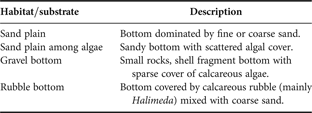
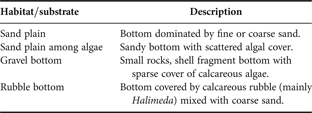
Underwater observations were carried out during the low tide periods on coastal reefs at Cabo Branco beach, Paraíba State (7°08′50″S 34°47′51″W), north-eastern Brazil, from November 2006 to May 2007. Data was recorded on plastic slates during 14 days of free diving during daytime hours at depths between 0.2 and 2.0 m. Intensive random searches were made for individuals of Voluta ebraea at the study site. The following data were recorded for each specimen found: total shell length (SL) in cm, depth of sighting (m), habitat/substrate type and animal activity in the moment of sighting. Habitat/substrate types were classified according to a predefined typology (Table 1). Ad libitum observations were performed during ten minute sessions (Lehner, Reference Lehner1996) to record eventual intra- or interspecific interactions. Whenever possible, individuals were filmed and photographed to record their habitats and their behaviour.
Characteristics of substrate/habitat types recorded for Voluta ebraea at Cabo Branco reefs.
RESULTS
A total of 17 sightings of Voluta ebraea was made during the study and, according to each specimen's location along the reef and its shell characteristics, we believe that each sighting represented a different individual. The observation frequency was 1.2 sightings/dive, ranging from 0 to 3 individuals sighted during a single dive. The mean shell length was 11.56 ± 2.13 cm (range = 8 to 15 cm). In 41.2% of sightings, the specimens were observed on sandy bottoms, with individuals also being sighted on gravel bottoms (35.3%), on the sand among algae (17.6%), and on rubble (5.9%). Voluta ebraea was predominantly distributed in shallow water. The mean depth of the sighting was 0.83 ± 0.47 m (range = 0.4 to 2.0 m) at low tide. In terms of activity, V. ebraea was in movement during 52.9% of sightings, or partially buried in the sand (47.1% of sightings). While in movement on the reef habitat, V. ebraea was observed searching for or attacking its prey, and while partially buried in the sand, it was observed either resting or ingesting the captured prey.
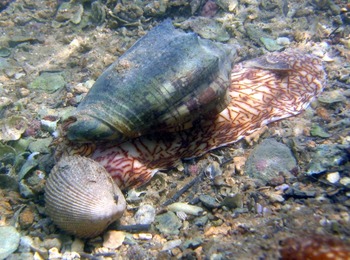
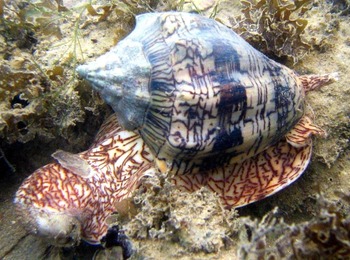
Seven predation events were recorded in 17 observation sessions (a total of 170 min), involving seven different individuals of V. ebraea. In five (71.4%) of the seven recorded events, the predation attack was unsuccessful. In two of the attacks, V. ebraea was able to capture its prey. Voluta ebraea attacked individuals of the bivalve Trachycardium muricatum (Linnaeus, 1758) (Family Cardiidae) in all of the predation events observed. While searching for prey, the Hebrew volute moved slowly along the reef bottom, passing over gravel, hard corals such as Siderastrea stellata (Verril, 1868), or sand. Hunting began when the prey was located (presumably by chemoreception) (Figure 1). As V. ebraea moved towards the bivalve, its siphon elongated and became positioned about 2 cm above the lip of the siphonal canal; the tips of its tentacles were barely visible. During the final approach, the volute would slightly raise the front edge of its muscular foot to reach the top of the bivalve in order to capture and hold it. When the attack was successful (two occasions), the bivalve was enveloped by the gastropod's foot and slowly dragged towards the posterior end of the volute (Figure 2). After capturing its prey, V. ebraea would search for a sandy area in which to bury itself and consume its meal. On a number of occasions, however, the attacks were not successful, and soon after a first contact by the gastropod, the bivalve was able to escape by way of a quick propulsion movement of its elongated foot. The escape direction was apparently random. On one occasion, V. ebraea pursued an escaped bivalve and relocated it five times, but was not successful in its final capture.
Voluta ebraea (11.5 cm long shell) is moving towards the bivalve Trachycardium muricatum. Photograph by T.L.P. Dias.

Voluta ebraea (10 cm long shell) is carrying its prey Trachycardium muricatum by using the posterior portion of its muscular foot. Photograph by T.L.P. Dias.

DISCUSSION
Individuals of Voluta ebraea of several sizes were observed on the Cabo Branco reefs, with the largest individuals (shell length = 15 cm) being longer than those reported by Weaver (Reference Weaver1965) and Rios (Reference Rios1994) (10.5 and 14.8 cm, respectively). Although the maximum shell length recorded underwater in this study was 15 cm, we encountered a 20 cm shell in a marine gift shop in Paraíba State (Silva et al., Reference Silva, Dias, Costa, Santos and Bezerra2007). The sexually dimorphic characteristics described by Weaver (Reference Weaver1965) and Rios (Reference Rios1994) were difficult to identify in the wild. In that way, it was not possible to separate males from females.
Voluta ebraea used shallow areas of the reef environment at Cabo Branco, and was usually observed at depths of less than one metre during low tide. This is particularly worrisome as this species is an important target of the marine souvenir trade in Brazil, especially in Paraíba State and other north-eastern Brazilian coastal areas (Silva et al., Reference Silva, Dias, Costa, Santos and Bezerra2007; Farias & Barreira, Reference Farias and Barreira2007). The occurrence of this volute in shallow coastal waters facilitates its harvesting by local fishermen and their sale to collectors. According to local fishermen, this species is now scarce in areas where it was abundant in the past, such as the coastal reefs. Along Paraíba coast, this species was commonly found only at Cabo Branco reefs, which turns this area into one of special conservation importance for that species (Dias, Reference Dias2007).
In terms of habitat use, V. ebraea was observed among corals and rocks as described by Thomé et al. (Reference Thomé, Bergonci and Gil2004) and Rios (Reference Rios1994), but it was most frequently observed on sandy bottoms, mainly while resting or ingesting its prey. This suggests that sandy bottoms represent an important component of the essential habitat of the Hebrew volute. Additionally, its preferred food item, the bivalve Trachycardium muricatum, lives buried in the sand (Rios, Reference Rios1994).
Predation events involving V. ebraea and T. muricatum were the first predatory behaviour recorded for this volute species in the wild. Mota et al. (Reference Mota, Pinheiro and Matthews-Cascon2004) examined the predatory behaviour of the Hebrew volute under laboratory conditions. In that study, V. ebraea was maintained in a marine aquarium and two gastropod species (Tegula viridula (Gmelin, 1791) and Stramonita haemastoma (Linnaeus, 1758)) were offered as prey. According to these authors, V. ebraea showed no food preference between these two items. Although all of the Volutidae are considered carnivorous, almost nothing is known about their feeding habits. Morton (Reference Morton1986) studied the diet and feeding behaviour of Melo melo and reported that this species consumed other gastropods, especially Hemifusus tuba and Babylonia lutosa. The Hebrew volute demonstrated prey capture behaviour similar to that of M. melo, where the detected prey is grasped and enveloped by the volute's muscular foot. Except for Adelomelon riosi, which feeds on starfish (Weaver & du Pont, Reference Weaver and Pont1970), other volutes, such as Alcithoe and Cybium, feed on bivalves or gastropods (Ponder, Reference Ponder1970; Weaver & du Pont, Reference Weaver and Pont1970). According to our observations, V. ebraea seems to prefer bivalves under natural conditions (specifically T. muricatum), indicating that V. ebraea has an important ecological role within the food chain of the reef as a key predator on T. muricatum. The impacts and the magnitude of this relationship will need to be more closely investigated.
The data presented here represents the first documentation of the habitat and feeding ecology of the Brazilian endemic gastropod V. ebraea in the wild. Almost nothing is known at this moment about the magnitude of the marine souvenir trade involving this species, or about the impact of its collection on wild populations. As such, additional studies are urgently needed on all aspects of the biology, ecology, and harvesting of V. ebraea throughout its geographical range. Additionally, strategies to conserve this endemic marine gastropod should place strong emphasis on habitat protection and maintaining its structural complexity. Steps to regulate the harvesting and trade of this species should also be given priority.
ACKNOWLEDGEMENTS
I am grateful to Ms C. Inês Martins (University of Fortaleza, Ceará, Brazil) for the initial identification of the Hebrew volute; Dr Roger N. Hughes (University of Wales, Bangor, UK) for providing many references on marine gastropods; and Luis Carlos Damasceno for essential support during fieldwork.