Recent years have witnessed growing attention to achieving gender parity in political and economic life, yet women globally continue to face barriers to their effective participation and representation (Paxton and Hughes Reference Paxton and Hughes2016). Consequently, in many countries women still lag behind men in their political representation, labor market participation, and human capital attainment (The United Nations Development Programme 2018; The World Economic Forum 2018). While the persistence of gender inequality is undisputed, explanations differ as to why women have struggled to achieve better representation of their interests. One set of explanations centers on the institutional, structural, and cultural obstacles to women’s advancement (Beall Reference Beall2005; Benstead, Jamal, and Lust Reference Benstead, Jamal and Lust2015). Others argue that differences in women’s preferences, goals, or values undermine their will or ability to engage in collective action to advance their interests (Beckwith Reference Beckwith2011; Weldon Reference Weldon2011).
There remain important unanswered questions about the extent to which differences among women undermine their collective action potential. This might seem surprising in light of recent evidence that women demonstrate strong problem-solving abilities and achieve high levels of cooperation in all-women groups (Berge, Juniwaty, and Sekei Reference Berge, Juniwaty and Sekei2016; Fearon and Humphreys Reference Fearon and Humphreys2017; Greig and Bohnet Reference Greig and Bohnet2009). Such evidence is consistent with claims that women – across a wide variety of cultures and contexts – display strong norms of communal and pro-social behavior (Eagly and Wood Reference Eagly and Wood1991; Hyde Reference Hyde2014). Yet, much of the existing research focuses on women’s behavior relative to men (Andreoni and Vesterlund Reference Andreoni and Vesterlund2001; Croson and Gneezy Reference Croson and Gneezy2009), or on how women cooperate in same- versus mixed-gender settings (Balliet et al. Reference Balliet, Li, Macfarlan and Van Vugt2011; Solow and Kirkwood Reference Solow and Kirkwood2002). Less attention has been paid, however, to how differences among women affect their collective action capacity. In an important exception, Klar (Reference Klar2018) shows that partisan differences in views of gender identity can undermine trust among women. Examining how social differences affect cooperation among women is critical to understanding the collective action dilemma that women face and the potential for building broad, gender-based coalitions in diverse societies.
This article highlights the challenges to women’s cooperation by presenting robust evidence that differences in socio-economic class weaken women’s collective action capacity. This result was not expected a priori given the existing evidence of women’s cooperative capacities. Finding that class differences impede women’s cooperation is important insofar as socio-economic cleavages are common to most societies and that class identity may be at least as important as racial or gender identity to shaping preferences and behaviors (Brown-Iannuzzi, Lundberg, and McKee Reference Brown-Iannuzzi, Lundberg and McKee2017; Manstead Reference Manstead2018). Moreover, history shows that major advances in women’s rights have required building cross-class alliances.Footnote 1
Our evidence comes from a public goods experiment implemented with 713 women and men interacting in 120 same-gender groups in Beirut, Lebanon. Lebanon is a highly relevant context for this study in that it both embodies the challenges to achieving gender equality and is characterized by class (and sectarian) social divisions that could affect gender-based cooperation. We opt for a public goods game because it captures the extent to which groups can overcome individual incentives to free-ride and maximize the welfare of all members (Balliet, Wu, and Dreu Reference Balliet, Wu and De Dreu2014; Ledyard Reference Ledyard, Kagel and Roth1995). Participants were recruited on the basis of their actual socio-economic and sectarian backgrounds and randomly assigned to play a one-shot public goods game in groups that were either homogeneous or heterogeneous in their class and sectarian compositions.Footnote 2 As such, we use the game to examine how class (relative to sect) affects the will or ability of women (contra men) to overcome a collective action dilemma and achieve better outcomes for all.
We find that women in mixed-class groups contributed about 30% less to the group fund than women in same-class groups. This pattern holds for both lower and upper class women, although the effect is more pronounced in the latter. In contrast, we show that men contributed significantly more in mixed-class groups, underscoring that the negative effects of class differences are unique to women. Moreover, owing to the cross-cutting experiment that also varied the sectarian composition of the groups, we show that class differences can have a bigger negative effect on women’s cooperation than ethnic differences.Footnote 3 This is surprising in light of a large literature highlighting the adverse effects of ethnic diversity on cooperation (Habyarimana et al. Reference Habyarimana, Humphreys, Posner and Weinstein2009; Miguel and Gugerty Reference Miguel and Gugerty2005) and the prominence of sectarian divisions in Lebanese politics and society. Further examination suggests it is important to consider how class and sect interact in shaping gender-based cooperation: our results indicate that sectarian differences might actually facilitate cross-class cooperation among cosectarian men but fail to do so for women. Overall, this article provides striking evidence that social differences among women – and particularly class differences – can undermine collective action capacity. Our findings have important implications for understanding prospects for gender-based mobilization and representation in diverse societies, as we elaborate below.
Research design
The setting for our study is Lebanon, a country that exhibits significant barriers to the participation and representation of women in all aspects of life. While women in Lebanon have had the right to vote since 1953, the country lags behind its neighbors on numerous measures of gender parity, ranking 13th out of 17 countries in the Middle East and North Africa on the Global Gender Gap Index – ahead of only Saudi Arabia, Iran, Syria, and Yemen (World Economic Forum 2017). Women in Lebanon have long faced obstacles to greater representation of their interests, including gender biased social norms and a political system that is deeply divided along sectarian lines, overshadowing women’s issues (Geagea and Fakih Reference Geagea and Fakih2015). Yet, there is also considerable evidence that class cleavages impede cooperation among women in key areas. Women’s organizing in Lebanon is often characterized as “elitist” and unwilling or unable to mobilize women across class lines (Kingston Reference Kingston2013; Mahdawi Reference Mahdawi2010; UN Women 2017). The absence of large cross-class coalitions is an impediment to the advancement of critical policies, including the introduction of gender-based quotas for representation and the passage of unified personal status and civil marriage laws that would protect women’s rights regardless of their sectarian background.
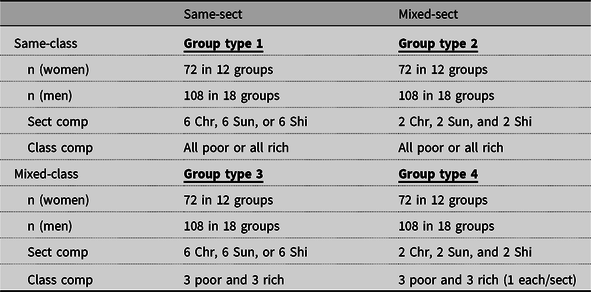
To examine how gender, class, and sect shape cooperation, we implemented a public goods experiment in which 720 lower and upper class Sunnis, Shia, and Christians were recruited from the Beirut area and block randomly assigned to six-person, same-gender groups that were either homogeneous or heterogeneous in their class and sectarian compositions (713 completed the study). Specifically, participants were assigned orthogonally following a 2 × 2 factorial design to same or mixed-class groups (where the latter consisted of three members of each class) and to same or mixed-sect groups (where the latter comprised two participants from each sect). As shown in Table 1, this yielded four group types: (1) same-class, same-sect, (2) same-class, mixed-sect, (3) mixed-class, same sect, and (4) mixed-class, mixed-sect.Footnote 4 Overall, 285 women interacted in 48 all-women groups (12 of each kind) while 428 men participated in 72 all-men groups (18 of each kind).Footnote 5 This design enables us to examine how women and men cooperate in heterogeneous versus homogeneous class groups; in heterogeneous versus homogeneous sectarian groups; and, finally, how the sectarian composition of the group conditions cross-class cooperation.
Summary of Experimental Design

We implemented the experiment by organizing the 120 groups in 5 sets of 24 sessions, where each set of sessions was single-gender.Footnote 6 A professional firm recruited participants for one set of sessions at a time using screening surveys to identify eligible participants. The screening survey contained multiple objective measures of class that were aggregated into an index, where individuals in the first and third index terciles were eligible for inclusion in the study.Footnote 7 This approach enabled us to assign participants by block randomizing on the basis of their actual socio-economic class. Most analyses of the impact of class on cooperation rely on experiments that attempt to mimic class cleavages by introducing artificial economic inequality into the group setting, for instance, by providing participants with varying initial endowments (Buckley and Croson Reference Buckley and Croson2006; Chan et al. Reference Chan, Mestelman, Moir and Muller1996). While some studies use measures of real class for heterogeneous effects analysis (Cardenas Reference Cardenas2003; Martinsson, Villegas-Palacio, and Wollbrant Reference Martinsson, Villegas-Palacio and Wollbrant2015), few extant studies use such measures for random assignment in order to understand how the class composition of groups affects cooperative outcomes. Using natural identities is potentially especially important for detecting results in our context, insofar as evidence suggests that women (compared to men) are more sensitive to the use of real identities in experimental settings involving social dilemmas (Chowdhury, Jeon, and Ramalingam Reference Chowdhury, Jeon and Ramalingam2016).
While our experimental design is innovative in how it varies the economic and sectarian compositions of the same-gender groups playing the public goods game, the game itself has features common to one-shot, voluntary contribution mechanism designs.Footnote 8 So that participants would know the class and sectarian composition of the group, the moderator started each session by welcoming participants and saying: “We have invited you here today to engage in a discussion with members from [SAME/DIFFERENT] sectarian groups and [SAME/DIFFERENT] economic classes so that you can share with each other your thoughts and feelings about your economic and political hopes and concerns.”Footnote 9 Participants were then asked to introduce themselves and offer basic personal information (e.g., on their jobs or neighborhoods) that would have further revealed their profiles.
A moderator completed example exercises and practice activities with participants before playing to ensure comprehension of payoffs.Footnote 10 Participants played with 10,000 Lebanese pounds (LBP) and could keep as much of that as they wanted for themselves or contribute any amount (in 1,000 LBP increments) to a group fund. Group contributions were multiplied by 1.5 and divided evenly among all six participants, regardless of whether they had contributed.Footnote 11 This highlights the social dilemma of the game – while maximum payoffs would be achieved if everyone in the group contributed their entire endowment, there were also strong individual incentives to free-ride. In such situations, how much an individual chooses to contribute is a function of unconditional considerations (e.g., altruism toward other group members) and/or conditional considerations, namely beliefs about how much others are likely to contribute (Fischbacher, Gächter, and Fehr Reference Fischbacher, Gächter and Fehr2001). Participants were not allowed to coordinate and all contribution decisions were made in private.
We estimate average treatment effects using weighted least squares regressions of the form:
 ${Y_i} = \alpha + \beta {M_i} + {\varepsilon _i}$
, where Yi
is the main outcome (contributions to the group pot) for individual i; Mi
is an indicator for assignment to a mixed-class or mixed-sect group; and ε
i
is the individual-level error term.Footnote
12
The weights account for unequal treatment assignment probabilities.Footnote
13
We estimate treatment effects separately for women and for men as well as by class. Given that gender, class, and sect are themselves not randomly assigned, we also run regressions that include a vector of control variables – detailed in Online Appendix E – to account for potential confounding. We show below and in Online Appendix F that results are not substantively affected by the inclusion of controls and are robust to different estimation strategies. Finally, given that women’s and men’s blocks were implemented sequentially, differential results by gender could be confounded by timing effects.Footnote
14
We aimed to mitigate such confounding by implementing the blocks in an alternating fashion, which results in balance in timing with respect to important events (such as temporal proximity to municipal elections, see Online Appendix B).
Main results
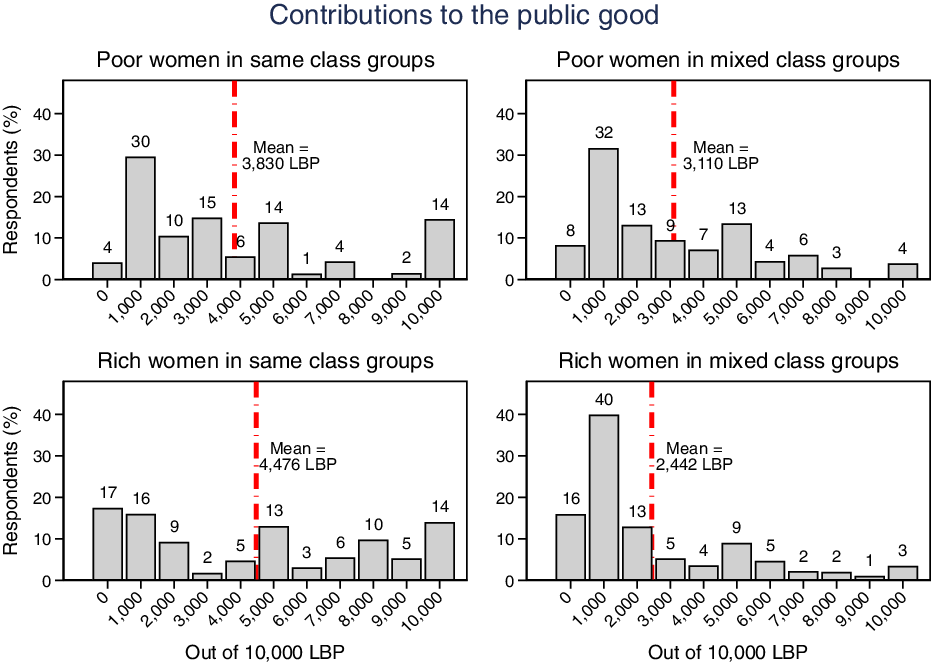
We first present descriptive evidence of the variation. Figure 1 shows the distribution of contributions to the group pot by treatment and class for women. This initial look at the data suggests that women, on average, contribute substantially less in heterogeneous class groups compared to homogeneous ones. Specifically, for rich women, we observe a much higher average contribution in same-class groups (4,476 LBP) compared to mixed-class groups (2,442 LBP). Poor women also contribute more in same-class relative to mixed-class groups (3,830 versus 3,110 LBP on average).
Distribution of contributions to the group pot by class group treatment and socio-economic background, women’s groups only. Dashed line indicates the mean contribution level.

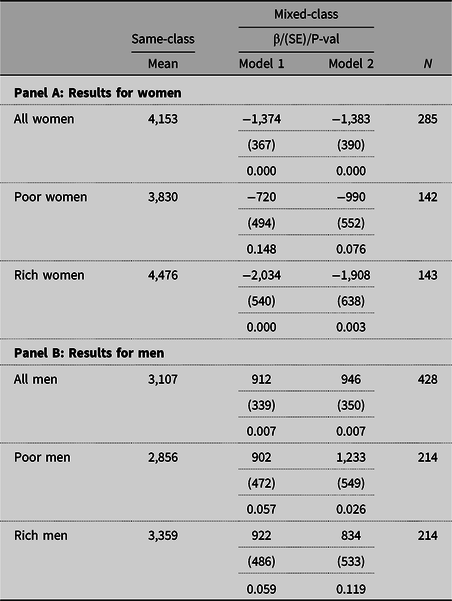
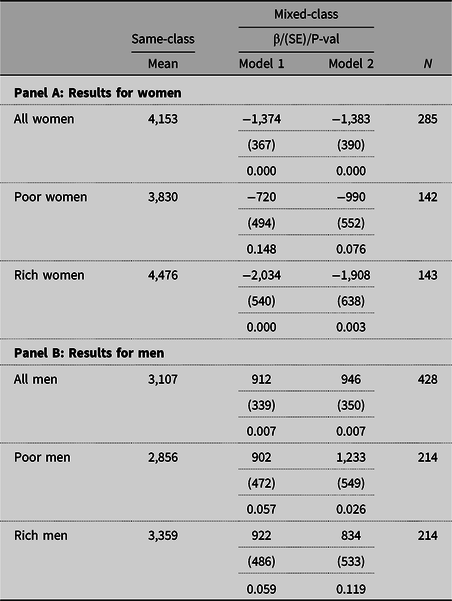
These patterns are confirmed by the regression analysis. Panel A of Table 2 presents results for the effect of being in a heterogeneous class group for women participants overall as well as disaggregated by class. Focusing our discussion on the results from Model 2 (with controls), we find that women in mixed-class groups contributed 1,383 LBP – or about 30% – less to the group fund than women in same-class groups (p = .000). This pattern holds for both poor and rich women, although it is especially pronounced for the latter. Poor women in heterogeneous class groups contributed 990 LBP less than their counterparts in homogeneous groups, although this result is only weakly significant (p = .076). Rich women gave 1,908 LBP – or about 43% – less in heterogeneous groups (p = .003). Overall, these results are striking in how strongly they suggest that women do not cooperate unconditionally with one another and that class cleavages do inhibit cooperation among women.
Public Goods Game Results
Notes: Table reports coefficients, robust standard errors (in parentheses), and p-values from two-sided tests. All models incorporate weights that correct for unequal treatment assignment probabilities across strata. Model 1 has no controls; Model 2 includes all controls.
Moreover, the pattern of contributions for women is notably different from that observed for men, as shown in Panel B. Instead of negatively affecting cooperation, being in a heterogeneous class group resulted in significantly higher contributions to the group fund for men. According to Model 2, men contributed 946 LBP more in mixed-class settings on average (p = .007), with both poor and rich men giving more. These results reinforce that there is something specific to gender that is interacting with the class cleavage in the context of group-based cooperation.
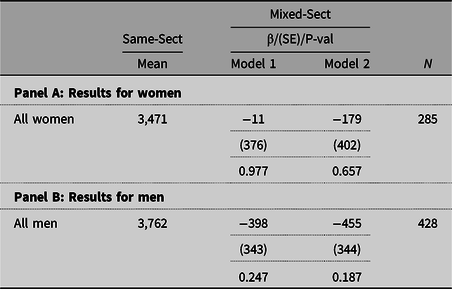
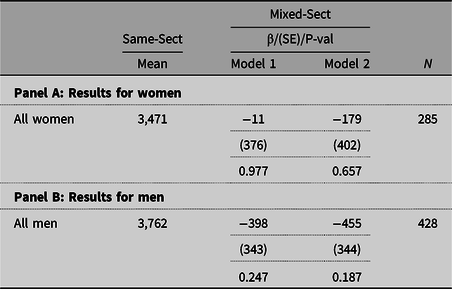
We also find that being in a heterogeneous class group has an even greater negative effect on cooperation for women than being in a heterogeneous sectarian group. The results reported in Table 3 demonstrate that both women and men in same and mixed sectarian groups contributed approximately equivalent amounts to the group fund. These findings are notable for showing that, even in an ethnically divided society like Lebanon’s, sectarian differences might have little effect on cooperation for either gender and that class differences can play a bigger role than sectarian differences in inhibiting cooperation among women.Footnote 15
Contributions in Mixed-Sectarian Groups
Notes: Table reports coefficients, robust standard errors (in parentheses), and p-values from two-sided tests. All models incorporate weights that correct for unequal treatment assignment probabilities across strata. Model 1 has no controls; Model 2 includes all controls.
In sum, we find that women in mixed-class groups cooperated significantly less than those in same-class groups while men cooperated substantially more, highlighting that this pattern is particular to women. We also show that not all social differences among women have the same effect: the negative effect on cooperation is pronounced for class, but not for sectarian, differences. These results raise important questions about why class, but not sectarian, differences undermine cooperation among women and about why women cooperate less than men in mixed-class groups, which we investigate further below.
Class versus sectarian differences
Why might class differences impede cooperation among women more than sectarian differences? Indeed, it is widely believed that ethnic or sectarian differences weaken cooperation in ethnically divided societies (Habyarimana et al. Reference Habyarimana, Humphreys, Posner and Weinstein2009), although evidence is mixed (Berge et al. Reference Berge, Bjorvatn, Galle, Miguel, Posner, Tungodden and Zhang2015; Greig and Bohnet Reference Greig and Bohnet2009) and few studies examine gender differences in sectarian cooperation. One possible explanation for our results is that sectarian differences are less relevant for women than for men because of the sectarian and gendered way in which competition over resources takes place in Lebanon. Research suggests that, in societies where resources are distributed along ethnic lines through clientelistic networks, women are more likely than men to be denied direct access to these benefits (Beall Reference Beall2005; Benstead Reference Benstead2016; Wantchekon Reference Wantchekon2003). If ethnicity is the foundation of competition over resources for men, and has little impact on access to goods and services for women, then sectarian differences might undermine cooperation among men more than among women. The fact that the negative coefficients in Table 3, Panel B appear to be bigger for men than for women could reflect that.
Moreover, it is possible that inter-sect competition over resources could promote stronger norms of intra-sect cooperation but only among men. This is consistent with evidence that between-group competition creates interdependence among group members, especially among those who expect to benefit when their group successfully enlarges its share (Raihani and Bshary Reference Raihani and Bshary2015). Additionally, research in evolutionary science suggests that men are more cooperative within groups in the presence of inter-group threat than women (Van Vugt, Cremer, and Janssen Reference Van Vugt, De Cremer and Janssen2007). Thus, it is possible that sectarian competition over resources could strengthen cross-class cooperation among cosectarian men but not cosectarian women.
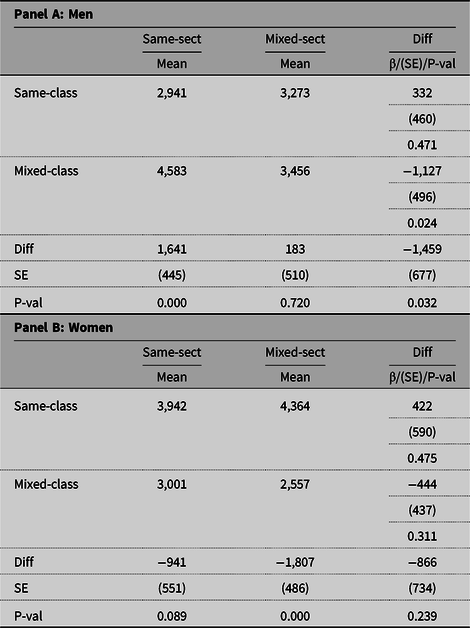
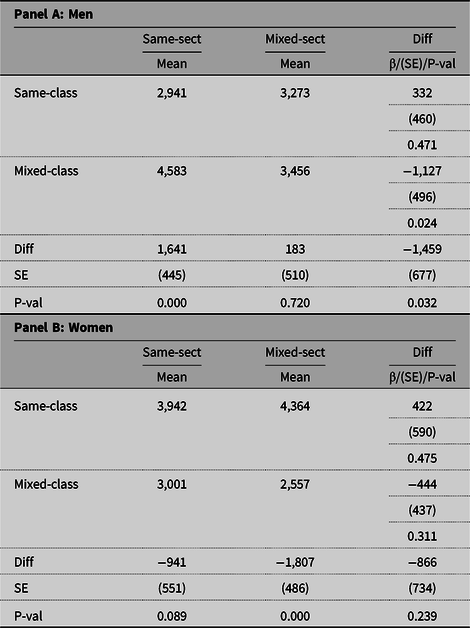
To investigate whether class and sect interact in different ways for women and men, we take advantage of the study’s 2 × 2 factorial design. Table 4 presents mean contribution levels for women and men for each of the four group types along with tests of the differences in means.Footnote 16
Contributions by Class and Sectarian Composition
Notes: Table shows mean contributions in each of the four experimental arms as well as regression-based tests of the differences between arms. Regressions incorporate weights that correct for unequal treatment assignment probabilities across strata and do not include controls.
The results for men in Panel A yield two notable findings. First, they provide further evidence that sectarian differences do not weaken cooperation even among men. Average contribution levels in same-sect, same-class groups are similar to those in both mixed-sect, same-class and mixed-sect, mixed-class groups at 2,941, 3,273, and 3,455 LBP respectively. Second, and even more striking, men cooperate significantly more in same-sect, mixed-class groups. Specifically, when men play with cosectarians, they contribute 1,641 LBP more in heterogeneous versus homogeneous class groups; there is no equivalent effect when men play with non-cosectarians. These results provide clear evidence that class differences yield greater cooperation among men but only among cosectarians. They also reveal that the negative coefficients in Panel B of Table 3 arise not because sectarian differences undermine cooperation among men but rather because class differences among cosectarians strengthen it.
The results in Panel B show a noticeable difference for women. Class differences undermine cooperation for women regardless of the sectarian composition of the groups. Being in a mixed-class group reduces cooperation by 941 LBP among cosectarian women and by 1,807 LBP among non-cosectarian women. While the negative (albeit statistically insignificant) coefficient on the interaction implies that class differences might reduce cooperation among non-cosectarian more than cosectarian women, the results clearly show that class differences harm collective action capacity among women in general. Additional analysis reported in Online Appendix G indicates that these results are driven predominantly by rich women, possibly due to efforts to attain status on the basis of class, as we discuss below and in Online Appendix H.
Overall, this analysis yields two main insights into why class, more that sectarian differences, undermine cooperation among women. First, they reinforce that sectarian differences do not impede cooperation among either women or men in our context. While surprising, there are several possible explanations for this finding. It could be that ordinary Lebanese are simply less divided along sectarian lines than many believe. A similar lack of coethnic bias has been found in public goods games played in Kenya, another context where ethnic divisions are thought to be highly salient (Berge et al. Reference Berge, Bjorvatn, Galle, Miguel, Posner, Tungodden and Zhang2015). It is also possible that sectarian differences only undermine cooperation among certain subgroups in the population – for instance, those with stronger identity attachments or access to coethnic elites (Marshall, Reference Marshall2019) – or only when ethnic identity is primed by political elites, for instance, during periods of electoral competition (Posner Reference Posner2004, Reference Posner2017).
Second, they suggest that sectarian differences in Lebanon could generate very different pressures for cross-class cooperation for men and for women. The results for men suggest that the chief impact of sectarian differences in Lebanon is not more out-group bias but rather more in-group cooperation among cosectarian men who differ on other social dimensions. Critically, because women are generally excluded from competition over resources, they might not experience similar pressures for in-group solidarity. In this way, sectarian differences might strengthen cross-class ties among cosectarian men but fail to do the same for cosectarian women. This indicates an important possible relationship between sectarian and class differences in their effect on cooperation.
There are, of course, other factors that could help to explain why class differences undermine cooperation among women and that could also help to shed light on why class differences weaken cooperation among non-cosectarian women but not non-cosectarian men. It could be, for instance, that women have fewer opportunities than men to interact across class lines due to differences in labor force participation or educational opportunities, leading to increased uncertainty about how other women will behave in mixed-class settings (Salameh Reference Salameh2014). Alternatively, evidence from the American politics literature demonstrates that women who enjoy status benefits in a male-dominated political arena are less likely to help other women, potentially due to fear that doing so would dilute their own status (Kanthak and Krause Reference Kanthak and Krause2010, Reference Kanthak and Krause2011). This explanation suggests that class bias should undermine cooperation more for rich than for poor women, which is in fact what our results in Table 2 and Online Appendix G suggest. Finally, following on Klar (Reference Klar2018), it is possible that rich and poor women diverge in their views of what the role of women in society should be, resulting in distrust. We explore these three mechanisms in Online Appendix H, finding suggestive evidence that both uncertainty and class bias could tell part of the story for women. More research is needed, however, to uncover the mechanisms by which social differences like class and sect – on their own and in relation to one another – affect cooperation among both women and men.
Conclusion
There is a growing global interest in improving the participation and representation of women in political, economic, and social life. This article provides striking evidence that one barrier to advancing these goals could be women themselves, particularly the obstacles to collective action that arise when women differ on other social dimensions. In showing that women cooperate less across class lines than within homogeneous class groups, our results challenge the perception that women cooperate unconditionally with one another and suggest that there could be significant barriers to the formation of broad, gender-based coalitions to advance women’s rights and interests.
This article also raises important questions as to why women cooperate less than men in heterogeneous class groups and why some social differences (like class) undermine cooperation more than others (like sect). Our results underscore the possibility that sectarianism does not undermine cooperation among either women or men in our context but rather creates pressure or opportunities for cross-class cooperation among cosectarian men that do not exist for women. In doing so, this article highlights the need for greater attention to understanding how different social cleavages interact with one another in shaping gender-based cooperation and collective action capacity.
The findings raise important questions about the extent to which our results generalize beyond the case of Lebanon. While the country’s power-sharing institutions and conflict history are in some ways unique, Lebanon is also similar to many other countries that have multiple salient social cleavages and male-dominated cultures or institutions. The fact that class differences among women – whether historical or due to more recent societal changes – are prominent in many countries, including the USA, suggests that the results presented here will extend to other contexts (Geier et al. Reference Geier, Reed, Leonard and Douglas2014). Yet, our results also indicate that considering how different social cleavages interact might be one of the most important factors in external validity. Just as sectarian differences possibly induce cross-class cooperation within sectarian groups among men, we might observe similar dynamics for women in other countries where ethnicity (or some other cleavage, like partisanship) is more salient for women.
We emphasize, however, that it might not always be class differences that undermine cooperation among women. While there is good reason to believe that class divisions impede women’s cooperation in many contexts, any number of social cleavages could divide women. The main contribution of this article is the broader point that social divisions among women – class or otherwise – exist and can have important consequences for women’s collective action potential and ability to work together to tackle persistent barriers to gender equality.
Supplementary material
To view supplementary material for this article, please visit https://doi.org/10.1017/XPS.2020.3