

Introduction
Pandemonium. That was how the New York Times’ reporter described the 1971 General Motors’ shareholder meeting. “The first public disagreement within memory on the 23-member G.M. board,” he claimed.Footnote 1 The focus of the controversy was a series of remarks made by Reverend Leon Howard Sullivan. A veteran of the civil rights movement, Sullivan had recently earned the distinction of becoming GM’s first black board member and the first black director of a major Fortune 500 company. Rather than sitting quietly and observing the proceedings, as some of his colleagues on the board had hoped he would, Sullivan used the opportunity of his first shareholder meeting to speak boldly on the issue of Apartheid. He joined a group of shareholder activists calling for GM to end its operations in South Africa in protest of Apartheid.Footnote 2 “Apartheid … is the most ruthless form of dealing with human beings in the world today. And … General Motors, Chrysler, Ford and 300 other American companies underwrite apartheid by being there,” stated Sullivan. “I hold that General Motors should get out of South Africa.”Footnote 3
Joining GM’s board in January 1971, amid a wave of shareholder and labor action calling for an end to racism within some of the largest U.S. corporations, Sullivan’s tenure at GM was illustrative of a broader shift within the black freedom struggle, which increasingly included calls for Black Power in U.S. corporate and financial institutions alongside demands for greater access to local and national government.Footnote 4 Addressing corporate executives at a press conference in May 1970, Congresswoman Shirley Chisholm (D-NY) stated that American companies like GM had failed to respond “to the needs of black Americans” for too long.Footnote 5 Her comments were echoed by Congressman Louis Stokes (D-OH). The congressman called for more black managers and black directors to wield real “decision-making [power] in American corporations.”Footnote 6 Subsequently, American corporations appointed black directors and managers in record numbers in response to pressure from shareholders, consumers, and government officials.Footnote 7 Whereas in 1969 there had been only one black American on the board of a Fortune 500 company, by mid-1971 there were at least a dozen. By the end of 1972, there were fifty-four black directors in Fortune 500 companies.Footnote 8 Similar increases in the number of black men in other executive, administrative, and managerial positions occurred between 1970 and 1980.Footnote 9
The appointment of black managers and directors was only the beginning. Working in collaboration with religious and other organizations outside the corporation, many of the first black directors and black executives struggled to exert Black Power within their respective companies through initiating various corporate social responsibility programs aimed at improving the lives of black and other marginalized people at home and abroad. Speaking at a press conference shortly after his appointment was announced, Sullivan told the media, “I know General Motors is going to use me as a symbol and sample of how liberal it has become, but I am going to use them … I’ll be one voice out of 23 … but I’m going to do all I can to help my people—black people, brown people, underprivileged people.”Footnote 10
Hence Sullivan’s outburst at the shareholder meeting calling for GM to leave South Africa. Sullivan’s choice of South Africa was far from arbitrary. Situated at the southern tip of the African continent and the intersections of the Atlantic and Indian Oceans, the Republic of South Africa increasingly drew the attention of anti-racist and anti-imperial activists in the United States and other countries who worked to illuminate the connections between American corporations doing business in South Africa and the country’s oppressive Apartheid system, which denied voting rights to approximately 60 to 90 percent of the population depending on the year.Footnote 11 By the mid-1970s, dozens of American corporations, including GM, faced calls from anti-apartheid activists to leave the country and stop doing business with South Africa.Footnote 12
Even as he fought to pressure GM on South Africa, echoing other anti-apartheid activists, Sullivan’s position on the board ultimately shaped his approach to fighting Apartheid. Indeed, one year following his initial protest at the GM annual shareholder meeting, Sullivan took a somewhat different approach, emphasizing the positive work the company was doing. “The company is trying to cooperate with me. They’re trying to help. And I’m trying to do the best I can from the inside,” Sullivan told reporters in response to questions about GM’s continued presence in South Africa.Footnote 13 Ultimately, Sullivan joined other black executives who opted to pursue change through corporate social responsibility programs like the Sullivan Principles, a corporate code of conduct for American corporations doing business in South Africa.
This article traces Sullivan’s trajectory from a supporter of divestment to author of the Principles, which garnered national and international recognition as one of the largest U.S. corporate-sponsored programs promoting black empowerment, signed by more than 150 U.S. companies. In doing so, it reveals the Black Power movement’s contributions to the development of modern corporate social responsibility.Footnote 14 Building on and engaging in conversation with the work being done by black leaders in government and religious organizations, black directors and executives like Sullivan fought for programs promoting black empowerment, including job training, benefits for black employees and their families, and other programs supporting black economic development, as representatives of their race within corporate America. In doing so, they often faced limitations stemming from disagreements with their white colleagues and critics outside the corporation. Sullivan himself garnered significant criticism from various anti-apartheid activists who saw the Principles as little more than a public relations initiative for American businesses resisting sanctions and divestment. Even so, Sullivan and his colleagues continued to argue that American corporations could be of greater help to black South Africans if they remained in the country and pushed for change. Ultimately, their stories shed light on the fruits of these efforts, while simultaneously revealing the limitations of Black Power in the boardroom.
Incorporating Struggle—The First Black Director
On the morning of March 1, 1971, Sullivan dressed in a “new white shirt and black suit,” put on his “light gray tie,” and prepared to walk over from his room at the Plaza Hotel in New York City to the corporate offices of GM to attend his first board meeting.Footnote 15 The first black director to serve on the board of the world’s largest corporation, Sullivan was a long way from where he had started as a young minister protesting racial discrimination in employment in Philadelphia. Frustrated with the slow pace of government-led civil rights reform symbolized by the voluntary Plans for Progress program, black people turned to direct action to combat racial discrimination in the workplace.Footnote 16 Building on the student-led boycotts in Greensboro, North Carolina, and other cities, Sullivan launched the Selective Patronage Movement, which targeted businesses in the Philadelphia-area that refused to employ black Americans. Utilizing the black church to spread the word, Selective Patronage proved successful in organizing black Philadelphians to put pressure on local businesses. Within several months, the ministers claimed to have opened up two thousand new skilled jobs for black Philadelphians.Footnote 17 Subsequently, several other black organizations, including the Southern Christian Leadership Conference and the Revolutionary Action Movement, launched similar campaigns modeled on the Selective Patronage Movement.Footnote 18
The Selective Patronage Movement had black people, according to Sullivan, “walking ten feet tall in the streets of Philadelphia.”Footnote 19 The sense of accomplishment gained from having won two thousand skilled jobs did not last long in the face of growing unemployment caused by urban divestment.Footnote 20 Between 1950 and 1965, Philadelphia lost ninety thousand industrial jobs. At the same time, the city’s black population continued to grow by 40 percent in the decade following World War II. According to one survey conducted in 1956, 37 percent of black workers surveyed in North Philadelphia reported being unemployed, while another 42 percent reported suffering from irregular employment.Footnote 21
Growing frustration and despair at the lack of adequate government response to address the economic crisis contributed to growing calls for Black Power during the late 1960s. First popularized by Student Nonviolent Coordinating Committee activist Stokely Carmichael, Black Power expanded to make room for a wide range of political organizations and programs focused on addressing the social, cultural, and material conditions of black people.Footnote 22 One strand of this expansive politics found voice in the Black Manifesto (1969). Drafted by black intellectuals and activists participating in the Black Economic Development Conference in Detroit, the Black Manifesto called for reparations in the form of “$500,000,000 from the Christian white churches and the Jewish synagogues” to help fund a Southern Land Trust and a black-owned media company among other black ventures.Footnote 23 While there were some who supported Nixon’s Black Capitalism, the majority of conference attendees decried these programs as insufficient at best and a blatant attempt to co-opt the Black Power movement, at worst. In his keynote address to the conference, black economist Robert S. Browne emphasized the need for black Americans to gain “access to the instruments of power,” including major corporations and the federal government. “Local development projects, small business programs, job training, consumer education, vocational guidance, school improvement, and other community programs” were, according to Brown, useful to black Americans without threatening the national power structure. Real power depended on black people “grasping the levers of control in this society.”Footnote 24
Browne’s call found a receptive audience with a subset of New Left activists eager to take on corporate America. Founded in early 1970 by four Washington-based lawyers, the Project for Corporate Responsibility (PCR) emerged alongside Ralph Nader’s Public Interest Research Group at the center of the movement for corporate social responsibility. The group’s first order of action: taking on the world’s largest corporation in Campaign GM. In early 1970, PCR organizers took the unconventional step of purchasing shares in GM. At the time, for social activists to strategically invest in a company was quite new. While a significant number of Americans began purchasing stocks in the 1930s as part of a business-led movement to counter widespread anti-corporate sentiment during the Depression, shareholder involvement focused on the business side of corporate affairs until the late 1960s.Footnote 25 Drawing on this popular view of the shareholders’ role, GM management rejected PCR’s proposed shareholder resolution. Management accused PCR of inserting what company officials called “social issues” into the agenda for the company’s annual shareholder meetings. Here, however, GM faced opposition from the Securities and Exchange Commission (SEC), which overruled GM’s petition to block the PCR resolution. The SEC ruling opened the door to a wave of similar shareholder resolutions by political and religious organizations seeking to transform corporate behavior throughout the 1970s and 1980s.Footnote 26
Having won the initial SEC ruling, PCR introduced a shareholder resolution at the spring 1970 GM shareholder meeting. The resolution demanded that the company restrict operations “detrimental to the health, safety, or welfare of [American] citizens” and alter the company’s management structure to include greater representation from union members, professors, scientists, and people of color.Footnote 27 PCR activists subsequently staged an action, with members of the organization accusing GM chairman James Roche of “lying [about the company’s] record of progress,” noting:
You have told the shareholders about 100,000 employees, black employees, of General Motors but you have not said that none of them are in top management positions. You have not told them that none of them are members of GM’s Board of Directors. You have not told them that of 13,000 GM dealerships, ten of them, if that many, are black. Why are there no blacks on GM’s Board of Directors?Footnote 28
Roche did not help the situation when he responded to a question posed by Campaign GM about whether GM was a public corporation by saying: “We are a public corporation owned by free, white…” At this point, some people in the audience gasped, while others laughed. Roche stammered, “ummm … and … and … and black and yellow people all over the world.”Footnote 29
This was the context in which Sullivan found himself appointed to GM’s board of directors. Following a series of discussions during the fall of 1970, the official announcement was made in January 1971. Sullivan’s appointment marked the first in a series of similar appointments. Within days of GM’s announcement, the New York Federal Reserve Bank and W.T. Grant Company announced that they had appointed National Urban League president Whitney Young and former North Carolina Mutual Insurance Company executive Asa Spaulding to their respective boards.Footnote 30 Other companies and financial institutions soon followed suit. Between 1970 and 1980, the number of black men holding executive, administrative, or managerial jobs increased each year at twice the rate of their white counterparts.Footnote 31
The narrative in the mainstream press followed a well-rehearsed script that framed these appointments in terms of corporate liberalism and the country’s penchant for progress.Footnote 32 Thus, the Wall Street Journal claimed Sullivan’s appointment served as proof of “GM[’s] … increasing sensitivity to the world in which they do business.”Footnote 33 In doing so, the mainstream media and others who touted a similar narrative marginalized the efforts of the Project for Corporate Responsibility and other activists by giving primary credit to white corporate executives.
Contradicting the liberal narratives found in the mainstream media, the black press framed Sullivan’s appointment in terms of Black Power. Writing in the popular Pittsburgh Courier, black journalist Louis Martin described Sullivan, who stood six feet and five inches tall, as a model of black masculinity, ready to “tackle” the titans of corporate America through his performance of “raw black manpower.”Footnote 34 Echoes of Martin’s description appeared in other black newspapers, which referenced Sullivan’s widespread popularity among black people, as well as Sullivan’s own speeches.Footnote 35
This tension between Black Power and liberalism subsequently followed black appointees into the corporation, ultimately shaping the development of corporate-sponsored social responsibility programs, many of which emerged under the leadership of black executives. While reticent to admit it, white executives’ actions suggest that they too saw black executives as manifestations of Black Power. Rather than simply rejecting black executives as posing a threat to the corporation, however, corporate executives pursued a balancing act, one which simultaneously sought to curtail the influence of black executives, while simultaneously appropriating the social capital associated with their status as community leaders.Footnote 36
This strategy resulted in black executives being appointed to newly created departments outside the existing organization. Going by a range of different names, including Urban Affairs, Public Affairs, and Community Relations, these departments shared a common goal, namely, improving company image through a series of corporate social responsibility programs.Footnote 37 In 1972, Harold R. Sims joined Johnson & Johnson as vice president for Corporate Affairs. Before joining Johnson & Johnson, Sims served as the acting executive director for the National Urban League and executive secretary to Sargent Shriver in the Office of Economic Opportunity. In an internal memo outlining his duties, Sims described his role as “represent[ing] Johnson & Johnson [to] the minority communities.”Footnote 38 Johnson & Johnson executives later told Sims that they hoped his activities, which included recruiting African Americans and woman managers into the company, would reduce chances for “disquiet, company dissension and inflammatory situations” experienced by other companies.Footnote 39
In public, corporate executives explained the appointment of civil rights leaders in slightly different terms. Addressing Sullivan’s recent appointment to GM’s board, GM chairman James Roche praised Sullivan’s “distinguished record of service to his community,” adding that Sullivan promised to “bring to [the company’s] board the benefit of his knowledge and expertise in areas of public concern.”Footnote 40 Roche’s comments reflected the widespread optimism surrounding the appointment of black directors and managers. Even so, there remained some who had concerns about the ability of black appointees to make a real difference at the companies they served. Following Sullivan’s appointment, famed environmental and consumer activist Ralph Nader, who supported PCR’s Campaign GM, told reporters that “after deep reflection, [he could] only conclude that the changes [made by GM] are purely cosmetic and that the company is going through a hardening stage so that it can increase its ability to resist any fundamental changes in its product policies.”Footnote 41 Somewhat more optimistic, PCR representatives said that while they were “encouraged by the appointment of a black man to General Motors’ board of directors [they] nevertheless deplore[d] the fact that the process by which GM’s directors are nominated and elected remains an entirely closed affair.”Footnote 42 In other words, the appointment of black directors like Sullivan had done nothing to change the exclusionary structures of corporate governance. Largely overshadowed by the initial excitement surrounding the first wave of black directors and managers in 1971, these critics increasingly garnered support amid national and international debates over the presence of U.S. corporations in Apartheid South Africa.
American Apartheid
Following Sullivan’s appointment, it seemed GM was able to satisfy its critics or at least persuade the media to turn its gaze elsewhere. This victory proved only temporary. In the spring of 1971, GM was back in the public spotlight, facing accusations from protesters for abetting South African Apartheid. Located at the southern tip of the African continent, South Africa has long attracted American entrepreneurs, who looked to profit from the country’s situatedness at the intersection of Indian and Atlantic Ocean trading networks and rich mineral resources. Some of the first Americans to do business with South Africa traded in slaves.Footnote 43 They were followed by American oil and manufacturing companies in the late nineteenth and early twentieth centuries.Footnote 44 Ford Motor Company and GM, both of which established wholly owned subsidiary plants outside Port Elizabeth, were key players in the development of South Africa’s auto-manufacturing industry, which flourished during the mid-twentieth century.Footnote 45
Like their European and South African counterparts, American companies profited from the colonial government’s program dispossessing Africans of their land, thereby creating large pools of cheap labor for the country’s agricultural, mining, and manufacturing industries.Footnote 46 This system of generating profits continued after the launch of Apartheid in 1948. Literally translated to mean “separateness” in Afrikaans, Apartheid created the most profitable system in the world, which in turn supported white supremacy in South Africa and other parts of the globe. By the mid-1960s, American investors were averaging a 20.6 percent rate of return, the highest rate in the world. (By comparison, the next highest country, Japan, had a 12 percent average return on investment.Footnote 47)
Profits wrung through expropriation and exploitation did not go unnoticed. In the United States, black Americans led the charge condemning Apartheid.Footnote 48 Throughout the postwar decades, multiple civil rights organizations, including the NAACP, the National Negro Congress, and the American Committee on Africa, raised the issue of South African Apartheid with politicians in the U.S. Congress and the United Nations (UN).Footnote 49 In 1962, the UN General Assembly called on member states to break all diplomatic and economic ties with South Africa in response to the Sharpeville massacre, which left no less than sixty-nine people dead and preceded a ramping up of government suppression of anti-apartheid activism, including banning the country’s two largest black political organizations, the Pan-African Congress and the African National Congress.Footnote 50 Subsequently, Sharpeville served as an important turning point in the anti-apartheid struggle, eliciting international sympathy for the plight of black and other non-white South Africans.
In early October 1970, Ken Williams, an African American photographer and Polaroid employee, stumbled on a sample identification badge for the South African Department of Mines in Polaroid’s main headquarters in Cambridge, Massachusetts. Further investigation revealed that Polaroid was selling its I.D.-2 system, which could make identification cards nearly instantaneously through its patented photographic technology, to various companies in South Africa. These photographs, Williams and others correctly deduced, were used to create passbooks—a tool used by the South African government to regulate the movement of non-white South Africans. Subsequently, Williams joined several other African American employees and students from nearby Harvard University to found the Polaroid Revolutionary Workers’ Movement, which led protests calling for Polaroid to leave South Africa.Footnote 51
Other companies soon began to feel the heat of sanctions and divestment activists. In early 1971, John Elbridge Hines, president of the Episcopal Church of the United States, sent a letter to GM chairman Roche condemning Apartheid in South Africa as immoral. Following the strategy pursued by the PCR, the church, which owned 12,574 shares of GM stock, submitted a shareholder resolution demanding GM proceed with “an orderly winding up of its present manufacturing operations in the Republic of South Africa” in protest of Apartheid.Footnote 52 At the shareholder meeting, Leon Sullivan declared his support for the resolution calling for GM to leave South Africa.Footnote 53
As the previously mentioned reporter’s comments suggest, Sullivan’s public declaration in support of divestment was a public relations nightmare for company executives.Footnote 54 GM chairman James Roche attempted to downplay the controversy while speaking to the press. In an interview with the New York Times, Roche noted that Sullivan, “always an outspoken man … wouldn’t be expected to change just by becoming a General Motors director.”Footnote 55 Behind closed doors, however, company executives struck a slightly different tone. In a private letter, chairman of the board John A. Mayer told Sullivan, “I am disturbed by some of the rhetoric attributed to you in the press [and] feel that it will eventually damage your ability to be an important influence on the G.M. Board, as indeed it would on any other board that I can think of.” The issue, according to Mayer, had less to do with Sullivan’s personal views on Apartheid, which Mayer noted were “agree[able],” if not to be “admire[d].” Rather, Mayer framed the problem as one of public relations: “As a director you [should] … confine your comments to Board meetings where they will be properly considered. Public [emphasis added] comments elsewhere [are] inappropriate.”Footnote 56
Mayer’s comments to Sullivan reflected a particular pressure felt by black executives to represent themselves and, more importantly, their corporations favorably in public. To be sure, all employees contended with expectations regarding avoiding statements that might damage a company’s image. As hypervisible members of the corporation occupying roles specifically designed to mitigate tensions with the community, however, black executives bore a particular responsibility for upholding a positive corporate image.Footnote 57 Indeed, elsewhere Mayer noted that Sullivan’s appointment had perhaps led to more media attention than any in the history of corporate boards.Footnote 58
Other black executives recalled similar experiences of being scrutinized. One black vice president and company director at a major bank in Chicago recalled that his task was “to promote the visibility and good name” of his bank to the black community.Footnote 59 Another black director of urban affairs noted that his role was to “make [the company] look good.”Footnote 60 At times, this hypervisibility could translate into a sense of “paranoia,” according to some black executives, who complained about the pressure put on them by white executives. “You feel as though you’re constantly being observed. Your actions are constantly being monitored,” noted one black bank manager.Footnote 61
Despite these experiences of explicit and implicit racism, many black executives remained optimistic regarding the possibilities of change. Sims, for example, noted that he “turned down several offers of equal or greater financial remuneration” to take the position of director of Social Concerns at Johnson & Johnson. Sims attributed his decision to accept the appointment to the excitement he felt regarding the possibility of assisting one of the world’s largest companies “become the corporate leader in multi-racial employment, upgrading and management development at all levels, regardless of sex.”Footnote 62 Sullivan too chose to remain at GM and work to change the company from within, even if that meant making certain sacrifices regarding his ability to criticize the company publicly. In exchange, Sullivan secured support for his job-training and community development program, Opportunities Industrialization Centers Inc. (OIC). In September 1971, GM announced a new partnership with OIC to train black auto mechanics and dealers.Footnote 63 By May 1972, the program had trained 100 black dealers and mechanics with projections to train another 250 in 1973.Footnote 64
Corporate executives took a similar approach to dealing with sanctions and divestment. In doing so, they drew on black political imaginations that linked the black freedom struggle in the United States to decolonization and anti-apartheid movements in the “Third World” as the basis for internationalizing corporate social responsibility programs promoting black empowerment. On November 25, 1971, the Polaroid Corporation, still under pressure from sanctions and divestment activists, took out a full-page advertisement in multiple national newspapers across the United States condemning Apartheid and describing the company’s positive actions in South Africa, including affirmative action hiring policies.Footnote 65 The Polaroid Experiment, as it was popularly known, subsequently paved the way for other U.S. corporations to assert their moral obligation to remain in South Africa and fight Apartheid through similar programs, including the Sullivan Principles, a corporate code of conduct for U.S. companies doing business with South Africa drafted by Leon Sullivan.
Fighting Apartheid “From the Inside”
In 1975, Sullivan made the first of several trips to South Africa. The trip made quite an impression on Sullivan.Footnote 66 Coordinated with the help of the State Department and paid for by GM, the trip was part of a broader effort by the company to persuade Sullivan of the benefits of it staying in the country.Footnote 67 Between 1971 and 1975, GM executives and Sullivan met many times to discuss the company’s South African operations, including their efforts “to upgrade [their] Colored and African employees in South Africa,” as they had done with “black employees in the United States.” As Mayer informed Sullivan, GM already had several “positive programs … in South Africa,” including training programs for black and other non-white employees, as well as education and housing assistance for black employees and their families. Thus, while GM executives could not deny the existence of racial inequalities in South Africa—acknowledging in an internal report that wages for white workers in South Africa were on average 643 percent higher than wages for their African counterparts in 1971—company officials made the case that “considerable progress has been made.”Footnote 68
Other U.S. companies pursued a similar path. For the most part, American businesses preferred to avoid commenting on the issue of Apartheid, adopting the popular stance that this was a domestic issue. With the appointment of black American executives, however, a select number of U.S. corporations began changing their tune. Initially, corporate action on the issue of Apartheid took place quietly, behind the scenes. In May 1977, Harold Sims wrote a letter to South African secretary of health J. DeBeer encouraging him to support a series of domestic reform initiatives launched in the wake of Soweto. In his letter, Sims noted that American multinational corporations had themselves recently “pass[ed] through [their] own apartheid and achieve[d] miracles in overcoming its limitations.” As such, Sims argued, American corporations were particularly well suited to contribute to the transformation of South African society. One merely need look at “what Ford Motor Company is doing in the rebuilding of Detroit, Michigan; what the Life Insurance industry is doing in the rebuilding of Hartford, Connecticut; and [Johnson & Johnsons] involvement in the revitalization of New Brunswick, N.J.” Sims continued, “American multinationals are capable of making a … contribution to the social, political and economic development of its own employees in [South Africa].”Footnote 69
The examples of U.S. corporations promoting black empowerment provided by Sims emphasized the link between social and economic transformation. During the 1970s, Sims and Sullivan were both part of a cohort of civil rights leaders turned corporate executives that helped craft a new narrative about the relationship between capitalism and desegregation. Rather than profiting from Apartheid, as critics argued, well-known black Americans like Andrew Young and Vernon Jordan argued that business and racial progress went hand in hand.Footnote 70 Responding to criticism from sanctions activists at GM’s 1972 shareholder meeting, including a South African exile who grew up a mile from GM’s Port Elizabeth plant and testified to the company’s abuses there, Sullivan made an impromptu speech condemning Apartheid. In his comments, Sullivan raised the possibility of GM being a positive force in the country. Sullivan exclaimed, “Get out so they can change the system. Stay if being there changes the system. But of all things change the system.” Later, at a press conference, Sullivan attempted to clarify his previous comments: “I didn’t want to make a show … the company is trying to cooperate with me. They’re trying to help. And I’m trying to do the best I can from the inside. But the issue here is to stop [A]partheid.”Footnote 71
“[Doing] the best [he could] from the inside” often involved various attempts to persuade white executives and government officials to support black empowerment programs in ways that mirrored the backroom politics of Jim Crow.Footnote 72 Back in South Africa, Sullivan met with various government representatives and South African businessmen, who echoed the reports of American business leaders regarding the positive changes taking place in the country.Footnote 73 South African GM director Alan de Kock told Sullivan that just recently “the South African Ambassador to the United Nations, Mr. R. F. Botha … announced to the Security Council … that ‘we shall do everything in our power to move away from discrimination based on race or colour.’”Footnote 74
Countering Kock’s assertions and demonstrating that he would not be a pawn for Apartheid apologists, Sullivan testified to the “gross inequities” he encountered while in South Africa. Years later, Sullivan recalled that “being” in South Africa in 1975 was like “being [in] Mississippi.” Walking the streets of Johannesburg and Soweto, “every black person I saw … had a large bulge in his or her right pocket,” a sign of the hated “passbooks” that served as the physical manifestations of Apartheid’s restrictive logic. In contrast to Botha’s pronouncements, Sullivan described a society deeply divided by race. He wrote, “[I witnessed] black workers sweeping and mopping floors, emptying the trash, and carrying things,” while white South Africans lived and worked in a state of luxury. In spite of the efforts of South African government officials and business leaders to convince Sullivan of the progress being made, Sullivan concluded, “Black [South Africans remained] the have-nots in a land of plenty.”Footnote 75
Still, Sullivan hesitated on the question of divestment, convinced that U.S. corporations still had a role to play promoting black empowerment in South Africa.Footnote 76 Nor was he alone. As the divestment and sanctions debate heated up during the 1970s, a number of other prominent black Americans and black South Africans voiced support for U.S. corporations that supported black economic empowerment.Footnote 77 In 1974, while testifying before the International Chamber of Commerce in Madrid, Samuel Motsuenyane, president of the Johannesburg-based National African Federated Chamber of Commerce (NAFCOC), proclaimed, “the future of the White man would certainly be in jeopardy if he would not share his power; his comfort; his wealth and his know-how on more equitable terms with the rest of the people of [South Africa] … Africans [are] becoming proud of being Black. Blackness [can] no more be accepted as a tag of inferiority.”Footnote 78 Rather than sanctions, however, Motsuenyane called for American and other foreign companies to remain in South Africa and contribute to the development of black businesses: “African[s] [must by encouraged] to become creative ... contributors to the overall [economic] development of the country.”Footnote 79
Sullivan’s strategy for persuading corporate executives to initiate training programs and other forms of black empowerment relied on a combination of moral appeals and subtle threats that often played on racialized fears of violence and communism. In June 1975, not long after his visit to South Africa, Sullivan delivered a sermon entitled “The Walls Must Come Down.” Sullivan’s sermons, delivered to his congregation at Zion Baptist Church in North Philadelphia, were, according to friends and parishioners, often “soul stirring” occasions that “could shake your soul till you shouted, ‘Hallelujah.’”Footnote 80 On this particular occasion, Sullivan approached his topic with a particular sense of urgency intended to motivate his audience, which included a number of prominent black Philadelphians, into action: “[I] fear that South Africa [will] be thrown into a terrible, bloody, racial war unless something [is] done to end the atrocious racist conditions that [prevail]” in that country.Footnote 81 Sullivan’s warning of a “bloody, racial war” was carefully chosen, aimed at stoking the fears of U.S. government and business leaders, who increasingly drew parallels between the situation in southern Africa and the urban rebellions in the United States.Footnote 82 In a letter to his superiors, Sims similarly emphasized “the fragile winds of change in South Africa” in an effort to gain support for a joint venture between Johnson & Johnson, Rutgers University School of Business Administration, and NAFCOC promoting black entrepreneurship. Rather than wait for the chaos that would, in Sims view, surely result if left to chance, Sims urged his higher-ups to consider the “long-term impact” of programs promoting the “development of a [black] commercial constituency and … leadership … experienced and committed to freedom as we aspire for it,” namely, one committed to free enterprise. Rather than simply opposing sanctions and divestment, American corporations, argued black executives like Sims and Sullivan, stood positioned to lead a black empowerment movement “as revolutionary” as the ongoing political transformation occurring throughout Africa, “but without drastic loss of … skills and capital.”Footnote 83
The idea that business could function as the solution rather than a facilitator of Apartheid was at the heart of what would become the Sullivan Principles, initially called “Principles of Equal Rights for United States Firms in the Republic of South Africa.”Footnote 84 The Principles themselves drew on similar programs enacted by the U.S. government and private entities in response to domestic anti-racist protests, including points addressing the desegregation of work facilities, equal pay to white and black workers, and the appointment and training of black managers.
One week following his initial sermon on the Principles, Sullivan met with members of GM’s board of directors to discuss his program. At first, Sullivan met with strong resistance from the board, a number of whom touted the popular corporate line on South Africa, which contended that Apartheid was a domestic policy of the South African government and any action on the part of American corporations related to black advancement would represent a breach of sovereignty.Footnote 85 After failing to convince his fellow directors through reason, Sullivan shifted tactics, threatening to leave the board if they did not support the Principles.Footnote 86 This placed GM’s board in awkward position. On one hand, they were weary of the consequences of taking a public stand on the issue, including retribution from the South African government and backlash from white investors. On the other hand, company directors feared further protests and the negative publicity that would inevitably result if Sullivan resigned. After considerable back and forth weighing the issue, GM chairman James Roche notified Sullivan that the company would support the Principles on one condition: Sullivan must secure a critical mass of other corporations willing to join the initiative.
International Business Machines (IBM) chairman Frank Cary, who previously served on OIC’s Industrial Advisory Council, soon emerged as Sullivan’s ally in the campaign to recruit other companies to the Principles’ program. In the spring of 1976, Cary informed Sullivan of his willingness to help arrange a meeting with eighteen executives representing fifteen leading American companies, all with operations in South Africa, where Sullivan could present his case for the Principles. The companies included American Cyanamid, Burroughs Corporation, Caltex Petroleum Corporation, Citicorp, Ford Motor Company, GM, IBM Corporation, International Harvester Company, Minnesota Mining & Manufacturing Company, Mobil Corporation, Otis Elevator, and Motorola.Footnote 87 Reflecting his earlier agreement to confine debate on corporate policy on South Africa to private discussions, Sullivan agreed to hold the meeting in a remote IBM training facility in Sands Point, Long Island, that was, in his words, “out of the way” and “free of public attention.” Sullivan justified the location by stating that he could “communicate [his] ideas as clearly as possible outside the gaze of public scrutiny.”Footnote 88
In addition to serving as a bulwark against public engagement with the Principles during the initial planning stage, the privacy of the Sands Point meeting furthermore served to hide disagreement among the various corporate executives, who later presented a united front behind the Sullivan Principles. This was far from the truth. At the Sands Point meeting, several business leaders expressed strong concerns about the Principles. James W. Wilcock, chairman and chief executive of Joy Manufacturing Company, who was unable to attend the meeting, but sent his remarks in a letter to Sullivan, stated, “I positively refuse to follow the track of too many other Americans by always sticking my nose into the business of other countries.”Footnote 89
Supporters of the Principles, on the other hand, emphasized the growing sanctions and divestment movement. Inspired by the advancements made by various black people locally and around the world, anti-apartheid activists initiated a wave of sanctions and divestment protests in the United States during the early 1970s.Footnote 90 Initially confined to university campuses and religious organizations, the sanctions and divestment movement produced a growing number of legislative victories with the rise in black elected officials.
Black political power had a noticeable impact on U.S. corporations strategizing in regard to their business dealings with South Africa. At the Sands Point meeting, IBM’s Frank Cary informed his fellow executives that the City of Gary, Indiana, had recently instituted sanctions against companies with operations in South Africa. In addition to the Gary resolution, Cary noted that members of the newly formed Congressional Black Caucus had introduced sanctions legislation in the U.S. Congress.Footnote 91 If American corporations did not do something to demonstrate their disapproval for Apartheid, warned Cary, they might be forced out of business in South Africa.
Eventually most of the executives came around to Cary’s position. Even after agreeing to sign the Principles, however, executives continued to argue about the exact nature of the program. At stake was an individual corporate executive’s ability to retain decision-making authority over a company. Thus, signatory company executives rejected a crucial clause proposed by Sullivan that would have made adherence to the Principles a prerequisite for any future investment by a signatory company in South Africa.Footnote 92 The clause failed to appear in the final document. Signatory company officials likewise worked to ensure that the Principles would remain a private initiative, foreclosing the possibility of government oversight. William (Bill) Tavoulareas, president of Mobil Corporation, justified this decision by noting that official government support for the Principles effort “[would only] impair our [effort]” by “invit[ing] government-to-government confrontation” with the South African government, which surely would interpret the Principles as an act of foreign interference.Footnote 93 Tavoulareas’s caution regarding offending the South African government was echoed by Honeywell chairman Stephen Keating, who argued that the language of the Principles must ensure that “American-based firms” would not be seen as being “in direct contravention [with] the laws of [South Africa].”Footnote 94 In the end, the private nature of the Principles program, which granted ultimate oversight to the signatory companies themselves, and the latter’s insistence that the Principles adhere to South African law, limited the program’s effectiveness as a vehicle of black liberation.
Statement of Principles of U.S. Firms with Affiliates in the Republic of South Africa (the Sullivan Principles), March 1, 1977
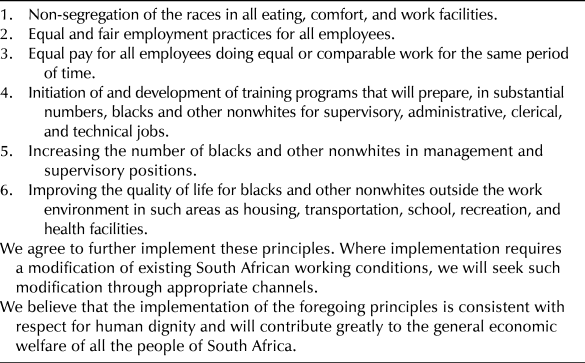
Source: State Department supplementary testimony, United States policy toward southern Africa: hearings before the Committee on International Relations, Subcommittee on Africa, U.S. House of Representatives, 95th Cong., 1 (March 1977) (Washington, DC: U.S. Government Printing Office, 1977), 16.
Soweto—Rebellion and American Business’ “Principled” Response
The Sullivan Principles were announced publicly at a press conference in Washington, D.C., in March 1977. Whereas Sullivan had had to fight to be heard during the drafting process and was often outvoted by white members of the group, the signatory companies gave Sullivan a starring role as spokesperson for Principles. At the press conference, Sullivan stood front and center at a podium flanked by GM chairman Thomas A. Murphy and IBM chairman Frank Cary. The image of the three corporate executives, dressed in suits, was intended to convey a sense of order amid the ongoing chaos in South Africa.
Nine months earlier, in June 1976, the world watched in horror as South African police opened fire on black school children protesting the introduction of Afrikaans in schools, among other things, in the black township of Soweto outside Johannesburg. Footage of the attack on unarmed protesters, including a photograph of a young Mbuyisa Makhubo carrying the lifeless body of Hector Pieterson alongside Hector’s visibly distraught sister Antoinette Sithole, struck a nerve with anti-apartheid sympathizers and ignited a new wave of anti-apartheid activism worldwide. Within South Africa, Soweto preceded a series of labor strikes and urban rebellions unseen since the early 1960s.Footnote 95
Before June 1976, Sullivan had encountered resistance from many corporate executives, some of whom, like Firestone’s J. M. Cornely, expressed concern about “interfere[ing] with [the] sovereign rights” of another nation. Following the Soweto Uprising and the growing public outcry it elicited, corporate support for the Principles grew significantly.Footnote 96 Concerned about the prospect of more sanctions, U.S. companies doing business in South Africa invested heavily in the Sullivan Principles and other corporate social responsibility projects promoting black empowerment. T. J. Barlow, president and chief executive officer of Anderson Clayton & Company, for one, informed Sullivan before the Principles’ public launch that “increased communications … [were] necessary” in order to inform the American public regarding “the [full] scope of the efforts [by American companies] on behalf of their non-white employees in South Africa.” Sullivan, for his part, was convinced that U.S. corporations were indeed doing positive things in South Africa, and promised Barlow that he would do his best to assist the signatory companies to “promote a better understanding and awareness of what is being accomplished … on behalf of … non-white workers” in South Africa.Footnote 97
Subsequently, Sullivan traveled the country promoting the Principles on dozens of radio stations, at private clubs, and in other public forums.Footnote 98 Later, Sullivan expanded his outreach to Europe, meeting with religious and business leaders in the United Kingdom, West Germany, France, the Netherlands, Sweden, and Denmark.Footnote 99 Sullivan gained many admirers on these trips. Business leaders, government officials, and other religious authorities praised the Principles as a “constructive” solution to the problem of Apartheid.
The positive feedback garnered on these trips by and large reflected public reaction to the Principles, which, at least in early days, elicited praise from parties across the political spectrum. The U.S. media largely praised the program as an example of the positive work being done by American corporations in South Africa. The Washington Post, for example, hailed the signatory companies for their courage in going beyond the Carter administration’s more timid response to the issue and taking a moral stance on Apartheid, which they perceived as a “[complex] and [volatile] … problem.”Footnote 100 Meanwhile NAACP executive director Roy Wilkins praised the Sullivan Principles as an important step “foreshadow[ing] … an end to segregation in South African life.”Footnote 101 Lest one think that support for the Principles came solely from liberals and moderates, in 1977, Ivorian politician Dramane Ouattara, writing on behalf of the Organization of African Unity, wrote Sullivan expressing his “total support” for Sullivan’s program. Let me “assure you,” Ouattara wrote, “of our readiness to contribute to your effort in whatever way you will find appropriate.”Footnote 102
Others were more critical of the Principles. “It seems most questionable that the Rev. Leon Sullivan should spend a year negotiating a ‘Statement of Principles’ which only seeks to ‘curb bias’ in a country guilty of some of the most atrocious racial crimes in this age,” noted one anonymous reader in a letter to the editor in the Baltimore Afro-American. “Have we learned nothing from our own struggles for civil rights? How long will those blacks in positions of influence continue to promote ambiguous or half-way solutions to the intolerable problems of racism and bigotry, not to mention apartheid?”Footnote 103 Chicago activist Prexy Nesbitt, who, at various times, worked at and served on the board of the American Committee on Africa (ACOA), likewise voiced skepticism about the Sullivan Principles. Addressing a forum on South Africa in Boston, Nesbitt stated, “I have a great deal of trouble as a black American in this country believing that corporations can help bring about social change [when] these same multinationals have abandoned the United States.”Footnote 104
Left-wing radicals were not the only ones with questions about the extent to which American corporations could be relied on to voluntarily promote desegregation and black empowerment in a country where Apartheid remained the official law. In a letter to Tim Smith, director of the Interfaith Center on Corporate Responsibility (ICCR), a corporate responsibility watchdog organization comprised of faith institutions, labor unions, and other socially conscious investors, Sullivan felt compelled to acknowledge the limitations of the Principles. “Much more will come out of the Statement of Principles in the longer run,” claimed Sullivan. In the meantime, however, he advised patience and understanding as he worked “to see how far [he] could go,” with the signatory companies.Footnote 105
As with earlier instances of social activism performed by PCR and others, growing criticism of the Principles, including from university students and faculty participating in the campus divestment movement, placed pressure on corporate executives to act. In February 1978, F. B. O’Mara, vice president of Union Carbide, whose company had been one of the founding signatories of the Principles, wrote Sullivan to express concern about the growing support for sanctions and divestment. Unless the signatory companies could show that progress was being made, O’Mara warned, the Principles would ultimately lose legitimacy.Footnote 106 In response, a subgroup of representatives from several dozen signatory companies got together to form the Industry Support Unit Inc. (ISU). As part of its commitment to improving the monitoring and implementation of the Principles, the ISU agreed to fund a “small administrative” staff to assist Sullivan and hired international consulting firm Arthur D. Little Inc. to oversee a semiannual report on the signatory companies.Footnote 107 The ISU also established a set of task forces, eight in the United States and another eight in South Africa, composed of representatives from the signatory companies and charged with monitoring progress on the Principles, including company hiring practices, employee pay, skills training and management development programs, and employee benefits.Footnote 108
Not all the signatory companies, however, saw things the way O’Mara did. Indeed, many resisted the ISU’s efforts to implement self-monitoring as an overreach. D. Reid Weedon Jr., the chief accountant from Arthur D. Little Inc. and lead on the monitoring initiative alongside Sullivan, received numerous complaints from signatory companies, including objections that “the complex and detailed questionnaire[s]” required as part of the Principles’ reporting program “[were] a distraction from [normal] business.” Others protested that the questionnaire “stand[s] in the way of” the signatory companies, whose own efforts “to improve the conditions for our employees” would be effective if only Weedon and other outside monitors would leave the companies alone to implement the Principles as they saw fit.Footnote 109
The signatory companies were even more resistant to monitoring from other organizations, including one overseen by Sullivan. With the news of the Soweto Uprising beginning to fade into the past, Sullivan found himself facing growing resistance from corporate executives, who still held out hope the South African issue would somehow resolve itself. As a result, Sullivan turned to his faithful supporters in the black church for assistance. Subsequently, a number of his colleagues, including several who had previously worked with Sullivan on the Selective Patronage campaign, formed the International Council of Equal Opportunity Principles (ICEOP), an independent monitoring organization for the Sullivan Principles.
Decades of experience fighting for affirmative action and equal opportunity in the United States, these ministers claimed, taught them that “companies [will] only do as much as they are forced to do.”Footnote 110 Eager to put pressure on the signatory companies, ICEOP embarked on a fact-finding mission to observe corporate operations in South Africa. The trip was funded with a $30,000 grant from the Edna McConnell Clark Foundation of New York. Sullivan’s longtime friends and colleagues Rev. Gus Roman and Daniel Purnell led the trip and were accompanied by D. Reid Weedon from Arthur D. Little Inc.Footnote 111 After visiting the operations of twenty-four signatory companies in South Africa, ICEOP produced a report on the mission, which was released in 1979. The report lambasted the practice of self-monitoring and joined other organizations, such as the Institute for Policy Studies, in criticizing the signatory companies for “[failing] to fulfill their stated purpose” and using the Principles to merely boost their own reputations.Footnote 112
The fight over the monitoring of the Sullivan Principles was emblematic of the tension between Black Power and corporate social responsibility. Facing heightened pressure in the wake of the Soweto Uprising, American corporations demonstrated a growing willingness to support programs aimed at improving the living and working conditions of black South Africans. Building on the work of the Sullivan Principles, the American Chamber of Commerce in South Africa announced its plans to open a new commercial high school in Jabulini in Soweto.Footnote 113 PACE commercial high school officially opened its doors in February 1982. Some seventy American companies helped to fund the cost of 600 students at $1400 per year in tuition.Footnote 114 These efforts represented a real investment in black empowerment. Yet they often stopped short of giving real decision-making power to black people. Such was the case with the Sullivan Principles, which continued to be plagued by issues of monitoring, with many executives refusing any sort of external monitoring.
Despite the issues regarding the monitoring of the program, the Sullivan Principles continued to receive significant support from business, government, and religious leaders, who drew encouragement from the actions, however minimal, taken by the signatory companies.Footnote 115 In a surprising turn of events, ICCR deputy director Terry Myers, whose organization had previously expressed skepticism about the Principles, revised his assessment of the program following a trip to South Africa. Myers told Sullivan, “[The signatory] companies have made substantial financial commitments to revamping existing eating, toilet or locker facilities to achieve desegregation.” Myers juxtaposed this progress with previous resistance on the part of South African subsidiaries, which “told me [in years prior] that desegregation of certain facilities could not be accomplished” due to high costs of “new designs and construction.”Footnote 116 Myers’ comments were echoed by Weedon, who encouraged Sullivan to view the “the cup [as] half full.” The point, according to Weedon, was not whether the signatory companies had met all the goals laid out by the Principles, but rather the positive “direction of change.”Footnote 117
Initial reports from Andrew D. Little Inc. seemed to confirm Weedon’s optimism. In 1978, Andrew D. Little Inc. published the first official report on the Sullivan Principles. According to the survey results, three-fourths of the reporting companies had integrated facilities (principle 1), while fifty-five out of seventy-eight companies (70.5 percent) reported having common benefit plans in place.Footnote 118 Many other companies had instituted training programs for black and other non-white employees. Motorola Company, for example, claimed to have recently appointed “a black personnel officer” tasked with “implement[ing] a broad series of programs involving selection, training and upgrading of factory personnel.”Footnote 119 Meanwhile Henry Ford II, chairman of the board of Ford Motor Company, reported that his company had designated $1.1 million for “training and development programs for blacks and colored employees” in South Africa. This represented an increase of over 150 percent from 1976 levels.Footnote 120
Subsequent investigation by anti-apartheid groups and corporate responsibility watchdog organizations cast doubt on these results, demonstrating that the signatory companies could not be relied upon to accurately report on the level of progress being made. Among the revelations to emerge from critics’ analysis of the report was the signatory companies’ use of the term “non-white,” instead of black or African, to obscure the fact that most of the increases in wages and benefits were accrued by Indian and colored South Africans—the latter category comprising a broad group of mixed origins, including the descendants of Malay slaves, who were designated by the South African government as a separate race distinct from native Africans.Footnote 121 In an external audit conducted by the South African Institute for Race Relations at Ford Motors, auditors discovered that the company’s claim to have increased the percentage of non-white salaried staff by 187 percent in three years was largely due to the hiring of colored workers, who were seen by the company as more dependable and hardworking than black Africans. Of the 165 new employees hired by Ford, 108 were colored compared with only 57 black new employees.Footnote 122
Meanwhile, others criticized the Principles for failing to support the rights of black South African workers to organize. In an independent report on the Sullivan Principles, the Institute for Policy Studies (IPS) reported that “only two companies, Ford and Kellogg, had recognized black trade unions, and only Kellogg had actually signed a contract.”Footnote 123 The IPS report mirrored criticism of the Principles by the United Automobile Workers (UAW) union, which negotiated with GM on behalf of black South Africans employed by GM South Africa who were detained by the South African government during a series of labor strikes enacted during the 1980s.Footnote 124 As a result, UAW president Owen Bieber observed that a growing number of South African trade unionists, “some [who previously] saw the [Sullivan] principles as useful,” increasingly saw the Principles as “outdated” and a “‘cover’ under which U.S. subsidiaries hide when the disinvestment/divestment issues come up.” Indeed, some black South Africans “found the code unfairly used in bargaining as a company diversion from inplant improvements that went far beyond the principles.”Footnote 125
Growing criticism of the Principles combined with ongoing reticence on the part of many signatory companies to monitoring prompted Sullivan to take action. In 1980, Sullivan caught signatory companies by surprise by calling for withdrawal. Sullivan made his pronouncement while speaking at the University of Witwatersrand in Johannesburg, where he said he was “going to turn the screws on [the signatory companies] … I will reach into corporation board rooms and take the cover off your companies … you American businessmen in South Africa and other parts of Africa had better get yourselves together.”Footnote 126 Sullivan’s speech was subsequently reprinted in the South African Rand Daily Mail alongside a quote from Sullivan threatening “Any U.S. company which does not do its part has no moral justification for being in this country. They should pack up and get out.”Footnote 127
The real pressure came from student activists, labor unions, and other anti-apartheid organizations, including the Free South Africa Movement and TransAfrica, which led the charge for sanctions and divestment. In 1977, Hampshire College became the first institution of higher education to completely divest from South Africa following several months of student protests. Hampshire College was soon followed by nearby Smith College, which sold nearly $700,000 in stock in companies operating in South Africa. Campus activism continued into the 1980s. By October 1985, twenty-four major colleges and universities had announced their intention to divest themselves of stocks in companies doing business in South Africa.Footnote 128
Growing unrest within and outside South Africa sparked a wave of capital flight. Beginning in 1984, large American banks began taking measures to reduce their exposure in South Africa by selling their loans to smaller U.S. and Japanese banks. By March 1985, overall lending by U.S. banks to South Africa dropped 16 percent to $4.2 billion, while the net capital flow from U.S. corporations to their South African subsidiaries fell from a $71 million positive flow into South Africa to a net outflow of $17 million.Footnote 129 In response to growing civil and political unrest, the South African government declared what would become the first of several states of emergency in July 1985. The state of emergency proved to be the last straw. By January 1986, at least thirty-nine major American firms had sold ownership of operations in South Africa, up from only seven the previous year.Footnote 130 Many more sold their assets and/or cut ties completely following the passage of the Comprehensive Anti-Apartheid Act later that summer. The act, which extended sanctions, including banning new bank loans and prohibiting the importation of South African steel, iron, coal, uranium, agricultural products, and food, was passed over President Reagan’s veto and signed into law on October 2, 1986.
Rewriting History—From Black Power to Corporate Social Responsibility
The passage of the Comprehensive Anti-Apartheid Act, which proved to be the most comprehensive sanctions enacted by the U.S. government against South Africa to date, has often been evoked by scholars and in popular memory as evidence of the failure of the Sullivan Principles.Footnote 131 Responding to growing criticism of the Principles, including one particularly scathing report by the ACOA, which called the Principles “toothless” and “[a] piece-meal reform that allows this cruel system of apartheid to survive” through helping to “modernize” it, and increased support for divestment, Sullivan announced in June 1985 his plan to abandon the Principles. “If in 24 months statutory apartheid had not been abolished, and there was not a clear commitment of the vote for Blacks,” Sullivan declared, “he would call for the [signatory] companies’ withdrawal, and an Embargo against South Africa.”Footnote 132 True to his word, in June 1987, Sullivan held a press conference outside the Dupont Plaza Hotel in Washington, D.C., where he called for the withdrawal of all American companies doing business in South Africa.Footnote 133
With Sullivan’s own abandonment of the Principles, the last vestiges of the struggle for Black Power within the corporation seemed to disappear into the recesses of history. In its absence, U.S. corporations were left the sole participants with the ability to write their own history of corporate social responsibility without interference from alternative perspectives provided by black directors and executives. Indeed, this rewriting of history began the very moment that Sullivan relinquished his stake in the Principles. In a press conference organized by a twelve-member steering committee representing the 104 remaining signatory companies, the corporations reasserted their commitment to pursuing a strategy of corporate-sponsored black empowerment over divestment. “Profound regret” were the words used by signatory committee cochairmen Colgate Palmolive CEO Reuben Mark, W. Michael Blumenthal of Unisys, and Mobil CEO William Tavoulareas to describe the news of Sullivan’s departure. “We owe a great debt to Leon Sullivan … but we will now have to carry out the Sullivan Principles without Sullivan.” The signatory companies refused to give up what they called the “tried and true” approach of the Principles, however. Rather, the committee spokesmen encouraged all “signatory companies … [to] renew and increase their efforts to end the apartheid system [emphasis added].” Footnote 134
Over the next several years, even while selling off local assets in accordance with the law, American businesses maintained their approach of corporate engagement as preferable to divestment and sanctions. In 1986, Coca-Cola announced plans to sell their South African bottling plant to a multiracial group of local investors and relocated its syrup manufacturing plant to nearby Swaziland. In doing so, Coca-Cola pursued a popular strategy followed by U.S. companies, whereby the company divested itself of all direct assets, while retaining licensing and franchise agreements to ensure that Coca-Cola products continued to make their way into South Africa.Footnote 135 Few of the details of Coca-Cola’s “divestment” reached the American public. Instead, Coca-Cola touted the company’s continued commitment to black empowerment with the launch of a new $10 million Equal Opportunity Fund administered by Nobel Peace Prize winner and famed anti-apartheid activist Desmond Tutu and Rev. Allan Boesak. Just months after leading a picket of Coca-Cola’s Centennial Celebration protesting the company’s presence in South Africa, Atlanta minister and president of the Southern Christian Leadership Conference Joseph Lowery lavished praise on Coca-Cola for its “strong moral statement” in the face of Apartheid. His comments echoed those of Andrew Young, Atlanta’s mayor and former aide to Martin Luther King Jr., who described the fund as “a bold and significant step in the battle against apartheid.”Footnote 136
These kinds of ventures, combined with corporations’ own intransigence with regard to divestment, helped to give continued credence to the idea of constructive engagement. In August 1988, the New York Times published a full-page editorial questioning the effect of divestment and sanctions and praising the work of the Sullivan signatories. “What … has been accomplished by … divestments? Products are still available” the author asked, further noting that in many cases, the local companies that acquired the sold-off assets of U.S. companies “support the status quo” of Apartheid. Where, the author reminisced, had the days when American business led the way in “advance[ing] the notion that business had a role to play in identifying social problems” gone.Footnote 137 This positive account of the Sullivan Principles later found credence in business schools, championed by management experts like S. Prakash Sethi, who subsequently authored a series of books on corporate ethics and touted the Sullivan Principles as an exemplary demonstration of corporate social responsibility.Footnote 138
Sullivan himself later joined in this rewriting of history. Following his retirement from GM’s board in 1992, Sullivan remained involved in various corporate social responsibility projects on the domestic front, including leading the effort to build an OIC center in post–riot torn Los Angeles. Like other OIC centers, the Los Angeles OIC benefited from corporate sponsorship, including a $1.3 million grant from Chevron Corporation to purchase a former AT&T operator service and training center on Western Avenue.Footnote 139 Sullivan never relinquished his desire to make impact on the world stage. In 1999, eight years after the end of Apartheid, multinational corporations again found themselves under fire for a range of issues, including environmental degradation and human rights abuses. In anticipation of protests scheduled to take place at the World Trade Organization meeting in Seattle later that year, a group of international business leaders approached Sullivan about reviving the Principles.Footnote 140 Ignoring the original Principles’ complicated history, including the questions regarding monitoring, these executives saw the Principles as offering moral legitimacy and an internationally recognized set of standards denoting ethical business practices. In November 1999, while protests raged in Seattle, Sullivan and U.N. secretary-general Kofi Annan unveiled the Global Sullivan Principles.Footnote 141 In attendance at the launching of the Global Sullivan Principles was GM chairman Jack Smith, demonstrating his company’s continued support for Sullivan and the example of corporate–community partnership he embodied.Footnote 142
In 2012, Ken Silverstein invoked both the original Principles and the Global Sullivan Principles in an article published in Forbes, urging corporations to become involved in ending gun violence. Silverstein described “Sullivan’s path” promoting corporate citizenry, rooted as it was in the fight against racism in the United States and South Africa, as “a universal example” capable of addressing a wide range of social issues.Footnote 143 These accolades remain by and large confined to elite circles like the United Nations, lacking popular support. As such, they reveal the chasm between modern corporate social responsibility and what Black Power proponents like Stokes called for, namely, for black and other marginalized people in positions to wield real “decision-making power” in the boardroom.



