Implications
Vitamin E is necessary to protect tissues from oxidative damage. When lambs were fed a concentrate or grass silage-based diet supplemented with increasing amounts of vitamin E, substantially lower plasma and tissue vitamin E levels were observed in lambs receiving the concentrate-based diets. Animal performance was, however, unaffected by dietary vitamin E level. Tissue fatty acid composition was also unaffected by dietary vitamin E level, but was higher in the beneficial n-3 polyunsaturated fatty acids when lambs received grass silage. These results demonstrate that basal diet can influence tissue vitamin E levels but performance is little affected by dietary vitamin E levels.
Introduction
The antioxidant α-tocopherol is a major component of systems that protect animal tissues from damage by free radicals (Gutteridge and Haliwell, Reference Gutteridge and Haliwell1994). It is deposited in tissue membranes where it acts to protect the membrane polyunsaturated fatty acids (PUFA) from oxidation. Quantities of α-tocopherol deposited in tissues are variable and depend upon the tissue and the concentration in the diet (Jensen et al., Reference Jensen, Lindholm and Hakkarainen1990; Ochoa et al., Reference Ochoa, McDowell, Williams, Wilkinson, Boucher and Lentz1992). Dietary supplementation with α-tocopheryl acetate raises the concentrations of α-tocopherol in the tissues of sheep (Ochoa et al., Reference Ochoa, McDowell, Williams, Wilkinson, Boucher and Lentz1992; Njeru et al., Reference Njeru, McDowell, Wilkinson, Linda, Rojas and Williams1994), but other components of the diet may also affect tissue levels. For example, Alderson et al. (Reference Alderson, Mitchell, Little, Warner and Tucker1971) reported that increasing the concentrate proportion in the diet fed to steers resulted in greater destruction of tocopherol in the rumen, although other studies have failed to confirm this result (Leedle et al., Reference Leedle, Leedle and Butine1993; Weiss et al., Reference Weiss, Smith, Hogan and Steiner1995). Additionally, long-chain PUFA may result in increased oxidation of vitamin E in the intestine, plasma and tissues (Horwitt, Reference Horwitt1962; Drevon, Reference Drevon1991). For example, muscular neuropathy, due to vitamin E deficiency, may occur in cattle turned out to fresh spring grass despite the high content of α-tocopherol in this forage, an effect that has been attributed to the presence of α-linolenic acid in the grass, resulting in high oxidative stress (Rammell and Cunliffe, Reference Rammell and Cunliffe1983).
Despite the clear role of vitamin E in animal metabolism, dietary levels necessary to maintain performance, health and meat quality in sheep are less apparent. For example, clinical signs of muscular dystrophy have been associated with serum α-tocopherol concentrations of less than 2.0 μg/ml (Radostits et al., Reference Radostits, Gay, Hinchcliffe and Constable2007). In contrast, we recently reported a study (Demirel et al., Reference Demirel, Wachira, Sinclair, Wilkinson, Wood and Enser2004) in which plasma α-tocopherol levels were less than 0.5 μg/ml, despite being fed a complete, pelleted diet based on dried grass that contained either 100 or 500 mg/kg dry matter (DM) all-rac-α-tocopheryl acetate. This dietary level was above the 15–20 mg/kg DM recommended for sheep by National Research Council (1985) but, despite the apparent deficiency, the lamb’s weight and feed efficiency were in the normal range. The high level of vitamin E supplementation did, however, provide additional protection against lipid peroxidation as indicated by the higher proportion of PUFA and lower proportion of monenoic fatty acids in muscle, liver and adipose tissue (Demirel et al., Reference Demirel, Wachira, Sinclair, Wilkinson, Wood and Enser2004). Reasons for the low plasma α-tocopherol levels were unclear, although it was suggested that it may have been related to some aspect of the basal ration The objectives of the present study were to examine the effect of basal diet (concentrate v. forage) and dietary vitamin E level on plasma and tissue α-tocopherol concentrations in growing lambs and to determine their effect on performance and tissue fatty acid composition.
Material and methods
The work described in this paper was conducted in accordance with the requirements of the Animals (Scientific Procedures) Act 1986.
Experimental design and treatments
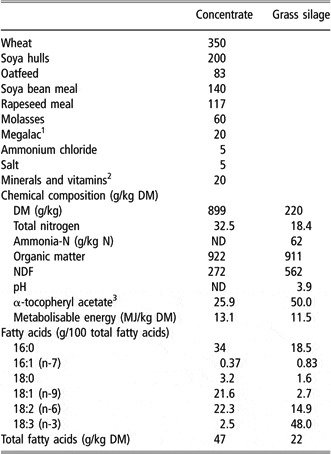
Fifty-six Suffolk × Charollais wether lambs previously reared on grass were stratified according to live weight and randomly allocated to one of seven dietary treatments based on either concentrates (C) or grass silage (S). The lambs allocated to concentrates received the same basal ration (Table 1) that was supplemented with one of five levels of all-rac-α-tocopheryl acetate (Roche Products Ltd, Derbyshire, UK) to provide a total content of α-tocopheryl acetate of 30 (C-30), 60 (C-60), 120 (C-120), 250 (C-250) or 500 (C-500) mg/kg DM. The lambs entered the study at an initial live weight of 28.4 (s.d. 1.6) kg and remained on study for 63 days. The remaining 16 lambs continued at pasture until entering the study when their live weight was 32.1 (s.d. 3.3) kg, where they were then fed for 56 days one of two diets based on grass silage and concentrates to supply the equivalent of 60 (S-60) or 500 (S-500) mg/kg DM α-tocopheryl acetate consisting of both the supplement and the vitamin E present in the silage. The aim of this design was to produce animals at a similar slaughter weight and length of supplementation despite differences in energy intake as a result of the lower energy density of the silage-based diet, whilst avoiding restriction of feed intake of the lambs fed concentrates alone.
Formulation (g/kg fresh weight) and chemical composition (g/kg DM) of the concentrate and grass silage fed to finishing lambs

DM = dry matter; ND = not determined.
1Volac Ltd, Royston, Herts., UK.
2Provided (g/kg total-diet); Ca, 1.3; P, 0.48; Na, 5.0; and (mg/kg) retinal 2.0; cholecalciferol, 0.27; Fe, 22; Co, 1.1; Mn, 22; Zn, 27; I 1.7; Se 0.2.
3Levels indicated are background levels without the addition of synthetic all-rac α-tocopheryl acetate.
Procedures and measurements
Animals were housed individually on slatted floor pens, in a well-ventilated room under continuous lighting and with water available ad libitum. Lambs on the concentrate-based diets were offered feed at 1.1 of ad libitum intake whereas grass silage-fed lambs received the silage at 1.1 of ad libitum intake and 400 g/day of concentrates in two equal meals at 0900 and 1600 h. The grass silage was a precision-chopped first cut from a predominately perennial ryegrass sward and ensiled in a concrete walled, roofed clamp. Refusals were collected and weighed three times per week and feed samples collected weekly and stored at −20°C prior to analysis. Animals were weighed weekly and blood samples taken by jugular venipuncture weekly at 1100 h into tubes containing potassium oxalate as an anticoagulant, spun at 2000 × g for 15 min and the plasma extracted and analysed for α-tocopherol. On study days 0, 30 and the day prior to slaughter, an additional blood sample was taken into heparinized tubes and the plasma extracted and stored at −20°C for subsequent determination of creatine kinase and glutathione peroxidise as indicators of oxidative status. Following transport to slaughter and overnight lairage, the lambs were slaughtered by electrical stunning and exsanguination and dressed conventionally. Blood samples were collected from the sticking wound during exsanguination into heparinized tubes and plasma collected and stored at −20°C. After evisceration the caudate lobe of the liver was removed. The pH of the m. longissimus was determined at the last rib with a penetrating probe and pH meter (Testo type 01-06, Testo Gmbh, Lenzkirch, Germany) at 45 min and 24-h post slaughter. The carcasses were then classified for conformation and fatness using 1–15 scales as described by Fisher et al. (Reference Fisher, Enser, Richardson, Wood, Nute, Kurt, Sinclair and Wilkinson2000), and samples of the full thickness of the tail head adipose tissue and the m. semimembranosus of the left hind limb collected. All tissue samples were vacuum packed in polyethylene bags, blast frozen and stored at −20°C immediately after preparation.
Chemical analyses
Feed samples were analysed according to the Association of Official Analytical Chemists (1995), except for metabolizable energy (ME) content, which was determined according to the Ministry of Agriculture, Fisheries and Food (1993) for the concentrates using equation E3, and according to Dowman and Collins (Reference Dowman and Collins1982) for the grass silage. Lipid extraction and fatty acid analysis were conducted according to Demirel et al. (Reference Demirel, Wachira, Sinclair, Wilkinson, Wood and Enser2004). Briefly, feed fatty acids were obtained from lyophilized samples by alkaline hydrolysis (5 M KOH) followed by acid hydrolysis (H2SO4 to pH 1.0) and extraction into petroleum spirit (BP 40–60°C). Liver fatty acids were obtained by a similar procedure except that the fatty acids were extracted immediately after acidification (Enser et al., Reference Enser, Hallett, Hewett, Fursey, Wood and Harrington1998). Muscle lipids were extracted with chloroform: methanol (2 : 1, v/v; Folch et al., Reference Folch, Lees and Stanley1957) containing 2, 6-di-tert-butyl-p-cresol (BHT) as an antioxidant. The lipids were then separated into neutral and polar fractions on columns of 500 mg silicic acid with sequential elution by chloroform and methanol, respectively. The lipids were then hydrolysed with 2.0 M KOH, the solution acidified and the fatty acids extracted into petroleum spirit. Adipose tissue was blended and extracted with chloroform containing BHT as an antioxidant. Anhydrous sodium sulphate was then added to absorb water and the dry solution of lipids obtained by filtration. Plasma fatty acids were obtained after alkaline hydrolysis, acidification and extraction as for muscle lipid fractions (Enser et al., Reference Enser, Hallett, Hewett, Fursey, Wood and Harrington1998). Fatty acids were methylated with a solution of diazomethane in diethyl ether and the methyl esters analysed by gas–liquid chromatography on a 50 m × 0.25 mm internal diameter CP Sil88 FAME column (Chrompack UK, Ltd, London, UK). The GC conditions were as follows: carrier gas He; split mode injection 70 : 1; injector and flame ionization detector temperature 250°C; initial oven temperature 180°C for 15 min; increased at 1.5°C/min to 220°C for 10 min. Saturated and monounsaturated methyl ester standard mixtures (Thames Restec UK, Ltd, Windsor, Berks, UK) were used to establish response linearity of the system. Fatty acids were quantified by adding methyl heneicosoanate as an internal standard prior to hydrolysis of tissues or lipid extracts. The vitamin E content of the feeds was determined by the method of Pocklington and Dieffenbacher (Reference Pocklington and Dieffenbacher1988). Vitamin E was extracted from plasma by the method of Burton et al. (Reference Burton, Webb and Ingold1985). A modified procedure from that described by Liu et al. (Reference Liu, Scheller and Schaefer1996) was employed to extract vitamin E from m. semimembranosus, liver and adipose tissue samples, but with 1 g of tissue and proportionate changes in volumes of reagents. Vitamin E was determined by normal-phase HPLC using a 5 μm silica column (HPLC Technology, Hertfordshire, UK) with a mobile phase of 4% 1,4-dioxane 96% n-hexane (v/v) at 40°C with fluorescence detection. Quantification was by use of rac-5,7-dimethyltocol as an internal standard (Universal Biological Ltd, Stroud, UK). Results were corrected for recovery through the extraction procedure, which was 94% for plasma, 86% for muscle and adipose tissue and 83% for liver based on spiking samples with α-tocopherol. Creatine kinase and glutathione peroxidase were determined in plasma by the Veterinary Laboratories Agency, Shrewsbury, UK. Creatine kinase was determined using the Bayer kit no. T01-1882-85 on a Bayer Technicon RA2000 analyser and glutathione peroxidase determined according to Anderson et al. (Reference Anderson, Berrett and Patterson1978) using a Bayer Technicon RA-XT analyser.
Statistical analysis
The effects of basal diet and vitamin E level were determined by analysis of variance with post-hoc analysis using Tukey’s test at a 5% level of significance. In addition, plasma vitamin E and enzymes were analysed as repeated measures. Pearson’s correlations were calculated where appropriate (SPSS version 10.0.5, 1999) and regressions determined using Minitab for windows (release 14, 2003).
Results
Animal performance and carcass composition
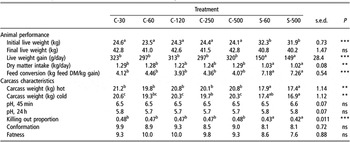
Daily DM intake was 0.24 kg lower (P < 0.01) in lambs receiving grass silage and concentrates compared to concentrates alone (Table 2). Lambs receiving the grass silage-based diet also grew more slowly and had a higher feed conversion ratio (P < 0.001), but at slaughter there were no differences (P > 0.05) in live weight between the dietary treatments. Within the basal diet, level of vitamin E supplementation did not affect (P > 0.05) animal performance. Carcass conformation and fatness and muscle pH values were also unaffected (P > 0.05) by dietary treatment. In contrast, killing out proportion was lower (P < 0.001) for lambs fed grass silage, resulting in the cold carcass weight being on average 2.9 kg less (P < 0.01) than in lambs fed concentrates alone. Dietary vitamin E level had no effect (P > 0.05) on carcass characteristics.
Effect of basal diet (concentrate (C) or grass silage (S)) and dietary vitamin E level (30, 60, 120, 250 or 500 mg α-tocopheryl acetate/kg dry matter (DM)) on the performance and carcass characteristics of finishing lambs

**P < 0.01, ***P < 0.001; ns = not significant.
a,b,cMeans within a row with a different superscript differ (P < 0.05).
Plasma α-tocopherol concentrations
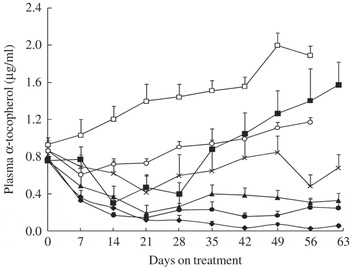
Initial plasma α-tocopherol concentrations were approximately 0.8 μg/ml and did not differ (P > 0.05) between treatments (Figure 1). Plasma α-tocopherol concentrations in all lambs fed the concentrate-based diets declined during the first 2–3 weeks of the study. For the C-30 group, plasma α-tocopherol concentration continued to decline up to day 42 of the study and remained low (approximately 0.05 μg/ml) thereafter. For animals receiving C-60 or C-120, plasma α-tocopherol concentrations stabilized at approximately 0.25 μg/ml around days 28–35 of the study. For animals receiving C-250, plasma α-tocopherol concentrations recovered to approximately the initial level by the end of the study, but only in C-500 did the final concentration exceed the initial value, with concentrations approximately doubling. For lambs receiving S-60 there was an initial decline in plasma α-tocopherol levels, but by day 28 levels had returned to initial values and then increased to approximately 1.1 μg/ml by the end of the study. In contrast to the other treatments, plasma α-tocopherol levels in lambs fed S-500 rose within the first 7 days of the study, with a final value of approximately 2.0 μg/ml.
Plasma α-tocopherol concentration during the growth of lambs fed either a concentrate-based (C) or a silage-based diet (S) and with differing dietary vitamin E concentrations (30, 60, 120, 250 or 500 mg α-tocopheryl acetate/kg DM): (⧫) C-30, (●) C-60, (▴) C-120, (x) C-250, (▪) C-500, (○) S-60, (□) S-500. Values are means for eight lambs per treatment with their standard errors represented by vertical bars.

Tissue α-tocopherol concentrations
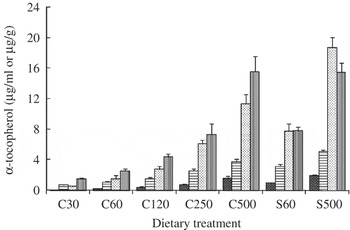
Muscle, liver and adipose tissue concentrations of α-tocopherol in lambs receiving C-500 compared to C-30 increased by factors of 5.1, 20.6 and 10.1, respectively (Figure 2). In muscle and liver, the highest dietary level of α-tocopherol fed to lambs on the concentrate diet (C-500) failed to produce tissue concentrations as high as that in lambs fed S-500. In contrast, adipose tissue α-tocopherol concentrations did not differ (P > 0.05) between lambs fed either C-500 or S-500 (mean of 15.6 μg/g tissue). Tissue α-tocopherol levels in lambs receiving S-60 were similar to those receiving C-250.
Tissue α-tocopherol concentrations in lambs fed either a concentrate- (C) or a silage-based diet (S) and with differing dietary vitamin E concentrations (30, 60, 120, 250 or 500 mg α-tocopheryl acetate/kg DM): ( ) plasma, (
 ) muscle, (
 ) liver and (
 ) adipose tissue. Values are means for eight lambs per treatment with their standard errors represented by vertical bars.

Plasma and tissue fatty acid content and composition
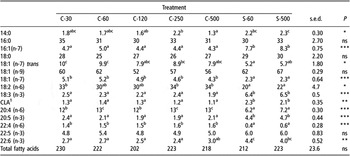
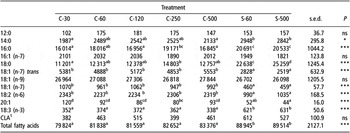
Total fatty acid content in the plasma collected at slaughter ranged between 202 and 230 mg/100 ml and was not affected (P > 0.05) by treatment (Table 3). There were, however, treatment differences in the concentration of fatty acids: 14:0, 16:1 (n-7), 18:3 (n-3), conjugated linoleic acid (CLA; cis-9, trans-11 18:2), 20:5 (n-3) and 22:6 (n-3) were higher and 18:1 (n-7) trans, cis-18:1 (n-7), 18:2 (n-6), 20:4 (n-6) and 22:4 (n-6) lower in lambs receiving grass silage than concentrates alone. Within the basal diet there was no effect (P > 0.05) of vitamin E level on plasma fatty acid composition.
Effect of basal diet (concentrate (C) or grass silage (S)) and dietary vitamin E level (30, 60, 120, 250 or 500 mg α-tocopheryl acetate/kg dry matter (DM)) on plasma fatty acid content (mg/100 ml)

*P < 0.05, **P < 0.01, ***P < 0.001, ns = not significant.
1Conjugated linoleic acid, cis 9, trans 11.
a,b,cMeans within a row with a different superscript differ (P < 0.05).
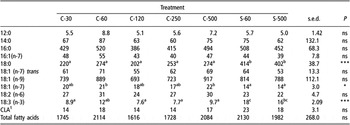
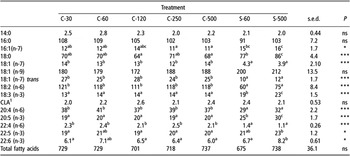
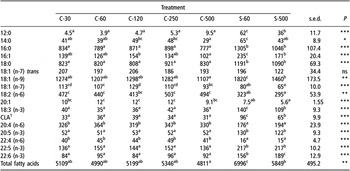
Basal diet or dietary vitamin E concentration did not affect (P > 0.05) the content of neutral lipid fatty acids in m. semimembranosus, which averaged 1914 mg/100 g muscle (Table 4). There was an effect of basal diet on the composition of neutral lipids, with 18:0 and 18:3 (n-3) being higher and 18:1 (n-7) lower (P < 0.05) in lambs receiving the grass silage compared with the concentrate-based diets. There was no effect (P > 0.05) of dietary treatment on the concentration of phospholipids in the m. semimembranosus, which averaged 718 mg/100 g muscle, but all the n-3 PUFA, together with 16:1 (n-7) and 18:0, were higher (P < 0.05) in lambs receiving grass silage than concentrates (Table 5). In contrast, all the n-6 PUFA were higher in the concentrate-fed lambs, along with 18:1 (n-7) trans and 18:1 (n-7). Liver total lipid fatty acid content was highest in lambs fed grass silage and 60 mg/kg DM α-tocopherol acetate (Table 6), but in general, the fatty acid composition of the liver was similar to the muscle phospholipids with all the n-3 PUFA, together with 12:0, 14:0, 16:0, 16:1 (n-7), 18:0 and 18:1 (n-9) being higher (P < 0.05) in the silage-fed lambs and all the n-6 PUFA, along with 18:1 (n-7) being higher (P < 0.05) in the concentrate-fed lambs. In addition, CLA was present in higher amounts (P < 0.001) in the liver of lambs fed grass silage. Adipose tissue total fatty acid concentrations were higher (P < 0.05) in lambs when fed diets based on grass silage than concentrates (Table 7). The contents of 14:0, 16:0, 18:0 and 18:3 (n-3) were also higher in lambs fed the grass silage-based diets, whilst 18:1 (n-7) trans and 18:2 (n-6) were lower.
Effect of basal diet (concentrate (C) or grass silage (S)) and dietary vitamin E level (30, 60, 120, 250 or 500 mg α-tocopheryl acetate/kg dry matter (DM)) on the neutral lipid fatty acids of m. semimembranous (mg/100 g muscle)

*P < 0.05, ***P < 0.001, ns = not significant.
1Conjugated linoleic acid, cis 9, trans 11.
a,b,cMeans within a row with a different superscript differ (P < 0.05).
Effect of basal diet (concentrate (C) or grass silage (S)) and dietary vitamin E level (30, 60, 120, 250 or 500 mg α-tocopheryl acetate/kg dry matter (DM)) on the polar lipid fatty acids of m. semimembranous (mg/100 g muscle)

*P < 0.05, ***P < 0.001, ns = not significant.
1Conjugated linoleic acid, cis 9, trans 11.
a,b,cMeans within a row with a different superscript differ (P < 0.05).
Effect of basal diet (concentrate (C) or grass silage (S)) and dietary vitamin E level (30, 60, 120, 250 or 500 mg α-tocopheryl acetate/kg dry matter (DM)) on the liver fatty acids (mg/100 g tissue)

*P < 0.05, **P < 0.01, ***P < 0.001, ns = not significant.
1Conjugated linoleic acid, cis 9, trans 11.
a,b,c,dMeans within a row with a different superscript differ (P < 0.05).
Effect of basal diet (concentrate (C) or grass silage (S)) and dietary vitamin E level (30, 60, 120, 250 or 500 mg α-tocopheryl acetate/kg dry matter (DM)) on adipose tissue fatty acids (mg/100 g tissue)

*P < 0.05, **P < 0.01, ***P < 0.001, ns = not significant.
1Conjugated linoleic acid, cis 9, trans 11.
a,b,c,dMeans within a row with a different superscript differ (P < 0.05).
Glutathione peroxidase and creatine kinase
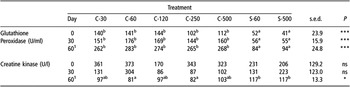
Glutathione peroxidase activity was unaffected by dietary α-tocopherol acetate level (Table 8). Activity generally increased with time for all groups, particularly between day 30 and the end of the study, and were 2–3-fold higher (P < 0.001) the day prior to slaughter in lambs fed the concentrate compared with the grass silage-based diets. Creatine kinase activity was particularly variable, especially on day 0 of the study, and generally decreased with time. Activity was not affected (P > 0.05) by dietary α-tocopherol acetate concentration, but animals fed the grass silage-based diets had a higher activity (P < .05) at the end of the study, but not at any of the other time points.
Effect of basal diet (concentrate (C) or grass silage (S)) and dietary vitamin E level (30, 60, 120, 250 or 500 mg α-tocopheryl acetate/kg dry matter (DM)) on plasma glutathione peroxidase and creatine kinase activity

*P < 0.05, ***P < 0.001, ns = not significant.
a,bMeans within a row with a different superscript differ (P < 0.05).
1Day 55 for silage-fed lambs.
Discussion
Dietary vitamin E concentration had no effect on animal performance or carcass composition. This result was not unexpected as the quantities of α-tocopherol consumed exceeded the recommended dietary level (Agricultural Research Council, 1980; National Research Council, 1985) and confirms our previous finding that dietary vitamin E level did not affect animal performance (Demirel et al., Reference Demirel, Wachira, Sinclair, Wilkinson, Wood and Enser2004). It is also consistent with the findings of Turner et al. (Reference Turner, McClure, Weiss, Borton and Foster2002) who supplemented lambs receiving concentrates or forage with α-tocopheryl acetate over a similar concentration range and Arnold et al. (Reference Arnold, Scheller, Arp, Williams, Buege and Schaefer1992) who reported no difference in the performance of steers supplemented with either 500 or 1000 mg/day of all-rac-α-tocopheryl acetate. In contrast, Wulf et al. (Reference Wulf, Morgan, Sanders, Tatum, Smith and Williams1995) reported a significantly lower growth rate in lambs receiving 1000 mg all-rac-α-tocopheryl acetate/day compared with those given 500 mg/day, although tissue α-tocopherol levels were not affected and carcass traits differed only slightly between the two groups.
Despite the normal growth of the lambs, mean plasma α-tocopherol concentrations were all below the 2 μg/ml considered critical before which deficiency occurs (Radostits et al., Reference Radostits, Gay, Hinchcliffe and Constable2007). For lambs fed concentrates alone, mean values were below the 1–1.5 μg/ml that is associated with white muscle disease (National Research Council, 2007). The stress of penning and adaptation from grazed grass to concentrates may have contributed to the initial fall in plasma α-tocopherol, but by the end of the study lambs receiving C-250 had returned to their initial value, whilst plasma levels in those receiving C-500 were approximately double. Plasma vitamin E levels have been reported to be poorly related to intake in sheep (Hidiroglou and Charmley, Reference Hidiroglou and Charmley1990), but we observed a strong linear relationship; regression of final plasma α-tocopherol concentration (μg/ml) on dietary α-tocopheryl acetate (mg/kg DM) for animals on the concentrate diet was y = 0.003 + 0.0031x, r 2 = 0.60, P < 0.001. The close correlation between plasma and liver vitamin E (r 2 = 0.852, P < 0.01) also suggests that plasma concentrations are reliable indicators of dietary availability since liver is thought to reflect the daily intake (Bieri, Reference Bieri1972).
Based on the plasma α-tocopherol concentrations, the apparent availability of α-tocopheryl acetate was lower in lambs on the concentrate compared to the silage-based diets. The causes of poor absorption are unclear but the rate of hydrolysis of the tocopheryl acetate, a necessary prelude to absorption, may be a contributing factor. For example peak plasma concentrations occurred later in lambs given a bolus of α-tocopheryl acetate compared to free α-tocopherol that is naturally present in forages (Hidiroglou et al., Reference Hidiroglou, McDowel and Balbuena1989), and slow hydrolysis has been suggested as the cause of low plasma tocopherol levels when supranutritional levels of α-tocopheryl acetate have been fed (Machlin and Gabriel, Reference Machlin and Gabriel1982; Drevon, Reference Drevon1991). At the end of the current study plasma concentrations in the C-60 group were 0.25 of those in the S-60 group, but for the C-500 lambs the levels were 0.81 of those in S-500, a difference that was not significant. This effect may be attributed to approximately 69% of the tocopherol in the S-60 diet being supplied as the naturally occurring α-tocopherol compared to 44% in C-60, whereas for S-500 and C-500 the contents were substantially lower and closer at 8% and 5%, respectively. The diet-sensitive factors that alter the rate of hydrolysis can only be hypothesized, but might include binding to components of digesta, changes in duodenal pH away from the optimum for esterases or differences in the rate of passage of intestinal contents. Another factor that may have contributed to the low plasma α-tocopherol in the C-60 group is stereoselectivity for the RRR isomer of α-tocopherol compared to the S isomers, particularly the 2S isomers (for a review see Burton and Traber, Reference Burton and Traber1990). In rats fed a 1 : 1 mixture of RRR-α-tocopheryl acetate and SRR-α-tocopheryl acetate, the plasma ratio of RRR/SRR reached a limiting value of 2.7, and values for the biceps femoris, inguinal white adipose tissue and liver were 1.7, 1.6 and 1.2, respectively (Ingold et al., Reference Ingold, Burton, Foster, Hughes, Lindsay and Webb1987). The discrimination between isomers occurs in the liver, with preferential incorporation of the RRR form into very low density lipoproteins and excretion of the 2S isomers in particular (Burton and Traber, Reference Burton and Traber1990). Assuming that the 2S isomers are 50% of the all-rac-α-tocopheryl acetate (Weiser et al., Reference Weiser, Riss and Korman1996), the proportion of 2R isomers in the diet of the S-60 lambs was 1.2 fold that in the feed of the C-60 lambs. If the stereoselectivity of the lamb liver is similar to that of the rat, α-tocopherol levels in the plasma, muscle, adipose tissue and liver of the S-60 lambs should be 3.2-, 2.0-, 1.9- and 1.4-fold higher than in the tissues of the C-60 lambs. The observed values were 4.6, 2.8, 3.1 and 3.4 higher, respectively, indicating that whilst stereoselectivity may play a role it was not the major factor influencing relative tissue concentrations.
Once hydrolysed, tocopherol is exposed to oxidative damage as a result of lipid peroxidation within the intestinal lumen, enterocytes or blood. The silage-based diet was expected to have the greater potential to cause destruction of α-tocopherol because of its high content of 18:3 (n-3), the peroxidizability index of which is twice that of 18:2 (n-6) (Witting and Horwitt, Reference Witting and Horwitt1964), the major PUFA in the concentrate. The differences between the feeds would, however, be reduced by biohydrogenation in the rumen as a result of the higher biohydrogenation of 18:3 (n-3) compared to 18:2 (n-6) (Chikunya et al., Reference Chikunya, Demirel, Enser, Wood, Wilkinson and Sinclair2004; Sinclair et al., Reference Sinclair, Cooper, Chikunya, Wilkinson, Hallett, Enser and Wood2005). Despite this, the plasma lipid fatty acid composition retained the differences between the diets with more 18:3 (n-3) in lambs fed silage and more 18:2 (n-6) in lambs fed concentrate alone, with the overall peroxidizability indices of the plasma fatty acids (calculated as [(% monoenoic × 0.025) + (% dienoic × 1) + (% trienoic × 2) + (% tetraenoic × 4) + (% pentaenoic × 6) + (% hexaenoic × 8)] being very similar at 71.2 and 76.3 for the C-60 and S-60 lambs, respectively. Also, the effectiveness of this difference might be reduced further by the higher plasma PUFA concentration in the concentrate-fed lambs, since the peroxidizability index is based on % composition rather than on content. Overall this suggests that the oxidation potential of the absorbed fatty acids from the two diets was similar and would affect α-tocopherol equally. In addition, the lack of effect of level of supplementation of α-tocopherol on the plasma fatty acid composition also indicates the absence of significant oxidation of fatty acids during absorption.
Tissues respond differently to variations in the availability of tocopherol and when supply is adequate the order is: liver > adipose tissue > skeletal muscle > plasma (Jensen et al., Reference Jensen, Lindholm and Hakkarainen1990; Ochoa et al., Reference Ochoa, McDowell, Williams, Wilkinson, Boucher and Lentz1992). On that basis only the S-500 lambs had a normal distribution pattern. At the 500 mg/kg DM concentration there was sufficient vitamin E available for adipose tissue, which accumulates vitamin E rapidly, to reach normal levels in the concentrate-fed animals. However, in the slower accumulating muscle tissue, concentrations remained below those of the S-500 group. This finding supports the conclusions based on plasma α-tocopherol levels that the rate and degree of absorption of α-tocopherol from the concentrate-based diet were less than that of the silage-based diet. The roles of the liver are short-term storage of vitamin E with incorporation into and secretion of tocopherol in plasma lipoproteins and excretion via the bile (Bjørneboe et al., Reference Bjørneboe, Bjørneboe and Drevon1990; Traber and Arai, Reference Traber and Arai1999). The lower α-tocopherol levels in the liver of lambs fed C-500 compared with S-500 may therefore reflect the uptake and secretion by the liver, resulting in insufficient amounts for storage. Our results differ from those of Turner et al. (Reference Turner, McClure, Weiss, Borton and Foster2002) who compared tissue α-tocopherol levels in lambs fed a diet based on shelled maize grains supplemented with α-tocopheryl acetate with those at pasture. The concentration of α-tocopherol in the m. longissimus dorsi was best related to intake by a quadratic function and the values for the pasture-finished lambs fell on the same line as those consuming concentrates. Overall, the efficiency of deposition of α-tocopherol was higher in the concentrate-fed lambs in the study of Turner et al. (Reference Turner, McClure, Weiss, Borton and Foster2002) than in the current study, with muscle concentrations of approximately 3 μg/g at an intake of 150 mg α-tocopheryl acetate/kg DM compared with only 2.6 μg/g at an intake of 250 mg/kg DM reported here. Factors that may have contributed to this difference include the greater length of study, concentrate composition or muscle studied.
Tissue α-tocopherol levels appeared less than optimal in lambs receiving C-30 or C-60, with C-120 being marginal (Radostits et al., Reference Radostits, Gay, Hinchcliffe and Constable2007), but levels of glutathione peroxidase and creative kinase activities did not indicate any signs of oxidative stress. Creatine kinase activity was within the reference normal range of <200 U/l for all but the C-120 group at the beginning of the study, but there was a wide variation between animals. There was a marked improvement in activity during the study, with levels falling within the normal range, with a small effect of basal diet but no effect of dietary vitamin E level. In both basal diet groups glutathione peroxidase levels were unaffected by dietary vitamin E level, and increased during the study. The causes of the low initial glutathione peroxidase activity in the silage-fed lambs and its failure to catch up with the concentrate-fed lambs during the study are not clear. These lambs spent an additional 3 months at pasture and it is possible that a low forage selenium concentration, combined with climatic or seasonal effects (Van Doorst et al., Reference Van Doorst, Thornton and Wuyi1986), contributed to this effect, although grass Se levels were not determined.
Tissue fatty acid composition demonstrated the well-established effect of dietary lipid, with more n-6 PUFA derived from the high content of dietary linoleic acid in the concentrate-fed lambs and higher proportions of n-3 PUFA as a result of higher dietary amounts of α-linolenic acid in the forage-fed lambs (Sinclair, Reference Sinclair2007). Within basal diet there was little effect of vitamin E intake on fatty acid composition in any of the tissues measured. This occurred despite differences in PUFA concentration and α-tocopherol : PUFA ratio between tissues, and confirms the adequacy of the low tissue vitamin E levels. In our previous study (Demirel et al., Reference Demirel, Wachira, Sinclair, Wilkinson, Wood and Enser2004), lambs with muscle vitamin E levels of 0.27 μg/g had lower proportions of PUFA in muscle lipids than lambs with muscle vitamin E concentrations of 0.52 μg/g, with the effects being greatest when the animals were oxidatively stressed by feeding high levels of PUFA. In the current study, muscle α-tocopherol levels were above 0.7 μg/g in all treatments. In the study of Demirel et al. (Reference Demirel, Wachira, Sinclair, Wilkinson, Wood and Enser2004), the main dietary ingredient was dried grass, although reasons why this basal forage should result in a very low efficiency of vitamin E utilization are unclear. The breeds were also different with Suffolk × Lleyn and Scottish Blackface compared to Suffolk × Charollais used here, but breed × vitamin E effects were small and did not suggest major breed effects on vitamin E deposition (Demirel et al., Reference Demirel, Wachira, Sinclair, Wilkinson, Wood and Enser2004). Whilst low tissue levels of vitamin E may allow normal growth and not alter tissue fatty acid composition, the shelf life of the meat with respect to colour and lipid peroxidation can be less than optimal (Kasapidou, Reference Kasapidou2003).
In conclusion, we have demonstrated substantially lower plasma and tissue levels of α-tocopherol in lambs supplemented with all-rac-α-tocopheryl acetate on a concentrate compared to a mixed diet of silage and concentrates. At low levels of supplementation the grass silage provided a higher proportion of dietary vitamin E as free RRR-α-tocopherol and we propose that poor hydrolysis of the supplemental ester may have contributed to the low tissue levels in lambs fed the concentrate-based diets. We have also demonstrated that at tissue levels previously considered to represent deficiency normal growth can be achieved and that tissue fatty acid composition is unaffected. Tissue fatty acid composition was, however, influenced by the basal diet, with n-3 PUFA being higher and n-6 PUFA lower in lambs fed the grass silage-based diets. Whilst low tissue levels of vitamin E may allow normal growth and not alter tissue fatty acid composition, the shelf life of the meat with respect to colour and lipid peroxidation may be less than optimal.
Acknowledgements
We gratefully acknowledge financial support from the Department for the Environment Food and Rural Affairs, ABN Ltd, Pedigree Petfoods Ltd, Roche Products Ltd and Tesco Stores Ltd. E. Kasapidou held an EU Marie Curie Studentship. We are grateful to the staff of the Veterinary Laboratories Agency, Shrewsbury, for the creatine kinase and glutathione peroxidase assays, and to J. Bibb at HAUC for assistance with the feeding study.