Introduction
For the past two years, we have been engaged in a project examining requests at a shoe repair shop in a small American town. This has presented us with an enormous intellectual challenge in the sheer number and variety of forms that are used to accomplish the requesting of repairs to shoes, boots, zippers, and a host of other leather items. Consider the following examples from our corpus.
-
(i) These are in bad shape
-
(ii) I need heels
-
(iii) I want these polished
-
(iv) So I'm just looking to get one more notch
-
(v) So you can't just replace this little thing
-
(vi) Can you fix this?
-
(vii) Would you be able to do that as well
-
(viii) Is it possible. To resole these
-
(ix) Is there any way that I could get these resoled or pfhh
-
(x) Wondered if I could get those stretched
-
(xi) My lovely wife would like to know if you can fix that
-
(xii) I wanted to see if there's any way those can be repaired
Obviously, our list of examples can be radically shortened by way of categorization; the first five requests, for instance, all have declarative syntax, whereas the next four are interrogatives. The last three requests are, like the first five, declaratives, but of a complex type with an embedded interrogative (e.g. if I could). Such categorization, however, would be rather crude. From the examples above we can note, for instance, that there are significant differences between the first declarative request (These are in bad shape), which is formulated as a (rather general) report of trouble (cf. Kendrick & Drew Reference Kendrick and Drew2016), compared to the very explicit expressions of need/want that is accomplished through the second and third request in which solutions are nominated either as an object (heels) or an action (polished). Likewise, within the category of interrogative requests, asking about the recipient's ability (Can you fix this) on the one hand and inquiring about the repairability of the item (Is it possible. To resole these) on the other hand, seem to constitute rather different ways of making a request. What intrigues us even more, however, is that we also find more granular grammatical variations in our data, at the level of morphology, lexis, and syntax.Footnote 1 For example, the second request on our list, which we call a need-declarative, can occur not only with a noun phrase (I need heels ), but also with a resultative clause (I need a second hole punched ) or a gerund (these need resoling ). And the sixth request on our list, which we call a can-interrogative, is other-oriented (i.e. inquiring into the recipient's ability, can you fix this), but can-interrogatives can also be self-oriented (can I just get these dyed black) or object-oriented (can sneakers be resoled).
We find these granular differences intriguing, in particular because we think they speak directly to current understandings—in particular within Conversation Analysis (CA) and Interactional Linguistics (IL)—of the relations between linguistic form and social action: that is, how speakers design their utterances to be recognizable as doing a particular action (action formation), and how recipients recognize that action, or ascribe that action to the utterance (action ascription; Levinson Reference Levinson, Stivers and Sidnell2013). Crucial to this line of research has been the notion of format; today the term is most commonly used to capture a recurrent linguistic practice or formulation for accomplishing a particular action. The earliest use of this term in the CA literature that we are aware of is in M. H. Goodwin's (Reference Goodwin, McConnell-Ginet, Borker and Furman1980) study of directive-response sequences where she notes that the format of a directive is ‘characteristically implicative’ (Reference Goodwin, McConnell-Ginet, Borker and Furman1980:161) for the format of the responding action; and C. Goodwin & M. H. Goodwin's (Reference Goodwin and Goodwin1987) study on assessments (see also C. Goodwin Reference Goodwin, Ochs, Schegloff and Thompson1996), where they note that postpositioned assessments are produced in the format [it] + [copula] + [adverbial intensifier] + [assessment term]. Fox (Reference Fox2000, Reference Fox2007) offers the term again as part of the notion of social action format. Social action format was meant to capture growing evidence that actions are often accomplished in recurrent and highly patterned grammatical ‘packages’ that can be discovered using the data and methods of Conversation Analysis and Interactional Linguistics. The term format has come to be quite common in the CA/IL literature, being used for grammatical patterns for offers (Curl Reference Curl2006), responses to several types of initiating actions (Thompson, Fox, & Couper-Kuhlen Reference Thompson, Fox and Couper-Kuhlen2015), and requests. In particular from the large body of research on requests, we find clear evidence for the relation between language and action, or action formation. In an early contribution in the area of linguistic resources and requesting actions, Wootton (Reference Wootton1981) found that in the interactions of a young child with her parents, two syntactic forms (I want x and can I have/do x) predominated in the construction of requests, but were used in distinctly different environments. Later studies in Conversation Analysis, beginning with Lindström's (Reference Lindström, Hakulinen and Selting2005) study on requests by seniors of their care providers, continued to examine the use of different grammatical forms for requesting, typically focusing on comparing the use of two (or three) different forms. Where Lindström (Reference Lindström, Hakulinen and Selting2005) explored imperatives, interrogatives, and declaratives in Swedish, Vinkhuyzen & Szymanski (Reference Vinkhuyzen, Szymanski, Richards and Seedhouse2005) focused on what they termed self-oriented declarative requests and other-oriented interrogative requests in American English, Heinemann (Reference Heinemann2006) on negative and positive polar interrogatives in Danish, Curl & Drew (Reference Curl and Drew2008) on modal interrogatives (could you/would you) and I wonder if x indirect questions in English, Zinken & Ogiermann (Reference Zinken and Ogiermann2011) on declarative trzeba-x turns and can you do x interrogatives in Polish, Rossi (Reference Rossi2012) on imperatives and mi x interrogatives in Italian, and Sorjonen & Raevaara (Reference Sorjonen, Raevaara, Drew and Couper-Kuhlen2014) on noun phrase requests and clausal requests in service encounters in Finnish. Not all of these studies are framed in terms of action formation,Footnote 2 but they all illustrate how a range of different formats can be employed to address a speaker's ‘primary concern’ with getting someone else to help with something, while their grammatical variation allows participants in interaction to at the same time address other (often multiple) ‘contingent concerns’ (Mandelbaum & Pomerantz Reference Mandelbaum, Pomerantz and Tracy1991). Such contingent concerns include, for instance, the degree to which the requester is entitled to make the request, the various contingencies that may apply with respect to granting the request, whether the request is part of a joint project, and the spatio-temporal position of the participants.
As our somewhat contracted overview of previous CA/IL work on requests indicates (see Drew & Couper-Kuhlen Reference Drew, Couper-Kuhlen, Drew and Couper-Kuhlen2014; Rossi Reference Rossi2015a for more expanded discussions), the relevance of action formation has for the most part been addressed with respect to larger syntactic categories, such as, for instance, imperatives, declaratives, and (modal) interrogatives. Our data, as illustrated in the list above, however, lead us to suggest that even relatively minor grammatical variations are of systematic relevance for how participants in interaction accomplish the action of requesting. In the following, we attempt to demonstrate this point by focusing on two particular formats for requesting: declaratives with need/want and can-interrogatives.
Our study is not only meant as a description of some highly detailed practices for accomplishing requests, however, but also as an exploration of some questions that should be of general, theoretical interest (see also Thompson et al. Reference Thompson, Fox and Couper-Kuhlen2015). We briefly sketch out these issues here, and return to them in our concluding discussion.
First, the current literature uses the term format often for major syntactic forms, such as interrogative, imperative, and declarative; even when more specific forms are referred to, such as I wonder if x, it appears that a wider class (such as indirect questions) might actually be intended (Curl & Drew Reference Curl and Drew2008). Our research leads us to ask: Do only major syntactic forms actually count as ‘formats’, or is it possible that highly grammatically specific practices might count as formats as well? In other words, what exactly counts as a format?
Second, and related to the first, prior work on requesting formats addresses the relevance of lexical specificity, but then typically only for the verb (e.g. Zinken & Ogierman Reference Zinken and Ogiermann2011; Childs Reference Childs2012a; Rossi Reference Rossi2012, Reference Rossi2015b), while what follows the specific verb is often glossed as x (or left unspecified). This manner of representing the format is meant to capture the claim that all utterances containing the lexical items in that syntactic frame count as an instance of the format, regardless of what comes after (or before, depending on the syntax of the language) in the clause. But again we can ask: Do only certain lexical choices, for instance with respect to the verb, affect action formation? What about morphology? And what about syntax and lexis in the subordinate clause? In other words, how much abstraction characterizes practices for constructing action types?
And third, the term format is often used in a way that seems similar to structure, that is, as a pre-existing blueprint for constructing utterances. However, such an understanding of format seems problematic within a CA/IL framework, given the importance placed on order as something achieved in the moment, arising in the contingencies of the interaction. As Schegloff has said of form:
If certain stable forms appear to emerge or recur in talk, they should be understood as an orderliness wrested by the participants from interactional contingency, rather than as automatic products of standardized plans. Form, one might say, is also the distillate of action and/in interaction, not only its blueprint. (Reference Schegloff and Tannen1982:89)
How are we thus to understand the ontological status of a format? If it is an ‘orderliness wrested by the participants from interactional contingency’, then it cannot be only a blueprint for linguistic form; it might also be an epiphenomenal ‘distillate’ available to the analyst across many instances but perhaps less available to the participants beforehand. This perspective aligns with recent work in linguistics on Emergent Grammar (Hopper Reference Hopper1987, Reference Hopper and Tomasello1998, Reference Hopper, Auer and Pfänder2011, Reference Hopper, Gee and Handford2013) and usage-based grammar (Bybee & Hopper Reference Bybee and Hopper2001; Bybee Reference Bybee2006, Reference Bybee2010), where linguistic form is seen as ‘a process that emerges in real time’ (Hopper Reference Hopper, Gee and Handford2013:301). Furthermore, the ‘fundamental temporality of language implies the paradox that structure itself is unstable and intrinsically incomplete, and is constantly being created and recreated in the course of each occasion of use’ (Hopper Reference Hopper, Gee and Handford2013:301). We are thus drawn to ask: To what extent are the formats we as analysts can identify and describe a result of a tension between recurrent practices and the contingent outcomes of moment-by-moment interactional work?
In this article, we begin with a general introduction to our data and provide an overview of the various request forms in the data along with a description of our methodological approach. We then turn to focus on two recurrently used formats for requesting in our data: need/want-declaratives and can-interrogatives. For each of these formats we show that more granular variation, at the clausal, phrasal, and lexical level, has interactional relevance, for instance, with respect to the request's position in an encounter, the requester's (displayed) degree of entitlement, the kinds of contingencies that may be involved in granting the request, the nature of the repair or service that is requested, whether the customer deems the solution to be ‘no problem’ or a matter of some negotiation, and so on. We conclude by discussing whether—or to what extent—our findings make relevant a respecification of the notion of action format.
Data and method
The site of our data collection is a shoe repair shop in a small town in the United States. As part of a larger on-going project videorecording at local businesses, we have collected approximately thirty-five hours of video data at the shoe shop. The shop is owned and operated by a family, with a few nonfamily employees. Because in American English the word ‘staff’ is a collective noun, not suitable for reference to individuals, and because not all staff who work at the service counter are actual cobblers, we use an invented word, ‘shoetender’, to refer to individual members of the staff.Footnote 3
The staff will attempt repairs (as well as cleaning and polishing) on most leather items, including shoes, boots, belts, jackets, purses, and even unusual items such as baseball gloves and saddles. In addition, they repair zippers on a variety of objects (e.g. suitcases and coats). They also have a small collection of shoes for sale, as well as accessories such as laces, shoe polish, socks, tights, and so on. Customers in the shoe shop engage in two main activities: dropping off their items for repair and picking up their items after the repair. On rare occasion customers enter the store to purchase accessories such as laces and shoe polish. In the current study we focus on requests produced during drop-off encounters.
Our overall collection consists of 259 customer requests produced during drop-off encounters, all analyzed using Conversation Analysis techniques. In addition, our interactional analysis was aided by the use of a database, within which we coded each request-sequence for a variety of properties, including the verb and tense used in the request, what the shoetender's response was, whether the request was initial in the interaction (or a follow up or second request), whether the item was inspectable by the shoetender before the request was produced, and so on. A complete list and description of the features coded for is given in Appendix A.
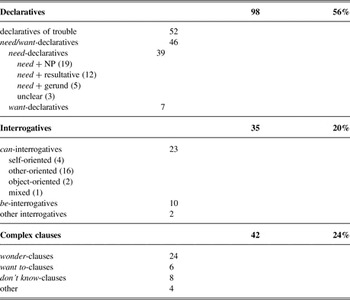
In order to be able to demonstrate that the grammatical variation we describe is not contingent on the type of request made, we focus only on those requests that primarily concern the repair or alteration of an item. We have thus excluded requests that primarily involve matters of time (e.g. is there any way to (kind of) rush job on that?, n = 10), price (e.g. u:m I have a couple (0.4) of (0.5) coats and a bag that (0.4) I just wondered how much it would cost to: fix the zippers?, n = 16), and availability (e.g. do you have red shoe polish?, n = 9). We have also excluded what we term preparatory requests, that is, utterances that project an upcoming request and are treated as such by the shoetender (e.g. So I have a repair question on this, n = 38), as well as requests produced by customers who we deemed to be nonnative speakers of American English (as judged by accent and/or syntax, n = 11). This leaves us with a total of 175 requests that involve the repair of an object, which we have classified first with respect to larger syntactic categories, then into smaller grammatical subcategories. We note here that there are no instances of imperative requests in our data. The distribution of the forms that are found in our data is illustrated in Table 1.
Distribution of forms.

As Table 1 illustrates, each of the larger syntactic categories has been separated into subcategories; we have divided declaratives into what we term declaratives of trouble (e.g. the zipper on this is broken) on the one hand and need/want-declaratives (e.g. I need/want these resoled) on the other hand. Interrogatives are separated into modal interrogatives (e.g. can you fix these)Footnote 4 and be-interrogatives (e.g. is there any way to fix this), and the complex, embedded clauses are divided into subcategories depending on the main clause verb (e.g. I wonder if/I don't know if/I wanted to see if). Within each of the subcategories, we are also able to make further, more granular distinctions, and it is these that we focus on in the remainder of the article. Due to limitations of space, here we choose to focus only on the granular distinctions that apply within the two subcategories of need/want-declaratives on the one hand and can-interrogatives on the other; hence only these distinctions are mapped out in Table 1. All distinctions are based on our analysis, rather than any predetermined categorizations: that is, for each of our distinctions, we are able to demonstrate that the participants themselves make use of, interpret, and respond to them as interactionally distinguishable formats for requesting. All extracts have been transcribed according to Jefferson (Reference Jefferson and Lerner2004), with the request presented in boldface as well as indicated with an arrow.Footnote 5 In addition we provide a graphic transcript (Laurier Reference Laurier2014) for each case that we discuss, in order to capture the relation between verbal and embodied actions.
Need/want-declaratives
The status of declaratively formatted requests is not always obvious; it has been suggested—at least for everyday face-to-face interactions—that reports of needs, necessity, or trouble do not constitute requests proper. Zinken & Ogiermann (Reference Zinken and Ogiermann2011), for instance, propose to use the term request only for those turns-at-talk that specifically ask the recipient to do something. By contrast, Kendrick & Drew (Reference Kendrick and Drew2016) argue that in ‘requests proper’ a possible solution to a difficulty is formulated, whereas in alternative ways of recruiting it is the trouble for which a resolution is solicited that is formulated (or displayed). The need/want-declaratives in our data—as declaratives—do not ask a recipient to do something, but they do, by contrast, clearly formulate a solution (e.g. heels, resoling, stretched), which suggests that they should be considered as requests proper. Moreover, earlier studies of requests in institutional settings, and in particular service encounters of various types, suggest that declaratives in general constitute one of the most basic and common ways for customers to recruit assistance from a service provider, and that in such contexts they do ‘establish a normative obligation for the other to assist’ (Kendrick & Drew Reference Kendrick and Drew2016:6), even if the nature of that assistance remains to be negotiated (e.g. Lindström Reference Lindström, Hakulinen and Selting2005; Vinkhuyzen & Szymanski Reference Vinkhuyzen, Szymanski, Richards and Seedhouse2005; Lee Reference Lee2009, Reference Lee2011; Kuroshima Reference Kuroshima2010). This is apparent in the shoe repair shop, where declaratives are the most common syntactic structure that customers use to ‘recruit’ the shoetender's assistance: overall, 56% (n = 98) requests are declarative (see Table 1). Moreover, the declaratives in our data are (with the exception of want-declaratives) systematically produced in the very first possible position for making a request, namely in the reason for visit slot, that is, immediately after the greeting sequence. And as we see in the following, both need- and want-declaratives are routinely treated by the shoetenders as requests. We thus feel confident in treating them as requests.
Need-declaratives
Need-declaratives account for 22% of all requests in our data (n = 39)Footnote 6 and are routinely produced in the reason for visit slot, that is, immediately after the greeting sequence, where they are typically used to state a very specific solution. According to Lee (Reference Lee2011:110), declarations of need are typical of service encounters, because they do not ‘display any consideration of the contingencies surrounding the granting of the request’ but instead embody ‘the requester's claim to an entitlement to the service requested’. This seems to be true of the need-declaratives in our data as well; with this type of request customers present themselves both as being entitled to make the request (and to be granted the requested service) and as there being no (or only few) possible contingencies that would stand in the way of their request being granted. As we have already noted, however, need-declaratives do not constitute a single category in our data, as need can take at least three different complements: a noun phrase (e.g. I need heels ), a resultative (e.g. I need to get these resoled ) or a gerund (e.g. They need resoling ).
Need + NP declaratives
A noun phrase is the most commonly used complement in need-declaratives in our data, accounting for 49% of all need-declaratives (n = 19). Of the three need-declarative subtypes, need + NP declaratives appear to be the quintessential example of low-contingency, high-entitlement requests. This fact may reside in part in the specific NP used; more than half of the need + NP cases in the data mention (or allude to, see extract (2)) the nouns ‘heels’ or ‘soles’. In a shoe repair shop, a need to replace heels or soles is something that customers can relatively easily diagnose on their own and can safely assume that the shoetenders are able to fix. Extract (1) is one such case.
-
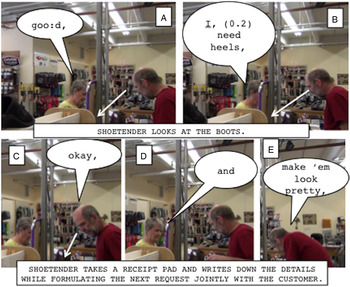
(1) Shoe shop 25-10-2014
3 S: how you doin’,
4 C: goo:d, [Fig. 1A]
5 (0.8)
6 → C: I, (0.2) need heels,= [Fig. 1B]
7 S: =okay, [Fig. 1C]
8 C: and (0.1) [Fig. 1D]
9 S: >shine [‘em up,<
10 C: [jus-
11 C: well[:
12 S: [clean ‘em [up.
13 C: [die ‘m and clean ‘em up,
14 S: make ‘em look pretty, [Fig. 1E]
15 C: yes ple:ase.
Graphic transcript of extract 1.

The grammatical simplicity of need + NP requests such as that in extract (1) appears to enact a ‘no-problem’ request, with no issues of entitlement or contingencies; and as we see here, the shoetender unproblematically grants the request, producing an “okay” while simultaneously reaching for a receipt pad and a pen (line 7, Fig. 1C). That the customer understands this as granting her request is evident from the fact that she now initiates a next request with “and” (line 8), a request that she and the shoetender formulate together while the shoetender takes down the details on the pad (lines 9–15, Figs. 1D and 1E).
Further evidence for our claim that need + NP requests typically involve ‘no-problem’ requests for repairs, which are both easily diagnosable and routinely done, can be seen in the following example. In extract (2) the need + NP request is not even brought to completion before the shoetender agrees and moves to pick up the receipt pad (see also Fox & Heinemann Reference Fox and Heinemann2015a).
-
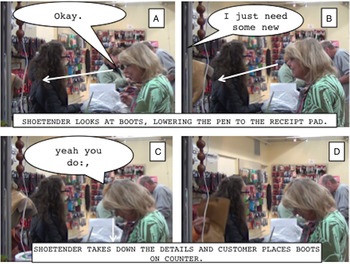
(2) Shoe shop 10-13-2013
1 S: who was next.
2 C: I think we were.
3 (1.0)
4 S: okay. [Fig. 2A]
5 → C: I just need some new: [Fig. 2B]
6 (0.2)
7 S: yeah you do:, [Fig. 2C]
[Fig. 2D]
Graphic transcript of extract 2.

The customer has been waiting in line, and the shoetender initiates the encounter by asking “who was next” (line 1). The customer moves towards the counter, holding the boots she has brought in for repair in front of her; as she reaches the counter she tips the boots slightly so that the heels are facing towards the shoetender (Figs. 2A and 2B). The customer then produces the need-declarative request “I just need some new” (line 5). Though this request is not brought to grammatical completion, the shoetender has no problem understanding it as a request—and as a request for new heels: she responds with a confirming “yeah you do:,” (line 7) and at the same time proceeds to take down the details of the request on a receipt pad (Figs. 2C and 2D). In this example, then, the request is constructed as an embodied completion (e.g. Olsher Reference Olsher, Gardner and Wagner2004), with the showing of the boot heels serving to complete a syntactic construction where an item (here a noun) has been projected.
As illustrated in extracts (1) and (2), need + NP declarative requests are routinely produced in the first possible slot in which a request can be made, where they are used to formulate a very specific solution. By virtue of their position, their relatively simple syntactic structure and their formulation of a solution, need + NP declaratives indicate that there are no apparent contingencies that would prevent the shoetender from granting the request and that the customer is unproblematically entitled to make the request. This appears to be a pattern that more generally applies to all need/want-declaratives, but as we shall show in the following three sections, this larger category of requests allows for variations both at the lexical level (i.e. need vs. want), at the syntactic level (i.e. NP vs. verbal complement), and at the morphological level (i.e. resultative vs. gerund), and each of these grammatical variations are of interactional relevance.
We now consider need + resultative declaratives.
Need + resultative declaratives
Resultatives are instances where a verb has a patient-undergoer that is also the subject of a nonfinite verb in past participle form.Footnote 7 For example, in my wife needs a shoe glued, a shoe is at once the direct object of need and the subject of the past participle glued; the agent of the gluing is not expressed. 31% (n = 12) of the need-declaratives in our data uses a resultative complement.
Like need + NP requests, need + resultative requests present the solution to a trouble, but what is specified is the action involved in implementing the solution, that is, that something should be punched, stretched, or glued. Typically, need + resultative requests are employed when the requested repair is one that requires further specification. In extract (3) below, the solution requested is that of punching holes in the straps of a boot, and here the shoetender and the customer subsequently attend to where exactly those holes should be punched.
-
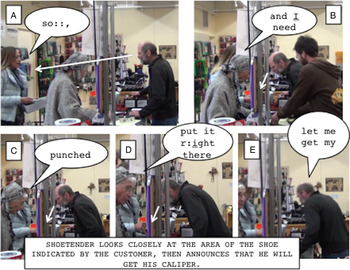
(3) Shoe shop 3-15-2014
[Fig. 3A]
4 C: so:hh, I'm >back with these< I tried them on a[t home,
5 S: [kay
6 → C: an- and [Fig. 3B] I need to get <a second hole [Fig. 3C]
7 → C: punched>,[like right there, on each side
8 S: [okay
9 C: just cause it was just a little too tight.
10 on the:[re
11 S: [o-
12 C: [but I think that would-
13 S: [so::, an inch? or:: l[ess::?
14 C: [yea::::h,hh
15 C: I would say
16 (0.7)
17 C: like if you [Fig. 3D] put it r:ight there, I'd be good.
18 S: [Fig. 3E]() let me get my:: c[aliper
19 C: [okay
Graphic transcript of extract 3.

Subsequent to a greeting sequence (not shown here) and before she reaches the counter, the customer produces a statement that provides the background for her being there (line 4). With this preface, she manages to introduce herself not just as a returning customer (“I'm back”) but as one returning with the same pair of shoes (“back with these”) that needs some additional repair (“a second hole”). The request is thus also framed as potentially complaint-relevant; the requested service is necessary because a previous service did not meet her needs and is as such a service she is unproblematically entitled to request. We see the shoetender ratifying this strong claim of entitlement, both in the “okay” produced in line 5, his attention to what needs doing (“so::, an inch? or:: less::?”, line 13) and his announcement of getting the caliper needed for the requested service (line 18).
Extract (3) illustrates the main difference between need + resultative requests and need + NP requests in our data: the former are usually followed by subsequent explications of how the requested solution should be carried out. In extract (3), the customer does not merely state her need for more holes, but goes on to specify exactly where she wants the holes punched (“like right there, on each side”, line 7). In extract (3) this need for explication is presumably motivated by this being a return visit; the staff did not get it right the first time and may hence need more direction. In other cases, however, it is the nature of the requested repair that makes relevant such explication: when a customer comes in to have shoes stretched, for instance, it will have to be determined subsequently exactly where and how much stretching should be done. While need + resultative declaratives thus indicate a similarly high degree of entitlement on behalf of the customer as do need + NP declaratives, need + resultative declaratives appear to be used in particular to request services that the customer may deem to be less commonplace; or rather, while the overall action is commonplace for the staff, need + resultative requests indicate that the precise details of that action (location, manner, etc.) might not be.
Need + gerund declaratives
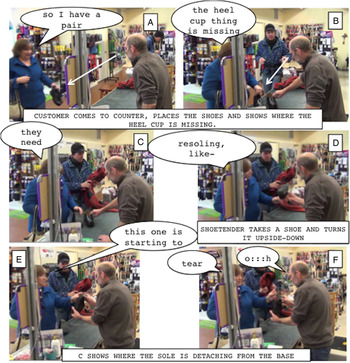
The need + gerund declaratives constitute the smallest category of need-declaratives in our data (n = 5). As with the other need-declaratives, here the solution (i.e. stretching, cobbling, resoling) rather than the problem is stated through the request. Like need + resultative declaratives, need + gerund declaratives name the action involved in doing the repair, and are similarly followed by some explication. But whereas explications that follow need + resultatives typically focus on the manner of the requested repair, explications that follow need + gerund declaratives typically focus on the nature of the problem, as illustrated in extract (4).
-
(4) Shoe shop 12-6-2014
3 C: so I have a pair [Fig. 4A] of danskos that need some help,
4 S: okay,
5 C: [Fig. 4B] the heel
6 S: yup
7 C: cup thing is missing,
8 S: kay,
9 → C: [Fig. 4C] they need resoling, [Fig. 4D] like-
10 (1.0)
11 C: [Fig. 4E] this o[ne is starting to [Fig. 4F] tear
12 S: [(the hee-) o:::h,
13 S: t[hat just needs glue.
14 C: [off
Graphic transcript of extract 4.

While the customer is approaching the counter, she produces the preparatory request “so I have a pair of danskos that need some help” (line 3). As noted above, we have excluded preparatory requests from the current study, but we can note here that in this particular case it appears to be produced in orientation to the spatio-temporal organization of the encounter (Sorjonen & Raevaara Reference Sorjonen, Raevaara, Drew and Couper-Kuhlen2014), that is, because the customer is still in the process of walking towards the counter (Fig. 4A). As soon as the customer reaches the counter and places the shoes there (Fig. 4B), she initiates her request proper by reporting a trouble “the heel cup is missing” (lines 5–7; see Kendrick & Drew Reference Kendrick and Drew2016). She then produces a need + gerund declarative (“they need resoling”, line 9), thus formulating at least one of the solutions to this trouble. At this point the shoetender has reached for one of the shoes; on “resoling” he turns the shoe upside down so that the sole side is facing him (Figs. 4C and 4D). Though the shoetender has in this way initiated a move towards inspecting the shoe, the customer now displays that there is more to come: following the grammatical completion of her request she adds “like” and moves her hand towards the shoe held by the shoetender, thus indicating that she is not quite done (Fig. 4D). The shoetender orients to this by turning the shoe towards the customer (Fig. 4E), who then both verbally describes and manually demonstrates the problem to him (“this one is starting to tear”, Fig. 4E) (Fox & Heinemann Reference Fox and Heinemann2015b). In response to this explication, the shoetender produces the change-of-state token “oh”, produced with rise-fall intonation to indicate that he now (and only now) realizes or sees the thing pointed out to him by the customer (e.g. Reber Reference Reber2012). Upon the production of this “o:::h”, the customer immediately retracts her hand, thus displaying that her request plus explication is now complete.
While need + gerund declaratives appear to exhibit the same high degree of entitlement as do the other types of need-declaratives, the fact that customers follow need + gerund declaratives with explications of the trouble for which they are seeking help may go some way towards downplaying this entitlement; by explicating the trouble, customers make the grounds for their diagnosed solution available to the shoetender. By providing the evidentiary basis for their diagnosis, customers can be heard to be orienting to the potentially accountable nature of them diagnosing their own trouble—a diagnosis that could—perhaps even should—have been left to the professional.
Want-declaratives
Declarative expressions of want are relatively rare in our data, compared to the number of need-declaratives: only 4% (n = 7) of all of our requests are formatted in this way. The relatively low number of want-declaratives means that there are some variations of this format that we simply cannot explore with any confidence. For instance, six of the seven want-declaratives are done with resultative complements; only one case has an NP and we have found no cases of want + gerund declaratives. Based on this, we cannot say anything about whether want-declaratives are used differently depending on the complement that follows.
The relatively smaller number of want-declaratives, when compared to need-declaratives, does, however, suggest that whether a declarative is formulated with want or need is something that participants orient to. In other words, the lower frequency of want-declaratives indicates that this type of declarative may have a special use. That I want and I need constructions do indeed differ has been shown by Childs (Reference Childs2012a), who demonstrates that in family interactions, the two constructions are employed in different sequential positions and with different interactional consequences. In our data, want-declaratives similarly distinguish themselves from need-declaratives in how—and in particular where—they are used: while need-declaratives, as illustrated in previous sections, are usually produced in the first possible slot for making a request, want-declaratives occur either as one in a series of requests or following an expansive preparatory sequence. Extract (5) below provides an illustration of the former situation, extract (6) of the latter.
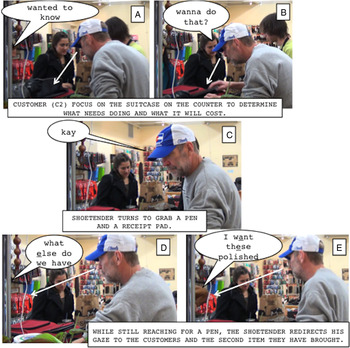
In extract (5), two customers have come in together and one responds to the shoetender's request solicititation (line 3) with the preparatory request “couple things to ask”, then brings out the first item and inquires about the price of a zipper repair. Here, we are mainly interested in the second request, the want-declarative that is produced in line 32.
-
(5) Shoe shop 10-13-2013
3 S: how can I help you.
4 C2: couple things to ask,
5 (2.5)
6 C2: um (0.3) [Fig. 5A] wanted to know what it
7 would cost to get this zip[per repaired,
8 S: [the slider?
9 C2: yeah,
10 (0.5)
11 S: uh, bout eighteen dollars.
((Thirteen lines left out in which the shoetender further
inspects the zipper))
24 S: kay [Fig. 5B] wanna do that?
25 (0.2)
26 C2: yeah=
27 C: =↑yeah=
28 S: [Fig. 5C] =kay
29 (0.5)
30 C2: kay [Fig. 5D] what else do we have,
31 (0.2)
32→ C: [Fig. 5E] <I want these> p↑olished?
33 (0.2)
34 S: kay,
Graphic transcript of extract 5.

The shoetender clearly treats the request-sequence initiated by C2 in line 6 as completed. Having checked whether the customers “wanna do that?” in line 24, he turns slightly away from the customers and the suitcase he has been inspecting and reaches for a pen and a receipt (Fig. 5C). When C2 initiates a second request-sequence in line 30 by asking the other customer “what else” they have, the shoetender redirects his gaze; when C holds out a pair of boots and says “I want these polished?” the shoetender is looking directly at the boots (Figs. 5D and 5E). This second request is a specific, resultative request with no orientation to contingencies or lack of entitlement. With the want format, the customer simply expresses her desire to have a specified service done, thus assuming that the specified service can be done, can be done by the shoetender, and that it is the relevant service to ask for in relation to the condition of the boots. In this respect, the request is very similar to the need-declaratives discussed above, except for the fact that the want-declarative here is a second request, which is entirely independent from the prior request, although made within the same encounter. Five out of the seven want-declarative requests in our data are similarly used for requests-in-a-series. This may account for the relative rareness of want-declaratives in our data: after all, not that many customers bring more than one item in for repair; consequently only very few customers need to be able to formulate second requests.
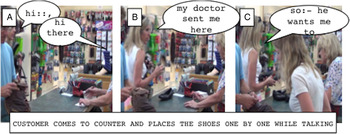
The second type of environment where we find want-declaratives is following a relatively expansive preparatory sequence in which the customer provides the background for their coming to the shop, as illustrated in extract (6). In this example, the customer has been waiting in line, several pairs of shoes clearly visible in her arms. A second shoetender has now come to the counter and the customer walks to the counter, the two greeting each other at the same time.
-
(6) Shoe shop 6-28-2013
1 S: h[i there,
2 C: [hi::. [Fig. 6A]
3 (0.7)
4 C: [Fig. 6B] my doctor sent me here,=
5 S: =alright,
6 (0.3)
7 C: having major foot problems,
8 S: ((nods)) (0.5)
9 C: already had already had surgery on my one foot
10 and my other foot's starting to act up
11 (0.3)
12 C: u:m (0.3) I'm a [flight attendant
13 S: [I just had surgery=
14 C: =(oh) ↓did you::,
15 (0.7)
16 → C: [Fig. 6C] so:- (0.3) he wants me to have these
17 stretched,
Graphic transcript of extract 6.

It is clear that during the greeting sequence, the shoetender has determined that the customer is there for a repair request, as she has taken a receipt and poises a pen over it, ready to take down the details of the request (Fig. 6A) (Fox & Heinemann Reference Fox and Heinemann2015c). Instead of producing the request proper when reaching the counter and placing the first shoe there, the customer instead states that she has been sent by her doctor, that she has “foot problems” and has had surgery, and so on (lines 4–15). Only well into the encounter does she formulate her actual request and then in the form of a want-declarative. In other work, we have reflected on this customer's ascription of want to the doctor, rather than to herself (Fox & Heinemann Reference Fox and Heinemann2015b); here we are mainly interested in the fact that the want-declarative follows an extended description of the circumstances that have brought the customer to the shop. Such extended descriptions are one of the two environments in which we have found want-declaratives to be used in our data.
Because of the smaller number of want-declaratives, we cannot exclude the possibility that a customer could use a want-declarative simply as a first and only request at the very beginning of the encounter, as we found for most of our need-declaratives. If we assume, however, that the seven want-declaratives in our data indicate a general tendency, we can suggest that customers treat want-declaratives as somewhat special by using them only in certain circumstances, that is, in a series of requests (as in extract (5)) or following an extended description of circumstances (as in extract (6)). In the same vein, we can also suggest why this might be so: though need-declaratives and want-declaratives are structurally similar, semantically they are not. As noted by Childs (Reference Childs2012b:15), want-declaratives ‘are best understood as formulations that are rhetorically organized to reject and undermine an alternative’. Thus, though a service requested with a need-declarative can be rejected on professional grounds or can be granted through the suggestion of an alternative solution, it would presumably be more difficult to argue (or indeed agree) with someone's expressed want.Footnote 8 The question of why a customer would use a want-declarative at all, however, remains. We suggest that the environments in which this type of request are used might provide an answer: want-declaratives are used in series of requests and/or after extended descriptions of circumstances, because, by virtue of rejecting and undermining any alternative solution to the one expressed, they index that the customer is now coming to the request in question.
Variation across need/want-declaratives
As the preceeding sections and examples have hopefully demonstrated, need/want-declaratives, as a group, clearly share some basic properties when used for making requests: as declarative expressions of need or want, they are high in entitlement and low in contingency: that is, they neither orient to any concerns as to whether the customer has the right to make the request (or have the requested repair granted), nor do they indicate any concerns as to whether the requested repair is, for instance, doable, or whether the shoetender can do it. In naming a solution, customers do further work to display low contingency; as laymen they have themselves been able to identify this solution and as such the solution is presumably commonplace and unproblematic.
But while there are clear interactional patterns that apply to all need/want-declaratives, there are also differences—at a more granular level—within this larger category of requests: first, it seems evident that customers treat and use want-declaratives differently than need-declaratives, both in terms of frequency and position, and perhaps even with respect to the type of repair requested. Such smaller grammatical variations also seem to matter with respect to how need-declaratives are employed to request repairs in the shoe shop. That is, the morphosyntactic variations we find in the complement of need reflect differences in use: while all three complements serve as nominations of the solution, need + NP declaratives distinguish themselves from the other two formats by formulating the solution as an object (heels, soles), rather than an action (punched, resoling). That this is not just a grammatical distinction but also one that is relevant for the participants is indicated by the fact that need + NP declaratives are employed in slightly different contexts and for slightly different purposes than the other types of need-declaratives, that is, to indicate low-contingency and high-entitlement, typically with respect to a very mundane repair, such as replacing heels or resoling a shoe.
By contrast, customers appear to employ the two other types of need-declaratives in contexts where they deem that further explication is needed. Within this category of explication, we also find differences, however. Thus it seems that while both need + resultative and need + gerund declaratives project an explication, the type of explication offered differs: those that follow a need + resultative declarative typically serve to specify the manner in which the requested repair is to be carried out, for instance by specifying how many holes should be punched and exactly where. Explications that follow need + gerund declaratives, by contrast, instead specify the underlying problem that has made the repair request relevant, for instance by specifying what has happened to a particular part of the shoe. In this respect, it seems that need + resulative declaratives are placed higher on the entitlement scale than are need + gerund declaratives, as the explication for the former serves to specify what the customer wants done, whereas the latter serves to account for why the customer wants something done.
We now turn to examine can-interrogatives.
Can-interrogatives
Until recently, the can-interrogatives that have been described within CA/IL have typically been of the type Vinkhuyzen & Szymanski (Reference Vinkhuyzen, Szymanski, Richards and Seedhouse2005) term other-oriented (e.g. can you x), because they inquire into the other's ability or possibility for granting the request (see also Heinemann Reference Heinemann2006; Curl & Drew Reference Curl and Drew2008; Zinken & Ogiermann Reference Zinken and Ogiermann2011). In a recent study, however, Zinken (Reference Zinken2015) focusses on self-oriented can-interrogatives in British English (e.g. can I have x; see also Fox Reference Fox2015). In line with the position we present here, Zinken briefly compares other-oriented and self-oriented can-interrogatives and notes the following:
From a ‘mono-modally’ linguistic perspective, that is, if we consider only the morpho-syntactic format of turns, we see that can I have x resembles the second person polar question format (for example, can you pass me x), namely in so far as both request formats employ a modal verb expressing possibility, and both are polar interrogatives. (Zinken Reference Zinken2015:36)
Zinken goes on to conclude that, despite this resemblance, ‘it would be misleading to generalize across request formats on relatively abstract grammatical grounds (such as polar interrogative syntax)’ (Reference Zinken2015:36).
In the shoe repair data, we find similar grounds for arguing that variations on the level of ‘orientation’ are relevant for distinguishing different categories of can-interrogatives, but in addition to other-oriented can-interrogatives (e.g. can you fix this, n = 16) and self-oriented can-interrogatives (e.g. can I just get these dyed, n = 4) we also find object-oriented can-interrogatives (e.g. can sneakers be resoled, n = 2). We shall deal with each of these in turn.
Other-oriented can-interrogatives
Other-oriented can-interrogatives are the most frequent format used for can-interrogatives in our data, with a total of sixteen cases. Other-oriented can-interrogatives index the possibility that the requested repair may lie outside what the shoetender can in fact do; they are thus typically used when the customer has already oriented to the potentially problematic nature of their request and indicated that the request they desire might be rather special. This is the case in the following extract (7).
-
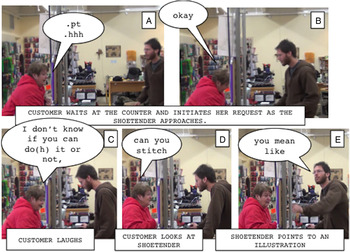
(7) Shoe shop 3-15-2014
8 C: [Fig. 7A].pt.h[hh o[kay:h. [Fig. 7B]
9 (0.8)
10 C: .hh (0.2) .pt I have a project [Fig. 7C] I don't know
11 if you can do(h) it or not,
12 (.)
13 S: kay,
((one minute not shown here, in which customer gives
background for the upcoming request))
14 C: .hhh [SO:, .pt u:h anyway. (.) these are
15 Justin little *boots* for ba(h)bies .hhh but-
16 (0.3) um, I got the baby a little um, y'know like
17 a (shurlin) vest?
18 (0.5)((S nods))
19 °about this big,°
20 .hhh a:nd (these just) don't look (0.2) cowboy. [Fig. 7D]
21 → can you stitch (0.5) a cowboy boot design on (there)?
22 (0.5)
23 S: .pt ↑we::ll, you mean like (.)[Fig. 7E] something: similar
24 to what's [on,
25 C: [↑ye↓a:h
Graphic transcript of extract 7.

Here, the customer is already at the counter and the item she has brought in for repair is on the counter (Fig. 7A). The shoetender has just finished with another customer and is now returning to the counter after having brought some shoes to the back. While he is still approaching the counter, the customer prepares to talk: she produces a lipsmack and a long inbreath, followed by “okay” (line 8). This is accompanied by a jerk of her head, down towards the object she has brought in (Fig. 7B). All of this serves to project or at least indicate that a lengthy turn is underway, that is, that she is now ‘getting down to business’. That a potentially problematic request (in whatever way) is underway is further underscored by what the customer does next, which is to produce the preparatory “I have a project”, rather than a request proper (line 10). This is followed directly with an explicit expression of doubt as to the shoetender's ability to meet her requirements (“I don't know if you can do it or not”). When the customer finally, after an extended troubles-telling about the boots she has brought in (not shown here), produces the other-oriented can-interrogative request in line 21, she has thus already clearly indicated that her request might be out of the ordinary and that the shoetender might not be able to grant it. This is also evident in the shoetender's response (“we::ll, you mean like something similar to what's on”), which seeks a reference point for what is meant by “cowboy boot design”, before he eventually seeks the advice of another shoetender in the back.
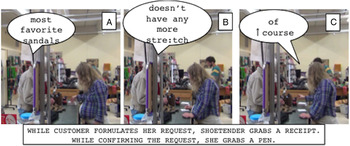
The relationship between ability and can-interrogatives is evident also from apparent counterexamples such as (8) below, in which a can-interrogative is used to request a service that has already been oriented to by the shoetender as within the ability of the shop (the replacement of an elastic strap on a pair of sandals).
-
(8) Shoe shop 4-9-2014
8 S: what can we do for yo[u
9 C: [these are my oldest fa- [Fig. 8A]
10 most favorite sandals [()
11 S: [↑okay
12 (0.3)
13 C: this is just doesn't have [Fig. 8B] any more stre[:tch
14 S: [((nods
vigorously))
15 S: ↑y[eah
16 → C: [can you all do that?=
17 S: =of ↑course [Fig. 8C]
Graphic transcript of extract 8.

Here the customer initiates the request with a report of trouble (“this is just doesn't have any more stretch”), while at the same time demonstrating the problem manually (Figs. 8A and 8B; see Fox & Heinemann Reference Fox and Heinemann2015b). In contrast to extract (7) above, she does not indicate in any way that the repair she is requesting is out of the ordinary, nor does she express any doubt about the shoetender's ability to do the requested service. The shoetender likewise appears to treat the requested service as ordinary; she reaches for a receipt slip (Figs. 8A and 8B), then nods vigorously in overlap with the customer's report of trouble, followed by an enthusiastic sounding “yeah” (line 15). In spite of these indications of granting the request, the customer now produces a can-interrogative, “can you all do that”. Notably, this can-interrogative is responded to not with a confirming “yes”, but with “of ↑course”. As demonstrated for questions more generally by Stivers (Reference Stivers, Stivers, Mondada and Steensig2011:87), when participants respond with ‘of course’ they ‘contest the presupposition of the question that both confirmation and disconfirmation are possible’. In extract (8), the shoetender thus appears to be indicating that there is no doubt that the requested service lies well within her ability and thus, that the question, as it was designed, was ultimately overdone.
Self-oriented can-interrogatives
Whereas other-oriented can-interrogatives are primarily employed in contexts where there may already be some doubt about whether the requested service is one that the shoetender can provide, self-oriented can-interrogatives seem to convey the customer's expectation that the shoetender is able to perform the service request and that the customer is entitled to request it (see also Fox Reference Fox2015). Consider extract (9) below.
-
(9) Shoe shop 3-28-2015
1 C: hello:,
2 S: hi,
3 (0.8)
4 C: >how ‘r ya doing,<
5 S: good.
6 (1.2)
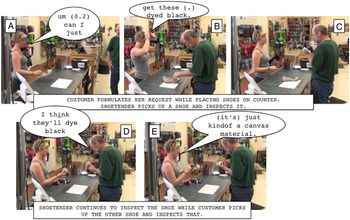
7 → C: [Fig. 9A] um (0.2) can I just [Fig. 9B] get these (.)
8 → dyed black.
9 [Fig. 9C] (5.0)
10 S: °e:hm° (.) [Fig. 9D] I think they'll dye black.
11 C: [Fig. 9E] (it's) just kindof a canvas material.
Graphic transcript of extract 9.

In contrast to the other-oriented can-interrogatives discussed above, the self-oriented can-interrogative used here is produced exactly at the point at which the customer has reached the counter and placed her shoes there—in fact the request is perhaps a little early in so far as the shoetender is still approaching (Fig. 9A). When the shoetender does reach the counter, he picks up a shoe and starts inspecting it in some detail (Figs. 9B and 9C), thus treating the request as deferred (or ‘remote’, e.g. Houtkoop-Steenstra Reference Houtkoop-Steenstra1987), that is, as a request that cannot be complied with immediately. When he initiates a response to the request in line 10, the hesitating “°e:hm°” possibly projects that something other than the preferred granting is coming up. By expressing his belief that the shoes “ll dye black”, the shoetender in essence accounts for his lack of immediate granting as well as for the extended period of inspection: it is not that the customer is not entitled to request her shoes to be dyed, nor is it the case that the staff are unable to provide such a service; rather it is the case that the material of the shoes might have implications for the final result. That it is this aspect of the request that may be problematic is also oriented to (and in essence rejected) by the customer in her response in line 11, that the shoes are “just kindof a canvas material”. With this she also indicates that she had already considered the material of her shoes as a possible contingency against granting her request. However, she rejected this possibility (as the shoes are clearly canvas) and thus used her self-oriented can-interrogative in an informed manner, that is, to indicate that the service she requested was one that is in the control of the shoetender, but also one that she is entitled to ask for.
Object-oriented can-interrogatives
Object-oriented can-interrogatives constitute a very small group, with only two instances. Like self-oriented can-interrogatives, they are produced in the first possible slot for making a request, that is, when the customer has reached the counter and placed the shoes on the counter. But like other-oriented can-interrogatives, object-oriented can-interrogatives do raise the possibility that the request will not be granted, though for different reasons, namely that there is something intrinsic to the nature or composition of the object brought in that makes it impossible or difficult to fix. In extract (10) below, the customer uses a can-interrogative to question whether the particular service he is requesting (resoling) can in actual fact be done to the type of shoe (sneakers) he is bringing in.
-
(10) Shoe shop 2-7-2015
1 S: hi.
2 C: hello.
3 S: how are you,
4 C: >good<=how are you,
5 S: good.
6 (2.3)
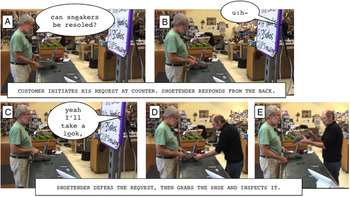
7 → C: [Fig. 10A] can sneakers be resoled?
8 (0.4)
9 S: [Fig. 10B] u:h- y- (0.3) [Fig. 10C] yeah I'll take a look,
10 [Fig. 10D] [Fig. 10E] (7.3)
((Twenty-five lines left out in which the customer explains why he wants the sneakers resoled))
36 S: so are you interested in resoling the whole
37 thing?=or do you just wanna do the back heel corner?
38 C: no like this thing too,
39 S: okay,
40 (0.2)
41 S: see what we've got,
Graphic transcript of extract 10.

Though the shoetender is occupied in the back of the shop, he greets the customer and the customer moves into the request (Fig. 10A). By formulating the request as an object-oriented can-interrogative, the customer raises the possibility that there is something integral to sneakers that may make it impossible to resole them. The shoetender also orients to this in his response; he confirms that there is in principle nothing that would hinder resoling sneaker (with “yeah”), but then goes on to indicate that there may still be contingencies preventing this repair (“I'll take a look”). He thus defers granting the request until he has made an adequate inspection of this particular pair of sneakers, an inspection he performs after having reached the counter and having grabbed one of the shoes (Figs. 10D and 10E).
Variation across can-interrogatives
Compared to need/want-declaratives, can-interrogatives—as a group—clearly indicate that there may be some contingencies that would impede the granting of a customer's request. As we have sought to illustrate in the preceding sections, however, the more granular grammatical details of can-interrogatives have consequences for which contingencies are raised and to what degree: other-oriented can-interrogatives raise the possibility that the requested repair lies outside the ability of the shoetender, whereas object-oriented can-interrogatives indicate that there is something integral to the object brought in for repair which might prevent the requested repair to be applied. Finally, self-oriented can-interrogatives indicate that while the requested repair is one that the customer is entitled to, the granting is ultimately in the control of the shoetender.
Concluding discussion
In the preceding sections, we have sought to illustrate that what might be thought of as relatively minor grammatical variations are of interactional relevance for making requests in the shoe repair shop. On the one hand, our examination of need/want-declaratives and can-interrogatives has confirmed what many other studies have previously illustrated, namely that declarative requests in general are used in cases of low contingency, where the customer displays an understanding that the requested service is within the abilities and resources of the staff and can be performed unproblematically, whereas interrogative requests show an orientation to somewhat greater contingencies, including that the repair is out of the ordinary.
On the other hand, however, we have also found that other details of a requesting utterance's composition matter. For example, we have found that the exact lexical verb within a particular syntactic format has consequences with respect to where and how that syntactic format is used: whereas need-declaratives are used for making straightforward requests at the very beginning of an encounter, want-declaratives have a more limited use, in sequential terms, as customers produce this type of declarative request only as part of a request-series, or following an extended preface. Similarly, we have shown that the complement structure of a verb such as need is of interactional relevance: whereas need + NP declarative requests work as straightforward requests for specific solutions, both need + resultative and need + gerund declarative requests are used in contexts in which the customer orients to the relevance of explicating the solution, either by specifying the manner in which the solution should be implemented (need + resulative) or the grounds for its implementation (need + gerund). Finally, we have demonstrated that the issue of ‘orientation’ is attended to in the formulation of can-interrogatives: other-oriented can-interrogatives indicate that the requested repair may be beyond the ability of the shoetender; self-oriented can-interrogatives indicate that the requested repair is in the control of the shoetender; and object-oriented can-interrogatives indicate that there is something integral to the object needing repair that may prevent the shoetender from providing the requested repair.
As already noted in the introduction, we believe that our findings raise some interesting questions with respect to how the notion of action formation is conceptualized—and perhaps more importantly how it is studied empirically. As we have demonstrated, relatively minor variations of lexis, morphology, and syntax are of interactional relevance. From a participant's perspective, these smaller variations make it possible to address many different (often multiple) contingent concerns, while still accomplishing the main action or primary concern of making a request. In that respect, minor grammatical variations seem to work no differently than alternations between major syntactic forms for requesting; for example, both can-interrogatives and need/want-declaratives serve to accomplish the primary concern of requesting, while addressing different contingent concerns by virtue of their form. To us, this suggests two things: first, that the notion of format covers a much wider, more varied and much finer-grained composition of grammatical practices than has previously been described; and second, that the analyses offered in previous work on requests hence can be elaborated to include attention to more granular morphosyntactic detail. Such details require accounts that take us beyond groupings by verb or mood and into areas of more subtle grammatical and interactional work.
But it also suggests a more crucial question facing scholars in the field, and that is: what counts as a ‘format’? As already mentioned, even the relatively fine-grained formats we have described here have variations within them that could be separated into multiple formats. And no doubt even within those variations there are further variations that could be separated out, which leads us to wonder how much generalization can be usefully done across particular instances (cf. Thompson et al. Reference Thompson, Fox and Couper-Kuhlen2015).Footnote 9 We hope to have shown that some level of generalization is possible, offering, for example, small patternings in uses of a particular verb in a particular verb-argument formation. These seem to represent recurrent practices. Nonetheless, the variation within those practices warrants attention and a place in our understanding of grammar. In this regard, Hopper's notion of Emergent Grammar seems especially important (Hopper Reference Hopper1987, Reference Hopper and Tomasello1998, Reference Hopper, Auer and Pfänder2011), as does Bybee's exemplar-based model (Bybee Reference Bybee2010). While there are no doubt recurrent practices for formulating certain kinds of requests, each particular utterance arises in a particular moment in interaction, with particular kinds of fixes wanted, and particular kinds of fixes offered, and all of these particularities and contingencies shape the particular form a given utterance eventually takes as it emerges in real time. Perhaps what we are calling a ‘format’ is actually a host of particular practices that come together on a particular occasion to build, moment by moment, a given request. While these questions await definitive answers, we hope to have presented data and analysis that lead us closer to those answers.
Appendix A: Coded features
Categorical aspects
-
(a) Based on syntax and/or accent, is the speaker producing the request a native speaker of American English?
-
(b) What type of request? Does it involve a repair proper, or is it an inquiry about cost, time, availability, or is it a preparatory request?
Lexico-syntactic aspects
-
(a) Is the request interrogative or not?
-
(b) Is the request a simple declarative?
-
(c) Is the request a declarative of trouble where the problem is described or an expression of want/need where the solution is stated?
-
(d) Is the request an embedded/complex declarative, and, if so, what is the syntactic format of the embedded clause (wh-interrogative, polar interrogative, polar alternative)?
-
(e) What is the main verb of the request?
-
(f) What is the tense-aspect of the main verb?
-
(g) Is the request resultative?
-
(h) Which indexical references are used for the item and/or the problem (i.e. a full noun like ‘shoes’, ‘heels’, or a proterm like ‘these’, ‘this’)?
-
(i) Is the request specific?
-
(j) Does the request include the adverb ‘just’?
-
(k) Does the request include the negative polarity items ‘any’ or ‘anything’?
Sequential aspects
-
(a) Is the request preceded by a request solicitation (i.e. ‘how can I help you’)?
-
(b) Is the item targeted by the request accessible to shoetender (i.e. can the shoetender see the item and perhaps even touch it to inspect)?
-
(c) Is the problem made accessible before the request, during the request, or after the request?
-
(d) Is the request initial, a follow up, or a pursuit?
-
(e) Is the request a first or second request concerning the same item, or a request concerning a second item?
Appendix B: Transcription conventions
- ,
-
rising intonation
- .
-
final, falling intonation
- ?
-
strong rising intonation
- :
-
prolongation of the immediate prior sound
- underline
-
emphatic stress
- ↑ ↓
-
shifts into especially high or low pitch
- °word°
-
softer or at a lower volume than the surrounding talk
- *word*
-
creaky voice
- -
-
cut-off, i.e. not brought to completion
- .hh
-
inhalation
- hh
-
exhalation
- > <
-
faster than the surrounding talk
- < >
-
slower than the surrounding talk
- (0.5)
-
elapsed time by tenths of seconds
- =
-
no break or gap between elements
- [
-
overlap onset
- ()
-
uncertainty on behalf of the transcriber
- (())
-
transcriber's descriptions