Introduction
Out-of-hospital cardiac arrest (OHCA) is a life-threatening condition and a significant public health concern world-wide. Globally, 50-60 cases of OHCA occur per 100,000 adult population annually, and the overall survival rate generally does not exceed 10%.Reference Berdowski, Berg and Tijssen1 Several factors play an important role in increasing the survival rate for these patients, such as early cardiac arrest recognition, Emergency Medical Service (EMS) activation, bystander cardiopulmonary resuscitation (CPR), high-quality chest compressions, and automated external defibrillator utilization.Reference Panchal, Bartos and Cabañas2–Reference Tanaka, Ong and Siddiqui4
Dispatcher-assisted cardiopulmonary resuscitation (DA-CPR), also known as telecommunication CPR or telephone CPR, is a process through which lay rescuers who are on site when a cardiac arrest occurs receive real-time CPR instructions from an emergency medical dispatcher (EMD) before the arrival of EMS providers.Reference Panchal, Berg and Cabañas5 Several studies have reported that DA-CPR is associated with increases in the likelihood of bystander CPR, the quality of chest compressions, and the return of spontaneous circulation with favorable neurological outcomes.Reference Song, Shin and Park6–Reference Wang, Zhang and Zhao9 To maximize the effectiveness of a DA-CPR program, the emergency assistance caller should be asked only a few questions to minimize the time interval from call receipt to cardiac arrest recognition,Reference Lerner, Rea and Bobrow10 and the instructions provided should be concrete and simple to improve the quality and compliance of bystander CPR.Reference Chen, Ko and Hsieh11
In Thailand, a DA-CPR program developed by the National Institute for Emergency Medicine (NIEMS; Nonthaburi, Thailand) has been implemented in the Emergency Medical Triage Protocol and Criteria-Based Dispatch.12 Cases of cardiac arrest are identified by the telephone operator using a set of questions asked of all callers, and relevant calls are then transferred to an EMD who provides CPR instructions (Appendix 1; available online only). Although the implementation of DA-CPR programs has been demonstrated to improve outcomes among patients with OHCA, there have been discrepancies in these findings, with some studies showing that this intervention did not improve CPR quality outcomes, including compression rate, depth, hands-off time, and proper hand placement.Reference Lee, Jeon and Ahn13,Reference Navarro-Patón, Freire-Tellado and Pavón-Prieto14 This experimental study aimed to assess the effectiveness of the Thailand NIEMS DA-CPR program.
Methods
Study Design and Setting
This was an experimental study with a randomized design using a manikin model. The study was conducted at the Department of Emergency Medicine in the Faculty of Medicine at Ramathibodi Hospital, a university-affiliated hospital in Bangkok, Thailand, from August through October 2019.
The Institutional Review Board of the Faculty of Medicine at Ramathibodi Hospital approved this experimental study (ethics code: MURA2018/859). Written informed consent was obtained from each participant, in line with the human rights related to research involving human subjects, as described in the Declaration of Helsinki.
Participants
The participants were faculty members (aged 18 to 60 years)—both health care providers and non-health care providers—who had attended all sessions of a Basic Life Support training course approved by the Thai Resuscitation Council (Bangkok, Thailand) and the American Heart Association (Dallas, Texas USA). Potential participants who had last taken the Basic Life Support training more than 12 months ago, those who had attended Advanced Cardiovascular Life Support training, pregnant women, and those with physical or communication disabilities were excluded.
Study Protocol
After enrollment, research assistants provided each participant with a standardized introduction to the study, presenting an overview of the study protocol and showing them the isolated simulation room where a Laerdal Resusci Anne QCPR manikin (Laerdal Medical Corporation; Stavanger, Norway) was placed on the floor. The participants were stratified by their health care provider status, and they were then randomly assigned to either the DA-CPR group or the uninstructed CPR group (U-CPR), which received no CPR instruction. Sequentially numbered, opaque, sealed envelopes in blocks of four were used for random assignment to the two groups, with a ratio of 1:1.
Participants in the DA-CPR group then received further instruction about EMS activation, along with a prepared mobile number and mobile phone. An independent paramedic playing the role of an EMD provided CPR instruction, in line with the abovementioned DA-CPR program developed by the Thailand NIEMS.
According to the standardized DA-CPR program, instruction was provided to participants using the speakerphone function. After the participants were instructed regarding proper posture, hand placement, compression rate, and compression depth, the dispatcher activated a metronome set to 110 beats per minuteReference Hwang, Lee and Park15 using Metronome Online (EMusic Institute Corporation; Valencia, California USA). The dispatcher was blinded in another isolated room and communicated with the participants only using the provided mobile phones.
All participants entered the simulation room alone and performed chest compressions on the manikin model for two minutes. The participants were video recorded from above throughout the simulation processReference Spelten, Warnecke and Wetsch16 to evaluate their CPR performance.
Data Collection
Data on the participants’ characteristics (age, sex, body mass index, comorbidity, and health care provider status) were recorded using a questionnaire form. Body mass index was categorized using the World Health Organization (Geneva, Switzerland) Classification of Overweight and Obesity.17
Laerdal SimPad PLUS was used to measure chest compression quality according to the American Heart Association’s 2015 recommendations,Reference Kleinman, Brennan and Goldberger18 with SkillReporter (Laerdal Medical Corporation) connected to the manikin model. Participants were blinded to the quality outcomes while performing chest compressions. The data were transferred to an electronic report using Laerdal SessionViewer software. Reviewing the video recordings, two independent investigators evaluated the participants’ performance, including posture and hand placement, using a validated checklist (Appendix 2; available online only). If there were any disagreements regarding performance evaluation, the final decision was made by a third independent investigator.
Outcome Measures
The study outcomes were chest compression performance and quality, compared between the two study groups. The specific outcome variables were time from the dispatcher receiving the call to the first chest compression, percentage of participants with proper chest compression posture, mean compression rate, mean compression depth, percentage with complete chest recoil, percentage with correct hand placement, and mean hands-off duration.
Statistical Analysis
For the sample size calculation, a pilot study was performed with six participants in each study group. To compare two proportions or means with a power of 0.8, a significance level of 0.05, a between-group ratio of 1:1, and two-sided tests, a minimum sample size of 90 participants was calculated. The sample size was calculated using Stata 14.0 (StataCorp; College Station, Texas USA).
The data were recorded using Microsoft Excel 2010 (Microsoft Corporation; Redmond, Washington USA), and the statistical analyses were performed using Stata 14.0. Categorical variables are presented as count and percentage (%), and continuous variables are presented as mean (standard deviation [SD]) or as median and interquartile range, depending on the data distribution. The chi-square test or the exact probability test was used to compare independent proportions. To compare two independent means, Student’s t-test was used for normally distributed variables, and the Wilcoxon rank-sum test was used for non-normally distributed variables. All results were considered to be significant at the level of P <.05.
It was hypothesized that the DA-CPR program would improve chest compression performance and quality among the non-health care provider participants and not change performance and quality among the health care provider participants. Therefore, a pre-specified analysis was performed to compare the DA-CPR and U-CPR groups, with stratification by health care provider status.
Results
Participant Characteristics
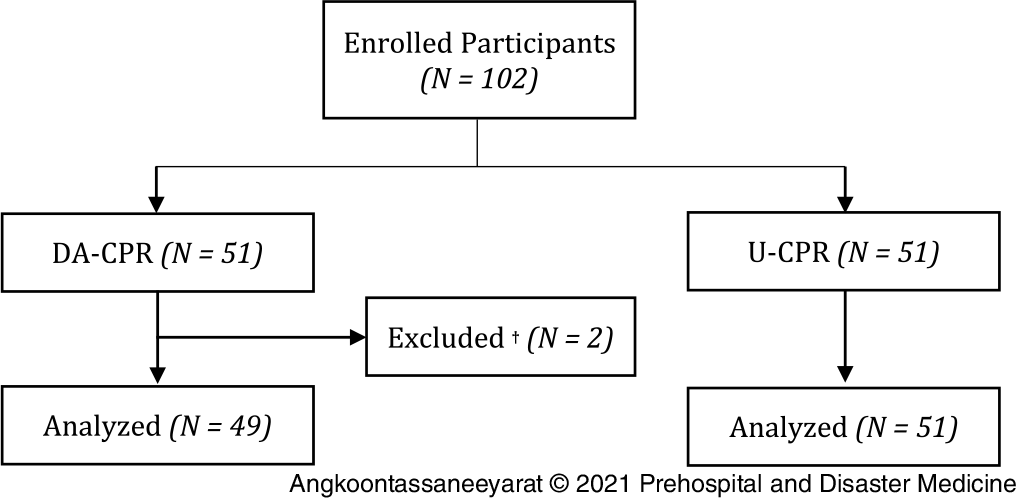
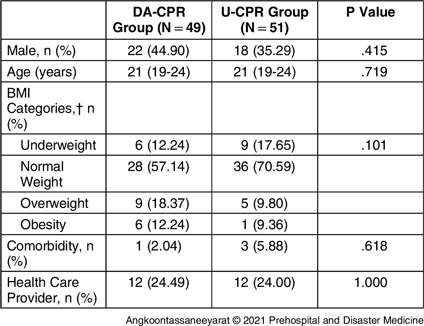
In total, 102 faculty members were enrolled as participants in this study. Two participants in the U-CPR group were excluded because of technical errors, leaving 100 participants who were included in the analyses—49 in the DA-CPR group and 51 in the U-CPR group (Figure 1). There were no statistically significant differences in baseline characteristics between the two study groups (Table 1).
Study Flow.
Abbreviations: DA-CPR, dispatcher-assisted cardiopulmonary resuscitation; U-CPR, uninstructed CPR group.
† In DA-CPR, two participants were excluded due to technical error.

Comparison of Baseline Characteristics between DA-CPR and U-CPR Group

Note: Data are presented as number (percentage) and median and interquartile range (IQR).
Abbreviations: DA-CPR, dispatcher-assisted cardiopulmonary resuscitation; U-CPR, uninstructed cardiopulmonary resuscitation; BMI, body mass index.
† Underweight <18.5kg/mReference Panchal, Bartos and Cabañas2; Normal Weight 18.5-24.9kg/mReference Panchal, Bartos and Cabañas2; Overweight 25.0-29.9kg/mReference Panchal, Bartos and Cabañas2; Obesity >30.0kg/mReference Panchal, Bartos and Cabañas2.
Chest Compression Performance and Quality
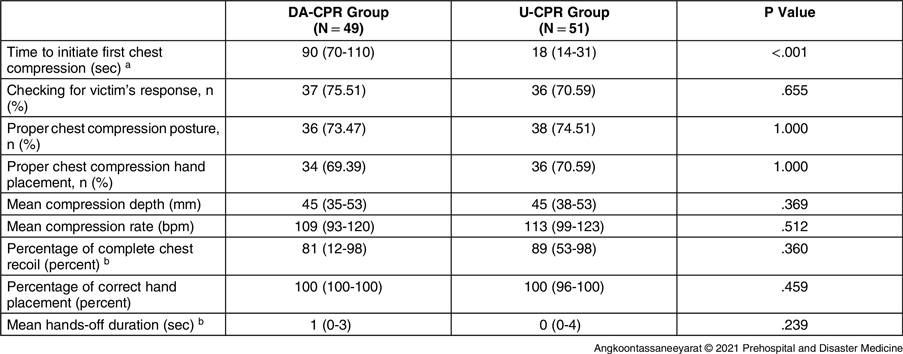
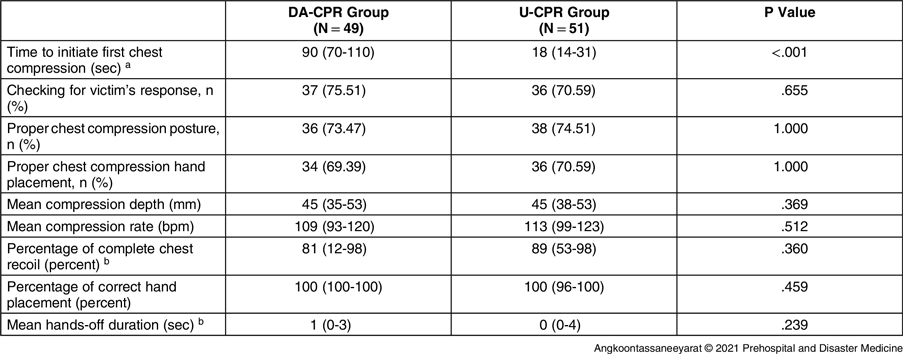
The time from the dispatcher receiving the call to the participant starting the first chest compression was statistically significantly longer than in the DA-CPR group than in the U-CPR group (85.82 [SD = 32.54] seconds versus 23.94 [SD = 16.70] seconds; P <.001). Checking for the victim’s response was higher in the DA-CPR group than in the U-CPR group, but the difference was not statistically significant (75.51% versus 70.59%; P = .655). Mean chest compression depth was suboptimal in both the DA-CPR group and the U-CPR group (42.71 [SD = 13.29] mm and 44.94 [SD = 11.36] mm), but mean chest compression rate was optimal in both groups (106.86 [SD = 22.37] bpm for the DA-CPR group and 109.76 [SD = 21.76] bpm for the U-CPR group). There were no differences between the two study groups in terms of chest compression performance or quality (Table 2).
Comparison of Chest Compression Quality between DA-CPR and U-CPR Group
Note: Data are presented as number (percentage) and median and interquartile range (IQR).
Abbreviations: DA-CPR, dispatcher-assisted cardiopulmonary resuscitation; U-CPR, uninstructed cardiopulmonary resuscitation.
a Defined as the time interval since dispatcher received a call to initiating first chest compression.
b P value calculated using the Wilcoxon rank sum test.
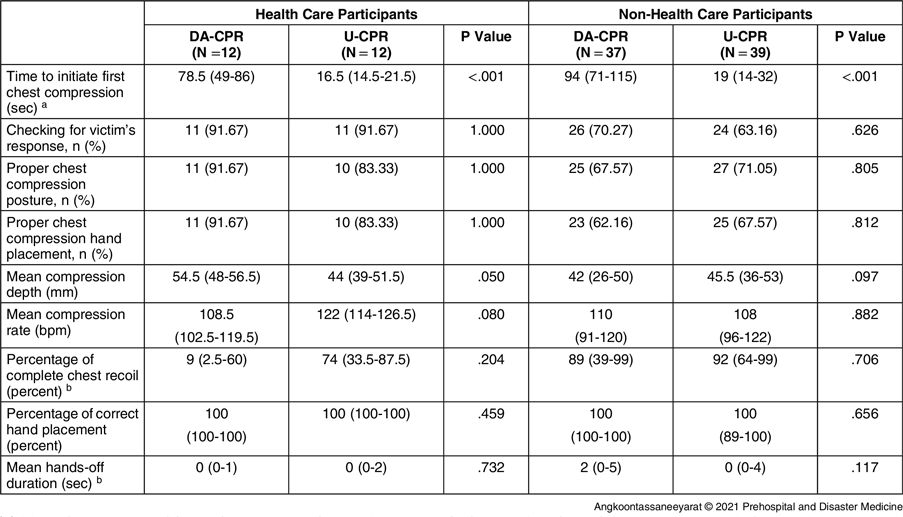
Further analyses were performed to test the hypothesis that the DA-CPR program improved chest compression performance and quality among non-health care provider participants and did not change those outcomes among health care provider participants. Table 3 demonstrates that time from the dispatcher receiving the call to the first chest compression was significantly longer in the DA-CPR group than in the U-CPR group for both the health care providers (70.83 [SD = 21.51] seconds versus 20.92 [SD = 11.25] seconds; P <.001) and the non-health care providers (90.68 [SD = 32.89] seconds versus 20.05 [SD = 18.28] seconds; P <.001). However, CPR instruction did not achieve better performance or chest compression quality for either the health care providers nor the non-health care providers.
Comparison of Chest Compression Quality between DA-CPR and U-CPR Group among Health Care and Non-Health Care Participants

Note: Data are presented as number (percentage) and median and interquartile range (IQR).
Abbreviations: DA-CPR, dispatcher-assisted cardiopulmonary resuscitation; U-CPR, uninstructed cardiopulmonary resuscitation.
a Defined as the time interval since dispatcher received a call to initiating first chest compression.
b P value calculated using the Wilcoxon rank sum test.
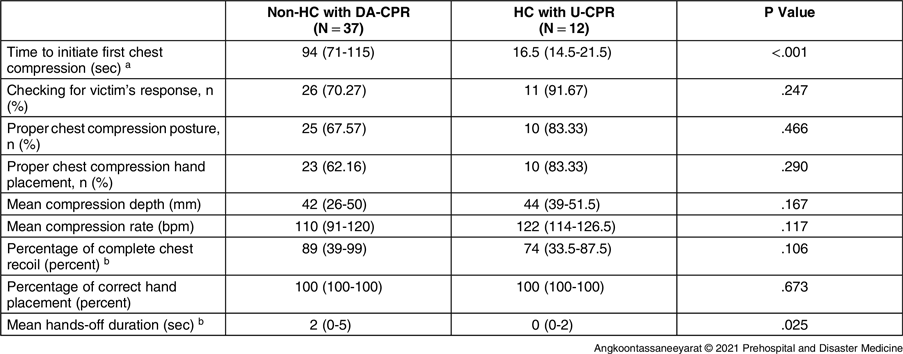
Therefore, a post-hoc analysis was also performed to compare chest compression performance and quality between non-health care provider participants who were provided with CPR instruction and health care provider participants who were not provided with such instruction. Although the time to initiate chest compressions was significantly longer for the non-health care provider participants receiving CPR instruction compared with the health care provider participants who received no CPR instruction, chest compression performance and quality did not differ between these two groups (Table 4).
Comparison of Chest Compression Quality between Non-Health Care Participants with CPR Instructions Provided and Health Care Participants without Instructions

Note: Data are presented as number (percentage) and median and interquartile range (IQR).
Abbreviations: DA-CPR, dispatcher-assisted cardiopulmonary resuscitation; U-CPR, uninstructed cardiopulmonary resuscitation; HC, health care.
a Defined as the time interval since dispatcher received a call to initiating first chest compression.
b P value calculated using the Wilcoxon rank sum test.
Discussion
In this experimental study, a DA-CPR program developed by the Thailand NIEMS delayed the initiation of chest compressions. The mean time to begin chest compressions was over one minute longer in the DA-CPR group than in the group that received no CPR instruction. The instructions were not shown to achieve better performance or quality of chest compressions in the overall analysis or in sub-group analyses comparing participants who were health care providers with those who were not health care providers.
Chest compression is a resuscitative procedure that plays an important role in increasing survival, especially in cases of OHCA. Delayed initiation of chest compressions results in poor survival.Reference Wissenberg, Lippert and Folke19,Reference Ong, Shin and De Souza20 High-quality chest compression is one of the most important factors to increase patient survival to the emergency department and hospital admission,Reference Bohn, Weber and Wecker21,Reference Kramer-Johansen, Myklebust and Wik22 hospital discharge,Reference Stiell, Brown and Nichol23 and favorable neurological outcomes.Reference Vadeboncoeur, Stolz and Panchal24
Several strategies, such as public education and mass CPR training,Reference Wissenberg, Lippert and Folke19 have been implemented in communities to increase the rate of bystander CPR. Implementation of a DA-CPR program is one such strategy.Reference Hallstrom, Cobb and Johnson25,Reference Bobrow, Spaite and Vadeboncoeur26 However, some studies have reported that the quality of resuscitation procedures following DA-CPR is often lower than the standard recommendation.Reference Lerner, Rea and Bobrow10,Reference Nikolaou, Dainty and Couper27–Reference Stipulante, Tubes and El Fassi30
Given that dispatchers providing explanations and instruction is a time-consuming process, cardiac arrest should be recognized early in the call with a limited number of questions, and dispatchers should deliver simple and concrete CPR instructions to the bystander.Reference Lerner, Rea and Bobrow10 A previous study conducted by Lewis, et alReference Lewis, Stubbs and Eisenberg31 found delays in the initiation of chest compressions in DA-CPR in more than 92% of cases in which cardiac arrest was recognized. The most common delays associated with dispatchers were caused by asking unnecessary questions such as patient age or sex, incident details, or medical history. The median delay time was 78 seconds, and one-third of the total delay time was attributed to the dispatchers. This finding relates to the current study, which found that DA-CPR causes significant delays in the initiation of chest compressions compared with U-CPR.
The quality parameter of compression depth during DA-CPR has commonly been found to be suboptimal according to the American Heart Association’s recommendations.Reference Cheung, Deakin and Hsu28,Reference Park, Jeong and Moon32,Reference Ghuysen, Collas and Stipulante33 Likewise, in this study, mean chest compression depth was found to be lower than the American Heart Association’s standard recommendation of 50-60mm for adults in both study groups. Numerous techniques have been implemented in DA-CPR protocols to increase chest compression depth, such as using verbal motivation by the dispatcher or real-time feedback strategies.Reference Hwang, Lee and Park15,Reference Mirza, Brown and Saini34,Reference Plata, Nowack and Loeser35
This study also demonstrated that non-health care provider participants who received CPR instruction and health care provider participants who received no CPR instruction had equal CPR performance and quality. This result suggests that providing frequent CPR education or training to lay rescuers would improve the quality of bystander CPR through an effective DA-CPR protocol, leading to improvements in the outcomes for patients with sudden cardiac arrest. The finding suggests that people who are frequently exposed to CPR education or training are familiar with this resuscitative procedure.Reference Chen, Ko and Hsieh11,Reference Kellermann, Hackman and Somes36
Limitations
There were some limitations in this study. First, the study was conducted in a single center located in a metropolis, and the participants were all faculty members; thus, the study may not reflect diversity in terms of individual characteristics or the broader geographical area. Second, this simulation study using a manikin in only one scenario (adult OHCA with a single rescuer) may not represent real-life situations. In terms of the study’s implications for implementation in clinical practice, the findings should be cautiously interpreted. Finally, CPR instruction was provided by only one investigator, who played the role of an EMD. It is reasonable to assume that the quality of instruction may differ across individuals.
Conclusion
Those in the CPR-trained group applied chest compressions (initiated CPR) more quickly than those who initiated CPR based upon dispatch-based CPR instructions.
Acknowledgment
The authors thank Jennifer Barrett, PhD from Edanz (https://www.edanz.com/ac) for editing a draft of this manuscript.
Conflicts of interest
All authors meet the criteria for authorship and have no conflict of interests to be declared.
Supplementary Materials
To view supplementary material for this article, please visit https://doi.org/10.1017/S1049023X21001084