The Great Depression of the 1930s was marked by a severe outbreak of protectionist trade policies. Governments around the world imposed tariffs, import quotas, and exchange controls to restrict spending on foreign goods. These trade barriers contributed to a sharp contraction in world trade in the early 1930s beyond the economic collapse itself, and to a lackluster rebound in trade later in the decade, despite the worldwide economic recovery.Footnote 1
The rise in protectionism is well-known, but most accounts of the period, whether gleaned from contemporary reports or subsequent histories, suggest that trade policy was thrown into chaos everywhere, with all countries scrambling equally to impose higher trade barriers.Footnote 2 This was not exactly the case, as we show below. In fact, there was considerable variation in the extent to which countries imposed protectionist measures. While some countries raised tariffs sharply and imposed draconian controls on foreign exchange transactions, others tightened trade and exchange restrictions only marginally.
What accounts for the cross-country variation in the use of protectionist measures? We argue the exchange rate regime and associated economic policies were key determinants of trade policies in the early 1930s. Countries that remained on the gold standard, keeping their currencies fixed, were more likely to restrict foreign trade. With other countries devaluing and gaining competitiveness at their expense, they resorted to protectionist policies to strengthen the balance of payments and limit gold losses. Lacking other instruments with which to address the deepening slump, particularly an independent monetary policy, they used trade restrictions to shift demand toward domestic goods and, they hoped, stem the decline in output.
In contrast, countries that abandoned the gold standard, allowing their currencies to depreciate, saw their balances of payments strengthen and benefited from gold inflows. Abandoning the gold standard also freed up monetary policy so that, with no gold parity to defend, interest rates could be cut. No longer constrained by the gold standard, central banks also had more freedom to act as lenders of last resort. Because they possessed other policy instruments with which to ameliorate the Depression, they were not forced to resort to trade protection as a second-best macroeconomic tool.
These findings are obviously related to the literature linking the gold standard to the Great Depression.Footnote 3 This research associates the length and depth of a country's economic downturn and the timing and vigor of its recovery to how long it remained on gold. Countries abandoning the gold standard relatively early experienced relatively mild recessions and early recoveries. In contrast, countries remaining on the gold standard experienced prolonged slumps. Countries leaving the gold standard were able to relax monetary policy, whereas countries staying on gold were forced to maintain tight monetary policies that inhibited recovery.
We offer a trade-policy corollary to this thesis: countries remaining on the gold standard, and thereby prevented from using monetary policy to stimulate their economies, were more inclined to restrict trade. The stubbornness with which countries clung to the gold standard is thus part of the explanation for why the world trading system was felled by an outbreak of protectionism. Had countries been quicker to abandon gold standard orthodoxy and the restrictive monetary policies associated with it, it would have been easier to avert the restrictive commercial policies that destroyed the network of world trade. Our account thus lends structure to what otherwise seems to be a haphazard scramble to close markets in the 1930s.
THE GOLD STANDARD AND THE GREAT DEPRESSION
The classical gold standard that existed from about 1870 to 1913 linked most of the world's economies through a system of de facto pegged exchange rates.Footnote 4 World War I disrupted this system and all of the major belligerents (except the United States) impeded gold exports and loosened the link between gold and the central bank currency and credit policies. Due to postwar economic and monetary dislocations, the principal belligerents only resumed gold convertibility in the mid- to late 1920s.Footnote 5 While not all countries returned at their prewar parities, the basics of the prewar international monetary system had been put back in place by the end of the decade.
Unfortunately, the interwar gold exchange standard was less robust than its prewar predecessor. Governments largely resurrected the prewar pattern of exchange rates despite the fact that relative financial strength and competitive positions had changed as a result of the war. Old gold parities were restored without lowering price levels to prewar levels, resulting in a lower ratio of the value of gold to nominal transactions. The remaining gold was unevenly distributed, with some 60 percent in the hands of the United States and France.
To address the postwar shortage of gold, the gold standard was reconstructed as a gold exchange standard, so called because it provided for expanded use of foreign exchange reserves (mainly sterling and dollars) in lieu of gold. Yet this heightened the fragility of the system. The willingness of countries to hold foreign exchange was only as strong as the commitment of the reserve-center countries, the United States and Britain, to honor their commitments to convert their liabilities into gold at a fixed price. If those commitments were called into question, there might be a scramble out of foreign exchange, putting sharp deflationary pressure on the world economy.Footnote 6 In addition, the international cooperation that had helped to support the prewar system, allowing countries in crisis to continue to adhere to gold parities, was more difficult in the aftermath of a war that had bequeathed ill will, war debts, and reparations.
For all these reasons, the interwar gold standard was incapable of withstanding the shock of the Great Depression.Footnote 7 The system immediately came under strain with the economic slowdown and recession that began in 1928/29. The trigger for this downturn continues to be debated, but many accounts have highlighted the 1928 decisions by the Federal Reserve to tighten monetary policy and France to de jure stabilize the franc at a depreciated rate and to convert holdings of foreign exchange reserves into gold.Footnote 8 These policies drained gold from the rest of the world and required other countries to pursue more restrictive monetary policies.
The options for responding to the deflationary pressure were limited. Any major change in monetary policy was precluded by the gold standard. Expansionary fiscal policy was ruled out by the orthodoxy that governments should run balanced budgets even in downturns.Footnote 9 This left three options: wage and price deflation to restore external and internal balance at the current gold parity; trade and payments restrictions to limit spending on imports and reduce gold outflows; or abandoning the gold standard and allowing the exchange rate to depreciate.
Some countries remained on the gold standard in the hope that sufficient wage and price deflation could restore internal and external balance. But the difficulties of wage deflation were considerable, and the burden of long-term debts denominated in nominal terms became progressively heavier. Rising unemployment also had political costs; more than a few governments fell as a result. Therefore, some countries banned capital outflows and imposed direct controls on payments for imports to conserve gold and foreign exchange reserves. In effect, they preserved the façade of the gold standard (their de jure exchange rates did not change) but without the reality (freedom to import and export gold and the statutory link between foreign reserves and money supplies were abrogated or, at best, honored in the breach). Other countries chose or were forced to abandon gold convertibility and permit their currencies to depreciate. By severing the link between the monetary base and gold reserves, they were able to pursue more expansionary monetary policies.
Insofar as the problem was too little gold, the first-best policy response would have been a monetary expansion achieved through a worldwide reduction in gold reserve ratios, i.e., in which countries simultaneously devalued against gold, leaving bilateral exchange rates unchanged.Footnote 10 In effect, this is what had happened by 1936 but without the international coordination. One country after another allowed its gold reserve ratio to fall (equivalently, one country after another raised the domestic currency price of gold). Although the prior constellation of bilateral exchange rates was largely restored at the end of the process, the constraints on monetary policy had been relaxed relative to the counterfactual in which the original gold standard rules remained in place.
But the haphazard manner in which this came about had enormous implications. The unilateral way in which one group of countries left the gold standard created difficulties for those remaining on gold. It put pressure on those left behind to limit gold exports by raising interest rates, restricting imports, or regulating foreign exchange transactions. In essence, the difficulties facing the international monetary system created spillover problems for commercial policy.
THE TRADE POLICY REACTION
The movement toward more restrictive trade policies first became evident immediately following the 1929 business cycle peak. The United States imposed the Smoot-Hawley tariff in June 1930, raising the average tariff on dutiable imports by nearly 20 percent.Footnote 11 The increase in American tariffs was deeply resented abroad, particularly as the United States was an international creditor and exports to the U.S. market were already declining. Smoot-Hawley provoked retaliatory responses, notably from its largest trading partner, Canada, as well as from a handful of European countries.Footnote 12 Yet, Smoot-Hawley was not the main trigger for the wave of protectionist measures that began in mid-1931. In comparison to what was to come, relatively few countries raised their tariffs in late 1930 and early 1931.Footnote 13
The spark that really caused the world trading system to collapse was the financial crisis in the summer of 1931. The failure of the largest Austrian bank, the Creditanstalt, unsettled financial markets and caused capital flows to seize up. The German government depended on foreign loans to finance its expenditures, and the drying up of those loans triggered a run on the mark.Footnote 14 To stop the rapid loss of gold and foreign exchange reserves, the government was forced to impose strict controls on foreign exchange transactions, affecting both capital movements and the finance of trade. In theory, Germany could have devalued, but the reparations agreement fixed its obligation in dollars of constant gold content. This meant that devaluing would have had devastating effects on the public finances. In any case, memories of hyperinflation when the gold standard was in abeyance meant that abandoning the system would have unleashed fears of monetary chaos.Footnote 15 Hungary's financial system also came under pressure but its banking system was closely tied to Austria's; it imposed controls in July 1931. Other countries such as Chile, which was battered by declining copper prices, followed with controls of their own.
In August, the pressure spread to Britain as trade credits extended to Germany by British merchant banks were frozen.Footnote 16 A sharp increase in interest rates did little to stem the Bank of England's gold losses. Against the backdrop of rising unemployment which rendered the bank reluctant to raise interest rates further, on September 19th Britain abandoned the gold standard and allowed sterling to depreciate.
This move sent shockwaves through the world economy. Other countries either followed Britain in going off the gold standard or imposed restrictions on trade and payments as a defensive measure to reduce imports and strengthen the balance of payments. Within days, other countries with close trade and financial ties to Britain—Denmark, Finland, Norway, and Sweden among them—allowed their currencies to depreciate relative to gold. Japan, concluding that its recent resumption of gold convertibility had been a mistake, followed in December.
Other countries responded by imposing exchange controls to stem gold outflows. In September-October 1931 exchange controls were adopted by Uruguay, Colombia, Greece, Czechoslovakia, Iceland, Bolivia, Yugoslavia, Austria, Argentina, Belgium, Norway, and Denmark. In addition, the improvement in the price competitiveness of exports from countries with depreciated currencies prompted defensive countermeasures in countries remaining on the gold standard. A large number of countries ratcheted up their tariffs to block cheap imports. France imposed a 15 percent surcharge on British goods to offset the depreciation of sterling and adopted more restrictive import quotas. Canada and South Africa, which did not delink from gold along with Britain, adopted antidumping duties aimed at imports from Britain. In January 1932 the German government was empowered to raise “equalizing” tariffs on goods coming from countries with depreciated currencies. The Netherlands also broke from its traditional policy of free trade, raising its duties by 25 percent to offset currency depreciation abroad.
This proliferation of restrictions on international trade and payments in the aftermath of Britain's devaluation dealt a severe blow to world commerce. World trade volume fell 16 percent from the third quarter of 1931 to the third quarter of 1932. Between 1929 and 1932 it fell 25 percent, and nearly half of this reduction was due to higher tariff and nontariff barriers.Footnote 17
There are several reasons why Britain's abandonment of gold, coming on the heels of the financial crisis in Central Europe, triggered this protectionist avalanche. First, it quickly became not just a British devaluation but a wholesale devaluation. If Britain, a leading gold standard country, acknowledged that there were more important policy objectives than pegging the domestic price of gold, others could now show less hesitation. As many as twenty other countries abandoned gold following the Bank of England's announcement.Footnote 18 Currency depreciation by countries accounting for upwards of a quarter of global GDP ratcheted up the pressure on the others to do something to protect their balance of payments position.
Second, Britain's action led to the widespread liquidation of not just sterling but also dollar reserves, forcing the Federal Reserve to raise interest rates to stem gold losses. Higher U.S. interest rates put upward pressure on rates in other gold standard countries. Again there was pressure on governments to respond. Some gold-standard countries imposed exchange controls to limit trade and capital flows. Others simply imposed higher tariffs to discourage imports.
Third, Britain itself followed the depreciation of sterling with higher tariffs. In November 1931 it enacted an Abnormal Importation Duties Act which gave the authorities discretion to impose higher duties on selected goods. In February 1932 Parliament passed the Import Duties Act imposing a 10 percent across-the-board tariff on imports, with additional restrictions on certain imports and exemptions for imports from the empire. This made life still more difficult for other countries that depended on the British market. Those not benefiting from imperial preferences responded with higher tariffs of their own.
Our hypothesis, of course, suggests that Britain should have been less inclined to resort to protectionism once it gained the ability to loosen monetary policy.Footnote 19 Why then did it go ahead with the tariff? One answer is politics. Parliament was dissolved in early October, and the subsequent election resulted in an increase in Conservative influence. The Conservative Party had long advocated protectionism and had already moved the country in that direction in the early 1920s; it now gained power in the National Government formed at the height of the crisis.Footnote 20 The Labour Party, which had supported free trade and been in power during the crisis, was discredited, leaving a protectionist Conservative Party to drive policy by default.
Another factor was the weakness of the balance of payments. The tariff was not adopted to support employment, a problem addressed by the depreciation. Instead, the goal was to strengthen the balance of payments, given fears of large-scale withdrawals of foreign balances. Britain had been home to large deposits and investments by foreign central banks and private investors. While these might not be withdrawn en masse, their steady liquidation might put dangerous downward pressure on the currency, precipitating its collapse, or so it was feared. The tariff was designed to strengthen other components of the balance of payments in order to head off this eventuality.Footnote 21
Central to our story is the reaction of countries that remained on the gold standard despite the turmoil of 1931. As we have seen, one set of countries that remained on the gold standard was the exchange control group, led by Germany, which restricted foreign currency transactions. The other group, the gold bloc countries led by France but including Belgium, the Netherlands, and Switzerland, persisted with deflationary policies. While foreswearing exchange controls, they raised tariffs and tightened quotas on imports in an effort to insulate their economies from the downturn and protect their gold reserves.
Thus, in the midst of the global depression, countries that remained on the gold standard sought to improve their balance of payments position and preserve their gold and foreign exchange reserves. This could be achieved either by limiting capital exports through exchange controls (Germany) or by limiting spending on imports through trade restrictions (France), or both. In fact, such policies were substitute for one another. If exchange controls were comprehensive, they could be administered in a manner that left no need for additional measures such as tariffs or quotas. Import licensing and government allocation of foreign exchange meant that officials could determine the total amount of spending on imports and allocate that spending across different goods and country suppliers. Therefore, a country imposing exchange controls might not have to resort to higher tariffs and quotas because it already had the ability to limit imports through administrative action.
A number of countries defy easy categorization, as their policy response reflected not just the exchange rate regime but also special circumstances. Denmark, for example, was a member of the sterling bloc and as such had close trade and financial ties to Britain. But as an agricultural exporter, it suffered unusually extensive discrimination against its exports because many tariffs and quotas in the 1930s were directed at agricultural goods. It experienced an especially adverse terms-of-trade shock, which severely affected its ability to import. Therefore, unlike other sterling bloc countries, Denmark imposed exchange controls.Footnote 22
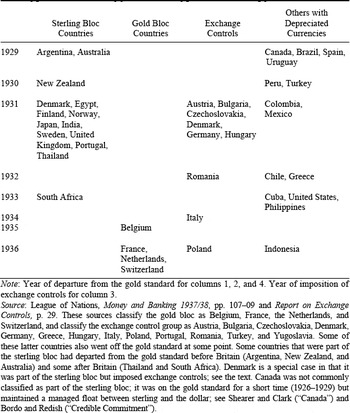
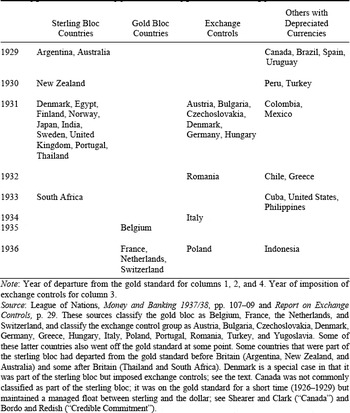
Table 1 summarizes the stance of the four different country groupings, along with the timing of their actions. Most sterling bloc countries went off the gold standard in late 1931. The gold bloc countries in column two remained on the gold standard until September 1936, except for Belgium which went off gold in March 1935. Most exchange control countries applied their foreign exchange restrictions in mid- to late 1931. The last column lists a final group of countries that never joined or left the gold standard at various other points, including Spain (never on the gold standard), Canada (formally delinked from gold in January 1929 but pegged to the dollar), and the United States (delinked in April 1933).
EXCHANGE RATE AND PAYMENTS REGIMES, SAMPLE COUNTRIES, 1929–1936
Note:
Year of departure from the gold standard for columns 1, 2, and 4. Year of imposition of exchange controls for column 3.
Source:
League of Nations, Money and Banking 1937/38, pp. 107–09 and Report on Exchange Controls, p. 29. These sources classify the gold bloc as Belgium, France, the Netherlands, and Switzerland, and classify the exchange control group as Austria, Bulgaria, Czechoslovakia, Denmark, Germany, Greece, Hungary, Italy, Poland, Portugal, Romania, Turkey, and Yugoslavia. Some of these latter countries also went off the gold standard at some point. Some countries that were part of the sterling bloc had departed from the gold standard before Britain (Argentina, New Zealand, and Australia) and some after Britain (Thailand and South Africa). Denmark is a special case in that it was part of the sterling bloc but imposed exchange controls; see the text. Canada was not commonly classified as part of the sterling bloc; it was on the gold standard for a short time (1926–1929) but maintained a managed float between sterling and the dollar; see Shearer and Clark (“Canada”) and Bordo and Redish (“Credible Commitment”).
EVIDENCE FROM TRADE POLICY MEASURES
This section examines the evidence that currency devaluation and trade and exchange controls were substitutes and that countries leaving the gold standard did not impose protectionist measures to the same extent as countries remaining on gold.
Tariffs
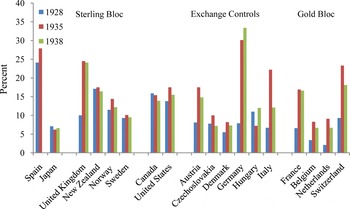
The simplest indicator of the level of tariff protection is customs revenue as a share of the value of imports.Footnote 23Figure 1 presents the average tariff for selected countries in 1928, 1935, and 1938.Footnote 24 As predicted, the sharpest increases between 1928 and 1935 are concentrated among members of the gold bloc and exchange control countries. With the exception of Britain, the sterling bloc countries show only relatively minor increases in average tariff rates between 1928 and 1938. By contrast, the average tariff of every member of the gold bloc rose noticeably between 1928 and 1935. Among exchange control countries, the average tariffs of Austria, Germany, and Italy escalated significantly while those of Czechoslovakia and Hungary did not. As noted above, this can be explained by the fact that administrative controls on foreign exchange are effectively a substitute for tariffs.
AVERAGE PERCENTAGE TARIFF RATE ON IMPORTS, VARIOUS COUNTRIES, 1928, 1935, AND 1938

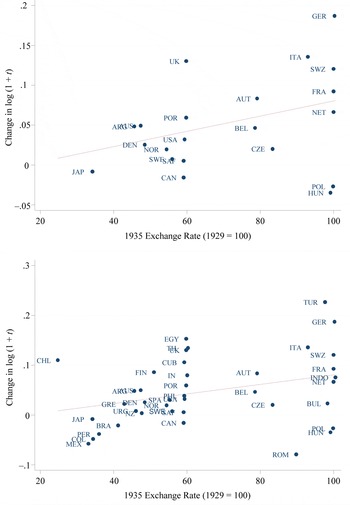
Figure 2 juxtaposes the change in the average tariff against change in gold parity between 1928 and 1935.Footnote 25 The year 1928 is just before the business cycle peak for most countries, while 1935 is roughly when trade protectionism peaked.Footnote 26 The change in the tariff is expressed as ▵ log (1 + τ), where τ is the average tariff rate. The change in the gold parity measures ounces of gold per unit of domestic currency in 1935 relative to 1928 (1928 = 100). The top panel focuses on a core group of mainly European countries (n = 21) and the bottom panel presents the full sample that includes many developing countries (n = 40). Both samples indicate that countries abandoning the gold standard and depreciating their currencies were less likely to raise tariffs.
EXCHANGE RATE AND CHANGE IN IMPORT TARIFFS, 1929–1935

Although there is considerable variation around the average relationship, regression analysis confirms the existence of a systematic relationship between the change in the average tariff and the change in the exchange rate. We estimate a regression of the form

where ▵ log TARIFF is defined as log [(1 + τ1935)/(1 + τ1928)], which is the change in (one plus) the tariff rate between 1928 and 1935 for country i, and ▵ PARITYi is the gold parity in 1935 relative to 1928, defined as the amount of gold that can be purchased with a unit of domestic currency, EXCHCONTROL is an indicator variable for whether a country imposed exchange controls, and WPI is the wholesale price index (1929 = 100). The exchange control indicator is included since countries with controls in place did not have to resort to higher tariffs in order to switch demand toward domestic goods. Including the price level helps control for the effect of deflation on the ad valorem equivalent of specific duties.Footnote 27
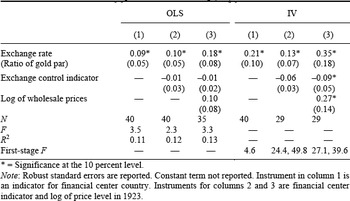
The first three columns of Table 2 present OLS estimates adding the exchange control indicator and log of wholesale prices sequentially. In each case, the coefficient on the exchange rate in 1935 (relative to the 1929 parity) is positive and significantly related to the change in tariffs between 1928 and 1935. This confirms the relationship in Figure 1: countries maintaining their gold parities tended to increase their tariffs more than others.
RELATIONSHIP BETWEEN CHANGE IN AVERAGE TARIFF AND EXCHANGE RATE, 1928–1935 Dependent Variable: ▵ log (1+τ)it

* = Significance at the 10 percent level.
Note:
Robust standard errors are reported. Constant term not reported. Instrument in column 1 is an indicator for financial center country. Instruments for columns 2 and 3 are financial center indicator and log of price level in 1923.
We checked the robustness of the result with respect to the inclusion of additional controls such as a country's trade-to-GDP ratio in 1928 and political regime.Footnote 28 These tended to be insignificant, and none of them noticeably affected the results.
Simultaneity bias (if the decision to devalue and change tariffs were driven by the same factors) and reverse causality (if countries with a differential willingness to abandon free trade therefore had a differential willingness to stay on the gold standard) could also contaminate the results.Footnote 29 The standard treatment for these problems is instrumental variables. A source of plausible instruments come from prior historical experience. Barry Eichengreen and Jeffrey Sachs argue that the decision to remain on the gold standard was heavily shaped by the country's monetary experience in the aftermath of World War I.Footnote 30 Countries experiencing high inflation (Belgium, Bulgaria, Czechoslovakia, and France) or hyperinflation (Austria, Germany, Hungary, and Poland) in the early 1920s hesitated to abandon the gold standard in the 1930s for fear of reigniting inflation and rekindling disruptive distributional conflicts. They saw it as necessary to prevent a recurrence of high inflation and financial self-destruction. Others that had not shared this searing experience, such as Scandinavian countries, were more willing to abandon gold in response to the downturn. This suggests using a measure of cumulative inflation (the price level in 1925 where 1913 = 100) as an instrument for the exchange rate and possibly in addition for the decision to impose exchange controls.
Another source of plausible instruments is financial center status. Countries that were host to international financial centers (Britain, France, the Netherlands, Switzerland, and the United States) were reluctant to leave the gold standard because they feared losing financial business to other countries. Although Britain did leave the gold standard under duress, other countries with financial center status were reluctant to abandon the gold standard even in response to the exigencies of the Depression.Footnote 31 This suggests using a binary indicator variable for financial center status as a second instrument.Footnote 32
These variables satisfy the exogeneity requirement for valid instruments insofar as both the financial center indicator and cumulated inflation are predetermined (they are determined by past history and not contemporaneous changes in tariff policy). Financial center status is acquired over time; it is largely a function of events occurring prior to the 1930s. Inflation in the 1920s was obviously exogenous to changes in the exchange rate in the 1930s. As for the relevance criterion for a valid instrument, these variables are also likely to be correlated with the decision to abandon the gold standard for the reasons given.Footnote 33
The last three columns of Table 2 report the results. When the change in parity is instrumented using the dummy variable for financial center status, the coefficient is both larger than its OLS counterpart and more precisely estimated. However, the first-stage F-statistic suggests that the instrument may be weak. In the second column, we include a dummy variable for exchange control countries, which is also endogenous since countries using exchange controls had problems achieving monetary stability after World War I and therefore wanted to remain on the gold standard. As an instrument, we use our measure of cumulated inflation. The results show the same pattern as in column 1, namely a point estimate on the change in exchange rate parity that is larger than the OLS coefficient.Footnote 34 The first-stage F-statistics are now larger and give less concern about weak instruments. Column 3 includes the log of the wholesale price level in 1935 (relative to 1929) as an additional covariate. The pattern is the same as in column 2: depreciated currencies were associated with smaller tariff increases.
The results confirm the existence of a relationship between the change in the exchange rate and the change in import tariffs between 1928 and 1935.Footnote 35 The IV estimates imply that the observed association between the two is not driven by omitted variables or reverse causation.
Import Quotas
Systematic data on import quotas during this period do not, to our knowledge, exist. However, the League of Nations calculated the share of imports covered by quotas for eight countries in 1937. As with most aggregate measures of nontariff barriers, there are no details on how binding these import quotas were.
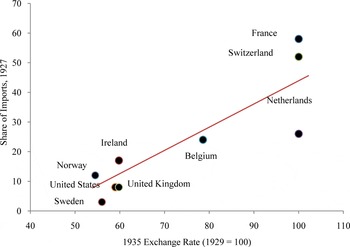
In Figure 3, we present these data along with the exchange rate in 1935.Footnote 36 As the figure shows, sterling bloc countries (Sweden, United Kingdom, Norway, and Ireland) employed import quotas to a lesser extent than gold bloc countries (Belgium, France, Netherlands, and Switzerland). The implication is that countries with depreciated currencies did not resort to import quotas to the same extent as countries remaining on gold. While the sample is admittedly small, a t-test rejects the hypothesis that there is no difference in the use of quotas across the two groups at the 98 percent confidence level. Of course, countries with exchange controls had other administrative mechanisms for allocating foreign exchange and did not need to impose quotas on imports. Apparently for this reason, they were not included in the League's tabulations.
EXCHANGE RATE AND SHARE OF IMPORT COVERED BY QUOTAS

Exchange Controls
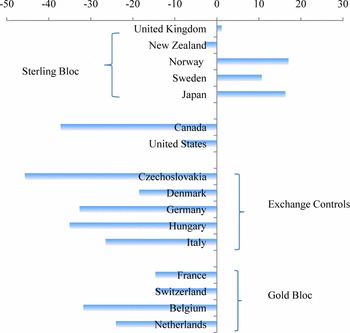
As noted earlier, Germany and central European countries were the main users of exchange controls.Footnote 37 They implemented them not simply to prevent the loss of gold and foreign exchange reserves, but as a new and permanent part of their trade and payments regime controls to limit spending on imports. Members of the sterling bloc and other countries depreciating their currencies are not widely represented on the list; to the extent that these countries ever employed exchange controls, they were used only briefly during periods of financial crisis, not as an instrument of commercial policy to reduce spending on imports (except for Denmark). Gold bloc countries that remained on the gold standard foreswore the use of exchange controls and maintained international capital mobility throughout this period.
In the absence of estimates of the relative restrictiveness of exchange controls, it is hard to estimate their effects. But one can indirectly assess their effects by examining the change in the volume of imports across countries. In effect, we are required to look at the impact of the choice of exchange rate regime on trade policy outcomes (the volume of imports) rather than the trade policies themselves.
Normally, one would expect countries depreciating their exchange rates to curtail their imports relative to countries maintaining their currencies at prevailing levels. But Figure 4, which presents the change in import volume between 1928 and 1935, shows the opposite: import volumes fell much more for gold bloc and exchange control countries that remained on the gold standard. This is consistent with the conclusion that countries maintaining their currencies at prevailing levels imposed restrictive trade measures that depreciating countries did not.
PERCENTAGE CHANGE IN IMPORT VOLUME, 1928–1935

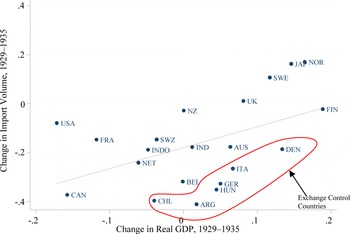
Of course, changes in the volume of trade are closely related to changes in domestic economic activity. Hence deviations from this relationship may be more informative about the potential impact of trade and payments restrictions. Figure 5 illustrates the relationship between changes in import volume and changes in real GDP between 1929 and 1935, controlling for whether a country imposed exchange controls. The underlying regression is

where EXCHCONTROL is a dummy variable for exchange control countries (n = 21, R 2 = 0.69; robust standard errors in parentheses).Footnote 38 As the figure and regression indicate, countries imposing exchange controls reduced their imports by about 23 percent more (exp[–0.26]–1) than one would have expected based on the change in GDP. Most of the observations well below the regression line—such as Argentina, Chile, Denmark, Germany, Hungary, and Italy—were exchange control countries. This suggests that such controls were a significant factor in reducing international trade, a finding that is consistent with more recent evidence.Footnote 39
CHANGE IN IMPORT VOLUME AND REAL GDP, 1929–1935

To conclude, the broad pattern across trade policy instruments—tariffs, import quotas, and exchange controls—suggests that abandoning the gold standard and depreciating one's currency was a substitute for the use of trade policies to restrict spending on imports. While none of the measures of commercial policy is ideal, the pattern across them is consistent.
Trade Costs
While there is no single summary measure of the stance of trade policy, recent research has developed an encompassing metric of the costs of conducting international trade. The term “trade costs” refers to any and all impediments to the exchange of goods across countries, not just government trade barriers but other costs of exchange, such as language barriers and distance, shipping and transportation costs, information and distributional costs, financing costs and uncertainty, and so forth.Footnote 40 While such costs have tended to decline over time, the early 1930s was unusual in that they rose sharply. David Jacks, Christopher Meissner, and Dennis Novy show that rising trade costs can account for most of the reduction in trade between 1921 and 1939, and it is plausible that a significant part of the rise was due to policy.Footnote 41
Following these authors, trade costs can be calculated using trade and GDP data for country pairs to fit an equation of the form

where τj,k is the country-pair specific costs of trade between country j and k (it is the geometric average of the bilateral trade barriers even if the trade barriers are asymmetric), EXPj,k is real exports from j to k, GDPj is the real output of country j, and EXPj = ∑k ≠jEXPj,k. The elasticity of substitution is ρ and sj is the share of tradable goods production in country j. Following Jacks, Meissner, and Novy, we set ρ = 8 and s = 0.8.Footnote 42
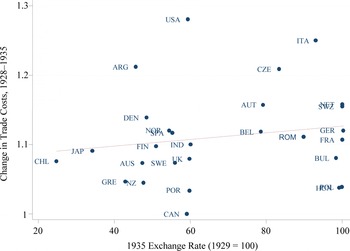
Figure 6 presents a scatter plot of the change in a country's trade costs and in its exchange rate from 1928 to 1935. The correlation is positive and thus consistent with our argument. While that correlation is relatively weak (r = 0.17), this may reflect the fact that other factors and not just commercial policies can affect trade costs.Footnote 43 In addition, the trade cost calculation for a bilateral pair is the geometric mean of their respective costs, making it difficult to determine which country factors are responsible for the change. In other words, if one country liberalizes its policy while another restricts trade, trade costs between them may not change even though the policies pursued in each are quite different. The working paper version of this article looks at trade costs for selected countries by type of trade partner (sterling bloc, gold bloc, and exchange group). The pattern of the costs is consistent with our thesis in that trade costs increased the most for Germany, less for France, and less still for Britain.
CHANGE IN TRADE COSTS AND EXCHANGE RATE

Trade Liberalization After Exiting Gold
If countries remaining on the gold standard raised trade barriers as a result of their inability to resort to other macroeconomic policies to stabilize their economies and financial systems, it follows that countries should have begun relaxing their trade restrictions once they abandoned gold. There is evidence of this pattern. In 1934, a year after the United States went off gold, Congress enacted the Reciprocal Trade Agreements Act authorizing the president to reduce U.S. import duties in trade agreements with other countries. Within four years, the agreements reached under the act had essentially reversed the Smoot-Hawley tariff increase.
Similarly, once the remaining gold bloc countries devalued in September 1936 and started recovering from the slump, they began removing some of their trade barriers. The League of Nations noted that, “Before the end of October 1936, tariff reductions and/or quota relaxations had been announced in France, Switzerland, the Netherlands, Italy, Czechoslovakia, and Latvia.” For example, having devalued in September, France reduced its tariffs by 15–20 percent the next month, and Switzerland reduced many of its import tariffs by more than 50 percent.Footnote 44 Relaxing the gold constraint and pursuing more expansionary monetary policies relieved the pressure to maintain restrictive trade policies. On the other hand, countries imposing exchange controls never formally abandoned the gold standard and consequently continued to restrict trade through such controls for the rest of the decade.
CONCLUSIONS
With the outbreak of the Great Depression, government officials were confronted with a difficult policy dilemma. In the face of an unprecedented economic collapse, the available choices were deflation under the gold standard, currency depreciation, or direct controls over trade and payments to maintain gold and foreign exchange reserves. Most countries rejected deflation as too wrenching given the severity of the shock and the magnitude of the required wage and price adjustment. Hence, these three options were effectively reduced to two: maintaining fixed exchange rates or maintaining open trade.
We find evidence of this policy tradeoff: countries that stayed on the gold standard tended to restrict trade more than those that allowed their currencies to depreciate. Having sacrificed one policy instrument (monetary autonomy) that might have been used to counter the Depression, policymakers in their desperation resorted to another (trade controls). Historical circumstances conditioned this choice. Countries that had suffered high inflation after World War I chose to stay on the gold standard and maintain the exchange rate peg; effectively, they sacrificed open trade policies on the altar of financial stability. The same was true of countries that had acquired financial center status and valued its maintenance. France and other countries in this position used import tariffs and quotas to regulate trade and the balance of payments; Germany and the exchange control countries did not maintain free capital mobility, leaving only the choice of whether to impose higher tariffs or allocate foreign exchange to regulate trade and the balance of payments. Countries that did not suffer from monetary problems after World War I or had no financial center status to defend went off the gold standard, allowed their currency to depreciate, and were able to maintain more liberal trade policies.
Our account helps explain why some countries were more inclined than others to a protectionist response and lends structure to the otherwise chaotic tale of the collapse of world trade. It suggests that had more countries been willing to abandon the gold standard and use expansionary monetary policy to counter the slump, fewer would have been driven to impose trade restrictions in the desperate if ultimately futile effort to stem the decline in output and rise in unemployment.