I.
In 1877, Liu Yuqing erected a tombstone for the founder of his patrilineage. A formidable local chief in the Ailao Mountains of northern Yunnan, Liu was in a victorious mood. He had recently helped the Qing army crush an extended uprising of the farmers and herders of his district. The rebels, led by a determined young farmer named Li Zixue and inspired by the Taiping Rebellion (1850–64), had seized an iron mine, manufactured their own weapons, and established a government that controlled the northern Ailao mountains for eighteen years (1856–74). As a reward for his aid in destroying them, Liu Yuqing had been returned extensive lands once owned and lost by his patrilineal ancestors. On the stone, Liu inscribed a long text in the meter of the Three Character Classic, memorized by every schoolboy. “In the southern mountains, the forests were profuse,” the inscription begins. It tells of how Liu's ancestors led their nomadic people into these mountains to hunt during a time when they wore hemp and goatskins, ate buckwheat and meat, fought the neighbors on their borders, and were happy from dawn to dusk. During the time of the Ming Hongwu Emperor (1368–98), the people discovered the fertility of the land and settled down to plow and plant. The text tells of how the first ancestor Liu was able to name, Pu Kai (1628–62), built rice fields and created markets, and of how, after his death, his sons gambled away most of his property. After listing the lands Liu Yuqing was returned, the inscription concludes:
楷父体, 火化后, 无着落, 楷遗体, 原葬处, 塔枝树, 地不利, 乖事出, 移此后, 龙脉旺, 万事昌, 南山强, 惟我庄Footnote 1
The body of patriarch Kai, After its cremation, Has no resting place. The remains of Kai, Their original place of burial, Is marked by a stupa and a branching tree. But the site was not auspicious, Perverse events occurred. After the remains were moved here, Where the dragon veins are splendid, All things prospered. The power of the Southern Mountains, Belongs only to our family.
Liu Yuqing's lineage, those it ruled, and most who had rebelled against it were of the people locally known as Black Luoluo (Liu and Li 1845, juan 7) or, in their own language, Lòlop’ò. Before the nineteenth century, they wrapped their corpses in clothing and quilts and carried them to the forested mountainside to be burned. The corpses were raised on a wooden frame and firewood was piled beneath. Some of the burned bones and ash were placed in an earthen urn or cloth bag, which was buried in a graveyard two or three inches below the ground. In most places, a small stone, square in shape but uncut and unmarked, was placed on the ground above the remains. Pu Kai's ashes had been removed from such a site and reinterred in a new lineage yard for buried corpses.Footnote 2
The stone memorializing Pu Kai is a heartfelt repudiation of this practice. The transition from cremation to burial coincided with the encroachment, first gradual then overwhelming, of Han traders and settlers into the Liu lineage's domain and its simultaneous loss of political autonomy. As James Lee (Reference Lee1985) has shown, the population of the Yunnan-Guizhou plateau quadrupled between 1700 and 1850. Immigrants from the interior seeking livelihoods in mines, cities, and trade accounted for most of this increase, but farmers' numbers also swelled. By the mid-nineteenth century, immigrants comprised some 20 percent of the region's aggregate population. In Chuxiong Prefecture, where the Ailao range was located, population density rose from ten people per square kilometer in 1775 to twenty-seven in 1825. Liu Yuqing's descendant, the pioneering scholar Liu Yaohan, has chronicled his lineage's struggle to retain control of its mountain domain in the face of this flood of immigrants. In the seventeenth century, Pu Kai had controlled a district some 40 by 60 li, with several villages of Lòlop’ò tenants. He welcomed Han craftsmen but he forbade trade with the Han merchants who were moving out from garrison villages into the mountains, having many killed. After his death, his five sons traded and gambled freely, selling off four fifths of their father's land to Han families who brought in other Han settlers. Understanding that his family's survival depended on identifying with the Han ruling class, Pu Kai's grandson Pu Zhongxin (1736–95) took the Han name “Liu,” abandoned his native dress, and married a Han woman. Yuqing, whose mother was also Han, was Zhongxin's grandson (Liu 1980, 12–30).
Liu's Yuqing's memorial for his ancestor makes it clear that the stone could serve as a medium for relations among lineage, land, and landscape in a way that Pu Kai's cremated remains alone could not. Bodies—both the living bodies of fathers and sons and the remains of dead forbears—are material anchors for the abstraction of patrilineage. Stones make bodily remains visible, render material their connections to the living, and create a conduit for the forces of the landscape, channeled through corpses, to manifest in the fates of the living. The text states that the “perverse events” that plagued the lineage after Pu Kai's death—the loss of most of its land and the rebellion of the people who served it—were due to the improper placement of his cremated remains. To rebury them in a new place beneath an inscribed stone was to reject a practice that did not anchor the corpse solidly to the soil and to refound the lineage, after decades of loss and rebellion, in secure connections among corpse, stone, land, and landscape.
This article traces the introduction of inscribed stones into the ritual field that surrounded the “great matter” of death and descent in a community much like Liu Yuqing's: a group of Lòlop’ò villages in the Baicaoling Mountains, which extend the Ailao range northward into Dayao and Yongren Counties. Inscribed stones came into death ritual as Yi peoples across the Yunnan-Guizhou plateau abandoned cremation in favor of burial, a transformation sought diligently by the imperial state since the beginning of the Ming and accelerated by the flood of immigrants from the interior during the eighteenth and nineteenth centuries. Nearly everywhere, the social experience of death is organized around practices of caring for bodies in transition. On the Yunnan-Guizhou plateau, whether a body was rendered into smoke that drifted into the sky or enclosed in a coffin, buried beneath a tomb, and memorialized on stone had much to do with the social fate of the dead and their relations to the living. In the transformation from cremation to burial, a system of thinking about the material nature of the dead, in which bodies dissolved into the sky, was eclipsed by a new system, in which bodies resided forever in stone houses, which doubled the houses of the living. A new vision of an underworld was adopted and the universe divided into two, the portals between guarded by representatives of the imperial state. Stones became replacements for corpses, doors to the underworld, narratives of lives, and textual diagrams of kinship relations. Whereas text had been seen, at least in Lòlop’ò places, primarily as transient material traces of unseen beings on the world's surface, subject to creative interpretation by skilled readers, inscription on stone shifted textual agency away from readers to writers and created links between state authority and the bodies of the dead. In the community described here, people began to bury their dead in the late nineteenth century and to write on stone in the twentieth. They used stones to create new ways of conceptualizing and reaffirming social relations among living descendants. And they made much of the connection of writing to state authority, inserting their dead into the national time of revolution as the state's beneficiaries or victims.
Recent literature in the ethnography of literacy questions previous attempts to establish global distinctions between orality and literacy influenced by Jack Goody's and Ian Watt's (Reference Goody and Watt1963) proposal that the introduction of writing into societies previously dominated by orality created new possibilities for distancing and critique and encouraged logical and critical cognition. This argument was allied to a long history of scholarly efforts to clearly distinguish writing from other material-semiotic practices such as picture-making, particularly in the context of logographic scripts in Mesoamerica (a comparative case in Yunnan is Naxi dongba script).Footnote 3 In recent years, the lively interdisciplinary reaction provoked by these arguments has deepened and diversified to produce a rich array of ethnographic and historical case studies about the ways writing and literacy participate in specific social practices. This literature has moved away from looking for cognitive implications for literacy in general to understanding how particular practices of writing and reading are implicated in social relations, especially relations of power.
Of particular relevance to the case presented here is the large literature on imperial peripheries where written colonial languages, vehicles for state power, are adopted by indigenous-language communities.Footnote 4 The present case study reinforces three points in this scholarship. First, as Hull (Reference Hull2012) points out in an ethnography of practices of bureaucratic writing and reading in Pakistan, the category of writing tends to dissolve internally when specific graphic practices are examined in their social context. Second, as the category of writing fragments into particular practices, its external boundaries also blur: very little analytical purchase can be gained by drawing rigid distinctions between writing and other material-semiotic practices—a point made eloquently in Mundy's (Reference Mundy1996) study of maps produced by Spanish, Creole, and native elites in Mesoamerica in the late sixteenth century. Third, material-semiotic practices like inscription on stone are emphatically material practices. It matters very much whether writing is inscribed on bone, skin, leaves, paper, or stone; indeed the weight of a text may lie nearly entirely in its material substrate.
The immense value of inscribed stones as historical sources in China is very well known. Yet tombstones from the contemporary era have been neglected as ethnographic sources, despite their ubiquity. In the community examined here, stones were ethnographically eloquent. They were nodes in a network of material links among corpses, houses, and landscapes, both worldly and underworldly. The practice of writing on stone was introduced by a tiny Han minority, for whom it became a way to retain Han identity by fixing the memory of ancestors in the face of established practices of deliberate genealogical forgetting. When Lòlop’ò took up this practice in the twentieth century, they extended it in two directions. They created lengthy biographies of the deceased, incorporating elements from oral laments and from the narrative practice of suku, “speaking bitterness.” And they elaborated the Han custom of listing the sons of the deceased into extended diagrams of descent groups, including as many as eighty people, living and dead, absent and present. After the community lost more than half its living members in the first decades of the twenty-first century, stones became a way to create a virtual universe of kinship that linked those who stayed behind to all who had departed.
II.
Abundant archaeological and textual evidence suggests that residents of the Southwest had been cremating their dead since at least the time of the Nanzhao kingdom (653–902). In the Man Shu, or “Book of Barbarians” (Fan [864] 1962), cremation and burial were already correlated with relative degrees of civilization of “white barbarians” (Baiman) on the plains who buried their dead and “black barbarians” (Wuman) in the mountains who burned theirs (Gu 2007, 217). By the time of the Nanzhao's successor, the Dali kingdom (937–1253), many elites had adopted a form of esoteric Buddhism transmitted from India and Tibet called Azhali after achārya, a Sanskrit term for spiritual masters. Under Azhali influence, Dali elites burned the corpses of their dead, gilded the bones, placed them in pots, and buried them, often under inscribed stone pillars. Archaeologists have found graveyards with urns of cremated remains and pillars throughout western Yunnan, ascribing them to the ethnic groups that included the elites of the Dali kingdom (Howard Reference Howard1997). The peoples the Man Shu called Wuman, whose descendants came to be called Luoluo and Yi, also continued to cremate. A Jingtai-period (1449–57) gazetteer of Yunnan describes funerary practices among the Luo Yi in Luo Zhou, Guizhou:
When they die they do not use a coffin. The great wrap their corpses with tiger and leopard skins, the mean with cattle and goat skins, carrying them in bamboo mats to the wilds to burn. Friends and relatives gather and kill livestock as sacrifices. They leave the bones without gathering them. The chiefs and the wealthy order slaves to stand guard for a period of two or three months, a month for children. They hide the bones in a place that non-kin do not know. Though Luoluo are scattered in many places, their customs are all the same; this is not unique to this prefecture alone. (Chen [1455] 1995, quoted in Rui Reference Zengrui2000, 4)Footnote 5
Cremation was not restricted to the barbarians of the Southwest. Patricia Ebrey has shown how it was common during the Song period in many other parts of China. Confucian scholars objected to the practice as “cruel, a desecration of the corpse, barbaric, Buddhist, and unfilial” (Ebrey Reference Ebrey1990, 421).Footnote 6 Philosophers argued that the body was a gift from the parents, to be returned to them whole at death. The Song state imposed the penalty of strangulation for burning a corpse in 962, with an exemption for foreigners and Buddhist monks, initiating a prohibition that would be renewed and reinforced repeatedly until the end of the Qing. Though Song and Yuan prohibitions seem to have had little influence on the popularity of the practice, the Ming and Qing were far more effective at social reform. The Ming legal code made the penalty for cremating a senior relative beheading and for cremating a child eighty strokes of the cane (Yang and Yang Reference Fuwang and Qiongying2000). Most Han communities had abandoned the practice by the end of the dynasty.
Ritual reform among the non-Han peoples of the Southwest was far slower, awaiting the imposition of direct imperial rule. At the beginning of the Ming, a third of Yunnan, half of Guizhou, and most of west Sichuan were governed by native hereditary officials ratified by the state under the tusi system. The imperial state gradually gained influence in these areas during the Ming, intervening more directly in the appointment of native chiefs and replacing them with court-appointed officials wherever possible. As John Herman (Reference Herman1997) shows, during the early decades of the Qing native chiefs continued to lose political autonomy to the state, creating new divisions amongst them and weakening their ties to their subjects, resulting in increased violence both among native chiefs and between Han and non-Han communities. In response, the Yongzheng Emperor determined in 1728 to abolish the tusi system once and for all. Local administrators responded with alacrity and sometimes with considerable violence, deposing or demoting most chiefs on the plateau.
The new local officials who replaced tusi encouraged non-Han peoples to adopt the custom of burial, sometimes with vigor. “Objectionable customs of the people such as burning corpses have been repeatedly prohibited, yet, as they still dare do this, the punishment must be heavy,” wrote Huang Zhaizhong, magistrate of Dading County in Guizhou during the Daoguan reign (Huang 1849, quoted in Yang and Yang Reference Fuwang and Qiongying2000, 66). State pressure and the massive influx of Han settlers caused most Yi communities on the plateau to abandon cremation during the Qianlong period (1735–96) or shortly thereafter. Tombs came to be erected over buried corpses, followed by inscribed tombstones. In the Yi areas of Chuxiong, particularly in Wuding, Shuangbai, and Yuanmo Counties, hundreds of tombstones inscribed in Yi scripts or a combination of Yi and Chinese have been found, dating from the late eighteenth and nineteenth centuries (Hua 1997). The Lipo and Lòlop’ò of Dayao, Nanhua, and Yao'an Counties had no script for their language and inscribed stones only in Chinese. Their stones, though remarkable, have drawn no scholarly attention.
III.
Li Ganxue leads me along the path that ascends to Kàlìbò, the largest gravesite in Júzò, where his family buries their dead, to a place between two parallel banks of earth, some four feet high. “This is where the old people say that they used to cremate the dead,” he says. “They carried the corpse up here on a stretcher with a bamboo mat on it. They built a wooden frame like a maize-drying rack, placed the corpse on top, and put a wooden cover over it. Everyone who came to help brought a stick of firewood, which they stacked beneath the rack. After the corpse was burned, they put some of the ashes in a small reddish bag, along with the jewelry the dead person wore, buried the bag, and placed a small square stone over it.” After both members of a couple had died, two stones were placed side by side. On the hillside below the tombs of many descent groups, we find the rectilinear stones, 4 to 6 inches high and 3 to 4 wide, uncut and uninscribed (see figure 1). No one can name these ancestors, yet many people know which stones belong to their descent group, and they clear the brush from them when they make offerings to the tombs of their buried ancestors.
Cremation stones below burial tombs. Photo by Erik Mueggler.

Li Ganxue remembers tending as a child a cremation stone for his mother's great-grandfather, the last person in her descent group to be cremated. His mother's own tombstone records that she was born in 1911. Assuming about twenty-five years between generations, her great-grandfather would have been born around 1836 and, if he lived to the age of fifty, died around 1886. Others in Júzò confirm that it was around this time that the cremation was finally abandoned here, shortly after Li Zixue's Lòlop’ò-led rebellion was crushed in 1874. This was considerably later than in most places on the plateau. Yet, like the decades after the Qing abolished the native hereditary chiefs, it too was a time when a disheartening loss of political autonomy followed close upon an extended period of state violence.
Lòlop’ò funeral practices no longer make explicit reference to cremation. Yet they contain many gestures and texts that might be read as belonging to an older system of thinking about human remains as media for relations between humans and immaterial beings. Funeral rituals combine two complex assemblages of tools for imagining how the dead are situated in the phenomenal world. In one, the dead sleep high in the sky, each couple cradled together for eternity amongst the stars. In the other, the dead live forever beneath the soil, tilling and herding in an underworld, subject to Chinese-speaking officials. While there is not room here to fully elaborate either assemblage, I will indicate a few points where implicit reference to practices of cremation seem to have been retained.
Luo Guifu died in April 2011 at the age of sixty. Immediately after her death, before her body was washed and dressed, her husband's brother's son Luo Yan, who knew something about ritual, climbed to an uninhabited place on the mountain to appease the spirit of lightning, Shr̀mògù, who claims souls at the moment of death. As in all such negotiations, the ritualist built a nègu, an effigy that made visible the spirit's most salient attributes. This particular nègu was a model, 4 to 6 inches high, of a maize-drying rack, an agricultural tool once common in these mountains (see figure 2). A drying rack was four posts, 9 to 12 feet high, planted in the ground. Each post was forked at the top; two beams were laid horizontally across these forks, and a number of poles were placed across the two supporting beams.
Building a ne`gu for Shr`mo`gu`, the lightning spirit, in the form of a maize-drying rack. Photo by Erik Mueggler.
By raising the maize far above ground level, the rack protected it from livestock and rats and allowed the wind to circulate beneath it. Luo Yan also built a miniature ladder modeled after the tall ladders used to climb to the top of the rack. He then made a speech describing Shr̀mògù's descent from the empty sky to the black clouds; to the yellow and white clouds; to the mists and mountaintops; to the firs, cedars, and pines; to the trees and brush, the rocks and pebbles, the river sands and weedy slopes; to the tiled roof of a house, the beams of a thatched house, the top of the wall, the hearth stones, the courtyard's head, the rice-pounder's mouth, and into the bones and marrow of the dead person. The speech described the offerings, begged Shr̀mògù to release the dead soul, and asked it to ascend along the same path on which it had descended. The speech contained a streamlined cosmology, a vision of the body's place in the phenomenal world, inserted into house and courtyard, with the forested mountain slopes above, overhung by mists and clouds, and finally the sky. This was a world of substances connected by paths, traveled by insubstantial beings driven by words. The nègu was an icon of this cosmos. The maize-drying rack modeled the world, described in mythology as square in shape with a sky supported by four great posts; the ladder was the path along which the spirit had descended and along which it would ascend again.
Old people in Júzò who remembered stories their parents had told about cremation always mentioned the structure, similar to a maize-drying rack, with which the corpse was raised some 6 feet above the ground and under which firewood was stacked. On the eve of socialist transformation, a similar structure was still used in some funerals. In a night vigil, held on the third day after a death, kin and friends gathered to offer the dead sacrifices of animals, grain, and alcohol, and to guard the corpse from harm by dancing around it until daylight. In most vigils, the corpse was placed in a coffin on the ground at the center of the courtyard, while animals were killed at its feet and sacrifices offered at its head. In vigils for the wealthiest, however, the coffin was raised on four sturdy posts and an arrangement of parallel beams to a height of at least 6 feet. The offerings were made beneath the coffin. This form of vigil, called tsa̱te, was undertaken only for a couple who had died well in old age and by sons and daughters who could afford to sacrifice at least one full-grown pig rather than the ordinary goats.
A long chant once performed during rituals held during the tenth lunar month for those who had died that year explicitly linked the procedure of raising the corpse at tsa̱te to a vision of the dead couple swaddled together in blankets and cradled in the sky:
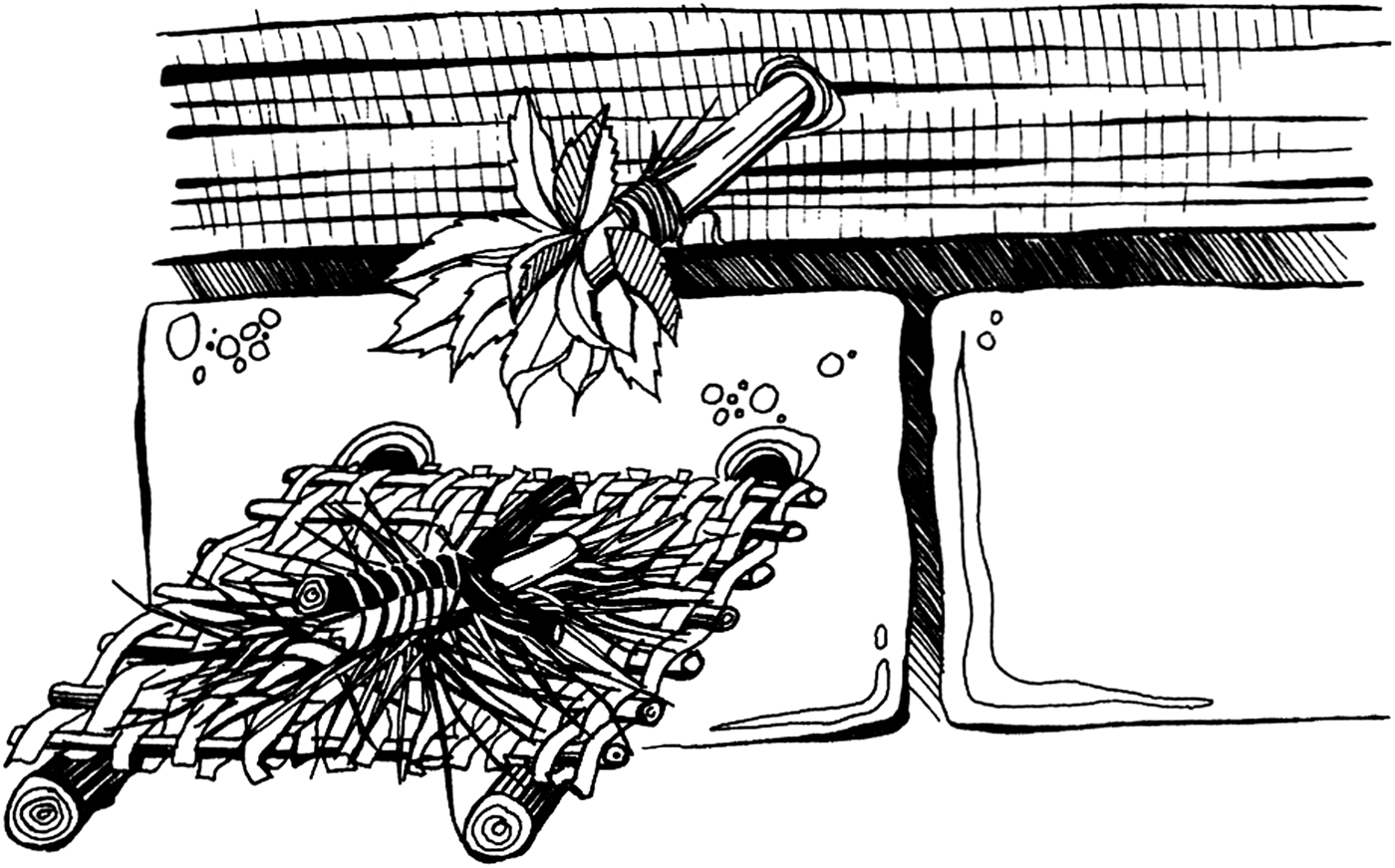
Here the unusual word tsa̱, “to lift” is repeatedly used to reference tsa̱te. This speech was addressed to a series of effigies that replaced the interred body of the deceased. Among these was an ancestral effigy (nèts'ɨ̀), a miniature icon of the dead couple bound together and cradled high in a “king's nest.” This effigy was a plaited platform of bamboo about 6 inches square supporting a figurine made of a straight pine twig bound to a crotched hardwood twig with thread. It was placed in in a row of similar effigies in the upstream room of a house, high on the wall, supported by two sticks pounded into the mud bricks. Like the miniature ladder and maize-drying rack for Shr̀mògù, it was a streamlined icon of the cosmos, a representation of the imagined place of the dead in the phenomenal world, a bamboo bed cradling coupled ancestral bodies in the squared-off sky of a house's ceiling beams (see figure 3).
An ancestral effigy: two twigs bound together lying on a bamboo bed below the wall's top beam, gazing up at a “flower” (Mueggler Reference Mueggler2001, 71).
In offering speeches and effigies, or nègu, to spirits and ancestors, people in Júzò paired two forms of formal, bounded textuality, oral and material, to create contained and simplified icons of the world the dead were imagined to share with the living. The intention was not as much to represent the cosmos as to act on it: Lòlop’ò textuality gathered and fixed powerful, animate, nonhuman beings within iconic structures, then moved them along streamlined paths. Ancestral effigies gave the dead bodies and locations from which they could enter into proper relations with the living. Yet these locations were always provisional. Nègu made disembodied beings material, but they were all eventually destroyed so as not to give immaterial beings permanent footholds in the world of the senses. Ancestral effigies were no exception. They were moved down the wall as more people died, falling into lower ranks as they aged and as those they represented gradually fell out of memory. After three generations, an effigy was removed from the wall, placed atop a coffin being carried out of a courtyard, and allowed to fall to the ground and be trampled underfoot, returning the forgotten ancestral soul to the interconnected animate substance of routes and paths.
This principle of impermanence also applied to stone. The small, square stones used to mark the remains of cremated bodies were a kind of nègu: like ancestral effigies they gathered and fixed the souls of the dead so they might receive offerings from their descendants. Though many of these stones remained in place, the names attached to them were forgotten after three or four generations. Those that still stand are all nameless even though cremation was only abandoned in the late nineteenth century. Burying corpses beneath tombstones introduced a new way of connecting semiosis and substance, founded on new principles of remembrance, and supporting new forms of relations with the dead, materialized in corpses, stones, and texts.
IV.
Two nights after Luo Guifu's death, her kin held a night vigil for her, during which about 150 relatives and friends made offerings, exchanged gifts, sang laments, and danced. The next morning, her son and nephews dug a grave while the other kin and friends who had followed the coffin up the mountainside rested amongst the tombs. In the portion of the graveyard owned by the Luo family, next to the site where Luo Guofu's first husband was buried, they shoveled into the steep slope, then lowered the coffin into the hole, head into the slope, feet towards the mountains opposite. They piled stone and earth over the coffin, covering it completely with a makeshift tomb. A genre of lament, called shrtsɨŋə, “songs for the dead,” sung by male ritualists, described the scene:
Later, Luo Guifu's descendants would return to fashion the front of the tomb, carrying cut stones carved with sculptures representing tales of filiality from Chinese history, legend, and myth. These stones were shaped like an elaborate doorframe. Within this frame, they would install a blank, flat stone called in Chinese, the language of the grave, a men, or door. Like many in Júzò, Luo Guifu's descendants had no immediate plans to inscribe this stone with text—a more expensive and time-consuming undertaking than they were prepared for at present. While the valley's graveyards contain many inscribed men, many more are merely blank surfaces carved from the local igneous stone. A few sites have no inscribed stones at all. These are owned by descent groups whose members make a point of adhering to what are now seen as the authentic Lòlop'ò practices of burying the dead in unpainted coffins and under uninscribed stones.
These unwritten surfaces have correlates inside the house. The corner of a house that ancestral effigies occupy is a node in the mobile world of paths that the dead inhabit, linked to the site of the tomb: people speak of three souls of the dead, one residing with the ancestral effigies, one inhabiting the house of the tomb, one wandering the paths. In any house with ancestral effigies, another nègu is placed in the same corner, upstream of them. This is the “bed's head spirit” (gə̀wúdεnè), which guards and protects the ancestral effigies. A bed's head spirit is a blank sheet of white paper tacked to the wall. A small shelf is placed below it to set offerings on; another shelf above protects it from falling soot; a “flower” is fashioned of twelve chestnut leaves tied to a twig and stuck into the wall beside it. This sheet of paper is where the spirit called, in Chinese, the cuiminggui, or “fate-hastening ghost,” writes the names of those about to die in invisible script. Yama, king of the underworld, sends the cuiminggui to capture souls about to die. These are the underworld correlates of Shr̀mògù and his servant Cánìshunì, whom he sends to collect those who are to die. The two pairs of spirits are correlated with the two locations the dead are imagined to inhabit in the phenomenal world: the Chinese-speaking Yama and cuiminggui with graveyard and underworld, the Lòloŋo-speaking Shr̀mògù and Cánìshunì with the sky.
The idea of a blank stone that records the unwritten name of the dead, or a blank sheet of paper on which is written the fate of the living, is in keeping with a notion of textuality central to Lòlop'ò ritual practice. When resorting to healing ritual, Júzò residents brought a gift to a diviner, who would read a goat's scapula, the bones of a chicken's head, the surface of a bowl of grain, the ripples on a cup of tea or wine, or the weave of a length of cloth for traces of the being at the root of an illness. Most speeches to immaterial beings had sections devoted to listing the ways a diviner had read evidence of the being in text left on the world's surfaces. Here as an example is an extract from speech performed to clear a house of unclean beings:
The word kà repeated in the fifth and seventh lines is short for Kàlìbò, the graveyard, the location of the underworld. The texts seen there were written on uninscribed tombstones. Lòlop'ò used the word và to describe this form of semiosis. They consistently translated và with the Chinese wen, used in a sense compatible with the explication of the word attributed to Jacques Gernet (Reference Gernet and Cohen1963): “It applies to the veins in stones and wood, to constellations, represented by the strokes connecting the stars to the tracks of birds and quadrupeds on the ground . . . to tattoo and even, for example, to the designs that decorate the turtle's shell” (quoted in Derrida Reference Derrida and Spivak1976, 123; on the etymology of wen, see also Bol Reference Bol1992 and Bergeton Reference Bergeton2013). Và or wen was a trace on the surface of the world left by an agentive being, which could be read by those with skill. Writing (sú và) was a special instance of text, authored by living people rather than unseen beings. To write on stone was to shift the agency of textual practice from a reading ritualist to a writing descendant. And it was to tap into the power that Chinese language represented for Lòlop'ò: the power of the state.
V.
Júzò's graveyards were damaged extensively during the “smash the four-olds” campaign of 1966. Local activists ploughed up the largest concentration of the small, squarish stones that marked cremated remains to plant maize. And the youthful activists sought out any stones inscribed with old dates and smashed them. Unreadable fragments of inscribed stones can still be seen embedded in the paths and in the foundations of public buildings. The oldest remaining stones, some pieced together out of fragments, belong to the Wu descent group, whose forbears settled in Júzò in the mid-seventeenth century at the same time as the first Lòlop'ò (see figure 4). In the face of considerable skepticism from their Lòlop'ò neighbors, and despite being in nearly every respect indistinguishable from them, the Wu persisted in clinging to a Han identity. They made a point of burying their dead, insulting the Lòlop'ò, who forced them to remove the body of their first patriarch from Kàlìbò to a separate site. Eventually they began erecting stones over the graves, inscribed only with names, formally presented, and dates. The oldest is undated; it memorializes Wu Xixian, who passed away in 1766, leaving two sons and three grandsons. The first dated stone was erected in 1823 for a woman, Yang Long, born to a Lòlop'ò family in 1762 but married to a Wu and buried in 1821.
A smashed tombstone with the dates chiseled off. Photo by Erik Mueggler.
Other early stones introduced the custom of inscribing biographies. In the 1820s, Gu Yuanzhang, his wife née Jiang, and his brother Gu Yuanwei settled in the valley, acquired farmland, and raised six sons. After their deaths, their sons traveled to the regional center of Baiyanjing and talked a shengyuan, a successful candidate in the county-level imperial examinations, into memorializing their parents on stone. This was an effort to distinguish themselves from the dubiously Han Wu as much as from Lòlop'ò. The scholar, Yang Bohe, inscribed the stones with brief biographies of each brother. His flowery but specific texts emphasize his own contribution, repeatedly naming himself and mentioning his love for writing. Though this was hardly in keeping with a proper focus on the virtues of the deceased, the Gus probably approved. As they worked to present themselves as their community's most civilized and literate family, they found in the shengyuan a source of textual authority ratified through the examination system by the imperial state itself.
In the early twentieth century, a few other Han families also erected inscribed stones that foregrounded the situation of a tiny Han minority who saw themselves as the struggling bearers of civilization to their goatskin-clad neighbors. These were rare holdouts: most Han immigrants to this valley were absorbed into the Lòlop'ò majority. Remembering one's ascendants, against the Lòlop'ò practice of forgetting them after three generations, was crucial for retaining Han identity, and stones served this purpose far better than paper could in the rough, poor homes of this valley. Lòlop'ò looked to these inscriptions as models for their early stones, adopting many of their formal features, including many stock phrases used to introduce the names of the deceased and to narrate their lives.
Our surveys of Júzò's graveyards recovered dated stones belonging to Lòlop'ò descent groups from two periods: 1954 to 1958 and 1989 to the present. If Lòlop'ò had inscribed stones before the socialist era, they were destroyed. In form, these stones were of three types. Some listed only the names of the deceased and the bereaved. The deceased were most often a couple, and their names were embellished with elaborate introductions and, usually, dates of birth and death, as well as of the stone's erection. Another type was divided into three vertical sections. On the right was inscribed a narrative of the life of the deceased; in the center were the names and dates of the deceased; on the left were the names of the bereaved. Finally, many tombs had three stones placed side by side. A biography was inscribed on the right-hand stone, the names of the deceased and bereaved on the center stone, and filial, nostalgic, or revolutionary verse copied from books published for that purpose on the left-hand stone (see figure 5).
Tomb erected in 1991, with a biography of the deceased on the right-hand stone, the names and dates of the deceased and names of the bereaved on the center stone, and revolutionary verse on the left-hand stone. Photo by Erik Mueggler.
Writing names required some innovation. Most Lòlop'ò children received a birth name, used only in childhood.Footnote 10 At the age of seven or eight, a child was given a more formal Chinese name to be used in school. In the early twentieth century, few girls were given Chinese names; after the socialist revolution most were. After their first child was born, both members of a couple took that child's birth name, adding the suffixes p'ò and mo for men and women respectively. They kept this name the rest of their lives, regardless of the fate of the child, using their formal Chinese names only on documents, if at all. As with Balinese teknonymy, described in Hildred and Clifford Geertz's (Reference Geertz and Geertz1964) classic article on the topic, this practice encouraged a degree of “genealogical amnesia” in keeping with the practice of forgetting ancestors after several generations. In addition, teknonymy focused social attention on childbearing couples, who had essentially the same name, as the centers of genealogical imagination, a focus reinforced by tombstones.
On stones, Lòlop'ò listed formal Chinese names when they were remembered and teknonyms when they were not. When not originally in Chinese, teknonyms were transliterated into Chinese characters with the suffixes po (颇) or mo (么 or 嬷) added. In keeping with the tendency to imagine couples as bound together forever in the afterlife, teknonyms allowed them to be named on stones as though they were a single person, as in this example from 1998:
Teknonyms were often made more formal by being introduced with the Chinese-style surname followed by the character jun (君). The teknonym itself might or might not also include the surname. The first lines of a biographical narration on a stone erected in 2004 illustrate the complexity of naming:
罗公桂成乃起君起福生颇之次子也取名起发…成人后赘入罗府与罗君正福之么女
Mr. Luo Guicheng was Mr. Qi Qifushengpo's second son, named Qi Fa … As an adult, he married into the Luo household, Luo Zhengfu's youngest daughter
The youth Qi Fa became Luo Guicheng after he married uxorilocally, then took the name of his first child. Luo Guicheng was used on his tomb, where his wife remained nameless. Many people chose not to use the teknonym of female ascendants, naming them in the Han style merely with the surname of their family of birth, followed by shi (氏).
The second essential task of every stone was to list the names of the bereaved (孝). Early local Han stones sometimes listed the names of sons or grandsons and their wives after the name of the deceased. Lòlop'ò elaborated extravagantly, attempting to carve into stone the mutable universe of kinship performed at rituals for the dead. People in Júzò divided the participants in all mortuary events into three categories with distinct roles: vεdù, zòmœ̀, and avə. The vεdù were the deceased's patrilineal descendants and their friends; the zòmæ̀ were the deceased's married-out daughters and their family and friends; the avə were the deceased's affines and their friends, headed by the deceased's brothers (if a woman) or wife's brothers (if a man). Most rituals had hundreds of participants, every one of which demonstrated allegiance with one of these groups by sitting and making offerings with it. In every event, the avə group took seats at the head of the coffin, nègu, or tomb, the vεdù at its feet, and the zòmœ̀ at its two sides. At every ritual, the zòmæ̀ group made offerings to the dead and received gifts from hundreds of their supporters first; the vεdù group offered next, and the avə group offered last (with many internal distinctions within the groups). Most participants had cross-cutting relations with avə, vεdù, and zòmœ̀, and they chose their allegiance deliberately depending on their formal kinship relation to the deceased, their intimacy with a principal avә, vεdù, or zòmæ̀ or one of her intimate kin or friends, or debts acquired at previous funerals. In the case of both seating and offerings, while the patterns followed were formally prescribed, their performance was extremely flexible.
The limited surface area of a stone did not lend itself to writing names in the spatial order in which avə, vεdù, and zòmæ̀ were usually arranged. Instead, inscribers divided the space into vertical ranks for different classes of kin. An early example is a stone Li Fuzhong inscribed for his parents in 1958, listing thirty-eight bereaved. Sons and daughters are listed in the top rank. The names of their wives and husbands are arranged directly below them, so that each couple can be discerned. The sons' sons are listed in the third rank with their wives arranged below them in the fourth. The sons' daughters are on the fifth with their husbands in the sixth; the daughters' sons and daughters are in the seventh with their wives and husbands in the eighth. This tomb includes the names of deceased and bereaved along with a biography on a single stone, so the space is limited. As more people divided inscriptions onto three stones in the 1990s and 2000s, they began to list the deceased's man's (or woman's husband's) brother's sons on the same rank as the deceased's sons, including their wives with the sons' wives on the next rank, and their sons and daughters, with their wives and husbands on further ranks. This arrangement created ranks by generation and gender rather than by genealogical distance from the deceased, ranking brothers' sons the same as sons, brothers' daughters the same as daughters, and so on with spouses and grandchildren. All stones privileged spousal relations over relations of descent by making clear who was married to whom but not who was the child of whom. All, crucially, preserved the vεdù/zòmæ̀ distinction by separating children of daughters from children of sons. And all excluded the avə group. As brothers of the female of a couple, avə and their children were not members of a descent group: they were protectors and supporters of their sister and her children and, since Lòlop'ò preferred bilateral cross-cousin marriage, the sources of potential marriage partners. Finally, in distinction from funeral rituals, stones employed clear genealogical principles, excluding the hundreds who belonged to the vεdù and zòmæ̀ groups as extended kin, co-residents, friends, and neighbors.
Stone inscriptions preserved foundational features of the universe of kinship relations performed at funeral rituals while creating new ways of conceptualizing it. Inscriptions formally defined a select descent group, excluding all others. But they also employed new principles of inclusion. They listed the names of deceased descendants, usually without marking them, installing the living and the dead side by side. And they included the absent. Even more than most places in rural China, Júzò had emptied out by the second decade of the twenty-first century. One third of households had been moved out to new villages in an effort to cure what local officials saw as the incorrigible backwardness and poverty of the valley's inhabitants. Most able-bodied or quick-witted youths from the households that remained had departed to seek work in cities. As the numbers of inscribed stones increased, those who remained could find their names on many stones, as members of many descent groups. Stones became the only place where a generation of brothers' sons and daughters with all their spouses, children's spouses, and children's children could be imagined and displayed in its full glory. In the past, people often spoke of the graveyard at Kàlìbò as a city of the dead, ruled by a Chinese-speaking bureaucracy, separated from the village of the living by a deep ravine. Now, it became the place where the full universe of kin was reconstituted across the increasingly deep ravines of death and absence.
VI.
Lòlop'ò had no formal tradition of individualized biography. In several genres of lament and song, people in Júzò chronicled the lives of the deceased from birth through childhood, marriage, childbearing, and death.Footnote 11 Laments were nearly identical for each decedent, rarely incorporating personal material beyond a name or two. Collectively, these forms of oral textuality inserted the life of the deceased into an expansive narrative of the history of creation. The long chant once sung during the tenth month for those who had died that year devoted its first section to the formation of earth and sky, before moving on to the origins of plants, animals, and humans. The biographical narrative Li Fuzhong inscribed for his parents in 1958 begins like an abbreviated translation of these songs of creation:
先有天地然后有万物先有父母然后始有兒女父母者为兒所虑不甚枚举为儿兒女者穷则呼天痛痒则呼为父母父母过去念养我骨肉 . . .
First there was Heaven and Earth, and then there were the ten thousand beings; first there were Father and Mother, and only then were there sons and daughters. Fathers and mothers have innumerable worries for their children. Everyone raised as a son or daughter will cry to Heaven when in poverty and cry to parents when in pain. Only when our parents have passed away do we remember that they raised our flesh and bones. . . .
Laments detail the suffering parents endured raising their children, then speak of the happy situation the children were able to arrange for their parents at the end of their lives. The most common form of biographical inscription on stones combined the structures of lament and suku, “speaking bitterness,” with which Chinese peasants of the 1950s learned to speak of their lives in relation to an approved narrative of the history of the nation.Footnote 12 As Li Fuzhong's inscription for his parents tells of the difficulty of life before Liberation, it narrates a tangled tale of family circumstances. The father married a virtuous woman from his village, who raised two boys and a girl:
欠百半拋夫丢兒乃夭没矣 . . . 孤兒血淚难堪言过三秋父娶对门大而村苏法邪嬷为 我继母 . . .
随母及家眷丧女苏法邪因不能尽孝早亡殁迹灵魂嫁与比作伴继母后又育 有一女嫁于耳田
Having reached only half her span of a hundred years, she abandoned her husband and cast off her children, dying at an early age. . . . The tears of blood versed by her orphaned children do not bear speaking about. After three autumns, my father married a proper match, Su Faxiemo of Da'er Village, to become my stepmother. . . . Following her mother into the household was her dearly remembered daughter, Su Faxie, who subsequently was unable to fulfill her filial obligations, dying early and becoming extinct. Her soul was married off to become the companion to a suitable partner. My stepmother later had another daughter, who was married off to Ertian Village.
The dead Su Faxie is listed among the bereaved, along with her husband, Xiaogou, “Little Dog,” the name of the infant to whom she was married after her death.Footnote 13 The inscription then transitions to the present, telling of the family's well-being and paying obeisance to the new apparatus of the party-state in the hamlet of Guiteng:
明日复明日往事不可复矣现在三代同堂桂藤方亦有公鄉和公务职称者
Tomorrow repeats tomorrow, but the past can never be repeated. Now we are three generations under one roof, and Guiteng has township officials and public functionaries.
When they began to inscribe stones again in the late 1980s, Júzò residents found the old narrative structure of suku useful for organizing inscriptions for those born during the “old society.” The stone Li Peisen erected for his parents in 2000 is typical, drawing on tropes repeatedly used in earlier stones—wearing the stars and carrying the moon for poverty, diligent study for filiality—while also speaking of the difficulty of prerevolutionary life. The stone narrates the life of his mother rather than his father, who died when Li Peisen was a child:
自从小丧母 . . . 少年安父家境贫寒无房无地旧社会为人恩度日披星載月恋爱劳动节省吃穿积攒薪金起房置地 . . . 膝下所生两男两女两女早夭折勤策全力抚育两儿 . . . 读诗书长大成才完婚极力扶育儿孙成长攻读诗书望子 . . . 精心抚育如愿以偿如今 儿孙满堂四代同堂全家合欢和睦幸福共享乐年岁月难留九十寿终
Since she mourned her mother at a young age, . . . as a child she lived with her father. The family circumstances were lowly and poor; they did not have a house or land. . . . In the old society she relied on others' kindness to pass her days, wearing the stars and carrying the moon. She loved labor, economized on food and clothing, and saved her money to raise a house and buy land. . . . Of children, she bore two boys and two girls. The two girls died prematurely, and she diligently spent all her strength nurturing her two sons. . . . We grew up reading the classics and became men of substance; we married and did our best to raise children and grandchildren who grew up diligently studying the classics and reading characters. We put our entire heart into raising our children, fulfilling her wishes in recompense. Now, children and grandchildren fill the house, four generations under one roof. The entire family rejoices in harmony, well disposed to one another and blessed: together we have enjoyed many happy years. But the years and months cannot be halted, and she died at the age of ninety.
The inscription employs a simple classical grammar, used traditionally in Han areas to impart moral and auspicious sayings, blending the vocabulary of suku with another vocabulary about labor and frugality, rooted in works of communist morality. And of course the biography is extremely selective: in fact, Li Peisen's elder brother never married, living in deep poverty with his mother until she died, while Li Peisen raised a family of children and grandchildren separately. Though biographical inscriptions are replete with descriptions of hardship, it is, as in lament, always the hardship of the parents during the time before their children came of age, a structure that coincided happily with suku for Li Peisen's mother's generation. Many of the first stones inscribed after the long hiatus of the Great Leap Forward and the Cultural Revolution reached into the past to settle wandering souls uprooted by the chaotic political events of the century. A moving example is the simple stone Su Pingying inscribed in 1992, thirty-seven years after his cousin Su Haijun's death in 1955:
故人苏海钧原系吾父之弟苏公荣昌之第二之子青年时身强力壮勤劳诚实可敬很受人们的尊重家里一把得力的劳动能手只因旧社会一次强行征兵中被縛大气所伤病故民间传说阴曹地府孤魂难度经双方人说合与小村力英邪颇之次女力英能配为阴室为 . . . 唸故者特建佳城永垂不殁留表寸心
My old friend Su Haijun was the second son of my father's younger brother Su Rongchang. When he was young, he was strong and tough, and his industry and honesty were admirable. At home he was a capable and expert laborer. But because in the old society his lungs were damaged when he was bound during forcible conscription into the army, folk tradition has it that his lonely soul is suffering in the underworld. After the two parties reached an agreement, he received Li Yingneng, the second daughter of Li Yingxiepo of Xiaocun, as his posthumous wife. . . . In memory of the deceased, we dedicate this auspicious compound, to endure forever, as a lasting display of our sentiments.
Li Yingneng, born a year after Su Haijun in 1924, died the same year as he, unmarried and childless. The wedding was a long-overdue funeral attended by hundreds of kin from both families, during which a handful of earth from Li Yingneng's grave was placed in a coffin and buried next to Su Haijun's.
Other stones memorialized early enemies of the socialist state. In 1989, Luo Guiyuan erected a stone for his wife's father, into whose family he had married. Luo Guoxing, the valley's powerful preliberation militia captain, had been publicly executed as a “local tyrant and evil bully” in 1951. His wife, memorialized with him, died in 1960. Luo Guiyuan's project met with strong objections from his kin, and the first stone he inscribed was smashed before it was finished. Guiyuan was no stranger to opposition, however—as Guoxing's heir, he had suffered considerably during the Cultural Revolution—and he persisted, driven by a desire to put his father-in-law's ghost to rest and rehabilitate his descendants in the eyes of their community. Directly contradicting four decades of political education, the inscription praises Guoxing's contributions to the defense of his community:
時遇国难当头軍閥混战各自称雄处处匪猖獗 . . . 鱼肉百姓处于水深火热之中而别 无良策唯有组织江防队以作自卫慎防匪患严父出抵族官门户历任中队长之职多次 与贯匪李自學斗智斗勇比高低又曾与丁海平部长和谈解百姓落难之虑严父中世从 武得一手好枪法千米之外射飞鸟弹无虚发
At that time the country was in imminent danger, as armies were mired in battle, and bandits were everywhere. . . . Treated like cattle or vermin, the people felt as though the water had risen to their lips, as though they were singed by fire, and the best plan they could think of was to organize a river defense force, to protect themselves and to defend themselves against marauding bandits. My honored father left to lend support to the leaders of our nationality, and he repeatedly served as a squadron leader. Many times he matched wits and courage with the armed bandit Li Zixue to see who was stronger. He also once held talks with Minister Ding Haiping to alleviate the sorrow of the people in their distress. Though my father entered the military in middle age, he became a skillful marksman, who could shoot a flying bird at a thousand meters, every shot hitting its mark.
Luo Guiyuan insisted that his father-in-law had fought the nineteenth-century Lòlop'ò rebel Li Zixue, perhaps confusing him with an early twentieth-century bandit of a similar name. But Guoxing did defeat a bandit named Ding Haiping, who assaulted Júzò with a strong band: the reference to Ding as Minister (buzhang) is ironic. Guiyuan told me the story of Guoxing's marksmanship several times before I saw it (perhaps rather exaggerated) on this stone, giving me the sense that as a youth this was what impressed him most about his father-in-law. The stone lists fifty-three bereaved: Guoxing's brothers' sons and daughters and Guiyuan's sons and daughters, with their spouses, children, and children's children—a descent group, much damaged by persecution during forty years of revolution, reconstituted on stone.
These genres of biographical inscription—lament combined with speaking bitterness on the one hand and rehabilitating dead and living souls damaged by past wrongs on the other—both position the dead in relation to national history and state power. In part, this is a contingency of the periods of history in which the stones examined here were composed. During the revolutionary 1950s, all forms of writing paid obeisance to the ascendant state, as Li Fuzhong's stone for his parents does by mentioning the difficulty of the prerevolutionary period and praising the new local public officials. In the early reform era, erecting a tombstone was a foray into an arena the state had forbidden in the recent past. Inscribers chose from a range of strategies of appeasement and defiance, often combining both on one stone. The defiance on Su Haijun's stone was implicit: as a veteran of a military force that was not the People's Liberation Army, the wounded Su spent the last part of his life in a persecuted and neglected class, making a stone at the time of his death in 1955 unthinkable. The defiance on Luo Guiyuan's stone for his storied father-in-law was open, recognized, and controversial. Yet, whether in appeasement or opposition, all these narratives foregrounded the imagined state as a central addressee.
This is not to say that authors necessarily shaped their inscriptions for the eyes of readers who might be local officials or Party members. Stones were rarely read outside of a series of encounters centered on the process of inscription. A stone's author consulted with someone literate in Chinese, usually a schoolteacher, to compose names and biographies. As a stone was inscribed, kin and friends gathered in the courtyard to watch a craftsman transfer the text from paper to stone. After the stone was finished, the avə was invited to view it and approve it in a formal ceremony, his reading often aided both by the central author and by the literate person who helped with its composition. Reading in all these contexts was oral, recitational, and communal, involving the active participation of the authors in interpreting and defending the text. To inscribe on stone in these contexts was to make claims about a universe of kin, present and departed, in relation to a living community of kin and friends. Yet, because stone inscription was permanent, it projected the text outside of this living community as well, to a potential universe of future readers: to inscribe on stone was to position the dead in history in relation to the future as well as the present. And the field in which this positioning took place was provided by the state, imagined as the master of history and its central agent.
In all the other texts and gestures of funeral ritual, lives were situated in the local spaces of house and field, mountain and river, shady side and sunny side. They were situated in relation to kin and friends and to the cycle of suffering, labor, nurture of the young, and care of the old that dominated funeral song and lament. But when they responded at last to state pressure to abandon cremation, Lòlop'ò in Júzò adopted a new set of tools for thinking about the relation of the dead to the world of the senses, all of which emphasized state authority over the dead. Writing on stone brought the state and the history of its efforts to reform ritual into the ways people narrated their ascendants' lives. In the late twentieth century, a reinvigorated state renewed its concern with ritual, banning all funerals for a few years and deeply curtailing many forms of ritual for several decades. When people began inscribing stones again, they could not but feel the redoubled weight of the socialist state's concern with the dead. Unlike all other forms of nègu, stone inscriptions left permanent evidence of an author's attitude toward the problem of the relation of the dead to state power. As a result, even narratives not dominated by postures of appeasement or defiance positioned individual lives in the context of revolution and reform, giving new meanings to suffering, labor, nurture, and care.
VII.
How does one nurture social relations with beings that cannot be seen or heard? How do such beings become focal media for social relations among humans who are material (if only partially) and present to the senses (if only at times)? As material manifestations of absent beings, corpses present these questions in exceptionally powerful ways. For this reason, the long struggle between the imperial state and the Tibeto-Burman-speaking peoples of the Yunnan-Guizhou plateau over whether to burn or bury the dead was deeply consequential for those who inherited its effects. In cremation, corpses were dematerialized with fire, materialized again in ancestral effigies or cremation stones, and dematerialized again when these nègu were deliberately destroyed or forgotten. In burial, corpses were preserved beneath the ground, made material in tomb-houses, then materialized more durably on inscribed stones. Lòlop'ò in Júzò preserved elements from both these very different trajectories in their funeral rituals. This gave them extraordinary flexibility as they sought to reconstitute social relations by creating ephemeral or durable material manifestations of the dead. They took ample advantage of this flexibility in the late twentieth and early twenty-first centuries, as social relations amongst the living came to depend ever more heavily on ritualized relations with the dead. Webb Keane (Reference Keane2013) has suggested that the special physical properties of writing make it particularly useful in operations that render material things immaterial and vice versa. This was clearly true in the case presented here. Though people in Júzò adopted writing into a field of textuality already constructed, writing on stone had properties shared with no other form of textuality. Stone inscriptions shifted the human agency involved in text from diviners' readings of traces of immaterial beings on the world's surfaces to the manipulation of text by people endowed with literary authority. Inscriptions also powerfully shaped the temporality of text. Inscribed stones were materializations of nonmanifest beings of the same order as ancestral effigies or cremation stones, but inscription made them durable. Among the consequences of this manipulation of time was the production of a specifically genealogical imagination. Inscriptions on stones created durable diagrams of relations based on narrowed principles of descent. And they employed new principles of inclusion as well, filling in descent groups with dead and absent kin.
Keane (Reference Keane2013) proposes that people often generate power—usually divine power of some kind—in such acts of translation across semiotic modalities. Again, this was clearly true in Júzò, though the potency delivered was hardly divine: it was the imagined power of the state. Those who wrote biographical inscriptions clearly had the sense that the state was a primary addressee and that this gave the act a particular potency. Chinese, particularly written Chinese, had been the language of colonization on the Yunnan-Guizhou plateau, and it continued to be the language of state power in every arena. This association was built into the very structure of the cosmos, repeatedly referenced in ritual negotiations with the Chinese-speaking governors of the underworld. Drawing on this power with inscription provided new opportunities to set right old wrongs, by memorializing those who had been harmed or forgotten by the socialist state. But it also created new restrictions: to narrate a life on stone was inevitably to insert it into the time of national history.
The transformations explored here might appear to be about relations with merely imaginary beings, separated from the living by an ontological divide. But the living are as imaginary as the dead. We too are manifest to the senses of others only at times and across diverse and shifting material forms from bodies to texts: as social persons our ontology is the same. Corpse, stone, door, text: these are media for relations among the living as much as between living and dead—beings spirit and material, absent and present, imagined and real.
Acknowledgments
This article is dedicated to Professor Liu Yaohan of the Chuxiong Yi Culture Research Institute. I am grateful to Mei Yang Seibold for her help with research, to Christian du Pee for his invaluable comments, and to students and faculty of the anthropology departments at the University of Michigan, the University of Toronto, and Cornell University, as well as participants in the 2013 “Frontier Fictions” workshop at the Max Planck Institute, for their insights and engagement.