Introduction
Hope and depression are two closely linked psychological dimensions in people in general as well as in those with severe mental illness (Schrank et al. Reference Schrank, Stanghellini and Slade2008). Hope can ameliorate depression (Arnau et al. Reference Arnau, Rosen, Finch, Rhudy and Fortunato2007) while hopelessness may aggravate depression and predict suicide (Lopez-Morinigo et al. Reference Lopez-Morinigo, Ramos-Rios, David and Dutta2012). Hope is also generally described as central for recovery from severe mental illness, considered both as a trigger and a maintaining factor of the recovery process (Slade et al. Reference Slade, Leamy, Bacon, Janosik, Le Boutillier, Williams and Bird2012). Depression can impair recovery in different ways, e.g., through negative self-image and negative future expectations as well as its negative effect on hope (Noordsy et al. Reference Noordsy, Torrey, Mueser, Mead, O'Keefe and Fox2002).
Two further central aspects in the course of illness, or recovery, are self-stigma and insight into illness. Self-stigma, i.e., the inner subjective experience of stigma resulting from applying negative stereotypes and stigmatizing attitudes to oneself, has been shown to be detrimental to recovery (Link et al. Reference Link, Struening, Neese-Todd, Asmussen and Phelan2001; Staring et al. Reference Staring, Van der Gaag, Van den Berge, Duivenvoorden and Mulder2009). People with a diagnosis of schizophrenia spectrum disorders are particularly at risk to experience stigmatization (Rose et al. Reference Rose, Willis, Brohan, Sartorius, Villares, Wahlbeck and Thornicroft2011; Lakeman et al. Reference Lakeman, McGowan, MacGabhann, Parkinson, Redmond, Sibitz, Stevenson and Walsh2012, Hengartner et al. Reference Hengartner, Loch, Lawson, Guarniero, Wang, Rössler and Gattaz2012) and develop self-stigmatizing attitudes (Brohan et al. Reference Brohan, Elgie, Sartorius and Thornicroft2010). The detrimental effects of self-stigma are manifold. For example, it negatively affects quality of life (Lysaker et al. Reference Lysaker, Roe and Yanos2007, Sibitz et al. Reference Sibitz, Amering, Unger, Seyringer, Bachmann, Schrank, Benesch, Schulze and Woppmann2011a, Park et al. Reference Park, Bennett, Couture and Blanchard2012), self-efficacy (Watson et al. Reference Watson, Corrigan, Larson and Sells2007), social functioning (Yanos et al. Reference Yanos, West, Gonzales, Smith, Roe and Lysaker2012a) and empowerment (Vauth et al. Reference Vauth, Kleim, Wirtz and Corrigan2007) and may lead to loss of self-esteem (Link et al. Reference Link, Struening, Neese-Todd, Asmussen and Phelan2001) and depression (Norman et al. Reference Norman, Windell, Lynch and Manchanda2011; Sibitz et al. Reference Sibitz, Amering, Unger, Seyringer, Bachmann, Schrank, Benesch, Schulze and Woppmann2011a; Park et al. Reference Park, Bennett, Couture and Blanchard2012). In contrast with self-stigma as a clearly negative factor, insight into illness is a highly ambiguous variable. Insight refers to the awareness of a mental disorder and its consequences, of the need for treatment, of symptoms and the attribution of symptoms to the disorder (Chakraborty & Basu, Reference Chakraborty and Basu2010). Higher levels of insight have been associated with clinically positive variables such as better treatment adherence (Lincoln et al. Reference Lincoln, Lullmann and Rief2007), social functioning (Brissos et al. Reference Brissos, Dias, Balanza-Martinez, Carita and Figueira2011) or work performance (Erickson et al. Reference Erickson, Jaafari and Lysaker2011). At the same time, insight has been linked to depression and suicide (Lincoln et al. Reference Lincoln, Lullmann and Rief2007; Staring et al. Reference Staring, Van der Gaag, Van den Berge, Duivenvoorden and Mulder2009), hopelessness, self-stigma and impaired quality of life (Hasson-Ohayon et al. Reference Hasson-Ohayon, Kravetz, Meir and Rozencwaig2009; Staring et al. Reference Staring, Van der Gaag, Van den Berge, Duivenvoorden and Mulder2009; Pruß et al. Reference Pruß, Wiedl and Waldorf2012). Hence, while insight can support recovery because it can help people assume control of and manage their illness, it may also impair recovery by stimulating self-stigma and impeding quality of life (Ghaemi & Rosenquist, Reference Ghaemi and Rosenquist2004).
All the mentioned variables are known to be connected with symptoms of psychosis. For example, negative symptoms may be linked to depression while positive symptoms have been frequently associated with impaired insight (Lincoln et al. Reference Lincoln, Lullmann and Rief2007; Brohan et al. Reference Brohan, Elgie, Sartorius and Thornicroft2010). Overall, positive and negative symptoms and the factors hope, depression, insight and internalized stigma show close and complex interactions and their interplay is important for psychiatric practice. Research has so far been patchy with regard to their mutual influence.
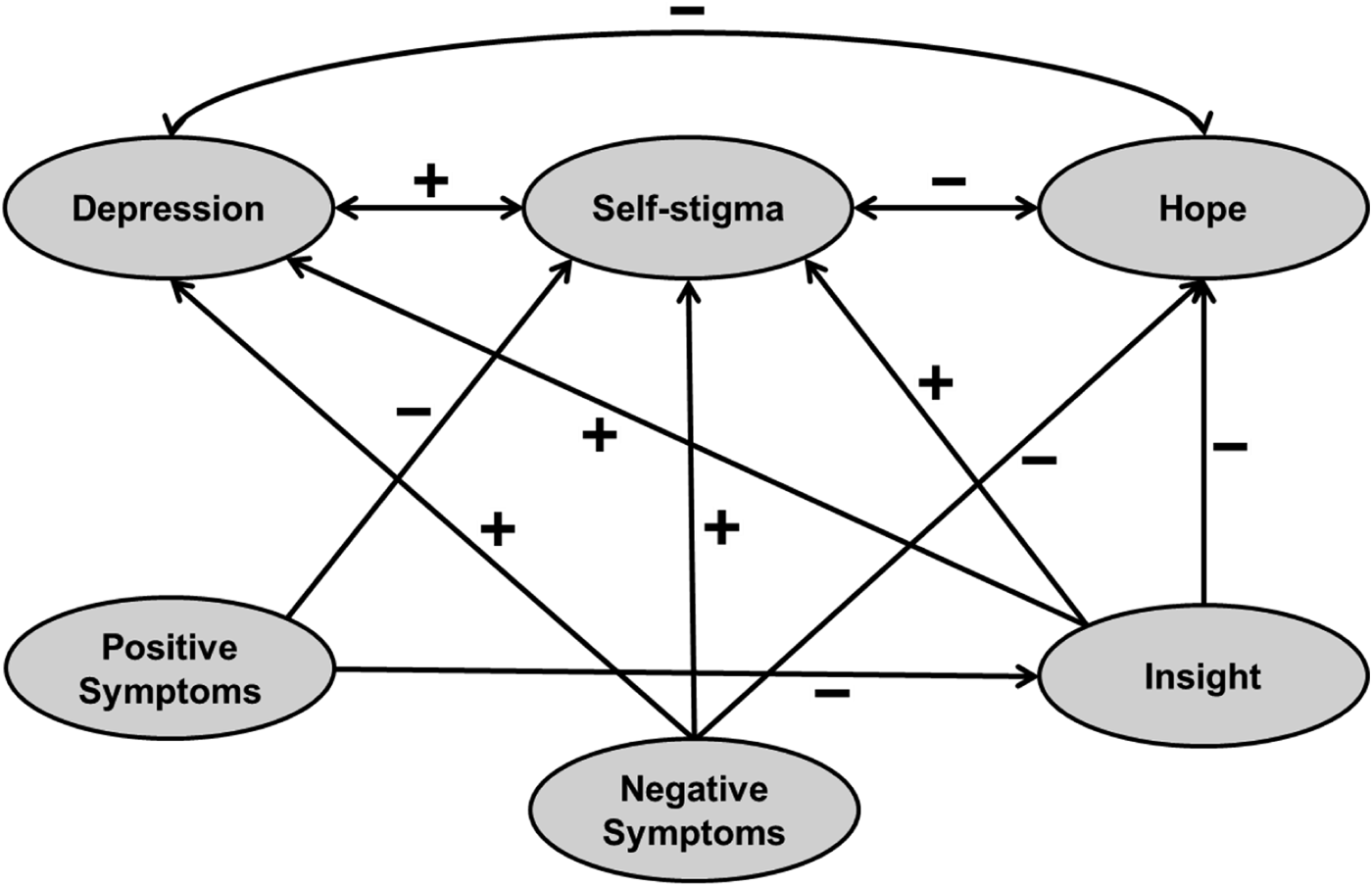
The aim of this study was to simultaneously test the relationships among insight, positive and negative symptoms, hope, depression and self-stigma using path modelling in a large sample of people with schizophrenia spectrum disorders. From the existing data on relationships between individual variables, as outlined above, we developed the model to be tested. Specifically, we hypothesized in the model that a greater degree of positive symptoms leads to less insight and less self-stigma, whereas a greater degree of negative symptoms leads to more depression, more self-stigma and less hope. Insight was assumed to decrease hope and increase depression and self-stigma. Finally, we assumed that hope and depression exert a mutual negative influence on each other, both directly and with self-stigma as a moderator. Figure 1 illustrates our model assumption.
Hypothesized model of mutual influences between the variables hope, depression, insight, self-stigma and positive and negative symptoms.

Methods
Participants and procedures
The study was approved by the ethics committee of Medical University of Vienna. Participants were adults with clinical diagnoses of an ICD-10 schizophrenia spectrum disorder. Recruitment took place at (i) the in-patient departments at all four psychiatric hospitals in Vienna (ii) the day clinic at the department of psychiatry and psychotherapy of Medical University of Vienna, (iii) one community mental health centre, (iv) one community service offering leisure activities and (v) two supported living services. Exclusion criteria included mental retardation, active substance dependence and co-morbidity with serious physical illness.
Patient records at the participating centres were screened weekly for potentially eligible participants. Inclusion criteria were confirmed by the attending psychiatrist. Leisure activity groups were visited monthly and participants were invited after eligibility criteria were confirmed by chart review. After receiving information about the study by a research worker, an interview was scheduled with interested participants. Written informed consent was obtained at the time of the interview and participants received remuneration of €10.
Measures
Hope
The Integrative Hope Scale (IHS) (Schrank et al. Reference Schrank, Woppmann, Sibitz and Lauber2011) contains 23 items rated on a Likert scale from 1 to 6. Overall values can range from 23 to 138, with high values indicating great hope. The scale measures a multidimensional concept of personal hopefulness. It shows good psychometric properties in people with schizophrenia spectrum disorders. Cronbach's α lies at 0.92, its test–retest reliability at 0.85. (Schrank et al. Reference Schrank, Woppmann, Grant Hay, Sibitz, Zehetmayer and Lauber2012). The IHS has moderate to strong negative correlation with depression (r = −0.58; Schrank et al. Reference Schrank, Woppmann, Grant Hay, Sibitz, Zehetmayer and Lauber2012) which reflects the widely acknowledged psychopathological overlap between hopelessness and depression but still suggests that they are different constructs. At the same time, the scale shows a weak negative correlation with negative symptoms (r = −0.26) which implies a clear distinction between the concepts.
Insight
The Schedule for the Assessment of Insight – Expanded Version (SAI-E) (Kemp & David, Reference Kemp, David and Blackwell1996) is based on a concept of insight encompassing the recognition of mental illness, the ability to re-label unusual mental events as pathological, treatment compliance, the awareness of core symptoms, emotional/psychological changes and difficulties resulting from the mental condition. The scale contains nine questions and results in possible global insight scores from 0 to 24 (high values stand for good insight). It shows good construct and concurrent validity (Ghaemi & Rosenquist, Reference Ghaemi and Rosenquist2004).
Self-stigma
The Internalised Stigma of Mental Illness (ISMI) scale (Ritsher et al. Reference Ritsher, Otilingam and Grajales2003) is a 29-item instrument that uses a Likert scale from 1 to 4 to assess the subjective experience of stigma. It consists of five subscales: alienation, stereotype endorsement, discrimination experience, social withdrawal and stigma resistance. Possible overall scores range from 29 (no self-stigma) to 116 (high self-stigma). The scale has high internal consistency with Cronbach's α = 0.92 and a test-retest reliability of r = 0.71 (Sibitz et al., Reference Sibitz, Friedrich, Unger, Bachmann, Benesch and Amering2013). Since stigma resistance was found to be a separate construct (Sibitz et al. Reference Sibitz, Amering, Unger, Seyringer, Bachmann, Schrank, Benesch, Schulze and Woppmann2011a, Reference Sibitz, Unger, Woppmann, Zidek and Ameringb), in this study, items of the stigma resistance subscale were not integrated in the total ISMI score.
Depression
The Allgemeine Depressionsskala (ADS) (Hautzinger & Bailer, Reference Hautzinger and Bailer1993) is the German version of the CES-D (Centre for Epidemiological Studies Depression Scale). It contains 20 items for assessment of subjective depressive symptoms rated on a Likert scale from 0 to 3 and shows highly satisfactory validity and reliability. Possible overall scores range from 0 (no depressive symptoms) to 60 (great impairment due to depressive symptoms). Internal consistency with Cronbach's α was up to α = 0.90 and test-retest correlation up to r = 0.67 (Radloff, Reference Radloff1977). Depressive symptoms as measured by the ADS can be clearly distinguished from negative symptoms, which is confirmed by the weak correlation between the ADS and the Positive and Negative Syndrome Scale (PANSS) negative sub-scale (r = 0.28) (data on request from the authors).
Symptoms
The PANSS (Kay et al. Reference Kay, Fiszbein and Opler1987) is the most widely used measure of symptom severity in schizophrenia. The 30-item rater administered scale evaluates patients' current severity level on each symptom by endorsing one of seven options. It has high internal reliability and good construct validity (Müller et al. Reference Müller, Rossbach, Davids, Wetzel and Benkert2000). We only included the positive and negative PANSS subscale as they have been shown to be more discriminating of individual differences in symptom severity and more reliable than the general psychopathology sub-scale (Santor et al. Reference Santor, Ascher-Svanum, Lindenmayer and Obenchain2007). They contain seven items each with possible overall scores ranging from 7 to 49.
The PANSS and SAI-E were rater administered by our researcher (A.G.) who received training and regular supervision for the rating. The other questionnaires were self-administered in the presence of the researcher in the same assessment session. Participants received help with the formal aspects of filling out the questionnaires but not with interpreting items.
Data analysis
In order to examine the relationships between insight, positive symptoms and negative symptoms, hope, depression and self-stigma, we conducted a path model (PM) based on a moment matrix. In the hypothesized model all variables had one indicator variable, namely the score of the respective measures as described in the previous section. PM is a confirmatory data analysis technique which allows the analysis of multiple relationships between variables by combining confirmatory factor analysis with multiple regression analysis. It tests the whole model rather than single relationships (Grace, Reference Grace2006). The statistical analyses were conducted using the software SPSS 19 and AMOS 16. The applied method was the full information Maximum Likelihood. This is a direct method which estimates model parameters and standard errors directly from the available data assuming missing at random simultaneously with estimating the model parameters. We assessed three indirect effects, i.e., from positive symptoms on insight and further from insight on stigma, depression and hope. All other relationships were modelled as direct effects.
Results
Participants
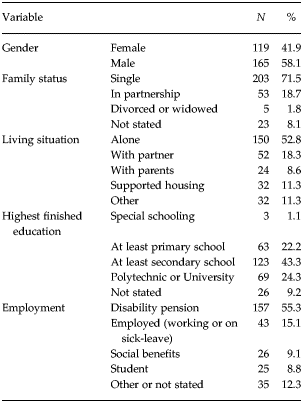
Two hundred and eighty-four service users participated in the study. Their mean age was 39.9 years (s.d. 12.6). The socio-demographic characteristics of the sample are shown in Table 1.
Sample characteristics (N = 284)
Clinical description
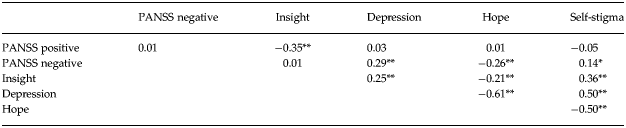
One hundred and thirteen (39.8%) participants received out-patient treatment, 158 (55.6%) were in-patients and 13 (4.6%) attended a day hospital. ICD-10 diagnoses included F20, F21, F23 and F25. The mean duration of illness was 15.2 years (s.d. 12.8). The mean score for positive symptoms lay at 12.1 (s.d. 4.4) and that for negative symptoms at 11.0 (s.d. 3.4), i.e., psychopathology scores may be rather low compared with other studies involving people with schizophrenia. However, PANSS scores are known to vary widely between studies in general (Levine et al. Reference Levine, Rabinowitz and Rizopoulos2011). The mean score for hope was 93.6 (s.d. 19.2) and that for depression 16.6 (s.d. 8.3). This means that hope was lower while depression was higher compared with the Austrian general population (Schrank et al. Reference Schrank, Woppmann, Sibitz and Lauber2011), as would be expected. The mean score for self-stigma was 1.89 (s.d. 0.6) and that for insight 10.2 (s.d. 5.6), which represents average values for both variables (Lysaker et al. Reference Lysaker, Roe and Yanos2007; Sibitz et al. Reference Sibitz, Unger, Woppmann, Zidek and Amering2011b). Table 2 shows the correlations of the variables within the study sample.
Pearson correlations (using pair-wise deletion) of positive and negative symptoms, insight, depression, hope and self-stigma
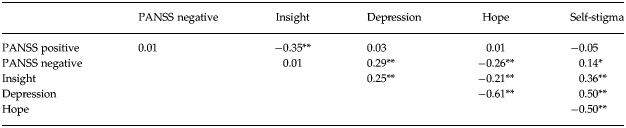
*Correlations significant at 0.05, **correlations significant at 0.01 (both two-tailed).
Model fit
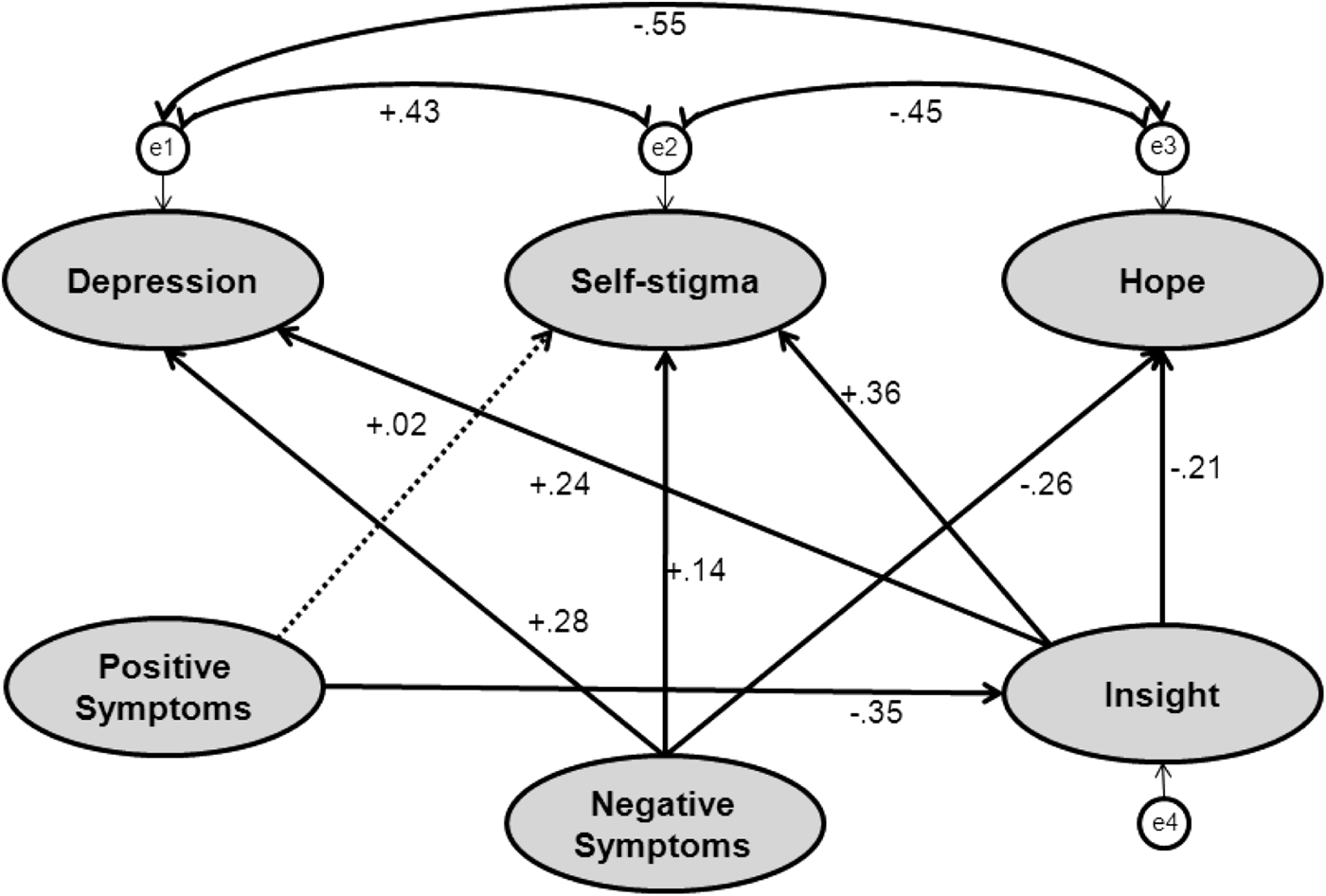
Path modelling revealed a very good fit of the model to the data (CMIN = 4.20, df = 4; CMIN/DF = 1.05, p = 0.38; RMSEA = 0.01 (90% CI 0.00–0.09); CFI = 0.99). The results, as shown in Fig. 2, strongly support our hypothesis. The results are consistent with a model in which insight influences hope, depression and self-stigma. Higher degree of insight is associated with less hope, greater depression and greater self-stigma. Our results also confirm a model of negative symptoms having an effect in the direction of greater depression and less hope. At the same time, negative symptoms had a minor reinforcing connection with self-stigma. More positive symptoms were connected with less insight but – contrary to our expectation – did not directly affect self-stigma. The model suggests that positive symptoms indirectly influence self-stigma via insight.
Path model (PM). Goodness of fit summary (Method: full information Maximum likelihood): χ2 = 4.20, df = 4; CMIN/DF = 1.05, p = 0.38; RMSEA = 0.01 (90% CI 0.00–0.09); and CFI = 0.99. Double arrows depict partial correlations. The variances explained are as follows: Insight: R 2 = 0.12, Hope: R 2 = 0.11, Self-stigma: R 2 = 0.15 and Depression: R 2 = 0.14.
Estimates for the saturated model are shown in Table 3. Explained variances in the saturated model are: Insight: multiple R 2 = 0.12, Hope: multiple R 2 = 0.12, Self-stigma: multiple R 2 = 0.15 and Depression 0.15.
Estimates of the saturated model: influences of positive symptoms, negative symptoms and insight on insight, hope, depression and stigma
Discussion
The aim of this study was to simultaneously test the chain of association between insights, positive and negative symptoms, hope, depression and self-stigma in people with schizophrenia spectrum disorders. Support for the hypothesized model was excellent.
Mutual influences and their implications
In our model, hope and depression showed a relatively strong negative connection with each other. Apart from the direct relationship between hope and depression there was another connection between these variables also including self-stigma, i.e., hope and self-stigma exert a relatively strong negative influence on each other while self-stigma and depression influence each other strongly positively. This mutual influence of self-stigma, hope and depression on each other shown in the present study confirms and expands previous research results which describe individual components of this triangular relationship, i.e., a negative correlation between hope and depression (Arnau et al. Reference Arnau, Rosen, Finch, Rhudy and Fortunato2007) or a positive correlation between self-stigma and depression (Norman et al. Reference Norman, Windell, Lynch and Manchanda2011, Sibitz et al. Reference Sibitz, Amering, Unger, Seyringer, Bachmann, Schrank, Benesch, Schulze and Woppmann2011a). A negative correlation between self-stigma and hope has not been explicitly described before, but studies investigating hopelessness together with other variables allude to this detrimental relation (Lysaker et al. Reference Lysaker, Roe and Yanos2007; Corrigan et al. Reference Corrigan, Rafacz and Rüsch2011).
The model was consistent with strong and mutual relationship between hope, depression and self-stigma. This suggests that in clinical practice these three variables should be dealt with conjointly in people with psychosis. Interventions targeted at fostering hope or dealing with depression should pay attention to the fact that self-stigma may account for a large part of the depressive symptoms and loss of hope found in service users. It has been suggested that significant gains in quality of life for people with schizophrenia spectrum disorders may result from education about self-stigma and the use of strategies to increase resilience against stigmatizing environments (Mittal et al. Reference Mittal, Sullivan, Chekuri, Allee and Corrigan2012; Lanfredi et al. Reference Lanfredi, Rossi, Rossi, Van Bortel, Thornicroft, Quinn, Zoppei and Lasalvia2013). Our results support this claim and argue for the use of strategies to conquer self-stigma both in everyday clinical practice as well as in specific interventions.
Another relevant result of our study is that our model showed insight to exert a clear influence on all three variables within the triangle of hope, depression and self-stigma. Insight relates to hope negatively and to depression and self-stigma in a positive, i.e., reinforcing fashion. The strength of these relationships was moderate in all cases. This result has practical treatment implications. Fostering insight has long been an important goal of mental health services since good insight is traditionally assumed to increase compliance and improve functional outcome in people with schizophrenia spectrum disorders. However, previous studies have produced inconsistent results with respect to the potential negative side-effects of insight, such as depression and hopelessness (Lincoln et al. Reference Lincoln, Lullmann and Rief2007). The present study confirms a potential clinically negative effect of insight on hope, depression and self-stigma. This result supports the claim that fostering insight should be approached in a differentiated manner (Pruß et al. Reference Pruß, Wiedl and Waldorf2012). On the one hand, knowledge about the illness and about treatment options are important to help people assume control, make informed decisions and manage their condition (Resnick et al. Reference Resnick, Fontana, Lehman and Rosenheck2005). On the other hand, insight is not just the acceptance of facts but also a personal narrative of what has happened to a person's life in the wake of illness. Such self-stigma can have particularly corrosive qualities. Accepting oneself as being ill could explain certain upsetting experiences but also carry with it the potential that one's identity has been permanently damaged or corrupted (Yanos et al. Reference Yanos, Roe and Lysaker2010). Framing insight as a personalized metacognitive account of psychiatric challenges might help to explain the seemingly contradictory links between insight and outcome. As a practical consequence, fostering insight may improve medication compliance and certain measures of functioning but at the same time it may destroy hope and increase depression and self-stigma. In clinical practice, it may be difficult to clearly distinguish between a positive and empowering or a detrimental way of promoting knowledge and insight. The important question of how to foster one and avoid the other is a topical challenge. Psychotherapeutic approaches have been suggested to solve the insight dilemma. For example, a narrative approach to addressing stigma in a way that achieving insight is less corrosive has recently resulted in a therapeutic intervention with promising results (Yanos et al. Reference Yanos, Roe, West, Smith and Lysaker2012b). Similarly, empowerment-oriented interventions have been proposed as a means against the negative effects of internalized stigma (Amering, Reference Amering2012).
The final important result of this study is the finding that positive and negative symptoms differ in their relation to the triangular constellation of hope, depression and self-stigma. While negative symptoms were directly related to all three variables, positive symptoms have virtually no direct relationship with self-stigma. However, positive symptoms influence self-stigma indirectly via insight. It may be concluded that the occurrence of positive symptoms decreases insight which leads to a decrease of self-stigma together with the described clinically positive effects on hope and depression. Following an acute episode, when positive symptoms fade and negative symptoms become more pronounced, the indirect ‘protective’ effect of positive symptoms against self-stigma is replaced by a direct clinically undesirable effect of negative symptoms on self-stigma, hope and depression. This hypothesized sequence, especially the potential ‘protective effect’ of positive symptoms against self-stigma and depression may contribute to further explaining the occurrence of favourable attitudes towards positive symptoms which have been found in previous research and were proposed as an alternative explanation contributing to poor medication compliance (Moritz et al. Reference Moritz, Favrod, Andreou, Morrison, Bohn, Veckenstedt, Tonn and Karow2012). However, further prospective research is needed to confirm the hypothesized sequence of influences exerted by positive and negative symptoms in the course of the illness, particularly following an acute episode.
Limitations
Overall, our sample showed moderate mean total scores on the PANSS. PANSS scores are known to vary widely between studies and our results might not be generalizable to patients' significantly higher PANSS scores. The sample had a comparatively high education status on average. This may be explained by the fact that people with lower education are usually less willing to take part in research which may lead to a selection bias towards people with higher education.
There is a widely acknowledged overlap between hopelessness, depression and negative symptoms, which may also be partly responsible for the outstanding goodness-of-fit of our model. The potential problem of confounding of depression with other variables of interest is well known from other research areas such as quality of life. However, we chose specific measurement scales in order to avoid this effect as far as possible. We used scales for depression and negative symptoms with only a weak correlation to each other and a multidimensional scale of hopefulness that includes a wide range of questions measuring aspects of hope different from the potential symptoms of depression.
It has to be acknowledged, that we used path modelling in a cross-sectional study design. This allows inferring causal pathways between the factors on a statistical basis only. Firm conclusions about the causality between the investigated variables can only be drawn from prospective study designs.
Conclusion
This study provides a synopsis of the influences between the variables insight, positive and negative symptoms, hope, depression and self-stigma by simultaneously testing their mutual relationships. It has relevant implications both for research and clinical practice.
Implications for research: Both qualitative and quantitative studies may investigate how insight supports recovery and how it leads to self-stigma. Determinants for insight to be beneficial or harmful may be explored. Prospective research will need to confirm the sequence of influences exerted by positive and negative symptoms in the course of the illness suggested by our results.
Implications for practice: Our study suggests that self-stigma and strategies to confront it should be considered both in everyday practice as well as in specific interventions given its close and therapeutically relevant link with hope and depression. It also reinforces the claim that a sensitive approach to insight is needed in psycho-education. Finally, it may be important to consider the potential benefits of positive symptoms in order to deal with issues of insight, self-stigma, loss of hope and their influence on concordance and on professional relationship.
Financial support
This work was supported by the Österreichische National Bank (Anniversary Fund, grant number: 13257).
Conflict of Interest
None of the authors have any conflict of interest.
Ethical standards
The authors assert that all procedures contributing to this work comply with the ethical standards of the relevant national and institutional committees on human experimentation and with the Helsinki Declaration of 1975, as revised in 2008.