Alcohol-control policies in the Nordic countries have historically been closely tied to the development of the welfare states. The balancing act between the freedom of citizens to drink alcohol and the freedom to make a living selling alcohol has to be considered against the public health and the public good. All of the involved interests have sound arguments; everybody wants freedom, health, and public order. From the start of the twentieth century, Danish policymakers have strived to achieve “increased sobriety and quiet in the streets”Footnote 1 through legal regulation of alcohol sales, but “modernization”Footnote 2 has both fueled and complicated these efforts. From the bar owner’s perspective, strict regulations have been viewed as “provisional measures”Footnote 3 based on paternalism and “obsolete dogmas”Footnote 4 that unjustly discriminate a trade that generates large tax revenues. In contrast, insufficient regulation has demonstrated repeatedly to have “detrimental and demoralising”Footnote 5 consequences in the form of “fornication, inebriety, and indecency.”Footnote 6 This article presents a study on morals, politics, and culture by examining how this dilemma has permeated Danish alcohol-control policy through its establishment, consolidation, and eventual dismantling. How did Danish policymakers originally establish successful alcohol-control systems and why is it so difficult to justify them now? Tracing the priorities in balancing the public health and the public good informs us on the relation between state authority and the citizen’s rights and obligations, and thereby the foundation of the welfare state.
The Nordic countries have traditionally been spirits-drinking countries with a widespread acceptance of drinking to intoxication. In a historical perspective, the initial objectives of Danish policymakers were to interchange spirits with beer and move drinking from public spaces and into bars. Authorities could then regulate the bars and hope for a self-fueling civilizing process. The policy objectives of changing the spirits-drinking tradition and decreasing total consumption were common for the Nordic countries; however, the way this was done in Denmark was unique. While the other Nordic countries implemented state monopolies on alcohol sale, Denmark primarily relied on a heavy excise tax on spirits. A monopoly on alcohol sales was perceived as infringing too much on both the citizens’ freedom to drink and their freedom to sell drink. Interestingly, the Danish model did succeed in changing drinking culture away from spirits, and it did so much earlier than the other Nordic countries. Unfortunately, total consumption was hard to keep down. By the late 1970s, Danish alcohol-consumption rates had soared to twelve liters of pure alcohol per capita (14+), which is in the high end of the European spectrum, and Danish youth (15 to 16 years of age) are currently the heaviest drinkers in all of Europe.Footnote 7 How did we get here?
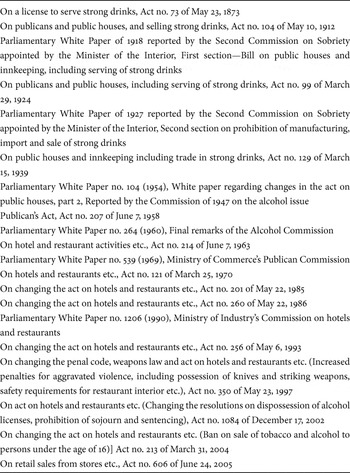
We can analyze this question by studying the legal documents of the time. The primary data are the law texts, which are viewed as “petrified politics”Footnote 8—a snapshot of society and the dominant interests at a particular time. To understand further how various interest groups may have been successful in their lobbying efforts or how a spirit of the time may have affected regulation, my analysis includes a wider variety of legal documents and parliamentary white papers and proceedings, as well as scholarly analysis of alcohol-policy history in other, primarily Nordic countries. Choosing representative conflicts from a time span of a hundred years holds a problem of selection. The criterion applied is that the conflicts and their official resolution in laws are suited to contribute toward explaining the current predicament of high consumption and the absence of controls.
These conflicts pertain not only to alcohol-control policy. Alcohol controls in the Nordic countries are implemented as part of a general civilizing process in extension of the establishment of parliamentary political institutions at the turn of the century. The developments in the relation between state controls and the citizens’ rights to drink and to sell drink are interpreted as an integral part of the overall development of the Danish welfare state.Footnote 9 In order to better present this general idea, I separate the period of analysis into three sections. The earliest history, roughly from 1912 to 1960, is seen as the time of the “constitutional state”; the period from 1960 until the late 1970s is the “welfare state”; and the period after the welfare state is interpreted with Sulkunen’s theory of the “saturated society.”
Sulkunen describes how the ideals of industrial progress, egalitarian universalism, and nationalism have been intimately linked to alcohol controls and have accelerated modernization of the Nordic welfare states.Footnote 10 According to Sulkunen, these processes ran their course during the periods that are described above as the constitutional state and the welfare state. The period after the welfare state is termed the “saturated society,” in which the ideals have become part of an achieved reality and where risks take on a new form—consumption risks. This claim is tested. Has alcohol-control policy in the postwelfare state period gone through its own modernization? Does the legal regulation in this period reflect the processes of externalization, particularization, and naturalization?Footnote 11 “Externalization” means that regulation is influenced by pressure from the European Union and the demands of legal and economic convergence. “Particularization” refers to the argument that alcohol should be treated like any other commodity. “Naturalization” means that deregulation of alcohol control is explained as a natural consequence of an overall deregulation of different markets.
Bruun et al. define “alcohol-control policy” as government controls on alcohol availability.Footnote 12 The various Danish governments throughout the period are perceived as representing the “public good,” which pertains to the balance between public health and the citizen’s freedom to drink and to sell drink.Footnote 13 In the early periods, the public health position is represented by the national temperance movement;Footnote 14 and the free-trade/individual freedom position is represented by the bar-owners union. The conflicts between these positions and the outcomes in the form of policy are discussed in relation to the number of alcohol-serving outlets and the annual total consumption rates.Footnote 15
The earliest history of Danish alcohol controls, from the nineteenth century until World War II, has been analyzed in previous studies,Footnote 16 but generally there is not much research on Danish alcohol-control policy compared to the other Nordic countries. In recent review articles on Nordic alcohol-control policies,Footnote 17 only one Danish study was included, and this study concerned developments in the twenty-first century.Footnote 18 The available material on the intersecting period has been published either by state authorities, the bar-owners’ trade association, or the temperance movement. This material provides valuable accounts on how the challenges of the times were perceived, but it lacks the balanced analysis necessary to understand how the inherent policy dilemmas are connected to the development of the welfare state.
The first part of the Danish licensing system was introduced in 1857. From then on it became a legal requirement to have a publican’s license, called a “citizenship,” in order to be allowed to serve “strong beverages.”Footnote 19 In rural municipalities, only one public house that served strong beverages was permitted. In the cities, every public house could serve alcohol but only to ill-defined “closed tables.”Footnote 20 This legal ambiguity led to a doubling of the number of public houses between 1840 and 1870, culminating with a concentration of per 122 citizens.Footnote 21 In an attempt to stop this trend, the local authorities (the parish councils in rural areas and the municipal councils in the cities) separated the licensing system into two parts: “citizenship” to run a public house and a separate license for serving alcohol.Footnote 22 An applicant had a legal claim to run a public house if he met a set of objective demands, but the license to serve alcohol depended on the discretion of the local authorities. The presence of public houses was contested. Publicans and the temperance movement alike used the discretionary element to apply pressure on policymakers. During this time, the temperance movement was an important popular movement that saw alcohol as a burden on the Danish people, a burden that was imposed by the upper classes. The temperance movement successfully campaigned locally and the map was now dotted with rural municipalities where the single legal public house had been closed.Footnote 23 This is the point of departure: the constitutional state and its democratic institutions were hardly in place, but the conflicts that it faced were already plain.
The Sobriety Commissions
At the behest of the temperance movement, a “sobriety commission” was appointed to formulate a parliamentary white paper in preparation for the first comprehensive legal regulation of public houses: the Publican’s Act of 1912. This act would soon become the cornerstone in the legal regulation of alcohol availability, so it is interesting to note that it was markedly more liberal than the recommendations in the white paper. The act introduced an upper limit for the concentration of public houses with licenses to serve strong drinks at 1 per 350 citizens, which is quite an ambitions reduction from the level 1 of per 122 citizens. The act also included the first provisions on hours of operation and the legal age limit for drinking.Footnote 24 These three regulatory mechanisms have been used to adjust the direct availability of alcohol from bars ever since.
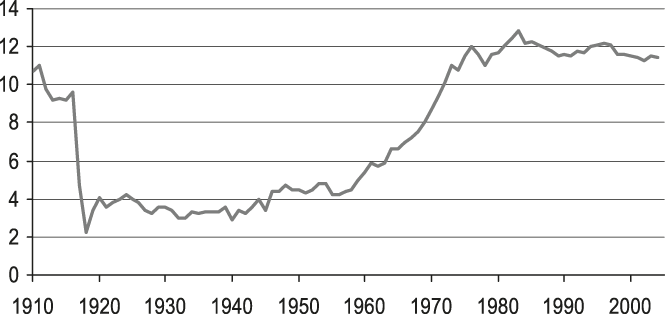
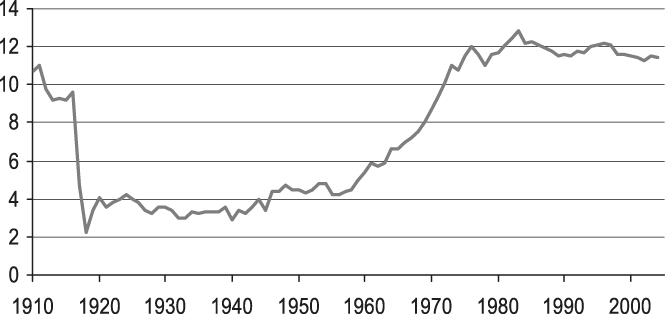
Parallel to the process of regulating the public houses, a steep excise tax was introduced in 1917 and this tax came to define the Danish model of alcohol control. From one day to the next, the price of distilled spirits increased tenfold, which of course had a series of interrelated positive effects. The farmers were most responsive to the increase in price. They could no longer afford distilled spirits and began to drink beer instead. This helped to reduce the average consumption of pure alcohol per citizen over the age of fourteen from nine liters to a historic low of two liters.Footnote 25 Alcohol-related crime was halved almost immediately, compared with the period between 1912 and 1916. In particular, arrests for public drunkenness and violent crimes decreased.Footnote 26
The reason beer was exempt from the tax is illustrative of the context. First, the Carlsberg brewery supported the tax on distilled spirits and presented nutritional arguments with patriotic undertones; beer contains more nourishment than the grain alone. Second, the temperance movement acknowledged that distilled spirits were much worse and that beer, could therefore be accepted in some circumstances. This type of pragmatism would eventually compromise the integrity of the Danish temperance movement within the international temperance movement, but for now it served to achieve important national regulations. The results from the combination of regulating bars and the steep excise tax on distilled spirits left policymakers pondering: “Why force a ‘dry’ tedious alcohol culture when a ‘wet’, pleasant and non-problematic alcohol culture is possible?”Footnote 27 This compromise exemplifies an early success for social reform in Denmark. The compromise included all of the relevant interest groups and also helped reduce social unrest. The workmen of the lower classes were free to congregate in public houses and at the same time were saved from the ravages of distilled spirits; as such, the results exemplify early social progress and nationalism.
The second Commission on Sobriety was formed in 1918 to evaluate the effects of the Publicans Act of 1912 and the excise tax of 1917 and to discuss the option of introducing a state monopoly on alcohol sales as the other Nordic countries were doing. The temperance movement was part of the commission and was critical of the lack of active enforcement of the provisions in the Publicans Act. From its perspective, the police were not eager to close down bars on their own; they had to be put under local pressure to do so.Footnote 28 The other members of the commission perceived the new regulations as great successes, and the Second Commission on Sobriety concluded that the decline in consumption was attributable to taxation and legal regulations. In this light, a state monopoly was neither necessary nor appropriate. The monopoly option was seen as an infringement on the freedom of trade, and the “screening” of customers, which was in place in other Nordic countries, was perceived as inefficient.Footnote 29 This is an example of regulating for the public good. Moderate drinkers are made to sacrifice some of their freedom of accessibility, but the sacrifice is accepted as a gesture of solidarity with heavy drinkers, who are more at risk. This illustrates the principle of universalism in regulation that characterizes the early constitutional state. After this, it became a matter of balancing freedom of trade with the citizens’ “physical and spiritual health and cultural development.”Footnote 30
The first legal issue was to establish the age at which a person is considered a citizen. A revision in 1924 introduced the eighteen-year age limit on buying alcohol in bars.Footnote 31 This was the first national age limit, and it was intended to strengthen the municipalities in order to meet the lofty objective of creating a civilized drinking culture that contributes to social progress. Prior to the Publican’s Act of 1912, the age limit on buying intoxicating drinks was controlled only by local police regulations. This was not a lasting model because the laws could vary greatly from one municipality to the next. In addition, the age restriction that was in place only banned serving “children.” Generally, the limit was sixteen years old, but some local police regulations permitted serving to fourteen-year-olds.Footnote 32 The majority of the members of the Second Commission on Sobriety thought the temperance movement’s pressure on local police was going too far. In some parts of Denmark, a factual ban on alcohol had been instated by the “discretionary” application of age restrictions. The local temperance movements had pressured police into enforcing an unusually high age requirement.Footnote 33 Seen in this historical context, the age restriction that was agreed upon in 1924 not only raised the previous limit; it also established a universal legal right to buy alcohol.
The final and most controversial aspect of the licensing system was the option for citizens in the country municipalities to make objections and recommendations concerning alcohol licenses. If one in three members of the parish or the municipal council voted in favor of a referendum, the council would hold a public referendum among citizens on a specific license. The aspects considered are still applicable today.Footnote 34
The owner’s conduct, business qualifications, and economic situation
The size, character, and location of the bar
Social circumstances and sobriety and policing issues directly or indirectly related to the concentration of bars in the area
This discretionary licensing procedure has been a source of discontent for bar owners since its inception. Originally the bar owners thought the discretionary elements were an “unconstitutional provisional measure,”Footnote 35 that is, a government act working against the people. The temperance movement, however, assessed the procedure as strengthening both grassroots involvement and the burgeoning local democratic institutions. At this point, the Danish temperance movement had accepted a pragmatic stance that brought it into conflict with other social organizations internationally.Footnote 36 For example, the Danish branch of the Nordic Independent Order of Good People had accepted the serving of beers with reduced alcohol content as a national compromise to break with the spirits-drinking culture. This move away from absolute abstention did not sit well with the International Order of Good Templars and the Danish branch was excluded. In the years to come, the popularity of the temperance movement declined as its role was supplanted by other movements and political parties.
The Licensing System, 1912–1970
The growth of the regulatory framework was affected by the temperance movement’s committed effort to portray alcohol as the cause of “poverty, crimes, insanity, suicide, disease, and death.”Footnote 37 These sentiments caught on among rural populations, and the average consumption rate remained at the low levels achieved in 1917 for forty years. This model of a “top-down civilizing liberalism” was widely accepted in Danish society at the time, with the exception of bar owners.Footnote 38 The regulation of the concentration of bars was introduced at an initial level of 350 inhabitants per bar. In 1939, this was further reduced to 550 inhabitants per bar in the larger towns. In 1958, the level was adjusted to 600 citizens per bar. These increasingly restrictive measures reflect a growing concern over the destructive effects of alcohol also in the cities.
This was also a time of the constitutional state. The legitimacy of initiatives toward the social progress and welfare state provisions rested on their universality and capacity for “ensuring order and social controls through legal regulations.”Footnote 39 State authorities and health policy experts enjoyed a high degree of legitimacy during this period because of their record of universality in rules and regulation and their effective control policy. Note how this Danish model of regulating prices, hours, and density predates the “total consumption theory” and its modern universalistic principle of prevention.Footnote 40 The theory’s core assumption is that there is no clear demarcation between alcohol use and abuse, which is a cornerstone in the Danish policy. The total consumption theory was adopted as a guiding principle by the WHO in 1975.
The fundamental structure of the licensing system’s regulation of alcohol availability was in place before 1939. Between 1939 and 1963, the law was adjusted with rather minor changes three times:Footnote 41 a limitation on the duration of the alcohol license, the extension of opening hours to prevent illicit bars, and the application of the age restriction to apply to retail sales as well. All three laws adjusted the rules on license concentration. The last local alcohol ban in a rural municipality was removed in 1945.
After 1960, the welfare state consolidated and expanded as the population saw a steady increase in overall income. The income increase is believed to have fostered a more “relaxed” and individualized attitude to the risks associated with alcohol, referred to as particularization.Footnote 42 Alcohol use increased as the rise in income levels decreased the real price of alcohol and inflation further eroded the effect of taxation. Ten years later, average consumption had almost returned to the level before the introduction of the excise tax in 1917—around eleven liters pure alcohol per inhabitant over the age of fourteen. This rapid increase has been interpreted as a revolt against the traditional moral values and the institutions that embodied these values.Footnote 43 This revolt signaled the demise of the disciplined subjects of the constitutional and welfare states and introduced the free individuals of the affluent consumer society, where alcohol is part of status-oriented consumption.Footnote 44
This shift is reflected in the laws passed during this period. State authorities moved away from universal controls and the establishment of basic individual rights and toward a focus on reducing the harmful effects of alcohol use on individuals, especially crime and misuse. The intellectual ownership of these issues was ascribed to a new category of experts, whose authority was rooted in science. All the while, moralistic ideologies lost ground. This time period was characterized by a lack of faith in positive effects from further expansions of the state’s universal restrictions on serving alcohol. Control policy had reached a point of saturation. Governance by objectives was replaced by government by rules.Footnote 45
These rules are apparent in the committee established by the Ministry of Commerce in 1966. The committee examined the options for liberalizing the law because the population had a new set of demands. The workforce was changing and urbanization was accelerating. Women increasingly worked outside the home, and the distance traveled between workplace and home was growing. There was a new demand for affordable eateries, with the option of serving alcohol. The fourteen members of the Ministry of Commerce’s committee focused on easing the administrative burdens of license owners. The members of the committee were mostly representatives from the restaurant trade, with the exception of two representatives from the Danish Temperance National Union and an alcohol consultant from the Ministry of the Interior. These three had the responsibility to oversee that the interests of sobriety and society were included in the final recommendations.Footnote 46
The recommendations included replacing the Publican’s Act with a new Bill of Restaurants.Footnote 47 This new law included both elements of tightened and loosened regulation. First, the last remains of the distinction between town and country were removed. Second, the limit to the number of bars in an area was removed, and with this also the option of holding referendums on specific licenses. Hereafter, the responsibility for assessing a reasonable local bar quota was to be shared between the municipal council and the police. The goal was still the same: to prevent “public drunkenness, serving of minors, vandalism, night disturbances.”Footnote 48
Acts and parliamentary white papers

The Restaurant and Hotel Act of 1970
The Bill of Restaurants was replaced by the Restaurant and Hotel Act of 1970, which was presented as a “liberalization.” The bar owners again protested the discretionary assessment of the owner’s financial situation. They claimed that it was in conflict with the Danish constitution and that it would eventually conflict with European Union regulations as well. Denmark became a member of the European Union in 1972 and the bar owners used this to argue that the “locking systems” ought to be removed so that alcohol could be sold like any other commodity—a naturalization, similar to the status of nicotine.Footnote 49 In the European Union, alcoholic beverages are treated as economic commodities, and alcohol-control policies are not allowed to be more restrictive than required to meet health and social policy objectives.Footnote 50 The paternalism of the welfare state had to give way to this “New public health” perspective.Footnote 51 The problems associated with alcohol were increasingly seen as personal problems that should be solved by applying expert advice on risk, rather than having the state limit citizen’s actions in a universal way.
From the state’s perspective, the basic idea of regulating bars was the same as it had always been: “The time spent in restaurants and bars, dining, recreation and entertaining is spent under circumstances that are secure and not subversive or demoralizing.”Footnote 52 For the publicans, the connection between regulating the bars and the public’s sobriety was not sufficiently substantiated, but rather was a “quite inexplicable . . . discrimination of a line of business” and an expression of “obsolete dogmas.” The bar owners did acknowledge that some problems remained because of the rapid growth in the number of bars. Among the new bars, there were “many smaller and harshly operated bodegas” that “attracted elements with economic crime as a specialty.” In general, the idea had been to prevent unsavory types such as “gamblers, ‘loose’ women, pimps and drunks” from obtaining licenses to sell alcohol. Their lack of “moral qualifications,” it was feared, would lead to bars that would be “hard serving,” which implied “fornication, drunkenness and indecency,” or even criminal acts such as “fencing, illicit drug sales and violence such as muggings.” To underline that it is the individual licensee’s responsibility to maintain proper operating conditions, failure to complete the “required inspections” became punishable by law in 1978.Footnote 53 In this sense, the goal of a civilizing process still existed but, in practice, conformity with international free-trade commitments trumped any argument based on morals or universal regulations. This externalization of alcohol-control policies has dominated the discussion ever since.
From 1979 until 1990, the law was revised six times. With an act from 1985, it became the responsibility of the bar owner to ensure that nonalcoholic drinks were available so that guests weren’t “forced” to drink alcohol, a rule that the Ministry of Commerce’s Commission had originally recommended in 1969.Footnote 54 The reach and ambitions of alcohol-control policies were generally reduced. What remains are the problems associated with individuals who drink too much, as well optimizing the excise-tax level and avoiding price violations of the open market.
These developments illustrate how the inherent conflicts and limitations of the Danish model persist, yet change. The growing aversion to state interference creates a dilemma for the control of problematic alcohol consumption. The process of particularization undermines state-imposed restrictions. The public acceptance of universal rules has been saturated; they are now seen as paternalistic and obsolete, rather than progressive and solidary.
Two conflicting trends in alcohol regulation occurred during this period. On the one hand, the increase in consumption levels and new expert knowledge on the harmful effects of alcohol require some state reaction to secure public health. On the other hand, untimely interference in the individual’s private sphere is scorned. The state’s legitimacy previously hinged on its contribution to the public’s well-being, this role is now being questioned because it conflicts with the growing individualization. On top of this comes externalization. The naturalization of alcohol is being pursued aggressively. In the European Union, alcohol is widely regarded as a regular commodity. These conflicts regarding the regulation of alcohol embody the dilemma of individual rights versus state authority in a globalized economy. Increasingly the state authorities would place the responsibility for preventing abusive drinking in the hands of bar owners, not necessarily because this was thought of as a good idea, but because a small and open economy like Denmark does not have much of a choice. At this point, Sweden and Finland struggled with the EU court to maintain some remnants of monopoly regulation,Footnote 55 but the Danish model’s focus on excise taxation stood no chance against the price convergence principle.
Controlling the Public Order
In 1990, a new commission was formed with the purpose of implementing a thorough deregulation.Footnote 56 An economic downturn in the 1980s had hurt alcohol sales and put a strain on the restaurant business. Out of the fifteen members of the commission, only one was appointed by the temperance movement. However, the commission still recommended that section 1 of the law be used to declare that the overall purpose of the law is to safeguard the interest of society and sobriety. In this way, the first section would serve as a pervasive contribution to interpreting other sections of the law. The white paper was ready in 1990 and the parliamentary negotiations lasted through 1992–93. From the parliamentary proceedings, it is clear that the commission was conflicted between the interests of the restaurant trade and public health concerns. Parliament deviated from the recommendation of the commission because in the white paper the restaurant trade “had not been able to have their voice heard.”Footnote 57 As a result, the specification of the societal interest in sobriety was relegated to a less significant position in section 12, part 12, as a consideration that the licensing authorities must respect in their decisions, not as a pervasive contribution to interpretation. This decision has significant implications.
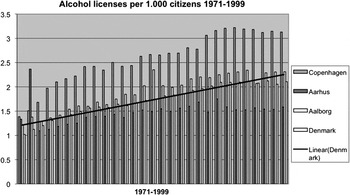
Alcohol-control policy objectives transcend policy sectors. If these objectives are to have any chance against the competing interests of externalization and particularization, they will require “an integrated center that can coordinate the intersectoral integration.”Footnote 58 Having Section 1 of the act state that the objective of regulation is to include society and sobriety could have been the formal recognition of such an integrated center. Instead, several of the contributions in the parliamentary negotiations refer to the need for a “modernization.”Footnote 59 In practice, this means relaxations of rules in anticipation of EU court decisions on anticompetitive practices. This argument had previously been put forth by the bar owners in relation to the law from 1970, but it had more political support this time. Traditional political demarcations and voting patterns were dissolving, and politicians were forced to ingratiate themselves with less faithful voters. Citizens were becoming consumers and had little patience for politicians with moral agendas, and this helped alcohol become a naturalized and regular commodity and less of a dangerous intoxicant.Footnote 60 Still, the considerations regarding concentration of bars, tax evasion, and pricing practices were included as part of the overall alcohol policy objectives. Figure 2 illustrates that these considerations may have halted the continuous increase in the concentration of bars in the bigger cities, but perhaps at a point of saturation.
Liters of pure alcohol per person over fourteen years old
Concentration of licenses in Denmark’s biggest cities

The limit to individualization comes when our choices have consequences for others, for example, when the public order is threatened by violence or other disturbances. It used to be the responsibility of bar owners to ensure that intoxicated persons “under adequate escort are brought home or to a police station.”Footnote 61 They also had to prevent minors and people in treatment for alcohol abuse imposed by public authorities from being served. These installments were removed in 1993 because they were too difficult to administer. The required inspections hereafter became a duty of the police. A bar owner’s responsibility, under the threat of legal sanctions, was to contact the police if the provisions were breached. For all intents and purposes, the law from 1993 is the current governing law when it comes to running a bar. The most recent regulations mostly deal with the issue of public order in and around locations that serve alcohol. The blame and responsibility for public order disturbances is not the alcohol or those selling it, but the few problematic persons among those buying it.
Analysis
Nordic alcohol policies have been a “spectacular social experiment” in the “power over individual choice, and ideas about the justification of that power.”Footnote 62 In many ways, the history presented above is the story of how citizens and businesses alike have perceived the state’s legitimacy in regulating the public’s choice, and vice versa. This is also the story of a country pursuing the ideals of industrial progress, egalitarian universalism, and nationalism, and eventually achieving them, at least for a period of time. This period of time is referred to as the welfare state and was a time of economic growth as well as increasing individualism. These processes would prove to be detrimental to the Danish model of alcohol control. The ideal of egalitarian universalism and nationalism were instrumental in the decision to apply what was essentially a practical predecessor to the total consumption theory: a steep excise tax on distilled spirits, regulation of availability, and restrictions on age and opening hours. This model was a tremendous success for as long as the economic restrictions were proportional to income levels, and as long as the hardest drinkers were found among the poorest rural populations. The success of the welfare state in raising incomes, leveling economic inequalities, and accelerating urbanization became the bane of the universal policy. The process of individualization conflicted with the paternalism that was essentially the basis of the civilizing ambitions.
The developments in alcohol policies beyond the welfare state underline this. The deregulation of alcohol controls after the 1970s and into the 1990s has coincided with a general trend in public administration arrangements toward decentralization and privatization. The ambition of improving the public good by restricting alcohol availability is now an issue that must be settled between the state and the market. In this confrontation, the processes of externalization, naturalization, and particularization have trumped public health, which is now reduced to providing information to risk-taking consumers.
The process of externalization relates to how the state authorities have dealt with the temperance movement as well as the increasing strength of market forces. The influence of this process is most obvious in the post-welfare state period. Market forces are apparent in the bar owners’ trade association’s support from the EU courts in their demand for removing barriers to competition. The temperance movement’s loss of influence after World War II had effectively reduced popular opposition to the bar owners’ trade association. This lack of civil society opposition to the free-trade position prevented the state’s attempt to curb free trade from gaining momentum. This is clear when the factual aspects of a proposed legal bill are not even debated in parliament because representatives in the preparatory commissions have already referred to the rules of the EU courts, which take precedence over Danish law. The conclusion that the publicans’ and the alcohol producers’ interests have had more influence following Denmark’s membership into the European Union in 1972 is not controversial. Similar developments have occurred in the other Nordic countries as well. Here, however, the state monopolies provided a stronger foundation that was not as easily eroded as the Danish policy model founded on universal egalitarianism. The publicans’ original protests against the moralistic state infringing on the right to sell alcohol was nothing compared with the international market forces that would pummel alcohol regulation after the 1970s.
In extension of this gradual development, a process of naturalization has occurred. Naturalization refers to how alcohol increasingly has come to be seen as a regular commodity, a commodity associated with some health risks, but risks that citizens have been informed about. As long as the intoxication occurs out of sight and does not threaten public order, alcohol is sold freely and consumed by risk-managing adults. Social well-being and sobriety are only formally limited by the police’s duty to uphold public order and stop neighborhood disturbances.
Finally, the process of particularization describes this autonomy and individual responsibility. The emancipation from the paternalistic state was slowly removed as incomes began to gain momentum from the 1960s on. The remaining restrictions are few and increasingly are seen as interferences to individual freedom more so than a reasonable regard for the public good. Individualization and increased prosperity affect the legitimacy of political interventions. In the end, society’s alcohol problem is the problematic consumption by some individuals. That average consumption is high is unfortunate, but it is not a valid reason for the state to intervene in individual cases. The state’s legitimacy has been reduced to supplying general information and providing treatment options in the most serious cases. This is most clearly observable in regard to the question of public order. Alcohol consumption can and will disturb the public order, but the explanations that are addressed in the legal regulation pertain to an individual’s lack of self-control or insufficient surveillance and security measures in bars. The steady increase in the concentration of bars is perhaps the clearest illustration of this process.
When seen over a period of a hundred years, alcohol controls in Denmark have gone from a socially progressive way of preventing threats to the burgeoning social order of the welfare state to a paternalistic attempt at reducing the societal costs of a regular, but somewhat risky, commodity.