Introduction
Neonates with congenital heart disease have a number of potential risk factors for chronic kidney disease,Reference Luyckx, Bertram and Brenner1,Reference Morgan, Zappitelli and Robertson2 including the development of acute kidney injury following cardiovascular surgery. In children, the rate of cardiac surgery-associated acute kidney injury is highest in neonates, and it is known to be associated with hospital mortality and morbidity.Reference Morgan, Zappitelli and Robertson2–Reference Blinder, Goldstein and Lee6 In adults, cardiac surgery-associated acute kidney injury is associated with new onset or progression of chronic kidney disease, and non-recovery from cardiac surgery-associated acute kidney injury prior to hospital discharge increases this risk.Reference Ishani, Nelson and Clothier7–Reference D’Hoore, Neirynck and Schepers9
Several studies have evaluated the association of cardiac surgery-associated acute kidney injury in children and have revealed conflicting results.Reference Cooper, Claes and Goldstein10–Reference Madsen, Goldstein, Froslev, Christiansen and Olsen12 Though these studies have shown that long-term chronic kidney disease incidence is high in these children, the extent to which cardiac surgery-associated acute kidney injury is a risk factor remains unclear. The existent evidence for long-term renal outcomes in neonates who undergo cardiac surgery is even scarcer and, therefore, there is lack of recommendations for long-term follow-up in this population. An international survey of neonatologists and paediatric nephrologists evaluated the practice patterns and perceptions surrounding neonatal acute kidney injury and demonstrated significant practice variation in the long-term renal follow-up after an episode of acute kidney injury in neonates admitted to the neonatal intensive care unit.Reference Kent, Charlton and Guillet13
There is a need for kidney function follow-up guidelines in neonates undergoing cardiac surgery, with a goal to implement measures (i.e., avoid nephrotoxins, treat hypertension and proteinuria) to reduce chronic kidney disease incidence and progression. As a first step towards this goal, there is a need to understand the current practice of follow-up and the factors associated with the presence of follow-up.
The objectives of this study were to assess renal function follow-up practice after neonatal cardiac surgery, evaluate predictors of follow-up, including cardiac surgery-associated acute kidney injury, and evaluate long-term evolution of estimated glomerular filtration rate during the study period.
Material and methods
Design, setting, and patients
We performed a two-centre retrospective cohort study of children 5–7 years of age with a history of cardiac surgery at less than 28 days of age. Cardiac surgeries were performed between 2005 and 2012 at the Stollery Children’s Hospital (Edmonton, Alberta) and Montreal Children’s Hospital (Montreal, Quebec). Exclusion criteria were pre-operative known kidney disease, already recruited into a longitudinal study, unwillingness to return to the study centre, or lived too far away (>3.5 hours drive) from the centre for a home study visit. Patients were identified (via hospital databases), reviewed for eligibility, and mailed invitations to contact us for study information. Responders were contacted, re-reviewed for eligibility, and invited to participate. In addition, children attending cardiology clinics in both Edmonton and Montreal fitting eligibility criteria were invited to participate, and children previously consenting to future contact during prior studies were contacted by telephone. Institutional Research Ethics Board approval was obtained before initiating this study. Written informed consent was provided by parents/legal guardians prior to initiating study activities with patients.
Data collection and sources
A study visit was performed 5–7 years post-surgery, at which time we asked families to inform us of all hospital admissions, emergency department visits, and bloodwork encounters. We then requested medical records for each of these health encounters and recorded all serum creatinine values and their source.
Data from the index cardiac surgical admission were collected retrospectively, including centre location, sex, gestational age, age and weight at surgery, complexity of cardiac procedure defined by the Risk Adjusted Classification for Congenital Heart Surgery score,Reference Jenkins, Gauvreau, Newburger, Spray, Moller and Iezzoni14 invasive mechanical ventilation at the time of surgery and 1 week after surgery, use of extracorporeal membrane oxygenation (before or after surgery), use of cardiopulmonary bypass, aortic cross-clamping, use of deep hypothermic circuit arrest, need for dialysis, and nephrology consultation. Additional data included length of total admission, length of stay in paediatric ICU, and number of days between paediatric ICU discharge and hospital discharge.
Definition of renal function follow-up and events
The presence of post-discharge renal function follow-up was defined as the presence of at least one serum creatinine measurement between hospital discharge and the time of study enrollment at age 5–7 years. An event corresponded to any emergency department visit or any hospital admission. Follow-up in the context of an event was defined as a serum creatinine drawn within 1 week prior to or after a hospital admission or an emergency department visit.
Estimated glomerular filtration rate calculation during follow-up
We estimated the glomerular filtration rate for each measured serum creatinine. We did not have height data available for each measure of serum creatinine and therefore used a validated paediatric height-independent estimated glomerular filtration rate equation: estimated glomerular filtration rate = 107.3 [1 – exp(–Age/0.5)]/(serum creatinine/Q).Reference Pottel, Hoste and Martens15 Q was obtained from age and sex subgroup analysis in large hospital databases and is considered the median serum creatinine for healthy children. We classified the results as normal or abnormal estimated glomerular filtration rate for the age of the child. An estimated glomerular filtration rate below 90 ml/min/1.73 m2 was considered abnormal for children over 2 years according to Kidney Disease Improving Global Outcomes guidelines.16 In children less than 2 years, abnormal estimated glomerular filtration rate was defined as age-based normative values.Reference Schwartz and Work17,Reference Piepsz, Tondeur and Ham18
Cardiac surgery-associated acute kidney injury and acute kidney injury recovery definitions
Cardiac surgery-associated acute kidney injury was defined based on internationally accepted criteria, the Kidney Disease Improving Global Outcomes guidelines, modified for neonatesReference Selewski, Charlton and Jetton19,Reference Askenazi, Abitbol and Boohaker20 ; we did not incorporate urine output criteria in the acute kidney injury definition. Acute kidney injury was graded as follows: Stage 1 as a serum creatinine rise to 1.5–1.9 times baseline; stage 2 as a serum creatinine rise to 2–2.9 times baseline; and stage 3 as a serum creatinine rise to 3 or more times baseline or initiation of renal replacement therapy. We used the last serum creatinine drawn before cardiac surgery as the baseline serum creatinine. In those with acute kidney injury, acute kidney injury recovery was defined as discharge serum creatinine less than 1.15 times baseline; this definition was used to take into account the 10–15% margin of error in laboratory assays.Reference Jones, Holmen, De Graauw, Jovanovich, Thornton and Chonchol21–Reference Hessey, Ali and Dorais23 We defined discharge acute kidney injury status as normal (no cardiac surgery-associated acute kidney injury or cardiac surgery-associated acute kidney injury with acute kidney injury recovery) or non-recovered (cardiac surgery-associated acute kidney injury without acute kidney injury recovery at discharge).
Statistical analysis
Continuous variables were described as mean (sd), as median value (interquartile range), or as frequency (N) with proportion (%), depending on variable distribution.
Renal function follow-up description
Timing of serum creatinine measurements during follow-up and whether or not measurements occurred in association with an event were described. The proportion of patients with and without post-discharge follow-up serum creatinine measurements was calculated. Renal function follow-up characteristics were compared between children with versus without cardiac surgery-associated acute kidney injury using appropriate univariable tests.
Factors associated with the presence of follow-up serum creatinine measurements
Univariable associations of cardiac surgery-associated acute kidney injury and other variables with follow-up serum creatinine measurements were evaluated using Student’s t-tests, Mann–Whitney U-tests, χ2, or Fisher’s exact tests, depending on distribution. Multiple logistic regression was used to evaluate independent factors associated with the presence of post-discharge follow-up serum creatinine measurements. Purposeful selection was used for model variable selection, with the following variables considered for the prediction model: centre, sex, gestational age (classified as term (≥37 weeks) or not), age and weight at surgery, invasive mechanical ventilation at the time of surgery and 1 week after surgery, use of extracorporeal membrane oxygenation (before or after surgery), use of cardiopulmonary bypass, aortic cross-clamping, use of deep hypothermic circuit arrest, nephrology consultation after paediatric ICU discharge, and length of admission (paediatric ICU, hospital, and time between paediatric ICU and discharge). Variables with p < 0.2 in univariable analysis were included as potential predictive variables in multiple regression modelling. Cardiac surgery-associated acute kidney injury status and discharge acute kidney injury status were considered as important predictors and forced into modelling, each in a separate model. Given the small sample size, we estimated that a maximum of four variables (approximately 5–10 outcomes per variable) could be included in the multiple regression model. A priori, we decided that if greater than three variables in addition to cardiac surgery-associated acute kidney injury (which was forced into the model) were associated with the outcome, we would use stepwise, backward elimination logistic regression analysis (with p-value for exclusion from the model >0.15).
Collinearity was assessed before inclusion of variables in multiple regression. Continuous variables that were not normally distributed were transformed where appropriate. Assumptions of regression analyses were verified. A p value of less than 0.05 was considered to be statistically significant. Stata (14.2)® statistical software (College Station, TX, USA) was used for statistical analysis.
Results
Characteristics of the cohort
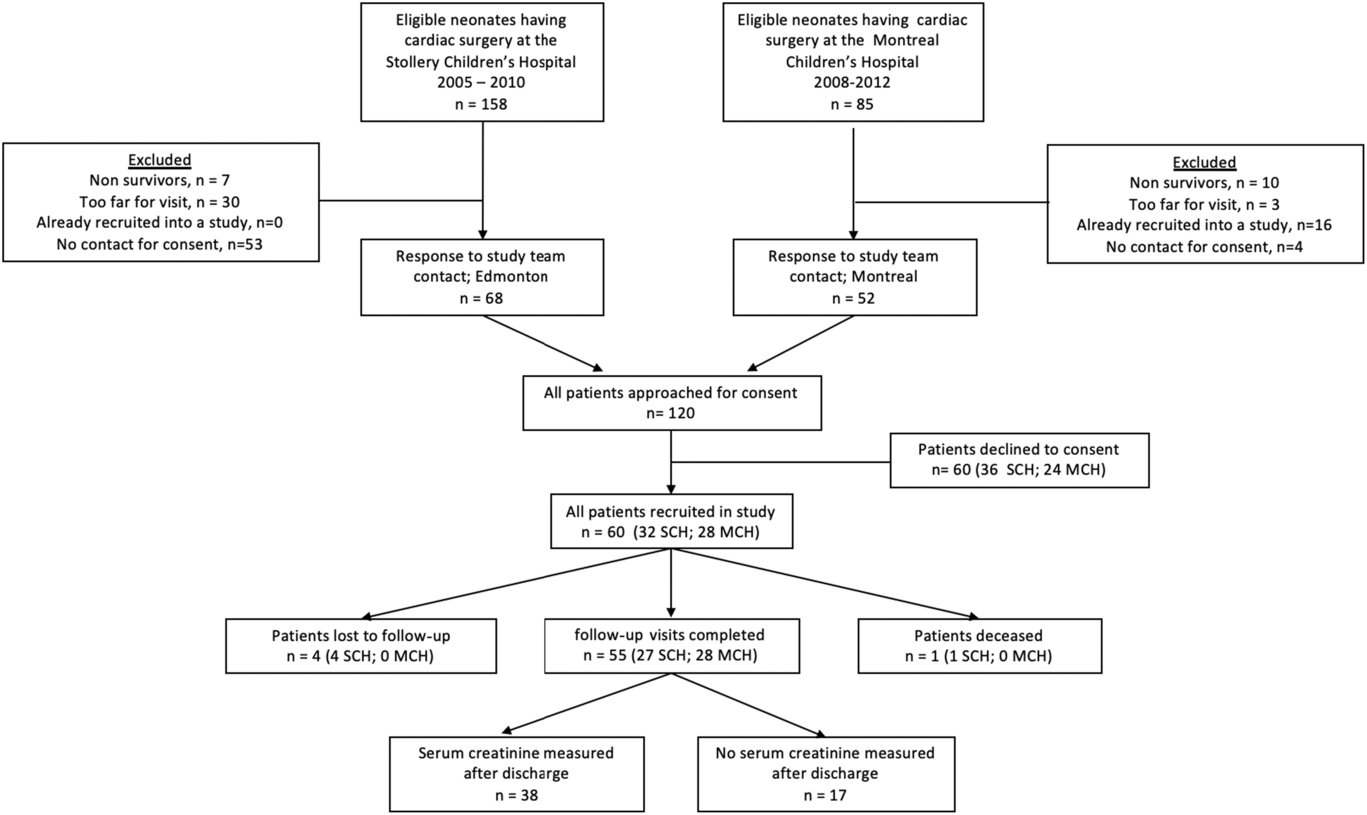
Fifty-five neonates were enrolled in the study (Figure 1). Response rate of patients contacted by study site is shown in Figure 1. Consent rate of patients who responded was 50% (Figure 1). Enrolled patients did not differ in sex, age at cardiac repair, or cardiac surgery associated acute kidney injury prevalence from a previously prospectively recruited cohort studied by our group.Reference Morgan, Zappitelli and Robertson2
Study flow.

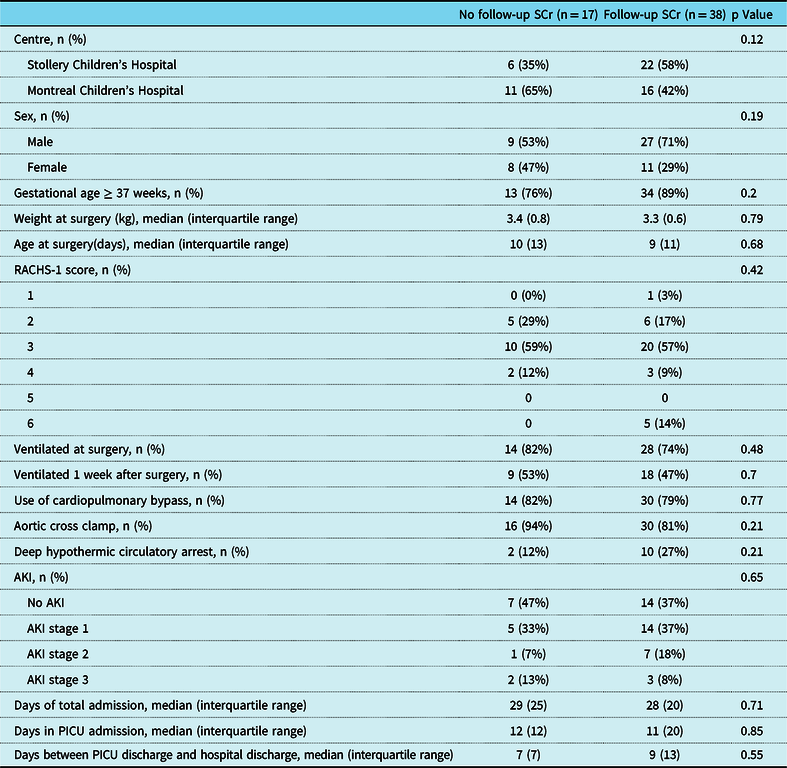
The median (interquartile range) time between the date from hospital discharge and the date of study enrollment was 71 (17) months. They had a median (interquartile range) gestational age of 39 (3) weeks and 65% were male. Cardiac surgery occurred at a median (interquartile range) age of 9 (10) days with 3300 (800) grams of weight. The majority of children were Risk Adjusted Classification for Congenital Heart Surgery score category 3 (57%), with 2%, 21%, 10%, and 10%, having Risk Adjusted Classification for Congenital Heart Surgery score categories 1, 2, 4, and 6, respectively. There was no child with Risk Adjusted Classification for Congenital Heart Surgery score category 5. None of the neonates needed extracorporeal membrane oxygenation pre- or post-surgery. Patient characteristics by renal follow-up status are compared in Table 1.
Characteristics of neonates undergoing congenital heart repair according to follow-up status

AKI = acute kidney injury; PICU = paediatric ICU; RACHS-1 = risk adjustment for congenital heart surgery; SCr = serum creatinine.
Acute kidney injury status was available in 53 of 55 neonates, as two neonates did not have any serum creatinine measured before the cardiac surgery. Thirty-two children (60%) had a history of cardiac surgery-associated acute kidney injury as neonates. Nineteen (60%) had acute kidney injury stage 1, eight (25%) acute kidney injury stage 2, and five (15%) acute kidney injury stage 3. Two neonates received dialysis after the surgery. More than one-third (37%) of the children who had cardiac surgery-associated acute kidney injury as neonates (12 out of 32) did not recover to their baseline serum creatinine during that hospital admission.
Characteristics of renal follow-up creatinine measurements
There were a total of 1395 serum creatinine levels drawn over the follow-up period, 622 of those corresponded to a single child. The median (interquartile range) number of events after hospital discharge was 6 (5), and the median (interquartile range) number of serum creatinine drawn between hospital discharge and study recruitment was 3 (24). The first and last serum creatinine measurement during the study period not related to an event occurred at a median (interquartile range) time of 4.5 (11.5) and 15 (54) months, respectively. Seventeen children (31%) did not have any follow-up serum creatinine after hospital discharge. Of those with no follow-up serum creatinine, eight (53%) had cardiac surgery-associated acute kidney injury. Of 32 patients with cardiac surgery-associated acute kidney injury, eight (25%) did not have post-discharge follow-up serum creatinine measurements. Of the 38 children who had follow-up serum creatinine measurements after index hospitalisation discharge, 15 (40%) had all of their serum creatinine drawn only in the context of an event. Twenty-three (60%) had at least one serum creatinine drawn not in the context of an event, six of whom had all of their serum creatinine drawn without any event.
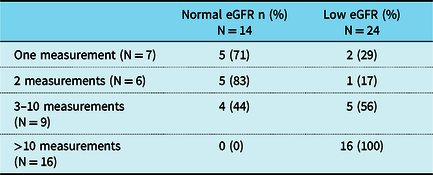
Twenty-four of the 38 children (63%) with follow-up serum creatinine measurements had an abnormal estimated glomerular filtration rate on at least one occasion. The proportion of children with normal or low estimated glomerular filtration rate by number of measurements is shown in Table 2. Of those children with serum creatinine measured only during non-events, 1/6 (17%) had an abnormal estimated glomerular filtration rate on at least one occasion. Of those children with an estimated glomerular filtration rate identified as low by study definitions, 20/24 (83%) had at least one subsequent serum creatinine measured identified as normal, but 4/24 (17%) did not have any other creatinine measured until the study appointment.
Proportion of children with all follow-up eGFR values being normal versus at least one low eGFR measurement during follow-up, by number of follow-up SCr measurements

Predictors of post-discharge serum creatinine measurements
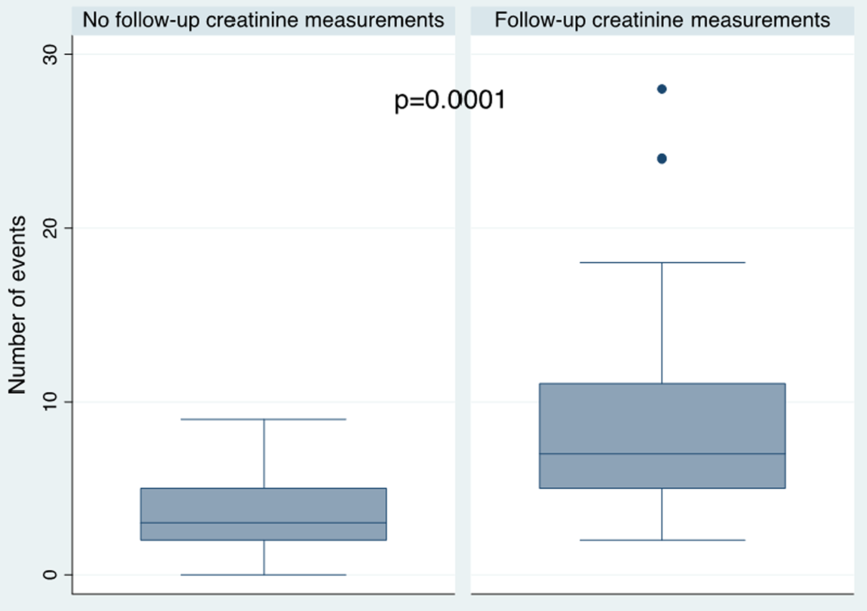
Neonate and acute care/surgical characteristics were not significantly different in univariable analysis between children who did versus did not have follow-up serum creatinine measurements (Table 1). Three children had a nephrology consult post-operatively during neonatal hospitalisation for surgery; two of these children had a follow-up serum creatinine measured, and one did not. Number of events was a significant predictor of renal follow-up status (OR 1.42, 95% CI 1.12–1.80; p = 0.0001). Distribution of number of events by renal follow-up status is shown in Figure 2. In multiple regression, number of events remained the only significant predictor of renal follow-up (adjusted OR 1.42, 95%CI 1.05–1.92; p = 0.007). Cardiac surgery-associated acute kidney injury was not associated with follow-up serum creatinine measurements even in moderate and severe cases (acute kidney injury stage 2 and 3), and discharge acute kidney injury status was also not a significant predictor.
Distribution of number of events by renal follow-up status.

Discussion
A large proportion of the cohort who had serum creatinine measurements after hospital discharge had the serum creatinine drawn only in the context of an event, such as a hospitalisation or an emergency department visit where those children may have had a serum creatinine drawn in the context of acute illness evaluation, rather than for screening of chronic kidney disease. The remainder had at least one serum creatinine drawn outside an event, although we do not know the specific circumstances of the blood work and whether it was purposeful renal function follow-up. The timing of serum creatinine measurements not related to an event, with the first after hospital discharge measured at a median time of 4 months and the last at a median of 15 months, may suggest that renal follow-up is not part of the longer-term follow-up of these children. These non-events findings, however, do highlight that since some of these children had blood work performed outside of events, practitioners and patients may be amenable to performing non-acute setting renal function follow-up to screen for chronic kidney disease.
We evaluated potential predictors of follow-up serum creatinine measurements and found that there were no demographic or clinical variables related to the neonate’s index cardiac surgery or hospitalisation that predicted follow-up. Despite the increasing evidence of potential deleterious long-term renal outcomes after an episode of acute kidney injury, we could not demonstrate a significant relationship between an episode of cardiac surgery-associated acute kidney injury and follow-up serum creatinine, even after an episode of moderate or severe acute kidney injury (stages 2 and 3). Furthermore, we did not demonstrate an association between follow-up serum creatinine measurements and discharge acute kidney injury status, even though many patients with cardiac surgery-associated acute kidney injury did not recover their baseline function prior to hospital discharge. Cardiac surgery-associated acute kidney injury was classified retrospectively by the study investigators and may have not have been recognised in the clinical context, this increases the likelihood that cardiac surgery-associated acute kidney injury would not predict follow-up in our analysis. We did, however, observe a significant positive association between the number of medical events after discharge and the presence of follow-up serum creatinine measurements. Therefore, since the majority of the serum creatinine measurements came from events, perhaps future knowledge translation strategies to enhance post cardiac surgery-associated acute kidney injury follow-up should be targeted to events. Establishing that cardiologists and or paediatricians check the serum creatinine and proteinuria during future admissions may be a feasible and useful strategy to screen for chronic kidney disease. Furthermore, educating cardiologists and paediatricians on acute kidney injury definition, classification, and potential long-term complications is crucial to incorporate standardised timing of follow-up serum creatinine. However, checking the serum creatinine or the urine may not be enough and a better follow-up system for children who are discharged after cardiac surgery is needed. That would facilitate early nephrology consultation when appropriate and interventions to prevent progression of chronic kidney disease if this occurs.
In this study, we also investigated whether the serum creatinine drawn over the course of the study period corresponded to normal estimated glomerular filtration rate for the age of the children. A large proportion of children (63%) with follow-up serum creatinine measurements had an abnormal estimated glomerular filtration rate on at least one occasion. However, we found that most of the abnormal results corresponded to a few patients who had multiple repeated serum creatinine measurements during one or more events. These children may have had intercurrent illnesses, which prompted a hospitalisation or emergency department visit and, potentially, a new episode of acute kidney injury. Most of the children who had an abnormal estimated glomerular filtration rate at some point had at least one normal value subsequently.
This study had limitations. The sample size is small, limiting our ability to evaluate potential predictors of follow-up serum creatinine measurements, including the association of acute kidney injury with follow-up. Given the response rate of our sampling methodology, external validity may be limited by selection bias, as those who responded to study invites may have had different follow-up experiences. Lastly, follow-up practice may change with time, particularly in light of increasing evidence of potential negative kidney outcomes in children following cardiac surgery and hence our data may not accurately reflect current practice. There has, however, been no generalised active intervention to change follow-up practice in this population.
In conclusion, a large proportion of neonates undergoing congenital heart repair did not have any serum creatinine follow-up in the first 5–7 years following cardiac surgery. In those that did have a serum creatinine measured, there was a lack of standardisation of the timing of these measurements, and the predictors of/triggers for follow-up were not clear. These patterns are in keeping with the current lack of guidelines for long-term renal follow-up in this population. A better renal follow-up system for children who are discharged after cardiac surgery is needed. That would facilitate early nephrology consultation when appropriate and interventions to prevent progression of chronic kidney disease if this occurs.
Acknowledgements
None.
Financial support
M.Z. and C.M. received an operating grant from the Canadian Institutes of Health Research (Funding Reference Number 115075) to perform this study. M.Z. was supported by a salary award from the Fonds de Recherche du Quebec-Sante and by institutional funds from the McGill University Health Centre.
Conflicts of interest
None.
Statement of authorship
S.R. contributed to data analysis and interpretation and wrote the first draft of the manuscript. L.H., K.B., E.H., A.P., A.P., M.P., and T.R. contributed to data collection and writing of the manuscript. A.D., D.G., A.J., and A.M. contributed to the study design, data interpretation, and writing of the manuscript. M.Z. and C.M. designed the study and contributed to data collection, data analysis and interpretation, and writing of the manuscript. All authors read and approved the final manuscript.