Introduction
Biological control of crop pests has historically focussed on specialist natural enemies, such as parasitoid wasps, due to the prominence of classical approaches focussed on the introduction of non-native species, where host specificity is critical to minimise non-target effects. However, interest in the role of generalist enemies has accompanied a growing body of work on conservation biological control, involving habitat or landscape manipulation approaches to bolster populations of native natural enemies that are often generalist species (Barbosa Reference Barbosa1998; Symondson et al. Reference Symondson, Sunderland and Greenstone2002; Tscharntke et al. Reference Tscharntke, Bommarco, Clough, Crist, Kleijn and Rand2007). A synthesis of empirical and theoretical work on the topic, strongly supports the hypothesis that generalist predators can often be at least as effective as specialists in controlling pest populations (Symondson et al. Reference Symondson, Sunderland and Greenstone2002).
The Alfalfa weevil, Hypera postica (Gyllenhal) (Coleoptera: Curculionidae), is a major and longstanding economic pest of alfalfa throughout the United States of America (White et al. Reference White, Allen, Moffitt and Kignsley1995). Work on biological control of this species has also historically concentrated on specialised parasitoids introduced as part of a national biological control programme (Bryan et al. Reference Bryan, Dysart and Burger1993; Radcliffe and Flanders Reference Radcliffe and Flanders1998). However, generalist predators, although much less studied, have long been considered potentially important natural enemies of the alfalfa weevil (Wheeler Reference Wheeler1977; Barney and Armbrust Reference Barney and Armbrust1980). In fact, life-table studies suggest that generalists may represent an important, yet generally unmeasured, source of mortality regulating alfalfa weevil populations (DeGooyer et al. Reference DeGooyer, Pedigo and Giles1995). A review of the literature (Barney and Armbrust Reference Barney and Armbrust1981) identified three families containing species that are considered major predators of alfalfa weevil larvae in the field: Pentatomidae (Hemiptera: Podisus maculiventris (Say)); Coccinellidae (Coleoptera: Hippodamia convergens Guérin-Méneville, Coleomegilla maculata (De Geer) and Coccinella septempunctata Linnaeus), and Melyridae (Coleoptera: Collops bipunctatus (Say)). Although ground predator groups (e.g., Coleoptera: Carabidae, Staphylinidae) were not among these taxa, they have been previously shown to be potentially important predators of alfalfa weevil adults (Barney and Armbrust Reference Barney and Armbrust1980) and accumulating evidence suggests that ground predators are often overlooked in terms of their contribution to the control of foliage associated crop pests (Losey and Denno Reference Losey and Denno1998; Schmidt et al. Reference Schmidt, Lauer, Purtauf, Thies, Schaefer and Tscharntke2003).
Approaches to identifying important generalist predators of alfalfa weevil have included direct field observation of predation events, surveys to quantify predator abundance and examine aggregative responses of predators to alfalfa weevil densities in the field, and laboratory-based feeding assays that examine consumption rates and prey preferences of various predators. Many different predator groups feed on weevil larvae in the field (Barney and Armbrust Reference Barney and Armbrust1981), and a number of these can consume relatively large quantities of larvae in the laboratory including, for example, species of Coccinellidae, Staphylinidae, and Nabidae (Hemiptera) (Hussain Reference Hussain1975; Ouayogode and Davis Reference Ouayogode and Davis1981). However, many of these same predators exhibit marked preferences for pea aphids, Acyrthosiphon pisum Harris (Hemiptera: Aphididae), over weevil larvae in choice experiments (Hussain Reference Hussain1975; Ouayogode and Davis Reference Ouayogode and Davis1981; Evans et al. Reference Evans, Richards and Kalaskar2004). Despite this preference for aphids, both the Coccinellidae, particularly C. maculata and C. septempunctata, and Nabidae exhibit aggregative responses to high-density patches of alfalfa weevil larvae in the field in some years or seasons (Evans and Youssef Reference Evans and Youssef1992; Giles et al. Reference Giles, Obrycki and Degooyer1994; Evans and Toler Reference Evans and Toler2007). Aggregative responses can result from natural enemy attraction to, and/or increased search time in, areas of high prey density (Holling Reference Holling1959; Readshaw Reference Readshaw1973) and are thought to be an important component of effective biological control (Hassell and May Reference Hassell and May1974; Luff Reference Luff1983). Thus, cumulatively the evidence suggests that generalist predators have the potential to be important biological control agents of the alfalfa weevil. However, there is a marked absence of manipulative experimental studies that actually assess the potential impact of generalist predators on alfalfa weevil survival or densities in the field. Such studies provide the most convincing and direct test of predator impacts on pest abundance and plant damage (Symondson et al. Reference Symondson, Sunderland and Greenstone2002).
In this study, I combined a cross-site predator survey with a manipulative field experiment to: (1) determine the dominant alfalfa weevil predators in eastern Montana and western North Dakota (United States of America) alfalfa fields; (2) test for aggregative responses of abundant predator groups to densities of alfalfa weevil and pea aphid hosts within and across fields; and (3) experimentally test whether generalist foliage dwelling versus ground dwelling predators impact weevil larval survival and plant defoliation levels.
Materials and methods
Pest natural history
The alfalfa weevil is univoltine throughout most of its range in North America, including the northern Great Plains, although a second generation can occur in warmer climates (Radcliffe and Flanders Reference Radcliffe and Flanders1998). Adult weevils emerge in early spring, laying eggs inside elongating alfalfa stems. Eggs typically hatch within a week, and the larvae then feed externally on alfalfa foliage through four instars. Abundance of the economically damaging third-and fourth-instars generally peaks a week or two before cutting of the first crop in the study region, usually mid-June to late June.
Pea aphids have multiple generations a year. They overwinter as eggs on leaves and stems of perennial legumes (e.g., alfalfa (Medicago sativa Linnaeus; Fabaceae) crowns). As temperatures warm and plants resume growth in the spring, wingless females (fundatrices) hatch from eggs, and reproduce asexually, giving birth to live young. Pea aphids prefer cool, dry conditions and are thus also generally early season pests of alfalfa, causing damage in the first crop in established fields or during spring seedling establishment in Montana (Blodgett Reference Blodgett2006).
Predator surveys
Ten irrigated alfalfa fields spanning ~80 km along the Yellowstone River Valley, Montana and North Dakota, United States of America, were sampled on 20–22 June 2011, just before cutting of the first crop. Sampling was carried out between 10:00 AM and 4:00 PM on clear to partly cloudy days, when temperatures were ⩾15 °C, and wind speeds were ⩽24 km/hour, because these factors can affect the efficacy of sweep sampling for insects in alfalfa (Kieckhefer et al. Reference Kieckhefer, Elliott and Beck1992). In each field, I collected 10 50-sweep samples with a 38-cm-diameter sweep net. Each sample consisted of 50 sweeps of the net, each 180°, taken while walking along a ~50-m transect running parallel to the field edge. The first transect was initiated 20 m from the field edge, to avoid major edge effects, and each subsequent transect was located 10 m farther into the field from the previous one, and parallel to it. Each 50-sweep sample was emptied into a 7.57-L, sealable, plastic bag containing a paper towel to absorb extra moisture. Bags were sealed and stored in coolers during collection and then placed in a freezer in the laboratory until they could be processed. Insects were initially separated from vegetation, placed into vials of 80% ethanol, and then processed to separate the major predatory insect groups by family, spiders (Araneae), and the two dominant crop pests, alfalfa weevil and pea aphids. I focussed on arthropod groups that had previously been identified to be major predators of alfalfa weevil larvae and/or pea aphids in the field (Wheeler Reference Wheeler1977; Barney and Armbrust Reference Barney and Armbrust1981): these included predatory Hemiptera (Pentatomidae, Reduviidae, Nabidae), Coleoptera (Melyridae, Coccinellidae, Staphylinidae, Tenebrionidae), Neuroptera (Chrysopidae), and spiders.
Predator exclusion experiment
Alfalfa crowns of Shaw, a commonly planted variety in the region, were collected from a field near Sidney, Montana, in April of 2011, and transplanted into 7.57-L, black, plastic nursery pots with a 22.8 cm top diameter. Four alfalfa crowns were planted into each pot, which was filled with 50% field soil and 50% of a potting mixture consisting of two parts peat to one part each of sand, perlite, and medium grade vermiculite. Plants were grown in the greenhouse under ambient temperature conditions and watered regularly until transfer to the experimental alfalfa field on 1 June 2011. The experimental site consisted of a 4.56-ha, irrigated alfalfa field in the Yellowstone River valley, near Sidney, Montana. Potted alfalfa plants were placed in two rows of 16 plants each, running parallel to, and starting 20 m from, the field edge. Row spacing was 120 cm, with 100-cm spacing between individual pots within a row. Pots containing alfalfa plants were sunk such that the top of each pot was flush with the soil surface, and irrigated every 7–10 days as necessary. Experimental plants were immediately enclosed within square 30.5×30.5 cm by 91.4 cm high mesh screen cages to prevent weevil oviposition. Cages were made of LS Econet 4045 Max screen (Ludvig Svensson, Charlotte, North Carolina, United States of America), with 0.4×0.45 mm mesh size, placed over square wire tomato frames. All background vegetation was removed from inside the frames. This left a gap of 4–10 cm between potted plants and the surrounding ambient vegetation at the stem base, however reductions in canopy closure were minimal given the average height of alfalfa stems (80–100 cm), and thus unlikely to be an important impediment to predator movement. Each cage contained two mesh panels (19.1×73.6 cm) on opposite sides that could be removed to allow access to predators and carry out insect additions.
Adult alfalfa weevils were collected from the experimental site in late May 2011, and allowed to mate and oviposit in cut alfalfa stems in the laboratory. On the 6 June 2011, 50 first instars were transferred with a paint brush into each of 72, 9-dram vials containing a sprig of alfalfa foliage. Larvae were allowed to settle on the foliage for one to two hours, and then transferred to field cages, 100 larvae per cage, by carefully attaching the base of the alfalfa sprigs to the stem of a growing alfalfa plant with a twist tie. Any larvae remaining in the vials were carefully transferred to the alfalfa plants with a paint brush. Cages were then resealed until the following day to allow larvae time to move onto live plant material. Predation treatments were imposed on 7 June 2011. Plants were randomly assigned to one of four predation treatments: a control where the wire frame was left in place, but the mesh cage was removed; a cage control in which the mesh cage was left in place, but two side panels were removed to allow access to predators; a ground predator exclusion, similar to the cage control only the base of the cages were surrounded by 25-cm-tall strips of 1.5-mm-thick clear plastic sheeting, with 5 cm buried into the ground and 20 cm extending above ground; a total predator exclusion in which the mesh cage was left intact. A single pitfall trap, consisting of a 266-mL plastic cup filled with ~80 mL of propylene glycol, was installed in one corner of each ground predator exclusion treatment, to capture and quantify numbers of any predators that may have breached the barriers. Treatments were left in place until 24 June, just before the first cutting of the alfalfa field. At that time, the cages were removed and all stems within each plot were harvested. The stems were clipped at the base and inverted into large plastic bags, being careful not to dislodge insects. The soil surface was then carefully scanned to collect any weevil larvae that might have become dislodged inadvertently. Bags were sealed and returned to the laboratory, where all vegetation and the inside of the collecting bags were carefully scanned for weevils and any other insects, which were removed and counted. The number of stems, total number of leaves, and the number of leaves damaged by weevil feeding were also quantified.
Statistical analysis
All statistical analyses were carried out in JMP version 12 (SAS Institute 2013). I calculated Pearson’s r correlation coefficients to examine potential correlations between the three dominant predator groups (spiders, nabids, and coccinellids) and the abundance of the two dominant prey species (alfalfa weevils and pea aphids) across the 10 sites of the survey, and across the 10 replicate transects within each site.
Generalised linear models were run to examine predator treatment effects on the proportion of weevil larvae surviving (binomial distribution, logit link), the proportion of damaged alfalfa leaves (binomial distribution, logit link), the number of pea aphids (poisson distribution, log link), and the number of pea aphid parasitoid cocoons or mummies (poisson distribution, log link), followed by pairwise contrasts where a significant treatment effect was found (SAS Institute 2010). Data were overdispersed for all models, thus overdispersion tests and intervals were specified in each case (SAS Institute 2010).
Results
Predator surveys
Spiders numerically dominated the predator complex from sweep samples collected in first-crop alfalfa at 10 sites in the region, followed by the Nabidae (Nabis spp. Latreille) and the Coccinellidae. The coccinellid complex was in turn dominated by the exotic species, C. septempunctata (98% of adult individuals). I found no significant correlations between any of predator groups (nabids, spiders, or coccinellids) and either prey species (alfalfa weevil larvae or pea aphids) across the 10 sites in the survey (P>0.1000 for all correlations). However, both total coccinellid density (r=0.8205, P=0.0036) and nabid density (r=0.7257, P=0.0175) were significantly positively correlated with alfalfa weevil larval densities across replicate sweep transects at the experimental site. Nabid, but not coccinellid, densities were also significantly positively correlated with pea aphid densities at this scale at our experimental site (r=0.6802, P=0.0304). These within-site spatial correlations were highly variable across sites however. At seven of 10 sites surveyed, we found no significant correlations between any predator–prey pairs. Additional significant positive correlations observed (P⩽0.05) included those between coccinellids and pea aphids at two sites.
Predator exclusion experiment
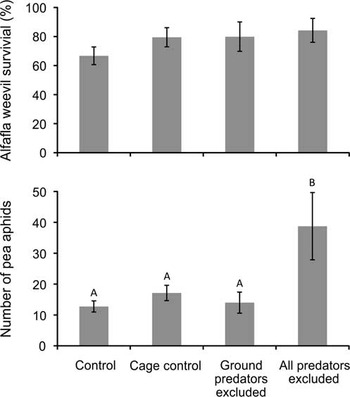
Stem densities averaged 33.9 (range 24–48) stems per plot, resulting in weevil densities of 2.0–4.1 larvae per stem, which is within the range generally considered economic in the region (Beauzay et al. Reference Beauzay, Knodel and Ganehiarachchi2013). There were no significant predator treatment effects on either the proportion of alfalfa weevils surviving (df=328; likelihood ratio χ2=2.0597; P=0.5601) or the proportion of alfalfa leaves damaged (df=322; likelihood ratio χ2=3.7428; P=0.2906). Although pea aphids were not intentionally added to experimental plots, they were found in all replicates of all treatments. For pea aphids, densities varied significantly across predator treatments at the end of the experiment (df=322; likelihood ratio χ2=17.0182; P=0.0007) with aphid numbers significantly higher in total predator exclusions compared with all other treatments (Fig. 1). Aphid parasitoid cocoons (mummies) were observed on experimental plants, but numbers were low (mean=2.34; standard error=0.34) and did not vary significantly across treatments (df=328; likelihood ratio χ2=2.6996; P=0.4403).
Influence of predator exclusion treatments on alfalfa weevil larval survival and pea aphid abundance. Different letters above bars indicate significant differences between treatments in posthoc contrasts.

Discussion
Predator surveys
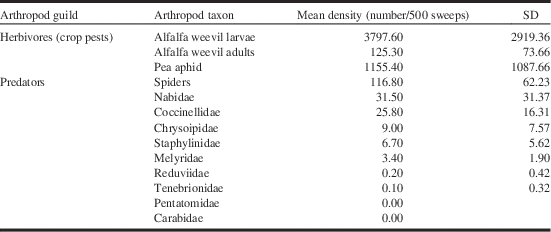
Of the groups that have been previously identified as important predators of alfalfa weevil larvae in the field (Barney and Armbrust Reference Barney and Armbrust1981) only the coccinellids (and not the Pentatomidae or Melyridae) were sufficiently abundant to be potentially important predators in the region. Spiders and nabids were also very abundant, and these have been found to feed on alfalfa weevil larvae in laboratory experiments (Ouayogode and Davis Reference Ouayogode and Davis1981). However, neither of these predator groups is thought to be particularly effective. Ouayogode and Davis (Reference Ouayogode and Davis1981) found that two common spider species were the least voracious predators of alfalfa weevil larvae, consuming the fewest individuals per unit time, out of 10 predator species tested in the laboratory. Nabids were also relatively ineffective, with coccinellids consuming on average three to nine times more weevil larvae than Nabis americoferus Carayon, depending on instar and coccinellid species (Hussain Reference Hussain1975; Ouayogode and Davis Reference Ouayogode and Davis1981). Podisus spp. Herrich-Schäffer were not recovered from any of the 10 sites sampled in this study, and Collops spp. Erichson were also relatively rare (see Table 1), in contrast with previous work suggesting they are important predators of alfalfa weevil larvae in other regions (Wheeler Reference Wheeler1977; Ouayogode and Davis Reference Ouayogode and Davis1981).
Mean densities (±standard deviation (SD)) of the two dominant pest species, alfalfa weevil (Hypera postica) and pea aphid (Acyrthosiphon pisum), and their predators, collected in sweep samples in first-crop alfalfa across 10 alfalfa fields in eastern Montana and western North Dakota in June 2011.

Modelling studies suggest that natural enemies with strong aggregative numerical responses tend to have more stable population dynamics and be more effective at depressing prey populations, and as such might be predicted to be particularly effective biological control agents (Hassell and May Reference Hassell and May1974; Luff Reference Luff1983). Generalist predators that attack a broad range of prey species are not predicted to exhibit aggregative numerical responses to a target pest species, unless it numerically dominates the prey assemblage (Symondson et al. Reference Symondson, Sunderland and Greenstone2002), which could limit their effectiveness as biological control agents under some conditions. I found no significant correlations between any predator group (nabids, spiders, or coccinellids) and either prey species (alfalfa weevil larvae or pea aphids) across the 10 sites in the survey, indicating the lack of any aggregative predator response at larger scales. In contrast, significant positive correlations of both coccinellid and nabid densities with alfalfa weevil densities, and nabid densities with pea aphid densities, indicate a strong aggregative response of these two predator groups at smaller spatial scales within the experimental site. However, these patterns were not observed at other surveyed sites. The lack of an observed aggregative response of coccinellids to aphid densities at large scales, and limited response at within-site scales (only two of 10 surveyed sites), contrasts with previous work showing strong aggregative numerical responses of C. septempunctata and C. maculata to pea aphid densities both among plots or transects within a field (Giles et al. Reference Giles, Obrycki and Degooyer1994; Evans and Toler Reference Evans and Toler2007) as well as among fields early in the growing season (Evans and Youssef Reference Evans and Youssef1992). However, our finding that predators can aggregate in response to larval weevil densities is consistent with previous work, which has also found positive density dependent responses of both nabids and coccinellids to alfalfa weevil larvae (Evans and Youssef Reference Evans and Youssef1992; Giles et al. Reference Giles, Obrycki and Degooyer1994; Evans and Toler Reference Evans and Toler2007).
Theoretical work suggests that positive aggregative responses to alternative prey, such as alfalfa weevil in this study, are most likely under conditions where the relative abundance of the alternative prey species is high relative to the preferred prey (Murdoch et al. Reference Murdoch, Chesson and Chesson1985; Symondson et al. Reference Symondson, Sunderland and Greenstone2002). Densities of the preferred prey, pea aphids, were relatively low in this study. Alfalfa weevil larvae, although consistently below economic thresholds of 20 larvae per sweep at all sites, were still on average three times more abundant than pea aphids (Fig. 1; Table 1). Thus, the strong responses of coccinellids to weevils relative to aphids in this study fit with theoretical expectations based on prey relative abundance. This result is also consistent Evans and Toler (Reference Evans and Toler2007) who found that C. septempunctata adults showed no response to alfalfa weevil densities in experimental plots early in the season, when their primary pea aphid prey was abundant. However, as aphid populations declined and weevil densities increased through the season, coccinellids occurred in higher densities in plots with higher weevil numbers, similar to the results from this study system dominated by the same coccinellid species. Thus predator groups traditionally associated with, and often preferring, aphids can none the less show strong aggregative numerical responses to alfalfa weevil larvae in the field, particular when weevil populations are high relative to the aphids. However, displaying an aggregative numerical response is not sufficient, in itself, to indicate that a predator will be effective at suppressing prey numbers. That question can only be addressed effectively using experimental approaches in the field.
Predator exclusion experiment
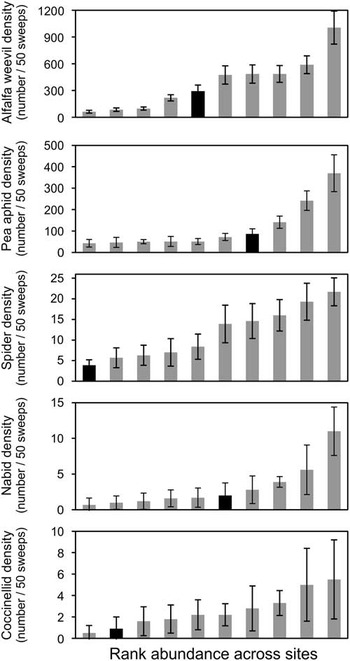
Predator exclusion treatments had no significant effects on either alfalfa weevil larval survival or levels of plant damage in this study, suggesting that generalist predators did not play a key role in biological control of alfalfa weevil. However, although non-significant, the general trend of lower average weevil survival in control plots relative to plots with all predators excluded is what would be predicted if generalist predators were contributing to weevil mortality. In addition, predator densities at the experimental sites were low relative to the nine other sites sampled in the region. This was true for both spiders (lowest ranked abundance) and coccinellids (second lowest ranked abundance), although nabid densities were fairly typical (Fig. 1). Thus, it may be that significant predator effects would be observed in years or sites with higher predator densities. That said, in one of the few other studies to manipulate predator densities in the field, Evans and England (Reference Evans and England1996) found that adding 20 C. septempunctata adults to experimental plots, to match the higher end of local densities observed in the field, had no significant effects on numbers of early maturing alfalfa weevil larvae. There was a significant effect on later maturing larvae, but the magnitude was relatively small (a 14% reduction) especially compared with the 35% decrease observed in aphid numbers. Thus, despite the fact that generalist predators are abundant in alfalfa, are known to consume weevil larvae, likely benefit from this alternative resource (Evans et al. Reference Evans, Richards and Kalaskar2004), and even exhibit aggregative responses to larval densities in the field in some cases, the evidence to date suggests that generalist predators do not typically exert sufficient predation pressure to reduce weevil populations and impacts.
Pea aphids were inadvertently introduced into the experiment, but were found consistently in all replicates of all treatments. This observation, combined with pea aphid’s life history and the relatively small mesh size of cages, suggests that overwintering pea aphid eggs or early instars were likely present on the potted alfalfa plants that were used in the experiment. In contrast to the lack of predator effects on weevil larvae, pea aphid densities at the end of the experiment were approximately three times higher in total predator exclusion treatments relative to controls or the ground predator exclusion treatments (Fig. 2), suggesting generalist predators likely play an important role in controlling aphid populations. Although cage artefacts may have contributed to this pattern to some extent, the effects were likely minimal given the short duration of the experiment and the fact that cage controls, which were designed to more closely mimic microclimatic conditions within cages, had similar numbers of aphids as uncaged controls. Cumulatively, the results suggest that even under conditions where predator densities are sufficiently high to exert considerable pressure on the pea aphids, they may still have minimal impacts on alfalfa weevil larvae. Nevertheless, the results reinforce a number of experimental studies demonstrating an important role of foliage-foraging generalist predators, especially coccinellids, in aphid biological control (Schmidt et al. Reference Schmidt, Lauer, Purtauf, Thies, Schaefer and Tscharntke2003; Gardiner et al. Reference Gardiner, Landis, Gratton, DiFonzo, O’Neal and Chacon2009) including in the pea aphid alfalfa system (Evans and England Reference Evans and England1996; Losey and Denno Reference Losey and Denno1998; Snyder and Ives Reference Snyder and Ives2003). Some studies have shown that ground foraging predators can suppress aphid numbers (Losey and Denno Reference Losey and Denno1998; Collins et al. Reference Collins, Boatman, Wilcox, Holland and Chaney2002; Schmidt et al. Reference Schmidt, Lauer, Purtauf, Thies, Schaefer and Tscharntke2003) but that was not the case in this study.
Rank abundance plots for the two crop pests and three dominant predator groups across the 10 sampled alfalfa fields. Bars represent mean densities across the 10 transects at a site±standard deviations. The black bar in each diagram represents the experimental site.

Are generalist predators likely to be important biological control agents of alfalfa weevil? Initial experiments where coccinellids are the dominant predators suggest weak impacts on weevil numbers. However, more experimental work is needed before general conclusions can be drawn. Experimental studies that manipulate predator numbers remain scarce. The high variability in predator numbers across sites found in this study (Table 1) suggests that replicating such studies across a range of typical densities within a region (i.e., across several sites or years) will be an important first step in gauging the broader potential of generalist predators as alfalfa weevil control agents within a region. Furthermore, results may vary across geographic regions as the dominant generalist predator groups or species, which may vary in predation efficiency, shift. For example, it may be that predation pressure is higher farther east in North America, where Podisus maculiventris is a dominant predator, compared with the middle of the continent where coccinellids dominate. Thus, the potential importance of generalist predators of the alfalfa weevil will likely need to be examined for each region of interest before more robust conclusions can be drawn.
Acknowledgements
The author thanks the alfalfa growers who allowed us to sample insects from their fields, with special thanks to Don Steinbeisser Jr. who allowed us to carry out experimental work in his field. Additional thanks are given to the following individuals who spent long hours collecting and processing samples: Amelia Jurkowska, Alyssa Kessel, Sarah Mason, and Ellen Titus. Deb Waters was invaluable in setting up experiments, and coordinating and training assistants for sample processing and data collection. Dave Branson, Ellen Titus, Matt O’Neal, and two anonymous reviewers provided insightful comments on previous drafts of the manuscript.