INTRODUCTION
The Magellanic penguin (Spheniscus magellanicus Forster, 1781) is distributed along the coast of southern South America and is the most abundant penguin species on the continent. In the south-western Atlantic, the species breeds primarily along the coasts of Argentinean Patagonia and nearby islands (41–55°S). After the breeding season, the penguins swim northwards to areas where their prey is more abundant (Boersma et al., Reference Boersma, Rebstock, Frere and Moore2009). During the austral winter (June to September) they can reach areas in northern Argentina, Uruguay and southern Brazil (33–40°S), but some specimens can arrive in south-eastern Brazil, approximately 21°S (Dantas et al., Reference Dantas, Almeida, Maracini, Serra, Chame, Labarthe, Kolesnikovass, Siciliano, Matias, Moura, Campos, Mader and Serafini2013). Juveniles predominate in the winter migrations that reach the Brazilian coast (Fonseca et al., Reference Fonseca, Petry and Jost2001; Pinto et al., Reference Pinto, Siciliano and Di Beneditto2007; García-Borboroglu et al., Reference García-Borboroglu, Boersma, Ruoppolo, Pinho da Silva, Corrado, Conte-Sena, Velozo, Myiaji-Kolesnikovas, Dutra, Maracini, Carvalho-do-Nascimento, Ramos-Júnior, Barbosa and Serra2010).
Annually, a few to several hundred juvenile Magellanic penguins are found drifting or stranded on beaches along the Brazilian coast. Indeed, during the winter of 2008, an extreme mortality event involving more than 4000 recorded specimens occurred at latitudes ranging from 33 to 5°S (García-Borboroglu et al., Reference García-Borboroglu, Boersma, Ruoppolo, Pinho da Silva, Corrado, Conte-Sena, Velozo, Myiaji-Kolesnikovas, Dutra, Maracini, Carvalho-do-Nascimento, Ramos-Júnior, Barbosa and Serra2010; Silva et al., Reference Silva, Pereira, Tanajura, Lentini, Cirano, Boersma and Rodrigues2012; present study). This was the highest mortality record in a wintering area along the Atlantic coast. García-Borboroglu et al. (Reference García-Borboroglu, Boersma, Ruoppolo, Pinho da Silva, Corrado, Conte-Sena, Velozo, Myiaji-Kolesnikovas, Dutra, Maracini, Carvalho-do-Nascimento, Ramos-Júnior, Barbosa and Serra2010) related this mortality to an unusually cold sea surface temperature between 35–25°S in the preceding year that drastically reduced the recruitment of anchovy Engraulis anchoita, an important prey to the penguins. Silva et al. (Reference Silva, Pereira, Tanajura, Lentini, Cirano, Boersma and Rodrigues2012) related this mortality event to an anomalous weather system that included not only colder coastal waters but also wind anomalies and intensive northward currents.
This penguin is an opportunistic feeder that primarily eats small schooling pelagic fish, but its diet can vary depending on available prey. Information on the species' diet is mainly from breeding colonies, where anchovy (E. anchoita), sprat (Sprattus fuegensis) and silverside (Odontesthes smitti) have previously been shown to be important prey (Frere et al., Reference Frere, Gandini and Lichtschein1996; Wilson et al., Reference Wilson, Scolaro, Grémillet, Kierspel, Laurenti, Upton, Gallelli, Quintana, Frere, Müller, Straten and Zimmer2005; Sala et al., Reference Sala, Wilson and Quintana2012). Epipelagic cephalopods are considered alternative prey for adult penguins, especially if fish availability is lower, and they are present in the juvenile diet (Forero et al., Reference Forero, Hobson, Bortolotti, Donazar, Bertellotti and Blanco2002a; Pinto et al., Reference Pinto, Siciliano and Di Beneditto2007; Baldassin et al., Reference Baldassin, Santos, Cunha, Werneck and Gallo2010).
Dietary analyses in seabirds can be based on stomach contents of dead animals, direct observation of feeding behaviour, and collection of prey remains at colonies (including regurgitated items and excrement) (Barrett et al., Reference Barrett, Camphuysen, Anker-Nilssen, Chardine, Furness, Garthe, Hüppop, Leopold, Montevecchi and Veit2007). These approaches are useful to identify the taxonomic level of consumed prey, but they reflect shorter-term features of the diet or can be biased due to differences in prey digestion rates. In the past two to three decades, stable isotope signatures (δ15N and δ13C) have provided complementary data on seabird feeding ecology and have been widely applied. This technique is particularly useful to evaluate food assimilation, long-term diet, trophic level and foraging location (e.g. Hobson et al., Reference Hobson, Alisauskas and Clark1993; Forero et al., Reference Forero, Tella, Hobson, Bertellotti and Blanco2002b; Cherel et al., Reference Cherel, Hobson, Bailleu and Groscola2005; Barrett et al., Reference Barrett, Camphuysen, Anker-Nilssen, Chardine, Furness, Garthe, Hüppop, Leopold, Montevecchi and Veit2007; Michalik et al., Reference Michalik, McGill, van Noordwijk, Masello, Furness, Eggers and Quillfeldt2013).
In the present study, the stomach contents of juvenile Magellanic penguins stranded along the Atlantic coast (21–23°S) during the extreme mortality event of 2008 were analysed. The isotopic profile of this species and their prey in a wintering area is presented in this study for the first time. The aim of the study is to determine the trophic relationships of the penguins and to evaluate whether the prey species recovered from the stomach contents were assimilated. The nutritional condition of the penguins was also discussed in terms of the ingestion of atypical items, the body weight of the animals, and the food remains recovered from the stomach contents.
MATERIALS AND METHODS
Samples of penguins and analysis of stomach contents
From July to October 2008, 776 juvenile Magellanic penguins were found stranded (95% of them already dead) along the coast of Rio de Janeiro State (21–23°S), Brazil. A total of 46 fresh carcasses were randomly selected from these stranded penguins for the analysis of the stomach contents. Pectoral muscle tissue was collected from 18 of these carcasses for isotopic analysis.
The specimens varied from 52.0 to 67.0 cm (mean: 59.8 ± 3.4 cm) in length and 1.5 to 2.5 kg (mean: 2.0 ± 0.3 kg) in weight. They were emaciated, as the normal expected weight is between 3 and 5 kg (Williams & Boersma, Reference Williams, Boersma and Williams1995). Because the specimens were all juveniles, their sex was not assessed in the field. However, Reis et al. (Reference Reis, Aires, Moura, Matias, Tavares, Ott, Siciliano and Lôbo-Hajdu2011) used molecular techniques to determine the sex of 106 penguins sampled during this mortality event, and 70% were females. Thus, we considered that most of our analysed specimens were females.
The stomachs were preserved in 70% ethanol, and the contents were analysed using a stereomicroscope with an eyepiece micrometer grid. Lower and/or upper cephalopod beaks recovered in the stomach contents were used to identify, quantify and back-calculate the mantle length and total weight of the cephalopod prey species using a regression equation. The Index of Relative Importance (IRI) of each cephalopod species, considered here as a percentage, was calculated from the expression [(%NF + %B) × %OF], modified by Pinkas et al. (Reference Pinkas, Oliphant and Iverson1971), where NF = numerical frequency, B = biomass and OF = occurrence frequency. Other remains recovered from the stomach contents, such as fish bones (e.g. otoliths, spines, vertebrae, skull), crystalline lenses and muscular tissue, crystalline cephalopod lenses, crustacean carapaces, mollusc shells and atypical items such as plant remains and solid waste were also recorded and identified whenever possible.
Isotopic analysis of δ15N and δ13C
The muscle isotopic signatures of juvenile Magellanic penguins (N = 18) were measured. Many previous studies have suggested that poor nutritional condition affects isotopic fractionation in the tissues of consumers, generally resulting in increased enrichment (Hobson & Welch, Reference Hobson and Welch1992; Hobson et al., Reference Hobson, Alisauskas and Clark1993; Cherel et al., Reference Cherel, Hobson, Bailleu and Groscola2005), or even depletion (Oelbermann & Scheu, Reference Oelbermann and Scheu2002), whereas some authors have demonstrated no effect (Schmidt et al., Reference Schmidt, Scrimgeour and Curry1999; Kempster et al., Reference Kempster, Zanette, LongstaVe, MacDougall-Shackleton, WingWeld and Clinchy2007; Williams et al., Reference Williams, Buck, Sears and Kitaysky2007).
In this study, we analysed the mantle muscle of squids of the genus Doryteuthis (N = 21) and the dorso-lateral muscle of sardine (Sardinella brasiliensis, Clupeidae) (N = 7) and anchovies (Anchoa spp. and Lycengraulis grossidens, Engraulidae) (N = 16) using an isotopic approach. Unfortunately, we did not sample the paper nautilus Argonauta nodosa, but as its trophic level and preferred habitat are similar to those of Doryteuthis spp., we assume that the isotopic signatures of these cephalopods would be comparable. These organisms are considered important food items for the Magellanic penguin in this wintering area (Pinto et al., Reference Pinto, Siciliano and Di Beneditto2007; García-Borboroglu et al., Reference García-Borboroglu, Boersma, Ruoppolo, Pinho da Silva, Corrado, Conte-Sena, Velozo, Myiaji-Kolesnikovas, Dutra, Maracini, Carvalho-do-Nascimento, Ramos-Júnior, Barbosa and Serra2010; present study). During 2009, the selected prey species were taken by local fisheries in the marine coastal area near the area in which the penguins were collected.
All muscle samples were freeze-dried and homogenized with a mortar and pestle for δ15N and δ13C analysis. The isotopic analyses were performed with a ThermoQuest Finnigan Delta Plus (Finnigan MAT) mass spectrometer coupled to an elemental analyser. The reference values for δ15N and δ13C were atmospheric nitrogen and Pee Dee Belemnite (PDB), respectively. The analytical precision was ±0.3‰ for δ15N and ±0.2‰ for δ13C, determined in triplicate at each of five samplings. The results were expressed in parts per thousand (‰).
Lipids were not extracted from the muscle samples prior to analysis; however, the C : N ratios in all samples (penguins and prey) were lower than 3.5, indicating low levels of lipids. Therefore, the interpretation of the results of the carbon isotopic signature was not compromised (Post et al., Reference Post, Layman, Arrington, Takimoto, Quattrochi and Montaña2007).
Data analysis
The isotopic measurement data were tested for normality and homogeneity of variance using a Kolmogorov–Smirnov test and a Levene's test, respectively. As the data did not meet the statistical assumptions required for the use of parametric methods, a Kruskal–Wallis H-test and an a posteriori Dunn's test were applied to test for differences among species and isotopic signatures. The statistical analyses were performed in Statistica 8.0 for Windows (StatSoft, Inc., USA, 2007), and differences were considered significant at P < 0.05.
The relative contributions of prey species to the diet of Magellanic penguins were estimated using a Bayesian approach with stable isotope mixing models in the SIAR (Stable Isotope Analysis in R) package. The model calculates the isotopic signatures in muscle and the fractionation between a predator and its prey along with the uncertainty in these values (Parnell et al., Reference Parnell, Inger, Bearhop and Jackson2010). The model was applied using R v. 2.12.2 for Windows (R Development Core Team, 2011).
RESULTS AND DISCUSSION
Prey species in the stomach contents
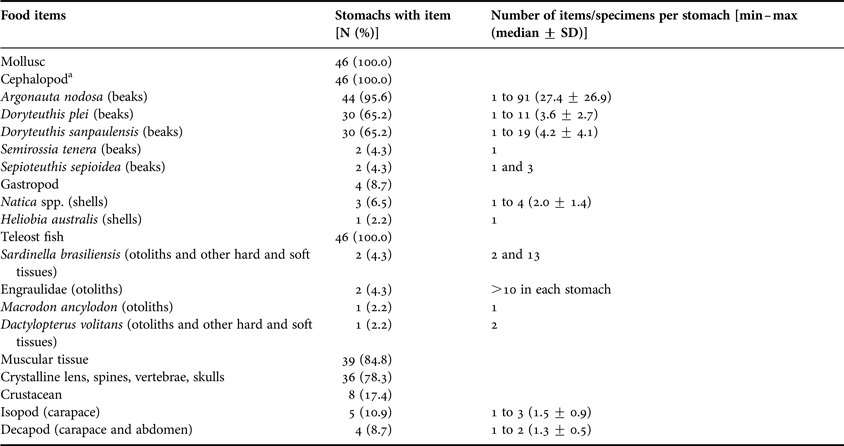
The penguin specimens analysed in the present study were starved animals, and the diet reported here is not necessarily representative of the winter diet of healthy animals. The analysed stomachs contained hard (e.g. beaks, otoliths, spines, vertebrae, skull, carapace, shells) and soft (muscular tissue) remains of prey species, but only the hard material could be used in species identification. The prey groups recorded were molluscs (cephalopods and gastropods), teleost fish and crustaceans (decapods and isopods) (Table 1).
Food items recorded in the stomach contents of juvenile Magellanic penguins stranded along the coast of Rio de Janeiro State, Brazil (21–23°S) in 2008.

aCrystalline lens of cephalopods were also found, but probably from the same individuals identified from beaks.
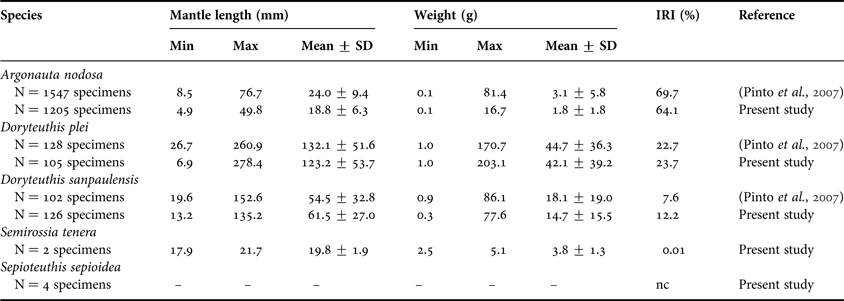
Cephalopods were the most frequent prey. The number of cephalopod prey per stomach was highly variable (Table 1). Most of the beaks recovered from the stomach contents showed damage to the wings. The smallest cephalopod was Argonauta nodosa, followed by bobtail squid (Semirrosia tenera) and coastal squids (Doryteuthis sanpaulensis and D. plei) (Table 2). The reef squid Sepioteuthis sepioidea was recorded in two stomachs, but its mantle length and total weight could not be back-calculated. Despite its small size, A. nodosa was the most abundant prey, with the highest IRI value (Table 2). The mean mantle length of the consumed specimens and the absence of shell remains in the stomach contents indicate that the penguins most likely prey upon males of A. nodosa. This cephalopod species shows strong sexual dimorphism, with males substantially smaller than females (30 mm vs 300 mm in mantle length), and a shell absent in male specimens (Wu, Reference Wu1989). Moreover, the males are planktonic, whereas the females are nektonic (Vidal et al., Reference Vidal, Haimovici and Hackbart2010). Accordingly, the males are more easily captured by the penguins than the females.
Mantle length, weight and Index of Relative Importance (IRI, %) of the cephalopods recorded in the stomach contents of juvenile Magellanic penguins stranded along the coast of Rio de Janeiro State, Brazil (21–23°S) in 2008.
SD, standard deviation; nc, not calculated.
Teleost fish had a high frequency of occurrence. However, only four species could be identified from otoliths recovered from the stomach contents (Table 1). Due to damage to the otoliths, it was not possible to back-calculate the total length and weight of the fish. Among the identified fish, S. brasiliensis and members of the family Engraulidae had the highest occurrence and number per stomach. However, further inferences about the frequency of fish as prey in the sampled penguins could not be obtained from the analysis of stomach contents. Decapod crustaceans were not frequent prey in penguins' diet, and it is probable that isopods resulted from secondary ingestion. These isopods are fish parasites found in oral and gill cavities and on the body surface of fish (Sartor, Reference Sartor1986). Thus, they can be ingested together with fish. Regarding the gastropods, their origin could not be specified (Table 1).
In addition to these prey groups, plant remains, including macro-algae and terrestrial vegetation (bark, branches, roots and flowers) were found in the stomach contents of three (6.5%) and 14 (30.4%) penguins, respectively. These items are unusual for marine predators such as penguins that inhabit pelagic areas.
Magellanic penguins are opportunistic feeders, as are other penguin species worldwide. They consume the pelagic prey that are most abundant in their habitat (Radl & Culik, Reference Radl and Culik1999). Argonauta nodosa is an epipelagic cephalopod occurring in all austral oceans from tropical to warm-temperate areas (Lansdell & Young, Reference Lansdell and Young2007). Squid species of the genus Doryteuthis are very abundant in southern and south-eastern Brazilian coastal waters and are captured for commercial purposes (Haimovici & Perez, Reference Haimovici and Perez1991; Santos & Haimovici, Reference Santos and Haimovici2002). The sardine S. brasiliensis occurs in tropical and subtropical waters of the western Atlantic and forms compact schools in coastal waters; these sardines are captured by local fisheries (Cergol et al., Reference Cergol, Saccard and Rossi-Wongtschowsk2002). The family Engraulidae is the most abundant pelagic fish family in the south-western Atlantic. It is important in commercial fisheries and as prey for marine predators (Frere et al., Reference Frere, Gandini and Lichtschein1996; Munroe & Nizinski, Reference Munroe, Nizinski and Carpenter2002).
In the study area, the importance of cephalopod species in the stomach contents of juvenile penguins has not changed over time. In 2000, 8 years prior to this study, Pinto et al. (Reference Pinto, Siciliano and Di Beneditto2007) found similar results for the IRI of cephalopods (Table 2). Moreover, the presence of A. nodosa and Doryteuthis spp. in the stomach contents has also been widely reported in other wintering areas along the Brazilian coast (24–33°S) (Fonseca et al., Reference Fonseca, Petry and Jost2001; Baldassin et al., Reference Baldassin, Santos, Cunha, Werneck and Gallo2010).
Stomach content analysis is a traditional method used to identify the taxonomic level of preferential prey and to estimate their quantitative contribution to predator diet (Barrett et al., Reference Barrett, Camphuysen, Anker-Nilssen, Chardine, Furness, Garthe, Hüppop, Leopold, Montevecchi and Veit2007; Pinto et al., Reference Pinto, Siciliano and Di Beneditto2007). There are some limits to this approach due to differences in prey's digestion rates. For example, cephalopod beaks are horny and indigestible structures that usually remain in the predator's stomach for a relatively long time (months), leading to overestimations of the prey's contribution to its diet (Xavier et al., Reference Xavier, Phillips and Cherel2011). However, in regions where species diversity presents a wide range of food resources to predators, as in tropical and subtropical areas, prior identification of consumed species by stomach content analysis optimizes utilization of other methods, such as isotopic signatures (Di Beneditto et al., Reference Di Beneditto, Souza, Kehrig and Rezende2011). Utilization of multiple methods to verify feeding preferences reduces bias in data interpretation and may elucidate much more about species' trophic ecology.
Solid waste in stomach contents
Solid waste of anthropogenic origin, such as plastic (flexible and rigid, both transparent and coloured), monofilament line, paper, rubber, styrofoam and synthetic sponges were recorded in 41 stomachs (89.1%). More than one category of waste was found in 23 stomachs (50.0%). Plastic was the most frequent type of waste (N = 40 stomachs; 86.9%), and flexible plastic bags were the most frequent type of plastic waste (N = 37; 80.4%). It is probable that these wastes resulted from the disposal of garbage bags, commercial shopping bags and various types of packaging. Waste related to the manufacture of fishing equipment, such as monofilament line (N = 14; 30.4%), styrofoam (N = 3; 6.5%) and rubber (N = 1; 2.2%), was also represented in the stomach contents.
The presence of solid waste in the stomachs of Magellanic penguins that occur along the Brazilian coast during the winter was previously discussed in Brandão et al. (Reference Brandão, Braga and Luque2011). These authors stated that 35.8% of the penguins are affected by solid waste ingestion, but our percentage is 2.5 times higher than this estimate. Thus, the true effect of this type of pollution could be underestimated in this species and other seabirds. In the wintering areas, solid waste pollution (or marine debris) has affected Magellanic penguins, as reported by Petry et al. (Reference Petry, Fonseca and Jost2004) for southern Brazil, and Pinto et al. (Reference Pinto, Siciliano and Di Beneditto2007) and Brandão et al. (Reference Brandão, Braga and Luque2011) for the same region where our samples were obtained. Indeed, this form of pollution is a global concern and affects the marine environment and organisms as a whole (Ivar do Sul & Costa, Reference Ivar do Sul and Costa2007).
The atypical items recovered from the stomachs, namely plant remains and solid waste, may be derived from the stomach contents of the penguins' prey; may be accidentally ingested by the penguins in the process of capturing the prey species; and/or may be eaten by starving animals (such as the specimens in the present study) in an effort to minimize hunger (Brandão et al., Reference Brandão, Braga and Luque2011). In this last context, starvation produces a poor nutritional condition that increases the sub-lethal effects of solid waste ingestion.
Isotopic profile of δ15N and δ13C and nutritional condition of juvenile Magellanic penguins
The nitrogen and carbon isotope values of the studied penguins varied from 13.3 to 15.9‰ (14.5 ± 0.8‰) and from −19.2 to −16.9‰ (−17.4 ± 0.5‰), respectively. The findings for the δ15N values for prey species showed that Doryteuthis spp. varied from 10.5 to 12.8‰ (11.8 ± 0.6‰), S. brasiliensis from 9.8 to 13.3‰ (11.7 ± 1.4‰) and engraulid fish from 11.5 to 12.9‰ (12.3 ± 0.4‰). The δ13C values varied from −18.5 to −16.1‰ (−17.1 ± 0.5‰) for Doryteuthis spp, −18.6 to −15.2‰ (−16.8 ± 1.3‰) for S. brasiliensis, and −20.2 to −16.2‰ (−18.7 ± 0.9‰) for engraulid fish (Figure 1).
Relationship between δ15N and δ13C of juvenile Magellanic penguins stranded along the coast of Rio de Janeiro State, Brazil (21–23°S) in 2008, and of some prey taxa. Spheniscus magellanicus: 18 samples, Doryteuthis spp.: 21 samples, Engraulidae: 16 samples, and Sardinella brasiliensis: seven samples. Error bars are standard deviations.
The δ15N values differed significantly among all species (Kruskal–Wallis test, H 62 = 39.4, P < 0.0001), and a similar result was obtained for δ13C (Kruskal–Wallis test, H 62 = 25.3, P < 0.0001) (Figure 1). A post-hoc test indicated that the penguins were more highly enriched in δ15N than any of the prey species, whereas no significant differences were found among the prey species. Engraulid fish showed lighter δ13C values than other species (Table 3).
Dunn's post-hoc test P values of multiple comparisons of stable isotopes values for muscle tissue of juvenile Magellanic penguins stranded along the coast of Rio de Janeiro State, Brazil (21–23°S) in 2008, and of some prey taxa. Upper right P values for δ15N comparisons, and lower left P values for δ13C comparisons.
*P < 0.001.
The nitrogen isotope values confirmed that the trophic position of the penguins was higher than that of their prey, as expected (Figure 1). The carbon isotope values found for all species are characteristic of marine coastal environments (Di Beneditto et al., Reference Di Beneditto, Souza, Kehrig and Rezende2011; Bisi et al., Reference Bisi, Lepoint, Azevedo, Dorneles, Flach, Das, Malm and Lailson-Brito2012). The significantly lighter values of this isotope found for engraulid fish indicate the anadromous characteristics of certain species, e.g. Lycengraulis grossidens (Mai & Vieira, Reference Mai and Vieira2013).
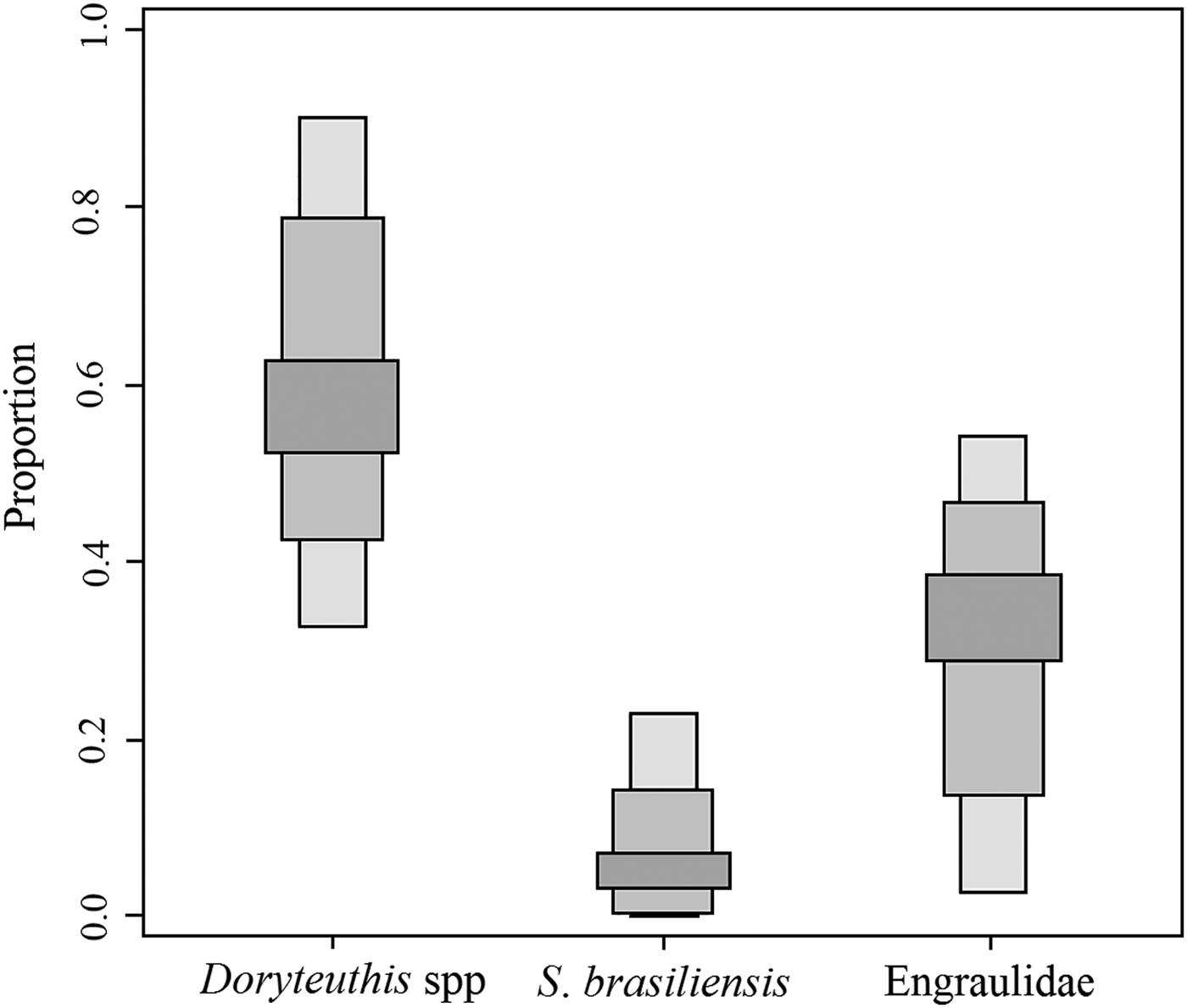
Using the Bayesian mixing model and assuming that cephalopods, S. brasiliensis and engraulid fish are important components of the juvenile Magellanic penguin's diet (see Materials and methods), the relative contributions of prey species, in terms of 95% credibility intervals, were as follows: 52–63% cephalopods (Doryteuthis spp.), 29–38% engraulid fish and 3–7% S. brasiliensis (Figure 2). Among the three prey species, this mixing model analysis highlighted cephalopods as prey with the highest value of assimilation.
Results of SIAR (Stable Isotope Analysis in R) showing 95, 75 and 25% credibility intervals of estimated prey contributions to the diet of juvenile Magellanic penguins stranded along the coast of Rio de Janeiro State, Brazil (21–23°S) in 2008. Doryteuthis spp.: 21 samples, Sardinella brasiliensis: seven samples, and Engraulidae: 16 samples.
Stable isotope approaches for Magellanic penguins are still limited, and only blood samples from specimens in breeding colonies have been analysed (Forero et al., Reference Forero, Hobson, Bortolotti, Donazar, Bertellotti and Blanco2002a, Reference Forero, Tella, Hobson, Bertellotti and Blancob). To our knowledge, this is the first study of stable isotope signatures in the muscular tissue of this species based on samples from a wintering area. The mean isotopic profile of juvenile specimens in breeding colonies, as shown in Forero et al. (Reference Forero, Hobson, Bortolotti, Donazar, Bertellotti and Blanco2002a), was 18.3 ± 0.3‰ for δ15N and 16.3 ± 0.3‰ for δ13C. Our values were 3.7 and 1.1‰ lighter for δ15N and δ13C, respectively. This difference can be related to the types of tissue samples analysed. Different tissues have different isotopic turnover rates, i.e. the time within which stable isotopes in tissues are replaced by isotopes derived from the diet, as well as different discrimination factors (Hobson & Clark, Reference Hobson and Clark1992; Caut et al., Reference Caut, Angulo and Courchamp2009). Comparisons of isotopic signatures in predator tissues allow food ingestion to be evaluated over various timescales, e.g. as days, weeks or months (Hobson et al., Reference Hobson, Schell, Renouf and Noseworthy1996; Barquete et al., Reference Barquete, Strauss and Ryan2013). From this perspective, isotopic signatures in the blood result from relatively recent food ingestion (e.g. days or a few weeks), whereas isotopic signatures in muscle reflect less recent food ingestion (e.g. months).
In the breeding colonies from Argentinean Patagonia, the relative contribution of cephalopods to the juveniles' diet indicated by an isotopic mixing model was 51% (Forero et al., Reference Forero, Hobson, Bortolotti, Donazar, Bertellotti and Blanco2002a). In the area examined in the current study, the contribution of cephalopods ranged from 52 to 63%. Although these results reinforce the importance of cephalopods as prey for this age class, caution is advised in interpretation, as the starvation condition of our specimens might influence the isotopic signatures (Hobson et al., Reference Hobson, Alisauskas and Clark1993; Cherel et al., Reference Cherel, Hobson, Bailleu and Groscola2005). The low body weight of the analysed specimens suggests that the frequency of prey ingestion is low in the study area, which is recognized as the northern limit of the distribution of Magellanic penguins on the Atlantic coast (Williams & Boersma, Reference Williams, Boersma and Williams1995; Pinto et al., Reference Pinto, Siciliano and Di Beneditto2007; Dantas et al., Reference Dantas, Almeida, Maracini, Serra, Chame, Labarthe, Kolesnikovass, Siciliano, Matias, Moura, Campos, Mader and Serafini2013).
The nutritional condition of our specimens was poor due to starvation. However, the only study that could be used as a reference for comparison of isotopic profiles with those of healthy penguins was performed with blood tissue (Forero et al., Reference Forero, Hobson, Bortolotti, Donazar, Bertellotti and Blanco2002a). The data of these two studies may not be comparable due to differences in diet-tissue turnover rates and discrimination factors; however, our specimens were depleted in δ15N and δ13C relative to the specimens examined by Forero et al. (Reference Forero, Hobson, Bortolotti, Donazar, Bertellotti and Blanco2002a). Further studies are necessary to better understand the isotopic response to food deprivation in this wild seabird.
García-Borboroglu et al. (Reference García-Borboroglu, Boersma, Ruoppolo, Pinho da Silva, Corrado, Conte-Sena, Velozo, Myiaji-Kolesnikovas, Dutra, Maracini, Carvalho-do-Nascimento, Ramos-Júnior, Barbosa and Serra2010) suggest that a food shortage was the most likely cause of death of thousands of penguins in the extreme mortality event that occurred along the Brazilian coast in 2008. Furthermore, these penguins may not have been able to capture alternative prey efficiently in this wintering area. Indeed, juvenile specimens that reach Brazilian wintering areas are already weak and emaciated, indicating a poor nutritional state. This condition is generally verified in specimens recovered in both large and small mortality events (e.g. Petry et al., Reference Petry, Krüger, Fonseca, Brummelhaus and Piuco2009; Baldassin et al., Reference Baldassin, Santos, Cunha, Werneck and Gallo2010; García-Borboroglu et al., Reference García-Borboroglu, Boersma, Ruoppolo, Pinho da Silva, Corrado, Conte-Sena, Velozo, Myiaji-Kolesnikovas, Dutra, Maracini, Carvalho-do-Nascimento, Ramos-Júnior, Barbosa and Serra2010; Mäder et al., Reference Mäder, Sander and Casa2010).
CONCLUDING REMARKS
The juvenile Magellanic penguins perform winter migrations along the southern Atlantic coast of South America, moving from Argentinean Patagonia to Brazil. However, the poor nutritional condition of specimens that come ashore on the Brazilian coast, especially those reaching the northern migration limit (~21°S), indicates that prey ingestion is not sufficient for body weight maintenance and, hence, maintenance of nutritional status. These animals may tend to ingest atypical items, such as plant remains and solid waste that do not contribute to weight gain. In the case of solid waste, ingestion can directly affect the health of the birds. These specimens have little opportunity to survive and return to the breeding colonies.
The muscle isotopic signatures presented here can be used as a baseline reference for further studies on the diet of juvenile Magellanic penguins in wintering areas. The isotopic profile of carcasses recovered in other wintering areas will increase the knowledge about the species' trophic relationships and will allow monitoring of the birds' nutritional condition during the migration period.
ACKNOWLEDGEMENTS
We thank the team of Grupo de Estudos de Mamíferos Marinhos da Região dos Lagos (GEMM-Lagos), who provided us with the Magellanic penguin samples for this study; and CENPES/PETROBRAS who coordinated the Projeto Habitats – Heterogeneidade Ambiental da Bacia de Campos, involved in this study.
FINANCIAL SUPPORT
This study was supported by Conselho Nacional de Desenvolvimento Científico e Tecnológico – CNPq (grant nos 403735/12-2, 01405/13-1); Fundação de Amparo a Pesquisa do Estado do Rio de Janeiro – FAPERJ (grant no. E-26/102.915/2011); and CNPq INCT Material Transference from the Continent to the Ocean (grant no. 573.601/08-9).