Between the sixties and the nineties of the past century, over a dozen reviews of the literature on homework and its relationship with academic achievement (e.g. Cooper, Robinson, & Patall, Reference Cooper, Robinson and Patall2006) were carried out. These revisions showed that the results of this relationship are not uniform, providing positive, negative or null associations (Keith, Reference Keith, Thomas and Grimes1987). However, most studies concluded that homework seemed to have some impact on performance (Núñez, Suárez, Cerezo et al., Reference Núñez, Suárez, Cerezo, González-Pienda, Rosário, Mourão and Valle2015; Paschal, Weinstein, & Walberg, Reference Paschal, Weinstein and Walberg1984), even in elementary school -ES- (Paschal et al., Reference Paschal, Weinstein and Walberg1984), although the correlation is much stronger in higher stages (Cooper et al., Reference Cooper, Robinson and Patall2006; Cooper & Valentine, Reference Cooper and Valentine2001).
Although ES data suggest a weak relationship between the two constructs (Cooper et al., Reference Cooper, Robinson and Patall2006), most researchers agree on the recommendation to assign homework to elementary school students (Bempechat, Reference Bempechat2004). Doing homework offers students a unique opportunity to learn in an extra-curricular setting when, how and to what extent they must complete their tasks and therefore become an important vehicle for developing study habits and self-regulation strategies (Corno & Xu, Reference Corno and Xu2004; Epstein & van Voorhis, Reference Epstein and van-Voorhis2001).
Another controversial issue is whether the time spent by students carrying out homework is related to a greater or lesser academic performance. The results of past research are unclear or even contradictory (Rosário et al., Reference Rosário, Mourão, Trigo, Suárez, Fernández and Tuero2011). The data available suggest that the time spent by students doing homework is not in itself a guarantee of their commitment to carry out their assigned tasks. Moreover, too much time spent on tasks can sometimes mean more than a high effort and motivation, but rather a low cognitive competence of the student in this field of knowledge, together with a low ability to self-regulate the study environment, and the distracting or negative emotions that deviate the student from the task at hand (Trautwein, Reference Trautwein2007; Trautwein, Schnyder, Niggli, Neumann, & Lüdtke, Reference Trautwein, Schnyder, Niggli, Neumann and Ludtke2009). However, the effort invested in homework has proven to have a more positive impact on academic achievement than the time spent on homework. One variable that appears to mediate this relationship is the age of students: from modest to weak among students in higher grades and lack of correlation in the case of ES students (e.g. Cooper & Valentine, Reference Cooper and Valentine2001).
Motivation, involvement in homework and academic performance
It is possible that the key to solve some of these controversies is in how students maximize the benefits of their behavior when doing homework (time spent, amount of homework performed, work time management, self-regulation of behavior study , etc.) depending on variables such as course, academic field, instructional context, quality of the instructional process, prior knowledge, study skills, motivational type and level of the student, or the attitude towards doing homework.
Trautwein, Lüdtke, Schnyder and Niggli (Reference Trautwein, Lüdtke, Schnyder and Niggli2006) have proposed a theoretical model of homework in which elements of the expectancy-value theory (Eccles & Wigfield, Reference Eccles and Wigfield2002), the self-determination theory (Deci & Ryan, Reference Deci and Ryan2002), and research on learning and instruction (Brophy & Good, Reference Brophy, Good and Wittrock1986) are combined. This model takes into account the three pillars that explain the process and importance of homework (students, teachers and parents). In essence, the model predicts that the performance achieved by the student is explained partly by the involvement of the latter in carrying out homework. In turn, according to the expectancy-value theory, it is predicted that student involvement is determined, partly by motivational variables related to homework (expectations and values) and these, in turn, are partly explined by other variables of the student, the instructional context and the family involvement.
Thus, it is possible that the variability in the relationship between involvement in doing homework and academic achievement may be related to the type and extent of motivation that students develop and maintain for homework (Trautwein et al., Reference Trautwein, Lüdtke, Schnyder and Niggli2006), since this is directly related to the quality of student involvement (Dettmers, Trautwein, Lüdtke, Kunter, & Baumert, Reference Dettmers, Trautwein, Lüdtke, Kunter and Baumert2010; Ryan & Deci, Reference Ryan and Deci2000; Trautwein et al., Reference Trautwein, Lüdtke, Schnyder and Niggli2006). Existing data suggest that students’ motivation (expectation, value, attitude) is positively associated with time spent on homework (Dettmers et al., Reference Dettmers, Trautwein, Lüdtke, Kunter and Baumert2010), the amount of homework performed (Bembenutty & White, Reference Bembenutty and White2013), sustained effort (Dettmers et al., Reference Dettmers, Trautwein, Lüdtke, Kunter and Baumert2010), interest in homework (Xu, Reference Xu2008), self-regulatory processes applied to homework performance (Hong, Peng, & Rowell, Reference Hong, Peng and Rowell2009), or time management when performing homework (Xu & Wu, Reference Xu and Wu2013).
However, at present, little research has analyzed the role that different types of goals may have on the deployment of one kind of behavior or another when performing homework. Pattal, Cooper and Robinson (Reference Patall, Cooper and Robinson2008), in a comprehensive review of the role of parental involvement and the factors related to its relevance in homework and academic achievement, noted the relevance of intensifying research on the role of students’ motivational and attitude variables, not only in homework involvement, but also as mediators of other variables such as parental involvement or instructional context.
Multiple goals and homework
It is important to know how motivated a person is, but it is also important to know what motivates him (Schwinger, Steinmayr, & Spinath, Reference Schwinger, Steinmayr and Spinath2012). Thus, for example, it was observed in some studies that many students carry out homework, not out of the interest or enthusiasm that it elicits in them, but rather for other reasons, such as a sense of duty, a desire to please or even punishment avoidance. Although the motivations that guide behavior are different, according to the academic goals theory (Ames, Reference Ames1992), most students often engage in their homework due to a desire to learn, develop and improve their skills (learning goals) or to demonstrate their capacity or to protect their personal image, looking for positive assessments by others (performance goals).
In general, most of these studies have focused mainly on the study of the motivational variables considered individually, but little is known on how the student integrates these variables within an individual profile of motivational regulation (Schwinger et al., Reference Schwinger, Steinmayr and Spinath2012; Valle et al., Reference Valle, Cabanach, Núñez, González-Pienda, Rodríguez and Piñeiro2003; Valle, Núñez et al., Reference Valle, Núñez, Cabanach, Rodríguez, Rosário and Inglés2015; Valle, Regueiro et al., Reference Valle, Regueiro, Rodríguez, Piñeiro, Freire, Ferradás and Suárez2015). Pintrich (Reference Pintrich2003) suggested that future research should go beyond the simplistic distinction between (good) learning goals and (bad) performance goals and contemplate the prospect of multiple goals as the main path to follow.
In the field of school education, most researchers have adopted an approach focused on variables (variable-centered approach), studying each achievement goal in isolation. Only a few authors have opted for a more person-centered approach, consisting in studying the differences between subgroups of students with different goal profiles (e.g. Valle et al., Reference Valle, Núñez, Rodríguez, Cabanach, González-Pienda and Rosário2010). Although both approaches have made significant progress in the motivational knowledge, some authors (e.g. Schwinger et al., Reference Schwinger, Steinmayr and Spinath2012) consider the person-centered approach involves a more realistic view of what students do at a motivational level in educational settings and allows for the integration within the same perspective of the quantity and quality of motivated behavior (Grund, Reference Grund2013).
Aim of this study
According to these approaches, it is considered that the different combinations of motivations and reasons that students have to do their homework, and that yield different motivational profiles, differentially affect the degree of involvement shown when doing homework (e.g. amount of homework done, time spent on it and homework time management) and, consequently, their academic achievements. However, despite the logic that multiple goals research has had in schools, there is, to our knowledge, no research in the field of homework that has used this perspective.
Taking a person-centered approach, the objective of this study was to find groups of students in their final years of ES with different combinations of academic goals and analyze how such goal combinations can be differentially associated with a particular involvement in homework (in terms of time spent on homework, time management and amount of homework performed) and academic achievements. This study does not present any explicit hypothesis, as the motivational groupings or profiles of students that make up this sample are not known in advance. Only at a general level, and based solely on studies in a classroom context, it is predicted that (a) students with a multiple goals profile will have high levels in the variables related to homework and academic achievement; (b) subjects who have high motivation to acquire competence will be heavily involved in time management and its use in homework, will very often complete all the homework assigned by teachers and their performance will be high; (c) students with a profile in which there is no interest in improving when performing homework, will devote little time to homework, will not benefit much from it, will complete less homework and will achieve a lower performance than students with high component of motivation to learn.
Method
Participants
The sample invited to participate in this study was initially composed of 596 students, selected non-randomly or intentionally, from four public elementary schools in the province of A Coruña, Spain. The final sample was composed of 535 students (49.3% boys) since 3.85% of the participants had to be eliminated from the sample due to errors or omissions in their responses, and another 6.37% because the informed consent was not obtained from their parents. Aged between 9 and 14 years of age (M = 10.32; DT = 0.99), 40.4% (n = 216) of students were enrolled in 4th year of elementary school, 35.1% (n = 188) were enrolled in 5th year of elementary school and 24.5% (n = 131) attended 6th grade of elementary school.
Measures
Academic goals were evaluated through the Cuestionario para la Evaluación de Metas Académicas (Assessment of Academic Goals Questionnaire) (Núñez, González-Pienda, González-Pumariega, García, & Roces, Reference Núñez, González-Pienda, González-Pumariega, García and Roces1997). Although this instrument allows to differentiate a wide variety of goals, in this study, the focus was placed on only three types of goals: (1) learning or domain goals (α = .87), (e.g. “I strive in my studies because learning makes me become more competent ”), (2) performance-approach goals (α = .79), (e.g.“I strive in my studies because I want to have one of the best academic records in my class”) and (3) performance-avoidance goals (α = .87), (e.g. “I strive in my studies because I do not want my classmates to make fun of me”). Participants responded to the different items of the questionnaire on a Likert scale ranging from 1 -never- to 5-always-.
The Encuesta sobre los Deberes Escolares (EDE, Homework Survey) was used to measure the variables associated to involvement in homework. Previous studies have used the dimensions of this questionnaire to assess the involvement of students in their homework (Núñez, Suárez, Cerezo et al., Reference Núñez, Suárez, Cerezo, González-Pienda, Rosário, Mourão and Valle2015; Núñez, Suárez, Rosário et al., Reference Núñez, Suárez, Cerezo, González-Pienda, Rosário, Mourão and Valle2015; Rosário et al., Reference Rosário, Mourão, Baldaque, Nunes, Núñez, González-pienda, Cerezo and Valle2009). In this study, the following variables were evaluated: a) amount of homework prescribed by teachers usually performed by students, b) time spent on homework, and c) homework time management. The estimated amount of homework performed by students was obtained through responses to an item on the amount of homework usually performed, using a Likert scale with five alternatives (ranging from 1 = none to 5 = all). As for the daily time spent doing homework, students responded to three items (usually on a typical week, on a typical weekend), (α = .70), with the general formulation “How much time do you usually spend on doing homework? ”, with response options being 1 = less than 30 minutes, 2 = 30 minutes to an hour, 3 = one hour to hour and a half, 4 = hour and a half to two hours, 5 = more than two hours. Finally, the homework time management was assessed through the response to three items (usually on a typical week, on a typical weekend), (α= .78), in which they were asked to indicate the level of use of time usually devoted to homework, using the following scale: 1 = I completely waste my time (I am constantly distracted by anything), 2 = I waste more time than I should, 3 = normal, 4 = I take good advantage of my time, 5 = I take full advantage of my time (I concentrate and don’t think of anything else until I’m finished).
The evaluation of academic achievement was obtained by the final qualifications obtained by the participating students in Spanish language, Galician Language, English Language, Mathematics and Science. And the average performance was calculated from the average of their grades in the five mentioned subjects.
Procedure
Data were collected during school hours by researchers, with the consent of the school board and students’ teachers. Written consent was requested from the participating students’ parents.
Data Analyses
To identify motivational profiles, cluster analysis is considered one of the most appropriate procedures. Following recommendations by Hair, Anderson, Tatham and Black (Reference Hair, Anderson, Tatham and Black1999), a non-hierarchical process (k-means) was used. In choosing the number of clusters, the maximizing inter-cluster differences and ensuring the theoretical feasibility of Groups with different motivational profiles criteria were followed.
A “profile analysis” was used in order to find out the potential differences between motivational groups in variables related to homework and academic achievement. To control the potential effect of Course and Gender, these two variables were considered as covariates in this analysis. The partial eta-squared (ηp 2) coefficient was used as a measure of effect size. For the interpretation of effect sizes, the following criteria were considered (Cohen, Reference Cohen1988): an effect size was considered small when ηp 2 = .01 (d = 0.20), the effect was medium when ηp 2 = .059 (d = .50) and the effect size was large if ηp 2 = .138 (d = 0.80).
Results
Preliminary Analyses
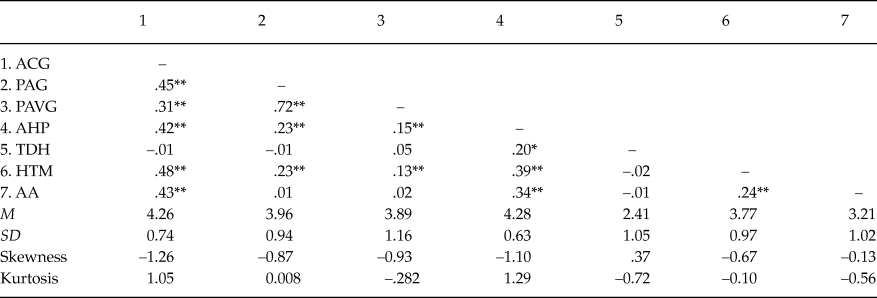
Table 1 shows the descriptive statistics and correlations between the variables used to distinguish motivational profiles and the rest of the variables analyzed in this study. As can be seen, the competence acquisition and control goals related significantly and positively with all variables except for the time spent on homework variable. Moreover, this last variable only seemed to show a positive and significant relationship with the amount of homework performed. The other two types of goals (performance-approach goal orientation and performance-avoidance goal orientation) had positive and significant relationships with all variables, except for time spent on homework and academic achievement. On the other hand, the amount of homework performed and the homework time management were positively and significantly related to each other, but also showed significant positive correlations with academic achievement.
Means, standard deviations, skewness, kurtosis and correlation matrix

1. ACG (acquisition of competence and control goals), 2. PAG (performance-approach goals), 3. PAVG (performance-avoidance goals), 4. AHP (amount of homework performed), 5. TSH (time spent on homework), 6. HTM (homework time management), 7. AA (academic achievement).
* p < .05. **p < .01.
As occurs in many cases when dealing with real data from the field of social sciences, the present study did not strictly fulfill assumptions of multivariate normality (although this did occur at a univariate level, since skewness and kurtosis were within normal univariate ranges) and homocedasticity (Box’s M = 97.58; F(20, 219082) = 4.80; p < .001). However, this did not invalidate the data analysis using ANOVAs, as the study’s sample was large (n > 30). Even in the smallest group, the effect of the breach of the above assumptions was estimated to be negligible. According to Harris (Reference Harris1985), with these sample sizes, multivariate analyses are robust enough to be insensitive to slight deviations from the parametric assumptions, mainly from the multivariate normality and homoscedasticity.
Identification of motivational groups
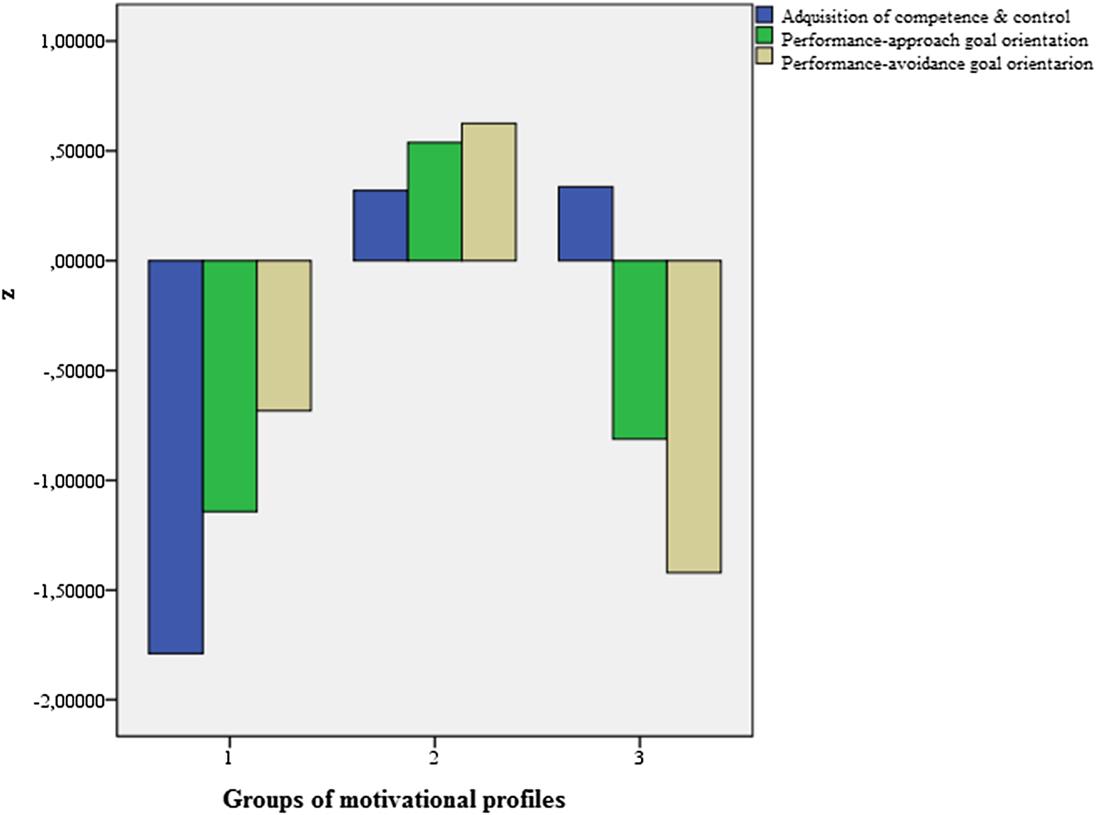
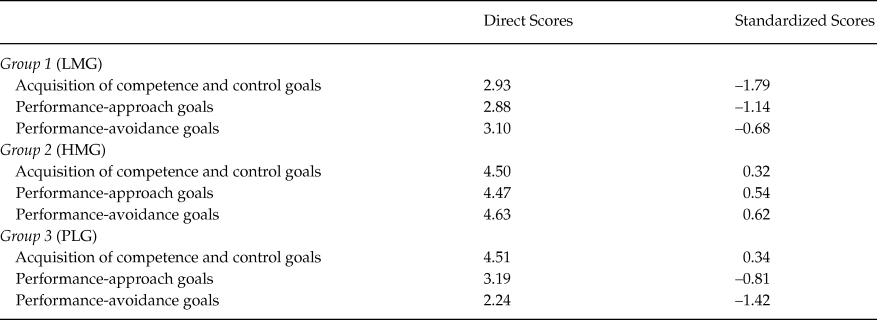
Using cluster analysis, three motivational groups were identified (see Figure 1 and Table 2). Group 1 was comprised of only 82 students (15.3% of total sample), and can be defined by low scores in the three types of goals (which was named the Low Multiple Goals Group, LMG), with statistically significant differences by gender (58.5% males, z = 2.19, p = .03; d = 0.50) and between 4th and 5th course (26.9, 40.2 and 32.9% of 4th, 5th and 6th respectively, z (4th-5th) = -2.10, p = .04, d = 0.59; z (4th-6th) = -1.01, p = .31; z (5th-6th) = 1.09, p = .27). Group 2, consisting of 342 students (63.9% of the sample) was defined by high scores on the three types of goals (which was entitled the High Multiple Goals Group, HMG), with no differences according to gender (51.2% male, z = 0.61, p = .54), but yielding differences per course (48, 33.3 and 18.7% of 4th, 5th and 6th respectively, z (4th-5th) = 4.24, p < .001, d = 0.52; z (4th-6th) = 9.36, p < .001, d = 1.39; z (5th-6th) = 5.30, p < .001, d = 0.83. Group 3 consisted of 111 students (20.7% of the sample) defined by a predominance of study involvement goals for the acquisition of competence and control (known as Predominantly Learning Goals Group, PLG), showing statistically significant differences by gender (63.1% female, z = -3.89, p < .001, d = 0.77), but not by course (27.1, 36.9 and 36% in 4th, 5th and 6th respectively, z (4th-5th) = -1.85, p = .06; z (4th-6th) = -1.69, p = .09; z (5th-6th) = 0.16, p = .87).
Graphical representation of motivational groups identified through cluster analysis.

Direct and standardized (z) scores for the three types of academic goals for each of the motivational groups identified

LMG (low multiple goals); HMG (high multiple goals); PLG (predominantly learning goals).
Although clusters were chosen to maximize the differences between the groups, a MANOVA was performed to check for statistically significant inter-group differences in the three motivational variables used for the production of profiles (involvement in study for the acquisition of competence and control goals, involvement in study in order to search for performance-approach goals, and performance-avoidance goals). The results indicate that there are statistically significant inter-group differences among the three variables (Wilks’ Lambda = .103; F(6, 1060) = 372.56, p < .001, ηp 2 = .68), and in each variable considered individually: involvement in study for the acquisition of competence and control goals (F(2, 532) = 367.21, p < .001, ηp 2 = .58), involvement in study in order to search for performance-approach goals (F(2, 532) = 290.93, p < .001, ηp 2 = .52) and performance-avoidance goals (F(2, 532) = 761.29, p < .001, ηp 2 = .74). The magnitude of the differences between groups was large.
Profiles of involvement in homework and academic achievement of the three motivational groups
In this study, the profile analysis, equivalent to a repeated measures multivariate analysis, aimed to check if the involvement in homework and academic achievement profiles corresponding to the three groups identified by cluster analysis (a) were parallel, (b) had the same level, and (c) showed flatness. Figure 2 shows the graphical representation of the profiles mentioned above.
Profiles of the three groups of students in relation to their involvement in carrying out homework and academic achievement.

The Parallelism hypothesis is frequently the one of most interest in the analysis of the profiles. In the present research, the profile consists of three measures related to student involvement in homework (time spent in performing homework, managing that time and the amount of homework performed) and academic achievement. Parallel testing has to do with whether each profile segment is the same across groups. In this study, the data provided by the performed MANOVA indicated that there was a statistically significant interaction between the two factors included in the analysis (λWilks = .93, F(6, 1060) = 6.93, p < .001, ηp 2 = .04): the group (the three motivational groups) and time (the measures of the four dependent variables). In the presence of statistical interaction, it can be said that there was no parallelism between the three profiles, although the multivariate test did not report what parts of the profile were responsible for the lack of parallelism. Visual inspection of Figure 2 suggests that it was primarily the time spent on homework variable that was responsible for the interaction effects between profiles. The remaining segments showed roughly equivalent slopes.
Similarly to the parallelism test, the flatness hypothesis is a multivariate test in which the multiple segments of the same profile are compared. The null hypothesis is that the slope of each of the segments that make up each of the profiles is zero (and hence the profile is flat). In this study, the results of the repeated measures MANOVA showed that the flatness of the profiles was statistically different from zero (F(1, 532) = 174.86, p < .001, ηp 2 = .25) and therefore, showed that they were not flat. These data suggest that there were statistically significant differences between the scores of the three variables related to involvement in homework and academic achievement (when compared to each other).
Finally, as to the level of the profiles, it is interesting to know if the average of the measures that compose each profile is statistically different between groups. In this case, a univariate test should be performed, since a great mean for each group is created, based on the specific measures that make up the profile. The obtained data indicated that the levels of the three groups were statistically different (F(2, 532) = 53.12, p < .001, ηp 2 = .17). The observation of Figure 2 suggests the existence of two levels, which was confirmed by the homogeneous subsets test: a lower level corresponding to the low motivation (LMG) group profile and an upper level where the other two profiles (HMG and PLG) would be, since the Scheffé’s test indicated no statistically significant difference between them (p = .60).
Since the results discussed in relation to the level of the profiles are related to the set of scores that make up the profile, the between-group differences for each of the dependent variables were analyzed next.
Between-group differences for involvement in homework and academic achievement
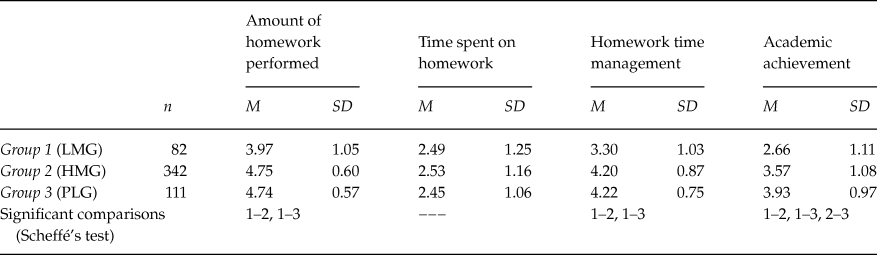
The results indicate that there were statistically significant differences between the motivational groups in the amount of homework (F(2, 530) = 42.59; p < .001; ηp 2 = .138), in the management of time spent on homework (F(2, 530) = 33.08; p < .001; ηp 2 = .111) and academic achievement (F(2, 530) = 33.99; p < .001; ηp 2 = .114). The effect size was large for the amount of homework performed and was also relatively large in the case of management of time and academic achievement. However, there were no statistically significant differences between motivational profile groups in the time spent on homework. Table 3 shows the descriptive statistics and significant comparisons (Scheffé’s test) of the three motivational groups for the dependent variables.
Descriptive statistics and statistical significance of the differences between the three motivational profile groups for the analyzed variables

Note: Group 1 (LMG; low multiple goals), Group 2 (HMG ; high multiple goals), Group 3 (PLG; predominantly learning goals).
From these results, it follows that the group of students with a motivational profile primarily aimed at the acquisition of competence and control (Group 3, PLG) obtained a significantly higher achievement than the group with multiple low goals (Group 1, LMG) and even than the group with multiple high goals (Group 2, HMG). Moreover, HMG also obtained significantly higher academic achievement than LMG.
As for the variables associated with involvement in homework, (a) no statistically significant differences among the three groups were found in time spent on homework; (b) however, both the amount of homework performed and the homework time management, LMG obtained significantly lower scores than the other two motivational groups (HMG and PLG). No statistically significant differences were observed between the HMG and PLG groups.
Discussion
In spite of the characteristic limitations of a cross-sectional study, where information is mainly provided through self-report measures, the results of this study appear to provide new information on the relationship between academic motivation, performing homework and academic achievement. In addition, the motivation construct was analyzed from a multiple goals perspective, which had received little attention so far in ES students.
Regarding the identified motivational groups, there is a majority of students characterized by high multiple goals (HMG), meaning that they would be highly motivated to both, learn and strive for achievement or avoid failure, depending on the situation. Another group, which integrates the 20.7% of students, adopted a profile clearly orientated towards learning and the acquisition of competence and control (PLG) profile, implying that their activity would be directed towards the pursuit of learning (intrinsically motivated), without fear of failure, but would not be especially interested in their performance. Finally, a third group, which integrated the 15.4% of students defined by a low multiple goal motivational profile (LMG), implying low motivational levels with little chance of sustaining a conduct directed towards learning or performance.
In relation to the differences between motivational groups in the variables related to homework, the most relevant results were as follows. Firstly, and contrary to hypotheses, it was observed that the time devoted to homework was not associated with the type of motivational profile (as shown in Figure 2, there were no differences among the three groups). However, as was hypothesized, a relationship between these motivational profiles and the management of time and amount of homework performed was found. It was observed that poorly motivated students managed time more poorly and completed less amount of homework than highly motivated students. Thirdly, in this case, and in line with the hypotheses of this study, the fact that there were no differences between the HMG and PLG groups may have occurred because both groups exhibited a high motivational component towards learning.
Fourthly, and also in accordance with predictions, the three motivational groups were differentially associated with academic achievement. The highest performance was obtained by students with a profile mainly oriented towards learning (PLG), with a minimal fear of failure and a low interest for performance as a goal in itself. The performance was slightly lower for students with high multiple goals (HMG), that is, they were equally motivated to learn and to obtain a good performance, but with a high component of fear of failure. Finally, the group with little interest in learning or performing and with a low fear of failure (LMG) were the students who obtained the worst performance.
Based on these results, it seems clear that the most maladaptive motivational profile regarding the amount of homework, the management of time spent on homework and academic achievement is undoubtedly Group1 (LMG), characterized by low goals aimed at developing and increasing knowledge and skills (learning or domain goals), by low goals aimed at demonstrating these skills (performance-approach goals) and by low goals oriented at avoiding seeming incompetent and incapable in front of others (performance-avoidance or failure-avoidance goals). On the other hand, the more adaptive motivational profiles seem to be those that have a profile with an exclusive predominance of high goals aimed at improving their skills and knowledge (HMG), characterized by an interest in learning, without fear of failure and with little interest in performance if it is not accompanied by learning. Conversely, when interest in learning appears in combination with other goals aimed at achieving better results than others and avoiding a bad image before them (fear of failure), academic achievement significantly decreased in comparison to that obtained by the exclusive learning or domain goals profile. These results obtained with elementary students are not consistent with those obtained in other studies with students from other educational stages (e.g., university), where the combined profile of high learning goals, high performance approach goals and high performance avoidance goals is the one that yields a higher academic achievement (see e.g., Valle et al., Reference Valle, Núñez, Rodríguez, Cabanach, González-Pienda and Rosário2010).
One of the keys that can possibly explain the difference in these results is that the link between learning motivation and academic achievement is much clearer in the early stages of education and loses exclusivity in later stages. As students progress through the different educational stages, other reasons and goals acquire a growing role. In many cases, these reasons are closely linked to the competitive nature of the education system derived from a kind of normative evaluation where high academic qualifications become a demonstration of capabilities and skills before others and low grades become a sign of incompetence. By establishing this link, a relevant set of goals, reasons and motives directly related to self-image and self-worth of the student come into play, in some cases to improve them and in other cases to protect and defend them. In fact, some authors (e.g., Bong, Reference Bong2009; Midgley, Kaplan, & Middleton, Reference Midgley, Kaplan and Middleton2001; Shim, Ryan, & Anderson, Reference Shim, Ryan and Anderson2008) have posed that relationship between academic goals and performance changes as students progress throughout the education system. Thus, the learning or domain goals would be most beneficial in elementary courses, showing a positive relationship with academic performance (Paulick, Watermann, & Nucklës, Reference Paulick, Watermann and Nucklës2013), yet they would lose weight throughout Secondary school and University, where relationships would be weaker. These results are of great importance, especially because of the close relationship between motivational variables and other constructs, such as learning strategies or prosocial behavior in certain educational stages (e.g., Inglés, Martínez-González, & García-Fernández, Reference Inglés, Martínez-González and García-Fernández2013).
Therefore, those ES students with a motivational profile exclusively oriented towards learning would live a quieter and more enjoyable experience in terms of motivation, positive affect, effort and strategy use in their “journey” towards achieving good academic results. However, in the case of those students with a combined profile of learning goals, performance-approach goals and performance-avoidance goals, perhaps their desire to outdo others and to avoid being the worst can lead them to a considerable increase in their levels of concern and even anxiety levels in all situations involving an assessment of their academic progress based primarily on interpersonal comparison criteria. Moreover, in some cases, it is possible that some of these students would try to demonstrate less effort because of their objective to appear more capable than their peers.
Educational implications
With regard to the educational implications of this study, it seems that if students have motivational profiles in which the priority is learning, they will not only carry out a larger amount of homework (assigned by their teachers) but may even manage better the time spent performing this homework. Therefore, being motivated to learn is positively associated with higher amount of homework carried out and with a more efficient use of their skills to manage time spent on homework. Furthermore, being motivated to learn, at least in elementary education, seems to be a certain guarantee of academic success.
However, the results of this study also indicate that academic achievement in elementary education has a much stronger positive relationship with those motivational profiles where the only priority is to learn than with those other profiles where the desire to learn and improve skills is combined with other reasons linked to the desire to demonstrate these skills to others. Probably, students motivated to learn will perform more homework and will manage their time more adequately, focusing their attention and resources towards achieving deep and meaningful learning processes, which, in turn will yield significant benefits in motivational and emotional terms. And this pleasant “journey” throughout this process will allow them not only to achieve a higher quality of learning but also to achieve the best academic results. On the other hand, students who are motivated to learn in order to be the best and to avoid being the worst, will also carry out more homework and will properly manage their time spent on homework. However, their focus of attention will not be exclusively centered on learning but other reasons will come into play. These reasons will use interpersonal comparison criteria in order to judge and assess their academic success or failure instead of using criteria of a more intrapersonal type, as can be observed in the case of students who exhibit a profile with the exclusive desire to learn and acquire knowledge. The difference in these comparison criteria found in the journey through the learning process can be one of the reasons why there are differences in academic achievement between the two motivational profiles that have high learning goals.
As indicated at the beginning of this section, this study is not without limitations, which should be considered when drawing conclusions. One of the mentioned limitations is that data from this study were collected through a cross-sectional strategy (on a single temporal moment), which precludes causal inferences. Therefore, when it is suggested, for example, that students with greater motivation towards acquiring competence and control are those that invest most time in doing homework, that take better advantage of them and perform more homework, only a relationship between motivation and behavior of the students can be assumed when performing homework, but no causal relationship can be assumed (however intuitive that relationship may seem). Moreover, it is also necessary to note that the information was obtained through student response. In this sense, there are clearly two limitations. Firstly, in relation to the three variables directly related to homework, data refer to the students’ perception, which may vary from what actually happens. It is possible that results may vary substantially if such information had been provided by the students’ parents. Secondly, the data collected are obtained through self-report (except academic achievement), which could compromise the accuracy of the data, as the students’ degree or ability to access this information is clearly involved. Future research could complement the data provided by this study by using other means of obtaining information that do not include self-report.
Finally, as in this study, like in other studies (e.g., Xu, Reference Xu2005; Xu, Reference Xu2011; Zimmerman & Kitsantas, Reference Zimmerman and Kitsantas2005), a relationship between the type of motivation and student behavior when performing homework was observed, it would be necessary to carry out a longitudinal research plan (e.g., repeated measures), in order to investigate the power or effect of the type of motivation (or of the motivational profile) on the student’s behavior when performing homework. Furthermore, the process of homework performance should be studied as a variable mediating between students’ motivation and behavior. For example, based on the results of previous studies in the field of educational learning (e.g., González-Pienda, Fernández, Bernardo, Núñez, & Rosário, Reference González-Pienda, Fernández, Bernardo, Núñez and Rosário2014; Pérez, Valenzuela, Díaz, González-Pienda, & Núñez, Reference Pérez, Valenzuela, Díaz, González-Pienda and Núñez2011; Rosário et al., Reference Rosário, Núñez, Ferrando, Paiva, Lourenço, Cerezo and Valle2013; Rosário et al., Reference Rosário, Núñez, Trigo, Guimarães, Fernández, Cerezo and Figueiredo2015; Valle, Núñez et al., Reference Valle, Núñez, Cabanach, Rodríguez, Rosário and Inglés2015), it is possible that when a student is highly motivated to learn, he/she will try to perform homework from a “deep focus”, which could significantly affect the amount of time spent carrying out homework, how they take advantage of it, the amount of homework performed and, eventually, their obtained performance/achievement.
This work was carried out using funding from the research project EDU2013–44062-P, belonging to the State Plan of Scientific and Technical Research and Innovation (Plan Estatal de Investigación Científica y Técnica y de Innovación) 2013–2016 (MINECO) and from the funding received by one of the authors in the FPU program of the Ministry of Education, Culture and Sport (Ministerio de Educación, Cultura y Deporte) and a Predoctoral stay grant awarded by INDITEX-UDC 2014.