Implications
The paper reports on technical options for the mitigation of livestock sector's contribution to climate change. On the basis of a comprehensive review of in vivo studies, it provides the researcher and the livestock sector stakeholder with concise information on exiting mitigation practices, their effectiveness and interactions. Uncertainties and areas for further research are also highlighted. It is hoped that the paper will contribute to the identification of lower greenhouse gas -emission pathways for livestock production.
Introduction
In view of livestock's sizeable contribution to global warming, this review assesses the veracity, efficacy and feasibility of the many mitigation options that have been put forward by practitioners and researchers over the past few decades. This review spans the breadth of the literature on mitigation, drawing primarily on a recent comprehensive review of mitigation measures for livestock by Hristov et al. (Reference Hristov, Oh, Lee, Meinen, Montes, Ott, Firkins, Rotz, Dell, Adesogan, Yang, Tricarico, Kebreab, Waghorn, Dijkstra and Oosting2013), which incorporates information from over 900 references. This review also benefitted from an expert consultation, which assembled leading global scientists to peer-review and improve the review by Hristov et al. (Reference Hristov, Oh, Lee, Meinen, Montes, Ott, Firkins, Rotz, Dell, Adesogan, Yang, Tricarico, Kebreab, Waghorn, Dijkstra and Oosting2013). Much of the discussion on interactions between mitigation practices and greenhouse gases (GHGs) in this paper is derived from the workshop.
Livestock production plays a crucial role in food security, rural livelihoods and development at large (Herrero et al., Reference Herrero, Grace, Njuki, Johnson, Enahoro, Silvestri and Rufino2013). It also accounts for a substantial share of global anthropogenic GHG. If all emissions along the livestock supply chain are considered, this contribution amounts to 7.1 Gt CO2-eq, for the 2005 reference period (FAO, 2013a and 2013b). When considering only the direct CH4 and N2O emissions from enteric fermentation and manure (including its application), livestock are estimated to contribute 5.4 Gt CO2-eq to global emissions (FAO, 2013a and 2013b).
Large differences in emission intensities and/or quantities are observed between species, regions and production systems. When considering total supply chain emissions, cattle (beef and dairy) production generates 4.6 Gt, the largest share of global livestock emissions by some margin. This figure drops to a still significant 3.3 Gt when only the direct CH4 and N2O emissions from enteric fermentation and manure are considered (FAO, 2013b). This massive contribution stems from cattle's dominant global share of live animal biomass and, like all ruminant animals, from their fermentative digestive system.
Other livestock species have much lower and similar levels of emissions, even when considering the full lifecycle of emissions: pigs (0.7 Gt CO2-eq), poultry (0.7 Gt CO2-eq), buffalo (0.6 Gt CO2-eq) and small ruminants (0.5 Gt CO2-eq) (FAO, 2013a and 2013b).
Of the 3.3 Gt of direct cattle GHG emissions, CH4 from enteric fermentation is the largest source, accounting for a 71% share. Manure N2O, particularly from deposition on pasture, accounts for the next largest share (25%), whereas the remaining 4% is from manure CH4 (FAO, 2013b).
Direct emissions typically account for 15% and 35% in poultry and pig production, respectively. Emissions related to manure storage and processing are important for pig supply chains with 27% of emissions (FAO, 2013a).
In addition to direct emissions, livestock supply chains release GHG through animal feed production and post-harvest activities. Feed production is the main source of indirect emissions and is particularly important for the monogastric sector. Emissions (primarily N2O) from feed production are almost equal in size to direct emissions. They represent 36% of cattle supply chain emissions, 60% of pork supply chains emissions and 75% for chicken and egg supply chains. A lifecycle framework can be used to account for these feed emissions, as well as those from off-farm emission sources (e.g. from processing, transport and land-use change) (FAO, 2013a and 2013b).
Emissions related to land-use change for pasture or feed crop expansion are insignificant. They represent almost 15% of emissions for beef, 13% for pigs and 18% for chicken. Broiler rations include a higher share of soy sourced from areas where land-use conversion is taking place, whereas land-use change emissions are of little importance for the dairy sector. Energy consumption along the supply chain contribute a significant share of emissions, especially in monogastric production where they can represent up to 40% of emissions in chicken production (FAO, 2013a).
The emission intensity (Ei) of a commodity, measured as the quantity of GHG emissions generated per unit of output, is a useful metric for several reasons. It allows for meaningful comparison of emissions especially within, but also between, commodities. It is also very closely linked to the productivity of the system, measured in terms of output per animal, or on a whole herd basis. Moreover, as productivity improvements can increase profits at the same time as lowering Ei, they may also present opportunities to profitably invest in mitigation. The Ei metric can also accommodate emission reductions (or emissions stabilization) alongside expanding output, which is important, given that livestock commodity production is projected to grow at a steady pace until at least the middle of this century. Mitigation measures that improve productivity also have the best prospects for minimizing the trade-offs between mitigation, food security and producer welfare. At the same time, profitable productivity improvements will, in many cases, encourage the sector to expand; therefore, from a policy perspective they are necessary options, which can only be sufficient for mitigation if coupled with policies to restrict the sector's total quantity of emissions.
This review focuses on mitigation options for direct emissions: enteric CH4 mitigation practices for ruminant animals (only in vivo studies were considered in the original review by Hristov et al., Reference Hristov, Oh, Lee, Meinen, Montes, Ott, Firkins, Rotz, Dell, Adesogan, Yang, Tricarico, Kebreab, Waghorn, Dijkstra and Oosting2013) and manure mitigation practices for both ruminant and monogastric species. Mitigation options that reduce Ei only by increasing herd productivity (e.g. animal husbandry, genetics and health management) while keeping herd GHG output constant (or increasing it proportionally less than productivity) are not included in this review, despite their great relevance among low-intensity ruminant systems (Gerber et al., Reference Gerber, Vellinga, Opio and Steinfeld2011; FAO, 2013a and 2013b).
In the following section, mitigation options for reducing enteric CH4 production are reviewed. These options fall into two broad categories of feed supplements and feeds/feeding management. Following this, mitigation options for manure management are reviewed. These include dietary management options, but the focus is mainly on a range of ‘end-of-pipe’ options for the storage, handling and application phases of manure management.
After this, the role of interactions between mitigation options, productivity and emission sources is explored for both ruminant and monogastric animals. Particular attention is given to the risks of pollution swapping, as well as other possible unintended impacts of mitigation.
Mitigation options for enteric methane emissions
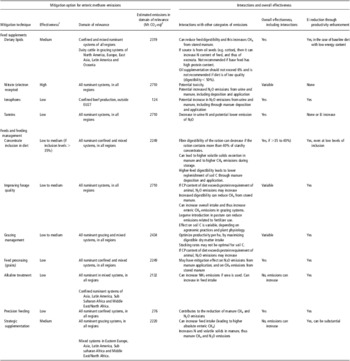
Methane and CO2 are the major by-products of microbial fermentation of carbohydrates in the rumen and both are GHGs. Methane is produced in the anaerobic conditions of the rumen by archaea. In ruminants, the vast majority of enteric CH4 production occurs in the reticulo-rumen. Rectal emissions account for a marginal share of emissions (Murray et al., Reference Murray, Bryant and Leng1976; Muñoz et al., Reference Muñoz, Yan, Wills, Murray and Gordon2012). A number of approaches, evaluated for mitigation of enteric CH4, are presented in Table 1.
Technical options for the mitigation of enteric methane emissions and their interactions with other categories of emissions

1Low = ⩽ 10% mitigating effect; medium = 10 to 30% mitigating effect; high = ⩾ 30% mitigating effect. Mitigating effects refer to percent change over a ‘standard practice’, that is, study control that was used for comparison and are based on combination of study data and judgement by the authors of this document. For a detailed discussion, see Hristov et al. (Reference Hristov, Oh, Lee, Meinen, Montes, Ott, Firkins, Rotz, Dell, Adesogan, Yang, Tricarico, Kebreab, Waghorn, Dijkstra and Oosting2013).
Mitigation options assessed but not recommended by Hristov et al. (Reference Hristov, Oh, Lee, Meinen, Montes, Ott, Firkins, Rotz, Dell, Adesogan, Yang, Tricarico, Kebreab, Waghorn, Dijkstra and Oosting2013), such as rumen archaea inhibitors (e.g. bromochloromethane), exogenous enzymes, rumen defaunation and yeast-based probiotics are not included in this review.
Vaccines against archaea have been successful in vitro (Wedlock et al., Reference Wedlock, Pedersen, Denis, Dey, Janssen and Buddle2010) and are a very promising option that could be applied to all ruminants, even in grazing situations with little human contact. As there are currently no vaccines that are ready for practical application (Clark et al., 2004; Wright et al., Reference Wright, Kennedy, O'Neill, Toovey, Popovski, Rea, Pimma and Klein2004) and they are also discussed in another review at this meeting (Wedlock et al., 2013), they are excluded from this review.
Feed supplements
Dietary lipids
On the basis of several studies (Eugene et al., Reference Eugène, Masse, Chiquette and Benchaar2008; Grainger and Beauchemin Reference Grainger and Beauchemin2011; Rabiee et al., Reference Rabiee, Breinhild, Scott, Golder, Block and Lean2012), Hristov et al. (Reference Hristov, Oh, Lee, Meinen, Montes, Ott, Firkins, Rotz, Dell, Adesogan, Yang, Tricarico, Kebreab, Waghorn, Dijkstra and Oosting2013) conclude that lipids are effective in reducing enteric CH4 emission, but the feasibility of this mitigation practice depends on affordability of oil products and potential negative effects on animal productivity, for example, reduction in fibre digestibility. Although Eugène et al. (Reference Eugène, Martin, Mialon, Krauss, Renand and Doreau2011) reported that the combination of CH4 reductions and reduced dry matter intake (DMI) resulted in no difference in CH4 per unit of DMI, Rabiee et al. (Reference Rabiee, Breinhild, Scott, Golder, Block and Lean2012) reported consistent reductions in CH4 production per unit of DMI, or Ei for dairy cows. Grainger and Beauchemin (Reference Grainger and Beauchemin2011) concluded that with up to 8% fat in the diet, a 10 g/kg increase in dietary fat would decrease CH4 yield by 1 g/kg DMI in cattle and 2.6 g/kg in sheep. However, the effect of these treatments on animal production over a longer time period was not reported. The important question of persistence of the effect of lipids on CH4 production has not been adequately addressed (Woodward et al., Reference Woodward, Waghorn and Thomson2006). Some studies do report long-term effects of dietary lipids, but data are inconsistent (Holter et al., Reference Holter, Haves, Urban and Duthie1992; Grainger et al., Reference Grainger, Clarke, Beauchemin, McGinn and Eckard2008 and Reference Grainger, Williams, Clarke, Wright and Eckard2010b; Grainger and Beauchemin, Reference Grainger and Beauchemin2011).
Electron receptors
Recent research on sheep (Sar et al., Reference Sar, Santoso, Mwenya, Gamo, Kobayashi, Morikawa, Kimura, Mizukoshi and Takahashi2004; Nolan et al., Reference Nolan, Hegarty, Hegarty, Godwin and Woodgate2010; van Zijderveld et al., Reference Van Zijderveld, Gerrits, Apajalahti, Newbold, Dijkstra, Leng and Perdok2010) and cattle (van Zijderveld et al., Reference Van Zijderveld, Fonken, Dijkstra, Gerrits, Perdok, Fokkink and Newbold2011a and Reference Van Zijderveld, Gerrits, Dijkstra, Newbold, Hulshof and Perdok2011b; Hulshof et al., Reference Hulshof, Berndt, Gerrits, Dijkstra, van Zijderveld, Newbold and Perdok2012) has shown promising results with nitrates decreasing enteric CH4 production by up to 50%. Nitrates may be particularly attractive in developing countries where forages contain negligible levels of nitrate and insufficient CP for maintaining animal production. When nitrates are used, it is critical that the animals are properly adapted to avoid nitrite toxicity (Hristov et al., Reference Hristov, Oh, Lee, Meinen, Montes, Ott, Firkins, Rotz, Dell, Adesogan, Yang, Tricarico, Kebreab, Waghorn, Dijkstra and Oosting2013). Adding sulfate to the diet of sheep reduced CH4 production, but their potential effects on animal health are unclear. Other electron acceptors such as fumaric and malic acids may reduce CH4 production when applied in large quantities, but most results indicate no mitigating effect and their costs are likely to be prohibitive (Hristov et al., Reference Hristov, Oh, Lee, Meinen, Montes, Ott, Firkins, Rotz, Dell, Adesogan, Yang, Tricarico, Kebreab, Waghorn, Dijkstra and Oosting2013).
Ionophores
A meta-analysis of 22 controlled studies concluded that monensin had stronger anti-methanogenic effect in beef steers than dairy cows, but the effects in dairy cows can potentially be improved by dietary modifications and increasing monensin dose (E. Kebreab, 2012, University of California—Davis, USA, personal communication). Other meta-analyses have shown monensin to improve feed efficiency in beef cattle in feedlots (by 7.5%; Goodrich et al., Reference Goodrich, Garrett, Gast, Kirick, Larson and Meiske1984) and on pasture (by 15%; Potter et al., Reference Potter, Muller, Wray, Carroll and Meyer1986), and for dairy cows (by 2.5%; Duffield et al., Reference Duffield, Rabiee and Lean2008), which can lower enteric CH4 Ei. However, ionophores are banned in the European Union, and therefore not applicable everywhere. On the basis of the available information, it is surmised that ionophores, through their effect on feed efficiency, would likely have a moderate CH4-mitigating effect in ruminants fed high-grain or grain-forage diets. This effect is less consistent in ruminants fed pasture (Hristov et al., Reference Hristov, Oh, Lee, Meinen, Montes, Ott, Firkins, Rotz, Dell, Adesogan, Yang, Tricarico, Kebreab, Waghorn, Dijkstra and Oosting2013).
Tannins and saponins
Tannins as feed supplements or as tanniferous plants have often, but not always (Beauchemin et al., Reference Beauchemin, McGinn, Martinez and McAllister2007a), shown potential for reducing enteric CH4 emissions, in some cases by up to 20% (Sliwinski et al., Reference Sliwinski, Kreuzer, Wettstein and Machmuller2002; Zhou et al., Reference Zhou, Chung, Beauchemin, Holtshausen, Oba, McAllister and Guan2011a; Staerfl et al., Reference Staerfl, Zeitz, Kreuzer and Soliva2012).
However, the effects of tannins on animal digestion and productivity are variable between studies. Some of the variation may be explained by the type, concentration and protein-binding capacity of the tannins, the type of technique used to measure the tannin concentration and failure to distinguish between condensed and hydrolyzable tannins (Makkar, Reference Makkar2003). In an extensive review of the effect of saponins and tannins on CH4 production in ruminants, mostly on the basis of in vivo studies, Goel and Makkar (Reference Goel and Makkar2012) concluded that the risk of impaired rumen function and animal productivity is greater with tannins than with saponins.
Hydrolyzable and condensed tannins may thus offer an opportunity to reduce enteric CH4 production, although intake and animal production may be compromised. Tea saponins seem to have shown some potential, but more and long-term studies are required before they could be recommended for use (Hristov et al., Reference Hristov, Oh, Lee, Meinen, Montes, Ott, Firkins, Rotz, Dell, Adesogan, Yang, Tricarico, Kebreab, Waghorn, Dijkstra and Oosting2013).
Feeds and feeding management
Feed intake
Feed intake is an important variable in predicting CH4 emissions. Johnson and Johnson (Reference Johnson and Johnson1995) stated that CH4 loss as a percentage of gross energy intake (Ym) decreases by 1.6% units per each level of intake above maintenance. For growing lambs on pasture, Hegarty et al. (Reference Hegarty, Alcock, Robinson, Goopy and Vercoe2010) predicted both a linear increase in average daily gain (ADG) and an increase in CH4 production, with increased DMI, with the rate of ADG being greater for feeds of greater digestibility. Further, as the amount of CH4 released per unit of additional intake is greater for lower-digestibility feeds, the Ei of growth at any given DMI is less for high-digestibility feeds than for low-digestibility feeds. Moreover, small changes in energy intake result in small changes in CH4 output, but in large changes in animal performance (Hegarty et al., Reference Hegarty, Alcock, Robinson, Goopy and Vercoe2010).
Concentrate inclusion in the diet
Hristov et al. (Reference Hristov, Oh, Lee, Meinen, Montes, Ott, Firkins, Rotz, Dell, Adesogan, Yang, Tricarico, Kebreab, Waghorn, Dijkstra and Oosting2013) concluded that the inclusion of concentrate feeds in the diet of ruminants will likely decrease enteric CH4, particularly when inclusion is above 35% to 40% of DMI (based on a meta-analysis by Sauvant and Giger-Reverdin, Reference Sauvant and Giger-Reverdin2009). However, the effect will depend on inclusion level, type of grain and grain processing, fibre digestibility, rumen function and production responses. Although supplementation with small amounts of concentrate feeds will increase animal productivity and thus decrease GHG Ei, if the emissions from concentrate feed production are included, absolute GHG emissions may not always decrease (FAO, 2013b). Furthermore, concentrate inclusion may not be an economically feasible and socially acceptable mitigation option in many parts of the world (Hristov et al., Reference Hristov, Oh, Lee, Meinen, Montes, Ott, Firkins, Rotz, Dell, Adesogan, Yang, Tricarico, Kebreab, Waghorn, Dijkstra and Oosting2013).
Forage quality and management
Harvesting forage at an earlier stage of maturity increases its soluble carbohydrate content and reduces lignification of plant cell walls, thereby increasing its digestibility (Van Soest, Reference Van Soest1994), and decreasing enteric CH4 production per unit of digestible dry matter (Tyrrell et al., Reference Tyrrell, Thomson, Waldo, Goering and Haaland1992; Boadi and Wittenberg, 2002). However, effects of forage quality on methane production are often contradictory (Hart et al., Reference Hart, Martin, Foley, Kenny and Boland2009).
High-sugar grasses (i.e. grasses with elevated concentrations of water-soluble carbohydrates) have been investigated as a tool for mitigating the environmental impact of livestock. These forages may have some mitigation effect on N losses, but the prospect for reducing enteric CH4 emissions is uncertain (Parsons et al., Reference Parsons, Rowarth and Rasmussen2011). No effect of high-sugar grasses on CH4 emissions in dairy cows was reported by Staerfl et al. (Reference Staerfl, Amelchanka, Kälber, Soliva, Kreuzer and Zeitz2012).
In a meta-analysis of data generated with grasses and legumes, Archimède et al. (Reference Archimède, Eugène, Magdeleine, Boval, Martin, Morgavi, Lecomte and Doreau2011) showed that C4 grasses produce greater amount of enteric CH4 than C3 grasses, and recommended the use of legumes in warm climates as a mitigation option, as animals fed warm climate legumes produced 20% less CH4 than animals fed C4 grasses. However, low persistence and a need for long establishment periods are important agronomic constraints for this option (Hristov et al., Reference Hristov, Oh, Lee, Meinen, Montes, Ott, Firkins, Rotz, Dell, Adesogan, Yang, Tricarico, Kebreab, Waghorn, Dijkstra and Oosting2013). Pasture management can also be an important CH4-mitigation practice. DeRamus et al. (Reference DeRamus, Clement, Giampola and Dickison2003) demonstrated that management-intensive grazing offered a more efficient use of grazed forage crops and more efficient conversion of forage into meat and milk, which resulted in a 22% reduction of projected CH4 annual emissions from beef cattle. A study from Canada (McCaughey et al., Reference McCaughey, Wittenberg and Corrigan1999) reported lower enteric CH4 losses in beef cattle grazing alfalfa grass pastures than in cows grazing grass-only pastures. Studies by Waghorn et al. (2002) showed sheep fed white clover, Lotus pedunculatus, and other legumes had much lower CH4 yields compared with sheep fed ryegrass.
Feed processing
In ruminants, forage particle size reduction through mechanical processing or chewing is an important component of enhancing forage digestibility, providing greater microbial access to the substrate, reducing energy expenditures and increasing passage rate, feed intake and animal productivity (Hristov et al., Reference Hristov, Oh, Lee, Meinen, Montes, Ott, Firkins, Rotz, Dell, Adesogan, Yang, Tricarico, Kebreab, Waghorn, Dijkstra and Oosting2013). A recent study by Hales et al. (Reference Hales, Cole and MacDonald2012b) with steers compared dry-rolled v. steam-flaked corn and reported increased digestibility and about 17% less CH4 emissions (per unit of DMI) with the latter treatment. Although processing of grain is likely to reduce enteric CH4 production per unit of animal product, caution should be exercised so that this does not result in decreased fibre digestibility (Hristov et al., Reference Hristov, Oh, Lee, Meinen, Montes, Ott, Firkins, Rotz, Dell, Adesogan, Yang, Tricarico, Kebreab, Waghorn, Dijkstra and Oosting2013). In low-input production systems, more minimal approaches to grain processing will be more economically feasible.
Precision feeding
Precision feeding would likely have an indirect effect on enteric CH4 emissions through maintaining a healthy rumen and maximizing microbial protein synthesis, which is important for maximizing feed efficiency and decreasing CH4 Ei (Hristov et al., Reference Hristov, Oh, Lee, Meinen, Montes, Ott, Firkins, Rotz, Dell, Adesogan, Yang, Tricarico, Kebreab, Waghorn, Dijkstra and Oosting2013). Precision feeding requires specific feed resources, equipment and management discipline. For subsistence and extensive farmers, lack of data on the nutrient requirements of native animal breeds and on the quality feed resources will hamper precision feeding (Hristov et al., Reference Hristov, Oh, Lee, Meinen, Montes, Ott, Firkins, Rotz, Dell, Adesogan, Yang, Tricarico, Kebreab, Waghorn, Dijkstra and Oosting2013). Nevertheless, there are examples of the positive effects of proper diet formulation on animal productivity and enteric CH4 mitigation in developing countries. In experiments with lactating cattle and buffalo in India, Garg et al. (Reference Garg, Sherasia, Bhanderi, Phondba, Shelke and Makkar2012) showed that balancing feed rations significantly improved milk yield by 2% to 14% and increased milk fat by 0.2% to 15%, and also improved feed-conversion efficiency, milk N efficiency and net daily income.
Mitigation options for manure management
Manure management includes the accumulation of manure in animal houses, its collection, storage, processing and application, as well as the direct deposition of manure on pasture. Throughout these management activities, CH4, N2O and NH3 are emitted, with the latter not being a GHG but potentially leading to indirect N2O emissions.
Most of the CH4 emissions resulting from manure are produced under anaerobic conditions during storage, with very little coming from land application. Nitrous oxide is directly produced through microbial nitrification under aerobic conditions and partial denitrification under anaerobic conditions (USEPA, 2010). Nitrous oxide can also be produced indirectly when manure N is lost through volatilization as NH3, nitric oxide and nitrogen dioxide (NOx), or run-off and leaching is nitrified and denitrified in soil following redeposition (USEPA, 2010).
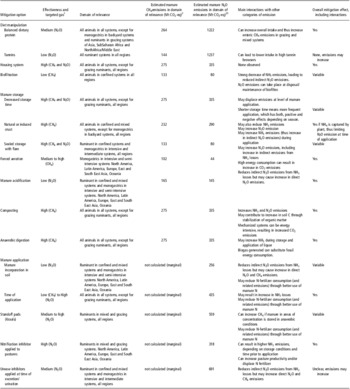
A broad range of technical options to mitigate GHG emissions during manure management have been evaluated by Hristov et al. (Reference Hristov, Oh, Lee, Meinen, Montes, Ott, Firkins, Rotz, Dell, Adesogan, Yang, Tricarico, Kebreab, Waghorn, Dijkstra and Oosting2013). The recommended options are introduced below and summarized in Table 2.
Technical options for the mitigation of manure methane and nitrous oxide emissions, and their interactions with other categories of emissions

1Low = ⩽10% mitigating effect; medium = 10 to 30% mitigating effect; High=⩾ 30% mitigatin g effect. Mitigating effects refer to percent change over a ‘standard practice’, that is, study control that was used for comparison and are based on combination of study data and judgement by the authors of this document. For a detailed discussion, see Hristov et al. (Reference Hristov, Oh, Lee, Meinen, Montes, Ott, Firkins, Rotz, Dell, Adesogan, Yang, Tricarico, Kebreab, Waghorn, Dijkstra and Oosting2013).
3Includes emissions from manure application and deposition when addressed by the mitigation option.
Diet manipulation
Diet can have a profound effect on manure emissions, as it drives the volume and composition of manure. In particular, diet affects the amount, form and partition of N excretion between urine and faeces, and the amount of fermentable organic matter (OM) excreted (Hristov et al., Reference Hristov, Oh, Lee, Meinen, Montes, Ott, Firkins, Rotz, Dell, Adesogan, Yang, Tricarico, Kebreab, Waghorn, Dijkstra and Oosting2013).
Reducing dietary CP and ruminally degradable protein concentration can reduce NH3 emissions from manure, through a marked reduction of urinary urea excretion, NH3 concentration and potentially N2O emissions from dairy manure (Külling et al., Reference Külling, Menzi, Krober, Neftel, Sutter, Lischer and Kreuzer2001; Agle et al., Reference Agle, Hristov, Zaman, Schneider, Ndegwa and Vaddella2010a; Luo et al., Reference Luo, de Klein, Ledgard and Saggar2010; Lee et al., Reference Lee, Hristov, Dell, Feyereisen, Kaye and Beegle2012; Schils et al., Reference Schils, Eriksen, Ledgard, Vellinga, Kuikman, Luo, Petersen and Velthof2013).
However, feed intake depression with protein- and amino acid-deficient diets has been demonstrated with pigs and poultry (Henry, Reference Henry1985; Picard et al., Reference Picard, Uzu, Dunnington and Siegel1993) and must be avoided to maintain production efficiency. Amino acid supplements can be combined with dietary protein reductions to maintain feed conversion efficiency and prevent production losses (Ball and Mohn, Reference Ball and Mohn2003; Mosnier et al., Reference Mosnier, van der Werf, Boisy and Dourmad2011; Osada et al., Reference Osada, Takada and Shinzato2011). For example, Cromwell and Coffey (Reference Cromwell and Coffey1993) reported a 17% to 23% decrease in N excretion when dietary protein was reduced by 2% units and the diet was supplemented with synthetic lysine.
Shifting N excretions from urine to faeces is expected to reduce N2O emissions from manure application because of the lower concentration of available N in manure, depending on manure storage time and conditions (Hristov et al., Reference Hristov, Oh, Lee, Meinen, Montes, Ott, Firkins, Rotz, Dell, Adesogan, Yang, Tricarico, Kebreab, Waghorn, Dijkstra and Oosting2013). Tannin supplements and tanniferous forages can be used for this purpose and have been shown to reduce urinary N as proportion of total N losses by 9.3% (Carulla et al., Reference Carulla, Kreuzer, Machmüller and Hess2005) and 25% (Misselbrook et al., Reference Misselbrook, Powell, Broderick and Grabber2005a). Tannin use can also decrease N-release rate from manure, and thus affect manure-N availability for plant growth (Hristov et al., Reference Hristov, Oh, Lee, Meinen, Montes, Ott, Firkins, Rotz, Dell, Adesogan, Yang, Tricarico, Kebreab, Waghorn, Dijkstra and Oosting2013).
Feed additives can also reduce CH4 emissions from pig and poultry manure. For example, the addition of thymol to sow diets reduced CH4 emissions from sow manure by up to 93% (Varel and Wells, Reference Varel and Wells2007).
In general, feeding protein close to animal requirements, including varying protein concentration with stage of lactation, laying or growth, is recommended as an effective manure NH3 and N2O-emission mitigation practice (Hristov et al., Reference Hristov, Oh, Lee, Meinen, Montes, Ott, Firkins, Rotz, Dell, Adesogan, Yang, Tricarico, Kebreab, Waghorn, Dijkstra and Oosting2013). Low-protein diets for ruminants should be balanced for ruminally degradable protein in order not to impair microbial protein synthesis and fibre degradability in the rumen. Further, diets for all animals should be balanced for amino acids to avoid feed-intake depression and decreased production (Hristov et al., Reference Hristov, Oh, Lee, Meinen, Montes, Ott, Firkins, Rotz, Dell, Adesogan, Yang, Tricarico, Kebreab, Waghorn, Dijkstra and Oosting2013).
Housing
Structures used to house livestock animals do not directly affect the processes resulting in N2O and CH4 emissions; however, they determine the method used to store and process manure and eventual litter. Housing systems with solid floors that use hay or straw for bedding accumulate manure that has higher dry matter and is commonly stored in piles, creating conditions conducive for N2O emissions. In general, manure systems in which manure is stored for prolonged periods of time produce greater NH3 and CH4 emissions compared with systems in which manure is removed daily. For example, Philippe et al. (Reference Philippe, Laitat, Canart, Vandenheede and Nicks2007) found that GHG emissions from fattening pigs raised on straw-based deep litter released nearly 20% more GHG emissions than when raised on a concrete slatted floor.
Hristov et al. (Reference Hristov, Heyler, Schurman, Griswold, Topper, Hile, Ishler, Wheeler and Dinh2012) assessed the effect of manure management on emissions from dairy farms in Pennsylvania and found that NH3, and particularly CH4, emissions from manure were much higher in dairy barns where manure was stored for prolonged periods of time (e.g. gravity-flow systems) than where manure was removed frequently (e.g. flush systems). Nitrous oxide emissions were negligible in all systems. In ruminant production, however, the effect of housing on CH4 emissions is relatively marginal because the animal is the main source of CH4 emission through eructation; N2O emissions from ruminant housing are also usually negligible. Housing and manure systems, however, have a greater impact on NH3 emission from cattle operations (Hristov et al., Reference Hristov, Oh, Lee, Meinen, Montes, Ott, Firkins, Rotz, Dell, Adesogan, Yang, Tricarico, Kebreab, Waghorn, Dijkstra and Oosting2013).
Biofiltration
Biofiltration can be performed on ventilated air from animal buildings. It uses biological filters to remove undesired elements (Hristov et al., Reference Hristov, Oh, Lee, Meinen, Montes, Ott, Firkins, Rotz, Dell, Adesogan, Yang, Tricarico, Kebreab, Waghorn, Dijkstra and Oosting2013). Melse and Ogink (Reference Melse and Ogink2005) found NH3 removal efficiencies in swine and poultry houses from acid scrubbers and biotrickling filters of 96% and 70%, respectively. However, recent reports (Maia et al., Reference Maia, Day, Gates and Taraba2012a and Reference Maia, Day, Gates, Taraba and Coyne2012b) have shown that biofilters used to scrub NH3 from exhaust streams generate N2O as a result of nitrification and denitrification processes in the biofiltration media. A few researchers have investigated CH4 mitigation by passing contaminated air from above swine manure storage or from swine housing through a biofiltration system. A Canadian Pork Council (2006) study reported reductions of 50% to 60%, and Girard et al. (Reference Girard, Ramirez, Buelna and Heitz2011) reported a maximum reduction of up to 40%. High residence time is necessary in these systems because the low solubility and biodegradability of CH4 hinder effectiveness (Melse and Verdoes, Reference Melse and Verdoes2005).
Manure storage
Greenhouse gas emissions during manure storage, in the form of CH4 (in anaerobic conditions), but also NH3 and N2O, can be significant. One simple way to avoid cumulative GHG emissions is to reduce the time manure is stored (Philippe et al., Reference Philippe, Laitat, Canart, Vandenheede and Nicks2007; Costa et al., Reference Costa, Chiarello, Selli and Guarino2012). Covering manure stores is another common option to reduce losses. The effectiveness of the manure storage cover depends on many factors, including permeability, cover thickness, degradability, porosity and management (Hristov et al., Reference Hristov, Oh, Lee, Meinen, Montes, Ott, Firkins, Rotz, Dell, Adesogan, Yang, Tricarico, Kebreab, Waghorn, Dijkstra and Oosting2013).
Semi-permeable covers are valuable for reducing NH3, CH4 and odour (Sommer et al., Reference Sommer, Petersen and Sörgard2000; Guarino et al., Reference Guarino, Fabbri, Brambilla, Valli and Navarotto2006; VanderZaag et al., Reference VanderZaag, Gordon, Glass and Jamieson2008); however, the net GHG effectiveness of semi-permeable manure storage covers is not clear, because they can provide conditions for nitrification, denitrification and subsequent release of N2O emissions (Hansen et al., 2009; Nielsen et al., Reference Nielsen, Schramm and Revsbech2010). Conversely, impermeable covers are an effective mitigation practice, if the CH4 captured under the cover is burned using a flare system or engine-generator to produce electricity (Hristov et al., Reference Hristov, Oh, Lee, Meinen, Montes, Ott, Firkins, Rotz, Dell, Adesogan, Yang, Tricarico, Kebreab, Waghorn, Dijkstra and Oosting2013).
Mechanical or intermittent aeration of manure during storage can also reduce CH4 emissions (Osada, 2000; Martinez et al., Reference Martinez, Guiziou, Peu and Gueutier2003; Loyon et al., Reference Loyon, Guiziou, Beline and Peu2007), although mechanical aeration may lead to increased CO2 emissions (Petersen and Sommer, Reference Petersen and Sommer2011). Decreasing manure temperature to <10°C by removing the manure from the building and storing it outside in cold climates can also mitigate CH4 emissions (Monteny et al., Reference Monteny, Bannink and Chadwick2006).
According to Petersen and Sommer (Reference Petersen and Sommer2011), manure acidification is an effective mitigation option for NH3 emissions, but the effect on N2O is not well studied. Ndegwa et al. (Reference Ndegwa, Hristov and Ogejo2011) listed 15 studies in which cattle, pig or poultry manure NH3 emissions were successfully mitigated (from 14% to 100%) by lowering manure pH. Although strong acids are cost-effective, weaker acids or acidifying salts are less hazardous and may therefore be more suitable for on-farm use (Hristov et al., Reference Hristov, Oh, Lee, Meinen, Montes, Ott, Firkins, Rotz, Dell, Adesogan, Yang, Tricarico, Kebreab, Waghorn, Dijkstra and Oosting2013).
Composting
Composting has several benefits related to manure handling, odour control, manure moisture and pathogen control, OM stabilization and farm profitability (Hristov et al., Reference Hristov, Oh, Lee, Meinen, Montes, Ott, Firkins, Rotz, Dell, Adesogan, Yang, Tricarico, Kebreab, Waghorn, Dijkstra and Oosting2013). The primary benefit of composting is that it reduces CH4 emissions compared with storage of manure under anaerobic conditions (Brown et al., Reference Brown, Kruger and Subler2008). However, depending on the intensity of composting, NH3 losses can be particularly high, reaching up to 50% of the total manure N (Peigné and Girardin, Reference Peigné and Girardin2004). Similarly, the aeration of compost reduces CH4 emissions (Thompson et al., Reference Thompson, Wagner-Riddle and Fleming2004; Jiang et al., Reference Jiang, Schuchardt, Li, Guo and Zhao2011b; Park et al., Reference Park, Jeon, Jeon, Kwag and Choi2011), but can increase NH3 and N2O losses (Tao et al., 2011). However, the review by Brown et al. (Reference Brown, Kruger and Subler2008) concluded that, even in a worst-case scenario, the increase in N emissions is minimal in comparison with the benefits associated with the CH4 reductions.
Anaerobic digestion
Anaerobic digestion is the process of degradation of organic material microorganisms in the absence of oxygen, producing CH4, CO2 and other gases as by-products, and is one of the most promising practices for mitigating GHG emissions from collected manure (Hristov et al., Reference Hristov, Oh, Lee, Meinen, Montes, Ott, Firkins, Rotz, Dell, Adesogan, Yang, Tricarico, Kebreab, Waghorn, Dijkstra and Oosting2013). Anaerobic digesters are also a source of renewable energy in the form of biogas, which is 60% to 80% CH4, depending on the substrate and operation conditions (Roos et al., Reference Roos, Martin and Moser2004). However, NH3 volatilization may be higher in digested manure (Petersen and Sommer, Reference Petersen and Sommer2011). In contrast, reduction of manure OM content is generally expected to reduce N2O emissions from manure-amended soils (Petersen, 1999; Bertora et al., Reference Bertora, Alluvione, Zavattaro, van Groenigen, Velthof and Grignani2008), although there have been contradictory results (Thomsen et al., Reference Thomsen, Pederson, Nyord and Petersen2010).
Digester designs vary widely in size, function and operational parameters. For a review of digester types and their comparative advantages in different production contexts (Hristov et al., Reference Hristov, Oh, Lee, Meinen, Montes, Ott, Firkins, Rotz, Dell, Adesogan, Yang, Tricarico, Kebreab, Waghorn, Dijkstra and Oosting2013). When CH4 is collected and used as an energy source, it can substitute for combusted fossil fuels reducing the emissions of GHG, NOx, hydrocarbons and particulate matter (Börjesson and Berglund, Reference Börjesson and Berglund2006). However, CH4 losses have been reported from stored manure gas leakages (Bjurling and Svärd, Reference Bjurling and Svärd1998; Sommer et al., Reference Sommer, Møller and Petersen2001). Typical losses from systems storing digested manure were reported to range from 5% to 20% of total biogas produced.
Overall, the use of anaerobic manure digesters is a strongly recommended CH4-mitigation strategy, but careful management is necessary, so that they do not become net emitters of CH4 (Hristov et al., Reference Hristov, Oh, Lee, Meinen, Montes, Ott, Firkins, Rotz, Dell, Adesogan, Yang, Tricarico, Kebreab, Waghorn, Dijkstra and Oosting2013). The adoption of this type of technology on farms of all sizes may not be widely applicable and will heavily depend on financial and technical capacity, climatic conditions and availability of alternative sources of energy.
Manure application
Results on CH4 and N2O emissions following manure application are highly variable, and many variables including manure composition, application technique, soil type and management, soil moisture and climate can affect emissions (Hristov et al., Reference Hristov, Oh, Lee, Meinen, Montes, Ott, Firkins, Rotz, Dell, Adesogan, Yang, Tricarico, Kebreab, Waghorn, Dijkstra and Oosting2013).
Subsurface injection of manure slurries into the soil can result in localized anaerobic conditions surrounding the buried liquid manure, which, together with an increased degradable C pool, may result in higher CH4 emissions than with surface applied manure (Külling et al., 2003; Amon et al., 2006; Clemens et al., Reference Clemens, Trimborn, Weiland and Amon2006). Diluting the manure or reducing the degradable C flux through solid separation or anaerobic degradation pre-treatments are options to reduce CH4 emissions from injected manure (Amon et al., 2006; Clemens et al., Reference Clemens, Trimborn, Weiland and Amon2006). As this combination of treatments reduces the availability of degradable C, it also tends to decrease N2O emission (Amon et al., 2006; Clemens et al., Reference Clemens, Trimborn, Weiland and Amon2006; Velthof and Mosquera, Reference Velthof and Mosquera2011). However, both CH4 and N2O emissions resulting from manure injection into soil are generally low, and therefore should be weighed against the benefits of reducing NH3 volatilization when manure is surface applied (Hristov et al., Reference Hristov, Oh, Lee, Meinen, Montes, Ott, Firkins, Rotz, Dell, Adesogan, Yang, Tricarico, Kebreab, Waghorn, Dijkstra and Oosting2013).
Unlike CH4, most of the N2O is produced after the manure has been applied to the soil. Nitrous oxide-mitigation options for manure application include controlling the amount of N available for nitrification and denitrification in soil, as well as the availability of degradable C and soil oxidation reduction potential (Hristov et al., Reference Hristov, Oh, Lee, Meinen, Montes, Ott, Firkins, Rotz, Dell, Adesogan, Yang, Tricarico, Kebreab, Waghorn, Dijkstra and Oosting2013). Wet soils tend to promote N2O emissions, and therefore application timing (e.g. avoiding application before a rain event) can be important (Hernandez-Ramirez et al., Reference Hernandez-Ramirez, Brouder, Smith and Van Scoyoc2009; Smith and Owens, Reference Smith and Owens2010; Meada et al., 2011).
Manure deposition on pasture
The effective N-application rate within a urine patch from a dairy cow on pasture can be much greater than the utilization capacity of the soil–plant system (Eckard et al., Reference Eckard, Grainger and de Klein2010). Nitrous oxide emissions from these systems can be reduced by creating a more uniform distribution of urine throughout the paddock.
Timing of grazing can also help, as De Klein et al. (Reference de Klein, Sherlock, Cameron and van der Weerden2001) showed a 40% to 57% reduction in N2O emissions when grazing was restricted to 3 h/day in the late humid New Zealand autumn. This reduction was attributed to diminished N input during conditions most conducive to N2O emissions. However, when de Klein et al. (Reference de Klein, Sherlock, Cameron and van der Weerden2001) included N2O emissions resulting from application of the effluent collected during the restricted grazing periods, N2O emissions were reduced by only 7% to 11%. It is also recognized that this practice results in much greater NH3 emissions (Luo et al., Reference Luo, de Klein, Ledgard and Saggar2010) because of urine and faeces being excreted and allowed to mix in the stand-off/feed area.
Urease and nitrification inhibitors
Nitrification inhibitors were found to reduce the amount of N2O emitted in intensive pasture-based systems in New Zealand when applied over urine and faeces that had been deposited on pastures and soil (de Klein et al., Reference de Klein, Sherlock, Cameron and van der Weerden2001 and Reference de Klein, Cameron, Di, Rys, Monaghan and Sherlock2011; Di and Cameron, Reference Di and Cameron2003 and Reference Di and Cameron2012). Luo et al. (Reference Luo, Saggar, Bhandral, Bolan, Ledgard, Lindsey and Sun2008) reported up to 45% reduction in N2O emissions from dairy cow urine applied to various soils in New Zealand by the dicyandiamide nitrification inhibitor (DCD). The effectiveness of the DCD nitrification inhibitors depends largely on temperature, moisture and soil type (Kelliher et al., Reference Kelliher, Clough, Clark and Rys2008; de Klein and Monaghan, 2011; Schils et al., Reference Schils, Eriksen, Ledgard, Vellinga, Kuikman, Luo, Petersen and Velthof2013). It should be noted that nitrification inhibitors can increase soil ammonium, and thus potentially increase NH3 losses (Hristov et al., Reference Hristov, Oh, Lee, Meinen, Montes, Ott, Firkins, Rotz, Dell, Adesogan, Yang, Tricarico, Kebreab, Waghorn, Dijkstra and Oosting2013).
In contrast, urease inhibitors preserve urea and reduce NH3 volatilization but may result in increased N2O emissions because of potential increase in ammonium and subsequently nitrate concentration in soil (Hristov et al., Reference Hristov, Oh, Lee, Meinen, Montes, Ott, Firkins, Rotz, Dell, Adesogan, Yang, Tricarico, Kebreab, Waghorn, Dijkstra and Oosting2013). Further, as they need to be applied to urine before it is mixed with soil or faeces, its applicability is limited to systems where faeces and urine are not separated or separated after mixing (Varel et al., Reference Varel, Nienaber and Freetly1999). Results of the combined use of nitrification and urease inhibitors have been inconclusive (Khalil et al., Reference Khalil, Gutser and Schmidhalter2009; Zaman and Blennerhassett, Reference Zaman and Blennerhassett2010).
Interactions and links with productivity
Interactions among individual components of livestock production systems are very complex, but must be considered when recommending GHG mitigation practices (Hristov et al., Reference Hristov, Oh, Lee, Meinen, Montes, Ott, Firkins, Rotz, Dell, Adesogan, Yang, Tricarico, Kebreab, Waghorn, Dijkstra and Oosting2013). One practice may successfully mitigate enteric CH4 emission, but increase fermentable substrate for increased CH4 emission from stored manure or N availability for increased N2O emission from land application of manure. Some mitigation practices are synergistic and are expected to decrease both enteric and manure GHG emissions. This section outlines some of the main interactions that are reported in the literature. A summary of interactions to be considered for each mitigation practice is also proposed in Tables 1 and 2.
Feed, enteric methane, manure content and productivity
Starting with feed-based strategies, the cascade of synergistic and antagonistic effects that mitigation practices may trigger are discussed.
Feed additives and dietary manipulation options targeting enteric CH4 emissions are mostly studied in isolation, but can have unexpected synergistic or antagonistic effects. It is unlikely that mitigation practices reviewed under the enteric CH4 section can have additive effects, but there is not much evidence to support or refute this assumption (Hristov et al., Reference Hristov, Oh, Lee, Meinen, Montes, Ott, Firkins, Rotz, Dell, Adesogan, Yang, Tricarico, Kebreab, Waghorn, Dijkstra and Oosting2013). Nitrates can possibly increase N emissions as their addition to the ration may lead to increased urea excreted in urine. Dietary lipids too may increase manure emissions either through reduced ration digestibility or increased N content (if lipids are supplied from oil cakes rich in CP; Hristov et al., Reference Hristov, Oh, Lee, Meinen, Montes, Ott, Firkins, Rotz, Dell, Adesogan, Yang, Tricarico, Kebreab, Waghorn, Dijkstra and Oosting2013). Furthermore, if overadministered, feed additives can reduce animal productivity and thereby increase GHG Ei.
Dietary manipulation to increase nutrient digestibility is expected to decrease enteric CH4 production and would most likely decrease GHG emissions from stored manure, because less-fermentable OM will be excreted with faeces (Hristov et al., Reference Hristov, Oh, Lee, Meinen, Montes, Ott, Firkins, Rotz, Dell, Adesogan, Yang, Tricarico, Kebreab, Waghorn, Dijkstra and Oosting2013). Feeding practices that stabilize rumen fermentation (in terms of pH) might also improve animal health and feed efficiency, and reduce GHG Ei by the animal or from manure storage. However, increased feed quality will generally result in an increased feed intake, which will in turn increase enteric CH4 emissions (Hristov et al., Reference Hristov, Oh, Lee, Meinen, Montes, Ott, Firkins, Rotz, Dell, Adesogan, Yang, Tricarico, Kebreab, Waghorn, Dijkstra and Oosting2013). In addition, manure CH4 emissions may also increase because of increased concentration of available substrate. This increase of emissions is, however, generally compensated by a greater increase in milk and meat output, resulting in a lower Ei (Hristov et al., Reference Hristov, Oh, Lee, Meinen, Montes, Ott, Firkins, Rotz, Dell, Adesogan, Yang, Tricarico, Kebreab, Waghorn, Dijkstra and Oosting2013). Yet, from a whole cycle perspective, this effect at farm level may be partially or entirely offset by greater emissions from the production of improved feed especially if land-use change (e.g. conversion of forests/grasslands to croplands) is involved. A side effect of increasing nutrient digestibility may be the oversupply of N to animals (e.g. in the case of pasture improvement/fertilization or urea treatment of by-products), resulting in higher N2O emissions from manure (Hristov et al., Reference Hristov, Oh, Lee, Meinen, Montes, Ott, Firkins, Rotz, Dell, Adesogan, Yang, Tricarico, Kebreab, Waghorn, Dijkstra and Oosting2013). The overall effect will depend on initial conditions and strategies used to improve feed digestibility.
Decreasing dietary protein concentration to address NH3 and N2O losses from stored manure or manure-amended soil may increase enteric CH4 emissions, as shown by the modelling work of Dijkstra et al. (Reference Dijkstra, Oenema and Bannink2011b). Low-protein diets for ruminants should be balanced for ruminally degradable protein in order to not impair microbial protein synthesis and fibre degradability in the rumen. In general terms, reduction of dietary protein should be accompanied by a careful balancing for all other nutrients, specifically energy and amino acids, so that animal production is not negatively affected, which would result in an increased Ei (Hristov et al., Reference Hristov, Oh, Lee, Meinen, Montes, Ott, Firkins, Rotz, Dell, Adesogan, Yang, Tricarico, Kebreab, Waghorn, Dijkstra and Oosting2013).
Shifting N excretion from urine to faeces by supplementing the diet with tannins or feeding tanniferous forages can also decrease N release rate from manure, and thus affect manure-N availability for plant growth (Hristov et al., Reference Hristov, Oh, Lee, Meinen, Montes, Ott, Firkins, Rotz, Dell, Adesogan, Yang, Tricarico, Kebreab, Waghorn, Dijkstra and Oosting2013).
Manure storage, processing and application
The main interaction effects for manure management are between manure ammonium (NH3) and soil N2O emissions. In general, mitigation measures that reduce NH3 losses in manure preserve ammonium N, and thereby increase potential soil N2O emissions. Similarly, mitigation measures that aim to lower CH4 emissions can also increase NH3 or N2O emissions.
However, the interactions involving N2O and NH3 need to be considered in light of the certainty with which the formation of each gas can be controlled. Because the conditions that support nitrification and denitrification processes are highly variable, N2O emissions are best treated as potential emissions. By contrast, NH3 emission and consequent N loss occur as a matter of course, though they also vary in magnitude depending on environmental and management factors (Hristov et al., Reference Hristov, Oh, Lee, Meinen, Montes, Ott, Firkins, Rotz, Dell, Adesogan, Yang, Tricarico, Kebreab, Waghorn, Dijkstra and Oosting2013).
Furthermore, the efficiency of practices that restrict NH3 and N loss before (e.g. acidification and cooling) and during (e.g. manure injection into soil) application to soil very much depends on the degree of integration between crop and livestock enterprises. By increasing the availability of N for uptake by plants, these practices lower the need for external inputs of N fertilizer and their associated GHG emissions during their manufacture and following application to soil (Hristov et al., Reference Hristov, Oh, Lee, Meinen, Montes, Ott, Firkins, Rotz, Dell, Adesogan, Yang, Tricarico, Kebreab, Waghorn, Dijkstra and Oosting2013). Thus, the mitigation potential of such practices needs to be evaluated at least from a whole farm, or preferably a lifecycle, perspective.
Urease inhibitors can reduce NH3 emissions, whereas nitrification inhibitors can reduce N2O emissions. However, the timing of their use and impact of environmental conditions greatly affect their effectiveness and length of inhibition, with a delay rather than a reduction of NH3 or N2O emissions occurring under some conditions (Hristov et al., Reference Hristov, Oh, Lee, Meinen, Montes, Ott, Firkins, Rotz, Dell, Adesogan, Yang, Tricarico, Kebreab, Waghorn, Dijkstra and Oosting2013). In addition, the use of nitrification inhibitors could result in greater NH3 emission following land application of manure because of greater accumulation of N as ammonium (Hristov et al., Reference Hristov, Oh, Lee, Meinen, Montes, Ott, Firkins, Rotz, Dell, Adesogan, Yang, Tricarico, Kebreab, Waghorn, Dijkstra and Oosting2013).
The fate of N2O and NH3 emissions is also affected by measures that seek to lower CH4 emissions. For example, owing to interactions between available C and N sources in the correct oxidation form, semi-permeable manure storage covers can enhance N2O formation (Hansen et al., 2009; Nielsen et al., Reference Nielsen, Schramm and Revsbech2010.
Decreasing storage time effectively reduces CH4 emissions, because little further CH4 emission occurs after land application of manure. However, the more frequent need for soil application may increase N2O emissions, if application occurs during prolonged periods with warm temperature, wet soil and low plant-N uptake. Therefore, a combination of decreased storage time in warm weather and extended winter storage is a viable option in many regions (Hristov et al., Reference Hristov, Oh, Lee, Meinen, Montes, Ott, Firkins, Rotz, Dell, Adesogan, Yang, Tricarico, Kebreab, Waghorn, Dijkstra and Oosting2013).
Also with regard to manure application, the incorporation of manure into soil not only greatly reduces NH3 emissions and N losses, but it also reduces CH4 emissions and at the same time increases manure OM content. However, the increase in OM accelerates soil metabolism, depleting oxygen, triggering denitrification and N2O emissions (Hristov et al., Reference Hristov, Oh, Lee, Meinen, Montes, Ott, Firkins, Rotz, Dell, Adesogan, Yang, Tricarico, Kebreab, Waghorn, Dijkstra and Oosting2013).
On the contrary, anaerobic digestion, or separation of manure solids, lowers the organic content of manure, which generally results in lower emissions of N2O (Clemens et al., Reference Clemens, Trimborn, Weiland and Amon2006; Velthof and Mosquera, Reference Velthof and Mosquera2011). However, the inhibition of nitrification under anaerobic conditions can lead to greater ammonium N in digested manure, which, coupled with the pH increase that is likely with digestion, can lead to greater NH3 emissions (Hristov et al., Reference Hristov, Oh, Lee, Meinen, Montes, Ott, Firkins, Rotz, Dell, Adesogan, Yang, Tricarico, Kebreab, Waghorn, Dijkstra and Oosting2013).
Composting is another measure where the mitigation consequences are confounded by interactions. Although composting tends to increase NH3 emissions, its effect on CH4 and N2O emissions is more complex. However, the significant loss of NH3 may lead to reduced soil N2O emissions, and thus reduce total non-CO2 GHG emissions from composted manure, compared with other manure management systems (Hristov et al., Reference Hristov, Oh, Lee, Meinen, Montes, Ott, Firkins, Rotz, Dell, Adesogan, Yang, Tricarico, Kebreab, Waghorn, Dijkstra and Oosting2013).
Conclusions
Many technical options exist for the mitigation of direct emissions from livestock production.
Diet manipulation and feed additives have been identified as main avenues for the mitigation of enteric CH4 production. Their effectiveness is estimated to be generally low to medium but can be substantially increased in terms of Ei, when they also result in improved feed efficiency and productivity gains.
Diets also affect manure emissions, as they alter the content of manure: ration composition and additives have an influence on the form and amount of N in urine and faeces, as well as on the amount of fermentable OM in faeces.
Methane emissions from manure can be effectively controlled by shortening storage duration, ensuring aerobic conditions or capturing the biogas emitted in anaerobic conditions. Direct and indirect N2O emissions are, however, much more difficult to prevent once N is excreted. Techniques that prevent emissions during initial stages of management preserve N in manure are often emitted at later stages. Thus, effective mitigation of N losses in one form (e.g. NH3) is often offset by N losses in other forms (e.g. N2O or NO3). These induced effects must be understood when mitigation practices are designed. Numerous interactions were also highlighted between mitigation techniques for CH4 and N2O emissions from manure.
More research work is needed to develop practical and economically viable techniques that can be widely put into practice. Efforts should target single practices with high potential (e.g. vaccination against rumen methanogens) but also the interactions between practices, towards the development of suites of mitigation practices for specific production systems, based on the assessment of their overall effectiveness. In addition, research is required to quantify the economics of mitigation as well as the impact mitigation practices may have on other environmental objectives and broad development goals, such as poverty reduction and food security.
Acknowledgements
The experts that participated in the workshop to peer-review the report by Hristov et al. (Reference Hristov, Oh, Lee, Meinen, Montes, Ott, Firkins, Rotz, Dell, Adesogan, Yang, Tricarico, Kebreab, Waghorn, Dijkstra and Oosting2013) and provide insights into interactions between mitigation measures are thanked for their input. They are (in alphabetic order): M. Doreau, R. Eckhardt, D. Hongmin, T. McAllister, H. Montgomery, M. Powell, S. Sommer and M. Tibbo. The authors remain responsible for the content of this article and accountable for any potential factual error. The research underpinning this review was co-financed by the MICCA (Mitigation of Climate Change in Agriculture) programme (http://www.fao.org/climatechange/micca).
This paper was published as part of a supplement to animal, publication of which was supported by the Greenhouse Gases & Animal Agriculture Conference 2013. The papers included in this supplement were invited by the Guest Editors and have undergone the standard journal formal review process. They may be cited. The Guest Editors appointed to this supplement are R. J. Dewhurst, D. R. Chadwick, E. Charmley, N. M. Holden, D. A. Kenny, G. Lanigan, D. Moran, C. J. Newbold, P. O'Kiely and T. Yan. The Guest Editors declare no conflict of interest.
Disclaimer
The views expressed in this publication are those of the author(s) and do not necessarily reflect the views or policies of the Food and Agriculture Organization of the United Nations.