Significant outcomes
-
∙ Overall, results from four completed phase 3 studies (three 6-week, short-term studies and one 52-week, long-term maintenance study) indicate that brexpiprazole is efficacious in the treatment of adults with schizophrenia as part of both a short- and long-term treatment programme.
-
∙ Brexpiprazole has a favourable tolerability profile with a notably low incidence of activating and sedating side effects.
-
∙ Brexpiprazole demonstrated substantial improvements on both social functioning and health-related quality of life.
Limitations
-
∙ Randomised controlled trials, like the ones presented in this overview, are primarily designed to provide reliable information on the efficacy and safety of therapeutic interventions (Reference Singh and Loke1–Reference Annemans and Kubin3). As such, they are highly regulated and often include a very specific and highly selective patient population (4). Such trials form the primary basis of the regulatory approval of a drug; however, they do not assess the real-world value of a drug (Reference Singh and Loke1–Reference Annemans and Kubin3). The use of real-world data would allow for a greater understanding of how a compound directly impacts the patient and their clinical management, in a real-life setting (Reference Annemans and Kubin3,4).
-
∙ Another limitation of these studies is the absence of comparison with other antipsychotics. The short-term flexible-dose study included quetiapine; however, this was introduced as an active reference for assay sensitivity only.
Introduction
Schizophrenia is a serious illness affecting ~1% of the world’s population (Reference McGrath, Saha, Chant and Welham5,Reference Messias, Chen and Eaton6). Patients with schizophrenia experience an array of positive (e.g. hallucinations, delusions, thought disorders) and negative symptoms (e.g. social withdrawal and lack of emotion, energy, and motivation), in addition to cognitive symptoms and behavioural changes (Reference Bobes, Garcia-Portilla, Bascaran, Saiz and Bousono7,Reference Lieberman, Perkins and Belger8). Collectively, these symptoms can significantly affect the patient’s ability to function socially and in the work environment, and have negative implications on their overall quality of life (Reference Volavka and Citrome9–Reference Hayhurst, Massie, Dunn, Lewis and Drake11).
Individuals with schizophrenia often have heterogeneous and difficult-to-predict responses to their antipsychotic medication, and as such often require multiple treatment options (Reference Correll12). Once a patient’s symptoms of schizophrenia are stabilised through adequate antipsychotic treatment, relapse prevention is extremely important. Relapse can have significant repercussions for patients with schizophrenia, including worsening of symptoms for each new relapse, progressive cognitive deterioration, impaired functioning, and reduced quality of life (Reference Olivares, Sermon, Hemels and Schreiner13). The American Psychiatric Association Practice Guideline for the Treatment of Patients with Schizophrenia (14) emphasises the importance of a long-term treatment management plan in order to minimise the risk of relapse, monitor for and minimise the severity of side effects, improve functioning, and address residual symptoms, as this will help reduce the indirect costs of schizophrenia (Reference Tajima-Pozo, de Castro Oller, Lewczuk and Montanes-Rada15). The use of antipsychotic medications often forms part of a long-term maintenance treatment programme for patients with schizophrenia. However, many patients are not on maintenance therapy, due to non- or partial adherence to medication caused by adverse events (AEs), cognitive impairment, or lack of illness insight.
Current antipsychotics are associated with a multitude of adverse effects, including neurological symptoms, extrapyramidal symptoms (EPS), sedation, adverse metabolic effects (weight gain, hyperglycaemia and dyslipidaemia), hyperprolactinaemia, and cardiac events (QTc prolongation) (Reference Young, Taylor and Lawrie16), all of which may impair the patient’s ability to perform everyday tasks and could diminish the patient’s overall subjective well-being and quality of life, as well as adherence to treatment regime (Reference Barnes17). Therefore, there is an urgent need for antipsychotic medications that can relieve the most common and debilitating symptoms of schizophrenia, but can also exhibit a favourable safety and tolerability profile.
Brexpiprazole is a serotonin-dopamine activity modulator that was approved in the United States in July 2015 for the treatment of schizophrenia and as an adjunctive therapy to antidepressants for the treatment of major depressive disorder. It acts as a partial agonist at serotonin 5-HT1A and dopamine D2 receptors, and as an antagonist at serotonin 5-HT2A and noradrenaline α1B/2C receptors, all at similar potency (Reference Maeda, Lerdrup and Sugino18). The intrinsic activity of brexpiprazole at D2 receptors is higher than that of pure antagonists, potentially resulting in fewer D2 antagonist-like AEs (e.g. EPS, hyperprolactinaemia, tardive dyskinaesia), but lower than that of the first commercially available D2 partial agonist, aripiprazole, which may translate into a reduced likelihood of inducing AEs potentially mediated by D2 receptor agonism (e.g. akathisia, insomnia, restlessness, nausea) (Reference Maeda, Sugino and Akazawa19,Reference Fleischhacker20). In addition, relative to its potency for D2/5-HT1A receptors, brexpiprazole has a lower (more than 50-fold) affinity for histamine H1 receptors (Reference Maeda, Sugino and Akazawa19), often associated with sedation and weight gain.
The efficacy, safety and tolerability of brexpiprazole in the treatment of an acute exacerbation of schizophrenia was demonstrated in two pivotal 6-week, fixed-dose, placebo-controlled studies [NCT01396421 (VECTOR trial); NCT01393613 (BEACON trial)] (Reference Kane, Skuban and Ouyang21,Reference Correll, Skuban and Ouyang22), and was evaluated in a 6-week, flexible-dose placebo controlled with active reference (quetiapine XR) study [NCT01810380 (LIGHTHOUSE trial)]. The efficacy and tolerability of brexpiprazole as a maintenance treatment for schizophrenia was also demonstrated in a 52-week maintenance study [NCT01668797 (EQUATOR trial)] (Reference Fleischhacker, Hobart and Ouyang23). This paper provides a comprehensive overview of the short- and long-term efficacy, safety and tolerability of brexpiprazole in adult patients with schizophrenia using the results from all these four completed phase 3 studies.
Methods
Patients
Patients in the brexpiprazole phase 3 clinical studies were recruited at sites in North America, Europe, Asia, and Latin America. Male and female patients, aged 18–65 years with a current diagnosis of schizophrenia [Diagnosis and Statistical Manual of Mental Disorders, Fourth Edition, Text Revision (DSM-IV-TR)] were enrolled. In the short-term studies, patients included were those who would benefit from hospitalisation or continued hospitalisation for the treatment of an acute exacerbation of schizophrenia. In the maintenance study, patients included were those experiencing a current exacerbation of psychotic symptoms requiring stabilisation as demonstrated by a Positive and Negative Syndrome Scale (PANSS) total score >80 at screening. In the two short-term, fixed-dose studies, inclusion criteria included a total Brief Psychiatric Rating Scale score ≥40. In the short-term, flexible-dose study, acute exacerbation of psychotic symptoms and marked deterioration of usual function were evidenced by PANSS total score ≥80; and a score of ≥4 in at least two of the following PANSS items: hallucinatory behaviour, unusual thought content, conceptual disorganisation, or suspiciousness/persecution; and Clinical Global Impression-Severity of Illness Scale (CGI-S) score ≥4. In the maintenance study, patients had schizophrenia for ≥3 years, with a PANSS total score of ≥80 at entry into the study. In all studies, patients with first episode schizophrenia and patients with a current Axis I diagnosis (DSM-IV-TR criteria) other than schizophrenia, or substance abuse or dependence within the past 6 months, were excluded.
Study designs
The three short-term studies were randomised, double-blind, placebo-controlled studies consisting of a screening phase (up to 14 days), double-blind treatment phase (6 weeks), and a safety follow-up phase (30 days). Patients were hospitalised throughout the double-blind treatment period.
In the two fixed-dose studies, patients were randomised to brexpiprazole at fixed doses of 0.25, 2 or 4 mg (VECTOR trial) or 1, 2 or 4 mg (BEACON trial), or placebo. The 0.25-mg dose was predicted to be non-efficacious based on phase 2 studies; the 1-mg dose was included to evaluate the lower dose range. The 0.25-mg dose is not included in this overview. For a detailed description of the study design, see Kane et al. (Reference Kane, Skuban and Ouyang21) and Correll et al. (Reference Correll, Skuban and Ouyang22).
In the flexible-dose study, patients were randomised to flexible doses of 2–4 mg brexpiprazole, 400–800 mg quetiapine XR, or placebo. Quetiapine XR was included as an active reference to demonstrate assay sensitivity and validate the study methodology.
The maintenance study was a randomised, double-blind, placebo-controlled study consisting of a screening phase (up to 15 days), three treatment phases (washout/conversion phase, stabilisation phase, and maintenance phase), and a safety follow-up period (30 days). This study consisted of the standard maintenance study design requiring 12 weeks of stability before randomisation to brexpiprazole or placebo for 52 weeks. For a detailed description of the study design, see Fleischhacker et al. (Reference Fleischhacker, Hobart and Ouyang23).
The studies were all conducted in compliance with the International Conference on Harmonization Good Clinical Practice Consolidated Guideline. The protocols were approved by independent ethics committees and all patients provided informed consent to participate.
Assessments
In all short-term studies, efficacy was assessed using the PANSS (Reference Kay, Fiszbein and Opler24), CGI-S and Clinical Global Impressions-Improvement (CGI-I) scales (Reference Guy25), and the Personal and Social Performance (PSP) scale (Reference Morosini, Magliano, Brambilla, Ugolini and Pioli26). In addition, in the flexible-dose study quality of life was assessed using the Schizophrenia Quality of Life scale (S-QoL) (Reference Auquier, Simeoni and Sapin27). In all of the short-term studies, the primary endpoint was the change from baseline to Week 6 in PANSS total score.
In the maintenance study, efficacy was assessed using the PANSS, CGI-S and CGI-I scales, PSP, and Global Assessment of Functioning (GAF) (28). The primary efficacy endpoint was the time from randomisation to exacerbation of psychotic symptoms/impending relapse. For a detailed description of the primary efficacy endpoint criteria please refer to Fleischhacker et al. (Reference Fleischhacker, Hobart and Ouyang23).
Standard safety assessments [including AEs, laboratory parameters, and electrocardiograms (ECG)], as well as EPS rating scales [including the Simpson Angus Scale (SAS) (Reference Simpson and Angus29), Abnormal Involuntary Movement Scale (AIMS) (Reference Guy25), and the Barnes Akathisia Rating Scale (BARS) (Reference Barnes30)], and assessments of suicidality using the Columbia Suicide Severity Rating Scale (Reference Posner, Brown and Stanley31) were performed in all studies.
Data analyses
In the short-term studies, the efficacy populations comprised all patients who received at least one dose of study medication and had both a baseline assessment and at least one post-randomisation efficacy assessment during the double-blind treatment period. Data from the short-term flexible-dose study are presented separately and as part of a meta-analysis of all three short-term studies combined. The long-term maintenance study results are also presented separately.
For the short-term studies, the primary (change from baseline to Week 6 in PANSS total score) and key secondary (change from baseline in CGI-S score) endpoints were analyzed using a mixed model repeated measures (MMRM) analysis at the 0.05 significance level (two-sided). The MMRM model included fixed class-effect terms for treatment, site, visit week, and treatment-by-visit interaction. The model also included baseline score-by-visit interaction as a covariate. The primary comparison between the brexpiprazole groups and the placebo group was estimated as the difference between least squares means at Week 6.
For the meta-analysis, as the three short-term studies were identical in design, the original individual patient data from these studies were pooled and an intention-to-treat analysis used. Patients randomised to fixed-dose brexpiprazole 2 or 4 mg or to flexible-dose brexpiprazole 2–4 mg were grouped for the meta-analysis; the brexpiprazole low-dosing treatment groups (0.25 and 1 mg) were not included in the analysis. Patients randomised to placebo were also grouped together. Statistical comparison between the 2–4 mg brexpiprazole group and placebo group for the pooled meta-analysis was achieved using the MMRM model, which included fixed class-effect terms for treatment, site nested within trial, visit week, and treatment-by-visit week interaction. The model also included baseline-by-visit interaction as a covariate.
In order to control for multiple comparisons, a hierarchical testing procedure approach was adopted (Reference Kane, Skuban and Ouyang21,Reference Correll, Skuban and Ouyang22). The average effect of 2 and 4 mg of brexpiprazole versus placebo for the primary efficacy variable was first tested and if the result was statistically significant (p<0.05) then a comparison of each individual dosage versus placebo was analysed. Secondary efficacy endpoints were only assessed, using the same hierarchical testing procedure approach, if both the 2- and 4-mg dosages were statistically significant for brexpiprazole versus placebo.
In the maintenance study in order to minimise duration of therapy for patients receiving placebo, two interim efficacy analyses were planned at ~50% and 75% of events of impending relapse. At the first interim analysis efficacy was demonstrated (45 events reached) and the study was terminated early. The primary endpoint compared the time with exacerbation of psychotic symptoms/impending relapse in the brexpiprazole group versus the placebo group (maintenance phase) using a log-rank test, at the 0.05 significance level (two-sided). For a detailed description of the data analysis carried out in this study please refer to Fleischhacker et al. (Reference Fleischhacker, Hobart and Ouyang23).
Results
Patients
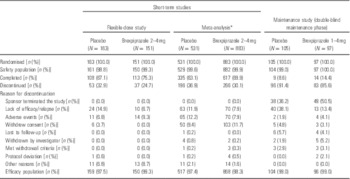
Across all short-term studies, the completion rate was >60%, and was higher in the brexpiprazole groups than the placebo group. Patient disposition is presented in Table 1.
Patient disposition

* Placebo and brexpiprazole 2–4 mg groups from the two fixed-dose phase 3 studies and the one flexible-dose phase 3 study were combined and analysed using individual patient data meta-analysis.
In the short-term studies, the most common reasons provided for study discontinuation were lack of efficacy/relapse, AEs, and withdrawal of consent (Table 1).
The early termination of the maintenance study, due to efficacy being demonstrated at the first pre-specified interim analysis, resulted in the discontinuation of 43.1% of patients. Other than this, the most frequent reason for study discontinuation was lack of efficacy/relapse (13.4% of brexpiprazole patients and 38.1% of placebo patients) (Table 1).
Demographic and baseline clinical characteristics
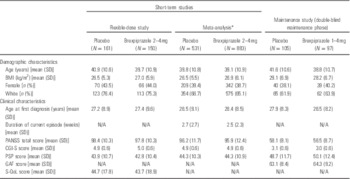
In both the flexible-dose study and the meta-analysis, the majority of patients were white (75.2% and 66.0%, respectively) and male (56.9% and 61.0%, respectively) (Table 2). Patients were markedly ill at entry to each of the short-term studies, with the mean PANSS total score ranging from 95.9 to 98.8 and CGI-S score from 4.9 to 5.0. The patient demographics in the maintenance study were similar to the short-term studies (Table 2). In addition, as per protocol, patients in the maintenance study who had already completed the stabilisation phase were more stable, with a PANSS total score <60 and CGI ~3 (Table 2).
Demographic and baseline clinical characteristics

CGI-I, Clinical Global Impressions-Improvement; CGI-S, Clinical Global Impression-Severity of Illness Scale; GAF, Global Assessment of Functioning; N/A, not applicable; PANSS, Positive and Negative Symptom Scale; PSP, Personal and Social Performance; S-QoL, Schizophrenia Quality of Life scale.
* Placebo and brexpiprazole 2–4 mg groups from the two fixed-dose phase 3 studies and the one flexible-dose phase 3 study were combined and analysed using individual patient data meta-analysis.
Dosing
In the short-term, flexible-dose study, the mean average dose of brexpiprazole at last visit was 3.5 mg/day, and 674.4 mg/day for quetiapine. In the maintenance study, the mean average dose for brexpiprazole was 3.6 mg/day. In the short-term, fixed-dose BEACON study, 186 patients received brexpiprazole 2 mg/day and 184 patients received brexpiprazole 4 mg/day (Reference Kane, Skuban and Ouyang21). In the short-term, fixed-dose VECTOR study, 180 patients received brexpiprazole 2 mg/day and 178 patients received brexpiprazole 4 mg/day (Reference Correll, Skuban and Ouyang22).
Efficacy
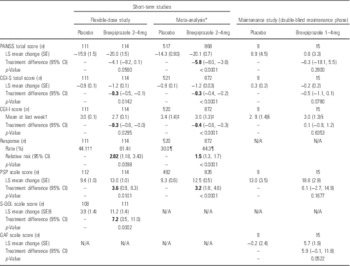
Patients in the brexpiprazole treatment groups of the short-term studies had greater improvements from baseline in PANSS total score compared with placebo (Table 3). In the previously reported fixed-dose studies, brexpiprazole at a dosage of 4 mg resulted in a statistically significantly greater improvement in PANSS total score than placebo in both studies (Reference Kane, Skuban and Ouyang21,Reference Correll, Skuban and Ouyang22), whereas the 2-mg dose of brexpiprazole demonstrated a superior improvement compared with placebo in one study (Reference Correll, Skuban and Ouyang22). In the flexible-dose study, the difference in change from baseline between brexpiprazole and placebo approached, but did not reach, statistical significance (p=0.056) as assessed with PANSS total score. The mean (SD) reduction in PANSS total score from baseline to Week 6 was 20.0 (1.5) points in the brexpiprazole group, compared with 15.9 (1.5) points in the placebo group. The mean (SD) reduction from baseline to Week 6 in PANSS total score for the quetiapine group was 24.0 (1.5) points and was statistically significantly different (p<0.001) from that in the placebo group (−15.9±1.5), which validated the study methodology and the patient population included. In the meta-analysis, the brexpiprazole 2–4 mg group showed a mean (SD) change of 20.1 (0.7) points on PANSS score from baseline to Week 6, which was significantly greater than with placebo (p<0.0001, −14.3±0.90).
Efficacy endpoints

Results indicate mean (SD) at Week 6 in the short-term studies and mean (SD) at Week 52 in the long-term maintenance study.
All results represent mixed model repeated measures analysis unless stated otherwise.
CGI-I, Clinical Global Impressions-Improvement; CGI-S, Clinical Global Impression-Severity of Illness Scale; CI, confidence interval; GAF, Global Assessment of Functioning; LS, least squares; N/A, not applicable; OC, observed cases; PANSS, Positive and Negative Symptom Scale; PSP, Personal and Social Performance; S-QoL, Schizophrenia Quality of Life scale.
* Placebo and brexpiprazole 2–4 mg groups from the two fixed-dose phase 3 studies and the one flexible-dose phase 3 study were combined and analysed using individual patient data meta-analysis.
† Mean (SD) at Week 6 for short-term fixed-dose studies; mean (SE) at Week 6 for short-term flexible-dose study; mean (SD) at Week 52 for maintenance study.
‡ Last observation carried forward (LOCF).
§ OC.
|| OC. Response defined as a reduction of ≥30% from baseline in PANSS total score, or a CGI-I score of 1 (very much improved) or 2 (much improved) at Week 6.
¶ LOCF. Response defined as a CGI-I score of 1 (very much improved) or 2 (much improved) at Week 6.
Bold text indicates p<0.05.
The secondary endpoints, including the change in CGI-S (pre-specified as key secondary endpoint), CGI-I score, and response rate, were all superior in the brexpiprazole group compared with that of placebo (p<0.05), both in the flexible-dose study and according to the meta-analysis (Table 3). Similar results were observed for the brexpiprazole 4-mg group in both fixed-dose studies (Reference Kane, Skuban and Ouyang21,Reference Correll, Skuban and Ouyang22), and for the brexpiprazole 2-mg dose in one of these studies (Reference Correll, Skuban and Ouyang22).
Brexpiprazole demonstrated improvements compared with placebo in PSP functioning (p=0.0101) and quality of life (p=0.0002) (Table 3), in the flexible-dose study. Similar results were seen in the meta-analysis, with brexpiprazole consistently showing greater improvement compared with placebo on functioning PSP (p<0.0001) (Table 3).
In the maintenance study, the primary analysis showed a beneficial effect of brexpiprazole relative to placebo on the time to exacerbation of psychotic symptoms/impending relapse (log-rank test: hazard ratio=0.292, p<0.0001). In addition, significantly fewer patients relapsed in the brexpiprazole group compared with placebo during the 52-week maintenance period (13.5% vs. 38.5%, p<0.0001) (Reference Fleischhacker, Hobart and Ouyang23).
Improvement in clinical symptomatology, as assessed by PANSS, CGI-S, and CGI-I scores, was maintained with brexpiprazole treatment, whereas placebo showed a worsening in clinical symptomatology at Week 52 (Table 3). Furthermore, PSP and GAF scores showed a positive effect of brexpiprazole relative to placebo on functioning at Week 52 (Table 3).
Safety and tolerability
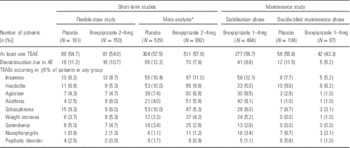
Treatment-emergent adverse events (TEAEs) are presented in Table 4. Overall, brexpiprazole was generally well tolerated in all studies. Across the studies, the incidence of AEs leading to withdrawal was lower in the brexpiprazole groups than with placebo.
Treatment-emergent adverse events

AE, adverse event; TEAE, treatment-emergent adverse event.
* Placebo and brexpiprazole 2–4mg groups from the two fixed-dose phase 3 studies and the one flexible-dose phase 3 study were combined and analysed using individual patient data meta-analysis.
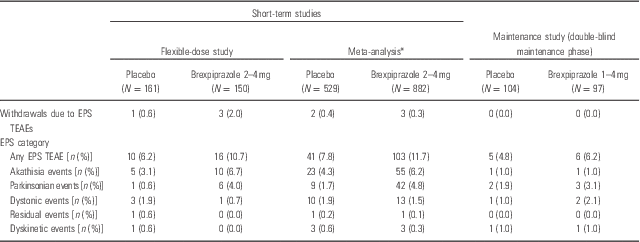
Akathisia was the only TEAE reported by patients with an incidence of ≥5% and twice the rate of placebo in the flexible-dose study; the rates of akathisia for brexpiprazole versus placebo were 6.0% and 2.5%, respectively (Table 4).
In the flexible-dose study, the mean (SD) increase in body weight at Week 6 was 1.6 (2.9) kg in the brexpiprazole group, compared with 0.5 (2.4) kg in the placebo group. In the meta-analysis, the mean (SD) increase in body weight at last visit was 1.2 (3.3) kg in the brexpiprazole 2–4 mg group, compared with 0.2 (2.7) kg in the placebo group. In the maintenance study, there was only moderate mean changes in body weight to last visit following both the stabilisation phase (0.8±4.0 kg in the brexpiprazole 1–4 mg group) and the maintenance phase (−0.3±4.9 kg and −2.2±3.6 kg, in the brexpiprazole 1–4 mg group and the placebo group, respectively).
In the flexible-dose study, the proportion of patients with EPS-related TEAEs was 6.2% (n=10) for placebo group and 10.7% (n=16) in the brexpiprazole group (Table 5). A similar proportion of patients with EPS-related TEAEs were seen in the meta-analysis, with a total of three patients (0.3%) from the brexpiprazole group and two patients (0.4%) from the placebo group withdrawing due to EPS-related TEAEs. In the maintenance study, five patients (4.8%) from the placebo group and six patients (6.2%) in the brexpiprazole 1–4-mg group reported EPS-related TEAEs (Table 5). No patients withdrew from the maintenance study due to EPS-related TEAEs.
Summary of extrapyramidal symptom-related adverse events

EPS, extrapyramidal symptoms; TEAE, treatment-emergent adverse events.
* Placebo and brexpiprazole 2–4 mg groups from the two fixed-dose phase 3 studies and the one flexible-dose phase 3 study were combined and analysed using individual patient data meta-analysis.
In the short-term studies, the reported incidence of sedation and somnolence TEAEs were similar between placebo and brexpiprazole groups (3.1% vs. 2.7% in the flexible-dose study and 1.5% vs. 2.3% in the meta-analysis, respectively, for sedation TEAEs; and 5.0% vs. 4.7% in the flexible-dose study and 3.4% vs. 2.8% in the meta-analysis, respectively, for somnolence TEAEs). Reports of both sedation and somnolence TEAEs were low (<3.0%) for both the brexpiprazole and placebo groups in the maintenance study. No patients withdrew due to somnolence-related TEAEs in any of the studies.
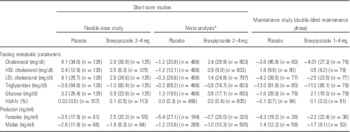
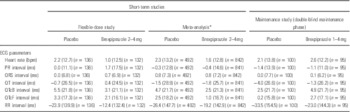
Across the studies, there were no clinically relevant findings with regard to formal EPS rating scales (Supplementary Table 1), suicidality, prolactin (Table 6), metabolic parameters (Table 6), or ECG assessments (Table 7).
Mean changes (SD) in fasting metabolic parameters and prolactin from baseline to last visit

HbA1c, haemoglobin A1C; HDL, high-density lipoprotein; LDL, low-density lipoprotein.
* Placebo and brexpiprazole 2–4 mg groups from the two fixed-dose phase 3 studies and the one flexible-dose phase 3 study were combined and analysed using individual patient data meta-analysis.
Mean (SD) change from baseline at last visit in ECG results at last visit

bpm, beats per minute; ECG, electrocardiogram; QTcB, QT interval corrected for heart rate by Bazett’s formula; QTcF, QT interval corrected for heart rate by Fridericia’s formula.
* Placebo and brexpiprazole 2–4 mg groups from the two fixed-dose phase 3 studies and the one flexible-dose phase 3 study were combined and analysed using individual patient data meta-analysis.
Discussion
Overall, results from these completed, phase 3 studies in adult patients with schizophrenia have demonstrated the efficacy, safety and tolerability of brexpiprazole as part of both a short- and long-term treatment programme.
Results from the meta-analysis of the short-term studies demonstrated that brexpiprazole 2–4 mg is efficacious in the treatment of adults with an acute exacerbation of schizophrenia as shown by the significant improvements from baseline to Week 6 in PANSS total score (p<0.0001) compared with placebo, supporting the results from the individual studies (Reference Kane, Skuban and Ouyang21,Reference Correll, Skuban and Ouyang22). In the fixed-dose studies, brexpiprazole 4 mg resulted in a statistically significantly greater improvement in PANSS total score than placebo (Reference Kane, Skuban and Ouyang21,Reference Correll, Skuban and Ouyang22), with brexpiprazole 2 mg demonstrating a statistically superior improvement compared with placebo in one study (Reference Correll, Skuban and Ouyang22), and a numerical improvement seen in the second study (Reference Kane, Skuban and Ouyang21). In the flexible-dose study, the difference in change from baseline in PANSS total score between brexpiprazole and placebo approached statistical significance (p=0.056). A reduction in PANSS total score of ~15–18 points can be considered clinically meaningful (Reference Leucht, Kane, Etschel, Kissling, Hamann and Engel32). In the flexible-dose study, we observed a mean decrease in PANSS total score from baseline to Week 6 of 20 points in the brexpiprazole group, which suggests a clinically meaningful improvement. Despite the magnitude of change, the difference between the brexpiprazole and placebo groups just failed to reach statistical significance (p=0.056) as a consequence of the larger than expected improvements in PANSS total score (16.2% reduction) seen in the placebo group. A significant difference in PANSS reduction was, however, observed with the assay sensitivity control (quetiapine) versus placebo.
In the meta-analysis, the mean change in PANSS total score was −20.1, suggesting a clinically detectable improvement equivalent to a reduction in CGI severity of ≥1 severity step, thus demonstrating the efficacy of brexpiprazole across these studies. This finding further demonstrates the clinical improvements observed following brexpiprazole 2–4 mg and is consistent with results from the pivotal BEACON and VECTOR trials (Reference Kane, Skuban and Ouyang21,Reference Correll, Skuban and Ouyang22), where decreases in PANSS total score from baseline to Week 6 were seen for both 2 mg brexpiprazole (−16.6 and −20.7, respectively) and 4 mg brexpiprazole (−20.0 and −19.7, respectively) groups.
Furthermore, improvements from baseline to Week 6 in CGI-S scores, as well as CGI-I scores and responder rate at Week 6 observed in the fixed-dose studies (Reference Kane, Skuban and Ouyang21,Reference Correll, Skuban and Ouyang22), the flexible-dose study and the meta-analysis, confirmed the efficacy of brexpiprazole as a treatment for acute schizophrenia in adult patients.
In the maintenance study, the efficacy of brexpiprazole as a maintenance treatment in adults with schizophrenia was demonstrated by the beneficial effect of brexpiprazole relative to placebo on the time to exacerbation of psychotic symptoms/impending relapse (p<0.0001). Furthermore, significantly fewer patients relapsed in the brexpiprazole group compared with placebo (p=0.0008). The efficacy of brexpiprazole as a maintenance therapy for patients with schizophrenia was also shown in PANSS and CGI scores, with symptom stability being maintained for patients in the 1–4 mg brexpiprazole treatment group. Conversely, patients in the placebo group showed a worsening in clinical symptomatology at Week 52 (Table 3).
Collectively, findings from these short-term studies and the long-term maintenance study indicate that brexpiprazole is a suitable treatment option for patients with schizophrenia presenting with both acute and stable illness.
Schizophrenia is a complex and multidimensional illness, with a number of elements contributing to the burden of disease. It is known that expression of prominent and numerous symptoms is associated with increased functional impairment (Reference Rabinowitz, Berardo, Bugarski-Kirola and Marder33). Therefore, improved functioning is crucial for patients with schizophrenia. Previous research in schizophrenia has noted that the PSP is reliable for detecting functional improvements in schizophrenia and that an increase of at least 7 points in PSP total score can be considered clinically meaningful to patients in terms of their overall functional capacity (Reference Nasrallah, Morosini and Gagnon34). In the flexible-dose study, there was a mean increase in PSP total score of 13 points in the brexpiprazole group, a similar 12.6 point increase across short-term studies, and in the maintenance study there was an increase of almost 19 points in the 1–4 mg brexpiprazole group. These data suggest that brexpiprazole, when taken as both a short- and long-term treatment, has a clinically relevant effect on the overall psychosocial functioning of patients with schizophrenia. The GAF assessment used in the maintenance study is a clinician-rated scale that measures the subject’s psychological, social, and occupational functioning, and was used in the maintenance study to help assess long-term overall functioning. There was a 5.7 point increase from baseline in GAF total scores for the brexpiprazole group at Week 52. This increase would suggest that brexpiprazole has a positive effect on functioning in adult patients with schizophrenia. However, despite the GAF assessment being widely used to determine functioning in patients with schizophrenia, there is no currently agreed acceptable value with regard to the minimum clinically important difference (MCID) (Reference Amri, Miller and Toumi35). As such, there is insufficient evidence in the literature to allow any conclusions to be drawn as to if the improvements in GAF scores observed in the phase 3 maintenance study represents a clinically relevant improvement.
The patient-reported S-QoL was developed through interviews with patients to identify dimensions of quality of life that are relevant to patients with schizophrenia (Reference Auquier, Simeoni and Sapin27), and was carried out in the short-term, flexible-dose study. Patients included in the brexpiprazole group had an 11-point increase in their S-QoL scores, resulting in a statistically significant treatment difference (p=0.0002) when compared with patients in the placebo group. One study has reported that an improvement of ≥1.13 on the S-QoL assessment represents a clinically important improvement (Reference Thwin, Hermes and Lew36), which suggests administration of brexpiprazole 2–4 mg does result in an overall clinically relevant improvement in the quality of life of patients. However, it must be noted that there is a paucity of additional literature supporting the suggested MCID value, and therefore the conclusions with respect to brexpiprazole treatment on quality of life must be cautiously interpreted. Nevertheless, the S-QoL results do indicate that brexpiprazole can exhibit substantial improvements on health-related quality of life, which is a key factor in the treatment of schizophrenia. Taken together, these results have shown that brexpiprazole may produce beneficial treatment effects on social functioning and quality of life in patients with schizophrenia.
Overall, brexpiprazole was found to be well tolerated in the short-term and maintenance studies, with the incidence of withdrawals due to AEs lower in the brexpiprazole groups than in the placebo groups, for all of the studies. Notably, the incidence of activating and sedating side effects was relatively low for all studies. In addition, changes in the EPS-scale scores (SAS, AIMS, and BARS) were minimal in the short-term studies and in the maintenance study.
In the flexible-dose study, the only TEAE in patients treated with brexpiprazole with an incidence of ≥5%, and twice the rate of placebo, was akathisia. This was not the case in the meta-analysis, where the incidence of akathisia was similar between the placebo and brexpiprazole 2–4 mg groups (4.0% vs. 5.8%, respectively). Furthermore, the incidence of akathisia in the maintenance study was similar between brexpiprazole and placebo groups (1% for both groups), suggesting that, over time, the incidence of akathisia events may be reduced with continued brexpiprazole use. In addition, no patients withdrew due to akathisia in the flexible-dose study, the fixed-dose studies (Reference Kane, Skuban and Ouyang21,Reference Correll, Skuban and Ouyang22), or the maintenance phase of the maintenance study [one patient (0.2%) discontinued due to akathisia in the single-blind stabilisation phase]. Akathisia is a common side effect of some antipsychotic treatments (Reference Kane, Fleischhacker, Hansen, Perlis, Pikalov and Assuncao-Talbott37–Reference Kane, Zukin and Wang39). Similar to brexpiprazole, both aripiprazole and cariprazine act as partial agonists at the dopamine D2 receptor and antagonists at the 5-HT2A receptor; however, both of these antipsychotics have been associated with inducing high rates of akathisia, possibly due to their activity at these receptors (Reference Calabrese, Keck and Starace40–Reference Citrome, Ota, Nagamizu, Perry, Weiller and Baker43). Although brexpiprazole is also a serotonin-dopamine activity modulator, it has lower intrinsic activity at D2 receptors and higher intrinsic antagonistic activity at 5-HT2A receptors compared with both aripiprazole and cariprazene (Reference Maeda, Lerdrup and Sugino18,Reference Maeda, Sugino and Akazawa19,Reference Laoutidis and Luckhaus44,Reference Adham, Gyertyan and Kiss45), which may at least partly explain the reduced akathisia and other activating side effects seen in these studies.
Antipsychotic drugs have long been associated with sedative adverse effects in patients with schizophrenia (Reference Correll12,Reference Leucht, Cipriani and Spineli46). Across the phase 3 studies, patients treated with brexpiprazole experienced low rates of somnolence (<5%) and sedation (<3%). Sedation induced by antipsychotic agents such as chlorpromazine, clozapine, quetiapine, and olanzapine has been associated with blockade of histamine receptors (Reference Correll12,Reference Maeda, Sugino and Akazawa19). Brexpiprazole, on the other hand, has a much higher affinity for dopamine receptors than for histamine receptors, potentially explaining its low level of sedation-related adverse effects (Reference Maeda, Sugino and Akazawa19).
Weight gain has also been associated with a number of antipsychotic treatments (Reference De Hert, Detraux, van Winkel, Yu and Correll47,Reference De Hert, Yu, Detraux, Sweers, van Winkel and Correll48). The results revealed a mean weight gain of ~1 kg greater than placebo in the short-term studies. These results compare favourably to previous short-term studies in patients with schizophrenia who were taking olanzapine and gained between 3.3 and 4.0 kg, following 6–8 weeks of treatment (Reference Meltzer, Cucchiaro and Silva49–Reference Conley and Mahmoud51), or risperidone who gained 1.5 kg after 8 weeks of treatment (Reference Conley and Mahmoud51). Although patients gained some weight (mean increase of 0.8 kg) during the stabilisation phase of the maintenance study (Reference Fleischhacker, Hobart and Ouyang23), the mean change in body weight decreased for both brexpiprazole and placebo following the maintenance phase in the long-term placebo-controlled study. However, due to the high rate of patient discontinuations in the study following the positive interim analysis, the trial population within the maintenance study may not be representative of the population intended to be analysed.
Brexpiprazole treatment induced small changes on prolactin in patients from the short-term studies and in patients from the long-term maintenance study. In addition, very few patients reported hyperprolactinaemia as an AE (0.7%, 0.3% and 0%, from the flexible-dose study, the meta-analysis and the long-term maintenance study, respectively).
There were only small changes in lipid or glucose concentrations in patients from the short-term studies or the long-term maintenance study, suggesting brexpiprazole did not have a clinically significant effect on these metabolic parameters in patients with schizophrenia. These results are important as a number of second generation antipsychotics have been associated with serious adverse metabolic side effects (Reference De Hert, Detraux, van Winkel, Yu and Correll47,Reference De Hert, Yu, Detraux, Sweers, van Winkel and Correll48,Reference Rummel-Kluge, Komossa and Schwarz52).
In addition to these findings, no further clinically significant safety concerns in terms of AEs, safety laboratory test values, ECG, or vital signs were observed with brexpiprazole in the short-term studies or the maintenance study, confirming the overall favourable safety and tolerability profile of brexpiprazole.
In summary, results from two fixed-dose, 6-week, placebo-controlled studies (Reference Kane, Skuban and Ouyang21,Reference Correll, Skuban and Ouyang22), one flexible-dose, 6-week, control- and active-reference study, and one fixed-dose, 52-week, placebo-controlled maintenance study (Reference Fleischhacker, Hobart and Ouyang23) together suggest that brexpiprazole is an efficacious therapy option as part of a short-term or long-term maintenance treatment programme in adults with schizophrenia, and that it is characterised by a favourable safety and tolerability profile.
Acknowledgements
The authors thank the investigators at the study sites as well as the subjects who participated in this study. Rachel Cicchelli, PhD [QXV Communications, an Ashfield business (part of UDG Healthcare plc), Macclesfield, UK], provided writing support which was funded by Otsuka Pharmaceutical Commercialization and Development Inc. (Princeton, NJ, USA) and H. Lundbeck A/S (Valby, Denmark). Authors’ Contributions: S.R.M., M.J.H., M.K.J., J.O., and M.H. participated in conception and design of the studies, and helped to coordinate the studies. P.Z. developed the meta-analysis plan. All authors interpreted the data, and contributed to and have approved the final manuscript.
Financial Support
S.R.M. has served on advisory boards for Otsuka, Lundbeck, Allergan, Teva, Takeda, Roche, Targacept, and has received research support from Forum and Neurocrine. M.H., J.O., P.Z. and C.W. are employees of Otsuka Pharmaceutical Development and Commercialization Inc. M.J.H., M.K.J. and E.W. are employees of H. Lundbeck A/S.
Conflicts of Interest
The authors have no specific statements of interest associated with these studies.
Ethical Standards
The authors assert that all procedures contributing to this work comply with the ethical standards of the relevant national and institutional committees on human experimentation and with the Helsinki Declaration of 1975, as revised in 2008.
Supplementary material
To view supplementary material for this article, please visit https://doi.org/10.1017/neu.2016.57