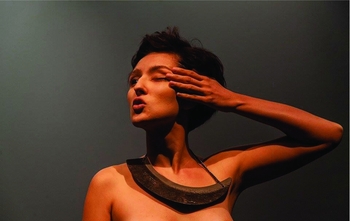
Title of show: Se eu fosse Iracema (If I Were Iracema)
Name of theatre company: N/A
Director: Fernando Nicolau
Playwright: Fernando Marques
Actor: Adassa Martins
Venue, city and date of performance reviewed: SESC Ipiranga, São Paulo, 2017
Se eu fosse Iracema (If I Were Iracema). Photographer: imatra.com.br.

The actress whose European beauty recalls Vermeer's Girl with a Pearl Earring expresses through her facial expression the bloody side of Brazil's historic persecution of its indigenous peoples. The sculpted features of Adassa Martins in the one-person play Se eu fosse Iracema (If I Were Iracema) transfigure the condition of the other, of the first inhabitants.
Out of this empty landscape, with teary eyes, lamentations come to life in the form of a shaman, of an elder, of a resident whose land is taken from him, and above all of a grown woman who directs her speech and her presence with vehement criticism.
With a discourse and a presence grounded in indigenous myths and rituals, the triad of acting (by Martins), playwriting by Fernando Marques and directing by Fernando Nicolau makes for an impressive theatrical event.
Martins' concentrated facial expressions and gestures express distortion arising from the secular disdain of governments and society for the performance's subject matter. The actress inhabits the performance space with oblique glances and directed voices that convincingly narrate a cosmogony – whether real or mythical – dealing with rain, sun and jungle.
On the political front, the actress employs a distancing effect when she moves to the front of the stage, breaching the curtain of light, and faces the audience to explain that Iracema is an anagram of America, or Américo, the Vespucci of the Discoveries.Footnote 2
There, the figure of the indigenous woman addresses the condition of having existed or of coming into existence. From José de Alencar's novel to 1970s Brazilian cinema, the subtext speaks to us of contradictions.Footnote 3
A topic of such urgency cannot be approached without indignation. Here it is done with notable aesthetic daring. Martins has the grounded feet, the bodily and vocal consciousness to overcome her urban background and portray the universality in what is specific and other in being and embodying an indigenous woman.
Her skirt and boots are made of latex extracted from the forest. The central and only set detail is a tree stump.
The genesis for this performance originated when the artistic team learned of the open letter sent by the Guarani-Kaiowá people in the state of Mato Grosso do Sul to the Justice Department of the Federal Government, which occurred in October 2012.
Isolated, abandoned and surrounded by gunmen sent by ranchers, the tribes declared they would not abandon the land of their ancestors under any circumstance: ‘we decided collectively that we would not leave this place living or dead’. In other words, they promoted communal death in defence of their historic lands. Different from suicide. Conflicts and violation of rights are still ongoing.